The Displaced Nation

A home for international creatives

Tag Archives: Brazil

LOCATION, LOCUTION: Paulo Coelho, on the monuments that immortalise cities

2010-26In this month’s “Location, Locution”, expat crime writer JJ Marsh talks with Paulo Coelho, the Brazilian best-selling author of The Alchemist, The Devil and Miss Prym, and The Witch of Portobello, among many others.

*  *  *

When I asked Paulo Coelho to take part in the “Location, Locution” concept, he was happy to oblige.

But he wanted to do it his way. So in a change to our usual format, here’s Paulo Coelho on place.

The moving monument

I have visited many monuments in this world that try to immortalize the cities that erect them in prominent places. Imposing men whose names have already been forgotten but who still pose mounted on their beautiful horses. Women who hold crowns or swords to the sky, symbols of victories that no longer even appear in school books. Solitary, nameless children engraved in stone, their innocence for ever lost during the hours and days they were obliged to pose for some sculptor that history has also forgotten.

And when all is said and done, with very rare exceptions (Rio de Janeiro is one of them with its statue of Christ the Redeemer), it is not the statues that mark the city, but the least expected things. When Eiffel built a steel tower for an exposition, he could not have dreamed that this would end up being the symbol of Paris, despite the Louvre, the Arc de Triomphe, and the impressive gardens. An apple represents New York. A not much visited bridge is the symbol of San Francisco. A bridge over the Tagus is also on the postcards of Lisbon. Barcelona, a city full of unresolved things, has an unfinished cathedral (The Holy Family) as its most emblematic monument. In Moscow, a square surrounded by buildings and a name that no longer represents the present (Red Square, in memory of communism) is the main reference. And so on and so forth.

Perhaps thinking about this, a city decided to create a monument that would never remain the same, one that could disappear every night and re-appear the next morning and would change at each and every moment of the day, depending on the strength of the wind and the rays of the sun. Legend has it that a child had the idea just as he was … taking a pee. When he finished his business, he told his father that the place where they lived would be protected from invaders if it had a sculpture capable of vanishing before they drew near. His father went to talk to the town councilors, who, even though they had adopted Protestantism as the official religion and considered everything that escaped logic as superstition, decided to follow the advice.

Another story tells us that, because a river pouring into a lake produced a very strong current, a hydroelectric dam was built there, but when the workers returned home and closed the valves, the pressure was very strong and the turbines eventually burst. Until an engineer had the idea of putting a fountain on the spot where the excess water could escape.

With the passing of time, engineering solved the problem and the fountain became unnecessary. But perhaps reminded of the legend of the little boy, the inhabitants decided to keep it. The city already had many fountains, and this one would be in the middle of a lake, so what could be done to make it visible?

And that is how the moving monument came to be. Powerful pumps were installed, and today a very strong jet of water spouts 500 liters per second vertically at 200 km per hour. They say, and I have confirmed it, that it can even be seen from a plane flying at 10,000 meters. It has no special name, just “Water Fountain” (Jet d’Eau), the symbol of the city of Geneva (where there is no lack of statues of men on horses, heroic women and solitary children).

Once I asked Denise, a Swiss scientist, what she thought of the Water Fountain.

“Our body is almost completely made of water through which electric discharges pass to convey information. One such piece of information is called Love, and this can interfere in the entire organism. Love changes all the time. I think that the symbol of Geneva is the most beautiful monument to Love yet conceived by any artist.”

I don’t know how the little boy in the legend would feel about it, but I think that Denise is absolutely right.

© Translated by James Mulholland

www.paulocoelhoblog.com

Read JJ Marsh’s 2011 interview with Paulo Coelho for Words with JAM magazine

Next on Location, Locution: Janet Skeslien Charles, author of Moonlight in Odessa

* * *

JJ Marsh grew up in Wales, Africa and the Middle East, where her curiosity for culture took root and triggered an urge to write. After living in Hong Kong, Nigeria, Dubai, Portugal and France, JJ finally settled in Switzerland, where she is currently halfway through her European crime series, set in compelling locations all over the continent and featuring detective inspector Beatrice Stubbs.

STAY TUNED for next week’s posts!

If you enjoyed this post, we invite you to register for The Displaced Dispatch, a round up of weekly posts from The Displaced Nation, with seasonal recipes, book giveaways and other extras. Register for The Displaced Dispatch by clicking here!

Related posts:

Image: Paulo Coelho, 2010 – PauloCoelho.com, used with permission.

After 6 years, this expat still finds his adopted home utterly enchanting

Michael in CuritibaLand CollageMany of us “international creatives” are attracted to the world’s major cities. Take me, for instance. I live in, and write about, São Paulo, the largest city in Brazil, and in the Southern Hemisphere. Today I’m happy to introduce a fellow expat who has ventured out as far as Curitiba, the largest city in Brazil’s South Region. B. Michael Rubin has a creative job, and he also finds Curitiba, a forerunner of the eco-city, a source of daily enchantment.

—Andy Martin

My first night in Curitiba, I awoke at 3:00 a.m., jet lagged after too many hours of solo travel with a ridiculous amount of luggage. I got up and drank some water, and it was then I noticed birds singing outside my window. I wondered if all expats were greeted by nocturnal serenades.

In the morning, surprisingly, it seemed the same birds were still singing. I could hear their melodious songs even though my apartment was on the tenth floor, making them a flock of super-birds.

The conclusion of an American on his first expat experience: the birds here are so happy they can’t stop singing; they must think they’re in paradise.

Adam and Eve discovered that paradise can be transitory, but after six years I have no desire to leave the lovely city of Curitiba, in the Brazilian state of Paraná.

Through the Curitiban looking glass

As every expat ascertains, adjusting to a new world is not easy; it’s a challenge simply to be polite in a foreign culture. I’ve learned to say “Excuse me” when I enter someone’s home, and that it’s acceptable to kiss a woman I’m meeting for the first time.

I’ve discerned it’s impolite to ask anyone to close her window at home or in the car, even on a cold winter day in the south of Brazil. Unfortunately, this lesson was revealed while asking my frail Brazilian mother-in-law why she had her apartment windows open, as she sat buried under a mountain of blankets.

For expats, daily life is an adventure in wonderment. I wonder how no one expects a tip herenot the taxi driver, the barber, or the pizza delivery guy.

I wonder how the price of everything is negotiable, and when I negotiate with an offer of cash, I can still pay with a credit card if I don’t want parcelas [paying in installments]. When I pay a doctor, I get a discount if I don’t request a receipt.

I marvel at the everyday site of twenty people in a Curitiba restaurant having a pleasant family lunch. In the US, this only happens at a wedding or a funeral because twenty family members don’t live in the same city. If they did, there would be trouble.

There is always more mystery…

Living in a new world becomes easier when we focus on the similarities—aren’t we all humans sharing the same planet? There’s a crazy comfort in knowing Brazilians are as preposterous as everyone else.

In other words, every country is a mystery.

For instance, I can’t explain how Brazilians have so effortlessly embraced the 21st century: Forty years ago, no one in Curitiba had a telephone, a car, or had been on an airplane.

I don’t understand politics in Brazil. How can a country govern itself with more than thirty political parties? In the US, two parties are sufficient to create chaos.

Meanwhile, the electronic banking system here is outstanding. Americans don’t believe me when I tell them it’s possible to pay the mortgage at an ATM.

Another wonderful mystery: In the days of the military government, Curitiba “elected” a visionary urban planner to be mayor for 12 years. It is a rare opportunity when an urban planner/architect runs a city. During that time, Jaime Lerner built one of the best urban bus systems anywhere; established mandatory recycling for all homes and businesses; created the first outdoor pedestrian mall in Brazil; and expanded a park system that made Curitiba one of the greenest cities in the world. Senhor Lerner was so good at city planning that the population has doubled in 40 years. Who knew.

After I’d survived my first melodic night in Curitiba, my future wife suggested a leisurely walk around the neighborhood. Having moved from New York, I was accustomed to seeing the homeless camped out on sidewalks. I remarked that I hadn’t seen any in Curitiba. “Don’t worry,” she said, “you will.”

Sure enough, a few minutes later we entered the local mall, and I observed three young men in the mall’s restroom brushing their teeth. My girlfriend, however, refused to accept my homeless sighting, a trio no less, and insisted we wait nearby.

When the three men emerged from the restroom, I noticed they were very well-dressed for homeless. “See, they work in the mall,” she said, with a look of “I thought Americans were smart?”

It was my first, but not my last, moment of supreme cultural stupidity. Men in their twenties brushing their teeth at work. Who knew.

The myths are true!

Today, I know that my wife keeps a toothbrush in her office so clients won’t see food in her teeth. For the same reason, women in the supermarket on Saturday morning are in full make-up and high heels with silk scarves that match their nail polish.

Like the proud, beautiful city of Curitiba, Brazilians are a proud, beautiful people.

The myths I’d heard are true. Who knew.

* * *

Readers, your turn! Do you feel similarly enamoured of your adopted land, or has the enchantment worn off? Please leave your thoughts for Michael and me in the comments!

B. Michael Rubin is an American living in Curitiba, Paraná, Brazil. He is the editor of the online magazine Curitiba in English.

STAY TUNED for tomorrow’s interview with this month’s featured author, Cinda MacKinnon!

If you enjoyed this post, we invite you to register for The Displaced Dispatch, a round up of weekly posts from The Displaced Nation, with seasonal recipes, book giveaways and other extras. Register for The Displaced Dispatch by clicking here!

Related posts:

Images (from left): B. Michael Rubin in João Pessoa (no, he doesn’t have a photo of himself in Curitiba!) and the Curitiba tubo, courtesy marcusrg via Flickr (Creative Commons license CC BY 2.0). We think it doesn’t take much imagination to see the cylindrical, clear-walled tube bus stations as the Curitiban equivalent of Alice’s rabbit hole or looking glass. After all, the city’s Rapid Bus Transit System (Rede Integrada de Transporte, or RIT) is rather wondrous: the first of its kind in the world.

GLOBAL FOOD GOSSIP: Keeping food real in Brazil

JoannaJoanna Masters-Maggs, our resident repeat-expat Food Gossip and Creative Chef, is back with her column for like-minded food lovers, which includes pretty much every expat we’ve ever encountered. This month: Authenticity, Brazilian-style.

* * *

“What’s the most depressing thing I’ve seen this morning?” I demanded of my husband as we arrived at our hotel on that first day in Brazil.

Was it something in my tone of voice that made my husband stick out his jaw? Having your wife positive about a new location is always a good thing. Any hint of wifely discontent can put the terrors into most expat husbands, even the most rufty-tufty oil field types.

“The favelas on either side of the motorway for the entire journey from the airport?” His voice had a slight tone of —  could it be? — belligerence. He’d decided to meet head on what he feared was my Western European squeamishness over visible poverty. I’d agreed to come, after all; it wasn’t his doing that the favelas existed.

“Oh.” I felt a pin pricking my outrage. “Actually no. It was the model of the Statue of Liberty outside the shopping mall we passed, the one with the Hard Rock Café.”

Not the voice of a woman with a strong social conscience, then.

“Aren’t we in Brazil?” I asked lamely.

Living in the shadow of the USA

In my defense, I was afraid that this most exciting and culturally rich of countries appeared in thrall to the ego of a foreign superpower. Here, where Christ the Redeemer looks down calmly over Rio and Guanabara Bay, it distressed me that he was unable to turn his cheek from the abominable reproduction Liberty. Such are the drawbacks of being made of stone.

My frustration really hadn’t abated much by the time we left several years later, but it was tempered. Here was a country that had its own great music, landscape, history and food. Brazil’s son Santos Dumont’s first flight had been overshadowed by the earlier but aided take off of the Wright Brothers’ heavier than air plan.

But surely the same could not happen to Brazilian fast food – and at their own hands?

Coxinha  — wins the Pepsi Challenge against the Chicken McNugget, any day

When I was in Brazil, workers could fill a canteen with beans, rice, a little meat and some pasta for 5 reais. A meal from McD costs four times that and cannot keep a belly as full for as long. Yet not only was there a Hard Rock Café, Dominos and McDonald’s, but the bloody Statue of Liberty to boot, holding her torch triumphantly aloft as if lighting the invasion of foreign fast food. (I know, I need to get over that tacky statue.)

Brazilian fast food choices, which can be grabbed on the run in a similar way to a hamburger, are extensive. Kibe consists of meat and bulgur wheat shaped into rugby balls and deep-fried. Empadhinas are little pastry pies often filled with palm hearts but options are endless. There are bollinhas de arroz (rice balls) and, a slightly more costly option these days, bollinhas de bacallao (salt cod).

Then there is the coxinha. Oooh, heaven. It is a pear-shaped, breadcrumb-coated, deep-fried confection of pulverized chicken, creamy catupiry cheese, and onion. I don’t want to be rude, but for heaven’s sake, Brazil — how could you choose a chicken nugget over that?

Please. It’s time for a Coxinhas R Brazil brand to sweep all before it.

Turn the milk sour with your grouse? Or simply dance the samba?

Brazilians probably have a greater openness and sense of fun than I do. They seem to tolerate kitschy statues and dodgy food for what it is, just a bit of fun not to be taken as a serious threat to national pride. There is a great deal of pride in being Brazilian and, I’m told, there are as many Americans trying to emigrate to Brazil as vice versa – it is a new land of opportunity.

Brazilians seem less sulky or passive aggressive than many in dealing with what they don’t like. One amusing example came in the immediate aftermath of 9/11 when America required passengers arriving on planes to America from Brazil to be subject to the same security searches, and delays, as planes coming from countries deemed a threat. Brazil has no history of terrorism and people were offended. However a cheerful approach was chosen. Officials simply decided to apply the same principle to American planes landing in Sao Paolo, Brazilian style. To ease the pain of the wait, passengers were treated to smiling samba bands and charming dancers. Nothing was ever going to change, but the point was made and relations not permanently soured.

A meal fit for a (Burger) King

Perhaps this non-confrontational approach is best. The invasion of American fast food is all-conquering everywhere. Its advance hasn’t been slowed by a thousand angry French farmers and restauranteurs, or by the Italian Slow Food movement. But its growth in Brazil alongside a rapidly emerging obesity crisis comes alongside economic improvements. According to a recent BBC Programme on the rise of obesity around the world and particularly in developing and BRIC countries, the answer is to be found less in the innate appeal of the food, but in the message that is sent out when you’re seen eating it. McDonald’s is an “aspirational food”.

(You might notice that I started a new paragraph rather suddenly. It was to give you a moment to recover from the shock of seeing the words “McDonalds” and “aspiration”, not only in the same sentence, but right next to each other. The idea of being proud to be seen eating fast food is a difficult one that takes time to absorb. I too enjoy the odd foray into the depths of culinary depravity, but I hide the bags – I admit hypocrisy right here. May I continue now?)

You might think you would aspire to a Wolf oven or even a Meile vacuum cleaner, but McDonald’s? No — bear with me. A Brazilian McDonald’s meal costs four times that of a plate of rice and beans. Its cost would buy you any number of coxinhas. It is impressive conspicuous consumption. You pay to eat a meal which won’t actually fill you and you will have to pay to eat again soon after, but the point is: you can.

It’s a fairly modest aspiration for the new middle class. Thousands of Brazilians have been lifted out of poverty over the last 10 years. But potential hunger is still a recent memory and the fear of slipping back must be strong for many. An outrageously priced Big Mac is still less expensive than a ritzy restaurant in Leblon and it’s certainly easier to avoid potentially embarrassing etiquette gaffes for those not yet accustomed to what is known in America as “fine dining”. This is what fast food companies can trade on, and before you know it, new habits are formed.

If you’re going to gain Brazilian pounds, make them worthwhile

Why get fat on this so-so food, though, when you can get gloriously fat on real cooking? You can easily pile on the pounds with Brazilian feijoida, Let the weight gain be a result of leisurely, indulgent meals and not sandwiches grabbed in plastic furnished, fluorescent lighted “restaurants” that are tiled like public lavatories.

I’d say the same to America. Ditch the McD and get fat on Southern and Soul Food, some of the most luscious food in the world. Wow, those Southerners know how to take a healthy low-calorie green vegetable and give it the cholesterol punch of cheesecake. My two personal favourites: collard greens cooked in fatty port cuts and sweet potatoes mashed with butter and topped with a crumble made of brown sugar pecans and a handful of marshmallows. Sounds appalling, but it is the closest thing to ambrosia since Zeus was a viable god to worship.

Both Brazilian and American Soul food has the opulence and indulgence to deaden and dazzle the senses at the same time. It has what a dried up hamburger and flabby white bun bread cannot hope to rival even with liberal dollops of ketchup.

Oh please. Get fat on real fat and be patriotic about that: your nation’s fat.

Make it worth your while.

Make it worth your money.

Aspire.

* * *

Joanna was displaced from her native England 16 years ago, and has since attempted to re-place herself and blend into the USA, Holland, Brazil, Malaysia, Venezuela, Saudi Arabia, and now France. She describes herself as a “food gossip”, saying: “I’ve always enjoyed cooking and trying out new recipes. Overseas, I am curious as to what people buy and from where. What is in the baskets of my fellow shoppers? What do they eat when they go home at night?”

Fellow Food Gossips, share your own stories with us!

STAY TUNED for tomorrow’s post!

If you enjoyed this post, we invite you to register for The Displaced Dispatch, a round up of weekly posts from The Displaced Nation, with seasonal recipes, book giveaways and other extras. Register for The Displaced Dispatch by clicking here!

Related posts:

Mark Hillary delivers reality check to gringos who moan about Brazil, in self-published book (2/2)

Mark Hillary Part 2 CollageIn Part 1 of my interview with Mark Hillary, a fellow Brit and amigo in São Paulo, we learned about what spurred him to write a book called Reality Check: Life in BRAZIL through the eyes of a foreigner.

A lively discussion ensued about what makes Brazil such a contentious country for expats (short answer: it’s a country of extremes).

Today I’ll ask Mark about his decision to publish Reality Check as an e-book. As I mentioned last week, Mark is well published in his chosen field of technology and globalization. He is a HuffPo columnist and has also blogged for Reuters about British politics. But Reality Check represents his first venture into the Amazon e-book platform.

I was curious about why he chose this route and also had some questions about his reading and writing habits generally.

* * *

Mark, Reality Check isn’t the first book that you’ve written. Can you tell us something about your other books?
It’s actually my tenth book. I used to be quite a senior IT manager in a bank, managing people all over the world. I had already started contributing articles to technology magazines while I was at the bank, and eventually I was sent off to India to help the company build up a big new office in Bangalore. I was hiring hundreds of technical team members and then trying to sell their services bank to other sections of the bank. It was quite an experience, especially as it occurred right at the beginning of the big push to India by many technology companies.

I wrote a book about it all, which was published by the respected German publisher Springer and well received in journals and newspapers such as the FT.

After that I carried on writing about the connection between work, technology, and globalization.

It’s impressive that you can span the range from big IT questions to a foreigner’s take on life in Brazil.
I’m interested in many areas, which is probably why my three times at university have included courses on computer science, business and management, and psychology. My earlier work on outsourcing naturally led me to how companies are changing and globalization, and this has naturally led onto my writing about being an expat. If there’s a connecting thread, it’s work and the changing nature of work in our time. That said, I wouldn’t want to only ever comment on a single topic. Life is a lot more complex than that.

You decided to release Reality Check in the Amazon Kindle format. Why did you make that decision?
I’ve been asked that question a lot. Six of my books were published using traditional publishers, and three were self-published via Lulu. And now, with the Brazil book, I’ve used the Amazon Kindle format. I went into some detail on the pros and cons of each of these methods in a recent Huffington Post article, but in short the important thing to remember is how the publishing market is changing. Obviously there is still a lingering sense of kudos with the traditional publishers. A novel published by Penguin is still seen as “better” than something self-published, but it doesn’t have to be. The platform and process of publishing itself has just been democratized and made available to all.

If you know how to write and you can market your work to an audience, then it is much faster to publish with Amazon or Lulu. And, not only can you reach a global audience instantly—you earn a far greater percentage of the sale price.

In the case of Reality Check, I wanted it to be available around the world as quickly as possible, and Amazon has a great system for doing that. Plus you don’t actually need a Kindle: iPads and phones are all being used to read this book.

Do you think it helps that you already had a following through your writings and other books?
Reality Check has has been in the Amazon top 20 books about Brazil since publication on September 1st, and yesterday when I checked, it was the number one book about Brazil and number two book about South America. So people have been noticing it.

I think it does help if you already have a following. It used to be that publishers and agents acted as the gatekeeper, so readers could be confident a book that ended up in the shops was good. Now anyone can publish any old rubbish, so there is no longer that guarantee of a published book being any good.

The much-celebrated poet Seamus Heaney is a good example. He has been lauded as one of the greatest writers of the past century, and he had plenty of work published by traditional publishers. But he was self-publishing new work before his recent death.

Do you plan to make Reality Check anything other than an e-book?
I’m planning to also release a paper version of the book, but it will not be until the second edition—planned to come out just before the World Cup football competition in June next year.

Are you working on any other writing projects at the moment?
The present one is about my own experience of ghostwriting. I’ve written for ambassadors and company CEOs, and I once had to help astronaut Neil Armstrong add a few jokes to his standard Apollo 11 speech. The work I have written for others to be delivered in their name has often, but not always, gone down well, and I wanted to explore that. And in the tech area, I’m working on a book project that aims to be a graduates’ guide to how you get a job in a job market where nobody wants to pay you a salary.

10 Questions for Mark Hillary

Finally, I’d like to ask a series of questions that we’ve asked some of our other featured authors, about your reading and writing habits:

1. Last truly great book you read: I recently read all of Ira Levin’s novels back to back—all great; but I’ll go for Paul Trynka’s biography of David Bowie, which I just now finished.
2. Favorite literary genre: Dystopian novels: Burgess, Orwell, Ballard.
3. Reading habits on a plane: I read fiction and non-fiction and always carry my Kindle because it’s so much better for travel than lugging around a lot of books. This week I was on a plane and I read The Default Line, by Faisal Islam—about the financial crash of 2008 and what has happened since.
4. The one book you’d require David Cameron to read, and why: Why It’s Kicking Off Everywhere: The new global revolutions, by Paul Mason. It’s a study of the various riots, uprisings and protests around the world, particularly in 2011. I think the UK has more unrest to come because living standards and earnings are in decline—the people are going to kick off again one day.
5. Favorite books as a child: Those by Roald Dahl, though everyone seems to think he was actually a nasty piece of work in real life.
6. Favorite heroine: Harper Lee. To Kill a Mockingbird was her only book and she never courted any publicity. It challenged racism over 50 years ago and still retains its power today.
7. The writer, alive or dead, you’d most like to meet: Oscar Wilde. He wrote 20th-century books and plays in the 19th century and despite his sad downfall, is still remembered and loved today.
8. Your reading habits: I mostly read in the evening. I don’t watch TV, other than for movies so that gives me more time. I tend to read one or two books a week unless I’m traveling a lot then it’s more just because of the endless time spent in airports or on buses.
9. The book you’d most like to see made as a film: The Drowned World, by J.G. Ballard. Life after the oceans have risen and the world we know now is flooded.
10. The book you plan to read next: Jesse Norman’s biography of Edmund Burke—already on the Kindle waiting for me.

* * *

Readers, any more questions for Mark? He may sound a bit intimidating, but in fact he’s very approachable and happy to answer any questions about e-publishing. (Though he doesn’t write fiction, he also has views on publishing platforms for novels.) Meanwhile, if you’re interested in Reality Check, you can purchase it on Amazon. I would also recommend becoming a fan of its Facebook page and following Mark on Twitter: @MarkHillary

STAY TUNED for tomorrow’s post, by another Englishman who is also an expat albeit in California: Anthony Windram.

If you enjoyed this post, we invite you to register for The Displaced Dispatch, a round up of weekly posts from The Displaced Nation, with seasonal recipes, book giveaways and other extras. Register for The Displaced Dispatch by clicking here!

Related posts:

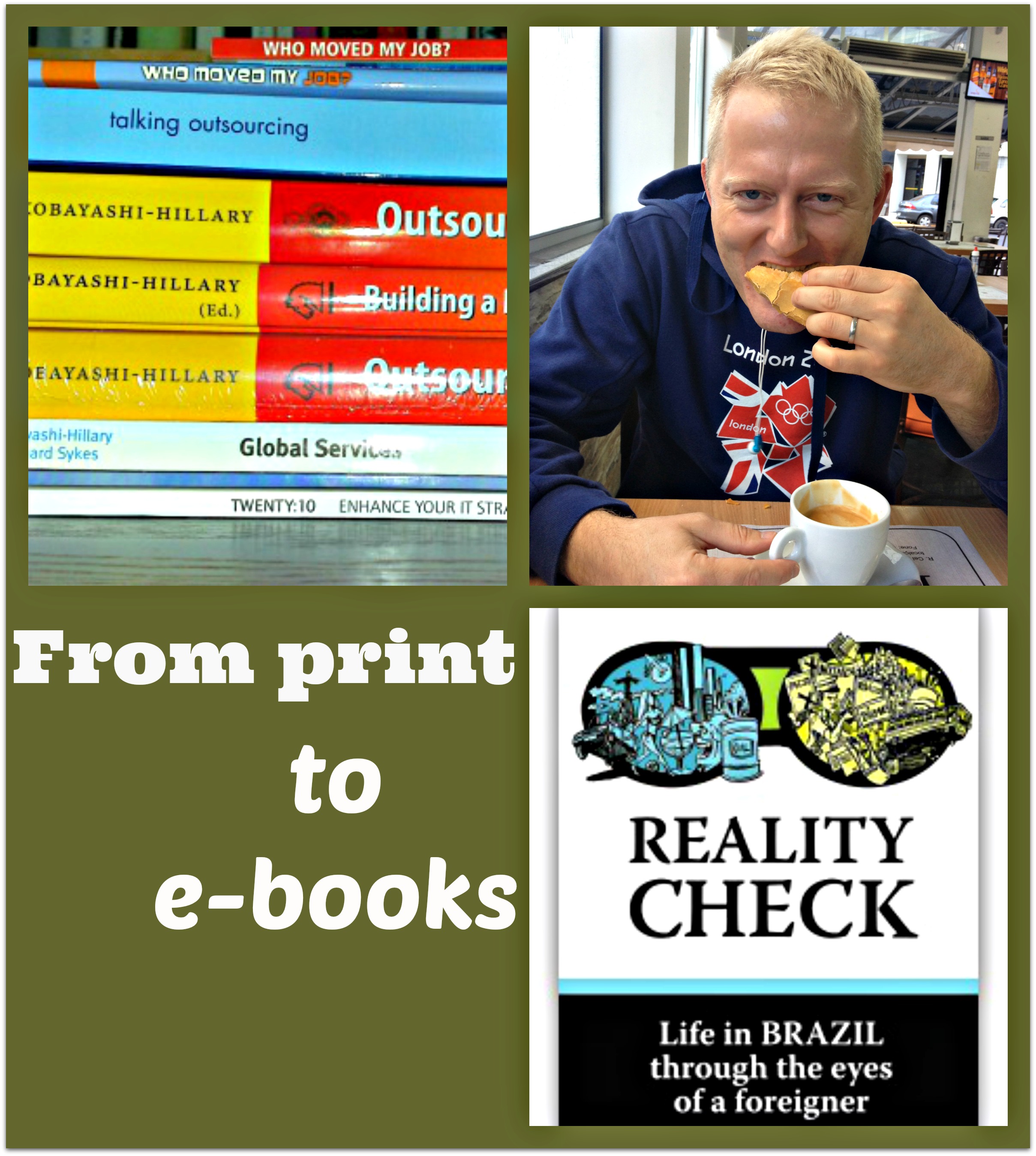
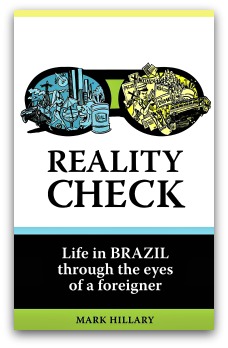
images: Mark Hillary surrounded by his traditional books and his e-book cover.

Mark Hillary delivers reality check to gringos who moan about Brazil, in self-published book (1/2)

Mark_HillaryA little while ago I interviewed Megan Farrell, a fellow gringo in São Paulo, about the book she had written about “exbrat” life in the city. As far as I’m aware, Megan’s was the first book to be written about life in SP by a foreigner, although she seems to have started a new trend because within the last fortnight another has emerged: Reality Check: Life in BRAZIL through the eyes of a foreigner.

Reality Check is by Mark Hillary, a fellow Brit in São Paulo (he recently moved outside the city), who is an author, blogger, and advisor on technology and globalization. He has already published a number of books and is a contributor to Huffington Post, Reuters, The Guardian, and Computer Weekly.

Mark is also a friend of mine. We connected through Twitter just over a year ago. We eventually met at a local bar when—unsurprisingly, given his background in technology and social media—he organized a meet-up of gringos who had connected online but had yet to meet up in the flesh.

Since then he and I have continued to meet up, although less so since his move to the countryside. We had a particularly memorable trip in June to Rio to watch England play Brazil in football at the brand new Maracanã Stadium. (As anyone who follows my posts should recall, I’m a bit of a football geek.)

Over the past year Mark has written, in his column for the Huffington Post, a number of insightful articles about life as a foreigner in Brazil—most notably, “No HP Sauce, Endless Red Tape: Would You Want to Live in Brazil?, which responded to a gringo Facebook forum that had listed all the reasons why foreigners hated living in this country.

It was to my pleasant surprise, then, when Mark announced he had extended his account of life in Brazil and intended to publish it as an e-book.

Leaving aside my acquaintance with Mark (and the fact he gives a nod to my personal blog in the book!), I must say that I found Reality Check a very enjoyable read. It is a thoughtful and critical, yet balanced, account of his experiences in Brazil and of the country in general—and frankly, I’m rather annoyed that I haven’t written it myself.

Mark’s book also seems to be a good accompaniment to Megan’s. Whilst hers is a straightforward, step-by-step guide to life in São Paulo, his is a narrative providing a broad overview of gringo life. Either way, both books will be of use to those who are either moving to Brazil or perhaps are simply interested in finding out a bit more about South America’s largest and most populous country (it’s also the world’s fifth largest economy).

Anyway, enough of my wittering on. Let’s hear more from Mark himself.

* * *

RealityCheck_bookcoverHi, Mark. Congratulations on your new book and thanks for agreeing to this interview. First off, can you say a little more about what inspired you to write it?
As you already mentioned, I wrote the book in large part as a reaction to the negative posts about Brazil in online gringo communities. Everyone has their own reasons for moving and living away from their home country, but the majority of the groups I’ve encountered online are full of complaints about Brazilian food, prices, bureaucracy… Anyone who reads the posts made in the Facebook group for Gringoes.com would think that the UK and US offer a utopian paradise that would be madness to ever leave.

As you said in your intro, I wrote an article for the Huffington Post where I tried to give a more balanced view on life in Brazil.

Then I thought that, as someone who has rented and bought a home, started a company, hired people, and married a Brazilian, I could probably give a more detailed opinion on the experience—hence the book.

So being married to a Brazilian was what brought you to Brazil?
Yes, we were living in London, but after the financial crash in 2008 my business was much slower than before. By 2010 it became clear that there were many more opportunities for me to build a research and publishing business in Brazil than in the UK and so we moved just before the end of that year, nearly four years ago.

We recently featured another book about expat life in Brazil: American Exbrat in São Paulo, by Megan Farrell. Megan’s focus was on the “exbrat” community in São Paulo—i.e., those who are transferred here for work by a large company. My impression is that your focus is less specific and more of a broad overview of life in Brazil as a foreigner.
I’m not really interested in the exbrats. If a big company transfers someone to Brazil and they have their home taken care of and a driver to ferry them around, and they only ever go for a drink in expat pubs, then I don’t think they are experiencing the real Brazil. I’m not suggesting that the only authentic Brazil experience is living in a favela, but there are other kinds of foreigners here—journalists, teachers, people from all walks of life—who are constantly looking for ways to explore their new home.

Did you have a specific audience in mind when you wrote the book?
I really set out to explore some of my own experiences, with the expectation that people investing in Brazil or looking for a job here might have an interest in the book.

The book has only just been published (2nd September) so I guess it is a little early to tell, but how has it been received so far?
It is very recent, but there is already a very positive review from a Brazilian reader on Amazon. I started my author Facebook page when I published the book, and that community is growing by around a hundred people every day—so people are noticing it. One of the biggest newspapers in Brazil (Folha de SP) has been in touch to interview me about the book—despite my not having done any press promotion for the book due to my traveling almost every day since the publication!

Did you connect with São Paulo and/or Brazil in any new ways whilst writing the book?
It made me more determined to plug areas outside of Rio, which has a lot of friends already. I’ve really enjoyed living in both São Paulo the city and interior—SP needs a few gringo fans to speak out and remind people that the city is not just about concrete and cops murdering civilians.

You recently moved to the countryside outside São Paulo—how and why did that come about?
We spent two years living in the centre of São Paulo and just wanted to find something a bit quieter. I love it where we are now. There is a great sense of community; the neighbours all know each other. There is none of the security paranoia you find in the city centre, and there is some fantastic scenery on our doorstep.

Do you miss SP at all?
I miss being able to go out to see my friends in the city, or go to concerts by international bands that will only ever play in major cities. But we are planning to get a very small apartment in SP soon, so we don’t completely lose touch with it.

You mentioned the “security paranoia” in SP. In my observation, most of us gringos carry a fear that is at odds with how our Brazilian partners and/or friends feel. I enjoyed reading the section of your book covering this perception gap. Do you think that more positive accounts of Brazil by writers/bloggers like you and myself can help to shift these perceptions?
If people like you and me can get visitors to realize that they can walk down Avenida Paulista or along Copacabana Beach without fearing for their life, that would help. On more than one occasion I have met business contacts who flew into town and then were shocked when I suggested meeting away from their hotel. Standard advice from American and European companies is often to stay inside when in Brazil because of all the street crime.

The Brazilians, too, should play a part in correcting this situation. I don’t think we have much influence because we are seen as outsiders, but as more Brazilians get exposed to alternative cultures through travel, I hope it can change a little.

Last year I brought my wife’s teenage cousin on a trip to the USA, just to show her what life is like outside of Brazil. She found it incredible that you could walk up to the front of so many celebrity homes in Los Angeles—that anyone could walk into Sylvester Stallone’s garden. That’s unimaginable in Brazil.

What are you thoughts on foreign media portrayals of Brazil? Do you feel, for example, that persistent foreign criticisms of Brazil’s preparations for the World Cup and Olympics have been fair?
Every World Cup and Olympic games gets this negative press, so I don’t know if it is any worse than the last time. Anyone from the UK should be able to recall how the London Games were going to be a disaster right up to the week of the Games—the attitude seemed to change only when everyone saw that spectacular opening ceremony.

All I know from personal experience is that when you and I went to the Brazil v England football game at the Maracanã in June, the organization was superb. The stadium looked good, the public transport all worked, and the volunteers helping the crowd were great. I couldn’t fault it—so I’m really looking forward to the World Cup.

From the way you write so passionately about Brazil it is clear that you love living here, but there must have been the odd difficult moment when you wondered whether you’d made the right decision in fleeing the economically stagnant UK for your wife’s native land. When have you felt most displaced?
Sometimes the bureaucracy in daily life does get perverse and goes beyond just the criticism of a foreigner claiming that it all works better in Europe. Examples include having to pay someone to get my car registered to a new address or being fined for not paying my stamp duty on the day I agreed a mortgage with the bank—even though I paid on the day I got the documents myself. Sometimes I wonder if there is ever going to be any government that sweeps away this nonsense. I also fear that the job cuts created by improved efficiency means we are stuck with much of this.

Conversely, when have been your least displaced moments, when it all seemed to make sense?
I live in a really beautiful place now surrounded by a lot of wonderful people. Every morning when I take my dog for a walk then start work for the day I know I’m lucky to be here.

* * *

Readers, I will be talking to Mark again on Tuesday of next week, when we focus on his decision to self-publish his book. Any further questions for him, meantime? And don’t forget, if you’re interested in Reality Check, you can purchase it on Amazon. I would also recommend becoming a fan of its Facebook page and following Mark on Twitter: @MarkHillary

STAY TUNED for tomorrow’s post, a new episode in our “Location, Locution” series, by JJ Marsh.

If you enjoyed this post, we invite you to register for The Displaced Dispatch, a round up of weekly posts from The Displaced Nation, with seasonal recipes, book giveaways and other extras. Register for The Displaced Dispatch by clicking here!

Related posts:

images: Mark Hillary’s author image and book cover

Don Quixote & Sancho, John Steinbeck & Charley…Olga & George? A travelogue for the expat annals (plus we’re giving away a copy!)

Olga Vannucci CollageWhen I first stumbled across Olga Vannucci’s memoir, Travels with George, I wondered whether the title alluded to John Steinbeck’s book Travels with Charley, about his road trip across America in the company of his French standard poodle, Charley.

Turns out, I got it right. Born in Italy, Olga went to Brown University and currently lives in rural New Jersey. As she tells it, she was driving through Doylestown, Pennsylvania, one day when Steinbeck’s travelogue popped into her head, and she knew she wanted to call her book “Travels with George.” When she announced this to her son (the “George” of the title), he said: “So I’m the dog?”

As you can gather from this story, mother and son make quite a pair.

Olga says she’s no Steinbeck, though she does prefer a plain and honest writing style. Also like Steinbeck, she had the desire to see her native land again.

So, how did she find the Italy of today: did she still fit in? And what did her sidekick, George, the blonde all-American kid, make of his mammina‘s homeland? Did he enjoy these escapades or feel puzzled by his mother’s motives? Perhaps the story he saw himself in wasn’t Steinbeck’s at all, but a modern Italian version of Don Quixote, in which he occupied the role of a skeptical Sancho Panza?

Olga has kindly agreed to give away one copy of the book to the reader who is keenest to find out the answers to these questions (see giveaway details below).

But before we get into that, let’s talk to Olga and hear some more about the travels that inspired her to put pen to paper…

* * *
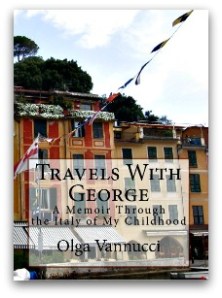
Travels with George Book CoverCiao, Olga! Let’s begin at the beginning. Tell us more about your decision to take a trip to Italy with your young son and write about it.
I was born in Italy (Milano), lived in Brazil two different times as a child, and came to the United States to attend college. I’ve been here ever since. When my son was seven years old, I realized suddenly that I hadn’t been back to Italy in ten years, and I went, taking him along. I thought he would learn about Italy and acquire a feel for what it’s like. I also hoped he would learn some Italian. I don’t know how much of that was accomplished, but I loved showing him around. We went back four more times over the course of six years (he is now 14). I wrote the book about those trips: a mix of travelogue, personal history, and little anecdotes, with some humor.

What impact did writing about the experience have on you—did it help you process your childhood memories?
It was wonderful to see the locales of my childhood again. At this point, my memories are either indelibly fixed or just gone—for instance, I can remember clearly sitting on the steps with my friends Sassello, in Ligurio, as I recount here:

[My sister and I] had two friends in Sassello, two girls the same age as [us]—Paola and Maria Elena. They spent their summers thirty meters from where we spent ours, and we spent hours and hours of every day together.

[George and I] walk by the steps where we used to sit. I expect to see them, I expect them to be there, but they’re not. No one is. It’s all the same, but it isn’t.

Did you also learn something about yourself, in taking these excursions down Memory Lane?
I did find out about my current self through the book, but primarily from what others told me my words said about me—for example that I’m kind, funny, and honest. It was also interesting to hear from others about the things that they could relate to in the book, ranging from the more profound to the totally mundane situations. That was amazing, to realize that what I wrote spoke to others.

George’s ordeal

Do you think it will help George someday, in understanding part of his heritage that might not otherwise be accessible?
George has not read the book because, he says, “I was there, I don’t need to read about it.” I do hope and trust that both the experience and the writing will be a part of him, that he will consider the book a gift.

What was your most displaced moment when you & George were touring Italy, when you thought of yourself as a stranger within your homeland?
I always struggle with whether I am Italian or, at this point, American, or, more likely, not really either one. What makes me feel at home in Italy is the fact that it’s largely so unchanged. What makes me feel displaced is that the people of the older generation, my parents’ generation, who are the people I particularly associate with Italy, are passing. They’re my biggest connection with Italy, and they will soon be gone. After that, I may feel displaced…

I gather you don’t feel nearly as comfortable with younger generations of Italians?
Yes. I’m not sure why not. Possibly because the younger generation is doing its own thing and is more all over the place, unlike the older, which has stayed put.

What was your least displaced moment, when it all seemed to make sense for you and George to be there—that you fit right in?
On all the trips we visited my aunt, my mother’s sister, and stayed at her house, where we slipped naturally into being part of the family. I had coffee with her in the morning, we planned meals, I helped her water her garden, George fed her goldfish, and we watched television in the evening.  There was not an ocean or even a smidge of formality between us.

I love the description you provide of your aunt in the book:

My aunt is a lovely person, she’s beautiful and she likes to dress well. She’s 80 now, and she still looks good in her clothes, she wears fashionable clothes. She is cheerful and tells funny stories. She loves to do stuff and see people, she’s chatty. She’s fun to be around.

In that same passage, you mention the “recurring nightmare” of finding food that George likes to eat. What was the most challenging thing about traveling with a young child?
I did not realize how jarring the experience would be for George. To me, Italy is pleasant, and while I knew it would all be new to him, I didn’t realize how different it really was. Being in a completely unrecognizable place where he didn’t understand the language was way outside his comfort zone. I also probably didn’t verbalize things enough. I could have prepared him more and explained things better.

The other thing about traveling with a small child is that I, as the adult, had to be “on” 100% of the time.  Not only did I have to plan and handle everything, but I also had to manage him and make sure I didn’t lose him, which was something I actually worried about, and when I became stressed I had to try to hide it so he wouldn’t become stressed, which I didn’t do very well. He’s very perceptive.

What do you think he took from the experience?
The knowledge that he can survive a terrible ordeal… Possibly I took him on a few too many hikes up hills. It wasn’t always fun and idyllic. I do believe that the trips will serve as a foundation for him to understand that the world is large and diverse and for him to appreciate differences.

The potential perils of writing about one’s offspring

What was the most difficult part of the book-writing process?
It was hard to write about others and protect their privacy at the same time, particularly with my son. I find him very amusing, but he doesn’t intend to amuse me, and he is sensitive to it. He thinks I’m making fun of him, basically. So I’m always walking that line, writing about him, but trying to be respectful of him.

I understand you decided to self-publish the book. Why is that, and do you have any advice for other writers who opt for self-publishing?
I made some attempts to get an agent but ultimately I went with self-publishing because I didn’t have the patience to wait. What I like about self-publishing is that it’s all mine, I created the book cover, I chose the font, I decided to favor the comma over all other punctuation, and it’s been incredibly fun and very rewarding.

There are so many options today to publish and distribute and get the word out, and it can be done without a big financial investment. All you need is the investment of time. Given that this is your passion, you want to spend your time on it anyway. And there are so many people who are open to help. I would encourage other writers not to be afraid to ask. Putting your thoughts out there to share with others is a gift, and people respond very kindly.

What audience did you intend for the book, and has it been reaching those people?
I thought it was a mother/son book, which it is, but it’s very much a book for people who love Italy, who have been there, or who plan to go. My writing is very direct and the book is written in the present tense, so readers feel like they’re there along with me. It combines some very personal time in Italy–with family or revisiting places of personal significance—with visits to the big tourist destinations like Venice and Rome.

Are you working on any other ambitious writing projects?
I am working on a book about traveling with George in America. It’s not an organized itinerary, it’s just places we’ve been or will go to. Mostly in the northeast, plus San Fran and Arizona. It’s still in the infant stages, this project. But I promise it will be extra funny!

10 questions for Olga Vannucci

Finally, I’d like to ask a series of questions that I’ve asked some of our other featured authors, about your reading and writing habits:
1. Last truly great book you read: Don’t Let’s Go to the Dogs Tonight, by Alexandra Fuller, about growing up in Africa.
2. Favorite literary genre: Definitely travel!
3. Reading habits on a plane: I don’t like to fly so I bring an easy-reading book that I know will keep me engaged, and paperback so it’s lightweight.
4. The one book you’d require President Obama to read, and why: He has such a tough job. I would wish, not require exactly but only wish, for him to read a book that his daughters like, so he can have a topic of conversation that they can share and enjoy. He will then tackle his job rejuvenated.
5. Favorite book as a child: Mary Poppins—the P.L. Travers book and the Disney movie, too. I think I had it in both languages. It was just magical, different, not at all like my daily life with my mother and sister.
6. Favorite heroine: Martha Gellhorn, who was a great journalist and writer. She was married to the literary giant Ernest Hemingway yet always retained a strong sense of herself.
7. The writer, alive or dead, you’d most like to meet: I would like Calvin Trillin to take me out to eat in New York, in the Village, to all his favorite eating places. It might take several days because he has a lot of favorite eateries. I would like to hear all about Alice, about his daughters, and about his long and brilliant career.
8. Your reading habits: I read in bed every single night, and I have been reading more during the day recently. I’ve been deliberate about carving out more time in the day, when it’s otherwise easy to get caught up in other activities.
9. The book you’d most like to see made as a film: Any book that takes place overseas, so I can see the place in which the events take place.
10. The book you plan to read next: Hard to tell… I have a stack of some thirty books in my bedroom, and I’m not sure which one is next. I may need to devise a lottery system to determine the reading order…

* * *

Grazie tanto, Olga! Your story certainly sounds amusing while also saying something profound about parent-child relationships and the quest to go home again. Something to rival the wisdom of Steinbeck or Miguel de Cervantes, for sure.

Readers, it’s time for you to ENTER OUR DRAW TO WIN A FREE COPY of Olga Vannucci’s book, by entering a comment below. Olga says she will favor comments that tell her why you’d like to read about her and George’s adventures.

Extra points, as always, if you’re a Displaced Dispatch subscriber!

The winner will be announced in our Displaced Dispatch on September 28, 2013.

To read more excerpts from Travels with George, go to Olga Vannucci’s author site. You can also keep up with her on the book’s very active Facebook page. Also feel free to order the book from Amazon.com.

STAY TUNED for tomorrow’s quota of Global Food Gossip. Rumor has it, Joanna Masters-Maggs has something particularly tasty in store for us!

If you enjoyed this post, we invite you to register for The Displaced Dispatch, a round up of weekly posts from The Displaced Nation, with seasonal recipes, book giveaways and other extras. Register for The Displaced Dispatch by clicking here!

Related posts:

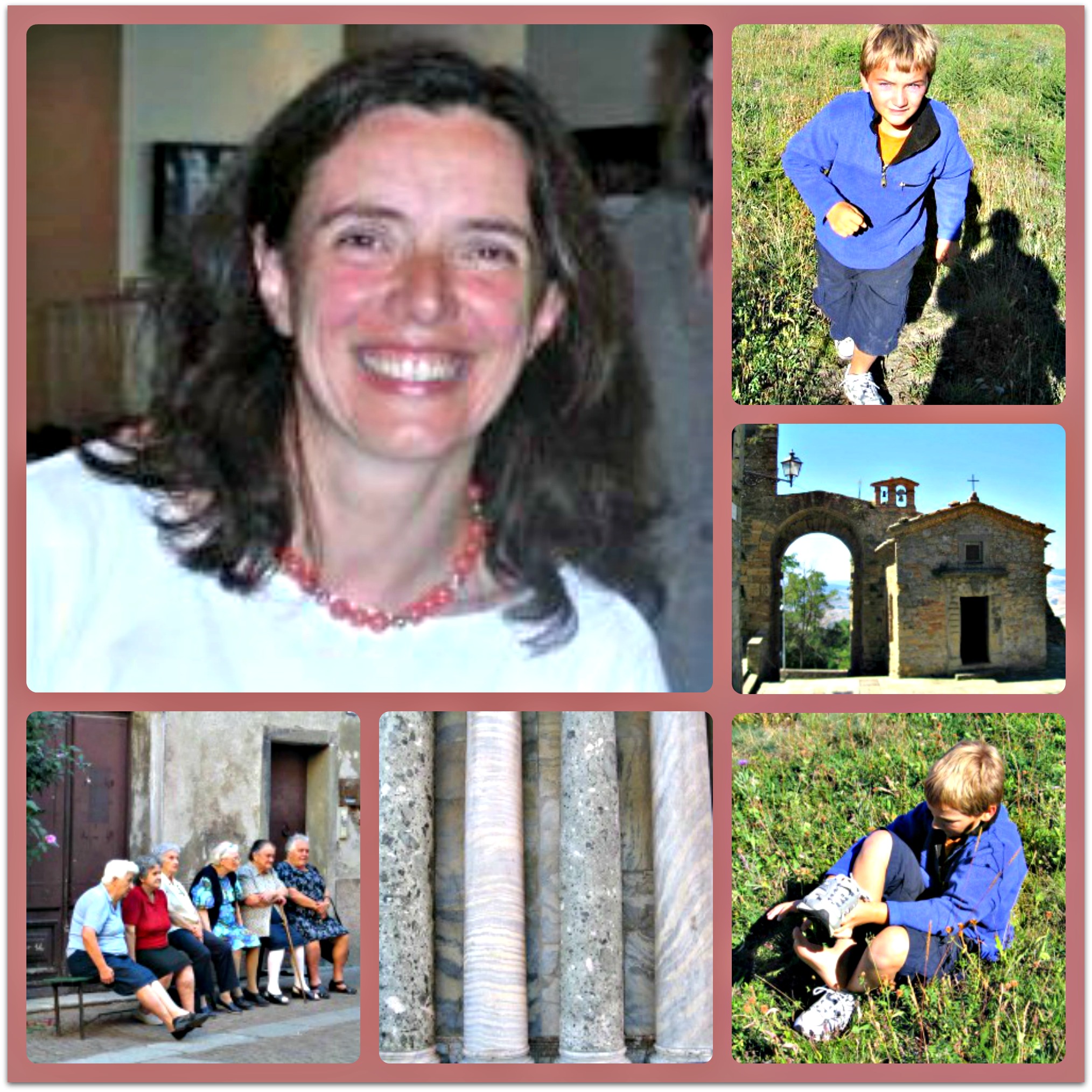
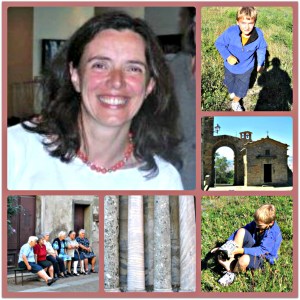
Images: Olga Vannucci and George, interspersed with Italian scenery. Of the George photos, Olga writes:

Let me provide the audio from George: “Where are we going? How much longer? I have something in my shoe. I want to go back. Why are we doing this? Do you know where we are? Do you know where we’re going? Mammaaaaaaa!”

Why “exbrats” in São Paulo need their own book to appreciate life in Brazil’s largest city

MeganFarrell CollageThis week’s guest interviewee is Megan Farrell, who like myself is an estrangeiro (foreigner) in São Paulo and married to a Brazilianalthough unlike my good British self, Megan is American and also has a young daughter (sounds like far too much responsibility if you ask me!).

Megan and her family previously lived in New York, but she took a sabbatical from her job on Wall Street in 2009 to become a full-time mum. Then, when her husband was offered a job opportunity here in São Paulo in 2010, they decided it would be a perfect opportunity for Megan and their daughter to learn Portuguese, experience life in a different culture, and learn more about Dad’s home country.

I first came to know of Megan when I moved to São Paulo myself at the start of 2012 and found her blog Born Again Brazilian whilst doing some research for my own blog. Ever since, I’ve kept up-to-date with her tales and travails, and was pleasantly surprisedif not a little enviouswhen she announced earlier this year that she would be releasing a step-by-step guide for foreigners who are living (or planning to) in São Paulo: American Exbrat in São Paulo: Advice, Stories, Tips and Tricks for Surviving South America’s Largest City.

I say envious because a similar idea had occasionally cropped up in my mind, but having read Megan’s book, I’m actually rather glad I didn’t attempt it myselfthere’s no way I could have had done the topic justice to the same extent. Megan has done her research, even offering advice on visas, taxes and other mundanebut extremely importantdetails that a move to São Paulo can entail. She includes things I would definitely not have thought of or, to be honest, had the patience to cover.

My only quibble—which perhaps tells you more about me than it does about the book, which is excellent—is that it reflects the experiences of a small minority in Brazil: exbrats. As someone who loves history as well as current affairs, I tend to prefer books that provide a holistic overview of life in a particular country. What’s more, the life of the exbrat seems completely outside my realm of experience. Though a cynic might suggest that I’m on an extended holiday, I didn’t move to Brazil on an all-expenses paid work package.

And to be fair, Megan doesn’t fall into the “exbrat” category either: her husband is Brazilian so didn’t qualify for the relocation package that makes countries like Brazil so enticing to non-Brazilians.

So, who exactly are these exbrats? And why write a book for them? Megan and I had the pleasure of meeting up I person a few days ago and talking about the audience she had in mind for her book. The following are some highlights from our conversation.

* * *

AmericanExbratinSaoPaulo_cover_pmHi, Megan. Tudo bem? Why did you decide to write a guidebook for non-Brazilians who come to live in Sao Paulo?
If you are making a move to a country such as Brazil, you need to have your expectations managed appropriately. Much of the pain my fellow expats have experienced has been because they were unprepared to deal with some of the idiosyncrasies of life in São Paulo.

What do you mean by an “exbrat”? Was the book specifically aimed at them?
I used “exbrat” because it feels rather fitting of the collection of people I’ve come across here. Expats, including myself, often stomp their feet over inconveniences they’ve encountered here, yet still expect and enjoy all the benefits of being in Brazil. Not necessarily in a pejorative way, but it felt very bratty to me. You also meet people who were previously army brats and were never able to shake their nomadic waysso “exbrat” is also an adult term for these foreigners.

So exbrats are primarily the foreigners who move to Brazil because of job opportunities?
Yes, the target audience is largely people who are moving to São Paulo or have recently arrived in the city for work, as well as human resource managers at companies who send employees to Brazil.

You included yourself just now in the “exbrat” category. But you are married to a Brazilian who didn’t get an expat package.
Believe me, some aspects of the things I’ve experienced here in Brazil have been a shock, as they probably were to you as well. So, while the book is definitely aimed at exbrats, I don’t think it’s too “exclusive.” There is an element of the “exbrat” in all of us. Some people are never able to get out of the exbrat cycle and as a result, fail to take advantage of the opportunities living in this country offers. My hope is that my book will give them a clearer picture of what to expect, and how they can prepare for that reality, so that they can get over the culture shock and go exploring. One of the world’s most fascinating countries awaits.

I think I know what you mean. I particularly remember reading in the book about your shock of attending an officially organized children’s “play-date” and there being seven paid staff to run it, as well as each child returning home afterwards with a crystal tea set as a parting gift!
Yes, exactly! That is far removed from my experiences in New York but is not so uncommon if you and your family start to mix in the same social circles with people towards the very top end of society in Brazilwhether that be through expat communities, your child’s school, or spouse’s workplace.

Has the book reached other audiences besides those who are moving to São Paulo? Perhaps people moving to other South American countries or those where English is not the first language?
Thus far the audience has been very specific to people moving to São Paulo, as opposed to other countries in South America—or even other cities in Brazil. It’s also attracted a few readers who work with Brazilians but in other countries.

Injecting her own anecdotes, and photos, into the book

Which section of the book are readers enjoying the most?
People tell me that they really enjoy the humorous stories I’ve included, which are based on some of my most painful and awkward experiences. For example, I tell the story of how I visited the same bakery for over a year before someone explained that because I wasn’t emphasizing the appropriate accent in the word pão (bread), to a Brazilian ear it sounded like I was asking for pau (penis)! Living in a non-English-speaking country provides plenty of opportunities for embarrassment or frustration, but when something goes wrong, I’m the kind of person who chooses to laugh, not cry.

Did you connect with the city in any new ways in the process of writing the book?
Definitely. I wanted the book to be as complete as possible (without taking ten years to write) and so I did more exploring on some of the subjects I wanted to include. Also, the photos in the book, minus a few I purchased the rights to, are ones I took. Much of the photography I already had in my collection. But there were gaps, so I had to get out and take pictures, which always gives you a second perspective on what you are seeingmore removed and analytical.

The topic of domestic servants

What was your most displaced moment when doing the research for the book, when you wondered why you’d embarked on this mission?
Trying to explain the culture of the people who might work in your homethe culture of the working poor in Brazil.

What do you mean when you say “culture of the working poor”? In your book you seem to suggest that household workers, who are of a far less lower rung on the lady in Brazilian society, are just taking advantage of the situation that they are in. Do you think this is cultural, or the impact of their socio-economic circumstances?
Half and half. I think it is definitely a Brazilian thing to try to take advantage of different situationsand this exists at all levels of society. For example, there’s the term jeitinho Brasileiro, which Brazilians use for situations in which they “creatively” try to get round complications in life.

However, yes, there is also a socio-economic component. If you are from a poor neighborhood and are working in the home of a rich family or person, it’s probably not too surprising that you might want to take advantage of your situation by asking for a loan or a raise.

From blogging to book-writing (she hasn’t looked back!)

Why a book instead of a series of blog posts?
Believe it or not, people still like reading books! HA. Over the past three years, since I’ve written my blog, I’ve received a number of questions about moving to São Paulo and life here. Most of the answers were already within the posts of my blog. I wanted to create a document that was more comprehensive, arranged by topic and easier to navigate. I also did a survey of my expat friends, and almost all of them said they would have purchased at least three books about moving to São Paulo before they camehad any actually existed. So I decided there was at least a bit of demand. Blogs are great, but sometimes you want to read a story from beginning to end. Plus, I’ve always just wanted to write a book.

What was the most challenging part of the book-writing process?
Editing. The editing process was a collaboration with my awesome friends, as well as my mother. It’s difficult to edit yourself. Actually, it is impossible to edit yourself. And when you have a pile of people helping you sort through the stories and facts, you get lots of opinions. But it was all good. However, I don’t think I can advantage of my friends again, so I’ll probably hire an editor for the next one.

Why did you self-publish the book?
A few of my writer friends encouraged me to try and find a publisher. But I just couldn’t figure out what a publisher was going to do for me that I couldn’t do for myself. I have a strong network and a background that includes marketing. I also don’t have the patience to go through a bureaucratic publishing process with an extended timeline. I knew that even if I did manage to find a publisher, I would not be their priority. The market for this is not on the level that would make a publisher move fast.

What’s next? Are you working on any other writing projects?
I am. I’ll probably update this book sometime in the next year. I also plan to write one for Rio. My husband is from Rio, and most of my experiences in Brazil (prior to moving to São Paulo) were in that city, so I know it pretty well.

You mentioned at the outset that you like broader books. I’d love to write something about Brazil as a wholeto counter the focus I put in this one on the expat life. It won’t be another step-by-step guide but a more of a general analysis, including politics, culture and so forth.

Finally, I’m working on some fiction stories that take place in Brazil. When living in New York, I did a screenplay course so have some experience in writing fiction. Currently, my idea is to write two series of short stories. The first will be based around Brazilian folklore, and the second, around some real-life episodes I’ve witnessed that are difficult to record in a blog or non-fiction format.

Ten Questions for Megan Farrell

Finally, we’d like to ask a series of questions that I’ve asked some of our other featured authors, about your reading and writing habits:

1. Last truly great book you read: Don’t Let the Pigeon Drive the Bus, by Mo Willems. I have a five-year-old. But we’ve read it more than a hundred times and it still makes me laugh. Okay, Don’t Let the Pigeon Stay Up Late is another contender. Mo Willems is a genius.
2. Favorite literary genre: I’d love to lie and offer up a more intellectual answer, but my favorite genre has always been horror. I enjoy a good creepy tale. After that, humorous memoirs from people who have overcome great obstacles, like Jeannette Walls‘s The Glass Castle.
3. Reading habits on a plane: I’m most happy if I have a copy of The Economist with me on a plane
4. The one book you’d require President Obama to read, and why: I wish Michael Bloomberg would write a book that Obama could read, because I think the USA would benefit by being run more like a business. But since Bloomberg has yet to put pen to paper, I’d have to say Getting to Yes: Negotiating Agreement Without Giving In.
5. Favorite books as a child: I loved any book that involved a child in a new world. James and the Giant Peach. Charlie and the Chocolate Factory. The Little Prince. The Little House series by Laura Ingalls Wilder. Pippi Longstocking.
6. Favorite heroine: Wonder Woman. I think if Brazil had a Wonder Woman, or the collection of super heroes that we have in the States as—albeit fictional—role models, people would emulate change for the good of the people. Brazil needs to believe in something other than futebol—but that seems to be in the process of changing, as Andy and I discussed last month on this blog.
7. The writer, alive or dead, you’d most like to meet: Hands down, Stephen King. I hope he doesn’t die before I get to meet him. I just need to figure out a way to do it that doesn’t involve stalking.
8. Your reading habits: I used to spend the weekends (sometimes all weekend) reading. But now that I have a child, I usually read right before I go to bed—in bed.
9. The book you’d most like to see made as a film: American Exbrat in São Paulo, of course!
10. The book you plan to read next: I suppose I should say Fifty Shades of Grey, because I haven’t read much of it and people keep bugging me about it. But if you’ve read Anne Rice’s Sleeping Beauty Trilogy (I only read the first), Fifty Shades is like reading Judy Blume. Yawn. I think I’ll wait for Stephen King’s Doctor Sleep. How could anyone resist a sequel to The Shining?

* * *

Readers, as I said, Megan was a delight to meet in person, a sense of which I hope I’ve conveyed above. Any further questions? Have I pressed her too hard on the “exbrat” point?

STAY TUNED for tomorrow’s post, a new episode in our “Location, Locution” series, by JJ Marsh.

If you enjoyed this post, we invite you to register for The Displaced Dispatch, a round up of weekly posts from The Displaced Nation, with seasonal recipes, book giveaways and other extras. Register for The Displaced Dispatch by clicking here!

Related posts:

images: Megan Farrell’s author image and book cover; photo of Sao Paulo from MorgueFile.

As an expat, is it my place to join another country’s political protest?

BrazilianProtest_ahpmJust after the street protests broke out in Brazil last month, Megan Farrell, an American who lives in São Paulo with her Brazilian spouse, contributed a guest post to the Displaced Nation.

Megan was very honest in admitting that she had previously taken little notice of politics or social issues in Brazil:

Being displaced … makes it easy to be in a bit of denial.

I, too, am an expat in São Paulo with a Brazilian spouse, albeit from the UK. Like Megan, I didn’t initially involve myself in Brazil’s latest political movement—but my reasoning was a little different from hers.

I’m someone who self-identifies as politically engaged and active. Back in the UK I was a union rep at my workplace and I’ve been involved in protest movements since my student days, the most prominent being those against the invasion of Iraq in 2003.

Additionally, as a social worker and student of social sciences, it’s second nature to be socially and politically aware of what is going on around me, whether that be at home or elsewhere.

Why, then, would I be reticent to involve myself in the politics of the protests that were going on around me here in São Paulo?

Not my fight to fight

Despite broadly agreeing with the objectives of the early protests (about a rise in bus fares which as a daily user of public transport, by which I was directly affected), I felt that as a gringo and a guest of Brazil, it wasn’t my place to get involved.

To be honest, I even felt a little reluctant to use social media to post articles or comment upon what was happening, and when I was asked to cover the protests for a site in the UK, my first inclination was to turn it down.

As a foreigner I was sensitive to being seen by Brazilians as poking my nose into their affairs. Additionally, I was also quite aware that there is a lot of history and background behind these protests that I am only, at best, partly aware of.

On top of this, Portuguese is my second language, so whilst I can read it without too much problem, I was apprehensive of inadvertently misconstruing a tweet, newspaper article or blog post, and using ill-informed or partly understood information to inform my opinions.

Eventually, however, I went out on the streets.

What led me to change my mind?

What was my impetus for joining the protests? I think it was seeing the extent of the violence (rubber bullets, tear gas, etc) the police used against what was widely reported as peaceful protest in São Paulo on 13 June.

And it wasn’t just me. The harsh police response was a turning point for many Brazilians as well, because while it may have successfully extinguished the 13 June protest, it also had the converse effect of igniting far broader outrage across the city and the whole of the country. At the same time, it provided an opportunity for a far wider array of grievances to be voiced (most of which Megan notes in her article so I won’t go into them again here).

Once I’d been out on the streets I felt a little bit more confident about joining in the discussion myself. When a couple of photographs I’d posted got a bit of attention on Twitter, and Planet Ivy in the UK—an online news magazine started up by a team of young, adventurous journalists—asked me to cover the protests, I agreed.

A duty to inform the folks back home

My decision was largely influenced by my realization that people at home in the UK—as first my mum and then Planet Ivy made me aware—were largely unaware of what was going on.

In Megan’s post, she mentioned her disbelief at how her friends and family members in the U.S. were still sharing updates on Facebook about their morning meals, their cats, and sports teams:

How could this be? How could they just not care?

Like her, I had the sense of being in the middle of something big and important, and for a while just assumed that everyone else around the world must be aware of it as well.

If I stopped to think about it, of course, no one is ever as interested in an event who are on the scene. But once I realized that there were people out there who wanted or needed to know more, I thought I could do my bit to inform them.

Another motivating factor was the need to correct the widespread misperceptions of the Brazil’s situation—in particular, the negative press the country has been receiving in the UK with regards to its preparations for the 2014 World Cup.

Whilst a fair amount of that criticism has been justified, it occasionally feels as though the UK press has some sort of vendetta against Brazil, with every news story seemingly inferring that “this once again casts doubts about the safety of Brazil and its ability to host a major international event.”

Alas, I thought, even if I am a naïve foreigner living in and writing about Brazil, I could at least provide some insight about what is actually going on at street level.

A closer connection with my adopted land

As an aside to this, one interesting thing about the protests is that they’ve helped alter my perception of the connection I have with São Paulo and Brazil.

Obviously, through my Brazilian wife and my residency in São Paulo, that connection is now much deeper than before. However, and as mentioned in my last post, in the 18 months since moving here I’ve evolved from whining expat (or “exbrat,” as Megan likes to say) to being an avid proponent of my new home.

My decision to join in the nation’s protests—whether participating on the streets or discussing and sharing the issues with people online—was a kind of watershed moment, effectively making the transition complete.

Of course, I’ll always primarily consider myself a Londoner, a Brit and a European (a fact I’m constantly reminded of by my Brazilian friends and family, who refer to me as “the gringo”), but increasingly I feel just as proud to be quasi-Paulistano*.

*People from São Paulo refer to themselves as Paulistanos.

* * *

COMING SOON: Andy’s interview Megan Farrell about her new book on expat life in São Paulo.

STAY TUNED for tomorrow’s post, from our travelogue writing coach Jack the Hack.

If you enjoyed this post, we invite you to register for The Displaced Dispatch, a round up of weekly posts from The Displaced Nation, with seasonal recipes, book giveaways and other extras. Register for The Displaced Dispatch by clicking here!

Related posts:

images: Photo of protesters in São Paulo, June 2103, by Andy Martin. Go to his photo blog to see more.

An American writer in Brazil is transformed from “exbrat” to politically awakened expat

Sao Paulo June Protests CollageWell, the best-laid plans of mice and menand international creatives—often go astray. Today, instead of Andy Martin interviewing Megan Farrell about her excellent book, American Exbrat in São Paulo: Advice, Stories, Tips and Tricks for Surviving South America’s Largest City, Megan herself will post about the transformational effect that the protests in her adopted country are having on her world outlook. (Not to worry, barring further major events, Andy’s interview with Megan should appear next month.)

—ML Awanohara

For nearly a week solid, I was locked to social media sites, doling out information about the protests in Brazil, via blogs, Facebook and Twitter. Along with other expat friends here in Brazil, I was been trying to make up for the fact that global news outlets were doing little to spread the word about the public demonstrations going on in São Paulo and other large cities.

Like a large percentage of my foreign friends, I have a closer connection to the country than your average expat. I have a Brazilian husband, and though she was born in New York City, a daughter who is a Brazilian national.

Ignorance was bliss

I’ll admit, before June 13, the night when police “lost control,” using rubber bullets against protesters and even journalists covering the events, I had little real knowledge about the injustices occurring in my new home country. I chose not to let such things enter my world.

Being displaced often makes it easy to be removed from your own surroundings.

Being displaced also makes it easy to be in a bit of denial.

But that Thursday night in mid-June, as my husband and I sat in a bar near our apartment and watched as the streets filled with protesters, my perspective on my adopted country changed.

The bar’s manager wasn’t allowing patrons to leave out of fear we would be exposed to the enthusiastic, but angry, crowd—some of whom were attempting to start fires to distract the police from blocking their access to Avenida Paulista, the central thoroughfare of São Paulo.

The protest eventually moved on, and we were able to leave, but my interest in what had initiated this movement lingered.

Not just about 20 centavos

By now, many of you hopefully understand that millions hit the streets of Brazil over more than a bus fare increase. Yes, that act was the catalyst. A 20 centavos increase meant an additional monthly expense of eight reais (R$8 is about US $4). It may not sound like a lot to you and I, but as minimum monthly wage in Brazil is R$675 per month (about US $300), every centavo is accounted for in the household of the working poor (i.e. the emerging middle class).

But the fare increase also speaks to deeper issues concerning the government’s priorities. Many Brazilians are finding it hard to stand by and watch as the government attempts to squeeze them for more, all the while spending millions of dollars on preparing stadiums for the 2014 World Cup—millions more than other countries who have hosted the event. Meanwhile, public services within Brazil remain abominable.

A few examples:

  • Across the country, emergency rooms of public hospitals are filled to the brim with patients hoping to get care, yet doctors have no means to help the majority.
  • Public school teachers often don’t show up to conduct class.
  • Police are untrained and uneducated, often looking to supplement their meager incomes with bribes.
  • Public transportation is decrepit in many cities.

“Its hour come round at last…” W.B. Yeats

As I wrote in my recent book, American Exbrat in São Paulo, one of the more frustrating aspects of living in Brazil can be the Brazilians’ passive attitude on the inefficiencies and transgressions that occurred in their country. Be it that the post office ran out of stamps (again) or the police never showed up when called, a local’s response to this would be some version of, “That’s Brazil.”

So when hundreds of thousands took to the street in protest, with a list of complaints in hand, no one was more surprised than the Brazilians.

The media took it lightly at first, burying the story about a bus far increase in the back of the papers. Then, the focus was on the violence of the demonstrations. But the reality is that when you gather such a large group (everyone was invited by social media), there are bound to be a few who are there to express extreme anger or simply to commit acts of violence.

But as one who sits within the scene, I’ve found the protests mostly peaceful and the intentions positive. The people of Brazil want change and want the world to understand that their country isn’t satisfied with the samba and beach party persona. There are real issues within the nation’s borders that need addressing.

Whither the rest of the world?

As mentioned at the outset of this post, sharing information about the realities of Brazil’s protest movement has become an important objective for me. Friends, both foreign and Brazilian, and I have been passing along videos, news articles and photos that depict the main events as well as the sentiments of the people.

Many of us who have blogs about being in Brazilmine is Born Again Brazilianhave written posts on these topics. For instance, I have just posted on Dilma Vana Rousseff, president of Brazil, who has stood in support of the Brazilian protesters.

Yet many friends and family members in the U.S. were still sharing updates on Facebook about their morning meals, their cats, sports teams, and other notices. These felt like irrelevant nonsense. How could this be? How could they just not care?

But then I recalled that I have friends in Turkey, who are going through the current protests. I have friends with family members who are in Greece and must have lived through the two years of protest in that country. I know little about what is happening in Ethiopia, where the first large-scale protest since 2005 has just broken out. And before June 13th, I was blissfully sharing little more than food photos and trip pics.

It is easy to be self-absorbed, content to contemplate the details of one’s own little world. It is even easier as an expat, when so much of your surroundings are of an unfamiliar nature. You take comfort in that which is close to home.

But now I have a different attitude and think about my power to disseminate information. It’s satisfying to share the details of what goes on in the politics of this country and have people you know respond positively.

But it is as important, especially for those of us who have an audience through blogs and other outlets, to keep tabs on what is happening elsewhere in the world and use our skills to move toward justice and peace.

This episode in Brazilian history has changed me forever.

Or so I hope…

* * *

Readers, any questions or comments for Megan about what she is experiencing? Have you had any similar moments of political (re)awakening—or do you not “do” politics as an expat?

STAY TUNED for tomorrow’s post, a new episode in our Capital Ideas series, by Anthony Windram.

If you enjoyed this post, we invite you to register for The Displaced Dispatch, a round up of weekly posts from The Displaced Nation, with seasonal recipes, book giveaways and other extras. Register for The Displaced Dispatch by clicking here!

Related posts:

images: Surrounding Megan Farrell (aka Maggie Foxhole) and her book cover photo are several photos taken by TDN writer Andy Martin. Go to his photo blog to see more.

NEW VS OLDE WORLDS: British husband and Brazilian wife swap cultural allegiances

Libby Collage New&OldThanks to Kate Allison, regular readers of the Displaced Nation are treated every other week to a new episode in the life of fictional expat Libby Patrick, a 30-something British woman who has relocated with her spouse to a town outside Boston. Her diary, Libby’s Life, is replete with rich observations about life in New England vs. England. In the weeks when Libby isn’t published, we are featuring posts by writers who are sensitive to the often subtle, yet powerful, differences between new and “olde” worlds. Today we hear from one of our regular contributors, Andy Martin. Those who caught Andy’s Random Nomad interview at the start of the year will remember that he’s a British social worker and football geek who followed his Brazilian spouse back to her native São Paulo.

—ML Awanohara

AndyMartininUK_pmA few weeks ago I made my first trip home to the UK since moving to São Paulo, Brazil’s largest city, in February 2012.

Prior to leaving I started to ponder how I’d feel once I touched down in London.

After such an extended period of time, I guess it’s only natural to feel this somewhat apprehensive. Yet another reason for my intrigue was the number of times over the past year a Brazilian had asked:

Você tem saudades de Londres?

There is no direct translation for “saudades“—which probably says a lot about how us English speakers struggle to express our feelings. Broadly it translates as something like:

having a deep sense of nostalgia or longing for something or someone*

To such beautifully expressed enquiries of my sentiments about home, my typical response has been some muttered utterance like “Na verdade, não,” which basically means: “No, not really.”

What did I say above about us English speakers being expressive?

Or perhaps that’s just me.

Delighted to be in the new world…

Yet, on the whole those two words do sum up my thoughts about home. Sure, I miss friends and family—but the place? As I said, “Na verdade, não.”

I’ve lived in London, walked its streets and drank in its pubs for most of my life, so why would I be so desperate to go back?

Perhaps it is because I know that we’re likely go back to settle there eventually.

Alternatively, perhaps it’s not that I don’t miss London, more that I am happy with my lot here in São Paulo.

Which I am.

…while my wife is attached to the old one!

Ironically, it is actually my wife who is the one who most wants to return “home” to London after she finishes her degree at the end of this year**. This surprises most people, who assume that my Brazilian wife is the one who wants us to stay in Brazil, when it’s actually the opposite.

Why?

Part of it, I guess, can be put down to the opportunity each of us has to explore the unknown.

When I traveled around South America in 2007, I had never before left Europe. Likewise, until she went to Buenos Aires in 2008 (where we met), she had never left Brazil.

Both of us had only really ever known one way of life.

Now, with my wife having spent three years in London and us now having spent almost 18 months in São Paulo, we both seem to have come to appreciate and adore the things about each other’s countries that the other takes for granted or even dislikes.

The predictability, and quaintness, of London

For my wife São Paulo is a stressful city, with its inadequate infrastructure having a tendency to make life more complicated than it needs to be.

On top of this it’s a place that for her, because of the fear of crime, constantly leaves her feeling on edge.

Conversely, London is a place where she says she feels safe and where life is made easier by things working as they should—even if it that isn’t always the case.

For example, it still amazes her that a train can be scheduled to arrive at, say, 10:27 a.m. and then on the whole it actually arrives and departs at 10:27 a.m.

Additionally, coming from a land that was “discovered” as recently as 1500 by the Portuguese, she finds Europe’s long history fascinating—the fact that there are buildings in London older than the country of Brazil itself being a prime example.

I’ll be honest, in some ways I probably felt the same when I first arrived in Brazil. My initial posts on my own blog, The Book is on the table, whilst written with my tongue firmly in cheek, could possibly also be seen as me just being another gringo moaning about stuff—the subtext being that “everything back home is much better.”

As time went on, I realized that I didn’t want to be or become one of those moaning expats. Of course, it is natural to compare things when you move or go abroad. Likewise, there’s nothing wrong being critical if it’s fair and balanced.

But to make a habit of it isn’t good for one’s mental health. It ends up making you bitter and unhappy with your new environment. It’s also the quickest way to feeling homesick.

Even worse, such comparisons can easily drift into self-righteous rants asserting one’s cultural superiority—a throwback to the attitudes of our colonialist ancestors that did no one any good back then and will do no one any good now.

The unpredictability, and beauty, of Brazil

Around the time I realized that moaning and comparing are pointless enterprises, I started to feel a genuine affection for Brazil, something that has been reflected in my blog posts over the past 6-9 months.

Firstly, it would be hard not adore a country and continent that shares my passion for futebol.

Additionally, I found it easy to get used to a relaxed, slower pace of life in this part of world, which is not hard to complain about when it’s touching 30°C (86°F) for most of the year.

We have a swimming pool in our apartment block, something that is unthinkable in the UK, and there’s 4,500 miles of stunning coastline to pick from to go to on holiday.

Then, there’s the fact that if I want to go out for a beer or meal I know the bar or restaurant won’t be shut by midnight, as they so often are in London. If I want to stay out sipping a beer until 4:00 a.m., I can.

I’m also enjoying, although also a little frustrated by, the challenge of learning Portuguese, and as someone who studied Sociology and Social Anthropology and then later worked with migrants as a social worker, living in Brazil provides the perfect opportunity to explore South America, its indigenous history and the legacy of immigration after its colonization.

Additionally, the continent’s history of revolution and resistance against oppression also matches my own rebellious tendencies and political values—something I didn’t always have an outlet for in the UK.

Finally, it might sound a little condescending but I’ve now come to embrace some of the things I once moaned about. Living in London is great, and I appreciate my wife’s perception of the quality of life, but all the things I mentioned above provide an alternative quality of life. In other words, there’s more to life than just functioning public services.

Brazil may be frustrating sometimes, but it certainly makes life just a little bit more interesting—though my wife is yet to be convinced by that argument.

Maybe at some point I’ll change my mind and the novelty of life in Brazil will wear off—there is certainly enough evidence to suggest that might be the case. However, for the time being, whenever a Brazilian affectionately ask about my longing for home, I’ll continue to mutter: “Na verdade, não.”

*It’s extremely convenient in these situations having a translator as your wife.
**As a compromise I’ve so far managed to negotiate us staying until at least the end of the World Cup next year, using these two strong arguments: 1) I love football; and 2) Living in São Paulo meant we missed the Olympics in London.

* * *

Speaking of the Olympics, the handing over of the torch to Brazil at the end of the London Olympics certainly showed you the contrast between old and new worlds! Readers, can you relate to this couple’s frequent twists and turns in their cultural allegiances?

STAY TUNED for next week’s series of posts!

If you enjoyed this post, we invite you to register for The Displaced Dispatch, a round up of weekly posts from The Displaced Nation, with seasonal recipes, book giveaways and other extras. Register for The Displaced Dispatch by clicking here!

Related posts:

Img: Photo of Andy Martin taken during his recent trip to the UK, at a wedding.

Portrait of woman from MorgueFile; Lighthouse (R) from MorgueFile; Lighthouse (L) from MorgueFile