The Displaced Nation

A home for international creatives

Tag Archives: Australia

My grandfather tried saving the world long before it became trendy — with mixed results

Our Third Culture Kid columnist, Charlotte Day, upon reading this month’s posts about those who displace themselves on behalf of those less fortunate, felt moved to contact her grandfather in Sydney, Australia, for a chat about his own experiences with international aid work, which began in the 1950s.

These days, it is a rare teenager who has not shown some evidence of civic engagement by a certain age: spending their summers beneath foreign suns in search of that fabled sensation, that fulfillment born of “helping others.”

Of course, no altruistic act is truly pure, but I would argue that it is better than nothing.

Nothing, however, is the word that best qualifies my own civic engagement. I have reached the age of 17 tacitly scorning the moral and spiritual quests of British gap-year students, as well as American Ivy-League hopefuls, from my comfortable desk chair.

I read Dostoevsky’s portraits of tormented youths, striving in vain and misguidedly to effect a change in society…and decide that changing the world is futile.

Yet a chastening thought sometimes breaks through this complacency: there are many who do valuable work. There are many who displace themselves — not only from their comfortable desk chairs, but from comfortable world-views and notions — to serve others, outside the framework of self.

My grandfather’s first foray into global philanthropy

One such person is my maternal grandfather, Robert Ayre-Smith. He entered the field of international aid before the idea of a “third world” even existed. As he informed me in our recent email exchange:

In the middle of the last century, there were the tropics, the Empire, the Americas, the colonies, etc. But they were not rated economically as is now the case.

Paradoxically, he chose animals over humans when he initially diverged from the family profession, medicine, and entered London’s Royal Veterinary College. His first appointment as a livestock specialist came in 1952, shortly after his marriage to my grandmother, Carol. The newlyweds set off for Kenya’s Rift Valley, where Robert set up a research station by Lake Naivasha, working with cattle, sheep and pigs. As motivation, he cites scientific interests in “tropical animal production” — a topic he’d investigated while doing graduate work at Louisiana State University.

As is often true of those who move from the halls of academe to real-life applications, Robert soon found that what he calls his “enthusiasm for science itself, and then for the benefits bestowed by scientific advances,” matured into “some feeling of disillusionment.” His focus shifted away from books to people — and looking at what small-scale farmers in Kenya’s villages were realistically capable of accomplishing.

But while he found fulfillment in these human interactions, he remained bothered by the tension between his “lofty agricultural scientist’s perspective” and the perspective taken by the farmers whose cares he was attempting to alleviate.

Some thirty years later, an “Aha!” moment

Fast forward to 1989, by which time my grandfather was working in Indonesia. During a roadside breakdown, Robert experienced an epiphany. Watching a nearby farmstead owner and his family tending their crops and livestock, he “started to question the appropriateness of much [then] current agricultural research for increasing crop and livestock productivity.”

His own knowledge, “derived from vastly different circumstances,” seemed markedly out of place. Until then, he’d been seeing agricultural development in the Third World through the lens of First World research, where commercial farms are relatively large-scale operations, and where farmers are literate and can therefore study results and adopt them to increase their productivity.

Yet most Third World farmers are fighting an altogether different battle. Their farms are small in scale, with “only two acres for the house, food crops and animals and virtually no machinery except hoe and sickle.”

From that time on, my grandfather thought it would be unreasonable — and betrayed a lack of empathy on the part of the professed do-gooder — to expect farmers in Indonesia and other developing countries to make changes according to developed-world research. He became a founding member of the Asian Farming Systems Association in 1991, which aimed to “undertake research of relevance to the farmer that it was hoped to benefit.”

As he concludes in his message to me:

So you see, Charlotte, it took time to mature my thoughts and approaches — a lot of time.

The world as one’s oyster — whatever that means

This being the Displaced Nation, I felt obliged to ask to what extent my grandfather ever felt himself displaced in the course of his work. “NEVER!” came his emphatic reply. He traces the desire to live and work abroad to his mother, “a great traveler in body and soul.”

Born and raised in India “at the height of the Raj,” my great-grandmother was educated in England and Switzerland before traveling widely in the United States and then working in France as a Voluntary Aid Detachment nurse during World War I.

Even after marrying, she continued to travel the Continent.

As Robert puts it: “I believe I may have learned from her that the world was my oyster — whatever that means. Certainly I have never had fear of the world.”

The only environment in which he recalls being ill at ease was Bogotá, Colombia, in 1980, where he was conscious of an underlying malaise about a possible recurrence of La Violencia, the nation’s horrifying period of civil conflict that had taken place from 1948 to 1958. He remembers being “hoicked out of a bus” between the Amazonian Basin and Bogotá by “some roadside gang — or was it the police?” It did not help matters that he found himself “doing an impossible job that no one really wanted [him] to do.”

Even in the presence of immense danger, my grandfather appears to have taken things in his stride. Here’s how he described being in Baghdad in late 1956, when the city revolted as a result of the British and French invasion of Egypt during the Suez Crisis:

I remember no fear although there was one moment when I was in the street of gold and silver smiths when a big and noisy mob rushed down a street parallel to it and all the merchants pulled down their corrugated metal shutters. Machine gun fire ensued.

A plethora of lessons learned

When I asked what he considered the most effective form of international aid, my grandfather’s immediate answer was “the health and welfare of under-privileged people, maybe I should say village people.” Yet this, he added, is not a form of aid, it’s an aim of aid. He went on: “Moreover, it sounds very pompous — as there are plenty of under-privileged people in all parts of the world, not just in villages.”

On the matter of food aid, Robert had this to say:

I could make a good case against food aid, and against some of the inappropriate advice that I gave in the past to small and large landholders. But what I can say with some confidence is that people in the front line of providing development aid must have empathy with those towards whom the aid is directed.

Empathy formed the heart of his approach — coupled with a saying of his father’s, borrowed from Hamlet (Act I, Scene iii):

To thine own self be true, and it must follow, as the night the day, thou canst not thence be false to any man.

Robert and Carol now live in Sydney, Australia — the last in a long series of displacements. Though he contentedly remembers his work in developing countries, and those with whom he worked, Robert prefers to focus on the present. Yet from time to time, he allows those close to him glimpses of the past — cuttings from the swathes of his memory.

His experiences have persuaded me that it does not pay to be defeatist about “changing the world” — and that the world, even amid current extremes of xenophobic paranoia, is nothing to be afraid of.

Readers, questions for Charlotte — or responses to her grandfather’s insights?

STAY TUNED for tomorrow’s post by the Displaced Nation’s agony aunt, Mary-Sue Wallace.

If you enjoyed this post, we invite you to subscribe to The Displaced Dispatch, a weekly round up of posts from The Displaced Nation, plus some extras such as seasonal recipes and occasional book giveaways. Sign up for The Displaced Dispatch by clicking here!

Related posts:

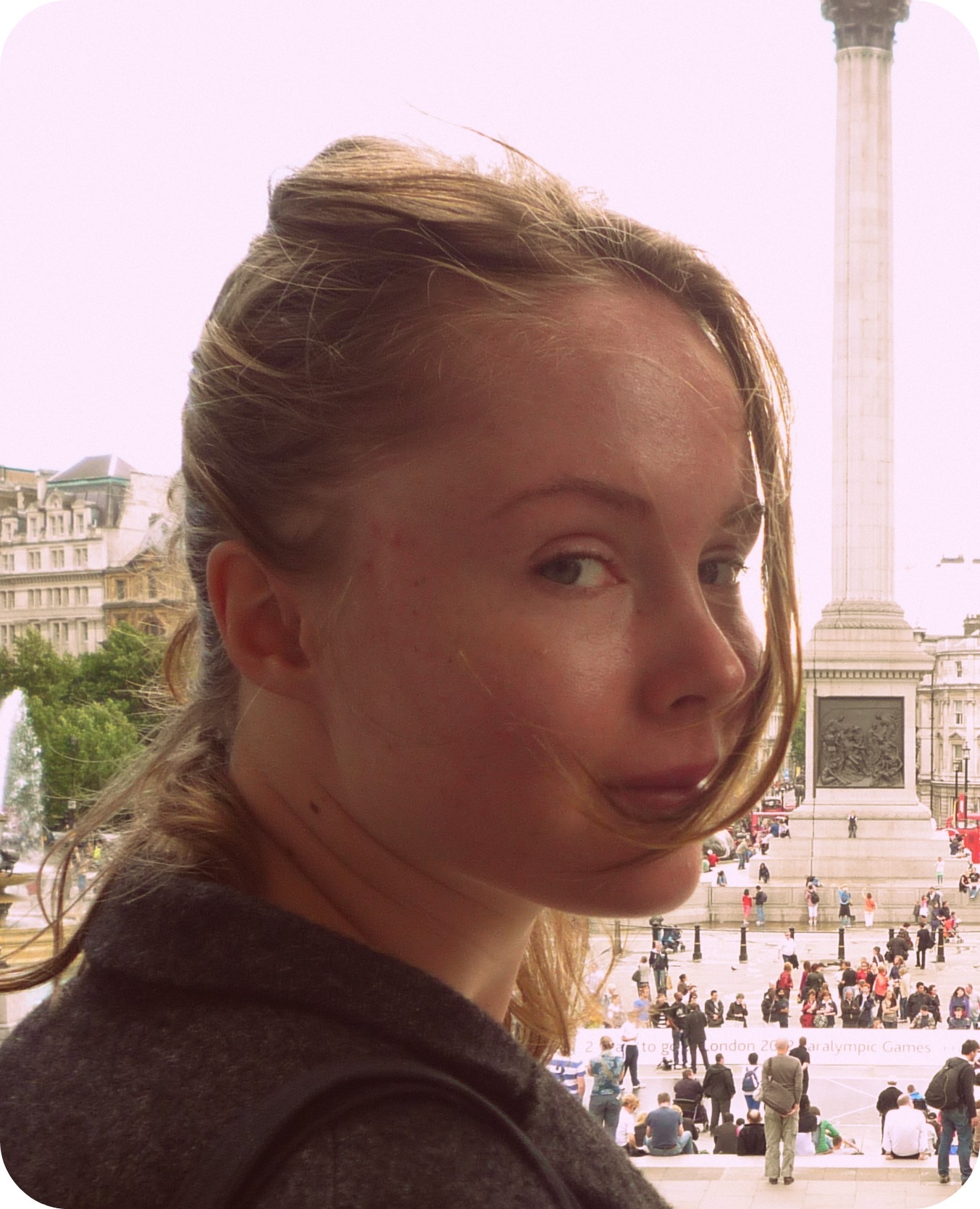
img: Charlotte Day surveying Trafalgar Square in London

RANDOM NOMAD: Mardi Michels, Elementary School French Teacher, Home Cook, Writer, Photographer & Traveler

Born in: Adelaide, South Australia
Passports: Australia (by birth), Britain/EU (through my dad), Canada (I became a citizen in 2007)
Countries lived in: France (Paris): 1995-2000; Canada (Toronto): 2000-present
Cyberspace coordinates: eat. live. travel. write | my creative refuge from academia (blog); eatlivtravwrite (Twitter handle)

What made you leave your homeland in the first place?
I left Australia because I was working on my PhD in French literature and felt it made a lot more sense to be in the country of the language and culture I was studying. Soon after moving to Paris, I began working in a restaurant (Woolloomooloo Restaurant Australien — now closed) to supplement a meagre scholarship. About a year after moving to Paris, I got a job teaching English at Université Paris X and I was hooked on teaching English (I was already qualified to teach French) so I undertook my Dip TEFL [professional diploma in Teaching English as a Foreign Language] at the University of London Institute in Paris, eventually scoring a full time teaching job at the British Council. My PhD? Incomplete…

Is anyone else in your immediate family “displaced”?
My sister also left home when she was in her early 20s to complete a PhD at Oxford (which she did), and from there she worked in banking all over the world (England, Singapore, Japan). She has also traveled extensively in South America. She, too, has ended up in North America (New York City), teaching math!

How about your husband? Is he displaced?
He was when we first met — in Casablanca in December 1999. I was on a vacation in Morocco, and after that two-week jaunt, Mr Neil followed me back to Paris for a visit. He is the reason I am now in Canada. Six months after he visited me in Paris, I had a job teaching in French in Toronto lined up for the 2000-01 school year — and the rest, as they say is history. Neil is originally from Vancouver but has traveled the seven continents to some “out there” places. I mean, how many people do you know who have been to Easter Island?

Describe the moment when you felt most displaced.
The first time I had to do lunchtime outdoor yard duty the first year I was living in Toronto. I was ill equipped for the cold, wearing leather boots and a wool coat that was more than adequate in Paris. Not so much here. It was five years before I succumbed to the puffy coat and winter boots.

Describe the moment when you felt least displaced.
Honestly? Stepping off the plane this past summer when I arrived in Paris. I try to get back there every year or so (I completed my MA in Second and Foreign Language Teaching a few years ago, requiring me to take courses two summers in a row in Paris). Even though I have lived longer in Toronto now than I did in Paris (and I love my life in Toronto), and I don’t have any family there, Paris is still a place where I feel curiously “at home.”

You may bring one curiosity you’ve collected from each of your adopted countries into the Displaced Nation. What’s in your suitcase?
I’m thinking cookware from Mora (a treasure trove of ring molds, tart pans and other French pastry equipment) or A Simon (good selection of glassware and heavy-duty white French porcelain) — both on rue Montmartre; or else baking ingredients from G Detou, one of the world’s great food shops, in Les Halles.

You’re invited to prepare one meal based on your travels for other Displaced Nation members. What’s on the menu?
The meal I would prepare for you would include a dish inspired by each continent. My husband and I have visited all seven continents, and we actually hosted this luxury dinner last year, as documented on my blog:

  • Moroccan spiced chick peas
  • Vietnamese caramelized chili prawns
  • Italian polpette d’uova
  • Australian micro meat pies
  • Mexican tortilla chicken soup
  • Cuban ropa vieja
  • Panamanian (coconut) rice with pigeon peas
  • Jamaican jerk chicken
  • Île flottante

You may add one word or expression from the country you’re living in to The Displaced Nation argot. What will you loan us?
I couldn’t pick one specific one but some words that have crept into my vocabulary (and that of my students’) include hop là, aïeoh là là, et hop, and ouf — words that sound ridiculous removed from the context of everyday French vocabulary but that have turned out to be very useful in the context of my classroom 😉 Surely The Displaced Nation could use a few more interjections?

It’s French Cuisine month at The Displaced Nation. Who is your favorite French chef, living or dead, and why?
Whilst she is not French, it has to be Julia Child, mainly for her “can-do” attitude.

Julia Child is the role model for our posts this month — and has just now been inducted into our Displaced Hall of Fame. Of the following three quotes by her, which one do you most identify with?

1) The only time to eat diet food is when you’re waiting for the steak to cook.

2) The only real stumbling block is fear of failure. In cooking, you’ve got to have a what-the-hell attitude.

3) Until I discovered cooking, I was never really interested in anything.

I have to say the quote I most identify with is “The only real stumbling block is fear of failure. In cooking, you’ve got to have a what-the-hell attitude.”

I teach a once a week cooking class to nine-to-eleven-year-old boys, called Les Petits Chefs; and though my students are pretty young and cannot be expected to know a lot about cooking (yet!), I found myself thinking of them as I read this quote. What continues to amaze me about my group of little chefs is their willingness to try new things and their (mostly) complete lack of fear about being in the kitchen (well, science lab, in our case!). Yesterday, for example, I had five little boys cutting up raw chicken (thighs, no less, so much messier than neat clean breast meat), and I watched them attack the task with great gusto. No fear (though a few “ewws!”) — they just got on and did the job, trusting me that the icky meat would be turned into something delicious in about 30 minutes (it was!).

Readers — yay or nay for letting Mardi Michels into The Displaced Nation? Tell us your reasons. (Note: It’s fine to vote “nay” as long as you couch your reasoning in terms we all — including Mardi — find amusing.)

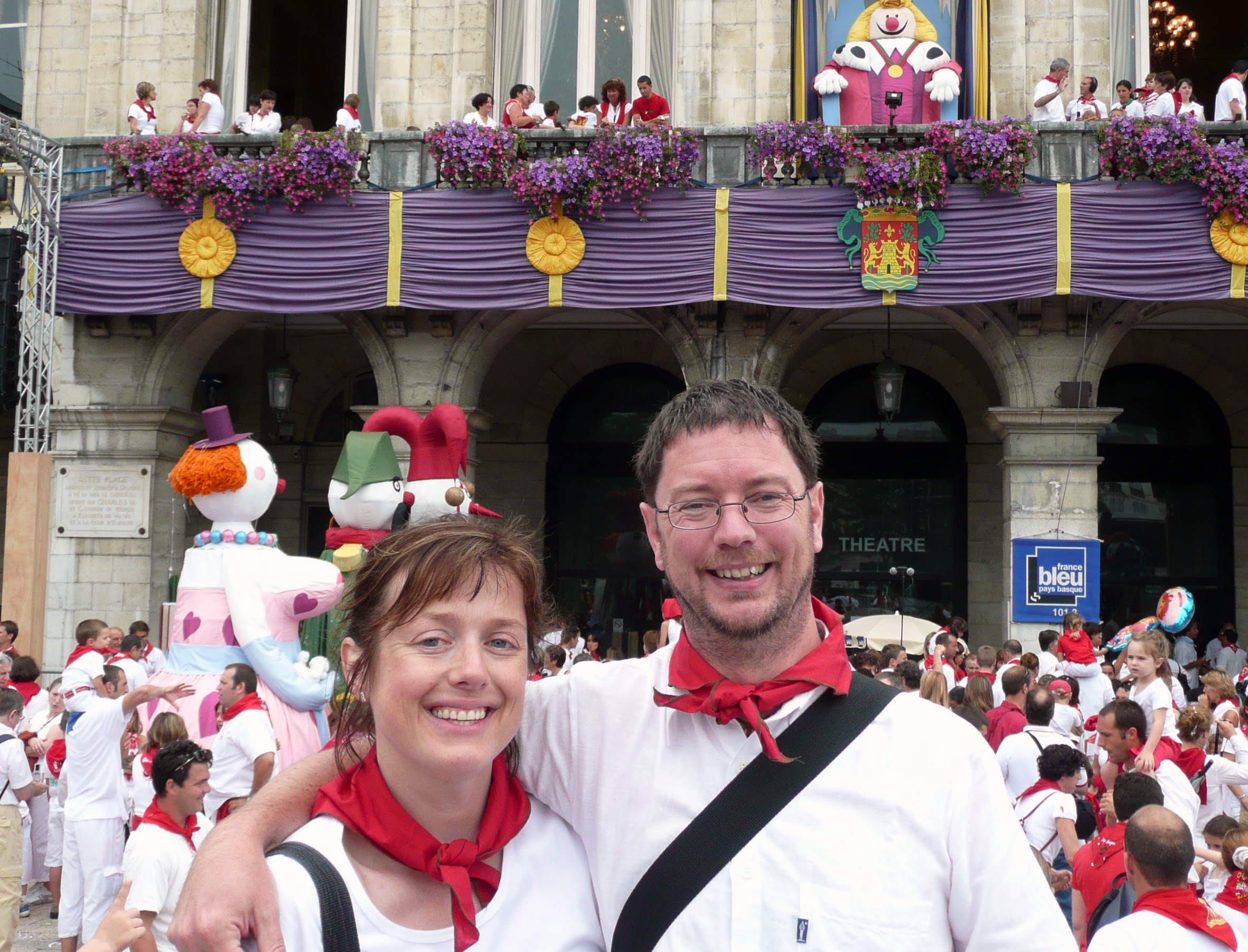
img: Mardi Michels and her mari, Mr Neil, at the Fêtes de Bayonne (2008).

STAY TUNED for tomorrow’s installment from our displaced fictional heroine, Libby, who seeks advice on her unexpected second pregnancy from someone who is older…if not altogether wiser. What, not keeping up with Libby? Read the first three episodes of her expat adventures.

If you enjoyed this post, we invite you to register for The Displaced Dispatch, a round up of weekly posts from The Displaced Nation. Includes seasonal recipes and book giveaways. Register for The Displaced Dispatch by clicking here!

Related posts:

RANDOM NOMAD: Kirsty Rice, Freelance Writer & Blogger

Born in: Renmark*, South Australia
Passport: Australia (no one else will have me!)
Countries lived in: Australia (Adelaide & Perth): 1997-98; Indonesia (Jakarta): 1999 – 2001; Malaysia (Kuala Lumpur): 2001-02; Libya (Tripoli): 2002-04; Canada (Calgary): 2004-08; USA (Houston): 2008-09; Qatar (Doha): 2010-present.
Cyberspace coordinates: 4 kids, 20 suitcases and a beagle (blog)
*A small town of 7,500; my parents still live there.

What made you leave your homeland in the first place?
I am married to a former expat child. I know the term is Third Culture Kid, but I don’t really think it applies to him. He was always keen on doing the “expat” thing. I, on the other hand, was raised in the same town that I was born in and wasn’t a great lover of change. Our first move was the result of a promotion for my husband and the fact that I was pregnant with our first child. The plan was to do a two-year posting in Indonesia and to return “home”. That was 7 countries and 12 years ago. I now thrive on change.

So your husband was already “displaced”?
My husband’s parents were expats. He was actually born in New Zealand and then they went to the Philippines for many years before moving to Sydney, then Melbourne, and finally to Brisbane.

How about your kids?
My children were all born in different countries. We were living in Jakarta when I had my first child, my second was born in KL, the third in Malta and the fourth in Canada. Although none of them have lived permanently in Australia (our longest stint has been during school holidays, so a maximum of 12 weeks), they all think of themselves as Australian. My husband and I have both worked hard for that to be the case.

Describe the moment when you felt most displaced.
When we first moved to Tripoli — it was the middle of summer and I had a two-week-old baby and a two-year-old. We then had to endure months of housing hell — we couldn’t find one! For a while, I shared a “guest house” with about sixty men who were rotating in and out of the desert: there were no other women. Breast feeding amongst men who hadn’t seen a woman for a couple of months was a rather unique experience. Due to the weather, fruit and vegetables were limited and small in size. I can remember standing in a fruit and vegetable stand with a screaming baby and a restless toddler wondering how I was going to cook carrots the size of my little finger. I was continually getting lost, and the simplest of tasks seemed very overwhelming. There were many days that I considered getting on a plane — but I’m so pleased I didn’t. Three months later, we had a house, the weather was better, I made friends, and I loved our life in Libya. I was devastated to leave.

Describe the moment when you felt least displaced.
I feel like that here in Qatar. Our children are at a fabulous school, I have a place to write, and my husband works for a Qatari company and really enjoys it. There is so much here in the community for expats, and we are made to feel very welcome. I have made local friends and love heading to the local souqs. I feel that this is very much our second home. In other locations I have felt that we were passing through, but not here.

You may bring one curiosity you’ve collected from your adopted country into The Displaced Nation. What’s in your suitcase?
From Indonesia: A jamu (traditional medicine) woman made of silver, given to me by a very dear friend.
From Malaysia: The Selangor pewter tea set I was given as a gift. Each time I use it I think of my friends.
From Libya: A wedding blanket with traditional jewellery pinned to it, which was given as a farewell present. It is such a unique gift and always a talking point when people spot it in our house.
From Canada: Nothing material, just the memory of what it was like to be back to work full time. In Calgary, I returned to the “old” me, remembering who I was pre children and travel. That was Canada’s gift — along with a huge appreciation of weather!
From the U.S. (Houston): A fantastic painting of an American flag that I picked up in San Antonio. It’s 3D and not in the traditional colors. It reminds me that America is far more layered and multidimensional that what I’d given it credit for.

You’re invited to prepare one meal based on your travels for other Displaced Nation members. What’s on the menu?
We’ll have some kind of soup for starters: either Indonesian soto ayam (chicken soup), Libyan soup* (I love it!), or the Canadian version of Italian wedding soup. Though I come from an area in Australia that has a large Italian community, I’d never heard of Italian Wedding Soup — turns out it’s more of a North American thing.

For the mains, perhaps I’ll offer a choice between Malaysian curry or maybe a nasi goreng from Indonesia.

And for drinks, we’ll have margaritas. I learned to make a mean margarita in Houston.

For dessert, a caramel cheesecake — a recipe I picked up from a fellow Aussie in Houston.

You may add one word or expression from the country you’re living in to The Displaced Nation argot. What will you loan us?
From Indonesia: Satu lagi (one more) — I said that way to often!
From Malaysia: I just loved how you could put lah on the end of everything and automatically make a sentence sound friendlier.
From Tripoli: Shokran (thank you). It was the first Arabic word I learned and makes me think of how special the people in Libya are — so kind and helpful. Incidentally, in learning how to say “pregnancy test,” I discovered that hamil is the word for “pregnant” in Indonesia, Malaysia and Tripoli.
From Canada: Hey — kind of the same as lah in Malaysian.
From the U.S. (Houston): I found myself describing things differently. It wasn’t just “the big tree out the front” but “the big ‘ol tree out the front.”
From Qatar: Right now I’m back to learning Arabic (unsuccessfully). Oh how I wish I had a chip I could just insert into my brain to switch languages. Why haven’t they invented that yet?

It’s Zen and the Art of the Road Trip month at The Displaced Nation. Robert M. Pirsig, author of Zen and the Art of Motorcycle Maintenance, famously said: “Sometimes it’s a little better to travel than to arrive.” Do you agree?
I disagree. I like to arrive, settle and learn how a city/country works. You can learn so much about a place just by trying to get the telephone connected! Traveling through is just a brief picture. I love that we’ve been able to become part of a community everywhere we have lived.

Pirsig’s book details two types of personalities: 1) those who are interested mostly in gestalts so focus on being in the moment, not rational analysis; and 2) those who seek to know the details, understand the inner workings, and master the mechanics. Which type are you?
If you read my blog you’ll see there is usually a romantic viewpoint or flowery end to a posting. I’m a big believer in things happening for a reason and not always being logical. Having said that, I am a stickler for details, I hate to enter into things blindly and have to know exactly what the story is. Which personality am I in my expat life? I’m a bit of both. I don’t believe that anyone can be a successful expat without having the flexibility to change with the situation. In our daily lives as expats we need to quickly learn the rules, find out the details, go with the flow and just enjoy the ride. You have to be both.

* Libyan soup is a tomato-based soup. There are many variations. The one I loved was with lamb.

Ingredients:
1/2 to 1/3 lb. lamb meat cut into small pieces
1/4 cup oil or “samn” (vegetable ghee)
one large onion
1 tablespoon tomato paste
2-3 tomatoes
1 lemon
1/2 cup orzo, salt, red pepper, Libyan spices (Hararat) or cinnamon

Directions:
Sauté the onion with meat in oil.
Add parsley and sauté until meet is brown.
Add chopped tomatoes, tomato paste, salt, spices, and stir while sizzling.
Add enough water to cover meat, simmer on medium heat until meat is cooked.
Add more water if needed, and bring to a boil.
Add orzo, simmer until cooked.
Before serving, sprinkle crushed dried mint leaves, and squeeze fresh lemon juice to taste.

Readers — yay or nay for letting Kirsty Rice into The Displaced Nation? Tell us your reasons. (Note: It’s fine to vote “nay” as long as you couch your reasoning in terms we all — including Kirsty — find amusing.)

img: Kirsty Rice with her family (sans the beagle) at Souq Waqif, Doha, Qatar.

STAY TUNED for tomorrow’s installment from our displaced fictional heroine, Libby, whose rather dramatic road-trip adventure has come to an end. Time to face reality again in Woodhaven! What, not keeping up with Libby? Read the first three episodes of her expat adventures.

If you enjoyed this post, we invite you to register for The Displaced Dispatch, a round up of weekly posts from The Displaced Nation. Includes seasonal recipes and book giveaways. Register for The Displaced Dispatch by clicking here!

Related posts:

RANDOM NOMAD: Camden Luxford, Hostel Owner, Freelance Writer/Blogger & Student

Born in: Mackay, Queensland, Australia
Passport: Australia
Countries lived in: United Kingdom (Brighton, Oxford, Edinburgh, and a country hotel near Crickhowell, Powys, Mid Wales): 2005-06; Peru (Cusco): 2009-present.
Cyberspace coordinates: The Brink of Something Else (blog)

What made you leave your homeland in the first place?
I left, at 20, because I’d always had an itch. As a kid, I’d poured over National Geographics and Lonely Planets, plotting these exotic routes across strange lands. I think I imagined myself some kind of Lara Croft-type figure. Then I grew up and didn’t really know what I wanted to do with the rest of my life, so I boringly did what thousands of Australian 20-somethings do every year — took off to the UK for a couple of years.

Is anyone else in your immediate family displaced?
Dad’s displaced — in a jet-setting, corporate type of way. He always traveled a lot for work when I was young, domestically and internationally, and now he’s semi-retired and living most of the year in Italy. It’s handy, ‘cos now I have a great place to stay close to really good pizza and wine.

Describe the moment when you felt most displaced.
Waiting at the police station to report an alcoholic Latino ex for threatening to kill me, and having the cops not really care. I just thought in that moment, what I wouldn’t do to be back home, away from this machismo, in a place were I instinctively understand how men and women relate to each other.

Describe the moment when you felt least displaced.
Every Wednesday I get together with my closest friends here in Cusco for lunch. We cook, open a few bottles of wine, and laugh away all the week’s problems and dramas. It’s my Cusco family, and when we sit around the table, teasing each other mercilessly, I feel completely at home.

You may bring one curiosity you’ve collected from your adopted country into The Displaced Nation. What’s in your suitcase?
I tend not to hold on to things, just memories — and a hard drive full of photos. So I’ll describe a treasured photo from each country, instead.

From England: One of myself and my friends on the pebbly beach of Brighton. It’s a candid, and nobody’s posing, we’re just scattered about doing our thing. A couple of the boys are playing chess, a small group is talking, I’m reading a book, someone’s playing guitar. It’s a lovely slice of our lives that summer.

From Wales: Tintern Abbey caught just as the sun set. I was driving, turned a corner, and that sight took my breath away.

From Scotland: An entire album covering my 22nd birthday — from the moment my roommates woke me up with fairy bread and beer until about 4:00 a.m. the following morning. The deteriorating respectability is spectacularly documented.

From Peru: A Photoshopped-together photo of “Yamanyá,” the name of my hostel, spelled out in fire. We were camping by the Templo de la Luna (Moon Temple) outside of Cusco, and after half a bottle of rum I pulled out the camera and an Argentinian friend lit a stick on fire. It kept us entertained for more than an hour.

You’re invited to prepare one meal based on your travels for other Displaced Nation members. What’s on the menu?
Definitely a starter of ceviche: thin fish strips flash-marinated in lime with a touch of coriander, a load of chile, and a pile of fresh red onion, accompanied by a very cold Cusqueña beer. Served on the sand within spraying distance of the waves.

Then, in anticipation of my upcoming move to Buenos Aires, it’s a thick Argentinian steak cooked rare, with a glass of Malbec. Good meat is hard to come by in Cusco, and I miss it.

For dessert we’ll visit Dad in Italy: tiramisu, and then a strong espresso to finish the caffeine kick.

Then the Pisco gets opened, and it’s chilcanos all round: Pisco, ginger ale, a drop of Angostura bitters and a squeeze of lime.

You may add one word or expression from the country you’re living in to The Displaced Nation argot. What will you loan us?
From the UK: Minging has always stuck with me; I have no idea why. For the uninitiated it means disgusting, ugly, gross.
From Peru: Sí, no? — a delightfully Limeñan turn of phrase whose English translation (yes, no?) doesn’t make any sense at all.

It’s Zen and the Art of the Road Trip month at The Displaced Nation. Robert M. Pirsig, author of Zen and the Art of Motorcycle Maintenance, famously said: “Sometimes it’s a little better to travel than to arrive.” Do you agree?
I’ve always loved long, uncomfortable journeys, whether in car, train, bus, boat, or on foot — the process of being in transit, of movement, of change. I even have a sick fascination with long stopovers in airports: sleeping curled up on an uncomfortable bench, announcements blaring over the loudspeakers.

So for me, yes, the journey is a little better. Having been here, in Cusco, for almost two years, I’m growing uncomfortably restless. My mother argues that this is fear of commitment on an epic scale, but I like my life most — feel like I’m learning the most — when I’m on the move, and in the first blush of a new life in a new place.

I will point out in my own defense that I maintain my work and studies even while on the road. In a very stop-start sort of fashion, I’m finishing a Bachelor of Arts in International Studies and a Bachelor of Commerce in Economics from Deakin University in Melbourne, as part of their off-campus program. So I’m not completely irresponsible. (So there, Mum.)

Pirsig’s book details two types of personalities: 1) those who are interested mostly in gestalts so focus on being in the moment, not rational analysis; and 2) those who seek to know the details, understand the inner workings, and master the mechanics. Which type are you?
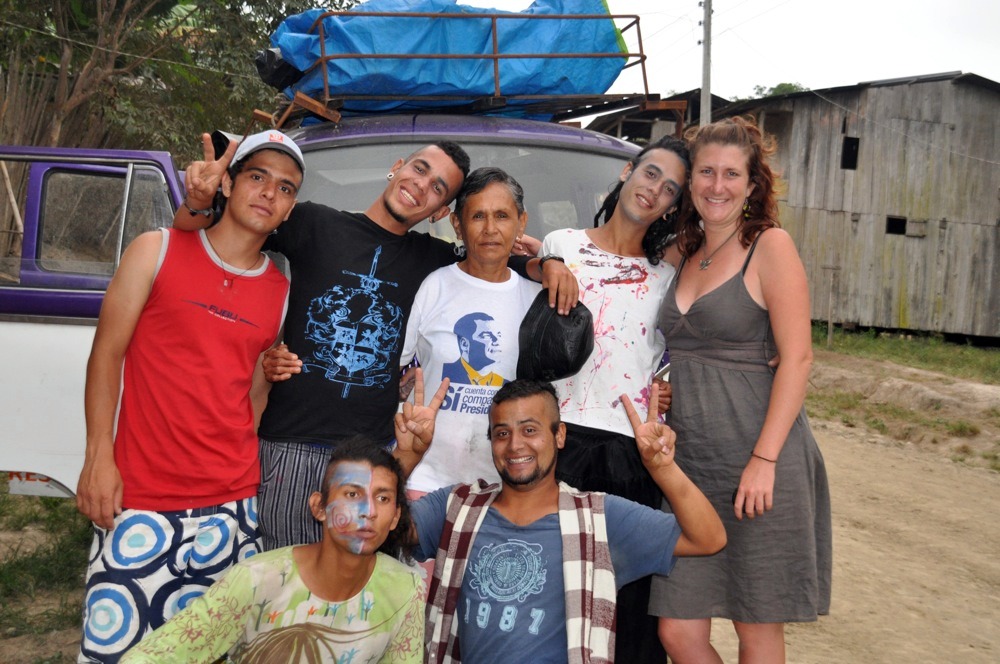
Despite a thoroughly scientific upbringing and education — Dad’s an engineer — and a very rational approach to my studies, when it comes to travel and expat life I’m all about the gestalts. I stayed in Cusco on little more than a whim, and recently returned from an ill-planned but exhilaratingly unpredictable road trip to Ecuador in a Volkswagen Kombi. Every moment of that road trip was a surprise — the cast of characters, a rotating mix of backpackers and South American musicians and circus performers. We followed the sun north, took a minor detour inland to teach a music and clowning workshop to the children in a poor community, and played music on the beach.

But although I laughed and made wonderful new friends and was constantly surrounded by music, this road trip, with its constant visits to mechanics, was also the reminder I needed of the importance of the rational type of personality. Road trips in general are a wonderful encapsulation of this duality, I think. Driving with the windows down on the highway with the music blaring, going where the wind takes you…but going there in a machine that needs care and understanding and maintenance. I’ve leaned too heavily to the romantic side, and it’s time to start taking better care of my machine.

Readers — yay or nay for letting Camden Luxford into The Displaced Nation? Tell us your reasons. (Note: It’s fine to vote “nay” as long as you couch your reasoning in terms we all — including Camden — find amusing.)

img: Camden Luxford on her recent road trip — in a tiny community about two hours form Pedernales in Ecuador, where she helped put on a juggling (among other things) workshop. She is posing with some of the kids and a teacher, along with members of the Colombian cumbia band she had as passengers for a couple of weeks. Yes, that’s the famous Kombi in the background!

STAY TUNED for tomorrow’s installment from our displaced fictional heroine, Libby, whose road-trip adventure of last week ended on a dramatic note. What, not keeping up with Libby? Read the first three episodes of her expat adventures.

If you enjoyed this post, we invite you to register for The Displaced Dispatch, a round up of weekly posts from The Displaced Nation. Includes seasonal recipes and book giveaways. Register for The Displaced Dispatch by clicking here!

Related posts:

RETURN TRIP: Random Nomad – Charlotte Day, High School Student (Sixth Former)

While our writers take off on what they hope will be enchanting August breaks, The Displaced Nation will occasionally be reissuing some posts that, for one reason or another, enchanted our readers. Enjoy these “return trips”!
As youngsters head back to school, we’re reissuing a Random Nomad interview ML Awanohara did with Charlotte Day, a displaced teenager in England. Charlotte spent a chunk of her summer taking a Russian-language course in St. Petersburg and living with a Russian family. She has produced a travel yarn on her adventures, which will appear on Monday.

Born in: Sydney, Australia
Passports: Australia, UK and US Green Card
Countries lived in: Australia (Sydney): 1994-2001; United States (New York, New York): 2001-2010; England (Sevenoaks, Kent): 2010-present

What made you leave your homeland in the first place?
My father is Australian and my mother English. They split up when I was two. When I was six, my mother met and married an Australian who had been living in New York for thirty years. I was rather disgruntled about moving to the United States and for two or three years, remained determined never to accept it as “home.” At that time, I was deeply patriotic to my native country — though this sentiment has dissipated since.

Is anyone else in your immediate family a “displaced” person?
My mother’s family, originally from England, has long been displaced. My mother herself was born in Kenya, in 1961. Following the Mau Mau Uprising, her parents were forced to relocate, and my grandfather, presented with a choice between Australia and Canada, chose the warmer of the two countries. My mother spent her childhood bouncing between schools in England and Australia. She eventually grew so fed up with packing and unpacking, she decided to leave school at the age of 16. Her father agreed to the plan provided she spend a final year at the school in Switzerland his own mother had attended as a girl. My mother moved on from Swiss finishing school to work in London, Paris and Sydney. But she appears to have made New York her last port of call. Indeed, we had a fairly solid life in the city until I decided to take myself off to boarding school in England.

Describe the moment when you felt most displaced over the course of your many displacements.
It must have been when I first arrived in New York as a six-year-old. I stepped out of the JFK arrivals terminal into a snowy March night. My stepfather was wearing a leather coat, the interior of his car smelled of leather — and the world outside the car window seemed an undulating stream of black and silver. Though it was the end of 2001’s warm winter, my Australian blood froze beneath my first-ever coat. And their apartment — that was all leather as well. It smelled of musk and cologne. Since that time, I have felt similar pangs of displacement, some of which lasted for considerable periods. But those first few moments in New York stand out as the most acute concentration of “displacedness” I have ever known.

Describe the moment when you felt least displaced.
For the last five or so years in New York, I have felt more at home than I ever did in Sydney. I ascribe this to growing up: at a certain age, one can take possession of a city, know its streets, bridges, tunnels and transportation system. I was too young when I lived in Sydney to reach that kind of comfort level. But when have I felt the most like a New Yorker? Perhaps it was the last time I came home for the holidays, and took the 4 train uptown for the first time in months. At that moment I realized how much this train had been a part of my life — conveying me home from school every day for two years. My old life would always be waiting for me on the subway, ready for me to pick it up again. That’s something only a New Yorker could say!

You may bring one curiosity you’ve collected from each of the countries where you’ve lived into the Displaced Nation. What’s in your suitcase?
From Australia: A miniature wooden wombat figurine — a gift from my grandfather. It conjures memories of a childhood spent beating about the bush (literally) and fishing for yabbies at the dam in the company of audacious dogs who stuck their heads down wombat holes, to no good end.
From New York: A pair of fake Harry Potter glasses. These defined my first six months in New York — I even wore them to my first day of school. I think it is telling that even at the age of six, I was unwilling to give all of my real self to this new home.
From England: My school tie — representative of the alternative universe I seem to have entered. At boarding school, the sense of removal from reality can be disconcerting — especially after having spent a decade in the city I regard as the world’s capital.

You’re invited to prepare one meal based on your travels for other Displaced Nation members. What’s on your menu?
I’d like to make you a Sydney breakfast: scrambled eggs, made with cream, salt and pepper and served on a bed of Turkish toast, with avocado and stewed tomato on the side (is this being greedy?). Our meal will be accompanied by a large “flat white”: what we call perfectly strong, milky coffee without excessive froth. I suggest we consume it overlooking a beach on a Sunday morning. At least, I assume The Displaced Nation has beaches?

You may add one word or expression from each of the countries you’ve lived in to The Displaced Nation argot. What words do you loan us?
From Australia: Daggy. I use this word all the time — and did not realize it was exclusively Australian until I was informed of the etymology. Apparently, it comes from trimming the soiled wool around a sheep’s bottom. Which part of this repugnant whole is actually the “dag,” I do not remember. (No, I’m not a proper Australian!) But as I understand it, “daggy” means sloppy in appearance or badly put together.
From New York: There are so many words, and most are second nature by now. However, I will choose grande-soy-chai-tea-latte because I still shudder to think of myself as the kind of person who can utter such a phrase, at great speed, with great insistence. In fact, I’m still in denial about my love for Starbucks: having known Sydney coffee, my standards should be higher.
From England: Banter. I still do not know the precise meaning of this word, but it seems to encapsulate everything that makes someone my age feel socially acceptable — and, of course, I have no banter whatsoever. I think it means the capacity for combining wit with meaningless conversation. But there are other components, too, which seem to me unfathomable.

Question: Readers, tell us what you think: should we welcome Charlotte Day to The Displaced Nation and if so, why? (Note: It’s fine to vote “no” as long as you couch your reasoning in terms you think we all — Charlotte included — will find amusing.)

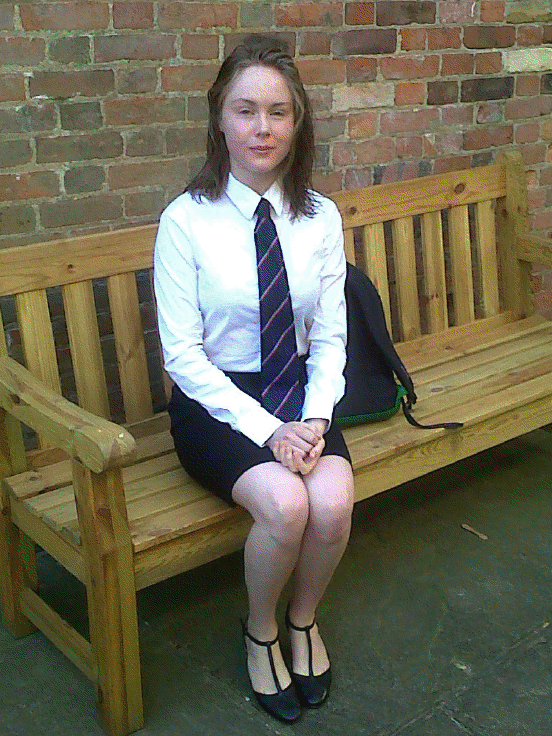
img: Charlotte Day at her boarding school in southeast England

If you enjoyed this post, we invite you to subscribe to The Displaced Dispatch, a weekly round up of posts from The Displaced Nation, plus some extras such as seasonal recipes and occasional book giveaways. Sign up for The Displaced Dispatch by clicking here!

Related posts:

CLASSIC DISPLACED WRITING: Joy in the place — Elizabeth von Arnim

The novelist Elizabeth von Arnim (1866-1941) wrote many enchanting books, all of which were autobiographical to some extent, linked to persons or places she knew.

But does that necessarily mean that Elizabeth — born Mary Annette, nicknamed May, she called herself “Elizabeth” upon becoming a professional writer — led an enchanted life?

Yes and no. By all accounts, she was an enchanting person herself, constantly delighting other people with her sharp wit.

She also kept enchanting company: E.M. Forster was tutor to her children, Katherine Mansfield was her adopted cousin, and H.G. Wells was one of her lovers.

Displaced almost from birth (she was born in Kirribilli Point, Australia, and then moved to England at the age of three), she made a life-long habit of flitting from one enchanting locale to the next.

Having spent her formative years in London, she moved to Pomerania in Prussia (Germany) for her first marriage, where she raised five children.

Upon the death of her husband in 1910, she made her home in the Valais, Switzerland, living in a glamorous house, Chalet Soleil, which she’d built from her riches as an author.

With the failure of her second marriage, Elizabeth zigzagged between homes in the United States and Europe.

She died in Charleston, South Carolina.

A full measure of sorrows

But a peripatetic life isn’t always a charmed one, as many of us expats and former expats can attest. As her life progressed, Elizabeth experienced a full measure of sorrows.

Her first marriage — to a domineering Prussian count — wasn’t particularly happy. She nicknamed him the Man of Wrath, and they separated several years before his death.

Her second marriage, to Frank Russell, elder brother of Bertrand, was even more miserable (he proved to be a despotic egoist).

Her only true love she met when she was 54 — and he was nearly 30 years younger. (They never married.)

She also suffered the grievous deaths of a daughter and a brother.

By the time she died, Elizabeth was estranged from most of her children, crippled with arthritis, and almost forgotten by her adoring public.

Her only devoted companion was her dog, Billy.

Escape artist par excellence

But despite these tribulations, Elizabeth remained throughout her life, in the words of gardening writer Deborah Kellaway,

a steadfast hedonist, firmly suppressing sorrows. … Her journals and letters repeatedly record moments of happiness, usually associated with sunny days.

As Elizabeth once wrote in a letter to one of her daughters,

“What I really am by nature is an escapist.”

Thus what we can learn from Elizabeth’s life — and from her many autobiographical books — is the art of escaping into happier worlds.

As Kellaway explains:

[The heroines of her novels] escape from richness into the simple life, or from conventional home life into foreign travel; they escape from houses into caravans.

The most famous example, of course, is Elizabeth’s 1922 novel, The Enchanted April — from which we’ve taken our theme of enchantment on the blog this month.

As everyone knows who has read that book — or, more likely, seen the 1992 film or the 2003 Broadway play — four women who share only their unhappiness and a love of wisteria flee 1920s London and converge in Portofino, Italy, on a magical medieval villa overlooking the Mediterranean.

Simple pleasures are the best?

But while Italian castles can certainly be a tonic — if offered one, I’d be off like a shot — what most people don’t know is that Elizabeth was equally fond of much simpler escapes. In the first two books that made her reputation as a writer, the heroine escapes her marital, motherly and household duties by venturing into a German garden, set in a wide landscape.

Here is the most lyrical passage from the second of these, The Solitary Summer (1899):

Yesterday morning I got up at three o’clock and stole through the echoing passages and strange dark rooms, undid with trembling hands the bolts of the door to the verandah, and passed out into a wonderful, unknown world. I stood for a few minutes motionless on the steps, almost frightened by the awful purity of nature when all the sin and ugliness is shut up and asleep, and there is nothing but the beauty left. It was quite light, yet a bright moon hung in the cloudless, grey-blue sky; the flowers were all awake, saturating the air with scent; and a nightingale sat on a hornbeam quite close to me, in loud raptures at the coming of the sun. …

It was wonderfully quiet, and the nightingale on the hornbeam had everything to itself as I sat motionless watching that glow in the east burning redder; wonderfully quiet, and so wonderfully beautiful because one associates daylight with people, and voices and bustle, and hurrying to and fro, and the dreariness of working to feed our bodies, and feeding our bodies that we may be able to work to feed them again; but here was the world wide awake and yet only for me, all the fresh pure air only for me, all the fragrance breathed only by me, not a living soul hearing the nightingale but me, the sun in a few moments coming up to warm only me…

A lovely garden at just the right time of day — as I know from my own experience of enduring many city summers*, that’s all it sometimes takes to escape into happiness.

*On that note, I’d like to recommend a walk on the High Line in early morning or late afternoon, to anyone living in or traveling to New York City this month…

QUESTION: What does it take for you to escape the dog days of summer into happiness: a trip to Italy, a walk in the garden — or something else?

STAY TUNED for tomorrow’s post, on our new weekly newsletter, The Displaced Dispatch.

If you enjoyed this post, we invite you to subscribe for email delivery of The Displaced Nation. That way, you won’t miss a single issue. SPECIAL OFFER: New subscribers receive a FREE copy of “A Royally Displaced Tea.”

Related posts:

Youth writer Gabrielle Wang’s characters solve cross-cultural conundrums with magic and aplomb

The spirit of Pocahontas has been haunting The Displaced Nation this month, lending a helping hand to anyone who feels stymied by the strange customs they’ve encountered in other lands.

This precocious Native American girl appears to have been naturally gifted in openness and tolerance — else how could she have become an intermediary between her father’s tribes and the Jamestown settlers at age 10?

The majority of us, however, are not naturals when it comes to cross-cultural relations. We could use some basic training, preferably while still young.

As suggested in one of this month’s posts, one solution might be to absorb the whole of Harry Potter — all those tales of discrimination against Half-bloods and Muggles.

But not every youth can identify with a universe that is governed by the laws of who’s magic and who isn’t. Take Pocahontas, for instance. If she prayed for magic in her dealings with the white invaders, it was most likely for herself, never mind anyone else.

Perhaps, then, I have her to thank for guiding me towards Melbourne-based author Gabrielle Wang, whose books for children and young people feature characters who in many ways resemble the feisty Anne of Green GablesPollyanna or Calpurnia Tate — but with a further twist: Wang’s heroines are always non-white, Chinese or some mix. They are culturally marginalized.

Wang’s very first book, The Garden of Empress Cassia (to be published for the first time in the U.S. this fall) involves a heroine, Mimi, who feels ashamed of being Chinese until she discovers a a box of magic pastels that enables her to draw, and then enter, the garden of the Empress Cassia — a transformative experience.
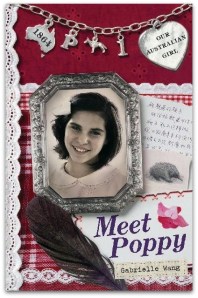
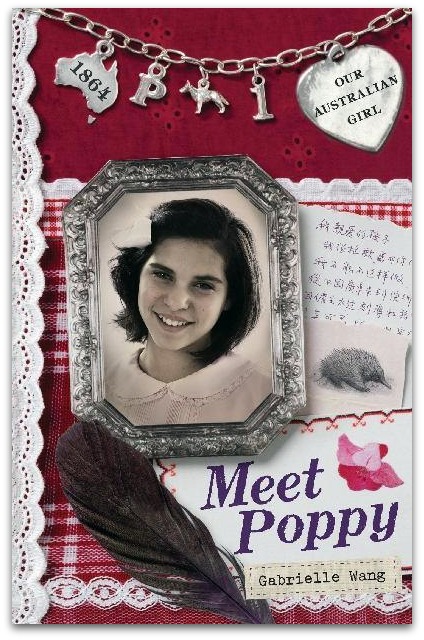
Wang’s latest heroine, Poppy, is even more unusual: she’s a half-Chinese, half-Aborigine girl who lived in the 19th century. Poppy’s Aboriginal mother died when she was a baby, and her Chinese father disappeared before she was born. When her brother, Gus, runs away to look for gold, Poppy decides to follow. Disguising herself as a boy, she stows away on a paddle steamer and keeps in touch with Gus through a secret code and Chinese symbols.

Wang’s books are targeted at the youth market, but adults are very fond of them as well. Here’s what one reviewer had to say of her first book in the Poppy series:

I’m sure young girls living in Australia who are interested in their country’s history will love this book, but as an adult living in America, I really enjoyed it too!

I recently had the pleasure of meeting Gabrielle Wang in person — at a congee restaurant in New York City’s Chinatown. Here’s how our conversation went:

Can you tell me a little about your background?
I’m a fourth-generation Chinese Australian on my mother’s side and first generation on my father’s. I live in Melbourne, where I’ve been a professional writer of children’s and young adult books for nine years. I’ve written ten books published by Penguin Books Australia, and a picture book published by Blackdog Books, now an imprint of Walker.

All my novels involve cross-cultural issues as that is my background. Being brought up in Australia and knowing little about my own heritage, I felt was a tremendous disadvantage. I was ashamed of looking different. I couldn’t speak Chinese and knew little of the beliefs and customs of China. Now, when I look back at that period in my life I know that if I’d been steeped in the culture of China, I would have grown up proud of my heritage. It was only when I left school that I realized that belonging to two cultures was an advantage and began learning Mandarin.

My latest books are being released this year three months apart. There are four in the Our Australian Girl series about a half-Chinese half-Aboriginal girl named Poppy.

Right now I’m working on a ghost short story for a Penguin anthology as well as thinking about my next novel, called The Wish Bird.

This month, our blog has dedicated many of its posts to Pocahontas, who was a member of the original displaced peoples in North America. Are the stories of the Native Americans and Australia’s Aborigines very similar?
Definitely, there are many similarities. But my impression of the Native Americans is of a more warring people — at least that’s how they’re often portrayed in the old cowboy-and-Indian films. I’m probably stereotyping here. The Aborigines were also driven off their hunting grounds. Many were slaughtered by the squatters while others starved to death or died from disease. It was a tragic time in Australian history which carried through even to the 1960s. The scars and the injustices still exist today.

The European settlement of Australia occurred at least a century later than that of North America. Were Australia’s settlers still influenced by the ideal of the Noble Savage, “the good wild man,” in their encounters with the natives?
The squatters of the 1800s looked down upon the Aborigines. They had no idea that the Indigenous Australians had a highly advanced and complex culture and belief system. And by the 1850s and 1860s, when my Poppy stories take place, the ideal of the Noble Savage never crossed anyone’s mind. At that time, large numbers of people from all over the world went to Australia to look for gold, not to discover a new land.

Turning to your Poppy books, I noticed that you employed the nature trope that’s associated with the Aborigines. Poppy uses the Southern Cross to guide her travels, follows water birds, eats wild raspberries and honey-flavoured sap-sucking bugs…
The Aborigines’ belief system is closely linked to the land they inhabit and to the animals in their environment. They have animal totems and there are sacred places all around Australia. Unfortunately, most of these sacred sites are not in the hands of the local Indigenous people and have been lost or desecrated. But if you go and visit the known ones, like I have, you can still feel a tremendous power and energy in the landscape.

When I was on a writing/walking trek through Central Australia near Alice Springs, we camped, with the permission of the local Indigenous tribe, on a sacred site. It was an amazing experience.

I am very interested in the Chinese philosophy of yin and yang, the I Ching and Daoism – which are not that dissimilar to the beliefs of the Indigenous Australians and their relationship with nature. The Aborigines are also like the Chinese in that they have an advanced plant medicine system.

Was it difficult to think through how an Aborigine child might have felt back then?
In my story, Poppy was born on a Christian mission, so she knows very little about her own culture. I am not an expert on Aborigine culture, so I was careful not to step over the line. I had several Aboriginal advisors who I consulted with. John Sandy Atkinson is an elder for the Bangerang tribe and Maxine Briggs is the Koorie Liaison officer at the State Library of Victoria. They were invaluable to me while writing the Poppy series. As a Chinese person, I know how wrong some authors can be when writing about a culture they have little knowledge of. It is easy to misconstrue and misunderstand things so I was careful to avoid this.

Since you’re so interested in the topic of portraying other cultures, you may find it interesting that Maxine Briggs lent me Werner Herzog’s film Where the Green Ants Dream just so I could see how NOT to portray another culture. The film as you may know had to do with a dispute between a mining company and the local Indigenous tribes in the Australian desert.

I noticed in reading some excerpts that the white people Poppy meets behave quite decently. Did you make them like that on purpose?
Race is a highly sensitive subject and sometimes it’s difficult to strike a good balance. In Poppy’s time, the 1860s, racial prejudice towards Aborigines was at an all-time high. But I’m always aware of my audience — children 8-11 years old. When you write for young people you have a responsibility. It is important to be positive; otherwise, the same prejudices can begin all over again.

Up until now, you’ve created Chinese heroines for your book. What inspired you to create a character who was only half-Chinese?
I wanted to write about the period when my maternal great-grandfather came to Victoria to join the Gold Rush. I also wanted to highlight the plight of the Indigenous population during that time when white settlement expanded at such an alarming rate. Before 1834, around 100,000 Aboriginal people lived in the State of Victoria. By 1860, with the influx of white settlers and the discovery of gold, this number had fallen to less than 2000. That figure is shocking.

I think I’d also been influenced by the recent consciousness in Australia about the injustices done to the Aborigines. Beginning in 1869, the Australian government rounded up the Aborigines into missions (as already mentioned, Poppy is from one such mission) and began removing some of the children — the ones who were of mixed race — from their families to work as indentured servants for white families. I’m talking about the so-called stolen generations. If you’ve seen the film Rabbit-Proof Fence, you’ll know what I’m talking about.

It’s a big issue right now in Australia — and is finally being recognized as a national tragedy. The former Prime Minister, Kevin Rudd, presented a formal apology in 2008 for this misguided policy. It was a long time coming.

To sum up: I could have just written about a Chinese child, but I wanted to stretch myself and imagine a child who was half Chinese, half Aborigine. It is important for young people to walk in the shoes of someone who is different — who might be of a different culture, race and skin color. Only by doing this can we empathize with others.

Were you able to find any examples of half-Chinese, half-Aboriginal children on which you could base the story?
In my research there were no written records in Victoria of mixed race children at that time. But there’s no doubt they would have existed as the Chinese gold diggers were all men. They left their wives and family back in China.

So an Aboriginal character was a first for you. Was it also the first time a non-Aboriginal person had written a story for kids?
No. The highly respected and wonderful Australian children’s author Patricia Wrightson may have been the first. But I’m certainly the first non-white Australian author to write about an Aboriginal character.

Is it important that you’re a “non-white”?
I think I was able to imagine the Aboriginal child’s situation quite easily because I know what it feels like to be an outsider, and to suffer racial prejudice. I was the only Asian child in my school in Melbourne and I only saw white faces in the street. I always felt embarrassed when my parents came to school as my mother would sometimes appear in traditional dress, and my father didn’t speak English well, which I found embarrassing. Of course, it’s changed now as more Chinese have migrated to Australia, but back then, Chinese Australians were real outsiders.

You have been an expat for several years, living in Taiwan and then Mainland China. Can you tell us what that felt like?
Strangely enough, before my first visit to China in 1977, I always said that I was going back to China even though I had never been there before. Perhaps this is true of many children of migrants. When I actually went to Taiwan and China to live, I was at a disadvantage because I couldn’t speak Chinese very well and therefore was never fully accepted. Language is so important.

There were a couple of incidents in particular that made me realize how difficult it would be living in China — apart from the difficulty of learning the language, that is.

Once in Taiwan, I was invited to a friend’s house. It was her birthday. I brought a gift of a necklace, but was so surprised when she didn’t open the gift, nor did she acknowledge its receipt with a thank-you. I thought, how rude! I had no idea that in China, it’s rude to open gifts in front of the giver.

The other incident occurred in Mainland China, when I was invited to a banquet by a friend of my mother’s. She sat next to me and kept filling my plate. In Australia, it’s impolite not to finish the food on your plate, so I kept eating what was given to me, only to have it filled again. Finally, when I couldn’t fit in another morsel of food, I put my chopsticks down and sat back. My hostess breathed an audible sigh of relief. In China, of course, people like to show their hospitality by giving their guests more food than they can possibly eat.

Your personal story is inspirational as you never fancied yourself a writer.
When I was younger, I didn’t think I could write at all. I failed Year 12 English and had to repeat the whole year because I wanted to study Graphic Design at University. When I became interested in children’s books, it was to illustrate them not to write the words. But in the year 2000 I took a writing course and discovered I had hidden potential. We all do, I think. And it’s never too late to find out what it is. I explore that theme a lot in my books, especially The Hidden Monastery.

As part of Pocahontas month, we’ve been coming up with proverbs for those who wish to spend their time abroad getting to know other cultures. Can you give us one proverb based on your own experiences?

“If you want to know what it means to be a migrant or a person who is displaced by outside forces, then live in — don’t just visit — another country where you cannot speak the language.”

To that I would add:

“If you can, make it a country where people have skin of a different color to yours. Then, and only then, can you understand what it means to be an outsider.”

Gabrielle Wang’s book The Garden of Empress Cassia will be published in USA by Kane Miller this September. You can also visit her Web site at www.gabriellewang.com.

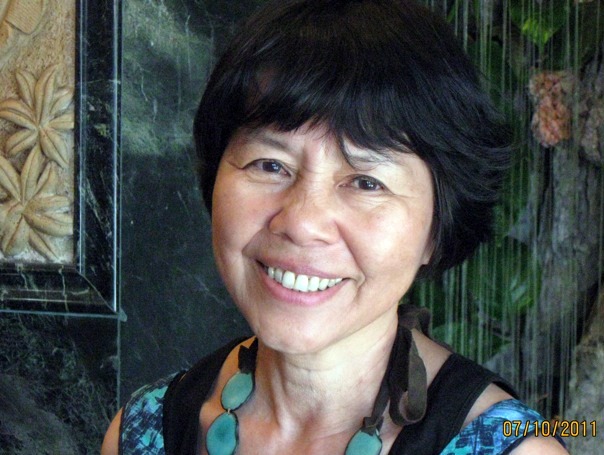
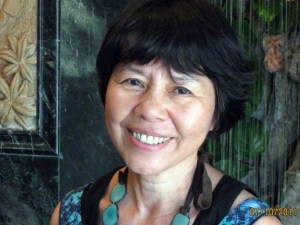
Images: Gabrielle Wang at Congee Bowery, NYC (by Susumu Awanohara); front cover of Wang’s first Poppy book; and front cover of the about-to-be-released American edition of her very first work, The Garden of the Empress Cassia.

STAY TUNED for tomorrow’s installment of our displaced fictional heroine, Libby, who learns more about her bête noire, the realtor Melissa. Were her initial misgivings about Melissa justified?

If you enjoyed this post, we invite you to subscribe for email delivery of The Displaced Nation. That way, you won’t miss a single issue. SPECIAL OFFER: New subscribers receive a FREE copy of “A Royally Displaced Tea.”

Related posts:
RANDOM NOMAD: Simon Wheeler, Steel Automotives Project Leader & Former Cricketer

Born in: Aylesbury, Bucks, England
Passport: English (never ever say British!)
Countries lived in: Australia (Adelaide): 1996-98; California (Newport Beach): 2006-09; Slovakia (Plavé Vozokany): 2006-present
Cyberspace coordinates: Rambling Thoughts of Moon | Englishman’s travelling thoughts from England, California and now Slovakia, Plavé Vozokany… Ahoj !! (blog)

What made you leave your homeland in the first place?
My initial travels to Australia came through boredom of work. Having worked in a large pharmaceutical company from 17, at 24 I realized that I needed to have some new adventures. I am a firm believer that if you don’t like your current situation, change it. When I was asked to go play cricket at Grade A level for the Fulham Cricket Club in Adelaide, I packed my bags and left. Actually, I got cold feet about two weeks before I was due to leave. But then a close friend was suddenly struck ill on a Friday, and sadly died two days later. That was the kick I needed.

Is anyone else in your immediate family displaced?
My sister is now a Canadian citizen living in Vancouver. She has been away from England for over 15 years.

Describe the moment when you felt most displaced over the course of your many displacements.
Can I have two? The first occurred just after I’d gotten married to my gorgeous wife on top of Grouse Mountain in Vancouver. After the wedding, she had to go back to her job in California, while I continued waiting in Vancouver for my visa to be approved. In those three months of waiting, the uncertainty of not knowing if I would be allowed to join her made for very stressful times. We could simply have flown back to England, where a job was being held for me in the City. That would have been so easy, but that said, we have never chosen the easy option.

The other time occurred much earlier: May 24th, 1997. A very precise date, but I remember it so well. I was on the road from Melbourne to Sydney, all on my own, on my birthday, and not one person said “Happy Birthday” or even knew it was my special day.

Describe the moment when you felt least displaced.
I’d have to say right now. We moved to my wife’s homeland two years ago. The culture shock, combined my lack of language skills, was daunting at first. The people, especially her family, have been incredible, but finding a life was very tough. Since we moved here, we have both found jobs in the same company; had our first child, the adorable Matej; and are about two months away from moving into the cottage we are renovating in the village next door to Plavé Vozokany (we’ve been living here with my wife’s parents since our arrival). So, right now, I am on the verge of having all I have ever wanted. To settle into a new country takes time, a lot of time, especially one that is so different to your homeland. I still have some time to go, but with the growing family, a supportive wife, a good job, and soon my dream house, I am ticking all the right boxes.

You may bring one curiosity you’ve collected from each of the countries where you’ve lived into the Displaced Nation. What’s in your suitcase?
From England: My St George’s flag — not because I wish to be associated with rowdy football supporters but because it’s a symbol of my country that I’m very proud of.
From Australia: My Ugg boots from the open-air market in Port Adelaide. I have them on right now!
From California: My photographs from the incredible national and state parks in the Western United States: Grand Canyon, Death Valley, Zion, Bryce, Joshua Tree, Big Sur… I could go on…
From Slovakia: A bottle of homemade Slivovica, a plum brandy strong enough to blow your socks off!

You’re invited to prepare one meal based on your travels for other Displaced Nation members. What’s on the menu?
Whoa, that’s tough… But let me try. To start, we’d have fresh prawns and seafood from Australia. As my main, I’d offer my Mum’s Christmas dinner: turkey, sausages and bacon, Brussels sprouts, veggies galore, roast potatoes, cranberries, stuffing… And if there’s still room, I’d throw in some sushi from Masa Sushi, a tiny, simple, dirty-looking place off 19th Street and Habour in Costa Mesa, California — the host/chef really knows what he’s doing. For dessert, we’d have fresh, homemade cream cakes from my mother-in-law here in Slovakia. It would all be washed down with an Australian white, a pint of Coopers (Southern Australian beer), and a couple of shots of Slivovica.

You may add one word or expression from each of the countries you’ve lived in to The Displaced Nation argot. What words do you loan us?
From Australia: Beauty (said in a heavy Aussie accent). It’s used all the time — but most especially on the cricket fields, after a player hits a good shot or the bowler gets a wicket.
From England“In England’s green and pleasant land…” We sang “Jerusulem” at my wedding and on many drunken occasions. It always takes me home…
From California: Awesome — but I’d advise that you restrict the usage to things that are truly awesome; otherwise, it loses its meaning. That pair of shoes is AWESOME; that TV show is AWESOME; You are AWESOME — no! The Grand Canyon is awesome — yes!

It’s Pocahontas month at The Displaced Nation, and we’re focusing on cross-cultural communications (or the lack). By living in your wife’s country, do you find that you’re relying on her to serve as your “interpreter” for Slovakian language and culture? Does this place a special stress on the marriage, and if so, how do the two of you cope with it?
Yes, it definitely does. When you go away on holiday and do, say, exploratory grocery shopping, it’s all a bit of fun trying to cope, but when you actually move to the country it’s totally different. So many things to sort out: banks, mortgages, identity cards, driving license — the list is endless. And she has to do all of this. Even if I have to make a trip to the doctor’s, she has to come. When you are sitting there having two people discuss your health, and you cannot understand what they’re saying, it’s very stressful. As I mentioned earlier, we are renovating an old Slovak cottage. But to communicate with all the different workers and tradesmen, again, she has to do it all… You can imagine what a workload she carries for this project, and the uselessness I feel in not being able to help her.

Our relationship, like so many others, works because one of us takes the lead, and in our case, that happens to be her. Imagine Monica Geller from Friends — well, that is my wife. She likes to be in control. Even when we were living in America, she was in charge. So for us, with some blips, it does work. But whenever I want to do things — relieve her of some of her workload and stress — it’s a struggle. My Slovak is improving, but it is not good enough to cope with these kinds of demands. It’s a very tough language, and at 40, I am a poor student.

QUESTION: Readers — yay or nay for letting Simon Wheeler into The Displaced Nation? Tell us your reasons. (Note: It’s fine to vote “nay” as long as you couch your reasoning in terms we all — including Simon — find amusing.)

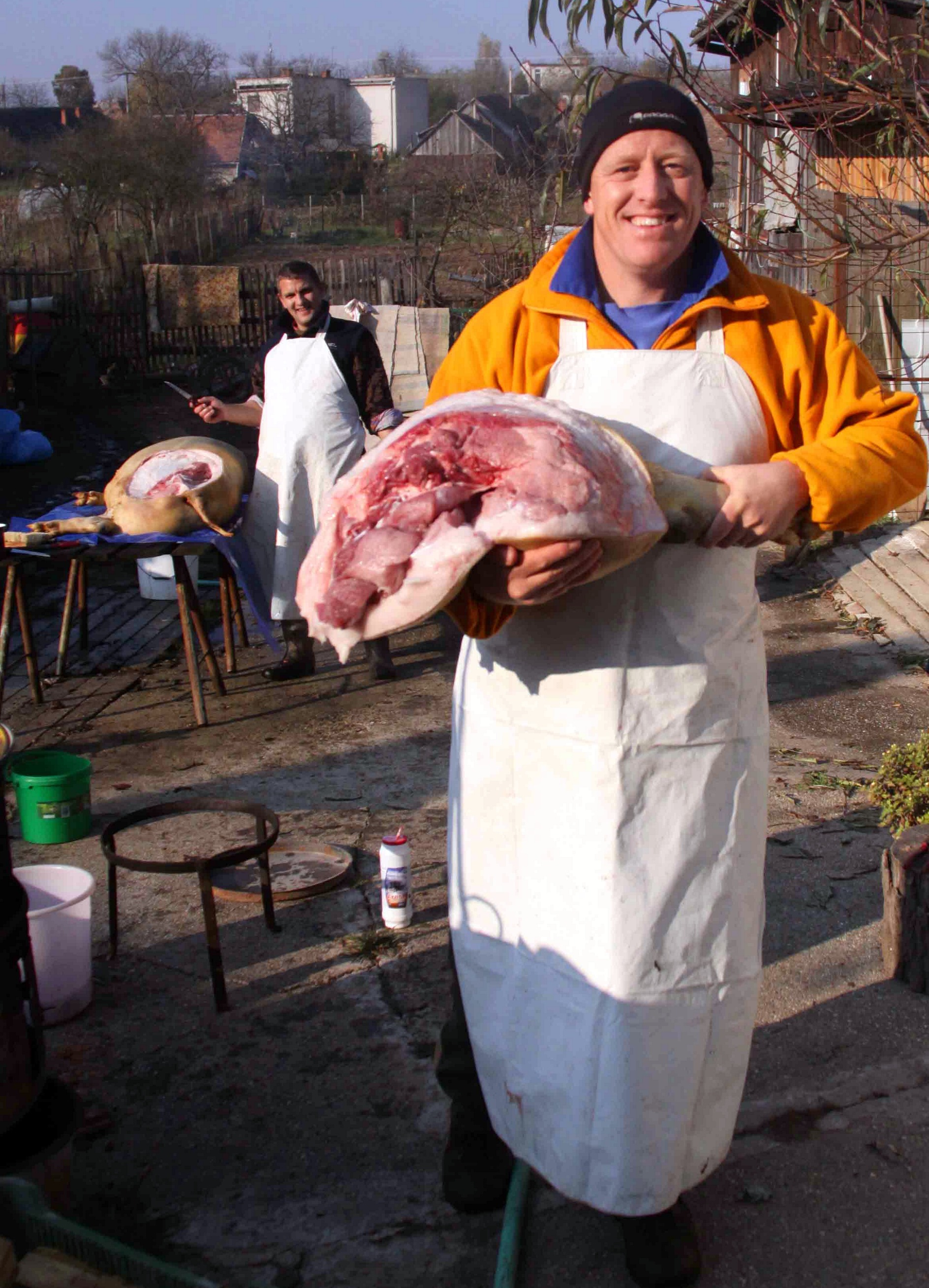
img: Simon participating in the traditional slaughter of pigs that occurs in his Slovakian village every year. His comment: “Most village families rear a couple of pigs every year for this purpose. The custom was new to me, and I didn’t like the idea — never ever thought I’d be doing this kind of thing! But it does mean you can fill your freezer with good quality, home-bred meat and sausages, and I’ve gotten used to it.”

STAY TUNED for tomorrow’s installment from our displaced fictional heroine, Libby, who encounters her very first 4th of July celebrations.

If you enjoyed this post, we invite you to subscribe for email delivery of The Displaced Nation. That way, you won’t miss a single issue. SPECIAL OFFER: New subscribers receive a FREE copy of “A Royally Displaced Tea.”

Related posts:
RANDOM NOMAD: Vicki Jeffels, blogger, freelance writer & social media consultant

Vicki JeffelsBorn in: Auckland, New Zealand
Passport: New Zealand (only, and proud of it!)
Countries lived in: Fiji Islands (Vatukoula): 1973-77; Australia (Brisbane): 1996-98; England (Tadley, Hampshire): 2008-present
Cyberspace coordinates: Vegemite Vix | A Kiwi expat in the UK licking the Vegemite off life’s fingers (blog); Digital Discussions (start-up consultancy)

What made you leave your homeland in the first place?
I first became an expat at the tender age of 3.5, when my family moved to the Fijian Islands for my father’s work: he had a contract with the Emperor Gold Mines in Vatukoula. I have wonderful memories of expat life as a child. The days were honeyed with heat, we munched sugar cane off the back of the cane truck, and we swam with the tropical fish through the intricate coral reef. Of course, a child’s experience is so very different from an adult’s, and now I’m a parent, I’m more aware of the challenges my parents faced — which included being robbed, almost being airlifted out in civil unrest, and sheltering under the house during the monstrous Hurricane Bebe in 1972.

I moved overseas again — to Brisbane, Australia — with my first husband in 1996, with a two year old and two-week-old baby in tow. On reflection, that wasn’t brilliant timing. We struggled to make a home for ourselves particularly as my (then) husband was working in Perth, an eight-hour flight away — leaving me to cope on my own in a new country with two babies. I did it, though. I made friends through the children’s networks and found work for myself — until two years later, when my husband was suddenly made redundant and we limped back to New Zealand with our tails between our legs.

My most recent expat adventure started on a holiday in Paris in 2007 when I met a rather scrumptious Englishman. We chatted, we flirted, we kept in touch long after we’d returned home — and our long-distance relationship soon blossomed. A year later, I packed up my three kids (two teens and a tweenie), dog, cat and 20 boxes of books and moved to Hampshire to live with my Englishman. After a romantic engagement atop Mt Hellvellyan (yes, he made me climb a mountain to get the engagement ring!), we married in his village church in North Yorkshire in 2009.  I’ve written about our story on my blog and am currently writing it up as a memoir — hopefully coming to a bookstore near you, shortly.

Is anyone else in your immediate family displaced?
All of my immediate family currently live outside of New Zealand. My mother, father and sister all live in Australia, but I wouldn’t say they are “displaced.” They are all happy living there and hold Australian passports, and my mother is an Australian by birth.

Describe the moment when you felt most displaced over the course of your many displacements.
When I found myself standing in front of the judge at the Asylum and Immigration Tribunal in London three weeks after our wedding, having swapped my wedding bouquet for brickbats from the UK Border Agency, as they probed and prodded and demanded to find fault with our story. Standing there pleading to stay in the UK with my husband and kids — when everything in my body was screaming “Get me out of here!” and “Get me home!” — was one of the hardest things I’ve ever done. It was dissonant not only because we were newly married — and I longed to go home and celebrate with my friends and family but had been restricted from leaving the country — but also because I’m the archetypical “good girl” who has barely ever had a parking ticket. What was I doing standing in front of a judge being cross-examined by solicitors? It was scary stuff and deeply disturbing — as if the entire nation wanted me to just leave. It was the final straw after a year’s worth of feeling displaced — of saying the wrong thing and being laughed out of the room, and of breaking unwritten rules of conduct in the supermarket that resulted in an elderly woman throwing limes at me! Who knew there were rules about how and when you should put your shopping on the checkout counter?

Describe the moment when you felt least displaced.
This is a telling question, because although I’ve had some great times whilst living here in England, I can’t say that I’ve ever experienced feeling “at home.” My most recent trip Down Under highlighted for me how displaced I truly feel living in the UK, and how exhausting it can be spending one’s days trying to “fit in.” It was wonderful to have a break from explaining myself all day every day. It doesn’t help that I moved from an upmarket suburb of a large seaside multicultural city, to a parochial town in the English countryside. I wonder if I would feel more at home in London where there is a far more multicultural vibe? At times I wonder about moving again, perhaps to the US or Australia. (Is it itchy feet, or failure to fit in, that’s behind those feelings?)

You may bring one curiosity you’ve collected from each of the countries where you’ve lived into the Displaced Nation. What’s in your suitcase?
From Fiji: A frangipani flower. We used to make them into wreaths when I was a child. The smell reminds me of the South Pacific and makes me smile.
From New Zealand (which, though home, is now something of a foreign country): A pāua shell to remind me of the ocean and the beautiful Kiwi beaches.
From Australia: A boomerang because it will remind me that there is always a home behind me as well as in front of me.
From England:St George’s cross to remind me that I too can fight and defeat the dragons.

You’re invited to prepare one meal based on your travels for other Displaced Nation members. What’s on the menu?
I hope you like seafood! For starters I’ve prepared a Fijian raw fish meal called kokoda, which is “cooked” in coconut milk and lime juice. It’s divine. On the side there’s a dozen Bluff oysters from New Zealand. For mains we’ll have barbequed prawns, Moreton Bay bugs (Australia), and good quality pork sausages (British). We’d probably toast the meal with a New Zealand champenoise and down the sausages with a Margaret River Shiraz.

You may add one word or expression from each of the countries you’ve lived in to The Displaced Nation argot. What words do you loan us?
From Fiji: Bula — one of those indispensable words. It means “hello” and “thank you” and “How are you?” and “See you later” and “Good luck.” In fact, it’s a phonetic smile.
From New Zealand: Wopwops, meaning out in the bush away from everyone and everything else, preferably where there is no mobile signal and Internet. We all need to lose ourselves in the wopwops from time to time.
From Australia: Barbie — colloquial for barbecue, or BBQ. Particularly when eaten outside in the glorious fresh air and sunshine, with sand between your toes and the sound of the surf crashing on the beach, a barbie is one of the finest meals you can have.
From England: Bless — because the English have a way of saying it that sounds nice but is really derogatory. It’s so English to hear someone recount the story about how they did something stupid, and have the listener respond with “Bless” — really meaning “You moron!” I offer it to The Displaced Nation as a reminder of the need to master some of the local lingo, without which you’ll have a tough time understanding the folkgeist of the country you’re in.

It’s Alice in Wonderland month at The Displaced Nation. In closing, can you tell us your worst “Pool of Tears” moment, when you wondered, how did I end up in such a predicament and will I ever escape?
It, too, occurred during my struggles with the UK immigration authorities. Having moved to the UK to be with my Englishman, I was awaiting a valid work visa so was restricted from working. At the same time, my ex stopped paying child support. As we were struggling financially, I was stuck at home feeling terribly isolated. One day I received the news that I had been served with a deportation order and had 28 days to leave the country and return to NZ with my three children. I collapsed in tears, wondering how on earth I was ever going to afford going back to NZ where I no longer had property or anywhere to go. My savings had been eaten away by legal fees, and I had no income. I felt utterly dispossessed. In the end, we won the appeal against the deportation — my most displaced moment — and I was granted a valid visa, after which I regained the self-confidence I feared had been lost in transit.

Like Alice, did you encounter a Mouse who helped you ashore?
My Mouse would have to be the first friend I made in my English town after living here for almost two years. All that time I would cheerily smile hello at strangers — and they’d run away as if I were brandishing a knife. I was bitterly lonely and would live for Facebook chats with the many friends I’d left in New Zealand. Finally, on the school sports day I met an Englishwoman who had relatively recently returned from expat adventures in Canada. We bonded over our shared status as outsiders in a town where the majority of local people have family connections back through several generations. I refer to her as Strawberry Munchkin in my blog and am so very grateful for her friendship. I think of her as an honorary Kiwi.

QUESTION: Readers — yay or nay for letting Vicki Jeffels into The Displaced Nation? Tell us your reasons. (Note: It’s fine to vote “nay” as long as you couch your reasoning in terms we all — including Vicki — find amusing.)

img: Vicki Jeffels, taken in the UK for use on her blog.

STAY TUNED for tomorrow’s installment from our displaced fictional heroine, Libby.

If you enjoyed this post, we invite you to subscribe for email delivery of The Displaced Nation. That way, you won’t miss a single issue. SPECIAL OFFER: New subscribers receive a FREE copy of “A Royally Displaced Tea.”

Related posts:
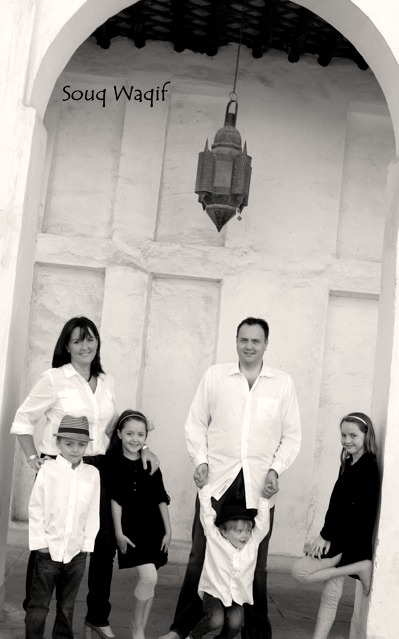
RANDOM NOMAD: Charlotte Day, High School Student (Sixth Former)

Born in: Sydney, Australia
Passports: Australia, UK and US Green Card
Countries lived in: Australia (Sydney): 1994-2001; United States (New York, New York): 2001-2010; England (Sevenoaks, Kent): 2010-present

What made you leave your homeland in the first place?
My father is Australian and my mother English. They split up when I was two. When I was six, my mother met and married an Australian who had been living in New York for thirty years. I was rather disgruntled about moving to the United States and for two or three years, remained determined never to accept it as “home.” At that time, I was deeply patriotic to my native country — though this sentiment has dissipated since.

Is anyone else in your immediate family a “displaced” person?
My mother’s family, originally from England, has long been displaced. My mother herself was born in Kenya, in 1961. Following the Mau Mau Uprising, her parents were forced to relocate, and my grandfather, presented with a choice between Australia and Canada, chose the warmer of the two countries. My mother spent her childhood bouncing between schools in England and Australia. She eventually grew so fed up with packing and unpacking, she decided to leave school at the age of 16. Her father agreed to the plan provided she spend a final year at the school in Switzerland his own mother had attended as a girl. My mother moved on from Swiss finishing school to work in London, Paris and Sydney. But she appears to have made New York her last port of call. Indeed, we had a fairly solid life in the city until I decided to take myself off to boarding school in England.

Describe the moment when you felt most displaced over the course of your many displacements.
It must have been when I first arrived in New York as a six-year-old. I stepped out of the JFK arrivals terminal into a snowy March night. My stepfather was wearing a leather coat, the interior of his car smelled of leather — and the world outside the car window seemed an undulating stream of black and silver. Though it was the end of 2001’s warm winter, my Australian blood froze beneath my first-ever coat. And their apartment — that was all leather as well. It smelled of musk and cologne. Since that time, I have felt similar pangs of displacement, some of which lasted for considerable periods. But those first few moments in New York stand out as the most acute concentration of “displacedness” I have ever known.

Describe the moment when you felt least displaced.
For the last five or so years in New York, I have felt more at home than I ever did in Sydney. I ascribe this to growing up: at a certain age, one can take possession of a city, know its streets, bridges, tunnels and transportation system. I was too young when I lived in Sydney to reach that kind of comfort level. But when have I felt the most like a New Yorker? Perhaps it was the last time I came home for the holidays, and took the 4 train uptown for the first time in months. At that moment I realized how much this train had been a part of my life — conveying me home from school every day for two years. My old life would always be waiting for me on the subway, ready for me to pick it up again. That’s something only a New Yorker could say!

You may bring one curiosity you’ve collected from each of the countries where you’ve lived into the Displaced Nation. What’s in your suitcase?
From Australia: A miniature wooden wombat figurine — a gift from my grandfather. It conjures memories of a childhood spent beating about the bush (literally) and fishing for yabbies at the dam in the company of audacious dogs who stuck their heads down wombat holes, to no good end.
From New York: A pair of fake Harry Potter glasses. These defined my first six months in New York — I even wore them to my first day of school. I think it is telling that even at the age of six, I was unwilling to give all of my real self to this new home.
From England: My school tie — representative of the alternative universe I seem to have entered. At boarding school, the sense of removal from reality can be disconcerting — especially after having spent a decade in the city I regard as the world’s capital.

You’re invited to prepare one meal based on your travels for other Displaced Nation members. What’s on your menu?
I’d like to make you a Sydney breakfast: scrambled eggs, made with cream, salt and pepper and served on a bed of Turkish toast, with avocado and stewed tomato on the side (is this being greedy?). Our meal will be accompanied by a large “flat white”: what we call perfectly strong, milky coffee without excessive froth. I suggest we consume it overlooking a beach on a Sunday morning. At least, I assume The Displaced Nation has beaches?

You may add one word or expression from each of the countries you’ve lived in to The Displaced Nation argot. What words do you loan us?
From Australia: Daggy. I use this word all the time — and did not realize it was exclusively Australian until I was informed of the etymology. Apparently, it comes from trimming the soiled wool around a sheep’s bottom. Which part of this repugnant whole is actually the “dag,” I do not remember. (No, I’m not a proper Australian!) But as I understand it, “daggy” means sloppy in appearance or badly put together.
From New York: There are so many words, and most are second nature by now. However, I will choose grande-soy-chai-tea-latte because I still shudder to think of myself as the kind of person who can utter such a phrase, at great speed, with great insistence. In fact, I’m still in denial about my love for Starbucks: having known Sydney coffee, my standards should be higher.
From England: Banter. I still do not know the precise meaning of this word, but it seems to encapsulate everything that makes someone my age feel socially acceptable — and, of course, I have no banter whatsoever. I think it means the capacity for combining wit with meaningless conversation. But there are other components, too, which seem to me unfathomable.

Question: Readers, tell us what you think: should we welcome Charlotte Day to The Displaced Nation and if so, why? (Note: It’s fine to vote “no” as long as you couch your reasoning in terms you think we all — Charlotte included — will find amusing.)

img: Charlotte Day at her boarding school in southeast England

If you enjoyed this post, we invite you to subscribe for email delivery of The Displaced Nation. That way, you won’t miss a single issue. SPECIAL OFFER: New subscribers receive a FREE copy of “A Royally Displaced Tea.”

Related posts: