The Displaced Nation

A home for international creatives

Tag Archives: Alice in Wonderland

Two displaced royals, William & Kate, in la-la land

We welcome Emily Henry to The Displaced Nation as a guest blogger. In this post on the royal visit to California that just took place, Emily neatly combines two of our blog’s favorite topics: what Alice in Wonderland can teach us about the displaced life, and how to assess royalty from within a global framework. A US citizen with an English mother, Emily grew up in the UK. She has been living in California, first in LA and now Oakland, for about 5 years.

In Chapter 3 of Lewis Carroll’s Alice’s Adventures in Wonderland, Alice experiences a “Caucus Race,” as the Dodo calls it. This race — run with the intention of getting all of the sopping wet animals dry — goes nowhere but round and round in a circle.

Despite making a ridiculous scene for themselves, the animals treat the affair with as much pomp and circumstance as they can muster. Although there is no clear winner,

“Everyone has won,” declares the Dodo, and “must be given prizes.”

A race with no rules and no winner, but drowned in ceremony and self-congratulation, might be somewhat similar to a royal tour. Watching the Duke and Duchess of Cambridge land in Los Angeles Friday afternoon made me wonder just how tiring it must be to run around in circles in another world — this time, California rather than Wonderland.

When I first heard that William and Kate would be visiting California, I imagined a sunny adventure for the new faces of the Royal Family. After all, I thought we had all agreed that these newlyweds were to be the modern, affectionate royal couple, not a re-enactment of the traditional frigid romance of yore.

They had proved themselves to be sufficiently “unstuffy” in Canada, so in California I imagined them sipping cocktails on the rooftop of the Standard Hotel, running hand-in-hand along the beach, or munching popcorn during a movie premier at the Chinese Theatre.

But then their schedule was released, and it turned out to be a Caucus Race. William and Kate must spend their few days in California running around in circles for the high and mighty: California Governor Jerry Brown was there to greet them from the plane, along with Los Angeles Mayor Antonio Villaraigosa. A bunch of flowers were presented. No doubt the weather was mentioned, as it would be — no doubt — in almost every instance of small talk throughout the rest of the trip.

Instead of cocktails and a rooftop bar, Friday night meant discussions of “innovation,” “communication” and “technology” at Variety’s Venture Capital and New Media Summit.

If these conceptual, “big picture” lectures weren’t enough to “dry” the couple out, the Duke and Duchess of Cambridge had an evening with businessmen and politicians to look forward to at the British Consular General’s house.

William, of course, is used to this sort of thing.

But much like Alice, who had arrived in Wonderland only to be forced to listen to a boring lecture on William the Conqueror given by a mouse, Kate must be stifling her yawns in disappointment.

However, she is doing an excellent job.

Perhaps what is most endearing about Kate Middleton is her ability to appease the pomp-loving self-congratulators while at the same time revealing the sense of humor and personality bubbling beneath her regal smile.

I knew I liked her from the moment she flashed a secret smile at William during their wedding as the couple shared a private joke. Amid the ridiculousness of her enormous wedding, the long-winded prayers, songs and sermons followed by more prayers, songs and sermons, Kate seemed to appreciate the funny side. She played her part beautifully, maintaining the airs of the occasion but accepting her wedding ring with an inward giggle.

Alice, too, accepts her self-given “prize” after the Caucus Race with the same sense of irony:

Alice thought the whole thing very absurd, but they all looked so grave that she did not dare to laugh; and, as she could not think of anything to say, she simply bowed, and took the thimble, looking as solemn as she could.

QUESTION: How did Kate and William’s first royal tour look from your displaced perspective — and do you agree with Emily that they, particularly Kate, managed it wonderfully?

Emily Henry is an associate local editor for Patch.com, reporting and editing for 11 hyper-local news Web sites in the East Bay area of California. She is currently running the Berkeley Patch site.

STAY TUNED for tomorrow’s post, when we return to our Pocahontas theme and consider some of the perils of cross-cultural marriage.

If you enjoyed this post, we invite you to subscribe for email delivery of The Displaced Nation. That way, you won’t miss a single issue. SPECIAL OFFER: New subscribers receive a FREE copy of “A Royally Displaced Tea.”

Related posts:

THE DISPLACED READS: 7 books with a twist of Alice

As it’s that time of year when (depending on your hemisphere) poolside or fireside books are a must, and since we’re not quite ready to let go of the Alice theme, we at TDN have come up with our own version of a summer (or winter) reading list.

In our usual perverse manner, we haven’t chosen books on the current New York Times bestsellers list, but, quite simply, books with the name “Alice” in the title.

We haven’t read them yet, either, so this list is as much a journey of discovery for us as it is for you.

Let us know what you think!

1. Alice in Verse: The Lost Rhymes of Wonderland by J. T. Holden and Andrew Johnson

Average Amazon rating: 5 stars

Have you ever wondered…
Who really stole the Queen’s tarts? Whatever did become of the Walrus & the Carpenter after their nefarious jot down the briny beach with the little Oysters? Is there truly any sense to be found in nonsense at all? (Amazon product description)

“The rumored ‘lost rhymes’ of Lewis Carroll are the inspiration behind Alice in Verse: The Lost Rhymes of Wonderland, a compilation of masterful poetry. While adding new and interesting elements, Holden has managed to keep the timeless appeal of the original works, allowing true fans to insatiably dig in. From the absurdity of the verse to the well-composed rhyme to the shrewd black-and-white illustrations, this book is certainly a literature lover’s delight.” The Children’s Book Review)

2. The Logic of Alice: Clear Thinking in Wonderland by Bernard M Patten

Average Amazon rating: 4 stars

“Alice in Wonderland may well be the most interpreted book in history, but there are always new depths to be plumbed. Bernard Patten dazzles us with his analysis of key episodes in the book. Like Lewis Carroll, Patten obviously loves logic and uses wit and humor to draw serious lessons about the principles of clear and logical thinking.” —Clare Imholtz, Secretary, Lewis Carroll Society of North America

“As Patten makes clear, Alice’s Adventures in Wonderland, far from being just an entertaining children’s book, is more complex and deeply reflective of Dodgson’s character than it may seem. By making an effort to understand its deeper layers, both children and adults may profit from this masterful tale by learning to think better and, along the way, having fun.” (Amazon product description)

3. Alice in Wonderland and Philosophy: Curiouser and Curiouser by William Irwin

Average Amazon rating: 4 stars

From the back cover:

  • Should the Cheshire Cat’s grin make us reconsider the nature of reality?
  • Can Humpty Dumpty make words mean whatever he says they mean?
  • Can drugs take us down the rabbit-hole?
  • Is Alice a feminist icon?

This book probes the deeper underlying meaning in the Alice books and reveals a world rich with philosophical life lessons. Tapping into some of the greatest philosophical minds that ever lived—Aristotle, Hume, Hobbes, and Nietzsche—Alice in Wonderland and Philosophy explores life’s ultimate questions through the eyes of perhaps the most endearing heroine in all of literature.

4. Alice I Have Been: A Novel  by Melanie Benjamin

Average Amazon rating: 4 stars

“Benjamin draws on one of the most enduring relationships in children’s literature in her excellent debut, spinning out the heartbreaking story of Alice from Alice’s Adventures in Wonderland…Focusing on three eras in Alice’s life, Benjamin offers a finely wrought portrait of Alice that seamlessly blends fact with fiction. This is book club gold.” (Publisher’s Weekly)

5. Alice Bliss: A Novel by Laura Harrington

Average Amazon rating: 5 stars

“When Alice Bliss learns that her father, Matt, is being deployed to Iraq, she’s heartbroken. Alice idolizes her father, loves working beside him in their garden, accompanying him on the occasional roofing job, playing baseball. When he ships out, Alice is faced with finding a way to fill the emptiness he has left behind.” (Amazon product description)

6. What Alice Forgot by Liane Moriarty

Average Amazon rating: 4.5 stars

“What would happen if you were visited by your younger self, and got a chance for a do-over?
Alice Love is twenty-nine years old, madly in love with her husband, and pregnant with their first child. So imagine her surprise when, after a fall, she comes to on the floor of a gym (a gym! she HATES the gym!) and discovers that she’s actually thirty-nine, has three children, and is in the midst of an acrimonious divorce.
A knock on the head has misplaced ten years of her life, and Alice isn’t sure she likes who she’s become. It turns out, though, that forgetting might be the most memorable thing that has ever happened to Alice.” (Amazon product description)

7. About Alice by Calvin Trillin

Average Amazon rating: 4 stars

Trillin, a staff writer at The New Yorker since 1963, regularly wrote about his family members, particularly his wife Alice, who lost her battle with lung cancer on September 11, 2001. This book, an homage to Alice, was published five years after her death.

“This succinct account of Alice’s upbringing, their meeting, their romance, their family, and her career beyond that of Trillin’s helpmeet, offers glimpses into a multifaceted character.” (Booklist)

“In his writing, she was sometimes his subject and always his muse. The dedication of the first book he published after her death read, ‘I wrote this for Alice. Actually, I wrote everything for Alice.’
In that spirit, Calvin Trillin has, with About Alice, created a gift to the wife he adored and to his readers.” (Amazon product review)

.

STAY TUNED for Monday’s account of the two displaced royals, William and Kate.

If you enjoyed this post, we invite you to subscribe for email delivery of The Displaced Nation. That way, you won’t miss a single issue. SPECIAL OFFER: New subscribers receive a FREE copy of “A Royally Displaced Tea.”

DISPLACED Q: Wimbledon — is it an anachronism in today’s international sporting world?

Given that Fred Perry was the last British man to win a Wimbledon singles event (1936) and Virginia Wade the last British woman (1977), the British public’s enthusiasm for this rather quaint championship is surprising. Then again, nothing fuels their enthusiasm as much as cheering on the underdog, and goodness knows, there are underdogs aplenty for them at Wimbledon.

Every now and then, a British competitor with a sniffing chance at victory will come along and be vigorously rooted for. Alas, no amount of national pride will change the inevitable outcome of (Andy Murray excepted) the Brit’s hangdog expression as he packs away his racquet and towel after losing 6-0 6-0 6-0 on an outside court to an American or Rumanian.

As Clive James, the Australian writer and broadcaster, pointed out:

“A traditional fixture at Wimbledon is the way the BBC TV commentary box fills up with British players eliminated in the early rounds.”

Perhaps different countries are wired for different sports? Czech-born Martina Navratilova, nine times winner of Wimbledon Ladies’ Singles, thinks not:

“I’m an American. You can’t go on where you were born. If you do, then John McEnroe would be a German.”

John McEnroe (born to American parents in West Germany) caused controversy at Wimbledon in 1981, when he loudly criticized a line call and called umpire Ted James “the pits of the world.”

Despite being named by Sports Illustrated as one of the Top 10 Men’s Tennis Players of All Time, McEnroe fears the reputation of his temperament will outlast that of his talent:

“I want to be remembered as a great player, but I guess it will be as a player who got angry on a tennis court.”

For those who say there’s no such thing as bad publicity, McEnroe disagrees:

“Princess Diana, she used to come watch the tennis [at Wimbledon]. And even though she had it 1,000 times worse than I ever did, she pulled me aside a few times and said, ‘I really feel for you.'”

Meeting the Royal Family is something that doesn’t happen too often at, say, the U.S. Open. Perhaps it would be better if it did. Serena Williams, who has her own reputation for putting her verbal equipment in gear ahead of time, describes a Wimbledon meeting with Queen Elizabeth:

“I was supposed to say, ‘Your Majesty.’ I totally choked. I was like, ‘Hey, nice to meet you’, total American style. And then she started talking. Then I was like ‘Your Majesty’ while she was talking… Maybe she’ll remember me.”

Undoubtedly. Serena should have heeded Jimmy Connors’ rueful comment nearly 30 years ago:

“New Yorkers love it when you spill your guts out there. Spill your guts at Wimbledon and they make you stop and clean it up.”

Some international tennis players remain unimpressed by the oldest, and to some the most prestigious, tennis tournament in the world. Russian player Nikolay Davydenko says:

“Wimbledon is the world’s most boring tournament. There’s hardly anything to do apart from tennis. You constantly find yourself yawning – there’s no entertainment here.”

Is he referring to the arduous 30-minute train ride into the bright lights of central London, or is it simply a severe case of sour grapes at never progressing beyond the fourth round at Wimbledon? Whatever the reason, he isn’t alone.

“A lot of people think that everything revolves around Wimbledon but it is just one week of the year for us. If nothing happens at Wimbledon, it’s not the end of the world.”

— this from Elena Baltacha, the Ukraine-born British player, after losing at Wimbledon 2009 and sadly proving Martina right in her earlier statement about birthplace versus nationality. Oh, and Elena — Wimbledon is a two-week tournament. Perhaps that’s where you’re going wrong.

But maybe she’s right not to take it so seriously. My all-time favorite saying by a tennis player is that of Boris Becker, youngest ever winner of Wimbledon’s Men’s Singles, when he lost in the 1987 final to Pete Doohan:

“Nobody died. I only lost a tennis match, nothing more.”

So, let us have your views! Do you see Wimbledon as an anachronism in today’s sporting world, or are its slightly eccentric traditions to be cherished? The strict dress code of white for competitors; the strawberries and champagne; and above all, the venue of the All England Lawn Tennis and Croquet Club. (How Alice is that!)

And on the subject of Alice, our last words come from Venus Williams, on her tennis outfit at this year’s Australian Open:

“The outfit is inspired by Alice in Wonderland. It’s kind of about a surprise, because when Alice goes down the rabbit hole, she finds all these things that are so surprising. This outfit is about having a surprise in a tennis dress, and showing some skin and then just having a print. Prints don’t happen that often in tennis. So it’s called the Wonderland dress.”

Call me old-fashioned, but I’m with the Wimbledon dress code on this one.

STAY TUNED for tomorrow’s post, Part 3 of Sebastian Doggart’s thrilling chase after James Bond creator Ian Fleming’s Jamaican haunts.

Related posts:

“Zuzu in Prahaland”: A departing expat takes inventory of strange, Lovecraftian Prague

For much of June, The Displaced Nation has been looking at what the story of Alice in Wonderland can tell us about displacement of the curious, unreal kind — as anchored by Kate Allison’s 5 Lessons Wonderland taught me about the expat life, by Lewis Carroll’s Alice. Today we welcome guest blogger Sezin Koehler, who received one of our Alice Awards for writing about her current home, Prague, in this vein. Koehler and her husband plan to leave the Czech Republic on August 2. Here, she credits their four-year stay in its capital city for bringing out the Alice in Wonderland, or Zuzu*, in her character.

When I first moved to Prague I had no idea I’d be entering a living snow globe rather than going down the proverbial rabbit hole. Not just any old snow globe, but one incessantly shaken by a petulant child, refusing to let but a glimmer of sunlight through the gray haze. I also had no idea that Prague was not so much a city, but rather some kind of unpronounceable Lovecraftian entity with a mind of its own.

The old mother with claws

Kafka called Prague “the old mother with claws,” and he struggled his whole life to escape from her clutches. He never managed.

After four years in her grasp, I myself feared I would never get out from her cruel and cold embrace. My suspicion is that if you die in Prague, your soul is trapped here forever, unable to move on or away, locked in a limbo that the entity within feeds upon, like a relentless vampire queen.

Since the Velvet Revolution that ended the reign of Communism in 1989, Prague has welcomed fresh blood in the form of expats with open arms. There is an entire community of American, Australian, British, Canadian and other expats who have lived here since the 1990s, and they make up their own insulated subculture within greater Prague. The mother claws have them, and good.

These long-term expats joke that Prague is a city that draws you in, makes you comfortable — and then, in the snap of a bony hand, chews you up and spits you out.

In my brief tenure I have witnessed this phenomenon several times: expats, happy as pie, loving the beer and the high life Prague affords — only to find themselves unceremoniously booted out of the country with no friends, no money and only a drinking problem to show for their life here.

Many of those who remain in the clutches for too long have, in the process, become a mutant strain of Czech: wary of outsiders, unwelcoming and generally cold people unless surrounded by their own.

The mother claws are a fickle bunch, taking what they need and discarding of you when there is nothing left.

Prague isn’t just a city, but an entity of some kind. My creativity in Its abode has come with often hefty prices. Two years into my stint here, I developed tendinitis in both wrists simultaneously from a combination of overwork and the extreme cold. I spent three months with both wrists in braces, unable to wash or clothe myself; it took steroid shots and brutal physiotherapy to finally get my hands back in working order.

Now I have the uncanny knack of predicting rain and cold snaps.

Looking back at this strange, sometimes nightmarish interlude, I offer up 20 stream-of-consciousness memories:

1. The place where my husband and I went from being just a couple to being a team.

2. A fairytale land on this side of the rainbow where my dreams started to come true — published in print for the first time, wrote my first screenplay, published my first novel and began work on its three sequels, started building my own platform as a writer. I can call myself what I wanted to be ever since I can remember.

3. Neo-Nazis and being screamed at by a racist Czech granny on the 18 tram.

4. Getting caught in the blizzard of 2010 and finally understanding that it’s not only people that can threaten you — the very elements themselves are forces of their own will and we live at their whim.

5. The phenomenal view of the University Botanical Garden from our living room window, as well as the original 6th century settlement of Prague, right smack in the middle of the city.

6. Chapeau Rouge, the friendliest bar in Prague — but only if you are there with me. I’ll make sure you pay homage to what I call Our Lady of the Music: an art installation featuring a Mary with a disco ball above her head and a record between her praying hands.

7. Discovering Afghan cuisine and vegetarian restaurants; also remembering South Indian cuisine and ordering Indian delivery online — useful especially when the streets were knee-deep in snow.

8. Bara, the world’s most talented tattoo artist: she gave me wings, stars, Falcor and Edward Scissorhands.

9. Cold that sinks right into your bones, feet aching and joints swelling from trudging through it across treacherous cobblestones and hidden patches of ice.

10. Bonsai and carnivorous plant exhibits at the Botanical Garden.

11. Sitting in our apartment, feeling my ears pop like I’m on an airplane from the rising and falling air pressure.

12. Lady Gaga’s monster brawl at the O2 arena: the Czechs marked the 21-year anniversary of the Velvet Revolution by punching people who wanted to dance; MGMT at Divadlo Archa; free passes to the Irish-American funk band Flogging Molly at Retro Music Hall — and hanging out with them afterwards.

13. Dancing in what was then Klub Kostel (literally, Church Club) on Hallowe’en, dressed as a witch.

14. Yearly fireworks and light shows over Vyšehrad (castle on a hill over the Vitava River), with a stage front view right from our window.

15. Mourning the deaths of, from a distance, Heath Ledger, Michael Jackson, Patrick Swayze, Corey Haim, Ryan Dunn … and close up, Curtis Jones, an American expat performance artist who’d been living in Prague since 1989 — a dear friend to many dear friends of mine in this city.

16. Cleaning up my first ever poop-drenched child, at an international pre-school where I worked. (I don’t and never will have kids.)

17. The vista of Prague from the tram on the way up to the castle, skyline scraped with spires and a cloud of fog overhead, feeling like I had somehow escaped the evil snow globeness if only for a moment.

18. Working for a newspaper, a mentally unbalanced artist, a shady off-shore investment banking firm, an international relocation company, a British school, and the largest university in central and eastern Europe.

19. The stench of Prague’s walking dead — homeless people with rotting parts of their bodies or insides, including one fellow with a black foot, the gangrene working its way up his leg. The worst thing I have ever smelled in my life, and I’ve lived in India and Africa; impossible to describe how awful and sad it is.

20. Seeing open graves for the first time ever, in Olšanské hřbitovy (Prague’s largest cemetery) — and imagining an imminent zombie invasion.

Na shledanou, Prahaland

I have made a tenuous peace with Prague.

This has been a place of great pain and great inspiration. The Entity is letting me go without a struggle: It knows that I will be telling stories about It for years to come.

It doesn’t even care if I paint Its portrait with darkness and horror — It wants to be seen, It wants to scare, It wants to fascinate so it can feed.

It knows the things I write, good and bad, will help bring many more people into Its icy embrace.

Prague is always hungry for fresh blood. Will yours be next?

*Sezin Koehler owes her nickname “Zuzu” to Rebi and Tereza, two Czech girls she took care of in an after-school program she organized. “Good afternoon, Miss Zuzu,” they would say. “Zuzu” is a common Czech nickname, short for “Zuzana.” This tickled Koehler’s fancy as one of her favorite films of all time — It’s a Wonderful Life — features a character named Zuzu Bailey. She has even named her blog Zuzu’s Petals — which, she says, “signify the most beautiful turning point in the film.”

Sezin Koehler is a half-American, half-Sri Lankan global nomad, horror novelist, writer and editor. Her first novel, American Monsters, was released last year. It has since been picked up by Ghostwoods Books, and an illustrated 2nd edition will be released by Fall 2011. Koehler’s Twitter moniker is @SezinKoehler.

img: “NO REST FOR THE WINGÉD — Zuzu Kahlo,” by Steven Koehler.

STAY TUNED for tomorrow’s post consisting of quotes attesting to the curious, unreal nature of Wimbledon tennis — which, to the more discerning observer, can seem disturbingly akin to the Queen of Hearts’ game of croquet.

If you enjoyed this post, we invite you to subscribe for email delivery of The Displaced Nation. That way, you won’t miss a single issue. SPECIAL OFFER: New subscribers receive a FREE copy of “A Royally Displaced Tea.”

Related posts:

RANDOM NOMAD: Vicki Jeffels, blogger, freelance writer & social media consultant

Vicki JeffelsBorn in: Auckland, New Zealand
Passport: New Zealand (only, and proud of it!)
Countries lived in: Fiji Islands (Vatukoula): 1973-77; Australia (Brisbane): 1996-98; England (Tadley, Hampshire): 2008-present
Cyberspace coordinates: Vegemite Vix | A Kiwi expat in the UK licking the Vegemite off life’s fingers (blog); Digital Discussions (start-up consultancy)

What made you leave your homeland in the first place?
I first became an expat at the tender age of 3.5, when my family moved to the Fijian Islands for my father’s work: he had a contract with the Emperor Gold Mines in Vatukoula. I have wonderful memories of expat life as a child. The days were honeyed with heat, we munched sugar cane off the back of the cane truck, and we swam with the tropical fish through the intricate coral reef. Of course, a child’s experience is so very different from an adult’s, and now I’m a parent, I’m more aware of the challenges my parents faced — which included being robbed, almost being airlifted out in civil unrest, and sheltering under the house during the monstrous Hurricane Bebe in 1972.

I moved overseas again — to Brisbane, Australia — with my first husband in 1996, with a two year old and two-week-old baby in tow. On reflection, that wasn’t brilliant timing. We struggled to make a home for ourselves particularly as my (then) husband was working in Perth, an eight-hour flight away — leaving me to cope on my own in a new country with two babies. I did it, though. I made friends through the children’s networks and found work for myself — until two years later, when my husband was suddenly made redundant and we limped back to New Zealand with our tails between our legs.

My most recent expat adventure started on a holiday in Paris in 2007 when I met a rather scrumptious Englishman. We chatted, we flirted, we kept in touch long after we’d returned home — and our long-distance relationship soon blossomed. A year later, I packed up my three kids (two teens and a tweenie), dog, cat and 20 boxes of books and moved to Hampshire to live with my Englishman. After a romantic engagement atop Mt Hellvellyan (yes, he made me climb a mountain to get the engagement ring!), we married in his village church in North Yorkshire in 2009.  I’ve written about our story on my blog and am currently writing it up as a memoir — hopefully coming to a bookstore near you, shortly.

Is anyone else in your immediate family displaced?
All of my immediate family currently live outside of New Zealand. My mother, father and sister all live in Australia, but I wouldn’t say they are “displaced.” They are all happy living there and hold Australian passports, and my mother is an Australian by birth.

Describe the moment when you felt most displaced over the course of your many displacements.
When I found myself standing in front of the judge at the Asylum and Immigration Tribunal in London three weeks after our wedding, having swapped my wedding bouquet for brickbats from the UK Border Agency, as they probed and prodded and demanded to find fault with our story. Standing there pleading to stay in the UK with my husband and kids — when everything in my body was screaming “Get me out of here!” and “Get me home!” — was one of the hardest things I’ve ever done. It was dissonant not only because we were newly married — and I longed to go home and celebrate with my friends and family but had been restricted from leaving the country — but also because I’m the archetypical “good girl” who has barely ever had a parking ticket. What was I doing standing in front of a judge being cross-examined by solicitors? It was scary stuff and deeply disturbing — as if the entire nation wanted me to just leave. It was the final straw after a year’s worth of feeling displaced — of saying the wrong thing and being laughed out of the room, and of breaking unwritten rules of conduct in the supermarket that resulted in an elderly woman throwing limes at me! Who knew there were rules about how and when you should put your shopping on the checkout counter?

Describe the moment when you felt least displaced.
This is a telling question, because although I’ve had some great times whilst living here in England, I can’t say that I’ve ever experienced feeling “at home.” My most recent trip Down Under highlighted for me how displaced I truly feel living in the UK, and how exhausting it can be spending one’s days trying to “fit in.” It was wonderful to have a break from explaining myself all day every day. It doesn’t help that I moved from an upmarket suburb of a large seaside multicultural city, to a parochial town in the English countryside. I wonder if I would feel more at home in London where there is a far more multicultural vibe? At times I wonder about moving again, perhaps to the US or Australia. (Is it itchy feet, or failure to fit in, that’s behind those feelings?)

You may bring one curiosity you’ve collected from each of the countries where you’ve lived into the Displaced Nation. What’s in your suitcase?
From Fiji: A frangipani flower. We used to make them into wreaths when I was a child. The smell reminds me of the South Pacific and makes me smile.
From New Zealand (which, though home, is now something of a foreign country): A pāua shell to remind me of the ocean and the beautiful Kiwi beaches.
From Australia: A boomerang because it will remind me that there is always a home behind me as well as in front of me.
From England:St George’s cross to remind me that I too can fight and defeat the dragons.

You’re invited to prepare one meal based on your travels for other Displaced Nation members. What’s on the menu?
I hope you like seafood! For starters I’ve prepared a Fijian raw fish meal called kokoda, which is “cooked” in coconut milk and lime juice. It’s divine. On the side there’s a dozen Bluff oysters from New Zealand. For mains we’ll have barbequed prawns, Moreton Bay bugs (Australia), and good quality pork sausages (British). We’d probably toast the meal with a New Zealand champenoise and down the sausages with a Margaret River Shiraz.

You may add one word or expression from each of the countries you’ve lived in to The Displaced Nation argot. What words do you loan us?
From Fiji: Bula — one of those indispensable words. It means “hello” and “thank you” and “How are you?” and “See you later” and “Good luck.” In fact, it’s a phonetic smile.
From New Zealand: Wopwops, meaning out in the bush away from everyone and everything else, preferably where there is no mobile signal and Internet. We all need to lose ourselves in the wopwops from time to time.
From Australia: Barbie — colloquial for barbecue, or BBQ. Particularly when eaten outside in the glorious fresh air and sunshine, with sand between your toes and the sound of the surf crashing on the beach, a barbie is one of the finest meals you can have.
From England: Bless — because the English have a way of saying it that sounds nice but is really derogatory. It’s so English to hear someone recount the story about how they did something stupid, and have the listener respond with “Bless” — really meaning “You moron!” I offer it to The Displaced Nation as a reminder of the need to master some of the local lingo, without which you’ll have a tough time understanding the folkgeist of the country you’re in.

It’s Alice in Wonderland month at The Displaced Nation. In closing, can you tell us your worst “Pool of Tears” moment, when you wondered, how did I end up in such a predicament and will I ever escape?
It, too, occurred during my struggles with the UK immigration authorities. Having moved to the UK to be with my Englishman, I was awaiting a valid work visa so was restricted from working. At the same time, my ex stopped paying child support. As we were struggling financially, I was stuck at home feeling terribly isolated. One day I received the news that I had been served with a deportation order and had 28 days to leave the country and return to NZ with my three children. I collapsed in tears, wondering how on earth I was ever going to afford going back to NZ where I no longer had property or anywhere to go. My savings had been eaten away by legal fees, and I had no income. I felt utterly dispossessed. In the end, we won the appeal against the deportation — my most displaced moment — and I was granted a valid visa, after which I regained the self-confidence I feared had been lost in transit.

Like Alice, did you encounter a Mouse who helped you ashore?
My Mouse would have to be the first friend I made in my English town after living here for almost two years. All that time I would cheerily smile hello at strangers — and they’d run away as if I were brandishing a knife. I was bitterly lonely and would live for Facebook chats with the many friends I’d left in New Zealand. Finally, on the school sports day I met an Englishwoman who had relatively recently returned from expat adventures in Canada. We bonded over our shared status as outsiders in a town where the majority of local people have family connections back through several generations. I refer to her as Strawberry Munchkin in my blog and am so very grateful for her friendship. I think of her as an honorary Kiwi.

QUESTION: Readers — yay or nay for letting Vicki Jeffels into The Displaced Nation? Tell us your reasons. (Note: It’s fine to vote “nay” as long as you couch your reasoning in terms we all — including Vicki — find amusing.)

img: Vicki Jeffels, taken in the UK for use on her blog.

STAY TUNED for tomorrow’s installment from our displaced fictional heroine, Libby.

If you enjoyed this post, we invite you to subscribe for email delivery of The Displaced Nation. That way, you won’t miss a single issue. SPECIAL OFFER: New subscribers receive a FREE copy of “A Royally Displaced Tea.”

Related posts:

Funny foreigners: A response to “Is English really the international language it claims to be?”

Last week Displaced Nation writer Kate Allison wrote about sarcasm. She expressed an idea I’ve heard before that the UK and US are not so much separated by a common language, but by different understandings of sarcasm and irony, the idea being that British humour and American humor are fundamentally very different beasts.

While I enjoyed Kate’s post, I can’t help but feel that she was perhaps being a little unfair on a country that has produced among many others Gore Vidal, Groucho Marx and Stephen Colbert.

Eddie Izzard, noted comedian, marathon runner and jam enthusiast claims that there is absolutely no difference between the two countries when it comes to humour. I’ve seen him perform the same material on different sides of the Atlantic, and while in both cases the audience had that happy, warm and disturbing feeling of having pissed their pants (in both the US and UK sense of the word, unless some of the audience attended the show commando) at Izzard’s brand of surreal lunacy, if I’m honest I thought it was noticeable that different parts of the act got very different responses in Philadelphia than they did in London.

I’m not convinced I can extrapolate that into fundamental differences between the two countries, there’s a strange alchemy that occurs between a stand up audience and a comic, and sometimes — as I felt when I saw Izzard in Philadelphia — it just doesn’t gel as well as it could, but the same could have happened in London too.

Of course, we need to keep all of this quiet. We’re among friends here so I’ll let you into a little secret. It is in the interest of British self-esteem for us to let Americans think that there’s a huge chasm between the British and the American sense of humour. We, the country that gave the world 29 Carry On films, like to project onto ourselves this idea that we have a sophisticated, dry humour unique to our soil. We (Brits) talk about “irony” in the similarly loose, off-putting, undefined, making-it-on-the-sly way that the French talk about “terroir.”

And yes, I wouldn’t for a moment contest that, in general, the rhythm and beats that make up my humour are not necessarily the rhythm and beats that make up my friends’ American humor.  For instance that time-honoured, equal opportunity offender, “taking the piss” doesn’t translate that well to the US. But it’s a giant leap from that to saying that the Americans don’t “get” irony as well as the British. The UK is not a land of 60 million Oscar Wildes all excelling in the arts of irony, witticisms and dry put downs. We’re a country that to our eternal shame has commissioned five seasons of Celebrity Juice — and with each season the carcass of comedy putrifies further.

Yes, we may use irony far more socially than is normal for Americans, and this is of course surprising and befuddling for the poor American who wasn’t expecting an ironic response when they politely asked if you’d had a nice weekend, but that is a very different from the idea that Americans don’t “get” it. Smart people get irony, and there’s plenty of smart people in the US, and no, that’s not me being ironic.

For anyone who is still curious on this subject you may be interested in this video via Big Think: “Ricky Gervais on British and American humo(u)r and their differences.”

STAY TUNED for Tuesday’s post, Part 2 of Sebastian Doggart’s Bond-worthy quest to track down traces of Ian Fleming in today’s Jamaica.

If you enjoyed this post, we invite you to subscribe for email delivery of The Displaced Nation. That way, you won’t miss a single issue. SPECIAL OFFER: New subscribers receive a FREE copy of “A Royally Displaced Tea.”

Related post:

RANDOM NOMAD: Helena Halme, Book Seller, Fashion Addict & Writer

Born in: Tampere, Finland
Passport: Finnish (only, and proud of it!)
Countries lived in: Sweden (Stockholm): 1971-74; Finland (Turku): 1975; Finland (Helsinki): 1975-84; England (Portsmouth): 1984-86, 1988; England (Plymouth): 1987; England (Wiltshire): 1989-2010; England (London): 2011-present
Cyberspace coordinates: Helena’s London Life | A Nordic view on style, fashion, art, literature, food and love in the city (blog)

What made you leave your homeland in the first place?
I left Finland for the first time as a 10-year-old with my family due to my father’s work, then moved back again for the same reason. And then I left Finland for good to marry my English husband. I’ve written 48 blog posts — soon to be a Kindle book called The Englishman — about how I came to be in England.

Is anyone else in your immediate family displaced?
My father is the only member of the family who still lives in Finland. My mother lives in Stockholm (she is remarried), and my sister lives also in Sweden (she married a Swedish man). Oh dear, that makes it sound as though we are are very man-dependent women, but I can assure you we’re strong and independent — really.

Describe the moment when you felt most displaced over the course of your many displacements.
I felt most displaced when I moved back to Finland at the age of 14. I didn’t want to leave Stockholm and felt completely alien in my home country. Since then I haven’t really felt at home anywhere. Although the two countries are divided only by the Baltic Sea, Finland was — and still is to a certain extent — a very different country to Sweden. The Finnish language is notoriously difficult, and in those days the culture was heavily influenced by Finland’s proximity to Russia (then the Soviet Union). Having lived in the very Western European city of Stockholm for three years, I saw my home country as being part of the Eastern bloc (even though it most certainly wasn’t). The radio played little pop music, and the TV was full of political broadcasts and dark plays about the struggle of the working classes. Western films took longer to arrive, and most people seemed dull and depressing. Nobody smiled and they all dressed in old-fashioned clothes. There seemed to be nothing you could buy in the shops. My sister and I would take the ferry across to Stockholm for many years afterwards — and wow our friends with the H&M clothes we brought back.

Describe the moment when you felt least displaced.
Once I had my children in the UK, I felt I belonged much more — although I took care to make sure they knew they were half-Finnish. To this day, we combine Finnish and English customs: have two Christmases, grow special grass for Easter called rairuoho, and so on… No particular moment stands out in my head where I’ve felt especially at home — yet! That said, the move to London last year has given me an even greater sense of belonging… Perhaps that’s it; perhaps it happened just this year, when we moved to Northwest London?

You may bring one curiosity you’ve collected from each of the countries where you’ve lived into the Displaced Nation. What’s in your suitcase?
From Finland (even though it’s my homeland, it remains somewhat foreign): A Finnish knife (puukko).
From Sweden: A slice of the traditional Swedish cake known as Prinsesstårta.
From England: BBC Radio 4.

You’re invited to prepare one meal based on your travels for other Displaced Nation members. What’s on the menu?
I love food and don’t think I’ve changed my tastes all that much since coming to the UK. Thus my menu for The Displaced Nation is mostly Scandinavian but with one concession to British tastes. (These days, of course, you can get almost any foodstuffs from Finland in London. Bless this multicultural city!)

You may add one word or expression from each of the countries you’ve lived in to The Displaced Nation argot. What words do you loan us?
From Sweden: Fy fan (bloody hell), because it just sounds right for a sense of frustration.
From Finland: Kippis (cheers) — it sounds like “get pissed” to an Englishman’s ears.
From the UK: That’s very interesting… The person who utters these words is usually dying of boredom. (A typical English white lie…)

A statement on your blog’s Home Page strikes us as being very Alice-like: “Rye bread not toast, pickled herring not fish & chips, cinnamon buns not Victoria sponge, ice-hockey not football, wander in a forest not walk in a park, silence not polite conversation.” Does the Alice-in-Wonderland story speak to the life you’ve led in the UK?
In England I’ve always felt as if I were the largest person in the room, particularly against the slight “English roses” — just as Alice did when she entered Wonderland. When I first arrived in this country, I’d often recall the words of the Queen of Hearts to Alice at the trial: “All persons more than a mile high must leave the court.”

QUESTION: Readers — yay or nay for letting Helena Halme into The Displaced Nation? Tell us your reasons. (Note: It’s fine to vote “nay” as long as you couch your reasoning in terms we all — including Helena — find amusing.)

img: Helena Halme’s self-portrait on the number 13 bus. As Halme explained in a blog post last month, the No 13 featured in the British TV series On the Buses, which was broadcast on Finnish TV in the 1970s and was an early influence on her view of men in England. Also please note that Halme’s hair in this picture owes to her own efforts; she hadn’t yet discovered the Brazilian blow dry.

STAY TUNED for tomorrow’s installment from our displaced fictional heroine, Libby, who is debating whether Woodhaven, Massachusetts, is really the picture-perfect Wonderland it seemed at first sight. (She also meets a realtor who is most decidedly a Red Queen…)

If you enjoyed this post, we invite you to subscribe for email delivery of The Displaced Nation. That way, you won’t miss a single issue. SPECIAL OFFER: New subscribers receive a FREE copy of “A Royally Displaced Tea.”

Related posts:

DISPLACED Q: How many of these 5 expat Alice characters do you recognize?

After two weeks of total immersion in all things Alice, we’re finding that even normal people look like Wonderland characters.

Here are a few we’ve noticed:

1. The Red Queen

The Red Queen, as her title suggests, queens it over the less experienced and the newly-arrived in Wonderland (or Looking-glass country, if you would like to be pedantic.)

We all knew her in school. She’s the bossy one who made a beeline for The New Girl recently arrived from out-of-town, made a big deal about showing her around, and kindly explained the school rules in a manner guaranteed to confuse and subtly terrify the newcomer – which, of course, was the intention.

Now fully grown rather than three inches high, she reigns supreme over the expat coffee morning posse and sends out Tupperware party invitations which no one dares refuse for fear of excommunication from the International School’s PTA.

Her self-proclaimed superiority is based on her many years in Wonderland, and her familiarity with the country. She knows the place forwards, backwards, sideways, and diagonally.

2. The White Rabbit.

The Red Queen’s (or Duchess’s) sidekick. Always busy, always rushing somewhere, always checking her watch or BlackBerry, always worrying that she will be late for something – although no one cares whether she is there or not, and most would prefer that she isn’t.

She organizes coffee mornings, school bake sales, and garden fetes, and is never happier than when she is chairing a committee. She loves giving orders, which are generally followed but with much resentful muttering from the minions.

Her favorite expression, apart from “Oh my fur and whiskers!” is “If you want something doing properly, do it yourself”, followed by a heavy sigh at the bumbling incompetents with whom she is forced to associate by dint of a common nationality.

3. The Cheshire Cat.

The Cheshire Cat holds himself slightly aloof from the madness that is the expat enclave, accepts Wonderland’s eccentricities with smiling resignation, but has a tendency to disappear when the going gets tough.

Although he is friendly and happy to chat, don’t expect more than a superficial friendship from this one.

4. The Hatter.

Here is someone who should have left Wonderland years ago. Time no longer has any true meaning to The Hatter, who calculates it in days rather than hours, and in months until visa expiration rather than weeks since the beginning of  tea time. He makes jokes that aren’t funny, then gets offended when no one laughs.

The Hatter is a  great fan of the traditional expat gin and tonic, however, and it is always six o’clock in his house.

5. Alice.

The homesick newcomer, desperately trying to make sense of a new country and managing to offend people every time she opens her mouth.

She soon discovers that the beautiful, magic place she tried so many times to enter is full of faults, just like home, and the people in it of whom she was once  in awe are “nothing but a pack of cards.”

At this point she often leaves the country, as she has found the grass on the other croquet lawn isn’t any greener after all. Ironically, if she stays just a little longer, she will find that she has gone through the most difficult time of adjustment, and life in Wonderland can – probably – only get easier.

So – Do you know one of these Alice characters, or – dare you admit it – are you one yourself?

Img: — Many thanks to Emily Cannell at Hey From Japan for the photograph of waxwork Alice at the Tokyo  Tower!

STAY TUNED for tomorrow’s interview with Random Nomad Helena Halme. She appeals for citizenship in The Displaced Nation — and answers an Alice question!

If you enjoyed this post, we invite you to subscribe for email delivery of The Displaced Nation. That way, you won’t miss a single issue. SPECIAL OFFER: New subscribers receive a FREE copy of “A Royally Displaced Tea.”

Related posts:
English – is it really the international language it claims to be?

Despite speaking English as the Wonderland creatures did, Alice frequently found there to be a language barrier:

Alice felt dreadfully puzzled. The Hatter’s remark seemed to have no sort of meaning in it, and yet it was certainly English. “I don’t quite understand you,” she said as politely as she could.

I sympathize with Alice; some years after the publication of Wonderland, George Bernard Shaw made his famous remark that

England and America are two countries separated by a common language

and that sentiment is as true today as it was in the 1800s.

“Perhaps it doesn’t understand English,” thought Alice.

I’ve got a piece of Facebook flair that says

“Sar-chasm: The giant gulf between the sarcastic comment and the person who doesn’t get it”

and this definition pretty much accounts for the language barrier between my home country and my adopted one.

Sarcasm is a Brit’s second language, and it’s disconcerting not to be understood when you speak it. A few years ago when our house in the States was for sale, we had the misfortune to deal with a prospective buyer who said he’d like to buy our house, but who actually wanted to amuse himself over several months by grinding our asking price down to the 1985 construction cost before saying, “You know, I think I’d rather live ten miles away in a different town altogether.”

When negotiations had come to an unpleasant halt, we observed facetiously to our real estate agent that at this point we’d prefer to torch the place than let this particular person live in the neighborhood, to which she replied, quite seriously, “I don’t think that would be a good idea. Arson’s illegal.”

A British estate agent may have replied, “Here’s twenty quid. Get some matches and petrol on me.”

Or maybe they wouldn’t these days. The litigious society has been shipped from America to Britain and is doing quite nicely, from what I can tell from the Daily Mail. Had the place had gone up in flames after an overenthusiastic barbecue, we could have sued the realtor for giving us ideas.

“Then you should say what you mean,” the March Hare went on.

Occasionally I do meet that rare American who understands sarcasm, but because they don’t go around ringing bells and shouting “Unclean!” I don’t realize they’re using it until it’s too late and I’m saying, “Oh, wait – no, I get this, I do, it’s just I’m out of practice…” (The exception is if he or she has a Brooklyn accent, in which case we greet each other with a secret handshake.)

The best way to identify sarcasm-users is to ask them what they watch on TV. Assuming they correctly identify your accent, they’ll generally say one of two things in reply: either “I have the whole of Monty Python on DVD!” or “Oh, wow, that Benny Hill – isn’t he just awesome?” If it’s the latter, don’t even think of mentioning the benefits of lighter fuel and matches in any part of the house other than the brick barbecue.

Especially if there’s a For Sale sign in the garden.

.

STAY TUNED for Tuesday’s post on the characters you can meet along the way in your own Wonderland…

If you enjoyed this post, we invite you to subscribe for email delivery of The Displaced Nation. That way, you won’t miss a single issue. SPECIAL OFFER: New subscribers receive a FREE copy of “A Royally Displaced Tea.”

Related posts:
Travel author Janet Brown channels Alice in Wonderland’s “tone deaf” adventures

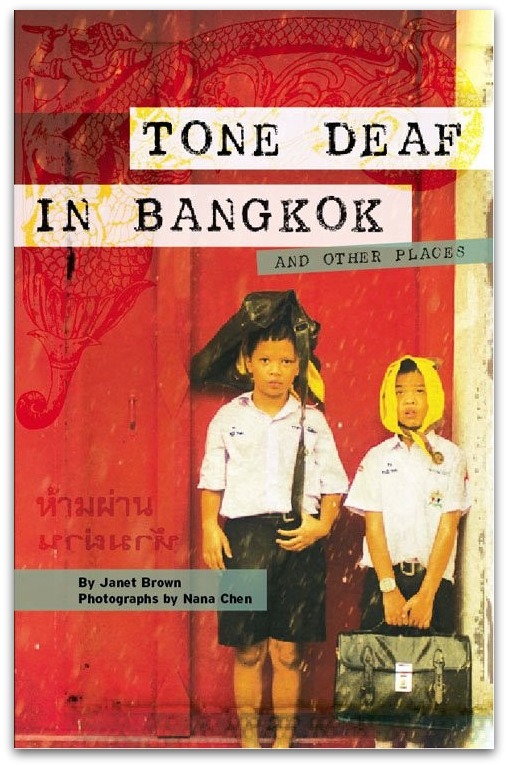
SPECIAL TREAT FOR TDN READERS: JANET BROWN, author of the travel gem Tone Deaf in Bangkok, has kindly agreed to “come in” and respond to your comments and questions. 

As you may have noticed, The Displaced Nation has gone Alice-in-Wonderland mad since around the first of June. To take just a few examples:

And now, to top that all off, the extraordinary travel writer Janet Brown is paying us a visit. Brown could almost be a stand-in for the Lewis Carroll heroine herself, having published a book on travel to and life in Thailand called Tone Deaf in Bangkok, to much acclaim.

“Tone deaf” — it puts one in mind of poor Alice’s plea to the Mouse, “I didn’t mean it…But you’re so easily offended, you know!”

But if Brown sees herself as tone deaf, her readers regard her as anything but. Here is a sampling of her reader reviews on Amazon:

It has been ages since I have loved a piece of travel literature…, and so when I read TONE DEAF IN BANGKOK, I was thrilled. This is a good travel book, and it is a good book, period.

I am not a traveler, nor do I typically read travel books. Shame on me, I know, but here’s the thing: … The author brought Bangkok to life in a way that made me want to go there, yes, but it was her own story that captivated me and kept me turning the pages. Now I’d read anything Janet Brown writes!

Janet Brown’s TONE DEAF IN BANGKOK is a travelogue, to be sure. Yet it is more, so much more. It’s also an investigation into how dislocated we can become by ourselves, by our priorities and by all that we demand of the cultures in which we live. … That she has a gift for spotting the universal in the exotic makes this collection all the more profound.

Janet Brown has graciously agreed to answer some of my Alice-related questions. After that, dear reader, I urge you to chime in!

Before we go down the rabbit-hole, can you tell me a little bit more about your background?
My parents turned me into a gypsy before I was two, by taking me on their journey by jeep from New York City to Alaska when the 49th state was still a territory and the Alcan Highway was still an unpaved trail into the frozen north. I have wandered ever since, most recently in Southeast Asia with Bangkok as my home, writing down the stories I encounter as I explore. My books include:

Maybe because I’m so steeped in Alice-of-Wonderland lore this month, I think of you as Alice Personified. To what extent can you relate to Alice’s sense of disorientation? Going back not just to the first time you went to Thailand but also when your family dragged you to Alaska…
I was 18 months old when my family moved to Alaska from Manhattan. I coped with any displacement issues by making my mother read my favorite book over and over again — a truly saccharine Little Golden Book called The New Baby. The main character had the same name as I so that was the big attraction — all about me!  My mother swears she can still recite it verbatim after having two martinis.

Alice came to mind constantly in my first months in Bangkok — and frequently thereafter. I knew I’d gone through the looking glass — or had entered the postcard — and asked myself often if that experience had been as painful for Alice as it often was for me.

Can you describe your worst “Pool of Tears” moment in Bangkok, where you wished you hadn’t decided on living there?
I’ve tried to make light of that time when I wrote about it in Tone Deaf in Bangkok, but it nearly demolished me. When the manager of my apartment turned me into Ryan’s Daughter by listening in on my phone calls and then entertaining the neighborhood with highly embroidered versions of my life — and when people fell silent when I walked down the street and began gabbling excitedly after I’d passed — I felt as though my life had been stolen from me and I shut down to the point of hypothermia. If my students hadn’t helped me find a new neighborhood, I would have gone home a gibbering mess.

Thailand is renowned for its distinctive cuisine. Was there anything that carried an “Eat me” label that you felt hesitant about at first, but then discovered you loved?
I’ve written about durian in Tone Deaf, how I thought its smell in the market was sewer gas and then how I was forced to taste it, with happy results. Fried grasshoppers were another thing I didn’t warm to at first sight and then liked as much as I do popcorn — they have much the same crunch and texture.

By the same token, were there any foods that you thought might be good but then didn’t acquire a taste for? (For Alice, of course, that was the Duchess’s over-peppered soup.)
One night I stopped to buy green papaya salad from a food cart to take home for supper. There was something in a little plastic bag that looked like a sort of relish, so I bought that, too.When I opened it at home a smell of rot filled the air, but remembering the delightful surprise that durian had proved to be, I took a generous spoonful. It was pla ra — fermented fish, a Northeastern Thailand culinary staple that is meant to be added and mixed judiciously with the salad, not eaten like peanut butter. There wasn’t enough toothpaste in the world to rid my mouth of that thoroughly foul taste.

As already mentioned, Alice finds it’s easy to offend the creatures in Wonderland without even trying. Why did you choose the expression “tone deaf” for the title of your book on Bangkok? 
“Tone deaf” can be taken quite literally. Thai is a tonal language with five different tones giving meaning to every word. Use the wrong tone and at best you’re incomprehensible, at worst shocking. The most common mistake for foreigners is to tell someone their baby is beautiful, while actually announcing that the infant is bad luck. Another pitfall is confusing the word “near” with the word for “far” — they are the same sound, differentiated by a crucial tone.

But travelers to Thailand can also be “tone deaf” when it comes to figuring out the Thais’ communication style. As a Thai-American friend has observed, the important things are what remain unsaid. “You looked so beautiful yesterday” probably means today you resemble dogfood and ought to go home and rectify that at once. Subtlety is the hallmark of Thai communication, and is often expressed through a quirk of an eyebrow or a famous Thai smile, which has at least one hundred different meanings — including disdain or outright menace.

Describe the biggest faux pas you’ve made since settling in Bangkok.
Oh, how to choose — it’s impossible not to make faux pas every second because Thai etiquette is demanding and complex. The one that makes me cringe most is in my first week when I set off on my first solo bus ride. I was clutching a twenty-baht note, which like all bank notes in Thailand bears the countenance of the King. He is revered to the point of near godhood in his kingdom and his picture is always elevated to the highest spot in a room — nothing is above the King. But I was fresh off the boat and when I dropped my money and it was caught in a little breeze, I put out my foot (the lowest and most ignominious part of the body) and stepped on the picture of the King’s face to secure my bus fare. I was too clueless to pick up on the ripples of horror that this caused others at the bus stop, but now I writhe when I remember this.

“Off with her head!” as the chief royal in Alice’s story is wont to proclaim. Actually, never mind your head. Your mention of your foot makes me think of how physically awkward Alice feels around the creatures in Wonderland. As a farang in Bangkok, do you often feel self conscious?
I’m short and dark in a family of pale-skinned people, so I was used to being an anomaly from early childhood. In Bangkok, if I dressed like a Thai woman and wore sunglasses and walked slowly, I felt as though I blended in. But one day I walked down a quiet street on my way to a class, and someone looked up and said, “Look at the foreigner.” “How did she know?” I asked my class of teenage girls. “Your hair,” they said. “No, lots of Thai women have dyed their hair brown,” I replied — to which they responded: “Your nose.” It was my big American nose that gave me away every time — and since I hate pain and surgery, I just had to accept that.

Have you tweaked your personal style at all so as to fit in better? 
Yes — I adopted the conservative “Don’t show your bare shoulders” school of dressing that prevailed in Bangkok when I first arrived and slowed my pace to that of the women around me. I learned to keep my facial expression as bland as I possibly could to achieve the quiet Thai “public face,” and I ironed everything, including my Levis. Now women are much more casual in the way they dress but I’m still stuck in the cultural mores of the 90s. To foreign women who live here now, my introductory years in Bangkok seem like fiction — things have changed so drastically in the past 16 years.

Time for a quote from the Cheshire Cat: “…we’re all mad here. I’m mad. You’re mad.” Can you relate?
Riding on the back of a motorcycle taxi down a crowded city sidewalk, buying a glass of Shiraz to take with my popcorn into a movie theater, being drenched to the bone during Thai New Year’s — this is actually the most difficult question you’ve asked so far because at this point it all seems normal.

If you were to hold your own Mad Hatter’s Tea Party in Bangkok, whom would you invite, and why?
Anais Nin, because she would love the unbridled hedonism of this place, Evelyn Waugh because he would satirize the expat scene so well, Ho Chi Minh because he could help put together the revolution that is needed here, Emily Hahn because she has always been my role model since I first read her when I was twelve, and Elvis because in Bangkok he is still the king.

Alice becomes aware that Wonderland is turning her into a different person, unrecognizable to the one she used to be. Has your identity has shifted in fundamental ways since living in Bangkok?
This is a very complex question — I’ve written one book about it and am working on a second one, Almost Home. I’m always drawn back to the US because my children are there. Seeing them for two weeks a year doesn’t work for me. Once I get back to the US this time around, I’ll return here but plan to spend the bulk of my time near family in the Pacific Northwest. I won’t know how much I’ve been changed by this recent incarnation in Bangkok until then. Ask me again in several months.

Can you offer any advice for newcomers to Bangkok, who aren’t sure who they are any more?
Tone Deaf in Bangkok and my next book, Almost Home, are where I directly address the challenges of feeling like an Alice in Thailand. In addition, the recently published Lost and Found Bangkok, for which I wrote the text, may be helpful for newcomers. It’s a book in which five different photographers — two American men, two Thai men (both from Bangkok), and one Taiwanese-American woman — show the city they live in. New arrivals can look at the photos and see some great places to get lost — and find out who they are — in this Wonderland-like city.

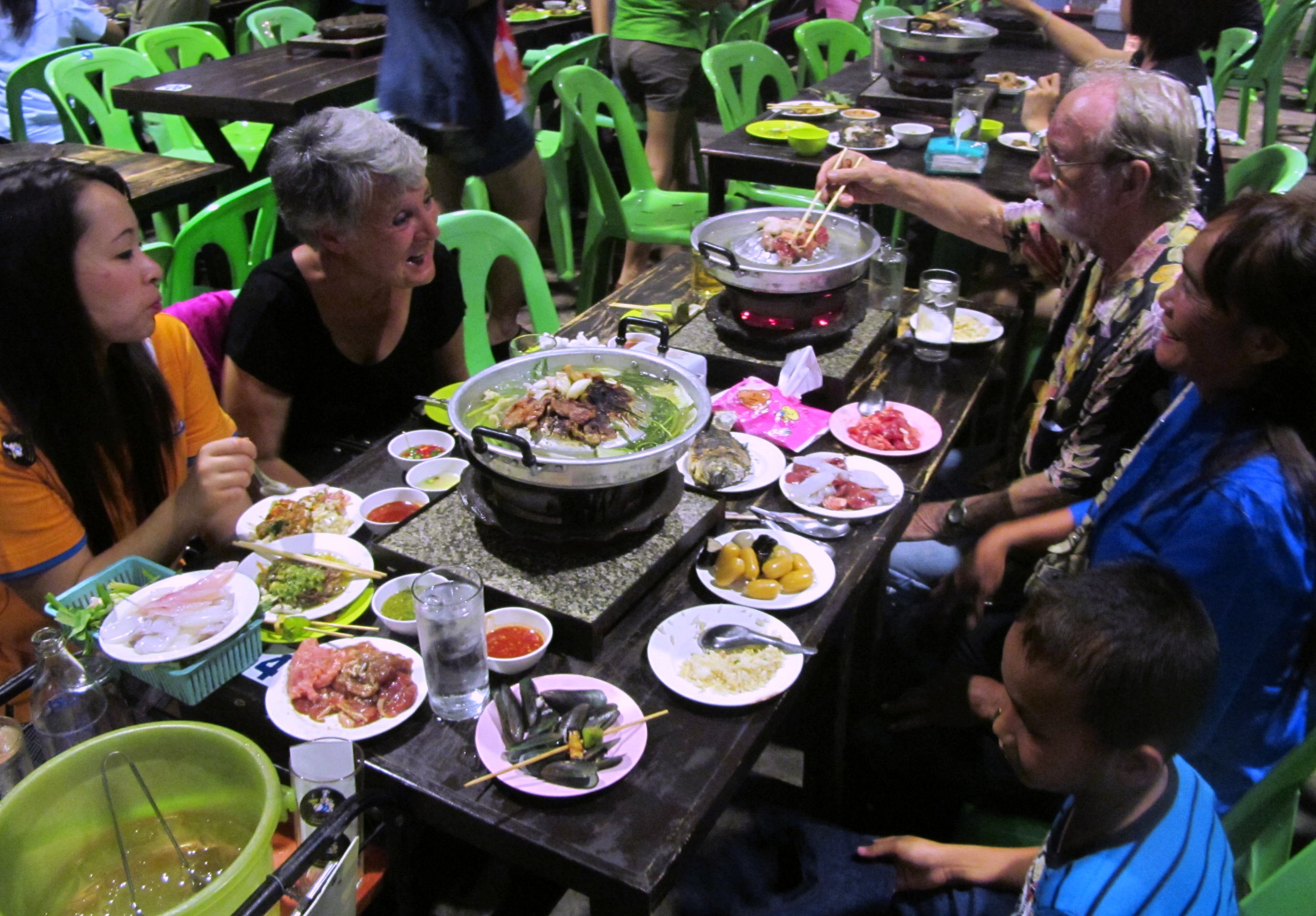
img: Janet Brown with friends at an all-you-can-eat DIY barbecue at a huge restaurant under a bridge in Bangkok, by Will Yaryan.

STAY TUNED for Monday’s post on the problems one can anticipate in trying out one’s humor on Wonderland’s inhabitants…

If you enjoyed this post, we invite you to subscribe for email delivery of The Displaced Nation. That way, you won’t miss a single issue. SPECIAL OFFER: New subscribers receive a FREE copy of “A Royally Displaced Tea.”

Related posts:

