
The Displaced Nation

A home for international creatives

Tag Archives: Acquired tastes

Travel author Janet Brown channels Alice in Wonderland’s “tone deaf” adventures

SPECIAL TREAT FOR TDN READERS: JANET BROWN, author of the travel gem Tone Deaf in Bangkok, has kindly agreed to “come in” and respond to your comments and questions. 

As you may have noticed, The Displaced Nation has gone Alice-in-Wonderland mad since around the first of June. To take just a few examples:

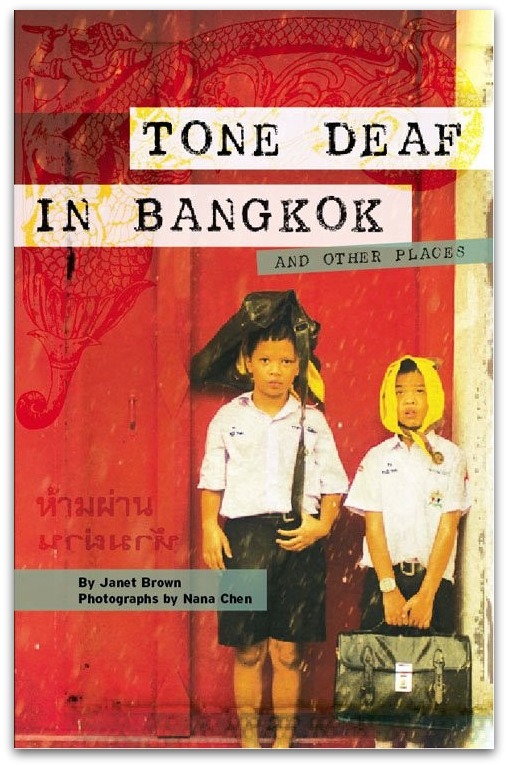
And now, to top that all off, the extraordinary travel writer Janet Brown is paying us a visit. Brown could almost be a stand-in for the Lewis Carroll heroine herself, having published a book on travel to and life in Thailand called Tone Deaf in Bangkok, to much acclaim.

“Tone deaf” — it puts one in mind of poor Alice’s plea to the Mouse, “I didn’t mean it…But you’re so easily offended, you know!”

But if Brown sees herself as tone deaf, her readers regard her as anything but. Here is a sampling of her reader reviews on Amazon:

It has been ages since I have loved a piece of travel literature…, and so when I read TONE DEAF IN BANGKOK, I was thrilled. This is a good travel book, and it is a good book, period.

I am not a traveler, nor do I typically read travel books. Shame on me, I know, but here’s the thing: … The author brought Bangkok to life in a way that made me want to go there, yes, but it was her own story that captivated me and kept me turning the pages. Now I’d read anything Janet Brown writes!

Janet Brown’s TONE DEAF IN BANGKOK is a travelogue, to be sure. Yet it is more, so much more. It’s also an investigation into how dislocated we can become by ourselves, by our priorities and by all that we demand of the cultures in which we live. … That she has a gift for spotting the universal in the exotic makes this collection all the more profound.

Janet Brown has graciously agreed to answer some of my Alice-related questions. After that, dear reader, I urge you to chime in!

Before we go down the rabbit-hole, can you tell me a little bit more about your background?
My parents turned me into a gypsy before I was two, by taking me on their journey by jeep from New York City to Alaska when the 49th state was still a territory and the Alcan Highway was still an unpaved trail into the frozen north. I have wandered ever since, most recently in Southeast Asia with Bangkok as my home, writing down the stories I encounter as I explore. My books include:

Maybe because I’m so steeped in Alice-of-Wonderland lore this month, I think of you as Alice Personified. To what extent can you relate to Alice’s sense of disorientation? Going back not just to the first time you went to Thailand but also when your family dragged you to Alaska…
I was 18 months old when my family moved to Alaska from Manhattan. I coped with any displacement issues by making my mother read my favorite book over and over again — a truly saccharine Little Golden Book called The New Baby. The main character had the same name as I so that was the big attraction — all about me!  My mother swears she can still recite it verbatim after having two martinis.

Alice came to mind constantly in my first months in Bangkok — and frequently thereafter. I knew I’d gone through the looking glass — or had entered the postcard — and asked myself often if that experience had been as painful for Alice as it often was for me.

Can you describe your worst “Pool of Tears” moment in Bangkok, where you wished you hadn’t decided on living there?
I’ve tried to make light of that time when I wrote about it in Tone Deaf in Bangkok, but it nearly demolished me. When the manager of my apartment turned me into Ryan’s Daughter by listening in on my phone calls and then entertaining the neighborhood with highly embroidered versions of my life — and when people fell silent when I walked down the street and began gabbling excitedly after I’d passed — I felt as though my life had been stolen from me and I shut down to the point of hypothermia. If my students hadn’t helped me find a new neighborhood, I would have gone home a gibbering mess.

Thailand is renowned for its distinctive cuisine. Was there anything that carried an “Eat me” label that you felt hesitant about at first, but then discovered you loved?
I’ve written about durian in Tone Deaf, how I thought its smell in the market was sewer gas and then how I was forced to taste it, with happy results. Fried grasshoppers were another thing I didn’t warm to at first sight and then liked as much as I do popcorn — they have much the same crunch and texture.

By the same token, were there any foods that you thought might be good but then didn’t acquire a taste for? (For Alice, of course, that was the Duchess’s over-peppered soup.)
One night I stopped to buy green papaya salad from a food cart to take home for supper. There was something in a little plastic bag that looked like a sort of relish, so I bought that, too.When I opened it at home a smell of rot filled the air, but remembering the delightful surprise that durian had proved to be, I took a generous spoonful. It was pla ra — fermented fish, a Northeastern Thailand culinary staple that is meant to be added and mixed judiciously with the salad, not eaten like peanut butter. There wasn’t enough toothpaste in the world to rid my mouth of that thoroughly foul taste.

As already mentioned, Alice finds it’s easy to offend the creatures in Wonderland without even trying. Why did you choose the expression “tone deaf” for the title of your book on Bangkok? 
“Tone deaf” can be taken quite literally. Thai is a tonal language with five different tones giving meaning to every word. Use the wrong tone and at best you’re incomprehensible, at worst shocking. The most common mistake for foreigners is to tell someone their baby is beautiful, while actually announcing that the infant is bad luck. Another pitfall is confusing the word “near” with the word for “far” — they are the same sound, differentiated by a crucial tone.

But travelers to Thailand can also be “tone deaf” when it comes to figuring out the Thais’ communication style. As a Thai-American friend has observed, the important things are what remain unsaid. “You looked so beautiful yesterday” probably means today you resemble dogfood and ought to go home and rectify that at once. Subtlety is the hallmark of Thai communication, and is often expressed through a quirk of an eyebrow or a famous Thai smile, which has at least one hundred different meanings — including disdain or outright menace.

Describe the biggest faux pas you’ve made since settling in Bangkok.
Oh, how to choose — it’s impossible not to make faux pas every second because Thai etiquette is demanding and complex. The one that makes me cringe most is in my first week when I set off on my first solo bus ride. I was clutching a twenty-baht note, which like all bank notes in Thailand bears the countenance of the King. He is revered to the point of near godhood in his kingdom and his picture is always elevated to the highest spot in a room — nothing is above the King. But I was fresh off the boat and when I dropped my money and it was caught in a little breeze, I put out my foot (the lowest and most ignominious part of the body) and stepped on the picture of the King’s face to secure my bus fare. I was too clueless to pick up on the ripples of horror that this caused others at the bus stop, but now I writhe when I remember this.

“Off with her head!” as the chief royal in Alice’s story is wont to proclaim. Actually, never mind your head. Your mention of your foot makes me think of how physically awkward Alice feels around the creatures in Wonderland. As a farang in Bangkok, do you often feel self conscious?
I’m short and dark in a family of pale-skinned people, so I was used to being an anomaly from early childhood. In Bangkok, if I dressed like a Thai woman and wore sunglasses and walked slowly, I felt as though I blended in. But one day I walked down a quiet street on my way to a class, and someone looked up and said, “Look at the foreigner.” “How did she know?” I asked my class of teenage girls. “Your hair,” they said. “No, lots of Thai women have dyed their hair brown,” I replied — to which they responded: “Your nose.” It was my big American nose that gave me away every time — and since I hate pain and surgery, I just had to accept that.

Have you tweaked your personal style at all so as to fit in better? 
Yes — I adopted the conservative “Don’t show your bare shoulders” school of dressing that prevailed in Bangkok when I first arrived and slowed my pace to that of the women around me. I learned to keep my facial expression as bland as I possibly could to achieve the quiet Thai “public face,” and I ironed everything, including my Levis. Now women are much more casual in the way they dress but I’m still stuck in the cultural mores of the 90s. To foreign women who live here now, my introductory years in Bangkok seem like fiction — things have changed so drastically in the past 16 years.

Time for a quote from the Cheshire Cat: “…we’re all mad here. I’m mad. You’re mad.” Can you relate?
Riding on the back of a motorcycle taxi down a crowded city sidewalk, buying a glass of Shiraz to take with my popcorn into a movie theater, being drenched to the bone during Thai New Year’s — this is actually the most difficult question you’ve asked so far because at this point it all seems normal.

If you were to hold your own Mad Hatter’s Tea Party in Bangkok, whom would you invite, and why?
Anais Nin, because she would love the unbridled hedonism of this place, Evelyn Waugh because he would satirize the expat scene so well, Ho Chi Minh because he could help put together the revolution that is needed here, Emily Hahn because she has always been my role model since I first read her when I was twelve, and Elvis because in Bangkok he is still the king.

Alice becomes aware that Wonderland is turning her into a different person, unrecognizable to the one she used to be. Has your identity has shifted in fundamental ways since living in Bangkok?
This is a very complex question — I’ve written one book about it and am working on a second one, Almost Home. I’m always drawn back to the US because my children are there. Seeing them for two weeks a year doesn’t work for me. Once I get back to the US this time around, I’ll return here but plan to spend the bulk of my time near family in the Pacific Northwest. I won’t know how much I’ve been changed by this recent incarnation in Bangkok until then. Ask me again in several months.

Can you offer any advice for newcomers to Bangkok, who aren’t sure who they are any more?
Tone Deaf in Bangkok and my next book, Almost Home, are where I directly address the challenges of feeling like an Alice in Thailand. In addition, the recently published Lost and Found Bangkok, for which I wrote the text, may be helpful for newcomers. It’s a book in which five different photographers — two American men, two Thai men (both from Bangkok), and one Taiwanese-American woman — show the city they live in. New arrivals can look at the photos and see some great places to get lost — and find out who they are — in this Wonderland-like city.

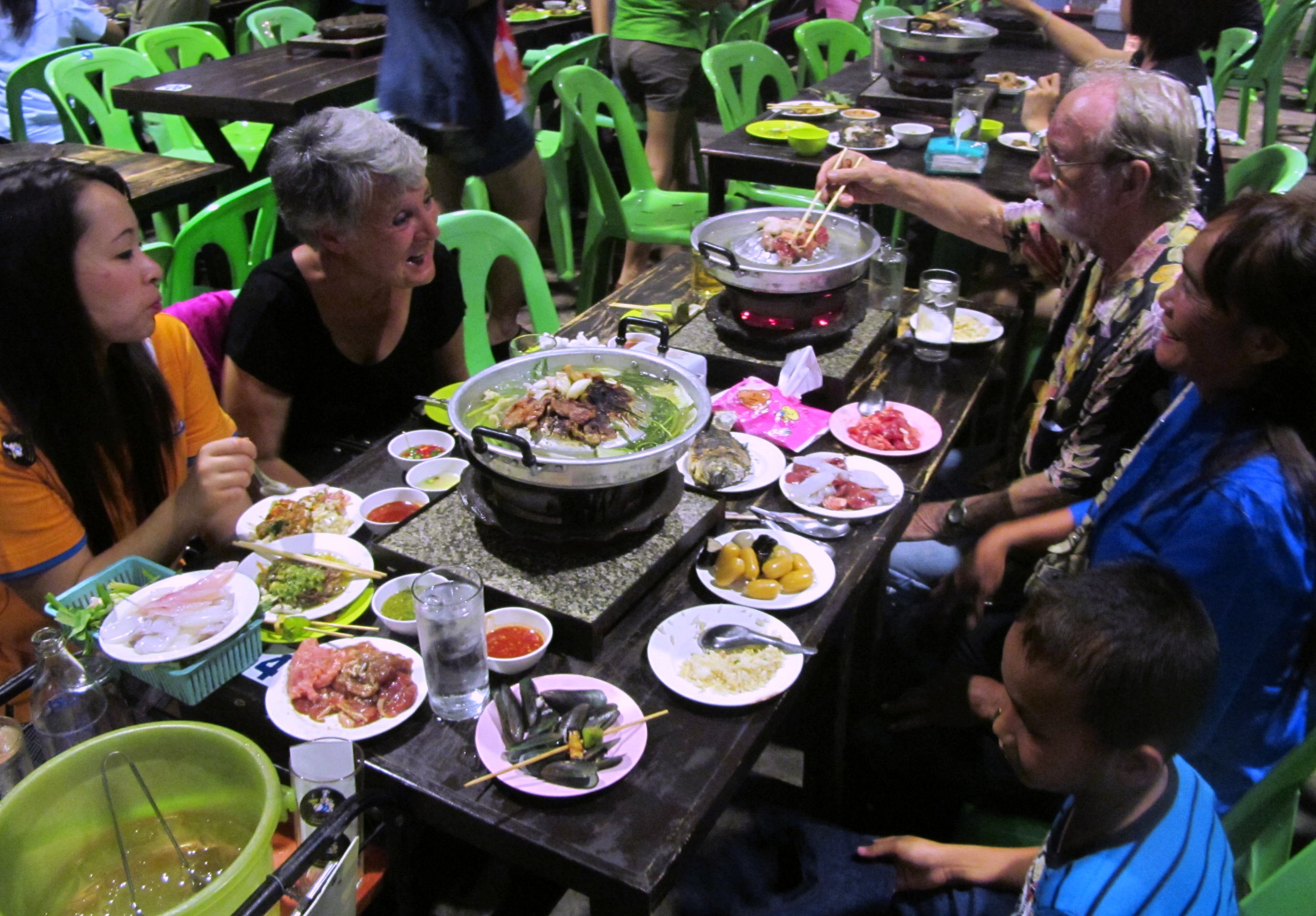
img: Janet Brown with friends at an all-you-can-eat DIY barbecue at a huge restaurant under a bridge in Bangkok, by Will Yaryan.

STAY TUNED for Monday’s post on the problems one can anticipate in trying out one’s humor on Wonderland’s inhabitants…

If you enjoyed this post, we invite you to subscribe for email delivery of The Displaced Nation. That way, you won’t miss a single issue. SPECIAL OFFER: New subscribers receive a FREE copy of “A Royally Displaced Tea.”

Related posts:
DISPLACED Q: Which dish is the worst international traveler?

Although “Does it travel well?” is a question usually asked of wine, we think the same query should be demanded of food, and often.

Alice agrees with us.

Soup didn’t cross successfully from the sublime to Wonderland:

“There’s too much pepper in that soup!” Alice said to herself as well as she could for sneezing.

At least use the correct animal.

In his Telegraph article, “Elegy to English shepherd’s pie”, our Alice Award winner, Sebastian Doggart, bemoans American ineptitude when it comes to making this most English of lamb dishes.

Americans just don’t get it.

First problem, encountered even in supposedly English pubs here in New York, is that it’s usually made with beef.

Putting the wrong animal in a dish? For shame!

Perhaps food should follow the jet stream.

Bill Bryson, in his book The Lost Continent, describes an equally disappointing encounter with another dish that hadn’t traveled well from East to West: a Cornish pasty in Michigan:

It was awful. There wasn’t anything, wrong with it exactly—it was a genuine pasty, accurate in every detail—it was just that after more than a month of eating American junk food it tasted indescribably bland and insipid, like warmed cardboard.

Although he attributes its lackluster flavor to his tastebuds becoming accustomed to American cuisine, I beg to differ on this point. Some dishes simply don’t travel well, and the Cornish pasty is evidently one of them. No one should attempt to recreate it outside England’s borders.

Or perhaps direction doesn’t matter.

However, Mr. Bryson found that some foods didn’t travel successfully across the Atlantic in the opposite direction, either.

In Notes from a Small Island, he comments on British hamburger chain Wimpy in the 1970s, before McDonald’s ruled UK fast food :

“I confess a certain fondness for the old-style Wimpy’s with their odd sense of what constituted American food, as if they had compiled their recipes from a garbled telex.”

He has a point. You don’t find American McDonald’s serving Big Macs with a side of Heinz baked beans.

And lastly — if you can’t boil a kettle, don’t make the tea.

Here, I am going to jump up on my hobby horse and say emphatically, “If you don’t understand that tea must be made with boiling water –- that’s when the cooking thermometer reads 100 degrees Celsius, not Fahrenheit –- don’t even try.”  Leave the tea to the British and Indian experts and stick to coffee instead.

I’ve lost count of the times when restaurants have served me “tea” by plonking down a cup of barely hot water with a teabag, still in its paper wrapper, at the side.

Why, for goodness’ sake? I also ordered a sandwich, but wasn’t handed two slices of stale bread and a packet of ham and told to get on with it.

Once bitten

Alice could have warned us of these perils, naturally. Her culinary adventures in Wonderland made her cautious before she jumped through the looking-glass:

“How would you like to live in Looking-glass House, Kitty? I wonder if they’d give you milk in there? Perhaps Looking-glass milk isn’t good to drink.”

Out of the mouth of babes and Victorian child-heroines, indeed.

So tell us: What’s the worst-traveled food you’ve encountered?

If you enjoyed this post, we invite you to subscribe for email delivery of The Displaced Nation. That way, you won’t miss a single issue. SPECIAL OFFER: New subscribers receive a FREE copy of “A Royally Displaced Tea.”

Related posts:
For curious and unreal travel, Tokyo sure beats Wonderland

Today we welcome Carole Hallett Mobbs to The Displaced Nation as a guest blogger. During June, TDN is looking at what the story of Alice in Wonderland can tell us about displacement of the curious, unreal kind — as anchored by Kate Allison’s “5 Lessons Wonderland taught me about the expat life, by Lewis Carroll’s Alice.” Hallet Mobbs can identify, having just left Japan — a country that Western travelers have long regarded as the ultimate topsy-turvy destination — after four-and-a-half years of living with her family in Tokyo.

“I’ve believed seen as many as six impossible things before breakfast”: this seems the most logical place to begin my account of life in Wonderland Japan.

In Tokyo, you can see a minimum of six impossible or incredible things before breakfast.

And then another six after breakfast.

In fact, I can safely say that a day spent in Tokyo will guarantee you a double-take moment approximately every ten minutes.

I know this, because I timed myself one day, using an oversized pocket watch.

Jaw-dropping sights abound — and I never failed to be delighted and amazed every single day during my four-and-a-half-year stay.

And if,  like me, you prefer seeing to believing, then Tokyo is the place to be.

Curiouser…

Whilst driving my young daughter, Rhiannon, to school one day, I absentmindedly pointed out a Routemaster bus.

Double take! A red double-decker is a London inhabitant, not normally seen outside the Big Smoke. What on earth was one doing trundling its way around Tokyo?

These beasts are not known for their flying abilities but it had obviously migrated somehow. I discovered that a Japanese diplomat who’d been posted to Britain persuaded London Transport to donate one of these wonderful buses to Japan. It’s now a cruising restaurant.

People, too, arrest your attention. With their unique, carefully honed fashion sense, Tokyoites take style to a whole new dimension.

Real Alice in Wonderlands trip along the fashionable Harajuku, mixing with other young people dressed in adult-sized furry romper suits complete with ears. (Rabbits and bears are favorites.)

A particularly memorable vision in that section of town was a fully decked-out Stormtrooper from Star Wars, casually walking up the road.

Then there are those whom I thought of as “dormice folk.” Due to their heavy workloads, many so-called salarymen need to catch forty winks whenever and wherever they can. Favorite snoozing spots include crashing out across a table in Starbucks or on a bench. And they’ve even been known to take advantage of armchair displays in department stores.

Nobody dreams of waking them; that would show a deep lack of respect.

…and curiouser

Look! That’s a baby in a sling. Oh, my mistake, it’s a white rabbit.

Stuff and nonsense… Or is it?

As well as people watching, I can highly recommend pet-watching as a surreal Tokyo pastime.

Peer into a buggy expecting to see a cute, chubby baby with spiky black hair and instead see — no, not a pig, but more than likely a dog or two.

Yes, canines are cosseted creatures in Tokyo. More often than not, they are the size of guinea pigs, and almost all wear fashionable outfits.

Is that a giant caterpillar? No, it’s a dressed-up dog. Dogs in kimono. Dogs wearing tutus with real diamond necklaces. Dogs in leather jackets and sunglasses. Dogs in boots…

More than once I had a curious conversation with fellow dog owners. I have a Japanese Shiba-Inu (unclothed). This caused much admiration — a gaijin with this special Japanese dog was a big hit — as well as some puzzlement. “But that’s a Japanese dog. How did you teach her to understand English?”

And it’s not just pets that are dreamlike.

Crows are as big as ravens, woodpeckers as small as wrens.

Saucer-sized butterflies flit by like vibrant handkerchiefs, and hornets are so large they need their own air traffic control center.

Drink me! Eat me!

Japanese interpretations of Western food can be a trifle bizarre. Experimentation is rife, and experiments include drinks such as iced Earl Grey lattes and cucumber Pepsi.

Being taken by surprise during a snack is commonplace.

Thrilled by finding some doughnuts that appeared to have jam inside, I took a huge bite. The “jam” was azuki bean paste. Not my favorite.

Another shock was a Wasabi Kit Kat. I still haven’t recovered from that one.

Some time in recent history, the sandwich reached Japan. I imagine the conversation went a little like this.

“What is a sandwich?”

“Well, it’s two slices of bread with a filling between the slices.”

“What filling goes into this sandwich?”

“Oh, anything really…”

One day a friend bought a sandwich with a lumpy filling. A gentle squeeze sent a whole cooked potato shooting across the room.

Through the looking-glass

Beckoning looks like waving goodbye.

Keys turn the wrong way.

Books and magazines are read from back to front.

Writing follows its own rules. The elegantly beautiful yet complex Chinese characters, known as kanji, are written vertically in columns and read from top to bottom and right to left.

Tell me, please, which way I should go from here?

Notably, as an Englishwoman in Europe, I can usually work out rough meanings by utilizing my limited knowledge of Latinate and Germanic languages.

In Japan, though, I was suddenly completely illiterate.

Imagine the fun my husband and I had on our car journeys. Trying to decipher the name of our destination on the map, he would say: “Look out for a sitting man, a picnic table, noughts and crosses, a ‘7”and a jellyfish.” Predictably, we got lost rather a lot.

Going somewhere on foot was no easier. Streets are not well labeled, or labeled at all. In fact, being lost in Tokyo is so common — even for Tokyoites — that everyone carries their own little maps with landmarks.

If you stand around looking pathetic for a while, a stranger will miraculously appear and guide you to your destination — and then disappear, leaving only a grin behind…

English words are considered interesting and “cool,” so are often used for shop names and slogans. But a love of English isn’t always correlated with an understanding of how our words link together — leaving us foreigners as clueless as ever.

“Tokyo Teleport Station” is just outside the city. Sadly, it’s just a train station, not a link to other worlds.

One that still puzzles me is a sign declaring “SLOB! Oxidised Sophistication.” I just have no idea.

The “Hotel Yesterday” has the tagline “Welcome to Yesterday.” I often feel like that.

Is Tokyo really a wonderland?

Goodness, what a long sleep I’ve had! Such a curious dream!

Though I’ve enjoyed using “Alice” allusions to describe my Tokyo adventures, I’m not sure if it’s of much use in helping other expats adjust to this very real yet extraordinary city.

The key to living in and enjoying Japan is to keep an open mind, embrace eccentricity and expect the unexpected at all times.

And if that’s too tall an order on any given day — rather like Alice’s serpent neck — then I suggest you follow her sister’s advice and “run in to your tea.” But if I were you, I’d give the “jam” doughnuts a miss!

Question: Can you think of any other cities that merit a “through the looking glass” reputation, or is Tokyo an extreme, as Carole Hallett Mobbs suggests?

Carole Hallett Mobbs is a trailing spouse and freelance writer. Her blog on life in Tokyo is called Japanory. After moving to Berlin with her family in April, she started up another blog, Berlinfusion, and is writing a book on expat children. Her Twitter moniker is @TallOracle.

img: Carole and her daughter, Rhiannon, caught in an Alice-like pose by 37 Frames (Tokyo).

STAY TUNED for tomorrow’s Displaced Q having to do with one of our — and Alice’s — favorite topics: food!

If you enjoyed this post, we invite you to subscribe for email delivery of The Displaced Nation. That way, you won’t miss a single issue. SPECIAL OFFER: New subscribers receive a FREE copy of “A Royally Displaced Tea.”

Related posts:

RANDOM NOMAD: Charlotte Day, High School Student (Sixth Former)

Born in: Sydney, Australia
Passports: Australia, UK and US Green Card
Countries lived in: Australia (Sydney): 1994-2001; United States (New York, New York): 2001-2010; England (Sevenoaks, Kent): 2010-present

What made you leave your homeland in the first place?
My father is Australian and my mother English. They split up when I was two. When I was six, my mother met and married an Australian who had been living in New York for thirty years. I was rather disgruntled about moving to the United States and for two or three years, remained determined never to accept it as “home.” At that time, I was deeply patriotic to my native country — though this sentiment has dissipated since.

Is anyone else in your immediate family a “displaced” person?
My mother’s family, originally from England, has long been displaced. My mother herself was born in Kenya, in 1961. Following the Mau Mau Uprising, her parents were forced to relocate, and my grandfather, presented with a choice between Australia and Canada, chose the warmer of the two countries. My mother spent her childhood bouncing between schools in England and Australia. She eventually grew so fed up with packing and unpacking, she decided to leave school at the age of 16. Her father agreed to the plan provided she spend a final year at the school in Switzerland his own mother had attended as a girl. My mother moved on from Swiss finishing school to work in London, Paris and Sydney. But she appears to have made New York her last port of call. Indeed, we had a fairly solid life in the city until I decided to take myself off to boarding school in England.

Describe the moment when you felt most displaced over the course of your many displacements.
It must have been when I first arrived in New York as a six-year-old. I stepped out of the JFK arrivals terminal into a snowy March night. My stepfather was wearing a leather coat, the interior of his car smelled of leather — and the world outside the car window seemed an undulating stream of black and silver. Though it was the end of 2001’s warm winter, my Australian blood froze beneath my first-ever coat. And their apartment — that was all leather as well. It smelled of musk and cologne. Since that time, I have felt similar pangs of displacement, some of which lasted for considerable periods. But those first few moments in New York stand out as the most acute concentration of “displacedness” I have ever known.

Describe the moment when you felt least displaced.
For the last five or so years in New York, I have felt more at home than I ever did in Sydney. I ascribe this to growing up: at a certain age, one can take possession of a city, know its streets, bridges, tunnels and transportation system. I was too young when I lived in Sydney to reach that kind of comfort level. But when have I felt the most like a New Yorker? Perhaps it was the last time I came home for the holidays, and took the 4 train uptown for the first time in months. At that moment I realized how much this train had been a part of my life — conveying me home from school every day for two years. My old life would always be waiting for me on the subway, ready for me to pick it up again. That’s something only a New Yorker could say!

You may bring one curiosity you’ve collected from each of the countries where you’ve lived into the Displaced Nation. What’s in your suitcase?
From Australia: A miniature wooden wombat figurine — a gift from my grandfather. It conjures memories of a childhood spent beating about the bush (literally) and fishing for yabbies at the dam in the company of audacious dogs who stuck their heads down wombat holes, to no good end.
From New York: A pair of fake Harry Potter glasses. These defined my first six months in New York — I even wore them to my first day of school. I think it is telling that even at the age of six, I was unwilling to give all of my real self to this new home.
From England: My school tie — representative of the alternative universe I seem to have entered. At boarding school, the sense of removal from reality can be disconcerting — especially after having spent a decade in the city I regard as the world’s capital.

You’re invited to prepare one meal based on your travels for other Displaced Nation members. What’s on your menu?
I’d like to make you a Sydney breakfast: scrambled eggs, made with cream, salt and pepper and served on a bed of Turkish toast, with avocado and stewed tomato on the side (is this being greedy?). Our meal will be accompanied by a large “flat white”: what we call perfectly strong, milky coffee without excessive froth. I suggest we consume it overlooking a beach on a Sunday morning. At least, I assume The Displaced Nation has beaches?

You may add one word or expression from each of the countries you’ve lived in to The Displaced Nation argot. What words do you loan us?
From Australia: Daggy. I use this word all the time — and did not realize it was exclusively Australian until I was informed of the etymology. Apparently, it comes from trimming the soiled wool around a sheep’s bottom. Which part of this repugnant whole is actually the “dag,” I do not remember. (No, I’m not a proper Australian!) But as I understand it, “daggy” means sloppy in appearance or badly put together.
From New York: There are so many words, and most are second nature by now. However, I will choose grande-soy-chai-tea-latte because I still shudder to think of myself as the kind of person who can utter such a phrase, at great speed, with great insistence. In fact, I’m still in denial about my love for Starbucks: having known Sydney coffee, my standards should be higher.
From England: Banter. I still do not know the precise meaning of this word, but it seems to encapsulate everything that makes someone my age feel socially acceptable — and, of course, I have no banter whatsoever. I think it means the capacity for combining wit with meaningless conversation. But there are other components, too, which seem to me unfathomable.

Question: Readers, tell us what you think: should we welcome Charlotte Day to The Displaced Nation and if so, why? (Note: It’s fine to vote “no” as long as you couch your reasoning in terms you think we all — Charlotte included — will find amusing.)

img: Charlotte Day at her boarding school in southeast England

If you enjoyed this post, we invite you to subscribe for email delivery of The Displaced Nation. That way, you won’t miss a single issue. SPECIAL OFFER: New subscribers receive a FREE copy of “A Royally Displaced Tea.”

Related posts:

DISPLACED Q: What items from home can you not live without?

UK department store John Lewis recently announced it would soon launch versions of its Website for shoppers in 27 countries, including the USA, Australia, and Singapore. The company has no plans to open stores in these locations, however; all orders will be delivered by courier.

Marks and Spencer, another institution of the British High Street, already ships to 80 countries worldwide, even though it has over 300 international stores scattered around the globe.

It seems both John Lewis and M&S  understand something that all expats know — there are certain items you only feel comfortable buying from home.

Marks & Spencer, for example, accounts for around thirty percent of the UK lingerie market; it’s not unreasonable to assume that displaced Brits with diminishing lingerie supplies and no access to M&S stores make up a goodly proportion of the international shipping numbers. Meanwhile, John Lewis has the most popular gift list in the UK. How about some Conran bed linen or Denby pottery to make your relations feel at home in their Moscow abode? Sometimes only the familiar will do.

It’s not all about the goods, either. Expat in Germany, in her March 17 post, explained why she hesitated to buy a wedding dress in Germany instead of in her native Canada. It had nothing to do with the quality of wedding gowns and everything to do with the charming honesty of German sales assistants that made her pine for a gentler shopping experience at home.

But these facts and anecdotes made us wonder: No matter how displaced you have become, are there certain items — other than food — that you still prefer to import from your home country?

Two members of the Displaced Nation Team kick off the discussion:

Kate Allison: During my 15 years as a Brit in the US, I have been known to ask visitors to bring gifts of children’s cotton pyjamas. The cotton in the UK is much nicer, somehow, than in the US. I also had a brief sojourn into Next duvet covers, because duvets aren’t as popular in the US as they are in Europe.  Last time I was over, though, it was shoes that caught my eye. And yes, they came from Marks and Spencer. It’s not that they were any better than their American counterparts — just different, and not from Macy’s.

ML Awanohara: As far as wedding (and other special) dresses go, the more exotic the better. I was never an expat in Rome but went shopping for my wedding dress a few years back in a charming boutique, Maga Morgana, very near the Piazza Navona. (If I had it to do over, I’d have studied abroad in Italy — art history, of course. So perhaps I was playing out that fantasy…) Kate, it’s funny you mention shoes. While living in the UK and Japan, I always preferred to buy shoes in the US. It wasn’t that I didn’t like the shoes in those countries — I coveted them. But they made my feet hurt, something to do with the “last” not being big enough. I noticed recently on an expat news feed that displaced New Zealanders often head to a shop called Minnie Cooper’s as soon as they get home. This piqued my curiosity: is it for the styles, the NZ leather, or both?

Your turn to chime in: What homey items, apart from food, have you yet to wean yourself off?

If you enjoyed this post, we invite you to subscribe for email delivery of The Displaced Nation. That way, you won’t miss a single issue. SPECIAL OFFER: New subscribers receive a FREE copy of “A Royally Displaced Tea.”

Seven deadly dishes — global grub to die for

A Briton abroad spends a surprising amount of time defending his native national cuisine. I remember going to a steak house in Connecticut where the waitress, upon taking our order and hearing our accents, said brightly, “From England, huh? I hear you don’t get anything good to eat over there. ”  When she brought the filet mignon to the table, she did so with the pitying smile of one delivering alms to the starving.

British super-chefs like Gordon Ramsay and Jamie Oliver may be taking the US by storm, but still this delusion of bad food persists. To which I say: whatever the perceived faults of English cuisine, at least no one has to take out extra life insurance before eating Yorkshire pudding.

Yet there are quite a few delicacies from countries without this dismal food reputation, where a top-up premium might be useful before you take that first bite.

In ascending order of danger or toxicity:

7.   Snake wine – Vietnam, Southeast Asian, Southern China.
An assortment of herbs, small snakes, and a large venomous snake are steeped for many months in a glass jar of rice wine, then consumed in small shots for medicinal purposes. Fortunately, the ethanol renders snake venom harmless.

6.   Surströmming – Sweden.
Fermented  Baltic herring. Stored in cans, where the fermentation continues, causing the cans to bulge. In 2006, Air France and British Airways banned surstromming from their flights because they said the cans were potentially explosive.  According to a Japanese study, the smell of this Scandinavian rotten fish is the most putrid food smell in the world.

5.   Fried tarantula – Cambodia.
Tarantulas, tossed in MSG, sugar, and salt, are fried with garlic  until their legs are stiff and the abdomen contents less liquid. The flesh tastes a little like chicken or white fish, and the body is gooey inside. Certain breeds of tarantula have urticating hairs on their abdomen, which they use for self-defense. If the spiders are not prepared properly – i.e., if the offending hairs are not removed with a blow torch or similar – these hairs can cause pharyngeal irritation in the consumer.

4.   Sannakji – Korea.
Small, live, wriggling octopus, seasoned with sesame and sesame oil. The suction cups are still active, so bits of tentacle may stick to your throat as you swallow, especially if you’ve had one too many drinks before dinner. The trick is to chew thoroughly so no piece is big enough to take hold of your tonsils. Some veteran sannakji eaters, however, enjoy the feel of longer pieces of writhing arm and are prepared to take the risk.

3.   Stinkhead – Alaska
Heads of salmon, left to ferment in a hole in the ground for a few weeks. Traditionally, the fish was wrapped in long grasses and fermented in cool temperatures, but then someone discovered Baggies and plastic buckets, which increase the speed of the process. Unfortunately, they also increase the number of botulism cases.

2.   Casu Marzu – Sardinia
Made by introducing the eggs of the cheese fly to whole Pecorino cheese (hard cheese made from sheep’s milk) and letting the cheese ferment to a stage of terminal decomposition. Locally, the cheese is considered dangerous to eat when the maggots are dead, so you eat them live and squirming. As the larvae can jump six inches in the air, it is advisable to cover your cheese sandwich with your hand while eating to prevent being smacked in the face by grubs. An alternative is to put the cheese in a paper bag to suffocate the maggots, then eat it straight away. The maggots will jump around in the bag for a while, making a sound, I imagine, not unlike that of popcorn in the microwave. Although the European Union outlawed this food for a while, it has since been classified as a “traditional” food and therefore exempt from EU food hygiene regulations.

1.   Fugu (Puffer fish) – Japan
Considered to be the second most toxic vertebrate in the world, puffer fish is a delicacy in Japan, but preparation of the food is strictly controlled, with only specially trained chefs in licensed restaurants permitted to deal with the fish. Fugu contains tetrodotoxin, a poison about 1200 times stronger than cyanide, which is most highly concentrated in the fish’s liver —  the tastiest part. Sadly, for gourmets who like to live life on the edge, fugu liver in restaurants was banned in Japan in 1984.

Question: What is the most adventurous dish you’ve ever eaten?

For tamer foods that won’t mean a trip to the emergency room, sign up to receive our posts by email and receive your free copy of “A Royally Displaced Tea,” with recipes for Victoria Sponge, Fruit Scones, Princess Pairs, Queen of Puddings and Tiffin. All English. All good.

If you enjoyed this post, we invite you to subscribe for email delivery of The Displaced Nation. That way, you won’t miss a single issue.

Jamie Oliver, culinary expert — and now expat?

Try as I might, I can’t make out why Jamie Oliver has taken it upon himself to save my countrymen from themselves.

I understand he’s trying to start a food revolution. Not only that but I’m a supporter, having signed the online petition. After all, I lived in Japan for long enough to see that if a national diet is in essence health food, there are many fewer incidences of obesity, diabetes, and heart disease, and people live longer.

But why is Jamie Oliver, of all people, leading this campaign? That’s the part I haven’t been able to fathom. Before going to Japan, I lived in Britain, where Oliver was known as the “naked chef.” Call it a lack of imagination but somehow I never anticipated that the face of the Sainsbury’s grocery-store chain would someday transform himself into a food activist and arrive on my shores. What happened?

Don’t get me wrong, I’m glad Oliver has decided to export his food revolution. For me, his confrontation with the stony-faced lunch ladies at the school in Huntington, West Virginia — which has been called the unhealthiest city in America — goes down in the annals as reality TV at its finest.

(I’m still not convinced those ladies aren’t actors.)

And now that he’s back for a second season of his “food revolution” show, which premiered last night, I’m enjoying seeing him take on the members of the Los Angeles school board, next to whom the West Virginian women seem warm and welcoming. LA is the second-largest school district in the nation, serving over half a million processed meals every day.

I note that this time, Oliver brought his wife, Jools, and their four young children, to live with him in LA. Is he planning to become an expat? Stranger things have happened…

I can’t really explain why Oliver would choose to displace himself and his loved ones in the service of America’s overfed youth, but I can offer some half-baked ideas:

1) He doesn’t like being less well known than Gordon Ramsay.

Ramsay surpassed Oliver some time ago in terms of earnings and visibility. Indeed, last night’s show offered evidence of this in a scene involving Dino Perris, the owner of a fast-food drive through in Glassell Park, a working-class neighborhood in LA. Perris said he’d never heard of Jamie Oliver and thought he might be that “rude guy.”

The only thing wrong with this theory? Ramsay is best known for swearing a blue streak and Oliver for interacting with kids like the Pied Piper of Hamelin. Apples and oranges.

2) He is descended from missionary stock (hahaha).

In other words, it’s in his DNA to make converts beyond his own shores.

This theory, however, doesn’t hold water when you study Oliver’s family tree. Most of his people hailed from Cornwall and his great-great grandfather John Oliver was a Royal Navy seaman who did time in prison — not exactly the ingredients from which a food evangelist emerges.

3) He is escaping from Britain because his popularity is on the wane.

His fellow Brits have grown tired of seeing him running around in his green pea costume, so he is seeking a fresh audience.

At first this theory seems quite palatable. Most Americans probably don’t know this, but there was a backlash against Oliver’s “school dinners” program in the UK. It reached its peak when two mothers at a school in South Yorkshire started delivering junk food from local shops through the school fence, claiming that their youngsters didn’t want to eat the celebrity chef’s “overpriced lowfat rubbish.”

Still, I can’t believe that Oliver was ever put off by people who cooked up stunts that are, in effect, straight out of his manual. He loves nothing better than stirring the pot, and besides, he achieved what he wanted: the UK government established the School Food Trust, dedicated to improving the quality of food in the nation’s schools.

Okay, so I have no idea why he’s here. I might as well chime in with Jon Stewart, who, when Oliver appeared on his show last week, summed it up as follows:

You have come to this land you and you would like to help us become healthier, better people. Good luck with that.

And if Angelenos start throwing rotten tomatoes at him, I hope he has the good sense to move across the Pacific. Rumor has it that obesity rates among children in Asia are rising with the invasion of McDonalds, KFC, Pizza Hut, and so on.

If that doesn’t make him fed up, I don’t know what will.

Question: What do you think has made Jamie Oliver cross borders, and would you like to see him become an expat in the United States?

If you enjoyed this post, we invite you to subscribe for email delivery of The Displaced Nation. That way, you won’t miss a single issue.

CLASSIC EXPAT WRITING: London and the English — Casanova

While inextricably linked in the imagination with his home city of Venice, Giacomo Casanova spent much of his life travelling and living in other parts of Europe. That ugly term “expat” which many of us, myself included, seem to cling onto as an identifier, was not in use in Casanova’s day, and to apply it to him retrospectively would seem to do him a great disservice. Casanova was a traveller and an observer, a man who seemed to treat Eighteenth Century Europe as a playground, a man whose life for the most part seemed permanently picaresque. Paris, St Petersburg, Dresden, Vienna, Warsaw, Prague, London: at some point all these cities played host to Casanova, and in his extensive memoir, Story of my Life he details his thoughts and observations about them all. While almost certainly someone we’ll return to at a later date, here are some choice extracts on his thoughts about London and the English. This is taken from the Arthur Machen translation of 1894.

On arriving in England:

The stranger who sets his foot on English soil has need of a good deal of patience. The custom-house officials made a minute, vexatious and even an impertinent perquisition; but as the duke and ambassador had to submit, I thought it best to follow his example; besides, resistance would be useless. The Englishman, who prides himself on his strict adherence to the law of the land, is curt and rude in his manner, and the English officials cannot be compared to the French, who know how to combine politeness with the exercise of their rights.

English is different in every respect from the rest of Europe; even the country has a different aspect, and the water of the Thames has a taste peculiar to itself. Everything has its own characteristics, and the fish, cattle, horses, men, and women are of a type not found in any other land. Their manner of living is wholly different from that of other countries, especially their cookery. The most striking feature in their character is their national pride; they exalt themselves above all other nations.

My attention was attracted by the universal cleanliness, the beauty of the country, the goodness of the roads, the reasonable charges for posting, the quickness of the horses, although they never go beyond a trot; and lastly, the construction of the towns on the Dover road; Canterbury and Rochester for instance, though large and populous, are like long passages; they are all length and no breadth…..

On whores and kings:

I visited the theatres of Covent Garden and Drury Lane, but I could not extract much enjoyment out of the performances as I did not know a word of English. I dined at all the taverns, high and low, to get some insight into the peculiar manners of the English. In the morning I went on ‘Change, where I made some friends. It was there that a merchant to whom I spoke got me a Negro servant who spoke English, French, and Italian with equal facility; and the same individual procured me a cook who spoke French. I also visited the bagnios where a rich man can sup, bathe, and sleep with a fashionable courtezan, of which species there are many in London. It makes a magnificent debauch and only costs six guineas. The expense may be reduced to a hundred francs, but economy in pleasure is not to my taste.

On Sunday I made an elegant toilette and went to Court about eleven, and met the Comte de Guerchi as we had arranged. He introduced me to George III., who spoke to me, but in such a low voice that I could not understand him and had to reply by a bow. The queen made up for the king, however, and I was delighted to observe that the proud ambassador from my beloved Venice was also present. When M. de Guerchi introduced me under the name of the Chevalier de Seingalt, Zuccato looked astonished, for Mr. Morosini had called me Casanova in his letter. The queen asked me from what part of France I came, and understanding from my answer that I was from Venice, she looked at the Venetian ambassador, who bowed as if to say that he had no objection to make. Her Majesty then asked me if I knew the ambassadors extraordinary, who had been sent to congratulate the king, and I replied that I had the pleasure of knowing them intimately, and that I had spent three days in their society at Lyons, where M. Morosini gave me letters for my Lord d’Egremont and M. Zuccato.

“M. Querini amused me extremely,” said the queen; “he called me a little devil.”

“He meant to say that your highness is as witty as an angel.”

I longed for the queen to ask me why I had not been presented by M. Zuccatto, for I had a reply on the tip of my tongue that would have deprived the ambassador of his sleep for a week, while I should have slept soundly, for vengeance is a divine pleasure, especially when it is taken on the proud and foolish; but the whole conversation was a compound of nothings, as is usual in courts.

After my interview was over I got into my sedan-chair and went to Soho Square. A man in court dress cannot walk the streets of London without being pelted with mud by the mob, while the gentleman look on and laugh. All customs must be respected; they are all at once worthy and absurd.

On matters of the stomach:

The Englishman is entirely carnivorous. He eats very little bread, and calls himself economical because he spares himself the expense of soup and dessert, which circumstance made me remark that an English dinner is like eternity: it has no beginning and no end. Soup is considered very extravagant, as the very servants refuse to eat the meat from which it has been made. They say it is only fit to give to dogs. The salt beef which they use is certainly excellent. I cannot say the same for their beer, which was so bitter that I could not drink it. However, I could not be expected to like beer after the excellent French wines with which the wine merchant supplied me, certainly at a very heavy cost.

On unruliness at the theatre:

After a long discussion on politics, national manners, literature, in which subjects Martinelli shone, we went to Drury Lane Theatre, where I had a specimen of the rough insular manners. By some accident or other the company could not give the piece that had been announced, and the audience were in a tumult. Garrick, the celebrated actor who was buried twenty years later in Westminster Abbey, came forward and tried in vain to restore order. He was obliged to retire behind the curtain. Then the king, the queen, and all the fashionables left the theatre, and in less than an hour the theatre was gutted, till nothing but the bare walls were left.

After this destruction, which went on without any authority interposing, the mad populace rushed to the taverns to consume gin and beer. In a fortnight the theatre was refitted and the piece announced again, and when Garrick appeared before the curtain to implore the indulgence of the house, a voice from the pit shouted, “On your knees.” A thousand voices took up the cry “On your knees,” and the English Roscius was obliged to kneel down and beg forgiveness. Then came a thunder of applause, and everything was over. Such are the English, and above all, the Londoners. They hoot the king and the royal family when they appear in public, and the consequence is, that they are never seen, save on great occasions, when order is kept by hundreds of constables.

If you enjoyed this post, we invite you to subscribe for email delivery of The Displaced Nation. That way, you won’t miss a single issue.

Miracle Whip as the new Marmite? It would take an act of God…

News has just reached the Displaced Nation — via a dog-eared copy of the Village Voice dated March 7 — about a new commercial for Miracle Whip that is in fact a rip-off of Marmite’s “love it or hate it” ad campaign. (Marmite of course being the savory spread made from waste yeast from the brewing industry, on which millions of Brits are weaned at an early age.)

Like Marmite before it, Miracle Whip is asking: do you love the not-quite-mayonnaise or hate it?


Kraft, the citizens of the Displaced Nation would like you to know: we are aware of your craftiness and we think it’s pretty cheesy of you to produce such a blatant imitation of Unilever’s brilliant Marmite campaign.

We also think it’s too bad that your marketing people didn’t consult with any Brits who are living in the United States, or they’d have set you straight on where Marmite belongs in the pantheon of branded foods: i.e., far above Miracle Whip.

Take, for instance, Kate Allison, a member of the Displaced Nation team. She chose to call her personal blog Marmite & Fluff. Marmite stands for Kate’s British heritage, while Fluff represents the past fifteen years she has spent living in the United States.

Notably, Kate decided to elevate Durkee-Mower’s Marshmallow Fluff — not Kraft’s Miracle Whip — to the level of her beloved Marmite because she believes the Fluffernutter sandwich has the same iconic status for American children as Marmite on toast does for their counterparts in Britain.

Another example is Lucy Sisman, a British resident of Manhattan who edits WWWORD.com, a site for anyone who uses, abuses, loves and hates the English Language.

Lucy includes the Marmite jar in her recent post listing objects from her kitchen cupboard that belong to the leave-us-as-we-are-hall-of-fame for their genius packaging. (Traditionally, Marmite was supplied in an earthenware pot, on which its glass, and now plastic, jars are modeled.)

Hmmm….when was the last time any of us heard an American wax nostalgic about a Miracle Whip jar?

Of Kraft’s many food products, only the Oreo comes anywhere near to arousing the kinds of passions that Marmite does, if expat blogs are anything to go by. But one doesn’t sense that Oreo lovers sit up and take umbrage whenever Kraft introduces a new variety, such as mini Oreos, chocolate creme Oreos, golden Oreos… Not so with the Marmite minions. Kate, for instance, had this to say of some new-fangled Marmite combos:

I thought Marmite and Fluff sandwiches were bad. Now I’ve discovered you can buy Marmite chocolate. And champagne Marmite, anyone? Or Marmite with Marston’s Pedigree?

Besides Oreos, Americans abroad also say they miss Kraft’s macaroni-and-cheese mix — though a surprising number go on to say that their nostalgia dissipates with each successive bite.

Robyn Lee, a foodie who lived in Taiwan as a kid, described her first experience with Kraft’s mac-cheese in a post for Serious Eats last October:

The first time I tried the iconic American foodstuff was in middle school when I was living in Taipei, out of some desperate longing to eat something American. It was an exciting experience, until I ate it.

Compare this to what Kate says about her favorite yeast sludge: “Isn’t the point of Marmite that it overrides all other flavours?”

Love it, hate it, or find it insipid? Kraft should have included a third option when tweaking the Marmite ads for Miracle Whip.


Question: Does Marmite stand alone, or are there other branded foods that inspire intense nationalistic feelings, which in no way diminish upon becoming displaced? (On the contrary, absence can make the palate grow even fonder…)

If you enjoyed this post, we invite you to subscribe for email delivery of The Displaced Nation. That way, you won’t miss a single issue.

Some tart comments on the sweetness of American food

The two-year-old blogging relationship between UK-based American Mike Harling and US-based Brit Toni Summers Hargis has entered a sweet phase. Mike wrote on Pond Parleys the other day:

I was surprised, on our recent visit, at how sweet America was: the beer, the bread, the pretzels (sugar-coated pretzels—honest to God) and even, oddly enough, the candy. And if it wasn’t infused with sugar, it was too salty and/or covered in cinnamon. After nearly ten years in UK, I found it all a bit too cloying.

Toni agreed, throwing in a recipe for marshmallow fruit salad, while also defending British food against its reputation for being too bland.

Most commentators agreed that American food is too sweet but less because of sugar as of additives like high fructose corn syrup and trans fats. One US-based Brit opined:

The epitome of American sugary ‘candy’ … has to be the easter ‘peeps’ that my dear mother-in-law is guaranteed to give us and which will stay in the cupboard in all their food-colouring sugariness until I throw them out next year to make space for the more recent offering.

Another British expat to the U.S., however, noted that she can’t tolerate canned baked beans in either country because of their over-sweetness. She went on to say she’d developed a liking for America’s apple pretzels as well as cinnamon flavoring. “I may have to make apple crumble tomorrow,” she wrote.

If you enjoyed this post, we invite you to subscribe for email delivery of The Displaced Nation. That way, you won’t miss a single issue.

