The Displaced Nation

A home for international creatives

Is The Displaced Nation for expats, travelers — or both?

When we started up The Displaced Nation on April Fool’s Day, many people wondered: is it a site for fools, be they expats, travelers, or both?

From the perspective of outsiders — people who aren’t in the biz — that distinction may seem frivolous. After all, many travelers become expats and many expats travel.

But from the inside, it’s very clear who the travelers and expats are. Both are interested in viewing the world’s rich tapestry firsthand — but expats tend to focus on the intricacies of particular patterns, whereas global travelers want to take in as much of the picture as they can, including the tattered bits.

So, who is more displaced — the expats or the travelers?

The answer is neither. Feeling displaced is a state of mind. To continue the tapestry metaphor, part of you identifies with the new patterns you’re looking at, while another part thinks it’s a confused mess compared to the patterns you’re used to.

Not all global residents feel displaced; same for global travelers. And there are even cases where a person has never traveled except in an armchair — but has ended up feeling displaced by what they’ve read.

As a student of Shakespeare, I’m often reminded of the King Lear line:

“Who is it that can tell me who I am?” – William Shakespeare, King Lear, 1.4.230

Except that King Lear felt this way at the end of his life; many of us global voyagers get there rather earlier. Is it any wonder we feel like fools?!

Now, if you’ve noticed that our site tends to be expat-centric, it’s because two of our writers are expats and the other one (me), a former expat.

Reflecting this imbalance, I’ve started commissioning guest posts by writers — switching metaphors here, but only slightly — who can spin the kind of travel yarn that focuses on the ways travel can make you feel misplaced, displaced, out of place — and, in the process, challenge who you are as a person.

Thus far we’ve featured three such yarns:

1) My first flirtation with the lawlessness of global travel: 4 painful lessons, by Lara Sterling
Sterling has done it all, from round-the-world trips to expat stints. In this article she reports on the shock/horror she experienced after falling in love with a German traveler and following him all the way to war-torn Guatemala — only to discover he was engaged in criminal activities. Part of her was with him, fascinated — they were in a lawless land, so was there any reason to abide by the laws back home? But another part of her was repelled, and couldn’t wait to get back to the United States.

2) In search of 007th heaven, a travel yarn in three parts, by Sebastian Doggart
Doggart — a Brit who lives in New York City and blogs for the Daily Telegraph‘s expat site — tells of the pilgrimage he made to Goldeneye, the Jamaican coastal retreat where Ian Fleming wrote all the James Bond novels. As a Bond fan, he had fun identifying the sights that made it into Fleming’s stories and films. But he also felt alienated that Goldeneye had become GoldeneEye, a playground of the rich and famous — sensing that Fleming, who wrote for the masses, would not approve.

3) How foreign is Fez? A travel yarn in two parts, by Joy Richards
Richards lives in her native England and travels whenever she can. Here she describes her first foray into Fez, Morocco, which was also her first time in an Arab country. She decided to go with the flow, finding that she could relate to the Moroccan sense of shame through her parents’ values, didn’t mind “covering up” (is it any worse than being urged by the Western media to put your body on display?), and had a knack for bargaining. But the flow stopped as soon as she became aware of corrupt police tactics along with some cracks in the society’s facade.

* * *

As The Displaced Nation assumes its normal schedule next month, we hope to feature still more travel yarns.

Meanwhile, can you kindly do us a favor by answering these questions:
1) Would you like to see travel play an even bigger part in our article mix?
2) If so, can you suggest any candidates for guest posts, as well as countries/regions you’d like to hear more about?

Much obliged, as always, for your input!


STAY TUNED for tomorrow’s post on the less-than-enchanting challenges of vacationing with family.

If you enjoyed this post, we invite you to subscribe to The Displaced Dispatch, a weekly round up of posts from The Displaced Nation, plus some extras such as seasonal recipes and occasional book giveaways. Sign up for The Displaced Dispatch by clicking here!

Related posts:

Some enchanted drinking: Summer cocktails that send you round the world

After spending many a summer in England (summer, what summer?) and Japan (beyond brutal!), I now live in New York City, where summers can best be described as a hot mess.

As the dog days set in, I’ve been known to sing out: “Drinks, glorious drinks! Don’t care what they look like!”

Actually, that’s not quite true.

Well, the part about my singing aloud is true — we’re all barking mad in this city, especially around mid-August.

And the part about drinks being glorious is also true —  what could be more glorious than an icy cold drink that cuts through the moisture-laden air, offering the possibility that this steam bath may end one day.

(I’m talking about alcoholic drinks, of course — anyone of a puritanical frame of mind can slake their thirst at one of the city’s fancy new portable water fountains, connected to fire hydrants.)

But the part about not caring what my drinks look like — that’s simply not true. For me, the ultimate summer refreshment is a well-made, well-presented cocktail.

As Penelope Wisner writes in her introduction to Summer Cocktails: 50 Tantalizing Recipes,

Everything matters: the taste of the spirit, the taste of the ice, the temperature of the drink, and the look of the drink.

My drinking history, in brief

During my expat years, I would happily down a half pint of lager in the pub with my English friends, or drink Kirin beer and sake on outings with my Japanese office mates.

That all changed when I moved back to my homeland.

Maybe it’s in my cultural DNA. The cocktail — a mixed drink with two or more ingredients, one of which must be a spirit — is one of America’s more inspired culinary accomplishments.

Or could it be my actual DNA — one of my earliest memories is of asking my father if I could chew on the lemon peel he put in his night-time martini.

In any case, not long after I became a resident of New York City — home of speakeasies and the only city I know of with a cocktail to its name — I was driven to drinking…cocktails. Particularly during summers.

You see, I’ve never been one of the lucky ones who can escape to the Hamptons or the Jersey shore.

Instead of the sea, sun, sand, and sky, I’ve had to grapple with sweat, smog, dirt, and skyscrapers.

Now, I could have gone the conventional route and drowned my sorrows in a beer. But why do that when a cocktail is so much pleasanter, and can transport you to places you’d rather be in — places much more exotic than an overcrowded beach?

Cocktails are a trip

My hunt for the transcendent cocktail experience has yielded several noteworthy finds, among them:

1) The mojito at Victor’s Cafe on West 52nd St. A single sip transported me to 1950s Havana, where I found myself salsa dancing with a Ricky Ricardo-look-alike. (And that was before I’d sampled the roast suckling pig!)

2) The vodka martini in the Russian Vodka Room, also on West 52nd St. I thought I was in Moscow from the moment I entered this swanky establishment, greeted by the sight of a curved bar at which many natives are downing shots, and behind which are these enormous jars of flavor-infused vodkas. Once I’d tasted my martini, I was well on my way to an enriching cultural experience. Oh, so that’s how they get through daily life in Russia. It all comes down to homemade vodka and to music — sublime combination! (Misha Tsiganov, a prize-winning jazz pianist who studied in St. Petersburg, is the bar’s official piano player.)

3) The classic martini at Angel’s Share, a tiny gem of a bar in the East Village. This drink made me feel I was in Tokyo again, even though I wasn’t really a cocktail person there. The Japanese bartenders had the mix, shake and stir down to an art form — which is soooo Japanese. And no one is allowed to stand at the bar — ditto. But by the time I’d polished off my divinely-inspired drink, I’d left Japan far behind for heaven itself — an effect enhanced by a ceiling mural that appears to have been inspired by Botticelli’s playful cherubs.

4) The Negroni at The Smith on 3rd Avenue. The Negroni — one part gin, one part sweet vermouth and one part Campari — is said to have originated in Florence in 1919, the invention of one Count Camillo Negroni. The first time I sampled one at the bar at The Smith, I fancied I’d become E.M. Forster’s Lucy Honeychurch at the very moment when she witnesses a murder on the Florentine streets, and is about to faint. (Where is George Emerson when you need him?) You see, the Smith version is anything but aristocratic: it packs quite a punch.

Next up? I hope it will be the Mexican martini, which I read about it in the New York Times last month. Basically, it’s a margarita served in a martini glass, with olives on a spear.

The drink is said to have been introduced from Matamoros, Mexico, just across from Brownsville, Texas, when a bartender from Austin visited there and was served a margarita in a martini glass.

It has since become Austin’s signature drink. Being Texan, it’s twice as large as a regular drink, so customers are given the cocktail shaker and urged to pour the drink themselves.

I haven’t been to Austin — and would love to go (though preferably not in the summer). I reckon a Mexican martini may be just the ticket…

The only issue is, the drink hasn’t really made it out of Austin yet.

So if you happen to hear of any Austin expats working behind Manhattan bars (yes, that’s how they’d refer to themselves), be sure to inform me.

For now though would you kindly join me in a refrain of “Drinks, glorious drinks, wonderful drinks!”

QUESTION: Can you recommend some summer cocktails you think have the makings of a mini-escape?

If you enjoyed this post, we invite you to subscribe to The Displaced Dispatch, a weekly round up of posts from The Displaced Nation, plus some extras such as seasonal recipes and occasional book giveaways. Sign up for The Displaced Dispatch by clicking here!

Related posts:

Some enchanted reading: A round-the-world tour from 4 of our featured writers

For this month’s reading suggestions, we have compiled a list of books from four of our recent featured writers — all of different genres, and set in different parts of the world.

If you are stay-cationing this year, we hope one of these books will transport you for a while to a different place —  and all for a fraction of the cost of a plane ticket.

IRAN – Sons of the Great Satan – Anthony Roberts

Our featured writer in April, Tony Roberts spent his childhood in Saudi Arabia and Iran before the Islamic revolution forced him and his family back to their hometown in Kansas — which, to Tony, no longer seemed like home.

Now living in Hawai’i with his New Zealand wife and their son, Tony has published his first novel, Sons of the Great Satan. It tells the story of the friendship between two teenagers — one American, one Iranian — in the last hours before the fall of the Shah of Iran.

Amazon description:

“SONS OF THE GREAT SATAN is a tale of culture clash, international politics, heroism, friendship, cowardice and sinister betrayal. The character and beliefs of the Shah of Iran, President Jimmy Carter and the Ayatollah Khomeini are all put to the test as the whirlwind of chaos engulfs them all. The actions of these powerful men play out on the world stage and forever change the lives of those who called Tehran home in the late 1970s.”

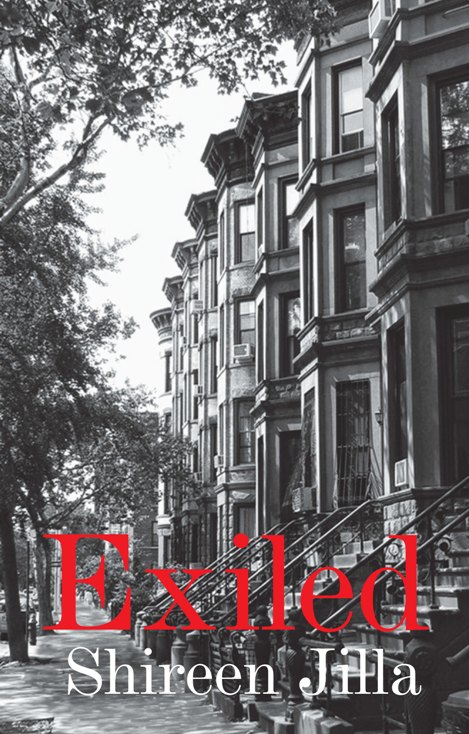
NEW YORK – Exiled – Shireen Jilla

Third Culture Kid Shireen Jilla (half English, half Persian, and grew up in Germany, Holland and England) currently lives in London after being an expat in Paris, Rome, and New York.

Commenting on our May 7th article, Shireen said, “New York is a material fantasy that most wannabe expats have had. People imagine it to be an adventure laced only with IPad2s and lychee martinis. But, as many of you know, stepping outside your own cultural comfort zone is never as straight forward as those people, longing for it from the comfort of their three-piece sofa in the suburbs, imagine. So I choose to write about Anna, an eager expat looking for experience, but finding she sucked into a cultural nightmare that she neither could control, or understand.”

Amazon description:

“In love with her husband Jessie, an ambitious British diplomat, whose first posting brings them to New York, Anna begins the hectic, enjoyable life of a successful expat. But New York also brings her into contact with her husband’s manipulative and competitive stepmother Nancy, a powerful American socialite and philanthropist. When a silly incident with her only son Josh involves the Police Department, Anna’s seemingly perfect world begins to shatter. As Jessie’s journey to rediscover his New York roots draws him closer to Nancy, terrible and strange things keep happening to Anna. She begins to fear that someone is out to destroy her family.”

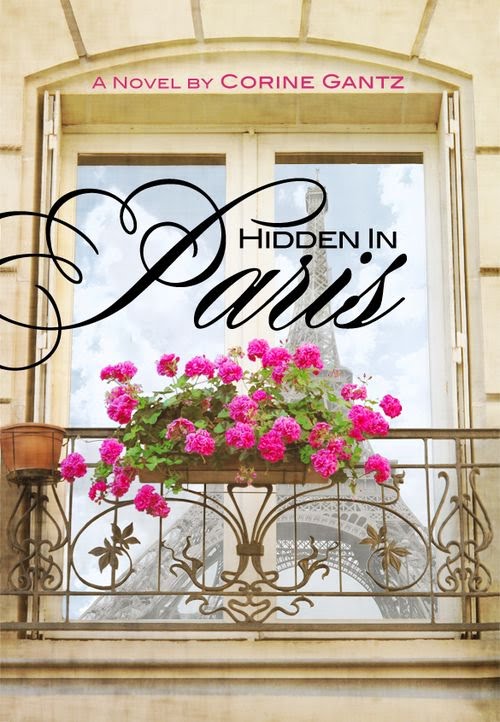
FRANCE – Hidden in Paris – Corine Gantz

Our second featured writer in May, Corine Gantz has just released her debut novel about a group of American women who try to start new lives in Paris.

A displaced Parisian in Los Angeles, where she lives with her husband and two sons, Corine blogs at Hidden in France.

Amazon description:

When bankruptcy threatens her beloved house, her one anchor in life, Annie has no choice but to find renters, and quick. Leave it to someone socially phobic to phrase a want ad in all the wrong ways. With shimmering promises of ‘Starting over in Paris’ –– a concept she has no intention of applying to her own life––Annie attracts tenants with the kind of baggage that doesn’t fit in suitcases.

THAILAND – Tone Deaf in Bangkok – Janet Brown

The last book on today’s list is by Janet Brown, whom we featured on June 10th.

In the article, Janet said: “My parents turned me into a gypsy before I was two, by taking me on their journey by jeep from New York City to Alaska when the 49th state was still a territory and the Alcan Highway was still an unpaved trail into the frozen north. I have wandered ever since, most recently in Southeast Asia with Bangkok as my home, writing down the stories I encounter as I explore.”

Amazon description:

“From her first bewildered hours to the moment that she reluctantly leaves, Janet Brown describes her experience of falling in love with, and in, Thailand’s largest city. Nana Chen’s evocative photographs provide illustrations of daily living in Bangkok.”
BC Magazine review:
“Janet Brown’s experiences in Thailand are chronicled in short essays that bypass the usual tourist spots and concepts and present an intimate and revealing understanding of Bangkok and the Thai way of life from a female foreigner’s fascinated point of view.”

If you enjoyed this post, we invite you to subscribe for email delivery of The Displaced Dispatch, a round up of the week’s posts from The Displaced Nation. Sign up for The Displaced Dispatch by clicking here!

Related posts:

Ho’ omaika’i ‘Ana to TCK writer Tony Roberts

Expat life as psychological thriller? An unholy appreciation of novelist Shireen Jilla

RETURN TRIP: Mobile in America

While our writers take off on what they hope will be enchanting August breaks, The Displaced Nation will occasionally be reissuing some posts that, for one reason or another, enchanted our readers. Enjoy these “return trips”!
Mandy Rogers wrote this post — about what it’s like to be a Southerner in New York City — in response to Kate Allison’s “The Domestic Expat.” Since then, her domestic expat adventure has entered a new phase. She and her husband, Kerry, packed up pets and belongings again at the end of July and set out on across-country trip to their new home — in San Francisco. We hope to hear back from Mandy before too long…

I don’t always understand what people are saying. I’m temperamentally unsuited to the noise and lack of personal space. I don’t think I’ll ever completely fit in. What am I?

A Mississippian in Manhattan!

My husband, Kary, and I moved to New York City two-and-a-half years ago, when we were in our early thirties. Until then, we had spent our entire lives in Mississippi. We loved it and had a great community of friends, whom we still miss.

Making the move

What possessed us to pick up stakes and try out life somewhere else?

Kary and I met in the marching band at Mississippi State. I played the flute and he the trumpet. We both landed jobs at the university immediately upon graduation. But there was something in each of us, a kind of restlessness. We knew we couldn’t be content with staying in Starkville forever. Was it a passion for travel or a fear of growing too complacent? Perhaps a bit of both…

There was also a practical reason for making the move. I’d gone back to school in my late twenties to do a masters in landscape architecture. I discovered I really enjoyed doing projects involving public spaces, such as parks, gardens, and streetscapes. Public green space isn’t a priority in Mississippi, where most people have their own land.

During my graduate studies, I’d taken a road trip with Kary and my sister to New York City, visiting Central Park, Paley Park, and Bryant Park. The amount of green space was a surprise to me. It’s something my mother, another garden lover, noticed during her first visit to the city, too.

In the end, it all happened rather quickly. Kary was offered the first job in New York he applied for. He actually got it via Twitter!

We packed up our belongings in a rental car — our cocker spaniel, Callie, in her seat belt harness and our three cats in their carriers — and traveled over three days to our new home in the Big Apple, staying in pet-friendly hotels along the way. (We’d flown out to find an apartment just beforehand, signing a lease for one in Brooklyn, which several of our friends had recommended as a great place to live.)

When we first moved, I didn’t have a job so spent the time exploring gardens and parks in Brooklyn, the Bronx and Staten Island. Even now that I’m working for a landscape architecture firm in Manhattan, I escape to the Brooklyn Botanic Garden whenever I can to see what’s in bloom. My dad gave me a membership there just before he died. We had a complicated relationship so it’s a nice reminder of him and our common love of gardens.

The adjustment process

People still ask me: where are you from? They usually guess North Carolina or Georgia; no one has guessed Mississippi yet.

I’m still picking up new vocabulary and pronunciations. “House-ton” instead of “Hue-ston” Street; standing “on line” at the grocery store (in the South we say “in line”).

And I continue to be amazed that the number of people living in Brooklyn equals the entire population of Mississippi (2.5 million). No wonder one of our most difficult adjustments has been to the noise and (by our standards) overcrowding.

Still, there are lots of things we love in this part of the world, beginning with the climate. Thunder and tornadoes are much less frequent here. And believe it or not, even after this rough winter, we still can’t get enough of snow.

We’ve adjusted very quickly to living without a car. You can see and experience so much more on foot than behind the wheel. That said, I usually did most of my singing in the car, and I miss that! (I don’t sing around my apartment too much, as the neighbors could hear me.)

And, although the South is renowned for its hospitality, I am often surprised by how much nicer, friendlier, and helpful New Yorkers are than they are given credit for being.

Moving right along…

Despite these many “likes,” I don’t think we’ll ever be true New Yorkers. To this day, I always relish running into other Southerners. The past two years, Kary and I have attended the annual picnic held in Central Park for folks from Mississippi. There’s always a blues band and plenty of fried catfish, sweet tea, and other Southern delicacies.

Not all Mississippians have exactly the same values, but each of us knows what it was like growing up in that neck of the woods, and it gives us a powerful bond.

During the year, Kary and I congregate with fellow Mississippi State alumni at a local bar to watch our alma mater compete in football or basketball. We’ve made some new acquaintances that way, such as a native New Yorker who went to MSU in the 1970s to run track.

Like most expats, Kary and I debate about the right moment to move on and where to go next. Will we try the West Coast, or consider moving back south? Every time I visit Mississippi these days — I’ve been back three times since we left — I realize how much I’ve missed its hospitality, beautiful forests, and tranquility. Plus it’s been nice catching up with family and friends over hearty Southern meals.

Still, the hot, humid summer would take some getting used to again. And now that we’ve been bitten by the travel bug, we’re contemplating our wish list again. We visited San Francisco last year and liked what we saw.

Being mobile in America — it’s a trip, in more ways than one. Tell me, why do so many Americans seek adventure overseas when it’s perfectly possible to be an expat here?

Question: Can being an “expat” within your own borders be just as enriching as becoming one by crossing borders?

Mandy doesn’t have a blog but you can follow her on Twitter: @mandyluvsplants

img: Mandy (right) and a friend she ran into at a Central Park picnic for Mississippians in New York. Mandy’s comment: “My friend still lives in Mississippi but was here with her daughter, who was attending the picnic as part of her duties as Mississippi’s Miss Hospitality. My mom says I can’t go anywhere without running into someone I know — I guess she’s right!”

STAY TUNED for Some Enchanted Reading on Monday! 

If you enjoyed this post, we invite you to subscribe for email delivery of The Displaced Dispatch, a round up of the week’s posts from The Displaced Nation, including some extras such as quiz questions, recipes, and occasional book giveaways. Sign up for The Displaced Dispatch by clicking here!

Announcing The Displaced Dispatch – our weekly newsletter

O yea! O yea! Read all about it!

A weekly round up of The Displaced Nation’s posts is now available, and can be delivered to you by email every Saturday.

Instead of your inbox being filled with daily emails from TDN – yes, we post quite often – you can now opt to have one email each week, to peruse at your weekend leisure. If you’re on vacation, you might even find that it’s a good beach read. (Just don’t spill the SPF30 on your mobile phone.)

As time goes by, we will be adding items to the newsletter that you may not get from the site, such as trivia questions, international recipes, or even the occasional giveaway!

So roll up, roll up! Sign up for The Displaced Dispatch by clicking here!

.
Img: Town Crier, Provincetown, MA – Wikimedia Commons

CLASSIC DISPLACED WRITING: Joy in the place — Elizabeth von Arnim

The novelist Elizabeth von Arnim (1866-1941) wrote many enchanting books, all of which were autobiographical to some extent, linked to persons or places she knew.

But does that necessarily mean that Elizabeth — born Mary Annette, nicknamed May, she called herself “Elizabeth” upon becoming a professional writer — led an enchanted life?

Yes and no. By all accounts, she was an enchanting person herself, constantly delighting other people with her sharp wit.

She also kept enchanting company: E.M. Forster was tutor to her children, Katherine Mansfield was her adopted cousin, and H.G. Wells was one of her lovers.

Displaced almost from birth (she was born in Kirribilli Point, Australia, and then moved to England at the age of three), she made a life-long habit of flitting from one enchanting locale to the next.

Having spent her formative years in London, she moved to Pomerania in Prussia (Germany) for her first marriage, where she raised five children.

Upon the death of her husband in 1910, she made her home in the Valais, Switzerland, living in a glamorous house, Chalet Soleil, which she’d built from her riches as an author.

With the failure of her second marriage, Elizabeth zigzagged between homes in the United States and Europe.

She died in Charleston, South Carolina.

A full measure of sorrows

But a peripatetic life isn’t always a charmed one, as many of us expats and former expats can attest. As her life progressed, Elizabeth experienced a full measure of sorrows.

Her first marriage — to a domineering Prussian count — wasn’t particularly happy. She nicknamed him the Man of Wrath, and they separated several years before his death.

Her second marriage, to Frank Russell, elder brother of Bertrand, was even more miserable (he proved to be a despotic egoist).

Her only true love she met when she was 54 — and he was nearly 30 years younger. (They never married.)

She also suffered the grievous deaths of a daughter and a brother.

By the time she died, Elizabeth was estranged from most of her children, crippled with arthritis, and almost forgotten by her adoring public.

Her only devoted companion was her dog, Billy.

Escape artist par excellence

But despite these tribulations, Elizabeth remained throughout her life, in the words of gardening writer Deborah Kellaway,

a steadfast hedonist, firmly suppressing sorrows. … Her journals and letters repeatedly record moments of happiness, usually associated with sunny days.

As Elizabeth once wrote in a letter to one of her daughters,

“What I really am by nature is an escapist.”

Thus what we can learn from Elizabeth’s life — and from her many autobiographical books — is the art of escaping into happier worlds.

As Kellaway explains:

[The heroines of her novels] escape from richness into the simple life, or from conventional home life into foreign travel; they escape from houses into caravans.

The most famous example, of course, is Elizabeth’s 1922 novel, The Enchanted April — from which we’ve taken our theme of enchantment on the blog this month.

As everyone knows who has read that book — or, more likely, seen the 1992 film or the 2003 Broadway play — four women who share only their unhappiness and a love of wisteria flee 1920s London and converge in Portofino, Italy, on a magical medieval villa overlooking the Mediterranean.

Simple pleasures are the best?

But while Italian castles can certainly be a tonic — if offered one, I’d be off like a shot — what most people don’t know is that Elizabeth was equally fond of much simpler escapes. In the first two books that made her reputation as a writer, the heroine escapes her marital, motherly and household duties by venturing into a German garden, set in a wide landscape.

Here is the most lyrical passage from the second of these, The Solitary Summer (1899):

Yesterday morning I got up at three o’clock and stole through the echoing passages and strange dark rooms, undid with trembling hands the bolts of the door to the verandah, and passed out into a wonderful, unknown world. I stood for a few minutes motionless on the steps, almost frightened by the awful purity of nature when all the sin and ugliness is shut up and asleep, and there is nothing but the beauty left. It was quite light, yet a bright moon hung in the cloudless, grey-blue sky; the flowers were all awake, saturating the air with scent; and a nightingale sat on a hornbeam quite close to me, in loud raptures at the coming of the sun. …

It was wonderfully quiet, and the nightingale on the hornbeam had everything to itself as I sat motionless watching that glow in the east burning redder; wonderfully quiet, and so wonderfully beautiful because one associates daylight with people, and voices and bustle, and hurrying to and fro, and the dreariness of working to feed our bodies, and feeding our bodies that we may be able to work to feed them again; but here was the world wide awake and yet only for me, all the fresh pure air only for me, all the fragrance breathed only by me, not a living soul hearing the nightingale but me, the sun in a few moments coming up to warm only me…

A lovely garden at just the right time of day — as I know from my own experience of enduring many city summers*, that’s all it sometimes takes to escape into happiness.

*On that note, I’d like to recommend a walk on the High Line in early morning or late afternoon, to anyone living in or traveling to New York City this month…

QUESTION: What does it take for you to escape the dog days of summer into happiness: a trip to Italy, a walk in the garden — or something else?

STAY TUNED for tomorrow’s post, on our new weekly newsletter, The Displaced Dispatch.

If you enjoyed this post, we invite you to subscribe for email delivery of The Displaced Nation. That way, you won’t miss a single issue. SPECIAL OFFER: New subscribers receive a FREE copy of “A Royally Displaced Tea.”

Related posts:

The Enchanted August: Finding vacation enchantment in a displaced world

In Friday’s Classic Displaced Writing post, featuring David Foster Wallace’s essay about a trip on a Caribbean cruiseliner, Anthony Windram gracefully led us into this month’s vacation theme of “The Enchanted August.”

Our August theme is inspired by The Enchanted April, the 1922 book by Elizabeth von Arnim, in which four women, strangers to one another and variously dissatisfied with their lives in post-World War One London, spend four weeks together in an Italian castle. Distanced from their usual habitats and placed in magical surroundings, they each gradually become the person they would aspire to be, rather than the armor that time and circumstance has created.

Now obviously we can’t all spend the summer in a Tuscan castle to cast off our external personae and discover our inner selves, and perhaps that is just as well: if we base our expectations upon the glowing results in The Enchanted April, our hopes are likely to be dashed.

Realizing this, the TDN team this month will be helping our readers to find other, smaller ways to rediscover the person inside — the inner enchantment — rather than the exterior of a person now defined by a displaced lifestyle.

We will look at less exotic sources of enchantment to be found in less idyllic vacation situations — a stay-cation at home, for example, or (as often constitutes a holiday when you’re a displaced person) a lengthy visit with relatives.

We will also practice what we preach this month, and take a break ourselves: August will feature shorter posts as well as a few reissues of some popular early posts which newcomers to the site may have missed, along with a few posts summarizing what we’ve done with the site so far, soliciting your feedback.

So enjoy the sunshine or snow! Wherever you are this August, we hope you have an Enchanted one, and feel a little of the joy that Lotty Wilkins, heroine of The Enchanted April (and now of TDN’s Enchanted August), feels on her vacation:

“…this was the simple happiness of complete harmony with her surroundings, the happiness that asks for nothing, that just accepts, just breathes, just is.”

“The Enchanted April” is available at Amazon, Barnes & Noble, Waterstones, etc. The 1992 movie of the same name, starring Miranda Richardson and Josie Lawrence, is available on DVD.

STAY TUNED for tomorrow’s Classic Displaced Writing post on Elizabeth von Arnim.

If you enjoyed this post, we invite you to subscribe for email delivery of The Displaced Nation. That way, you won’t miss a single issue. SPECIAL OFFER: New subscribers receive a FREE copy of “A Royally Displaced Tea.”

Related posts:

CONTEMPORARY DISPLACED WRITING: David Foster Wallace – A Supposedly Fun Thing I’ll Never Do Again

A few weeks ago I found myself in Claremont, California. I hadn’t intentionally planned to stop there, it was a spur-of-the-moment thing. I’d been at a wedding in Southern California the day before, and as I made the long drive back home the next day my stomach began to rumble, and there were signs on the highway for Claremont. That name rang a bell with me, but I couldn’t quite recall why. Possibly, being not the world’s greatest driver, I was too busy concentrating on the road, and the suicidal, kamikaze driving of the locals, to really stop and think on why the name Claremont was so familiar to me. My wife told me that it was probably because I’d heard of Ponoma College, a liberal arts university, which is based in downtown Claremont. That certainly sounds familiar. Yep, it must be that, I thought. And being a college town, it seemed like the perfect place to stop for lunch on a Sunday afternoon.

It was only as after lunch as I was getting back into my car – already dreading the thought of getting back onto the highway, staying on it for another 6 hours, and sharing it with mad men – that I realised why the name Claremont and Ponoma College had seemed so familiar. It wasn’t through a synapse suddenly working, finally passing a neuron to that part of my brain that stores all my thoughts on Claremont. No, it was my wife googling Ponoma College on her iPhone. Reading its Wikipedia entry, she said, “Oh, David Foster Wallace was a professor here. You must have known that, surely?”

David Foster Wallace had taught at Ponoma College, and it was in Claremont that he had sadly taken his life in 2008. You probably already know about him, so I won’t waste time repeating things here that you already know. What I will note is what an important writer he has been for me. Foster Wallace was not, as far as I know (or as far as I can remember, and as we have established, it’s not clear if we can really trust my synapses) an expat, which is what this blog focuses on. His writing does, at least to me, convey better than any other writer of his generation a sense of displacement with himself and with his America.

Moving to the U.S. in 2007, Foster Wallace’s essays were something I eagerly reconsumed. I’d read them early, but that was from the position of being a young Englishman in his early 20s who had never been to the U.S. Somehow, it didn’t count as much. Now with an I-551 visa stamped in my passport, Foster Wallace’s essays, along with de Tocqueville were the first books off my shelf as an American resident. Like de Tocqueville, Foster Wallace, though American, gave me an outsider’s perspective on my new homeland.

So this week’s displaced writing is David Foster Wallace’s essay “A Supposedly Fun Thing I’ll Never Do Again.” It was first published in Harpers and has since been republished in book form along with other Foster Wallace essays. It’s the Harpers version that I’m going to link to as it’s still available for free on the web. The essay details an assignment Foster Wallace had, trapped and displaced, on a Carribean cruiseliner and which is the supposedly fun thing he’ll never do again.

Click below to read.

“I have seen sucrose beaches and water a very bright blue. I have seen an all-red leisure suit with flared lapels. I have smelled what suntan lotion smells like spread over 21000 pounds of hot flesh. I have been addressed as “Mon” in three different nations. I have watched 500 upscale Americans dance the Electric Slide. I have seen sunsets that looked computer-enhanced and a tropical moon that looked more like a sort of obscenely large and dangling lemon than like the good old stony U.S. moon I’m used to. I have (very briefly) joined a Conga Line.”

STAY TUNED for Monday’s post, when we explore next month’s theme: “An Enchanted August.”

If you enjoyed this post, we invite you to subscribe for email delivery of The Displaced Nation. That way, you won’t miss a single issue. SPECIAL OFFER: New subscribers receive a FREE copy of “A Royally Displaced Tea.”

Related posts:

Youth writer Gabrielle Wang’s characters solve cross-cultural conundrums with magic and aplomb

The spirit of Pocahontas has been haunting The Displaced Nation this month, lending a helping hand to anyone who feels stymied by the strange customs they’ve encountered in other lands.

This precocious Native American girl appears to have been naturally gifted in openness and tolerance — else how could she have become an intermediary between her father’s tribes and the Jamestown settlers at age 10?

The majority of us, however, are not naturals when it comes to cross-cultural relations. We could use some basic training, preferably while still young.

As suggested in one of this month’s posts, one solution might be to absorb the whole of Harry Potter — all those tales of discrimination against Half-bloods and Muggles.

But not every youth can identify with a universe that is governed by the laws of who’s magic and who isn’t. Take Pocahontas, for instance. If she prayed for magic in her dealings with the white invaders, it was most likely for herself, never mind anyone else.

Perhaps, then, I have her to thank for guiding me towards Melbourne-based author Gabrielle Wang, whose books for children and young people feature characters who in many ways resemble the feisty Anne of Green GablesPollyanna or Calpurnia Tate — but with a further twist: Wang’s heroines are always non-white, Chinese or some mix. They are culturally marginalized.

Wang’s very first book, The Garden of Empress Cassia (to be published for the first time in the U.S. this fall) involves a heroine, Mimi, who feels ashamed of being Chinese until she discovers a a box of magic pastels that enables her to draw, and then enter, the garden of the Empress Cassia — a transformative experience.
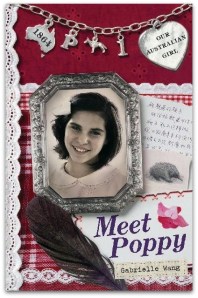
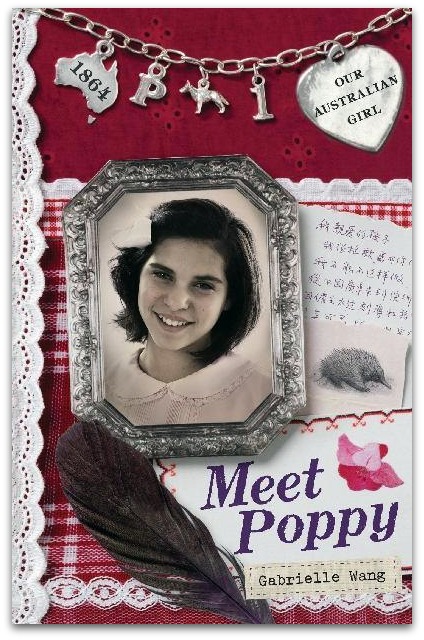
Wang’s latest heroine, Poppy, is even more unusual: she’s a half-Chinese, half-Aborigine girl who lived in the 19th century. Poppy’s Aboriginal mother died when she was a baby, and her Chinese father disappeared before she was born. When her brother, Gus, runs away to look for gold, Poppy decides to follow. Disguising herself as a boy, she stows away on a paddle steamer and keeps in touch with Gus through a secret code and Chinese symbols.

Wang’s books are targeted at the youth market, but adults are very fond of them as well. Here’s what one reviewer had to say of her first book in the Poppy series:

I’m sure young girls living in Australia who are interested in their country’s history will love this book, but as an adult living in America, I really enjoyed it too!

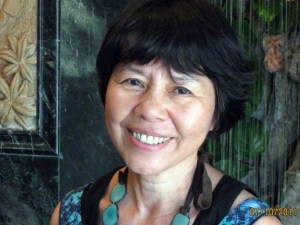
I recently had the pleasure of meeting Gabrielle Wang in person — at a congee restaurant in New York City’s Chinatown. Here’s how our conversation went:

Can you tell me a little about your background?
I’m a fourth-generation Chinese Australian on my mother’s side and first generation on my father’s. I live in Melbourne, where I’ve been a professional writer of children’s and young adult books for nine years. I’ve written ten books published by Penguin Books Australia, and a picture book published by Blackdog Books, now an imprint of Walker.

All my novels involve cross-cultural issues as that is my background. Being brought up in Australia and knowing little about my own heritage, I felt was a tremendous disadvantage. I was ashamed of looking different. I couldn’t speak Chinese and knew little of the beliefs and customs of China. Now, when I look back at that period in my life I know that if I’d been steeped in the culture of China, I would have grown up proud of my heritage. It was only when I left school that I realized that belonging to two cultures was an advantage and began learning Mandarin.

My latest books are being released this year three months apart. There are four in the Our Australian Girl series about a half-Chinese half-Aboriginal girl named Poppy.

Right now I’m working on a ghost short story for a Penguin anthology as well as thinking about my next novel, called The Wish Bird.

This month, our blog has dedicated many of its posts to Pocahontas, who was a member of the original displaced peoples in North America. Are the stories of the Native Americans and Australia’s Aborigines very similar?
Definitely, there are many similarities. But my impression of the Native Americans is of a more warring people — at least that’s how they’re often portrayed in the old cowboy-and-Indian films. I’m probably stereotyping here. The Aborigines were also driven off their hunting grounds. Many were slaughtered by the squatters while others starved to death or died from disease. It was a tragic time in Australian history which carried through even to the 1960s. The scars and the injustices still exist today.

The European settlement of Australia occurred at least a century later than that of North America. Were Australia’s settlers still influenced by the ideal of the Noble Savage, “the good wild man,” in their encounters with the natives?
The squatters of the 1800s looked down upon the Aborigines. They had no idea that the Indigenous Australians had a highly advanced and complex culture and belief system. And by the 1850s and 1860s, when my Poppy stories take place, the ideal of the Noble Savage never crossed anyone’s mind. At that time, large numbers of people from all over the world went to Australia to look for gold, not to discover a new land.

Turning to your Poppy books, I noticed that you employed the nature trope that’s associated with the Aborigines. Poppy uses the Southern Cross to guide her travels, follows water birds, eats wild raspberries and honey-flavoured sap-sucking bugs…
The Aborigines’ belief system is closely linked to the land they inhabit and to the animals in their environment. They have animal totems and there are sacred places all around Australia. Unfortunately, most of these sacred sites are not in the hands of the local Indigenous people and have been lost or desecrated. But if you go and visit the known ones, like I have, you can still feel a tremendous power and energy in the landscape.

When I was on a writing/walking trek through Central Australia near Alice Springs, we camped, with the permission of the local Indigenous tribe, on a sacred site. It was an amazing experience.

I am very interested in the Chinese philosophy of yin and yang, the I Ching and Daoism – which are not that dissimilar to the beliefs of the Indigenous Australians and their relationship with nature. The Aborigines are also like the Chinese in that they have an advanced plant medicine system.

Was it difficult to think through how an Aborigine child might have felt back then?
In my story, Poppy was born on a Christian mission, so she knows very little about her own culture. I am not an expert on Aborigine culture, so I was careful not to step over the line. I had several Aboriginal advisors who I consulted with. John Sandy Atkinson is an elder for the Bangerang tribe and Maxine Briggs is the Koorie Liaison officer at the State Library of Victoria. They were invaluable to me while writing the Poppy series. As a Chinese person, I know how wrong some authors can be when writing about a culture they have little knowledge of. It is easy to misconstrue and misunderstand things so I was careful to avoid this.

Since you’re so interested in the topic of portraying other cultures, you may find it interesting that Maxine Briggs lent me Werner Herzog’s film Where the Green Ants Dream just so I could see how NOT to portray another culture. The film as you may know had to do with a dispute between a mining company and the local Indigenous tribes in the Australian desert.

I noticed in reading some excerpts that the white people Poppy meets behave quite decently. Did you make them like that on purpose?
Race is a highly sensitive subject and sometimes it’s difficult to strike a good balance. In Poppy’s time, the 1860s, racial prejudice towards Aborigines was at an all-time high. But I’m always aware of my audience — children 8-11 years old. When you write for young people you have a responsibility. It is important to be positive; otherwise, the same prejudices can begin all over again.

Up until now, you’ve created Chinese heroines for your book. What inspired you to create a character who was only half-Chinese?
I wanted to write about the period when my maternal great-grandfather came to Victoria to join the Gold Rush. I also wanted to highlight the plight of the Indigenous population during that time when white settlement expanded at such an alarming rate. Before 1834, around 100,000 Aboriginal people lived in the State of Victoria. By 1860, with the influx of white settlers and the discovery of gold, this number had fallen to less than 2000. That figure is shocking.

I think I’d also been influenced by the recent consciousness in Australia about the injustices done to the Aborigines. Beginning in 1869, the Australian government rounded up the Aborigines into missions (as already mentioned, Poppy is from one such mission) and began removing some of the children — the ones who were of mixed race — from their families to work as indentured servants for white families. I’m talking about the so-called stolen generations. If you’ve seen the film Rabbit-Proof Fence, you’ll know what I’m talking about.

It’s a big issue right now in Australia — and is finally being recognized as a national tragedy. The former Prime Minister, Kevin Rudd, presented a formal apology in 2008 for this misguided policy. It was a long time coming.

To sum up: I could have just written about a Chinese child, but I wanted to stretch myself and imagine a child who was half Chinese, half Aborigine. It is important for young people to walk in the shoes of someone who is different — who might be of a different culture, race and skin color. Only by doing this can we empathize with others.

Were you able to find any examples of half-Chinese, half-Aboriginal children on which you could base the story?
In my research there were no written records in Victoria of mixed race children at that time. But there’s no doubt they would have existed as the Chinese gold diggers were all men. They left their wives and family back in China.

So an Aboriginal character was a first for you. Was it also the first time a non-Aboriginal person had written a story for kids?
No. The highly respected and wonderful Australian children’s author Patricia Wrightson may have been the first. But I’m certainly the first non-white Australian author to write about an Aboriginal character.

Is it important that you’re a “non-white”?
I think I was able to imagine the Aboriginal child’s situation quite easily because I know what it feels like to be an outsider, and to suffer racial prejudice. I was the only Asian child in my school in Melbourne and I only saw white faces in the street. I always felt embarrassed when my parents came to school as my mother would sometimes appear in traditional dress, and my father didn’t speak English well, which I found embarrassing. Of course, it’s changed now as more Chinese have migrated to Australia, but back then, Chinese Australians were real outsiders.

You have been an expat for several years, living in Taiwan and then Mainland China. Can you tell us what that felt like?
Strangely enough, before my first visit to China in 1977, I always said that I was going back to China even though I had never been there before. Perhaps this is true of many children of migrants. When I actually went to Taiwan and China to live, I was at a disadvantage because I couldn’t speak Chinese very well and therefore was never fully accepted. Language is so important.

There were a couple of incidents in particular that made me realize how difficult it would be living in China — apart from the difficulty of learning the language, that is.

Once in Taiwan, I was invited to a friend’s house. It was her birthday. I brought a gift of a necklace, but was so surprised when she didn’t open the gift, nor did she acknowledge its receipt with a thank-you. I thought, how rude! I had no idea that in China, it’s rude to open gifts in front of the giver.

The other incident occurred in Mainland China, when I was invited to a banquet by a friend of my mother’s. She sat next to me and kept filling my plate. In Australia, it’s impolite not to finish the food on your plate, so I kept eating what was given to me, only to have it filled again. Finally, when I couldn’t fit in another morsel of food, I put my chopsticks down and sat back. My hostess breathed an audible sigh of relief. In China, of course, people like to show their hospitality by giving their guests more food than they can possibly eat.

Your personal story is inspirational as you never fancied yourself a writer.
When I was younger, I didn’t think I could write at all. I failed Year 12 English and had to repeat the whole year because I wanted to study Graphic Design at University. When I became interested in children’s books, it was to illustrate them not to write the words. But in the year 2000 I took a writing course and discovered I had hidden potential. We all do, I think. And it’s never too late to find out what it is. I explore that theme a lot in my books, especially The Hidden Monastery.

As part of Pocahontas month, we’ve been coming up with proverbs for those who wish to spend their time abroad getting to know other cultures. Can you give us one proverb based on your own experiences?

“If you want to know what it means to be a migrant or a person who is displaced by outside forces, then live in — don’t just visit — another country where you cannot speak the language.”

To that I would add:

“If you can, make it a country where people have skin of a different color to yours. Then, and only then, can you understand what it means to be an outsider.”

Gabrielle Wang’s book The Garden of Empress Cassia will be published in USA by Kane Miller this September. You can also visit her Web site at www.gabriellewang.com.

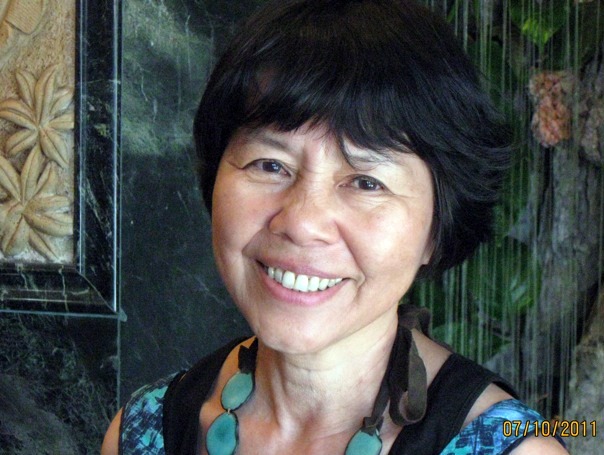
Images: Gabrielle Wang at Congee Bowery, NYC (by Susumu Awanohara); front cover of Wang’s first Poppy book; and front cover of the about-to-be-released American edition of her very first work, The Garden of the Empress Cassia.

STAY TUNED for tomorrow’s installment of our displaced fictional heroine, Libby, who learns more about her bête noire, the realtor Melissa. Were her initial misgivings about Melissa justified?

If you enjoyed this post, we invite you to subscribe for email delivery of The Displaced Nation. That way, you won’t miss a single issue. SPECIAL OFFER: New subscribers receive a FREE copy of “A Royally Displaced Tea.”

Related posts:

How foreign is Fez? A travel yarn in two parts (Part 2)

We welcome back Joy Richards to The Displaced Nation for the second part of her travel yarn about a trip she made in May to visit a British expat friend in Fez, Morocco. In Part 1, Richards learns about the Moroccan concept of hshuma (forbidden, shameful) and reveals she rather likes “covering up.” In Part 2, she discovers she has an innate bargaining instinct while shopping in the Fez medina, but then an incident occurs on a day trip to the Roman ruins that gets her thinking…   

My traveling companions and I are about to go shopping in the Fez medina (walled city), and I wonder to myself: is this how I might feel if I were to attend a football match in England as a lone woman? Actually, women are even less obvious in Fez than they are in British football stadiums.

Morocco prizes its reputation as a “modern” country. It is so modern that the King of Morocco took a computer engineer from Fez, Salma Bennani, as his wife.

However, here in the Medina, where women wear traditional dress and all of the shopkeepers are male, the occupation of the King’s wife seems beside the point.

Shopping until you, or the price, drop

Not as confrontational as football but requiring almost as much as strategy and skill, shopping in Fez is an interactive game. Rarely will any item have a price tag on it, so buying does not happen quickly. Typically, the interchange goes something like:

“How much is this?”

“It is very beautiful.” Seller places the item into your hands. “You like?”

“It depends how much it is.”

“I give you best price. I give you very good price because your friend lives here.”

“What is your best price?”

“She” — gesturing to my friend — “is like family. I give you best price.” Seller begins to wrap the item.

“Don’t wrap it. How much is it?”

“200 dirhams, very good price, best in medina.”

“No, too expensive.”

“No, very good price.”

“100 dirhams.”

“No no. 200 dirhams best price.”

“Ok. No thank you.”

“For you 190 dirhams. Yes.” Begins wrapping again.

“No. Too expensive. 150 dirhams…”

This will continue, and may include either buyer or seller declaring that they are no longer interested and even walking away, until a price is agreed. Probably around 170 if the starting point is 200.

I start bargaining for a scarf, and somewhere through the process, I lose sight of the exchange rate and feel that haggling for ten minutes to get a reduction of 10 dirhams (about 70p) is worth it.

So I take the scarf and put it in my bag with the rest of my loot, the result of a morning’s hard bargaining.

As someone who has haggled over the price of a laptop in PC World (the UK’s largest computing store) — and done so successfully — I have slipped into this mode of shopping rather easily.

Somewhere in my memory is my Mum’s belief that any shopkeeper would “rob you blind if given half a chance.” As a child, shopping was frequently interrupted by Mum asking for a reduction in price on the basis of some imperceptible fault or inadequacy with the proposed purchase. Obtaining the reduction was accompanied by a sense of pride and challenging social injustice.

Ah, Mother, you would have been proud of me.

However as one of my traveling companions points out: “We are not in Kansas any more!”

No, not in Kansas, or in Northampton where my parents lived and I grew up — but I reckon my Mum could have popped on her headscarf, picked up her handbag and got her week’s shopping at a good price.

Mind you, she probably wouldn’t have bought her sausages at the stall with the camel’s head hanging up.

An excursion, and a close encounter

My English friend who lives in Fez suggests that we venture into the countryside to visit nearby towns and the amazing Roman remains of Volublis. We have a great day out. The roads are chaotic, and we feel fortunate to have a friendly and helpful driver, Mustapha, who repeatedly saves us from serious accidents.

But then, as we are driving past the orange farms on our way back to Fez, the police pull us over.

Mustapha has been talking to the police officers for some time and is clearly becoming agitated. He comes back for his wallet and informs us they claim he was speeding.

My friend asks him in Arabic if he has to pay a “back hander.” Yes, he has to pay 200 dirhams (probably 2-3 day’s pay for him).

He goes back over with the money, and the discussion grows even more heated. When he finally comes back, he reports that the policeman said: “You and your f***ing taxi with your f***ing tourists! You should pay 500 dirham. Perhaps we will get you stopped again.”

“These are our police,” he shrugs. “They do what they want and make money for themselves. We cannot trust them, and they are part of our government. It is not right.”

At that very moment, a 1965 country song by Roger Miller, telling of a swinging England with “bobbies on bicycles two by two” pops into my head. The reality it depicts is of course a long way from today’s Britain, where our police are accused of using excessive force in managing demonstrations and of taking payments from journalists for information.

But even if the British law enforcement system isn’t all squeaky clean, I know that when my partner was done for speeding recently, it was not due to the whim of a corrupt police officer. The evidence was fair and reliable, and the fine went to the court — not into the pocket of any policeman.

A plethora of questions, and precious few answers

I’ve been in Fez for a couple of days, and I still have very little idea of the forces that govern people’s behavior: the modern state and its representatives, the traditions of the medina and the controls of hshuma, or both?

Many Westerners are now living in Fez, some of whom are buying up cheap traditional properties. I wonder how they perceive fitting in to the future of this medieval city.

Reviewing the events of the past couple of days, I realize I have many more questions than answers:

  • Was it simply an accident that one of my female friends, who refused to be hshuma-ed out of smoking on the street, got hit on the hand by a stone?
  • Why does the babysitter my friend employs for her daughter, Francesca, have to stay the night rather than walk home through the medina?
  • Will the young boys who, according to some expat observers, sniff glue — and who now have access to satellite TV — uphold the traditional values? How many of Morocco’s young men respond to the call to prayer?
  • Moving on to the country’s young women: how do they make sense of the various and contradictory influences on their lives — and decide what to wear? What do they want, and are they allowed to want it?

The friend whom I visited, who is English and a single mother, told me that as a Western woman, she is a “third sex” in the Fez medina, neither male nor female in terms of what she is allowed and expected to do. She sees opportunities in this strange and wonderful place that would not be there for her in England. She also acknowledges that there will be a point when this way of living is too claustrophobic for her and Francesca.

Overall, Fez is a “find” for a tourist like me — I was delighted to find somewhere so exotic and so accessible from Britain. And, if I step back into my memories of traditional working class culture of the 50s and 60s, I think that we Brits were not always so different to the people of Fez medina. Our world has changed, and theirs is apparently changing now as well.

Or is it? I am left with a feeling that modernity poses a considerable threat to those living and working in this walled city, many of whom would find it easier to maintain the status quo of a traditional Muslim culture.

Would I go back to visit? Yes. Would I live there? No. When I said good-bye to my friend, I was sad to leave her. Our visit had been memorable as well as highly stimulating. I hope she can continue to live safely in her chosen city, and I also hope, and pray, that if the cracks in this fragile society become too wide, she will notice them and remember as Dorothy said, “There’s no place like home.”

Images (top to bottom): The markets of the Fez medina; camel meat for sale; the ruins of the Roman town of Volubilis (Oualili); and the Royal Palace at Meknes, about 60km north of Fez.

STAY TUNED for tomorrow’s interview with Australian author Gabrielle Wang, whose books for children and young adults encourage them to broaden their cultural horizons.

If you enjoyed this post, we invite you to subscribe for email delivery of The Displaced Nation. That way, you won’t miss a single issue. SPECIAL OFFER: New subscribers receive a FREE copy of “A Royally Displaced Tea.”

Related posts: