The Displaced Nation

A home for international creatives

For travel & shutter bug Ildrim Valley, a picture says …

Collage_1000words_Ildrim_dssWelcome to our new series: “A picture says …”, featuring interviews with displaced creatives for whom a camera is a mode of artistic expression for the sights and people they encounter in their nomadic wanderings.

To kick off the series, I have the pleasure of conversing with Ildrim Valley, an intrepid adventurer who is also an economist(!) and travel photographer. It is, of course, this last point we’ll be focusing on, so to speak…

But first a few of Ildrim’s vital statistics:

Place of birth: Baku, Azerbaijan
Passports: Canada; Azerbaijan
Overseas history: From least to most recent: Azerbaijan (Baku); Switzerland (Geneva); Kenya (Nairobi); Canada (Vancouver, British Columbia); Hungary (Budapest); France (Toulouse)—2012 to present.
Occupations: Graduate student of economics; travel photographer; amateur snowboarder; adventurer!
Cyberspace coordinates: Curious Lines (photography blog)

Without further ado, let’s find out more about Ildrim and the way he uses photography as a creative outlet for his international adventures.

Peripatetic from an early age

Hello there, Ildrim. Welcome to the Displaced Nation. Let’s begin by having you tell us a bit about your travels. What inspired you to set off and what has motivated you to keep on going?
My first travel experiences come from traveling with my mom and brother. My mom is eager to change her surroundings, so thanks to her I was lucky to move around and travel early in life. At an early age I’ve been amazed at how life can be so different for people elsewhere than my hometown.

I think that this early fascination developed into a strong curiosity about lifestyles. Now that my mom no longer takes me on adventures (she gets herself into trouble without me!), I try to find my own means of traveling and satisfying my curiosity about places around the world.

You are a self-described adventurer. Do you prefer going and going, or do you sometimes settle in one place for a time?
As I travel more, I realize that it’s not just about seeing a new place that excites me the most. As fun as it is to keep going and going, simply being somewhere new isn’t always satisfying. Settling somewhere for a time gives me an opportunity to live through something different and possibly understand it.

I understand you recently moved to Toulouse, France?
Yes, I moved to Toulouse in September 2012 for graduate school. I felt like grad school would open a few doors to pursue some of my other interests, and it presented a fairly easy way to move to another country. So I set out to look for good schools around the world that fit my background as well as academic interests. At the time I was interested in southern Europe, and Toulouse offers the right kind of balance: it’s a great school with welcoming people and fine landscapes to be explored. Plus an opportunity to finally master French was very appealing—though I have to say I’m not doing a very satisfactory job so far.

On your photography blog, Curious Lines, you say:

Photography for me isn’t just an art form, it’s a way to share experiences.

When and why did you start using DSLR cameras?
I got my first DSLR in 2010, shortly before moving to Budapest. I got it in order to document the move.

Does the process itself of capturing a place or moment affect the relationship you have with that place? For example, does capturing a good set of photos increase the fondness you have for that place?
The process of capturing a moment does affect the way I experience a place, which in turn affects my relationship with it. But how I feel about a place has a lot to do with how I feel about the people from that place. So when I spend enough time in one spot, I get to meet people and build relationships. However, when the stays are short, the camera has a more significant role as it facilitates a connection with others. It helps me get a reaction, an emotional response—a smile or maybe a conversation.

But it’s important to point out that in some places around the world, carrying a camera can have a negative affect. People are fast to judge you on how you look. In Kenya, for example, I have a lighter skin tone, which results in the locals treating me differently, not necessarily in a positive way.

Likewise, having a large camera around your neck or in your hand will send a different signal and will be interpreted in a different way depending on where you are in the world.

I would just like to add that one way in which camera affects my experiences is that it taught me how to look at things differently without a lens. It helps me appreciate things differently and it’s important to know when to put the camera away and enjoy things with your own eyes. It’s easy for me to get sucked into continuous photo taking when I’m in a new place. Though I enjoy it, there are still other things to be enjoyed behind the lens, which is even more true when you’re traveling with someone else. But it doesn’t have to be one or the other; with time I’ve been learning how to balance the two.

For me, the camera has to be an extension of the adventure and not the purpose for it.

Looking back on all the places where you’ve taken photos, which have been your top three favorite places to shoot?
Although my opinion changes with time, my top spot for now is Mongolia. Last year I spent about a month there. The people and their lifestyles around the country fascinate me. The landscapes are pure and surreal. When you have such a keen interest and curiosity about your subject, shooting becomes that much more enjoyable. I’m actually redesigning my Website to present more content via other channels than a blog. One of the new sections will be about my experiences in Mongolia. The other two places that I love for photography are coastal British Columbia and Croatia.

An eye for the London Eye

On your blog you also say:

Once I started using a DSLR I’ve realized that scenes that come out on my computer screen don’t reflect the whole beauty of the moment. They don’t transmit the same type of emotion I felt standing behind the lens. So I tried and am still experimenting with different techniques to bring myself and others closer to how it actually was, at least in my mind. I don’t always try to achieve the most “realistic” looking photos, but rather try to transmit the feeling of the scene.

the-london-eye_dropshadowI notice that one of the techniques you’ve used is High Dynamic Range Imaging (HDR), an example of which can be seen in this striking image of my hometown London (original here)—by the way, you’ve now made me feel a little homesick! Tell me a little about HDR and how a novice photographer like myself can go about trying to achieve similar effects with a DSLR camera.
I have a very basic example of what High Dynamic Range (HDR) does in one of my blog posts. In a nutshell, cameras don’t capture the range of light the same way our eyes do. Our eyes adjust to both bright and dark spots in the same scene while for cameras it’s always a trade off.

HDR photography allows you to capture more light by taking multiple shots of different exposures. I take three: one normal, one overexposed bright photo, and one underexposed dark photo. By combining these three shots together you get a higher range of light information available to play with. Some people take five or even seven photos, but three is enough in most situations.

To achieve this HDR effect, I take my three shots bearing these points in mind:

  • The auto-bracketing option on modern-day cameras helps you take three photos with a single click.
  • Set the camera on Aperture priority mode (“AV” or “A” on most cameras) to have the same aperture and depth of field in all three shots.
  • Ensure that the three shots are as identical in composition as possible. A tripod could be useful. (The surroundings or simply holding your breath will do in many cases.)
  • Use software* to combine all three shots together and then let your imagination take charge.

*Some of the most popular softwares are Photomatix Pro, HDR EFEX PRO and HDR Darkroom. Then there are options like Luminance HDR, which is free (open source) but will take some time getting used to. Whichever software you choose, it will help you combine all this light information into one image. Then it’s almost always a good idea to take it into your preferred photo editing software and continue working as you would with any other photo.

People pix

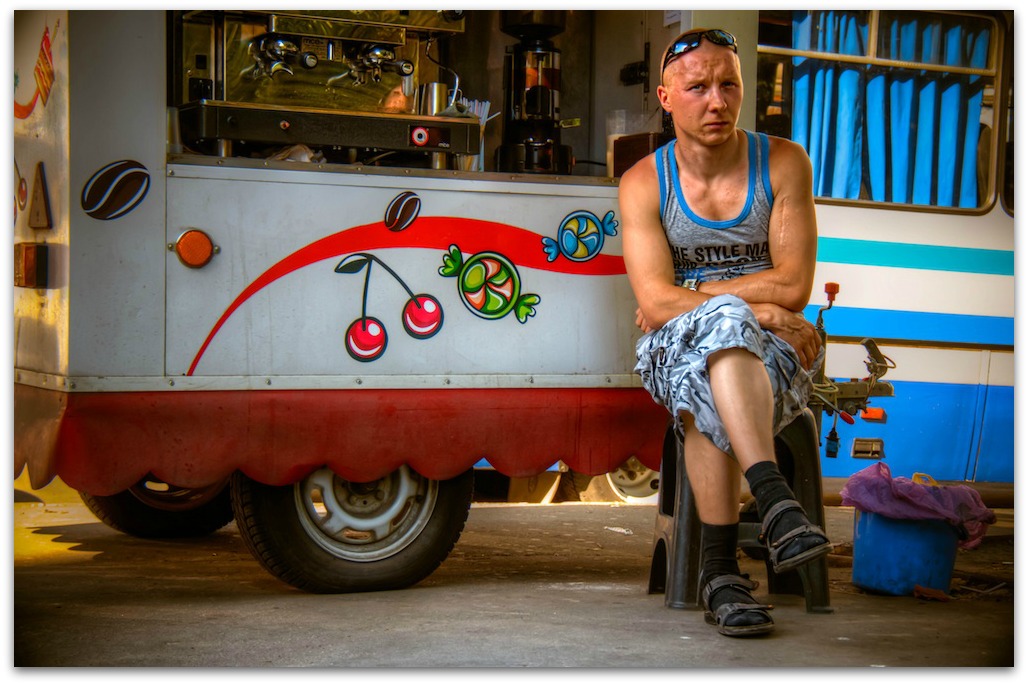
Streetvendor_drop shadowTell me about this recent photo you took of a street vendor in Kiev (original here). How did you find yourself in Kiev?
I was on a long earthbound trip in 2012 from Budapest to Hong Kong, which took me through Kiev.

How did you come across this street vendor? Did you converse with him before taking his photo?
There was no verbal communication. Rather, I nodded at the guy while moving the camera in my hand slowly, indicating that I wanted to take his photo. His face was blank in acceptance so I went ahead and snapped the photo.

Do you always try to try get permission from people when trying to take a photo?
I prefer to ask for permission, but sometimes it’s the spontaneity that makes the photo and asking would yield a different result when they prepare themselves for the photo. Either way, I make sure the subject knows I’m taking their photo.

Is it difficult to obtain permission when facing a language barrier?
It’s important to learn how to communicate with your facial expressions and your body as well as being able to read others. In my experience, regardless of whether your communications are verbal or non-verbal, the more confident and subtle you are, the more likely you are to get approval.

One thing about the street vendor picture that really stands out for me is the boldness of the colors. Can you tell me why and how you set up the shot like this?
Initially, I tried to achieve an effect that would provoke an emotional response akin to the one I had in that moment. A new environment can be emotionally overwhelming—a feeling that can be difficult to capture. First impressions are special. So when I first started editing it was the exaggeration of colors that made me feel the closest to “re-experiencing” the place. Although you can never really re-live the moment, you can come up with something that reminds you of it.

In a way it’s like when a friend tells you a “you really had to be there” story—and exaggerates the details to make the point. It’s not that the true story needs any exaggeration to be interesting, but you need to have the exaggeration to translate the feeling.

Many of these aspects of photography are, of course, a matter of experience and taste. Believe it or not, my earlier photos were even more color crazy. With more experience I’m leaning away from it and trying to express the moment in other ways. I really like black-and-white photography and the subtlety of its expression. I find it trickier and am experimenting with it more at the moment.

Parting shots…

When you take a look at the two photos mentioned above, what’s the first thing you remember?
The London photo reminds me of my host, a friend I haven’t seen in years.

The photo of the Ukrainian street vendor reminds me of a young violinist I met on the train and spent the day with. It also reminds me of how hot the day was and my craving for kvass (a fermented drink made from rye bread). Believe me, a hot day in Ukraine can make you crave kvass as a refreshment.

Are you hoping that these photos will evoke similar emotions in other viewers?
The intent is not always to prompt the same reaction I had. The same photo can prompt many different reactions. I like it when visitors to my site send messages expressing how my photos reminded them of their own experiences.

Finally, do you have any advice for wannabe photographers who are traveling or living abroad, on getting started?
I’d say to take photos for yourself first and not to think about what others would want to see or to try to meet their expectations. The first person your photos should move is yourself.

Thank you, Ildrim! Readers, what do you make of our first photographer post? Some wise words here, and who knew that autobracketing could be so useful? So, any further questions for Ildrim? Please leave them in the comments!

STAY TUNED for tomorrow’s post from expat author, Helena Halme, who is giving away THREE COPIES of her latest novel! 🙂

If you enjoyed this post, we invite you to register for The Displaced Dispatch, a round up of weekly posts from The Displaced Nation, with seasonal recipes, book giveaways and other extras. Register for The Displaced Dispatch by clicking here!

Related post:

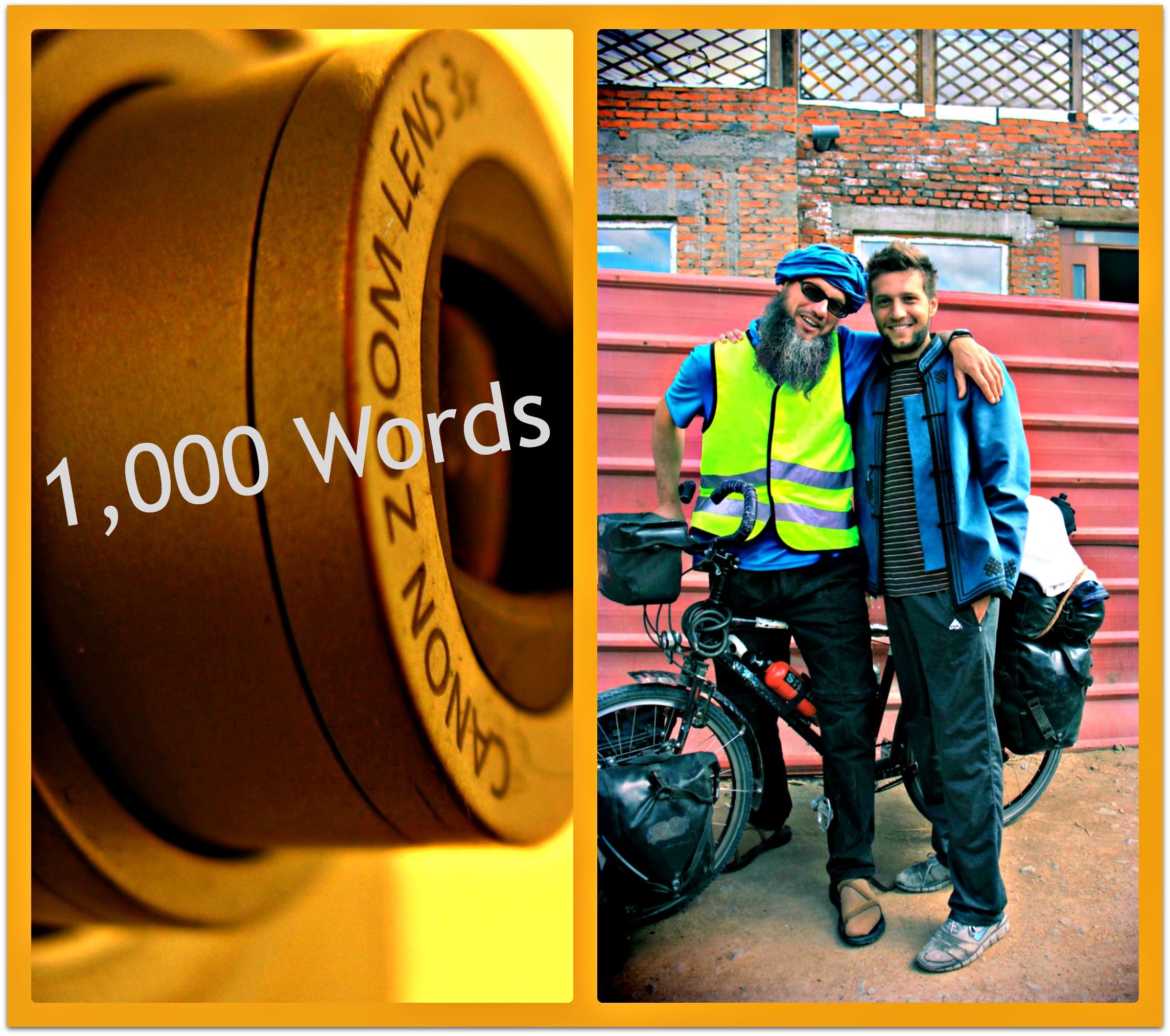
Images (from left): Camera lens from MorgueFile; Ildrim Valley (on right) with a traveler he met last summer in Ulaanbaatar in Mongolia. Says Ildrim: “He was originally from Slovenia but didn’t like being associated with any particular place. He’d been traveling on his bicycle for about four years at that point.”

LIBBY’S LIFE #77 – First refusal

“You have got to be kidding me. What were you thinking, Libs?”

Oliver prods with his toe at an oak panel in the empty, echoing living room. The panel cracks; a large piece of wood falls backwards into the abyss behind, and a suspicious scurrying tells us we have disturbed someone’s living quarters.

“Christ in a bucket,” Oliver mutters, as I try to keep an optimistic smile on my face to balance out his own expression, which is grumpier by the second.

It’s his first visit to see the house I found for us and, so far, things are not going well. Although the house boasts new electric wiring and plumbing, as our realtor Donna proudly pointed out last week, it does not boast a new furnace, a new roof, solid floorboards, or any air conditioning.

Or even wooden wall panels that stay intact when you kick them.

But you know what? I don’t care. I want this house. It’s old, it has character, it is full of quirky little corners and unexpected alcoves. I want it. Don’t ask me why.

I just know I want it.

“But it’s so cheap!” I say to Oliver, who is now looking critically at the door frame between living room and dining room. The builder of that part of the house apparently was not familiar with set squares or right angles two centuries ago, because the door shape is an interesting variation on a trapezoid.

“It would need to be,” he says. “Even if it’s free, it’s too much.”

Donna watches us, her eyes swivelling left, right, and back again. She doesn’t like the way this conversation is going, I think. She can see her commission flying out of the dusty windows.

I have an ally.

“An antique house is an investment,” she squeaks in her Minnie Mouse voice. “People like the knowledge that no one is going to build an identical house on the next lot. They like the original features. They like not living in a cookie cutter. They like owning a piece of history.”

“And they like repaying a very, very large home improvement loan and spending all their Saturdays in Home Depot,” Oliver says. “Because if you didn’t like those two things, you’d need to be bloody barking mad before you bought a crumbling money pit like this.”

He turns to me.

“Nope, I’m sorry, Libs. No can do. We’ll keep on looking until we find something more our style and less work. I’m sure Donna can show us some new construction in another town, can’t you?”

I stare at Donna, silently pleading with her to say “Absolutely not. The state has issued a moratorium on the building of new houses. If you don’t buy this house, you’ll be homeless in two months.”

But she doesn’t, of course. Instead, she takes an exaggerated breath, closes her eyes, and breathes out again. As if she thought of saying something but then thought better of it.

“Of course I can,” she says, “if you really want me to. But — could I just say something?”

Oliver looks up at the ceiling, as if asking a deity to give him strength. A dead spider is dangling from the light fitting just above his head, and he steps to one side.

“Be my guest,” he says.

“Woodhaven is a desirable town. We have an excellent school system, yet disproportionately low taxes. If you go to one of the neighbouring towns, you could end up spending on school fees and property taxes what you save on buying a house. Woodhaven is a little oasis of value-for-money town taxes. You might find what you’re looking for in Banbury, two towns away, but believe me, the twenty thousand you save on a house purchase there will be spent in eighteen months in extra taxes and school fees. I wouldn’t put my own children in Banbury schools,” she adds. “Their standardised test results last year were appalling.”

“Huh.” Oliver is scornful. “Jack’s a bright child. He’ll do fine wherever he goes to school.”

“And believe me, I admire that attitude,” Donna says, leaning towards him and patting his arm.

Actually, I don’t believe her. Nor, I can tell, does Oliver. He doesn’t like being patted by realtors with high-pitched voices, either.

“The problem is,” she continues, “most homebuyers don’t have that attitude, and you’ll find that out when you come to sell. You could be stuck with a new house that’s exactly like every other house for sale, in a school district that’s less than stellar. Whereas this house–” she makes a sweeping gesture around the living room, her arm cutting through a swathe of dust motes “– with a little love and attention from you beforehand, it would be snapped up in an instant. Like that,” she adds, snapping her fingers in case we hadn’t understood.

Her cell phone chirps. She pulls it out of her pocket, looks at the screen, and frowns.

“Excuse me.”

She trots out into the hallway where we can hear her murmuring a few seconds later.

I turn to Oliver and open my eyes very wide.

“Please?” I say. “Pretty please? With sugar on the top?”

“No.” He folds his arms, tapping one foot.

“We won’t have anywhere to live if we don’t buy it.” I stick my lower lip out. “And then we’ll have to live in the apartments near the mall again, next to that crazy man who likes using the azaleas for target practice. Remember him?”

Oliver stops tapping his foot and winces. He remembers our old neighbour, all right. The one with the pickup truck with the NRA sticker on the bumper. Oliver was convinced the man was harmless until we ran into him at a Fourth of July celebration, when he rambled on about how he hated all effing Limey effers, and we had to pretend for the next three weeks that we were Australian. Oliver avoided him as much as possible after that. One day he was late home from work, and it turned out he’d been sitting in the car for over an hour, waiting for the crazy man to finish playing poker on the front porch with his equally crazy friends, before he dared to venture into our own apartment.

Considering how he’d told me off for being silly and paranoid, you’d think he would have been less of a wuss.

Donna returns from the hallway, cell phone in hand.

“Another couple is on the way to see this house, so we should leave very soon,” she says. “The office tells me it’s the second time they’ve viewed it. That tells me they’re keen. If I were in your shoes, I’d be making an offer this afternoon. But if you’re sure you want to look at some new houses in Banbury…”

She shrugs. It’s your funeral.

I look up at Oliver, pouting a little again, and make puppy-whimper noises. “I really don’t want to live next door to that man with the BB gun again.”

“Oh, for God’s sake.” Oliver snatches the sheet of property details from me. “Offer them a hundred and forty, and not a cent more.”

Donna beams, and I try not to do a happy dance.

“You’ve got a really good chance of getting it at that price after so long on the market,” Donna says. “I don’t want to raise your hopes or anything, but if I were the seller, I’d jump at that offer. Let’s head back to my office and complete the paperwork.”

She walks back into the kitchen to collect her briefcase.

I hug Oliver, and after a split second while he tries to pretend he’s not in the least excited about buying a two-hundred-year-old American house, he hugs me back.

* * *

Four hours later, our mood is very different.

“I don’t understand it,” Donna says. She’s come round to our house to give us the bad news in person. “If it had been me, I’d have accepted that offer. I know the seller doesn’t live round here, but surely they must realise that in this economic climate you sometimes have to take what you’re offered, especially with the house needing so much renovation. I am just so sorry.”

I can’t speak. I am, as they say back home, absolutely gutted.

“They didn’t make a counter offer?” Oliver asks.

Donna shakes her head.

“Is it the other couple who saw it today? Did they make a higher offer?”

“Not that I know of.”

“Who was their realtor?” I ask. “Could you find out?”

“It was the seller’s realtor. Melissa Harvey Connor. If they want to buy it, she will probably pass them onto another realtor so there isn’t a conflict of interest.”

I manage to turn a splutter of disbelief into a cough. Conflicts of interest have never bothered Melissa in the past.

“Do you want to make a higher offer?” Donna asks.

I look at Oliver and we both shake our heads. If we pay anything more, I’ll never hear the last of it from him.

“I’m sure I can find you something nice in another town. It might mean moving away, and Oliver having a longer commute, but don’t worry. We’ll find something.”  Donna gathers up her briefcase and jacket, and leaves.

Oliver and I sit on the sofa in silence.

“The idea of making that house a project was starting to grow on me,” he says. “I’m kind of surprised at how disappointed I am now.”

We sit some more, considering our options.

“So,” Oliver says at last. “We’ve got Melissa Harvey Connor representing the seller and a potential buyer, and she just happens to be our landlady. Is it just me,” he asks, “or can you also smell a rat?”

I’m so glad I’m not the only one with paranoia.

“Oh yes,” I say. “A big rat.”

A great, big, fat rat called Melissa.”

The thing is — how on earth do we prove it?

.

Next post: LIBBY’S LIFE #78 – Trust no agent

Previous post: LIBBY’S LIFE #76 – This old house

Read Libby’s Life from the first episode

Want to read more? Head on over to Kate Allison’s own site, where you can find out more about Libby and the characters of Woodhaven, and where you can buy Taking Flight, the first year of Libby’s Life — now available as an ebook.

 STAY TUNED for next week’s posts!

If you enjoyed this post, we invite you to subscribe for email delivery of The Displaced Dispatch, a round up of the week’s posts from The Displaced Nation. Sign up for The Displaced Dispatch by clicking here!

Image: Travel – Map of the World by Salvatore Vuono / FreeDigitalPhotos.net
Talking to Kate Allison, writer of serialized expat fiction (we’re giving away her first book!)


Taking_Flight_dropshadowToday I find myself in the enviable position of having to introduce my co-blogger and good friend, Kate Allison. As one of the founding members of the Displaced Nation, she needs no introduction to our regular readers, many of whom are as awestruck as I am at her ability to churn out well-c

rafted, entertaining episodes of Libby’s Life week after week, month after month.

For the uninitiated: Kate’s stories center on Libby Patrick, a thirty-something stay-at-home mum who has trailed her spouse, Oliver, from their native UK to Woodhaven, Massachusetts—a small New England town that, in Libby’s own words, “makes Stepford look like inner city gangland.” The Patricks live there with their three small children: preschooler Jack and infant twins, Beth and George. (At one point they also had a dog, Fergus—don’t ask.)

Libby keeps a diary of her expat adventures, and during the past two years, Kate has churned out a whopping 76 entries, an average of three per month.

In consequence, a number of us (even those who aren’t trailing spouses with families) have become certified Libby addicts—always looking forward to the next installment!

If we need a “fix” between episodes, we can go to Kate’s companion site dedicated to Libby and all things Woodhaven, where not only do we receive more information about Libby and the characters she encounters in Woodhaven, but we can also read additional posts from the other characters’ points of view!

And now there is another exciting development: Kate has just self-published the first year of Libby’s expat life in a single volume, Libby’s Life: Taking Flight. I highly recommend this aggregated version to anyone who is new to the Libby phenomenon…

And you’ll never guess what? We are giving away two copies!!! (Details below.)

But before we get to that, let’s visit with Kate and find out more about her. Having visited with her non-virtually, I can report that she really does live in a small New England town similar to Woodhaven.

What inspired her to create the lovely and loveable Libby, and what possessed her (I don’t think it’s too strong an expression) to commit herself to the potential folly of writing a novel online? Her temerity cannot be underestimated, I think you’ll agree…

* * *

Why did you decide to write a book about a trailing spouse, and how long have you been at this?
I first started “Libby’s Life” on my own blog (now extinct) just before Displaced Nation launched, a little over two years ago. I published three episodes there, and then transferred Libby to The Displaced Nation.

Libby didn’t start out as a book; she started out as a fiction blog because I found it difficult to blog about my personal life which, frankly, isn’t very interesting to anyone else. It’s easier for me to mesh snippets of facts into the fictitious world of Woodhaven. I was uncomfortable writing about my own family members—just because I like writing doesn’t give me the right to invade their privacy—but every now and then, certain incidents in Libby have happened in real life.

For example, when my son was a toddler, he was obsessed with toy cars, just as Jack is now. And the episode about Winter Storm Alfred, when Libby loses power for several days because of a freak snowstorm at Halloween, is based on a real situation. We were without power for four days ourselves after that same storm.

Fortunately, unlike Libby, we don’t have a man-eating landlady who lets herself into our house to sniff my husband’s sweatshirts.

Have you found out anything new about yourself, your own feelings of displacement, in the process?
Libby is at the beginning of her displacement journey. I’m quite a few years ahead of her, and have had to trawl through old memories to imagine how she would feel in certain situations. So the fact that I have to do that suggests I’m not terribly displaced anymore and I’ve come further than I thought.

Turning to Libby, what is her most displaced moment?
Probably when they first moved into their temporary apartment, next to a Limey-hating NRA supporter who liked shooting air soft pellets at the rhododendrons in the back garden. Poor Libs! She was quite traumatized. And also last year, when she went back to England for the first time and everything felt foreign—a reversed displacement.

What is her least displaced moment?
I think it was fairly recently, when she met Willow Reeves. Willow is from Brooklyn, very no-nonsense. She’s the first American friend Libby has made outside the expat Coffee Morning Posse, that hasn’t been via an introduction. It’s a sign that Libs is starting to fit in.

According to a recent article in the business section of the New York Times, serialized fiction, where episodes are delivered to readers in scheduled installments much like episodes in a television series, has been the subject of an unusual amount of experimentation in publishing in recent months. You seem to be ahead of the game in that respect. What have you learned from your two-year-long experiment?
I’m amazed at the number of people who do seem to follow the episodes, and yes, it is like a TV soap opera. I think Aisha at Expatlog commented a while ago that it filled the EastEnders void for her. But I didn’t intend it to be like that when I first started, envisaging instead a few blog posts dealing with certain aspects of moving abroad. I certainly hadn’t envisaged me still doing it two years later.

The main thing it’s taught me is that when I have to write a story because I’m on the Displaced Nation schedule to do so, I can do it. Novelist Peter De Vries famously said:

I write when I’m inspired, and I see to it that I’m inspired at nine o’clock every morning.

It doesn’t matter what type of writer you are—his philosophy is a good one.

What has been the most challenging part of the book-writing process?
Thinking up new topics for story lines. Every now and then I’ll put out a plea for ideas. A friend of mine jokingly said she’d like to see headlice as a Libby topic, and lo! There were headlice.

I now keep track of all the characters and story lines on a timeline program. I can see the last time a character came in, in which story line, in which episode, and I can plan ahead.

Theoretically, anyway. My actual way of planning is to sit in front of the blank screen and panic about a post that’s due in two days’ time. But I’m getting better. I even know what is going to happen in September.

What made you decided to publish the first year of Libby’s Life as a book?
I ended Libby’s Life: Taking Flight ends with Libby’s first Christmas in the United States because that was a natural break in the story. Libs had just started to spread her expat wings at that point, hence Taking Flight.

What do you intend to follow it up with?
The next one will be called Cargo Hold. Well, she’s pregnant with the twins, you see.

What audience do you intend for the Libby books?
It probably falls in the unflattering genre of “hen lit” — chick lit for the more mature woman. It seems most popular with women from thirty onwards, but then again, a friend of mine, a man who is now in his 70s, is an avid fan, so who am I to say?

What aspect of it is proving the most popular—any surprises?
Regarding the audience’s nationality, I expected it to be most popular with English women who had moved around a bit, but it turns out that one of Libby’s greatest cheerleaders is an American lady who is a keen armchair traveler. That’s pretty encouraging. (And thank you—you know who you are!)

Are you working on any other writing projects? (When’s the next book coming out?!)
At the moment I’m rereading/rewriting the 2012 episodes so I can turn them into either one or two short ebooks later this year. Additionally, I’ve gone back—yet again—to the WIP that triggered a lot of Libby characters. Woodhaven, Maggie, Melissa, Patsy, and all the Giannis were around in my imagination and in draft form long before Libby came along. The WIP is the story of Maggie’s daughter, Sara, a Woodhaven native now living in Somerset, England (my own native neck of the woods). Much of it is set in the 1980s, so you get to meet Maggie, Melissa et al when they were younger. Not sure when it will be finished…but making it public through this answer is a good spur.

10 Questions for Kate

Finally, I’d like to ask a series of questions that I’ve asked some of our other featured authors, about your reading and writing habits:
Last truly great book you read: There are two I’ve read several times in the last few years and each time thought “Damn, I wish I’d written that”: The Time Traveler’s Wife by Audrey Niffenegger, and Behind the Scenes at the Museum by Kate Atkinson.
Favorite literary genre: Sigh. Call me predictable. Women’s fiction and travel. Anything by Joanne Harris is a great combination of the two.
Reading habits on a plane: Either some piece of fluffery from the airport bookshop or a book I’ve already read from my Kindle. My Kindle is stuffed with classics, free ebooks, and review copies for TDN. But I have to have a paperback for the times you’re required to Turn Off All Electronic Devices. If I don’t have a paperback, I’ll write in a notebook, and chances are it will be notes on a conversation taking place near me. I’m a compulsive eavesdropper. Be warned.
The one book you’d require President Obama to read, and why: ML, I really hate getting into politics! Pass!
Favorite books as a child: Anne of Green Gables; E Nesbit books, especially The Railway Children; Enid Blyton‘s Malory Towers; Sadlers Wells series by Lorna Hill; anything by Noel Streatfield; the William stories by Richmal Crompton.
Favorite heroine(s): Maggie Tulliver (George Eliot’s The Mill on the Floss) and Emma Woodhouse (Jane Austen’s Emma).
The writer, alive or dead, you’d most like to meet: Roald Dahl. I really would like to know for myself if he was as sick-minded as his books are.
Your reading habits: In bed.
The book you’d most like to see made as a film: I’m looking forward to Robert Redford’s version of Bill Bryson’s A Walk In The Woods. And I’d love to see one of my favorite books in question #1—Behind the Scenes at the Museum. But it would have to be set in the English city of York, as it is in the book, not Americanized and set in Philadelphia or wherever, as so often happens.
The book you plan to read next: My “to read” list gets ever longer. At the top is The Hare With Amber Eyes by Edmund de Waal. At the bottom, just added, is Hilary Mantel‘s Wolf Hall. And a whole lot of others in between.

* * *

Thanks so much, Kate! Long live Libs!!!

Readers, now it’s your chance to ENTER OUR DRAW TO WIN A FREE COPY of Kate Allison’s first Libby book. Kate is giving away TWO FREE COPIES and will favor comments that offer storyline ideas for future Libby posts, which will also get included in Libby at some point!!!

Extra points, as always, if you’re a Displaced Dispatch subscriber!

The winners will be announced in our Displaced Dispatch on June 1, 2013.

STAY TUNED for the next episode in the life of our fictional expat heroine, Libby! (What, not keeping up with Libby? How could you resist after reading this interview?!?!? Sign up NOW for our Displaced Dispatch and you’ll receive the first three chapters!!!)

If you enjoyed this post, we invite you to register for The Displaced Dispatch, a round up of weekly posts from The Displaced Nation, with seasonal recipes, book giveaways and other extras. Register for The Displaced Dispatch by clicking here!

Related posts:

GLOBAL FOOD GOSSIP: There’s no taste like home

global food gossipJoanna Masters-Maggs, our resident Food Gossip, is back with her monthly column for like-minded food gossips.

Today’s topic for discussion in the kitchen is something very dear to Joanna’s heart: English food.

Before I left the shores of England over 16 years ago, I never gave a thought to British recipes and ingredients as long as I had a supply of strong English teabags. And once I left England and adopted a “displaced” lifestyle, not being able to find ingredients for familiar English recipes simply meant an opportunity to try something new and wonderful, because I love cooking. I tasted and cooked my way around the world and lost touch with food from home.

Now, some people might be unkind enough to suggest that this was for the best, given England’s reputation for lacklustre food. How unfair! A difficult century of war and rationing, followed by the arrival of new convenience foods had an adverse affect on home cooking and restaurants alike. If I had to collect my rations for weeks in order to make a cake, I would probably lose interest within days. The new packets and tins must have seemed welcome relief from the effort of thinking about how to put a meal together. But that’s another story. For now, take it from me that properly cooked English food made with quality ingredients and which doesn’t substitute homemade for pre-packed, is a wonderful thing. It is a wonderful thing.

However. Back to me, living overseas: I felt it was important to learn to cook the local food, and I took this task very seriously. So seriously, in fact, that one day the realization hit me that, in eight years of motherhood, I couldn’t recall having made a single traditional English dish for my kids. Why on earth not? This was the culinary equivalent of refusing to speak to your child in your native tongue, and potentially just as psychologically damaging.

We had just arrived in Malaysia. Kuala Lumpur has a large expat population, and a certain supermarket, Hock Choon, caters to it shamelessly. During one expedition there, I picked up a distinctive green and gold tin of Golden Syrup.

“What’s that?” asked my kids, crowding around, eager to look at this strange foreign product.

Oh dear. What woeful ignorance of an iconic British product. My own children didn’t know that Golden Syrup is to foie gras what corn syrup is to Spam.

Clearly there was some cultural awareness to be taught.

A taste of home

On the drive home I began to feel a tingle of excitement. A quest had begun. A project is a good thing to have in the difficult first few months in a new country. It keeps you from mourning over your lost life elsewhere. I determined that I would cook English favourites for my kids and I would cook them well. No corner cutting, no packets, and certainly no shop bought pastry—one thing thankfully, that was conspicuous by its absence at Hock Choon.

That Sunday I produced my kids’ first-ever Sunday roast. It was simple stuff: just chicken, roast potatoes and green beans, but I just felt such a damn capable mother as I carried it to the dining table. Steamed syrup pudding came next, and custard too — the real deal, made with cream, eggs and a steady nerve.

My children stared with fixed intensity as I lifted the dish to reveal the pudding in its full golden glory. Accustomed to tarts and tortes, they were unsure what they were facing.

“Umm…what is it called?” asked six-year-old Isabel, as I poured custard on her serving.

Seconds later she discovered what everyone does when they try this delight of English baking. The name gives no hint of its tender lightness. It doesn’t swamp the vanilla delicacy of custard. Here was something that looked as though it could break storefronts for ram raiders, but which in reality was a frou-frou pussycat of buttery, light delight. With relief, I surveyed the smiles of my family. There would be no pudding mutiny that night.

Over the months that came, aided by the marvelously stocked Hock Choon, I mastered steak and kidney pie with homemade suet pastry, roast racks of lamb, and liver and onions. On the pudding side, Bakewell tart became a firm favourite and more than adequate British competition for a tarte au citron.

Bravely, I served English food for my children’s Korean and Japanese friends and found they delighted in the names of some of the dishes. I lost count of the number of children who couldn’t wait to tell their parents they had eaten “toads” and that they were delicious. Toad in the Hole, if the fat and oven are hot enough, is a glorious combination of light and golden batter, meaty sausages and sweet onion gravy. I remember one lovely Chinese mum being genuinely disappointed to learn that it was a pork dish and not a spin on frog legs.

Now, my children have favourites recipes from England and are fiercely defensive of their national dishes. Criticism is met with an invitation home for dinner and on those nights I cook with extra care. I am happy to report that we have enjoyed quite a lot of success. No longer are we bashful when our food or produce is knocked—we talk back. That’s important. Food forges a sense of belonging to somewhere.

One more thing before I go: Clotted Cream

905482_10151362556866828_2018383220_oEngland is rightly famous for its dairy products, king of which is clotted cream. It hails from South West England, particularly Devon, but also Dorset and South Somerset. This is the stuff traditionally served with scones and for which ‘cream tea’ is named. I like to serve it with fruit tarts at dinner and — oh, let’s be frank, this is the cream that goes anywhere. Just don’t waste it in cooking.

It’s quite difficult to find outside Britain, but not to worry—you can make your own.

RECIPE FOR CLOTTED CREAM

You need “raw” cream. It can be called heavy, whipping, double or single cream, just as long as it isn’t UHT (ultra heat treated). UHT won’t separate, and you need to separate the cream from the milk.

Now put that cream in an ovenproof dish and cover. Place it in an oven preheated to 180°F or 80°C and leave for 8-12 hours—yes, you read that correctly.

When a thick, yellowish crust of mascarpone-like consistency has been achieved, remove the dish, wait for it to cool, then refrigerate for a minimum of 8 hours. Scoop it in to jars, cover and eat within a few days.

That should be the easiest part of all.

Joanna was displaced from her native England 16 years ago, and has since attempted to re-place herself and blend into the USA, Holland, Brazil, Malaysia, Venezuela, Saudi Arabia, and now France. She describes herself as a “food gossip”, saying: “I’ve always enjoyed cooking and trying out new recipes. Overseas, I am curious as to what people buy and from where. What is in the baskets of my fellow shoppers? What do they eat when they go home at night?”

Fellow Food Gossips, share your own stories with us!

STAY TUNED for tomorrow’s post!

If you enjoyed this post, we invite you to register for The Displaced Dispatch, a round up of weekly posts from The Displaced Nation, with seasonal recipes, book giveaways and other extras. Register for The Displaced Dispatch by clicking here!

Related posts:

Images: all photos by Joanna and used with her permission

CAPITAL IDEA: Bangkok: A quick guide

bangkokWelcome to another “Capital Ideas”—our somewhat idiosyncratic, ever so slightly tongue-in-cheek guide to various world cities, perfect for the ever discerning readership of this blog. We know our readers are always visitors, never tourists (an important distinction).

Do feel free to contribute your own ideas or suggestions in the comments section, we’d love to hear your thoughts, too.

Capital: Bangkok

That reminds me I saw The Hangover Part 2 recently. Great movie. Um, no, it isn’t.

What are you crazy? A chain-smoking capuchin monkey and that guy who is in The Office wakes up to a Mike Tyson-style face tattoowhat’s not to love? Its content? Anyway, why are you blathering on about The Hangover Part 2?

Because dude, it’s set in Bangkok. As is Bangkok Dangerous. What a surprise!

Anyway, you’ve got my attention. Those films have certainly piqued my interest in visiting Thailand’s capital city. Well, that is good to hear.

Yes, I think I could have a fun, hedonistic vacation. Is it as crazy as it seems in those films? It’s a city of over eight million. I’m sure you can find some craziness if you’re so inclined, but there’s far more to this city than some of your preconceptions.

Oh yeah, I’m sure that is the case, and I’m all ears regarding all that culture nonsense that I know you love, but still, I might want to take in a ping pong show in Soi Cowboy. How can you go to Bangkok and not see its seedy underbelly? Fairly easily. This is not a guide for sex tourists.

Oh, you’re such a square! Okay, what would you have me see? Take a ferry to the Old City. There you’ll be able to visit the ornate Grand Palace built in the 18th century for the Thai king and Wat Phra Kaew, where you can find Emerald Buddha. A trip to Wat Arun is also a must.

The Grand Palace, you say? They’re pretty big on their Royal Family, aren’t they? You can say that again. Indeed, you’ll find portraits of the current King, Bhumibol Adulyadej, as well as some of his predecessors, in most restaurants.

So jokes about the King probably won’t go down too well? No. In fact, lèse majesté, which is the crime of violating majesty, is enshrined in law, so no, probably not the best idea to make a joke about the Thai King as it could lead to a prison sentence.

Blimey! Kind of appreciate that I can make all those jokes about Prince Charles’s ears with impunity. Absolutely!

Anything else I need to know on this? Yes, Thai nationals have to stand for the national anthem by law.

I think I’m going to regret saying this, but what do you recommend? I’ve got one word for you—puppets.

Oh God, I wished I hadn’t asked. No, hear me out. Traditional Thai puppetry is fascinating. The Aksra Theatre in Bangkok puts on a great introductory show for tourists that also showcase traditional Thai music too. The puppets will depict scenes from the Ramakien, Thailand’s national epic. Go, you’ll love it, I promise!

Trust this guide to push some weird recommendation on me. What? Me? The very idea! … I think I might rather try my hand at the ping pong show. No!!!! Go with the puppet show.

I’m guessing I’ll eat well in Bangkok? You guess right. Really, you can’t go wrong. You don’t need to find out who the fanciest, trendiest chefs in town are, just take a wander and keep is simple. You’ll be able to eat very well and by spending very little.

Sounds great, and how do I get around the city? The city has three rapid transit systems: the BTS Skytrain, the underground MRT and the elevated Airport Rail Link. They’re all pretty good if you’re going long distances across the city. For shorter distances just take a taxi. I would, however, give one warning on this, based on personal experience. Bangkok taxi drivers don’t have the best of reputationsdon’t allow yourself to be ripped off. Some unscrupulous taxi drivers will refuse to put on their meters and will quote you outrageous sums when you first step in their cab to get you to your destination, because they see you’re a farang. If they’re not prepared to negotiate to a sum you feel is reasonable, then don’t feel shy about exiting their cab and searching for another taxi.

What should I read to prepare for the journey? More than any other expat destination, Bangkok seems to have inspired cringe-worthy expat books about crime and sin in the capital or “hard man” accounts from Westerners who’ve ended up in Thai prisons for drug smuggling. They’re for the most part best avoiding. If you must have something that touches on the sin and crime of the city, then John Burdett‘s Bangkok 8 is an entertaining read for a flight over to Thailand. If you’re particularly ambitious you could also try reading The Ramakien (in translation).

What should I watch? You could watch the original Thai version of Bangkok Dangerous from 1999 if you were interested by the American remake. Also, in recent years a number of Thai films have gained attention at the Cannes Film Festival. Blissfully Yours and Tropical Malady are worth investigating.

STAY TUNED for next week’s Displaced Nation posts.

If you enjoyed this post, we invite you to register for The Displaced Dispatch, a round up of weekly posts from The Displaced Nation, with seasonal recipes, book giveaways and other extras. Register for The Displaced Dispatch by clicking here!

Related posts:

Image: awindram

JACK THE HACK: How do you know whether you want to write a memoir or a novel, and what’s the difference?

JACK THE HACK _writingtipsJack Scott is back with his monthly column for all of you wannabe authors who are hacking away at travelogues-cum-memoirs (cum-novels?). For those who don’t know, he was a Random Nomad for the Displaced Nation way back when we started this site. After an expat experience that was literally something to write home about, he and his partner, Liam, have traded in the dream for a less pressured existence back home in the UK.

—ML Awanohara

Hmmm… Is it easier to turn expat stories or travel adventures into a memoir or a novel, and how does one decide?

As with all such questions, the answer is a resounding “it depends”.

Let’s look at some definitions:

Memoir (noun) – a historical account or biography written from personal knowledge.
Travelogue (noun) – a film, book, or illustrated lecture about the places visited by or experiences of a traveller.
Novel (noun) – a fictional narrative, typically having a plot that is unfolded by the actions, speech, and thoughts of the characters.

So it seems that travelogues and biographies can’t be novels because, by definition, they’re based on real events by real people in real places.

Does this matter?

I think not.

False dichotomies

For me, writing a memoir is like telling a story and every story, even a real-life one, needs order, pace, plot, a compelling blend of highs and lows and a sense of purpose.

I learned some valuable lessons from David Steddall, the English teacher at my South London grammar school back in the big hair, bell-bottomed Seventies.

“A story should have a beginning, a middle and an end,” Mr Steddall would say.

We’ve all heard the mantra, haven’t we?

Mr Steddall seemed to like my essays, even if they were sometimes a little risqué in a post-pubescent, hormone-raging kind of way. He would often give me top marks and have me recite my work in class. His encouragement gave me confidence—a confidence that lay dormant for thirty-odd years until a little sun-kissed nourishment breathed life into it like rains in a desert.

I’ve stayed faithful to Dave(as I now think of him)’s cause. My own memoir has a beginning, a middle and an end. It’s not a random series of observations like a diary. Who’d want to read that? Let’s face it, I’m not Anne Frank, Kenneth Williams or Samuel Pepys.

Make it work!

Here’s the trick. Just because a memoir can’t be a novel, it doesn’t mean it can’t be written as if it were. The greatest challenge is to give memoir a plot that readers will find convincing and engaging enough to make them turn the page.

For me, that meant very little fat. One of the first tips I picked up from my publisher was to dump storylines and characters that weren’t key to the main event or didn’t add interesting flavour. I tackled this by creating a story board, much like they do in the movies. This meant I could identify gaps in the narrative, ensure continuity and shoot down the flights of fancy.

Does this mean it’s not true?

Well, as I wrote at the top of my first book:

This book is based on actual events. To protect the privacy of the persons involved, and in the interest of narrative clarity, some names, characterizations, locations, conversations and timescales have been changed.

This was necessary to protect the guilty, avoid a brick through my window and keep me out of the courts. The end result is that all the characters are true, if renamed and heavily disguised, and all the events actually happened, though not necessarily as chronologically written. Once I accepted this, I could let my imagination run riot and had enormous fun assembling the pieces of my life abroad like one huge colourful jigsaw.

I admit, though, I may have left some little gems on the cutting-room floor.

It’s the risk you take.

Glossy travelogues and expat classics

Most people are familiar with the lavish and beautifully crafted travel book, heavy enough to stop a burglar or prop open the living room door. Every coffee table should have one.

But I don’t really think of travelogues as memoir as their primary purpose is to inform the reader about foreign places in words and (often) pictures.

As for the kind of expat book that has ended up appealing to a mass audience—Peter Mayle’s A Year in Provence and Chris Stewart’s Driving Over Lemons come to mind—the formula calls for lots of descriptions of majestic landscapes as well as a plot centered around building a dream home out of a hovel in the rolling hills.

Which leads me to …

WRITING TIP FOR EXPATS NO 2:

My advice to the budding expat writer: find your own angle; don’t waste your time reinventing the wheel.

In my case, I wrote about the (sometimes grubby) reality of expat life from the unique perspective of a gay man in a Muslim land. It’s something no one had done before, and why would they? There weren’t many of us there.

* * *

Readers, any comments, further questions for Jack the Hack? He’ll be back next month with some more writing tips…

Jack Scott’s debut book, Perking the Pansies — Jack and Liam move to Turkey, is a bitter-sweet tragi-comedy that recalls the first year of a British gay couple in a Muslim country. For more information on this and Jack’s other titles, go to his author site.

STAY TUNED for tomorrow’s “Capital Ideas” post, by Anthony Windram.

If you enjoyed this post, we invite you to register for The Displaced Dispatch, a round up of weekly posts from The Displaced Nation, with seasonal recipes, book giveaways and other extras. Register for The Displaced Dispatch by clicking here!

Related posts:

Images from top, clockwise: Hand with pen / MorgueFile.com; Boats in King’s Lynn, Norfolk / MorgueFile.com; Jack Scott, used with his permission; Turkish boats / MorgueFile.com

And the April 2013 Alices go to … these 5 international creatives

 © Iamezan | Dreamstime.com Used under license

© Iamezan | Dreamstime.com
Used under license

As subscribers to our weekly newsletter, The Displaced Dispatch, may have noticed, we are now presenting our “Alice Awards” in that esteemed publication. Each week, we give an “Alice” to someone who has a special handle on the the curious and unreal aspects of the displaced life of global residency and travel. Not only that, but they have used their befuddlement as a spur to creativity of all kinds.

Today’s post honors our first five Alice recipients, beginning with the most recent and this time including citations.

So, without further ado: The April 2013 Alices went to …

1) MICHELLE GARRETT, expat blogger

Source:Has Your Expat Life Inspired You To Write A Book?” in Expat Focus (e-zine for anyone moving or living abroad)
Posted on: 19 April 2013
Snippet:

By definition is an “expat novel” about an expat? Or does it need to be more than that—does an expat novel need to be about an expat experiencing expat life? You know, the culture shock, the language differences, the homesickness …

I have always written and always wanted to be a Writer so for me the motivation to write a novel was more about “you want to write? Start by writing what you know’” rather than, “I’m an expat with adventures—I think I’ll write about them!”

Citation: Should we expats write books about the wonderlands we’ve experienced on our travels, or should we write because we enjoy writing (and just so happen to live abroad)? Michelle, you’re sounding a little Mad Hatterish by posing this riddle with no answer, and we feel duty bound to point out that Alice herself felt that her adventures could be worth writing about:

When I used to read fairy-tales, I fancied that kind of thing never happened, and now here I am in the middle of one! There ought to be a book written about me, that there ought!

But listen, if our enjoyment of your blog, The American Resident, is any indication, we’re going to love the novel you’re writing about an expat woman but that isn’t an expat novel. We also look forward to your book of tips for expats with long and sad tales, like the Mouse’s.

2) JUDY LEE DUNN, award-winning blogger on blogging and former humanitarian aid worker

Source:Judy Lee Dunn on words, maps, and inspiration“—an interview with Judy conducted by author Lisa Ahn (notably, Lisa’s own favorite words are “once upon a time”!).
Posted on: 17 April 2013
Snippet:

For as long as I can remember, I have been enchanted by the power of words to transport readers to a world they don’t yet know.

And when I was a child, maps were a metaphor for a world I had not yet seen …

Whenever my two passions intersected, I was truly inspired. As manager of Writing Resources for World Vision, words and maps perfectly converged to send me to West Africa as part of a documentary team to tell the stories of projects helping third world families become self-sufficient. …

Now, I’ve finally reached the point where I am putting together the pieces of my life, word by word, shining a light on one of the recurring themes of my life. Finding just the right words to express a life map of sorts: to understand where I started and where I am going.

Citation: Judy, we feel certain you would approve of our fondness for Lewis Carroll, believing as you do in the power of words to transport us to other worlds (and also having worked as a first-grade teacher!). We’re with you on the map thing, too, as evidenced by our “Here be dragons” banner. And we love the idea of someone who has worked abroad, as you have (in West Africa), writing a “life map.” May we borrow this term?

3) ANN PATCHETT, best-selling American author

Source:What now? Advice on Writing and Life from Ann Patchett“—a post by Maria Popova on her Brain Pickings blog, containing extracts from Patchett’s 2006 commencement address at Sarah Lawrence, which has been published as a book, What Now?
Snippet:

Coming back is the thing that enables you to see how all the dots in your life are connected, how one decision leads you to another, how one twist of fate, good or bad, brings you to a door that later takes you to another door, which aided by several detours—long hallways and unforeseen stairwells—eventually puts you in the place you are now. … But when you look ahead there isn’t a bread crumb in sight—there are just a few shrubs, a bunch of trees, a handful of skittish woodland creatures.

Citation: Ann, we know you intended your words for the ears of graduates from your alma mater, but they could easily apply to us displaced types, who spend a good deal of our time feeling lost and clueless. You go on to say: “Sometimes not having any idea where we’re going works out better than we could possibly have imagined.” What a marvelous assertion! Far more reassuring than the series of unhelpful responses Alice elicits from the Cheshire Cat after asking him: “Would you tell me, please, which way I ought to go from here?” (What’s more, you’ve followed your own advice, booking a trip to the Amazon as soon as you decided to set your sixth novel there.)

4) LAINIE LIBERTI, world traveler and blogger

Source:Reentry Observations—Washington DC,” an entry on her blog, Raising Milo on the Road of Life—a single mom and son’s nomadic adventures as they travel around the world together.
Posted on: 29 March 2013
Snippet:

I imagined this country’s politicians, their assistants, their staff, all rushing away from the Capital, eager to go somewhere else. I imagined this was the group of stressed people who were running the United States of America. … I clearly have a different feeling about the United States now. I feel as if I’m on foreign soil. I don’t perceive the energy as welcoming.

Citation: Lainie, your description of Washington VIPs dashing about reminds us of Alice’s encounters with the White Rabbit. And we join you in wondering: don’t they realize that someday their actions will seems as trivial as some might perceive the ancient cultures of Peru? (Certainly puts it in perspective!)

5) LAURA J. STEPHENS, psychotherapist and author

Source: “Overcoming Isolation,” an entry on her author blog (she is the author of An Inconvenient Posting: an expat wife’s memoir of lost identity).
Posted on: 9 March 2013
Snippet:

For me, there was nothing in my experience quite so isolating as arriving in an unfamiliar country and trying to orientate myself, whilst experiencing the losses of “home” and all the while thinking I should be grateful for my new existence.

Citation: Laura, it’s great to know that someone out there understands the tendency for us expat Alices to declare “I am so very tired of being all alone here!” and then to suffer “pool of tears” moments… Not only that, but you provide practical tips to keep from drowning. What more can we ask?

* * *

So, readers, do you have a favorite from the above, and do you have any posts you’d like to see among May’s Alice Awards? We’d love to hear your suggestions! And don’t miss out on these weekly sources of inspiration. Get on our subscription list now!

STAY TUNED for tomorrow’s post—more writing advice from Jack (the Hack) Scott!

Writers and other international creatives: If you want to know in advance whether you’re one of our Alice Award winners, sign up to receive The Displaced Dispatch, a round up of weekly posts from The Displaced Nation, with news of book giveaways, future posts, and of course, our weekly Alice Award!. Register for The Displaced Dispatch by clicking here!

Related posts:

LIBBY’S LIFE #76 – This old house

“Did you do something special with the twins on their birthday?” Willow squirts ketchup on the burger that Oliver’s handed her, then pops open a can of Bud. “On the day itself, I mean?”

Oliver catches my eye, grins, and turns away to flip more burgers while discussing cricket, or the American lack thereof, with his English friends. They, in turn, are trying to explain to Willow’s bewildered partner, Dan — Bronx native and lifelong Yankees fan — a sport where one game can take up an entire working week and which has rest breaks for tea and cucumber sandwiches.

I stick my tongue out at Oliver’s back.

“We went out for ice cream in the evening,” I say, “after I dragged them round the streets of Woodhaven with a realtor. After trailing through eight houses, though, they were ready for bed rather than for ice cream.”

Willow, I reflect, is the type of woman you can say this to. She won’t be shocked that you didn’t do something special for your little snowflakes on their first birthday, or that you are celebrating it nearly two weeks late in the form of a backyard barbecue for grownup friends. She understands that while twelve-month-old babies won’t care if you have a children’s party for them on April 23rd or an adult one on May 4th, the whole family is going to be in the soup if no one has anywhere to sleep on the night of July 15th.

The prospect of homelessness has been playing on my mind more than my children’s numerical milestones have, I admit.

“And did you have any luck finding a house?” Willow asks.

I shake my head.

“Either the work they needed would put them over budget, or they were too expensive to start with.”

Willow doesn’t say, as many people might, “I’m sure something will turn up” or “Everything will be OK”, and for this I’m grateful. There’s a fine line between spouting comforting platitudes and sounding as if you don’t give a damn.

“What are you going to do?” she says instead.

I make my way across the deck to the food table where Beth and George are strapped into their high chairs, tantalisingly out of reach of their birthday cake.

“Donna, the realtor, is taking me round some more places tomorrow. If I don’t like any of them, I suppose we will have to move back into an apartment near the mall, where we lived when we first arrived. The alternative is to look for a house outside Woodhaven.”

“Is that what you want?”

I cut two more pieces of cake and plonk them on paper plates in front of the twins, who look at each other and wave their arms around in choreographed excitement. Beth and George are already covered from forehead to chest in red velvet cake and cream cheese frosting. They look like twin Hannibal Lecters, but appear to be enjoying their belated birthday party.

Eventually, I answer Willow.

“You can’t imagine,” I say, “how much I don’t want that.

* * *

I’m surprised how upset I am at the prospect of moving to another town. I’m sure another town in Massachusetts would be just as nice, but there’s something special about this one. When I first met Maggie eighteen months ago, she summed it up by saying “Woodhaven is the kind of place that gets to you. It’s like Hotel California — you can check out any time you like but you can never leave. I’ve been trying to leave ever since 1976, but haven’t managed it yet.” After less than two years in the place, I already know what she means.

It’s scary to think that, if not for Oliver’s promotion at Christmas and subsequent extension of his contract in Massachusetts, we’d be packing our belongings into cardboard boxes ready to go back to Milton Keynes next month. Though, as Oliver’s mother is still living in our house there, perhaps it’s just as well we’re staying. I really must check up on what she’s doing to the place, but until we’re sorted out with somewhere to live, that’s a distant second place on my list of priorities.

Still. Chin up. Perhaps today is the day that Donna, our geographically-challenged realtor, will find us a house that’s a) big enough, b) cheap enough, and c) empty.

* * *

“What do you think?” Donna asks, when I’ve looked in all the bedrooms and opened all the closets.

This is the thirteenth house she’s shown me round in as many days, and she’s learning. No longer does she froth with enthusiasm over hardwood floors and granite countertops. I need three, if not four, bedrooms; two bathrooms that don’t contain 1970s-coloured suites or swimming pool-sized bathtubs that require an entire water tank to fill them; a bedroom for me and Oliver that’s on the same level as the other bedrooms; and, most of all, a laundry room that isn’t in a dark, cobwebby basement. If none of those conditions apply, the house needs to be cheap enough for us to make the necessary improvements.

“It’s better than the last one,” I say, “but still not there. The blue bathroom suite is an improvement on the chocolate brown one, I’ll give you that, and the kitchen is old enough for me to call it ‘retro’, but I am not prepared to do my laundry in a dungeon that has a mouse carcass next to the washing machine.”

“That’s not a problem,” Donna says. She’s got a squeaky little voice; she doesn’t so much speak as chirrup. “We can ask the sellers to remove the dead mice from the basement.”

“If you can make it a condition of sale that they come and remove every mouse that enters the house after we’ve bought it, I might consider it.”

She frowns.

“No, I don’t think we could ask them to do that. It wouldn’t be their property any more, so it would be your responsibility after you move in, you see.”

I sigh inwardly. Donna’s one of those people who always take you literally. It’s exhausting.

“How many houses left to see today?” I ask.

She shuffles her sheaf of papers around and passes me a sheet of closely typed, small fonted property details.

“Just the one. It’s a long shot, though. I doubt it’s what you’re looking for.”

I squint at the flyer for this last house, our last chance to find something today, and for the first time since we started on this house hunting lark, I feel a spark of optimism.

* * *

When you come to live in America, you realise that, your whole life, you’ve been taking something for granted in England.

History.

There is so much of it back home. (OK, so maybe my home town of Milton Keynes isn’t the best example.) But every day, we stop in pubs and shops that were around when Columbus was getting seasick, take shortcuts through churchyards over graves that are centuries old, drive past ruined castles that were built to stop marauding invaders.

Do we appreciate it? Not really. Not until it isn’t there.

Here in Massachusetts there seems to be an all-or-nothing attitude to history. Old houses and monuments are reverently preserved, while anything younger than fifty years is, sooner or later, demolished to make way for something bigger, brighter, and brand new.

And while I like big, bright, and brand new, sometimes I miss low, beamed ceilings, and signs in pubs saying “Duck or Grouse.”

* * *

“What do you think of this house?” Donna asks for the last time.

Not for the last time today, but for the last time ever. I can feel it. She won’t have to ask me again, or show me round any more houses.

I’m in love. I’m in love like I was the first time I saw Woodhaven, with its shuttered, clapboard houses and village green, its white church spires and maple trees.

This house is Woodhaven encapsulated. It’s nearly as old as the town itself which, according to the signpost at the city limits, was incorporated in 1766.

It needs a lot of attention and TLC, of course, but I like to have a project.

“How come no one has snapped this up before?” I ask Donna. “It’s been on the market for nearly a year.”

She shuffles her feet a bit before answering. “An old lady owned it before she died. It had been in her family for years. Not everyone wants to take on a fixer-upper like this.”

In that case, other people are big wusses with a very different idea than I have of what constitutes a “fixer-upper”. According to the house details, it’s had new plumbing and electrics within the last year — presumably to hasten its sale by the old lady’s beneficiaries — and the outside also has a fresh coat of paint. The bathrooms — OK, they’re 1970s avocado and orange, and the kitchen needs to be gutted and sympathetically replaced — but this house is so cheap, we will have more than enough headroom in our budget. And, most important of all, there is plumbing for a washing machine in the little mud room next to the kitchen, with not a mouse cadaver in sight.

“I need to talk it over with Oliver, and he’ll want to see it, of course. But we need a place pretty soon, and this is a good price.”

Donna nods.

“It’s been for sale so long that we can probably get them down even more on price.”  She glances at the paper of house details. “Actually, I know the realtor it’s listed with. She’s a friend of mine, which might make things easier. I think you said you know her, too.”

I study my own copy, and when I see the name of the seller’s realtor, I shut my eyes.

Can you say “Conflict of interest”?

And now can you say “Melissa Harvey Connor”?

.

Next post: LIBBY’S LIFE #77 – First refusal

Previous post: LIBBY’S LIFE #75  – Glass houses

Read Libby’s Life from the first episode

Want to read more? Head on over to Kate Allison’s own site, where you can find out more about Libby and the characters of Woodhaven, and where you can buy Taking Flight, the first year of Libby’s Life — now available as an ebook.

 STAY TUNED for next week’s posts!

If you enjoyed this post, we invite you to subscribe for email delivery of The Displaced Dispatch, a round up of the week’s posts from The Displaced Nation. Sign up for The Displaced Dispatch by clicking here!

Image: Travel – Map of the World by Salvatore Vuono / FreeDigitalPhotos.net

Who is it that can tell me who I am? Third Culture Kid drama!

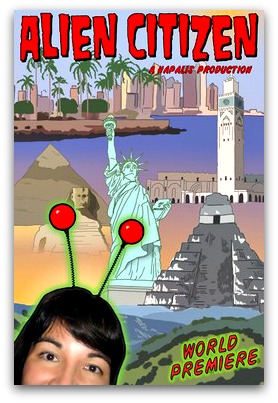
AlienCitizen_posterAt the height of my own repeat expat experience—when I had a foot in Asia (Japan), Europe (UK) and North America (United States)—I often thought of this line from Shakespeare’s King Lear:

Who is it that can tell me who I am?

—King Lear (Act I, Scene 4)

Prone to being somewhat melodramatic and hyperbolic (yes, I know I don’t have three feet!), I decided I’d peaked out too early. After all, Lear was an old man when he cast himself out and then had to grapple with what it feels like not to have a home or identity, whereas I was still a young woman.

It’s a good thing I was never a Third Culture Kid, or TCK—that’s all I can say, or else we’d be in for some MAJOR drama on this site. Instead we can leave that to someone much more suited: the actress Elizabeth Liang, who is the subject of today’s post. A self-described Guatemalan-American business brat of Chinese-Spanish-Irish-French-German-English descent, Liang was brought up by peripatetic parents in Central America, North Africa, the Middle East, and Connecticut.

Having faced the existential question of “Who are you when you’re from everywhere and nowhere?” practically from the moment of birth, Liang has channeled her thoughts into the creation of a one-woman show, Alien Citizen, which will have its world premiere in Los Angeles with performances this coming Friday and Saturday, May 3-4  (closing June 1). It’s being presented by Liang’s own company, HapaLis Productions, in association with the Multiracial Americans of Southern California.

Any TCKs reading this post (and/or their parents) should be happy to hear that Lliang’s play is not a tragedy. According to the press release, which she shared by email last night, Alien Citizen has both funny and poignant moments:

It weaves humorous stories about growing up as an Alien Citizen abroad with American commercial jingles providing [Elizabeth’s] soundtrack through first love, language confusion, culture shock, Clark Gable, and sandstorms.

Hmmm… Clark Gable?

Though Liang is busy preparing for Friday’s opening, she was kind enough to answer a couple of my questions. Naturally, I wanted to hear more about why she’d written the play and the audience she had in mind for it. Here’s what she told me:

I wrote Alien Citizen for my fellow global nomads and TCKs, because we rarely see our stories portrayed on stage or screen. I also wrote it because I kept being asked if I was from the Midwestern USA and I wanted to set the record straight: my story is unusual, and, I hope, interesting. The play is about identity, which everyone grapples with, but I especially hope that everyone who has lived a cross-cultural life—anyone who has felt like a bridge or an island or both—will relate to it.

Aha, I knew it! It’s for the likes of me as well! And probably you, too, reader, if you’re a Displaced Nation regular. We could use a little drama in our lives…

A few choice lines from the drama

I also asked Liang to share some lines from the play. She obliged with the following list:

  • “We’re Guatemalan when I’m little.”
  • “Nobody on TV looks like me…except maybe Spock on the Star Trek reruns.”
  • “Fairfield County, Connecticut. With four whole seasons, including winter! And the people are even colder than the winters.”
  • “Morocco is like the moon to us at first.”
  • “I love Egypt so much in that moment, it knocks the wind out of me. And I’m just this useless teenager from… Well, I’m not from here.”
  • “And I make friends! Because in the theatre, everybody’s weird.”
  • “I’m not from a place, I’m from people.”

I must say, I like that one about everyone in the theatre being weird. Maybe I should have tried my hand at acting after repatriating? (Except at this point I’d choose to be a Korean soap opera star—yes, I know I’m displaced!)

Show our TCK performer some love!

Readers, it’s time we showed Elizabeth some love for what she’s up to this month. If you live in the LA area, get your ticket half price through May 25th and after that at regular price.

If not, you can:

Questions for Elizabeth, calls for encores? (Should we invite her to submit a post on how the play was received?) Please leave them below. And on Friday evening LA time, let’s all shout out, from wherever we are in the world, “Break a leg, Elizabeth!”

STAY TUNED for tomorrow’s post, another installment in the life of our fictional expat heroine, Libby. (What, not keeping up with Libby? Read the first three episodes of her expat adventures.)

If you enjoyed this post, we invite you to register for The Displaced Dispatch, a round up of weekly posts from The Displaced Nation, with seasonal recipes, book giveaways and other extras. Register for The Displaced Dispatch by clicking here!

Related posts:

img: Promotional poster for world premiere of Alien Citizen

Talking to expat entrepreneur Alison McGowan about cracking the hard nut of Brazil’s tourism market

Hidden Pousatas Brazil CollageAlison McGowan is rather famous among us expats in Brazil: a foreigner who has settled here and “made it” as an entrepreneur. Her business is called Hidden Pousadas Brazil. Pousada literally means “place to land” or “place to stay”; but as McGowan explains on her About Us page, unlike in Portugal where a pousada is usually a luxury inn in a restored historical building, in Brazil the concept encompasses a much wider range of price and accommodation.

Alison has visited and vetted many of Brazil’s pousadas on behalf of Western tourists who might be overwhelmed by a country of Brazil’s size and complexity. She offers a set of well-honed marketing services to pousadas that come up to her standard, consisting of an English-language Web page on her site optimized for Google, from which they can receive direct bookings. (She will also add social media and PR for a further fee.) And she provides an English-speaking interface for those pousada owners who lack the requisite linguistic skills to attract foreign guests.

Perhaps you’ve heard of Alison’s pousada business, too? Word has traveled far and wide among the English-speaking world thanks to some choice publicity. Seth Kugal chose to include it in his write-up on Brazil for the New York Times‘s Frugal Traveler series, urging those looking to make Brazil more affordable to try

a rare English-language pousada site nicely curated by an expatriate Englishwoman, Alison McGowan.

And the intrepid Michael Palin, while he finally added Brazil to his itinerary with a four-part BBC series last year, gave a shout-out to McGowan for her “gorgeous pousada” recommendations.

Yet her accomplishment can’t have been easy. According to recent data, 40 percent of Brazilian start-up businesses do not survive for more than two years after opening due to the “excess of laws, regulations, taxes, paperwork…”

I caught up with McGowan recently on behalf of the Displaced Nation and peppered her with questions about her business success story. Any wannabe displaced entrepreneurs out there, listen up!

Olá, Alison! Tudo bem? Thanks for agreeing to be interviewed for the Displaced Nation. How long have you been working in Brazil?
I established Hidden Pousadas Brazil in 2008 but have a long history of working with and in Brazil dating back to 1979 when I was sent out to set up the first office for Oxford University Press. In 1984 I decided to return to UK but continued working with Brazil over the next 18 years before returning to the country definitively in 2002, bringing my old business in educational marketing—called Florence Associates—with me. This lasted me very well until 2008, when the increased use of broadband Internet and students booking direct with schools effectively put paid to the business model. Hidden Pousadas Brazil was a very lucky idea which came to me at just the right time. It never occurred to me to go “home” when the other business ended.

Let’s go back even further in time. What first attracted you to the country both of us now call home?
I lived in Paris for a year in the early 70s and that was where I first discovered Brazilian music, and Brazilian musicians. I fell in love with both!

What do you love most about living here?
I love the people, the attitude, the optimisim, the energy and the light.

As an Englishwoman, do you ever feel “displaced”?
I rarely feel “displaced” but had one such moment yesterday when I realized I had spent over a thousand reais paying company bills which were actually optional. My Britishness and desire to be up to date with payments had blinded me to the possibility that anyone would or could legally send an official demand for something which I actually didn’t have to pay.

Have you reached a point where you now feel more comfortable in Brazil than in Britain?
I feel totally comfortable in both countries and move easily between them, partly because I am pretty well bilingual and understand both cultures very well. People here often refer to me as a gringa carioca—basically a foreigner who is at the same time someone from Rio de Janeiro. Brazilian musician friends just introduce me to others as a fellow musician. Nationality isn’t usually mentioned.

You said that Hidden Pousadas Brazil was a “lucky idea.” Where did it come from?
I was super stressed from running a huge cello festival in Rio and asked a friend for a recommendation of somewhere to stay where I could just chill out in peace for a while. He immediately told me to go to the Pousada Santa Clara on Boipeba. I had no idea at the time where Boipeba was or indeed what a pousada was, but I went and discovered paradise—a traffic free island with endless deserted sandy beaches fringed by palm trees and a lovely, friendly pousada guesthouse to stay at. I thought if this paradise existed there must be other paradises in Brazil, and I reckoned I knew quite a lot of people who would like to be in paradise if they only knew it existed! Hidden Pousadas Brazil was born.

Was opening up your own business something you always wanted to do?
Had I not lost my rather well-paid job in the UK, I might not have started down the entrepreneurial path. That was the original stimulus. But now that I’m on my second business, I can’t imagine working for someone else again!

What’s been the biggest challenge of running your own business in Brazil?
The most challenging part is undoubtedly Brazilian bureaucracy and tax system. It is both expensive and time consuming to get it right.

The most fulfilling?
Meeting so many satisfied travelers who have been choosing pousadas and trips just using the recommendations on www.hiddenpousadasbrazil.com.

If you could do anything else, what would it be?
I can’t imagine doing anything else right now. Once Hidden Pousadas Brazil is in a mature phase and is no longer challenging, a logical step would be to move into consultancy, public speaking and training for pousada owners, but whatever I do would still have to allow me extensive travel in offbeat Brazil!

What’s on your bucket list?
Right at the moment a few pousadas on deserted beaches in Piauí, Ceará, Maranhão, and Rio Grande do Norte are beckoning; also some places near the capital city of Brasília such as Pirenópolis and São Jorge in the neighboring state of Goias, as well as in the historical cities of Minas Gerais.

It sounds as though you still have a lot to explore. Have you left Britain behind, or will you go back to live some day?
I will be here in Brazil for as long as good is good, but I still go back to the UK twice a year, and could easily run the business the other way round, living in the UK and coming over to Brazil a few times a year.

Do you have any advice for anyone else wanting to be an entrepreneur in Brazil?
I wouldn’t do it unless you speak Portuguese fluently, understand the culture, have tons of patience, considerable money and support behind you, AND see a gap in the market for that brilliant idea you are passionate about! If you’ve got all that then go for it! The rewards are enormous.

We understand you are creative in another way: as a travel writer. Do you have any books planned?
I have plans for two forthcoming books: one just entitled The Hidden Pousadas of Brazil and the other on foreign immigration and entrerpreneurship in the Amazon in early-20th century Brazil (title still to be decided).

É boa pra caramba! We look forward to featuring one day on the Displaced Nation.

* * *

Readers, I found talking to Alison McGowan quite a trip! Do you have any questions for her before she ventures off in hot pursuit of the next Brazilian paradise? You can also follow Hidden Pousadas Brazil on Twitter, like them on Facebook, and subscribe to their YouTube station, where the latest video shows Alison giving advice for anyone planning a trip to Brazil for the World Cup in 2014 (coming soon!) or the Rio Olympics in 2016. As an avid football fan myself, I have only one comment to make on Alison’s creative enterprise: Vai Brasil! O Brasil é o número um! For the purposes of today’s celebration of Alison, this football rallying cry may be translated as “Go to Brazil! It’s the number-one country!”

STAY TUNED for tomorrow’s post, about a theatrical enterprise…

If you enjoyed this post, we invite you to register for The Displaced Dispatch, a round up of weekly posts from The Displaced Nation, with seasonal recipes, book giveaways and other extras. Register for The Displaced Dispatch by clicking here!

Related posts:

Images: (Clockwise from Alison McGowan’s headshot) Pousada Araras Eco Lodge, in the northern Pantanal (home of the Hyacinth Macaw); Pousada Uacari (in the Mamirauá reserve, home of the uacari monkey); Pousada de Selva Mato Limpo (in the hills of the Serra da Mantiqueira); and Hidden Posadas Brazil logo.