The Displaced Nation

A home for international creatives

Category Archives: Pot Luck

THE DISPLACED POLL: Which of these 4 travel champions deserves an Olympic gold medal?

Hi there, folks! In keeping with our summer theme — we’ve been talking up the Olympics, in case you haven’t noticed — today I’ll be taking a look at some travely-types who have performed what can only be described as Herculean endeavors.

Which one of these travel worthies would you vote onto the gold medal podium for their efforts? Register your choice in our poll below.

1) THE SPRINTER: Gunnar Garfors

The 30-something Norwegian Gunnar Garfors (he’s a tech and new media guy as well as an avid traveler and former footballer) will never forget where he was on June 18th, 2012. Because he was in Istanbul (Asia), Casablanca (Africa), Paris (Europe), Punta Cana (North America) and Caracas (South America). Yup — all of ’em! He managed to create a new world record by visiting five different continents in one day!

Although the “day” was quite a long one, as Gunnar used the advancing dateline to squeeze a few more hours into his schedule.

It’s hard to believe that something like this is possible… I’m guessing he didn’t use Qantas for any of the flights. (Okay, that little dig was meant for Australians!)

Seriously, he makes me tired just thinking about it! Can you remember what you did on Monday? I think I got a hair cut…

Definitely an Olympian achievement.

2) THE MARATHONER: Jean Béliveau (no, not the ice hockey icon; we’re talking summer Olympics!)

Montrealer Jean Béliveau took a little longer to accomplish his feat than Gunnar Garfors — because Jean walked all the way around the word. No, really! 47,000 miles… It took him 11 years — and 53 pairs of shoes!

At 45, Jean went through a mid-life crisis with the failure of his neon sign business. In his own words:

“I played the game. It left me empty.”

Jean liked the idea of sailing around the world, but ocean-going yachts cost too much. Instead, he began to imagine running away as far as he could.  He started jogging and working out but told no one of his plans — not even his life partner, Luce Archambault. When he finally told Luce, she gave him her blessing — but insisted that he do it for a cause. Jean chose world peace and the safety of children, something no one could disagree with (at that point, he was after some peace of mind).

He began by running south, but by the time he’d reached Atlanta, his knees had started bothering him, so he switched to walking. He waked through the rest of America, Mexico, Latin America, Africa, Europe and Asia — six continents and 64 countries.

His interest in promoting peace didn’t stop him from being mugged, as well as imprisoned (the latter in Ethiopia). But he carried on and eventually even came to embrace his cause, telling people that to achieve peace, we must see the world through “eyes of love.”

It’s an achievement so staggering it begs the question: what can he possibly do next? Where do you go from there?

“Hey honey, let’s celebrate with a holiday…”

“NO! Already been there.”

Another record, of course, belongs to Luce, who has remained loyal to Jean despite his absence of 11 years from their home in Montreal and his falling for a woman in Mexico. Once a year, she would come to him and they would spend three weeks together, in one place.

Jean walked back into Montreal in October of last year. How does the couple find it being under one roof again? Rumor has it, they’re writing a book together! Talk about Olympian challenges…

3) THE PREPOSTEROUS POLYGLOT: Benny Lewis

Brendan (Benny) Lewis is a polyglot who hails from Cavan County in Ireland. (No, “polyglot” isn’t a type of glue; it’s a person who speaks four or more languages fluently.) Benny earned this title — he is also a vegetarian and a teetotaler — after nine years on the road, during which he taught himself to speak eight languages fluently (with more than a smattering of half a dozen more).

I know nothing about Benny’s musculature, but it’s clear his tongue has gotten plenty of exercise.

Benny now considers himself to be a “technomad” — a full-time technology-enabled globe-trotter. His Web site, Fluent in Three Months, is a treasure trove of tips and tricks for picking up languages (called “language hacks”), as well as a tribute to his mind-boggling achievement. (I’m actually surprised that his head hasn’t exploded from the pressure of all that knowledge.)

According to him, it is no big deal — anyone can do what he has done. All they need is dedication, hard work…and more of the same. (Times a million!)

You know, I have to hand it to Benny, he’s the very essence of — sorry, I can’t resist — a cunning linguist. (Well, I said I was sorry! Please stop throwing things at me.)

4) THE MASTER OF EXTREME ENDURANCE: Ben Hatch

The British novelist and travel writer Ben Hatch is the author of a hugely popular (and very entertaining) book about a recent adventure of his: driving 8,000 miles around Britain in a cramped Vauxhall Astra, while researching a guidebook for Frommers.

“But why is that worthy of an Olympics gold medal?” I hear you ask. “Novelists usually aren’t athletes. And he only traveled around his own neck of the woods, Britain.”

Well, there are lots of reasons I could pick: because he practically lived in his car for five months, because he purposefully inflicted dozens of tourist attractions on himself every week, because he had a car crash en route, or because he stayed in a haunted Scottish castle.

But the one I like best is the fact that he did all this with his wife and two children — aged four and two! — in tow.

Can you imagine? While the family was attempting fine dining in a posh hotel restaurant, his children engaged in food fights and eating mashed potatoes with their bare hands. There were tears and tantrums in the car — every single day. For months. It sounds like my worst nightmare! And I don’t even have kids…

The resulting trauma became his best-selling book Are We Nearly There Yet? 8,000 Misguided Miles Round Britain in a Vauxhall Astra — which I can only assume was written cathartically, in a desperate attempt to cling on to what remained of his sanity after such a grueling experience. I think he deserves a medal just for surviving the first week. And of course, once the kids are old enough to read what he’s written about them, he’ll be in for a whole new world of trouble…

* * *

Right! There’s my suggestions. What do think. folks? I just know there are loads of people out there making epic journeys, achieving the unachievable, and generally making the rest of us look like couch potatoes in comparison. Do you know of any? (Olympians, I mean, not couch potatoes — I’ve got enough of the latter in my house.) BTW, I toyed with the idea of including an older traveler, as unlike sport, there seems to be no real age limit on world travel, especially with all the recent growth in the international cruise-ship industry (see photo above).

In any event, I’d love to hear from you — let me know in the comments, or hit us up on Twitter: @DisplacedNation and/or @TonyJamesSlater

And don’t forget to vote in our poll!

STAY TUNED for Tuesday’s post on a historical traveler worthy of a gold medal or two.

If you enjoyed this post, we invite you to register for The Displaced Dispatch, a round up of weekly posts from The Displaced Nation, with seasonal recipes, book giveaways and other extras. Register for The Displaced Dispatch by clicking here!

Related posts:
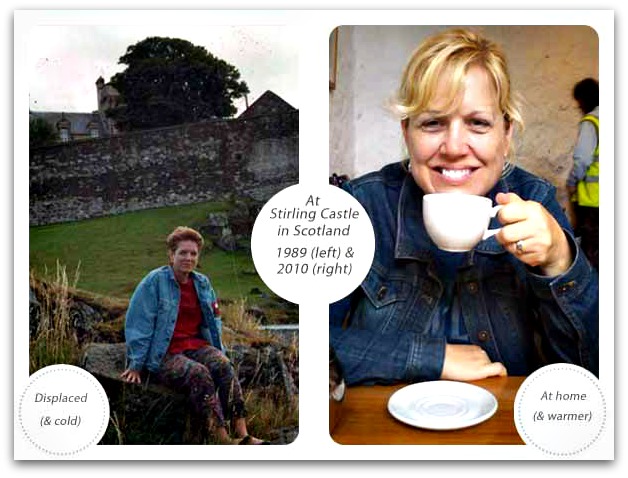
Image: MorgueFile

RANDOM NOMAD: Melissa Stoey, Former Expat in UK and Incurable Britophile

Place of birth: Northern Virginia, USA
Passports: USA
Overseas history: England (Huntingdon, Cambridgeshire + Shefford, Bedfordshire): 1988-91.
Occupation: Research technician (basically I do data analysis) and part-time professional blogger.
Cyberspace coordinates: Smitten by Britain: Home of the Britophile (blog); @SmittnbyBritain (Twitter handle); Facebook page; and Pinterest.

What made you leave your homeland in the first place?
I’m intrigued by other cultures and more specifically by the British culture. I have been fascinated by Britain since I was a young teen. I have always had the itch for travel and I knew I definitely wanted to visit the UK, if not live there. My love for travel one of the reasons I joined the military. I put England down as my first choice for duty station and I got it!

Where were you stationed?
At Chicksands air base (Chicks for shorts). It’s now Royal Air Force (RAF) Chicksands. Britain’s Ministry of Defense has since taken it over.

You ended up marrying a Brit, right?
Yes. My first husband, and the father of my son, was stationed at what was then RAF Brampton, which is in Cambridgeshire. At first we lived in Huntingdon, but then he got transferred to a base in Hitchin, which is closer to Chicks, so we moved to Shefford.

Is anyone else in your immediate family “displaced”?
Ironically, my brother was stationed at Chicks three years before, so it sort of felt like I was meant to go there. Right now, I don’t have any displaced relatives, but my son is a dual national between the U.S. and U.K. I suspect at some point he may move to the U.K. after he fulfills his dream of living and teaching in Japan for a year. We’ll see! It may be a case of like mother, like son.

So you and your son now live in the United States?
Yes. His father and I are divorced. We came back and lived in Texas for a year, then West Virginia. We now live in Pennsylvania. Meanwhile, his father has gone back to Scotland, where he is from.

How often do you return to the U.K.?
My son and I, and my second husband — I am now married to an American! — try to go every year or at least once very two years, depending on funds and time off.

Can you describe the moment in your association with Britain when you felt the most displaced?
The first night I was in England the culture shock was horrible. I lived around sixty miles north of London in a small village where there were no street lights, and when I looked out the window there was complete and utter darkness. It felt as if I’d landed on a different planet with no signs of life. This was 1988 when almost everything closed much earlier than it does now and wasn’t open on Sundays. If you switched on the radio you might pick up two or three stations, the television had only four channels and of course there was no Internet. It felt much more isolating than if you moved to England today; it has changed by leaps and bounds in the last 25 years as far as conveniences go. I envy current expats who have so many wonderful resources available to help limit the culture shock and make the transition easier.

Is there any particular moment that stands out as your “least displaced”?
We had a great night back in July of 2010 when we met a Glaswegian couple at a curry house in the west end of Glasgow. They invited us to the pub for drinks where we spent the night taste testing different whiskies. I felt totally at home, like I had known this couple my whole life. The Scots have a way — similar to Americans — of making one feel welcomed and accepted. I can say this because of having once been married to a Scot and having spent a lot of time there. My ex-husband was, and still is, one of the friendliest people I know.

You may bring one curiosity you’ve collected from your adopted country into The Displaced Nation. What’s in your suitcase?
My bag is always full of tea and sweets from England. I never return without them. I always pack a few British newspapers as well because my parents are Anglophiles, have been to England many times and enjoy reading them. Rumor has it that some of you Displaced Nation citizens are avid tea drinkers and readers, and that you rarely turn down sweets.

You are invited to prepare one meal based on your travels for other members of The Displaced Nation. What’s on your menu?

I will fix my favorite meal which is a nice Sunday roast that includes roast beef, roasted potatoes, carrots, peas, and Yorkshire pudding (I don’t do sprouts, thank you.) We’ll finish it off with a nice pot of tea and a slice of Victoria sponge, with jam and whipped cream.

And now you may add a word or expression from each of the countries where you’ve lived to The Displaced Nation argot. What will you loan us?
I’m feeling peckish. I say that quite often and it always results in the odd look or two. It’s just not used here, at least where I live. To feel “peckish” means to feel slightly hungry.

Earlier this month, we did a series of posts on Queen Elizabeth’s Diamond Jubilee. Incurable Britophile that you are, I presume you celebrated from a distance?
I watched the River Pageant, which was on early in the morning East Coast time, and then hosted my own Diamond Jubilee lunch (see photos on my blog). The food was great — we nibbled on leftovers for days! Even though I didn’t have a big party (it was just for my family), I was glad to do it to show my blog readers that you don’t have to be in Britain to celebrate properly. You can still enjoy yourself and take part in your own little way.

A couple of us on The Displaced Nation team thinks that the Queen deserves an Olympic medal for having survived almost being displaced by Princess Diana. Do you agree?
I don’t agree that the Queen was almost displaced by Diana; if she was going to be displaced it would have been due to her actions (or lack of) that left the British public feeling as if she was heartless and out of touch. However, I still don’t think she would have been displaced. Time heals and I think many of us now understand the dilemma she faced as a grandmother trying to protect her grandchildren who just lost their mother. However, as Head of State I do wish she had at least made a televised message to the public within the first 24 hours. Waiting five days was a bit much.

Americans seem to love the Royal Family. Do you think the United States might benefit from having one?
The idea of the United States having a royal family at this point is a silly one. It doesn’t fit our history or where we are headed as a country. Let’s leave that to the nation that does Monarchy the best.

Readers — yay or nay for letting Melissa Stoey into The Displaced Nation? Tell us your reasons. (Note: It’s fine to vote “nay” as long as you couch your reasoning in terms we all — including Melissa — find amusing!)

STAY TUNED for tomorrow’s episode in Libby’s Life, our fictional expat series set in small town New England. (What, not keeping up with Libby? Read the first three episodes of her expat adventures and/or check out “Who’s Who in Libby’s Life.”)

If you enjoyed this post, we invite you to register for The Displaced Dispatch, a round up of weekly posts from The Displaced Nation, with seasonal recipes, book giveaways and other extras. Register for The Displaced Dispatch by clicking here!

Related posts:
img: Melissa Stoey at Stirling Castle, Scotland, then and now — in 1989, when she was displaced (and cold!), and in 2010, when she was visiting (and warmer!).

TRAVEL YARN: A second date with Rome

Kym Hamer, an Australian expat in London, joins us today as guest blogger to share her version of a Roman Holiday — one of several trips she has made since having the continent of Europe and all of its history on her doorstep. Notably, for Kym, Rome doesn’t need Gregory Peck to be irresistible!

After 12 years away, I recently went back to Rome.

My only previous dalliance with the Eternal City was part of a “12 cities in 20 days” type tour that at the time, seemed to be the best option for getting a taste of Europe in the three weeks of holiday I had available from my job in Australia. You see, when you’re coming from the other side of the world, the flights are long and expensive, so there needs to be a pretty high rate of return for the time and money invested.

It was an amazing holiday. I visited a whole range of places — some hotly anticipated, some moving me unexpectedly, some not quite what I had hoped for. Each got 1-2 days with an experienced tour guide who made the queues disappear, added humour to the gruelling schedule and brought each city to life with her own blend of historic narrative and personal storytelling.

But each stop allowed no more than a brief and flirtatious encounter, the faint ripples disappearing almost as quickly as they were made by the time I’d left. Each major European city, Rome included, made its impression but was quickly over-run by the next.

Living the dream in London

When I moved to London from Melbourne more than eight years ago, it was the third time I travelled to the UK’s capital in four years. The first time I had been drawn for a week and the second time for four days — both times before a longer “whistlestop” tour of the sort just described. And on both of these visits, I split my time between “tourist” and “traveller,” between the seeing what I wanted to see and the aimless wandering: immersing myself in the city streets, using the local transport and chatting with the natives. One way and another, I got the true taste of the city that was to become my home just a few years later.

I love history and I’ve read it — beginning in the guise of historical fiction (by the likes of Jean Plaidy) through to Simon Schama, Alison Weir and several others — since my very early teens, always trying to imagine what those real worlds, leaping off the pages in front of me, were actually like.

Once I’d moved to London, suddenly I felt I was living the dream (albeit one never particularly aligned to that city). I still stand on Waterloo Bridge at night, gazing at all that history along the riverbank reflected in the Thames, pinching myself and wondering: “Wow, how did I get here?”

Was it a love of history that had tempted me across the world? Not really…there were other candidate cities, but the “right” circumstances conspired with a passionate fling to bring me here. And just as you never know where things might lead in life, the fling came and went, yet London had captured my heart.

The grass still looks green(er)

But my yen to explore means there’s always a sense of looking over the fence (so to speak) with curiosity. What’s it like over there? Would I like it? Be disappointed or even worse, nonplussed?

Which leads me to Rome and some of the other cities I’ve visited since living in London. Being able to hop on a plane (or train — the Eurostar is a pretty fabulous way to travel) and, in just a couple of hours, walk the historic cobbled laneways of a completely different place is an extraordinary experience for any Antipodean. Only a few short hours is required to separate oneself from the familiar and the habitual.

European travel has an especially strong hold on my bucket list. For the most part, Australia’s history is both inextricably linked to and considerably newer than anywhere on the Continent, even though some of the names and boundaries may have changed since I first learned of these faraway lands in the schoolroom.

Of course, nothing can ever take you back in time to know truly what it was like standing at The Green at the Tower of London or inside Newgrange passage tomb in Ireland’s Boyne Valley or atop Hadrian’s Mausoleum — now known as Castel Sant’Angelo — in Rome.

But in the Eternal City, there’s a deep sense of generations past, not just battles won and lost and the rise and fall of the empires that at one time or another shaped “the world” — but also everyday trifles, evidence of the “day-to-day” living of previous generations (take, for instance, Trajan’s market, the “shopping” centre where people went to buy their fresh produce). Both strands of history — the extraordinary and the quotidian — are accessible and visible everywhere.

Second-date nerves

There’s always a part of me that feels a little nervous when I first arrive somewhere new — a piece of me that says, “You could stay in the hotel room tonight, read your guidebook a bit more and be really sure when you set out tomorrow morning.” And it takes some mustering of courage to stop dawdling and plunge right in.

I’m always glad, invigorated actually, once I set off but I guess that essential human-ness in us wants to avoid the risks and keep ourselves safe and sound.

The Rome I had encountered on our first date, before moving to London, had grown faint and unfamiliar. But on this second Roman Holiday, I surprised myself by diving right in to its sights, sounds and smells. I was out the door just an hour after checking in to my hotel. Not for me the lolling about to “recover” from my travels. No way. I had only four days and I wanted to fill it with…well, Rome. It was an immersive experience I was after.

So I walked down from Quirinale in the darkening streets as night fell, map in one hand, camera in the other, my eyes filled with wonder and excitement. A stranger in the night if you will: with no local knowledge, limited lingo (si and grazie get you only so far) and quite frankly no idea where I was going. Tingling and a little breathless with the thrill of discovery somehow I found my way through the warren of streets to the Fontana di Trevi.

And the four days flew by. I walked and bus-sed and walked and Metro-ed and walked and cruised and walked some more. Compact and exuberant, Rome spreads its charm around every corner. The noise and busy-ness were energising although the traffic in some of the piazzas less so.

(I always imagined piazzas to be intimate and bustling, even green, rather than spacious, concrete or filled with litter. So the Piazza Navona and Campo de’ Fiori — the latter translates into “field of flowers” — were amongst the few “oh, is that it?” moments.)

A piece of my heart

From my coin toss into the Trevi on that first night to my final morning meandering in the warm rain through the gardens of the Villa Borghese, my second encounter with Rome has moved us beyond the acknowledgement of two passing strangers. But while we are not yet close friends, there’s a piece of my heart that’s indelibly stamped with a sense of delightful possibility.

Will I return to the Italian capital for a gentle kiss, for one more embrace perhaps? I don’t know but it’s exciting, exhilarating, a little self-conscious and filled with promise.

Just like Rome.

Born and raised in Melbourne, Kym Hamer has worked in London in sales and marketing for the past eight-and-a-half years. She writes the popular blog Gidday from the UK. Also follow Kym on Twitter: @giddayfromtheuk.

STAY TUNED for tomorrow’s Random Nomad interview with an American who has taken the “phile” in Anglophile to an extreme.

If you enjoyed this post, we invite you to register for The Displaced Dispatch, a round up of weekly posts from The Displaced Nation, with seasonal recipes, book giveaways and other extras. Register for The Displaced Dispatch by clicking here!

Related posts:

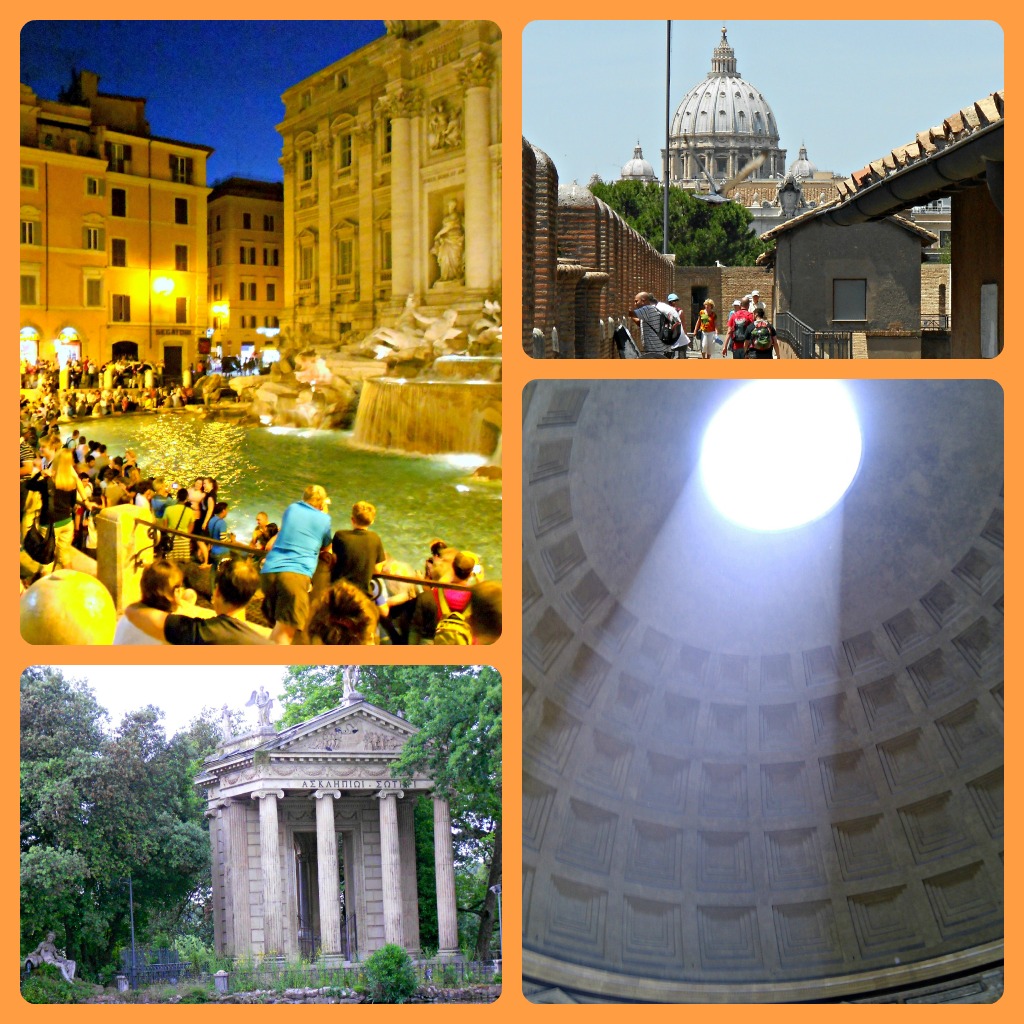
Images: Some enchanted moments from Kym’s second date with Rome. Clockwise from top left: Off peak at the Trevi Fountain (“busy, yes, but somehow still magical”); the Vatican from the battements of the Castel Sant’Angelo; sunlight pouring into the Pantheon; the Giardino del Lago at the Villa Borghese.

THE DISPLACED POLL: Who will win the Ladies’ Grunt Championship at Wimbledon?

Ah, the start of Wimbledon Fortnight. Two weeks of tennis whites, polite applause, Royalty, and strawberries and cream.

And grunts. Don’t forget the grunts. Especially the ladies’ grunts.

If some of the newspapers this week are to believed, that’s what modern tennis is all about.

The history of the grunt

Men’s tennis grunts started back in the 1970s with Jimmy Connors, and the popularity soon spread among the guys. In the 1988 US Open, Ivan Lendl complained about opponent Andre Agassi‘s grunts, saying they threw him, Lendl, off his timing.

Women’s tennis took a little longer to catch on, starting with Monica Seles‘s guttural shrieks in the 1990s. Once started, though, the women soon raised grunting to an art form, or at least another sport, putting the men’s feeble efforts to shame.

Serve in silence

Fans and media, however, are not amused by Centre Court’s soundtrack, and Martina Navratilova, a champion when women’s tennis was played in dignified silence, also disapproves. Her view is that the grunt masks the sound of the ball leaving the grunter’s racquet, putting the non-grunting opponent at a disadvantage.

“The grunting has reached an unacceptable level. It is cheating, pure and simple. It is time for something to be done.”

World Tennis Association chairman and chief executive, Stacey Allaster, agrees:

“It’s time for us to drive excessive grunting out of the game for future generations.”

Quite how this will be achieved, though, is rather vague. A fine for noisy players. perhaps? It would have to be a big one to have any effect. Michelle Larcher de Brito, the Portuguese player, and rumoured to be the next Maria Sharapova as far as grunt volume goes, reportedly said:

 “I’d rather get fined than lose a match because I had to stop grunting.”

The WTA is quick to point out that current players will not have to curb their on-court vocal emissions. The ban on grunts will be phased in after a period of educating up-and-coming players in grunt etiquette.

In the mean time, however, perhaps the solution would be to make Grunting an official Olympic sport, permissible only at Olympics (i.e. every four years) and not at Grand Slam tournaments.

With grunt decibel readings at similar levels to pneumatic drills, that would be music to everyone’s ears.

Judge for yourself:

Serena Williams and Victoria Azarenka

Maria Sharapova – Russia

And vote for the Gold Medal Winner in our poll!

Image: MorgueFile

Which country produces the people who travel the farthest, the longest — and with the most credit cards?

The Displaced Nation was contacted about doing a post on a recent survey by Travelex on “How the World Vacations” — the results of which are summed up in a cool infographic (see bottom of this post).

Since Travelex helps travelers with their foreign currency needs, they were particularly interested in finding out not only where people are traveling internationally but also how they are financing their vacations.

I thought I’d go over some of their findings and see if it helps me to understand this Big Wide World of Travel.

Really? Did I? Or did I do something altogether more irresponsible, and just pull it apart for my own amusement? Well, you all know me by now. You decide…

What’s up with international travel?

More people are doing it now than ever before. Even in the most parochial parts of England, folk are pulling the ferrets out of their trousers, staring at glossy magazine adverts and dreaming of something more glamorous than a weekend caravanning in Skegness.

Rumor has it that almost ten percent of Americans now own a passport; even more significantly, some of them have actually used them!

Yes, travel beyond one’s borders is growing — but so is the human race. So it’s only to be expected, right? (The numbers of people going abroad did decline, however, in 2008 due to the global recession, but in 2009 the upwards trend resumed.)

And now for some stereotype-busting!?

I’m not sure how much the survey tells us that we didn’t already know, to be honest — but I’m willing to be persuaded otherwise, if one of you is a better statistician than I am.

Where do the Brits go on holiday? Hmm. Tough one.

If you guessed Spain, you can give yourself a pat on the back. It is Spain. For two weeks. The survey doesn’t tell us this, but most of them spend the entire fortnight lying lobster-red on the beach before heading for the nearest bar. Had the survey asked what they ate, the finding would have been 85 percent fish and chips, of which most would have been washed down with beer — the local variety of course, because it’s so staggeringly cheap.

The destination that comes in second for the Brits? Right again! France. The main surprise is how few are going to the United States nowadays: just nine percent (versus over fifty percent to Spain and France).

The Americans? They head to Mexico and Canada. Goodness, that’s a revelation! And if they venture any further, it’s usually to Europe, especially the UK and Italy, or to the Caribbean. That said, there are a few brave American souls visiting China these days.

The survey doesn’t report this, but most Americans when they go abroad eat burgers and fries, even when sitting in an Italian restaurant. They drink beer, too — but the good stuff, because it’s still cheap, and imported, which makes everything taste better!

Noticed any Chinese tourists lately?

Thanks to its booming economy, China gets pride of place in this survey. (The Japanese used to be the most well-traveled of all Asians, but I’m afraid they’ve been displaced!)

Interestingly, the 1.3 billion Chinese are represented by a sample of 20,000; anyway, for most of them the average length of holiday is six days. Perhaps it’s not surprising, then, that they end up going to Hong Kong — which I’m not sure counts as foreign these days. (Didn’t my country transfer sovereignty to China in 1997, or have I misremembered something?)

Chinese mostly use credit cards to pay their way, despite almost a third of those being refused. Which is a shame, though I can’t say it surprises me. Would you take a Chinese credit card? Be honest.

And a surprising number, about a third, travel by boat. Still trying to puzzle that one out, given how short their vacations are. Fear of flying, perhaps? I’ve heard some nightmare stories about China Airlines.

How about Brazilians?

Another booming emerging economy is Brazil, which is the fourth country to be featured in a big way in the survey. Guess where most Brazilians go? You got it, their wealthy neighbor to the North, the United States!

But what I’d really like to know is whether the five percent of Brazilians who had their bank cards stolen were the same ones that said they traveled by rail — in which case, it serves ’em right. Everyone knows that if you take a train in Brazil, you get robbed — it’s, like, common knowledge.

International holiday central

Australia, my adopted and much beloved homeland, makes a brief appearance in the statistics for “how long they stay.” We’re at the top of the charts. Did you know that Aussies having the longest holidays IN THE WORLD, by almost a week?

The survey doesn’t tell you how often we go abroad and where we go, however.  Because if you knew that every man, woman, child and most of the sheep here take a foreign holiday every single year — and that the vast majority spend it in Bali — you’d have perished of jealousy by now (or else looking into emigrating!).

As it is, I’m worried that if the Chinese see that Aussie vacations are almost three times longer than theirs, it will trigger a revolt, for which Australia will somehow be blamed! 🙂

Herzlichen Glückwunsch!

In their write-up of the survey findings, Travelex said:

We were surprised to find that the most consistent destination for international travel seems to be Germany. That’s right! Germany. We guess lederhosen and lagers hold a certain amount of appeal no matter what native language you speak.

It’s a fair point — who’da thunk it? Even the Chinese went to Germany. Well, 1.9 percent of them did. (Which, out of the 20,000 vacationers surveyed, means at least 382 out of a country of 1.3 billion.) Germany must be thrilled at this news of its new-found popularity across cultures.

I suppose another surprising finding is that while Chinese are busy having their credit cards turned down, Brits tend to err on the side of caution, doing their money exchanges before they leave, while many Americans are still getting away with using dollars — despite the recent talk of abandoning the U.S. dollar as the single major reserve currency.

* * *

It’s often said that statistics can be made to say whatever you want them to say. And then of course, there’s the old truism that 97.6 percent of statistics are made up on the spot…

Not that I’m saying Travelex did any of this, of course. Far be it from me to cast aspersions on their information-gathering tactics. I’m just wondering if something like this can tell us much. Still, it’s a pretty infographic — the designer of which has certainly earned a vacation overseas, in my opinion!

Please talk to me in the comments. Are you into travel surveys? Have I missed something earthshaking in this one? Am I being too flippant? I’d love to know your thoughts!

Additionally, you can hit us up on Twitter: @DisplacedNation and/or @TonyJamesSlater

And now for that fabuloso infographic:

STAY TUNED for Tuesday’s post reviewing some books by expats in Dubai.

If you enjoyed this post, we invite you to register for The Displaced Dispatch, a round up of weekly posts from The Displaced Nation, with seasonal recipes, book giveaways and other extras. Register for The Displaced Dispatch by clicking here!

Related posts:
Infographic courtesy of Adria Saracino, Distilled Creative.

RANDOM NOMAD: Lynne Murphy, American Expat in UK & Champion Linguist

Place of birth: Western New York State, USA
Passports: USA + UK
Overseas history: South Africa (Johannesburg): 1993-97; Texas, USA (Waco): 1997-99 — definitely a different country!; England, UK (Brighton): 2000 – present.
Occupation: Senior Lecturer in Linguistics, University of Sussex
Cyberspace coordinates: Separated by a Common Language — observations on British and American English by an American linguist in the UK (blog); @LynneGuist (Twitter handle).

What made you leave your homeland in the first place?
What made me move were jobs. I am a theoretical lexicologist. Not many places want a theoretical lexicologist, so I applied far and wide and have been rewarded with some very interesting jobs and living experiences.

Is anyone else in your immediate family “displaced”?
I was the first person in my immediate family-of-birth to own a passport.

Can you describe the moment when you felt the most displaced?
The night after the American student Amy Biehl was killed in South Africa, in August 1993. At that point, I lived in a granny flat — an outbuilding behind a house in a Johannesburg suburb. I came home to find my neighbours in the main house packing up and leaving for a safe place to stay, as they’d been robbed during the day. As they left, they told me the thieves had taken the spare keys to my flat — and had already come back to steal the bicycles from the garage. At that point, I had no car, no telephone (setting one up there took FOREVER), nowhere to go and no way to get there. I stayed up all night with the lights on and with a newspaper with the story of Biehl’s murder on the front page, feeling very alone and very scared.

Is there any particular moment that stands out as your “least displaced”?
Sometimes it’s funny to reflect on the fact that my own child speaks with an English accent, and I feel most absolutely at home with her. But I also often feel really divorced from the US when I read the news. When the hullabaloo about “Obamacare” was going on, I just couldn’t believe that I came from a place where many people seem not to see good medical care as a basic right for all. And it especially galled when I saw some Americans spreading lies about how British healthcare works and others willing to believe those lies. The National Health Service isn’t perfect, but it has saved my life, and I have more confidence in its care for me than I had in the insurance-industry-driven care I had in the US.

You may bring one curiosity you’ve collected from your adopted country into The Displaced Nation. What’s in your suitcase?
From South Africa: It’s the art that’s lasted! Two pieces by Ezekiel Madiba, a print and one of his printing blocks — which is nice because it’s sturdy enough to put in a suitcase and to hug every once in a while.
From Texas: My doctor’s instructions on what to do the next time I’m stung by a fire ant (to try to avoid being bed-ridden for a week, like the first time).
From England: My wedding ring. It’s a one-off, made by a Brighton goldsmith, and it’s a curiosity, because I hadn’t thought I was the marrying type.

You are invited to prepare one meal based on your travels for other members of The Displaced Nation. What’s on your menu?

Starter/Appetizer: South African biltong. A nice peppery one—but I don’t mind if it’s beef or game. Maybe a selection.
Main course: For this, I’ll bring together the British and the American — not fancy but delicious. I haven’t given it a name, but here’s the recipe: Toast crumpets. cover with cheddar cheese and put under the broiler/grill. Slather on A1 Steak Sauce. Eat with knife and fork.
Dessert: Eton mess with raspberries instead of strawberries.
Drinks: South African wine (I never had a South African wine I didn’t like while I was in South Africa– the exported stuff is of more variable quality, in my experience); Castle Lager (a South African beer); and Schweppes Bitter Lemon (a popular soft drink in South Africa, no longer being produced in this part of the world as far as I know).

And now you may add a word or expression from each of the countries where you’ve lived to The Displaced Nation argot. What will you loan us?
From South Africa: Putting hey? on the ends of sentences. It was so easy to start doing, since I’d grown up using the “Canadian” eh? (Though I hadn’t realized I said it till I moved from upstate New York to Massachusetts, where they don’t say it.) It’s been a while since I lived in South Africa, but I still find myself doing it.
From the UK: There are so many great expressions, but the thing that’s invaded my language most is lovely. When I write emails, I have to go back at the end and take out half of the lovelies because I say it so terrifically much.

This month we have been doing some posts on Queen Elizabeth’s Diamond Jubilee. How did you spend the Bank Holiday weekend? Did you celebrate?
We’re not much into the monarchy in my house, so we just enjoyed the extra time off. But we did go to a friend’s house and eat red-white-and-blue cupcakes — which we should probably have called “fairy cakes” if we wanted to take the whole Rule Britannia thing seriously.

A couple of us on The Displaced Nation team thinks that the Queen deserves an Olympic medal for being on the throne for so long. Do you agree?
I respect the queen for handling many awkward situations with grace, but all she has done to be on the throne so long is not die yet. She got a national holiday for the occasion—I think that’s sufficient!

Readers — yay or nay for letting Lynne Murphy into The Displaced Nation? Tell us your reasons. (Note: It’s fine to vote “nay” as long as you couch your reasoning in terms we all — including Lynne — find amusing!)

STAY TUNED for tomorrow’s episode in Libby’s Life, our fictional expat series set in small town New England. (What, not keeping up with Libby? Read the first three episodes of her expat adventures and/or check out “Who’s Who in Libby’s Life.”)

If you enjoyed this post, we invite you to register for The Displaced Dispatch, a round up of weekly posts from The Displaced Nation, with seasonal recipes, book giveaways and other extras. Register for The Displaced Dispatch by clicking here!

Related posts:
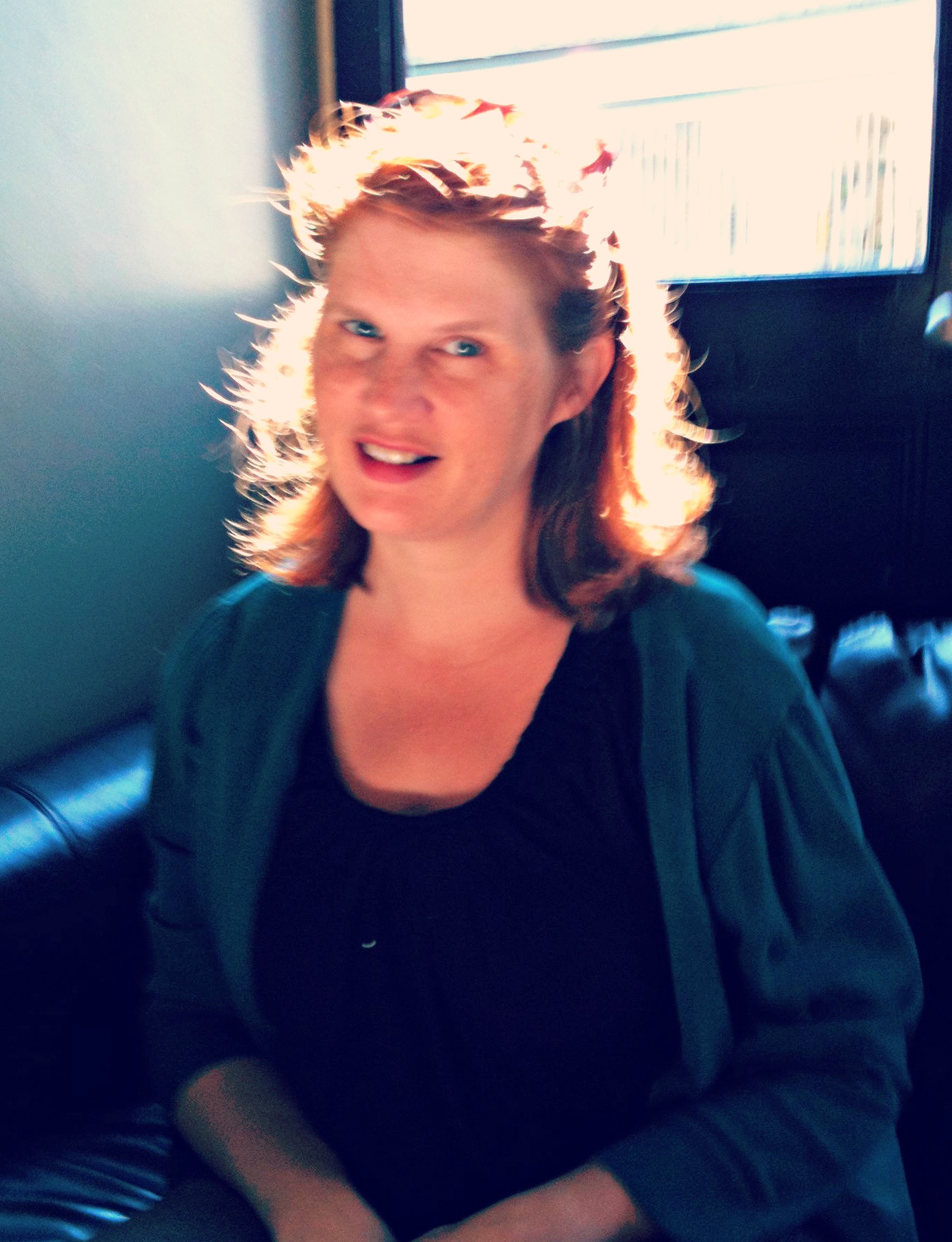
img: Lynne Murphy looking rather other-worldly — or  “out of this displaced world,” as we like to say — in a Brighton pub.

A marathon reign of Olympic proportions: Queen Elizabeth II’s Diamond Jubilee

Regardless of where you were in the world at the weekend, you were most likely aware of a little party going on in Britain, to celebrate one woman’s six decades as Queen.

Queen Elizabeth II is only the second monarch of Great Britain to have reigned sixty years, the first being Queen Victoria, who was on the throne for 63 years and 7 months. Given the Royal Family’s record of longevity — the Queen Mother was 101 when she died in 2002 —  Victoria’s record could well be beaten in 2016, and Brits shouldn’t rush to chuck away the flags and bunting. They’ll probably need them in another ten years’ time for Britain’s first Platinum Jubilee.

Sixty years is a long time for anyone to be in one job, particularly when you didn’t get much say in your nomination for it. And, OK, while republican sympathizers might think a carriage clock for the mantlepiece at Buckingham Palace would be adequate recognition, millions of Brits this weekend seemed very happy to foot their share of the bill for the extravagant national celebrations.

A job for life

Most people would have quit that job long ago. The Queen, however, is made of sterner stuff, and her determination to see the job through to the end — quite literally — means, inevitably, she has seen huge changes during her reign.

Not least of these is the issue of how she came to be Queen in the first place. Forced to choose between being King and marrying divorcee Wallis Simpson, Edward VIII abdicated the crown to be with the love of his life, and in doing so made his younger brother King, and his niece Elizabeth first in line to the throne. To have a monarch married to a divorcee went against the teachings of the Church of England, of which the British monarch is Supreme Governor.

Ironic, then, that three of Queen Elizabeth’s four children have divorced, including, of course, the Prince of Wales, Britain’s next King. They all divorced or separated in 1992, the year referred to by the Queen as her “annus horribilis”.

The monarchy survived this crisis with its usual show of stalwartness and stiff upper lip, only to be hit, five years later, by a much bigger crisis — the greatest since the abdication of the Queen’s uncle in 1936.

Making a rod for one’s own back

After the sudden death of Diana, Princess of Wales, the Queen again employed a stiff upper lip in her “business as usual” approach to the tragedy, but drastically underestimated the intensity of the public’s grief at the death of her ex-daughter-in-law. The public perceived the Queen as cold and uncaring when she stayed in Scotland in Balmoral Castle while insisting on adhering to Royal  protocol by not having the flag at Buckingham Palace flying at half mast.

In an article in The Telegraph, Mary Francis, a former advisor of the Queen,  said that at the time she “feared that republican MPs would call for a end to the monarchy because of public anger at the Royal Family’s initial reaction to the death of Diana.”

In the Radio 4 documentary, “A Royal Recovery”, Mrs. Francis said:

I do remember walking into Buckingham Palace the first morning I was back. Although there were so many people around, it was very quiet. It was a threatening and rather unpleasant atmosphere.

Rising from the ashes

Incredible, then, fifteen years later, to watch the enthusiastic crowds in London at the weekend as 1,000 boats sailed up the River Thames in the largest pageant on the Thames since the reign of Charles II, 350 years ago. It was as if the Diana crisis had never happened. Or maybe it was something more – an acknowledgement, admiration, of this woman’s unswerving devotion to duty.

As my Australian friend, Kym, said to me yesterday:

“Regardless of what you think of the monarchy, it’s an amazing testament to a woman who has been in ‘the job’ for 60 years.”

Indeed. Sixty years is, in terms of Olympian feats, a marathon; one which deserves a crowd to cheer on the runner.

Our theme for summer: Olympian Feats

It’s fitting, therefore, that the Jubilee’s acknowledgement of stamina and determination should come at the time of another event when these qualities are essential:  the 2012 Summer Olympics in London.

Because of this, we have decided to revolve our summer posts around an Olympic theme — not necessarily the sports themselves, but more about the qualities required of an Olympic athlete, or a long-reigning monarch.

As we are more armchair sportsmen, however — and it is Wimbledon very soon, of course, which takes up an awful lot of armchair time —  we will be taking a break ourselves, by cutting our posts down to four per week rather than the usual five. Nevertheless, you can look forward to two new series starting this month — “Chance Encounters” and “You CAN Go Home Again” as well as the familiar Random Nomads, Displaced Qs, questions for Mary-Sue, book reviews, and bulletins from Libby in Woodhaven.


If you enjoyed this post, we invite you to subscribe for email delivery of The Displaced Dispatch, a round up of the week’s posts from The Displaced Nation. Sign up for The Displaced Dispatch by clicking here!

Living La Dolce Vita with Heather Hamilton — Writer, Sailor & Adventurer

One year ago almost to the day, Heather Hamilton and her husband cast off their docklines in Annapolis, Maryland, in their 40-foot ketch. Since then, they’ve covered over 3,500 miles, up the east coast of the U.S. and down through the Caribbean island chain. Life on the open seas with nary a care in the world — sounds like La Dolce Vita, doesn’t it? I asked Hamilton to share the sensory highlights of her nautical adventures, along with a few “sweet life” tips for confirmed landlubbers.

Most heart-stopping sights

On the terrifyingly heart-stopping end of the spectrum: the sight of my mizzen-mast rocking back and forth (definitely something you don’t want) while the boat lurched in 12-foot seas and 45-knot winds. It nearly caused a heart attack. It was our first coastal offshore passage, and we were already sleep deprived and exhausted by the time the storm blew up overnight. We hove-to — that is, basically set the sails so that the boat could kind of “park” and wait out the blow. Pip was below, trying to get some rest, when I noticed that the mizzen sail just kept getting looser and looser, despite my many attempts to tighten it. Then I noticed the mast moving. PANIC!

Turns out, we had just had the rigging replaced, and during the big storm the new rig decided to undergo its initial stretching. The loosening of the stays had allowed the chocks to fall out of the mast’s base.

Despite the howling wind and lurching seas, Pip was able to tighten the rig and replace the chocks — only to discover that the pounding into the waves had splintered the bowsprit platform. After hours of work, we had finally secured the boat. We collapsed in a heap for some rest.

On the heart-stoppingly beautiful side of the spectrum: the hundreds of dolphins that danced around us on our trip down the Chesapeake Bay from Annapolis to Norfolk, Virginia. Despite having spent my childhood sailing with my dad in California and having sailed for five years on the Chesapeake, I’d never seen dolphins in the wild. On this particular day, I saw more than I’ve ever seen since: the pod stretched literally further than the eye could see. We radioed a sailing buddy who was two miles ahead of us and he was also surrounded. They played in our bow wave and did acrobatic flips around the boat — but the most astounding thing was their sheer numbers. Hundreds is probably an understatement; there may well have been a thousand dolphins frolicking around us. It was magic.

Most intoxicating scent

Ganja. It’s ever-present in many of the Caribbean islands, and its characteristic skunky smell is nothing if not intoxicating. Local youths and gnarled old rastas alike lounge around the town square smoking their joints; in certain places you get the impression that half the population is stoned. Boat vendors — the men who approach your boat in an anchorage to help you anchor, sell you fish/fruit/veggies, do your laundry, or otherwise do just about anything you will pay them for (uh, no thanks…) — seem particularly fond of weed, often puffing away as they row their boats along.

As we entered a bay in St. Vincent, one particularly ill-mannered vendor shouted at me for declining his services. He sported a spliff literally the size of a stogie, leading Pip to dub him “Stoner Churchill.” His aggression was surprising. Given the amount of weed he’d clearly ingested, one would have expected a much mellower response!

Dreamiest sounds

When I was at home, I had a fancy-schmancy alarm clock that allowed you to fall asleep or awaken to different sounds, like a Zen bell or running water. My two favorites to listen to while falling asleep were the ocean waves and the frogs. Who doesn’t love to fall asleep to the sound of surf? And the sound of the frogs reminded me of the few weeks every spring when the spring peepers went wild in the remote Appalachian area where I grew up.

One night, when we were moored in the national park in St. John, U.S. Virgin Islands, I fell asleep in the cockpit to these two sounds playing in harmony: the real surf gently breaking on the rocks only a hundred yards from the boat, and the nighttime frogs’ chorus providing the treble counterpoint. Heaven.

Most delicate flavors

Tree-ripened mango in Dominica — actually, the taste itself is nowhere near delicate, but I enjoyed the subtle distinctions between the different kinds of mango the island has. We arrived in Dominica in mid-April, just as these tropical fruits were coming into season. Everywhere you looked, sticky children and adults were peeling mangoes and gnawing the flesh off the seed as they walked down the street, chilled on their porches, or waited for the bus. Mangoes rolled in the gutters, where they became treats for street dogs and chickens. Since mango trees are everywhere, it’s simple to pick up a long stick and knock down a few ripe ones anytime you get the craving.

One day, we hiked several miles to the top of a hill where we were greeted by the sight of a stunningly beautiful little farm nestled in the jungle. There were coconut palms, banana trees, taro and sweet potato plants cascading down the steep hills. The farm’s owner, Ti-Babe, was a gnarled old man with approximately six remaining teeth and the warmest smile and eyes you can imagine. Ti-Babe answered all of our questions about his farm before insisting that he load us up with mangoes, peeling open both the large and small mangoes he grew so that we could taste the difference between the two. (The smaller mango had an amazing flavor, with a little sour to balance the sickly sweetness characteristic of a really ripe mango, but was very fibrous.) We sucked on mangoes the whole way back, arriving back at the boat exhausted, sticky and sated.


Softest physical sensations

The feel of the current across my skin while floating along snorkeling in perfectly clear turquoise waters, bright tropical fish flitting underneath in the dappled sunlight. (Pretty much every other physical sensation on a cruising sailboat is intense, painful, or just uncomfortable!)

Most interesting unexpected encounter with a stranger

The other day, I talked the owner of a local beach bar in Bequia, the largest island in the Grenadines, into allowing me to write an article about how she makes her roti, which are a flat bread wrapped around curried fillings, a kind of West Indian burrito. I’d heard that her roti were excellent, but was most intrigued as other sailors had cautioned me that she took a long time to make them — mixing and rolling out the tortilla-like dough for each order rather than making several in a batch. We’d chatted with Ruthie briefly at the bar the day before, when her eight-year old son proudly served us our beers. Her wicked sense of humor promised a fun afternoon in the kitchen.

Ruthie chopped ingredients for the fillings and then walked me through the labor-intensive process of creating the dough, which involves folding cooked, mashed yellow split peas into a flour dough and then rolling it out carefully. While the dough rested, she demonstrated how to make the fillings — both the vegetarian (black-eyed pea/pumpkin) and fish kind, both of which are strongly flavored with Trinidadian curry powder, which is milder and sweeter than the spices used for Indian curries in the States.

As Pip and I tucked into the final, delicious product, we invited Ruthie to sit with us and chat — and that’s when the real fun started. She regaled us with stories of island life, including a side-splitting story about a gay dog she once had. We talked about life and politics and travel, laughing the afternoon away over beers and her delicious food. It was the first serious conversation I’ve had with a local that lasted more than ten minutes, and I know that when we return to Bequia in the future, I’ll seek out Ruthie right away to catch up and continue building our friendship.

The place that stimulates all five senses

Because my life is constant travel, my boat is that place. Living on a voyaging sailboat means that your senses are constantly being stimulated — and not always in pleasant ways. You are stimulated for instance by the smell of a full holding tank, the sight of an approaching squall, the sound of a storm howling in the rigging, the sensation of a rough anchorage that makes you seasick in your own home, and the bitter, dry taste of fear. On the other hand, taking your home with you opens amazing possibilities: staying in one place for long enough to really get to know it; taking days off to do nothing, knowing that another hike or snorkel or town will be there the next day to explore; meeting not just locals but adventurers who have sailed from all over the world; and — most importantly — going to sleep every night in a bed of your very own, cats cuddled at your side. A sailor’s life is bittersweet.

Favorite artist with a sense of dolce vita

In the British Virgin Islands, I was entranced by the art of a man named Aragorn, who had started an artists’ cooperative, complete with pottery studio and organic garden, in the town of Trellis Bay. Every month, Aragorn’s Studio hosts a full moon party, a traditional Caribbean jump-up held on the beach. Trellis Bay’s party is legendary because of Aragorn’s art. Known for his sculpture, Aragorn recently started creating large outdoor fire sculptures: steel spheres, pyramids or cubes that come to life with fire. He hand cuts elaborate silhouetted shapes into the steel to tell a story. On full-moon night, he mounts these sculptures in the sea just beyond the shoreline, fuels them with firewood and sets them ablaze. The roaring fire within the sculptures, each of which is the height of a man, makes the almost prehistoric-style figures seem to dance in the darkness, evoking the earliest cave paintings. All of the elements — water, earth, wind, fire — combine to evoke a kind of primal beauty.

Favorite travel quote

“Every great and commanding moment is the product of some enthusiasm.”

— Ralph Waldo Emerson

I truly believe that without enthusiasm, life risks not only being terribly boring, but meaningless as well. Great things do not generally occur because one stumbles into them, but instead are the product of passion. Travel, with its many discomforts and trials, requires that one persevere with enthusiasm and passion. If you manage to do that, you’ll be rewarded accordingly — with great and commanding moments.

Advice for living la dolce vita under more mundane circumstances

The very same thing that makes travel great — but takes the most work — is something you can do at home: seek out new experiences and take the time to talk with people you meet while having them. I spent 15 years in Washington, DC, and while I hit the art museums more than some people would, I certainly didn’t begin to plumb the depths of experiences I could have had in that city. I wish I had taken the time to attend a service at the African-Methodist-Episcopalian church around the corner, whose rockin’ gospel shook the neighborhood windows every Sunday morning. I didn’t take any funky, historical tours or visit the off-the-beaten-path attractions. Most importantly, I didn’t take as much time to talk to people about their lives as I would have liked. When I travel, I’m good at asking questions and drawing people out; at home, I was in such a hurry to get things done that I didn’t take the time to ask the quirky characters omnipresent in any city about their lives. Travel is definitely a state of mind, a way of becoming an observer rather than a doer. Take a day now and then to become a traveler in your home town; it’s amazing what stories people have to tell.

A self-described “overachieving save-the-worlder” who used to run an international affairs advocacy group in Washington, D.C., Heather Hamilton is enjoying her newest incarnation as a writer, sailor and adventurer in the company of her husband, Pip Fryers. (Fryers has been sailing since he was a wee laddie in the Lake District of northern England.) You can learn more about this adventuresome pair and see where their boat is right now on their Picaroon Blog.

STAY TUNED for tomorrow’s post, another expat book review, by Kate Allison.

If you enjoyed this post, we invite you to register for The Displaced Dispatch, a round up of weekly posts from The Displaced Nation, with seasonal recipes, book giveaways and other extras. Register for The Displaced Dispatch by clicking here!

Related posts:

When in London, hey? Ag no man! 10 foods I still miss from my homeland…

It’s time to take a break from the craving for La Dolce Vita with a guest post by Lexi Mills, a young South African expat in London. Mills has a another kind of craving: for her home cuisine. YES, IT’S FOOD!!! One of the Displaced Nation’s all-time favorite topics…

I moved from South Africa to London when I was 18 with my parents. Everyday my feet straddle the line between two very different places that I consider home, and sometimes I lean more toward one side than the other. For example, I absolutely love the opportunities that London affords, but I miss the warmth of South African people.

While I will forever be torn between my two homes, one country will forever win when it comes to food: South Africa. You see, South Africa offers not only a great variety of different and amazing landscapes, it is also home to people from diverse backgrounds. A rich combination of cultures, traditions and religions results not only in a unique way of life but also in a wide menu of food items.

I miss everything about South African food: the access to affordable fresh fruit, the healthier diet, grilled meats on the braai (barbecue), to name just a few.

I even miss those packaged foods that you don’t realize you often crave until you don’t have access to them anymore.(Over the years, I’ve met a lot of South African expats and discovered just how much of a hold those packaged foods have on our memories. While you can try to re-create homemade South African foods in other countries, it’s a struggle to replace the items for which you need to find a specialized grocery.)

Out of curiosity, I decided to conduct a study among South African expats here in London to see just how widespread these cravings are. Luckily, as my job is to represent South African Hotels in offering accommodations for travelers to the Rainbow Nation, I was able to utilize their resources for my study of which foods my people miss most.

According to my findings, South Africans who live and work in London miss the following 10 food items from their home country most of all. (Note: I’ve added explanations for the benefit of those who aren’t familiar with our culture.)

1) Biltong

A type of cured meat usually made from raw fillets of beef, ostrich or other meats. South Africa’s biltong can be compared to beef jerky as they are both spiced, dried meats, but biltong has different ingredients, is produced by a different method, and isn’t at all sweet.

2) Dry wors (also known as droëwors in Afrikaans)

Literally, dried sausage. Because it is dried quickly in warm and dry conditions, droëwors does not contain any curing agents as found in most cured sausages. As a result, it should not be kept in moist conditions (such as exist in the UK!). Droëwors is a popular snack.

3) Crème soda

A sweet, carbonated soft drink, usually flavored with vanilla.

4) Nik Naks

A popular brand of maize snack, available in the original real cheese, fruit chutney, cheese & onion and BBQ flavors.

5) Mrs Balls Chutney

A beloved brand of chutney often served with South African meals, with roots firmly planted in the country’s heritage. Made from apricots and peaches, it’s slightly sweet and spicy.

6) Peppermint Crisps

Milk chocolate bars filled with thin cylinders of mint-flavored toffee that were invented in South Africa by Wilson-Rowntree (it’s now produced by Nestlé). Kids in South Africa like to break off both ends of the bar and use it as a “straw” to drink milk.

7) Boerewors

A very popular sausage in South Africa that is used for braais/barbeques. Boerewors is made from coarsely minced beef, sometimes combined with minced pork and lamb as well as spices, and preserved with vinegar and salt. This quintessential South African sausage contains a high proportion of fat; no wonder it’s so tasty!

8) Rusks

Hard, very dry biscuits that were originally prepared by the Dutch for traveling long distances in South Africa’s hot climate. Rusks can be plain or with added texture from nuts, raisins or seeds. We often dunk them in tea.

9) Maize meal, locally referred to as mielie/mealie

Ground maize/corn that you mix with hot water and stir until you get a porridge-like mash (also called pap) — especially delicious when served with a nice homemade meaty tomato sauce.

10) Bakers Tennis Biscuits

A square coconut biscuit with a distinctive petal pattern, made with real golden syrup, coconut and butter. The brand has been around since 1914, when the South African biscuit/cookie manufacturer Bakers first introduced them.

* * *

I hope this gives you an idea of the unique South African palate. If you are an expat, then you’ll know what an adjustment it can be to live in another country, but for me the most profound difference among cultures comes down to cuisine.

Have you had a similar experience? I’d love to hear what foods you miss from back home in the comments!

Lexi Mills is a PR professional living in London. You can find her chatting up Brits all over the Foggy City and enjoying the National Gallery on her days off — a luxury she could not enjoy in her native South Africa. Follow her on Twitter at @leximills.

STAY TUNED for Wednesday’s post, featuring the first of several practitioners of la dolce vita.

If you enjoyed this post, we invite you to register for The Displaced Dispatch, a round up of weekly posts from The Displaced Nation, with seasonal recipes, book giveaways and other extras. Register for The Displaced Dispatch by clicking here!

Related posts:

Img: Octopus, anyone? Lexi Mills at a seaside cafe in Brighton, UK, in 2011.

Welcome to May: A month of living La Dolce Vita

After a month of partying, we’re ready for a quieter life. Fewer late nights and hangovers, and more self-TLC: more sleep, more relaxation, more stopping to smell the roses, more broccoli on our dinner plates…

OK. Maybe not the broccoli. You can have too much of a good thing.

But the sleep, relaxation, and sniffing the roses — they’re all part of living a good life.

A sweet life.

In other words: La dolce vita.

A gateway to the sweet life

A “displaced” life, by definition, is a gateway into experiences we probably wouldn’t have had if we’d stayed home: new places, new people, new perspectives.

While for some this means pushing excitement and new experiences out of your personal comfort zone somewhere into the moon’s orbit — yes, Tony James Slater, I’m thinking of you! — for others, this gateway is one that leads to la dolce vita.

A life of self-indulgence, or indulging yourself in Life?

How do we define la dolce vita?

It’s a phrase that entered the English language after the 1960 Federico Fellini film of the same name, and literally translates to “The sweet life.” It sounds harmless enough, if a little vague.

The Merriam-Webster dictionary takes a more Puritanical view of the translation, and condemns it as “a life of indolence and self-indulgence.”

For our purposes this month, however, we’re going with the definition Barbara Conelli gives at the beginning of her book, Chique Secrets of Dolce Vita:

To live a dolce vita means living with an open heart and soul, indulging in life with all your senses. It means having the eyes to see real beauty, having the nose to smell intoxicating scents, having the ears to hear dreamy sounds, having the mouth to taste delicate flavors, having the body to perceive soft sensations. It means being aware of yourself, of your emotions and desires. It means finding happiness in ordinary yet unique things.

What sort of things are we talking about? Well, I guess it depends on the person.

Respite. Sleep. A massage. Meals you don’t have to cook or cater. Looking up at a different sky. Heart-stopping views. Silence. Walking barefoot on the beach at sunrise. Or sunset. Or midnight.

Another way of putting it?  “A life that caters to the pleasures of the senses” — that’s the definition of “Hedonism.”

How TDN will be living la dolce vita in May

Later this month, we will be reviewing Barbara Conelli’s new book, Chique Secrets of Dolce Amore, and interviewing best-selling author Douglas Kennedy, whose book Temptation reveals downsides of the materialistic dolce vita. We will also be talking to several global nomads about how they define, and live, their own dolce vita.

One of these Random Nomads will be Jeff Jung. Many people who’ve reached mid-life realize that they haven’t smelled the roses in a while, and some are now taking time out of the rat race in order to do just that.  Jeff, who specializes in mid-life gap years, is now settled in Bogota, Columbia, where he markets instructional videos for people preparing for career breaks.  You can read more about Jeff and his philosophy on mid-life gap years here.

Until tomorrow’s interview with another Random Nomad, though, I’ll leave you with more words from Barbara Conelli:

Live your own dolce vita no matter where you are in the world. Because la vita e bella, life is beautiful, and the most amazing wonders of this world often hide in the simplest things.

STAY TUNED for Wednesday’s Random Nomad interview with artist Isabelle Bryer, French expat in the City of Angels.

If you enjoyed this post, we invite you to register for The Displaced Dispatch, a round up of weekly posts from The Displaced Nation, with seasonal recipes, book giveaways and other extras. Register for The Displaced Dispatch by clicking here!

Related posts:

