The Displaced Nation

A home for international creatives

Category Archives: Golden Oldies

12 NOMADS OF CHRISTMAS: Brian Peter, Scottish expat in Brazil (3/12)

Current home: Rio das Ostras, RJ, Brazil
Past overseas location: Houston, Texas, USA
Cyberspace coordinates: A Kilt and a Camera | Travel tales, reviews, photos, interviews and crazy goings on. Because you never know what’s going to happen (blog) and @KiltandaCamera (Twitter handle)
Most recent post: Brazil — “Getting to know Aldeia Velha,” by Peg Peter [Brian’s American photographer wife] (December 19, 2011)

Where are you spending the holidays this year?
In Houston.

What will you do when you first arrive?
Peg will arrive three weeks before I do, so the first thing I want to do is hug my wife. After that I’ll put my feet up and relax after the long flight from Rio for a few hours. That night we will spend the evening with good friends we haven’t seen in way too long.

What do you most like doing during the holidays?
Relax. We are living in Brazil while I’m working as a manufacturing and production manager in the oil and gas field. The growth in the industry has been enormous. I’ve been working long hours, and long weeks, for too many months. I’m going to turn off my phone, keep my laptop shut and switch my mind off.

So you’ll be offline?
Pegs is the Internet junkie of the team so I trust she’ll let me know if anything important happens out in cyberworld.

Are you sending any cards?
Peg will send a few Christmas cards for us. As for a Christmas letter, we do too many things and go to too many places each year to write something brief. Our family and friends who want to know more about what we’re doing can take a look at our Web site.

What’s the thing you most look forward to eating?
A bloody decent whiskey, and a tin of haggis. If I can find a good smoked mackerel, I’ll eat that too. I really wish I could get my hands on an Orkney black pudding.

Can you recommend any good books other expats or “internationals” might enjoy?
Because of work I haven’t had time to read a single book all year, unless you count industrial engineering books as a good read. But Peg always has her nose in a book. Right now she says she’s really enjoying Barbara Kingsolver’s The Poisonwood Bible. The sense of stepping into another world is something any traveler or expat can relate to.

If you could travel anywhere for New Year’s Eve, where would it be?
I’d love to do an Old Year’s Night in Comrie, a small village in the Scottish highlands. As I remember, its Hogmanay ritual starts in the evening with the kids in a fancy-dress parade riding on the back of a lorrie — a kind of float. That goes on until nearly midnight, when the whole community gathers at the bridge on the side of town near Oban and throws three flambeaux (flaming torches) over it into the River Earn. Then there’s a procession through the village with a pipe band leading the way — the villagers in the middle, the float bringing up the rear. When they reach the bridge at the other end of town, they throw the remaining flambeaux into the river. The whole thing is a ritual to protect the village from evil spirits for the year. Back in the center of town the party, including a céilidh, will go on for hours.

My sister has lived there for the past twenty years. Someday I’ll take Peg back there to show her how my family of Scots does an old fashioned Old Year’s Night properly.

What’s been your most displaced celebration of the holidays?
My first Christmas in Houston. I spent the day in shorts, roasting by the pool. It just doesn’t feel like Christmas without freezing your b*******s off.

How about the least displaced — when you’ve felt the true joy of the season?
Even though we live in Brazil, we always go back to Houston to spend the holidays with Peg’s kids. I’ve enjoyed the last few holidays with them, among new family, but I still don’t feel at home as much as I did back in Scotland– especially since I’m so far away from my own adult sons.

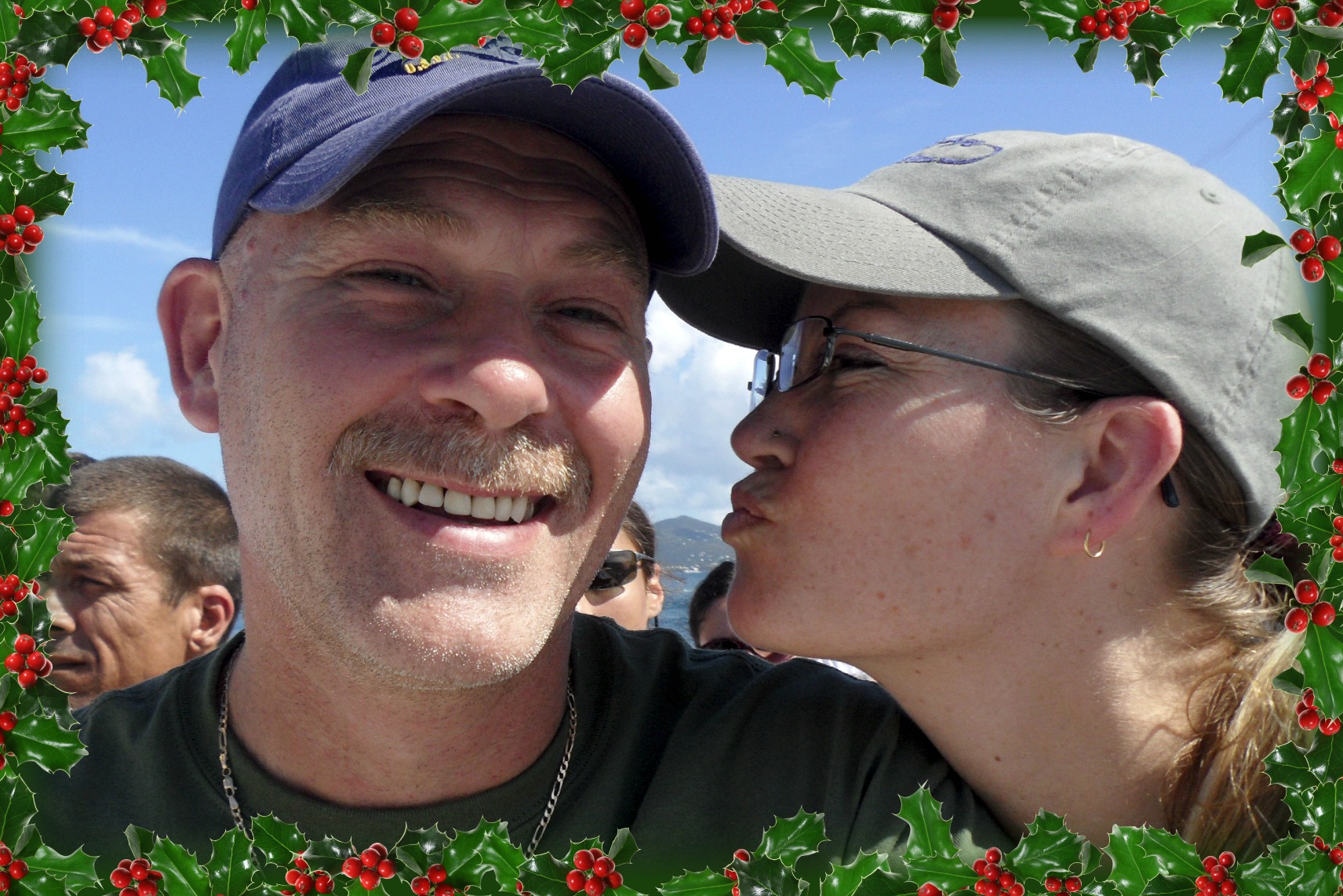
However, last year was a bit more exciting because Peg and I had a big secret plan between us. On Boxing Day we hopped on a plane and flew to the Caribbean. One long haul, three airports, three islands and one ferry later we arrived on St. John in the US Virgin Islands, where we eloped on the beach on December 28th. The photo above was taken of us on the ferry ride over to the courthouse in Charlotte Amalie to pick up our marriage license the day before. This year, of course, we’ll have our first anniversary!

How do you feel when the holidays are over?
It’s a bit anti-climactic. I start the new year with a long flight back to Brazil, which is a country we love living in, but it means back to work for a while. When my job is done there, we’ll have more time to travel when we please. In the meantime, we’ll enjoy as much of Brazil as we can. We both love to travel and look forward to the day when we can just keep going.

On the first day of Christmas, my true love said to me:
THREE DECENT WHISKIES,
TWO CANDY BOXES,
& AN IRISHMAN IN A PALM TREE!

STAY TUNED for tomorrow’s featured nomad (4/12) in our 12 Nomads of Christmas series.

If you enjoyed this post, we invite you to register for The Displaced Dispatch, a round up of weekly posts from The Displaced Nation, with seasonal recipes, book giveaways and other extras. Register for The Displaced Dispatch by clicking here!

Related posts:

12 NOMADS OF CHRISTMAS: Robin Graham, Irish Expat in Spain (1/12)

Current home: Tarifa, Spain
Past overseas locations: UK, Netherlands, Israel, and a previous stay in Spain
Cyberspace coordinates: a lot of wind… (blog) and @robinjgraham (Twitter handle)
Most recent post: “Gran Bretaña” (December 21, 2011)

Where are you spending the holidays this year?
In Hampshire, England. My mother lives there now with her husband, as does my brother and his family.

What will you do when you first arrive?
Once all the greetings are out of the way I may well go for a walk. I’ll be in the town where I spent my adolescent years and there will be memories and perhaps one or two stories for my fiancée, who will be visiting for the first time.

What do you most like doing during the holidays?
TV off, lights off. Candles on, perhaps a fire. To sit in the near dark and talk; to feel connected to all the people who are doing that around the world and to those who have done it down through the centuries. I am not religious but something about gathering with loved ones in the depths of winter seems to run deep.

Will you be on or offline?
I will tell myself to be offline and will fail. Lessline? Halfline? Online Lite?

Are you sending any cards?
Don’t do cards as a result of a selfish and entirely misspent youth. Not going to start now.

What’s the thing you most look forward to eating?
Tricky. I don’t have much of a sweet tooth. If there’s goose I’ll be happy. Roast potatoes never hurt either.

Can you recommend any good books other expats or “internationals” might enjoy?
Ghosts of Spain (2008) is an account of a journalist’s (Giles Tremlett‘s) trips around the country in search of its hidden history, particularly with regard to the civil war and Franco era, and how the country has changed since that era ended with his death in the mid-seventies. It fills a gap that I would have thought was there for many expats in many countries; a chance to get under the skin of your adopted country in your own language.

Foreign Flavours is the second anthology from the online writers group Writers Abroad. The theme is food (and drink) as experienced by the expat, and the collection is nothing if not varied — from short stories to journalistic pieces to recipes; it’s a real kitchen companion. All of the proceeds from the book go to the Book Bus, a registered charity that aims to provide books to and increase literacy rates among children in the developing world.

If you could travel anywhere for Christmas, where would it be?
I was brought up on the premise that an ideal Christmas would involve snow and reindeer, so the notion of an isolated but cosy log cabin in the woods of Lapland has a distinct appeal. Family around me — great. Just my fiancée — better.

What famous person do you think it would be fun to spend some time time with over the holidays?
Richard Dawkins. We could pontificate on the merits of an atheist world view whilst getting tipsy on eggnog, pigging out on Advent chocolates and singing Christmas carols. I hear he does a mean rendition of “Silent Night,” and I’m sure he’d be good company.

What’s been your most displaced Christmas experience?
I spent one Christmas entirely alone in Holland. Broke. Cue violins — it was an episode in that misspent youth I mentioned. My least Christmassy Christmas.

How about the least displaced experience — when you’ve felt the true joy of the season?
When I was a child most Christmas cards, cookie tins and cake wrappers would, for some reason, feature images of snow-laden Bavarian countryside. Castles and cutesy villages with snowy candlelit windows in the darkness. So to find myself in Bavaria a few years ago with my fiancee’s folks, watching families sled down a nearby hill in the evening, attending midnight mass in a 14th century church with an exquisitely painted ceiling, sitting in the house with candles and glühwein and stollen; that would have to be the one that ticked all the boxes for me.

This Christmas coming will be special, too — a family gathering such as there hasn’t been for long time.

How do you feel when the holidays are over?
Honestly? Relieved, ready to get on with it!

On the first day of Christmas, my true love said to me:
AN IRISHMAN IN A PALM TREE!

STAY TUNED for tomorrow’s featured nomad (2/12) in our 12 Nomads of Christmas series.

If you enjoyed this post, we invite you to register for The Displaced Dispatch, a round up of weekly posts from The Displaced Nation, with seasonal recipes, book giveaways and other extras. Register for The Displaced Dispatch by clicking here!

Related posts:

DISPLACED Q: Where and how would you spend your ideal Christmas?


For the last 14 years, we have spent Christmas in Connecticut. It sounds ideal – it’s the name of a classic Christmas film, for goodness’ sake – yet recently, more and more, I’ve wished to spend the festive season elsewhere.

By ‘elsewhere’ I don’t necessarily mean Olde England. Although I may be overtaken by the occasional yearning to spend a foggy afternoon in a pub while Slade and Wizzard bellow Christmas songs in the background, the feeling usually passes after two aspirin and ten minutes in a darkened room.

No; now that youngest child is healthily skeptical and I don’t have to invent elaborate fibs about how Santa Claus is going to track us down at another location, more and more I would prefer to spend Christmas somewhere — well, warmer. Much warmer. Maybe in another hemisphere, even.

But (someone is bound to say) you’re in New England! You have White Christmases!

It’s cold, certainly. But white? Not really. Of the fourteen Christmases here, only one has been properly white. While we have snow, and lots of it, the timing is always spectacularly bad. In any case, any aesthetic pleasure in snow is dimmed by the worry of whether the power lines will collapse before or after the beef comes out of the electric oven, and if it will be necessary to raid the kids’ Christmas toys for batteries for flashlights.

Speaking of my kids, they’re a traditional lot. They like Mum’s roast beef and Yorkshire puddings (the British roast turkey was shelved long ago when it became apparent that you can have turkey for Christmas or Thanksgiving, but not both) and my last suggestion of being anywhere but Smalltown, Connecticut on December 25th was met with howls of distress.

Christmas in Aruba? Barbados? Cancun? You’d think I’d suggested Christmas In The Workhouse.

I showed the kids a photo of Santa-hatted people frolicking in the waves at Bondi Beach.

“Doesn’t this look great?” I pleaded.

One of them sniffed. “Christmas is meant to be cold,” he said.

Cold outside with the central heating turned up to 75 degrees, that is.

“How about Disney World?” suggested another. “It’s supposed to be really nice at Disney at Christmas.”

OK, I can see a couple of advantages: above-frigid temperatures, and fake snow that won’t cut your electricity off. The disadvantages: too many to enumerate, but enduring a Disney Character Christmas Dinner would come top of the list and make me wish that either we or Mickey and friends were, indeed, spending Christmas In The Workhouse.

So, in the absence of family enthusiasm for an alternative location, I guess visions of sugar-plums will stay in Connecticut, while my own visions of barbecued shrimp under waving palm trees will just have to stay hold for a little longer.

I’ll keep working on it. Maybe next year.

QUESTION: Where would you spend your ideal Christmas?

STAY TUNED…for Tuesday’s Classic Displaced Writing, when Anthony discusses — who else, at this time of year? — Charles Dickens.

If you enjoyed this post, we invite you to subscribe for email delivery of The Displaced Dispatch, a round up of the week’s posts from The Displaced Nation. Sign up for The Displaced Dispatch by clicking here!

Related posts:

I’ll (not) be home for Christmas: A holiday travel yarn

Today we welcome Kat Selvocki to The Displaced Nation as a guest blogger. A retired roller derby skater and yogini who has lived in New York City for the past six years, Selvocki is en route to Sydney, Australia, to start a new chapter in her life as a yoga teacher. In this travel yarn, she contemplates being in Europe for the holidays, without any family.

When I left Brooklyn on September 27, I had every intention of arriving in Australia by December 23. That way, even though I was away from my parents and brother for the first time ever on Christmas, I would at least be able to spend the holiday with my cousins on the other side of the globe.

One of the first rules of travel is that things never go exactly as planned. It’s no surprise, then, that I’ve been in Europe for two months with no sign of purchasing a plane ticket to Australia.

By the time I finished the first leg of my travels — two weeks in Iceland volunteering on farms — I had a feeling I’d be in Europe longer than initially expected. My one hesitation was that, after spending thirty some years celebrating Christmas with my family, the idea of spending it alone scared the hell out of me.

I spent a solo New Year’s Eve in my Queens apartment in 2007; I’d decided I didn’t feel like venturing out and about into the craziness of New York that night. Though I don’t especially enjoy that particular holiday, there was something upsetting about wishing myself a happy new year. I didn’t want to repeat that mistake.

Central Europe works its charm

I arrived in Prague the day before Thanksgiving and was greeted by friends who immediately invited me to spend Christmas with them in Austria.

Prague is one of my favorite cities in the world, and the holiday season is one of the best times to be there, its Christkindlmarkts being among the best in Europe. Mugs of glühwein (mulled wine), tubes of bread coated with cinnamon, palačinky (Czech crêpes) dripping with lemon and sugar, the glimmer of fairy lights, handicrafts for sale, Christmas trees, live concerts — what’s not to like?

Though I didn’t have the space in my bags this time around to purchase any gifts at the markets, I was happy to return for some of my favorite Czech treats. As I perused the stands one chilly Saturday, I happily munched on lázeňské oplatky, large round spa wafers served with chocolate filling sandwiched in between.

The flavor brought back memories of Christmas Eve dinners of my youth, spent with my paternal grandparents. Though my grandmother and grandfather were both born in the United States, they continued some traditions passed down from their Polish parents. On December 24, my grandmother would serve a meatless meal at their house: fish that my grandfather had caught that fall, homemade pierogi (the Polish equivalent of ravioli, stuffed with potato and cheese), and vegetables from their friend’s farm.

We began the meal with those wafers, breaking pieces from each other’s opłatek as a symbol of forgiveness and the spirit of Christmas, as well as a reminder of the importance of family.

The ghost of holidays past

Prague was also where I spent my first Thanksgiving away from home, in 2002. I was on a study abroad program with American University, and all of us had gathered to celebrate at one of our favorite pubs, where our program director had reserved several long tables for us, piled with food — mostly Czech versions of traditional Thanksgiving dishes like stuffing, mashed potatoes, and green bean casserole. The American ideas were there, but the execution and seasonings were distinctly Czech.

(At least this was an improvement over a Thanksgiving dinner that a friend of mine had during her Parisian semester abroad, where bowls of peanut butter were served alongside the turkey and roasted vegetables.)

At my table, my tall anarchist friend with a mohawk carved the turkey. After we’d feasted, several classmates took over the restaurant’s upright bass and piano as the rest of us cheered and clapped.

Most of us had met only three months earlier, but there was a tight bond between us that day.

I called home later in the evening. My cousin’s husband answered the phone, and at first he couldn’t believe it was me, all the way from Europe. He yelled to the rest of my family to get on the phone. Though I probably used up my phone card, it was worth it.

My mother came to visit me in Prague not long afterwards. She, too, couldn’t resist the siren song of all the beautiful handmade items at the holiday markets. She settled on a blown glass ornament covered with simple stars made out of straw. It still hangs on my parents’ tree today, an annual reminder of when she and I traveled together.

Holidays are all about the 3 Fs: Family, Friends & (especially!) Food

My family and I have always enjoyed the culinary traditions associated with each of the holidays, be it Thanksgiving, Christmas or Easter. While Christmas was always tops for me as a kid, over the years my allegiance has shifted, and I now look forward the most to sharing the Thanksgiving meal with my nearest and dearest. (This may have been triggered by extended Christmas vacations in college, which so often seemed to end in ridiculous battles with my parents.)

Last month, I was lucky enough to celebrate Thanksgiving twice — each time with a mix of American travelers/expats and international friends.

At the first of these dinners, which took place in Prague, my Belgian friend asked the Americans in the room about the significance of Thanksgiving. While I think he might have meant historically, I replied with the answer that is truest to me: Thanksgiving is about eating lots of food and spending time with people you love.

On that occasion, friends new and old shared their talents in the kitchen. One friend made a traditional Austrian stuffing, while another roasted three Cornish hens and taught us how to make mulled wine. We mashed potatoes together — both white spuds and sweet — and roasted a colorful array of vegetables. I offered my baking talents with a pear-plum pie, inspired by a drink I’d had the night before.

The small kitchen of our rented apartment quickly filled with the mingling scents of cinnamon and cloves, parsley and chives.

I couldn’t have asked for anything better.

The lingering fairy tale of New York

Some of my holiday nostalgia also relates to my recent past — to the six years I’ve just spent living and working as a volunteer manager in New York City. There may be no place more magical than Central Europe, but there’s also something I’ll always miss about being in Manhattan during the holidays.

During each of the six years that I lived in New York, I would have periods of doubt over whether I wanted to stay. But then December would come along and I’d fall in love with the city all over again.

Some of my fondest memories are of walking around late at night gazing at the major Christmas displays in the shop windows. I preferred viewing the windows at that time, with fewer tourists around and the street lamps casting an atmospheric glow.

My favorites were always Bergdorf Goodman’s windows; I could stand and stare at those for hours and never quite take in all of the perfectly arranged details.

And, while my friends are currently lamenting the unseasonably warm weather in New York, I’m cherishing the memories of December nights when I would get off the subway in Brooklyn or Queens and walk home through a fresh layer of snow, surrounded by silent streets.

Volunteerism, burning bright

Still, the náměstís of Prague and plätze of Graz have proved to be a pretty good distraction, as has the volunteer work that I did in Iceland, when I first arrived in Europe.

After visiting Iceland in November of last year, I wanted to go back again and, after a bit of research, learned that there were a few Icelandic farms looking for volunteer labor.

Assisting with the end-of-season harvest — a time of year when farms need all the hands they can get: it seemed like the perfect way to experience one of the most beautiful countries I’ve ever seen, along with learning new skills.

At the organic farm I went to near Egilsstaðir in northeastern Iceland, called Vallanes, there were 11 of us volunteering (4 Americans, 3 Germans, 1 Italian, 1 Tasmanian, 1 Singaporean, and 1 Belgian), plus two paid workers (1 German and 1 Icelander, in case you’re curious).

The friendships we all formed in the turnip fields and the kitchen were an unexpected bonus.

Though it was sad to leave when the season ended, the spirit of Vallanes remains with me as I contemplate the next chapter of my life, the adventure of setting up as a yoga instructor in Sydney.

The saying that your friends are the family you choose becomes more true for me every year. This year, the holidays might not be the same as they were when I was young, and while I miss my family and it’s hard to be away, I’m enjoying the opportunity to soak up — and create — new traditions of my own while sharing the ones with which I was raised. Traveling alone has opened my heart to a variety of new people and experiences.

All of it feels right somehow, at this current crossroads — which led me to leave the familiarity of my old job, New York, and the United States to pursue a new career halfway around the world.

This New Year’s Eve will see me in Vienna. I will not be alone but with a mix of expats and native Austrians, drinking red wine and watching fireworks — concluding a year of transitions and ringing in what I hope will be an exciting new life overseas in 2012.

NOTE: You can read more about Kat Selvocki’s travel adventures on her blog, Pierced Hearts and True Love, and sample some of her gluten-free baking recipes at Kat of All Trades. You can also hire her to give you personalized yoga lessons over Skype; details on KatSelvocki.com

STAY TUNED for Monday’s post, a list of 2011 books for, by, and about expats.

If you enjoyed this post, we invite you to subscribe to The Displaced Dispatch, a weekly round up of posts from The Displaced Nation, with seasonal recipes and occasional book giveaways. Sign up for The Displaced Dispatch by clicking here!

Related posts:

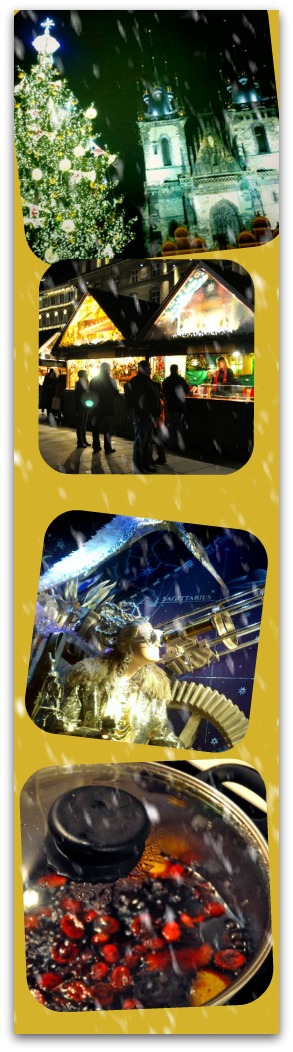
Images (top to bottom): Staromestske namesti (Old Town Square in Prague) decked out for the holidays; waffle stall at the Christkindlmarkt in Graz; Bergdorf Goodman’s window, 2010; mulled wine in preparation for an Austrian Thanksgiving dinner. All photos by the multi-talented (yes, she does photography, too!) Kat Selvocki.

Welcome to December: No place like home for the holidays (depending on where you call ‘home’)

Every year around this time, I dust off a CD of Christmas songs and play it – pretty much non-stop – in the car. Yesterday, after hearing Mud’s “Lonely This Christmas” once too often, my teenaged son rolled his eyes and asked, “Why are such a lot of Christmas songs so depressing?”

It’s not something I’ve really thought about before, but he’s right. “Blue Christmas”,“All alone on Christmas”, “Last Christmas” – they all tell the same sad story of being forlorn and loveless while everyone else is whooping it up at parties and wearing plastic antlers around the office.

And although I’m not forlorn and loveless, I admit that these are not the songs an expat should be listening to when family and best friends are on the other side of the ocean. No wonder I’ve found Christmas less than inspiring for the last few years, if this has been my playlist of choice.

It’s a fact of expat life that you’re not always able to be with loved ones at the moments when you should be with them. but at least there are plenty of ways to stay in touch, with email, Facebook, Skype, and so on. So many options, in fact, that sending holiday cards in early December seems almost superfluous.

Nevertheless, many of you reading this today will be staying put in your adopted countries, wishing you could be with the folks for Christmas or Hanukkah.

I’ll Be Home For Christmas (if only in my dreams)

We are here to reassure you that spending time away from the relatives isn’t such a bad thing.

For one thing, it’s impossible to argue with relatives when they’re not there. Instead, you can fondly imagine the scene at home – chestnuts roasting, carol singers outside – and ignore the probability that what is actually occurring is a fight over the remote control, a mountain of dishes piling up in the sink, and Uncle Earnest asleep in the comfiest chair, his false teeth slowly obeying the force of gravity and sliding from his gaping mouth.

Keep that picture in mind next time you feel homesick this month.

Chestnuts Roasting On An Open Fire – or, Home Is Where The Hearth Is

But if you’re still feeling homesick, we at TDN are here to help.

Our December theme revolves around the winter holidays, plus a look back at the year that’s gone by. You can look forward to a recap of our favorite expat books of the year (plus some new ones), our favorite TDN moments, and, during the critical time at the end of the month, The Twelve Nomads of Christmas.

We hope that you enjoy this special month with us!

And now, if you will excuse me, I’m off to make a more cheerful Christmas mix tape.

.

STAY TUNED…for Monday’s interview with Free The Children’s Robin Wiszowaty


The Displaced Nation’s Halloween post is…mysteriously displaced!

Kate Allison was supposed to post today, for Halloween…but then, pouf, she vanished without a trace!

How very strange, we think you’ll agree…

Her topic was going to be Halloween costumes for expats. Given her offbeat sense of humor, none of us would have been the least bit surprised had she suggested we dress up as:

  • Dorothy, staggering around with a sign that says “I’m not in Kansas any more.”
  • Pocahontas &  John Rolfe — suitable for cross-cultural, bi-racial couples with large age differences.
  • Mary-Sue Wallace, to give ourselves a break from feeling displaced for a few hours.
  • A giant red snail, to signal enthusiastic support for the slow-food movement that began in Italy and is s-l-o-w-l-y spreading around the world.
  • Marcel Proust, carrying a madeleine and looking very displaced.

But instead of speculating what Kate might have written about, perhaps we should be spending our time wondering where she has gone. ML Awanohara and Anthony Windram have a few hypotheses — do let us know if you can think of any others!

  1. She enjoyed a repast of the seven deadly dishes from around the world, overdosed on snake wine, took a nap to recover, and hasn’t yet woken up.
  2. She is out flying on a broomstick with her fictional sidekick, Libby — or, even more likely, with Libby’s nemesis, Melissa (and they are evilly plotting Melissa’s next move on Libby).
  3. She was the victim of some sort of gothic expat tale — either a trick-or-treater dressed up as Hannibal Lecter, who thought she looked tasty and got carried away; or else some sort of natural disaster, such as a bizarre October blizzard, leading to widespread power outages.

Kate, chills are running down our spines as we fantasize about all the spooky things that might have befallen you on this All Hallows’ Eve. New England is not the same as Merry Olde, as no doubt you and your English family have discovered…

Of course, knowing you as well as we do, you may simply be playing a prank by not treating us with one of your posts.

But if that’s not the case and you truly have been spirited away, send us a signal, and the citizens of The Displaced Nation will perform some incantations on your behalf over a bubbling cauldron — a molten mix of Marmite, Fluff and chocolate, with the odd tongue-in-cheek thrown in…

STAY TUNED for Tuesday’s post, introducing November’s theme, on those who displace themselves on behalf of those less fortunate.

If you enjoyed this post, we invite you to subscribe to The Displaced Dispatch, a weekly round up of posts from The Displaced Nation, plus some extras such as seasonal recipes and occasional book giveaways. Sign up for The Displaced Dispatch by clicking here!

Image: MorgueFile

Give a dog a chocolate — why US-based expats shouldn’t use UK Chocolate Week to revive an old complaint

Continuing this month’s food-related theme — and in honor of National Chocolate Week in the UK — founding contributor Anthony Windram weighs in with some thoughts on the often contentious expat topic of American chocolate.

Though I do, like most people, enjoy a bit of chocolate, I’ve never been a connoisseur of the stuff. Any old rubbish will do for a quick fix, truth be told. I’m not one of those people looking for what percent of cocoa is in a bar. As a six year old, I remember my Nana — God bless her, then in the beginnings of dementia — had bought me a packet of chocolate from the corner shop. I can still recall the packet which, rather tellingly, was taken up with the picture of a happy dog. The chocolate inside was a little more out of the ordinary, a little grittier than normal. But it was chocolate and I was happy sat on the floor of my Nana’s living room munching away while watching TV, my mouth doubtless covered in chocolate. My dad, however, happened to notice the packet of chocolate and asked me if he could see it for a moment. Being a trusting child I made the mistake of giving him the packet of chocolate. I was never to see it again.

Nana, I was later to learn, had inadvertently purchased for me some chocolatey dog treats. However, as I recall they really weren’t too bad. Yes, the texture was more gritty than you’d prefer, but I had been as happy as Larry eating them. That should have been the moment that I realized that I was not, and never would be, a chocolate aficionado. When I was older and the only chocolate that I could find in the house was cooking chocolate, I was more than happy to snack on that, too. Coincidentally, its grittier taste reminded me of the dog treats I’d been given all those years before.

In its own way eating that chocolatey dog treat turned out to be good preparation for living in the US. The European expat now often seems to have strong views about chocolate in the US. Without any prompting they’ll bring the subject up and scrunch their face in disgust. “American chocolate,” they’ll say, spitting out the words like they probably do the chocolate itself, “is disgusting.”  And yes, I will admit, that it’s not great. Hershey’s chocolate has a lingering, bitter aftertaste that after eating it I often think I’m suffering from GERD. But you can eat a Milky Way and for the most part it is fine. You’ll possibly suffer from cognitive dissonance from the fact that an American Milky Way is, in fact, like a British Mars bar rather than a British Milky Way bar which is, in turn, like an American Three Musketeers Bar…oh, the confusion! But the chocolate in a Milky Way, while different, isn’t necessarily worse. It’s just in the grand scheme of things in the world of chocolate, American chocolate is the chocolate dog treats my confused Nana bought — and that isn’t something I’m going to complain too much about.

Question: What are your thoughts on American chocolate?

Image: MorgueFile

STAY TUNED for tomorrow’s post, part 2 of Joanna Masters-Maggs’ quest to find paradise in Provence.

If you enjoyed this post, we invite you to subscribe to The Displaced Dispatch, a weekly round up of posts from The Displaced Nation, plus some extras such as seasonal recipes and occasional book giveaways. Sign up for The Displaced Dispatch by clicking here!

Related posts:

Gotta helmet? Time to burn some rubber, have a real travel adventure

The Displaced Nation has dedicated the month of September to the ideas within Robert Pirsig’s classic, Zen and the Art of Motorcycle Maintenance. But enough with theory. What’s it really like to see the world from the back of a motorcycle — and what are us more timid types missing out on? Rubber hits the road today with Matthew Cashmore, aka The London Biker. Braaaaown… brraaoom…… rrooaaarr………. Take it away, Matthew! NOTE: This post has not been edited for British spelling.

There are some things in life that just have to be done. Laying on your back staring at the stars, wondering which ones are dead and which are still blazing. Getting so drunk on cider that you can no longer stand (perhaps that’s just me). Or travelling the world by motorcycle.

The last, many people would say, is optional. But it’s not. If you feel as I do, motorcycle travel is as essential to life as water or food, then there is only one way to do it.

I’m not the first to point out that seeing the world from a motorcycle is better than any other means of travel — just dig out a copy of Zen and the Art of Motorcycle Maintenance or my personal favourite, Jupiter’s Travels, by Ted Simon.* You’ll only read a quarter of each book before you discover why this method of travel trumps the rest. You’re part of the world in which you’re travelling. There is nothing between you, the elements and the people with whom you interact.

I’ve been fortunate enough to see much of the world. I’ve backpacked, travelled by plane to amazing cities, jumped on buses or driven cars. But nothing, absolutely nothing, can match the experience of the wind rushing past your head trying to knock you off your bike, as you hurtle between towns and villages. And nothing can give you a greater grin than riding across the bay in San Francisco on the back of a growling Harley — safe in the knowledge that in a car this would be just another American highway.

If you don’t ride in the rain, you don’t ride…

It does take a certain amount of effort, though. This summer I did a short run from London out to Budapest via France, Germany, Austria and then into Hungry. The return leg took me through northern Croatia, Slovenia, back into Austria and up into the Alps over into Italy and then back over the Stelvio Pass into Switzerland, France and finally home. It rained the entire trip. Every single morning I was greeted with sheets of rain. I was beginning to suspect it was actually following me to Budapest. Each night I was soaked to the skin — even with the most expensive rain gear. Each night I was dog tired, and I really had to question what I was doing. What kind of a nut case chooses to spend his summer holiday riding a motorbike half way across Europe in the rain?

The reason I, and many others like me, do this is because you can ride for eight days in the rain — and then out of nowhere the clouds will clear and you’ll be presented with a road of perfect grace. A strip of tarmac that sings as you press on, a view that leaves you crying because of its beauty. Something you would never have seen had you been in a car or a bus. Something you’ve had to work to achieve — and it’s even more beautiful for that.

A parable of the hospitality shown to bikers

On the Budapest trip I found myself at the top of the Austrian Alps. I was running a day behind because I’d had a stomach bug back in Budapest. I was determined to make up that lost day so that I could still get over the pass into Switzerland ahead of a (yet another) rain front. I had been riding for ten hours, I had another six ahead of me, and I was already on my fourth change of clothes. I was incredibly fed up. Why on earth was I doing this?

I pulled into the first service stop I’d seen for about 150 miles, 2000 metres above sea level and hidden by cloud, rain and spray. Filling the bike up with petrol I spotted a small restaurant complete with a hotel — bliss, escape! I headed inside, dripping water everywhere. As I walked through the door I must have looked like a monster from the deep. I was dressed head to foot in every single piece of waterproof gear I could find — complete with an army surplus poncho. The restaurant manager took one look at me and ordered me onto a piece of lino, where I promptly created a rather large puddle. She demanded I remove my clothing leaving me standing there in just my thermals. I shivered, waiting for her next command. Did they have ways of making me warm?

My gear was whisked off (it came back nearly dry and very warm), and I was pointed in the direction of the shower and given a hot towel. I emerged a different man. Clean clothes, warm, and for the first time in two days, dry. Ushered to a seat, I took the opportunity to eat well — feasting on sausage and strudel, the best Austria had to offer. Buoyed by such amazing hospitality I got back on the bike and rode on. As I rounded the first corner the rain stopped and I hit Italy, sun, and the kind of twisty roads God clearly made for bikers.

I could say this was a one off, but the more I travel the world by motorbike the more I come to realise that the very thing that makes you vulnerable is the very thing that makes you approachable. It’s different if you’re travelling with other bikers, but when you’re on your own it’s a perfect combination of being totally exposed to the environment and more importantly to people.

This is what makes travelling by motorcycle so special. The openness, the access, the smells, the sounds, the people who are curious because you’ve rolled into town in something other than a bus or 4×4. If you want to experience, to imbibe, the world through which you travel…there is only one option. Gotta helmet?

* Suggested further reading:

Matthew Cashmore works in digital publishing. He keeps track of his “random thoughts” on his blog, The London Biker. He also has a YouTube channel, where he posts videos about his life on the road, camp cooking and related topics.

img: Matthew Cashmore in Budapest, July 2011.

STAY TUNED for Tuesday’s post, on the diner food that has played a part in many an American road trip.

If you enjoyed this post, we invite you to subscribe to The Displaced Dispatch, a weekly round up of posts from The Displaced Nation, plus some extras such as seasonal recipes and occasional book giveaways. Sign up for The Displaced Dispatch by clicking here!

Related posts:

RANDOM NOMAD: Kirsty Rice, Freelance Writer & Blogger

Born in: Renmark*, South Australia
Passport: Australia (no one else will have me!)
Countries lived in: Australia (Adelaide & Perth): 1997-98; Indonesia (Jakarta): 1999 – 2001; Malaysia (Kuala Lumpur): 2001-02; Libya (Tripoli): 2002-04; Canada (Calgary): 2004-08; USA (Houston): 2008-09; Qatar (Doha): 2010-present.
Cyberspace coordinates: 4 kids, 20 suitcases and a beagle (blog)
*A small town of 7,500; my parents still live there.

What made you leave your homeland in the first place?
I am married to a former expat child. I know the term is Third Culture Kid, but I don’t really think it applies to him. He was always keen on doing the “expat” thing. I, on the other hand, was raised in the same town that I was born in and wasn’t a great lover of change. Our first move was the result of a promotion for my husband and the fact that I was pregnant with our first child. The plan was to do a two-year posting in Indonesia and to return “home”. That was 7 countries and 12 years ago. I now thrive on change.

So your husband was already “displaced”?
My husband’s parents were expats. He was actually born in New Zealand and then they went to the Philippines for many years before moving to Sydney, then Melbourne, and finally to Brisbane.

How about your kids?
My children were all born in different countries. We were living in Jakarta when I had my first child, my second was born in KL, the third in Malta and the fourth in Canada. Although none of them have lived permanently in Australia (our longest stint has been during school holidays, so a maximum of 12 weeks), they all think of themselves as Australian. My husband and I have both worked hard for that to be the case.

Describe the moment when you felt most displaced.
When we first moved to Tripoli — it was the middle of summer and I had a two-week-old baby and a two-year-old. We then had to endure months of housing hell — we couldn’t find one! For a while, I shared a “guest house” with about sixty men who were rotating in and out of the desert: there were no other women. Breast feeding amongst men who hadn’t seen a woman for a couple of months was a rather unique experience. Due to the weather, fruit and vegetables were limited and small in size. I can remember standing in a fruit and vegetable stand with a screaming baby and a restless toddler wondering how I was going to cook carrots the size of my little finger. I was continually getting lost, and the simplest of tasks seemed very overwhelming. There were many days that I considered getting on a plane — but I’m so pleased I didn’t. Three months later, we had a house, the weather was better, I made friends, and I loved our life in Libya. I was devastated to leave.

Describe the moment when you felt least displaced.
I feel like that here in Qatar. Our children are at a fabulous school, I have a place to write, and my husband works for a Qatari company and really enjoys it. There is so much here in the community for expats, and we are made to feel very welcome. I have made local friends and love heading to the local souqs. I feel that this is very much our second home. In other locations I have felt that we were passing through, but not here.

You may bring one curiosity you’ve collected from your adopted country into The Displaced Nation. What’s in your suitcase?
From Indonesia: A jamu (traditional medicine) woman made of silver, given to me by a very dear friend.
From Malaysia: The Selangor pewter tea set I was given as a gift. Each time I use it I think of my friends.
From Libya: A wedding blanket with traditional jewellery pinned to it, which was given as a farewell present. It is such a unique gift and always a talking point when people spot it in our house.
From Canada: Nothing material, just the memory of what it was like to be back to work full time. In Calgary, I returned to the “old” me, remembering who I was pre children and travel. That was Canada’s gift — along with a huge appreciation of weather!
From the U.S. (Houston): A fantastic painting of an American flag that I picked up in San Antonio. It’s 3D and not in the traditional colors. It reminds me that America is far more layered and multidimensional that what I’d given it credit for.

You’re invited to prepare one meal based on your travels for other Displaced Nation members. What’s on the menu?
We’ll have some kind of soup for starters: either Indonesian soto ayam (chicken soup), Libyan soup* (I love it!), or the Canadian version of Italian wedding soup. Though I come from an area in Australia that has a large Italian community, I’d never heard of Italian Wedding Soup — turns out it’s more of a North American thing.

For the mains, perhaps I’ll offer a choice between Malaysian curry or maybe a nasi goreng from Indonesia.

And for drinks, we’ll have margaritas. I learned to make a mean margarita in Houston.

For dessert, a caramel cheesecake — a recipe I picked up from a fellow Aussie in Houston.

You may add one word or expression from the country you’re living in to The Displaced Nation argot. What will you loan us?
From Indonesia: Satu lagi (one more) — I said that way to often!
From Malaysia: I just loved how you could put lah on the end of everything and automatically make a sentence sound friendlier.
From Tripoli: Shokran (thank you). It was the first Arabic word I learned and makes me think of how special the people in Libya are — so kind and helpful. Incidentally, in learning how to say “pregnancy test,” I discovered that hamil is the word for “pregnant” in Indonesia, Malaysia and Tripoli.
From Canada: Hey — kind of the same as lah in Malaysian.
From the U.S. (Houston): I found myself describing things differently. It wasn’t just “the big tree out the front” but “the big ‘ol tree out the front.”
From Qatar: Right now I’m back to learning Arabic (unsuccessfully). Oh how I wish I had a chip I could just insert into my brain to switch languages. Why haven’t they invented that yet?

It’s Zen and the Art of the Road Trip month at The Displaced Nation. Robert M. Pirsig, author of Zen and the Art of Motorcycle Maintenance, famously said: “Sometimes it’s a little better to travel than to arrive.” Do you agree?
I disagree. I like to arrive, settle and learn how a city/country works. You can learn so much about a place just by trying to get the telephone connected! Traveling through is just a brief picture. I love that we’ve been able to become part of a community everywhere we have lived.

Pirsig’s book details two types of personalities: 1) those who are interested mostly in gestalts so focus on being in the moment, not rational analysis; and 2) those who seek to know the details, understand the inner workings, and master the mechanics. Which type are you?
If you read my blog you’ll see there is usually a romantic viewpoint or flowery end to a posting. I’m a big believer in things happening for a reason and not always being logical. Having said that, I am a stickler for details, I hate to enter into things blindly and have to know exactly what the story is. Which personality am I in my expat life? I’m a bit of both. I don’t believe that anyone can be a successful expat without having the flexibility to change with the situation. In our daily lives as expats we need to quickly learn the rules, find out the details, go with the flow and just enjoy the ride. You have to be both.

* Libyan soup is a tomato-based soup. There are many variations. The one I loved was with lamb.

Ingredients:
1/2 to 1/3 lb. lamb meat cut into small pieces
1/4 cup oil or “samn” (vegetable ghee)
one large onion
1 tablespoon tomato paste
2-3 tomatoes
1 lemon
1/2 cup orzo, salt, red pepper, Libyan spices (Hararat) or cinnamon

Directions:
Sauté the onion with meat in oil.
Add parsley and sauté until meet is brown.
Add chopped tomatoes, tomato paste, salt, spices, and stir while sizzling.
Add enough water to cover meat, simmer on medium heat until meat is cooked.
Add more water if needed, and bring to a boil.
Add orzo, simmer until cooked.
Before serving, sprinkle crushed dried mint leaves, and squeeze fresh lemon juice to taste.

Readers — yay or nay for letting Kirsty Rice into The Displaced Nation? Tell us your reasons. (Note: It’s fine to vote “nay” as long as you couch your reasoning in terms we all — including Kirsty — find amusing.)

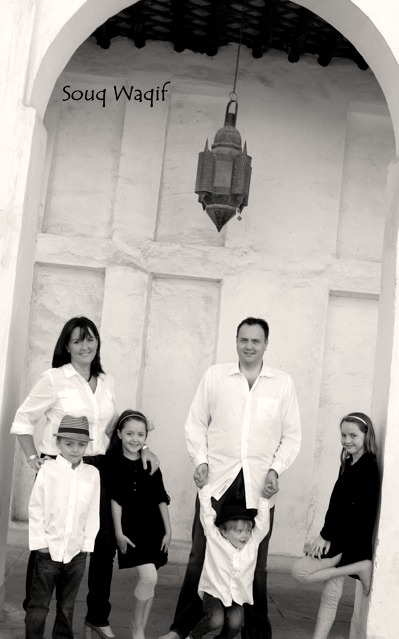
img: Kirsty Rice with her family (sans the beagle) at Souq Waqif, Doha, Qatar.

STAY TUNED for tomorrow’s installment from our displaced fictional heroine, Libby, whose rather dramatic road-trip adventure has come to an end. Time to face reality again in Woodhaven! What, not keeping up with Libby? Read the first three episodes of her expat adventures.

If you enjoyed this post, we invite you to register for The Displaced Dispatch, a round up of weekly posts from The Displaced Nation. Includes seasonal recipes and book giveaways. Register for The Displaced Dispatch by clicking here!

Related posts:

The Displaced Nation observes the 10th anniversary of 9/11

Two members of The Displaced Nation team, ML Awanohara and Kate Allison, were living in the United States at the time of 9/11 — Kate as an expatriate from the UK, and ML as a recent repatriate. In commemoration of Sunday’s 10th anniversary, they recount where they were on that day, as well as the impact it’s had on their lives for the past 10 years.

ML AWANOHARA:
I moved to New York City about a year before the 9/11 attacks occurred. Though an American, I’d spent a big chunk of my life abroad, in England and Japan.

But on that fateful day, just as the planes crashed into the towers, I was sitting at an outdoor table at a hotel on the island of Santorini, sipping retsina and savoring the sweetness of the tomatoes in my salad while admiring the hotel’s cliff-perched views of the sea.

The man who would become my second husband and I had gone to Crete for vacation. We’d traveled to this extraordinary cycladic island by ferry for the day.

After lunch, we made our way through the winding streets of Fira to the cable car station — we had to take the cable car back down to the beach to catch the ferry back home to Crete. We decided we needed more film and went into a little souvenir shop near the cable car entrance. The man behind the counter said something excitedly in Greek and gestured at the little TV on his wall.

The screen contained a surreal image of a plane crashing into the twin towers and billows of smoke.

I then had to do one of the hardest things I’ve ever done: get on a ferry for six hours, without any way of finding out what was going on. By the time we reached Crete, I had worked myself up into a state of panic over my sister and her young family, who were living in Battery Park City, right next to the twin towers. (Fortunately, my sister and her two-week-old baby were evacuated.)

We spent the rest of our holiday glued to CNN. On the occasions when we ventured out, many Cretans would offer words of sympathy. I remember in particular talking to the proprietor of one of the many open-fronted shops on Souliou Street, in the old quarter of Rethymno. She confessed to me how frightened 9/11 had made her feel. “If they can do that to America, then how can any of us be safe?” she said, gesturing at her wares, mostly hand-made sweaters.

Dogs, buses and other neuroses

In the aftermath of 9/11, I got my very first dog — a black-and-tan cocker spaniel, whom I named Cadbury for his sweetness (that was before I knew he had moods).

There’s nothing more comforting than a pet when undergoing trauma, and like everyone else in New York, I felt traumatized by the knowledge that there were people out there who hated our country enough to target civilians.

I also started riding the bus home from work. In the months following 9/11, there were constant rumors of threats against the subway. I’d lived through the sarin gas attacks on the Tokyo subway, and didn’t fancy another round of underground terror.

I liked the bus culture and have been taking buses ever since.

The attacks also deepened my interest in politics and foreign affairs. I understood for the first time how vulnerable cities are in general, and New York in particular. Shouldn’t the opinion of New Yorkers, who are on the front lines, count for more than those of people who live in states that aren’t vulnerable to terrorism? Especially when it comes to choosing our nation’s leaders…

That said, city politics are no better. How many city officials does it take to construct a 9/11 memorial? In fact, fewer (or none at all!) would have been more effective.

But I think what I found most disturbing was the role of religion in international affairs. What was all this talk of “holy wars” and crusades? Were we back in the Middle Ages? No doubt I was influenced by all my years of living in the polytheistic Far East, but I just kept thinking: this monotheism embraced by the West and the Middle East has a lot to answer for. (Give me Buddhism any day!)

A noisy anniversary

We’ve made it 10 years, and that’s a relief. At least, I assume that’s why so many people, along with the mainstream media, are making such a loud noise over this. (Are all ten-year anniversaries commemorated this vociferously?)

What I crave right now, to be honest, is some quiet time, away from all these celebratory undercurrents.

When I first came to NYC in 2000, I lived in Greenwich Village. Whenever I looked down 6th Avenue, the twin towers loomed in the distance, helping to orient me in the right direction.

I now live in the East Village, but perhaps I’ll head toward 6th Avenue this Sunday with my two dogs (Cadbury now has a younger companion) and reflect on my lost landmark.

I may also reflect on the snippet of Zen wisdom that appeared in The Displaced Nation’s Monday post, on road trips:

The place to improve the world is first in one’s own heart and head and hands, and then work outward from there.

KATE ALLISON:

Summer 2001 marked our five year anniversary of living in the USA. Nine months before the attacks, we moved from New England to Leesburg, Virginia – a busy, rapidly expanding town about forty minutes west of Washington DC. I loved our new location. There were fields, and cows, and rolling hills; narrow streets and brick houses in the town. It was, dare I say it, very English.

September 11 started as a normal, beautiful, sunny day. I put my eight-year-old on the school bus, and went back home with my preschooler.

A little before 10 a.m., a friend phoned me. We chatted for a moment, then she asked where my husband was; since he worked with her husband, and they both traveled abroad in their jobs, this question wasn’t unusual. It’s what expat wives with traveling spouses talk about.

“At the Virginia office this week,” I said. “Yours?”

“India. He left yesterday from Dulles…thank goodness.”

Here, I should explain that I’m not a big TV watcher, especially when it comes to daytime programming, so the TV wasn’t on. If it had been, most likely it would have been tuned to Teletubbies.

“Why ’thank goodness’?” I asked.

Silence at the end of the phone, then “Haven’t you heard? Turn your TV on. It’s unbelievable.”

So I turned the TV on. I stared at the picture of the Twin Towers, not quite comprehending. I heard the announcement that a plane had crashed into the Pentagon, just forty miles away. The plane was believed to have taken off from Dulles – the airport my husband, his colleagues, and our friends flew from every week. There but for the grace of God.

“World War Three’s just started,” said my friend.

*

My memories of the rest of that day are disjointed. I tried several times to phone family in England to let them know that we were safe, that no one was traveling this week, and eventually, after many busy signals, I got through. My husband came home from work and I breathed more easily. I didn’t want to be alone with just a four-year-old for company while this was going on.

Reports were vague, rumors rife. There were eleven hijacked planes in the air, there were six hijacked planes in the air. The USAF had shot some down; another two hijacked planes were on the way to Washington. Thirty thousand had died in the towers.

What was clear, however, was that airspace was gradually being cleared, and all planes had to land.

The silence from the skies as this happened was deafening. You don’t realize how much noise comes from overhead aircraft – particularly near a busy airport like Dulles – until the noise isn’t there.

In the early afternoon, rumors were still circulating about a rogue flight on its way to the White House or the Capitol. I went outside into our garden for a moment, and was panicked to hear aircraft engines overhead, because by this time all planes in US airspace had been grounded.

Only later did I discover I had heard Air Force One and its accompanying fighter jets, bringing the President back to Washington.

Our daughter returned from school and wanted to know what was going on. Something was going on, she said; she knew it was, because her teacher was being much nicer than usual and had let the kids draw pictures all day.

How do you explain something like this to a child? For the first time, I wondered at the wisdom of bringing children into this world at all.

Two weeks later, still pondering this question, I discovered we were expecting our third baby. Perhaps it was the answer I needed.

*

Déjà vu

No one we personally knew died that day, but because of where we had lived in the US, close to both attacks, many people we knew lost friends or relatives. Their grief makes me uneasy when I see movies being made about 9/11. It’s too soon, too raw. I’m not sure when it will ever be anything else.

Something I was asked a lot in the aftermath – Will you be coming back to live in England after this?

The answer was always No. I grew up in Britain during the 70s and 80s, when IRA bombings on the mainland occurred all too often. These things can happen anywhere.

This attitude was somewhat justified four years later, on July 7, 2005. I was in London that day, having arrived at Heathrow the night before. Had I not been jet lagged and so overslept, my children and I could have been on one of those trains that were torn apart by suicide bombers – we had planned some sightseeing that day.

Like I said before – there but for the grace of God…whatever you conceive Him to be.

STAY TUNED for Monday’s post, when we return to the theme of road trips.

If you enjoyed this post, we invite you to register for The Displaced Dispatch, a round up of weekly posts from The Displaced Nation. Includes seasonal recipes and book giveaways. Register for The Displaced Dispatch by clicking here!

img: Remember — a September 11th memorial image (the New York skyline is reflected in the eye from a silhouette placed on a window), by David Hepworth.