The Displaced Nation

A home for international creatives

RANDOM NOMAD: Charlotte Day, High School Student (Sixth Former)

Born in: Sydney, Australia
Passports: Australia, UK and US Green Card
Countries lived in: Australia (Sydney): 1994-2001; United States (New York, New York): 2001-2010; England (Sevenoaks, Kent): 2010-present

What made you leave your homeland in the first place?
My father is Australian and my mother English. They split up when I was two. When I was six, my mother met and married an Australian who had been living in New York for thirty years. I was rather disgruntled about moving to the United States and for two or three years, remained determined never to accept it as “home.” At that time, I was deeply patriotic to my native country — though this sentiment has dissipated since.

Is anyone else in your immediate family a “displaced” person?
My mother’s family, originally from England, has long been displaced. My mother herself was born in Kenya, in 1961. Following the Mau Mau Uprising, her parents were forced to relocate, and my grandfather, presented with a choice between Australia and Canada, chose the warmer of the two countries. My mother spent her childhood bouncing between schools in England and Australia. She eventually grew so fed up with packing and unpacking, she decided to leave school at the age of 16. Her father agreed to the plan provided she spend a final year at the school in Switzerland his own mother had attended as a girl. My mother moved on from Swiss finishing school to work in London, Paris and Sydney. But she appears to have made New York her last port of call. Indeed, we had a fairly solid life in the city until I decided to take myself off to boarding school in England.

Describe the moment when you felt most displaced over the course of your many displacements.
It must have been when I first arrived in New York as a six-year-old. I stepped out of the JFK arrivals terminal into a snowy March night. My stepfather was wearing a leather coat, the interior of his car smelled of leather — and the world outside the car window seemed an undulating stream of black and silver. Though it was the end of 2001’s warm winter, my Australian blood froze beneath my first-ever coat. And their apartment — that was all leather as well. It smelled of musk and cologne. Since that time, I have felt similar pangs of displacement, some of which lasted for considerable periods. But those first few moments in New York stand out as the most acute concentration of “displacedness” I have ever known.

Describe the moment when you felt least displaced.
For the last five or so years in New York, I have felt more at home than I ever did in Sydney. I ascribe this to growing up: at a certain age, one can take possession of a city, know its streets, bridges, tunnels and transportation system. I was too young when I lived in Sydney to reach that kind of comfort level. But when have I felt the most like a New Yorker? Perhaps it was the last time I came home for the holidays, and took the 4 train uptown for the first time in months. At that moment I realized how much this train had been a part of my life — conveying me home from school every day for two years. My old life would always be waiting for me on the subway, ready for me to pick it up again. That’s something only a New Yorker could say!

You may bring one curiosity you’ve collected from each of the countries where you’ve lived into the Displaced Nation. What’s in your suitcase?
From Australia: A miniature wooden wombat figurine — a gift from my grandfather. It conjures memories of a childhood spent beating about the bush (literally) and fishing for yabbies at the dam in the company of audacious dogs who stuck their heads down wombat holes, to no good end.
From New York: A pair of fake Harry Potter glasses. These defined my first six months in New York — I even wore them to my first day of school. I think it is telling that even at the age of six, I was unwilling to give all of my real self to this new home.
From England: My school tie — representative of the alternative universe I seem to have entered. At boarding school, the sense of removal from reality can be disconcerting — especially after having spent a decade in the city I regard as the world’s capital.

You’re invited to prepare one meal based on your travels for other Displaced Nation members. What’s on your menu?
I’d like to make you a Sydney breakfast: scrambled eggs, made with cream, salt and pepper and served on a bed of Turkish toast, with avocado and stewed tomato on the side (is this being greedy?). Our meal will be accompanied by a large “flat white”: what we call perfectly strong, milky coffee without excessive froth. I suggest we consume it overlooking a beach on a Sunday morning. At least, I assume The Displaced Nation has beaches?

You may add one word or expression from each of the countries you’ve lived in to The Displaced Nation argot. What words do you loan us?
From Australia: Daggy. I use this word all the time — and did not realize it was exclusively Australian until I was informed of the etymology. Apparently, it comes from trimming the soiled wool around a sheep’s bottom. Which part of this repugnant whole is actually the “dag,” I do not remember. (No, I’m not a proper Australian!) But as I understand it, “daggy” means sloppy in appearance or badly put together.
From New York: There are so many words, and most are second nature by now. However, I will choose grande-soy-chai-tea-latte because I still shudder to think of myself as the kind of person who can utter such a phrase, at great speed, with great insistence. In fact, I’m still in denial about my love for Starbucks: having known Sydney coffee, my standards should be higher.
From England: Banter. I still do not know the precise meaning of this word, but it seems to encapsulate everything that makes someone my age feel socially acceptable — and, of course, I have no banter whatsoever. I think it means the capacity for combining wit with meaningless conversation. But there are other components, too, which seem to me unfathomable.

Question: Readers, tell us what you think: should we welcome Charlotte Day to The Displaced Nation and if so, why? (Note: It’s fine to vote “no” as long as you couch your reasoning in terms you think we all — Charlotte included — will find amusing.)

img: Charlotte Day at her boarding school in southeast England

If you enjoyed this post, we invite you to subscribe for email delivery of The Displaced Nation. That way, you won’t miss a single issue. SPECIAL OFFER: New subscribers receive a FREE copy of “A Royally Displaced Tea.”

Related posts:

What did Agatha Christie know? Expats make great criminals

I’m going to kill myself for saying this — I’m an Agatha Christie fan — but I think the Queen of Crime got it wrong.

Either that or she purposely misled us into thinking that the most cunning criminal minds were hiding behind lace curtains in oldy-worldy English villages.

I don’t know about you, but for a while, I found it convincing. Don’t most scions of wealthy families want to murder the patriarch? And what better place to do it than in the library of his stately home…

But then I became what the tagline of this blog refers to as a “global voyager.” As I navigated worlds far beyond the one in which I was born, I wasn’t so clueless any more. I began to notice that the perpetrators of the some of the worst crimes are people who no longer live in their villages, who are displaced in some way.

And the more I thought about it, the more sense it made.

No Gardens of Eden out there

Psychological studies have shown that we are less likely to cheat when we’re aware of someone else observing our behavior — even if it’s a poster with eyes on it.

Thus, having a village busybody like Miss Marple should help to deter crime, never mind solving it.

Now many international travelers — especially those with plum expat packages — feel they live in a self-anointed paradise. And perhaps they have to convince themselves of this, or else they wouldn’t travel.

But the sad fact is, no one is immune. To rephrase an old saying, some of us are born bad, others achieve badness, and still others have badness thrust upon us.

If anything, badness is more likely to be a feature of the international life. Those of us who become adept at navigating the globe sometimes lose our moral compass along the way.

As for the Miss Marples, chances are, they’ve gone home. Many of an expat’s associates are transients.

So many bad apples

As you’re probably aware by now, not every expat you meet is a good egg. Some are in fact bad apples (not sure why an egg is good and an apple bad — call it a mystery of English slang).

The actress Anne Hathaway had to learn this lesson the hard way. She fell for Raffaello Follieri, who headed the Follieri Group, a real estate development company based in New York City.

With his mop of brown hair and cherubic features, Follieri came across as the embodiment of old world charm and manners. He cut what the Italians call a bella figura.

He was also, it turned out, a crook. He wined and dined Hathaway with the money he’d conned it out of people by posing as the Vatican’s real-estate man. He’s now in prison.

Murder most foul

Just as we don’t like to think of rats being part of the animal kingdom, we don’t like to think of conmen, pirates, gangsters, and terrorists being part of the group we have loosely defined as “global voyagers” — such a noble concept, and one to which The Displaced Nation has dedicated itself.

But trust me, they are a part of it — as are murderers.

Take, for instance, Nancy Kissel. One day she was living in an exclusive high-rise apartment complex in Hong Kong, the city that scores a perfect 10 as an expat destination, with a banker husband worth many millions.

The next day she was known as the Milkshake Murderess — accused (and then convicted, conviction now upheld) of bludgeoning her husband to death after drugging him with a sedative-laced strawberry milkshake and then wrapping his body in an Oriental carpet destined for basement storage.

It’s a story more than worthy of Agatha Christie.

Or ask the parents of Meredith Kercher, a young British woman who went to Italy as part of the Erasmus student exchange programme, to study and immerse herself in the language and culture.

She chose the ancient city of Perugia in Umbria. Surely nothing could go wrong in such a serene setting?

Wrong again. Unless you’ve been living on another planet, you’ve heard that Meredith was brutally murdered, allegedly by two men and her American roommate, Amanda Knox, in what prosecutors called a violent sex game. Only one of the alleged perpetrators was a native-born Italian.

Public fascination with the case has continued unabated — and not just because of the media circus surrounding Knox, who maintains her innocence and is appealing her conviction.

As the Christian Science Monitor put it in an article last September:

…the highly contested circumstances of the crime make it a genuine murder mystery.

(Where is Hercule Poirot when you need him — surely his marrows would thrive in the Umbrian soils?)

And now for a bit of a twist!

I’d like to retract my statement on the Queen of Crime. Je me suis trompé! I’ve done her an injustice.

True, Agatha Christie did produce lots of drawing-room mysteries, but she also also told us everything we need to know about expat criminality in her classic work Murder on the Orient Express.

When the shifty-looking Samuel Edward Rachett is found stabbed to death, the redoubtable Hercule Poirot assembles the 12 suspects in the restaurant car. It’s an odd assortment — call it an expat enclave in microcosm — consisting of an American translator, a British valet, a French conductor, a British governess, a retired British army officer, an elderly Russian noblewoman, a German maid, a Hungarian diplomat and his wife, a Swedish missionary, an elderly American woman who has just been to see her daughter in Baghdad, and an Italian-American businessman from Chicago.

So, whodunit? Can you remember? The answer is: all 12! Each of these characters had thrust the knife into Ratchett, making it impossible for Poirot to determine who delivered the fatal blow.

But as it turned out, it didn’t matter. Ratchett deserved his fate for his own dastardly deeds. He was, of course, the most displaced of all the passengers on that exotic train: a fugitive from justice, whose real name was Cassetti.

I’m sure I don’t have to tell you which transnational group of gangsters he was affiliated with. No surprises there!

Question: Do you agree that citizens of The Displaced Nation have criminal potential, and have you ever come face to face with any criminal elements in your travels? I’d love to hear your stories, however unsavory…

img: “There’s been a murder!” by Richard Bogle.

If you enjoyed this post, we invite you to subscribe for email delivery of The Displaced Nation. That way, you won’t miss a single issue. SPECIAL OFFER: New subscribers receive a FREE copy of “A Royally Displaced Tea.”

Related posts:
RANDOM NOMAD: Nerissa Muijs, Business Development Specialist

Born in: Kingston S.E., a wee town in South Australia
Passport: Australian, but will be eligible to become a dual Australian-Dutch citizen this year
Countries lived in: Malaysia (Shah Alam): 1997; New Zealand (Christchurch): 2003; England (Plymouth): 2006-2007; Scotland (Edinburgh): 2007-2008; Netherlands (Almere): 2008-present
Cyberspace coordinates: Adventures in Integration (blog)

What made you leave your homeland in the first place?
I grew up in a small town in South Australia called Lucindale (just 300 people). I don’t feel like I was ever a good fit. I have always had a feeling of wanderlust and being able to go on an AFS exchange to Malaysia when I was 17 added more fuel to the fire, rather than sating my taste for experiencing new places. Once I returned home, I never really settled down again. I was constantly planning my next adventure.

Is anyone else in your immediate family a “displaced” person?
One of my Fabulous Aunts is also perfectly displaced. She lives on a yacht with her partner and two cats. They are currently floating around the Colombian coast, preparing for hurricane season before braving the Panama Canal to head back into the Pacific and beyond.

Describe the moment when you felt most displaced over the course of your many displacements.
Perhaps it was sitting in a restaurant in Malaysia with my wonderful Chinese host family. They had taken me out especially to eat shark’s fin soup. Or it could be the time I was the only Australian sitting in a bar in Christchurch watching the Wallabies beat the All Blacks in the semi finals of the 2003 Rugby World Cup. But seriously, it was probably when I found myself in the immigration offices in Amsterdam realizing I was making a potentially permanent commitment by moving to my husband’s homeland — it was time to grow up!

Describe the moment when you felt least displaced.
On my birthday in 2007. I was living in Edinburgh at the time. My Dutch boyfriend, who is now my husband — we met in Australia when he joined one of my tours to Uluru — was visiting from the Netherlands. A group of my friends took us out to celebrate. In that moment I was happy, I was at home. I find I don’t have the sense of “home” when I return to my hometown in Australia any more. I feel at home with people, not places. Having a cup of tea with my best friend, for example. We’ve done that in at least four countries together and it’s always the same.

You may bring one curiosity you’ve collected from each of the countries where you’ve lived into the Displaced Nation. What’s in your suitcase?
From Malaysia: A batik sarong. I’ve been wearing the same one weekly since 1997, and I love it just as much as the day I paid 5RM for it.
From NZ: The jade pendant I got from Hokitika. It feels cool or warm on my skin and is smooth and comforting.
From England: A cream tea with scones and Cornish clotted cream. A cream tea will always make me think of my elderly great aunts at home and of England.
From Scotland: A “hairy coo” fluffy toy. (Actually, I’d prefer to bring a real-life hairy coo, but I imagine you have strict quarantine rules…)
From Netherlands: Rookworst (a type of smoked sausage, similar to bratwurst).

You’re invited to prepare one meal based on your travels for other Displaced Nation members. What’s on your menu?
Being Australian, I will have to say a barbie. We’ll eat steak, snags [sausages], lamb chops and onions. We’ll tip our hats to Malaysia with some satay sticks. We’ll have bread and my grandma’s hot potato salad. There will be noodle salad that my mum made and sliced beetroot on the side, which I’ll drop on my shirt. Of course, because I live in the Netherlands, we’ll have garlic sauce along with our tomato sauce. And because of the UK influence it will probably be raining, but there will be beer. Lots of beer. And it won’t end for two days. I’ll be up early to cook bacon and eggs again the next morning for the people who just won’t leave. (Dad, I’m talking to you!) It will be fun — care to join me?

You may add one word or expression from each of the countries you’ve lived in to The Displaced Nation argot. What words do you loan us?
From Malaysia: Adding a “la” onto words and sentences: “Okay-la.”
From New Zealand: “Chur bro.” Depending on the context, it can mean “thanks,” “nice,” or “cheers, mate.”
From England: “I’m not trying to be funny, but [insert random passive aggressive insult here].”
From Scotland: Any swear word you can imagine.
From Netherlands: Gezellig, the most important word in the Dutch language. There is no real English translation, though “cosy” is sometimes used. It’s a word people use to describe a pleasant situation. Going out with friends is gezellig. Sitting around having a nice dinner with family is gezellig. Anything that gives you a nice warm fuzzy happy feeling inside can be described as gezellig. Wonderful word.

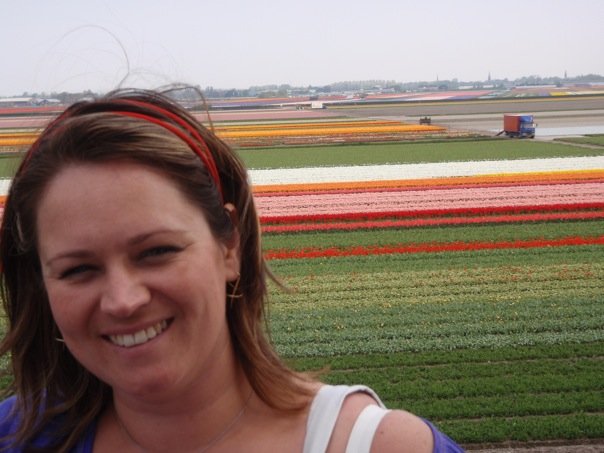
img: Nerissa Muijs at tulip fields outside Lisse, Netherlands.

If you enjoyed this post, we invite you to subscribe for email delivery of The Displaced Nation. That way, you won’t miss a single issue. SPECIAL OFFER: New subscribers receive a FREE copy of “A Royally Displaced Tea.”

Related posts:

Displaced India Hicks throws in beach hat for Royal Wedding hat

Special announcement from TDN: ML Awanohara and Kate Allison will be live-tweeting the Royal Wedding from a displaced perspective. Join us from 5:00 a.m. EST, using the hash tag: #DNRW

On Sunday night I decided to indulge in nostalgia for my misspent youth in England. I watched a couple of TLC programs showing footage from the wedding of Charles and Diana on July 29, 1981.

I was there as a displaced American. Well, I wasn’t in London but at a street party in an East Anglian town.

To be honest, I have only the haziest recollection of how I spent the day: who attended the fete, what we talked about, what we ate. Part of the reason is my exceedingly poor memory.

But I think the lapse is also due to having been displaced so many times since then — to Japan, back to England, and now back to my native United States. England’s royal wedding no longer stands out in my memory compared to other landmark events I’ve observed, such as the marriage of Masako Iwada to Japan’s Crown Prince.

Always a bridesmaid, never a bride

I was therefore particularly taken with the TLC special Untold Stories of a Royal Bridesmaid, featuring model, interior design entrepreneur — and expat — India Hicks.

I kept wondering: does Hicks actually remember that hot day at the end of July 30 years ago? True, she was a bridesmaid for Princess Diana — but she was also only 13 at the time.

And, unlike many of the participants in that Royal Wedding, Hicks has moved on since, quite literally: she has put down roots on a three-mile-long fishing island in the Bahamas, where she lives with her family in a plantation-style oceanfront house.

Indeed, at 43, Hicks is living life on her own terms, a novel concept for a female who was born in the Royal Family orbit (Prince Charles is her second cousin and godfather, and she is 512th in line for the throne). As the New York Times pointed out in its profile of Hicks last month:

For many years, Ms. Hicks distanced herself from the royal circles that surrounded her childhood, focusing on developing her profession.

What’s more — and the Times didn’t point this out — she and her lifelong partner, David Flint Wood, have never bothered to marry, despite having had four children together.

Hicks may have been one of the two bridesmaids assigned to keep track of Diana’s 25-foot-long train, but she doesn’t appear to like weddings much, or else I assume she would have designed one for herself …

A most unroyal royal

I ask you, does this sound like something an heir to the British throne, however remote, would say:

I’d liked to have lived as Cleopatra. She didn’t take any crap from anyone, had lots of children out of wedlock, was intelligent and witty, known for her abilities and was a good stateswoman. I like most that she didn’t take any crap.

It’s what Hicks told the Wall Street Journal in an interview just a few days ago. You go, girl, as we say in the States…

So what’s in it for her besides money — and a higher profile for her brand, which is branching out next month to include jewelry? Not to mention her sense of duty (these are her people, after all).

British people are wont to say that the Royal Wedding provides a good excuse for a day off and a party. But for us displaced people, these affairs are a little different.

For Hicks as for many of the rest of us under equivalent circumstances, I suspect the wedding of Wills and Kate provides a good excuse to:

1) Indulge in a spot of nostalgia.

As Hicks remarks on her TLC special: “I think it will bring back memories that perhaps I’ve forgotten.”

As already mentioned, we displaced types can relate. The desire to recapture your youth intensifies if you are no longer living in your home (or adopted home) country.

2) Spend time in the home country.

As mentioned, Hicks has opted for the life of an expat, far from the madding crowds.

But, while retreating to a Caribbean island may sound like a dream come true, I imagine it has its dull moments, when one longs for a tad more intellectual and social stimulation.

Covering the Royal Wedding provides Hicks with the pretext for hanging out in her native land a little more and for introducing herself to such people as Diana’s wedding dress designer, David Emanuel. (The two haven’t met since 1981.)

3) Reconnect with family.

Living far away from one’s family is another penalty of the expat life, which tends to get steeper with time — especially for women who are close to their mothers.

By becoming a Royal Wedding pundit, Hicks has had the opportunity to reminisce about the good old days with her mother, Lady Pamela Hicks, for several of her TV specials.

A daughter of Lord Mountbatten, the last Viceroy of India (hence her daughter’s first name), Lady Hicks was herself a bridesmaid to Queen Elizabeth.

I particularly enjoyed the moment on the TLC special when mere and fille pull their respective bridesmaids’ dresses out of the boxes and compare them. Hicks thinks her mother’s looks more classical, while hers is dated — a product of the frilly 1980s.

* * *

On the “bridesmaid” special, the time that Hicks seems most enthused about revealing her stories is when she picks up the Halcyon Days china pot that Diana gave to all her bridesmaids, containing a silk worm that helped to produce The Dress. Hicks holds up the little white cocoon and gives it a rattle.

For that single instant, she looks as though she’s been transported back in her island home, having taken the road less (or more?) traveled by…and to which she will be jolly glad to return on April 30.

Question: In your experience as a displaced person, do events in one’s home (or adopted home) country — whether private or public — induce an overblown sense of nostalgia? I’d love to hear your stories.

If you enjoyed this post, we invite you to subscribe for email delivery of The Displaced Nation. That way, you won’t miss a single issue.

What the concept of home means for expats

My mother was the kind of woman who knew she wanted to be a journalist from the age of 12. She never stopped moving. Maybe that’s why I remember so clearly the one ambitious sewing project that she managed to finish. It was a sampler that lay over one of the chairs in our family home embroidered with the words “Home is where the heart is.”

I’ve often pictured my mother’s needlework as I wandered the globe, first as an expat in England, then as an expat in Japan. Where was my heart, and therefore my home: with my mother, my husband, my husband’s family, or in some of the places I’d visited and connected with? Hadn’t I left a piece of my heart in each of those places?

Then when I finally returned to my native land, having spent as many years abroad as I’d consciously lived in the United States, I was no longer sure if this country could be my home any more, as it appeared to have changed so much.

Misery loves company, especially when it includes Joanna Penn

Oh, why does life have to be so complicated? Why can’t it be summed up on a sampler?

Still, I have taken much solace in knowing I’m not alone in grappling with such questions. Just last week, I was pleasantly surprised to discover that my expat-to-repat group now includes the extraordinary Joanna Penn, author, speaker, and business consultant.

I am a faithful subscriber to Joanna’s blog, The Creative Penn, which not for nothing has achieved the distinction of being one of the top ten blogs for writers. Recently, Joanna gave us the thrill of live-blogging the writing and self-publishing process for her very first novel, a fast-paced thriller called Pentacost.

Somehow, though, it hadn’t clicked with me that Joanna was an expat.

But then I read her 8 April 2011 post and watched the accompanying YouTube video, “What the Concept of Home Means for Writers.”

Joanna was prompted to talk about “home” because she’s repatriating to England after having spent the past 11 years in New Zealand and Australia. Not only that but it turns out that Joanna was a so-called third-culture kid. Her family moved all over the place when she was young, including to Africa for a while.

For Joanna, home is a spiritual bond

Joanna thinks outside the box when it comes to publishing, so I suppose I shouldn’t be too surprised that she thinks outside the box when it comes to being an expat. She seems to regard her displaced state as par for the course, as nothing particularly special. This is because she sees herself as a writer first and an expat second:

… for me the concept of home is not necessarily where I’m physically based at any one point but somewhere where I spiritually feel I belong…

We could say Joanna is out of the James Joyce mould, as described by Anthony Windram in his latest TDN article, “James Joyce’s Paris.”

This is not to say Joanna isn’t fond of the countries where she’s lived. She says she still has a soft spot for Malawi, where she went to school as a kid, and has enjoyed her more recent time Down Under.

That said, I sense she will be glad to see the back of Oz in some ways — judging by her response to one of the commenters on her “concept of home” post, that she is “looking forward to being without mosquitoes, huge spiders, sweltering heat and humidity.”

Joanna’s mention of the spiders gives her something in common with Robert Pickles, who has stirred up some controversy for his Daily Telegraph series on why he’s decided to ditch his dream of Australia and move back to Blighty — the “vast array of insects … with fizzing wings and frenzied little eyes” being at the top of his list of dislikes.

A tale of two cities that are now “home”

But that is where the similarity between Penn and Pickles ends. Unlike Robert Pickles, Joanna Penn never really thought of Australia as “home.” Right now she feels a spiritual kinship with two cities: Oxford, where she went to university and near where her father now lives, and Jerusalem, which she’s visited at least ten times because she loves it there so much.

What’s more, Joanna connects these two cities in her mind and has done so ever since reading the Thomas Hardy novel Jude the Obscure as a kid.

The novel’s tragic hero, Jude, is a working-class boy who tries to educate himself. He idealizes Oxford (known in the book as Christminster) as a “city of light,” where “the tree of knowledge grows.” Coming over a ridge and gazing at the city of his dreams for the first time, he refers to it as a “new Jerusalem.”

Joanna approves of Jude’s hypocatastasis. (“And did those feet in ancient time…” is now playing in my head.) Steeped in religious studies, she sees both Oxford and Jerusalem as holy cities, worthy of pilgrimages and therefore an intense romantic attachment.

Some parting spiritual reflections

In the week of Passover and Easter, I sometimes envy those people with strong spiritual ties, a pull that I’ve never especially felt.

In fact, the only time I’ve ever wanted to kiss the ground upon first discovering a place was when I landed in Taipei and my husband took me to a restaurant called Din Tai Fung. The dumplings were so delectable that I decided then and there that if ever I were told I had only a few days left to live, I’d demand to be transported to that restaurant for my final few hours.

Could a Taiwanese dumpling house really be my spiritual home? No doubt that explains why I’m writing about Jamie Oliver’s food revolution on this blog whereas Joanna Penn is working on her second in a series of religious thrillers set in Oxford and Jerusalem.

Still, fans of Ang Lee’s Eat Drink Man Woman should understand how I feel… My mother would understand it: she was an excellent cook, when she had time for it…

But I digress.

Question: What do you think of Joanna’s notion of a spiritual home? Is “home” for you a place that has captured your heart, your imagination and your spirit? Or is it a place where you live with your nearest and dearest?

If you enjoyed this post, we invite you to subscribe for email delivery of The Displaced Nation. That way, you won’t miss a single issue.

RANDOM NOMAD: Kim Andreasson, Management Consultant

Kim AndreassonBorn in: Sweden
Passport: Swedish
Countries lived in: Australia(Sydney): 1988-89; USA (New York and LA): 1996-2010; Vietnam (Saigon): 2010-present
Cyberspace coordinates: DAKA Advisory (business)

What made you leave your homeland in the first place?
My parents decided to travel around the world in 1988-89 and took me along for the ride. We left a snowy Sweden in December and arrived at our first destination, Los Angeles, in 72 degrees and sunshine, staying in the Hyatt on Sunset (now the Andaz West Hollywood). We explored the city’s many attractions including Disneyland and Universal Studios. I was sold and ever since, have considered LA to be the greatest city in the world. At the same time, my curiosity was piqued and I was sold on the idea of leaving something you know well for something different. I have never looked back.

Is anyone else in your immediate family a “displaced” person?
My California-born wife is now displaced as we are living in Saigon. By the way, we first met at a Swedish restaurant in Chinatown in New York City — call it displacement in microcosm.

Describe the moment when you felt the most displaced over the course of your various travels.
I’ve been fortunate to live in the kinds of cities where it’s relatively easy to blend in. But I’ve certainly experienced some memorable cultural contrasts. Soccer (what we Europeans call “football”) is a good example. During the World Cup in 2002 I was in an Irish pub on New York City’s Upper East Side at 4 a.m. watching the match between Sweden and Argentina. I believe I was the only one there watching the game. That was a really strange feeling. By contrast, during the 2009 qualifying match, the time difference was better and there were thousands of of us Swedes watching the games at a bar near Times Square in the middle of the day. This time, I thought I was in Sweden, which was also strange, in its way.

Describe the moment when you felt least displaced.
It’s a curious thing, but it’s when I leave my adopted homeland(s) that I feel especially at home in them. If you ask me my nationality in Vietnam, I’ll always say I’m Swedish. But if you ask me when I’ve just left Vietnam, I’ll say I’m Saigonese (a resident of Saigon). I was in Bangkok recently and couldn’t stop talking about how much I preferred life in Saigon. Likewise, when I lived in the U.S. and went home to Europe, I would feel more American than European during my visit.

You may bring one curiosity you’ve collected from your travels into the Displaced Nation. What’s in your suitcase?
From Australia, a boomerang, for the symbolism of always coming back. From America, a basketball because I enjoy the game and would like to continue playing it. And from Vietnam, a business suit — you can get world-class tailoring here at a very good price.

You’re invited to prepare one meal based on your travels for other Displaced Nation members. What’s on your menu?
Without a doubt, as a Swede, I am known for my guacamole. No, really. I guess because I lived in LA for so long, I came to love Mexican food. I would prepare it for you according to a classic recipe, something like:
1 tablespoon red onion
1 tablespoon cilantro
1 tablespoon jalapeno
1 avocado
2 tablespoons diced tomato
1 pinch of salt

You may add one word or expression from each of the countries you’ve lived in to The Displaced Nation argot. What words do you loan us?
From Australia: “G’day mate” — for its friendliness.
From the USA: “Awesome” — it reminds me of how globalized LA jargon has become, courtesy of Hollywood.
From Vietnam: “Ba” — and if you repeat it three times, you get a beer (333)!

img: Kim Andreasson on his way to Bến Thành Market, in Saigon (Ho Chi Minh City) — that’s if he can navigate the intersection of Le Loi, Ham Nghi, Tran Hung Dao Avenues and Le Lai Street.

If you enjoyed this post, we invite you to subscribe for email delivery of The Displaced Nation. That way, you won’t miss a single issue.

Jamie Oliver, culinary expert — and now expat?

Try as I might, I can’t make out why Jamie Oliver has taken it upon himself to save my countrymen from themselves.

I understand he’s trying to start a food revolution. Not only that but I’m a supporter, having signed the online petition. After all, I lived in Japan for long enough to see that if a national diet is in essence health food, there are many fewer incidences of obesity, diabetes, and heart disease, and people live longer.

But why is Jamie Oliver, of all people, leading this campaign? That’s the part I haven’t been able to fathom. Before going to Japan, I lived in Britain, where Oliver was known as the “naked chef.” Call it a lack of imagination but somehow I never anticipated that the face of the Sainsbury’s grocery-store chain would someday transform himself into a food activist and arrive on my shores. What happened?

Don’t get me wrong, I’m glad Oliver has decided to export his food revolution. For me, his confrontation with the stony-faced lunch ladies at the school in Huntington, West Virginia — which has been called the unhealthiest city in America — goes down in the annals as reality TV at its finest.

(I’m still not convinced those ladies aren’t actors.)

And now that he’s back for a second season of his “food revolution” show, which premiered last night, I’m enjoying seeing him take on the members of the Los Angeles school board, next to whom the West Virginian women seem warm and welcoming. LA is the second-largest school district in the nation, serving over half a million processed meals every day.

I note that this time, Oliver brought his wife, Jools, and their four young children, to live with him in LA. Is he planning to become an expat? Stranger things have happened…

I can’t really explain why Oliver would choose to displace himself and his loved ones in the service of America’s overfed youth, but I can offer some half-baked ideas:

1) He doesn’t like being less well known than Gordon Ramsay.

Ramsay surpassed Oliver some time ago in terms of earnings and visibility. Indeed, last night’s show offered evidence of this in a scene involving Dino Perris, the owner of a fast-food drive through in Glassell Park, a working-class neighborhood in LA. Perris said he’d never heard of Jamie Oliver and thought he might be that “rude guy.”

The only thing wrong with this theory? Ramsay is best known for swearing a blue streak and Oliver for interacting with kids like the Pied Piper of Hamelin. Apples and oranges.

2) He is descended from missionary stock (hahaha).

In other words, it’s in his DNA to make converts beyond his own shores.

This theory, however, doesn’t hold water when you study Oliver’s family tree. Most of his people hailed from Cornwall and his great-great grandfather John Oliver was a Royal Navy seaman who did time in prison — not exactly the ingredients from which a food evangelist emerges.

3) He is escaping from Britain because his popularity is on the wane.

His fellow Brits have grown tired of seeing him running around in his green pea costume, so he is seeking a fresh audience.

At first this theory seems quite palatable. Most Americans probably don’t know this, but there was a backlash against Oliver’s “school dinners” program in the UK. It reached its peak when two mothers at a school in South Yorkshire started delivering junk food from local shops through the school fence, claiming that their youngsters didn’t want to eat the celebrity chef’s “overpriced lowfat rubbish.”

Still, I can’t believe that Oliver was ever put off by people who cooked up stunts that are, in effect, straight out of his manual. He loves nothing better than stirring the pot, and besides, he achieved what he wanted: the UK government established the School Food Trust, dedicated to improving the quality of food in the nation’s schools.

Okay, so I have no idea why he’s here. I might as well chime in with Jon Stewart, who, when Oliver appeared on his show last week, summed it up as follows:

You have come to this land you and you would like to help us become healthier, better people. Good luck with that.

And if Angelenos start throwing rotten tomatoes at him, I hope he has the good sense to move across the Pacific. Rumor has it that obesity rates among children in Asia are rising with the invasion of McDonalds, KFC, Pizza Hut, and so on.

If that doesn’t make him fed up, I don’t know what will.

Question: What do you think has made Jamie Oliver cross borders, and would you like to see him become an expat in the United States?

If you enjoyed this post, we invite you to subscribe for email delivery of The Displaced Nation. That way, you won’t miss a single issue.

How many years should an expat stay? The answer is blowin’ in the wind…

Most human beings feel disconcerted when they lose the self-validating “mirror” that tells them who they are. That’s what we hear from the relocation experts — as cited by Kate Allison in her article exploring how even people who move within the same country can have something akin to an expat experience.

But in my own experience of being displaced, first in England and then in Japan, trying to live in a country where you share a great deal — ethnically, culturally, linguistically — with the natives is easier to sustain for lengthy periods. Under those conditions, it’s possible to maintain the illusion of the mirror still being in place.

After all, quite a few Americans — comedians like Ruby Wax and Reginald D. Hunter, writers like Bill Buford and Bill Bryson — have made it in England. In Japan, by contrast, although foreigners can become talento, they will never achieve the same level of belonging.

Thus when I first learned the news that Junichi Kinoshita had won this year’s Taipei Literature Award, the first non-native writer to do so in 13 years, I thought, well, no wonder. On the face of it, Taiwan should be a relatively easy adjustment for a Japanese person.

But does Kinoshita actually feel that way? Yes and no. His first impression of the Taiwanese was how similar they looked to the Japanese, and though he found learning Mandarin a challenge, he eventually mastered it to the point where he was able to write his debut novel in Chinese, and at a level that garnered it a prestigious award.

On the other hand, life in Taiwan posed a considerable culture shock as people there tend to be much more hospitable than the Japanese. In Kinoshita’s book, the title of which can be roughly translated as Dandelion Floss, five Japanese expatriates in Taipei struggle to adjust to the local culture — and when they finally get the hang of it, must grapple with the question of when (and whether) to go home to Japan.

At the end of the novel, one of them says:

I think every expatriate is following some kind of mysterious calling from their heart. There is some predestined relationship between a person and a city. One leaves the city when the affinity ends, be it a few months or 10 years, it just happens.

Kinoshita intended his book as a swan song to his life in Taipei. After submitting it to the contest, he planned to return to Japan with his wife, who is also Japanese. Now, however, they are rethinking their next step: perhaps the prize is a signal that Kinoshita isn’t finished with the city yet? Besides, he has already decided on a theme for his next work of fiction, as well as a language: Chinese again.

If you enjoyed this post, we invite you to subscribe for email delivery of The Displaced Nation. That way, you won’t miss a single issue.

RANDOM NOMAD: Anita McKay, Property Manager

Born in: Indonesia
Passport(s): Indonesian and British Permanent Resident
Countries lived in: Australia (Sydney): 1999-2001; Scotland (Aberdeen): 2007-2009; Western Australia (Perth): 2009-2013
Cyberspace coordinates: Finally Woken (blog)

What made you leave your homeland in the first place?
I left in 2000 to study for a master’s degree in Sydney. I left again in 2007 because my then fiance (now husband) got a job in the UK. Philosophically, I have never really felt at “home” in my own home country of Indonesia. Lots of its values don’t match with mine. From the time I was a child, I felt like an alien and longed to go away.

Is anyone else in your immediate family a “displaced” person?
No. My brother doesn’t like to travel and still lives at home with my parents. But three of my father’s sisters are married to Germans: two still in Germany and one in Indonesia. And I have four cousins living in the Netherlands and Germany.

Describe the moment when you felt the most displaced over the course of your various travels.
It was in Sydney. I was working as a casual staff at an ice cream shop while doing my postgraduate study. It was winter, around 10:00 or 11:00 p.m. I had just closed the shop and was waiting for the bus. It was rainy and cold, and then all of a sudden, there was a hailstorm. I almost cried, I felt so sorry for myself. I was thinking about how if I’d stayed put in Indonesia, I could have been working for a big company and earning a nice salary by then, living with maids and a chauffeur. I wouldn’t have to mop floors or clean windows to pay the rent. In the Indonesian island where I come from, everyone knows me and my family, but here in Sydney, no one cares who I am or whose daughter I am…

Describe the moment when you felt least displaced.
Weirdly, I almost always feel more at home in anywhere but my own country.

You may bring one curiosity you’ve collected from your travels into the Displaced Nation. What’s in your suitcase?
A flash disk containing thousands of photos.

You’re invited to prepare one meal based on your travels for other Displaced Nation members. What’s on your menu?
Chicken tikka masala — it’s originally from Glasgow, most people don’t know that — and cranachan for dessert.

You may add one word or expression you’ve picked up from the countries you’ve lived in to The Displaced Nation argot. What word(s) do you loan us?
“Bollocks.” My hubby, who is Scottish, says it sounds cute when I say it. I try to use a Scottish intonation. He would let me say it whenever I wanted — until I said it in front of his 95-year-old grandmother, and then he explained it was actually a very very rude word.

img: Anita McKay (left) with a good Indonesian friend who was visiting her in Scotland, in front of Balmoral Castle, the only royal residence outside England.

If you enjoyed this post, we invite you to subscribe for email delivery of The Displaced Nation. That way, you won’t miss a single issue.

Free at last of the media bubble: The FT’s Simon Kuper on the expat life

Every once in a while, I come across an article on the expat life that is so brilliant, I cannot refrain from screaming “yes!” aloud — thereby disturbing my two dogs, who don’t like being aroused from their naps unless it’s food.

That’s how I felt when reading Simon Kuper’s “Why expats don’t get tinnitus,” which appeared in the March 25 FT Magazine.

Kuper had me with the opening sentence:

I’ve lived in Paris for nine years now, but I’m still often not sure what goes on here.

Yes, I can relate, after my nine years in England and my seven in Japan!

He then goes one to say that he doesn’t actually mind living in ignorance, if it means being immune to the daily news cycle —  who’s up and who’s down — as well as the “status dance.”

Yes, I get that, too! Particularly in Japan, where I soon reached the point of not really knowing or caring whether I was meeting VIPs (the exception being when I met Prince Charles). I could decide whether I liked a person for who they were, not for the “status hat” they were wearing. (Not sure he could have worn a hat, with those ears.)

For Kuper, living in the media bubble can be likened to having a “constant dreadful ringing sound in your ears,” or tinnitus. He says he loves his tinnitus-free life, recognizing he’s not the first expat to feel this way. (No, he’s not!) He quotes the writer James Baldwin saying he was grateful to Paris for treating him with “utter indifference,” notes that Gertrude Stein appreciated Paris for a similar reason, and acknowledges Pico Iyer for capturing the liberation-through-alienation sentiment so well in his book The Global Soul.

The only thing I can’t concur with is Kuper’s conclusion, that if the Internet could be shut down, he’d be completely cured of his tinnitus. Were it not for the Web and my Google alerts, I may never have discovered this article of his, and would be the poorer for it.

If you enjoyed this post, we invite you to subscribe for email delivery of The Displaced Nation. That way, you won’t miss a single issue.

