The Displaced Nation

A home for international creatives

RANDOM NOMAD: Camden Luxford, Hostel Owner, Freelance Writer/Blogger & Student

Born in: Mackay, Queensland, Australia
Passport: Australia
Countries lived in: United Kingdom (Brighton, Oxford, Edinburgh, and a country hotel near Crickhowell, Powys, Mid Wales): 2005-06; Peru (Cusco): 2009-present.
Cyberspace coordinates: The Brink of Something Else (blog)

What made you leave your homeland in the first place?
I left, at 20, because I’d always had an itch. As a kid, I’d poured over National Geographics and Lonely Planets, plotting these exotic routes across strange lands. I think I imagined myself some kind of Lara Croft-type figure. Then I grew up and didn’t really know what I wanted to do with the rest of my life, so I boringly did what thousands of Australian 20-somethings do every year — took off to the UK for a couple of years.

Is anyone else in your immediate family displaced?
Dad’s displaced — in a jet-setting, corporate type of way. He always traveled a lot for work when I was young, domestically and internationally, and now he’s semi-retired and living most of the year in Italy. It’s handy, ‘cos now I have a great place to stay close to really good pizza and wine.

Describe the moment when you felt most displaced.
Waiting at the police station to report an alcoholic Latino ex for threatening to kill me, and having the cops not really care. I just thought in that moment, what I wouldn’t do to be back home, away from this machismo, in a place were I instinctively understand how men and women relate to each other.

Describe the moment when you felt least displaced.
Every Wednesday I get together with my closest friends here in Cusco for lunch. We cook, open a few bottles of wine, and laugh away all the week’s problems and dramas. It’s my Cusco family, and when we sit around the table, teasing each other mercilessly, I feel completely at home.

You may bring one curiosity you’ve collected from your adopted country into The Displaced Nation. What’s in your suitcase?
I tend not to hold on to things, just memories — and a hard drive full of photos. So I’ll describe a treasured photo from each country, instead.

From England: One of myself and my friends on the pebbly beach of Brighton. It’s a candid, and nobody’s posing, we’re just scattered about doing our thing. A couple of the boys are playing chess, a small group is talking, I’m reading a book, someone’s playing guitar. It’s a lovely slice of our lives that summer.

From Wales: Tintern Abbey caught just as the sun set. I was driving, turned a corner, and that sight took my breath away.

From Scotland: An entire album covering my 22nd birthday — from the moment my roommates woke me up with fairy bread and beer until about 4:00 a.m. the following morning. The deteriorating respectability is spectacularly documented.

From Peru: A Photoshopped-together photo of “Yamanyá,” the name of my hostel, spelled out in fire. We were camping by the Templo de la Luna (Moon Temple) outside of Cusco, and after half a bottle of rum I pulled out the camera and an Argentinian friend lit a stick on fire. It kept us entertained for more than an hour.

You’re invited to prepare one meal based on your travels for other Displaced Nation members. What’s on the menu?
Definitely a starter of ceviche: thin fish strips flash-marinated in lime with a touch of coriander, a load of chile, and a pile of fresh red onion, accompanied by a very cold Cusqueña beer. Served on the sand within spraying distance of the waves.

Then, in anticipation of my upcoming move to Buenos Aires, it’s a thick Argentinian steak cooked rare, with a glass of Malbec. Good meat is hard to come by in Cusco, and I miss it.

For dessert we’ll visit Dad in Italy: tiramisu, and then a strong espresso to finish the caffeine kick.

Then the Pisco gets opened, and it’s chilcanos all round: Pisco, ginger ale, a drop of Angostura bitters and a squeeze of lime.

You may add one word or expression from the country you’re living in to The Displaced Nation argot. What will you loan us?
From the UK: Minging has always stuck with me; I have no idea why. For the uninitiated it means disgusting, ugly, gross.
From Peru: Sí, no? — a delightfully Limeñan turn of phrase whose English translation (yes, no?) doesn’t make any sense at all.

It’s Zen and the Art of the Road Trip month at The Displaced Nation. Robert M. Pirsig, author of Zen and the Art of Motorcycle Maintenance, famously said: “Sometimes it’s a little better to travel than to arrive.” Do you agree?
I’ve always loved long, uncomfortable journeys, whether in car, train, bus, boat, or on foot — the process of being in transit, of movement, of change. I even have a sick fascination with long stopovers in airports: sleeping curled up on an uncomfortable bench, announcements blaring over the loudspeakers.

So for me, yes, the journey is a little better. Having been here, in Cusco, for almost two years, I’m growing uncomfortably restless. My mother argues that this is fear of commitment on an epic scale, but I like my life most — feel like I’m learning the most — when I’m on the move, and in the first blush of a new life in a new place.

I will point out in my own defense that I maintain my work and studies even while on the road. In a very stop-start sort of fashion, I’m finishing a Bachelor of Arts in International Studies and a Bachelor of Commerce in Economics from Deakin University in Melbourne, as part of their off-campus program. So I’m not completely irresponsible. (So there, Mum.)

Pirsig’s book details two types of personalities: 1) those who are interested mostly in gestalts so focus on being in the moment, not rational analysis; and 2) those who seek to know the details, understand the inner workings, and master the mechanics. Which type are you?
Despite a thoroughly scientific upbringing and education — Dad’s an engineer — and a very rational approach to my studies, when it comes to travel and expat life I’m all about the gestalts. I stayed in Cusco on little more than a whim, and recently returned from an ill-planned but exhilaratingly unpredictable road trip to Ecuador in a Volkswagen Kombi. Every moment of that road trip was a surprise — the cast of characters, a rotating mix of backpackers and South American musicians and circus performers. We followed the sun north, took a minor detour inland to teach a music and clowning workshop to the children in a poor community, and played music on the beach.

But although I laughed and made wonderful new friends and was constantly surrounded by music, this road trip, with its constant visits to mechanics, was also the reminder I needed of the importance of the rational type of personality. Road trips in general are a wonderful encapsulation of this duality, I think. Driving with the windows down on the highway with the music blaring, going where the wind takes you…but going there in a machine that needs care and understanding and maintenance. I’ve leaned too heavily to the romantic side, and it’s time to start taking better care of my machine.

Readers — yay or nay for letting Camden Luxford into The Displaced Nation? Tell us your reasons. (Note: It’s fine to vote “nay” as long as you couch your reasoning in terms we all — including Camden — find amusing.)

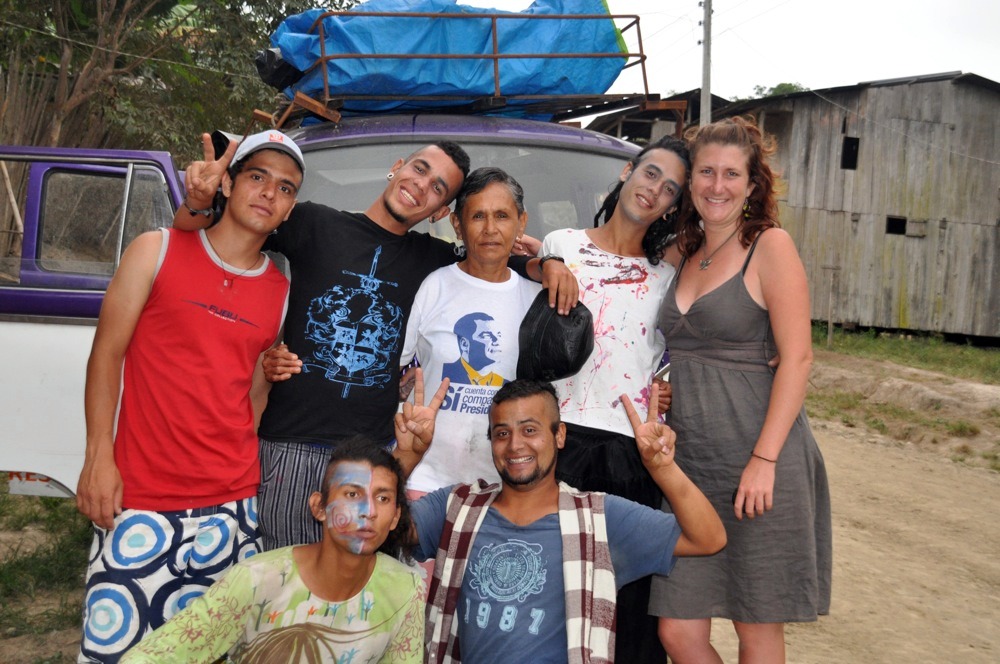
img: Camden Luxford on her recent road trip — in a tiny community about two hours form Pedernales in Ecuador, where she helped put on a juggling (among other things) workshop. She is posing with some of the kids and a teacher, along with members of the Colombian cumbia band she had as passengers for a couple of weeks. Yes, that’s the famous Kombi in the background!

STAY TUNED for tomorrow’s installment from our displaced fictional heroine, Libby, whose road-trip adventure of last week ended on a dramatic note. What, not keeping up with Libby? Read the first three episodes of her expat adventures.

If you enjoyed this post, we invite you to register for The Displaced Dispatch, a round up of weekly posts from The Displaced Nation. Includes seasonal recipes and book giveaways. Register for The Displaced Dispatch by clicking here!

Related posts:

The John Steinbeck Encyclopedia of Road Trips

When we announced this month’s theme — road trips — some of you may have wondered if we’d gone around the bend. Zen and the Art of Motorcycle Maintenance — really? That’s a book for roadgeeks or — if you get into its philosophical meanderings — Roads Scholars, not for Displaced Nation types, most of whom equate travel with boarding an international flight.

Besides, road trips are for the young and restless — something you do when you’ve just graduated college.

But before you put the brakes on the road-trip idea again, let me convince you to take one more test drive. Only this time, instead of riding pillion on Robert Persig’s motorcycle, you’ll be seated in John Steinbeck’s camper station wagon next to his pet dog, Charley, on a 10,000-mile journey across America — from Long Island to Maine to Chicago to Seattle to California to Texas to New Orleans and back to New York City.

As the Nobel prize-winning writer puts his engine in gear, may I invite you to peruse our specially compiled John Steinbeck Encyclopedia of Road Trips.

A is for Autumn

John Steinbeck made a road trip across America in the autumn season and in the autumn of his life. He set out from his home in Sag Harbor, Long Island, shortly after Labor Day in 1960. He was 58 years old and not in the best of health. As Edward Weeks wrote of Steinbeck’s expedition in The Atlantic:

He set out with some misgiving, not sure his health would stand up to the 10,000-mile journey he envisioned; as he traveled, the years sloughed off him…

B is for Bestseller

Steinbeck wrote a book about his journey, Travels with Charley. It reached #1 on the New York Times bestseller list for non-fiction on October 21, 1962. To this day, the book retains a special place in the American imagination, despite attempts to challenge its categorization as “non-fiction” (see F).

C is for Charley

Meet Charley, Steinbeck’s middle-aged French poodle, one of the most civilized and attractive dogs in literature. He’s the genuine article, a real French poodle, having been born on the outskirts of Paris, where he also received his training. As his proud owner once said:

…while he knows a little Poodle-English, he responds quickly only to commands in French. Otherwise he has to translate, and that slows him down.

D is for Dog

For Steinbeck, a dog is an ideal companion on the open road as well as being an effective ice breaker:

A dog is a bond between strangers. Many conversations en route began with “What degree of dog is that?”

E is for Environment

Steinbeck was extremely attuned to the intimate connection between people’s lives and the rhythms of nature — weather, geography, the cycles of the seasons. But while nature animates his picaresque tale of his travels with his dog, one of his key observations was the the high price Americans would eventually pay for lives filled with ease and convenience. He felt they were trashing their environment for the sake of material prosperity. (A tad prescient, might we say?)

F is for Fictions

Journalist Bill Steigerwald set out to retrace Steinbeck’s steps on the 50th anniversary of his road trip. He concluded that not only had the Nobel laureate invented characters, he’d also embellished the hardships of his cross-country journey with Charley. In other words, this brilliant author’s much-loved book is loaded with creative fictions. (Wait, I thought all travel writers used some creative license — is there anything wrong with a novelist-turned-travel-writer using some?)

G is for Giant Redwoods

After sorting out his flat tire in Oregon (see O), Steinbeck visited the giant redwoods and ancient Sequoias and found them as awe inspiring as ever:

The vainest, most slap-happy and irreverent of men, in the presence of redwoods, goes under a spell of wonder and respect.

Steinbeck was further impressed when his dog, Charley, refused to urinate on the trees…

H is for Hurricane

The best-laid schemes of mice and men go oft awry, and Steinbeck had to delay the start of his trip slightly due to Hurricane Donna, which made a direct hit on Long Island. (Still, it could have been worse. It could have been Hurricane Irene!)

I is for International

While he never became an expat, Steinbeck moved to New York City and took quite a few international trips, mostly to Europe. He hoped that his road trip would enable him to reconnect with both the people and the landscape of his native land. He also wanted to see his birthplace — Salinas, California — one last time.

J is for Jamming

Steinbeck’s journey concluded with jamming Rocinante (see R) across a busy New York City street, during a failed attempt at making a U-turn. He reports having said to the traffic policeman:

Officer, I’ve driven this thing all over the country — mountains, plains, deserts. And now I’m back in my own town, where I live — and I’m lost.

K is for Knight-errant

A mainstay of medieval romance literature, the knight-errant wanders the land in search of adventures to prove himself a worthy warrior. Don Quixote is a famous example (see Q). Likewise, Steinbeck hoped to recapture his youth, the spirit of a knight-errant, through his travels. (Makes sense if you’re middle aged and your health is rapidly deteriorating — see P.)

L is for Language (of Road Signs)

Steinbeck closely observes the language of road signs during his trip across country. In New York State, he notes that the road signs are commands: “Stop! No turning!” But in Ohio, the language is gentler, with friendly advice rather than curt demands.

M is for Maine

Steinbeck reports that he learned not to ask for directions in Maine because locals don’t like tourists and tend to give them the wrong directions — another example of regional differences (see L).

N is for North Dakota

Upon arriving at Fargo, North Dakota, Steinbeck declares that the mentality of the American nation has grown “bland.” He fell head over heels in love with Montana, however. NOTE: Steinbeck’s account of meeting an itinerant Shakespearean actor outside the town of Alice, North Dakota, is disputed by the journalist Bill Steigerwald (see F).

O is for Oregon

Having his first flat tire on a remote back road in Oregon inspired Steinbeck to write a send-up of similarly desperate scenes in his most famous novel, The Grapes of Wrath:

It was obvious that the other tire might go at any minute, and it was Sunday and it was raining and it was Oregon.

P is for Poignancy

When Steinbeck set out on his road trip, he knew he could have died at any point along the way because of his heart condition. This knowledge suffuses Travels with Charley with a certain poignancy, and perhaps explains why it’s such a beloved book.

Q is for Quixote

As one might expect of a man who won a Nobel Prize in Literature, Steinbeck had a literary hero in mind when he set out on his road trip: Don Quixote. Like the ingenious gentleman of La Mancha, it seems that Steinbeck fancied himself a knight-errant in search of adventure (see K). He even named his camper truck for Quixote‘s steed (see R).

R is for Rocinante

As the narrator of Don Quixote explains, its hero feels obliged to find the right name for his horse:

Four days were spent in thinking what name to give it, because (as he said to himself) it was not right that a horse belonging to a knight so famous, and one with such merits of his own, should be without some distinctive name…

At last, Don Quixote calls the skinny steed Rocinante. In a nod to this fictional knight-errant (see K), Steinbeck christened the vehicle for his journey — a green GMC truck, which he’d had custom-fitted with a camper — Rocinante. He even painted the name across the side of the truck in 16th-century Spanish script.

S is for Salinas

Steinbeck was born in Salinas, California. He wrote his first stories about the Salinas Valley and was determined to see his hometown one last time before he died. Visiting a bar from his youth, he lamented the loss of several regulars as well as quite a few of his childhood chums, wondering if perhaps Thomas Wolfe was right (see Y).

T is for Texas

Steinbeck remarked of Texas that it was the kind of state that “people either passionately love or passionately hate.” He went on:

Texas is a state of mind. Texas is an obsession. Above all, Texas is a nation in every sense of the word. … A Texan outside of Texas is a foreigner.

Texas was also where Charley (see C) became ill for a few days and stayed in a veterinary hospital. NOTE: From Texas onwards, Steinbeck’s travel writing gives way to social commentary, culminating in the account of a school integration crisis he witnesses firsthand in New Orleans.

U is for U.S. Route 66

In mid-November of 1960, Steinbeck crossed the Mojave Desert and picked up the historical U.S. Route 66 at Barstow, California. He and Charley then drove 1,300 miles to arrive in time for a Texas-style Thanksgiving on a cattle ranch near Amarillo. U.S. Route 66, known colloquially as the “Main Street of America” or the “Mother Road” was a major path for those who migrated west. In Steinbeck’s classic novel The Grapes of Wrath, the poor family of sharecroppers, the Joads, make their way west from Oklahoma to California on U.S. Route 66.

V is for Viking Press

Travels with Charley was published by the Viking Press in mid-summer of 1962, several months before Steinbeck was awarded the Nobel Prize in Literature.

W is for Wanderlust

Steinbeck begins Travels with Charley by describing his wanderlust, saying he’s had a life-long impulse to travel and explore the world.

X is for Xena the Warrior Princess

This entry has nothing to do with John Steinbeck, but I have included it in case there are any women travelers who are having trouble identifying with the adventures of a rugged, broad-shouldered, six-foot-tall writer, and his desire to be seen as a knight-errant (see K). Xena the Warrior Princess reminds me of the title of Debbie Anderson’s best-selling guide for women who travel the open road: Simple Rules for…The Road-Warrior Princess.

Y is for “You can’t go home again”

When Steinbeck reached his birthplace of Salinas, he discovered the truth of Thomas Wolfe’s words “You can’t go home again.” Saying good-bye to his hometown for the last time was a bittersweet experience:

I printed once more on my eyes, south, west, and north, and then we hurried away from the permanent and changeless past where my mother is always shooting a wildcat and my father is always burning his name with his love.

Z is for Zzzzz (under the stars)

Steinbeck reports that camping out with Charley in the American outback — where they enjoyed lots of zzzzz under the stars — was one of the highlights of their trip (though the veracity of that experience is now disputed — see F). But, despite the magnificent setting, both he and Charley often suffered moments of crushing loneliness. Ultimately, man and dog concurred that however much they relished their adventure, home is where the heart is.

So…are you inspired? Can you now see yourself motoring across country in the autumn and/or autumn of your life? And how about attempting a best-selling travelogue? (Or am I still driving you bonkers?!)

STAY TUNED for tomorrow’s post, a Displaced Q about none else than road trips(!).

If you enjoyed this post, we invite you to register for The Displaced Dispatch, a round up of weekly posts from The Displaced Nation. Includes seasonal recipes and book giveaways. Register for The Displaced Dispatch by clicking here!

Related posts:

Image: MorgueFile
RANDOM NOMAD: Tom Frost, Kindergarten Teacher & Expat Blogger

Born in: Hillsboro, Oregon USA
Passport: USA
Countries lived in: India (Belgaum): 1979-80; Japan (Mutsu and Hachinohe): 1983-88; Mexico (Mazatlán):2005-06; Argentina (Buenos Aires): 2006-09; Uruguay (Colonia del Sacramento): 2009-10; Asia (Japan, Thailand, Malaysia, Laos, Hong Kong): 2010-2011; China (Beijing): July 2011 – present.
Cyberspace coordinates: Expat Alley (blog)

What made you leave your homeland in the first place?
My wife, Maya Frost, and I left the US to give our children a taste of the world outside and to supercharge their brains with new languages, new challenges and new experiences. Maya wrote the book The New Global Student: Skip the SAT, Save Thousands on Tuition, and Get a Truly International Education, detailing our experiences getting the kids — we have four daughters — through high school and college without going the traditional route. Two of them are now working in Buenos Aires and Abu Dhabi. The other two are in New York, one of whom has just completed a couple of years working as a multilingual events coordinator on Norwegian Cruise Lines — she was craving some “land time.” Maya and I have settled in Beijing for the time being.

Is anyone else in your immediate family displaced?
My wife and I were both displaced Oregonians living in Japan when we first met. All of my family have traveled quite extensively. Like me, my three siblings were all Rotary exchange students for a year in France, Philippines and South Africa (I lived in India). For a time one of my siblings lived in Japan for several years. I have a niece in Barcelona, a nephew in Japan, a cousin in Africa…

Describe the moment when you felt most displaced.
Getting off a plane in Miami after being in South America for two years. It was overwhelming to understand everything that was going on around me. All the magazine racks were screaming that I was too fat, too old, too poor and too poorly dressed. I wanted so much just to get back on the plane and go “home” to Buenos Aires.

Describe the moment when you felt least displaced.
The longer I stay out of the US the more this is happening. The “normal” feeling for me now is to feel displaced. Not understanding the language, not feeling like one of the crowd, not recognizing anything on a menu — that is when I feel at home.

You may bring one curiosity you’ve collected from your adopted country into the Displaced Nation. What’s in your suitcase?
My wife and I are obsessively light travelers. Even when moving to a new place to live for an extended period of time, we never have more than one carry-on each. I am a firm believer in the old adage that “you don’t own stuff, your stuff owns you.” I have a compass that was left to me by my father and about 30 photographs (unframed) of our family — we buy new frames each time we set up a new home. Beyond those items we take nothing more than a few changes of clothes and our laptops.

You’re invited to prepare one meal based on your travels for other Displaced Nation members. What’s on the menu?
Let’s start with the drinks because they generally taste the same each time they come out of the bottle, unlike my favorite meals which are those have not yet tasted.

A bucket of iced Mexican Pacifico [a Pilsner-style beer] for the appetizer, chilled sake for the cold course, a hearty Uruguayan Tannat for the main, Argentine fernet for dessert — and a couple of Tylenol for a nightcap.

I love to cook and am in charge of all the meals in our house. But I do not use recipes and generally do not make the same thing twice. Each time I go to the grocery store I buy at least one item I do not recognize. Past favorites have included:

My current craving is for shrimp Chinese dumpling, purple cabbage and cucumber in a spicy chili sauce, with cut chives for garnish. How does that sound?

You may add one word or expression from the country you’re living in to The Displaced Nation argot. What will you loan us?
My ability with languages is less than stellar so I’d prefer to loan you a few body language motions.

From Japan: Sucking air through gritted teeth and turning your head to the side — this means you are giving something a great deal of thought but also buys time to figure out what what was just said. Even if you cannot come up with a reply, you get points for showing you are thinking hard about the subject at hand.

From Argentina: The shoulder shrug — a good way of masking your ignorance of an indecipherable comment. Essentially it means: “Sometimes shit just happens, you know?”

From India: The head bobble — it can be construed as an affirmation but is ambivalent enough that you can later change your mind and renege on whatever you agreed to. It is also fun to practice in the mirror for your own amusement when bored.

It’s Zen and the Art of the Road Trip month at The Displaced Nation. Robert M. Pirsig, author of Zen and the Art of Motorcycle Maintenance, famously said: “Sometimes it’s a little better to travel than to arrive.” Do you agree?
I dislike traveling without arriving.

There are certain things I immediately look for in any destination to make me feel at home, but in reality, it is silly I look for them — why bother traveling if I want to feel at home?

I love this paradox.

Pirsig’s book details two types of personalities: 1) those who are interested mostly in gestalts so focus on being in the moment, not rational analysis; and 2) those who seek to know the details, understand the inner workings, and master the mechanics. Which type are you?
I definitely lean more toward the rational mindset. I love getting to know transportation — specifically, bus routes and subways — as well as getting a handle on how traffic patterns have developed over time. As a child of the US suburbs, I used to equate riding public transportation with being a loser, but now I know it is freedom. And it’s not just rational, it can also be “in the moment.” Life happens on public transportation — the grateful glance from an elderly woman you give up your seat to on a subway in Tokyo, the giggles of the small child you play peek-a-boo with on the train in Kuala Lumpur, the strains of the guitarist serenading bus riders on a Friday afternoon in Buenos Aires. Nothing interesting has ever happened to me by myself in a car.

Readers — yay or nay for letting Tom Frost into The Displaced Nation? Tell us your reasons. (Note: It’s fine to vote “nay” as long as you couch your reasoning in terms we all — including Tom — find amusing.)

img: Tom Frost becoming displaced yet again — by an elephant in Pai, Thailand (June 2011).

STAY TUNED for tomorrow’s installment from our displaced fictional heroine, Libby, who is just back from a road trip with Oliver and Jack, during which she has pondered her new life and the Melissa situation. What, not keeping up with Libby’s expat adventures? Read the first three episodes here.

If you enjoyed this post, we invite you to register for The Displaced Dispatch, a round up of weekly posts from The Displaced Nation. Includes seasonal recipes and book giveaways. Register for The Displaced Dispatch by clicking here!

Related posts:

6 celebrated women travel writers with the power to enchant you

Any wannabe expat/travel writer would do well to consult with Kristin Bair O’Keeffe, herself a novelist and former expat, before beginning their Great Works. Kristin offers a wealth of writing tips on Writerhead, a blog that she launched on April 1 of this year (which, coincidentally, was the same day we launched The Displaced Nation).

Of the helpful hints Kristin has offered thus far, I have many favorites, but if I had to pick one, it would be her post entitled “Write Wee.” In her breathlessly inimitable style, Kristin assures us that producing a multi-volume series on one’s overseas adventures is not the way to go:

Instead find a nugget. A moment. A single object. One exchange. One epiphany. One cultural revelation.

Find one story and tell it.

Just it.

The only thing I would add is that in general, women are better at extracting such nuggets than men.

Actually, what got me started in thinking about the difference in travel writing styles of the sexes was a post I wrote a couple of weeks ago on Edwardian novelist Elizabeth von Arnim, who penned the much-loved work, The Enchanted April, about four women who escape to a medieval castle in Italy for a much-needed break from their routines.

For me, von Arnim typifies one of characteristics that makes women’s travel writing so special (no doubt there are many more!). As she wandered far and wide across Europe and America, she paid extremely careful attention to the details of her surroundings.

A forerunner of what today we’d call a nature freak, she could get lost in telling the story of watching a “nightingale on a hornbeam, in loud raptures at the coming of the sun…” — I quote from her largely autobiographical novel The Solitary Summer, about a woman, also called Elizabeth, who is anything but solitary. She has a husband, to whom she refers as the Man of Wrath, small child and household to care for.

Perhaps such descriptive powers are born of necessity. Women have little choice but to make the most of spinning tales out of the moments they snatch from lives that are otherwise spent ministering to the needs of others — even when they’re technically on vacation.

Having combed through the pages of The Virago Book of Women Travellers (ed. Mary Morris with Larry O’Connor), I think I may be on to something. I discovered any number of women travel writers with the power to enchant their readers by capturing in their works the moments, exchanges, and personal ephiphanies their wanderings have yielded.

Here are six whose “nuggets” continue to gleam for us modern-day nomads:

Frances Trollope (1780-1863)

Who was she? Mother of Anthony and like her son, a prolific writer of novels (34 in total!).
Key work: Domestic Manners of the Americans, a travel book that made her name, about the four years she spent pursuing opportunities in the United States after her family suffered financial setbacks.

from DOMESTIC MANNERS OF THE AMERICANS
At length my wish of obtaining a house in the country was gratified….But even this was not enough to satisfy us when we first escaped from the city, and we determined upon having a day’s enjoyment of the wildest forest scenery we could find. So we packed up books, albums, pencils, and sandwiches, and, despite a burning sun, dragged up a hill so steep that we sometimes fancied we could rest ourselves against it by only leaning forward a little. In panting and in groaning we reached the top, hoping to be refreshed by the purest breath of heaven; but to have tasted the breath of heaven we must have climbed yet farther, even to the tops of the trees themselves, for we soon found that the air beneath them stirred not, nor ever had stirred, as it seemed to us, since first it settled there, so heavily did it weigh upon our lungs.

Still we were determined to enjoy ourselves, and forward we went, crunching knee deep through aboriginal leaves, hoping to reach some spot less perfectly air-tight than our landing place. Wearied with the fruitless search, we decided on reposing awhile on the trunk of a fallen tree; being all comfortably exhausted, the idea of sitting down on this tempting log was conceived and executed simultaneously by the whole party, and the whole party sunk together through its treacherous surface into a mass of rotten rubbish that had formed part of the pith and marrow of the eternal forest a hundred years before.

We were by no means the only sufferers from the accident; frogs, lizards, locusts, katydids, beetles, and hornets, had the whole of their various tenements disturbed, and testified their displeasure very naturally by annoying us as much as possible in return; we were bit, we were stung, we were scratched; and when, at last, we succeeded in raining ourselves from the venerable ruin, we presented as woeful a spectacle as can well be imagined. We shook our (not ambrosial) garments, and panting with heat, stings, and vexation, moved a few paces from the scene of our misfortune, and again sat down; but this time it was upon the solid earth.

We had no sooner begun to “chew the cud” of the bitter fancy that had beguiled us to these mountain solitudes than a new annoyance assailed us. A cloud of mosquitoes gathered round, and while each sharp proboscis sucked our blood, they teased us with their humming chorus, till we lost all patience, and started again on our feet, pretty firmly resolved never to try the al fresco joys of an American forest again.

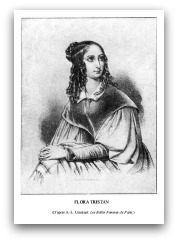
Flora Tristan (1803-1844)

Who was she? French reformer who campaigned for workers’ and women’s rights; grandmother to artist Paul Gauguin.
Key work: Peregrinations of a Pariah, about a trip she made alone to Peru to stake her claim to her family’s fortune.

from PEREGRINATIONS OF A PARIAH
Mr. Smith took me to the house of his correspondents, and here once more I found all of the luxury and comfort characteristic of the English. The servants were English, and like their masters they were dressed just as they would have been in England. The house had a verandah, as do all the houses in Lima, and this is very convenient in hot countries, as it gives shelter from the sun and enables one to walk all round the house to take the air. This particular verandah was embellished with pretty English blinds. I stayed there for some time and could survey in comfort the only long wide street which constitutes the whole of Callao. It was a Sunday, and sailors in holiday attire were strolling about; I saw groups of Englishmen, Americans, Frenchmen, Dutchmen, Germans — in short, a mixture from nearly every nation — and I heard snatches from every tongue. As I listened to these sailors, I began to understand the charm they find in their adventurous life… When I tired of looking at the street I cast a glance into the large drawing-room whose windows overlooked the verandah, where five or six immaculately dressed Englishmen, their handsome faces calm and impassive, were drinking grog and smoking excellent Havana cigars as they swung gently to and fro from hammocks from Guayaquil suspended from the ceiling.

Mary Anne Barker (1831 – 1911)

Who was she? Jamaica-born, England-educated author and journalist who with her second husband tried to run a sheep station in New Zealand (they later traveled to Mauritius, Western Australia, Barbados and Trinidad for his colonial appointments).
Key works: Station Life in New Zealand (1870); First Lessons in the Principles of Cooking (1874); A Year’s Housekeeping in South Africa (1880).

from STATION LIFE IN NEW ZEALAND
All this beauty would have been almost too oppressive, it was on such a large scale and the solitude was so intense, if it had not been for the pretty little touch of life and movement afforded by the hut belonging to the station we were bound for. It was only a rough building, made of slabs of wood with cob between; but there was a bit of fence and the corner of a garden and an English grass paddock, which looked about as big as a pocket-handkerchief from where we stood. A horse or two and a couple of cows were tethered near, and we could hear the bark of a dog. A more complete hermitage could not have been desired by Diogenes himself, and for the first time we felt ashamed of invading the recluse in such a formidable body, but ungrudging, open-handed hospitality is so universal in New Zealand that we took courage and began our descent. … We put the least scratched and most respectable-looking member of the party in the van, and followed him, amid much barking of dogs, to the low porch; and after hearing a cheery “Come in,” answering our modest tap at the door, we trooped in one after the other till the little room was quite full. I never saw such astonishment on any human face as on that of the poor master of the house, who could not stir from his chair by the fire, on account of a bad wound in his leg from an axe. There he sat quite helpless, a moment ago so solitary, and now finding himself the centre of a large, odd-looking crowd of strangers. He was a middle-aged Scotchman, probably of not a very elevated position in life, and had passed many years in this lonely spot, and yet he showed himself quite equal to the occasion.

After that first uncontrollable look of amazement he did the honours of his poor hut with the utmost courtesy… His only apology was for being unable to rise form his arm-chair (made out of half a barrel and an old flour-sack by the way); he made us perfectly welcome, took it for granted we were hungry — hunger is a very mild world to express my appetite, for one… I never felt more awkward in my life than when I stooped to enter that low doorway, and yet in a minute I was quite at my ease again; but of the whole party I was naturally the one who puzzled him the most. In the first place, I strongly suspect that he had doubts as to my being anything but a boy in a rather long kilt; and when this point was explained, he could not understand what a “female,” as he also called me, was doing on a rough hunting expedition. He particularly inquired more than once if I had come of my own free will, and could not understand what pleasure I found in walking so far.

Vivienne de Watteville (1900 – 1957)

Who was she? British writer and adventurer who accompanied her father on a safari in Kenya. After he was killed by a lion, she finished the trip on her own.
Key works: Out in the Blue (1927); Speak to the Earth: Wanderings and Reflections among Elephants and Mountains (1937).

from SPEAK TO THE EARTH
Finally, it was the boys themselves who pointed to the summit and said it was not very far.

Enviously, I admired the way they could climb. As for me, … I was badly spent; my knees trembled as I panted up through the reeling boulders. …

At last I climbed above the forest zone, passing beneath the last outposts — stunted trees ragged with beard-moss in whose chequered shade lay a carpet of tiny peas … whose blossoms were a lovely transparent blue. Above them flitted miniature butterflies, as though the petals themselves had taken wing. …

The top, when I at last reached it, was, after all, not really the top, and beyond a dipping saddle another granite head still frowned down upon me.

But meanwhile, below me the south side disclosed a grassing depression girt about by the two summits and bare granite screes; and amid that desolation the grass stretched so green and rural that you had looked there for shepherds with their flocks. Instead of which, on the far side of a quaking bog, I saw — grey among the grey slabs — two rhino.

… I drew to within forty yards of the rhino, yet they still looked like a couple of grey boulders as they browsed off an isolated patch of sere grass. …

The wind had risen to a tearing gale, and nosing straight into it I approached the rhino somewhat downhill. There was no chance of this steady blow jumping around to betray me, and it was strong enough to carry away any sound of my footsteps. Precaution was therefore unnecessary, and I walked boldly up to them. Just how close I was, it is hard to say; but I felt that I could have flipped a pebble at them, and I noted subconsciously that the eye of the one nearest me was not dark brown as I had imagined it, but the colour of sherry.

… he now came deliberately towards me nose to the ground, and horn foremost, full of suspicion. … In the finder [of my small cinema camera] I saw his tail go up, and knew that he was on the point of charging. Though it was the impression of a fraction of a second, it was unforgettable. …

… I read the danger signal, yet in a kind of trance of excitement I still held the camera against my forehead. Then Mohamed fired a shot over the rhino’s head to scare him, and I turned and fled for my very life.

M. F. K. Fisher (1908 – 1992)

Who was she? A preeminent American food writer, whose books are an amalgam of food literature, travel and memoir.
Key works: How to Cook a Wolf (1942); Map of Another Town: A Memoir of Provence (1964); Dubious Honors (1988); Long Ago in France: The Years in Dijon (1991).

from LONG AGO IN FRANCE
Monsieur Venot was a town character and was supposed to be the stingiest and most disagreeable man in Dijon, if not in the whole of France. But I did not know this, and I assumed that it was all right to treat him as if he were a polite and even generous person. I never bought much from him but textbooks, because I had no extra money, but I often spent hours in his cluttered shop, looking at books and asking him things, and sniffing the fine papers there, and even sitting copying things from books he would suggest I use at his worktable, with his compliments and his ink and often his paper. In other words, he was polite and generous to me, and I liked him. …

In Monsieur Venot’s shop I learned to like French books better than any others. They bent to the hand and had to be cut, page by page. I liked that; having to work to earn the reward, cutting impatiently through the cheap paper of a “train novel,” the kind bought in railroad stations to be thrown away and then as often kept for many years, precious for one reason or another. I liked the way the paper crumbled a little into my lap or my blanket or my plate, along the edges of each page.

Mary Lee Settle (1918 – 2005)

Who was she? American writer, novelist and expat, one of the founders of the PEN/Faulkner Award for Fiction.
Key works: “Beulah Quintet” novel series (1956-1982), about the history of her native West Virginia (and hence of America); Turkish Reflections: A Biography of Place (1991).

from TURKISH REFLECTIONS
I hadn’t heard anything move, yet he stood there in front of me, smiling, quite silent, a large strong Turkish man, holding in his hand a small bunch of sweet wild thyme. He held it toward me, saying nothing, still smiling. There was something so gentle about him that I could not be afraid. I took the wild thyme, and I thanked him, in Turkish. He smiled again and touched his mouth and his ear. He was deaf and dumb. I still have the wild thyme, pressed and dried, kept like a Victorian lady’s souvenir of the Holy Land.

Dumb was the wrong word for him. There was no need for speech. He was an actor, an eloquent mime. I pointed to the atrium below and held my hands apart to show I didn’t know how to get down into it. He took my arm, and carefully, slowly, led me down a steep pile of rubble.

He mimed the opening of a nonexistent door and ushered me through it. He showed me roofless room after roofless room after roofless room as if he had discovered them. …

I think he had scared people before, and he was happy that there was someone who would let him show his house, for it was his house. Maybe he didn’t sleep there. I don’t know. I only know that he treated me as a guest in a ruin ten feet below the levee of the ground, and that he took me from room to room where once there had been marble walls and now there was only stone, where he was host and owner for a little while.

He showed me a small pool, held out his hand the height of a small child, and then swam across the air. All the time he smiled. He took me to a larger pool and swam again. Then he grabbed my arm and led me through a dark corridor toward what I thought was at first a cave. It was not. He sat down in an niche in the corridor, and strained until his face was pink, to show me it was the toilet. Then he took me into the kitchen where there were two ovens. …

For the first one he rolled dough for bread, kneaded it in air, slapped it, and put it in the oven. Then he took it out, broke it, and shared it with me. I ate the air with him. …

When I gave my friend, my arkadaş, some money, he kissed my hand and held it to his forehead, and then, pleased with the sun and me, and the fact that someone had not run away from him who lived like Caliban in a ruin, he put his arms around me and kissed me on both cheeks. Then I went down the hill to Ephesus. When I looked back to wave he had disappeared.

STAY TUNED for tomorrow’s post, a tell-all from Kate Allison on what inspired her to create her fictional expat heroine, Libby.

If you enjoyed this post, we invite you to subscribe to The Displaced Dispatch, a weekly round up of posts from The Displaced Nation, plus some extras such as seasonal recipes and occasional book giveaways. Sign up for The Displaced Dispatch by clicking here!

Related posts:

Random Nomads to the rescue! How to have an enchanted August (2/2)

Every year in mid-August, I swear I can still hear the beat of the taiko drums, even though it’s been years since I lived in Japan as an expat.

As I mentioned in my comment on Anthony Windram’s post of last week, the Japanese hold their Obon Festival in the dead of August. Appropriately, it’s the Buddhist version of the Festival of the Dead — when the dead are supposed to come back and visit.

That said, I have always thought of obon festivities as an attempt to arouse the living dead, which is what most people are after enduring the agonies of a Japanese summer. Just hearing the lively drumbeat can be revitalizing, getting one’s blood flowing again.

I am therefore personally curious to see how The Displaced Nation’s Random Nomads who live in Asia are doing. Are they managing to have some enchanting moments despite the heat — which, if anything, appears to be even more brutal in that part of the world than it was in my day? And what advice can they impart to the rest of us? (Besides the fact that compared to them, we shouldn’t really be complaining…)

Three of them got back with answers to these questions:
1) What has been your most enchanting moment of Summer 2011 thus far?
2) What has been your least enchanting moment?
3) Do you have any survival tips for people who can’t escape?

Please note:
a. You can read interviews with each of these three Random Nomads about their “displacement” by clicking on their names. They, and their lives, are fabulously inspiring regardless of season.
b. In Part 1 of this post, five US/Europe-based Random Nomads answered the same three questions. Check it out!

KIM ANDREASSON — Swedish passport; current home: Vietnam (Saigon)
Most enchanting:
Vacationing in my native Sweden with my wife. It was the longest time I have spent in my homeland in over a decade, and I have a new-found appreciation for the proverb: “Away is good, but home is best.”

Least enchanting:
Trying to do work while vacationing in Italy. An hour before an important conference call, the Internet went down at our 4-star hotel, and the hotel manager airily proclaimed, “That’s what usually happens when it rains.”

Survival tips:
We live in Saigon, where it’s basically 90 degrees all the time so there are only two options: stay inside and use AC; or if you go outside, wear light-colored clothes and drink lots of liquid.

EMILY CANNELL — U.S. passport; current home: Japan (Tokyo)
Most enchanting:
In spite of not being terribly interested in the rainforest or the quest to save it, I found myself smack dab in the middle of Borneo, Malaysia, on an Ecotour. Searching for the endangered orang-utans, we happened upon what became one of the highlights of my summer — and life. A pygmy elephant emerged from the trees, and just like the rest of us, he was hot. Slowly, he ambled in to the river where he proceeded to entertain us with his cooling down antics — scratching his ears on the trees, blowing water out of his trunk, and completely submerging himself while only 10 feet away from our boat. What a gift! I got out my checkbook then and there.

Least enchanting:
Getting up at 4:00 a.m. for the fifth time this summer in order to catch a 7:00 a.m. flight to somewhere. Once is okay, but five times?

Survival tips:
Currently I’m writing from the complete darkness of the guest bedroom, fan on high. Keep the curtains closed and the fans on high to circulate the air. When outside, wear a hat to keep the sun off the top of the head. It’ll do wonders.

JO GAN — U.S. passport; current home: China (Yuyao City, Zhejiang Province)
Most enchanting:
Since my summer is usually spent teaching high school and university students on their summer holidays, I usually don’t get many enchanting moments.  However, I did have one thing that was kind of nice.  After a long day at the language school, I walked down to the Yaojiang River that flows through the downtown area, with some fellow expat teachers and a couple of our adult students.  To our great surprise, white plastic chairs and tables had been set up all along the river underneath the willow trees. Cold beer and hot tea was being served, and there was a lone guitarist playing Chinese folk music for all to enjoy. We sat down and chatted, drank our beers, and watched the river float by with a slight breeze. The servers kept the beggars at bay so we were not hounded for money.

The best part of the evening was around midnight when they started shooting fireworks over the river.

It wasn’t a special occasion or even a special event — just the right mix of people and location, at just the right moment.

Least enchanting:
That would have to be when it rained for a month. I don’t know what was going on with the weather, but in the month of June I thought we were going to have to build an ark. It rained for three weeks straight every day without stopping. I didn’t want to do anything, but had to trek in the rain and puddles all the way to school every day. One day was particularly miserable because the electricity went out.  So it was hot and rainy, and we had no lights. I just kept thinking, why me?

Survival tips:
In the small Chinese city where I live, it’s the little things that count. Taking a trip around the city center in a rickshaw may cost you a little, but you get to sit back and survey the different things going on — and if that special person joins you, it can be romantic.

Another option is going out to the local parks every evening from 7:00 to 8:30 p.m. to dance with the older locals. They are almost always playing some salsa or pop music and dancing the cha cha, or there’s some line dancing action. It is actually kind of fun to join them even if your are not in their age set. They always are excited to teach you their moves.

Lastly, we live close to Siming Mountain. You can take a trolley bus to the top and then float down the small river in a little orange raft. The river has added twists, turns and drops that make you scream out for your mama to help you. It makes for an interesting day, and you are bound to get wet and cool off.

STAY TUNED for tomorrow’s post, in which Anthony Windram debuts his new Agony Aunt column!

If you enjoyed this post, we invite you to subscribe to The Displaced Dispatch, a weekly round up of posts from The Displaced Nation, plus some extras such as seasonal recipes and occasional book giveaways. Sign up for The Displaced Dispatch by clicking here!

Related posts:

Enchanting European escapes at the hands of Woody Allen, BBC & Jersey Shore(!)

I could easily have gotten in a crabby mood this summer while watching everyone (who’s anyone) escape the heat of New York City while I stayed put.

But what saved me, in addition to cocktails, were all the enchanting images of Europe on the big and small screen.

I could live vicariously through the works of film directors and TV producers who have packed up casts and crew and moved to foreign locales — all for my viewing pleasure.

So what if their works weren’t exactly exploring the kinds of themes that citizens of the displaced nation care about? We’re talking escape and enchantment here, and that means pleasant scenery, surely?

Woody Allen’s postcard Paris

Take, for instance, the new Woody Allen film, Midnight in Paris. I haven’t seen it yet but the trailer already has me in love with the idea of an escape within an escape, particularly as it involves Paris.

Woody’s hero, Gil, a disenchanted Hollywood screenwriter played by Owen Wilson, gets to escape to Paris — pretty nice even if he’s going as the guest of his pushy fiancée and her frightful parents. Especially as he gets to escape from them by traveling back in time to the sizzling city of the 1920s.

There he hobnobs with the brilliant expat crowd of that era, including on the American side, F. Scott and Zelda Fitzgerald, Ernest Hemingway, Gertrude Stein, and Cole Porter, and on the European side, Picasso, Salvador Dalí and T. S. Eliot.

In the course of this time-travel adventure, Gil picks up writing advice from Papa Hemingway and even has an affair with Picasso’s fictional mistress, played by the enchanting French actress Marion Cotillard.

But let’s get back to the scenery, which, to be honest, sounds like the real star of the film — or as one film critic put it:

What an enchanting movie — almost as enchanting as its location.

And indeed, the City of Light has never looked more glorious, from the opening montage of narrow streets, the Eiffel Tower and the Arc de Triomphe, to the vistas unfolding before Gil on his warm spring evening strolls.

Yes, it’s a mostly touristic view of the city, but that’s precisely what I’m after while living through a spell of hot, humid weather in New York City.

And speaking of New York, I’m further inspired that a kid from Brooklyn — someone who has always struck me as NOT being displaced — can abandon his hometown so completely in his twilight years. Woody Allen now seems to favor photogenic foreign locales for his films — e.g., London in Match Point and Barcelona in Vicky Cristina Barcelona.

Rumor has it that this is because New York has become too expensive and he’s found some European investors.

But even if Allen wasn’t yearning for it, he certainly seems to have been stimulated by his change of surroundings. I for one am still chuckling over Penélope Cruz’s constant defiance to speak English in front of her ex’s (American) girlfriend in VCB. Has Allen elicited that level of comic performance in an actress since Diane Keaton in Annie Hall? I personally don’t think so, and Oscar agrees with me!

The BBC’s postcard Rome


This summer PBS’s Masterpiece Mystery! carried a new crime series, Zen, produced for the BBC by Left Bank Films. The title refers to the hero, a Venetian-born Roman police detective by the name of Aurelio Zen (“Zen” is a Venetian way of shortening the surname “Zeno”).

Originally the creation of British crime writer Michael Dibdin, Zen attempts to bring justice to modern-day Italy whether the authorities — politicians, the Church, the Mafia — want it or not. (They don’t — and to make matters worse for poor Zen, his bosses, too, side with the outlaws.)

Now, Dibdin was as English as they come but he led a peripatetic life and wrote the Zen books after being an expat in Italy for four years, where he taught at a university in Perugia.

So we have him to thank for the chance to see some of Britain’s handsomest actors wearing sharp suits, talking sexy, and frolicking about in the Roman sunshine. I kept waiting for Rufus Sewell, who plays Zen, to wink at me as if to say, aren’t I lucky to be on this Roman holiday instead of making yet another London-based crime drama?

He even gets a dishy Italian girlfriend, played by the Italian actress Caterina Murino (see above clip).

As New York Times TV critic Gina Bellefonte observes,

The [Zen] films deploy a light comic sensibility and graphics that suggest a ‘60s caper. They situate us in a Rome where the weather always seems heavenly, blouses are always unbuttoned suggestively, and no lunch transpires without multiple courses and repeated instances of sexual innuendo. Risotto is eaten; cigarettes are smoked; espresso is consumed; public displays of lust are evident. There is little resistance to cliché in all this, but the cliché is so visually appealing that you’ll feel like a spoiled child if you complain.

Not to worry, Gina, I’m not complaining! A 1960s caper is exactly the kind of enchantment I’ve been so desperately seeking this summer.

Jersey Shore’s postcard Florence


Okay, I know I’m stretching the picture-perfect postcard idea here, but the fact is that MTV’s hit reality series — about eight housemates who spend their summers in a summer share on the Jersey shore — has opened its fourth season in Florence, Italy. It premiered on August 4.

And that’s a lot more enchanting than Seaside Heights, NJ, or Miami (where Season 2 took place) — I say that having never been to Seaside Heights or Miami, but still…

Ostensibly, Snooki, Vinny, and the rest are in Florence to find their Italian roots.

They certainly aren’t there to meet the natives, try the food, or tour the Uffizi or the Duomo. As New York Times TV critic Alessandra Stanley has it:

The road signs point to Florence but they should read “Welcome to the Jersey Shoro.” … Even in Florence, the producers are determined not to let anything under the Tuscan sun melt the parochial insularity of “Jersey Shore.”

But that doesn’t mean the rest of us can’t enjoy the setting, does it? Call me a snobbo, but watching Snooki, Sammi, Deena and Jenni negotiate the cobblestone streets of Florence in their six-inch leopard skin stilettos makes me appreciate the city’s quaint beauty even more.

And MTV has already announced that in the fifth season, the gang (many of the whom in fact hail from Staten Island or other outer NYC boroughs) will return to Seaside Heights. So for now, viva Italia — that’s what I say!

QUESTION: Can you recommend any more TV series or films that can serve as eye candy for the travel-starved this summer?

YouTube clips: Midnight in Paris trailer 2011, by MoviePediaTrailers; Rufus Sewell — Zen — Vendetta (2011) — Drinks, PrairieGirl1000; and Jersey shore season 4 sneak peek, by TheAdam419.

STAY TUNED for tomorrow’s post, a reprise of our popular post about seven deadly dishes — apparently, we didn’t kill enough of you off the first time around! 🙂

If you enjoyed this post, we invite you to subscribe to The Displaced Dispatch, a weekly round up of posts from The Displaced Nation, plus some extras such as seasonal recipes and occasional book giveaways. Sign up for The Displaced Dispatch by clicking here!

Related posts:

The Displaced Nation’s monthly themes — witty, wacky, wise, all or none of the above?

Before drawing up the charter, as it were, for The Displaced Nation in April, the site’s two Founding Mothers — Kate Allison and myself — and its one Founding Father, Anthony Windram, engaged in some vigorous debate over what the site’s “categories” should be.

We had met through our blogs. What topics did we all have in common?

One of them was easy: cultural discombobulation, to borrow a phrase from Anthony Windram’s blog title. Except we had now come up with a new term: displacement.

Now what do we mean by “displacement” in the context of global travel and residency? My favorite analogy is to an old-fashioned fruit slot machine — but where each fruit is assigned a national identity. I suspect, for instance, that my two colleagues, both of whom are Brits who are living in the U.S., sometimes have days when they spin the reels and get two gooseberries (British fruit) and one cranberry (American fruit) — meaning they’re feeling a lot more British than American. Whereas for me — an American who has lived in both the UK and Japan — I’ll often get one cranberry, one gooseberry and one mikan (Japanese fruit), an outcome that makes my head spin, as I simply don’t know where or who I am. That, btw, is what’s known as hitting the jackpot in our displaced world!

Thus the category What a Displaced World was born, the default category for most of our articles.

Speaking of fruits, food was another obvious category. It was something that had drawn the three of us together in the first place. Indeed, Kate Allison’s blog — Marmite & Fluff — even has food (two of her favorites) in its title.

For this category, we came up with It’s Food! — which, if less than original, we hope does the job thanks to the exclamation mark.

Around the time we spoke about starting this blog, Kate was beginning to serialize a fictional account of a trailing spouse, Libby, on her blog. She proposed moving Libby’s Life to the new site, and we came up with the category It’s Fiction! Libby now shares that real estate with our posts consisting of interviews with novelists who’ve written about the expat life or travel.

Sometimes truth is stranger than fiction, and the category Random Nomads sprung out of our decision to have me continue the interviews with expats and repats I’d started on my blog, Seen the Elephant. If “nomad” was obvious, the three of us felt that “random” worked well with it, since we’re constantly bumping into — actually as well as virtually — the kind of people who strike us as being interesting because of their displacement.

As for the Displaced Hall of Fame, this came about because of Anthony Windram’s desire to explore the writings of famous people who’ve been displaced both in centuries past and our own time. While he has a bent for the classics — and has chosen to feature literary giants such as Vladimir Nabokov and James Joyce in his posts — Kate and I have occasionally expanded the category to include celebrity types, ranging from the actress Mia Wasikowska (a Third Culture Kid) to the model India Hicks to the chef Jamie Oliver.

The “monthly theme” idea

But then once the blog got underway, we decided that in addition to these categories, we enjoyed organizing our posts around monthly themes, rather like a magazine (the fashion issue, the cheap eats issue, the summer issue, etc.).

This came about rather by accident as Kate Middleton and Prince William’s nuptials took place around the time we launched, prompting us to do a series of Royal Wedding posts focusing on what a global event this quintessentially British occasion had become.

Other initial themes were:

  • Domestic expats — the idea that you didn’t have to go abroad to feel displaced (apt in these economically troubled times), anchored by Kate Allison’s The domestic expat.

But then something (we’re not quite clear what) happened, and our thinking morphed again. We started exploring themes based on particular characters, historical and literary, that have inspired us, as well as books:

And September will be — wait for it! — Zen and the Art of Motorcycle Maintenance month, a series of posts inspired by Robert M. Pirsig’s 1974 philosophical novel.

Some say they like the way we cover themes, while we suspect others find it rather zany.

How about you, what do you think? And if you’re pro-theme, can you suggest any you might like us to cover?

STAY TUNED for tomorrow’s post on films and TV series that take vacations to other lands.

If you enjoyed this post, we invite you to subscribe to The Displaced Dispatch, a weekly round up of posts from The Displaced Nation, plus some extras such as seasonal recipes and occasional book giveaways. Sign up for The Displaced Dispatch by clicking here!

Related posts:

Random Nomads to the rescue! How to have an enchanted August (1/2)

Ah, summer — what power you have to make us suffer…and like it?!

I don’t know about you, but I’m not liking the mid-August dog days very much. For a start, I’m getting tired of watching my own two dogs panting instead of playing.

Thus I’ve turned to The Displaced Nation’s Random Nomads to help me find things to like during the remaining weeks of Summer 2011, which doesn’t technically end until September 23.

Besides asking them to report back on how their own summers have been, I begged them to share some tips for escaping one’s surroundings at times when one can’t manage a physical escape. I recall from my own expat days (in the UK and Japan) that global residents develop superhuman-reserves of stamina (the Japanese call it gaman, or “enduring the seemingly unendurable with patience and dignity”) to sustain them during less-than-pleasant interludes.

And I wasn’t disappointed — no less than five USA/Europe-based Random Nomads have come to my rescue! They’ve answered these three questions:
1) What has been your most enchanting moment of Summer 2011 thus far?
2) What has been your least enchanting moment?
3) Do you have any survival tips for people who can’t escape?

And next week, we’ll hear from three more, all of whom hang their hats in Asia.

NOTE: If you haven’t read the interviews with these five people about their “displacement,” be sure to do so by clicking on their names. They, and their lives, are fabulously inspiring regardless of what season it is!

BALAKA BASU — USA passport; current home: USA (New York City)
Most enchanting:
Swimming at Sandy Hook in New Jersey. The water out there at Gunnison Beach is green and gorgeous; the waves are gentle and warm, and they lap round you like a soft embrace. Over in the distance, you can see the skyline of NYC, wrapped in haze. It’s truly lovely, the closest you can come to the Caribbean in the metropolitan area, I think.

Least enchanting:
WASPS (the insects)! They built five(!) hives in our car, and we had to suit up in full sleeves, veils and boots — full-on winter armor in heat-stroke inducing weather — to kill them with poison as they boiled out of their hives. Not cool. Not cool at all.

Survival tip:
Find a cheap(ish) hotel with a bar and an outdoor pool — someplace no tourist would ever visit. Bring towels, bathing suits, a great beach read, and plastic cups — and pretend you’re on beachfront property in some place awesome: e.g., “Jamaica” without the plane ticket.

VICKI JEFFELS — New Zealand passport; current home: England (Tadley, Hampshire)
Most enchanting:
England had a couple of days of really tropical weather back in July — I loved it. For a brief time there was the lingering smell of BBQ wafting around our neighborhood, and I was even able to lie down on a towel in the garden and safely fill up my vitamin D reserves. Ah, bliss!

Least enchanting:
The following week the temperatures plummeted and it looked as if that was all the summer we were going to get.

Survival tips:
Ah yes, right down my alley! Many of my neighbors and friends were finding it really difficult to sleep in the humid weather, not helped at all by the BBC advising everyone to close their curtains! Whaaat? When you find it difficult to sleep, I advise a tepid (not cold!) shower to lower the body temperature before sleep. If possible (I know it’s not always possible), take a dip in a swimming pool — that’s ideal.

PIGLET IN PORTUGAL — English passport; current home: Portugal (Algarve)
Most enchanting:
To date, there are two special moments. Can I have two?

Yes, OK. Great!

Actually, one is magical and the other enchanting. Both slightly predate the summer months, but the effects still linger.

The most magical moment was the birth of our first grandchild, Lily-May, on the 28th of April in France. We drove as if possessed for two days from Portugal across Spain to the South of France to see her. Although I am not maternal by nature (I’m more of a practical Mom), when I held her in my arms for the first time, my heart melted. As recorded on my blog, she’s adorable!

The most enchanting moment was when I was singing to her and she gave me a big smile. Poor little thing — my singing is not that tuneful; I think she felt sorry for me!

Least enchanting:
The least enchanting because most worrying moment of Summer 2011 was the way our daughter’s health deteriorated after giving birth. Despite various consultations with doctors about the excruciating pain and the ongoing urine infections she was experiencing, they just prescribed antibiotics rather than trying to find the root cause. The local GPs were totally clueless! However, the answer quickly became apparent once her husband insisted she go to hospital for a proper examination. The maternity ward doctor, upon examining our daughter, quickly discovered that medical compresses, now rotting, had been left inside her! Once these were removed, she began to recover. But had they remained, I have since been informed septicaemia would have set in, with devastating consequences for both our daughter and breastfed baby granddaughter.

Survival tips:
This is difficult because adverse weather conditions to some could be absolute heaven for others. Weather, I tend to take as it comes as it is out of my control.

My own great escape would not be from the weather but from tourist areas. Living in a tourist area myself, I have renamed tourists “terrorists” because many leave their manners and consideration for others at home. They literally do “terrorize” the locals!

 Personally, I love wild and natural places far away from the mass concrete high-rise hotels, with rows of sun beds and parasols lining the beaches.

My idea of heaven is to take a picnic, a bottle of chilled white wine, our comfy chairs and a parasol down to one of the unspoilt beaches for a “sun-downer.”

Yes, there are other people there in July and August, but we all seem to appreciate the luxury of freedom from tourists, and peace…

So, if you are coming to the Algarve on holiday please check out some of my
“secret beaches.” I can show you how to escape the “maddening” crowds!

JACK SCOTT — British passport; current home: Bodrum, Turkey
Most enchanting:
Bodrum is the most secular and modern of Turkish towns. It’s where people come to escape the conformity of everyday Turkish society. Normal social rules don’t apply. However, scrape the surface and you will find magic of a different kind.

This summer, we were visiting a friend, a thoroughly modern Millie, who lives just a few hundred meters behind the bustling marina with its luxury yachts and raucous watering holes. Her home is set within a traditional quarter of whitewashed buildings huddled together along narrow lanes.

As we approached her door, we noticed an elderly neighbor dressed in traditional livery of floral headscarf, crocheted cardigan and capacious clashing pantaloons. She sat cross-legged in a shady spot of her bountiful garden and was busy plucking a fleece.

Being city boys and largely ignorant of country ways, we asked our friend what the old lady was doing. She was preparing the wool for hand carding, straightening and separating fibers for weaving on the spinning wheel she kept in her house.

She hummed as she plucked, happy under the cool of an ancient knotted olive tree and doing what women have done in Turkey for millennia.

Now you don’t get that in Blighty.

Least enchanting:
We were wandering down Bodrum’s bar street, a procession of cheap and cheerful bars and hassle shops.

We normally rush by; casual shopping in Turkey can be a bruising experience best only tried by the foolish and heroic. The cheaper outlets employ aggressive teenagers in tight, bright, white shirts to drag gullible punters in from the street. A firm refusal elicits a bellicose riposte. The posher shops employ mostly female staff whose sales technique is softer but no less annoying. Speculative browsing is unbearable when tailed by KGB-trained assistants and you are made to feel like a serial shoplifter.

On this occasion my partner, Liam, popped into a corner shop to buy some cigarettes. Keen to use the local lingo, he asked for them in very passable Turkish. The po-faced assistant looked at him blankly. Liam repeated the request. Another blank look. After a brief standoff, the assistant relented and repeated the order in English. He threw the cigarettes at Liam, snatched the payment and slammed the change on the counter.

Welcome to Turkey, where hospitality greets you at every corner. I know there are arse-holes in every country — but next time we’ll just shout loudly in English.

Survival tips:
During the height of the summer we’re like camp vampires and only venture out after dark. Earlier in the season we found ourselves sweltering in 40+C (104+F) heat with no air conditioning. Because our pretty little cottage has 18-inch thick stone and concrete walls it took us weeks to find a technical solution. In the meantime, I received a host of suggestions to help us through the sleepless, sweaty nights. I’d like to share a few:
• Wrap a gel-type freezer pack in a wet tea-towel and apply it to your hot bits (and watch them shrink).
• Buy a floor-standing industrial fan (but nail everything down).
• Bathe your feet in an ice bucket (and develop frostbite).
• Take a cold shower (except the cold water is hot at this time of year).
• Sleep on a wet towel (and rot the mattress).
• Decamp to the roof (and get eaten alive my mozzies).
• Emigrate to Sweden?!

SIMON WHEELER — English passport; current home: Slovakia (Plavé Vozokany)
Most enchanting:
I love the sound of the crickets chirping. Whenever I left for holidays from England as a kid, that sound always meant I was away and exploring. Now I have them every summer’s night, and I still cannot get used to it. I still get that thrill of being in a new place…

Least enchanting:
Mosquitoes — they love every bit of me!!!

Survival tip:
I’m afraid I need a physical escape from our 35C (95F) “phew, what a scorcher!” summer. Fortunately, one is available in North Slovakia — in the Tatra Mountains, on the border between Slovakia and Poland. Just a stunning part of the world, very quiet, largely undiscovered, a place that exudes old-fashioned peace. Being that bit higher in altitude, the temps are perfect.


STAY TUNED for tomorrow’s Displaced Q on enchanting expat summers.

If you enjoyed this post, we invite you to subscribe to The Displaced Dispatch, a weekly round up of posts from The Displaced Nation, plus some extras such as seasonal recipes and occasional book giveaways. Sign up for The Displaced Dispatch by clicking here!

Related posts:

Is The Displaced Nation for expats, travelers — or both?

When we started up The Displaced Nation on April Fool’s Day, many people wondered: is it a site for fools, be they expats, travelers, or both?

From the perspective of outsiders — people who aren’t in the biz — that distinction may seem frivolous. After all, many travelers become expats and many expats travel.

But from the inside, it’s very clear who the travelers and expats are. Both are interested in viewing the world’s rich tapestry firsthand — but expats tend to focus on the intricacies of particular patterns, whereas global travelers want to take in as much of the picture as they can, including the tattered bits.

So, who is more displaced — the expats or the travelers?

The answer is neither. Feeling displaced is a state of mind. To continue the tapestry metaphor, part of you identifies with the new patterns you’re looking at, while another part thinks it’s a confused mess compared to the patterns you’re used to.

Not all global residents feel displaced; same for global travelers. And there are even cases where a person has never traveled except in an armchair — but has ended up feeling displaced by what they’ve read.

As a student of Shakespeare, I’m often reminded of the King Lear line:

“Who is it that can tell me who I am?” – William Shakespeare, King Lear, 1.4.230

Except that King Lear felt this way at the end of his life; many of us global voyagers get there rather earlier. Is it any wonder we feel like fools?!

Now, if you’ve noticed that our site tends to be expat-centric, it’s because two of our writers are expats and the other one (me), a former expat.

Reflecting this imbalance, I’ve started commissioning guest posts by writers — switching metaphors here, but only slightly — who can spin the kind of travel yarn that focuses on the ways travel can make you feel misplaced, displaced, out of place — and, in the process, challenge who you are as a person.

Thus far we’ve featured three such yarns:

1) My first flirtation with the lawlessness of global travel: 4 painful lessons, by Lara Sterling
Sterling has done it all, from round-the-world trips to expat stints. In this article she reports on the shock/horror she experienced after falling in love with a German traveler and following him all the way to war-torn Guatemala — only to discover he was engaged in criminal activities. Part of her was with him, fascinated — they were in a lawless land, so was there any reason to abide by the laws back home? But another part of her was repelled, and couldn’t wait to get back to the United States.

2) In search of 007th heaven, a travel yarn in three parts, by Sebastian Doggart
Doggart — a Brit who lives in New York City and blogs for the Daily Telegraph‘s expat site — tells of the pilgrimage he made to Goldeneye, the Jamaican coastal retreat where Ian Fleming wrote all the James Bond novels. As a Bond fan, he had fun identifying the sights that made it into Fleming’s stories and films. But he also felt alienated that Goldeneye had become GoldeneEye, a playground of the rich and famous — sensing that Fleming, who wrote for the masses, would not approve.

3) How foreign is Fez? A travel yarn in two parts, by Joy Richards
Richards lives in her native England and travels whenever she can. Here she describes her first foray into Fez, Morocco, which was also her first time in an Arab country. She decided to go with the flow, finding that she could relate to the Moroccan sense of shame through her parents’ values, didn’t mind “covering up” (is it any worse than being urged by the Western media to put your body on display?), and had a knack for bargaining. But the flow stopped as soon as she became aware of corrupt police tactics along with some cracks in the society’s facade.

* * *

As The Displaced Nation assumes its normal schedule next month, we hope to feature still more travel yarns.

Meanwhile, can you kindly do us a favor by answering these questions:
1) Would you like to see travel play an even bigger part in our article mix?
2) If so, can you suggest any candidates for guest posts, as well as countries/regions you’d like to hear more about?

Much obliged, as always, for your input!


STAY TUNED for tomorrow’s post on the less-than-enchanting challenges of vacationing with family.

If you enjoyed this post, we invite you to subscribe to The Displaced Dispatch, a weekly round up of posts from The Displaced Nation, plus some extras such as seasonal recipes and occasional book giveaways. Sign up for The Displaced Dispatch by clicking here!

Related posts:

Some enchanted drinking: Summer cocktails that send you round the world

After spending many a summer in England (summer, what summer?) and Japan (beyond brutal!), I now live in New York City, where summers can best be described as a hot mess.

As the dog days set in, I’ve been known to sing out: “Drinks, glorious drinks! Don’t care what they look like!”

Actually, that’s not quite true.

Well, the part about my singing aloud is true — we’re all barking mad in this city, especially around mid-August.

And the part about drinks being glorious is also true —  what could be more glorious than an icy cold drink that cuts through the moisture-laden air, offering the possibility that this steam bath may end one day.

(I’m talking about alcoholic drinks, of course — anyone of a puritanical frame of mind can slake their thirst at one of the city’s fancy new portable water fountains, connected to fire hydrants.)

But the part about not caring what my drinks look like — that’s simply not true. For me, the ultimate summer refreshment is a well-made, well-presented cocktail.

As Penelope Wisner writes in her introduction to Summer Cocktails: 50 Tantalizing Recipes,

Everything matters: the taste of the spirit, the taste of the ice, the temperature of the drink, and the look of the drink.

My drinking history, in brief

During my expat years, I would happily down a half pint of lager in the pub with my English friends, or drink Kirin beer and sake on outings with my Japanese office mates.

That all changed when I moved back to my homeland.

Maybe it’s in my cultural DNA. The cocktail — a mixed drink with two or more ingredients, one of which must be a spirit — is one of America’s more inspired culinary accomplishments.

Or could it be my actual DNA — one of my earliest memories is of asking my father if I could chew on the lemon peel he put in his night-time martini.

In any case, not long after I became a resident of New York City — home of speakeasies and the only city I know of with a cocktail to its name — I was driven to drinking…cocktails. Particularly during summers.

You see, I’ve never been one of the lucky ones who can escape to the Hamptons or the Jersey shore.

Instead of the sea, sun, sand, and sky, I’ve had to grapple with sweat, smog, dirt, and skyscrapers.

Now, I could have gone the conventional route and drowned my sorrows in a beer. But why do that when a cocktail is so much pleasanter, and can transport you to places you’d rather be in — places much more exotic than an overcrowded beach?

Cocktails are a trip

My hunt for the transcendent cocktail experience has yielded several noteworthy finds, among them:

1) The mojito at Victor’s Cafe on West 52nd St. A single sip transported me to 1950s Havana, where I found myself salsa dancing with a Ricky Ricardo-look-alike. (And that was before I’d sampled the roast suckling pig!)

2) The vodka martini in the Russian Vodka Room, also on West 52nd St. I thought I was in Moscow from the moment I entered this swanky establishment, greeted by the sight of a curved bar at which many natives are downing shots, and behind which are these enormous jars of flavor-infused vodkas. Once I’d tasted my martini, I was well on my way to an enriching cultural experience. Oh, so that’s how they get through daily life in Russia. It all comes down to homemade vodka and to music — sublime combination! (Misha Tsiganov, a prize-winning jazz pianist who studied in St. Petersburg, is the bar’s official piano player.)

3) The classic martini at Angel’s Share, a tiny gem of a bar in the East Village. This drink made me feel I was in Tokyo again, even though I wasn’t really a cocktail person there. The Japanese bartenders had the mix, shake and stir down to an art form — which is soooo Japanese. And no one is allowed to stand at the bar — ditto. But by the time I’d polished off my divinely-inspired drink, I’d left Japan far behind for heaven itself — an effect enhanced by a ceiling mural that appears to have been inspired by Botticelli’s playful cherubs.

4) The Negroni at The Smith on 3rd Avenue. The Negroni — one part gin, one part sweet vermouth and one part Campari — is said to have originated in Florence in 1919, the invention of one Count Camillo Negroni. The first time I sampled one at the bar at The Smith, I fancied I’d become E.M. Forster’s Lucy Honeychurch at the very moment when she witnesses a murder on the Florentine streets, and is about to faint. (Where is George Emerson when you need him?) You see, the Smith version is anything but aristocratic: it packs quite a punch.

Next up? I hope it will be the Mexican martini, which I read about it in the New York Times last month. Basically, it’s a margarita served in a martini glass, with olives on a spear.

The drink is said to have been introduced from Matamoros, Mexico, just across from Brownsville, Texas, when a bartender from Austin visited there and was served a margarita in a martini glass.

It has since become Austin’s signature drink. Being Texan, it’s twice as large as a regular drink, so customers are given the cocktail shaker and urged to pour the drink themselves.

I haven’t been to Austin — and would love to go (though preferably not in the summer). I reckon a Mexican martini may be just the ticket…

The only issue is, the drink hasn’t really made it out of Austin yet.

So if you happen to hear of any Austin expats working behind Manhattan bars (yes, that’s how they’d refer to themselves), be sure to inform me.

For now though would you kindly join me in a refrain of “Drinks, glorious drinks, wonderful drinks!”

QUESTION: Can you recommend some summer cocktails you think have the makings of a mini-escape?

If you enjoyed this post, we invite you to subscribe to The Displaced Dispatch, a weekly round up of posts from The Displaced Nation, plus some extras such as seasonal recipes and occasional book giveaways. Sign up for The Displaced Dispatch by clicking here!

Related posts: