The Displaced Nation

A home for international creatives

Tag Archives: USA

RANDOM NOMAD: Melissa Stoey, Former Expat in UK and Incurable Britophile

Place of birth: Northern Virginia, USA
Passports: USA
Overseas history: England (Huntingdon, Cambridgeshire + Shefford, Bedfordshire): 1988-91.
Occupation: Research technician (basically I do data analysis) and part-time professional blogger.
Cyberspace coordinates: Smitten by Britain: Home of the Britophile (blog); @SmittnbyBritain (Twitter handle); Facebook page; and Pinterest.

What made you leave your homeland in the first place?
I’m intrigued by other cultures and more specifically by the British culture. I have been fascinated by Britain since I was a young teen. I have always had the itch for travel and I knew I definitely wanted to visit the UK, if not live there. My love for travel one of the reasons I joined the military. I put England down as my first choice for duty station and I got it!

Where were you stationed?
At Chicksands air base (Chicks for shorts). It’s now Royal Air Force (RAF) Chicksands. Britain’s Ministry of Defense has since taken it over.

You ended up marrying a Brit, right?
Yes. My first husband, and the father of my son, was stationed at what was then RAF Brampton, which is in Cambridgeshire. At first we lived in Huntingdon, but then he got transferred to a base in Hitchin, which is closer to Chicks, so we moved to Shefford.

Is anyone else in your immediate family “displaced”?
Ironically, my brother was stationed at Chicks three years before, so it sort of felt like I was meant to go there. Right now, I don’t have any displaced relatives, but my son is a dual national between the U.S. and U.K. I suspect at some point he may move to the U.K. after he fulfills his dream of living and teaching in Japan for a year. We’ll see! It may be a case of like mother, like son.

So you and your son now live in the United States?
Yes. His father and I are divorced. We came back and lived in Texas for a year, then West Virginia. We now live in Pennsylvania. Meanwhile, his father has gone back to Scotland, where he is from.

How often do you return to the U.K.?
My son and I, and my second husband — I am now married to an American! — try to go every year or at least once very two years, depending on funds and time off.

Can you describe the moment in your association with Britain when you felt the most displaced?
The first night I was in England the culture shock was horrible. I lived around sixty miles north of London in a small village where there were no street lights, and when I looked out the window there was complete and utter darkness. It felt as if I’d landed on a different planet with no signs of life. This was 1988 when almost everything closed much earlier than it does now and wasn’t open on Sundays. If you switched on the radio you might pick up two or three stations, the television had only four channels and of course there was no Internet. It felt much more isolating than if you moved to England today; it has changed by leaps and bounds in the last 25 years as far as conveniences go. I envy current expats who have so many wonderful resources available to help limit the culture shock and make the transition easier.

Is there any particular moment that stands out as your “least displaced”?
We had a great night back in July of 2010 when we met a Glaswegian couple at a curry house in the west end of Glasgow. They invited us to the pub for drinks where we spent the night taste testing different whiskies. I felt totally at home, like I had known this couple my whole life. The Scots have a way — similar to Americans — of making one feel welcomed and accepted. I can say this because of having once been married to a Scot and having spent a lot of time there. My ex-husband was, and still is, one of the friendliest people I know.

You may bring one curiosity you’ve collected from your adopted country into The Displaced Nation. What’s in your suitcase?
My bag is always full of tea and sweets from England. I never return without them. I always pack a few British newspapers as well because my parents are Anglophiles, have been to England many times and enjoy reading them. Rumor has it that some of you Displaced Nation citizens are avid tea drinkers and readers, and that you rarely turn down sweets.

You are invited to prepare one meal based on your travels for other members of The Displaced Nation. What’s on your menu?

I will fix my favorite meal which is a nice Sunday roast that includes roast beef, roasted potatoes, carrots, peas, and Yorkshire pudding (I don’t do sprouts, thank you.) We’ll finish it off with a nice pot of tea and a slice of Victoria sponge, with jam and whipped cream.

And now you may add a word or expression from each of the countries where you’ve lived to The Displaced Nation argot. What will you loan us?
I’m feeling peckish. I say that quite often and it always results in the odd look or two. It’s just not used here, at least where I live. To feel “peckish” means to feel slightly hungry.

Earlier this month, we did a series of posts on Queen Elizabeth’s Diamond Jubilee. Incurable Britophile that you are, I presume you celebrated from a distance?
I watched the River Pageant, which was on early in the morning East Coast time, and then hosted my own Diamond Jubilee lunch (see photos on my blog). The food was great — we nibbled on leftovers for days! Even though I didn’t have a big party (it was just for my family), I was glad to do it to show my blog readers that you don’t have to be in Britain to celebrate properly. You can still enjoy yourself and take part in your own little way.

A couple of us on The Displaced Nation team thinks that the Queen deserves an Olympic medal for having survived almost being displaced by Princess Diana. Do you agree?
I don’t agree that the Queen was almost displaced by Diana; if she was going to be displaced it would have been due to her actions (or lack of) that left the British public feeling as if she was heartless and out of touch. However, I still don’t think she would have been displaced. Time heals and I think many of us now understand the dilemma she faced as a grandmother trying to protect her grandchildren who just lost their mother. However, as Head of State I do wish she had at least made a televised message to the public within the first 24 hours. Waiting five days was a bit much.

Americans seem to love the Royal Family. Do you think the United States might benefit from having one?
The idea of the United States having a royal family at this point is a silly one. It doesn’t fit our history or where we are headed as a country. Let’s leave that to the nation that does Monarchy the best.

Readers — yay or nay for letting Melissa Stoey into The Displaced Nation? Tell us your reasons. (Note: It’s fine to vote “nay” as long as you couch your reasoning in terms we all — including Melissa — find amusing!)

STAY TUNED for tomorrow’s episode in Libby’s Life, our fictional expat series set in small town New England. (What, not keeping up with Libby? Read the first three episodes of her expat adventures and/or check out “Who’s Who in Libby’s Life.”)

If you enjoyed this post, we invite you to register for The Displaced Dispatch, a round up of weekly posts from The Displaced Nation, with seasonal recipes, book giveaways and other extras. Register for The Displaced Dispatch by clicking here!

Related posts:

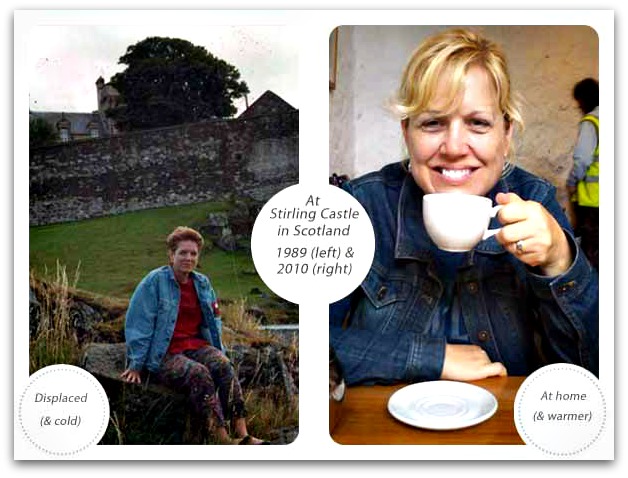
img: Melissa Stoey at Stirling Castle, Scotland, then and now — in 1989, when she was displaced (and cold!), and in 2010, when she was visiting (and warmer!).

EXPAT MOMENTS: American Dentata

Following last month’s post on expat moments, we start a new series focusing on little moments of expat experience — moments that at the time seemed pifflingly insignificant.

The dentist I went to as a child was located in a Victorian terrace which had been converted into a practice. What must have once been a gloomy living room where the family of the house had sat in sullen silence had now become a gloomy waiting room where the patients of the current occupant sat on musty couches until called for their appointment. When it was finally your turn, you would make your way up a staircase just off from the waiting room; a staircase that always seemed too steep, too narrow, too dark.

There at the top of the stairs were three rooms; two always had their doors shut, but the third would always be open. This was the examination room; no threadbare carpet or peeling plaster here. The smell of must from downstairs replaced with the sweet smell of eugenol. Clean and white with foreboding looking machinery, the centrepiece being that chair, it all felt futuristic and at odds with the rest of the house, and to my imagination it was as if I had stepped through the wardrobe or into the TARDIS. I was in the unknown.

Not so now; there is no peeling plaster, musty smells or dark Gormenghast shadows to navigate at my current dentist’s. I am in a box within a box; that is, like nearly every business in this part of California, the practice is to be found in a strip mall and the examination room is in a perfectly square room that reminds me of the prefab annexes I was sometimes taught in at Secondary school. My mouth is in the painful process of being “Americanized”. A molar is ground down in order to be crowned and slowly a childhood’s worth of NHS fillings, the colour of slate, will be extracted and the teeth will be capped gleaming white.

Bereft of a crumbling Victorian house my nightmarish fears of the dentist may have gone, but they have simply been replaced with a fear of humiliation and mockery. Opening my mouth in a dental surgery here I feel self-conscious. When my dentist starts scraping around in there I feel a whole nation’s health system being judged rather than my own admittedly poor choices.

British teeth and their perceived awfulness have become an established American comic meme popularized by The Simpsons and personified by Mike Myer’s Austin Powers. It’s an entrenched stereotype and always good for a cheap laugh.

When I open my still predominantly British mouth (it’s only partly been Americanized, the vowels and consonants it forms are still resolutely British) it inspires my American dentist to grandiose plans of what she should do with it – rip out those British pegs and start from scratch and craf me an all-American smile.

My understanding is that a teeth whitening course will be a compulsory part of the American citizenship test.

This post was first featured on Culturally Discombobulated

STAY TUNED for Monday’s post, a poll on Wimbledon by Kate Allison.

If you enjoyed this post, we invite you to register for The Displaced Dispatch, a round up of weekly posts from The Displaced Nation, with seasonal recipes, book giveaways and other extras. Register for The Displaced Dispatch by clicking here!

Related posts:

img courtesy morguefile

LESSONS FROM TWO SMALL ISLANDS — 2) Keep calm and learn to enjoy imperfection

I must have been born with a melancholy nature, because it didn’t take me long to work out that we live in an imperfect world.

Imagine my discomfort, then, when I realized that many of the people who surrounded me in my nation of birth — my fellow Americans — were obsessed with having perfect teeth, perfect bodies and a perfect appearance during their brief time on this earth.

“What’s that about?” I thought to myself at a relatively early age (I was around 6, already on the way to driving my mother, an eternal optimist, crazy). “We’re all going to grow old and die regardless.”

By the time I reached adolescence, I decided that the need to be flawless was my birth nation’s fatal flaw. It was our best feature — hey, no one can deny how good we look flashing those orthodontically-enhanced smiles — but also our worst. The list is long of fabulously talented Americans who have perished in the pursuit of physical perfection.

That lists always begins with Marilyn Monroe — a pretty and bright young thing who ruthlessly remade herself into a sex symbol, and died at age 36. (Among other things, she got work done on her nose and chin to create her classic, timeless look.) And culminates in Michael Jackson, for whom it apparently wasn’t enough to be blessed with good looks and an extraordinary musical talent. No, the King of Pop felt compelled to have lots of plastic surgery — even if it meant destroying his career and himself.

Endearing little imperfections (England)

It’s a pity Marilyn and Michael were never offered the chance to study abroad in England, that’s all I can say. My prolonged stint as a graduate student at a British university soon cured me of any lingering fixations on fixing my looks.

Why bother when the people around you seem so oblivious? None of the Brits I knew seemed to mind that the politicians who were gracing their TV screens had funny eyebrows (cue Michael Heseltine), dowdy outfits (cue Shirley Williams) or speech impediments like rhotacism, pronouncing the sound r as w (cue the now-departed Roy Jenkins).

And not just politicians but also British actresses seemed much less interested than their American counterparts in their looks. On the contrary, such glamorous types appear to thrive on their imperfections — Kate Winslet proudly flaunting her curves, Helen Mirren daring to be sexy despite having wrinkles.

And now we have the English singer Adele (Laurie Blue Adkins), who is fond of saying things like: “Fans are encouraged that I’m not a size 0 — that you don’t have to look a certain way to do well.”

Have I mentioned teeth yet? An American journalist once complimented the comedian Ricky Gervais on being prepared to wear unflattering false teeth for his role as an English dentist in the film Ghost Town — only those were his real chompers! As Gervais told a BBC reporter:

He was horrified that I could have such horrible real teeth. It’s like the biggest difference between the Brits and the Americans, they are obsessed with perfect teeth.

Imperfection is perfection (Japan)

And then I reached my second small island, Japan, which I soon came to see as the Land of Melancholy — and hence as a kind of spiritual home for someone of my proclivities. I instantly appreciated the fact that Japanese revere the cherry blossom not so much for its beauty as for the brevity of that beauty. The blossom lasts just a few days before its petals scatter to the wind.

The Japanese aesthetic that attracts so many of us in the West is based on this notion of flawed beauty. We’re talking wabi-sabi here — the value derived from the Buddhist teaching on life’s impermanence. Wabi-sabi stands in stark contrast to the Greek ideals of beauty and perfection found in many Western countries. (Hey, those Greeks have a lot to answer for, besides their spendthrift ways!)

A good example is the tea ceremony bowl: not quite symmetrical, rough in texture, and often deliberately chipped or nicked at the bottom. You turn it around slowly to appreciate its hidden beauty, a kind of diamond in the rough…

And did I mention teeth yet? Japan is the land of REALLY crooked teeth. Even some young girls who don’t have crooked teeth apparently are asking their dentists to give them a fang-like yaeba (snaggletooth) as they think it’s charming to be imperfect. Japanese celebrities too, are imperfectly perfect.

Don’t overcultivate your garden

On the face of it, the English cottage garden has very little in common with the Japanese garden — the former full of flowers and exuberance, the latter much more subdued and restrained.

But I think they are alike in one important respect: both embrace imperfection. As California horticulturalist and lover of English gardens Mary Lou Heard once said:

The thing about a cottage garden is that it is not perfect. It is not a sterile place; there is always a lot happening and changing.

Not sterile — I like that. It means that something is breathing, growing, alive…and probably imperfect. To my way of thinking, as informed by my long expat life, a row of perfect brilliant white teeth looks a bit like a row of tomb stones, and a facelifted face, like a death mask.

A Japanese garden celebrates imperfection as well — but by using elements that have a natural, rough finish. If the garden features a wooden bridge, for example, it will be made of planks of different sizes, and the wood itself will have crooked edges or knobs.

For the Japanese, the point is not to restructure reality but to embrace its quirks. That’s why they’d rather see pile of rocks in different colors and sizes than a statue surrounded by carefully landscaped bushes.

My takeaways

As I mentioned in my first post in the series, “Keep Calm and Carry On,” repatriating to the United States has been a feat of Olympian proportions. Clearly I left it a little too long! But at least I stayed away for long enough that, upon coming home again, I have conquered the part of me that says I must always be striving for physical perfection. I no longer fear looking imperfect.

Thus, while my countrymen and women engage in excessive exercising, crash dieting, and surgical enhancements, I am free to sit back and enjoy the beautiful — precisely because it is imperfect — world we live in.

This means I’m not keeping up with the Kardashians. And for a long time, I assumed Mitt Romney was from central casting, not an actual presidential candidate. (I understand he has a problem of coming across as real enough, even among mainstream Americans, which is saying a lot. If I were his image consultant, I’d suggest growing his eyebrows to look more like those of the Archbishop of Canterbury, Rowan Williams. Now that would give him some character.)

If you are a fellow American and are reading this, I suggest that you, too, try weaning yourself off our nation’s physical-perfection kick. Here are a few scenarios close to some I’ve experienced, with pointers on appropriate responses:

1 — The dentist says that in his opinion, you’d look a lot better with straight teeth. Keep calm and inform him that you’ve learned to enjoy nature’s little imperfections. If he persists, then say you were actually thinking of getting a snaggletooth, and does he happen to have any expertise in that area? If not, then whip out a photo of Ricky Gervais’s fangs to show him. (Notably, I did not take my own advice on this. Shortly I returned to the Land of the Straight Teeth, I succumbed to my dentist’s suggestion that I get braces again!)

2 — A woman stops you on the subway to point out you have a run in your stockings, or a work colleague comes up to you to tuck in the label hanging out the back of your blouse. Keep calm and tell them you’ve learned to appreciate life’s little imperfections, and they, too, may wish to get some wabi-sabi in their lives.

3 — You’re picking a mini-labradoodle puppy, and your husband wants to get the one that looks “normal,” but you like the one whose markings have asymmetry, because of her parti-colored poodle father. Keep calm and instruct your husband that the one with the strange spots is much more beautiful, and that one day people will make offers to take her away from you. (True story — my imperfect dog is perfection itself! And no, that is not her in the photo…)

* * *

So, tell me: does any of this make sense, or has living abroad for so long rendered me totally bonkers?!

STAY TUNED for Thursday’s post, another in our new “Expat Moments” series, by Anthony Windram.

If you enjoyed this post, we invite you to register for The Displaced Dispatch, a round up of weekly posts from The Displaced Nation, with seasonal recipes, book giveaways and other extras. Register for The Displaced Dispatch by clicking here!

Related posts:

Image: MorgueFile
Which country produces the people who travel the farthest, the longest — and with the most credit cards?

The Displaced Nation was contacted about doing a post on a recent survey by Travelex on “How the World Vacations” — the results of which are summed up in a cool infographic (see bottom of this post).

Since Travelex helps travelers with their foreign currency needs, they were particularly interested in finding out not only where people are traveling internationally but also how they are financing their vacations.

I thought I’d go over some of their findings and see if it helps me to understand this Big Wide World of Travel.

Really? Did I? Or did I do something altogether more irresponsible, and just pull it apart for my own amusement? Well, you all know me by now. You decide…

What’s up with international travel?

More people are doing it now than ever before. Even in the most parochial parts of England, folk are pulling the ferrets out of their trousers, staring at glossy magazine adverts and dreaming of something more glamorous than a weekend caravanning in Skegness.

Rumor has it that almost ten percent of Americans now own a passport; even more significantly, some of them have actually used them!

Yes, travel beyond one’s borders is growing — but so is the human race. So it’s only to be expected, right? (The numbers of people going abroad did decline, however, in 2008 due to the global recession, but in 2009 the upwards trend resumed.)

And now for some stereotype-busting!?

I’m not sure how much the survey tells us that we didn’t already know, to be honest — but I’m willing to be persuaded otherwise, if one of you is a better statistician than I am.

Where do the Brits go on holiday? Hmm. Tough one.

If you guessed Spain, you can give yourself a pat on the back. It is Spain. For two weeks. The survey doesn’t tell us this, but most of them spend the entire fortnight lying lobster-red on the beach before heading for the nearest bar. Had the survey asked what they ate, the finding would have been 85 percent fish and chips, of which most would have been washed down with beer — the local variety of course, because it’s so staggeringly cheap.

The destination that comes in second for the Brits? Right again! France. The main surprise is how few are going to the United States nowadays: just nine percent (versus over fifty percent to Spain and France).

The Americans? They head to Mexico and Canada. Goodness, that’s a revelation! And if they venture any further, it’s usually to Europe, especially the UK and Italy, or to the Caribbean. That said, there are a few brave American souls visiting China these days.

The survey doesn’t report this, but most Americans when they go abroad eat burgers and fries, even when sitting in an Italian restaurant. They drink beer, too — but the good stuff, because it’s still cheap, and imported, which makes everything taste better!

Noticed any Chinese tourists lately?

Thanks to its booming economy, China gets pride of place in this survey. (The Japanese used to be the most well-traveled of all Asians, but I’m afraid they’ve been displaced!)

Interestingly, the 1.3 billion Chinese are represented by a sample of 20,000; anyway, for most of them the average length of holiday is six days. Perhaps it’s not surprising, then, that they end up going to Hong Kong — which I’m not sure counts as foreign these days. (Didn’t my country transfer sovereignty to China in 1997, or have I misremembered something?)

Chinese mostly use credit cards to pay their way, despite almost a third of those being refused. Which is a shame, though I can’t say it surprises me. Would you take a Chinese credit card? Be honest.

And a surprising number, about a third, travel by boat. Still trying to puzzle that one out, given how short their vacations are. Fear of flying, perhaps? I’ve heard some nightmare stories about China Airlines.

How about Brazilians?

Another booming emerging economy is Brazil, which is the fourth country to be featured in a big way in the survey. Guess where most Brazilians go? You got it, their wealthy neighbor to the North, the United States!

But what I’d really like to know is whether the five percent of Brazilians who had their bank cards stolen were the same ones that said they traveled by rail — in which case, it serves ’em right. Everyone knows that if you take a train in Brazil, you get robbed — it’s, like, common knowledge.

International holiday central

Australia, my adopted and much beloved homeland, makes a brief appearance in the statistics for “how long they stay.” We’re at the top of the charts. Did you know that Aussies having the longest holidays IN THE WORLD, by almost a week?

The survey doesn’t tell you how often we go abroad and where we go, however.  Because if you knew that every man, woman, child and most of the sheep here take a foreign holiday every single year — and that the vast majority spend it in Bali — you’d have perished of jealousy by now (or else looking into emigrating!).

As it is, I’m worried that if the Chinese see that Aussie vacations are almost three times longer than theirs, it will trigger a revolt, for which Australia will somehow be blamed! 🙂

Herzlichen Glückwunsch!

In their write-up of the survey findings, Travelex said:

We were surprised to find that the most consistent destination for international travel seems to be Germany. That’s right! Germany. We guess lederhosen and lagers hold a certain amount of appeal no matter what native language you speak.

It’s a fair point — who’da thunk it? Even the Chinese went to Germany. Well, 1.9 percent of them did. (Which, out of the 20,000 vacationers surveyed, means at least 382 out of a country of 1.3 billion.) Germany must be thrilled at this news of its new-found popularity across cultures.

I suppose another surprising finding is that while Chinese are busy having their credit cards turned down, Brits tend to err on the side of caution, doing their money exchanges before they leave, while many Americans are still getting away with using dollars — despite the recent talk of abandoning the U.S. dollar as the single major reserve currency.

* * *

It’s often said that statistics can be made to say whatever you want them to say. And then of course, there’s the old truism that 97.6 percent of statistics are made up on the spot…

Not that I’m saying Travelex did any of this, of course. Far be it from me to cast aspersions on their information-gathering tactics. I’m just wondering if something like this can tell us much. Still, it’s a pretty infographic — the designer of which has certainly earned a vacation overseas, in my opinion!

Please talk to me in the comments. Are you into travel surveys? Have I missed something earthshaking in this one? Am I being too flippant? I’d love to know your thoughts!

Additionally, you can hit us up on Twitter: @DisplacedNation and/or @TonyJamesSlater

And now for that fabuloso infographic:

STAY TUNED for Tuesday’s post reviewing some books by expats in Dubai.

If you enjoyed this post, we invite you to register for The Displaced Dispatch, a round up of weekly posts from The Displaced Nation, with seasonal recipes, book giveaways and other extras. Register for The Displaced Dispatch by clicking here!

Related posts:

Infographic courtesy of Adria Saracino, Distilled Creative.

LIBBY’S LIFE #54 – Opening the cocoon

There’s probably a word for it in the Complete Oxford English Dictionary. An obscure word that only makes an appearance on Radio 4 intellectual game shows. Something like:

Tri-gami-matri-taci-filial (noun, Old English) — the silence of a son regarding his mother’s marriage to a serial bigamist after the father’s third marriage.

Then people like Stephen Fry and Paul Merton would make clever, rude jokes about this word, and you’d wonder why the English language possessed such an item, because such a situation was unlikely to exist.

Except the situation does exist, and consequently I’d like to know the word that has this definition:

“The pissed-off feeling after realising that your husband of nearly seven years has accidentally-on-purpose forgotten to tell you that his estranged father was a serial bigamist and didn’t run off with a local librarian like he and your mother-in-law had always led you to believe.”

I mean, it’s not as if it would have mattered, is it? If Oliver had told me on our second date, “Oh, by the way, Libs, I didn’t grow up with a father because my mum found out that he was married to a couple of other women at the same time” — I would hardly have stomped out of the restaurant before he could ask me out on a third date.

Did he really think I would have said, “God, Oliver, I’m glad you came clean with me now because obviously, there is no way I could marry the spawn of such pond slime”?

I know what you’re thinking. If it wouldn’t have been such a big deal on our second date, why am I making a fuss now?

Because it’s gone past the point of being an unfortunate fact about Oliver’s ancestry. Ten years ago, before our engagement, I could have processed the knowledge and said, “Poor Oliver. Your poor mum. What a terrible thing to happen.”

Now, although I still think that way, pity has been overtaken by hurt that Oliver couldn’t see fit to tell me.

I am being treated like the criminal, but why? The real criminal is Oliver. He has known about this all along, and in the ten years we have known each other, has never told me this story, although it’s obvious that he knew. Why did he not feel he could tell me, his girlfriend, his fiancé, his wife, his soulmate? Has he so little faith in me? I feel bereft, my faith in Oliver plundered.

But self-pity inevitably mutates into anger.

Today, I am angry, and everyone knows it.

Well, nearly everyone. Jack knows it, George knows it, and Beth knows it. The only person who is oblivious is Oliver himself, the object of my anger, and as usual he’s out, avoiding the issue. Avoiding me.

Meanwhile, rage swirls around my head and seeps out through my ears, filling the house with noxious atmosphere.

I’ve been passive too long.

I gather up the twins and strap them into the double stroller. Jack peeps cautiously at me from behind the sofa where he is quietly playing with Lego bricks.

“Put your sneakers on,” I say. “We’re going out.”

*  *  *

It’s a long time since we’ve been out.  Nursery school has finished for the summer. After the first couple of weeks when the Coffee Morning Posse delivered freezer casserole after freezer casserole, no one has been to visit — not even Maggie. I suppose they think I’ve got enough to do without catering to visitors. Even my mother has been quiet, phoning only once since she got back home. For the last few weeks, I’ve holed myself up in the house, seeing no one, ordering groceries online, too depressed and timid to put a foot outside.

But today is a beautiful, sunny day, my anger is invigorating, and I’m tired of being a hermit. I make Jack hold the handle of the stroller, loop Fergus’s leash round my wrist, and off we set, along Juniper Close.  We are walking to Main Street, to a place of busy-ness, to be with other people who will only coo at my babies and won’t see the rage and hurt in the back story.

Fergus, however, has other ideas. He crosses the street docilely enough, but as we turn right towards the road that leads to Main Street, however, he lags behind and his leash pulls on my wrist. He wants to go the other way.

I tug on the leash. He sits. I tug again. He lies down.

It’s an impasse. Fergus and I stare at each other. He usually wins these stare-down contests, but I’m in no mood for defeat. Today, I’m determined to win, so I don’t break my gaze, not even when I hear footsteps on the sidewalk behind me. Whoever it is can step onto the road and walk around us.

The footsteps slow, then stop.

“We first met,” I hear Maggie say, “when there was another drama going on between you and this dog. I haven’t seen you out with these children for weeks. Were you coming to see me?”

I continue to stare at Fergus so I don’t have to meet Maggie’s eyes. She’s right. I haven’t seen her since the twins were a couple of weeks old. How time flies when you’re having fun.

“If I hadn’t seen you today,” she goes on, “I’d have come to visit. I don’t like to intrude, but…”

“It’s been difficult,” I mutter. “The twins — they’re a lot of work.”

“I’m sure they are,” she says. “And from what I hear, so is your husband.”

She has my attention now.

“How do you know?” I demand. “What do you know?”

Maggie places a hand on my forearm and takes Fergus’s leash from my wrist. She gives the leash a gentle shake, and he gets up to stand by her, as docile as you please.

“Your mother and I became pretty good friends while she was here, you know. We made an agreement. I would be there for her daughter in America, and if the need ever arises, she will be there for mine in England.”

Mums’ Army. The Maternal Foreign Legion.

“Come on, Jack,” Maggie says, taking his hand. “Back to Granny Maggie’s house.”

With difficulty, I turn the wide stroller around to face the other direction.

“‘Granny Maggie’?” I ask. “Does that make you my mother, then?”

Maggie smiles, just a little.

“The next best thing on this side of the ocean,” she says.

.

Next post: LIBBY’S LIFE # 55 – Dark secrets

Previous post: LIBBY’S LIFE #53 – Preserved on tape 

Need the 411 on characters in Libby’s Life? Click here for  Kate’s page  of Who’s Who in Woodhaven.

Click here to read Libby’s Life from the first episode.


STAY TUNED for Monday’s post — a Dolce Vita Slideshow!

If you enjoyed this post, we invite you to subscribe for email delivery of The Displaced Dispatch, a round up of the week’s posts from The Displaced Nation. Sign up for The Displaced Dispatch by clicking here!

Image: Travel – Map of the World by Salvatore Vuono / FreeDigit

RANDOM NOMAD: Lynne Murphy, American Expat in UK & Champion Linguist

Place of birth: Western New York State, USA
Passports: USA + UK
Overseas history: South Africa (Johannesburg): 1993-97; Texas, USA (Waco): 1997-99 — definitely a different country!; England, UK (Brighton): 2000 – present.
Occupation: Senior Lecturer in Linguistics, University of Sussex
Cyberspace coordinates: Separated by a Common Language — observations on British and American English by an American linguist in the UK (blog); @LynneGuist (Twitter handle).

What made you leave your homeland in the first place?
What made me move were jobs. I am a theoretical lexicologist. Not many places want a theoretical lexicologist, so I applied far and wide and have been rewarded with some very interesting jobs and living experiences.

Is anyone else in your immediate family “displaced”?
I was the first person in my immediate family-of-birth to own a passport.

Can you describe the moment when you felt the most displaced?
The night after the American student Amy Biehl was killed in South Africa, in August 1993. At that point, I lived in a granny flat — an outbuilding behind a house in a Johannesburg suburb. I came home to find my neighbours in the main house packing up and leaving for a safe place to stay, as they’d been robbed during the day. As they left, they told me the thieves had taken the spare keys to my flat — and had already come back to steal the bicycles from the garage. At that point, I had no car, no telephone (setting one up there took FOREVER), nowhere to go and no way to get there. I stayed up all night with the lights on and with a newspaper with the story of Biehl’s murder on the front page, feeling very alone and very scared.

Is there any particular moment that stands out as your “least displaced”?
Sometimes it’s funny to reflect on the fact that my own child speaks with an English accent, and I feel most absolutely at home with her. But I also often feel really divorced from the US when I read the news. When the hullabaloo about “Obamacare” was going on, I just couldn’t believe that I came from a place where many people seem not to see good medical care as a basic right for all. And it especially galled when I saw some Americans spreading lies about how British healthcare works and others willing to believe those lies. The National Health Service isn’t perfect, but it has saved my life, and I have more confidence in its care for me than I had in the insurance-industry-driven care I had in the US.

You may bring one curiosity you’ve collected from your adopted country into The Displaced Nation. What’s in your suitcase?
From South Africa: It’s the art that’s lasted! Two pieces by Ezekiel Madiba, a print and one of his printing blocks — which is nice because it’s sturdy enough to put in a suitcase and to hug every once in a while.
From Texas: My doctor’s instructions on what to do the next time I’m stung by a fire ant (to try to avoid being bed-ridden for a week, like the first time).
From England: My wedding ring. It’s a one-off, made by a Brighton goldsmith, and it’s a curiosity, because I hadn’t thought I was the marrying type.

You are invited to prepare one meal based on your travels for other members of The Displaced Nation. What’s on your menu?

Starter/Appetizer: South African biltong. A nice peppery one—but I don’t mind if it’s beef or game. Maybe a selection.
Main course: For this, I’ll bring together the British and the American — not fancy but delicious. I haven’t given it a name, but here’s the recipe: Toast crumpets. cover with cheddar cheese and put under the broiler/grill. Slather on A1 Steak Sauce. Eat with knife and fork.
Dessert: Eton mess with raspberries instead of strawberries.
Drinks: South African wine (I never had a South African wine I didn’t like while I was in South Africa– the exported stuff is of more variable quality, in my experience); Castle Lager (a South African beer); and Schweppes Bitter Lemon (a popular soft drink in South Africa, no longer being produced in this part of the world as far as I know).

And now you may add a word or expression from each of the countries where you’ve lived to The Displaced Nation argot. What will you loan us?
From South Africa: Putting hey? on the ends of sentences. It was so easy to start doing, since I’d grown up using the “Canadian” eh? (Though I hadn’t realized I said it till I moved from upstate New York to Massachusetts, where they don’t say it.) It’s been a while since I lived in South Africa, but I still find myself doing it.
From the UK: There are so many great expressions, but the thing that’s invaded my language most is lovely. When I write emails, I have to go back at the end and take out half of the lovelies because I say it so terrifically much.

This month we have been doing some posts on Queen Elizabeth’s Diamond Jubilee. How did you spend the Bank Holiday weekend? Did you celebrate?
We’re not much into the monarchy in my house, so we just enjoyed the extra time off. But we did go to a friend’s house and eat red-white-and-blue cupcakes — which we should probably have called “fairy cakes” if we wanted to take the whole Rule Britannia thing seriously.

A couple of us on The Displaced Nation team thinks that the Queen deserves an Olympic medal for being on the throne for so long. Do you agree?
I respect the queen for handling many awkward situations with grace, but all she has done to be on the throne so long is not die yet. She got a national holiday for the occasion—I think that’s sufficient!

Readers — yay or nay for letting Lynne Murphy into The Displaced Nation? Tell us your reasons. (Note: It’s fine to vote “nay” as long as you couch your reasoning in terms we all — including Lynne — find amusing!)

STAY TUNED for tomorrow’s episode in Libby’s Life, our fictional expat series set in small town New England. (What, not keeping up with Libby? Read the first three episodes of her expat adventures and/or check out “Who’s Who in Libby’s Life.”)

If you enjoyed this post, we invite you to register for The Displaced Dispatch, a round up of weekly posts from The Displaced Nation, with seasonal recipes, book giveaways and other extras. Register for The Displaced Dispatch by clicking here!

Related posts:

img: Lynne Murphy looking rather other-worldly — or  “out of this displaced world,” as we like to say — in a Brighton pub.

EXPAT MOMENTS: Two Englishmen in New York

Following last month’s post on expat moments, we start a new series focusing on little moments of expat experience — moments that at the time seemed pifflingly insignificant. This week involves a celebrity encounter. No prizes for guessing the name of the celeb.

At Columbus Circle, for a fleeting moment, an opportunity presents itself.

A sidewalk collision between two pasty-faced men is avoided as both intuitively, if ungracefully, swerve to avoid bumping into each other. They are both headed towards the same crosswalk where they wait, shoulder-to-shoulder, for the traffic to stop. An observant onlooker might guess — correctly, as it turns out — from their uncoordinated, somewhat flailing gaits that both men are, in fact, English. The onlooker might also note, despite the difference in ages between these two men, that they are dressed similarly; both wear brown brogues, blue jeans, white shirts and blue velvet jackets. However, having established that this onlooker is particularly observant he or she notices more than that; they can see that though they are dressed similarly, the clothes of one of the men — the older man — are expensive and designer label whereas the younger man’s are from a department store.

As these two men wait at the crosswalk the younger man glances at the older and, though he has never before met him, recognizes him immediately. If you were to ask the younger man, he would confirm that he holds very strong views of the older man he is stood next to. If you were to press further, the younger man would admit that he has long judged the moral character of the older man stood next to him. If you were to have asked the younger man only an hour before how he would define “unctuousness,” he would merely would have replied with the name of the older man.

The younger man considers that he could lean in towards the older man and tell him that he thinks he should go “f**k himself.” But the younger man, though he would not admit it, is enthralled enough by the older man’s celebrity that he is striken momentarily dumb.

Instead, the younger man — who in his more vainglorious moments views himself as a modern-day Frank Capra everyman — thinks homicidal thoughts. As they keep on waiting at the crosswalks for the pedestrian light, and car after speeding car passes them, the younger man thinks about how the most … “accidental” … of nudges would send the older man under a New York cab.

And those few seconds, as they wait for the pedestrian light, last for the younger man the thinking and execution of a thousand “accidental” deaths, until finally there is the glow of the pedestrian crossing light and they safely cross the road before separating to go their own ways and the younger man can go back to pretending that he’s at heart a decent chap.

This post was first featured on Culturally Discombobulated

STAY TUNED for tomorrow’s post.

If you enjoyed this post, we invite you to register for The Displaced Dispatch, a round up of weekly posts from The Displaced Nation, with seasonal recipes, book giveaways and other extras. Register for The Displaced Dispatch by clicking here!

Related posts:

Image: MorgueFile

LESSONS FROM TWO SMALL ISLANDS — 1) Keep Calm and Carry On

Justin Mussler is traveling around the world with his wife and two kids, recording their adventures in the blog “The Great Family Escape.” In a recent post defending his family’s decision to eschew a conventional lifestyle for one of constant travel, he says:

By the time it’s time to go home, we all realize that home is just not where we want to be.

Hmmmm… “Home is just not where we want to be.” Once upon a time, I could relate to those sentiments. I spent a significant chunk of my adult life living on two small (and rainy!) islands, England and Japan. I never expected to go home again.

But that was then and this is now. As regular readers of this blog will know, I’m now back in my native land, the United States — though still living on a small, mercifully less rainy, island (Manhattan).

So, can you go home again?

The conventional wisdom is that you can NEVER go home again, particularly if you spend more than three years abroad.

To which I say: “Poppycock!”

Well, not really. I’ve definitely had my Rip Van Winkle moments in attempting to get used to the United States again. Still do, in fact.

But unlike Mr Mussler and his family, home is exactly where I want to be right now.

By “home,” of course, I mean my original nation of birth. I mention that in case you’re one of those people who has lived abroad for so long that you no longer know where “home” is or have reached the point of questioning what “home” really means.

(If you are a Third Culture Kid who has never lived in your nation of birth, this post doesn’t really apply — though I’m happy to point you towards some blogs with plenty of posts that would.)

A few overall discoveries I’ve made since repatriating:
1) Travels are like stories: they need a beginning, middle — and an end — to have true meaning. By going home again, you can begin to see what you’ve actually retained from the experience. No doubt you changed some of your behavior — but how much of that was due to expediency and how much to actual lessons learned?
2) Hard as it may seem, travelers can contribute something of what they’ve learned to their native lands. Coming home again gives you a chance to do that.
3) We long-term expats, rex-pats and round-the-world travelers enjoy a good challenge. Trust me, going home again is a challenge of Olympian proportions — which just so happens to fit the theme The Displaced Nation will be exploring this summer.

Lesson #1: Keep Calm and Carry On!

And now to begin my new, occasional series for The Displaced Nation. Through my own expat-to-repat experience, I will try to demonstrate that going home again can be just as enriching as venturing across borders to travel and live.

So what did I learn from being displaced within two small-island countries for so long? I’ll start with the most obvious lesson that anyone who is at all familiar with Japan and/or England has doubtless picked up on:

KEEP
CALM
AND
CARRY
ON

In England it’s known as Stiff Upper Lip (SUL); in Japan, as gaman.

In America we use many words to describe this quality — perseverance, patience, fortitude, stoicism — but I think that’s because we don’t have a single cultural concept that corresponds to what the English mean by SUL or the Japanese by showing gaman.

This may be why I didn’t take to the concept in either country right away. On the contrary, I took to it kicking and screaming. Where the citizens of each of these countries saw grace, strength, endurance, and perseverance, I saw passivity, masochism, fatalism and pain. “Why is everyone bowing so readily to their fates?” I would ask myself repeatedly.

And, though I never committed an act of “queue rage” while standing in line at the post office in the English town where I lived, I came pretty close — especially when watching others who’d come in after I did get served before me.

On those occasions, I felt like crying out: why don’t we try a serpentine line instead? (You know the kind of line I mean — when all customers are funneled into one big snaking queue, demarcated by ropes or barriers. When you reach the head of the queue, you are directed to the next available server.*) But I was too polite to do so.
*Fellow serpentine-line enthusiasts should check out Seth Stevenson’s terrific article on the topic, published just now in Slate.

It’s the weather, stupid!

Thank you, Jared Diamond, for your book that supports, in scholarly depth and detail, the inkling I had while living in Japan and Britain that climate has much to do with how people behave. For a long time, I’d been convinced that it’s the weather on both of these small islands that builds stoicism.

My mental image of gaman is the famous woodblock print by Hiroshige depicting figures huddling under straw umbrellas as they cross a bridge in a driving, chilling rain — carrying on despite. Hiroshige was much admired in Europe for the slanting lines in his prints. But I suspect the Europeans didn’t fully understand the conditions that inspired him to portray rain in this manner — it’s a rainy (and windy) old island, Honshu.

My mental image of England is — well, in fact, it’s what happened on the River Thames Flotilla Spectacular for Queen Elizabeth’s Diamond Jubilee this past week-end. Yes, it rained on that dear lady’s parade, yet she carried on despite…

Now, I don’t mean to equate the English stiff upper lip with Japanese gaman. The Japanese have a grounding in the Buddhist religion, which shapes their understanding of this concept. In addition, they must often contend with fairly severe climactic conditions — earthquakes as well as typhoons. No wonder they tend to emphasize the fatalistic aspect of keeping calm and carrying on. There’s nothing you can do about Mother Nature’s whims, so just bow to the inevitable and make the best of it.

The English, by contrast, tend to feel that they should make the best of situations by finding some humor in them. SUL is called for in situations where you might otherwise be overwhelmed by huge feelings (to the point where your upper lip might start to tremble). Black humor along with understatement can provide some welcome relief or distraction: “I won’t let the Jerries spoil our picnic! What’s a few bombs on a sunny day?” (Hey, I wonder if the Queen cracked a joke about the rain the other day? She’s reputed to have a sense of humor…)

Respect for the aged

In my view, however, the overlap between England and Japan on this point is greater than the differences. It’s interesting, for instance, that both countries have created a special category for those who’ve mastered their professions through years of persistence. Japan confers the title of Living National Treasure, or Preserver of Important Intangible Cultural Properties, to prominent artists or craftspeople of advanced years.

Likewise in England, knighthoods and dame-hoods (is that a word?) go to artists, entrepreneurs, and other major contributors to British society once they’ve reached a certain age — Dame Judi Dench, Sir Richard Branson, Sir Paul McCartney (almost 70 and still rockin’ with no signs of stoppin’!).

And then there’s the veneration shown to Queen Elizabeth herself. Having bounced back from her self-proclaimed annus horribilis, she now finds herself admired precisely for the quality that people (myself included!) at one time loathed: her ability to keep calm and do her duty. As the political journalist Anne Applebaum put it in her Slate column this week:

…the queen, simply by living so long, has come to epitomize an increasingly rare idea of duty that many in Britain, and elsewhere, admire. She doesn’t quit, she doesn’t complain, she doesn’t talk to the press or protest when people draw nasty caricatures or say unpleasant things about her family…

My, she has aged well!

My queenly umbrella

When touring Nova Scotia in the rain this time last year, I ended up buying the exact same “birdcage” umbrella that the Queen uses. A product of the Royal warranted umbrella maker, Fulton, the umbrella is transparent so that the Queen’s public can still see her, but then trimmed with the appropriate color so that it matches her outfit exactly. (Mine is trimmed in gold.)

Notably, that’s the brand of umbrella she and Camilla were carrying as they stepped off the royal barge when Sunday’s Jubilee pageant came to an end at Tower Bridge.

I think I was attracted to the umbrella not just because the Queen uses it but because it reminded me of the transparent umbrellas you can buy everywhere in Japan — helps you to see where you’re going when you’re bent over in the wind and rain like a Hiroshige figure.

Of late a couple of my friends have remarked that I remind them of the Queen. At first I was horrified: are they trying to say I’m getting on? But I think they might have been referring to my habit of wearing hats to protect my skin from sun and rain (which I picked up in Japan, actually) — and now, of course, there’s my Fulton umbrella! 🙂

My takeaways

The lesson of “keep calm and carry on” enriches my current life in all kinds of ways and, I’m convinced, can enrich the lives of my fellow Americans. Here are a few scenarios close to some I’ve experienced, with pointers on appropriate responses:

1 — Two airplanes crash into the twin towers in your city and there are constant rumors of another attack on the subways. Keep calm and carry on — and take the bus for a change. It’s slower, but the culture is a lot more pleasant.

2 — Your dentist asks you if you mind a slight pinprick from the needle used to inject the novocaine for fixing your cavity. Keep calm and carry on — and resist the temptation to remark: “Yanks are such wimps!” Instead, make a joke: “That’s going to make it damn tricky to keep talking to you.” He won’t laugh, but at least you’ll be seizing the occasion to practice your black humor, a key component of SUL.

3 — You’ve gathered together a group of friends from your apartment building to go out for dinner. You all meet in the lobby, but just as you’re about to step outside it starts raining like it does in the tropics. Your friends show hesitancy and want to call off the evening’s festivities. Keep calm and carry on — and think of the Queen. After checking that everyone is wearing the proper foot gear (wellies), go out the door first, wielding your queenly umbrella. So what if you get a bit wet? Just smile and be regal. If anyone looks at you as though they think you’re crazy, give them the royal wave. How dare they intrude on this, your finest hour? Off with their heads!

* * *

So, tell me: does any of this make sense, or has living abroad for so long rendered me totally bonkers?!

STAY TUNED for Thursday’s post, a Displaced Q on patriotism and the expat life, by Tony James Slater.

If you enjoyed this post, we invite you to register for The Displaced Dispatch, a round up of weekly posts from The Displaced Nation, with seasonal recipes, book giveaways and other extras. Register for The Displaced Dispatch by clicking here!

Related posts:

Image: MorgueFile

Dear Mary-Sue: The Queen’s Diamond Jubilee — not the most sparkling of times

Mary-Sue Wallace, The Displaced Nation’s agony aunt, is back. Her thoughtful advice eases and soothes any cross-cultural quandary or travel-related confusion you may have. Submit your questions and comments here, or else by emailing her at thedisplacednation@gmail.com.

Another month passes us by, Mary-Suers. It seems only moments ago that I was penning my New Year post and yet here we are at the beginning of summer. Really, where does the time fly (and how many air miles does it have)?

Anyhoo, let’s get on with the show. We were running low on submissions this month, but this week’s jubilee celebration in Ye Olde Englande seems to have got The Displaced Nation readers all a-fluster.

__________________________________________

Dear Mary-Sue,

I don’t understand all the palaver about Queen Elizabeth II and her 60 years on the throne. Why is it such a big deal when the Britain she presides over now is much reduced in prestige from the one she inherited? I mean, it’s not as though her reign has heralded a second Elizabethan Age!

Curious from California

p.s. Yes, I am an American, just like you, but that’s not the reason I hold these opinions. Most of our fellow Yanks worship the British monarchy (don’t ask me why).

Dear Curious,

Do you have any travel-related queries or are you in need of any relationship advice? That’s kind of the point of the column, honey!

Did you send this to Tina Brown first and get no response? She’s always good for some royal chit-chat.

Write back when you have some juicy sexual problem for me to pontificate on. If it involves Tina Brown all the better. Although in fairness, a lot of the relationship letters I receive seems to involve Tina “man-eater” Brown.

Mary-Sue

———————————-

Dear Mary-Sue,

I’m an American expat in England, and the Diamond Jubilee celebrations that just took place were my first big exposure to how the Brits treat their royal family. Frankly, I think they could have done better. I mean, put most of the Royal Family on a boat in the middle of the river? It’s almost as though they were setting them up as a target for anyone who would like to dispose of them in one go. And I also kept thinking that the boat could easily capsize (what in heavens name were all those other boats doing there?).

Finally, I found it disrespectful of the Brits to expose their elderly monarch to the cold and wet river conditions. What if she contracts a nasty cold and chest infection?

Lorrie from Lancaster

Not only that Lorri, but they made her sit through a concert featuring Will.i.am (or however you spell it) and Grace Jones. What 83-year-old wants to sit through all that? They should have got her whoever the British equivalent of Lawrence Welk is. My dear departed mother loved Lawrence Welk – and who can blame her? The man was a natural entertainer. They didn’t call him the Elvis of North Dakota for nothing.

Mary-Sue

———————————-


Dear Mary-Sue,

I’m a British expat in Dubai, and I am now suffering a case of acute homesickness owing to not being at home for the Diamond Jubilee celebrations. It’s not the same to watch it on TV, and the parties held by British expats here — well, I attempted to join in but just couldn’t get into watching people dressed up like Mary Poppins or Knights of the Realm. Many of the latter were parading around in a drunken stupor bellowing out “God save the Queen!”

Do you think I’m crazy to feel this way? Wouldn’t you feel odd trying to celebrate 4th of July in Britain, for instance? I expect you’d be longing for a barbecue, just as I was for an old-fashioned street party.

Debbie from Dubai

Honey, July 4th is a holiday for the whole world.

Mary-Sue

___________________________________________

Anyhoo, that’s all from me readers. I’m so keen to hear about your cultural issues and all your juicy problems (no doubt all about Tina Brown) then drop me a line.

Mary-Sue is a retired travel agent who lives in Tulsa with her husband Jake. She is the best-selling author of Traveling Made Easy, Low-Fat Chicken Soup for the Traveler’s Soul, The Art of War: The Authorized Biography of Samantha Brown, and William Shatner’s TekWar: An Unofficial Guide. If you have any questions that you would like Mary-Sue to answer, you can contact her at thedisplacednation@gmail.com, or by adding to the comments below.

STAY TUNED for tomorrow’s post. Mary-Sue has heard it’s going to be great.

If you enjoyed this post, we invite you to register for The Displaced Dispatch, a round up of weekly posts from The Displaced Nation, with seasonal recipes, book giveaways and other extras. Register for The Displaced Dispatch by clicking here!

Related posts:


THE DISPLACED Q: On your travels, what’s the most memorable chance encounter that brought you closer to The Sweet Life?

Since the beginning of May, I’ve been posing weekly questions as a way of getting at how we travelers experience La Dolce Vita, or The Sweet Life.

Seeking truths by your own lights — that’s what’s known as the Socratic method!

But while my questions thus far have focused on the sensory delights that travel offers — heart-stopping sights, delightful sounds, intoxicating scents, delicate flavors — today’s question is a little different. I want to know about the people you’ve encountered by chance on your travels, who’ve opened your heart and mind to the possibility of living The Sweet Life.

I’ve been very lucky in my life. I’ve met quite a few individuals who have inspired me in one way or another. Perhaps it’s because I’m a big believer in fate; I’ve always thought that everything will play out according to plan, if I just let it.

Not that I sit around and do nothing. Rather, I try to do as much as I possibly can, in the hope that I’ll end up doing enough of the Right Things to shape my life to come. Some of those things will reveal their hidden meaning only years later, in hindsight…

“Life is what happens to us while we are making other plans.”

— American cartoonist Allen Saunders, 1957 (later featured in a John Lennon song)

A couple of early mentors

I owe this philosophy in part to something that happened to me when I was still living in the UK, thinking I was going to become an actor. In order to help my sister, Gillian, integrate into university life, I took her to a kung-fu class. The teacher (or sifu) became more than just a friend to her, he became a spiritual mentor.

What Gill learned passed through to me, and eventually we both attended a personal development seminar that changed our whole worldview. I became more open and generous, rejecting the lessons I’d learned at acting school about clawing my way to the top over the bodies of those less fortunate. My epiphany led me to see that acting was an every-man-for-himself type industry — not exactly good for my soul.

So I gave it up. I went traveling instead. When volunteering in Ecuador, I met Toby, who also helped shape the course of my life. Toby was my boss at the Ecuadorian animal shelter; and, as I recount in my book, That Bear Ate My Pants!, he was confident and capable, at ease in his own skin — just the way I wanted to be.

Toby told me all about his adventures as a professional diver in Thailand, and I began to crave that life as though it was the answer to all my heart’s desires.

He also tricked me into getting my head shaved, the bugger.

A Sheila who suddenly showed up in my life

After three months in Ecuador, I suffered some pretty severe reverse culture shock when I got back to England. I got quite depressed, and wanted nothing more than to leave again. Well, it’s England — can you blame me? (No offense to those who are enjoying the Queen’s Diamond Jubilee celebrations while reading this…)

Around that same time, Gillian was traveling in the USA with a bunch of friends she’d met while working for Camp America. I decided to fly out and meet up with them, in the hope that a few more adventures would dispel my unhappiness.

By the time I got there, she only had two companions left, a young Kiwi-Aussie couple called Richie and Krista. We hung out together for a couple of weeks and had fun, and one by one they, and then the two of us, left for home.

Back in England again, I busied myself trying to recapture the combination of excitement and contentment I’d found in Ecuador, but to no avail. In the end I left for Thailand, following Toby’s advice, hoping that another stint of volunteering would sort my head out.

By pure chance, Gill had invited Krista to come and explore England with her; I flew out the same day she flew in, and we met briefly at the bus station. I said my good-byes and was gone. Though my original plan was to stay away for three months, I got kind of caught up in things and didn’t come back for over two years.

The two girls meanwhile, roamed around the UK until their money ran out, and Krista flew back to Australia. Gill promised to return the visit as soon as she could afford to.

In Thailand, I neither knew nor cared about such things! I was having a great time, diving for a living and partying every opportunity I got.

Toby would be proud, I thought.

Until one day I woke up broke. I’d lost a lot of money to fraud and then had what was left stolen from my bungalow. I realized I would never survive on my meager diving wages. My friends supported me for a while, but I knew I couldn’t ask this of them for long.

It was time to face facts; I was going to have to go home.

Hang on, there’s that Sheila again!

By this time, Gill was in Australia, exploring the country with Krista in a knackered van covered in multi-colored handprints. In a series of tearful emails to my sis, I poured my heart out — telling her how much I hated the idea of abandoning all my hopes and dreams and going home.

She wrote back with an offer from Krista: I could come over to Perth and stay with her family! Krista had even lined up an interview for me with a local job agency — I could hardly believe it! I still didn’t want to leave Thailand, but at least this way I could carry on traveling. (Krista and Gill also pointed out that there were plenty of spare seats in their van…)

I flew to Australia without the price of a cup of coffee. I didn’t even own enough clothing to fill a bag. The girls met me in the airport with their crumbling van (nicknamed Rusty!), and I immediately learned a few things about Krista:

  1. She was prettier than I remembered.
  2. She was now single.
  3. She was a whole lot of fun to be around!

Six years later, after many adventures together, Krista and I were married in the grounds of Taunton Castle, in Somerset in England. Her whole family flew out to join in the medieval-themed celebration, and not long after they flew back, we followed them, back to Perth, where we now live.

Of course, it was a LOT more complicated than that.

But as chance encounters go — and in terms of the ones that influence your life the most — well, that one, for me, takes the biscuit!

What about you? I want to know what chance encounters have affected you the most during your travels — leading to new experiences you wouldn’t have otherwise had. And did they ultimately take you closer to The Sweet Life, as in my case?

Spill the beans in the comments below. (You know you want to!)

STAY TUNED for Monday’s post, a tribute to Queen Elizabeth for lasting 60 years on the throne, despite a period of displacedness.

If you enjoyed this post, we invite you to register for The Displaced Dispatch, a round up of weekly posts from The Displaced Nation, with seasonal recipes, book giveaways and other extras. Register for The Displaced Dispatch by clicking here!

Related posts:

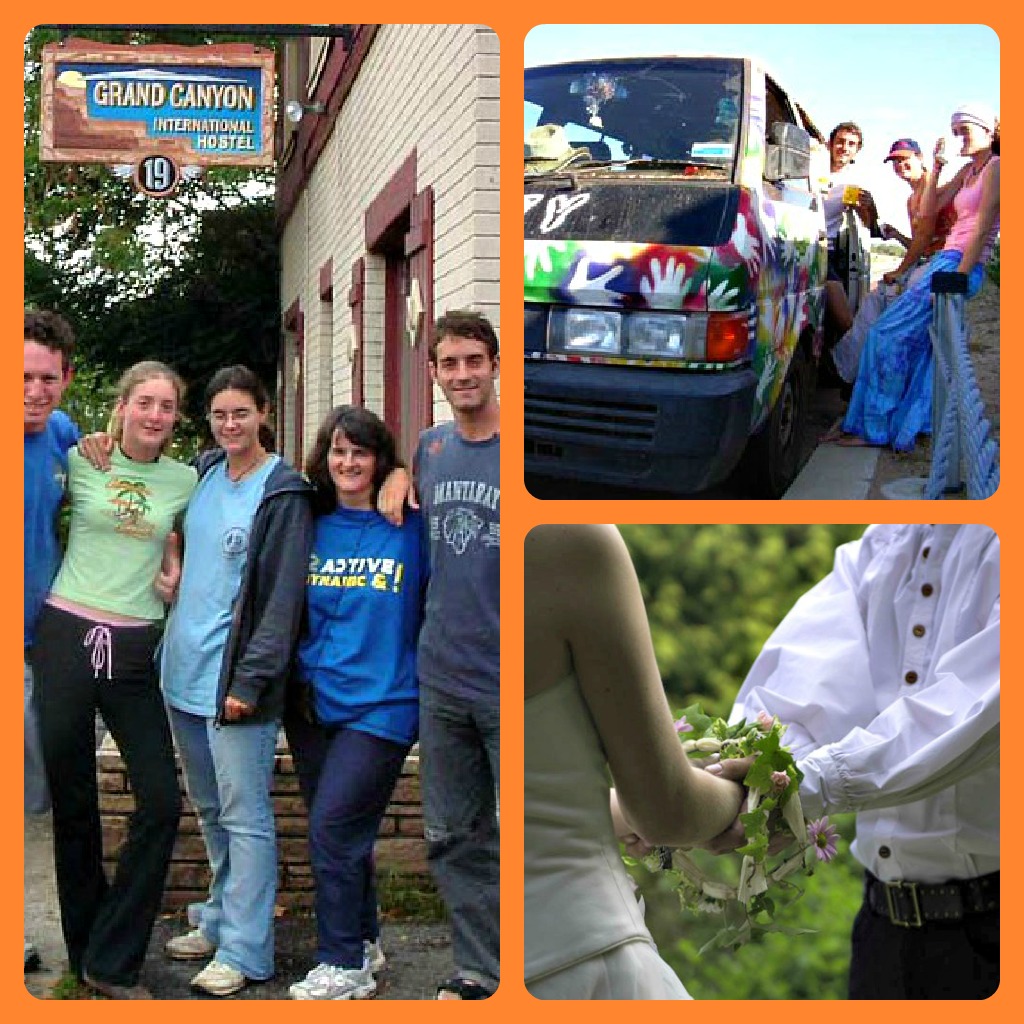
Images from Tony James Slater’s personal collection: Touring the Grand Canyon with Krista (she is in the green tee shirt), her boyfriend and his sister, Gill; his reunion with Krista and Gill in Perth, Australia, some years later (Tony is driving Rusty); all of this leading to Tony and Krista’s medieval-themed wedding in the UK (this is their “hand fasting”).