The Displaced Nation

A home for international creatives

Tag Archives: Travel yarn

Journeys through nomadic Africa — a travel yarn in two parts (Part 2)

Today we are joined again by Kathleen Colson, who delivers the second part of her travel yarn on a trip she made to Kenya from September 8 to October 14. In Part 1, Colson shared some overall impressions of the country, which she has visited innumerable times — most recently in the role of founder and CEO of a micro-enterprise development organization known as the BOMA Project. Today she focuses on the portions of the journey having to do with that project.

I founded The BOMA Project in 2005. “Boma” is a Swahili word for a livestock enclosure, but it also means “to fortify.” Our main program is the Rural Entrepreneur Access Project (REAP), which offers a seed-capital grant and business-skills training to small business groups of three people. The training is delivered by BOMA Village Mentors, who in turn are trained and supported by BOMA field staff.

So far, 2,688 adults, some of the poorest people on earth, are running 720 businesses, impacting the lives of over 14,000 children in northern Kenya.

As the project’s founder, I’ve had the great fortune to spend time with the pastoral nomads of this isolated region of Africa during several extended visits each year. In the first few years, there were four of us who traveled around the district meeting with village elders and groups of women. Since then, the organization has grown, and my trips have been busy hosting donors, photographers and consultants.

For this trip we would be back to the core team: Kura Omar, BOMA’s Operations Director; Semeji, our bodyguard; Omar, field support; and me, Mama Rungu. People always ask about my name, one that I have had for many years. It’s a long story, but a rungu is a warrior club. I got this name because someone thought I was tough.

I looked forward to the long drives across the rough terrain of northern Kenya — talking with Kura non-stop, sometimes shouting above the corrugated roads. While we drive, Semeji sings and Omar spots for cheetahs and hoopoes, all the while listening for the sound of a bad tire. At night, stories are told under a brilliant night sky, and we listen to Semeji’s soulful warrior songs along with the hyena’s call.

Shiny is good

The BOMA Project now has 40 businesses in and around the village of Kargi and we are soon to launch 20 more.

Kargi, home to numerous clans of the Rendille people, has grown into a substantial village because it’s a road-accessible location where missionary and aid organizations can easily distribute food relief. (Periodic droughts are part of the life cycle of these arid lands.)

BOMA has worked hard to establish ourselves in this village — keeping in mind that we also had to keep our staff safe in an area that sees frequent ethnic conflicts over livestock. Now there is tremendous enthusiasm for our work, including from the village leadership. The chief has told Kura:

…these BOMA people, they look shiny.

Clean, healthy, shiny. Shiny is good.

The case of Ndebe Arbele

In the Rendille village of Falam, near Kargi, Kura insisted that I meet Ndebe Arbele, a member of one of the BOMA businesses. BOMA had given her business group, May Yeel, a seed capital grant of $150 and they used it to buy food, beads, washing powder and other small essentials in Marsabit, a town on Africa’s main artery, the Cape to Cairo Road — which they now sell to residents and travelers in their village.

Ndebe and her partners have attended BOMA business-skills training programs, and soon they will start a training program on savings. After just two short months they were able to distribute profits, and according to their record book, they now have savings and cash on hand of 5,300 shillings, or about $56.

As Kura translated, Ndebe told me about her son who was bitten by a rabid dog. The medical treatment was 4,000 shillings for four injections. She told me, “If it was not for this business, I would not have been able to pay for the medical treatment for my son. Many children here die from rabies, but not my son.”

I am very aware when I visit with our BOMA businesses, that I am sometimes told what I want to hear. On this occasion, I decided to push back.

“But didn’t you also receive money from HSNP [Hunger Safety Net Programme]? I am looking at your group’s record book and I don’t see how the 4,000 shillings came from the BOMA business,” I said to her.

Ndebe looked down. “Yes, you are right. I also took my HSNP money to pay for the shots.”

She looked up at me with tears in her eyes, then said:

Please don’t take this business away from me. All my life I have been a beggar. I used to be idle, waiting for food relief to feed my children. Now I am a trader. Now I work every day. From others we get relief, but it always ends. This business stays with us, and now I am someone. Please, please don’t take this away from me.

I suddenly realized that it is here that we stake our claim. We can provide grants and training so that women like Ndebe can earn an income that will help her care for her seven children. But the human spirit craves dignity and respect more than it seeks wealth, and that is what we had given Ndebe. It was enough.

“I could never take this business from you, Ndebe. It is yours forever. Thank you for telling me why this business is important to you. I will always come and visit you when I am here, and I want you always to tell me what you feel in your heart.”

Kalath (thank you), Mama Rungu.”

A gloomier picture

In another Northern Kenyan village, Lengima, BOMA has facilitated the building of a school through the Dorothea Haus Ross Foundation. Currently, “school” is taught under a tree, with a blackboard and a volunteer teacher. For most of the students, there are no desks, no chairs, no paper, no pencils — not a single thing that would enrich the learning experience.

The whole village is involved in the building of the school. The men do the hard labor and each woman has been asked to collect a pile of stones — equivalent to a wheelbarrow-size load — for which they receive 50 shillings (55 cents).

The poverty in Lengima is extreme. Traditionally, the area relies on livestock as a source of income and food, but in times of drought, the men move the livestock elsewhere.

When we visited this time, a period of extreme drought, many of the children had the telltale signs of kwashiorkor (protein malnutrition), with reddish hints in their hair and extended bellies. The women were all painfully thin.

I met with Nalebicho Koitip, an older woman and a member of a BOMA business in the village, called Nkabe. She told me:

This drought has taken our livestock and our husbands. We keep our children alive with the small profits we make in this business. But it is hard because those without a business are turning to us for short-term food credit.

Locals must lead

In each village, we have BOMA Village Mentors. Using standard of living indicators — household assets and nutritional information — the Mentors select the “poorest of the poor” residents who are also enterprising and willing to work.

One of the highlights of my trip was attending BOMA’s Mentor University — our annual training session for the 26 BOMA Village Mentors — in South Horr.

This year, the goal of local leadership was a reality. I was now an observer. I said hello but was not expected to do anything else.

Sarah Ellis, one of our new researchers, has developed a micro-savings program for REAP participants, and at the meeting she introduced the new program to our Mentors. They will be the ones responsible for implementing the program region-wide. By regularly setting aside committed funds in a safe location, we believe we can provide insurance against the regular shocks that are typical for people who live in extreme poverty. It can also become a source of savings-led credit for BOMA grant recipients to grow their businesses.

Fresh ideas, goals

I always go to Kenya with lots of ideas and come back with even more. In the months prior to this trip to Kenya, I had spent time reading about the success of healthcare in Africa. While economic interventions, in general, have not been successful — incomes across the continent are down or stagnant — healthcare delivery has done reasonably well. The book Getting Better: Why Global Development Is Succeeding — And How We Can Improve the World Even More, by the economist Charles Kenny, is a fascinating read.

I wondered if we could apply some of the lessons learned by community healthcare workers in Africa to our team of BOMA Village Mentors.

In our last impact assessment, we had a 4 percent failure rate of the first 100 businesses. So I asked the BOMA team, “What if our businesses were patients? Would we tolerate a 4 percent failure rate?”

Once we started focusing on our failures, we became more imaginative, more creative. Every organization, for profit or not, likes to focus on its successes. If you are a nonprofit, you especially want to tout your successes, as this enables you to secure donations.

When we focused on our failures, however, we suddenly realized what we had to do — strengthen the training and support of our BOMA Mentors, the people at the heart of our program. We needed to give them the resources to fortify the success of BOMA businesses. We set a zero percent failure-rate goal for the following year.

Asked to say a few words at the end of the Mentor University meeting, I shared the concept of zero percent failure. It was a goal — a lofty goal — but I could sense the confidence in the room.

Our Mentors come from communities that have been overwhelmed by aid organizations that keep them on life support. Our program represents an opportunity to bring out the strength and resilience that resides in all of us.

Readers, any questions or comments for Kathleen Colson on her travel yarn or the BOMA Project?

For more details on Kathleen Colson’s recent East African journeys, go to the BOMA Project blog. Those familiar with the Matador Network may be curious to note that the BOMA Project was recently listed as one of the top 50 organizations “making a world of difference.”

STAY TUNED for Monday’s post on the “celebrity’s burden,” by Displaced Nation founding contributor Anthony Windram.

If you enjoyed this post, we invite you to subscribe to The Displaced Dispatch, a weekly round up of posts from The Displaced Nation, plus seasonal recipes, book giveaways and other extras. Sign up for The Displaced Dispatch by clicking here!

Related posts:

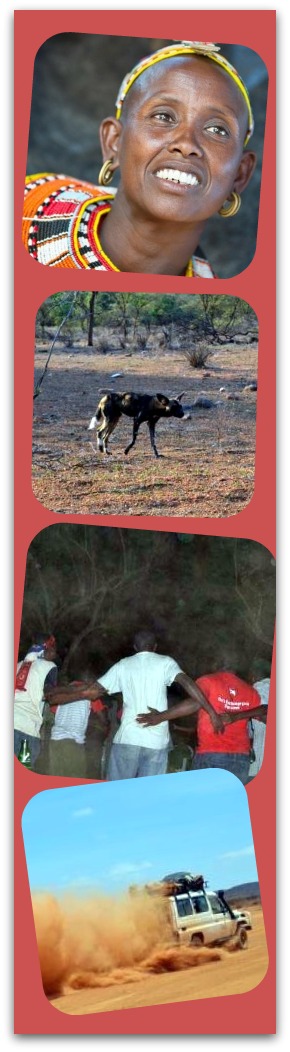
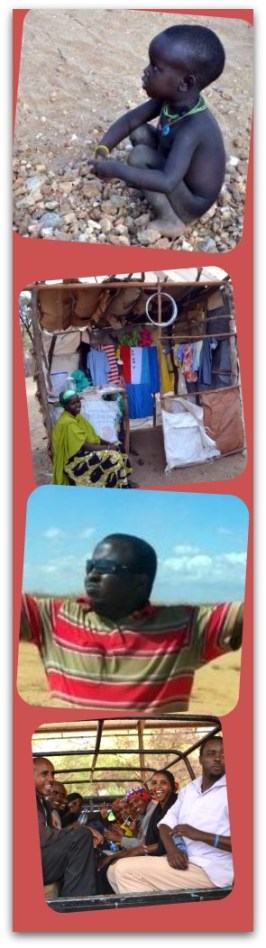
Images (top to bottom): A child in Lengima helping to collect stones for the building of the village school; a BOMA business in the village of Ngurunit; Kura Omar, BOMA’s man in Northern Kenya; a “taxi” full of  BOMA Village Mentors, at the end of the three-day Mentor University training program.
Journeys through nomadic Africa — a travel yarn in two parts (Part 1)

Today we welcome Kathleen Colson to The Displaced Nation as a guest blogger. Colson was in Kenya from September 8 to October 14 to lead a safari for her alma mater, St Lawrence University, and to meet with her staff and the participants of The BOMA Project — the micro-enterprise development organization that she founded in 2005. Colson has traveled to the African continent over 30 times.

In this, the first in a two-part series on her most recent travels, Colson shares some overall impressions of Kenya. In Part 2, to be published next week, she will report on her journeys related to the BOMA Project’s work.

For over a quarter of a century, I have traveled to Africa, visiting 11 African countries in the process. But East Africa — in particular, Kenya — is the place that keeps bringing me back.

Each time I’m in Kenya, there’s a moment when I feel overcome by the sheer physical beauty and rawness of the landscape. This time, that moment occurred when I was flying over the land that I had spent years driving through — northern Kenya. Now — only my second time to do so — I was seeing the land from the air.

Fractured volcanic mountains stood in stark contrast to the vast open spaces of desert and scrub brush. But for the occasional circle of villages inhabited by Samburu or Rendille nomads, the land looked uninhabited.

I was looking down on ancient untamed wilderness.

Land of infinite variety

Kenya is a land of varied terrains and climates. So it is always difficult to pack when you are traveling between the extremes — from the cold and damp nights in the village of Nanyuki (Kongoni Camp), at the base of Mount Kenya, to the heat and arid conditions of the nomadic villages of northern Kenya.

Millions of years ago, the African continent tore itself apart, creating a 5,400 mile trench that runs from Jordan in the north to Mozambique in the south. A 19th-century British explorer called the trench the Great Rift Valley. It is visible from the moon.

On either side of this crevice, great volcanic mountains erupted creating Kilimanjaro and Ol Donyo Lengai (Mountain of God) in Tanzania and Longonot, Menengai and Mount Kulal in Kenya.

Wake-up calls

Being in Kenya always heightens my sense of hearing — whether it is the sounds of the night that reach me through the thin barrier of tent canvas, or the sounds that come with the morning light.

In mid-October, while staying in South Horr, I was awakened by the muezzin calling the faithful to prayer at 4:30 a.m. In this village of mostly Catholic parishioners, South Horr was a typical village in northern Kenya with a diversity of spiritual practices.

As light filtered through the cracks of my wooden windows I heard the sounds of a village awakening — chickens and goats and the murmur of soft, gentle voices. A tropical bulbul, go-away birds and the honking of a hornbill joined the chorus. And then it came — the sound that has started almost every day that I have ever spent in Africa — the whisk, whisk of a palm branch broom.

By the next day, those noises were drowned out by the growl of winds blasting down the Rift Valley. I awakened from a night of Malarone-infused dreams to the sound of young fruit dropping onto the tin roof of my hut from the gnarled olive tree above it.

That day we would make the treacherous climb up Mt. Kulal to Gatab, a Samburu village perched on the edge of a sheer cliff. I was glad we would be staying in a solid cement house — the home of a doctor who had left the area but who allowed visitors, as long as they were approved by the missionaries, to use it.

That first night in Gatab, the thorn branches of a bougainvillea bush, brilliant with pink blossoms during the day, now clawed at the tin roof of the building, desperately trying to hang on as the wind blew and blew.

The missionaries’ dogs barked in desperate pleas for calm which eventually came with the dawn, as the winds quieted down and the mists descended from the forest, blanketing the village in an eerie white fog.

On safari

One of the purposes of my trip was to lead a safari of 22 people from September 16 to 28. After a costly snafu with my return flight from northern Kenya to Nairobi, I was finally able to check in with my head guide, Eutychus, and introduce myself to the group members, whom I recognized from their passport photos.

Our safari consisted of a mix of presentations on some of the good works being done in Kenya — Ken Okoth of St. Lawrence University started it off by giving us a tour of his facility in the Kibera slums of Nairobi — and animal sightings.

In the Samburu National Reserve, we saw cheetah, lion and leopard. We also had a sighting of rare wild dogs — unbelievable! One afternoon, we watched a delighted group of young elephants swim and bathe in the rushing waters of the Ewaso Nyiro River.

At a surprise sundowner setting in the hills surrounding Sekenani Camp, I awarded two of our travelers a rungu — the traditional club of Maasai and Samburu men — for carrying on with the trip despite becoming ill.

East African joie de vivre

Another purpose of my journey was to attend a training program for the Mentors of The BOMA Project. On our last night together, I paid for a case of Tusker beer and sodas. As it grew dark everyone straggled back to camp and gathered in a circle of chairs outside my hut. Song leaders like Teresa, our Mentor from Loiy, and Semeji, our security man, led us in rounds of music. Spirits were high by the time dinner was served — steaming bowls of rice, cabbage and goat meat.

After the meal, the dancing began. It started with sonar tenor chants and simple songs. Soon other guests staying at the club as well as people from the town joined in the celebration. Arms around waists, hands clasped and feet pounding in a circle of bodies, the ethnic mix of Samburu, Rendille, Ariaal and Turkana voices joined together in a shared chant — i-lee-um, il-ee-um, il-ee-um, il-ee-um.

Teresa and Semeji’s voices pierced the chanting voices with whoops and wails, connecting the voices to stories of love and longing and the battles of brave warriors.

Two young mothers handed me their babies and I held them close as the dancers pounded their feet and sang the songs of the nomadic people from the north. The dust from the dancers’ feet and the chanting voices rose into the night sky.

Rumblings of discontent

I arrived in Kenya in early September. By that time, the news of the East African drought that started over a year ago was bringing well-intended organizations into the region who had not spent time asking the people what they need. During my first few days, I heard many complaints from residents.

One organization, for instance, had proposed that the community build a greenhouse to grow vegetables.

“And where do we get water for the greenhouse?” the residents responded.

Another organization arrived with desks and chairs for the local primary boarding school.

“But we have desks and chairs,” the residents told them. “We need beds and mattresses for the dormitory so the children do not sleep on the ground.”

And those weren’t the only complaints I heard voiced against foreigners. In the remote mountain village of Gatab, I witnessed hundreds of residents quietly protesting the presence of one of the missionaries who has lived in the village with his family behind a tall chain-link fence.

I was only a casual observer and the circumstances were, I am sure, complicated.

But it is hard not to notice, in contrast to the poverty of this village, the relative wealth of a missionary family whom I am told do not interact socially with the villagers — multiple ATV and lorry vehicles, a backhoe, a wind tower, a satellite dish and a trampoline for children who do not attend the local school. All of this infrastructure was in support of a clinic and Haven Home — a boarding school for nomadic children and orphans.

A number of years ago a local woman had received a divorce after years of abuse by her husband. She was employed by this missionary family and had finally decided that she wanted to have a baby but would do so without a husband. She was fired. According to a number of village leaders that I spoke with, this was the last straw. “We’ve had enough,” the villagers told me again and again.

I tried to find out more and later that evening I did a search on the Web (yes, you can get slow Internet through a mobile phone modem), where I found this description:

Haven Home provides a Christian environment for these young people from many of the immoral and destructive tribal practices.

Before I started The BOMA Project, I spent two years traveling the district and listening to the people. We tried lots of things and we kept listening. Out of this came two founding principles — that we would focus on income as our development strategy and that we would remain committed to the local leadership of all BOMA programs.

But more on that in next week’s post…

For more details on Kathleen Colson’s recent East African journeys, go to the BOMA Project blog. Those familiar with the Matador Network may be curious to note that it recently listed the BOMA Project as one of the top 50 organizations “making a world of difference.”

Readers, any questions or comments for Kathleen Colson before next week’s installment?

STAY TUNED for Monday’s post by our guest blogger Lawrence Hunt, about gap years, voluntourism, and the search for the “authentic” travel experience.

If you enjoyed this post, we invite you to subscribe to The Displaced Dispatch, a weekly round up of posts from The Displaced Nation, plus some extras such as seasonal recipes and occasional book giveaways. Sign up for The Displaced Dispatch by clicking here!

Related posts:

Images (top to bottom): Nalepicho from Lependera, a Rendille nomadic village in the Kaisut Desert; a rare sighting of a wild dogs in Samburu; dust from dancing feet during the BOMA Project’s celebration; GUMPS (the BOMA Project vehicle) crossing the desert on the way to Gatab.

Bon appétit, really? A TCK’s encounter with French cuisine — and culture

Our Third Culture Kid columnist, Charlotte Day, regales us with stories of encounters with France and French cuisine that piqued her curiosity somewhat more than her palate.

My experience of France and of French food consists of a miserable trip to Paris and the Loire Valley with my mother and stepfather in cold, drizzly March, and an even more miserable language exchange to Lyon last February.

The first experience saw us through innumerable cafés au lait, pains au chocolat and frothy miracles of haute cuisine in the Loire Valley. Afterwards, my mother went on her first raw food diet.

The second was a mandatory school trip for all French-language students at my boarding school in England, which I faced with more optimism than most. Two weeks in Lyon, two weeks back in England, dramatic language improvement and cultural interchange — why ever not?

From the moment we boarded the Eurostar, however, things did not look promising. Two boys arrived sporting Union Jacks and carrying paper cut-outs of Wills and Kate. The rest had already scoured their exchange partners’ Facebook pages and resolved to dislike them.

I suppose I ought to have anticipated this Anglo-French clash, given the historical precedents. Yet the English contingent’s narrow-mindedness unsettled me.

Yes, we were sacrificing a holiday to spend two weeks with a stranger. But their genuine unwillingness to learn, Anglo-supremacist attitude and lack of curiosity were a little disturbing.

As we descended into the arrivals hall of Lyon Part-Dieu station, the smiles of expectant correspondents ought to have rebuffed the querulous English students. Yet each went through his or her initial greeting with as pronounced an English accent as possible.

You are what you eat

My exchange partner and her mother drove me back to their beautiful old farmhouse, in a village known for horse breeding. My bedroom was large and warm, my French not as bad as I’d feared it to be.

And yet one anxiety still plagued me: sustaining a gluten-and-dairy-free diet in England was sufficiently difficult, but in France, I imagined, next to impossible. I sat in my room, weighing the relative merits of two weeks’ stomach cramps against starvation — and how to explain in French the effects of wheat, barley and rye on the small intestine?

What I found in the dining room occasioned raw joy: steamed vegetables, fish and salad. Likewise in the kitchen: a refrigerator shelf full of yahourt au soja. To their question “Ça marche?” I would have poured forth encomiums had I mastered a suitable vocabulary set. But I could not move beyond “Oui, c’est fantastique” before we sat down to eat.

This first meal was to be the most talkative of my two-week sojourn. As the breakfasts and dinners succeeded one another in an endless cortège of fresh fruit, perfectly steamed broccoli and silence, I felt that either starvation or stomach cramps around a more convivial table would have been preferable.

My exchange partner was kind, but icy. Her fastidious and sparing eating habits made me feel a glutton in comparison. Her mother ate protein powder in yoghurt more often than a solid meal. Eventually, my mornings were characterized by a solitary repast of fruit salad — no one else seemed to be eating.

Ghosts at the feast

The occasional apparition flitted around the dinner table — some closer to human form than others. The first was Pierre, the former lover of my exchange’s mother, with whom she was still sharing living expenses. He was tall and corpulent with a thunderous voice. She had cast him from her life — but only driven him out as far as the other end of the house, where he entrenched himself in a study strewn with half-smoked cigars.

At least he ate like a Frenchman — belonged to the cult of taste, before that of health. Yet he vanished soon after his first appearance, driving off to see his mother in a neighboring town. He returned after five days, at two o’clock one morning, and left again the next day.

The second apparition was my exchange partner’s boyfriend, Samson — a thin, pale young man with an unruly mass of curls; a maths prodigy who’d set his sights on attending one of the grandes écoles.

Samson, too, was slightly less given to subsist on lettuce and pumpkin seeds. My exchange partner lovingly provided him with a baguette and chocolate — which he would munch while explaining to me the superiority of the French educational system.

He cross-examined me on my plans for the future. I had got as far as a spectral PhD in Russian Literature, when he stopped me with a shocking rejoinder:

Il faut réfléchir, Charlotte! La vie est sérieuse. (In essence: “Life will pass you by before you have accomplished anything.”)

I refrained from pointing out that he had not planned beyond the classes préparatoires, or prépas — two hellishly difficult years spent preparing for university entrance tests. Instinctively, I commended his ambition and drive — yet felt him ill qualified to condemn my lack of perspective given his own determination to sacrifice two years of his youth to a virtually unattainable goal.

My tryst with moules frites

Midway through my stay, our funereal meals were interrupted by my exchange’s mother taking us on her weekend-long tryst in Brussels. She’d discovered that a childhood sweetheart was living in Belgium’s capital, and over the past months, they’d re-cultivated their relations. My exchange and I were invited along as third and fourth wheels.

José, the new lover, was almost as much the gourmand as Pierre, his predecessor.

Yet of his guests, I was the only one who ate at all.

Our meals together included lunch in a traditional Belgian restaurant, where I unadvisedly ordered moules-frites without the butter, causing a scandal in the kitchen.

We had Thai for dinner — a first for my partner and her mother — after which I turned around to see the latter and José kissing passionately on the curb.

Resolving to see something of Brussels at all costs, I accompanied the couple on a walk to the markets, while my partner sat sullenly in José’s penthouse apartment. There, I stared mournfully at beautifully packaged jams, cheeses and Breton biscuits — knowing that we were to leave for Lyon that evening, where another week of salad and silence awaited.

I returned to England appreciably thinner, with an improved French accent and a block of Belgian chocolate for my mother.

Though my experience of France did not come floating in butter, it was more French than I could ever have anticipated.

Readers, any questions or suggestions for Charlotte, should she have any future encounters with France?

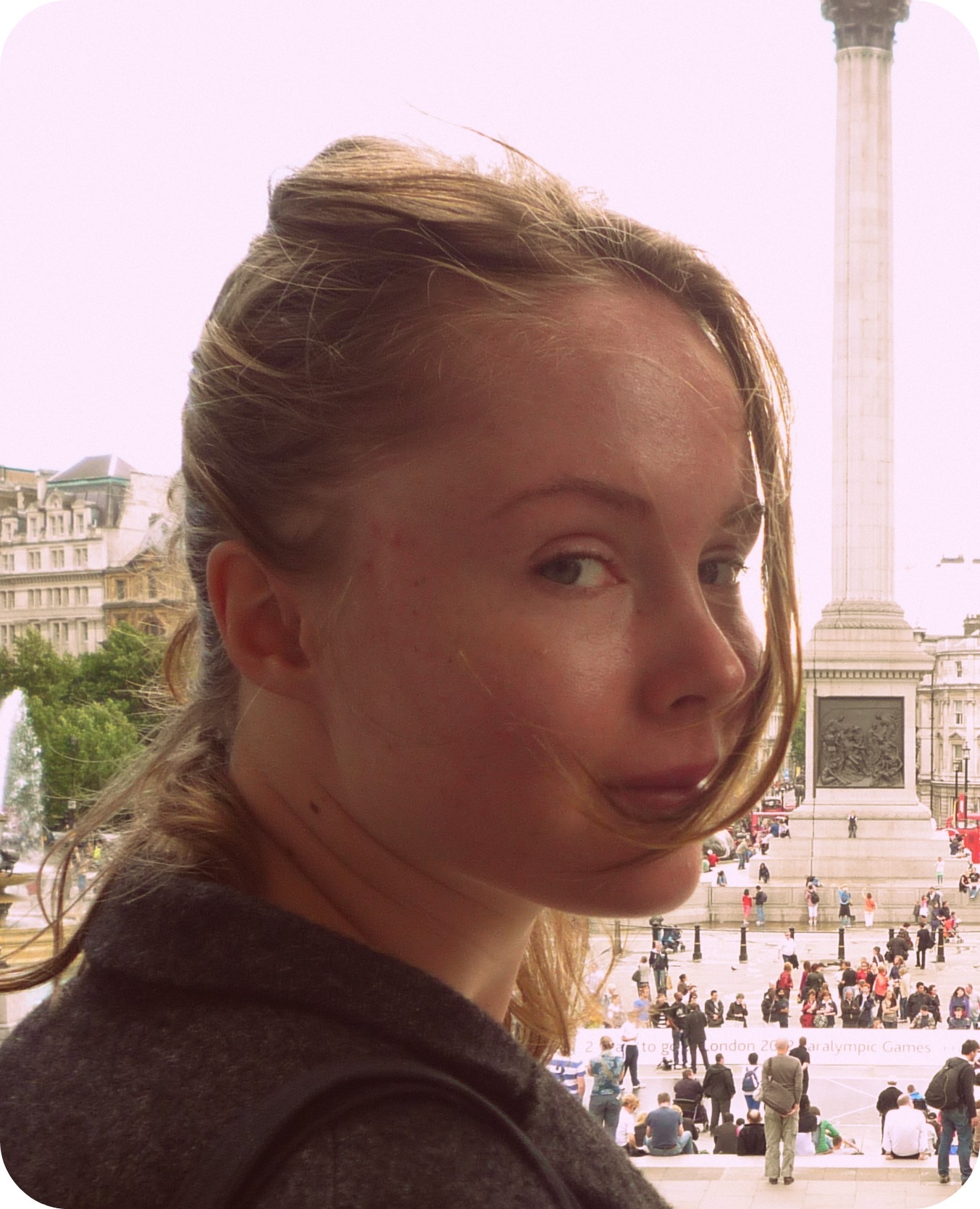
img: Charlotte Day surveying Trafalgar Square in London.

STAY TUNED for Monday’s post, offering a few last-minute Halloween costume suggestions for Displaced Nation citizens.

If you enjoyed this post, we invite you to subscribe to The Displaced Dispatch, a weekly round up of posts from The Displaced Nation, plus some extras such as seasonal recipes and occasional book giveaways. Sign up for The Displaced Dispatch by clicking here!

Related posts:

My Grand Tour through Italy on an art history student’s budget

Today Monika Frise — the daughter of one of our Random Nomads, Helena Halme — joins us as a guest blogger. Monika is an art history student in the UK. Here she tells of her trip to Italy last month with another art history student friend — a travel yarn that makes a welcome change from all the French foodie posts we’ve been doing of late. (That said, Monika does start out by talking about food — it’s Italy, after all!)

At the end of my first year at the University of Birmingham, facing a stressful exam period, I decided to book a holiday to Italy with a friend of mine, Liz. We planned to go in early September, after the summer crowds had ebbed and the weather would be somewhat cooler. We organized to visit five cities: Verona, Venice, Pisa, Florence, Siena and finally, Rome.

Both Liz and I are studying art history. Neither of us is specializing in Renaissance art — I’m studying Eastern European architecture/art and 19th-century French art this year (concentrating on the period just before the impressionists). However, we both loved the idea of making a Grand Tour through Italy to see the Grand Masters’ works, following in the footsteps of European aristocrats of centuries past — we just wished we had their riches to finance our journey!

The trip came around sooner than expected and I for one felt a little apprehensive about what it would be like moving to a different location every couple of days, on a student budget.

Buon appetito

Italians are famously passionate about their food, and despite having to watch our expenses, we were determined not to miss out — even if it meant eating a lot of pizza.

We made a determined effort to avoid restaurants close to large monuments and museums and seek out local eateries instead. We were somewhat taken aback at the prices of food, though — especially in Rome, where we had to search for a long time in order to find a cheap restaurant that also looked good.

Our first night in Verona, the plump, friendly hostel owner recommended a restaurant, Bella Napoli, for “having the best pizza in town.”

She also told us to “touch the left breast” of Juliet’s statue for good fortune in life.

We took her advice on both counts and weren’t sorry. At Bella Napoli, we shared the house specialty, pizza al metro (pizza by the meter), which arrived on its very own table on wheels.

Venice, however, posed more of a challenge. But, on our first night, after walking somewhat aimlessly through the narrow streets for some time, we chanced upon a small osteria offering home-cooked food at great value. For a change, we didn’t have pizza. I ordered gnocchi with tomato sauce: delicious.

The service, however, left a little to be desired — our waitress dumped our change on the table without even a smile. Likewise in Rome, service was rather hit or miss. We had excellent service at a pizzeria where they roll the dough right in front of you, but at a café close to Termini station we waited for our bill for such a long time we could have walked away without paying (yes, the thought did seriously cross our minds!).

Another affordable yet delectable treat is the famed gelato. The best we tasted — and we tasted a lot — was at a place called Rivareno just around the corner of our hostel in Rome . They soften the gelato with a palette knife before spooning it into the cup. There were so many different flavors on offer, but my favorite was probably caramelized fig and ricotta.

“Roughing” it

We students will walk miles to save money, but in a country like Italy that’s not such a bad thing. As Liz and I soon discovered, going everywhere on foot was the best way to take in the local color (not to mention work off all that pizza, pasta and gelato!).

In the small winding streets of Siena, we encountered a small boy playing the drums in little side street whilst a group of old men and women chatted nearby, seemingly oblivious to the racket he was making.

In Verona one night, we happened upon Juliet’s balcony (which we’d seen the day before in the daylight). The bronze statue of Juliet in the courtyard looked completely different when illuminated. Gazing through the gates at her peaceful shape summed up this city for me: bright and vibrant yet calm.

Walking was also a way of avoiding unwanted curiosities in the hostels where we stayed. The hostel in Venice, for instance, had a very bad case of bedbugs — so much so that we spent our second night sleeping on the dusty floor, with only a sheet beneath us. But even that didn’t stop the little blighters. At one point one of the other girls woke up with one of them on her cheek. Unfortunately, despite the beauty of Venetian art and architecture, it’s the bedbugs that made the most lasting impression, rather literally!

That said, walking also exposed us to some humans who behave like pests. More than once did we have to hurry away from some overeager men who were making kissing noises at us, and outside the Arena in Verona, the city of love, a “Roman gladiator” gave Liz a pat on the bum!

Art coming out of our ears

Tourism in Italy involves an endless parade in and out of churches. I reckon we saw about three in every city, apart from Siena where we saw only one, the Duomo di Siena.

We ended up appreciating the cathedral in Siena far more than the Basilica san Marco in Venice, which overwhelmed us with its abundance of Gold Romanesque mosaics and small adjoining rooms replete with countless treasures. Our guidebook had advised us to make several visits, but for me, a single visit was more than enough. Both interior and exterior reminded me of an over-sweet, over-decorated cake.

Since we are both interested in Renaissance art, Florence had a great deal to offer. My wise mother had advised that we pre-order tickets for both the Uffizi Gallery and the Accademia Gallery — the latter of course being the home of Michelangelo’s David.

After smugly walking past the long queue for the Accademia, Liz and I took a seat on a bench close to the David and watched as people circled around it, discussing its various aspects. (We even managed to sneak a picture of the statue whilst the guards weren’t looking, saving us a few extra cents on a postcard.)

At the Uffizi Gallery I particularly loved seeing Flora by Titian — so much better seeing it in a photo for appreciating the colors and brush strokes.

By the time we reached Rome, our enthusiasm for the Grand Tour had flagged somewhat. The Sistine Chapel, where everyone was herded around like sheep, especially disappointed us.

The best part of Rome was our trip to the Pantheon — fantastic! As we wandered around this circular building, I couldn’t take my eyes off the ceiling. I was transfixed.

First of many tours?

I would definitely like to return to Italy one day soon, and perhaps even try living there for a while.

Of the five cities we visited, I could really see myself in Siena even though it wasn’t my favorite place. It’s just that the atmosphere made me feel at home, I think because there were fewer tourists. (I particularly enjoyed my trip to the local supermarket, full of hustle and bustle and the smell of freshly baked bread.)

My Italian, which was very basic, got better as our trip progressed. However I would have to take a lot of classes if I were ever to brave living there!

NOTE: You can read Monika Frise’s art reviews on her new blog, Post Raphaelite, and/or follow her on twitter: @Shmonn.

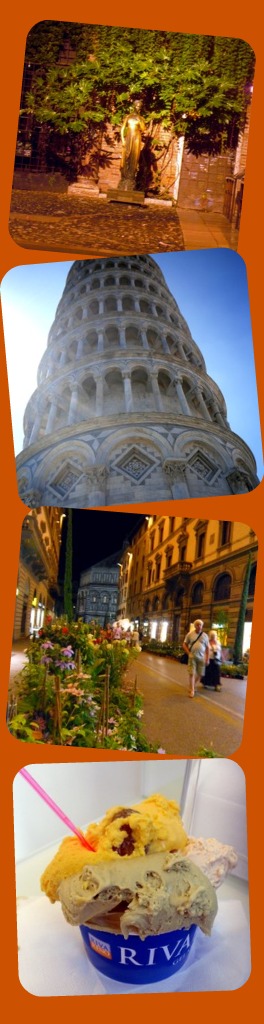
Images: Juliet’s statue in Verona by night; from the foot of the leaning Tower of Pisa; flower sellers in streets of Florence, near the Duomo; three flavors of Roman gelato: pistachio, caramelized fig and ricotta, and crema mediterranea (a Rivareno speciality).

STAY TUNED for Monday’s post, when founding contributing Anthony Windram reports on his attempt to make a Parisian lunch in California, following the recipes of Elizabeth Bard (see also ML Awanohara’s attempt).

If you enjoyed this post, we invite you to subscribe to The Displaced Dispatch, a weekly round up of posts from The Displaced Nation, with seasonal recipes and occasional book giveaways. Sign up for The Displaced Dispatch by clicking here!

Related posts:

Budding Slavophiles, welcome to my kitchen’s-eye view of Russia

As we learned from her Random Nomad interview with us in May, Charlotte Day is torn between three countries: Australia, USA, and England. As if this weren’t enough, it turns out she harbors an obsession with Russia, going back to when she discovered classical Russian novels in 8th grade. Here she spins a travel yarn about the her month-long sojourn in Saint Petersburg this summer, where she studied Russian language while living with a homestay family. So, did the real Russia live up to Charlotte’s expectations, or had her overactive imagination led her astray? Let’s find out…

Bolshoi Kazachiy Pereulok is not a notable St Petersburg street. It is a bent elbow between Zagorodniy Prospekt and the Fontanka embankment.

Emerging from Pushkinskaya metro station, one walks past a travel agency of sorts, a faded basketball court and Kazachiy Bani, a green-tiled 24-hour bathhouse from which emerge oiled men, rubbing their hair with threadbare towels. Peering through the open door, one can just about discern a gleaming ticket window, half plastered over with out-dated rate notices.

In the crook of the elbow stands Number 9, a magnificent turn-of-the-century apartment building, with geraniums tumbling over the serpentine-patterned grilling of occasional balconies. The building’s green façade, tinged as if by an eternal sunset, smiles mournfully over the street — watching as beer bottles clink and smash on the pavement, cats stalk along beneath decades-old cars, and the high gates open and shut in a kind of eternal song.

The plaque outside Number 7 reads: “In this building lived and worked Vladimir Ilich Lenin,” and on a rack beneath, three red carnations wilt.

I lived for a month at Number 5 — past the automated bell at the gate; through the courtyard, painted a warm, yet exhausted, yellow; up the shallow, concrete steps; and behind two locked doors — in the home of Nadezhda Skarinova, her husband, Kirill, and their son, Vladimir.

Striking up an acquaintance with the Skarinovas

While in theory I shared a home with entire family, the two male Skarinovs managed to be absent for the majority of my stay. Kirill, a chemical engineer, offered a smile — sometimes a privyet (hi) — whenever we met in the hallway.

But as he left for work as I was getting up, and had dinner immediately upon returning home at 6:30, we saw very little of each other.

Vladimir, or Vova, had been a source of much speculation before I set off — in the way that only unknown 21-year-old sons can be — among my well-meaning friends and relatives. (I am only sixteen.)

But he turned out to be largely taciturn, spending his days facing a computer screen (he was studying to become a programmer).

We had one two-sentence exchange — when he helped me down with my suitcase, on departure.

The only stories I can spin about my month in Petersburg involve minutiae. Such had been my idea of the perfect adventure before I left for Russia, in anticipation of what it would be like to be free from parental dictates for the first time.

Indeed, I did very little.

Not prone to escapades, I spent my evenings, after class, wandering along the Griboedov Canal Embankment (where I saw a drowned corpse—lying, swollen, neglected, and only haphazardly covered by a tarpaulin), or taking the metro into a far-flung, neglected suburb to spend ten minutes looking at an exquisite church.

But if my journey had less geographical displacement than those of most adventurers, my nightly dinner conversations with Mrs Skarinova made up for the lack by advancing me along the path of greater understanding of that strange thing — Russia.

A series of stove-side conversations

The first time I heard a bang on my bedroom door, and a gruff mozhno uzhinat? (roughly, “is it possible to have dinner?”) at 8:00 p.m., I hurried a nervous da, closed my book, and sidled into the kitchen.

The news was on, as it would be every subsequent evening — the twin anchors of channel Rossiya speaking too quickly for me to understand, their journalistic jargon blending into an unvarying mumble.

There sat Nadya, looking terribly bored, with large bags under her eyes. She poured me some tea from the eternal teapot. (Russians make tea by brewing a pot, which can keep, it would seem, for over a week—and then pouring a small amount, diluted with hot water, into your cup.)

Kuritsa — normalno? She presented me with a plate. As it was chicken, I nodded in assent.

Sitting down opposite me, shelling sunflower seeds — aimlessly, it seemed — she began to comment on the news.

Before I knew what had hit me, we were traipsing through the hardships of the 1990s — lining up outside an empty supermarket, clutching a prescription for baby formula. Mothers would rush from work during their lunch breaks, Nadya said, to secure a ration of bread for their family’s evening meal. And she’d had to bring up the infant Vova without the help of her mother — who died in her early sixties, from exhaustion.

And this was not the only thread Nadya spun over the course of our four weeks together. Another was the Orthodox Church. Her grandmother, who had lived through both world wars and the Russian Revolution of 1917 — and consequently wasn’t afraid of anything — spirited her granddaughter off to a church to be baptized, at a time when any hint of religion could make you a social pariah.

As a member of the Komsomol (“because everyone was in the Komsomol then”), Nadya hid her crucifix under her pillow. She told me that when religion resurfaced after the collapse of the Soviet Union, young couples longing for a church wedding were in a dilemma. How could they know if they had been baptized or not? Perhaps their grandmothers, like Nadya’s, had had it done in secret.

Nadya scowled as Patriarch Kirill appeared on the screen, leading a service in Kiev. His cardinal offense was the purchase of an expensive designer watch, several years back.

Many don’t like Patriarch Kirill so much… I’m an Orthodox person, but Patriarch Kirill… And he’s just one of the problems: for instance, why did they have to make Tsar Nikolai* a saint? What did he ever do? In his youth he was just a normal young man — women, alcohol, all that. What should I pray to him for? And his wife? Nothing wrong with her — German princess, worked in hospitals… And her little boy had that illness. But go to church and ask them for help? Yes, it was a tragedy, a crime — to kill all those children, too. Yes, the revolution oughtn’t to have happened. But Nikolai II a saint?

*With his family, Tsar Nicolas II, Russia’s last emperor, was recognized as a martyred saint and canonized as a passion bearer by the Russian Orthodox Church in 1981.

A samovar too big for the kitchen

On my last night in Petersburg, Mr Skarinova came into the kitchen bearing a large 1830s, wood-burning samovar — complete with chimney.

Nadya was not certain about this new addition to their lives.

It’s going to the dacha. No question about it. Wouldn’t fit in the kitchen anyway. And what am I going to do with a samovar like that? Put it in the bathhouse — na dachye. There’s no electricity in there.

The family had been to their dacha — a few hours south of the city — once while I had stayed at their apartment. They came back laden with berries: bitter and smelling of evergreen.

“All the men want to do there is drink,” Nadya told me one night. “I personally don’t drink — only wine. But Kirill…”

And another evening —

At least Kirill’s never come home drunk in the evenings. On holidays, yes — New Year’s… But the rest of the time — I don’t tolerate that sort of thing. What would have happened with Vova, a child, if dad kept coming home drunk? But it’s a common thing…

And judging by the beer bottles littering the street every morning when I walked to school, I doubt not that it is.

But this seems a catalogue of complaints — when my own experience of Russia was quite the reverse.

There was a moment when, crossing the Neva River on my last evening wander, I saw the spectral moon, blooming into fullness over the Winter Palace embankment.

And faced with that glut of unabashed beauty, I made an inarticulate noise — half of despair, half of exaltation — as people do in Russian novels. (It was only my English reserve keeping me from falling to my knees and weeping: the truly literary gesture.)

As it was, I left the next day feeling I would like to spend the rest of my life in Petersburg. But before I advance any further along that path, I must brave a winter without being killed by a falling snow drift. (“It happens,” says the Voice of Wisdom…)

But no matter how many tracks I beat in Russia, it is somewhat sobering to think of Nadya sitting, through endless reports of train crashes, patriarchal visits and state holidays, in that desperately uncomfortable chair, shelling sunflower seeds and passing the time.

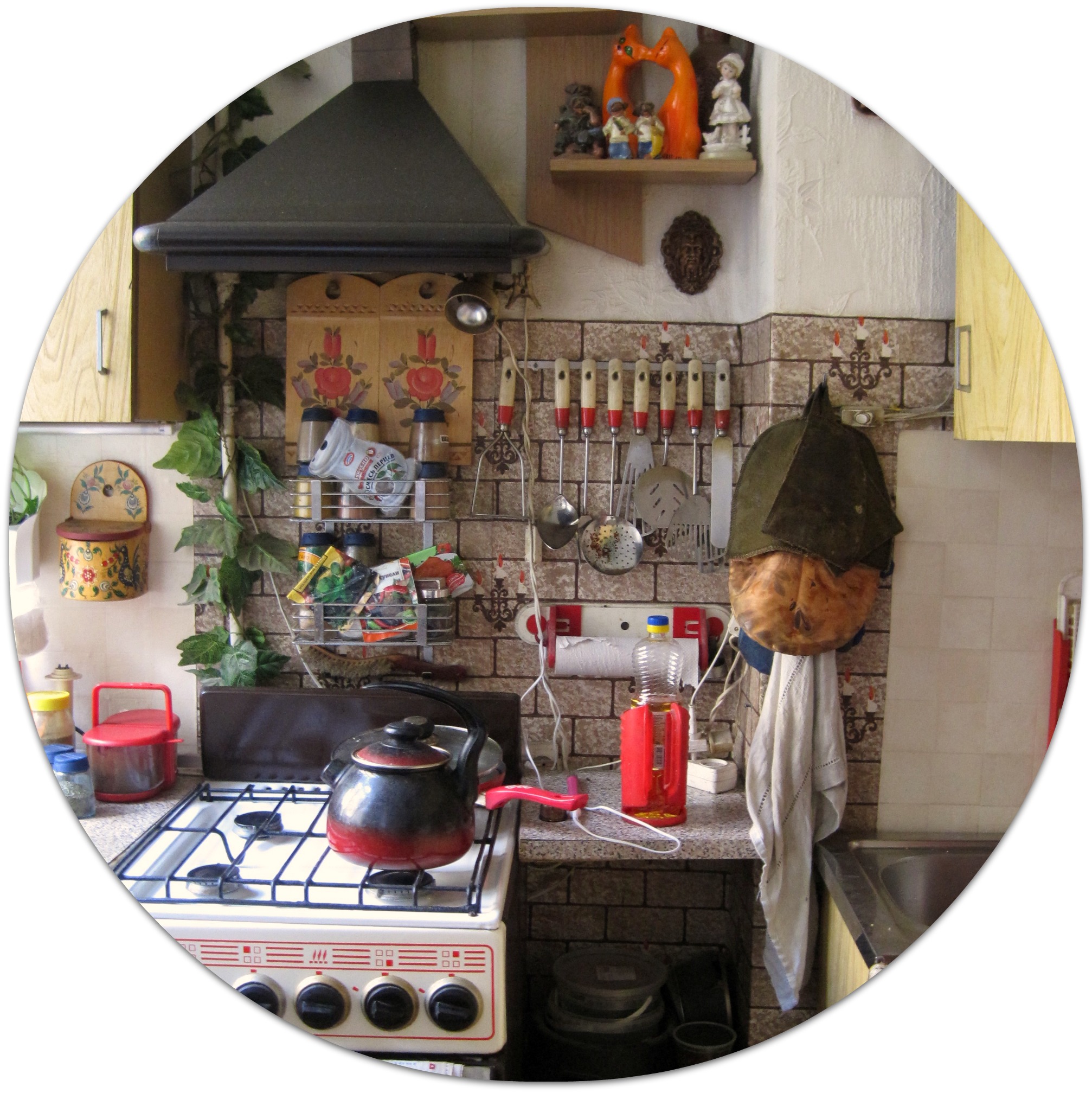
img: The Skarinova kitchen, where Charlotte’s nighttime chats with Nadya took place.

STAY TUNED for tomorrow’s post taking a parting glimpse at summer’s millinery enchantments, by our Alice awardee Sebastian Doggart.

If you enjoyed this post, we invite you to subscribe to The Displaced Dispatch, a weekly round up of posts from The Displaced Nation, with some fun extras such as seasonal recipes. Sign up for The Displaced Dispatch by clicking here!

Related posts:

Is The Displaced Nation for expats, travelers — or both?

When we started up The Displaced Nation on April Fool’s Day, many people wondered: is it a site for fools, be they expats, travelers, or both?

From the perspective of outsiders — people who aren’t in the biz — that distinction may seem frivolous. After all, many travelers become expats and many expats travel.

But from the inside, it’s very clear who the travelers and expats are. Both are interested in viewing the world’s rich tapestry firsthand — but expats tend to focus on the intricacies of particular patterns, whereas global travelers want to take in as much of the picture as they can, including the tattered bits.

So, who is more displaced — the expats or the travelers?

The answer is neither. Feeling displaced is a state of mind. To continue the tapestry metaphor, part of you identifies with the new patterns you’re looking at, while another part thinks it’s a confused mess compared to the patterns you’re used to.

Not all global residents feel displaced; same for global travelers. And there are even cases where a person has never traveled except in an armchair — but has ended up feeling displaced by what they’ve read.

As a student of Shakespeare, I’m often reminded of the King Lear line:

“Who is it that can tell me who I am?” – William Shakespeare, King Lear, 1.4.230

Except that King Lear felt this way at the end of his life; many of us global voyagers get there rather earlier. Is it any wonder we feel like fools?!

Now, if you’ve noticed that our site tends to be expat-centric, it’s because two of our writers are expats and the other one (me), a former expat.

Reflecting this imbalance, I’ve started commissioning guest posts by writers — switching metaphors here, but only slightly — who can spin the kind of travel yarn that focuses on the ways travel can make you feel misplaced, displaced, out of place — and, in the process, challenge who you are as a person.

Thus far we’ve featured three such yarns:

1) My first flirtation with the lawlessness of global travel: 4 painful lessons, by Lara Sterling
Sterling has done it all, from round-the-world trips to expat stints. In this article she reports on the shock/horror she experienced after falling in love with a German traveler and following him all the way to war-torn Guatemala — only to discover he was engaged in criminal activities. Part of her was with him, fascinated — they were in a lawless land, so was there any reason to abide by the laws back home? But another part of her was repelled, and couldn’t wait to get back to the United States.

2) In search of 007th heaven, a travel yarn in three parts, by Sebastian Doggart
Doggart — a Brit who lives in New York City and blogs for the Daily Telegraph‘s expat site — tells of the pilgrimage he made to Goldeneye, the Jamaican coastal retreat where Ian Fleming wrote all the James Bond novels. As a Bond fan, he had fun identifying the sights that made it into Fleming’s stories and films. But he also felt alienated that Goldeneye had become GoldeneEye, a playground of the rich and famous — sensing that Fleming, who wrote for the masses, would not approve.

3) How foreign is Fez? A travel yarn in two parts, by Joy Richards
Richards lives in her native England and travels whenever she can. Here she describes her first foray into Fez, Morocco, which was also her first time in an Arab country. She decided to go with the flow, finding that she could relate to the Moroccan sense of shame through her parents’ values, didn’t mind “covering up” (is it any worse than being urged by the Western media to put your body on display?), and had a knack for bargaining. But the flow stopped as soon as she became aware of corrupt police tactics along with some cracks in the society’s facade.

* * *

As The Displaced Nation assumes its normal schedule next month, we hope to feature still more travel yarns.

Meanwhile, can you kindly do us a favor by answering these questions:
1) Would you like to see travel play an even bigger part in our article mix?
2) If so, can you suggest any candidates for guest posts, as well as countries/regions you’d like to hear more about?

Much obliged, as always, for your input!


STAY TUNED for tomorrow’s post on the less-than-enchanting challenges of vacationing with family.

If you enjoyed this post, we invite you to subscribe to The Displaced Dispatch, a weekly round up of posts from The Displaced Nation, plus some extras such as seasonal recipes and occasional book giveaways. Sign up for The Displaced Dispatch by clicking here!

Related posts:

How foreign is Fez? A travel yarn in two parts (Part 2)

We welcome back Joy Richards to The Displaced Nation for the second part of her travel yarn about a trip she made in May to visit a British expat friend in Fez, Morocco. In Part 1, Richards learns about the Moroccan concept of hshuma (forbidden, shameful) and reveals she rather likes “covering up.” In Part 2, she discovers she has an innate bargaining instinct while shopping in the Fez medina, but then an incident occurs on a day trip to the Roman ruins that gets her thinking…   

My traveling companions and I are about to go shopping in the Fez medina (walled city), and I wonder to myself: is this how I might feel if I were to attend a football match in England as a lone woman? Actually, women are even less obvious in Fez than they are in British football stadiums.

Morocco prizes its reputation as a “modern” country. It is so modern that the King of Morocco took a computer engineer from Fez, Salma Bennani, as his wife.

However, here in the Medina, where women wear traditional dress and all of the shopkeepers are male, the occupation of the King’s wife seems beside the point.

Shopping until you, or the price, drop

Not as confrontational as football but requiring almost as much as strategy and skill, shopping in Fez is an interactive game. Rarely will any item have a price tag on it, so buying does not happen quickly. Typically, the interchange goes something like:

“How much is this?”

“It is very beautiful.” Seller places the item into your hands. “You like?”

“It depends how much it is.”

“I give you best price. I give you very good price because your friend lives here.”

“What is your best price?”

“She” — gesturing to my friend — “is like family. I give you best price.” Seller begins to wrap the item.

“Don’t wrap it. How much is it?”

“200 dirhams, very good price, best in medina.”

“No, too expensive.”

“No, very good price.”

“100 dirhams.”

“No no. 200 dirhams best price.”

“Ok. No thank you.”

“For you 190 dirhams. Yes.” Begins wrapping again.

“No. Too expensive. 150 dirhams…”

This will continue, and may include either buyer or seller declaring that they are no longer interested and even walking away, until a price is agreed. Probably around 170 if the starting point is 200.

I start bargaining for a scarf, and somewhere through the process, I lose sight of the exchange rate and feel that haggling for ten minutes to get a reduction of 10 dirhams (about 70p) is worth it.

So I take the scarf and put it in my bag with the rest of my loot, the result of a morning’s hard bargaining.

As someone who has haggled over the price of a laptop in PC World (the UK’s largest computing store) — and done so successfully — I have slipped into this mode of shopping rather easily.

Somewhere in my memory is my Mum’s belief that any shopkeeper would “rob you blind if given half a chance.” As a child, shopping was frequently interrupted by Mum asking for a reduction in price on the basis of some imperceptible fault or inadequacy with the proposed purchase. Obtaining the reduction was accompanied by a sense of pride and challenging social injustice.

Ah, Mother, you would have been proud of me.

However as one of my traveling companions points out: “We are not in Kansas any more!”

No, not in Kansas, or in Northampton where my parents lived and I grew up — but I reckon my Mum could have popped on her headscarf, picked up her handbag and got her week’s shopping at a good price.

Mind you, she probably wouldn’t have bought her sausages at the stall with the camel’s head hanging up.

An excursion, and a close encounter

My English friend who lives in Fez suggests that we venture into the countryside to visit nearby towns and the amazing Roman remains of Volublis. We have a great day out. The roads are chaotic, and we feel fortunate to have a friendly and helpful driver, Mustapha, who repeatedly saves us from serious accidents.

But then, as we are driving past the orange farms on our way back to Fez, the police pull us over.

Mustapha has been talking to the police officers for some time and is clearly becoming agitated. He comes back for his wallet and informs us they claim he was speeding.

My friend asks him in Arabic if he has to pay a “back hander.” Yes, he has to pay 200 dirhams (probably 2-3 day’s pay for him).

He goes back over with the money, and the discussion grows even more heated. When he finally comes back, he reports that the policeman said: “You and your f***ing taxi with your f***ing tourists! You should pay 500 dirham. Perhaps we will get you stopped again.”

“These are our police,” he shrugs. “They do what they want and make money for themselves. We cannot trust them, and they are part of our government. It is not right.”

At that very moment, a 1965 country song by Roger Miller, telling of a swinging England with “bobbies on bicycles two by two” pops into my head. The reality it depicts is of course a long way from today’s Britain, where our police are accused of using excessive force in managing demonstrations and of taking payments from journalists for information.

But even if the British law enforcement system isn’t all squeaky clean, I know that when my partner was done for speeding recently, it was not due to the whim of a corrupt police officer. The evidence was fair and reliable, and the fine went to the court — not into the pocket of any policeman.

A plethora of questions, and precious few answers

I’ve been in Fez for a couple of days, and I still have very little idea of the forces that govern people’s behavior: the modern state and its representatives, the traditions of the medina and the controls of hshuma, or both?

Many Westerners are now living in Fez, some of whom are buying up cheap traditional properties. I wonder how they perceive fitting in to the future of this medieval city.

Reviewing the events of the past couple of days, I realize I have many more questions than answers:

  • Was it simply an accident that one of my female friends, who refused to be hshuma-ed out of smoking on the street, got hit on the hand by a stone?
  • Why does the babysitter my friend employs for her daughter, Francesca, have to stay the night rather than walk home through the medina?
  • Will the young boys who, according to some expat observers, sniff glue — and who now have access to satellite TV — uphold the traditional values? How many of Morocco’s young men respond to the call to prayer?
  • Moving on to the country’s young women: how do they make sense of the various and contradictory influences on their lives — and decide what to wear? What do they want, and are they allowed to want it?

The friend whom I visited, who is English and a single mother, told me that as a Western woman, she is a “third sex” in the Fez medina, neither male nor female in terms of what she is allowed and expected to do. She sees opportunities in this strange and wonderful place that would not be there for her in England. She also acknowledges that there will be a point when this way of living is too claustrophobic for her and Francesca.

Overall, Fez is a “find” for a tourist like me — I was delighted to find somewhere so exotic and so accessible from Britain. And, if I step back into my memories of traditional working class culture of the 50s and 60s, I think that we Brits were not always so different to the people of Fez medina. Our world has changed, and theirs is apparently changing now as well.

Or is it? I am left with a feeling that modernity poses a considerable threat to those living and working in this walled city, many of whom would find it easier to maintain the status quo of a traditional Muslim culture.

Would I go back to visit? Yes. Would I live there? No. When I said good-bye to my friend, I was sad to leave her. Our visit had been memorable as well as highly stimulating. I hope she can continue to live safely in her chosen city, and I also hope, and pray, that if the cracks in this fragile society become too wide, she will notice them and remember as Dorothy said, “There’s no place like home.”

Images (top to bottom): The markets of the Fez medina; camel meat for sale; the ruins of the Roman town of Volubilis (Oualili); and the Royal Palace at Meknes, about 60km north of Fez.

STAY TUNED for tomorrow’s interview with Australian author Gabrielle Wang, whose books for children and young adults encourage them to broaden their cultural horizons.

If you enjoyed this post, we invite you to subscribe for email delivery of The Displaced Nation. That way, you won’t miss a single issue. SPECIAL OFFER: New subscribers receive a FREE copy of “A Royally Displaced Tea.”

Related posts:

How foreign is Fez? A travel yarn in two parts (Part 1)

We welcome Joy Richards to The Displaced Nation as a guest blogger. Though she lives and works in the town of Harrogate in North Yorkshire, UK, Richards seizes the opportunity to travel whenever she can. In May, she journeyed to Fez, Morocco, to visit an English friend who lives in that city. It was her first foray into North Africa and her first time in an Arab country. Richards found herself thinking deeply about one of the topics raised in our blog this month: the challenge of bridging two cultures that have developed separately over thousands of years and therefore do not share the same basic beliefs and values.

My trip to Morocco was full of uncertainties. I was traveling with two friends I had worked with in the past but had very little contact with in the last three years. God bless Facebook for bringing us together again — but I was unsure how holidaying together would work.

We were staying with another ex-work colleague who lives as a single parent with her little girl in the ancient medina (walled city) of Fez. She has lived here for about three years earning an income by arranging tours for visitors to experience the food of Fez. I knew nothing about her home and again had not had any regular contact in three years.

But most worrying of all, we were traveling not long after the major events of the Arab Spring and only a few weeks after the suicide bomb in the main square of the Moroccan city of Marrakesh. Would our short time together be safe and enjoyable?

As the plane landed in Morocco, I immediately noticed the sun was unlike the British sun. It had “photo-shopped” the scenery around me to the maximum color intensity, contrast and brightness.

The black glove treatment

Screwing up my eyes in the late afternoon light, I walked into the small and crowded airport and began queuing for immigration. Ability to queue is clearly a skill shared by Brits and Moroccans.

By the time I got to the baggage area, I could see that that the Moroccan women from our flight were all more covered than when they had left England. (My female friend and I had taken advice from our host in Fez and had traveled in trousers and loose tops with sleeves.)

One lady was totally covered — including her hands, which were in black gloves. As she chatted to her small son in Arabic and he replied in English, with a slight northern accent, it was not the veil or the long black gown that looked strange to me, but the gloves.

Black gloves on a hot May afternoon in an airport in Morocco — and yet I’m old enough to remember summer gloves. Lacy or nylon with a frill, they were worn for church and weddings, even for parties. Polite British gloves worn by polite, fashion-conscious British women in the 1950s and 1960s.

But soon my travel companions and I would be slipping back in time much further than the 50s or 60s, as our taxi dropped us at the entrance to the world’s most intact Islamic medieval city, the Fez medina.

The winding mysteries of the medina

Our friend and her little girl, Francesca, met our little threesome at the gate. We plunged head on into narrow, crowded alleyways full of donkeys, skinny cats, open fronted shops, chickens, vegetables… There were children playing, men selling — and so many smells.

Fez’s medina is said to be the world’s largest contiguous car-free area, and no wonder. Cars couldn’t have squeezed through even if allowed.

I was excited, confused, aware of being female and English and of not knowing this place.

I had read my guidebook, which warned of unwanted and persistent attention from shopkeepers and “faux guides,” and walked on purposefully, not making eye contact with any of the locals. I determinedly ignored every greeting whether in Arabic, French or (occasionally) in English.

My friend and her daughter had clearly not read the same guidebook as they stopped and chatted to several men on the way to their house.

As we turned up a narrow, dusty alley which was to take us to my friend’s house, there was another greeting shouted by a man on the street: “Welcome to Fez.” And then: “Welcome to Fez, family of Francesca.”

I turned, smiled and said hello. Suddenly it had dawned on me that intense, close living in this way required constant greeting. Relationships must be established and confirmed for everyone to feel safe and comfortable.

My friend’s home, at the end of a dark alley, was deceptively unappealing. Inside, it turned out to be a beautiful traditional house decorated with carved wood and traditional Moroccan tiles. That evening, we talked and ate and drank wine as friends do.

Our hostess had bought the wine in one of the large modern supermarkets in the Ville Nouvelle — the modern and rapidly developing part of Fez that has spread out around the Medina.

Alcohol is not illegal in the Medina but is disapproved of. Or, to put it in the Moroccan Arabic dialect (Dirja), alcohol is hshuma (pronounced h’shoo-mah). A very useful phrase, it’s equivalent to a very loud British “Tch, tut, tut” (or the American tsk-tsk) — but, unlike our expressions, hshuma carries the further connotation of being shamed by one’s peers. It’s used when someone has been drinking, smoking, hanging out at a café (women, mainly in small towns), wearing shorts (men or women), dancing with the opposite sex, or engaging in other forbidden acts.

My friend had been heard “clinking” as she tried to get a taxi back to the medina and was evicted from the cab as she had alcohol with her — hshuma.

I work as a psychotherapist and much of my work includes challenging personal shame and its destructive effects, but here in this intense and exotic environment the social control of hshuma in some ways made sense, as a way of navigating the social structure.

Thank goodness for my mum and her directives

The following day my friends and I set out into the Medina, shoulders and legs covered so as not to offend and not to attract unwanted attention.

As foreigners we would not be expected to wear the djellaba (traditional long, hooded outer robe) and headscarf of the local women. Nevertheless, we were expected to be discreet. Skimpy clothes would be hshuma.

My mother brought me up with a good understanding of what was “common” as well as a clear directive that I was not to be “common.” The list of “common” characteristics and behaviours could fill several pages but included: dyed hair, bright lipstick, exposed cleavage, short skirts, a “lot of thigh,” swearing, smoking in public, bare shoulders (unless at the seaside or a dinner dance).

Any woman being common is this way was “no better than she ought to be” and would probably “get into trouble” (some sort of sexual misadventure).

So, stepping out into the medina, I was able to apply my mother’s rule about not looking “common” so as not to be socially ostracized.

A throwback or a step forward?

I wrestled with trying to decide if I minded applying these guidelines to myself in this traditional, Muslim city. Was I being respected or controlled?

I have been, in my youth, a dedicated follower of fashion and have worn mini-skirts, hot pants and many other items of clothing that exposed my body to the casual view of all.

Even now, as a woman of a certain age, I know that I can attract male attention with a bit of cleavage. That is, of course, my choice — but what is the message the Western media delivers to women of all ages? We must be young, slim and, above all, sexy. Boobs, booty and thighs…get them displayed.

So what was the message in the Fez medina? Women’s bodies are private, respected, not to be displayed.

I don’t like being told what to wear, but I realized that I — and I can only speak for myself — felt more comfortable and relaxed with less of my flesh exposed.

As a Western woman, I am glad that I am free to be divorced (as I am) and to have a career (as I do). But does that mean I want my granddaughters to be free to put their bodies on display when they are pubescent, as so many British girls do?

As I hear the call to prayer echoing over the medina, I am being prompted to challenge my assumptions about, my expectations of, this society.

I am an outsider, and as a non-Muslim I can only peer through the entrances into any of the mosques in the city, catching glimpses of beauty and faith, unquestioning perhaps — Inshallah (as God wills it).

My will, society’s will, God’s will — that requires a lot of untangling.

Images (clockwise from top left): The gateway into the Fez medina; a chick-pea salesman inside the medina; Richards’s mother, Thelma Browett, in headscarf while on holiday in Scotland (taken by Ron Browett); and the inner courtyard of the home where Richards stayed in Fez.

STAY TUNED for next week’s installment of Joy Richards’s travel yarn, and on Monday, for Part 2 of “Marriage, cross-cultural style: Two veterans tell all.”

If you enjoyed this post, we invite you to subscribe for email delivery of The Displaced Nation. That way, you won’t miss a single issue. SPECIAL OFFER: New subscribers receive a FREE copy of “A Royally Displaced Tea.”

Related posts:

In search of 007th heaven: A travel yarn in three parts (Part 3)

We welcome back Sebastian Doggart for the final installment of his story about the pilgrimage he made to Goldeneye, the Jamaican coastal retreat where Ian Fleming wrote all the James Bond novels. In Part 1, Sebastian reports on his clever ploy to gain admission to the birthplace of James Bond. In Part 2, he registers disappointment at the conversion of Goldeneye into GoldenEye, a soulless bolt-hole for the rich and famous. In this final part, he tracks down the original locations where some famous scenes in two early Bond films were shot.

Back on the cactus-studded road, fortified with a cup of 007’s favorite Blue Mountain coffee, I — along with my two Bond girls: my lovely girlfriend, Emily, and our cheeky six-month-old daughter, Alma — renewed the quest to find some legitimate traces of Britain’s greatest spy.

The movie that pays greatest tribute to Fleming’s love for Jamaica is Dr. No (1962). Filmed just outside the island’s capital city, Kingston, on the south coast, Dr. No features the first Bond car chase, as glimpsed in the film’s original trailer. (Notably, I did not encourage our red-eyed Jamaican driver to hit the accelerator and, for Alma’s sake, was relieved to see a large blue traffic safety sign saying: “SPEED KILLS. Don’t be in a hurry to eternity”.)

Also as glimpsed in this trailer, Dr. No also introduced the world to the first Bond Girl: Ursula Andress as Honey Ryder — emerging from the waves, cuddling a conch shell.

No matter that her voice was dubbed in the final film, Ms. Andress in a bikini was a vision that launched a million erotic fantasies, including my own. The beach where this iconic scene was filmed is as hard to reach today as it was for Bond in the movie. Located four miles west of Ocho Ríos, behind the Roaring River generating station, on a privately owned, rentable estate, it is approached by an unmarked track that ends at a security gate. The Laughing Waters stream — in which Bond and Honey concealed themselves — still pours into the sea.

But Bond and Honey’s actual hiding place is now a very unromantic drainage ditch.

In both the movie and the book, Honey’s beach lies on the island of Crab Key, which is Dr. No’s well-appointed hide-out. Bond and Honey make their way from the beach, through a lush forest, where they find a stunning waterfall in which to wash off.

I would do the same thing…

The cascade used for the movie is now one of Jamaica’s top tourist attractions, Dunn’s River Falls. As we reached this reputedly picturesque spot, the first thing we noticed were grotesque conga lines of cruise-ship passengers — mainly American, but with a large smattering of Chinese — clambering over the rocks. How I wished I’d had a Walther PPK pistol to silence the tour-guides as they orchestrated raucous football chants.

(Afterwards, Alma exacted her own ruthless revenge on the commercialized desecration of the waterfall. As we were waiting for our driver to pull up, a septuagenarian American couple, all sunhats and positive energy, approached us. Alma served up her gummiest, sweetest grin to the lady, whose tired face melted. “Awww,” she cooed, “you are the cuutest ba–“, at which moment she stumbled sharply and fell face first on to the asphalt. A blackish red liquid oozed from her mouth. Emily shielded Alma’s gaze from the horror. The husband yelled for help. A call went out to out to an ambulance, which — do they have one permanently stationed at the Falls to handle tourists tumbling down the rocks? — arrived within minutes. The lady was carried into the back of the ambulance, as her husband asked a fellow cruise passenger to tell the captain not to leave until she had been patched up and discharged.)

Dr. Julius No’s lair was where he entertained Bond and Honey for dinner…and concealed the laser that could disable American missiles. It also contained the nuclear reactor where he would meet his death, sinking into the boiling liquid from which he was unable to escape because of his metal hands.

The building used for the reactor’s exterior is a bauxite plant that sits beside the main road on the crescent harbor of Discovery Bay. It’s owned and operated by the American company Kaiser. Beneath its russet-stained dome is where the “red gold” that is Jamaica’s second-leading money earner after tourism is transformed into aluminium for export to U.S. refineries.

The other movie where Jamaica plays a major role is Live and Let Die (1974), the first film to star Roger Moore as James Bond.

Jamaica stands in as the Louisiana bayou for the classic scene in the crocodile farm owned by the evil Mr. Big. In the film, Mr. Big’s real name is Kananga, which was taken from real-life crocodile wrangler Ross Kananga, who was the double for Moore in the scene where Bond escapes by running over a phalanx of crocodiles.

In this clip you can see all five takes of Kananga performing this perilous stunt for Moore. The location was an actual crocodile farm called Swamp Safari, near the town of Falmouth. (It was being refurbished when we visited and is due to re-open next year.)

In Live and Let Die, Jamaica is also the fictional Caribbean island of San Monique. In the original novel, Bond comes here to track down what his MI6 boss, M, believes to be a stash of gold that was originally amassed by the notorious pirate Henry Morgan, himself an early foreign resident of Jamaica. That gold was being used by the criminal network SMERSH to fund nefarious activities in America.

In the movie, Kananga’s base was conceived of as a cathedral-like cave beneath a cemetery. It was here where the infamous drug lord kept his submarine. And it was here, in a shark-infested lagoon, that Moore kills Kananga by stuffing a bullet of compressed air down his throat, causing him to explode.

The Kananga scenes were shot in the real-life Green Grotto and Runaway Caves near Discovery Bay. They comprise a network of limestone caves and a limpid lake, 120 feet below sea level. Originally a Taíno place of worship, the caves had a recent incarnation as a nightclub — but after revelers damaged the stalactites, it was closed down. Today, tour guides are scrupulously protective of the green algae on the walls.

As my Bond girls and I wound up our 007 tour and headed back to New York, I was re-energized to write my own Bond novel. It will begin with our hero discovering that his mother, whom he has not seen since he was very young, is alive but has been kidnapped by a mysterious criminal gang.

With Bond’s fascination for women clearly linked to an Oedipal complex and an impossible love for his mother, this will set up the highest stakes of any 007 story ever. In an extraordinary final twist, his mother will be revealed as none other than…M herself!

M for Mummy! Genius!

What do you think? Will this effectively reboot the Bond franchise?

img: The intrepid Sebastian Doggart with his equally intrepid “Bond girls,” girlfriend Emily and their daughter Alma, snapped in front of Dunn’s River Falls, Jamaica, with conga lines of cruise-ship passengers in the background.

STAY TUNED for tomorrow’s installment from our displaced fictional heroine, Libby, who, having just said good-bye to her London home, is about to embark on her long-anticipated relocation adventure.

If you enjoyed this post, we invite you to subscribe for email delivery of The Displaced Nation. That way, you won’t miss a single issue. SPECIAL OFFER: New subscribers receive a FREE copy of “A Royally Displaced Tea.”

Related posts:

See also:

In search of 007th heaven: A travel yarn in three parts (Part 2)

GoldenEye collageWe welcome back Sebastian Doggart for the second in his three-part travel yarn about his attempt to infiltrate the Caribbean retreat called GoldenEye, where Ian Fleming composed all the Bond books. In Part 1, Sebastian reports on his arrival on Jamaica’s northern coast and admission at the gates of the compound that marks the birthplace of James Bond — newly remade into a resort for the super-rich. Stay tuned for Part 3, where Sebastian continues his Bond-worthy quest for traces of Fleming elsewhere in Jamaica.

Alighting from the car, I was greeted by Jenny Wood, GoldenEye’s English general manager, whose plummily cheerful efficiency had echoes of Miss Moneypenny. She welcomed us warmly and introduced us to a Jamaican employee called Henry, who would take us to our friends, the Usmanovs.

As Henry led us down a stone path, I asked him about visiting Fleming’s house. He said that, the week before, Bono had been staying there, but that it was now vacant.

Thrillingly, Henry promised he would get a key and take us to see inside.

He took us through a wooded area, where the trees had all been planted by a celebrity guest. Handwritten signs showed a tamarind planted by Princess Margaret, a royal palm by the Clintons, a lime by Harrison Ford, an ackee by River Phoenix, a cinnamon by Willie Nelson, and a guava by Johnny Depp.

Surely, this was the most eco-friendly example of name-dropping in the world.

Shaken, not stirred

We came to the luxuriously simple main restaurant, which also housed a bar in the very gazebo where Fleming would do some of his writing. Henry informed us that, when British Prime Minister Anthony Eden visited in 1956, he used this as a command post.

It was a perfect spot for a quick drink. I eschewed the obvious choice of a dry martini, shaken not stirred and ordered instead Bond’s own creation, a Vesper. Named after his Casino Royale lover Vesper Lynd, it’s made of three measures of Gordon’s gin, one of grain vodka, half a measure of Kina Lillet, all shaken until iced cold, and served with a slice of lemon peel in a champagne goblet.

Energized, we walked on to a wooden bridge, over an emerald waterway that drifted into the sea, through a maze of discreet wooden buildings, each bordering a lagoon, to our friends’ own villa.

They welcomed us with a rum punch, made from Blackwell’s own self-named brand. We sat on the back deck, listening to the resort’s own reggae-oriented radio station, and savoring the sweet scent of marijuana wafting from the neighboring cabana. I slipped into my bathing suit and leapt into the cool water.

On the other shore of the lagoon nestled the spa, described in the resort guidebook as a place where guests have “a license to chill,” and where Bond himself “would willingly put down his guns, girls and gadgets to lose himself — and find himself.”

I went back inside my friends’ cabana for a shower. The bedroom smelled of fresh cedar and was immaculately decorated. The bathroom, adorned with new Villeroy & Boch taps and a craw-feet tub, was outside — shielded by a bamboo fence and festooned with bougainvillea.

I hope you can swim, Goodnight.

Soon after, Henry returned to honor his promise to take us to Bond’s actual birthplace, and we said goodbye to our friends.

Henry led us to the private beach where Fleming used to don flippers and a diving mask (but no snorkel) to look at parrotfish and snapper, and to spear lobsters and octopi for his dinner. A glass-bottomed boat is now available for guests to peer for barracuda.

On the shore, hotel lounge-chairs broke the natural rhythms. A rock pool that Fleming built for his son, Casper, teemed with black crabs — the same beasts that Dr. No used to torture Honey Rider. I wondered whether Fleming and his “Jamaican wife,” Blanche Lindo, might have indulged in some related zoologically erotic games.

Overlooking the beach was a charming sunken garden which Fleming had hallowed out for dining al fresco. Shaded by a proscenium arch of almond trees, he and his illustrious chums would sit here feasting on ackee, curried goat, and grilled salt-fish.

Henry took out a key to show us inside the complex known as “The Fleming House.” The renovations have expanded Fleming’s own modest footprint to embrace four houses, all built around a new, sunken swimming pool. The main building is an enlarged version of Fleming’s original bungalow, and there are three neighboring villas, which contain guest rooms and a private cinema.

Time to face gravity!

To stay in the Fleming House is beyond most mortals’ spending power: it rents for between $7,000 and $21,000 a night, depending on the season.

To put that in context, Henry, whom Chris Blackwell was paying $60 a week, would have to work seven years — and incur no other expenditures — in order to take his family to the Fleming House for just one night.

My first impression on entering the main building was similar to that of Noël Coward,
who, in a teasing ode he wrote to Fleming, complained about the hard furniture and the airless rooms.

Totemic African statues stared threateningly down into the cavernous living room. Paintings of a conch shell and a sea-view looked as though they had been bought from the local market. The floor was made of cold, pale stone.

The master bedroom was where Fleming did most of his writing, but this too was disappointing. Below a framed black-and-white photograph of Fleming stood a bullet-wood corner desk, but Henry admitted that it was a replica.

There was no sign either of the Imperial typewriter that Fleming used to write most of the Bond novels, or of the gold-plated Royal Quiet DeLuxe portable that he later purchased from the Royal Typewriter Company in New York. (The Royal, I learned later, had been sold to Bond actor Pierce Brosnan for a reported $75,000.)

As Henry led me back to my car, past a lime tree planted by Yoko Ono, the whole place suddenly felt fake and exploitative. It seemed more a celebration of celebritocracy than a tribute to the creative spirit — more akin to Scaramanga’s island than to Fleming’s original Goldeneye.

And as the iron gates clanged behind us, I suspected that, if Fleming had a chance to see how his erstwhile 007th heaven has been transformed, he would feel that Chris Blackwell has leapt on an ugly Bondwagon — and, like Auric Goldfinger, may be suffering from a deadly Midas complex.

img: (top to bottom) Fleming’s private beach; Fleming’s sunken garden; GoldenEye villa outdoor bath; GoldenEye villa bedroom — all by Sebastian Doggart.

STAY TUNED for Part 3, in which Sebastian continues his search for 007 on the beach where Ursula Andress appeared, in evil Doctor Kananga’s limestone caves, and in Dr. No’s lair on Coral Key. And before that we have tomorrow’s post — an interview with Random Nomad Vicki Jeffels, who answers an Alice question.

If you enjoyed this post, we invite you to subscribe for email delivery of The Displaced Nation. That way, you won’t miss a single issue. SPECIAL OFFER: New subscribers receive a FREE copy of “A Royally Displaced Tea.”

Related post: