The Displaced Nation

A home for international creatives

Tag Archives: Russia

Bon appétit, really? A TCK’s encounter with French cuisine — and culture

Our Third Culture Kid columnist, Charlotte Day, regales us with stories of encounters with France and French cuisine that piqued her curiosity somewhat more than her palate.

My experience of France and of French food consists of a miserable trip to Paris and the Loire Valley with my mother and stepfather in cold, drizzly March, and an even more miserable language exchange to Lyon last February.

The first experience saw us through innumerable cafés au lait, pains au chocolat and frothy miracles of haute cuisine in the Loire Valley. Afterwards, my mother went on her first raw food diet.

The second was a mandatory school trip for all French-language students at my boarding school in England, which I faced with more optimism than most. Two weeks in Lyon, two weeks back in England, dramatic language improvement and cultural interchange — why ever not?

From the moment we boarded the Eurostar, however, things did not look promising. Two boys arrived sporting Union Jacks and carrying paper cut-outs of Wills and Kate. The rest had already scoured their exchange partners’ Facebook pages and resolved to dislike them.

I suppose I ought to have anticipated this Anglo-French clash, given the historical precedents. Yet the English contingent’s narrow-mindedness unsettled me.

Yes, we were sacrificing a holiday to spend two weeks with a stranger. But their genuine unwillingness to learn, Anglo-supremacist attitude and lack of curiosity were a little disturbing.

As we descended into the arrivals hall of Lyon Part-Dieu station, the smiles of expectant correspondents ought to have rebuffed the querulous English students. Yet each went through his or her initial greeting with as pronounced an English accent as possible.

You are what you eat

My exchange partner and her mother drove me back to their beautiful old farmhouse, in a village known for horse breeding. My bedroom was large and warm, my French not as bad as I’d feared it to be.

And yet one anxiety still plagued me: sustaining a gluten-and-dairy-free diet in England was sufficiently difficult, but in France, I imagined, next to impossible. I sat in my room, weighing the relative merits of two weeks’ stomach cramps against starvation — and how to explain in French the effects of wheat, barley and rye on the small intestine?

What I found in the dining room occasioned raw joy: steamed vegetables, fish and salad. Likewise in the kitchen: a refrigerator shelf full of yahourt au soja. To their question “Ça marche?” I would have poured forth encomiums had I mastered a suitable vocabulary set. But I could not move beyond “Oui, c’est fantastique” before we sat down to eat.

This first meal was to be the most talkative of my two-week sojourn. As the breakfasts and dinners succeeded one another in an endless cortège of fresh fruit, perfectly steamed broccoli and silence, I felt that either starvation or stomach cramps around a more convivial table would have been preferable.

My exchange partner was kind, but icy. Her fastidious and sparing eating habits made me feel a glutton in comparison. Her mother ate protein powder in yoghurt more often than a solid meal. Eventually, my mornings were characterized by a solitary repast of fruit salad — no one else seemed to be eating.

Ghosts at the feast

The occasional apparition flitted around the dinner table — some closer to human form than others. The first was Pierre, the former lover of my exchange’s mother, with whom she was still sharing living expenses. He was tall and corpulent with a thunderous voice. She had cast him from her life — but only driven him out as far as the other end of the house, where he entrenched himself in a study strewn with half-smoked cigars.

At least he ate like a Frenchman — belonged to the cult of taste, before that of health. Yet he vanished soon after his first appearance, driving off to see his mother in a neighboring town. He returned after five days, at two o’clock one morning, and left again the next day.

The second apparition was my exchange partner’s boyfriend, Samson — a thin, pale young man with an unruly mass of curls; a maths prodigy who’d set his sights on attending one of the grandes écoles.

Samson, too, was slightly less given to subsist on lettuce and pumpkin seeds. My exchange partner lovingly provided him with a baguette and chocolate — which he would munch while explaining to me the superiority of the French educational system.

He cross-examined me on my plans for the future. I had got as far as a spectral PhD in Russian Literature, when he stopped me with a shocking rejoinder:

Il faut réfléchir, Charlotte! La vie est sérieuse. (In essence: “Life will pass you by before you have accomplished anything.”)

I refrained from pointing out that he had not planned beyond the classes préparatoires, or prépas — two hellishly difficult years spent preparing for university entrance tests. Instinctively, I commended his ambition and drive — yet felt him ill qualified to condemn my lack of perspective given his own determination to sacrifice two years of his youth to a virtually unattainable goal.

My tryst with moules frites

Midway through my stay, our funereal meals were interrupted by my exchange’s mother taking us on her weekend-long tryst in Brussels. She’d discovered that a childhood sweetheart was living in Belgium’s capital, and over the past months, they’d re-cultivated their relations. My exchange and I were invited along as third and fourth wheels.

José, the new lover, was almost as much the gourmand as Pierre, his predecessor.

Yet of his guests, I was the only one who ate at all.

Our meals together included lunch in a traditional Belgian restaurant, where I unadvisedly ordered moules-frites without the butter, causing a scandal in the kitchen.

We had Thai for dinner — a first for my partner and her mother — after which I turned around to see the latter and José kissing passionately on the curb.

Resolving to see something of Brussels at all costs, I accompanied the couple on a walk to the markets, while my partner sat sullenly in José’s penthouse apartment. There, I stared mournfully at beautifully packaged jams, cheeses and Breton biscuits — knowing that we were to leave for Lyon that evening, where another week of salad and silence awaited.

I returned to England appreciably thinner, with an improved French accent and a block of Belgian chocolate for my mother.

Though my experience of France did not come floating in butter, it was more French than I could ever have anticipated.

Readers, any questions or suggestions for Charlotte, should she have any future encounters with France?

img: Charlotte Day surveying Trafalgar Square in London.

STAY TUNED for Monday’s post, offering a few last-minute Halloween costume suggestions for Displaced Nation citizens.

If you enjoyed this post, we invite you to subscribe to The Displaced Dispatch, a weekly round up of posts from The Displaced Nation, plus some extras such as seasonal recipes and occasional book giveaways. Sign up for The Displaced Dispatch by clicking here!

Related posts:

The road trip and the teenage soul

Beginning today, Charlotte Day joins The Displaced Nation as monthly columnist and will comment on our themes from her third culture kid (Australia-US-UK) perspective. September, of course, was road trip month. Though Charlotte has yet to earn her driver’s license, the prospect of free time between high school and university has begun to fuel her imagination…

Sitting at my English boarding school desk, with English boarding school weather drizzling down from the sky outside my window, the idea of a road trip seems utterly foreign. While I’ve been putting together my application for English universities over the past week, which involves a disgustingly trite “personal statement,” the post-exam summer has been jeering at me from behind an ever-growing pile of books.

The road trip represents all of a stressed and stifled sixth former’s ideals, the first being absolute freedom. This freedom is born more of security than anything else — exams finished, hopefully a university offer in the bag, five whole months to dispose of, no looming responsibilities. The image of the angst-ridden teenager is romanticized and misguided: we do not seek malaise and uncertainty but rather comfort and certainty.

Evaluated in this sense, the road trip is akin to a ghost story. The pleasure we take in listening to ghost stories comes from the knowledge that, though the tale itself may threaten, secure reality encircles and protects us. Teenagers nowadays go adventuring in South America, more often than not supervised by charitable organizations and subsidized by their parents. Setting off into the wilds, they seek a future that doesn’t seem vulnerable to any current of chance. Rather, adventure is a brief detour from a pre-set plan.

I have often contemplated my own post-exam adventure in the form of a road trip across the Australian desert with one of my oldest friends. Yet, I am tempted to wonder, what is the point of venturing into the unknown, if only to return to the comfort of the known?

A true coming-of-age adventure would take courage — and would not end in merely turning the van around and arriving home with several memory-sticks full of photographs. That said, I do not cancel the possibility of driving through my native country — an experience that would very likely prove both enjoyable and “life-changing” in a tame sense. But my phantom road trip, eschewing tameness and security, is, undoubtedly, more interesting material for this column.

Let us begin, then, with the road. (I can’t say I know much about roads, save that hairpin bends on a mountainside are as hair-raising as country dirt roads are romantic.) Given that this is the Displaced Nation, familiarity with the territory is out of the question. I will forcibly displace myself — ruling out the United States, England and Australia.

Setting out to conquer … Western Siberia?

This still leaves a huge selection of countries — and having done the electronic version of sticking a pin at random in a world atlas, I have settled on Western Siberia.

Given I am a passionate Russophile and speak a modicum of Russian, my cursor couldn’t have landed on a better country. But confronted with the expanse of Western Siberia, it is doubtful that either of these qualities will be of much use. Perhaps it is telling that Google maps cannot plot a journey from Yakutsk, through Irkutsk and Krasnoyarsk, to Novosibirsk.

One dilemma instantly presents itself: where would I stop and spend the night? I would doubtless end up sleeping in the car for the vast majority of the trip, which brings us to the car itself. In my perhaps misguided road-trip fantasies, I had always pictured one of those old Volkswagen vans — slightly falling apart, squeaking along an endless highway.

But the prospect of breaking down in the middle of Western Siberia does not appeal to me. I must settle for a more prosaic Winnebago-type vehicle, and seek excitement elsewhere. And, as traveling through a wooded desert of sorts, alone, would be not only foolhardy but isolating, a companion seems necessary.

But who, of my sensible friends and relatives, would jump at the chance to travel Siberia in a Winnebago with an insane Russophile?

Given this journey is a child of my fancy, I will not scruple to add another fantastic fabrication: someone whom the power of affection has persuaded to join me on my ill-advised quest. In short, a boyfriend: thoroughly idealized, as a genuine boy in his late teens would prove a terrible nuisance, stuck in a Winnebago from Yakutsk to Novosibirsk. (But of course, the conceit of the comfortable Winnebago is also absurd: such things are found with difficulty in Russia.)

Relishing the … monotony?

You may ask, save an endless parade of trees, open space, greyish vegetation, what would I hope to see? Just that, smattered with the odd town, church cupola, river, lake, blue sky, grey sky, sunrise and sunset.

Unlike Konstantin Levin of Anna Karenina, I do not see myself losing my heart to the Russian land, and devoting my future to wheat threshing. I would become an unfulfilled Chekhovian heroine, stifled in the provinces.

But I believe the fields must be seen, just as we must eat bread, where macaroons would bring more pleasure to the taste buds. Macaroons, far from nourishing, make us fat and complacent. Bread sustains, and makes us grateful to be alive and fed.

I would like to see land in all its endless, characterless glory, to drive from sunrise to sunset, and to talk the night through (although not literally, as I would be loath to crash my Winnebago through exhausted inattention).

I envisage some sort of talisman, suspended from my rear-view mirror—and not one of those scented pine trees, seen so frequently dangling from the rear-view mirrors of American cars. Perhaps an Australian gum leaf on a string, as a reminder of my greater journey’s starting point, now eleven years in the distance.

After all, if I am not to return to the known at the end of this journey, I must bring a fragment of it with me, into the dangerous, the blank, the uncharted space, from which discovery springs.

Readers, any questions or suggestions for Charlotte, before she sets out on any phantom — or real — road-trip adventures?

img: Charlotte Day surveying Trafalgar Square in London.

STAY TUNED for Monday’s post, the first in a new series on the joys and challenges of being an expat in France and attempting to master French cookery.

If you enjoyed this post, we invite you to subscribe to The Displaced Dispatch, a weekly round up of posts from The Displaced Nation, plus some extras such as seasonal recipes and occasional book giveaways. Sign up for The Displaced Dispatch by clicking here!

Related posts:

Budding Slavophiles, welcome to my kitchen’s-eye view of Russia

As we learned from her Random Nomad interview with us in May, Charlotte Day is torn between three countries: Australia, USA, and England. As if this weren’t enough, it turns out she harbors an obsession with Russia, going back to when she discovered classical Russian novels in 8th grade. Here she spins a travel yarn about the her month-long sojourn in Saint Petersburg this summer, where she studied Russian language while living with a homestay family. So, did the real Russia live up to Charlotte’s expectations, or had her overactive imagination led her astray? Let’s find out…

Bolshoi Kazachiy Pereulok is not a notable St Petersburg street. It is a bent elbow between Zagorodniy Prospekt and the Fontanka embankment.

Emerging from Pushkinskaya metro station, one walks past a travel agency of sorts, a faded basketball court and Kazachiy Bani, a green-tiled 24-hour bathhouse from which emerge oiled men, rubbing their hair with threadbare towels. Peering through the open door, one can just about discern a gleaming ticket window, half plastered over with out-dated rate notices.

In the crook of the elbow stands Number 9, a magnificent turn-of-the-century apartment building, with geraniums tumbling over the serpentine-patterned grilling of occasional balconies. The building’s green façade, tinged as if by an eternal sunset, smiles mournfully over the street — watching as beer bottles clink and smash on the pavement, cats stalk along beneath decades-old cars, and the high gates open and shut in a kind of eternal song.

The plaque outside Number 7 reads: “In this building lived and worked Vladimir Ilich Lenin,” and on a rack beneath, three red carnations wilt.

I lived for a month at Number 5 — past the automated bell at the gate; through the courtyard, painted a warm, yet exhausted, yellow; up the shallow, concrete steps; and behind two locked doors — in the home of Nadezhda Skarinova, her husband, Kirill, and their son, Vladimir.

Striking up an acquaintance with the Skarinovas

While in theory I shared a home with entire family, the two male Skarinovs managed to be absent for the majority of my stay. Kirill, a chemical engineer, offered a smile — sometimes a privyet (hi) — whenever we met in the hallway.

But as he left for work as I was getting up, and had dinner immediately upon returning home at 6:30, we saw very little of each other.

Vladimir, or Vova, had been a source of much speculation before I set off — in the way that only unknown 21-year-old sons can be — among my well-meaning friends and relatives. (I am only sixteen.)

But he turned out to be largely taciturn, spending his days facing a computer screen (he was studying to become a programmer).

We had one two-sentence exchange — when he helped me down with my suitcase, on departure.

The only stories I can spin about my month in Petersburg involve minutiae. Such had been my idea of the perfect adventure before I left for Russia, in anticipation of what it would be like to be free from parental dictates for the first time.

Indeed, I did very little.

Not prone to escapades, I spent my evenings, after class, wandering along the Griboedov Canal Embankment (where I saw a drowned corpse—lying, swollen, neglected, and only haphazardly covered by a tarpaulin), or taking the metro into a far-flung, neglected suburb to spend ten minutes looking at an exquisite church.

But if my journey had less geographical displacement than those of most adventurers, my nightly dinner conversations with Mrs Skarinova made up for the lack by advancing me along the path of greater understanding of that strange thing — Russia.

A series of stove-side conversations

The first time I heard a bang on my bedroom door, and a gruff mozhno uzhinat? (roughly, “is it possible to have dinner?”) at 8:00 p.m., I hurried a nervous da, closed my book, and sidled into the kitchen.

The news was on, as it would be every subsequent evening — the twin anchors of channel Rossiya speaking too quickly for me to understand, their journalistic jargon blending into an unvarying mumble.

There sat Nadya, looking terribly bored, with large bags under her eyes. She poured me some tea from the eternal teapot. (Russians make tea by brewing a pot, which can keep, it would seem, for over a week—and then pouring a small amount, diluted with hot water, into your cup.)

Kuritsa — normalno? She presented me with a plate. As it was chicken, I nodded in assent.

Sitting down opposite me, shelling sunflower seeds — aimlessly, it seemed — she began to comment on the news.

Before I knew what had hit me, we were traipsing through the hardships of the 1990s — lining up outside an empty supermarket, clutching a prescription for baby formula. Mothers would rush from work during their lunch breaks, Nadya said, to secure a ration of bread for their family’s evening meal. And she’d had to bring up the infant Vova without the help of her mother — who died in her early sixties, from exhaustion.

And this was not the only thread Nadya spun over the course of our four weeks together. Another was the Orthodox Church. Her grandmother, who had lived through both world wars and the Russian Revolution of 1917 — and consequently wasn’t afraid of anything — spirited her granddaughter off to a church to be baptized, at a time when any hint of religion could make you a social pariah.

As a member of the Komsomol (“because everyone was in the Komsomol then”), Nadya hid her crucifix under her pillow. She told me that when religion resurfaced after the collapse of the Soviet Union, young couples longing for a church wedding were in a dilemma. How could they know if they had been baptized or not? Perhaps their grandmothers, like Nadya’s, had had it done in secret.

Nadya scowled as Patriarch Kirill appeared on the screen, leading a service in Kiev. His cardinal offense was the purchase of an expensive designer watch, several years back.

Many don’t like Patriarch Kirill so much… I’m an Orthodox person, but Patriarch Kirill… And he’s just one of the problems: for instance, why did they have to make Tsar Nikolai* a saint? What did he ever do? In his youth he was just a normal young man — women, alcohol, all that. What should I pray to him for? And his wife? Nothing wrong with her — German princess, worked in hospitals… And her little boy had that illness. But go to church and ask them for help? Yes, it was a tragedy, a crime — to kill all those children, too. Yes, the revolution oughtn’t to have happened. But Nikolai II a saint?

*With his family, Tsar Nicolas II, Russia’s last emperor, was recognized as a martyred saint and canonized as a passion bearer by the Russian Orthodox Church in 1981.

A samovar too big for the kitchen

On my last night in Petersburg, Mr Skarinova came into the kitchen bearing a large 1830s, wood-burning samovar — complete with chimney.

Nadya was not certain about this new addition to their lives.

It’s going to the dacha. No question about it. Wouldn’t fit in the kitchen anyway. And what am I going to do with a samovar like that? Put it in the bathhouse — na dachye. There’s no electricity in there.

The family had been to their dacha — a few hours south of the city — once while I had stayed at their apartment. They came back laden with berries: bitter and smelling of evergreen.

“All the men want to do there is drink,” Nadya told me one night. “I personally don’t drink — only wine. But Kirill…”

And another evening —

At least Kirill’s never come home drunk in the evenings. On holidays, yes — New Year’s… But the rest of the time — I don’t tolerate that sort of thing. What would have happened with Vova, a child, if dad kept coming home drunk? But it’s a common thing…

And judging by the beer bottles littering the street every morning when I walked to school, I doubt not that it is.

But this seems a catalogue of complaints — when my own experience of Russia was quite the reverse.

There was a moment when, crossing the Neva River on my last evening wander, I saw the spectral moon, blooming into fullness over the Winter Palace embankment.

And faced with that glut of unabashed beauty, I made an inarticulate noise — half of despair, half of exaltation — as people do in Russian novels. (It was only my English reserve keeping me from falling to my knees and weeping: the truly literary gesture.)

As it was, I left the next day feeling I would like to spend the rest of my life in Petersburg. But before I advance any further along that path, I must brave a winter without being killed by a falling snow drift. (“It happens,” says the Voice of Wisdom…)

But no matter how many tracks I beat in Russia, it is somewhat sobering to think of Nadya sitting, through endless reports of train crashes, patriarchal visits and state holidays, in that desperately uncomfortable chair, shelling sunflower seeds and passing the time.

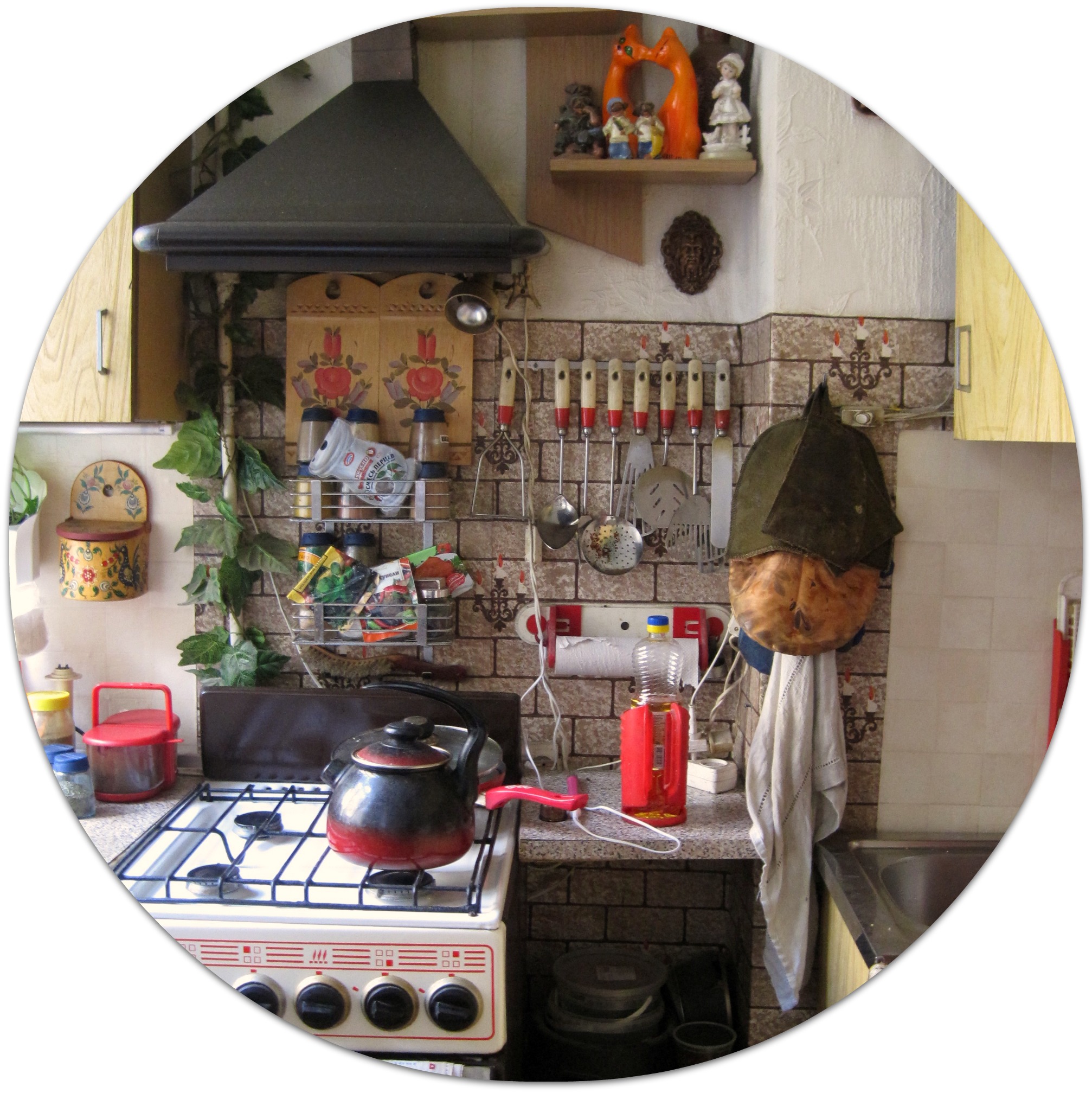
img: The Skarinova kitchen, where Charlotte’s nighttime chats with Nadya took place.

STAY TUNED for tomorrow’s post taking a parting glimpse at summer’s millinery enchantments, by our Alice awardee Sebastian Doggart.

If you enjoyed this post, we invite you to subscribe to The Displaced Dispatch, a weekly round up of posts from The Displaced Nation, with some fun extras such as seasonal recipes. Sign up for The Displaced Dispatch by clicking here!

Related posts:

The Displaced Nation’s Agony Aunt: Introducing Mary-Sue

Please give a warm welcome to Mary-Sue Wallace, The Displaced Nation’s agony aunt. We’re delighted to have Mary-Sue on board and know that her thoughtful advice will be able to ease and soothe our readers with any cross-cultural quandary or travel-related confusion that they may have.

Mary-Sue is a retired travel agent who lives in Tulsa with her husband Jake. She has taken a credited course in therapy from Tulsa Community College and is the best-selling author of Traveling Made Easy, Low-Fat Chicken Soup for the Traveler’s Soul, The Art of War: The Authorized Biography of Samantha Brown, and William Shatner’s TekWar: An Unofficial Guide. If you have any questions that you would like Mary-Sue to answer, you can contact her at thedisplacednation@gmail.com, or by adding to the comments below.

I’m a 68-year-old retired insurance salesman from Buffalo, NY. Six months ago I got married for a second time to a woman that I met on www.meetukranianbrides.com, an international matchmaking site. My new wife, Oksana, is 24 and she seems increasingly distant with me. I’m worried that she doesn’t like Buffalo as much as I thought she would and that she’s having second thoughts about me. What can I do? DP, Buffalo.

Oh, DP, I think it’s time to start turning that frown upside down, don’t you? As you write in your letter, you’re a retired insurance salesman from Buffalo. What’s not to love about that? How can that fail to get the passion inflamed? My husband, Jake, is a retired insurance salesman from Tulsa, and let me tell you, I could not be happier — both in and out of the bedroom.

I bet you have a nice little pension from a life spent working hard. Now is the time to open up that wallet and throw the moolah around a bit. That way you can have a romantic time while also showing off all the best that Buffalo has to offer. Take her to Country Buffet or to Cracker Barrel, order her the meatloaf, she’ll soon stop her pining for Odessa. And over your romantic all-you-can-eat buffet, why not take this time to open up about yourself. Us gals love to know how our hubbys tick, believe me. Tell Oksana about your time as an insurance salesman. Tell her precisely how premiums work. Explain how your job was to give peace of mind to your average Joe. Believe me, Oksana will be reminded of just why she fell in love with you in the first place, that magical moment when she logged into her email and saw the JPEG file of your passport photo you’d sent her.

As an Irish Expat in Austria I sometimes have a hard time connecting with people. It seems humour-wise I’m on a different wavelength to everyone else. I’m used to using humour to diffuse situations or to put people at ease, but every time I make a joke here it’s met with stony silence. The sort of stuff that they laugh at I get really confused by. How can I bridge this humour gap? MA, Vienna.

It’s Austria, stony silence is a good thing. It’s when they start laughing at your jokes you’ve got a problem — that’s the time you really need to ask for help.

img: Close, by Corina Sanchez.

STAY TUNED for tomorrow’s post, on celebrated women travel writers of old.

If you enjoyed this post, we invite you to subscribe to The Displaced Dispatch, a weekly round up of posts from The Displaced Nation, plus some extras such as seasonal recipes and occasional book giveaways. Sign up for The Displaced Dispatch by clicking here!

Some enchanted drinking: Summer cocktails that send you round the world

After spending many a summer in England (summer, what summer?) and Japan (beyond brutal!), I now live in New York City, where summers can best be described as a hot mess.

As the dog days set in, I’ve been known to sing out: “Drinks, glorious drinks! Don’t care what they look like!”

Actually, that’s not quite true.

Well, the part about my singing aloud is true — we’re all barking mad in this city, especially around mid-August.

And the part about drinks being glorious is also true —  what could be more glorious than an icy cold drink that cuts through the moisture-laden air, offering the possibility that this steam bath may end one day.

(I’m talking about alcoholic drinks, of course — anyone of a puritanical frame of mind can slake their thirst at one of the city’s fancy new portable water fountains, connected to fire hydrants.)

But the part about not caring what my drinks look like — that’s simply not true. For me, the ultimate summer refreshment is a well-made, well-presented cocktail.

As Penelope Wisner writes in her introduction to Summer Cocktails: 50 Tantalizing Recipes,

Everything matters: the taste of the spirit, the taste of the ice, the temperature of the drink, and the look of the drink.

My drinking history, in brief

During my expat years, I would happily down a half pint of lager in the pub with my English friends, or drink Kirin beer and sake on outings with my Japanese office mates.

That all changed when I moved back to my homeland.

Maybe it’s in my cultural DNA. The cocktail — a mixed drink with two or more ingredients, one of which must be a spirit — is one of America’s more inspired culinary accomplishments.

Or could it be my actual DNA — one of my earliest memories is of asking my father if I could chew on the lemon peel he put in his night-time martini.

In any case, not long after I became a resident of New York City — home of speakeasies and the only city I know of with a cocktail to its name — I was driven to drinking…cocktails. Particularly during summers.

You see, I’ve never been one of the lucky ones who can escape to the Hamptons or the Jersey shore.

Instead of the sea, sun, sand, and sky, I’ve had to grapple with sweat, smog, dirt, and skyscrapers.

Now, I could have gone the conventional route and drowned my sorrows in a beer. But why do that when a cocktail is so much pleasanter, and can transport you to places you’d rather be in — places much more exotic than an overcrowded beach?

Cocktails are a trip

My hunt for the transcendent cocktail experience has yielded several noteworthy finds, among them:

1) The mojito at Victor’s Cafe on West 52nd St. A single sip transported me to 1950s Havana, where I found myself salsa dancing with a Ricky Ricardo-look-alike. (And that was before I’d sampled the roast suckling pig!)

2) The vodka martini in the Russian Vodka Room, also on West 52nd St. I thought I was in Moscow from the moment I entered this swanky establishment, greeted by the sight of a curved bar at which many natives are downing shots, and behind which are these enormous jars of flavor-infused vodkas. Once I’d tasted my martini, I was well on my way to an enriching cultural experience. Oh, so that’s how they get through daily life in Russia. It all comes down to homemade vodka and to music — sublime combination! (Misha Tsiganov, a prize-winning jazz pianist who studied in St. Petersburg, is the bar’s official piano player.)

3) The classic martini at Angel’s Share, a tiny gem of a bar in the East Village. This drink made me feel I was in Tokyo again, even though I wasn’t really a cocktail person there. The Japanese bartenders had the mix, shake and stir down to an art form — which is soooo Japanese. And no one is allowed to stand at the bar — ditto. But by the time I’d polished off my divinely-inspired drink, I’d left Japan far behind for heaven itself — an effect enhanced by a ceiling mural that appears to have been inspired by Botticelli’s playful cherubs.

4) The Negroni at The Smith on 3rd Avenue. The Negroni — one part gin, one part sweet vermouth and one part Campari — is said to have originated in Florence in 1919, the invention of one Count Camillo Negroni. The first time I sampled one at the bar at The Smith, I fancied I’d become E.M. Forster’s Lucy Honeychurch at the very moment when she witnesses a murder on the Florentine streets, and is about to faint. (Where is George Emerson when you need him?) You see, the Smith version is anything but aristocratic: it packs quite a punch.

Next up? I hope it will be the Mexican martini, which I read about it in the New York Times last month. Basically, it’s a margarita served in a martini glass, with olives on a spear.

The drink is said to have been introduced from Matamoros, Mexico, just across from Brownsville, Texas, when a bartender from Austin visited there and was served a margarita in a martini glass.

It has since become Austin’s signature drink. Being Texan, it’s twice as large as a regular drink, so customers are given the cocktail shaker and urged to pour the drink themselves.

I haven’t been to Austin — and would love to go (though preferably not in the summer). I reckon a Mexican martini may be just the ticket…

The only issue is, the drink hasn’t really made it out of Austin yet.

So if you happen to hear of any Austin expats working behind Manhattan bars (yes, that’s how they’d refer to themselves), be sure to inform me.

For now though would you kindly join me in a refrain of “Drinks, glorious drinks, wonderful drinks!”

QUESTION: Can you recommend some summer cocktails you think have the makings of a mini-escape?

If you enjoyed this post, we invite you to subscribe to The Displaced Dispatch, a weekly round up of posts from The Displaced Nation, plus some extras such as seasonal recipes and occasional book giveaways. Sign up for The Displaced Dispatch by clicking here!

Related posts:
And the Alices go to … these 7 writers who get the curious, unreal side of international travel

 © Iamezan | Dreamstime.com Used under license

© Iamezan | Dreamstime.com
Used under license

Since founding The Displaced Nation on April Fool’s Day (no fooling?), Kate Allison, Anthony Windram and I have been coming across travel writers who understand just how befuddling the life of the global nomad can be.

We are inclined to think that they have channeled Lewis Carroll’s Alice.

Offering themselves up as examples, such writers talk about what’s it like for a crossborder traveler to be plagued with feelings akin to adolescent self-doubt: what am I doing here, and will I ever get over this feeling of displacedness?

And they’ve shown us how to emerge from such escapades as more fulfilled human beings, full of stories to tell, perhaps to our grandkids, one day…

In recognition of these models of displacedness, my colleagues and I have created a new accolade for the travel writing profession: the Alice’s Adventures in Wonderland Award, otherwise known as an “Alice.”

And The Displaced Nation‘s very first Alices go to…drumroll!…(listed in reverse chronological order)

1. ANABEL KANTARIA for Do we all need behavior lessons?, in the Daily Telegraph:

“Just remember, you’re not playing in your own backyard now,” my boss told me when I took my first job in the UAE. “You’re in someone else’s yard now, and you play by their rules.” It was probably the best piece of advice I was ever given about the UAE, and one that’s kept me out of trouble on numerous occasions.

Alice link: “I don’t think they play at all fairly,” Alice began, in rather a complaining tone, “… I should have croqueted the Queen’s hedgehog just now, only it ran away when it saw mine coming!”

2. SUZY GUESE for The Unexpected Benefits to Solo Travel, in Suzy Guese: Traveling with a redheaded temperament:

While I know people who travel with others can have their share of weird conversations, solo travel for some reason brings this about almost with every day. … From a musician at the Giant’s Causeway [Northern Ireland’s only UNESCO World Heritage Site] who started talking to me by insulting my shoes, to a B&B owner who told me her “journey of life”, leaving in all of the gory details, I have had some strange encounters.

Alice link: “Your hair wants cutting,” said the Hatter. He had been looking at Alice for some time with great curiosity, and this was his first speech.

3. ANDREA MARTINS for Expat women living the high life or secretly struggling?, in the Daily Telegraph:

In mid-2005, April Davidson’s world was turned upside down following her husband’s job transfer to Mexico City. … She could not understand what was happening to her and she started taking medication for anxiety and unexplained stomach problems. Little did April realise that her feelings represented a completely normal piece of the relocation jigsaw, and that taking medication to cope with the transition process was again, not uncommon.

Alice link: “You ought to be ashamed of yourself,” said Alice, “a great girl like you,” (she might well say this), “to go on crying in this way! Stop this moment, I tell you!” But she went on all the same, shedding gallons of tears, until there was a large pool all round her, about four inches deep and reaching half down the hall.

4. SEBASTIAN DOGGART for Elegy to English shepherd’s pie, in the Daily Telegraph:

One of the things I miss the most about living outside England is shepherd’s pie. … The greatest desecration is found in Quebec, where they call it “Chinese pâté” (pâté chinois). To suggest this sacred dish has anything Chinese about it is preposterous.

Alice link: “When I’m a Duchess,” she said to herself…”I won’t have any pepper in my kitchen at all. Soup does very well without…”

5. SALLY THELEN for 4 Tips on Embracing Your Inner Weirdo, in Unbrave Girl:

This morning, when I went running [in Wuxi, China], I happened upon a group of teenagers dressed up as anime characters. A crowd had formed around them to gape at their hot pink wigs, Nutcracker-like jackets and French maid dresses.

I stopped for a minute to stare slack-jawed with the rest of the crowd.

I was baffled.

I was confused.

And, frankly, I was a bit miffed. After all, didn’t these kids know that I was the main attraction at this park?

Alice link: This piece of rudeness was more than Alice could bear: she got up in great disgust, and walked off, the Dormouse fell asleep instantly, and neither of the others took the least notice of her going, though she looked back one or twice, half hoping that they would call after her…

6. SEZIN KOEHLER for My foreign body: geocharacteristics of a population, in Expat+HAREM:

When I first arrived in Prague I was a size 7, had an acceptable C-cup and chocolate-colored skin. Three years later I’ve become a size 12 and an overbearing DD-cup with skin the color of weak tea.

Aging plays only a small part….

Alice link: “Curiouser and curiouser!” cried Alice (she was so much surprised, that for the moment she quite forgot how to speak good English); now I’m opening out like the largest telescope that ever was! Good-bye, feet!”

7. JENNIFER EREMEEVA for Conversation is a One-way Street, in Dividing my time: finding the funnier side of life in Russia:

“Let me tell you about New York,” he [a Russian friend of my husband’s] said, “I was really impressed: the streets are completely strait, from one end of Manhattan to the other — ”

“– Well, except for the Village down to Wall Street,” I interjected absent-mindedly.

“Jennifer went to University in New York,” said my husband apologetically to the group.

Sergei squinted at me suspiciously, and then, changing tack, began to expand on the virtues of vacationing at Valaam on Lake Ladoga.

Alice link: “I’ve been to a day-school, too,” said Alice; “you needn’t be so proud as all that.” … “…[Y]ours wasn’t a really good school,” said the Mock Turtle in a tone of great relief. “Now at ours they had at the end of the bill, ‘French, music, and washing — extra.”

QUESTION: Do you have a favorite from the above, and do you have any other writers/posts to nominate for our next round of Alices? We’d love to hear your suggestions.

STAY TUNED for tomorrow’s interview with Random Nomad Balaka Basu. She appeals for citizenship in The Displaced Nation — and agrees to answer one Alice question!

If you enjoyed this post, we invite you to subscribe for email delivery of The Displaced Nation. That way, you won’t miss a single issue. SPECIAL OFFER: New subscribers receive a FREE copy of “A Royally Displaced Tea.”

Related post:

CLASSIC EXPAT WRITING: Nabokov — Pnin

Few characters in literature deal with discombobulation to quite the extent as Vladimir Nabokov’s Timofey Pnin. Pnin, a Russian-born professor at the “somewhat provincial institution” of Waindell College, is a somewhat absent-minded and culturally confused man. Nabokov begins the novel with Pnin catching the wrong train, thus missing an important lecture he was due to give.

Despite such a farcical beginning, Pnin is not a campus farce. Yes, it is deeply comic, but it is also a novel that plays on Nabokov’s own experiences as a Russian émigré marooned in American academia. There is a phrase I like a lot — I like it so much I named my own blog after it. It is the term “culturally discombobulated.” I think this is something that Pnin struggled under the weight of. For all his intelligence, Pnin struggles with English — “If his Russian was music, his English was murder,” writes Nabokov — and who constantly seems out of step with the society he is living in.

The extract I want to highlight this week comes from early in the novel. Pnin has boarded a train for his lecture, but oblivious to him he has boarded the wrong train — a fact he won’t discover for a number of hours. As Pnin sits in the  train, the novel’s narrator allows us a closer look at Pnin’s history and some of his shortcomings.

Pnin, despite his many shortcomings, had about him a disarming old-fashioned charm, which Dr. Hagen, his staunch protector, insisted before morose trustees was a delicate imported article worth paying in domestic cash. Whereas the degree in sociology and political economy that Pnin had obtained with some point at the University of Prague around 1925 had become by mid-century a doctorate in desuetude, he was not altogether miscast as a teacher of Russian. He was beloved not for any essential ability but for those unforgettable digressions of his, when he would remove his glasses to beam at the past while massaging the lenses of the present. Nostalgic excursions in broken English. Autobiographical tidbits. How Pnin came to the Soedinyonnie Shtati (the United States). “Examination on ship before landing. Very well! ‘Nothing to declare?’ ‘Nothing.’ Very well! Then political questions. He asks: ‘Are you anarchist?’ I answer” — time out on the part of the narrator for a spell of cozy mute mirth — “‘First what do you understand under “anarchism”? Anarchism practical, metaphysical, theoretical, mystical, abstractical, individual, social? When I was young,’ I say, ‘all this had for me signification.’ So we had a very interesting discussion, in consequence of which I passed two whole weeks on Ellis Island” — abdomen beginning to heave; heaving; narrator convulsed …

… And he still did not know that he was on the wrong train.

A special danger in Pnin’s case was the English language. Except for such not very helpful odds and ends as “the rest is silence,” “nevermore,” “weekend,” “who’s who,” and a few ordinary words like “eat,” “street,” “fountain pen,” “gangster,” “Charleston,” “marginal utility,” he had no English at all at the time he left France for the States. Stubbornly he sat down to the task of learning the language of Fenimore Cooper, Edgar Poe, Edison, and thirty-one Presidents. In 1941, at the end of one year of study, he was proficient enough to use glibly terms like “wishful thinking” and “okey-dokey.” By 1942 he was able to interrupt his narration with the phrase, “To make a long story short.” By the time Truman entered his second term, Pnin could handle practically any topic, but otherwise progress seemed to have stopped despite his efforts, and by 1950 his English was still full of flaws.

If you enjoyed this post, we invite you to subscribe for email delivery of The Displaced Nation. That way, you won’t miss a single issue. SPECIAL OFFER: New subscribers receive a FREE copy of “A Royally Displaced Tea.”

Related posts:

Mia Wasikowska — a Third Culture Kid who is no Cinderella

Neatly coinciding with The Displaced Nation’s recent themes of the Royal Wedding and Gothic Tales, Maureen Dowd in her New York Times article “Who Married Up: The Women or the Men?” compares Cinderella with Kate Middleton and Charlotte Bronte’s Jane Eyre.

While the comparison with Kate Middleton is oft-cited, Bronte’s tale is less obvious: the story of a society misfit Plain Jane who suffers a series of gothic melodramas before finally claiming her maimed prince – but on her own terms. It’s possible that at some point during her ten-year waiting game in which Prince William apparently called all the shots, Kate Middleton may have sympathized with Jane Eyre’s wistful statement in the latest adaptation of Bronte’s novel:

“I wish a woman could have action in her life, like a man.”

A shooting star who needs no wishes

Mia Wasikowska, who stars in the title role of Cary Fukunaga’s “Jane Eyre,” needs no such wishful thinking. The 21-year-old Australian had her first US TV role at 17, was named the following year as one of  Variety magazine’s Top Ten Actors To Watch, and won the 2010 Hollywood Film Festival Award for Best Breakthrough Actress. Until “Jane Eyre” came along, she was best known for her portrayal of Tim Burton’s Alice in Wonderland.

While it is hard to imagine two female characters more different than Jane Eyre and Alice,  they do share some similarities:  Jane’s feeling of exile, of being shunned by society, is echoed in Burton’s Alice. In an interview with Australian Harper’s Bazaar, Wasikowska spoke of her interpretation of the role:

“Alice has a certain discomfort within herself, within society and among her peers. I feel similarly, or have definitely felt similarly, about all of those things, so I could really understand her not quite fitting in.”

Although Ms. Wasikowska  does not elaborate about her own feelings of displacement — and certainly most young women feel insecure at some time or other —  one can’t help wondering if she is referring to travel experiences in her childhood and teens.

A TCK in Tinseltown

The daughter of an Australian father and Polish-born mother, Wasikowska is a TCK (Third Culture Kid.) She was born and raised in Canberra, Australia, and when she was eight years old the family moved to Szczecin, Poland, for a year, during which time they also traveled in France, Germany and  Russia.  At 17, she was cast in the role of Sophie in HBO’s “In Treatment,” which necessitated a move to Los Angeles.

One could argue that anyone, of any nationality, who is flung into the Hollywood carnival at such a tender age could qualify for the label of TCK.

Ignore the naysayers

The US Department of State defines Third Culture Kids as:

“those who have spent some of their growing up years in a foreign country and experience a sense of not belonging to their passport country when they return to it…they are often considered an oddity [and] what third culture kids want most is to be accepted as the individuals they are.”

A most depressing definition, highlighting the bad and ignoring all the good. It says nothing of the inevitable expansion of horizons that enable a TCK to empathize with other ways of life, to walk in another’s shoes – and if you’re an actor, the ability to walk in another’s shoes is crucial.

It would be nice to think that, despite governmental gloom, TCK experiences played a part in Wasikowska’s professional development and rocketing career.

Home is where reality is

Canberra is still Wasikowska’s home, however, and she lives there with her family between film projects. When asked by PopEater if she was treated like a celebrity at home, she answered:

“I still take the rubbish out and empty the dishwasher. It’s good going back for that reason.”

Well, that’s OK. After all, Kate Middleton said she intended to cook dinner for Prince William when they married.

And I expect even Cinderella swept a few floors in her new castle.

Img: Tomdog/Wikimedia Commons

If you enjoyed this post, we invite you to subscribe for email delivery of The Displaced Nation. That way, you won’t miss a single issue.

Expats in Moscow satisfy a hunger to learn

Special announcement from TDN: ML Awanohara and Kate Allison will be live-tweeting the Royal Wedding from a displaced perspective. Join us from 5:00 a.m. EST, using the hash tag: #DNRW

I well remember my first foray into an American supermarket. Dozens of brands of orange juice, offset by a dearth of blackcurrant Ribena.  Cheese in aerosol cans, breakfast pizza bagels…  As for the meat — well, thank goodness everything came shrink-wrapped so I could smuggle it home and investigate its cooking requirements in privacy. Anything was better than revealing my ignorance of American cuts of beef to Stop & Shop’s rather intimidating butcher. It made me want to attend cooking classes – not because I couldn’t cook,  but because unfamiliar ingredients and lack of vital ones limited my usual repertoire. I had to eat what Americans did.

All this confusion took place in a country where the language was approximately the same as at home. How much more difficult must this experience be, then, in a country whose language is strange to you?

Borsch and blini

Victoria Agabalyan understands this problem well. She is the founder and chief executive of Taste of Russia, the first English-language culinary school in Moscow, whose students are primarily foreign tourists and expats.

In order to understand what Europeans expected of cooking classes, she, like American TV chef and one-time expat Julia Child before her, attended culinary school in France.  Consequently, Taste of Russia focuses on teaching traditional cuisine from Russia and the former Soviet Union in a cozy atmosphere. Student Bonnie van der Velde says:

“I cooked borshch and drankini with mushrooms for my mom and her colleagues in the Netherlands, and they liked it very much.”

Although Agabalyan teaches some of the classes herself, she also invites chefs to conduct culinary workshops while she or the school’s administrator translates. She plans to open more schools in other cities in Russia.

Hidden bonus for expats

Similar to my own dealings with strange supermarkets,  expats in Moscow have problems finding their way round the grocery shelves, and attendance at Taste of Russia helps them get over this difficulty. Another student, Angeline Sandmann, says that on her first shopping trip in Moscow she bought sour cream instead of the intended yogurt.

But it could have been worse. Try spraying cheese on top of your ice cream sundae.

Source:  The Moscow Times

If you enjoyed this post, we invite you to subscribe for email delivery of The Displaced Nation. That way, you won’t miss a single issue.

