The Displaced Nation

A home for international creatives

Tag Archives: Pot Luck

DISPLACED Q: In the words of The Clash, “Should I stay or should I go?”; When reality bites in your adopted country, are you more — or less — determined to stay as an expat?

In our post on March 20, When in doubt, have a pint of Guinness, we drew attention to the Britons who resolutely stayed in post-earthquake Japan rather than fleeing with the majority of their expat countrymen back to the UK. Despite the danger of the nuclear situation, one man interviewed by the Telegraph said

“I actually feel a bit of a duty not to leave.”

Friends in need

Although this person’s mother couldn’t see his point, I understand this mentality. The events of September 11, 2001, so close to our home in Virginia, made me defensive of my adopted country, and outraged at such an audacious attack. To leave at this stage was unthinkable. That would mean we were just fair weather friends of the USA.

Instead, we taped a small American flag to our mailbox, as the rest of our neighbors did to theirs. It couldn’t help the 3,000 who died that day, but it showed our sympathy and solidarity, which didn’t go unnoticed: a neighbor made a point of telling me how touched she was that I, a foreigner, had done this.

Yet I suppose expats here did leave to go back home after 9/11, because it’s human nature to think the grass is greener – or safer – on the other side.

More trolls, not greener grass

It’s not greener or safer, of course. I know this from years of frequent news reports of IRA bombings.  The Spanish know this from decades of Basque separatist attacks. 2009 saw 10,999 terrorist attacks worldwide, and while 60 percent of these occurred in Iraq, Afghanistan, and Pakistan, that still leaves over 4,000 to be shared by the rest of the globe.

As chance had it, I arrived at Heathrow the day before the 2005 bombings of London’s transport system, and had planned to take the tube into the city the following morning to do some sightseeing with my children. Had we not been tired from jetlag and therefore overslept on July 7th, we could easily have been on one of the trains that were destroyed.

Was I as upset by 7/7 as I had been by 9/11? Undoubtedly. Yet there was something else, too – a feeling of deja vu, of “here we go again” or – dare I say it? – resignation.

Whether you run or stay, there is a difference between enduring atrocities in your own country and suffering them on another’s turf.

Not all disasters are manmade

It doesn’t have to be a terrorist atrocity, as our friends drinking Guinness in Tokyo can testify. Perhaps you were an expat in Christchurch, New Zealand during the last two earthquakes; perhaps you were posted to New Orleans just before Katrina hit the Gulf Coast. Only two days ago, Joplin, Missouri was devastated by a deadly tornado.

The world is a dangerous place. There are no certainties, especially when it comes to safety. To quote The Clash again:

“If I go there will be trouble

And if I stay it will be double.”

So, tell us:  What’s an expat to do when disaster strikes?

If you enjoyed this post, we invite you to subscribe for email delivery of The Displaced Nation. That way, you won’t miss a single issue. SPECIAL OFFER: New subscribers receive a FREE copy of “A Royally Displaced Tea.”

Related posts:
In the jaws of political or natural disaster: When reality bites for expats

Lately I’ve been thinking about plot lines for movies based on adventure travel. The one I like the most involves a round-the world traveler spotting a shark while scuba diving in the Indian Ocean…

In the hands of the right director, I could see it becoming a remake of Jaws.

Speaking of which, did you notice that first prize for the Matador Network’s “When Travel Goes Wrong” photo contest went to a young woman whose travel bag — containing passport, wallet and cell phone — fell down a Swiss sewage drain and got fished out by a kind, thin stranger. Now that has real Jaws potential!

Unfortunately, however, travel is not today’s focus. Rather, my goal is to highlight some of the mishaps that occur when a global voyager becomes a global resident.

“Boring!” I can hear you say. And having been an expat myself twice over, I have to admit, at some level, you are right.

They’re a privileged set, those expats.

Privileged with insider knowledge. You’re not going to catch them on the street with the open sewers.

Privileged with accommodation. Not for them a stay in Fawlty Towers, or the equivalent.

Still, reality has a way of impinging even on the most glittering expat lives, and in my experience, global residents tend to be even more traumatized than their short-stay counterparts when something goes badly amiss.

(Is that because they’re spoiled? I’ll let you decide…)

Gothic horror redux

In case you haven’t been tuning into The Displaced Nation of late, our posts have been exploring cases where individual expats have had their lives turned upside down, or worse (see “related posts” below).

My colleagues and I have put forth incontrovertible evidence that the expat life, like any other, can have its gothic moments.

Lest any skeptics remain, may I draw your attention to the Friday May 13 incident in Spain’s Canary Islands. A homeless Bulgarian man stabbed and hacked off the head of a 62-year-old British resident of Tenerife, after which he paraded into the street, holding his “treasure” up by the hair for all to see.

According to one eyewitness, who, too, is a long-term British resident of the Canaries:

When I saw the man holding the head, the first thing that popped into my mind was the scene from “Clash Of The Titans,” where the hero holds up the Gorgon’s head — but his was real.

Disruption en masse

Now let’s turn to the instances where the expat life gets disrupted en masse by natural disaster or political upheaval.

Emily Cannell, an American who’s been living in Tokyo with her family since last year, paid a visit to The Displaced Nation as a random nomad last Thursday. She told us about what it was like to be in that city when the Great East Japan Earthquake struck on March 11. In just a few moments, she went from a woman whose biggest worry was driving to car pool on time, to wondering if her kids were alive or dead.

And let’s not forget Tony Roberts, who was an honored guest on our site several weeks ago. His story, now written up in the form of a novel, is about what it was like being a teenager in Iran in 1979, just before the revolution took place. The trauma came when his family was given just 24 hours to evacuate back to their home in Kansas, and he had no time to say good-bye to his friends. For some time afterwards, this Third Culture Kid suffered from General Anxiety Disorder, “with feelings of unresolved anger,” as the psychologists put it. He tweeted recently: “Revolution will do that.”

Snatched from the jaws of [domestic terrorism]

I myself had an experience of this ilk towards the end of my stay in Japan, when the religious cult Aum Shinrikyo attacked the Tokyo subway with sarin gas — killing a couple of people in the station just down the street from my house. In all, 13 people died, and thousands more suffered from after-effects. It was and remains the most serious incident of this kind in Japanese history.

As I struggled to come to grips with the idea of nice, safe Japan being populated by terrorists, quite a few thoughts raced through my head; for instance:

1) This place is weirder than I’d realized.
I’d never before heard of the kind of cult where the adherents are well-off, educated young people and their leader, a bearded mystic with a destructive political agenda. (Needless to say, I hadn’t heard of al-Qaeda. But even if I had, Japan is the Far, not the Middle, East.)

2) Do the authorities know what they are doing?
From what I’d observed of the Japanese police, they seemed pretty wimpy, precisely because the country doesn’t have a high incidence of violent crime. Did they really have the chops to capture Shoko Asahara and put an end to his madness? (The attack on the subway took place on March 20, and they didn’t find him until May 16. He was hiding inside the wall of a cult building in the group’s compound near Mt Fuji, dressed in purple robes and in good health.)

3) Who’s looking out for us foreigners?
I suspected that we foreign residents would be the last to know if further incidents were likely to take place. (For weeks following the subway attack, rumors of imminent attacks were rife, and I didn’t know whom to believe.)

Though I eventually got on the Tokyo subway again, the incident took its toll on how I felt about living in that city. Little did I know that I would one day be working in New York City and reliving many of the same emotions — ignorance, disenfranchisement, and vulnerability — in the wake of 9/11.

I discovered, however, in comparing these two incidents that when reality bites in one’s native land, it’s not nearly as unsettling as when it happens abroad.

After 9/11, I wanted to stay in NYC and carry on — it was a way of fighting back. Whereas after the subway attack in Tokyo, I started to fantasize about leaving Japan.

* * *

Are there any world travelers out there who’ve stuck with me throughout this catalogue of woes? I wouldn’t be surprised if you’ve come to the conclusion that your nomadic life, even with its many dangers, is preferable to that of most world residents.

Or perhaps you’re feeling a touch of envy? In that case, you may wish to check out Bootsnall’s virtual tour of the top 10 shark-infested beaches in the world.

Question: Have you had any experiences of large-scale disasters during your stay abroad, and if so, how did it affect your perceptions of your adopted country — did it make you feel any less “at home” there?

If you enjoyed this post, we invite you to subscribe for email delivery of The Displaced Nation. That way, you won’t miss a single issue. SPECIAL OFFER: New subscribers receive a FREE copy of “A Royally Displaced Tea.”

Related posts:
3 hardboiled observations on the displaced TV series “The Killing”

Hillstreet Blues Law and Order Crime Scene Investigation (CSI)Bones… I could keep going, but point made: American TV is the undisputed godfather of the crime series genre.

These shows may be fiction, but they are underpinned by a grim reality: the United States has the highest rates of homicide and other violent crimes in the industrialized world.

But, not so fast. There’s a rookie on the scene that is taking on the veteran. I refer to the Danish crime series, The Killing, which is currently airing on AMC.

Now, what do the Danes know about crime — apart from suicide (regicide, too, if we go as far back as Hamlet)? Well, I’m here to tell you that this “smorgasbord thriller” has fast achieved cult status in the UK and now the US. As Alessandra Stanley wrote in her New York Times review:

It’s unnerving how well the Nordic sensibility fits a genre that for a long time seemed indisputably and inimitably violent and American, particularly given that Sweden, Norway and Denmark have homicide rates that suggest that they have more mystery writers per capita than murders.

Having become a a diehard (haha!) fan of the Danish noir series after a couple of episodes, I’ve been thinking about it of late in the context of The Displaced Nation. What happens when a TV series becomes expatified? Can we who have chosen to displace ourselves to other countries glean anything from its acculturation process?

Here are three hardboiled observations:

1) America is not Britain.

I was an expat in the UK for many years so am fated to have this thought nearly everyday: America is not Britain. Still, it’s gratifying to have it confirmed by third-party sources. Gratifying and, I must say, somewhat surprising given how quickly the UK appears to have become Americanized since I left. (I mean, pub grub now includes peanut-butter-and-jelly sandwiches! That would NEVER have happened in my day!)

Here’s the thing: the UK imported the original Danish series, entitled Forbydelsen, and simply added subtitles. Which completely makes sense to me — yes, I remain that anglicized.

But for an American audience, of course, subtitles won’t do. Thus AMC hired Veena Sud to come up with an adaptation. Sud moved the action to Seattle, which, she says, is the “closest American city, viscerally, to Copenhagen.”

2) Sud is right: Seattle is as creepy as Copenhagen.

Who knew that Seattle could be so creepy? Certainly not me. Though I’ve never had the honor of visiting that Pacific Northwest city, being an East Coaster I have always held a romantic view of it. At one point I even thought of Seattle as a place I might like to live in some day —  especially as the people are reputed to behave with greater decency towards each other than us competitive, dog-eat-dog New Yorkers.

But The Killing has quashed this “domestic expat” fantasy of mine, at least for now.

It underlines a truth we’ve been exploring recently on The Displaced Nation: horrific crimes can happen anywhere, even in settings where people are bending over backwards to be pleasant to one another.

3) But the series also addresses themes that transcend national borders, at least in Western countries.

Setting is important — one of the reasons for the series’ popularity in Britain is that so many people coveted the female detective’s classic Feroese sweater, and I think some fans of the AMC production enjoy watching a crime drama that takes place in Seattle, not New York or L.A.

But if setting is a crucial hook, it’s by no means the only reason The Killing has captivated viewers beyond Denmark and made such a killing for the Danish Broadcasting Corporation.

The show also addresses themes of widespread concern to Western countries: most notably, the fact that even in our supposedly civilized societies (we don’t have female genital mutilation! we don’t have honor killings!), many young women continue to be victims of violence.

The killing to which the title refers is that of a teenage girl, and each each one-hour episode depicts 24 hours in the police investigation, during which we are able to observe the impact of the tragedy has had on the girl’s family, her community, and the people involved in the investigation.

Another theme running through the series is xenophobia: the distrust American and European societies have for Muslim immigrants. America has yet to process the legacy of 9/11, while the Danes are still reeling from the incident involving cartoonist Kurt Westergaard. (To this day, he receives death threats for his cheeky portrayal of the Prophet Muhammad.)

For better or for worse, this Danish crime thriller holds up a mirror to Western culture and shows how easy it is for us to pin the murder of the girl on the Muslim teacher. It eerily reflects the times we live in — perhaps its most chilling facet.

Question: Do you have an experience with a TV show or series that made you look at your own and/or other cultures in a fresh light?

If you enjoyed this post, we invite you to subscribe for email delivery of The Displaced Nation. That way, you won’t miss a single issue. SPECIAL OFFER: New subscribers receive a FREE copy of “A Royally Displaced Tea.”

Related posts:
RANDOM NOMAD: Emily Cannell, Housewife & Mother

Born in: Houston, Texas
Passport(s): USA
States/countries lived in: Pennsylvania (Philadelphia): 1989-1990, 1993-1997, 1999-2004, 2006-2010; Louisiana (New Orleans): 1990-1993; Washington (Seattle): 1997-1999; Arizona (Scottsdale): 2004-2006; Japan (Tokyo): 2010-present
Cyber coordinates: Hey from Japan — Notes on Moving (blog)

What made you leave your homeland in the first place?
My husband’s company offered him a job in Japan. We were living near Philadelphia at the time, our fourth “tour of duty” in that city. We jumped at the chance to go somewhere new — location wasn’t that important. Unlike most citizens of the Displaced Nation, I’d never lived overseas. I should point out, though, that in the American vernacular “expat” is often used to describe a person who moves beyond a 50-mile radius from where they were born. By that standard, I’ve long been considered an expat, with Louisiana, Texas, Alabama, Florida, Pennsylvania, Arizona, and Washington state on my resume. At one point, back in the days when I was working as a jack-of-all-trades in the pharmaceuticals industry, I commuted to New Jersey — which in dog years counts as exile in Siberia.

Is anyone else in your immediate family a “displaced” person?
My father is a displaced Canadian living in the US. Does that count? Seriously, he was born in Edmonton, Alberta. After attending medical school, he left to do his residency, internship, and fellowships in the US, which had more cutting-edge techniques and offered more advanced studies than the Canadian system. Eventually, he became too involved in academia to return to Canada, although he still goes back and forth.

Describe the moment when you felt most displaced over the course of your many displacements.
It probably won’t surprise you when I say that the earthquake on March 11th produced one of the worst feelings of displacement — literal as well as psychological — I’ve ever experienced. I was in a small grocery store in Tokyo at the time, trying to read the back of a ready-mix pancake box. The rest of the boxes on the shelves started falling on me, and I could hear glass breaking as wine bottles fell to the floor. The other shoppers, who were mostly Japanese housewives, and I made a beeline for the door. As we reached the street, I saw a man holding on to a street lamp that was swaying back and forth, the top almost touching the ground at my feet. I remember thinking: “These 40-year-old buildings are going to fall on top of me. Where do I go to stay alive?” I headed toward the intersection, stumbling as I went — it was like running on a trampoline with someone else jumping on it. Once I reached the middle of the intersection, I stood there watching and saying nothing while vending machines crashed down, plants fell off balconies, and bikes toppled over. In that moment, I wondered how my biggest worry went from driving car pool on time, to staying alive so I could find my family — alive or dead. (Fortunately, they were all safe.)

Describe the moment when you felt least displaced.
One activity that remains consistent no matter where we live is the kids’ participation in track. Since track meets are an all-day event, my husband and I pitch tent and settle in as though we were on a campsite. This year, just like every other, we hammered in the stakes, opened the cooler, and fed or watered every kid on the track team. And our kids referred to us as “Mr. and Mrs. Noddin’” — not our real names.

You may bring one curiosity you’ve collected from the country where you’ve lived into the Displaced Nation. What’s in your suitcase?
I’ve been toying with the idea of bringing a ninja for their home security value, but once gunpowder was introduced to Japan, the profession went into decline. Besides, the poor man might suffocate if he had to be packed in my suitcase. So instead I’ll carry in these wonderful carved wooden fish I discovered in a Tokyo antique shop. Two fish are looped together with ropes to which big hooks are attached — ideal for hanging pots in the kitchen.

Speaking of the kitchen: you’re invited to prepare one meal based on your travels for other Displaced Nation members. What’s on the menu?
I can make a mean plate of fried green tomatoes, fried okra, collards, corn bread, fried chicken, and black eyed peas. To that I’ll add two dishes that are popular in the Western U.S.: 1) grilled salmon on a plank and 2) fajitas with homemade guacamole. For starters, there will be a choice of Louisiana gumbo (for which I’m famous) and tuna sashimi with ponzu sauce — yes, I’m learning how to “cook” Japanese! Please note that I haven’t chosen to include any of the traditional Amish-country foods despite my many years as a Pennsylvania resident. I can’t make any of the good stuff, and the bad stuff — especially scrapple (pon haus) — is really bad. Residents of The Displaced Nation should not be eating pork scraps if they can avoid it — though I understand your numbers include a dog named Fergus? But dogs are rather spoiled nowadays, and I suspect Fergus may turn his nose up, too.

You may add one word or expression from each of the countries you’ve lived in to the Displaced Nation argot. What words do you loan us?
From the South: Hey. It’s the most common greeting. By adopting this term, you’ll have an easy way of knowing if someone is an outsider. Do they say “hello” or “hi”? Then they’re not from these parts.
From Pennsylvania: Goomba, meaning a male friend. Use it often, and it will detract the kinds of visitors you don’t want.
From the Southwest: Ride ’em hard and put ’em away wet — referring, of course, to how one rides a horse. My husband and I approach parenting in a similar manner.
From Louisiana: Le bon ton roule! Cajun for “Let the good times roll!”
From Washington state: Chinook — a type of salmon. You gotta know your salmon (also true in Japan, of course).
From Japan: So desu ne — meaning “Oh, is that so?” It’s a way of showing that you’re listening when the other person is talking — and I suspect that some Displaced Nation citizens could use some help in that department. I mean, all of us expats want to tell our stories, but how much do we want to listen?

Question: Readers, tell us what you think: should we welcome Emily Cannell to The Displaced Nation and if so, why? (Note: It’s fine to vote “no” as long as you couch your reasoning in terms we all — Emily included — find amusing.)

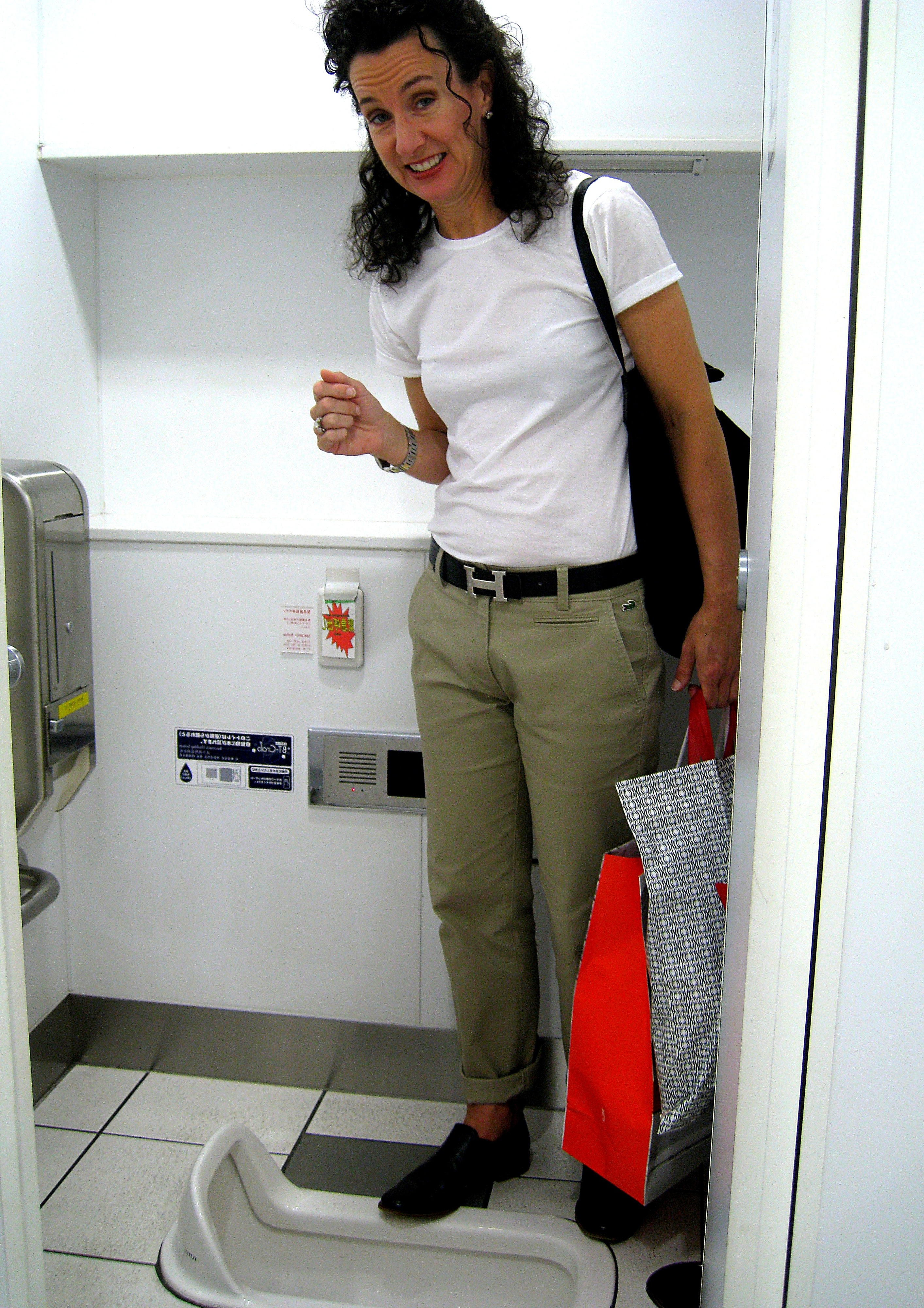
img: Emily Cannell deciding whether to put her carrier bags down and use the facilities in Tokyo’s Harajuku station.

If you enjoyed this post, we invite you to subscribe for email delivery of The Displaced Nation. That way, you won’t miss a single issue. SPECIAL OFFER: New subscribers receive a FREE copy of “A Royally Displaced Tea.”

Related posts:

My first flirtation with the lawlessness of global travel: 4 painful lessons

Today we welcome Lara Sterling to The Displaced Nation as a guest blogger. She wrote this post as part of our series on Gothic Tales, anchored by ML Awanohara’s “What did Agatha Christie know? Expats make great criminals.”  A native Californian, Sterling is an inveterate traveler. Her many adventures include a round-the-world trip and a stint as an expat in Spain (2001-2005).

Have you ever traveled to a foreign country, thinking you could get away with murder?

Maybe that’s what Amanda Knox was thinking…

Regardless of whether you believe Knox is guilty or not, I’m talking about getting away with murder on a trip I made to Guatemala.

Well, not actual murder — just a little bypassing of the laws.

War-torn tourism

This was Guatemala in 1993. The country was in the last days of a decades-long civil war. The nation’s social fabric had been torn apart. That meant there weren’t many laws anyhow. Or at least laws that anyone was abiding.
I remember one time drinking at a bar in Antigua, a city in the Guatemalan highlands. Plainclothes cops showed up to get bribes from the travelers who didn’t have passports.

I was twenty-three. I was a female traveling alone in a dangerous country. It was appealing to team up with the handsome German man I’d met in Antigua.

His name was Fritz. He wanted me to travel with him to the pyramids in Tikal, in the north.

I was nervous about travel to Tikal. I had heard many terrible stories about travel outside of the cities. Buses were high-jacked by bandits. Women were raped. But Fritz was gorgeous! I couldn’t resist.

Lesson #1: Don’t trust handsome Germans

Fritz and I traveled to Tikal without problems. I agreed to travel more, to Livingston, on the coast.

Livingston is an enclave in Guatemala. A slave ship wrecked there in a past century. The inhabitants speak a local patois, the Garifuna language.

Fritz and I disembarked the boat. There were men with machetes everywhere. They were returning home from work in the fields. My overactive tourist imagination went crazy. I thought we were going to be robbed at every corner.

Muggings and rapes were known to take place on the trails outside of town. Fritz wanted to hike, but I was nervous. We spent our afternoons at the beach and drinking coffees in the local cafes.

At some point, we were approached by one of the natives, a guy named Billy. He had a business proposition.

“Ya want to buy yaself some fun?” Billy asked.

“What’s that?” asked Fritz in English.

The man bent in close. “Crack.”

Crack cocaine? I asked myself. Surely, Fritz will say no.

He didn’t.

Lesson #2: Give a wide berth to a man with a machete

Before I knew it, Fritz and I were following Billy into a cluster of trees off of a back street. Billy’s eyes were bloodshot. He was armed with his machete. I was terrified.

Fritz handed over some quetzales. Billy handed over a small, plastic baggie.

Fritz and I retired to the room we were renting. I watched as Fritz got out some tin foil and a lighter. He began to smoke. The odor was metallic, and the smoke was blue. Fritz’s eyes glazed over.

I told him I was going for a walk.

I walked down to where the women washed their clothes in a community well. I can leave, I thought. I can get another room.

I couldn’t. I had a serious crush on Fritz.

Luckily, by the time I returned, the effects of the drugs had worn off of Fritz. He wanted to go out again.

It was still light. We walked to the edge of town. Fritz pointed to a small swathe of beige that looked like it was miles away.

“There’s a beach over there,” he said.

Between us and the beach was jungle.

Maybe in kilometers, it seemed shorter.

Lesson #3: Dogs are not the same the world over

Fritz and I began our hike. Because of the infamy of the trails, I was a nervous wreck. But I was also tired of buying into my fears. I had traveled all the way here. I might as well have some fun.

The sounds of birds chirping in the trees and of leaves rustling in the breeze calmed me.

Suddenly, two mutts appeared. They were small, and their coats were white and black. They were growling, barking.

I hoped they would go away, like the dogs I knew from home. They didn’t. The dogs moved closer, encroaching.

The mutts leapt at our bodies. One of the canines sank his incisors into my behind. I screamed.

Fritz was bitten too, in the leg.

A couple of Guatemalan children emerged from the jungle. They beat the dogs off with sticks. The dogs retreated behind the palms.

My bottom was bleeding. I needed stitches. Luckily, someone had called the local doctor. He was waiting for us on the street at the edge of the jungle.

The doctor led us to his office. I climbed onto his examining table. He numbed my butt, then sewed my loose flesh back up again.

“You must return to Guatemala City for rabies shots,” the doctor said.

I felt woozy, weak. “We’ll have to leave tonight,” I told Fritz.

“I can’t,” Fritz said. “I have to get to El Salvador.”

El Salvador?

“But what if you get rabies?” I asked.

“Then I will come and bite you,” Fritz responded.

He flashed me the same mischievous smile I had fallen for.

Lesson #4: Make sure you have a cubicle waiting for you back home

Fritz and I parted ways, never to meet again. Alone, I suffered through a week of visits to the Guatemalan hospital.

Each day, I took the bus to the hospital, then waited in the hours-long lines. Finally, I’d get my shot in the stomach.

The employees of the hospital were on strike. I was lucky I was treated at all.

It wasn’t until weeks afterward that I mustered up the gumption to leave the country.

Guatemala had changed me. I had learned a lot. A lot of lessons.

But I was also the same person: young, hungry, ambitious, confused.

I thanked my lucky stars there was a job waiting for me at home. In some cubicle!

I couldn’t wait.

Question: Have you ever encountered world travelers who think that the laws of the lands they visit don’t apply to them — and, time to ‘fess up, have you ever been in their ranks? We’d love to hear your stories.

Lara Sterling has contributed to many magazines, was a columnist for Spanish Playboy, and published one of Spain’s first non-fiction books on fetish sexuality. She currently teaches writing at www.yourplotthickens.com.

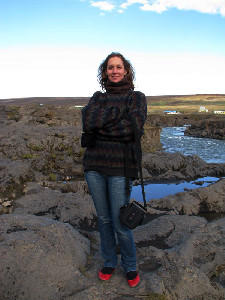
img: Lara Sterling on a lava bed in Iceland, on one of her many trips.

If you enjoyed this post, we invite you to subscribe for email delivery of The Displaced Nation. That way, you won’t miss a single issue. SPECIAL OFFER: New subscribers receive a FREE copy of “A Royally Displaced Tea.”

Related posts:
RANDOM NOMAD: Charlotte Day, High School Student (Sixth Former)

Born in: Sydney, Australia
Passports: Australia, UK and US Green Card
Countries lived in: Australia (Sydney): 1994-2001; United States (New York, New York): 2001-2010; England (Sevenoaks, Kent): 2010-present

What made you leave your homeland in the first place?
My father is Australian and my mother English. They split up when I was two. When I was six, my mother met and married an Australian who had been living in New York for thirty years. I was rather disgruntled about moving to the United States and for two or three years, remained determined never to accept it as “home.” At that time, I was deeply patriotic to my native country — though this sentiment has dissipated since.

Is anyone else in your immediate family a “displaced” person?
My mother’s family, originally from England, has long been displaced. My mother herself was born in Kenya, in 1961. Following the Mau Mau Uprising, her parents were forced to relocate, and my grandfather, presented with a choice between Australia and Canada, chose the warmer of the two countries. My mother spent her childhood bouncing between schools in England and Australia. She eventually grew so fed up with packing and unpacking, she decided to leave school at the age of 16. Her father agreed to the plan provided she spend a final year at the school in Switzerland his own mother had attended as a girl. My mother moved on from Swiss finishing school to work in London, Paris and Sydney. But she appears to have made New York her last port of call. Indeed, we had a fairly solid life in the city until I decided to take myself off to boarding school in England.

Describe the moment when you felt most displaced over the course of your many displacements.
It must have been when I first arrived in New York as a six-year-old. I stepped out of the JFK arrivals terminal into a snowy March night. My stepfather was wearing a leather coat, the interior of his car smelled of leather — and the world outside the car window seemed an undulating stream of black and silver. Though it was the end of 2001’s warm winter, my Australian blood froze beneath my first-ever coat. And their apartment — that was all leather as well. It smelled of musk and cologne. Since that time, I have felt similar pangs of displacement, some of which lasted for considerable periods. But those first few moments in New York stand out as the most acute concentration of “displacedness” I have ever known.

Describe the moment when you felt least displaced.
For the last five or so years in New York, I have felt more at home than I ever did in Sydney. I ascribe this to growing up: at a certain age, one can take possession of a city, know its streets, bridges, tunnels and transportation system. I was too young when I lived in Sydney to reach that kind of comfort level. But when have I felt the most like a New Yorker? Perhaps it was the last time I came home for the holidays, and took the 4 train uptown for the first time in months. At that moment I realized how much this train had been a part of my life — conveying me home from school every day for two years. My old life would always be waiting for me on the subway, ready for me to pick it up again. That’s something only a New Yorker could say!

You may bring one curiosity you’ve collected from each of the countries where you’ve lived into the Displaced Nation. What’s in your suitcase?
From Australia: A miniature wooden wombat figurine — a gift from my grandfather. It conjures memories of a childhood spent beating about the bush (literally) and fishing for yabbies at the dam in the company of audacious dogs who stuck their heads down wombat holes, to no good end.
From New York: A pair of fake Harry Potter glasses. These defined my first six months in New York — I even wore them to my first day of school. I think it is telling that even at the age of six, I was unwilling to give all of my real self to this new home.
From England: My school tie — representative of the alternative universe I seem to have entered. At boarding school, the sense of removal from reality can be disconcerting — especially after having spent a decade in the city I regard as the world’s capital.

You’re invited to prepare one meal based on your travels for other Displaced Nation members. What’s on your menu?
I’d like to make you a Sydney breakfast: scrambled eggs, made with cream, salt and pepper and served on a bed of Turkish toast, with avocado and stewed tomato on the side (is this being greedy?). Our meal will be accompanied by a large “flat white”: what we call perfectly strong, milky coffee without excessive froth. I suggest we consume it overlooking a beach on a Sunday morning. At least, I assume The Displaced Nation has beaches?

You may add one word or expression from each of the countries you’ve lived in to The Displaced Nation argot. What words do you loan us?
From Australia: Daggy. I use this word all the time — and did not realize it was exclusively Australian until I was informed of the etymology. Apparently, it comes from trimming the soiled wool around a sheep’s bottom. Which part of this repugnant whole is actually the “dag,” I do not remember. (No, I’m not a proper Australian!) But as I understand it, “daggy” means sloppy in appearance or badly put together.
From New York: There are so many words, and most are second nature by now. However, I will choose grande-soy-chai-tea-latte because I still shudder to think of myself as the kind of person who can utter such a phrase, at great speed, with great insistence. In fact, I’m still in denial about my love for Starbucks: having known Sydney coffee, my standards should be higher.
From England: Banter. I still do not know the precise meaning of this word, but it seems to encapsulate everything that makes someone my age feel socially acceptable — and, of course, I have no banter whatsoever. I think it means the capacity for combining wit with meaningless conversation. But there are other components, too, which seem to me unfathomable.

Question: Readers, tell us what you think: should we welcome Charlotte Day to The Displaced Nation and if so, why? (Note: It’s fine to vote “no” as long as you couch your reasoning in terms you think we all — Charlotte included — will find amusing.)

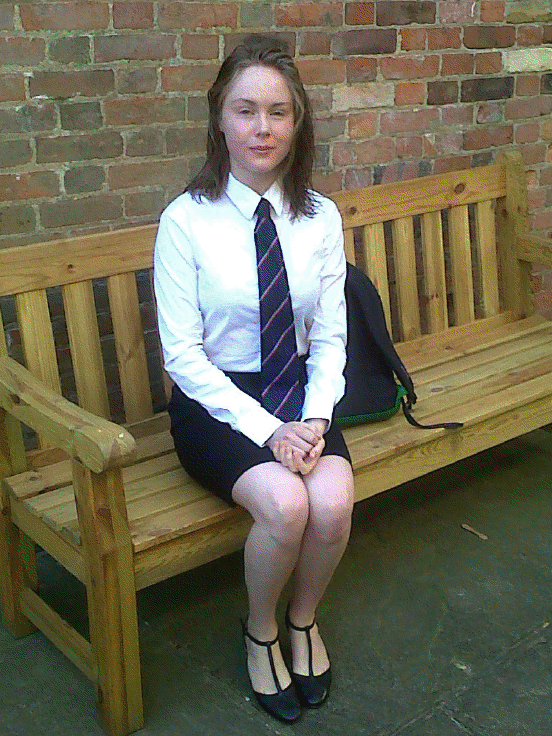
img: Charlotte Day at her boarding school in southeast England

If you enjoyed this post, we invite you to subscribe for email delivery of The Displaced Nation. That way, you won’t miss a single issue. SPECIAL OFFER: New subscribers receive a FREE copy of “A Royally Displaced Tea.”

Related posts:

Mia Wasikowska — a Third Culture Kid who is no Cinderella

Neatly coinciding with The Displaced Nation’s recent themes of the Royal Wedding and Gothic Tales, Maureen Dowd in her New York Times article “Who Married Up: The Women or the Men?” compares Cinderella with Kate Middleton and Charlotte Bronte’s Jane Eyre.

While the comparison with Kate Middleton is oft-cited, Bronte’s tale is less obvious: the story of a society misfit Plain Jane who suffers a series of gothic melodramas before finally claiming her maimed prince – but on her own terms. It’s possible that at some point during her ten-year waiting game in which Prince William apparently called all the shots, Kate Middleton may have sympathized with Jane Eyre’s wistful statement in the latest adaptation of Bronte’s novel:

“I wish a woman could have action in her life, like a man.”

A shooting star who needs no wishes

Mia Wasikowska, who stars in the title role of Cary Fukunaga’s “Jane Eyre,” needs no such wishful thinking. The 21-year-old Australian had her first US TV role at 17, was named the following year as one of  Variety magazine’s Top Ten Actors To Watch, and won the 2010 Hollywood Film Festival Award for Best Breakthrough Actress. Until “Jane Eyre” came along, she was best known for her portrayal of Tim Burton’s Alice in Wonderland.

While it is hard to imagine two female characters more different than Jane Eyre and Alice,  they do share some similarities:  Jane’s feeling of exile, of being shunned by society, is echoed in Burton’s Alice. In an interview with Australian Harper’s Bazaar, Wasikowska spoke of her interpretation of the role:

“Alice has a certain discomfort within herself, within society and among her peers. I feel similarly, or have definitely felt similarly, about all of those things, so I could really understand her not quite fitting in.”

Although Ms. Wasikowska  does not elaborate about her own feelings of displacement — and certainly most young women feel insecure at some time or other —  one can’t help wondering if she is referring to travel experiences in her childhood and teens.

A TCK in Tinseltown

The daughter of an Australian father and Polish-born mother, Wasikowska is a TCK (Third Culture Kid.) She was born and raised in Canberra, Australia, and when she was eight years old the family moved to Szczecin, Poland, for a year, during which time they also traveled in France, Germany and  Russia.  At 17, she was cast in the role of Sophie in HBO’s “In Treatment,” which necessitated a move to Los Angeles.

One could argue that anyone, of any nationality, who is flung into the Hollywood carnival at such a tender age could qualify for the label of TCK.

Ignore the naysayers

The US Department of State defines Third Culture Kids as:

“those who have spent some of their growing up years in a foreign country and experience a sense of not belonging to their passport country when they return to it…they are often considered an oddity [and] what third culture kids want most is to be accepted as the individuals they are.”

A most depressing definition, highlighting the bad and ignoring all the good. It says nothing of the inevitable expansion of horizons that enable a TCK to empathize with other ways of life, to walk in another’s shoes – and if you’re an actor, the ability to walk in another’s shoes is crucial.

It would be nice to think that, despite governmental gloom, TCK experiences played a part in Wasikowska’s professional development and rocketing career.

Home is where reality is

Canberra is still Wasikowska’s home, however, and she lives there with her family between film projects. When asked by PopEater if she was treated like a celebrity at home, she answered:

“I still take the rubbish out and empty the dishwasher. It’s good going back for that reason.”

Well, that’s OK. After all, Kate Middleton said she intended to cook dinner for Prince William when they married.

And I expect even Cinderella swept a few floors in her new castle.

Img: Tomdog/Wikimedia Commons

If you enjoyed this post, we invite you to subscribe for email delivery of The Displaced Nation. That way, you won’t miss a single issue.

DISPLACED Q: What items from home can you not live without?

UK department store John Lewis recently announced it would soon launch versions of its Website for shoppers in 27 countries, including the USA, Australia, and Singapore. The company has no plans to open stores in these locations, however; all orders will be delivered by courier.

Marks and Spencer, another institution of the British High Street, already ships to 80 countries worldwide, even though it has over 300 international stores scattered around the globe.

It seems both John Lewis and M&S  understand something that all expats know — there are certain items you only feel comfortable buying from home.

Marks & Spencer, for example, accounts for around thirty percent of the UK lingerie market; it’s not unreasonable to assume that displaced Brits with diminishing lingerie supplies and no access to M&S stores make up a goodly proportion of the international shipping numbers. Meanwhile, John Lewis has the most popular gift list in the UK. How about some Conran bed linen or Denby pottery to make your relations feel at home in their Moscow abode? Sometimes only the familiar will do.

It’s not all about the goods, either. Expat in Germany, in her March 17 post, explained why she hesitated to buy a wedding dress in Germany instead of in her native Canada. It had nothing to do with the quality of wedding gowns and everything to do with the charming honesty of German sales assistants that made her pine for a gentler shopping experience at home.

But these facts and anecdotes made us wonder: No matter how displaced you have become, are there certain items — other than food — that you still prefer to import from your home country?

Two members of the Displaced Nation Team kick off the discussion:

Kate Allison: During my 15 years as a Brit in the US, I have been known to ask visitors to bring gifts of children’s cotton pyjamas. The cotton in the UK is much nicer, somehow, than in the US. I also had a brief sojourn into Next duvet covers, because duvets aren’t as popular in the US as they are in Europe.  Last time I was over, though, it was shoes that caught my eye. And yes, they came from Marks and Spencer. It’s not that they were any better than their American counterparts — just different, and not from Macy’s.

ML Awanohara: As far as wedding (and other special) dresses go, the more exotic the better. I was never an expat in Rome but went shopping for my wedding dress a few years back in a charming boutique, Maga Morgana, very near the Piazza Navona. (If I had it to do over, I’d have studied abroad in Italy — art history, of course. So perhaps I was playing out that fantasy…) Kate, it’s funny you mention shoes. While living in the UK and Japan, I always preferred to buy shoes in the US. It wasn’t that I didn’t like the shoes in those countries — I coveted them. But they made my feet hurt, something to do with the “last” not being big enough. I noticed recently on an expat news feed that displaced New Zealanders often head to a shop called Minnie Cooper’s as soon as they get home. This piqued my curiosity: is it for the styles, the NZ leather, or both?

Your turn to chime in: What homey items, apart from food, have you yet to wean yourself off?

If you enjoyed this post, we invite you to subscribe for email delivery of The Displaced Nation. That way, you won’t miss a single issue. SPECIAL OFFER: New subscribers receive a FREE copy of “A Royally Displaced Tea.”

What did Agatha Christie know? Expats make great criminals

I’m going to kill myself for saying this — I’m an Agatha Christie fan — but I think the Queen of Crime got it wrong.

Either that or she purposely misled us into thinking that the most cunning criminal minds were hiding behind lace curtains in oldy-worldy English villages.

I don’t know about you, but for a while, I found it convincing. Don’t most scions of wealthy families want to murder the patriarch? And what better place to do it than in the library of his stately home…

But then I became what the tagline of this blog refers to as a “global voyager.” As I navigated worlds far beyond the one in which I was born, I wasn’t so clueless any more. I began to notice that the perpetrators of the some of the worst crimes are people who no longer live in their villages, who are displaced in some way.

And the more I thought about it, the more sense it made.

No Gardens of Eden out there

Psychological studies have shown that we are less likely to cheat when we’re aware of someone else observing our behavior — even if it’s a poster with eyes on it.

Thus, having a village busybody like Miss Marple should help to deter crime, never mind solving it.

Now many international travelers — especially those with plum expat packages — feel they live in a self-anointed paradise. And perhaps they have to convince themselves of this, or else they wouldn’t travel.

But the sad fact is, no one is immune. To rephrase an old saying, some of us are born bad, others achieve badness, and still others have badness thrust upon us.

If anything, badness is more likely to be a feature of the international life. Those of us who become adept at navigating the globe sometimes lose our moral compass along the way.

As for the Miss Marples, chances are, they’ve gone home. Many of an expat’s associates are transients.

So many bad apples

As you’re probably aware by now, not every expat you meet is a good egg. Some are in fact bad apples (not sure why an egg is good and an apple bad — call it a mystery of English slang).

The actress Anne Hathaway had to learn this lesson the hard way. She fell for Raffaello Follieri, who headed the Follieri Group, a real estate development company based in New York City.

With his mop of brown hair and cherubic features, Follieri came across as the embodiment of old world charm and manners. He cut what the Italians call a bella figura.

He was also, it turned out, a crook. He wined and dined Hathaway with the money he’d conned it out of people by posing as the Vatican’s real-estate man. He’s now in prison.

Murder most foul

Just as we don’t like to think of rats being part of the animal kingdom, we don’t like to think of conmen, pirates, gangsters, and terrorists being part of the group we have loosely defined as “global voyagers” — such a noble concept, and one to which The Displaced Nation has dedicated itself.

But trust me, they are a part of it — as are murderers.

Take, for instance, Nancy Kissel. One day she was living in an exclusive high-rise apartment complex in Hong Kong, the city that scores a perfect 10 as an expat destination, with a banker husband worth many millions.

The next day she was known as the Milkshake Murderess — accused (and then convicted, conviction now upheld) of bludgeoning her husband to death after drugging him with a sedative-laced strawberry milkshake and then wrapping his body in an Oriental carpet destined for basement storage.

It’s a story more than worthy of Agatha Christie.

Or ask the parents of Meredith Kercher, a young British woman who went to Italy as part of the Erasmus student exchange programme, to study and immerse herself in the language and culture.

She chose the ancient city of Perugia in Umbria. Surely nothing could go wrong in such a serene setting?

Wrong again. Unless you’ve been living on another planet, you’ve heard that Meredith was brutally murdered, allegedly by two men and her American roommate, Amanda Knox, in what prosecutors called a violent sex game. Only one of the alleged perpetrators was a native-born Italian.

Public fascination with the case has continued unabated — and not just because of the media circus surrounding Knox, who maintains her innocence and is appealing her conviction.

As the Christian Science Monitor put it in an article last September:

…the highly contested circumstances of the crime make it a genuine murder mystery.

(Where is Hercule Poirot when you need him — surely his marrows would thrive in the Umbrian soils?)

And now for a bit of a twist!

I’d like to retract my statement on the Queen of Crime. Je me suis trompé! I’ve done her an injustice.

True, Agatha Christie did produce lots of drawing-room mysteries, but she also also told us everything we need to know about expat criminality in her classic work Murder on the Orient Express.

When the shifty-looking Samuel Edward Rachett is found stabbed to death, the redoubtable Hercule Poirot assembles the 12 suspects in the restaurant car. It’s an odd assortment — call it an expat enclave in microcosm — consisting of an American translator, a British valet, a French conductor, a British governess, a retired British army officer, an elderly Russian noblewoman, a German maid, a Hungarian diplomat and his wife, a Swedish missionary, an elderly American woman who has just been to see her daughter in Baghdad, and an Italian-American businessman from Chicago.

So, whodunit? Can you remember? The answer is: all 12! Each of these characters had thrust the knife into Ratchett, making it impossible for Poirot to determine who delivered the fatal blow.

But as it turned out, it didn’t matter. Ratchett deserved his fate for his own dastardly deeds. He was, of course, the most displaced of all the passengers on that exotic train: a fugitive from justice, whose real name was Cassetti.

I’m sure I don’t have to tell you which transnational group of gangsters he was affiliated with. No surprises there!

Question: Do you agree that citizens of The Displaced Nation have criminal potential, and have you ever come face to face with any criminal elements in your travels? I’d love to hear your stories, however unsavory…

img: “There’s been a murder!” by Richard Bogle.

If you enjoyed this post, we invite you to subscribe for email delivery of The Displaced Nation. That way, you won’t miss a single issue. SPECIAL OFFER: New subscribers receive a FREE copy of “A Royally Displaced Tea.”

Related posts:
RANDOM NOMAD: Nerissa Muijs, Business Development Specialist

Born in: Kingston S.E., a wee town in South Australia
Passport: Australian, but will be eligible to become a dual Australian-Dutch citizen this year
Countries lived in: Malaysia (Shah Alam): 1997; New Zealand (Christchurch): 2003; England (Plymouth): 2006-2007; Scotland (Edinburgh): 2007-2008; Netherlands (Almere): 2008-present
Cyberspace coordinates: Adventures in Integration (blog)

What made you leave your homeland in the first place?
I grew up in a small town in South Australia called Lucindale (just 300 people). I don’t feel like I was ever a good fit. I have always had a feeling of wanderlust and being able to go on an AFS exchange to Malaysia when I was 17 added more fuel to the fire, rather than sating my taste for experiencing new places. Once I returned home, I never really settled down again. I was constantly planning my next adventure.

Is anyone else in your immediate family a “displaced” person?
One of my Fabulous Aunts is also perfectly displaced. She lives on a yacht with her partner and two cats. They are currently floating around the Colombian coast, preparing for hurricane season before braving the Panama Canal to head back into the Pacific and beyond.

Describe the moment when you felt most displaced over the course of your many displacements.
Perhaps it was sitting in a restaurant in Malaysia with my wonderful Chinese host family. They had taken me out especially to eat shark’s fin soup. Or it could be the time I was the only Australian sitting in a bar in Christchurch watching the Wallabies beat the All Blacks in the semi finals of the 2003 Rugby World Cup. But seriously, it was probably when I found myself in the immigration offices in Amsterdam realizing I was making a potentially permanent commitment by moving to my husband’s homeland — it was time to grow up!

Describe the moment when you felt least displaced.
On my birthday in 2007. I was living in Edinburgh at the time. My Dutch boyfriend, who is now my husband — we met in Australia when he joined one of my tours to Uluru — was visiting from the Netherlands. A group of my friends took us out to celebrate. In that moment I was happy, I was at home. I find I don’t have the sense of “home” when I return to my hometown in Australia any more. I feel at home with people, not places. Having a cup of tea with my best friend, for example. We’ve done that in at least four countries together and it’s always the same.

You may bring one curiosity you’ve collected from each of the countries where you’ve lived into the Displaced Nation. What’s in your suitcase?
From Malaysia: A batik sarong. I’ve been wearing the same one weekly since 1997, and I love it just as much as the day I paid 5RM for it.
From NZ: The jade pendant I got from Hokitika. It feels cool or warm on my skin and is smooth and comforting.
From England: A cream tea with scones and Cornish clotted cream. A cream tea will always make me think of my elderly great aunts at home and of England.
From Scotland: A “hairy coo” fluffy toy. (Actually, I’d prefer to bring a real-life hairy coo, but I imagine you have strict quarantine rules…)
From Netherlands: Rookworst (a type of smoked sausage, similar to bratwurst).

You’re invited to prepare one meal based on your travels for other Displaced Nation members. What’s on your menu?
Being Australian, I will have to say a barbie. We’ll eat steak, snags [sausages], lamb chops and onions. We’ll tip our hats to Malaysia with some satay sticks. We’ll have bread and my grandma’s hot potato salad. There will be noodle salad that my mum made and sliced beetroot on the side, which I’ll drop on my shirt. Of course, because I live in the Netherlands, we’ll have garlic sauce along with our tomato sauce. And because of the UK influence it will probably be raining, but there will be beer. Lots of beer. And it won’t end for two days. I’ll be up early to cook bacon and eggs again the next morning for the people who just won’t leave. (Dad, I’m talking to you!) It will be fun — care to join me?

You may add one word or expression from each of the countries you’ve lived in to The Displaced Nation argot. What words do you loan us?
From Malaysia: Adding a “la” onto words and sentences: “Okay-la.”
From New Zealand: “Chur bro.” Depending on the context, it can mean “thanks,” “nice,” or “cheers, mate.”
From England: “I’m not trying to be funny, but [insert random passive aggressive insult here].”
From Scotland: Any swear word you can imagine.
From Netherlands: Gezellig, the most important word in the Dutch language. There is no real English translation, though “cosy” is sometimes used. It’s a word people use to describe a pleasant situation. Going out with friends is gezellig. Sitting around having a nice dinner with family is gezellig. Anything that gives you a nice warm fuzzy happy feeling inside can be described as gezellig. Wonderful word.

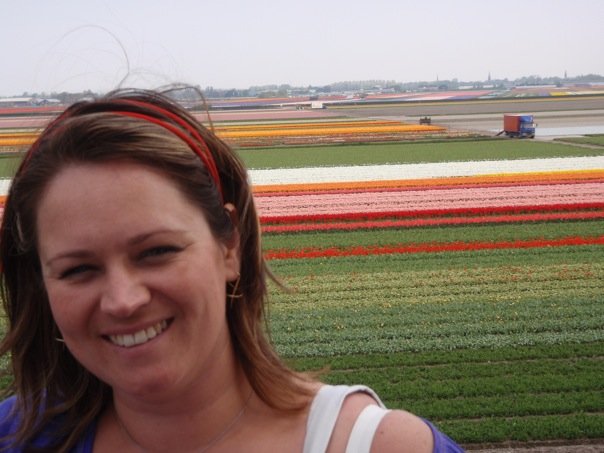
img: Nerissa Muijs at tulip fields outside Lisse, Netherlands.

If you enjoyed this post, we invite you to subscribe for email delivery of The Displaced Nation. That way, you won’t miss a single issue. SPECIAL OFFER: New subscribers receive a FREE copy of “A Royally Displaced Tea.”

Related posts: