The Displaced Nation

A home for international creatives

Tag Archives: Olympian feats

Summer reading list: an Olympic selection of books

Welcome to our summer list of reading suggestions. With only four days to go until the first official day of the 2012 London Olympics, we offer no prizes for guessing the theme of this list! What we have tried to do, however, is find you some books that are a little outside the usual “History of the Olympics” mold.

2012 London Olympics: Some fun facts and figures

8,000 torchbearers
26 sports
8.8 million tickets
10,490 athletes
350 miles of cabling
5,000 anti-doping samples
10,000 temporary toilets
356 pairs of boxing gloves
4 skeletons removed from prehistoric settlement on site
(Source: http://www.london2012.com

A spectator’s eye view:

The Olympics Beat: A Spectator’s Memoir of Beijing
by Shannon Young

Published May 2012

About the author:
An American writer living in Hong Kong, Shannon Young writes a blog called A Kindle in Hong Kong, featuring her walking tours, book reviews, and bookspotting adventures.

Cyber coordinates:
Blog: A Kindle in Hong Kong
Twitter: @ShannonYoungHK
Facebook:  A Kindle in Hong Kong

Overview of book:
The drama, the variety, the spectacle – Shannon can’t get enough of it. She is an American student who has always been fascinated by the Olympic Games; her father has a lifelong love affair with China. They team up for the Beijing games and the adventure of a lifetime. Without the filter of a small screen, Shannon and her father are hypnotized by the passion of a great nation unveiling itself to the world. This mini travel memoir is a picture of a new China and the experiences that would change one American girl’s life forever.
(Amazon product description)

Displaced Nation review:
A search for “Olympics” on Amazon will bring up many hits: history of the Olympics, Olympics in ancient times, autobiographies of famous Olympic competitors, lots of picture books for children about the Olympics, and so on. Unique on this list, however, is Shannon Young’s autobiographical account of what it is like to be a spectator at the Games.

As a young university student, Shannon received a fellowship to go to the Beijing Olympics and study the effects the Games had on the city. The resultant academic paper, she felt, was dry and earnest and did nothing to capture the  excitement of the sights and atmosphere, so, three years later, she decided to write a memoir of her personal experience there. Although the book is mainly travelogue, there is also a touching glimpse into the relationship between Shannon and her father, with whom she traveled, and who wants to impart his love of China to his daughter.

At only 60 pages, this is a very short and easy read — quite manageable before the Games start in four days’ time. While Shannon traveled to Beijing for academic purposes, this memoir is not a commentary on the political situation in China in 2008. It is simply the honest observations of a twenty-year-old at the world’s most important sporting event, in a country that is trying to show its best, Botoxed, surgically enhanced face to the rest of that world. The final paragraph of the book sums this up so well:

We returned to the US TV coverage of the remaining events, and it focused on China’s problems: air quality, protesters confined to limited spaces, rumours of human rights violations and trouble. But that wasn’t the Olympics we witnessed. We saw a city full of people who were proud of their accomplishments… The athletes, volunteers, and spectators had poured their souls into welcoming people to their city, and they wanted the world to know how great China was. We knew it — because we were there.

A survivor’s eye view:

Running for My Life: One Lost Boy’s Journey from the Killing Fields of Sudan to the Olympic Games
by Lopez Lomong, Mark Tabb

Published July 2012

About the author:
Lopez Lomong was born in southern Sudan in 1985. After his village was attacked by rebel soldiers when he was 6 years old, he spent ten years in Kenyan refugee camp before moving to the United States, where he was fostered by a family in New York. He became a professional runner in 2007, and a US citizen in 2008, the year he also represented the US at the Beijing Olympics.

Cyber coordinates:
Website: lopezlomong.com
Twitter: @LopezLomong
Facebook: https://www.facebook.com/LopezLomong

Overview of book:
Lopez Lomong chronicles his inspiring ascent from a barefoot lost boy of the Sudanese Civil War to a Nike sponsored athlete on the US Olympic Team. Though most of us fall somewhere between the catastrophic lows and dizzying highs of Lomong’s incredible life, every reader will find in his story the human spark to pursue dreams that might seem unthinkable, even from circumstances that might appear hopeless. (Barnes and Noble product overview)

One reader’s review:
“Lopez Lomong’s story is certainly one of pain, suffering and hardship but all that is overshadowed by his tremendous drive, hope and selfless endeavors for the people of South Sudan.” (Review at “Reflecting from here”)


A stranger-than-fiction eye view:

The Olympics’ Strangest Moments: Extraordinary but True Stories from the History of the Olympic Games
by Geoff Tibballs

Published July 2008

About the author:
Geoff Tibballs is a former sports journalist who has written nearly 100 books. He is “an accomplished armchair sportsman, [who] believes his life-long devotion to Millwall Football Club has enabled him to appreciate the ridiculous.” (Random House author bio)

Cyber coordinates:
Author’s page on publisher’s website: Random House/ Geoff Tibballs

Overview of book:
The Olympics’ Strangest Moments recounts the bizarre, controversial, inept, heroic and plain unlucky from the first modern games in 1896 to the return of the games to their birthplace in Athens in 2004 and up to the Beijing 2008 games. (Amazon book description)

One reader’s review:
“The early episodes offer a glimpse into a very different world than the one we know today… The 1900 Paris Olympics featured a cricket competition with only two teams entered…The swimming events were staged in the River Seine…This book is sometimes funny, occasionally tragic, but always entertaining. You don’t have to be fanatical about the Olympics to enjoy this book.” (Amazon.com review)

An insider’s eye view:

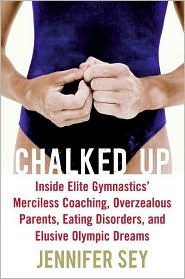
Chalked Up: Inside Elite Gymnastics’ Merciless Coaching, Overzealous Parents, Eating Disorders, and Elusive Olympic Dreams
by Jennifer Sey

Published October 2009

About the author:
Jennifer Sey is an American writer, producer and former gymnast. She began competing in the sport of gymnastics at the age of six and went on to become 1986 National Gymnastics Champion and seven-time national team member.  She lives with her husband and two sons in San Francisco. (Amazon/Wikipedia bio)

Cyber coordinates:
Author’s page on publisher’s website: Harper Collins/Jennifer Sey

Overview of book:
“Chalked Up” presents the story of the 1986 US National Gymnastics champion whose life long dream was to compete in the 1988 Olympics – until anorexia, injuries, coaching abuses, and parental hopes and neglect nearly destroyed her. (Amazon.com book description)

One reader’s review:
“Jennifer Sey is telling her story. She is not preaching nor is she telling you to remove your child from the sport of gymnastics. Although a painful side of gymnastics, which so many of us are scared to acknowledge, it is a reality in the elite world of gymnastics. Twenty two years after winning the national title, a crown that all elite gymnasts dream of, Sey still struggles with a love/hate gymnastics relationship.” (Amazon.com review)

.

Img: Olympic Torch with laurel wreath by nirots/freedigitalphotos.net

STAY TUNED for another Displaced Q!

If you enjoyed this post, we invite you to subscribe for email delivery of The Displaced Dispatch, a round up of the week’s posts from The Displaced Nation. Sign up for The Displaced Dispatch by clicking here!

Related posts:

Expat book review: “The Chalk Circle” by Tara L. Masih

Expat book reivew: “Chique Secrets of Dolce Amore” by Barbara Conelli

Expat book review: “Picky, Sticky or Just Plain Icky?” by Valerie Hamer

Expat book review: “A Tight Wide-open Space,” by Matt Krause

LESSONS FROM TWO SMALL ISLANDS — 3) Keep calm and eat curry

Mid-July in Manhattan, and I’m thinking that New York deserves its reputation as The City That Never Sleeps. Not because we’re all out partying — far from it. We’re lying there tossing and turning because we can’t regulate our air-conditioning units.

“High” puts you in Siberia; “Low” sends you down into the Tropics. There are no in-betweens, except for the brief period just after you’ve gotten out of bed to adjust the setting. But by then you’re awake again…

It has always surprised me that New Yorkers are willing to put up with such primitive cooling methods. It’s not like them to suffer silently. My theory is that they simply don’t know any better. As the world begins and ends in New York (isn’t Times Square supposed to be the center of the universe?), this must be the best of all possible air conditioning systems.

Regardless. The point is that I am finding summer a terrible trial now that I’ve repatriated — one that at times requires Olympic strength and endurance.

As summer wears on, I wear out. Not only do I never sleep but I never eat — or eat only minimally. My appetite dwindles at the thought of passing yet another uncomfortable night at the mercy of Simon-Aire products.

All of that changed, however, a few nights ago. Actually, the night had started normally enough: I had gone to bed and was freezing cold so couldn’t sleep. But just as I was lying there thinking about getting up to turn the air con down or else searching the closet for another blanket, I had a sudden, heartwarming thought: “I could kill for a curry!”

How did I go from cursing Dr. Cool, whose workers had installed a supposedly upgraded Simon-Aire unit in the bedroom at considerable cost, to a happy craving for curry? I can only surmise that my subconscious mind was trying to restore my spirits by reminding me of my curry-eating days in the two small islands where I’d lived as an expat, England and Japan. I felt calm again, and my appetite returned…

America — a nation that has deprived itself of a serious curry experience

When I first moved to New York, I was beyond thrilled to discover that the Indian actress and cookbook author Madhur Jaffrey lived here, too. To my utter surprise (and delight) — I had always assumed she lived in London — she has been residing in an apartment on the Upper East Side for the past several decades. (She also has a farmhouse in the Hudson Valley.)

Surprised in a good way, yes — but also somewhat mystified. Why would Jaffrey choose to live in America for so long, given the sorry state of Indian cuisine in this part of the world?

I guess it has to do with husbands — she came to the city with her first husband, the Indian actor, Saeed Jaffrey, and then after their divorce, married an American.

Or perhaps she just likes a challenge? In Jaffrey’s very first cookbook, An Invitation to Indian Cooking, written not long after her arrival on American soil, she says she is writing the book because

there is no place in New York or anywhere in America where top-quality Indian food could be found, except, of course, in private Indian homes.

That was nearly forty years ago, and I have to say, her efforts to improve the situation, beginning with that book, have yet to pay off. Manhattan now has a couple of Indian restaurant neighborhoods, and then there’s Jackson Heights in Queens — but in general curry hasn’t caught on in a big way with Americans. If we want to eat spicy food, we usually turn to Mexican or Thai, not Indian.

As Jaffrey herself put it in an interview with an American reporter last year:

America as a whole has not embraced Indian food like they have with Chinese, or with sushi. It’s beginning to change, but only in big cities. Something is needed, something real. I have waited for this revolution, but it hasn’t happened yet.

This is in stark contrast to England and Japan — both of which embraced the curry cause on first exposure and now behave as though they’d invented certain dishes. Indeed, chicken tikka is considered to be a national dish in the UK, while “curry rice” (pronounced karē raisu) rapidly achieved the status of a national dish in Japan.

Nostalgia: Going out for a curry in England

England, my England — where Madhur Jaffrey is a household name, and curry houses abound!

Britain got the hots for curry during the 19th century, when there was an enthusiasm for all things Indian. And I got the hots for the Brits’ late-20th-century version of curry when living in an English town as an expat. My friends and I would spice up our evenings by going out for curries. We always ordered a biriani, chicken tikka masala, and a couple of vegetable dishes (one was usually sag paneer, which remains a favorite to this day).

Our starters would be onion bhaji and papadums, and drinks would be pints of lager. If we had the space for dessert, it was usually chocolate ice cream — none of us ever acquired the taste for Indian desserts (dessert of course being an area where the British excel!).

But even more special were the times when friends invited me to their homes for meals they’d concocted using Madhur Jaffrey’s recipes. One memory that stands out for me is an occasion when my former husband, a Brit, and I joined four other couples for a friend’s 40th birthday party. The hostess, the birthday-boy’s wife, presented a dazzling array of Madhur Jaffrey dishes that looked like something out of a food magazine. I’ve been to much ritzier birthday parties before and since, but none have struck me as being as elegant as this one — partly because of the splendid display and partly because by then I knew how much chopping and dicing of garlic, ginger and onion, how much grinding of spices must have been involved. What a labor of love!

Yes, by then I’d begun experimenting with Indian cookery myself thanks to the influence of a very good friend, who’d given me the classic Madhur Jaffrey work, Indian Cookery (which had been a BBC series), along with all the spices I would need for making the recipes: nutmeg, cinnamon, cardamon, mustard seeds, coriander, cumin turmeric, cloves… To this day, I always keep an array of Indian spices in my pantry so that I can make my own garam masala at the drop of a hat. Now if only I could find some friends who would drop their hats! (Hey, I even have the old coffee grinder ready for grinding the spices, just as Jaffrey instructs.)

Nostalgia: Curry rice & curry lunches in Japan

Eventually, I moved away from England to another small island, Japan — where I was relieved to discover I would not need to give up my new-found passion for Indian food (though I would be foregoing my beloved basmati rice unless I smuggled it in at customs).

Thankfully, the Brits had gotten there about a hundred years before me and had introduced curry to the Japanese, with great success.

Because of “r” being pronounced like an “l” in the Japanese language, we foreigners couldn’t resist making many tasteless jokes about eating curried lice, but that didn’t stop us from having our fill of the tasty national dish, curry rice.

As in the UK, I found it a nice contrast to the traditional fare, which, though healthy, can be rather bland.

At this point, I’d like to loop back to Madhur Jaffrey and note that she disapproves of the word “curry” being used to describe India’s great cuisine — says it’s as degrading as the term “chop suey” was to Chinese cuisine. But I wonder if she might make an exception to the Japanese usage? Apparently, Indians themselves when speaking in English use “curry” to to distinguish stew-like dishes. And Japanese curry rice is the richest of stews, made from a “roux” that can be bought in a box if you do it yourself.

My first box of curry roux was a gift from a Japanese friend. It was accompanied by her recipe for enriching the stew with fresh shrimp and scallops. Oishii!

Still, the curry I crave most often from Japan isn’t curry rice at all, which I find on the heavy side. No, my deepest nostalgia is reserved for the set lunches in Tokyo’s Indian restaurants, which I used to partake in with office colleagues.

The (mostly Indian) chefs have tweaked the ingredients to appeal to the Japanese palate: little dishes of curry that are artistically arranged on a platter, accompanied by naan. freshly baked (fresh is very important to the Japanese) and a side of Japanese pickles: pickled onions, or rakkyōzuke (a tiny, whole, sweet onion); and pickled vegetables, or fukujinzuke.

(The addition of Japanese pickles, by the way, is genius! Try it — you’ll love it!)

All of this is capped by coffee or masala tea, both of which are so well executed they can fill in as desserts.

My takeaways (I wish!)

I fear there may not be many takeaways for my fellow Americans from Lesson #3. After all, the world’s leading authority on Indian cuisine has tried to convert us and failed.

Nevertheless I’ll suggest a few scenarios, with pointers on how you might attempt to introduce a curry-eating tradition into your circle:

1 — Summer is getting to you, so you suggest to a group of friends that you all go out for a curry. When they stare at you blankly, do a little head bobble, smile charmingly and say: “Why ever not?”

2 — Summer is getting to you, and you decide to build a shrine to Madhur Jaffrey in your home by buying as many of her books as you can — including her children’s book on the Indian elephant, Robi Dobi, and her memoir of her childhood, Climbing Mango Trees. You arrange them around a screen that is playing Shakespeare Wallah, a film she appeared in in the 1960s (directed by James Ivory and starring Felicity Kendal). Invite some friends over and when they ask you about the shrine, start talking about the joys of Indian cookery and see if you can make some converts. Perhaps offer to lend out a book or two. (I might start with her newest work, which emphasizes “quick and easy” methods — bless the 78-year-old Jaffrey, she’s indefatigable!) And you can always dip into the books yourself if the heat is making you sleepless. Jaffrey writes beautifully.

3 — Summer is getting to you, but you decide that when the heat breaks, you will start up a Curry Club with a few of your friends, encouraging everyone to contribute one Madhur Jaffrey dish or a Japanese curry made from roux. Even if most of them drop out and you end up cooking a dish for yourself, perhaps this exercise will satisfy your craving until winter. (I find I get these cravings roughly every six months, usually in summer and winter.)

* * *

Well, I’m off to see if I can resume my sweetly fragrant dreams of my expat culinary adventures — just hope it does the trick of distracting me from my ancient “aircon” (popular Japanese contraction) units!

In the meantime, let me know what you think of this lesson. Are you a curry lover? And if so, could you live in a nation that doesn’t share your craving? How would you put some spice into your life under such sorry circumstances? Do tell!

STAY TUNED for Thursday’s post, another in our “Expat Moments” series, by Anthony Windram.

If you enjoyed this post, we invite you to register for The Displaced Dispatch, a round up of weekly posts from The Displaced Nation, with seasonal recipes, book giveaways and other extras. Register for The Displaced Dispatch by clicking here!

Related posts:

Image: MorgueFile

For former expat Matt Krause, a second act as a heathen pilgrim

For some of us, starting a new life overseas is challenge enough. But for others, it represents an opportunity to take things to the next level. It’s fair to say that Matt Krause falls into the latter category. Returning to California after following a Turkish woman back to her native land, he used the material for his first book. And now he’s preparing to set out on a 1,300-mile solo walk across Turkey — a country he still regards as his second home. I caught up with Matt recently to ask about this latest, much more athletic challenge.

Hi again, Matt. Welcome back to The Displaced Nation. It seems like only yesterday that we were reviewing your expat memoir, A Tight Wide-open Space, and now we find you preparing for an epic travel adventure. Can you say a little more about it?
On Saturday, September 1, 2012, I will start an eight-month solo walk across Turkey, from the Aegean to Iran — 1,305 miles (2,100 km) in all. I will carry a backpack, a tent, and a sleeping bag.

Why are you doing this?
To put my life where my mouth is.

In 2003 I met a girl on an airplane to Hong Kong. We ended up going out, then moving together to her hometown of Istanbul and getting married there. We lived in Turkey for six years, but in 2009 things unraveled and I came back home to the US.

When I came back to the US, people kept asking me about the differences I had seen in Turkey. Political differences, religious differences, cultural differences, gender differences, just about every kind of difference you could think of.

But I really wanted to tell them about how people are so much the same. Living in Turkey had reminded me that most of what we are as human beings, and how we act in any given situation, is pretty much the same. Human nature being what it is, though, we can’t take our eyes off our differences, and I think that this focus makes us more afraid of each other than we need to be.

I don’t want to talk about this in theory. If these similarities are so profound, I should be able to walk, alone and unprotected, across the country I still think of as my second home.

Going to the dogs

What have you done to prepare for this odyssey?
I walked 1,200 miles (almost 2,000 km), 700 of them with a fully loaded backpack. That’s four hours a day, five days a week, for five months.

I walked the same four 12-mile routes about 25 times each — those were 1,200 very repetitive and boring miles.

However, I love dogs, and the dogs added some flavor to the walks. The first few times I walked those routes, the dogs all acted ferocious, but week by week they warmed up to me. The Labs were the first, of course — I only had to walk past them once or twice before they’d run out to me wagging their behinds like I was an old friend.

The last to go was one particular Doberman Pinscher. He spent about four months acting like he was going to rip my head off each time I passed by, and then one day when I walked by he was busy talking to another dog. He looked over at me like, “Are you serious, are you going to make me interrupt this perfectly good conversation in order to come chase you?” He broke down quickly after that, and now when I walk past his house he just playfully runs alongside me, glancing back at the house every few seconds to make sure nobody’s watching. He’s got a reputation to think about, after all.

How will you finance the trip?
I have savings, which I’ve supplemented by working in the peach and plum orchards near my hometown of Reedley, California. I was grafting, which is basically cutting off the top of an old tree and sticking a new kind of wood into it. The new wood takes over, and within a couple years the tree is producing a new variety of fruit.

I will also be raising some money on Kickstarter in a few weeks.

Will you be grafting any electronic devices onto yourself while you walk?
I’ll have a pocket camera and a cell phone connection so that I can post daily updates (people photos, landscape photos, short written updates, etc) on my Web site, Heathen Pilgrim. Most of the time, of course, I’ll be out in the middle of nowhere. It’s not like I’ll be able to run into the nearest Starbucks and connect over wifi, so I had to figure some things out. I’ve been doing a lot of equipment testing.

An oxymoronic concept?

“Heathen Pilgrim” — that’s a curious name for a project.
I picked that name for a couple of reasons. The main reason is that a heathen is a person who does not share one’s religion. Christians see non-believers as pagan; Muslims see them as infidels; and as far as Jews are concerned, gentiles can never be members of God’s chosen people.

One thing we all have in common is that someone, somewhere considers us heathen. And if you want to travel outside of your own circle, you must be willing to be considered a heathen by someone else. If the people around you are not considering you heathen yet, you have not traveled far enough from home.

I also have a tongue-in-cheek reason. A secondary definition of “heathen” is “a rude or uncivilized person.” I’m a fairly polite and well-mannered person. So calling myself a heathen pilgrim is a bit of an attempt at self-deprecating humor.

Well, particularly when you juxtapose it with a word like “pilgrim,” since pilgrims are supposed to be on a journey to a holy place. Your itinerary is pretty ambitious. Do you identify at all with the athletes who are now preparing for the Olympics?
No, not at all. Those guys train all their lives. I’m just a guy who likes to eat donuts and walk — although I did have to turn a lot of things upside down in my life in order to do this.

On the subject of ways of looking at this project, there’s a relevant saying I like, that we are not entitled to the fruits of our labors, only to the labors themselves.

In this case, I have no control over the meanings people might assign to my walk. I only have a say in whether or not I do it.

A few last-minute jitters

What’s left by way of preparation for this unholy journey of yours?
Not much. At some point you’ve just got to take the leap of faith (no pun intended!), and that time has arrived for me. Right now I’m preparing for the Kickstarter campaign in a few weeks, and there are still a few things I still need to get, like a sleeping pad and a small whiteboard. But I’m as prepared as I’ll ever be without actually doing it. It’s time to go.

But what about psychological preparation? Are you nervous? Despite your affection for Turkey, do you worry about feeling out of your element, displaced in ways you’ve never been before?
You bet I’m nervous. I’ve never walked across a country before. I’ll be displaced and out of my element 24 hours a day, seven days a week, for the entire trip.

What makes me most nervous is that I don’t know where I’ll be sleeping at night. I don’t want to stay in hotels, because then I’d just be doing the tourist thing. So I’ll be taking people up on their offers to pitch my tent in their front yard, or let me sleep on their living room floors, or even sleep on their roofs (many of the roofs in that part of the world are flat, and people use them like a front porch).

For a while, I was really worried about approaching all these strangers and asking for help. In fact, until a few months ago I would wake up in the middle of the night worrying about how that was going to pan out. But then I talked to a young woman who had backpacked through that part of the world many times. She said don’t worry about them, they’ll be fine with it. The worry is in you. Get over it quickly by knocking on a stranger’s door the very first night.

How to follow Matt’s progress

If people want to follow your progress, what should they do?
I’ve put out an open invitation to anyone who wants to come walk part of the route with me. So if you can, get yourself a backpack and a sleeping bag, and join me on the road somewhere.

However, if you can’t join me in person, follow the trip vicariously. There’s the aforementioned Heathen Pilgrim site, a weekly email newsletter, a Facebook page, and my Twitter account (@mattkrause). Use whichever of those you prefer — they’ll be showing pretty much the same content.

I assume you’ll also be getting some books out of this?
I’ll also be writing four books at the end of the trip: two books tentatively titled “Turkey on 12 Miles a Day” and “Walking Turkey”; and two photo essays, tentatively titled “Walk Turkey: The Landscape” and “Walk Turkey: The People.”

Those books will be available later on Amazon, but you can sign up for them early, and get some other trip-related goodies, by backing the trip on Kickstarter. The Kickstarter campaign isn’t live yet, but if you keep an eye on my cyber-coordinates, in early August you’ll hear about it when it starts.

Thanks, Matt. You may not think of yourself as an Olympic athlete, but I’m impressed by your determination and all the meticulous preparations. Readers, make sure you follow Matt’s journey in one of the ways he suggests and spread the word about his Kickstarter campaign. You can also support him by downloading his memoir on his expat life in Turkey — as Kate Allison said in her review, “For all that this is a love story, Matt pulls no punches in the telling of it.” He’s honest, as well as humble. Two great qualities for a pilgrim, even if he is a bit of a heathen! 🙂

STAY TUNED for tomorrow’s Displaced Q on the Olympic Games and the sometimes awkward issues they raise for us displaced types about national loyalties, by Tony James Slater.

If you enjoyed this post, we invite you to register for The Displaced Dispatch, a round up of weekly posts from The Displaced Nation, with seasonal recipes, book giveaways and other extras. Register for The Displaced Dispatch by clicking here!

Related posts:

RANDOM NOMAD: Antrese Wood, American Expat in Argentina and Artist on an Epic Expedition

Place of birth: Pomona Valley Hospital. I grew up in Claremont, California — in fact, my mother still lives in the house she brought me home to.
Passport: USA
Overseas history: Honduras (San Pedro Sula): 1986; Argentina (San Antonio de Arredondo + Villa Carlos Paz), 2010-11 + 2011 – present.
Occupation: Artist (painter).
Cyberspace coordinates: Antrese.com (art site + blog); @antresewood (Twitter handle);  Antrese Wood Artist Page (Facebook); and Antrese Wood (Pinterest) — see “A Portrait of Argentina” board.

What made you leave your homeland in the first place?
A friend of mine in high school asked me to go with her to an American Field Service (AFS) meeting. I went because she didn’t want to go alone. I had no idea what it was, but after the meeting I thought, “Awesome! I’m in!!” I ended up going to San Pedro Sula, Honduras, for six months. I didn’t speak a word of Spanish when I left. I memorized the three questions I thought I would get asked most: What is your name, where are you from & how old are you? Unfortunately, I got them mixed up. When someone asked “What is your name?,” with a huge smile I would answer: “I’m 15 years old!” By the time I left, my Spanish was pretty good.

I didn’t travel much until after college, and I didn’t practice my Spanish, so I lost most of it. After college, I got bit by the travel bug again. I would go anywhere if I had the chance. I worked in the video game department at Disney for years, and got to travel a lot with them — all over the US, Vancouver, Montreal, London, Paris, even to the South of France. On my own, I went to South Korea. I also lived in Alaska for a short while (not a foreign country but compared to the Los Angeles culture, it might as well be). At one point I decided I wanted to do a semester with NOLS (the National Outdoor Leadership School). I choose their semester in Patagonia, and thinking this was my last chance to see South America, I spent a few months exploring Chile, Argentina, Peru, and Ecuador.

Indirectly, that is how I met my husband. A friend was worried about my traveling alone, so she introduced me to her friend from Argentina (“even though she doesn’t live there, she can at least give you a few phone numbers just in case…”). Years later, my new Argentine friend introduced me to my future husband.

Which brings me to why I left Los Angeles to live in Argentina: I fell in love.

Wow — that’s some wanderlust! So is anyone else in your immediate family “displaced”?
No one else in my family is displaced. My mother and I both travel as much as possible, but my brothers and sisters are happy where they are.

Can you describe the moment in your Argentinian life when you felt the most displaced?
My husband and I first lived in a tiny town called San Antonio de Arredondo. It’s in el campo — literally, the countryside. But when you move from Los Angeles to a town of barely 5,000…you call it the boondocks. Some friends rented us their quincho (guest house) while they were out of the country. It was in a new neighborhood with few other houses and lots of empty lots. Green and beautiful, but no natural gas, no phone lines…and worst of all, no Internet!

I was used to 24-hour access to everything. The Internet, grocery stores, restaurants…everything. Another thing: San Antonio and Carlos Paz (where we currently live), both honor the siesta. Everything closes between 1:30 and 5:00 p.m.

It was quaint and beautiful at first, but I got tired of riding my bike to the next town to check my email. I’m completely dependent on the Internet. It was in those moments when I admittedly thought “Oh my god, what have I done!?” When we moved to Carlos Paz, the first question I had about the apartment was: “Does it have high-speed Internet?”

And does it?
YES IT DOES!!!….yay!

Now that you have Internet access and are feeling more at home, is there any particular moment that stands out as your least displaced?
As I contemplate this question, a series of images and moments flashes through my head: our house filled with friends for an impromptu dinner; the huge smile on my husband’s face when he cooks for a crowd (he loves it!); looking at the clock and being surprised that it’s already 4:00 a.m…. A big cultural difference is that you can call friends for a dinner, and within an hour or two, your house is filled with all your friends and all their kids. There is always room for just one more.

If I had to pick one event where I didn’t feel displaced, it would definitely be our wedding. It was the best of both worlds. Friends and family from the US, along with about 200 of our “closest” friends from Argentina, came to celebrate. We had a huge asado (barbecue), lots of wine, dancing until 6:30 a.m.

Sounds amazing. And now you may bring one curiosity you’ve collected from your adopted country into The Displaced Nation. What’s in your suitcase?
Really? only one!?

I’m tempted to pack some fernet, but I’ll bring my mate instead.

Drinking mate is a national pastime in Argentina. The mate is a hollowed out gourd that you fill with tea leaves called yerba. You add hot water and drink the tea from a bombilla (a kind of straw with a filter at the bottom). Typically, it’s shared with other people — one person serves the mate to the circle. Drinking mate plays an important social role; it’s the preferred excuse to get together and hang out. “Let’s have a mate” really means “Let’s hang out and chat for a while.” Most gas stations have a hot water dispenser at exactly the right temperature, and almost any restaurant will fill your thermos regardless of whether you eat there. They understand the importance.

There are various subtleties to preparing mate (sugar, no sugar, with mint, water temperature, etc.), and the opinions on how to properly prepare mate are strong and sometimes fiercely debated. When a person drinks mate alone for the first time, its like a right of passage into adulthood. When my husband came home and found me drinking mate by myself, he said: “AHA!! now you are an Argentine!!”

Let’s move on to food. You are invited to prepare one meal based on your travels for other members of The Displaced Nation. What’s on your menu?

Now we’re talking! This one is pretty easy:

Appetizer: Empanadas — dough filled with just about anything and then baked or fried. They’re a staple here. A common filling is ground beef, olives, hard boiled egg, paprika, cumin and salt. My favorite is the árabes, which is ground beef “cooked” with lemon and aromatic spices.

Main: Definitely an asado: various cuts of Argentine beef, and lamb. The meat here is so good, people are surprised how much flavor it has. Typically the only condiment used is salt. (Argentina would be a difficult place for vegetarians!)

Dessert: We could have ice cream — call and have it delivered (yes, they do!!); but I think I’d prefer to introduce you to alfajores from Las delicias de Mamushka. An alfajor is like a cookie sandwich: two cookies made from cornmeal, filled with dulce de leche. I never liked them until I tried Mamushka’s. Now I’m addicted.

Wine & after-dinner drinks: A nice Malbec wine. I like Trapiche. A few hours later, after dessert and coffee, an ice-cold Fernet con Coka.

And now you may add a word or expression from the country you live in to The Displaced Nation argot. What will you loan us?
There are so many — again, hard to choose.

Che and “más vale!” are among my favorites.

Che is used all the time here, especially in the province of Córdoba. Depending on the context, it means “hey…” or “umm…” Sometimes, it seems to be used in the same way we Californians use the word “like.” Che Guevara is from this area. He is actually called Che because when he went to Cuba, he used the word so frequently, people just started calling him “Che.”

Más vale is equivalent to “Hell, yeah!!” — and also has a bit of “Let’s do this!!”

This summer we’ve been doing some posts with an Olympics theme. Are you planning to watch the Summer Olympics in London? If so, who will you be rooting for: Americans, Argentines, both, or neither?
I’ll be rooting for them both. In the event that the U.S. squares off against Argentina in a soccer match, I will be wearing a helmet and full body armor — and cheering for the US!

Are Agentines excited about the Games?
In general, Argentines are fanatical about sports. Especially soccer. Messi is a God. During the World Cup, It seemed like every man, woman and child in this country was wearing a blue-and-white striped #10 jersey. We went to a  friend’s house to watch a game. Normally busy streets were completely deserted. The city had literally shut down. There was an eerie silence occasionally broken by simultaneous cheers erupting from the houses and (closed) shops. During national playoffs, you see grown men sobbing uncontrollably after their local team has lost. The first time I saw this, I was flipping channels on TV. As the camera switched from one sobbing man to another, I thought there had been a national disaster. So, yes, I think it’s safe to say that there will be plenty of excitement about the Games!

The Olympics gives me a segue way into your 8-month project to paint Argentina. That strikes me as being an Olympian feat. Can you say a little bit more about it?
Now that you mention it, it is an Olympian feat! The project is called “A Portrait of Argentina.” I will spend eight months visiting the country’s 23 provinces, traversing something like 15,600 miles, painting portraits of the people I meet. I’ll listen to their stories and then paint en plein-aire, the scenes from their daily life. I’m hoping to deliver a cultural portrait of my adopted home.

When did you first conceive of the project?
The idea came out of a period of misery after I left Los Angeles to live in Argentina. The first year I lived here, I saw everything from a touristic point of view. It was quaint, beautiful and…a little quirky. But the second year was more difficult. It was no longer cute and quirky; the honeymoon was over. I made unfair comparisons and was judging everything. My normally optimistic and upbeat attitude shifted to “This sucks.”

I had two obvious choices: go back to California — or change my outlook, appreciate all that is good, and stay. My husband (fiancé at the time) left it up to me (no pressure, eh?). We could pack everything up and head back to Los Angeles, or I could give Argentina another try.

I realized that much of my misery was self imposed. It came from the fact that I had not integrated and was spending the majority of my time alone, working out of the house. You can’t love anything until you take the time to develop a relationship with, and really get to know, it. Here I was, on an adventure of living in another country, and I wasn’t even willing to give it the time of day. What a wasted opportunity!

As I integrated myself more and became determined to learn as much as I could about Argentina, I started taking classes at the university and began developing this idea about painting my way across the country. Painting has always been my way of making sense out of the world. It forces me to pause and really look at my subject.

Is the project having the effect that you’d hoped — is it improving your attitude?
Just by researching the project, looking for “known” and “unknown” people and places, I have a new-found appreciation for this country. I’m realizing how easy it would be to say I know Argentina because I’ve lived here for two years. The fact is, I know a lot about one region in one province of a very large country, and a little bit about a dozen other places. A native New Yorker and a native Alaskan may live in the same country, but they are culturally worlds apart. The same can be said for a Porteño (a person from Buenos Aires) and a person from La Quiaca near the Bolivian border. Same country, worlds apart.

I’m also overjoyed that so many people here seem excited about my project. Obviously, I’m super excited about it (it’s my baby, after all), but when I share my vision with Argentines and their response is equally enthusiastic, it’s just amazing.

I’ve barely started, and already my outlook has changed. I’m owning the project in a way I didn’t at the start.

What do you hope the project will ultimately accomplish?
“A Portrait of Argentina” is both a personal and a professional journey. I expect to be surprised, challenged, and profoundly affected by it. I’ll be seeking out people from diverse backgrounds, looking to honor those who have dedicated their lives to their passion and whose work positively impacts others: scientists, athletes, artists, musicians, teachers, even the abuelita (little old lady) on the street corner. It’s a collaborative project, and I hope to involve as many people as possible. Luckily, the people I’m meeting are quick to offer help and introduce me to others who might want to participate.

Do you ever feel daunted by the scale of the project?
Argentina is a huge country so I’ve set myself a very ambitious goal to cover this much ground in just eight months. When I break it down into small chunks, it feels manageable. When I think about its entirety, it’s overwhelming.

Finance was another daunting prospect. When I first thought about the funds it would take to get me to and from so many places, it seemed completely insane and impossible. I decided to launch a Kickstarter campaign with a $25k goal. Kickstarter is all or nothing, so if I didn’t hit the goal, my five-week campaign would end with $0.

There were days when I did let the campaign get to me and was sure it would fail. To keep going, I would sometimes just think, okay, how can I raise just $100?

In addition to a herculean effort by family and friends, I was fortunate to have some key influencers get excited about the project and promote it. In the end, with just 17 hours to spare, I made my goal!

I’m sure I will have some of these same feelings on the road, but I’ve developed a number of tactics to deal with it. I don’t give up easily. Besides, there are too many people supporting me and cheering me on. I know it will be hard, but am I ready for it? Más vale!!

Readers — yay or nay for letting Antrese Wood into The Displaced Nation once she’s finished her travels for her project? Tell us your reasons. (Note: It’s fine to vote “nay” as long as you couch your reasoning in terms we all — including Antrese — find amusing!)

STAY TUNED for tomorrow’s episode in Libby’s Life, our fictional expat series set in small town New England. (What, not keeping up with Libby? Read the first three episodes of her expat adventures and/or check out “Who’s Who in Libby’s Life.”)

If you enjoyed this post, we invite you to register for The Displaced Dispatch, a round up of weekly posts from The Displaced Nation, with seasonal recipes, book giveaways and other extras. Register for The Displaced Dispatch by clicking here!

Related posts:

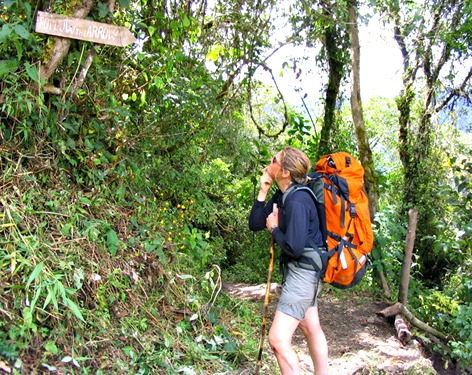
img: Antrese Wood displaying her intrepid travel skills on the Machu Picchu trail in Peru. Her comment: “I thought the Follow the Arrow sign was hilarious because 1) the trail is so well marked I cant imagine anyone getting lost; and 2) this was the one and only sign on the trail and it was near the end of the four-day hike. The other hilarious thing about the photo, at least to me, is that if you look closely, you can see my knee is bleeding. I had just spent 80 days carrying a backpack two-three times as heavy in seriously remote back country, no trails, no markers, nothing. We had to sign a waiver acknowledging the understanding that if something should happen, it could take a helicopter up to a week to arrive. I made it through without a scratch. Here, on this comparative cake-walk, on a perfectly even trail, I fell for no apparent reason and totally skinned up my knee.”

THE DISPLACED Q: How many of these Olympic travelers do you recognize?

It’s a strange thing about high-profile sporting events. They bring out the athlete in even the most unathletic of us. During Wimbledon fortnight, the normally deserted tennis courts in the local park are packed with Federer wannabes; driving back from a Grand Prix, drivers of Ford Fiestas morph into Jenson Button; and while the World Cup is on, everyone kicks random household objects around the kitchen and becomes temporarily expert on the offside rule.

During the Olympics, of course, there’s a much bigger menu of sports to choose from, and during those 16 days, not to mention the previous 70 days of torch relay, it becomes impossible not to see everybody in an Olympic (torch)light.

Especially — since this is our particular mindset– travelers.

So, how many of these Olympic travelers do you recognize?

The Greco-Roman Wrestler

Greco-Roman Wrestling — so-called because of its purported similarity to the wrestling at the ancient Greek Olympics, which lends dignity to an otherwise extremely undignified sport.

Greco-Roman Wrestling Travelers, while not engaging in unseemly public bear hugs and takedowns, are often found at locations of ancient ruins, fighting to hold down folding maps, and heaving around 30-pound guide books. Instead of wrestling headgear and ear guards, they wear sets of headphones, plugged into their audio tour devices.

Matches with other GRWTs are strictly intellectual, based on the Intellectual One-Upmanship system, and wins are determined only by Technical Superiority.

The Synchro Swimmer

Synchro swimming is the only sport where it’s obligatory to wear quantities of makeup that make Dame Edna Everage‘s layers of face paint seem subtle. While regular makeup is dubiously acceptable in  figure skating, this caked-on paint job is ridiculous in an aquatic sport.

The Synchro Traveler is invariably female, and insists on dressing up to the nines no matter how unsuitable for the circumstances.

Hiking boots and backpack for an all-day trek along the Great Wall of China?

No thank you, darling. Louboutins and this divine little Prada clutch will be just fine.

The Rugby Player

Rugby needs no introduction, unless it’s to spout that old joke about it being a game played by men with funny-shaped…but never mind.

The Rugby Traveler — actually, what am I talking about? There is no such thing as a Rugby Traveler Singular. They travel in packs. They also drink lots of beer, sing patriotic songs (out of tune, at 1 a.m.) and do manly guy-things together.

Usually found in their natural habitats of Ibiza and Cancun, hunting for females.

The Pentathlete

The Modern Pentathlon is a series of five events: pistol shooting, fencing, freestyle swimming, show jumping, and cross-country running. It’s athletics for the overachiever.

In traveling terms, the Pentathlete Traveler is the vacationer who will bore you for hours with their elaborate plans to see everything in Fodor’s Guide to Europe in ten days, traveling variously by airplane, train, helicopter, ferry, and pack mule.

Upon their return from said vacation, be prepared to sit through interminable soirees of home videos, accompanied by some marvelous duty-free Chianti Riserva all the way from Leonardo da Vinci-Fiumicino Airport.

Don’t spoil their fun by telling them the same stuff was on special offer at the local wine shop while they were away.

The Archer

Archery: the art of firing arrows from a bow. Requires great concentration and accuracy if you don’t want to poke someone’s eye out (see: King Harold, Hastings, 14th October 1066.)

As far as traveling goes, The Archer knows what he wants, where he wants to go, and how to get there. Easily spotted in airports, Archers are the ones pushing past you on the moving walkway so they get to the end before anyone else does.

They are expert, seasoned travelers and know the layout of every major international airport. Because of this, they are blasé about the arrive-two-hours-before-flight-time rule.

When the flight attendant at the boarding gate pages them by name — that’s more than time enough for The Archer.

.

Image: “Athletics On The Line” by hin255/FreeDigitalPhotos.net

STAY TUNED for Tuesday’s Question and Answer session with Mary-Sue!

If you enjoyed this post, we invite you to subscribe for email delivery of The Displaced Dispatch, a round up of the week’s posts from The Displaced Nation. Sign up for The Displaced Dispatch by clicking here!

Related posts:

5 reasons why American aviatrix Amelia Earhart could be an expat heroine

The American aviatrix Amelia Earhart has been propelling her way into the news headlines this week. Yesterday marked the 75th anniversary of her Lockheed Electra disappearing over the Pacific Ocean.

And today marked the beginning of an expedition, led by an American nonprofit group, to locate the wreckage from her plane. The group plans to scan the depths of the Pacific Ocean near a remote island where they believe Earhart and her navigator, Fred Noonan, died as castaways.

With America’s most famous aviatrix back on our horizons, it seems a timely moment to nominate her for our Displaced Hall of Fame, where we put all of our expat heroes and heroines.

What, was she an expat, too? I can hear you asking. In fact, she was an expat briefly — during World War I, when she went to visit her sister in Toronto and ended up staying on as a nurse’s aide in a military hospital.

But I’ll admit that Earhart seems more of a domestic heroine — as American as apple pie, you might say. Born in Atchison, Kansas, in America’s heartland, Amelia grew up tall and willowy like the corn in the fields. As the Reigning Queen of the Air, she became the nation’s sweetheart and to this day retains a special place in the hearts of young American women.

What’s more, recruiting her to serve as a heroine for global nomads, many of whom have hybrid nationalities, might not fly with my fellow Americans. Secretary of State Hillary Clinton has endorsed the expedition to hunt for Earhart’s plane, saying that Earhart embodies the “spirit of America coming of age and increasingly confident, ready to lead in a quite uncertain and dangerous world…”

But in reviewing the main facts of Earhart’s life, I have found plenty of aspects that show how “displaced” she actually was — “displaced” in the sense of being “removed from the usual or proper place” (see definition on our About page) — and hence belongs in our orbit. Here are five of my top reasons:

1) She was born with wings.

Veteran expats and long-term travelers cannot afford to have fear, or dislike of, flying. Should we incline at all in this direction, it may help to lie back in your airplane seat (or pretend you have a seat where it’s possible to lie back) and think of Earhart, who took to the skies without hesitation, as though the airplane wings were her own. Legend has it that she first caught the aviation bug while an expat in Canada. She went to see an exhibition of stunt flying at a fair in Toronto and later wrote about the sensation she’d felt as a pilot began diving at her and her friend:

I remember the mingled fear and pleasure which surged over me as I watched that small plane at the top of its earthward swoop. I did not understand it at the time, but I believe that little red airplane said something to me as it swished by.

From then on, it was all she could do to keep her feet on the earth. Of her first airplane flight she said: “As soon as we left the ground, I knew I had to fly.” In 1921 she took her first flying lesson, and soon saved enough money to buy a second-hand plane.

Of course it helped that in the early days, flying was a romantic sport for the lucky few, not a form of transport where everyone from pilot to passenger feels as though they’re herding or being treated like cattle. Earhart named her first plane “Canary” because of its bright yellow color. Perhaps she felt like a canary when setting her first women’s record: rising to an altitude of 14,000 feet.

By the time she became the first female pilot to cross the Atlantic solo (Charles Lindbergh was first to do so), she had her own little red airplane — a cherry-colored Lockheed Vega, reputed to be the world’s fastest aircraft and therefore favored by pioneering aviators. Hmmm… Did it make her feel like a cardinal?

2) Always restless with the status quo, she let it drive her adventures.

What’s the litmus test for being a travel or expat type? A person who is always upping the ante. We’re a gang of permanent malcontents!

No sooner had Earhart become the first woman to cross the Atlantic (as a passenger) — a flight that made headlines because three women had died within the same year in trying to achieve it — but she sought to become the first woman to fly solo across the Atlantic (1932) and the first person to fly solo across the Pacific, from Honolulu to Oakland (1935), among other achievements.

At that point, there was nothing for it but to make a bid to become the first person to fly around the world (1937).

One wonders what Earhart might have done next, had she not gone down in her plane on the very last leg of the journey. Perhaps she would she have concluded that she’d peaked out too early? (No doubt many of you serial expats and repats can relate…)

3) She had no qualms whatsoever about the risks involved in an adventuresome life.

In the lore surrounding Earhart, great emphasis is placed on her early feminism. Much of it is said to be due to her mother, who had very little interest in bringing up Amelia and her younger sister as “nice little girls” — she even allowed them to wear bloomers!

Clad in this comfortable attire (Amelia would later design a clothing line for women who wanted comfort), the Earhart sisters climbed trees, hunted rats with a rifle, and “belly-slammed” their sleds downhill.

The young Amelia also kept a scrapbook of newspaper clippings about successful women in predominantly male fields, including film direction and production, law, advertising, management, and mechanical engineering.

Although she did marry eventually — to the publisher George Putnam — she always referred to the marriage as a “partnership” with “dual control,” and did not change her last name.

When she became the first woman to fly solo across the Atlantic, Earhart said it proved that men and women were equal in “jobs requiring intelligence, coordination, speed, coolness and willpower.”

(No doubt she would be knocked out to learn that women’s boxing will be included in the London 2012 Olympics for the very first time.)

But to me, what’s even more impressive about Earhart’s life is that she knew about the risks involved in her chosen occupation — but decided not to let them hold her back. That same kind of risk-taking is at the heart of the overseas travel enterprise, which goes against the grain of most people’s common sense. (“You want to go THERE? And FOR HOW LONG?” Expats and global nomads know the drill of fielding constant questions and doubts from the people back home.)

When Earhart set out on her second attempt to circumnavigate the world (the first had ended in a crash when a tire blew out on take-off), she wrote to her husband: “Please know I am quite aware of the hazards.” And then she went ahead and packed a jar of freckle cream. (I say that because a jar of freckle cream was found on the Pacific Island that’s now being searched.)

4) She was never more in her element than when out of her element (quite literally).

There is something that draws all of us to the displaced life. Since it’s a life of challenges, I have to assume that for most of us, it’s that feeling of being a pioneer, of going the way no one else in our circles has gone before…

In Earhart’s case, the displacement was quite literal: she loved being in the empty sky and facing the unknown. In that sense she was like a character out of Greek myth — a female Icarus. As she once said of an early flight:

The stars seemed near enough to touch and never before have I seen so many. I always believed the lure of flying is the lure of beauty…

Jane Mendelsohn was inspired to write her first novel, I Was Amelia Earhart, after reading that a piece of what may have been Earhart’s plane had been recovered on an atoll in the Pacific. Imagining the life that Earhart and Noonan might have led as castaways, Mendelsohn shows Earhart coming into her own in the desert-island setting, and finding peace of mind.

Random House editor Kristin Fritz commends Mendelsohn for creating a whole new iteration of Earhart as

a woman who had perhaps “taken this journey in order to escape the madness of the world,” a woman who “didn’t give a damn if she was alone” and finally a woman who would “live the rest of her long and brilliant life on this wild and desolate island.”

Now that’s displaced! And if Fritz is right and Medelsohn captured the essence of Earhart in her novel, then we should not feel too bad that she perished on an island out in the middle of nowhere. That’s how she would have wanted it…

5) Last but not least, she appears to have known the value of chocolate.

Here we come to the true test of an expat or international traveler: do they like chocolate? Are they addicted to that sudden charge of energy, the little lift, one gets from the sugar and the caffeine? Most seasoned expats and international travelers know that we could never have prevailed during the inevitable moments of loneliness and displacement the life entails without a chocolate supply of some sort.

When Earhart embarked on her 2,408-mile solo flight across the Pacific in 1935, she packed a thermos of hot chocolate in case she felt chilled. As she later observed:

Indeed, that was the most interesting cup of chocolate I have ever had sitting up eight thousand feet over the middle of the Pacific Ocean, quite alone.

* * *

Now that we’re touching down, I feel the need to quote from Mendelsohn’s recent op-ed for the New York Times:

We still wonder what happened to Amelia Earhart — perhaps soon we may even find out — but do we know what to do with her? Do we know how to make not just her mysterious disappearance but also her miraculous life relevant and inspiring to our global society? And could she matter across the globe, that ball around which she tried to fly that feels so much smaller today but is in fact exactly the same size as it was then?

For me there’s an easy answer to all three of Mendelsohn’s questions: YESSSSSSS!!! It’s time Amelia Earhart went global, and not just literally…don’t you agree?

STAY TUNED for Wednesday’s post, another in our Expat Moments series by Anthony Windram — and yes, it does have to do with the 4th of July!

If you enjoyed this post, we invite you to register for The Displaced Dispatch, a round up of weekly posts from The Displaced Nation, with seasonal recipes, book giveaways and other extras. Register for The Displaced Dispatch by clicking here!

Related posts:


THE DISPLACED POLL: Which of these 4 travel champions deserves an Olympic gold medal?

Hi there, folks! In keeping with our summer theme — we’ve been talking up the Olympics, in case you haven’t noticed — today I’ll be taking a look at some travely-types who have performed what can only be described as Herculean endeavors.

Which one of these travel worthies would you vote onto the gold medal podium for their efforts? Register your choice in our poll below.

1) THE SPRINTER: Gunnar Garfors

The 30-something Norwegian Gunnar Garfors (he’s a tech and new media guy as well as an avid traveler and former footballer) will never forget where he was on June 18th, 2012. Because he was in Istanbul (Asia), Casablanca (Africa), Paris (Europe), Punta Cana (North America) and Caracas (South America). Yup — all of ’em! He managed to create a new world record by visiting five different continents in one day!

Although the “day” was quite a long one, as Gunnar used the advancing dateline to squeeze a few more hours into his schedule.

It’s hard to believe that something like this is possible… I’m guessing he didn’t use Qantas for any of the flights. (Okay, that little dig was meant for Australians!)

Seriously, he makes me tired just thinking about it! Can you remember what you did on Monday? I think I got a hair cut…

Definitely an Olympian achievement.

2) THE MARATHONER: Jean Béliveau (no, not the ice hockey icon; we’re talking summer Olympics!)

Montrealer Jean Béliveau took a little longer to accomplish his feat than Gunnar Garfors — because Jean walked all the way around the word. No, really! 47,000 miles… It took him 11 years — and 53 pairs of shoes!

At 45, Jean went through a mid-life crisis with the failure of his neon sign business. In his own words:

“I played the game. It left me empty.”

Jean liked the idea of sailing around the world, but ocean-going yachts cost too much. Instead, he began to imagine running away as far as he could.  He started jogging and working out but told no one of his plans — not even his life partner, Luce Archambault. When he finally told Luce, she gave him her blessing — but insisted that he do it for a cause. Jean chose world peace and the safety of children, something no one could disagree with (at that point, he was after some peace of mind).

He began by running south, but by the time he’d reached Atlanta, his knees had started bothering him, so he switched to walking. He waked through the rest of America, Mexico, Latin America, Africa, Europe and Asia — six continents and 64 countries.

His interest in promoting peace didn’t stop him from being mugged, as well as imprisoned (the latter in Ethiopia). But he carried on and eventually even came to embrace his cause, telling people that to achieve peace, we must see the world through “eyes of love.”

It’s an achievement so staggering it begs the question: what can he possibly do next? Where do you go from there?

“Hey honey, let’s celebrate with a holiday…”

“NO! Already been there.”

Another record, of course, belongs to Luce, who has remained loyal to Jean despite his absence of 11 years from their home in Montreal and his falling for a woman in Mexico. Once a year, she would come to him and they would spend three weeks together, in one place.

Jean walked back into Montreal in October of last year. How does the couple find it being under one roof again? Rumor has it, they’re writing a book together! Talk about Olympian challenges…

3) THE PREPOSTEROUS POLYGLOT: Benny Lewis

Brendan (Benny) Lewis is a polyglot who hails from Cavan County in Ireland. (No, “polyglot” isn’t a type of glue; it’s a person who speaks four or more languages fluently.) Benny earned this title — he is also a vegetarian and a teetotaler — after nine years on the road, during which he taught himself to speak eight languages fluently (with more than a smattering of half a dozen more).

I know nothing about Benny’s musculature, but it’s clear his tongue has gotten plenty of exercise.

Benny now considers himself to be a “technomad” — a full-time technology-enabled globe-trotter. His Web site, Fluent in Three Months, is a treasure trove of tips and tricks for picking up languages (called “language hacks”), as well as a tribute to his mind-boggling achievement. (I’m actually surprised that his head hasn’t exploded from the pressure of all that knowledge.)

According to him, it is no big deal — anyone can do what he has done. All they need is dedication, hard work…and more of the same. (Times a million!)

You know, I have to hand it to Benny, he’s the very essence of — sorry, I can’t resist — a cunning linguist. (Well, I said I was sorry! Please stop throwing things at me.)

4) THE MASTER OF EXTREME ENDURANCE: Ben Hatch

The British novelist and travel writer Ben Hatch is the author of a hugely popular (and very entertaining) book about a recent adventure of his: driving 8,000 miles around Britain in a cramped Vauxhall Astra, while researching a guidebook for Frommers.

“But why is that worthy of an Olympics gold medal?” I hear you ask. “Novelists usually aren’t athletes. And he only traveled around his own neck of the woods, Britain.”

Well, there are lots of reasons I could pick: because he practically lived in his car for five months, because he purposefully inflicted dozens of tourist attractions on himself every week, because he had a car crash en route, or because he stayed in a haunted Scottish castle.

But the one I like best is the fact that he did all this with his wife and two children — aged four and two! — in tow.

Can you imagine? While the family was attempting fine dining in a posh hotel restaurant, his children engaged in food fights and eating mashed potatoes with their bare hands. There were tears and tantrums in the car — every single day. For months. It sounds like my worst nightmare! And I don’t even have kids…

The resulting trauma became his best-selling book Are We Nearly There Yet? 8,000 Misguided Miles Round Britain in a Vauxhall Astra — which I can only assume was written cathartically, in a desperate attempt to cling on to what remained of his sanity after such a grueling experience. I think he deserves a medal just for surviving the first week. And of course, once the kids are old enough to read what he’s written about them, he’ll be in for a whole new world of trouble…

* * *

Right! There’s my suggestions. What do think. folks? I just know there are loads of people out there making epic journeys, achieving the unachievable, and generally making the rest of us look like couch potatoes in comparison. Do you know of any? (Olympians, I mean, not couch potatoes — I’ve got enough of the latter in my house.) BTW, I toyed with the idea of including an older traveler, as unlike sport, there seems to be no real age limit on world travel, especially with all the recent growth in the international cruise-ship industry (see photo above).

In any event, I’d love to hear from you — let me know in the comments, or hit us up on Twitter: @DisplacedNation and/or @TonyJamesSlater

And don’t forget to vote in our poll!

STAY TUNED for Tuesday’s post on a historical traveler worthy of a gold medal or two.

If you enjoyed this post, we invite you to register for The Displaced Dispatch, a round up of weekly posts from The Displaced Nation, with seasonal recipes, book giveaways and other extras. Register for The Displaced Dispatch by clicking here!

Related posts:

Image: MorgueFile

RANDOM NOMAD: Melissa Stoey, Former Expat in UK and Incurable Britophile

Place of birth: Northern Virginia, USA
Passports: USA
Overseas history: England (Huntingdon, Cambridgeshire + Shefford, Bedfordshire): 1988-91.
Occupation: Research technician (basically I do data analysis) and part-time professional blogger.
Cyberspace coordinates: Smitten by Britain: Home of the Britophile (blog); @SmittnbyBritain (Twitter handle); Facebook page; and Pinterest.

What made you leave your homeland in the first place?
I’m intrigued by other cultures and more specifically by the British culture. I have been fascinated by Britain since I was a young teen. I have always had the itch for travel and I knew I definitely wanted to visit the UK, if not live there. My love for travel one of the reasons I joined the military. I put England down as my first choice for duty station and I got it!

Where were you stationed?
At Chicksands air base (Chicks for shorts). It’s now Royal Air Force (RAF) Chicksands. Britain’s Ministry of Defense has since taken it over.

You ended up marrying a Brit, right?
Yes. My first husband, and the father of my son, was stationed at what was then RAF Brampton, which is in Cambridgeshire. At first we lived in Huntingdon, but then he got transferred to a base in Hitchin, which is closer to Chicks, so we moved to Shefford.

Is anyone else in your immediate family “displaced”?
Ironically, my brother was stationed at Chicks three years before, so it sort of felt like I was meant to go there. Right now, I don’t have any displaced relatives, but my son is a dual national between the U.S. and U.K. I suspect at some point he may move to the U.K. after he fulfills his dream of living and teaching in Japan for a year. We’ll see! It may be a case of like mother, like son.

So you and your son now live in the United States?
Yes. His father and I are divorced. We came back and lived in Texas for a year, then West Virginia. We now live in Pennsylvania. Meanwhile, his father has gone back to Scotland, where he is from.

How often do you return to the U.K.?
My son and I, and my second husband — I am now married to an American! — try to go every year or at least once very two years, depending on funds and time off.

Can you describe the moment in your association with Britain when you felt the most displaced?
The first night I was in England the culture shock was horrible. I lived around sixty miles north of London in a small village where there were no street lights, and when I looked out the window there was complete and utter darkness. It felt as if I’d landed on a different planet with no signs of life. This was 1988 when almost everything closed much earlier than it does now and wasn’t open on Sundays. If you switched on the radio you might pick up two or three stations, the television had only four channels and of course there was no Internet. It felt much more isolating than if you moved to England today; it has changed by leaps and bounds in the last 25 years as far as conveniences go. I envy current expats who have so many wonderful resources available to help limit the culture shock and make the transition easier.

Is there any particular moment that stands out as your “least displaced”?
We had a great night back in July of 2010 when we met a Glaswegian couple at a curry house in the west end of Glasgow. They invited us to the pub for drinks where we spent the night taste testing different whiskies. I felt totally at home, like I had known this couple my whole life. The Scots have a way — similar to Americans — of making one feel welcomed and accepted. I can say this because of having once been married to a Scot and having spent a lot of time there. My ex-husband was, and still is, one of the friendliest people I know.

You may bring one curiosity you’ve collected from your adopted country into The Displaced Nation. What’s in your suitcase?
My bag is always full of tea and sweets from England. I never return without them. I always pack a few British newspapers as well because my parents are Anglophiles, have been to England many times and enjoy reading them. Rumor has it that some of you Displaced Nation citizens are avid tea drinkers and readers, and that you rarely turn down sweets.

You are invited to prepare one meal based on your travels for other members of The Displaced Nation. What’s on your menu?

I will fix my favorite meal which is a nice Sunday roast that includes roast beef, roasted potatoes, carrots, peas, and Yorkshire pudding (I don’t do sprouts, thank you.) We’ll finish it off with a nice pot of tea and a slice of Victoria sponge, with jam and whipped cream.

And now you may add a word or expression from each of the countries where you’ve lived to The Displaced Nation argot. What will you loan us?
I’m feeling peckish. I say that quite often and it always results in the odd look or two. It’s just not used here, at least where I live. To feel “peckish” means to feel slightly hungry.

Earlier this month, we did a series of posts on Queen Elizabeth’s Diamond Jubilee. Incurable Britophile that you are, I presume you celebrated from a distance?
I watched the River Pageant, which was on early in the morning East Coast time, and then hosted my own Diamond Jubilee lunch (see photos on my blog). The food was great — we nibbled on leftovers for days! Even though I didn’t have a big party (it was just for my family), I was glad to do it to show my blog readers that you don’t have to be in Britain to celebrate properly. You can still enjoy yourself and take part in your own little way.

A couple of us on The Displaced Nation team thinks that the Queen deserves an Olympic medal for having survived almost being displaced by Princess Diana. Do you agree?
I don’t agree that the Queen was almost displaced by Diana; if she was going to be displaced it would have been due to her actions (or lack of) that left the British public feeling as if she was heartless and out of touch. However, I still don’t think she would have been displaced. Time heals and I think many of us now understand the dilemma she faced as a grandmother trying to protect her grandchildren who just lost their mother. However, as Head of State I do wish she had at least made a televised message to the public within the first 24 hours. Waiting five days was a bit much.

Americans seem to love the Royal Family. Do you think the United States might benefit from having one?
The idea of the United States having a royal family at this point is a silly one. It doesn’t fit our history or where we are headed as a country. Let’s leave that to the nation that does Monarchy the best.

Readers — yay or nay for letting Melissa Stoey into The Displaced Nation? Tell us your reasons. (Note: It’s fine to vote “nay” as long as you couch your reasoning in terms we all — including Melissa — find amusing!)

STAY TUNED for tomorrow’s episode in Libby’s Life, our fictional expat series set in small town New England. (What, not keeping up with Libby? Read the first three episodes of her expat adventures and/or check out “Who’s Who in Libby’s Life.”)

If you enjoyed this post, we invite you to register for The Displaced Dispatch, a round up of weekly posts from The Displaced Nation, with seasonal recipes, book giveaways and other extras. Register for The Displaced Dispatch by clicking here!

Related posts:

img: Melissa Stoey at Stirling Castle, Scotland, then and now — in 1989, when she was displaced (and cold!), and in 2010, when she was visiting (and warmer!).

THE DISPLACED POLL: Who will win the Ladies’ Grunt Championship at Wimbledon?

Ah, the start of Wimbledon Fortnight. Two weeks of tennis whites, polite applause, Royalty, and strawberries and cream.

And grunts. Don’t forget the grunts. Especially the ladies’ grunts.

If some of the newspapers this week are to believed, that’s what modern tennis is all about.

The history of the grunt

Men’s tennis grunts started back in the 1970s with Jimmy Connors, and the popularity soon spread among the guys. In the 1988 US Open, Ivan Lendl complained about opponent Andre Agassi‘s grunts, saying they threw him, Lendl, off his timing.

Women’s tennis took a little longer to catch on, starting with Monica Seles‘s guttural shrieks in the 1990s. Once started, though, the women soon raised grunting to an art form, or at least another sport, putting the men’s feeble efforts to shame.

Serve in silence

Fans and media, however, are not amused by Centre Court’s soundtrack, and Martina Navratilova, a champion when women’s tennis was played in dignified silence, also disapproves. Her view is that the grunt masks the sound of the ball leaving the grunter’s racquet, putting the non-grunting opponent at a disadvantage.

“The grunting has reached an unacceptable level. It is cheating, pure and simple. It is time for something to be done.”

World Tennis Association chairman and chief executive, Stacey Allaster, agrees:

“It’s time for us to drive excessive grunting out of the game for future generations.”

Quite how this will be achieved, though, is rather vague. A fine for noisy players. perhaps? It would have to be a big one to have any effect. Michelle Larcher de Brito, the Portuguese player, and rumoured to be the next Maria Sharapova as far as grunt volume goes, reportedly said:

 “I’d rather get fined than lose a match because I had to stop grunting.”

The WTA is quick to point out that current players will not have to curb their on-court vocal emissions. The ban on grunts will be phased in after a period of educating up-and-coming players in grunt etiquette.

In the mean time, however, perhaps the solution would be to make Grunting an official Olympic sport, permissible only at Olympics (i.e. every four years) and not at Grand Slam tournaments.

With grunt decibel readings at similar levels to pneumatic drills, that would be music to everyone’s ears.

Judge for yourself:

Serena Williams and Victoria Azarenka

Maria Sharapova – Russia

And vote for the Gold Medal Winner in our poll!

Image: MorgueFile

LESSONS FROM TWO SMALL ISLANDS — 2) Keep calm and learn to enjoy imperfection

I must have been born with a melancholy nature, because it didn’t take me long to work out that we live in an imperfect world.

Imagine my discomfort, then, when I realized that many of the people who surrounded me in my nation of birth — my fellow Americans — were obsessed with having perfect teeth, perfect bodies and a perfect appearance during their brief time on this earth.

“What’s that about?” I thought to myself at a relatively early age (I was around 6, already on the way to driving my mother, an eternal optimist, crazy). “We’re all going to grow old and die regardless.”

By the time I reached adolescence, I decided that the need to be flawless was my birth nation’s fatal flaw. It was our best feature — hey, no one can deny how good we look flashing those orthodontically-enhanced smiles — but also our worst. The list is long of fabulously talented Americans who have perished in the pursuit of physical perfection.

That lists always begins with Marilyn Monroe — a pretty and bright young thing who ruthlessly remade herself into a sex symbol, and died at age 36. (Among other things, she got work done on her nose and chin to create her classic, timeless look.) And culminates in Michael Jackson, for whom it apparently wasn’t enough to be blessed with good looks and an extraordinary musical talent. No, the King of Pop felt compelled to have lots of plastic surgery — even if it meant destroying his career and himself.

Endearing little imperfections (England)

It’s a pity Marilyn and Michael were never offered the chance to study abroad in England, that’s all I can say. My prolonged stint as a graduate student at a British university soon cured me of any lingering fixations on fixing my looks.

Why bother when the people around you seem so oblivious? None of the Brits I knew seemed to mind that the politicians who were gracing their TV screens had funny eyebrows (cue Michael Heseltine), dowdy outfits (cue Shirley Williams) or speech impediments like rhotacism, pronouncing the sound r as w (cue the now-departed Roy Jenkins).

And not just politicians but also British actresses seemed much less interested than their American counterparts in their looks. On the contrary, such glamorous types appear to thrive on their imperfections — Kate Winslet proudly flaunting her curves, Helen Mirren daring to be sexy despite having wrinkles.

And now we have the English singer Adele (Laurie Blue Adkins), who is fond of saying things like: “Fans are encouraged that I’m not a size 0 — that you don’t have to look a certain way to do well.”

Have I mentioned teeth yet? An American journalist once complimented the comedian Ricky Gervais on being prepared to wear unflattering false teeth for his role as an English dentist in the film Ghost Town — only those were his real chompers! As Gervais told a BBC reporter:

He was horrified that I could have such horrible real teeth. It’s like the biggest difference between the Brits and the Americans, they are obsessed with perfect teeth.

Imperfection is perfection (Japan)

And then I reached my second small island, Japan, which I soon came to see as the Land of Melancholy — and hence as a kind of spiritual home for someone of my proclivities. I instantly appreciated the fact that Japanese revere the cherry blossom not so much for its beauty as for the brevity of that beauty. The blossom lasts just a few days before its petals scatter to the wind.

The Japanese aesthetic that attracts so many of us in the West is based on this notion of flawed beauty. We’re talking wabi-sabi here — the value derived from the Buddhist teaching on life’s impermanence. Wabi-sabi stands in stark contrast to the Greek ideals of beauty and perfection found in many Western countries. (Hey, those Greeks have a lot to answer for, besides their spendthrift ways!)

A good example is the tea ceremony bowl: not quite symmetrical, rough in texture, and often deliberately chipped or nicked at the bottom. You turn it around slowly to appreciate its hidden beauty, a kind of diamond in the rough…

And did I mention teeth yet? Japan is the land of REALLY crooked teeth. Even some young girls who don’t have crooked teeth apparently are asking their dentists to give them a fang-like yaeba (snaggletooth) as they think it’s charming to be imperfect. Japanese celebrities too, are imperfectly perfect.

Don’t overcultivate your garden

On the face of it, the English cottage garden has very little in common with the Japanese garden — the former full of flowers and exuberance, the latter much more subdued and restrained.

But I think they are alike in one important respect: both embrace imperfection. As California horticulturalist and lover of English gardens Mary Lou Heard once said:

The thing about a cottage garden is that it is not perfect. It is not a sterile place; there is always a lot happening and changing.

Not sterile — I like that. It means that something is breathing, growing, alive…and probably imperfect. To my way of thinking, as informed by my long expat life, a row of perfect brilliant white teeth looks a bit like a row of tomb stones, and a facelifted face, like a death mask.

A Japanese garden celebrates imperfection as well — but by using elements that have a natural, rough finish. If the garden features a wooden bridge, for example, it will be made of planks of different sizes, and the wood itself will have crooked edges or knobs.

For the Japanese, the point is not to restructure reality but to embrace its quirks. That’s why they’d rather see pile of rocks in different colors and sizes than a statue surrounded by carefully landscaped bushes.

My takeaways

As I mentioned in my first post in the series, “Keep Calm and Carry On,” repatriating to the United States has been a feat of Olympian proportions. Clearly I left it a little too long! But at least I stayed away for long enough that, upon coming home again, I have conquered the part of me that says I must always be striving for physical perfection. I no longer fear looking imperfect.

Thus, while my countrymen and women engage in excessive exercising, crash dieting, and surgical enhancements, I am free to sit back and enjoy the beautiful — precisely because it is imperfect — world we live in.

This means I’m not keeping up with the Kardashians. And for a long time, I assumed Mitt Romney was from central casting, not an actual presidential candidate. (I understand he has a problem of coming across as real enough, even among mainstream Americans, which is saying a lot. If I were his image consultant, I’d suggest growing his eyebrows to look more like those of the Archbishop of Canterbury, Rowan Williams. Now that would give him some character.)

If you are a fellow American and are reading this, I suggest that you, too, try weaning yourself off our nation’s physical-perfection kick. Here are a few scenarios close to some I’ve experienced, with pointers on appropriate responses:

1 — The dentist says that in his opinion, you’d look a lot better with straight teeth. Keep calm and inform him that you’ve learned to enjoy nature’s little imperfections. If he persists, then say you were actually thinking of getting a snaggletooth, and does he happen to have any expertise in that area? If not, then whip out a photo of Ricky Gervais’s fangs to show him. (Notably, I did not take my own advice on this. Shortly I returned to the Land of the Straight Teeth, I succumbed to my dentist’s suggestion that I get braces again!)

2 — A woman stops you on the subway to point out you have a run in your stockings, or a work colleague comes up to you to tuck in the label hanging out the back of your blouse. Keep calm and tell them you’ve learned to appreciate life’s little imperfections, and they, too, may wish to get some wabi-sabi in their lives.

3 — You’re picking a mini-labradoodle puppy, and your husband wants to get the one that looks “normal,” but you like the one whose markings have asymmetry, because of her parti-colored poodle father. Keep calm and instruct your husband that the one with the strange spots is much more beautiful, and that one day people will make offers to take her away from you. (True story — my imperfect dog is perfection itself! And no, that is not her in the photo…)

* * *

So, tell me: does any of this make sense, or has living abroad for so long rendered me totally bonkers?!

STAY TUNED for Thursday’s post, another in our new “Expat Moments” series, by Anthony Windram.

If you enjoyed this post, we invite you to register for The Displaced Dispatch, a round up of weekly posts from The Displaced Nation, with seasonal recipes, book giveaways and other extras. Register for The Displaced Dispatch by clicking here!

Related posts:

Image: MorgueFile