The Displaced Nation

A home for international creatives

Tag Archives: London

Dear Mary-Sue: Mad Mad Mad expat men & their fashion & beauty quirks

Mary-Sue Wallace, The Displaced Nation’s agony aunt, is back. Her thoughtful advice eases and soothes any cross-cultural quandary or travel-related confusion you may have. With this month’s theme being fashion and Mary-Sue being Tulsa’s answer to Donatella Versace, she’s keen to share her sartorial expertise with Displaced Nation readers. Submit your questions and comments here, or else by emailing her at thedisplacednation@gmail.com.

You Mary-Suers are an insatiable lot, aren’t you? One big helping of my advice wasn’t enough for y’all this month, so after popular demand following my earlier post on fashion, I’ve been asked back. So that’s two lots of Mary-Sue for you this month — or “double the trouble” as Jake (or Mr Mary-Sue Wallace, as my pastor calls him) likes to say. (My how we laugh at that little joke! Well, I do and the pastor does — Jake doesn’t.)

Anyhoo, if my latest mailbag is anything to go by, I’m finding some interesting (or should that be alarming?) insights into my readership. Seems a lot of my readership skews male and weird — story of my life!

Am I right, or am I right?!

___________________________________________

Dear Mary-Sue,

About a year ago, I moved to the United States from the UK and find I’m now in thrall to the Mad Men series, which has just now started up again on AMC.

My obsession has grown to the point where I’m thinking of getting a retro hair style similar to Don Draper’s. I’ve enclosed a photo of myself to get your opinion on whether that would look good or if it might be too natty?

Cheers,

Tim from Tunbridge Wells via Trenton

Dear Tim from Tunbridge Wells (incidentally my cousin Janine visited there last summer – MS),

Hmmm, I’ll be honest, I’m not convinced this Mad Men malarkey is going to last. Sure, it’s the flavor of the month at the moment, but will we still be talking about Don Draper and his style in thirty years’ time in the way we still talk about Magnum P.I.?

I think not!

My advice to you, Tim, is to grow a mustache like Tom Selleck’s. Having seen the photo you’ve enclosed, you’ll still look like a drunk manatee, but at least you’ll look like a drunk manatee with a Tom Selleck mustache. I can’t promise that it’ll make you look good or natty, but you will definitely be a talking point.

———————————-

Dear Mary-Sue,

I’m from Germany but am now living in London. At the suggestion of my new English girlfriend, I’ve been browsing this mantyhose site (http://e-mancipate.net/). TBH, I can’t decide among the white, the military green, or the ones with patterns (eg, checkerboard, stars, or stripes). Since I’m a newbie to this trend, I wonder if you could give me your thoughts? (I’ve enclosed photos of myself in the mantyhose.)

Hans from Hamburg via Holland Park

Dear Hans from Hamburg,

Thank you for the photograph you sent me. (I don’t know why everyone is so insistent on sending pictures of themselves to me this week. And not a looker among you. I mean I don’t expect all my male admirers to be Tom Selleck or Richard Chamberlain lookalikes, but when it gets to the point where I’d settle for you being an Al Roker lookalike — well, that’s one slim pickings I’ve got.) More importantly, thank you for including a return address on your envelope, the authorities say that will make it very easy to track you down.

I don’t know why you’d think I’d want to see that. You must have mistaken me for Dear Prudence over on Slate.

———————————-

Dear Mary-Sue,

I just moved from Oslo to Oshkosh. I have a suitcase full of trousers in different colors — salmon pink, sky blue, red rose, and kelly green. Back home, these are the latest trend, but looking around here in Wisconsin, I’m afraid I might stand out a little too far in the crowd. Do you think I can get away with wearing them and if so, which color(s)?

Nils from Norway

Dear Nils,

Quite why you’re so bothered with what people from Wisconsin think of your clothes is bizarre to me. Anything other than stretch denim is probably going to draw attention out there.

What I would suggest is that you go with yellow-colored pants. That’ll probably sate your Nordic desire for garish pants. What you can do is claim that they’re your cheese pants and that you’ve picked them out as they’re the same shade of yellow as a fine (though that’s a relative term in this context) Wisconsin cheddar. I’m sure you can convince them that it’s your weird pants-based way of paying tribute to the state’s cheese industry.

Best of luck!

___________________________________________

Anyhoo, that’s all from me readers. I’m so keen to hear about your cultural issues and all your juicy problems. Do drop me a line with any problems you have, or if you want to talk smack about Delilah Rene.

Mary-Sue is a retired travel agent who lives in Tulsa with her husband Jake. She is the best-selling author of Traveling Made Easy, Low-Fat Chicken Soup for the Traveler’s Soul, The Art of War: The Authorized Biography of Samantha Brown, and William Shatner’s TekWar: An Unofficial Guide. If you have any questions that you would like Mary-Sue to answer, you can contact her at thedisplacednation@gmail.com, or by adding to the comments below.

STAY TUNED for Tuesday’s post. Mary-Sue has heard it’s going to be great.

If you enjoyed this post, we invite you to register for The Displaced Dispatch, a round up of weekly posts from The Displaced Nation, with seasonal recipes, book giveaways and other extras. Register for The Displaced Dispatch by clicking here!

Related posts:


CLEOPATRA FOR A DAY: Fashion & beauty diary of expat Helena Halme

Today we introduce a new feature: “Cleopatra for a Day.” Displaced citizens open their little black books and spill the fashion and beauty secrets they’ve collected on their travels. First up is Helena Halme. One of TDN’s Random Nomads, Halme is a Finnish expat in London and a self-professed fashion maven.

BEAUTY

When my husband (“The Englishman”) and I did a house-swap in Los Angeles in the nineties, I discovered Origins, then a skin care range that wasn’t universally available here in the UK. Anything close to nature was an upcoming trend, and the Origins shops in LA looked quite revolutionary — all wooden flooring and straw shopping baskets. I still use a lot of Origins products and couldn’t live without their foot cream, Reinventing the Heel.

Some time ago, an English friend recommended that I try Elizabeth Arden’s Eight Hour cream — I couldn’t live without it now. If I’d ever end up on a desert island, this would be the one luxury item I’d crave for.

HAIR

When I’d only lived in the UK for a matter of months, I cut my hair very, very short. The Englishman was away at sea and when he came back he was quite shocked to see my blonde locks all gone. But, gentleman that he is, he told me the new style suited me. (I’m not so sure it did!) Much more recently, I’ve discovered the the Brazilian blow dry, a luxurious treatment that makes my thick Nordic locks gleam. I feel like a film star!

FASHION

A few years ago on an annual girls’ trip with my school friends, this time to Rome, I bought a long down coat which has been my winter staple ever since. It was weird shopping for warm winter wear in the humid late summer heat in Rome, but it was great to have the style advice of good friends. I understand that the Displaced Nation has been been debating whether down coats can be fashionable. I’d be curious to hear your verdict on my Roman find!

LINGERIE

I seem to always run out of underwear when on holiday, so I have bought some in Rome, New York, Stockholm, Seville… Now what I bought — that would be telling!

JEWELRY

When on holiday in Puglia, Italy, a few years ago, I bought a set of plastic beads. I love them so much I still wear them. They’re a wonderful color that goes with everything.

WEARING RIGHT NOW

Crickey! It’s a miserably cold and rainy Sunday here in London so I’m in my favorite beige-colored Uniqlo jeans, an All Saints double layer t-shirt (bought at their London store in Spitalfields) and my blonde cashmere poncho from Plum. Underwear is Marks and Spencer (it is the one and only store for underwear for me) and there are warm & cozy Ugg boots on my feet.

DAILY FASHION FIX

There are two magazines I cannot live without: Vogue and Grazia. Vogue is for trying to keep up to date with high fashion, Grazia for street style and gossip. I’m also an avid follower and reader of blogs. My favorites are:

STYLE ICON

I don’t really have style icons — I believe that style is a very individual thing; but one person who I really admire is Helena Bonham-Carter. She used to come into the bookshop I worked at in North London and always looked wonderful, in her extremely unique way. However, I could not pull off her style.

STREET FASHION

Two great places to people watch are Selfridges on Oxford Street and Liberty’s on Regent Street. There are lovely cafes in both stores where you can sip your latte and feel as though you’re on the front row of a Mulberry or McQueen show.

TOP BEAUTY/STYLE LESSONS FROM TRAVELS

1) When on holiday to Greece, I learned to try saving my fair skin from burning through the application of sunscreen and after-sun moisturizer.
2) From watching French and Italian women on my trips to Paris or Rome, I learned about how to use a splash of color when wearing neutrals.
3) From my trips to New York I learned about simple lines, neat tailoring, and the chicness of one color (black) or two (eg, beige turtleneck with black trouser suit) — as perfected by designers like Michael Kors, Donna Karan and Ralph Lauren.

Helena Halme blogs at Helena’s London Life and tweets at @HelenaHalme. She will soon be releasing a digital book based on a popular series of her posts, “How I came to be in England,” entitled The Englishman.

STAY TUNED for tomorrow’s post, a male perspective on how to travel and look good.

If you enjoyed this post, we invite you to register for The Displaced Dispatch, a round up of weekly posts from The Displaced Nation, with seasonal recipes, book giveaways and other extras. Register for The Displaced Dispatch by clicking here!

Related posts:

Images: (clockwise beginning with main photo) Helena Halme modeling her Italian down coat in Harrod’s food hall; posing with The Englishman in Italy, just after picking up the beloved beaded necklace; showing off her hair after a Brazilian blow dry in London; staying warm and stylish in London in her blonde cashmere poncho, just a few days ago.

RANDOM NOMAD: Helena Halme, Book Seller, Fashion Addict & Writer

Born in: Tampere, Finland
Passport: Finnish (only, and proud of it!)
Countries lived in: Sweden (Stockholm): 1971-74; Finland (Turku): 1975; Finland (Helsinki): 1975-84; England (Portsmouth): 1984-86, 1988; England (Plymouth): 1987; England (Wiltshire): 1989-2010; England (London): 2011-present
Cyberspace coordinates: Helena’s London Life | A Nordic view on style, fashion, art, literature, food and love in the city (blog)

What made you leave your homeland in the first place?
I left Finland for the first time as a 10-year-old with my family due to my father’s work, then moved back again for the same reason. And then I left Finland for good to marry my English husband. I’ve written 48 blog posts — soon to be a Kindle book called The Englishman — about how I came to be in England.

Is anyone else in your immediate family displaced?
My father is the only member of the family who still lives in Finland. My mother lives in Stockholm (she is remarried), and my sister lives also in Sweden (she married a Swedish man). Oh dear, that makes it sound as though we are are very man-dependent women, but I can assure you we’re strong and independent — really.

Describe the moment when you felt most displaced over the course of your many displacements.
I felt most displaced when I moved back to Finland at the age of 14. I didn’t want to leave Stockholm and felt completely alien in my home country. Since then I haven’t really felt at home anywhere. Although the two countries are divided only by the Baltic Sea, Finland was — and still is to a certain extent — a very different country to Sweden. The Finnish language is notoriously difficult, and in those days the culture was heavily influenced by Finland’s proximity to Russia (then the Soviet Union). Having lived in the very Western European city of Stockholm for three years, I saw my home country as being part of the Eastern bloc (even though it most certainly wasn’t). The radio played little pop music, and the TV was full of political broadcasts and dark plays about the struggle of the working classes. Western films took longer to arrive, and most people seemed dull and depressing. Nobody smiled and they all dressed in old-fashioned clothes. There seemed to be nothing you could buy in the shops. My sister and I would take the ferry across to Stockholm for many years afterwards — and wow our friends with the H&M clothes we brought back.

Describe the moment when you felt least displaced.
Once I had my children in the UK, I felt I belonged much more — although I took care to make sure they knew they were half-Finnish. To this day, we combine Finnish and English customs: have two Christmases, grow special grass for Easter called rairuoho, and so on… No particular moment stands out in my head where I’ve felt especially at home — yet! That said, the move to London last year has given me an even greater sense of belonging… Perhaps that’s it; perhaps it happened just this year, when we moved to Northwest London?

You may bring one curiosity you’ve collected from each of the countries where you’ve lived into the Displaced Nation. What’s in your suitcase?
From Finland (even though it’s my homeland, it remains somewhat foreign): A Finnish knife (puukko).
From Sweden: A slice of the traditional Swedish cake known as Prinsesstårta.
From England: BBC Radio 4.

You’re invited to prepare one meal based on your travels for other Displaced Nation members. What’s on the menu?
I love food and don’t think I’ve changed my tastes all that much since coming to the UK. Thus my menu for The Displaced Nation is mostly Scandinavian but with one concession to British tastes. (These days, of course, you can get almost any foodstuffs from Finland in London. Bless this multicultural city!)

You may add one word or expression from each of the countries you’ve lived in to The Displaced Nation argot. What words do you loan us?
From Sweden: Fy fan (bloody hell), because it just sounds right for a sense of frustration.
From Finland: Kippis (cheers) — it sounds like “get pissed” to an Englishman’s ears.
From the UK: That’s very interesting… The person who utters these words is usually dying of boredom. (A typical English white lie…)

A statement on your blog’s Home Page strikes us as being very Alice-like: “Rye bread not toast, pickled herring not fish & chips, cinnamon buns not Victoria sponge, ice-hockey not football, wander in a forest not walk in a park, silence not polite conversation.” Does the Alice-in-Wonderland story speak to the life you’ve led in the UK?
In England I’ve always felt as if I were the largest person in the room, particularly against the slight “English roses” — just as Alice did when she entered Wonderland. When I first arrived in this country, I’d often recall the words of the Queen of Hearts to Alice at the trial: “All persons more than a mile high must leave the court.”

QUESTION: Readers — yay or nay for letting Helena Halme into The Displaced Nation? Tell us your reasons. (Note: It’s fine to vote “nay” as long as you couch your reasoning in terms we all — including Helena — find amusing.)

img: Helena Halme’s self-portrait on the number 13 bus. As Halme explained in a blog post last month, the No 13 featured in the British TV series On the Buses, which was broadcast on Finnish TV in the 1970s and was an early influence on her view of men in England. Also please note that Halme’s hair in this picture owes to her own efforts; she hadn’t yet discovered the Brazilian blow dry.

STAY TUNED for tomorrow’s installment from our displaced fictional heroine, Libby, who is debating whether Woodhaven, Massachusetts, is really the picture-perfect Wonderland it seemed at first sight. (She also meets a realtor who is most decidedly a Red Queen…)

If you enjoyed this post, we invite you to subscribe for email delivery of The Displaced Nation. That way, you won’t miss a single issue. SPECIAL OFFER: New subscribers receive a FREE copy of “A Royally Displaced Tea.”

Related posts:

DISPLACED Q: In the words of The Clash, “Should I stay or should I go?”; When reality bites in your adopted country, are you more — or less — determined to stay as an expat?

In our post on March 20, When in doubt, have a pint of Guinness, we drew attention to the Britons who resolutely stayed in post-earthquake Japan rather than fleeing with the majority of their expat countrymen back to the UK. Despite the danger of the nuclear situation, one man interviewed by the Telegraph said

“I actually feel a bit of a duty not to leave.”

Friends in need

Although this person’s mother couldn’t see his point, I understand this mentality. The events of September 11, 2001, so close to our home in Virginia, made me defensive of my adopted country, and outraged at such an audacious attack. To leave at this stage was unthinkable. That would mean we were just fair weather friends of the USA.

Instead, we taped a small American flag to our mailbox, as the rest of our neighbors did to theirs. It couldn’t help the 3,000 who died that day, but it showed our sympathy and solidarity, which didn’t go unnoticed: a neighbor made a point of telling me how touched she was that I, a foreigner, had done this.

Yet I suppose expats here did leave to go back home after 9/11, because it’s human nature to think the grass is greener – or safer – on the other side.

More trolls, not greener grass

It’s not greener or safer, of course. I know this from years of frequent news reports of IRA bombings.  The Spanish know this from decades of Basque separatist attacks. 2009 saw 10,999 terrorist attacks worldwide, and while 60 percent of these occurred in Iraq, Afghanistan, and Pakistan, that still leaves over 4,000 to be shared by the rest of the globe.

As chance had it, I arrived at Heathrow the day before the 2005 bombings of London’s transport system, and had planned to take the tube into the city the following morning to do some sightseeing with my children. Had we not been tired from jetlag and therefore overslept on July 7th, we could easily have been on one of the trains that were destroyed.

Was I as upset by 7/7 as I had been by 9/11? Undoubtedly. Yet there was something else, too – a feeling of deja vu, of “here we go again” or – dare I say it? – resignation.

Whether you run or stay, there is a difference between enduring atrocities in your own country and suffering them on another’s turf.

Not all disasters are manmade

It doesn’t have to be a terrorist atrocity, as our friends drinking Guinness in Tokyo can testify. Perhaps you were an expat in Christchurch, New Zealand during the last two earthquakes; perhaps you were posted to New Orleans just before Katrina hit the Gulf Coast. Only two days ago, Joplin, Missouri was devastated by a deadly tornado.

The world is a dangerous place. There are no certainties, especially when it comes to safety. To quote The Clash again:

“If I go there will be trouble

And if I stay it will be double.”

So, tell us:  What’s an expat to do when disaster strikes?

If you enjoyed this post, we invite you to subscribe for email delivery of The Displaced Nation. That way, you won’t miss a single issue. SPECIAL OFFER: New subscribers receive a FREE copy of “A Royally Displaced Tea.”

Related posts:

CLASSIC EXPAT WRITING: Letter From London — Sōseki

So with my last entry, on James Joyce’s Paris, I was left bemoaning the term Expat Writer. Partly, I’m annoyed with myself for choosing such a term as “Classic Expat Writing” for this series of blog posts. Ultimately, who wants to read a series of posts called “Classic Expat Writing”? It assumes too much and adopts a slightly superior attitude. And, most importantly, it’s dry and not all catchy. Instead, think of this as writing by the displaced.

The reason that I opted to do this series of posts was so I could share some writing that has moved me, and present it to an audience that is likely to in some way be attuned and empathetic to its contents, either through their own personal experience or particular interests. If people then go off and look at the authors in more detail, so much the better. It’s for these reasons why I am particularly excited with this week’s example.

I have to confess that I was not familiar with the name Sōseki until I visited Japan. My knowledge of Japanese literature is embarrassingly slight and doesn’t really extend beyond Mishima and Murakami. But a few years back, when visiting Tokyo, I sought out the Kinokuniya bookstore near Shinjuku because it had a large selection of English-language books. Having a few days before visiting the Temple of the Golden Pavilion in Kyoto, I was keen to buy Mishima’s novel The Temple of the Golden Pavilion. But when left in a bookstore I can’t help but browse and one book, in particular, caught my eye: The Tower of London: Tales of Victorian London by Sōseki. At this point, I had never before heard about Sōseki Natsume (1867 – 1916), and had no idea about his place in the canon of Japanese literature. If I had been in Japan a few years earlier, it may have passed me unnoticed that the two 1,000 yen notes I would use to buy this book, in fact, featured Sōseki’s portrait.

Instead from a position of ignorance I picked up the book and was intrigued by it. It’s a collection of essays and writings that Sōseki wrote about his time in London.* In the summer of 1900, as a young, unknown professor, he traveled to London on a somewhat meagre scholarship that was provided to him by the Japanese government.  Sōseki was to spend the next two years in the city, unhappy and isolated.

Now being a miserable monoglot, I am entirely dependent upon skilled translators when it comes to foreign (well “foreign” from my perspective) literature. Obviously, I’m not in a position to comment on how accurately Damian Flanagan’s translation conveys the flavor of  Sōseki’s prose, but I did find it to be an incredible read with crisp and clean prose.

The title essay is a phenomenal piece of literature, but it is Sōseki’s Letter from London that I’m highlighting today. Sōseki conveys in a way that I’ve not seen from others that awkward, slippery sense of dislocation of being in an alien country. Even politeness takes on a faintly threatening edge.

One of the things I’ve noticed in the Expat blogging community, we seem to like it when we find writing that we can relate to, that reiterates thoughts and fears that we have had. Of course, there is a place for  that. With Expat blogging it can help develop relationships, it helps builds an audience, and there is very much a place for it. But it can also act like comfort food.

Sōseki, by contrast, has observations and thoughts about the city that I don’t think anybody other than himself could have had. And, for me, that’s what is so interesting and so worthwhile about this book.

This collection, which is published by Tuttle publishing, really should be read by more people. Go buy it and then read it, pronto.

Once outside, everyone I meet is depressingly tall. Worse, they all have unfriendly faces. If they imposed a tax on height in this country they might come up with a more economically small animal. But these are the words of one who cannot accept defeat gracefully, and, looked at impartially, one would have to say that it was they, not I, who look splendid. In any case, I feel small. An unusually small person approaches. Eureka! I think. But when we brush past one another I see he is about two inches taller than me. A strangely complexioned Tom Thumb approaches, but now I realize this is my own image reflected in a mirror. There is nothing for it but to laugh bitterly, and, naturally, when I do so, the image laughs, bitterly, too …

… Generally, people are of a pleasant disposition. Nobody would ever grab me and start insulting and abusing me. They do not take any notice of me. Being magnanimous and composed in all things is in these parts one qualification of being a gentleman. Overtly fussing over trifles like some pickpocket or staring at a person’s face with curiosity is considered vulgar … Pointing at people is the height of rudeness. Such are the customs, but of course London is also the workshop of the world, so they do not laughingly regard foreigners as curiosities. Most people are extremely busy. The ir heads seem to be so teeming with thoughts of money that they have no time to jeer at us Japanese as yellow people. (‘Yellow people’ is well chosen. We are indeed yellow. When I was in Japan I knew I was not particularly white but I regarded myself as being close to a regular human colour, but in this country I have finally realized that I am three leagues away from a human colour – a yellow person who saunters amongst the crowds going to watch plays and shows).

But sometimes there are people who surreptitiously comment on my country of origin. The other day I was standing in looking around a shop somewhere when two women approached me from behind, remarking, “least-poor Chinese”. “Least-poor” is an extraordinary adjective. In one park I heard a couple arguing whether I was a Chinaman or a Japanese. Two or three days ago I was invited out somewhere and set off in my silk hat and frock-coat only for two men who seemed like workmen to pass by saying, “A handsome Jap.” I do not know whether I should be flattered or offended.

*I’m not entirely sure what it says about me that in browsing a large selection of Japanese literature in an effort to get a better understanding of Japan, I picked up a book that is centered around impressions of London and the English.

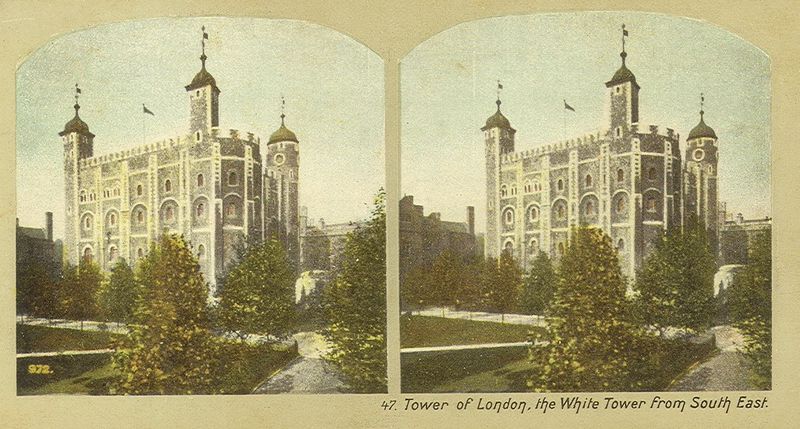
Img: White Tower, Tower of London, from the South East, c. 1890-1910, courtesy Wikimedia Commons

If you enjoyed this post, we invite you to subscribe for email delivery of The Displaced Nation. That way, you won’t miss a single issue.

Related posts:

Jerry Seinfeld — the Royal Wedding’s answer to Ricky Gervais

“You’re from England, aren’t you?” asked the lady behind the supermarket checkout. “Will you be watching the Royal Wedding?”

I shrugged. “Probably not.”

“Well,” she said, “I will.”

Go figure.

Royal Wedding fever on this side of the pond has reached bemusing levels of hysteria. The happy couple’s faces smile from magazines at every checkout, and news channels fill their airtime with Royal Wedding stories. BBC America is running a program called “Royally Mad,” in which five Americans, chosen by the BBC for their worrying obsession with the Windsor family, are whisked to London for a few days of royal sycophancy and accumulation of Will-and-Kate souvenir teaspoons. In the interests of research for this post, I watched the first episode and, try as I might, couldn’t understand what made otherwise sane people turn on the waterworks at the sight of a ho-hum frock once worn by Princess Diana. Growing up in England, I was used to hearing the BBC speak of the Royals with hushed deference. This tearful swooning over recent Royal memorabilia was more suited for a US network channel documentary about a pilgrimage to Graceland.

In a very unscientific survey, I asked some of my English friends if they were looking forward to the wedding. The answers varied from a resounding “No!” to “Looking forward to the street party” to  “I love a good wedding.”  (So do I — when I personally know the parties involved.) Interestingly, the most enthusiastic responses came from expat friends in Singapore and Saudi Arabia. None, however, displayed the starstruck adulation of the Royal Family that I see  in America.

So why the American fixation with English Royalty? Americans had their most significant war while ridding themselves of the people whose descendants they now idolize. Legend has it they weren’t ready to give up the idea of a monarchy even then: a group of people wanted to crown George Washington as the first King of America, but he refused. Had his ego been bigger, Americans would now have their own King Paul.

But Washington’s decision prevailed, so another idol had to be found. The Kennedy dynasty is sometimes referred to as America’s Royalty, as are the President and First Lady. Presidents, though, must be elected — even when they are part of a political dynasty. True idols must have a birthright, be it a 1,000-year genealogy, a trust fund from the Hilton empire, or innate acting ability (especially when coupled with a last name of Redgrave, Barrymore, etc.)  In terms of public fawning and adoration, I feel it’s fair to compare English Royalty with Hollywood stars.

As I watch the hoopla surrounding this wedding, however, it seems the distinction between Beverly Hills and Buckingham Palace has blurred. Disney princesses are being confused with the real deal.  A few days ago on a BBC blog, an American commenter noted that she liked the way the Royal Family did their weddings openly. Hollywood stars, she said, held their weddings in secret now, and that was no fun.

Perhaps the Windsors could learn something from Hollywood.

One of the attractions of the Royal Family used to be its mystique.  Unfortunately, with the modern, out-of-control paparazzi and a gossip-hungry public denied the insight into Hollywood weddings, mystique is a thing of the past, and its disappearance was greatly aided by Prince Charles and Princess Diana separately airing their dirty laundry on TV in the mid-1990s.  It might be prudent for Royals either to stay out of the limelight or behave with a little decorum and sensitivity, as the Royal Matriarch has always done. Because when newspapers run stories about Prince Andrew spending taxpayers’ money on numerous helicopter rides to play golf, or Prince Harry turning up to fancy dress parties in Nazi uniforms, it’s hard for English Joe Public to go along with the notion that these people are privileged by divine right any more than Paris Hilton is.

I honestly am not being mean-spirited — I genuinely wish Prince William and Kate Middleton all the best for their life together, just as I would wish it for any couple about to get married. She seems a nice enough girl, and he understands the definition of ‘Love,’ unlike his father.  But the whole thing has been blown out of proportion, as Jerry Seinfeld controversially – or refreshingly, depending on your viewpoint – pointed out on Friday, when on a British TV show he called the wedding “a circus.”  “These are not special people,” he said.

The reaction from the show’s hosts (“How dare he!”) was not unlike that of the Washington Post  in response to Ricky Gervais’s comments at this year’s Golden Globes.

“Are we at war with England? If not, then why have we been subjected to two years of Ricky Gervais hosting the Golden Globe Awards?”

And yet despite the furor, Gervais is rumored to be returning to host the awards for a third time, proving that he did provide the shot of popularity that the Globes needed.

Windsors and BBC take note.  Judging by the number of positive comments from the British public about Jerry’s outburst, I am not the only Brit to feel nonplussed about the Wedding Of The Century.

For Harry’s wedding, book Jerry Seinfeld to do the commentary.

Adrian Chiles, host of the British TV show that featured Jerry Seinfeld, suggested that Seinfeld could end up doing his stand-up show on June 3 from the Tower of London.  Do you agree? If not, whom would you rather see in the Tower?

If you enjoyed this post, we invite you to subscribe for email delivery of The Displaced Nation. That way, you won’t miss a single issue.

CLASSIC EXPAT WRITING: London and the English — Casanova

While inextricably linked in the imagination with his home city of Venice, Giacomo Casanova spent much of his life travelling and living in other parts of Europe. That ugly term “expat” which many of us, myself included, seem to cling onto as an identifier, was not in use in Casanova’s day, and to apply it to him retrospectively would seem to do him a great disservice. Casanova was a traveller and an observer, a man who seemed to treat Eighteenth Century Europe as a playground, a man whose life for the most part seemed permanently picaresque. Paris, St Petersburg, Dresden, Vienna, Warsaw, Prague, London: at some point all these cities played host to Casanova, and in his extensive memoir, Story of my Life he details his thoughts and observations about them all. While almost certainly someone we’ll return to at a later date, here are some choice extracts on his thoughts about London and the English. This is taken from the Arthur Machen translation of 1894.

On arriving in England:

The stranger who sets his foot on English soil has need of a good deal of patience. The custom-house officials made a minute, vexatious and even an impertinent perquisition; but as the duke and ambassador had to submit, I thought it best to follow his example; besides, resistance would be useless. The Englishman, who prides himself on his strict adherence to the law of the land, is curt and rude in his manner, and the English officials cannot be compared to the French, who know how to combine politeness with the exercise of their rights.

English is different in every respect from the rest of Europe; even the country has a different aspect, and the water of the Thames has a taste peculiar to itself. Everything has its own characteristics, and the fish, cattle, horses, men, and women are of a type not found in any other land. Their manner of living is wholly different from that of other countries, especially their cookery. The most striking feature in their character is their national pride; they exalt themselves above all other nations.

My attention was attracted by the universal cleanliness, the beauty of the country, the goodness of the roads, the reasonable charges for posting, the quickness of the horses, although they never go beyond a trot; and lastly, the construction of the towns on the Dover road; Canterbury and Rochester for instance, though large and populous, are like long passages; they are all length and no breadth…..

On whores and kings:

I visited the theatres of Covent Garden and Drury Lane, but I could not extract much enjoyment out of the performances as I did not know a word of English. I dined at all the taverns, high and low, to get some insight into the peculiar manners of the English. In the morning I went on ‘Change, where I made some friends. It was there that a merchant to whom I spoke got me a Negro servant who spoke English, French, and Italian with equal facility; and the same individual procured me a cook who spoke French. I also visited the bagnios where a rich man can sup, bathe, and sleep with a fashionable courtezan, of which species there are many in London. It makes a magnificent debauch and only costs six guineas. The expense may be reduced to a hundred francs, but economy in pleasure is not to my taste.

On Sunday I made an elegant toilette and went to Court about eleven, and met the Comte de Guerchi as we had arranged. He introduced me to George III., who spoke to me, but in such a low voice that I could not understand him and had to reply by a bow. The queen made up for the king, however, and I was delighted to observe that the proud ambassador from my beloved Venice was also present. When M. de Guerchi introduced me under the name of the Chevalier de Seingalt, Zuccato looked astonished, for Mr. Morosini had called me Casanova in his letter. The queen asked me from what part of France I came, and understanding from my answer that I was from Venice, she looked at the Venetian ambassador, who bowed as if to say that he had no objection to make. Her Majesty then asked me if I knew the ambassadors extraordinary, who had been sent to congratulate the king, and I replied that I had the pleasure of knowing them intimately, and that I had spent three days in their society at Lyons, where M. Morosini gave me letters for my Lord d’Egremont and M. Zuccato.

“M. Querini amused me extremely,” said the queen; “he called me a little devil.”

“He meant to say that your highness is as witty as an angel.”

I longed for the queen to ask me why I had not been presented by M. Zuccatto, for I had a reply on the tip of my tongue that would have deprived the ambassador of his sleep for a week, while I should have slept soundly, for vengeance is a divine pleasure, especially when it is taken on the proud and foolish; but the whole conversation was a compound of nothings, as is usual in courts.

After my interview was over I got into my sedan-chair and went to Soho Square. A man in court dress cannot walk the streets of London without being pelted with mud by the mob, while the gentleman look on and laugh. All customs must be respected; they are all at once worthy and absurd.

On matters of the stomach:

The Englishman is entirely carnivorous. He eats very little bread, and calls himself economical because he spares himself the expense of soup and dessert, which circumstance made me remark that an English dinner is like eternity: it has no beginning and no end. Soup is considered very extravagant, as the very servants refuse to eat the meat from which it has been made. They say it is only fit to give to dogs. The salt beef which they use is certainly excellent. I cannot say the same for their beer, which was so bitter that I could not drink it. However, I could not be expected to like beer after the excellent French wines with which the wine merchant supplied me, certainly at a very heavy cost.

On unruliness at the theatre:

After a long discussion on politics, national manners, literature, in which subjects Martinelli shone, we went to Drury Lane Theatre, where I had a specimen of the rough insular manners. By some accident or other the company could not give the piece that had been announced, and the audience were in a tumult. Garrick, the celebrated actor who was buried twenty years later in Westminster Abbey, came forward and tried in vain to restore order. He was obliged to retire behind the curtain. Then the king, the queen, and all the fashionables left the theatre, and in less than an hour the theatre was gutted, till nothing but the bare walls were left.

After this destruction, which went on without any authority interposing, the mad populace rushed to the taverns to consume gin and beer. In a fortnight the theatre was refitted and the piece announced again, and when Garrick appeared before the curtain to implore the indulgence of the house, a voice from the pit shouted, “On your knees.” A thousand voices took up the cry “On your knees,” and the English Roscius was obliged to kneel down and beg forgiveness. Then came a thunder of applause, and everything was over. Such are the English, and above all, the Londoners. They hoot the king and the royal family when they appear in public, and the consequence is, that they are never seen, save on great occasions, when order is kept by hundreds of constables.

If you enjoyed this post, we invite you to subscribe for email delivery of The Displaced Nation. That way, you won’t miss a single issue.