The Displaced Nation

A home for international creatives

Tag Archives: London

Do refugees and migrants have anything in common with us expats? No, and yes…

displacedvdisplacedBelieve it or not, the Displaced Nation has occasional qualms about whether “displaced” is the right word to describe a group of expats and internationalists. What does a group of privileged travelers have in common with refugees or migrants who’ve had no choice but to leave their homelands? We thought we’d begin the new year by touching on this vexed question, this time with the help of a mentor, Andy Martin. Andy is now an expat in Brazil, but he previously worked with refugees in London.

— ML Awanohara

Before moving to Brazil in February 2012 I worked with refugees as a social worker in the UK, and my last job entailed supporting unaccompanied minors: children as young as 11 who flee conflicts and persecution in countries such as Afghanistan — on their own.

And it is of them that I remind myself when I reflect upon my own struggles and anxieties at being “displaced” from my own country. Suddenly, my tongue-in-cheek British moans about uncomfortable buses and lopsided pavements (yes, pavements), or my frustrations with struggling to learn Portuguese, seem trivial when contrasted with the experiences of the young people I worked with.

Given this, it would seem bizarre for a rich (relatively) migrant like myself to even contemplate comparing my experiences of displacement with those who flee poverty, persecution or some other unimaginably unfortunate situation that most of us will thankfully never have to experience.

Or is it?

Well, I guess the differences are probably easier to distinguish — for example:

1) The reasons for the migration

Whilst refugees are forcibly displaced through circumstances outside of their control, more fortunate gringos like myself possess far greater agency when it comes to the motives for our movements: love, jobs, travel, etc.

2) The journey itself

Forcibly displaced people often leave their homes unexpectedly with no belongings, or else hurriedly sell whatever possessions and land they have in order to fund their flight, whilst my wife and I had carefully planned our move for over two years (well, we read a few books and, to be fair, she is Brazilian herself — which helps).

What’s more, the route a refugee takes is often perilous, taking months or even years, and in turn may comprise many different means of movement: on foot, by car, on overcrowded boats, airtight lorries or refrigerated trucks. On top of that, their destinies also usually lie in the hands of people smugglers.

My wife and I, though, as middle-earners in the UK, booked our flight with a click of our laptop, and the path from our flat in London to our new life in São Paulo was no more than a day’s inconvenience — and a relatively smooth and comfortable one at that.

I had the cabin crew to serve me unlimited amounts of Cabernet Sauvignon and my biggest anxiety was which of the in-flight films to watch: Moneyball or Midnight in Paris?

3) The arrival at the new destination

Refugees are typically at the complete mercy of the host countries they successfully manage to reach. Most likely, they are from countries for which there are strict immigration controls and they are typically confronted not with empathy but with a culture of disbelief — yes, 11-year-old kids from Afghanistan with no family.

A British citizen like myself meanwhile, merely through my place of birth, possesses a passport that requires one of the fewest number of visas to travel around the world. Even when there is a requirement, particularly to live or work, it’s often pretty straightforward.

Refugees, though, even if they are granted some form of status, will by the nature of their former lives typically have to start from scratch, their qualifications often meaningless (that’s if they can even prove them) — and thus with access to only menial jobs and bottom-of-the-rung housing.

And then, once they’re settled, the mental scars from the trauma they’ve experienced will slowly emerge.

Fortunately for me — with the education I’ve received, the qualifications I’ve gained and the work experience I’ve accumulated — I’ll be in a far better position to start my dream life abroad.

Just take me to the beach already!

* * *

So far, so different then.

Is it really possible then that the experiences of forcibly displaced people can ever be compared to those whose displacement is chosen?

Well, yes, I think they can. Here’s a couple of ways we are similar:

1) The requisite adjustments to a new culture

One of the fascinating things about my job back in London was listening to people describe their reactions and adjustments to their strange new worlds. And, as you can imagine, the youthful frankness of the kids I worked with often made these accounts hilarious and, perhaps, more honest.

For example, I remember one young person seemed bemused as to why on one particularly hot day (well, relatively anyway) in London, so many people were stripping off their clothes and heading to the local park to sunbathe. He only realized why when by the next time I had seen him, there had been subsequently been 20 successive days of rain in London.

“Welcome to the UK,” I joked.

2) The occasional bouts of homesickness

It wasn’t, of course, just the things they were discovering which were intriguing, it was also what they were missing. For some it was their homelands, for others it was speaking their language, whilst often it was specific things like their mother’s home cooking, although most commonly it was the weather — of course.

However, a common and I guess obvious sadness amongst all of them was missing people — whether that be their friends, family or both.

* * *

In sum, writing my blog over the past year has made me realize that despite our very many differences all migrants share some common behaviors: that of exploring, adjusting and, inevitably, comparing (in my case moaning), as well as reflecting upon the losses we have to make in order to get to where we are.

At the same time, I’ve also acknowledged that my own anxieties are not trivial just because they might seem so in comparison. They are real and probably shared by many people. However, thinking about those kids back in the UK just gives me the motivation to try even harder.

Thank you, Andy, for that reality check! Readers, what did you think of Andy’s analysis?

British by birth and slowly becoming a little more Brazilian each day after moving to São Paulo a year ago with his Brazilian wife, Andy Martin is also a qualified social worker in the UK, who specialized in supporting refugees in negotiating the process of displacement. Now, as a migrant himself, he is finding out whether any of the advice he gave them was of any use in the first place. Andy is also known to drink tea, warm beer and play cricket, none of which Brazilians seem to be massively convinced by. You can learn more about him by following his blog, The book is on the table, and/or following him on Twitter: @andyhpmartin.

STAY TUNED for next week’s posts.

If you enjoyed this post, we invite you to register for The Displaced Dispatch, a round up of weekly posts from The Displaced Nation, with seasonal recipes, book giveaways and other extras. Register for The Displaced Dispatch by clicking here!

Related posts:

Images: The photo of the boy is from Morguefiles; the other photo is of Andy Martin (his own).

Expats and travelers, the adage is true: There’s no place like home for the holidays

“I’ll be home for Christmas if only in my dreams” — Bing Crosby’s closing line has special meaning for best-selling Australian author Lana Penrose. As reported below, she will never forget spending the holidays in Europe during her decade-long stint as an expat, beginning in Greece — highlights from which are chronicled in two memoirs: To Hellas and Back and Kickstart My HeartNOTE: As a special gift to Displaced Nation readers, Lana is giving away a print copy of To Hellas and Back! See details below.

— ML Awanohara

It’s that time again: Christmas, where the cynical amongst us are found warbling, “‘Tis the season to be melancholy.” For the displaced expat, this period really can be an odd time. If you’re remaining in your adopted country, you may catch yourself yearning for your friends, family and homeland. Somehow drunken Uncle Ernie who likes to lick your neck vanishes from memory.

Yes, there’s no place like home, particularly on Christmas Day. I know this because (a) I lived as an expat in Athens for 5 years; (b) I also lived as an expat in London for 5 years; and (c) I’ve written books about it, one a bestseller titled To Hellas and Back (see what I did there?).

So I get it. I truly do.

And I’m no stranger to grappling with the unfamiliar during the festive season. Actually, make that most celebratory occasions.

Hell yeah!

I believe it all started when I was encouraged to join “The Circle.” No, it wasn’t a cult (arguably), although there was a noticeable absence of Kool-Aid and Nike trainers.

I was attending a Greek boyfriend’s cousin’s engagement party in my native country of Australia. It was to be my first head-on collision with Hellenic culture. I distinctly recall being led by the hand towards my beau’s extended family. And as Greek folk music wailed from tinny speakers, I watched relatives dance around and around connected by tightly clutched handkerchiefs.

The leg-scissoring madness was mesmerizing — and there was nothing else for it but to clap along as though attending a barn dance, get hitched and relinquish my country for at least half a decade.

As the years passed, I swallowed more foreign tradition than I did dolmades. I was now living in Greece. And as I’d done so many times before, come Easter I was straddling yet more unfamiliar customs. There I was ingesting mageiritsa soup, traditionally made from lambs’ tongue, lungs, liver and intestines.

It seemed all about innards as my own sighed dejectedly.

A misplaced gift

I also remember a Christmas where I was presented with a gift from a bone fide Athenian native. I excitedly opened a grey velvet box — and there, inside, was a flashy faux gold necklace of the type preferred by gangland hos.

It kind of made sense considering he’d once also given me a birthday present in the form of a pair of black and gold shoes and a fluffy white vest.

At the end of the day, the gesture was beautiful and I couldn’t wait to try everything on as an ensemble … and submit a job application to the Black Eyed Peas.

Food — a substitute for love?

But that stuff’s plain amusing. The toughest part about spending auspicious occasions away from home is missing the people you love most, which thankfully at Christmas usually means the perfect excuse for unprecedented weight gain (if you’re in a country that celebrates such things).

In contrast to Easter, for me Greek Christmases meant hoovering up* delicious fare — including egg and lemon chicken, rice soup, roast pork, turkey stuffed with ground beef, spinach and cheese pies, stuffed cabbage leaves and salads of every description, followed by sesame baklava and cinnamon melomakarona.

My standout memory of a Christmas abroad, however, is the time that an older Greek couple lamented how sorry they were that I wasn’t able to spend the festive season with my family. They “got” it. Because they’d lived as expats, too.

That couple promised to do all in their power to make my day happy, and they succeeded simply by being mindful, considerate and absolutely lovely.

The sentiment was so touching that it will stay with me forever.

So, yeah, the pros and cons of celebrating Christmas abroad. The anomalies are hardly going to kill you, but sometimes you just want to click your shiny red shoes and declare, “There’s no place like home.”
*Canadian slang for “eat very fast and too much.” (Lana, where and when did you pick that up?!)

* * *

And now to that giveaway! Readers, Lana Penrose has offered to send a copy of her best-selling memoir, To Hellas and Back, to the person who leaves the best comment in answer to the question:  Where are you spending the holidays this year, and will you feel at home or displaced? To tempt you even more, consider the fact that To Hellas and Back, which was first published by Penguin, has been described as an “Eat, Pray, Love face-ploughing into a steaming pile of moussaka.” Its dedication coincidentally reads: “For the displaced.” So if you’re tired of reading about the joys of successfully renovating Tuscan homes and the like, this book might be for you!

Sydney-based (and no longer displaced!) author Lana Penrose has had various incarnations, including music journalist, record company promotions gal, music television producer and personal assistant to an iconic pop sensation whose name shall never be revealed unless she’s subjected to Chinese water torture. She also once worked with the now-infamous Simon Cowell, which she today finds really odd. You can read more about her and her works on her author blog and/or follow her on Twitter: @LanaPenrose

STAY TUNED for tomorrow’s post, when we’ll be checking in on some of our Random Nomads from earlier in the year and find out what they’re up to for the holidays and beyond.

If you enjoyed this post, we invite you to register for The Displaced Dispatch, a round up of weekly posts from The Displaced Nation, with seasonal recipes, book giveaways and other extras. Register for The Displaced Dispatch by clicking here!

Related posts:


And the Alices go to … these 3 expat writers for their Hurricane Sandy posts

 © Iamezan | Dreamstime.com Used under license

© Iamezan | Dreamstime.com
Used under license

My husband and I have a habit of going on holiday just before some major world crisis occurs — after which we have no choice but to spend several days holed up in our hotel room watching the events unfold on CNN. Twice it was a crisis involving water: the deadly Hurricane Katrina and the 2004 Boxing Day tsunami.

But for Hurricane Sandy, we were very much on the scene — ensconced in our apartment in NYC’s East Village, and with no television to watch, not even a radio to listen to! As those who read my post of earlier this month are aware, we were deprived not only of power but also water, communications and public transportation for several days, and displaced from our home for one night — an inconvenience that, while somewhat traumatic, turned out to be minor compared to what others had suffered in harder-hit areas.

As I mentioned then, the experience gave me a chance to test this blog’s basic premise: that forcible displacement at some level compares with the kind of displacement one has when living in a country that is not your home. And if so, can a former expat like me draw on the strengths gained from living overseas to keep calm and carry on?

While pondering these fundamental questions, I came across three posts by expats on Hurricane Sandy that gave me some fresh insights — not only on Sandy but on the down-the-rabbit hole nature of international travel and the expat life.

Thus I’d like to hand out three “Alices” today to (in reverse chronological order):

1) PETE LAWLER

Awarded for: Clouds from the Past: My Reflections on Sandy, Gloria and the Jersey Shore, in his personal blog: The American Londoner
Posted on: 3 November 2012
Moving passage:

But here and now, when things are raw, when my cousins have been without power for a week and my parents are cooking with a propane tank and a Coleman portable grill even high up in the Pocono Mountains of Pennsylvania, I mourn. My heart goes out to those suffering and I mourn for that place of childhood sunshine and wish it a good and steady recovery in the coming months.
All the best, Jersey. I am thinking of you.

Citation: Pete, before Sandy, you probably weren’t thinking that much about “that place of childhood sunshine,” the Jersey shore — because, after eight years in London, you try not to think too much about sunshine any more. But then Sandy plunged you into mourning for all the good times you had as an all-American kid — the “long sunny days spent lazily frolicking through waves, collecting shells, and cautiously avoiding jellyfish.” It even made you think with some nostalgia of Hurricane Gloria, which you rather enjoyed as a seven-year-old. Absence, plus tragedy, can indeed make the heart grow fonder… What’s more, I sense how bad you must have felt about being powerless, from a distance, to help your parents and your cousin in their time of need — a guilt that’s at the hard core of the expat life. Just ask Linda Janssen — I’m thinking of her aptly titled “Down the Rabbit Hole” post of last summer, about her father’s illness.

2) MADELINE GRESSEL

Awarded for: Hurricane Sandy and the unspoken attraction of disaster, in Matador Abroad
Posted on: 1 November 2012
Thought-provoking passage:

Now, as New York City is sloshed by a record-breaking 13ft wall of water, it is I sitting comfortably in a café in Hong Kong watching the light October rain outside. … My friends post photos on Facebook of candlelit dinners, submerged cars, and the powerless, darkened skyline.

And I wish I were there with them. Not because I’m afraid for their safety (I’m not), but because I’m missing a moment of New York history. I’ll never be able to say, “Remember the flood of 2012? That was insane.” I feel jealous at the pictures, like I’ve seen a photo of an ex-lover with his new flame.

Citation: Maddie, I wonder why it is, as we also learned on this blog this month, so few American expats feel the need to connect with their homeland during a presidential election — which, too, provides a chance to be “part of history,” especially if the race is closely contested? I think the answer may lie in your rather astute observation: people love a disaster. Come to think of it, a friend of mine has confessed that during Sandy, she had the overwhelming urge to go outside — in the storm! (Even though it was expressly forbidden by Mayor Bloomberg.) In addition, your post reminded me of another old expat adage: out of sight, (afraid of being) out of mind…

3) RUTH MARGOLIS

Awarded for: “I wasn’t afraid of Superstorm Sandy — until the lights went out,” in Telegraph Expat
Posted on: 31 October 2012
Moving passage:

Forty-eight hours ago, I was relishing my role as stoic, cynical Brit, refusing to bow down to an impending crisis. I bashed out jokey emails to friends and family noting that it was “a bit blustery”…

…my husband and I — plus my visiting younger sister — spent much of Sunday and Monday quite enjoying the commotion. Like kids playing an imaginary game, we stocked up on all the (un)necessaries: crisps mainly, and garish American junk foods…

Then, something strange happened: the lights went out in Manhattan. … “Ah,” we thought, followed by a shaky: “Hmm”. … Eventually, we went to bed, with the radio on. No one got much sleep.

When the next storm hits, I expect I’ll ditch the cockiness sooner.

Citation: Ruth, there I was, trying to conjure up the “keep calm and carry on” ethos that I’d learned (rather begrudgingly) from nearly a decade of living in Britain, when, had I known you were down in Brooklyn, I could have asked for a refresher course (ah, yes, the junk foods and the jokey emails!). Still and all, I’m glad to know that even for a native-born Brit, there are limits, one of which is seeing the lights go out in lower Manhattan… (From now on, I won’t be too hard on myself!) I can also relate to what you said about these disasters having a cumulative effect (made worse by the fact that you’re living far away from your homeland and already feeling somewhat displaced). As you point out in your post, Sandy was the second time since emigrating that you’ve “had to assume the brace position,” the first being Irene. I can recall feeling something similar when living in Tokyo — first there was the Aum Shinrikyo attack on the subway and then the massive earthquake in Kobe, after which I decided that the stoicism required for this situation hadn’t yet been invented! (Bloomin’ heck, why was it I’d told everyone at “home” that Japan was so much safer?)

* * *

So, readers, do you have a favorite from the above, any comments on these bloggers’ ruminations, or any further posts to suggest? I’d love to hear your suggestions!

STAY TUNED for tomorrow’s post, some comforting advice and (hopefully) words of wisdom from The Displaced Nation’s resident agony aunt, Mary-Sue Wallace.

If you enjoyed this post, we invite you to register for The Displaced Dispatch, a round up of weekly posts from The Displaced Nation, with seasonal recipes, book giveaways and other extras. Register for The Displaced Dispatch by clicking here!

Related posts:

Images: All from Morguefiles.

15 films that depict the horrors of being abroad, or otherwise displaced

Readers, we’re getting goosebumps and our blood is curdling. Horror novelist, former expat and Third Culture Kid Sezin Koehler is here to remind us that, however glamorous the life of an expat or world traveler may seem, it has a netherworld — one that horror movie makers are fond of depicting. To proceed is at your peril.

As if moving or traveling abroad isn’t scary enough, there is a whole host of films that would put the kibosh on even the most adventurous of people. For today’s guest post for The Displaced Nation, I’m breaking down these tales of terror into three groups:

  1. The expat.
  2. The world traveler.
  3. The otherwise displaced.

What follows is a rundown of some of the best horror films that will make you never want to leave home again.

1. Expat Horror: Caveat expat, or expat beware (or in some cases, beware of the expat!).

1) Ils (Them) (2006), dir. David Moreau and Xavier Palud.
In this terrifying French film, two expat partners, a teacher and a writer, living outside Bucharest in Romania are terrorized and psychologically tortured by an unknown group for days before their murder. Based on a true story, the villains — who were apprehended in real life — turn out to be even more shocking than the events they perpetrated.

My big question: Why on earth do you choose to live out in the middle of nowhere in Romania? Tragic story indeed, but really, they should have known better. Now you do.

2) Suspiria (1977), dir. Dario Argento.
Considered one of the classic horror films and what many now consider to be the father of the arthouse horror genre, Argento’s dark and twisted tale features a ballet school in Rome full of young girls from all around the world who live and study within walls haunted by a chilling presence that picks off the girls one by one. The score by Goblin is enough to give you nightmares and make you reconsider sending your children away to school. Ever.

3) & 4) Red Dragon (2002), dir. Bret Rattner; & The Silence of the Lambs (1991), dir. Jonathan Demme.
In Red Dragon Dr. Hannibal Lector is just a British expat living and practicing psychiatry in the United States. In fact, he’s helping the police with a brutal series of murders in which specific body parts had been taken as trophies. Detective Will Graham eventually discovers that not only is psychiatrist-to-the-stars Dr. Lector responsible for these grisly killings, he’s also eating the missing pieces.

The next time we meet Hannibal the Cannibal is in The Silence of the Lambs, where he is safely tucked away in a maximum security prison until the FBI needs his profiling assistance in uncovering the identity of a man who is kidnapping and skinning women.

Maybe Dr. Lector is a reason why locals are so wary of expats around the world?

5) The Omen (1976), dir. Richard Donner.
It’s hard enough being the wife of the American ambassador to the UK, but when Lee Remick discovers that there is something very wrong, very evil with her son, Damien, matters only get worse.

In many ways this is the kind of expat horror to which we can most relate: being in a foreign country, going through a difficult time, and not having the kind of support one might have at home. Even though the Thorns are wealthy and have a full staff at their beck and call, Mrs. Thorn cannot confide in them her misgivings that her son is the Antichrist — nor can she with anyone else since she’s the ambassador’s wife. In the end she goes mad from fear and frustration.

As expats, we’ve all been there. Luckily, though, we didn’t have the incarnation of Satan as our son. At least I hope not.

6) Freaks (1932), dir. Tod Browning.
This magnificent film follows a group of sideshow circus performers in Dust Bowl America — the majority of whom are European expats from all over the continent. As foreigners as well as displaying physical deformities of all kinds, this group is the marginalized of the most marginalized in America not just at that time, but even today.

The gorgeous German and “normal” trapeze artist Cleopatra finds out that Hans, the midget, is fabulously wealthy and sets out to steal him away from his same-sized girlfriend Frieda — with disastrous consequences as the group of freaks tries to bring the wicked Cleopatra into their embrace. Cleo finds out well and good that one does not mess with members of the sideshow.

The message here? Respect your local customs, even if you think them freakish. It could be what stands between your body as it is or being turned into a human-chicken hybrid.

2. Traveler Horror: “Let your suitcases gather dust!”, cry these films.

1) Hostel (2005), dir. Eli Roth.
A group of backpackers passing through the Slovakian capital city, Bratislava — it has no semblance to the real place whatsoever — gets kidnapped by an organization that sells young people to the highest bidders so that they can be tortured and murdered in the Slovakian outback with impunity. While the film is rife with cultural and geographical blunders, it nonetheless preys on a legitimate fear of kidnapping and/or human trafficking while traveling, especially for young women as we see in the two follow-up films in this gory franchise.

Kids, don’t fall for the local pretty girl/handsome boy who picks you up in a bar. You have no idea whom they could be working for.

2) American Werewolf in London (1981), dir. John Landis.
Two American backpackers (uh-oh) in the Scottish highlands stray from the road and are attacked by a wild beast. One dies, the other is in a coma for three days with horrible gashes across his chest. When the doctor informs him he was attacked by a madman he’s confused, claiming it was a wolf that had killed his friend and wounded him. Come full moon, young David Kessler finds out it was neither man nor wolf, and he’s becoming one.

There’s nothing like a story about a horrific accident taking place while traveling, especially when said accident turns you into a monster. Always remember, STAY AWAY FROM THE MOORS/MUIRS!

3) The Descent (2005), dir. Neil Marshall.
After the tragic death of Sarah’s husband and daughter in a wicked car accident, her fellow British extreme-sporting friends decide to take a trip across the pond to Appalachia for a spelunking expedition. Why anyone would think that crawling around in caves would be a good idea I haven’t a clue — let alone choose to take an already-traumatized woman into that scenario. But hey, they do. And not only do they find themselves in an unmapped cave system that has no way back to the surface, there are others down there in the dark who’d like to ensure the girls never leave.

Dear People Traveling to America: For Pete’s sake, avoid the US’s back country! Monsters are above and below.

4) Wolf Creek (2005), dir. Greg Mclean.
Two British tourists in Australia pair up with a local to check out a supposed alien-landing site in the middle of nowhere. All is fine until their car battery dies. Stranded in the badlands of Oz, grateful are they when a mechanic rolls up and tows them to his place to fix their vehicle. But oh, he’s not a mechanic at all. He’s a serial murderer who waits for tourists to come out to the Wolf Creek Crater, and takes his good time torturing them before their slow death.

The film is based on a true story — one of the British girls actually survived and made it to the authorities. It turned out the man had killed hundreds of people over decades, and nobody even suspected a thing. Shiver

5) Primeval (2007), dir. Michael Katleman.
During the Rwanda-Burundi conflict, bodies were dumped into the Ruzizi River at such alarming rates that the crocs began eating human flesh. One of these crocs, nicknamed Gustave by the locals, gets a taste for human flesh and begins hunting humans inland. An American team of journalists are sent to capture and bring back the beast amidst an ongoing civil conflict between warlords and villagers.

The best thing about this movie is that there really is a 70-year-old, 22-feet-long croc named Gustave who swims the Ruzizi. He was last sighted in 2008, but I know he’s still out there. I can feel him.

3. Displaced Horror: “Think twice about moving or taking a sojourn outside the ‘hood” is the moral here.

1) The Amityville Horror (1979), dir. Stuart Rosenberg.
As if moving doesn’t suck enough, can you imagine moving into a house that not only was the site of a brutal family murder but is also haunted? I don’t even know how many whammies that makes the scene. Also based on the true story of the Lutz family, who were terrorized by their house to the point where they fled without any of their belongings and never went back to collect them.

Word to the wise: Always check about the house’s history before you move in, and always remember to burn sage throughout, even in cabinets and drawers, before you move anything in anything at all. Trust me on this one.

2) Se7en (1995), dir. David Fincher.
Heralding a promotion to detective, Brad Pitt gets transferred to an anonymous city with a reputation of being among the worst in America. *Cough* Detroit *Cough*. His wife is miserable as she wants to have a family, but cannot imagine raising children in that town. The first case he lands is a serial killer murdering people based on the Seven Deadly Sins — one that quickly sucks both him and his wife into a horrific spiral of torture and murder.

Women, don’t let your husband drag you to a horrible city. Just don’t. Your life very well may depend on it.

3) The Texas Chainsaw Massacre (2003), dir. Marcus Nispel.
A group of friends on a road trip through Texas and — oh crap! — their car breaks down. It’s just their luck that the person who finds them is the patriarch of the psychotic and inbred Hewett family, known for killing and cooking their victims. There are no happy endings here, people.

If you’re going on a road trip, stick to the main roads, for God’s sake! I mean, jeez, everybody knows that. And while you’re at it, stay the bloody hell out of Texas!

4) El laberinto del fauno (Pan’s Labyrinth) (2006), dir. Guillermo del Toro.
Set in 1944 fascist Spain, the film tells the story of Ofelia, a young girl who accompanies her mother to live with her new stepfather, a barbarous Spanish general. Amidst the horror, Ofelia discovers a fairy world underneath the very grounds of their home, a place to which she escapes when the torture around her becomes too much to bear. But even fairy worlds have their horrors, as she soon finds out.

Moms, jeez, don’t marry jerks and then don’t agree to live in their military camp. Seems like logic to me, but I guess it needs to be said.

* * *

So, are you ready to burn your passport and throw away all your travel gear yet? 😉

And do you have any other films you’d add to my best-of abroad horror list?

Sezin Koehler, author of American Monsters, is a woman either on the verge of a breakdown or breakthrough writing from Lighthouse Point, Florida. Culture shock aside, she’s working on four follow-up novels to her first, progress of which you can follow on her Pinterest boards. Her other online haunts are Zuzu’s Petals, Twitter, and Facebook — all of which feature eclectic bon mots, rants and raves.

STAY TUNED for tomorrow’s post, which has Kate Allison continuing our horror theme.

If you enjoyed this post, we invite you to register for The Displaced Dispatch, a round up of weekly posts from The Displaced Nation, with seasonal recipes, book giveaways and other extras. Register for The Displaced Dispatch by clicking here!

Related posts:

Images: From MorgueFile: Cinema; Hat and suitcase;  Bridge from biplane.

Photo of Sezin, from her newest FB page, ZUZUHULK, used with her permission.

A classic TCK dilemma: Which of my 3 heritages counts for the Olympics?

We welcome back Third Culture Kid Tiffany Lake-Haeuser to the Displaced Nation. (She last joined us during fashion month.) Born in the United States to German parents, Tiffany returned “home” to Frankfurt when she was six. But then at age 13, she moved with her family to Abu Dhabi, UAE. Now back in Frankfurt, this 16-year-old divides her time between this city and Paris, where her father currently resides. So which team(s) does Tiffany support in the Olympics? That’s the million-euro (or is it dollar?) question.

I was never really very interested in sports. This year, during the Olympics, that changed. You still won’t find me glued to the television to see all the events, but I’m definitely more interested than in the past.

Then of course, there is the somewhat confusing decision of which country to cheer for. Do I support my heritage and the country I now live in, Germany? Or do I support the country I was born in and often associate with, the USA? Well for me it was easy to decide. You see, I am extremely competitive and enjoy cheering for the country that wins, which for the most part leads to me cheering for the USA.

I watched the pre-Olympic trials for the American gymnastics team when I was in the United States visiting childhood friends earlier this summer. I was gobsmacked — not only by the amazing talent of the athletes, but also by the enthusiasm shown by the spectators.  I think that’s when I caught the Olympic bug. Suddenly I was eager to see the team compete for gold in London.

German apathy

But when I got back in Germany, there was barely any sign that the Games were fast approaching. Maybe I was just in the wrong environment, but no one was even talking about it. Even when the Games started, it felt like no one cared. The most excitement I observed was a small promotional program by a pharmacy(!). Unless I was on some social networking site, I barely ever exchanged views with anyone about what was happening at the Olympics.

While waiting for the Games to start, I did some research and found out that since the modern Olympic Games began, the USA has always been in the top three countries when it came to the number of medals won.

This history made me even more inclined to support my other “home” country. I love cheering for countries that are doing well. I love being a fan.

Go USA! Hmmm…unless it’s soccer?

As anyone who read my March interview with The Displaced Nation knows, I’m something of a fashionista. I love the idea of showing some pride for the US team by wearing red, white and blue. It may seem petty, but half the fun of watching the Olympics for a non-athlete like me is getting dressed up and painting your face in your team’s colors.

That’s something I picked up from Germany, in fact. Germans get truly pumped up for one thing: soccer. It’s our pride and joy. During the European Cup or the World Cup, Germany is transformed into a black, red and golden country. While in the USA people have flags hanging by their doors all year long, in Germany that happens only during these major soccer events.

One test of which side I was on in the Olympics came when a friend tried to bug me by saying that Germany was being beaten by his country in some sport. To be honest, I didn’t mind that much. All I could think about how well Gabby Douglas was doing in gymnastics.

Does this mean I am not proud of my German heritage? It definitely doesn’t; by the next soccer game you will see me losing my voice for cheering on Germany.

So it really isn’t that straightforward or clear. You never truly stop cheering for a country that means something to you. All you can really hope for is that the two countries’ teams never play against each other…

Go women athletes!

On a different note, I was excited to hear about how every country sent women to the Olympics this year. I wouldn’t call myself a feminist, but I do think gender equality is important, and that a country that is sending its women athletes to compete in the Olympics for the first time is taking a big step. I hope that gender equality in sports can become the new standard. Some day, perhaps, it will be considered so normal it won’t even make the headlines.

Having lived for three years in Abu Dhabi, I was particularly interested in the news about Saudi Arabian women participating in the Games. I know from experience how easy it is for us Westerners to look at Arab women wearing the hijab and think they are less liberated than we are. When I saw the Saudi women walking behind the men during the London opening ceremony, I was not surprised so much as humbled. Not everyone sees equality in the same way as we Westerners do.

Likewise, I didn’t think it was fair for the International Olympic Committee to consider banning the judo wrestler Wodjan Ali Seraj Abdulrahim Shahrkhani from dressing according to the traditions by which she was raised.  (In the end, they compromised on a cap for her to wear instead of the hijab.) To some degree, I admire Saudi Arabia for insisting upon preserving its cultural identity and traditions in face of the influence of Westernization.

By the time the Games end on Sunday, I think my favorite part will not be about having supported a particular country. The best part, in my opinion, has been seeing the people who rise to the occasion and do phenomenally well. It sounds cheesy, but you can see in their eyes the joy and relief that all their hard work and training has finally paid off — in the moment that counted, they were able to be the best they could be.

* * *

Readers, any thoughts on or reactions to Tiffany Lake-Haeuser’s dilemma? Please put them in the comments. You can also follow what she is up to on her blog, Girl on the Run.

STAY TUNED for tomorrow’s episode in the life of our fictional expat heroine, Libby. (What, not keeping up with Libby? Read the first three episodes of her expat adventures.)

If you enjoyed this post, we invite you to register for The Displaced Dispatch, a round up of weekly posts from The Displaced Nation, with seasonal recipes, book giveaways and other extras. Register for The Displaced Dispatch by clicking here!

Related posts:


The opening ceremony of the London Olympics — from an expat who witnessed Beijing’s spectacle firsthand

As regular readers will know, The Displaced Nation has some special connections to Britain. We therefore held our collective breath when the Olympic ceremony opened on Friday evening in London. How would the Brits measure up to the Chinese extravaganza of four years ago? Britain is after all a declining power — which is not exactly true of China! Today we turn to guest poster Shannon Young, an expat in Hong Kong who has written a book about her firsthand experience of attending the Beijing Games, for a verdict.

Four years ago, 2,008 drummers opened the Summer Olympics in Beijing with a thunderous rhythm heard ’round the world. Spectacular feats of coordination, drama and energy followed, wowing the world with the precision and ambition of the production.

Heralded as the greatest live performance in history, Beijing’s opening ceremony was a tough act to follow.

It was a tough act for me to follow as well. I’d been in the stands as the rumble of the drums swelled through Beijing’s Bird’s Nest stadium. But as the opening ceremony of the London Games was about to begin, I found myself at the kitchen table of my grandparents’ home in Oregon (I am back in the United States for a visit) watching a live stream on my computer.

Oh we can be heroes…just for one day

A landscape that looked rather like a shire appeared, complete with sheep and idyllically dressed country folk. The agrarian scene was quickly replaced with the frenetic energy of the Industrial Revolution, but the contrast was obvious: London was not trying to “beat” China.

Quirky, funny and nuanced. Those three words characterize the July 27th, 2012, ceremony. It displayed the heart and humor for which the British are famous — especially in the form of Rowan Atkinson (Mr. Bean), whose rendition of “Chariots of Fire” completely stole the show.

London brought the opening ceremony of the Summer Olympics back down to a human level. It was no Beijing, but it was the kind of show that speaks to people.

Famous for such films as Trainspotting and Slumdog Millionaire, director Danny Boyle infused the London ceremony with a cinematic flare.

Like many other spectators around the world, I loved the short film in which James Bond picked up Queen Elizabeth in a helicopter, which they (or their stunt doubles) proceeded to jump out of, for their “entrance” into the stadium.

There were other nods to cinematography throughout the production, including to Boyle’s own films, mixing the mediums of live performance and cinema. The costumes were intricate when viewed through a zoomed-in camera, but I had to wonder how much of this was for the camera and not the live audience. The spectators in the stands may not have been able to enjoy the details.

Only rock ‘n roll (but I like it)

There was a rock-and-roll feeling to the show. The dance numbers were more like big parties than expertly timed performances. They were full of mini-storylines and surprises.

The segment that began with a nightmare of the villains of children’s literature ended with the raucous defeat of a gigantic Lord Voldemort by none other than Mary Poppins.

The soundtrack was fun and familiar, liberally paying homage to Britain’s many contributions to culture.

A high-octane production like the Olympics opening ceremony needs to have quiet moments, too.

In Beijing there were eerie performances, such as a single dancer gliding across a glowing scroll.

In London, the quiet moments were solemn. There was a moving dance performance dedicated to the victims of the July 7th bombings on London transport, and a moment of silence for those who fell in the two world wars.

New takes on old classics

The Parade of Nations was faster than usual, bringing 204 teams into the stadium in record time.

The production culminated in the lighting of the torch, which was done in a particularly elegant fashion. David Beckham delivered the torch to retired British rower Sir Stephen Redgrave in a neon speedboat on the Thames.

In a touching act, Britain’s venerated Olympian then delivered the torch to seven promising young athletes, who lit the torch together. The torch itself was composed of many copper petals which rose together on long stems to create the Olympic cauldron.

London’s opening ceremony drew many laughs and perhaps a few tears. There weren’t as many breathtaking moments as in Beijing, but the show was like the British: quirky, personable, and utterly self-assured.

Shannon Young is an American writer currently living in Hong Kong. She is the author of The Olympics Beat: A Spectator’s Memoir of Beijing. She writes a blog called A Kindle in Hong Kong and tweets @ShannonYoungHK.

EDITOR’S NOTE: We will be giving away several copies of Shannon Young’s mini travel memoir of the Beijing Olympics this month. The first will go to a commenter on this post — please share your favorite moment from London’s opening ceremony, or a memorable moment from a previous Olympics.

STAY TUNED for tomorrow’s Expat Moment with Anthony Windram!

If you enjoyed this post, we invite you to register for The Displaced Dispatch, a round up of weekly posts from The Displaced Nation, with seasonal recipes, book giveaways and other extras. Register for The Displaced Dispatch by clicking here!

Related posts:

Images: A London Olympics sign courtesy e-costa on Flickr; author Shannon Young and two of her photos from the opening ceremony of the 2008 Summer Olympics in Beijing.

LESSONS FROM TWO SMALL ISLANDS — 3) Keep calm and eat curry

Mid-July in Manhattan, and I’m thinking that New York deserves its reputation as The City That Never Sleeps. Not because we’re all out partying — far from it. We’re lying there tossing and turning because we can’t regulate our air-conditioning units.

“High” puts you in Siberia; “Low” sends you down into the Tropics. There are no in-betweens, except for the brief period just after you’ve gotten out of bed to adjust the setting. But by then you’re awake again…

It has always surprised me that New Yorkers are willing to put up with such primitive cooling methods. It’s not like them to suffer silently. My theory is that they simply don’t know any better. As the world begins and ends in New York (isn’t Times Square supposed to be the center of the universe?), this must be the best of all possible air conditioning systems.

Regardless. The point is that I am finding summer a terrible trial now that I’ve repatriated — one that at times requires Olympic strength and endurance.

As summer wears on, I wear out. Not only do I never sleep but I never eat — or eat only minimally. My appetite dwindles at the thought of passing yet another uncomfortable night at the mercy of Simon-Aire products.

All of that changed, however, a few nights ago. Actually, the night had started normally enough: I had gone to bed and was freezing cold so couldn’t sleep. But just as I was lying there thinking about getting up to turn the air con down or else searching the closet for another blanket, I had a sudden, heartwarming thought: “I could kill for a curry!”

How did I go from cursing Dr. Cool, whose workers had installed a supposedly upgraded Simon-Aire unit in the bedroom at considerable cost, to a happy craving for curry? I can only surmise that my subconscious mind was trying to restore my spirits by reminding me of my curry-eating days in the two small islands where I’d lived as an expat, England and Japan. I felt calm again, and my appetite returned…

America — a nation that has deprived itself of a serious curry experience

When I first moved to New York, I was beyond thrilled to discover that the Indian actress and cookbook author Madhur Jaffrey lived here, too. To my utter surprise (and delight) — I had always assumed she lived in London — she has been residing in an apartment on the Upper East Side for the past several decades. (She also has a farmhouse in the Hudson Valley.)

Surprised in a good way, yes — but also somewhat mystified. Why would Jaffrey choose to live in America for so long, given the sorry state of Indian cuisine in this part of the world?

I guess it has to do with husbands — she came to the city with her first husband, the Indian actor, Saeed Jaffrey, and then after their divorce, married an American.

Or perhaps she just likes a challenge? In Jaffrey’s very first cookbook, An Invitation to Indian Cooking, written not long after her arrival on American soil, she says she is writing the book because

there is no place in New York or anywhere in America where top-quality Indian food could be found, except, of course, in private Indian homes.

That was nearly forty years ago, and I have to say, her efforts to improve the situation, beginning with that book, have yet to pay off. Manhattan now has a couple of Indian restaurant neighborhoods, and then there’s Jackson Heights in Queens — but in general curry hasn’t caught on in a big way with Americans. If we want to eat spicy food, we usually turn to Mexican or Thai, not Indian.

As Jaffrey herself put it in an interview with an American reporter last year:

America as a whole has not embraced Indian food like they have with Chinese, or with sushi. It’s beginning to change, but only in big cities. Something is needed, something real. I have waited for this revolution, but it hasn’t happened yet.

This is in stark contrast to England and Japan — both of which embraced the curry cause on first exposure and now behave as though they’d invented certain dishes. Indeed, chicken tikka is considered to be a national dish in the UK, while “curry rice” (pronounced karē raisu) rapidly achieved the status of a national dish in Japan.

Nostalgia: Going out for a curry in England

England, my England — where Madhur Jaffrey is a household name, and curry houses abound!

Britain got the hots for curry during the 19th century, when there was an enthusiasm for all things Indian. And I got the hots for the Brits’ late-20th-century version of curry when living in an English town as an expat. My friends and I would spice up our evenings by going out for curries. We always ordered a biriani, chicken tikka masala, and a couple of vegetable dishes (one was usually sag paneer, which remains a favorite to this day).

Our starters would be onion bhaji and papadums, and drinks would be pints of lager. If we had the space for dessert, it was usually chocolate ice cream — none of us ever acquired the taste for Indian desserts (dessert of course being an area where the British excel!).

But even more special were the times when friends invited me to their homes for meals they’d concocted using Madhur Jaffrey’s recipes. One memory that stands out for me is an occasion when my former husband, a Brit, and I joined four other couples for a friend’s 40th birthday party. The hostess, the birthday-boy’s wife, presented a dazzling array of Madhur Jaffrey dishes that looked like something out of a food magazine. I’ve been to much ritzier birthday parties before and since, but none have struck me as being as elegant as this one — partly because of the splendid display and partly because by then I knew how much chopping and dicing of garlic, ginger and onion, how much grinding of spices must have been involved. What a labor of love!

Yes, by then I’d begun experimenting with Indian cookery myself thanks to the influence of a very good friend, who’d given me the classic Madhur Jaffrey work, Indian Cookery (which had been a BBC series), along with all the spices I would need for making the recipes: nutmeg, cinnamon, cardamon, mustard seeds, coriander, cumin turmeric, cloves… To this day, I always keep an array of Indian spices in my pantry so that I can make my own garam masala at the drop of a hat. Now if only I could find some friends who would drop their hats! (Hey, I even have the old coffee grinder ready for grinding the spices, just as Jaffrey instructs.)

Nostalgia: Curry rice & curry lunches in Japan

Eventually, I moved away from England to another small island, Japan — where I was relieved to discover I would not need to give up my new-found passion for Indian food (though I would be foregoing my beloved basmati rice unless I smuggled it in at customs).

Thankfully, the Brits had gotten there about a hundred years before me and had introduced curry to the Japanese, with great success.

Because of “r” being pronounced like an “l” in the Japanese language, we foreigners couldn’t resist making many tasteless jokes about eating curried lice, but that didn’t stop us from having our fill of the tasty national dish, curry rice.

As in the UK, I found it a nice contrast to the traditional fare, which, though healthy, can be rather bland.

At this point, I’d like to loop back to Madhur Jaffrey and note that she disapproves of the word “curry” being used to describe India’s great cuisine — says it’s as degrading as the term “chop suey” was to Chinese cuisine. But I wonder if she might make an exception to the Japanese usage? Apparently, Indians themselves when speaking in English use “curry” to to distinguish stew-like dishes. And Japanese curry rice is the richest of stews, made from a “roux” that can be bought in a box if you do it yourself.

My first box of curry roux was a gift from a Japanese friend. It was accompanied by her recipe for enriching the stew with fresh shrimp and scallops. Oishii!

Still, the curry I crave most often from Japan isn’t curry rice at all, which I find on the heavy side. No, my deepest nostalgia is reserved for the set lunches in Tokyo’s Indian restaurants, which I used to partake in with office colleagues.

The (mostly Indian) chefs have tweaked the ingredients to appeal to the Japanese palate: little dishes of curry that are artistically arranged on a platter, accompanied by naan. freshly baked (fresh is very important to the Japanese) and a side of Japanese pickles: pickled onions, or rakkyōzuke (a tiny, whole, sweet onion); and pickled vegetables, or fukujinzuke.

(The addition of Japanese pickles, by the way, is genius! Try it — you’ll love it!)

All of this is capped by coffee or masala tea, both of which are so well executed they can fill in as desserts.

My takeaways (I wish!)

I fear there may not be many takeaways for my fellow Americans from Lesson #3. After all, the world’s leading authority on Indian cuisine has tried to convert us and failed.

Nevertheless I’ll suggest a few scenarios, with pointers on how you might attempt to introduce a curry-eating tradition into your circle:

1 — Summer is getting to you, so you suggest to a group of friends that you all go out for a curry. When they stare at you blankly, do a little head bobble, smile charmingly and say: “Why ever not?”

2 — Summer is getting to you, and you decide to build a shrine to Madhur Jaffrey in your home by buying as many of her books as you can — including her children’s book on the Indian elephant, Robi Dobi, and her memoir of her childhood, Climbing Mango Trees. You arrange them around a screen that is playing Shakespeare Wallah, a film she appeared in in the 1960s (directed by James Ivory and starring Felicity Kendal). Invite some friends over and when they ask you about the shrine, start talking about the joys of Indian cookery and see if you can make some converts. Perhaps offer to lend out a book or two. (I might start with her newest work, which emphasizes “quick and easy” methods — bless the 78-year-old Jaffrey, she’s indefatigable!) And you can always dip into the books yourself if the heat is making you sleepless. Jaffrey writes beautifully.

3 — Summer is getting to you, but you decide that when the heat breaks, you will start up a Curry Club with a few of your friends, encouraging everyone to contribute one Madhur Jaffrey dish or a Japanese curry made from roux. Even if most of them drop out and you end up cooking a dish for yourself, perhaps this exercise will satisfy your craving until winter. (I find I get these cravings roughly every six months, usually in summer and winter.)

* * *

Well, I’m off to see if I can resume my sweetly fragrant dreams of my expat culinary adventures — just hope it does the trick of distracting me from my ancient “aircon” (popular Japanese contraction) units!

In the meantime, let me know what you think of this lesson. Are you a curry lover? And if so, could you live in a nation that doesn’t share your craving? How would you put some spice into your life under such sorry circumstances? Do tell!

STAY TUNED for Thursday’s post, another in our “Expat Moments” series, by Anthony Windram.

If you enjoyed this post, we invite you to register for The Displaced Dispatch, a round up of weekly posts from The Displaced Nation, with seasonal recipes, book giveaways and other extras. Register for The Displaced Dispatch by clicking here!

Related posts:

Image: MorgueFile

TRAVEL YARN: A second date with Rome

Kym Hamer, an Australian expat in London, joins us today as guest blogger to share her version of a Roman Holiday — one of several trips she has made since having the continent of Europe and all of its history on her doorstep. Notably, for Kym, Rome doesn’t need Gregory Peck to be irresistible!

After 12 years away, I recently went back to Rome.

My only previous dalliance with the Eternal City was part of a “12 cities in 20 days” type tour that at the time, seemed to be the best option for getting a taste of Europe in the three weeks of holiday I had available from my job in Australia. You see, when you’re coming from the other side of the world, the flights are long and expensive, so there needs to be a pretty high rate of return for the time and money invested.

It was an amazing holiday. I visited a whole range of places — some hotly anticipated, some moving me unexpectedly, some not quite what I had hoped for. Each got 1-2 days with an experienced tour guide who made the queues disappear, added humour to the gruelling schedule and brought each city to life with her own blend of historic narrative and personal storytelling.

But each stop allowed no more than a brief and flirtatious encounter, the faint ripples disappearing almost as quickly as they were made by the time I’d left. Each major European city, Rome included, made its impression but was quickly over-run by the next.

Living the dream in London

When I moved to London from Melbourne more than eight years ago, it was the third time I travelled to the UK’s capital in four years. The first time I had been drawn for a week and the second time for four days — both times before a longer “whistlestop” tour of the sort just described. And on both of these visits, I split my time between “tourist” and “traveller,” between the seeing what I wanted to see and the aimless wandering: immersing myself in the city streets, using the local transport and chatting with the natives. One way and another, I got the true taste of the city that was to become my home just a few years later.

I love history and I’ve read it — beginning in the guise of historical fiction (by the likes of Jean Plaidy) through to Simon Schama, Alison Weir and several others — since my very early teens, always trying to imagine what those real worlds, leaping off the pages in front of me, were actually like.

Once I’d moved to London, suddenly I felt I was living the dream (albeit one never particularly aligned to that city). I still stand on Waterloo Bridge at night, gazing at all that history along the riverbank reflected in the Thames, pinching myself and wondering: “Wow, how did I get here?”

Was it a love of history that had tempted me across the world? Not really…there were other candidate cities, but the “right” circumstances conspired with a passionate fling to bring me here. And just as you never know where things might lead in life, the fling came and went, yet London had captured my heart.

The grass still looks green(er)

But my yen to explore means there’s always a sense of looking over the fence (so to speak) with curiosity. What’s it like over there? Would I like it? Be disappointed or even worse, nonplussed?

Which leads me to Rome and some of the other cities I’ve visited since living in London. Being able to hop on a plane (or train — the Eurostar is a pretty fabulous way to travel) and, in just a couple of hours, walk the historic cobbled laneways of a completely different place is an extraordinary experience for any Antipodean. Only a few short hours is required to separate oneself from the familiar and the habitual.

European travel has an especially strong hold on my bucket list. For the most part, Australia’s history is both inextricably linked to and considerably newer than anywhere on the Continent, even though some of the names and boundaries may have changed since I first learned of these faraway lands in the schoolroom.

Of course, nothing can ever take you back in time to know truly what it was like standing at The Green at the Tower of London or inside Newgrange passage tomb in Ireland’s Boyne Valley or atop Hadrian’s Mausoleum — now known as Castel Sant’Angelo — in Rome.

But in the Eternal City, there’s a deep sense of generations past, not just battles won and lost and the rise and fall of the empires that at one time or another shaped “the world” — but also everyday trifles, evidence of the “day-to-day” living of previous generations (take, for instance, Trajan’s market, the “shopping” centre where people went to buy their fresh produce). Both strands of history — the extraordinary and the quotidian — are accessible and visible everywhere.

Second-date nerves

There’s always a part of me that feels a little nervous when I first arrive somewhere new — a piece of me that says, “You could stay in the hotel room tonight, read your guidebook a bit more and be really sure when you set out tomorrow morning.” And it takes some mustering of courage to stop dawdling and plunge right in.

I’m always glad, invigorated actually, once I set off but I guess that essential human-ness in us wants to avoid the risks and keep ourselves safe and sound.

The Rome I had encountered on our first date, before moving to London, had grown faint and unfamiliar. But on this second Roman Holiday, I surprised myself by diving right in to its sights, sounds and smells. I was out the door just an hour after checking in to my hotel. Not for me the lolling about to “recover” from my travels. No way. I had only four days and I wanted to fill it with…well, Rome. It was an immersive experience I was after.

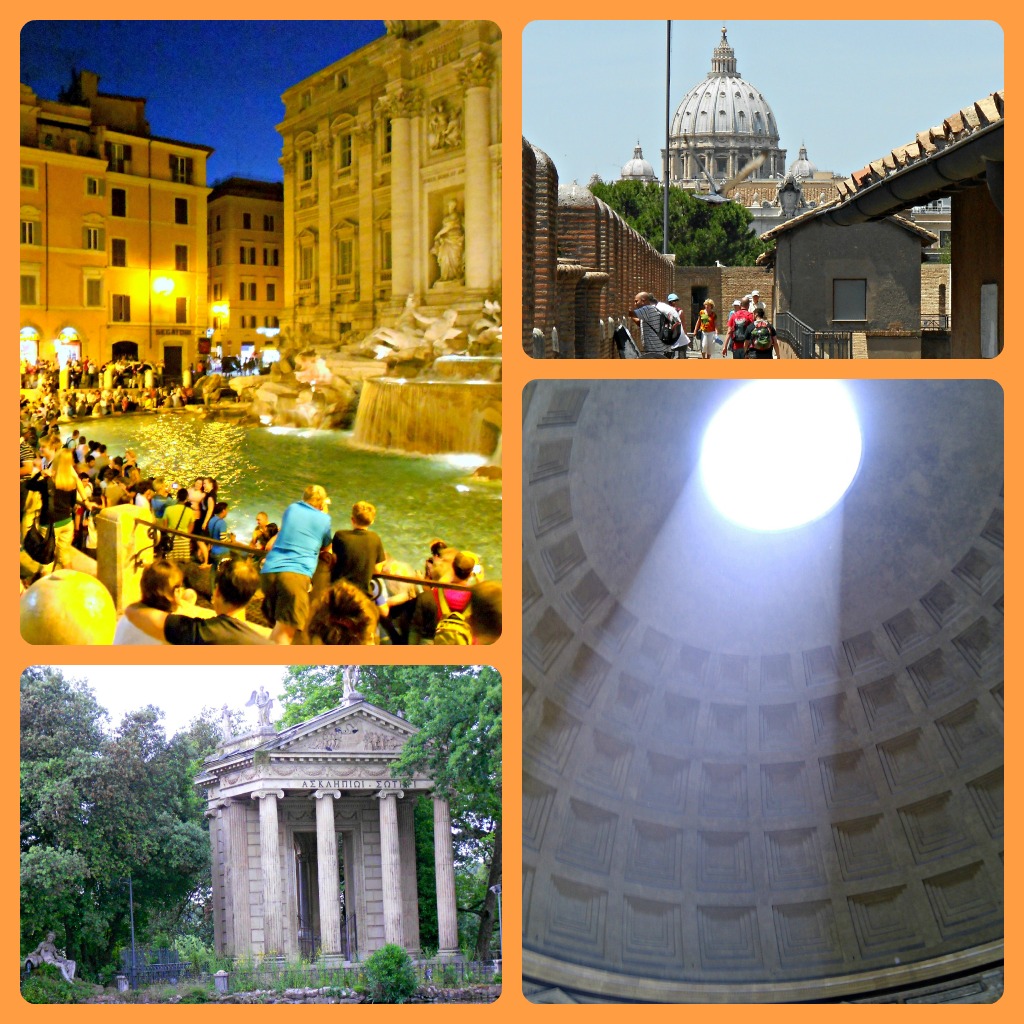
So I walked down from Quirinale in the darkening streets as night fell, map in one hand, camera in the other, my eyes filled with wonder and excitement. A stranger in the night if you will: with no local knowledge, limited lingo (si and grazie get you only so far) and quite frankly no idea where I was going. Tingling and a little breathless with the thrill of discovery somehow I found my way through the warren of streets to the Fontana di Trevi.

And the four days flew by. I walked and bus-sed and walked and Metro-ed and walked and cruised and walked some more. Compact and exuberant, Rome spreads its charm around every corner. The noise and busy-ness were energising although the traffic in some of the piazzas less so.

(I always imagined piazzas to be intimate and bustling, even green, rather than spacious, concrete or filled with litter. So the Piazza Navona and Campo de’ Fiori — the latter translates into “field of flowers” — were amongst the few “oh, is that it?” moments.)

A piece of my heart

From my coin toss into the Trevi on that first night to my final morning meandering in the warm rain through the gardens of the Villa Borghese, my second encounter with Rome has moved us beyond the acknowledgement of two passing strangers. But while we are not yet close friends, there’s a piece of my heart that’s indelibly stamped with a sense of delightful possibility.

Will I return to the Italian capital for a gentle kiss, for one more embrace perhaps? I don’t know but it’s exciting, exhilarating, a little self-conscious and filled with promise.

Just like Rome.

Born and raised in Melbourne, Kym Hamer has worked in London in sales and marketing for the past eight-and-a-half years. She writes the popular blog Gidday from the UK. Also follow Kym on Twitter: @giddayfromtheuk.

STAY TUNED for tomorrow’s Random Nomad interview with an American who has taken the “phile” in Anglophile to an extreme.

If you enjoyed this post, we invite you to register for The Displaced Dispatch, a round up of weekly posts from The Displaced Nation, with seasonal recipes, book giveaways and other extras. Register for The Displaced Dispatch by clicking here!

Related posts:

Images: Some enchanted moments from Kym’s second date with Rome. Clockwise from top left: Off peak at the Trevi Fountain (“busy, yes, but somehow still magical”); the Vatican from the battements of the Castel Sant’Angelo; sunlight pouring into the Pantheon; the Giardino del Lago at the Villa Borghese.

THE DISPLACED POLL: Which of these 4 exotic sports should be part of the Olympics?

One thing everyone in Britain knows at the moment — if not everyone in the world — is that the Games of the XXX Olympiad (July 27 – August 12, 2012) are coming to London!

Although this grandest of international sporting events is still a ways off, we’re already starting to get into the mood at The Displaced Nation.

So I’ve decided to review some of the sports I’ve observed in my travels around the world that I’d like to see making an appearance at the Summer Olympic Games. And I’ll need your help with deciding on the most suitable candidate, which I’ll of course put forward to the International Olympic Committee — which will of course guarantee its inclusion if not this year then in four years’ time. Well, maybe. 🙂

Because I’m a recent addition to the population of the Southern Hemisphere, I’ve picked some of the more interesting and praiseworthy activities from my part of the world, which, I believe, have been under-represented at a set of games that had their origins in ancient Greece.

I know there’s loads of candidates in the UK, in Europe and the US — we’ve all heard about cheese-rolling and bog snorkeling and beard-growing…haven’t we? Ah well, maybe we’ll get to those crazy sports next week.

I’ll open with an oddly appropriate quote from the American sports journalist Robert Strauss, on how success is achieved:

It’s a little like wrestling a gorilla. You don’t quit when you’re tired; you quit when the gorilla is tired.

With that in mind, let’s get down to the voting for the Next Olympic Sport. Here are your four candidates:

1) From Australia: SHEEP SHEARING

It’s a job; it’s a sport; it’s a hobby…the Aussies even hold a world championship of their own! Apparently seasoned shearers (or “guns”) can have the complete fleece off a medium-sized sheep is as little as two minutes. The current champion is Aussie Brendan Boyle, who in 2007 singlehandedly deprived 841 sheep of their coats in 24 hours! Hell, I think he deserves a medal just for wanting to. Or perhaps something more akin to a straight-jacket…

2) From South Africa: OSTRICH RACING

Yes, it’s true. It’s a sport and everything! They have jockeys and racetracks and…well, everything else you would expect, though it certainly isn’t sponsored by Goodyear. There are ostrich farms that occasionally let tourists have a go — but it’s not for the faint-hearted. Not only are ostriches damn hard to get on, harder to stay on and capable of doing over 40 mph — they’re also quite dangerous. Near Oudtshoorn, where the sport is most famously practiced, there are two or three people killed every year by ostriches — and up to a hundred world-wide! Brilliant. Kicked to death by an ostrich is going on my list of all-time weirdest ways to die!

Amazingly enough, this sport is on the increase. If you happen to live in New Jersey, you might get chance to see some — there’s a camel and ostrich race coming to the Meadowlands Racetrack in four days’ time!

3) From India: ROLLER SKATING LIMBO

I know, not exactly Southern Hemisphere — but this sport is so amazing it has to be given a chance! Check it out:

Like most sports, this probably goes on in other places too. Other, equally crazy places… But for the feat of flexibility this activity requires, you really can’t beat the Birthplace of Yoga when it comes to training. In India, when roller-skating under bars and beams ceases to be enough of a challenge, they try skating under cars! And when that’s no enough — under LOTS of cars!

In October of last year, an 11-year-old boy Rohan Ajit Kokane took advantage of the 35cm ground clearance and skated, blindfolded, underneath 20 cars in a row — a new Guinness World Record! If asked how he’d felt during the challenge, I’m sure he’d have replied “a little low…”

4) From New Zealand: ZORBING

Well, it’s hard to see how rolling down a hill in a giant inflatable ball could become competitive enough for a spot in the Olympics —  unless the challenge was to see how many times you could do it without being violently sick all over yourself, whilst still inside…! (Oh yeah, that would take some cleaning up!)

As an athletic activity though, you can’t beat zorbing. Trust the New Zealanders to come up with such an immensely fun sport! I can foresee zorbing obstacle courses coming into vogue in the not-distant future — after all, you can literally walk on water in one of these things. Or, wait — is that the next Olympic sport? White-water zorbing! Now surely there’s something medal-worthy in that? As for an athlete who would like to compete? Me. I’ll do it! Please…?

So what do you think, Displaced Nation-ers?

Which of these four is worthy of being the next Olympic sport?

Cast your votes in our poll — and if you have any other suggestions, I’d love to hear ‘em! Comment below, or hit us up on Twitter: @DisplacedNation and/or @TonyJamesSlater

Img: Tony James Slater celebrates his zorbing success (2009).

STAY TUNED for Wednesday’s Random Nomad interview with a champion linguist.

If you enjoyed this post, we invite you to register for The Displaced Dispatch, a round up of weekly posts from The Displaced Nation, with seasonal recipes, book giveaways and other extras. Register for The Displaced Dispatch by clicking here!

Related posts:

When in London, hey? Ag no man! 10 foods I still miss from my homeland…

It’s time to take a break from the craving for La Dolce Vita with a guest post by Lexi Mills, a young South African expat in London. Mills has a another kind of craving: for her home cuisine. YES, IT’S FOOD!!! One of the Displaced Nation’s all-time favorite topics…

I moved from South Africa to London when I was 18 with my parents. Everyday my feet straddle the line between two very different places that I consider home, and sometimes I lean more toward one side than the other. For example, I absolutely love the opportunities that London affords, but I miss the warmth of South African people.

While I will forever be torn between my two homes, one country will forever win when it comes to food: South Africa. You see, South Africa offers not only a great variety of different and amazing landscapes, it is also home to people from diverse backgrounds. A rich combination of cultures, traditions and religions results not only in a unique way of life but also in a wide menu of food items.

I miss everything about South African food: the access to affordable fresh fruit, the healthier diet, grilled meats on the braai (barbecue), to name just a few.

I even miss those packaged foods that you don’t realize you often crave until you don’t have access to them anymore.(Over the years, I’ve met a lot of South African expats and discovered just how much of a hold those packaged foods have on our memories. While you can try to re-create homemade South African foods in other countries, it’s a struggle to replace the items for which you need to find a specialized grocery.)

Out of curiosity, I decided to conduct a study among South African expats here in London to see just how widespread these cravings are. Luckily, as my job is to represent South African Hotels in offering accommodations for travelers to the Rainbow Nation, I was able to utilize their resources for my study of which foods my people miss most.

According to my findings, South Africans who live and work in London miss the following 10 food items from their home country most of all. (Note: I’ve added explanations for the benefit of those who aren’t familiar with our culture.)

1) Biltong

A type of cured meat usually made from raw fillets of beef, ostrich or other meats. South Africa’s biltong can be compared to beef jerky as they are both spiced, dried meats, but biltong has different ingredients, is produced by a different method, and isn’t at all sweet.

2) Dry wors (also known as droëwors in Afrikaans)

Literally, dried sausage. Because it is dried quickly in warm and dry conditions, droëwors does not contain any curing agents as found in most cured sausages. As a result, it should not be kept in moist conditions (such as exist in the UK!). Droëwors is a popular snack.

3) Crème soda

A sweet, carbonated soft drink, usually flavored with vanilla.

4) Nik Naks

A popular brand of maize snack, available in the original real cheese, fruit chutney, cheese & onion and BBQ flavors.

5) Mrs Balls Chutney

A beloved brand of chutney often served with South African meals, with roots firmly planted in the country’s heritage. Made from apricots and peaches, it’s slightly sweet and spicy.

6) Peppermint Crisps

Milk chocolate bars filled with thin cylinders of mint-flavored toffee that were invented in South Africa by Wilson-Rowntree (it’s now produced by Nestlé). Kids in South Africa like to break off both ends of the bar and use it as a “straw” to drink milk.

7) Boerewors

A very popular sausage in South Africa that is used for braais/barbeques. Boerewors is made from coarsely minced beef, sometimes combined with minced pork and lamb as well as spices, and preserved with vinegar and salt. This quintessential South African sausage contains a high proportion of fat; no wonder it’s so tasty!

8) Rusks

Hard, very dry biscuits that were originally prepared by the Dutch for traveling long distances in South Africa’s hot climate. Rusks can be plain or with added texture from nuts, raisins or seeds. We often dunk them in tea.

9) Maize meal, locally referred to as mielie/mealie

Ground maize/corn that you mix with hot water and stir until you get a porridge-like mash (also called pap) — especially delicious when served with a nice homemade meaty tomato sauce.

10) Bakers Tennis Biscuits

A square coconut biscuit with a distinctive petal pattern, made with real golden syrup, coconut and butter. The brand has been around since 1914, when the South African biscuit/cookie manufacturer Bakers first introduced them.

* * *

I hope this gives you an idea of the unique South African palate. If you are an expat, then you’ll know what an adjustment it can be to live in another country, but for me the most profound difference among cultures comes down to cuisine.

Have you had a similar experience? I’d love to hear what foods you miss from back home in the comments!

Lexi Mills is a PR professional living in London. You can find her chatting up Brits all over the Foggy City and enjoying the National Gallery on her days off — a luxury she could not enjoy in her native South Africa. Follow her on Twitter at @leximills.

STAY TUNED for Wednesday’s post, featuring the first of several practitioners of la dolce vita.

If you enjoyed this post, we invite you to register for The Displaced Dispatch, a round up of weekly posts from The Displaced Nation, with seasonal recipes, book giveaways and other extras. Register for The Displaced Dispatch by clicking here!

Related posts:

Img: Octopus, anyone? Lexi Mills at a seaside cafe in Brighton, UK, in 2011.