The Displaced Nation

A home for international creatives

Tag Archives: Fiction Writers

For TCK writer Cinda MacKinnon, fiction is a way to revisit “homes” she has cherished

Cinda MacKinnon CollageWhen I first returned to the United States after my extended expat journey, I remember humming to myself:

There’s a place for me,
Somewhere a place for me.

But then last month, when I went to see our monthly columnist Elizabeth Liang perform her one-woman show, Alien Citizen, I realized that my displacement, which took place as an adult, does not compare to that of Third Culture Kids. Most expats have been global residents by choice, whereas TCKs had no choice in being dragged around the globe by their parents. They and they alone have earned the epithet of “global nomad”.

Elizabeth has found a place for herself in theatrical circles. And today we talk to another adult TCK, Cinda Crabbe MacKinnon, who has found a place in fiction writers’ groups. Based on the first novel she produced, tellingly entitled A Place in the World, it seems fair to say that Cinda thrives on creating fictional characters whose lives resemble her own in some way, and then placing them in a part of the world where she has fond memories of spending some portion of her formative years, as a TCK.

In brief, A Place in the World centers around a young American woman named Alicia, who marries a Colombian and goes to live on his family’s remote coffee finca in the “cloud” forests of the Andes Mountains. Calamities strike one after another and Alicia ends up running the finca alone.

According to the book description, A Place in the World is a romantic adventure story, with a multicultural cast of characters, in the same vein as Isak Dineson’s Out of Africa.

Unlike Dineson’s work, however, it is not a memoir. Cinda may have loved her time in Colombia, but she didn’t marry a Colombian. And though she always wanted to be a biologist, she became an environmental scientist instead.

Well, enough from me. Let’s find out more about Cinda, why she wrote the book, and the book-writing process. And don’t forget to comment at the end of the interview! As Cinda has agreed to be this month’s featured author, we will be giving away ONE FREE E-COPY of her book to the person who leaves the most interesting comment!

* * *

APlaceintheWorld_coverCinda, pura vida. Thanks so much for agreeing to this interview. Let’s begin at the beginning: what made you decide to write a novel about an American woman who lives in the cloud forests of Colombia?
Well, like all writers the story was simply in my head. Contrary to what I’d been told to do, I wrote for myself, without the idea of publishing—at least when I first got started. But I guess there were also some motivating factors. As you mentioned, I grew up as a Third Culture Kid, or TCK. My family lived in Greece, Germany, Colombia, and Costa Rica because my father was in the United States Air Force and then worked as an attaché to American embassies. I spent my formative years—and by far the longest time—in Colombia and Costa Rica. I wanted to be a rainforest biologist. That didn’t happen, but I’ve been able to live this dream through my protagonist, Alicia. Writing the book gave me an excuse to visit and study tropical nature in several places.

What impact did writing about the experience have on you overall—did it help you process what you’d been through as a TCK?
I love Latin America—the setting and culture are comfortable to me. The book gave me a chance to write about the people in that part of the world who were enormously kind to me. Growing up as a girl without a country, I came “home” for the first time to the States for college and felt totally out of place. Writing gave expression to some of this unanticipated culture shock.

What kinds of books have influenced you as a writer?
When I look at my Goodreads list of top 40 favorite books I see there is a definite multicultural theme: 30 are set in other countries, written by foreign authors or about expats. A few eclectic examples:

  • The Poisonwood Bible, by Barbara Kingsolver
  • Crime and Punishment, by F. Dostoyevsky
  • Zorba the Greek, by N. Kazantzakis
  • Tortilla Curtain, by T.C  Boyle
  • Small Kingdoms, by A. Hobbet
  • How the García Girls Lost Their Accents, by J. Alvarez
  • Eva Luna, by I. Allende
  • Caravans and Hawaii, by James Michener
  • The Thorn Birds, by C. McCullough
  • Pillars of the Earth, by K. Follett;
  • The Paris Wife, P. McLain;
  • Lost in Translation (different from the movie), by N. Mones
  • Dreaming in Cuban, by C. Garcia.

A fish out of water…

As you know, we like to talk about “displacement” on this site. When you were growing up as a TCK, what was your most displaced moment?
When I was working in New Zealand as a young adult. I’d lived in four or five different countries and could make myself understood in several languages so wasn’t expecting that to be a problem in NZ. I remember being with a colleague trying to order a milkshake, and the lady behind the counter asked me to repeat myself. “A chocolate milkshake, please,” I said as clearly as I could. She looked at me blankly and said, “Say it one more time dear, I’m trying very hard to understand you, but your accent is so thick.” As we left the shop, I told my work mate, “I don’t know what I got, but it sure isn’t chocolate!” Alistair smiled and replied, “I thought you asked for ‘banahnah’”!  Go figure!

Yes, having been to New Zealand, I can kind of imagine that! What was your least displaced moment, when you felt that the peripatetic life suited you, and you were at “home”?
As an eighth grader arriving in Costa Rica from Colombia. My first week I was accepted as part of the class and invited to a party. I spoke Spanish and felt I fit in. Costa Ricans are a hospitable people, but I think I was also especially lucky to have been in that particular class. They were—and are—an exceptionally nice group of people; they still meet every month or so for dinner, and any classmate who happens to be in town is invited to drop in. I found life in Costa Rica to be nurturing.

You mentioned the counter culture shock you experienced when coming back to America for college. What was the biggest challenge you faced at that moment?
Well, it wasn’t one thing but all the little things: I was dressed “wrong”, didn’t know the music, had never been to a football game… I just really felt like a fish out of water and wanted to go back to Costa Rica—so, after a couple years, I did! (For a while…)

Clearing the writing & publishing hurdles

Moving on to A Place in the World: what was the most difficult part of the book-writing process?
Beginnings are the most difficult for me, as well as writing synopses for agents and publishers. In general, however, the answer is: time. Finding time to write while I was still working; finding time to meet my indispensable writing critique group; and once edited and published, finding time to speak at bookstores, do interviews, and write posts for my own blog!

What was your path to publishing?
Like any previously unpublished author, I had a difficult time. I had one agent hold onto my novel for six months as we discussed strategies and then (with the downturn in the markets) told me they had decided not to handle unpublished writers anymore. This has become a mantra with traditional publishers. (J.K. Rowlings was turned down dozens of times before finding a publisher for Harry Potter.) After a couple of years (during which time I was polishing the manuscript with my critique group), I decided to “indie” publish. There is a range of providers between traditional publisher and self publishing; and my publisher, VirtualBookworm, is one of those in the middle. I paid for my own editor (she was great—an expat who married a Latino) and a very small fee towards printing; but I get a bigger percentage per book than with a big publisher. I’ve been happy with all the support they have given me and would do it again.

What audience did you intend for the book? Has it been reaching those people?  Can other kinds of expats, who haven’t lived in Latin America, relate to Alicia’s story as well?
I think of it as “mainstream” fiction that will appeal to anyone who likes to read about other places and cultures; but yes, it has been popular with expats. I rather thought that alumni from the overseas schools I went to would be interested, and that has been the case. I’m heartened and amazed at the support and e-mails I’ve received from adults of all ages.

Are you working on any other writing projects?
Yes (she says hesitantly). Hesitantly because, as you might guess from what I’ve already told you, I’m working pretty much FT—and finding time for creative writing is harder than usual! I do have several ideas that I’ve started: one set in Hawaii, another in Costa Rica, and a third in Europe. This last might be of interest to your followers, as it will be about a group of kids in an international school in Switzerland written from the point of view several different characters, taking their experiences into adulthood. And then my writers group thinks I should do a memoir. So I don’t know which of these schemes will “win”, but I intend to set priorities before the New Year.

10 Questions for Cinda MacKinnon

Finally, I’d like to ask a series of questions that I’ve asked some of our other featured authors, about your reading and writing habits:
1. Last truly great book you read: The Help, by Kathryn Stockett, comes to mind, but how great is great? I could go back to Zorba the Greek, by Nikos Kazantzakis.
2. Favorite literary genre: Literary and mainstream—especially multicultural or historical.

3. Reading habits on a plane: Anything—even the airline magazine in a pinch, but I usually take my Kindle with a good novel. Also, planes provide great down time to write!

4. Book(s) you would recommend to other TCKs, expats: Other than my “multicultural” fiction list above, it would be two books: Tales of Wonder, a fascinating autobiography about growing up in China almost a century ago, by Huston Smith; and I’m a Stranger Here Myself—Bill Bryson’s funny take on coming home after years abroad.

5. Favorite books as a child: Fairy Tales, by Brothers Grimm. When I was a little older, the Nancy Drew mysteries and I enjoyed reading Dr. Seuss to my little brother.
6. Favorite heroine: In fiction: Nancy Drew? In real life: There are too many to choose just one.

7. The writer, alive or dead, you’d most like to meet: Barbara Kingsolver and John Steinbeck.
8. Your reading habits: I take a break every afternoon and I get a little reading in, and then my husband and I always read before turning out the light.
9. The book you’d most like to see made as a film: A Place in the World! Seriously, two fans have suggested this and I love the idea. I visualize the opening as the cloud forest seen from the air and then zooming in to the tiled roof house with the veranda and bougainvillea. (This is actually a possibility! A colleague of mine is a script writer and mentioned that it would make a good movie.)
10. The book you plan to read next:  I just started Flight Behavior, by Barbara Kingsolver. Then I’ll probably read The Old Way: A Story of the First People, by Elizabeth Marshall Thomas, or Cristina García’s new novel, King of Cuba.

* * *

Thanks, Cinda! Though I’ve never been to Colombia, I find myself enamoured of the idea of finding a place for myself in a cloud forest. It’s actually an apt metaphor for how many of us “displaced” types live: with our heads in the clouds, pretending we are somewhere else half the time.

Readers, how about you? Is your head in the cloud (forest) after listening to Cinda? BTW, if you’re as new to Colombian cloud forests as I am, I suggest that you check out Cinda’s Pinterest boards. You can also get to know her better by visiting her author site and blog, and liking her Facebook page.

And don’t forget to comment on this post! Extra points, as always, if you’re a Displaced Dispatch subscriber!

The winner will be announced in our Displaced Dispatch on November 2, 2013.

NOTE: If you can’t wait to read the book, you can always get a softcover copy here and the e-book version in various formats on Smashwords or Amazon.

STAY TUNED for tomorrow’s post, when monthly columnist JJ Marsh talks “location, locution” with best-selling Brazilian author Paulo Coelho.

If you enjoyed this post, we invite you to register for The Displaced Dispatch, a round up of weekly posts from The Displaced Nation, with seasonal recipes, book giveaways and other extras. Register for The Displaced Dispatch by clicking here!

Related posts:

Images (left to right): Valle de Cocora in Columbia, with wax palms towering over the cloud forest, courtesy McKay Savage on Flickr (Creative Commons license CC BY 2.0); Cinda MacKinnon as a child in Colombia; Cinda MacKinnon now (she lives in northern California); and Cinda with her husband in front of Monserrate, a mountain that dominates the city center of Bogotá, Colombia, taken just this past summer.

FOOTLOOSE & FANCIFUL: Margaret Drabble’s “The Red Queen”

Welcome to Footloose & Fanciful, an occasional series of posts where we talk about books, films or other art forms that have inspired us to travel to new places or appraise familiar places with fresh eyes.

I’m probably not the best person to kick off this series. As much as I adore fiction, I’m not one to travel on a whim, because of something I read in a book. Especially not these days, when my expat years, spent in England and Japan, are behind me and I have to take time off from work. Typically, I arrive at my destination and collapse in a heap of exhaustion. It’s not until I’ve had a good rest that I am able to take in my surroundings. I peer out the window and say: “Really, I’m in xxx?!”

At that point I go to the other extreme, manically trying to find out as much as possible about where I’ve landed, visiting bookstores with an English-language section to stock up on translated novels, expat memoirs, the lot…

The second time I went to Seoul, South Korea, though, was different, and I’ll make that the subject of today’s post. That trip marked a rare time when a book had piqued my interest in a country to the point of influencing what I wanted to do and see and talk about during my stay.

Finding the soul of Seoul

I said my second visit to Seoul. The first had occurred a few years before. It followed the typical pattern. I arrived tired and unprepared, although on that occasion, I got an immediate lesson in the local culture.

Just as my husband and I were landing in Incheon International Airport, the news was breaking that Dr. Hwang Woo Suk—a veterinary researcher who had achieved world fame by cloning an Afghan hound named Snuppy—had falsified his latest results to make it look as though he’d made advances in human cloning.

“It’s a very Korean story,” some Korean friends of my husband’s informed us. I wasn’t sure what they meant, but little by little, I pieced it together. The Korean government, desperate to project a modern, high-tech face to the world, had turned Dr. Hwang into a national hero. He appeared in many of their promotional campaigns. The post office sold stamps to commemorate his research, and Dr and Mrs Hwang enjoyed a decade of first-class tickets on Korea Air, because of his status as “national treasure.”

Interestingly, our Korean friends were reluctant to condemn him outright. He’d been under a phenomenal amount of pressure to produce results and bring his country greater glory. If you were under that much pressure, you’d probably be tempted to skip a few rounds of clinical trials, too, they seemed to be saying.

I had to think about that for a while. Already, I was inclined to feel sorry for the Koreans because I knew how they’d suffered under Japanese rule. They are the Central Europeans of Asia, if you will. Just as the Hungarians, Poles and Czechs have had to put up with Germany and Russia, the Koreans, due to being sandwiched between China and Japan, have had to put up with incursions from both.

Gradually, I came round to the Korean point of view. My thought process went something like this:

Okay, the Koreans have been victims of some bad geography. But then why do they make things so much worse for themselves by setting such impossibly high standards? What Dr. Hwang did was wrong, a violation of ethical standards in medical research. But, okay, if I can feel sorry for all the Korean schoolchildren cramming like crazy for exams, I guess I can spare a bit of sympathy for Snuppy’s creator…

After arriving home from that trip, I was eager to read more about the country (I hadn’t found much in translation in Seoul’s bookstores).

That was when I happened upon the novel The Red Queen, by Margaret Drabble.

Seeing Korea in shades of red

A novel on Korean history by one of the writers I’d most admired when living in the UK: what could be a more perfect bridge between the two parts of my expat life?

The Red Queen of the book’s title refers to Lady Hyegyong, a Korean woman who lived in the 18th and early 19th centuries. She was plucked from obscurity to marry the Crown Prince of Korea, Sado, who turned out to be…a HOMICIDAL MANIAC, I kid you not.

The reason we know all of this is that Lady Hyegyong left behind a diary, and Part 1 of the novel is Drabble’s version of that document, which she based on JaHyun Kim Haboush’s translation of The Memoirs of Lady Hyegyong: The Autobiographical Writings of a Crown Princess of Eighteenth-Century Korea.

In Part 1, the Crown Princess tells us about what it was like to live with a husband and in a court where daily, several dead bodies would be carried out of the palace (whenever Sado felt agitated or depressed, he would seek relief by murdering his servants) or reports would arrive of another court lady being raped. After he murders his concubine, he starts harassing his own sister, too.

At about this point, I concluded that the only thing worse than discovering you’re married to psychopath would be to find out you’re confined with him in a palace, from which there’s no escape. Terror within a claustrophobic setting must be the worst kind there is!

The story has a further twist. The Crown Prince’s father, King Yongjo, turns out to have been deeply Confucian. He is the kind of Korean parent who sets impossibly high standards for his son, which—it is hinted in the Crown Princess’s diaries—may be part of what triggers the son’s madness.

In the end, the cruel father proves more than the psycho son’s match. On a hot day in July 1762, he summons Sado and orders him to get into a heavy wooden chest, ordinarily used for storing rice or grain. The lid is shut and locked, and Sado is left to starve. It takes eight days.

The Crown Princess is traumatized all over again at witnessing her father-in-law execute her husband in such a cruel manner.

In part 2 of the book, an Oxford academic travels to Seoul with the Crown Princess’s diary in hand (which has been sent to her anonymously via Amazon.com) and finds parallels between her own life and hers. Professor Halliwell feels that the Princess “has entered her, like an alien creature in a science-fiction movie.” She becomes possessed by her—just as I was by the end of the book, just as I’m sure Drabble was, which was what inspired her to create (in her words) this “transcultural tragi-comedy.”

More questions than answers

I went back to Korea for a second time not long after reading the novel, accompanying my husband on some work he had there. So moved had I been by Drabble’s book that I was determined to find a way to pay tribute to the Red Queen, so called because of all the blood that flowed during her husband’s reign.

But here’s the strange thing. All of my attempts to find out about Lady Hyegyong came to naught. My Korean friends said I needed special permission to visit Changgyeong Palace, where this tragic series of events took place. They did not seem to want to engage in a conversation about this period of their history.

I left Korea with more questions than answers: Do Koreans repress this part of their past, and if so, what does that tell us about them? Is my previous view of them as helpless victims all wrong? Did other countries walk in and take over because Korea had weakened itself through its impossibly high Confucian ideals, which had led to total anarchy by the end of the 18th century?

But the weirdest thing is, I wasn’t that surprised by the Korean reaction. While the Western part of me applauds Drabble for resurrecting Lady Hyegyeong as feminist hero, one who lived long enough to write her tale (the existence of her memoirs, incidentally, served to refute later attempts to restore Sado to a position of honor in Korean history books), the Asian part thinks that poor Lady Hyegyeong must feel displaced in Drabble’s novel. Relationships are, after all, a central theme to Confucianism. The husband is the head of the household and the wife is obedient to him, full stop.

This inner dilemma of mine, along with the spirit of Lady Hyegyeong, which Drabble portrays so vividly in her novel, still haunts me to this day…

* * *

Readers, have you ever read a book that has colored your impressions of a place in weird ways? Also, if you would like to contribute to this new series—perhaps an uplifting tale of being inspired by a book set in the idyllic Tuscan countryside would be in order after this rather macabre story?—please don’t hesitate to get in touch: ml@thedisplacednation.com.

STAY TUNED for next week’s fab posts!

If you enjoyed this post, we invite you to register for The Displaced Dispatch, a round up of weekly posts from The Displaced Nation, with seasonal recipes, book giveaways and other extras. Register for The Displaced Dispatch by clicking here!

Related posts:

LIBBY’S LIFE #85 – A trick of the light

Talk about déjà vu. January 2012 all over again.

I sit on an uncomfortable plastic chair on one side of a teacher’s desk. On the other side of the desk, in a larger, more padded chair, sits Patsy Traynor: Jack’s ex-preschool teacher and now kindergarten teacher. Behind her is an expansive window, west-facing, and the afternoon sun blasts through the glass, forcing me to squint if I want to read her expression. This is a little intimidation trick of hers that I’ve encountered once before; although in this case forewarned doesn’t mean forearmed.

A hostile silence hovers between us as she opens a manila folder labeled “Jack Patrick” and runs a fingernail down the middle crease — her shell-pink nail varnish is chipped, I note with satisfaction — then picks out a sheet of paper with the heading “Behavioral Report”.

She looks up and smiles. I don’t smile back, because it’s not a friendly smile. It’s a smile of pleasurable anticipation, and the pleasure belongs only to her.

“Mrs. Patrick,” she says. No cosy first-names today, although she knows mine well enough. She looks down at the report in front of her. “Mrs Patrick. I asked you to meet me here today because—”

“I know why you asked me here,” I interrupt her. “Actually, the letter you sent home with Jack was addressed to both me and my husband, so if you don’t mind, we’ll wait until he arrives before we start.”

The smile falters a little, and she looks pointedly at the clock on the classroom wall.

“The appointment was for four p.m., and we are already running five minutes late.”

“Some people work full-time,” I say, and smirk to myself as Patsy swells up with indignation.

If you really want to piss off a teacher, simply insinuate that their workday finishes at three-thirty.

I fold my arms and sit back in my chair, waiting, avoiding catching Patsy’s eye. In the far corner of the room, inside an igloo-shaped tent, Jack is ordering around Beth and George. He’s trying to make them sit still and listen to his newfound skill of reading a Dr. Seuss book about dogs and cars. Beth and George aren’t impressed with his instructions to stay in the tent when there are so many exciting playthings outside it to scatter and destroy; George registers his disapproval with a determined “No!” (his current favourite word) while Beth lets out a high scream. There is the sound of a hard object hitting the floor with some force. After a pause, Jack’s voice cuts clearly across the room:

“If you don’t behave, I’m going to tell M and she will break your favourite toys.”

I feel rather than see Patsy’s smug moue, and I squeeze my eyes shut. It’s a defensive reaction, against both Patsy and the sunshine behind her that dazzles me.

Hurry up, Oliver. I need some backup here.

On cue, to my relief, the classroom door opens and Oliver strides across to the desk. He’s in his best suit, not for Patsy’s benefit but because he’s been meeting new customers today, and is still in professional work mode. He exudes brisk confidence and an air of brooking no nonsense.

I’ve never been so glad to see him in all my life, and that includes the time he was late for our own wedding because his best man was in the throes of an almighty hangover and drove to the wrong church. Oliver must also have had an almighty hangover, because the pair of them waited outside for half an hour before realising that a locked church, a lack of guests, and no vicar might be significant.

Oliver shakes hands with Patsy, introducing himself, then, before sitting down, he moves to Patsy’s side of the desk and twiddles with the venetian blind behind her chair, moving the slats so that the sun shines upwards instead of directly in my eyes.

“Better?” he asks me.

We exchange small, conspiratorial winks, and I bite my lip to stop myself laughing at Patsy’s expression. Her face is red and her eyes very wide, as if she can’t believe that someone has had the gall to do now what she should have done out of courtesy fifteen minutes ago.

She picks up Jack’s Behavioral Report again, although with not as much assurance as before. Oliver seems to have flustered her.

“I asked to speak to you both because of issues Jack is having in the classroom. He appears not to be able to differentiate between fact and fiction, and while we encourage strong, lively imaginations, we do try, at this point in child development, to make it clear to our students that the two viewpoints are separate.”

“So in other words, you’re saying Jack is a liar.” Oliver slices neatly through the spiel of edu-jargon.

Patsy’s face reddens further. “Not at all, but—”

“In that case, you must be saying that he’s telling the truth?”

“Not quite, but—”

“You must be saying one or the other. Which is it that he’s telling you? Fact or fiction?”

“Well—”

“Fact or fiction? Quick!”

Oliver’s not giving Patsy a chance to get a word in. He reminds me of Samuel L Jackson in Pulp Fiction: “Say ‘What’ again! I dare you! I double-dare you!”

“Imaginary friends are one thing!” Patsy bursts out. “But his obsession with this particular friend, whatever her name is—”

“Her name’s M,” Jacks voice says from inside the nylon igloo, and I stifle a giggle with my hand. “M, like the letter M.”

“—This obsession is out of hand. And I would like your permission to refer him to the school district’s educational psychologist for further assessment.”

Oliver stands up. “If that’s all you called us in for,” he says, “you might as well have phoned. Because the answer is No. Jack is not a liar, and he’s not a psycho either. You, on the other hand, I have always had my doubts about, and I’m not about to take child-rearing advice from someone who accepts bribes from parents. Come on Libs. Kids!” he shouts in the direction of the igloo. “Time to go home now. If we have to be in a madhouse, I prefer the homegrown type. No wonder homeschooling is so popular,” he adds to Patsy.

* * *

“And then what?” Maggie asks me the following day, when Jack is at school and I’ve taken the twins to see their adopted granny. Their adopted ex-grandpa, thank goodness, is busy in the back yard, splitting logs for Maggie’s wood-burning stove.

I shrug. “We went home, and Oliver sat down with Jack and lectured him long and hard about differentiating between fact and fiction.”

“So he was only standing up for Jack against Patsy at school. He doesn’t really believe the story that there is the ghost of a little girl in your house. Although you do?”

I think back to the day we found the shattered Dresden shepherdess. It was in the centre of the dining room floor, a long way from the shelf where I’d put it. To get to its final resting place, it would have had to jump seven or eight feet through the air. We don’t own a cat, and to my knowledge, there had been no freak earthquake that morning. And yet, all my life, I have pooh-poohed the idea of ghosts and ghouls.

In other words, I am having a crisis of faith.

“I believe there is something,” I say finally. “I just don’t know what, exactly. The china shepherdess broke in the dining room, which happens to be the room that won’t warm up, no matter what you do to it. And there’s Fergus — he wouldn’t come in the house at all. I’ve heard that dogs are sensitive to… things.” I shiver, despite the warm sunshine that is shining through Maggie’s living room windows. “It could just be circumstantial, of course. Logic tells me that it probably is, and everything can be explained by rational argument. But whenever I start to explain things away with logic, I come up against the biggest obstacle — that I honestly believe Jack thinks he is telling the truth.”

Maggie nods thoughtfully, and rocks back and forth in her rocking chair. Beth, who is sitting on her lap and playing with Maggie’s long string of amber beads, leans back, puts her thumb in her mouth, and closes her eyes.

“I remember Cathy saying that Chuck had an imaginary friend when he was a little boy,” she says at last. “In that very house.”

“So you said, in one of your emails. He grew out of it, though.”

Maggie wiggles her hand in a comme ci comme ça gesture. “He was very old to have a pretend friend. Eleven, twelve. And I don’t know, but… I got the impression that he said he’d grown out of it, to humour her. I remember visiting the house once, and he didn’t know I was there, and he was talking to someone – someone who wasn’t there. He’d have been about fifteen at the time.”

I sit still, turning over possibilities in my mind. George waddles over to me and puts his head on my knee. Any minute now, he will go to sleep, standing up where he is.

“He was very keen that I read the folder of old documents relating to the house. It’s full of papers to do with plumbing and roofs, but there’s also records of people who used to live there, a couple of hundred years ago. Perhaps I should read it more carefully.”

But later, in bright sunshine, when the house is full of real people and real laughter. Right now, I’m not very keen on going back to my silent, empty house with two sleepy toddlers.

“Does Jack’s friend have a name?” Maggie asks.

“He calls her M. Like the character in James Bond. Or Dial M for Murder.”

I shiver again., then notice that Maggie has stopped rocking in her chair and is rubbing her arms.

“Are you cold?” I ask. “I thought it was just me. Shall I turn the heat up?”

Maggie shakes her head, and I see that she has lost some colour from her cheeks.

“Chuck used to love the film The Wizard of Oz. Cathy said he’d named his imaginary friend after one of the characters.”

I laugh. “Like, Dorothy? Toto? Tin Man?”

Maggie is still shaking her head. “No. Cathy always thought it was an odd choice, but assumed it was because Cathy and her husband didn’t have any brothers or sisters. He named her after the aunt.”

I stare at Maggie, and start to rub my own arms which, like Maggie’s, have sprung a rash of goosepimples.

Aunt Em.

Em.

M.

.

Next post: LIBBY’S LIFE #86

Previous post: LIBBY’S LIFE #84 – Stages of youth

Read Libby’s Life from the first episode.

Want to read more? Head on over to Kate Allison’s own site, where you can find out more about Libby and the characters of Woodhaven, and where you can buy Taking Flight, the first year of Libby’s Life — now available as an ebook.

STAY TUNED for next week’s posts!

If you enjoyed this post, we invite you to subscribe for email delivery of The Displaced Dispatch, a round up of the week’s posts from The Displaced Nation. Sign up for The Displaced Dispatch by clicking here!

LOCATION, LOCUTION: Liza Perrat on writing a location to life

Liza Perrat visualIn this month’s “Location, Locution”, expat crime writer JJ Marsh interviews  Liza Perrat, author of Spirit of Lost Angels.

Liza grew up in Wollongong, Australia, where she worked as a general nurse and midwife for fifteen years. When she met her French husband on a Bangkok bus, she moved to France, where she has been living with her husband and three children for twenty years. She works part-time as a French-English medical translator.

Spirit of Lost Angels tells the story of Victoire Charpentier and her courage in facing injustice and abuse in revolutionary France. Wolfsangel (due out in November 2013) follows Victoire’s descendant, Celeste, who finds that under Nazi occupation, the personal is political.

*  *  *

Which comes first, story or location?
So far, for me, it has been location. I’m enthused, enthralled or nostalgic about a place, and want to use it as a backdrop around a story. In the case of my current novels, the location has become as much a character as the real-life ones.

How do you go about evoking the atmosphere of a place?
My novels are set in the French rural area in which I live, which makes it much easier to evoke atmosphere. I take loads of photos of the countryside, the people and the buildings, during each different season. The local historical association has lots of sketches and documents on what it looked like through the ages. As I walk the dog, I jot down descriptions of sunrises, sunsets, stormy light, fruit on the trees, snow on the hills, flowers in spring and the icy river in winter.

Which particular features create a sense of location? Landscape, culture, food?
Landscape, culture and food, certainly. But most of all, for me, it is the people who create a sense of location. Often, the people are the place. Also language, especially expressions, plays a part. Architecture too, gives a feel for a place. Smells also, create a sense of location.

How well do you need to know the place before using it as a setting?
Intimately well. I’d have trouble creating a believable atmosphere if I’d not been to a place, or at least read widely on it.

Could you give a brief example from your work which you feel brings the location to life?
Many reviewers of Spirit of Lost Angels commented positively on the atmosphere created of La Salpêtrière asylum in Paris, during the late 1700s:

… I found the scenes of cruelty in the Salpêtrière Asylum painful to read – not because of the way in which they were written, but simply to have been shown such unpalatable truths …

… the section of the novel concerning Victoire’s stay in La Salpêtrière vividly illustrates what a horrible experience it must have been…

… part of the reason I waved to savour this book so much was because of the scenery and the settings…

The book vividly depicts the violent and inhumane methods doctors used to “treat” mental illness at Salpêtrière. To me, this was perhaps the most fascinating portion of the story- descriptions of the appalling conditions under which the women were kept, the rivalries that developed among cell mates, the rules one had to learn in order to survive this prison. The narrative was stark and believable and, believe it or not, educational. Since I’ve finished the book, I’ve been looking up the history of the Salpêtrière Hospital, intrigued at how low mental health care and the care of women had deteriorated at that time. Introducing an urge to learn more, dear readers, is the mark of excellent historical fiction.

Which writers do you admire for the way they use location?
Ones that come to mind:

  • Stef Penney’s The Tenderness of Wolves. Even more amazing as, apparently, she’s never been to the wilderness snowscapes of Canada.
  • Joanne Harris’s Chocolat evokes the small French village.
  • Nikki Gemmell’s Cleave and Kate Grenville’s The Idea of Perfection, describe so well the desolate landscape of central Australia.
  • Jennifer Worth’s Call the Midwife brings to life 1950s East End London.
  • Emma Donoghue’s Room brilliantly portrays an entire existence in a single, small room.

Thank you, Liza!

Next month, my guest on Location, Locution will be Paulo Coelho, author of The Alchemist, The Devil and Miss Prym and Eleven Minutes

* * *

JJ Marsh grew up in Wales, Africa and the Middle East, where her curiosity for culture took root and triggered an urge to write. After living in Hong Kong, Nigeria, Dubai, Portugal and France, JJ finally settled in Switzerland, where she is currently halfway through her European crime series, set in compelling locations all over the continent and featuring detective inspector Beatrice Stubbs.

STAY TUNED for next week’s posts!

If you enjoyed this post, we invite you to register for The Displaced Dispatch, a round up of weekly posts from The Displaced Nation, with seasonal recipes, book giveaways and other extras. Register for The Displaced Dispatch by clicking here!

Related posts:

LIBBY’S LIFE #84 – Stages of youth


“No. For the last time, she can’t come to school with us,” I say to Jack, as I lock the front door behind us and start to hustle the three children into the car. “We’re already late. You want to meet your teacher today, ready for when school starts tomorrow, don’t you?”

Jack pouts. “But she wants to. M says she’ll be lonely if I go without her. She says she’ll break something in the house if we leave her on her own.”

You know, I’ve had just about enough of Jack’s overactive imagination and this pretend friend.

“M” has been an invisible fixture in the house for the last six weeks, and she’s a demanding little sod — worse than my own three, live, already demanding children. I have to lay an extra place for her at every mealtime, and recently I’ve been evicted from my favourite spot on the recliner chair in the living room because Jack says that M is already sitting there.

Now the brat is ready to smash my china if she doesn’t get her own way.

I could just play along with the game and say, “Of course M can come with us”, but that would precipitate the need for an extra car seat because M is not old enough to sit in the front seat, Jack says.

And the name. What sort of name for a girl is “M”, for crying out loud, unless you happen to be Judi Dench in a Bond film?

“She’s very upset,” Jack says, with the air of someone washing his hands of all blame for the consequences. “You’re going to be sorry.”

“I hope you’re not threatening me,” I say, as I make sure his seat belt is fastened properly. “Otherwise it won’t be me who is sorry. I promise you that.”

Jack is unrepentant.

“I was just telling you what she said.”

Thank goodness school starts properly tomorrow, is all I can say, when Jack will (I hope) make new, human friends and forget about the fictitious girl in our house. The same girl who now has the nerve to  threaten vandalism if I don’t allow her to come along to kindergarten orientation with us.  I mean, it’s obvious she can’t come. She isn’t even enrolled at the sch–

Oh, this is ridiculous.

It’s got to the point where I almost believe in her myself.

*  *  *

Before I take Jack to meet his new teacher, I drive to Maggie’s house on our old street. Maggie is looking after the twins while Jack and I go to school for the morning.

“So it’s not Jack’s first proper day of school today?” she asks. “It’s just a meet and greet with the teacher, find out where the sand box is, that kind of thing?”

“Breaking them in gently, that’s right.”

“Didn’t happen in my day,” a Southern, male voice chips in from Maggie’s armchair. “My mother stayed in bed and let me walk to school with the neighbour’s kid on my first day.”

Derek. Maggie’s ex who, if I’m not mistaken – and I hope to God I am mistaken — will shortly be her ex-ex.

He arrived in Boston with her on the flight from Miami nearly three weeks ago, and seems in no hurry to return to his home in Virginia, or Maryland, or Delaware, or whichever state he comes from. We met on the second day of his visit, and took an immediate dislike to each other.

“We Northerners must be made of softer stuff than you tough Southerners,” Maggie says in a sugary voice that’s quite unlike the acid tone this comment would elicit from her had it been made by anyone else.

I have no idea what witchcraft Maggie’s ex has spun on my friend, but in the four weeks she was in the Keys, Maggie changed. She’s never been one to show or act her age — “Age is but a number” she is fond of saying — but since she came back, she’s been nearer in mental age and outlook to Jack than to me.

I did wonder if she was starting to become prematurely senile, until I saw Maggie and Derek together one afternoon. Then I realised what had happened.

They’ve teleported themselves back forty years. She is behaving as she did when she was nineteen, and he thinks he’s the dashing young state trooper who stopped a redheaded English woman for speeding in a borrowed Corvette.

And it won’t work. You can’t be teenagers when you’re drawing a pension — at least, you can’t be the same teenagers that you used to be. By all means, have a second youth; but the key word there is “second”.

Reliving their first one will end in a pool of tears, I’m sure of it.

Maggie’s my best friend, and I don’t want to see her hurt. But what can I do?

*  *  *

At the elementary school, Dr Felix Roth, the Principal,  is in his element as he greets all the parents in the foyer.

I tell a lie. He doesn’t greet all the parents. He greets the parents who know him well enough to call him by his first name because they’re on the PTA, and he gives a weak smile down his nose to all the others. I get my own back by pretending not to know who he is, and Jack and I make our way to Room 43, where Jack will be spending the next year with his kindergarten teacher, Mrs Healy. My friend Willow tells me that Mrs Healy is a plump, cosy, grandmotherly type, close to retirement age.  A lucky class placement for Jack, says Willow.

Room 43 is heaving with babies, toddlers, and five-year-old children. Jack pushes his way into a group of boys who are playing in a nylon igloo tent, and I look around the room to see if I recognise anyone.

With a sigh and feeling of déjà vu, I see Jodee Addison, mother of Jack’s Valentine crush this year, Crystal. Then, to my absolute dismay, I see Caroline Michaels.

Caroline, the wife of Oliver’s boss, whose son Dominic was the catalyst for Jack’s defection from Patsy Traynor’s nursery school. I’d heard on the grapevine that Caroline was going back to England and divorcing her boss husband after the fiasco at the Christmas party last year, but her presence in the classroom suggests that she prefers the expat-married-to-a-slimeball lifestyle to the divorced-and-living-in-Milton Keynes version.

As the teacher doesn’t seem to have arrived yet, I move closer to Jodee and Caroline, who are venting their opinions on something, and eavesdrop shamelessly.

“It’s too bad,” Jodee is saying loudly. ” You’d think someone in her position of trust would look after her health better instead of eating saturated fat all day. Such a bad example for the children.”

“It’s not just her suffering because of her bad health choices,” Caroline says, her lips pursed self-righteously.  “I mean, a heart attack? Really? Only herself to blame. Thoughtless, I call it.”

Jodee nods vigorously.

Wow. Some woman has had a heart attack and this is the sympathy these witches give her. I wonder who they’re talking about. Poor soul.

Caroline says: “There should be mandatory six-monthly physicals for teachers, and they should be made to diet down to an acceptable weight or lose their jobs. Having a heart attack in your late 50s, when it’s entirely preventable, is nothing short of selfish. And now our children have to suffer.”

Wait. Is she talking about Mrs Healy?

I’m about to turn and ask the mother next to me, who is also listening, jaw on the floor, to Caroline and Jodee, when the Principal enters the room.

In his high, squeaky voice, he tells the gathered parents that, as some of us may already know — here, Jodee and Caroline look smugly at each other — Mrs Healy sadly had a heart attack two days ago, and is still in the ICU at St Whatsit’s Hospital. Her condition is stable but critical, and she will not be coming back for the foreseeable future. With school starting tomorrow, parents will appreciate that time was of the essence, he says, and the school is extremely fortunate to have found a longterm substitute teacher with much experience, who comes with glowing recommendations.

“Someone who is probably known to many of you from pre-school,” he adds, with a smile that can only be described as arch. “May I introduce to you — “ he looks behind him, out into the corridor, and beckons to someone with his arm “– Mrs Patsy Traynor, who will be taking over the captain’s wheel of your child’s kindergarten ship until Mrs Healy is able to return to work.”

Patsy looks over the classroom, sees Jodee and Caroline, and beams broadly at them.

Then she sees me.

I wonder how easy it is for Jack to be transferred to another school.

*  *  *

Two hours later, back home, I unlock the front door and Jack races into the dining room.

“M! I’m back!” he shouts.

And then: “Mummy, I told you she wouldn’t like it if I went out.”

On the dining room floor, in shattered pieces, is the despised Dresden shepherdess that my mother’s aunt gave Oliver and me on our wedding day.

Well, I reflect with a shiver, as I sweep up the bits before Beth and George can toddle over them in their bare feet – everything is clear now.

And I suppose that,  if we have to have a poltergeist in the house, at least this one appears to share my taste in internal decor.

.

Next post: LIBBY’S LIFE #85

Previous post: LIBBY’S LIFE #83 – Letters from afar

Read Libby’s Life from the first episode.

Want to read more? Head on over to Kate Allison’s own site, where you can find out more about Libby and the characters of Woodhaven, and where you can buy Taking Flight, the first year of Libby’s Life — now available as an ebook.

STAY TUNED for tomorrow’s post!

If you enjoyed this post, we invite you to subscribe for email delivery of The Displaced Dispatch, a round up of the week’s posts from The Displaced Nation. Sign up for The Displaced Dispatch by clicking here!

Image: Travel – Map of the World by Salvatore Vuono / FreeDigialPhotos.net; “Suitcase” © Tiff20 at Dreamstime.com – used under license; portrait from MorgueFile

LIBBY’S LIFE #83 – Letters from afar

Libby logo blueFrom: Libby Patrick
To: Maggie Sharpe
Subject: Having a good holiday?
Date: August 1, 2013

Hi Maggie!

Sorry to interrupt your holiday – or should I say “vacation”? – but I thought I’d better drop you an email. Fergus wasn’t very well last week, not eating, looking very sorry for himself, and I took him to the vet. The vet says it’s nothing to worry about, probably just the heatwave getting him down.  So I have to make sure he stays hydrated, and I’ve got a huge horse-tablet supplement that I squash up and hide in his food. Which, of course, he won’t eat.

It might help if the stupid dog came into the house instead of staying outside in the heat on hunger strike, but he won’t. Pining, I suppose. Such a drama queen.

How’s Florida? Has your ex arrived yet? (!)

Love, Libs

~

From: Maggie Sharpe
To: Libby Patrick
Subject: Re: Having a good holiday?
Date: August 2, 2013 

Hello my dear

Not to worry, I’m sure Fergus will be fine. It will take more than a bit of outdoor sulking to finish him off.  If you’re passing by my house, there’s an unopened bag of those organic treats he loves in the pantry. Just keep them away from Jack and any of his little lady friends 😉

Florida is very hot.  Well, naturally. It is August. On balance, though, I prefer unbearable Florida heat to unbearable Massachusetts cold. At least you don’t have to shovel ninety-five degrees of sunshine from your driveway.

Derek isn’t here yet. He arrives tomorrow. I have deliberately not cleaned the apartment, because I wouldn’t like him to think I’ve changed in our years apart and am now the perfect housewife. I am not, and never will be, a replacement for his dear, departed, oh-so-perfect second wife, Cassie.

I try not to speak ill of the dead, but since I spoke only ill of the woman while she was alive, a death certificate with barely dry ink shouldn’t make any difference.

Much love, Maggie

~

From: Libby Patrick
To: Maggie Sharpe
Subject: Re: Having a good holiday?
Date: August 4, 2013

Ouch! Well, no one can ever accuse you of being a hypocrite 😀

I got the treats from your pantry, as you suggested, but to be honest, Fergus seems fine as long as I don’t force him to come in the house. So – I can’t believe I did this for the ungrateful hound — I’ve set his bed up in the children’s Fisher-Price playhouse, in the back garden. Jack plays in his bedroom or the uber-air-conditioned dining room most of the time, so it’s not a problem.

Did I tell you that Jack has a new imaginary girlfriend? Her name is M, he says. Just M.  She was born in England like him, he says, and her dad is in the army, and she’s lonely. I’m always amazed at children’s imaginations, but I’m not convinced his obsession with “M” is entirely healthy. We even have to set an extra place at the dinner table for her.

Hopefully, this nonsense will stop in September when he goes to kindergarten and makes some real friends.

How’s Derek? Are you playing nicely together, or is he turning out to be an imaginary friend also?

Libs

~

From: Maggie Sharpe
To: Libby Patrick
Subject: Re: Having a good holiday?
Date: August 7, 2013 

Sorry I didn’t answer right away. (That’s the difference between emails and old-fashioned letters – no one expected an immediate answer in the good old days of first class stamps and duck egg blue Basildon Bond.)

Derek has been here four days now. I must confess that when I offered him the chance to spend two weeks in the Keys with me, I was a) feeling sorry for him and b) drunk on our daughter’s wedding champagne. Sadly, he can hold his drink better than I, and therefore remembered my offer the next morning. I could have argued, but Sara and her new husband were witnesses.

Will explain more later, but I have to go now. Derek and I are heading off for a catamaran cruise this afternoon. All the years I have been coming to the Keys on vacation, and I have never been on one before — isn’t that strange?

M x

~

From: Libby Patrick
To: Maggie Sharpe
Subject: Re: Having a good holiday?
Date: August 11, 2013

When you said you would explain more later, I was expecting another email from you the minute you got back from your cruise. Don’t leave me in suspense like that!

~

From: Maggie Sharpe
To: Libby Patrick
Subject: Re: Having a good holiday?
Date: August 12, 2013 

So sorry, Libby!  I should have said — the catamaran involved was in South Beach, Miami, and instead of coming back immediately, we decided to stay a few days. Neither of us had been before, and it’s a wonderful place. Very romantic, if you’re that way inclined. Which, obviously, having acrimoniously divorced forty years ago, we are not.

M

~

From: Libby Patrick
To: Maggie Sharpe

Subject: Re: Having a good holiday?
Date: August 12, 2013

Acrimoniously divorced people don’t generally vacation together. There is nothing obvious about your situation at all.

L.

~

From: Maggie Sharpe
To: Libby Patrick
Subject: Re: Having a good holiday?
Date: August 14, 2013 

Back in the Keys now.

By the way, don’t let Jack’s imaginary girlfriend bother you.  It’s a phase a lot of children go through.  I remember Chuck when he was small, living in the same house — he had an imaginary friend, too. Cathy was quite worried about it, but as you can see, Chuck turned out fine.

M.

~

From: Libby Patrick
To: Maggie Sharpe

Subject: Re: Having a good holiday?
Date: August 15, 2013

It must be nearly time for Derek to go home now, am I right? Are you sorry or glad?

L.

~

From: Libby Patrick
To: Maggie Sharpe

Subject: Re: Having a good holiday?
Date: August 19, 2013

Maggie? Are you there?

L.

~

From: Maggie Sharpe
To: Libby Patrick
Subject: Re: Having a good holiday?
Date: August 20, 2013

Sorry! It’s been a busy and surprising few days. Spontaneity – the zest of life, I find.

I keep meaning to ask – did you ever get round to looking through the folder of old papers about the house, the one that Chuck left for you? And dare I ask if you’ve checked out the basement?

M.

~

From: Libby Patrick
To: Maggie Sharpe

Subject: Re: Having a good holiday?
Date: August 21, 2013

I did indeed. There’s quite a history. The house as it stands now is not the original. There was an older building on the grounds before it, built before the Revolutionary War. Someone kept meticulous records, and even the names of some of the family members are there. Funny to think there were children Jack’s age running around the place two hundred and fifty years ago.

Have I been in the basement? You have to be kidding me.

I take it that Derek has gone back to Virginia and you’re on your own again. Remind me which day you’re coming home? Do you need me to pick you up from the airport?

L.

~

From: Maggie Sharpe
To: Libby Patrick
Subject: Re: Having a good holiday?
Date: August 23, 2013

Tomorrow, August 24th. We’ll get a taxi from Logan, so don’t worry.

M.

~

From: Libby Patrick
To: Maggie Sharpe

Subject: Re: Having a good holiday?
Date: August 24, 2013

Wait — “We”?

.

Next post: LIBBY’S LIFE #84 – Stages of youth

Previous post: LIBBY’S LIFE #82 – A chilly reception

Read Libby’s Life from the first episode.

Want to read more? Head on over to Kate Allison’s own site, where you can find out more about Libby and the characters of Woodhaven, and where you can buy Taking Flight, the first year of Libby’s Life — now available as an ebook.

STAY TUNED for tomorrow’s post!

If you enjoyed this post, we invite you to subscribe for email delivery of The Displaced Dispatch, a round up of the week’s posts from The Displaced Nation. Sign up for The Displaced Dispatch by clicking here!

Image: Travel – Map of the World by Salvatore Vuono / FreeDigitalPhotos.net

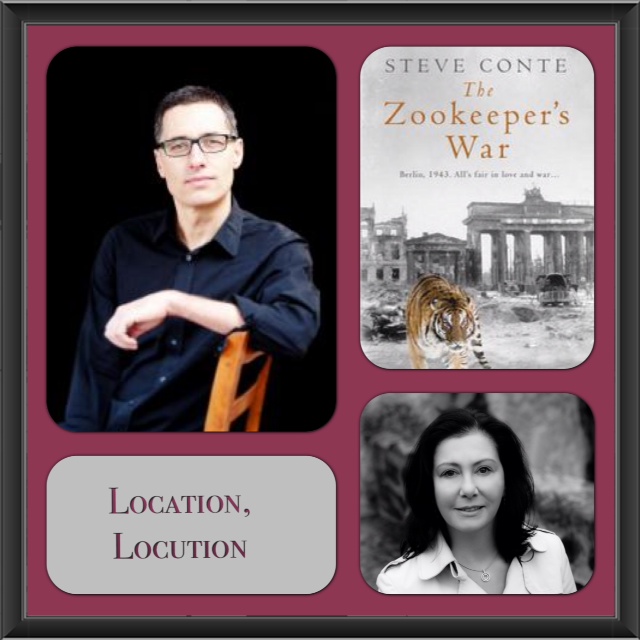
LOCATION, LOCUTION: Award-winning author Steven Conte, bringing location to life through writing

steven conte visualIn this month’s “Location, Locution”, expat crime writer JJ Marsh interviews  Steven Conte, the Melbourne-based author of The Zookeeper’s War. The setting is the Berlin Zoo, 1943. An Australian woman, Vera, and her German husband, Axel, the zoo’s director, struggle to look after the animals through the air raids and food shortages.

In 2008, The Zookeeper’s War won the inaugural Australian Prime Minister’s Award for Fiction, then worth A$100,000. The Zookeeper’s War has been published in Britain and Ireland and translated into Spanish and Portuguese. Barman, life model, taxi driver, public servant, book reviewer and university tutor are some of the jobs with which Steven has supported his writing.

*  *  *

Which comes first, story or location?
For me this depends on the project. The city of Berlin was definitely the initial inspiration for The Zookeeper’s War, in particular the atmosphere of enclosure and entrapment which I sensed there three years before the Berlin Wall came down. While I chose to set my novel in the Berlin of WWII, the Cold War tensions I had witnessed there in 1986 helped me to imagine what it might have felt like to live through the twelve terrifying years of the Third Reich. It was only after the novel was published that I realised I had chosen a setting which has powerful, indeed mythic, associations for many readers (some other examples being New York, Paris, London and, in the east, Hong Kong and Shanghai).

How do you go about evoking the atmosphere of a place?
Stimulating the reader’s senses is the most reliable way, though in a realist narrative a character needs psychologically plausible reasons to notice his or her environment, a difficult ask if focal characters are already familiar with their surroundings. Selecting a focal character who is a newcomer to the setting is one way to emphasise place. Another is to take the focal character on a journey. In The Zookeeper’s War I chose a setting which aerial bombing destroys day by day, compelling the characters to keep on noticing their surroundings.

Which particular features create a sense of location? Landscape, culture, food?
All of the above, provided that accounts of them belong in the story and ring true to the narrative voice. Ideally, descriptive detail reveals as much about the focal character or narrator as it does about setting. In contrast, “unanchored” description can sound like passages of travel writing or anthropology.

How well do you need to know the place before using it as a setting?
With skill, only moderately well, though it’s probably wise to minimise the difference between your characters’ supposed knowledge of a setting and your own. This aside, the best fiction implies more than it states (Hemingway’s iceberg principle), and a few vivid details can be enough to evoke an entire town or city or region. I’d recommend not writing about famous landmarks, since locations such as the Brooklyn Bridge, the Eiffel Tower and the Brandenburg Gate will remain clichés of place however brilliantly they might be described.

Could you give a brief example from your work which you feel brings the location to life?
In the following passage from The Zookeeper’s War the heroine, Vera, walks through Berlin the morning after an air raid:

In the Mitte, the old city, bombs had caved in the skyline, dropping telegraph poles, power lines and tram cables onto burnt-out lorries and trams. Shops were destroyed or boarded up, and glass, chunks of plaster and shrapnel paved the streets. Field kitchens had sprouted at the major intersections, and in alleys off Alexanderplatz girls were already soliciting. Outside one bombed-out tenement Vera read the chalked inscription, Everyone in this shelter has been saved. Around the corner: My angel where are you? Leave a message for your Sigi. In a house without walls on Unter den Linden, a man played Bach on a grand piano, and below him, in a lake fed by a burst water main, a fur stole clung to a hatstand. Half the people on the streets wore a uniform: police, air-raid wardens, women postal workers. Soldiers moved in squads and the only vehicles were staff cars and Wehrmacht lorries, as if the army had conquered Berlin and deployed clerks and shop assistants to the front in a fleet of private cars.

Which writers do you admire for the way they use location?
Cormac McCarthy for the poetry and grandeur of his descriptions, in Blood Meridian and The Border Trilogy, of the border regions of Mexico and the United States. Colm Tóibín for his evocation of the eroding coastline of County Wexford in his early novel The Heather Blazing. William Styron for the magnificent range of settings in Sophie’s Choice, from post-war New York, New England and North Carolina to Warsaw under German occupation and the netherworld of Auschwitz.

* * *

Readers, what did you think of Steven’s suggestions on evoking place? Next month, my guest will be Liza Perrat, author of Spirit of Lost Angels.

JJ Marsh grew up in Wales, Africa and the Middle East, where her curiosity for culture took root and triggered an urge to write. After living in Hong Kong, Nigeria, Dubai, Portugal and France, JJ finally settled in Switzerland, where she is currently halfway through her European crime series, set in compelling locations all over the continent and featuring detective inspector Beatrice Stubbs.

STAY TUNED for Tuesday’s, another installment in the life of our fictional expat heroine, Libby. (What, not keeping up with Libby? Read the first three episodes of her expat adventures.)

If you enjoyed this post, we invite you to register for The Displaced Dispatch, a round up of weekly posts from The Displaced Nation, with seasonal recipes, book giveaways and other extras. Register for The Displaced Dispatch by clicking here!

Related posts:

LIBBY’S LIFE #82 – A chilly reception

Well, here we are.

After all the trials, tribulations, tears, and tantrums, Oliver and I — and Jack, George, and Beth, of course — are finally in Our House.

Our house.  How wonderful to be able to say that again.

I can’t begin to describe the feeling of being in a house that we own, or at least pay a mortgage on, rather than being in a house owned by a sociopathic landlady with the hots for Oliver.

It’s not perfect, of course. These last few days, the northeast of the country has been sweltering in ninety-five degree constant sunshine, with no cooling thunderstorms to break the heatwave. When you live in an old, cedar house such as ours — Ours! That word again! — air-conditioning under such circumstances is a good idea. Working air-conditioning, that is: the kind that kicks in when the thermostat reaches a certain level and cools the air down again. While the AC unit we have makes a big deal about kicking in, with lots of vibrations and shaking of the foundations, it doesn’t pay much attention to the part of the process where it’s supposed to pump cold air through the house. There’s only one room where it works, and that’s the dining room with the French windows at the back of the house. In fact, the room seems to be a cold air terminus, getting all the cold air while the rest of the house has none. We alternate sitting in that room to cool down, and sitting in all the others to warm up again.

So “Replace AC Unit before next summer” figures pretty highly on the house-repair list, which is growing at an average rate of four items per day.

“I can’t see it getting any smaller,” I say to Maggie, who has popped round for one last morning coffee before she disappears to the Keys for a month. At the moment she and I are in the Cooling Stage, sitting in armchairs in the icy dining room.

“It will,” she says. “It might never disappear completely, but I’m sure the list will shrink.”

I don’t find this as comforting as she probably intends it to be.

“It was in tip-top condition when Cathy had all her faculties,” she goes on. “She was always having something or other done to it. Which reminds me…” She delves into her tote bag, and pulls out a bulging manila file. “Here’s the paperwork from Chuck.”

I take the file from her and look at a few of the most recent papers on top. There are receipts for repairs to the central heating — we’ve yet to see how the house stands up to the frigid chill of a Massachusetts winter, and the number of repair bills here doesn’t look encouraging — and yellowed instruction booklets for kitchen appliances that were state of the art in 1975. Nothing that seems relevant to the immediate tasks of unpacking our belongings from Sonoma wine boxes and cleaning every room in the house. And goodness me, there are a lot of rooms.

“I’ll go through that properly later,” I say, then ask, “Did you bring Fergus? I haven’t seen him.”

“Jack took him to play in the back yard.”

I look through the glass of the French window and nod, satisfied. That’s the other great thing about living here. Despite the house having twelve acres to its name, there’s a fenced yard that the children can safely play in. Just like the back garden at home in Acacia Drive, only twenty times the size.

“I’ll miss Fergus while I’m away,” Maggie says.

Call me slow, but it hadn’t occurred to me that Fergus wouldn’t be jaunting off to Key Largo with his new owner.

“Who’s looking after him?” I ask. “Anna?”

Maggie shakes her head. “The Pooch Hotel. I’m dropping him off this afternoon. It’s very nice, they look after the dogs well, I’m sure he’ll be fine—”

“But it’s for a month! Kennels for a month will cost you a fortune!” I’m horrified that the dog I persuaded her to take off my hands is eating into her retirement fund like this. “Why on earth didn’t you ask me to have him for you?”

Maggie wriggles in her seat. “Moving house and everything? I couldn’t possibly impose upon you at such a time.”

I smile at her, feeling a rush of affection for her that, God help me, I rarely feel for my own mother without being quickly overridden by irritation.

“You could never impose,” I tell her. “Not on me. Call the kennels this minute and cancel Fergus’s booking. Any cancellation fee will be cheaper than paying for the full month.”

She looks relieved, I think, but still goes through the ritual of “No-I-couldn’t-possibly-Are-you-sure-Well-all-right-then.”

“Of course I’m sure,” I say. “Who better to look after him than his previous owners? Jack will be thrilled. Go get his things right now, before you change your mind.”

*  *  *

I’ve been dying to hear more about Maggie’s holiday plans, ever since she told me that she was vacationing with her newly rediscovered ex-husband, Derek. But Maggie’s a private person, and there’s no point trying to wangle information out of her if she’s not ready to give it.

Today though, perhaps as a quid pro quo for me looking after Fergus for a month, she’s ready to spill the beans.

“Derek won’t be in Florida with me all the time,” she says, once she’s returned with Fergus’s basket, personalised dishes, and a mound of dog toys. She spoils him, and I hope he’s not expecting the same five-star treatment at the Patrick Pooch Hotel. “He’s only visiting for the middle two weeks. He was going to get a hotel room, but I told him that was silly, I’ve got an apartment with plenty of space.”

She sets Fergus’s dishes on the floor of the mud room — we’ve moved back into the non-airconditioned part of the house to get warm again — then straightens up.

“I only hope I won’t regret this. Forty years ago, I was ready to kill him after five minutes in his company, and here I am now, offering him two weeks in my spare bedroom.”

I’m relieved to hear he’s in the spare bedroom, given Maggie’s racy reputation of her younger days.

“I felt sorry for him, though,” she continues. “At Sara’s wedding, I mean. He’d lost his wife, Cassie, only four months before, and he seemed utterly lost. It was such a long time since I’d seen him and I was reminded of the very first time we met. In my wilder days,” she says, and laughs.

I’m standing at the sink in the mud room, washing dishes that are covered with ink from the newspaper we packed them in. I hold my breath, hoping she will tell me more and not stop with a story half told, as she so often does.

“It was quite the whirlwind romance,” Maggie says, staring out the window at the garden, although her eyes are unfocused and I can tell she’s not really watching Jack and Fergus playing on the lawn. “I was visiting the States for the first time, hitchhiking my way down the east coast. One young man stopped to give me a lift in his Corvette, then foolishly gave in to my nagging and let me drive it. Derek pulled me over for speeding.”

I cough. “Derek was a cop?”

“A state trooper. He gave me a warning, then insisted I come sit with him in his police cruiser. I thought he was going to drive me to the station and have me deported or something. Instead, he asked me out to dinner. We were married a few weeks later, and I never used my return ticket back to England. In the years after, though, I often wished I had.”

Yet here she is today, planning a holiday with her ex.

“What’s changed?” I ask.

Maggie doesn’t answer for a while.

“I suppose,” she says at last, “I’m hoping that our thirty-odd years apart have been more helpful than our five years together.”

*  *  *

When Maggie has said goodbye and gone to finish getting ready for her trip tomorrow, I call Jack and Fergus in from the garden in a futile attempt to disprove the theory that only mad dogs and Englishmen go out in the midday sun.

Jack runs himself a glass of water from the fridge then takes it into the dining room, shouting at Fergus to follow him.

“Fergus is thirsty too, Jack. He’ll be with you in a minute.”

I fill Fergus’s water bowl, and he drinks for a long time. Then he trots across the kitchen and stops at the doorway that leads into the cool dining room, where Jack is brandishing a Matchbox car at Beth and repeatedly asking her if she knows what sort of car it is. (Beth, it appears, to Jack’s disgust, does not.)

“Go on,” I say to Fergus. “Go to Jack.”

But Fergus just sits on the kitchen floor and whines.

And even when the temperature on the kitchen thermometer hits 85 degrees, he still won’t enter the beautiful — if rather chilly — dining room.

.

Next post: LIBBY’S LIFE #83 – Letters from afar

Previous post: LIBBY’S LIFE #81 – Send the past packing

Read Libby’s Life from the first episode.

Want to read more? Head on over to Kate Allison’s own site, where you can find out more about Libby and the characters of Woodhaven, and where you can buy Taking Flight, the first year of Libby’s Life — now available as an ebook.

STAY TUNED for next week’s posts!

If you enjoyed this post, we invite you to subscribe for email delivery of The Displaced Dispatch, a round up of the week’s posts from The Displaced Nation. Sign up for The Displaced Dispatch by clicking here!

Image: Travel – Map of the World by Salvatore Vuono / FreeDigialPhotos.net; “Suitcase” © Tiff20 at Dreamstime.com – used under license; portrait from MorgueFile

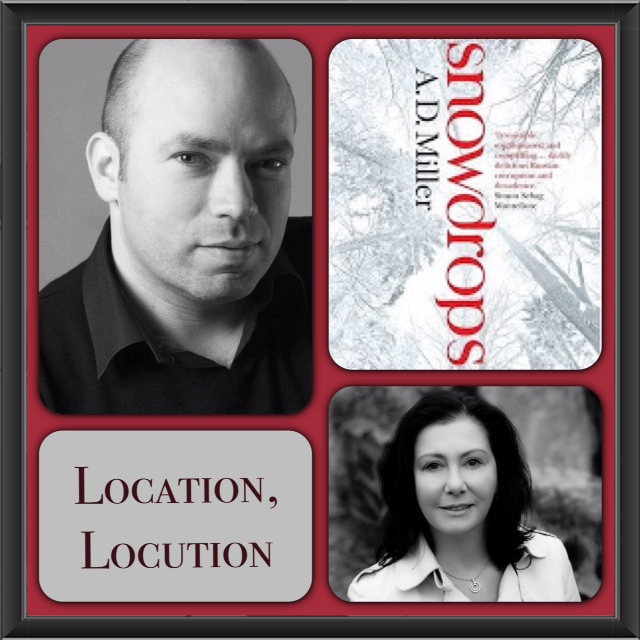
LOCATION, LOCUTION: Booker Prize-nominated author AD Miller, on bringing a location to life through writing

ADMillerIn the second of our series “Location, Locution”, expat crime writer JJ Marsh interviews AD Miller, the British author and journalist.

About AD Miller

AD Miller was born in London in 1974. He studied literature at Cambridge and Princeton, where he began his journalistic career writing travel pieces about America. Returning to London, he worked as a television producer before joining The Economist to write about British politics and culture. In 2004 he became The Economist’s correspondent in Moscow, travelling widely across Russia and the former Soviet Union. He is currently the magazine’s Writer at Large; he lives in London with his wife Emma, daughter Milly and son Jacob. He wrote a critically acclaimed non-fiction book, The Earl of Petticoat Lane, in 2006. His second novel, Snowdrops, was shortlisted for the 2011 Booker Prize.

About his novel, Snowdrops

A fast-paced drama that unfolds during a beautiful but lethally cold Russian winter. Ostensibly a story of naive foreigners and cynical natives, the novel becomes something richer and darker: a tale of erotic obsession, self-deception and moral freefall. It is set in a land of hedonism and desperation, corruption and kindness, magical hideaways and debauched nightclubs; a place where secrets, and corpses, come to light when the snows thaw.

Q&A on Location, Locution

JJ Marsh: Which comes first, story or location?  
AD Miller: Story. But locations can be suggestive of certain kinds of story. For example, Russia lends itself to tales of moral challenge and to philosophical inquiry.

JJM: How do you go about evoking the atmosphere of a place?
ADM: Take notes. Write down what people wear on the Metro and what the vendors on commuter trains are selling. You will recollect less than you think you will. For historical settings, read old newspapers and unpublished memoirs. Remember it is the inconsequential detail that is most important.

JJM: Which particular features create a sense of location? Landscape, culture, food?
ADM: Smell. Sounds. Language (especially slang and proverbs). Clothes. And weather: in Snowdrops, the Russian winter functions as a sort of ancillary sub-plot.

JJM: How well do you need to know the place before using it as a setting?
ADM: You need to know it, and then you need to unknow it. A novel isn’t a travelogue or an encyclopaedia; you enlist only those aspects or details of a place that serve the narrative.

JJM: Could you give a brief example from your work which you feel brings the location to life?
ADM: There’s a passage in Snowdrops in which Nick, the narrator, is taxiing at night alongside “the soupy Moscow River, not yet frozen and curling mysteriously through the wild city”, which is OK.

JJM: Which writers do you admire for the way they use location?
ADM: Isaac Babel and Giorgio Bassani (Odessa and Ferrara respectively).

* * *

Thanks, JJ, for that fabulous interview! Readers, any comments on what AD Miller had to say? Up next month in Location, Locution: Steven Conte, Australian author of The Zookeeper’s War.

JJ Marsh grew up in Wales, Africa and the Middle East, where her curiosity for culture took root and triggered an urge to write. After living in Hong Kong, Nigeria, Dubai, Portugal and France, JJ finally settled in Switzerland, where she is currently halfway through her European crime series, set in compelling locations all over the continent and featuring detective inspector Beatrice Stubbs.

STAY TUNED for tomorrow’s post, another installment in the life of our fictional expat heroine, Libby. (What, not keeping up with Libby? Read the first three episodes of her expat adventures.)

If you enjoyed this post, we invite you to register for The Displaced Dispatch, a round up of weekly posts from The Displaced Nation, with seasonal recipes, book giveaways and other extras. Register for The Displaced Dispatch by clicking here!

Related post:

LIBBY’S LIFE #81 – Send the past packing

The best thing about moving to a house only a mile and a half away is that you can do your own packing and take the boxes there yourself.

And the worst thing about moving to a house only a mile and a half away is that you can do your own packing and take the boxes there yourself.

Chuck, you see, nice, reasonable man that he is, has given Maggie the keys to his mother’s house and told us to move our stuff in before the official handover date. “Make things easy for yourself,” he said.

Fantastic — or so Oliver and I thought at first. We could take our time and move everything in stages, starting with the least critical items. But after a couple of days of wrapping china in newspaper and getting our hands and clothes covered in printer’s ink, we began to see why most sensible people fork out a big pile of dollar bills and pay someone else to do it.

We used cardboard wine crates from the local liquor store to pack everything in, then, after only four trips over to the house with the car filled with Napa Valley Cabernet Shiraz boxes, Oliver announced he was leaving for a business trip to Vancouver.

“I’ll be back on the eleventh,” he said. “That gives us four days to get everything together. No problem! Piece of cake!”

What, pray, does Oliver know about cake? About as much as he knows about packing, I’d say.

Before he went, we’d barely made a dent in it — packing, not cake — and now, with less than a week to go before we hand the keys back to Melissa, it’s all down to me to pack the rest up and move it across town. Not the big important pieces like bed, chests, tables, or sofas, you understand, but the fiddly, inconsequential things like clothes, toys, non-perishable food, ornaments, books, CDs, Oliver’s extensive collection of rocks and dead beetles that he catalogued when he was twelve and can’t bear to throw away…

Piece of cake. Right.

“I’ll help,” Maggie said to me, after she saw Oliver trundling his carry-on case towards the taxi marked Airport Shuttle Service.

I protested out of politeness, but not enough for her to change her mind.

“No, I insist,” she said. “It will take you twice as long on your own to transport the boxes, because you will have to take the children with you. This way, I can stay with the children while you drive over to the house on your own.”

Well, when she puts it like that… Sometimes a girl has to take whatever kind of me-time she can get.

* * *

Maggie sits on the floor of our living room and wraps up a Dresden china figurine in the sports section of the Boston Globe. I don’t like the ornament, and one part of me is hoping that it will get broken in the move, “accidentally”, of course. My mother’s aunt gave it to us for a wedding present, and while it was very kind of her, Dresden china isn’t our style. Great Aunt Esther might as well have given us a set of antimacassars or an aspidistra.

“Chuck left me a big folder of paperwork relating to the house, to give to you.” Maggie carefully places the Dresden in a cardboard crate and moves onto the next item — a pair of Wedgwood candlesticks from my grandmother. “Old paperwork. Old deeds, plans, that kind of thing.”

“Oh yes?”

I confess, I’m not paying too much attention to Maggie. I’ve just found Oliver’s badminton racquet case with the stuffed tiger in it, and I can’t help but remember the awful chain of events it precipitated last year, shortly after the twins were born.

“Mmm. I haven’t looked at it, because the house will be yours, not mine, but it could be interesting. For example, while the official date of the house is 1830, I remember Cathy saying that she thought there might have been another building there before. Something to do with the basement being only a few feet high and her not being able to stand upright in it. I’m not sure what her reasoning was, but maybe you’ll find the answer in the folder.”

I jam the badminton racquet and all its emotional baggage in a suitcase.

“Your friend Cathy must have been very tall, then,” I say. “The basement’s like any other. Dark, creepy, and full of noisy machinery. I can stand upright in it, no problem.”

“No, not that part. I mean the part behind the furnace.”

Maggie falls silent, and at first I think she’s admiring Granny’s Wedgwood candlesticks, but then I realize she’s been distracted by the packing paper and is reading about the dramatic arrest of a New England Patriots player accused of murder.

I think hard about the basement in the house we’re buying. I remember the furnace, because it was surprisingly new in such an old place. But it was next to a wall. There was no more basement space behind it.

I tell Maggie this, and she tears herself away from the gory details of local sports scandals.

“Oh no, you can’t see it now. Cathy had some work done on the house, back in the late seventies. Had the basement sealed off behind the furnace, because it was neither use nor ornament since you had to bend over double to get in there.” She places the Boston Globe-wrapped candlesticks in the box with the Dresden shepherdess. “Or at least, that’s what she… Goodness me, are these your wedding photos?”

She holds up a cream suede album.

“May I look?” she asks.

I wave my hand graciously. “Be my guest.”

I’ll have to put her in charge of the mugs and glasses. She’s too easily distracted. Still, this has reminded me of something.

“You never showed me the photos of your daughter’s wedding at Christmas,” I say, and wait as she slowly turns the pages of our album. She’s stalling for time, I think. “You promised you would, and then forgot. And we won’t have time next week what with moving, and the week after that you go to the Keys for a month.”

She looks up from the photos. She’s on the page where Oliver and I have our hands on the knife, ready to cut the wedding cake. It was a traditional, heavy fruit cake, and I recall thinking at the time that a circular saw would have been more useful than that dinky, ivory-handled cake knife.

“After we’ve finished packing for the day, how’s that?”

She sounds rather strange, I think. And I’d bet a lot of money, or at least a Dresden shepherdess and a couple of candlesticks, that she’s hoping I’ll have forgotten by the end of the day.

* * *

I make five trips to the house on Main Street, and by the end of the fourth, the sun is bobbing along behind the trees, and the children are getting cranky. To make it easier for Maggie, who is also looking tired and cranky, I decide to take Jack along with me for the last trip. He’s very excited at seeing the new house again, and wants Fergus to come along too, so we have a little family outing — me, Jack, and Fergus — which makes me feel strangely nostalgic, because it’s how we used to be in Milton Keynes, before America and before the twins were even thought of.

At the new house, I dump the boxes with all the others in the living room while Jack and Fergus play in the back garden, then I walk down the hallway to the dining room at the back of the house. The room has French windows that open out into the garden — or at least, they should open out but they’re stuck together with many layers of paint. I knock on one of the small panes at Jack, and beckon him to come back in the house.

After a few seconds I hear his running footsteps on the wooden floor, and he bumps into me as I’m closing the dining room door. He’s alone.

“Where’s Fergus?” I ask. Fergus, now that he no longer lives with us, slavishly and perversely follows Jack around whenever they’re together.

Jack points. “He’s tired.”

Fergus is lying down next to the open front door at the other end of the hallway.

“Fergus! Here, boy!”

He sits up and whines softly, but doesn’t move any nearer.

“Guess that’s a hint that he’s had enough house-moving for today,” I say to Jack. “You know what? I know exactly how he feels.”

* * *

Back at Juniper Street, I deliver Fergus to Maggie, and she murmurs something about turning in for the evening, but I’m not letting her off that easily. I remind her of her promise to show me Sara’s wedding photos and how she’s off to Florida for a month, so she trots over to her house to get them.

When she returns, I have to stop myself from snatching the album out of her hands. I’ve heard so many rumours about Sara Sharpe, this mystery woman of Woodhaven, that I’m dying to see what she looks like. A femme fatale, I imagine… The sultry looks of Nigella Lawson and the seductiveness of Greta Garbo.

I’m disappointed. She’s serious-looking, her hair dark and smooth, as severe as a ballerina’s. On most of the photos, she wears a little frown as if she’s thinking very hard about what she’s doing — and, let’s face it, you shouldn’t have to think hard about a wedding on a beach in the Seychelles. She looks absolutely nothing like Maggie.

“No,” Maggie says. “She’s the image of her father, that’s what she is.” She points at a man in the photo. “Him. Derek. My ex-husband, whom I hadn’t seen for over thirty years until that day.”

“That must have been awkward,” I say. I try to imagine meeting Oliver for the first time in thirty years at Jack’s wedding, and fail utterly. “I suppose that’s one advantage of Sara being an only child. You won’t have to meet him again.”

I hand the photos back to Maggie, and I see that her face has turned pink.

“Are you OK?” I ask. “Do you want me to turn the air conditioning up?”

She shakes her head.

“No, I’m fine.” She throws her pashmina around her shoulders and stuffs the photos into her handbag. “It was, as you say, a little awkward meeting Derek again.”

She looks down, fiddling with the clasp on the bag. “He’s widowed now, poor man. I never liked my replacement, but he obviously did. I felt sorry for him.”

“Not your problem any more, though, right?”

Her face goes a bit pinker.

“I might as well tell you, Libby. My vacation in Florida — I’m spending it with Derek. My ex-husband whom I divorced in 1976.”

.

Next post: LIBBY’S LIFE #82  – A chilly reception

Previous post: LIBBY’S LIFE #80 – A place of our own

Read Libby’s Life from the first episode.

Want to read more? Head on over to Kate Allison’s own site, where you can find out more about Libby and the characters of Woodhaven, and where you can buy Taking Flight, the first year of Libby’s Life — now available as an ebook.

STAY TUNED for next week’s posts!

If you enjoyed this post, we invite you to subscribe for email delivery of The Displaced Dispatch, a round up of the week’s posts from The Displaced Nation. Sign up for The Displaced Dispatch by clicking here!

Image: Travel – Map of the World by Salvatore Vuono / FreeDigitalPhotos.net