The Displaced Nation

A home for international creatives

Tag Archives: Expat novelists

LIBBY’S LIFE #35 – A big piranha in a small pond

Even a week after the ultrasound, I can hardly take it in. Twins? Me?

I phoned Mum to tell her about it, of course, and regretted it immediately. She means to be helpful and encouraging, but it never works out that way.

“You’ll probably have a Caesarian,” she said, sniffing. “Everyone does in America, from what I’ve read. But it runs in families, you know, twins. Auntie Doris, my grandmother’s cousin, she had twins. At least, I think she was a cousin.”

Or possibly not related at all. Grandma-Great was from a generation that called all older females Auntie.

“Was everything OK?” I asked. “We must be talking pre-National Health Service here.”

“Heavens, yes. Auntie Doris outlasted Grandma by ten years.”

“I meant the twins.”

“Oh, I see! Well, it was New Year’s Eve. The midwife had had a bit too much gin by the time she got to Doris’s house, and passed out on the floor at a critical moment. Uncle Harry was down the pub, as men did back then, so he was no help, and the twins didn’t survive into January. But since yours are due in May, I’m sure they’ll be fine.”

You see? This is my mother’s idea of making me feel better. I can never decide if she was always like that, or if forty years of marriage with dad has taken its toll.

“It’s OK, Mum. I don’t think nurses are allowed to turn up drunk to work nowadays, whether it’s a bank holiday or not. They get sacked, and sued, and stuff like that.”

“You say that, but only last week in the Daily Mail, I read about a Romanian nurse in London – ”

“If you’re going to start quoting Daily Mail hysteria at me, I’m going to put the phone down. I need to take Jack to nursery school anyway.”

“How’s he doing there? Does he like it? I don’t think it’s right, sending little ones off to school when they could be at home with their mummies.”

I rolled my eyes and started to tell her that of course he liked it there – then stopped. Last week he’d twice had a tantrum when I left him there. And yet before Christmas, he was going happily. Maybe it would take him a few days to get him back into the routine after the Christmas break.

“He’s fine,” I said, crushing the little niggle of doubt.

All the same, I thought, as I put the phone back in the charger, I would have a word with Patsy, his teacher.

* * *

I’ve tried to avoid Patsy as much as possible since Jack started at nursery. It’s partly because I still have nightmares about being roped in for Play-Doh sessions with Playgroup Mafia Mums, and partly because I sense she doesn’t like me. Or at least, she thinks I’m not worth spending time on.

How do I know this? Because I know the sort of girl that Patsy Traynor used to be at school.

She was the one with lank hair and unfashionable clothes, who used to tag along with the pretty, popular, calculating girls. She’d hang on their every word, laugh at every unfunny, airhead comment they made, massaging their already inflated egos and trying to be their best friend. In return, they would let her think she was a friend, but in reality they were keeping her on a string, waiting for the day when she might be useful in their social-political games. The sad thing was, everyone knew this except Patsy.

Now that she’s grown up, you’d think she might be wiser – but no. She has her favourites among the mothers – those who are disgustingly well-off, those who display potential PTA leadership qualities, those with interesting quirks to set them apart (but only in a good way; tattoos and body-piercings don’t count except negatively) – and as I have none of these traits, I’m an also-ran in Patsy’s eyes. Thankfully, Jack talks about “Miss Patsy” with enthusiasm, so I hope her disdain for mediocre parents doesn’t extend to their mediocre children.

When I arrived at the school, she stood in the classroom, chatting to another mum. I caught her eye, mouthed “Hello” and raised my eyebrows to indicate that I needed to ask her something, but my body language was lost on her. She had already turned back to the mum who, even by looking at the back of her perfectly highlighted head, I could tell was just the type with whom Patsy would have ingratiated herself thirty years ago.

I helped Jack take off his coat, but instead of wandering across the room to play in the toy bus as he had done before Christmas, he stayed close to me, staring warily around the classroom.

“Don’t you want to go and play with your friends?” I asked.

He clutched the hem of my jacket and shook his head.

I bent down to his level. “Why not?”

He glanced around again, put his mouth to my ear, and whispered, “Tom.”

“Tom?” I was bewildered. Tom was a little fair-haired boy with glasses and a lisp, incapable of anything more frightening than swatting at Jack with a Milky Bar. “What has Tom done to you?”

Jack shook his head and wouldn’t elaborate further.

What on earth am I doing, having two more children? I can’t comprehend the one I’ve already got.

I decided to be firm.

“Whatever Tom has done, I’m sure it can’t be that bad.” Could it? These boys were only three, after all. “And if you have any trouble with him, you tell Miss Patsy. That’s what she’s there for.”

Jack nodded uncertainly, then wandered off to the Transportation Play Area (translation = toy cars on a frayed rug) where, to my exasperation, he began to race Hot Wheels cars with the very child he’d complained about.

But since I was here, I’d have a quick word with Patsy and mention my concerns about Jack’s reluctance to go to school. She was still chatting, and as I lingered nearby waiting to speak, I realised the other mother had an English accent.

Patsy glanced at me and I heard her say, “This lady here is also British. I think I’ve seen your son playing with her little boy.”

The mother turned around, and I saw with a shock that it was Caroline, the pregnant tiger-mom discussing 4-carat diamond earrings at a coffee morning last July, whom I’d last seen at the Christmas party looking puffy and tired.

No puffiness now, though. She could have been an advertisement for Chanel’s Spring Maternity Collection.

“We’ve met,” she said to Patsy. “Two British mums, both expecting! When are you due, Libby?” She shot a look at my stomach. “Very soon, I do believe…next month, is it?”

You know, it’s fine for me and Oliver to make fun of the size of my bump. But it’s not at all fine for some superior tiger-mum to do it, especially when I distinctly remember telling her my due date at the Christmas party.

I smiled with as much sweetness as I could manage. “May.”

“You poor thing! So huge, and still four months to go! You should get your husband to send you to this marvelous spa in Vermont that I went to at Christmas. I went there with swollen ankles, had seaweed wraps every day, and came out ten days later like this.”

She pulled her trouser leg up a little way to reveal one defined, bony ankle above shoes that she and only Victoria Beckham would wear in late pregnancy.

“I’ve only got another three weeks, thank the lord. I think I’d kill myself if I had four months to go.” She laughed, then abruptly stopped as a small boy charged across the room and head-butted her three times in the thigh, making her wobble slightly on those ridiculous heels. “Dominic, sweetheart, remember what we talked about this morning, about making good choices? Do you think that was a good choice?”

“Yes!” the monster shouted, and raced off again.

“Oh dear.” Caroline sighed. “He’s so boisterous. But I believe in letting children be children, don’t you?’

Umm, no. Children are like weeds. Without due care, vigilance, and regular cutting back, they grow out of control. But you can’t say things like that any more, otherwise you’re not being “supportive”.

Pasty put her hand on Caroline’s arm. “Don’t worry about it. Or, you know, the other issue. The other mother was quite certainly exaggerating, and the school felt they had to make an example of him – quite wrong, in my opinion. Bullying isn’t a problem among three-year-olds. It’s always the parents, believe me – certain types of parents, anyhow. I’m glad you chose this school for him. He’s settled in very well.”

Interesting. Could I infer from this that Caroline, a new parent at this nursery school, had been forced to withdraw her child from another? She’d be all right here, I could tell. She was on Patsy’s list of VIP parents already. Amazing what a big rock in each earlobe would do.

“Libby, did you want to speak to me?” Patsy asked. “We can talk briefly now, or if it’s not urgent I’d be happy to see you after school one day next week.”

Caroline didn’t attempt to move away, and I didn’t feel like discussing Jack’s problems in front of her. “After school on Monday would be fine,” I said.

As I turned away, Caroline’s monster-child ran up behind her again, this time knocking her into Patsy’s arms.

“Dominic!”

It wasn’t quite a shout from Caroline, but it wasn’t far off. She went a little red, presumably embarrassed to be caught not allowing her child to be a child.

“Boys will be boys!” Patsy sang. “Well, time for school. Goodbye, ladies.”

As Caroline and I walked out to the car park, Caroline said, “I’d appreciate it if you didn’t mention anything about what Patsy and I were talking about. To the other Brits, I mean. Some of those women like nothing better than to bad-mouth Dom. Jealous, I suppose.”

Jealous of what? I wondered as I watched her drive away. Diamond earrings that could be cubic zirconia? Give me a break.

Then something else registered. Tom…Dominic…Dom. Dom? Is that what Jack had been trying to tell me, that someone called Dom was making his life hard?

I wasn’t on Patsy’s VIP list. With her shiny hair, sparkly earrings and posh accent, on the other hand, Caroline most definitely was.

Oh dear. Poor Jack.

To be continued next week

.

Next: LIBBY’S LIFE #36: Filthy cash, dirty deeds

 Previous: LIBBY’S LIFE #34: Shadows on a screen

Click here to read Libby’s Life from the first episode

STAY TUNED for another post from TCK Lawrence Hunt.

If you enjoyed this post, we invite you to subscribe for email delivery of The Displaced Dispatch, a round up of the week’s posts from The Displaced Nation. Sign up for The Displaced Dispatch by clicking here!

Image: Travel – Map of the World by Salvatore Vuono / FreeDigit

LIBBY’S LIFE #34 – Shadows on a screen

After a Christmas far away from her family, Libby is wondering if she is ready to face the new year without her loved ones. The foods she has been forced to abandon, that is.

Happy New Year!

A bit late, I know. It takes me a few days to get into the ‘Happy’ part. Until then, it’s just another month of winter, minus whatever food or beverage I’ve resolved to give up.

This year was different because I’d given up every nice food or beverage already, hijacked as I am by this alien growing in my midriff. Brie, prawns, coffee, every type of alcohol – you name it, and I have sacrificed it at the altar of pregnancy, although I’m thrilled to report that my taste for tea has unexpectedly returned. But give up chocolate for New Year? I think not. Not with Pinot Noir off the menu for another five months or more. Pass the Cadbury’s – lots of it, and now.

So, here we are in 2012, the year of our second child’s birth. I will be so happy to be rid of this bump. Have heard that babies get bigger the more you have of them, but I always imagined the increments would be more gentle. This one already has the proportions of a fully grown Oompa-Loompa. Still, twenty-two weeks down, eighteen to go, assuming this baby gets out of bed on time, unlike its brother who would have been happy to stay there until his peers were taking A-levels.

In a couple of hours, though, I will be able to stop calling it “it” or “this baby” because it will have a gender and proper name. (More on the dilemma of name choices later. I’m convinced it’s a girl, who is therefore going to be called Megan. Oliver is only contemplating a boy called Sam.) Oliver and I – obviously I, but we’re taking joint ownership of this pregnancy seriously – are going for our first ultrasound scan. I was supposed to go a few weeks ago, but what with Thanksgiving and Christmas and falling off ladders while decorating fir trees, I didn’t quite get round to it.

Such is the cavalier attitude of a second-time mum. Dr. Gallagher’s receptionist was horrified to find I’d only seen a doctor twice in half a pregnancy. I don’t know why. The baby is still there, isn’t it? It’s not as if I’ve put it down somewhere and forgotten it. Although I did that once with Jack when he was a few weeks old in his car seat. I went to Sainsbury’s cafe with Mum, put Jack on the floor next to the table, drank coffee, got up to clear the trays away, and…left.

But the important thing is I came back. The lady wiping the tables down was all set to ring social services, or so she said. Mum tipped her ten quid, and she shut up, but I always went to Morrison’s cafe after that, just in case she wanted another ten quid.

Oops. Time to leave for our appointment.

* * *

Tapping at a computer keyboard with her left hand and staring intently at the monitor’s mass of swirling, indecipherable grey shapes, the technician runs the gelled transducer over my bulging middle. She’s warmed the gel, so the pressure is not an unpleasant sensation, although the baby doesn’t agree and I feel a gentle kick of protest from within. It’s still very gentle, not much more than a flutter really, but it’s there all right.

The technician mutters to herself and types in numbers as she measures and remeasures the distance between various blobs.

“They’re very thorough over here, aren’t they?” I say in a low voice to Oliver, who is also concentrating on the picture on the screen. “I swear Jack’s ultrasound didn’t take this long.”

Oliver looks at me, a little cleft appearing between his eyebrows. “You’re right. It didn’t.” He clears his throat and raises his voice. “Is everything – you know, all right?” he asks.

The technician stops tapping the keyboard and moving the transducer. She smiles at Oliver and then briefly at me. She doesn’t look me in the eye.

“It looks…fine. So far,” she says carefully.

I don’t like her tone. She’s hiding something.

A couple of seconds later, she snatches up a handful of tissue paper, scrubs some gel off my abdomen, and covers me up with a sheet, which after two seconds feels cold on my skin, gooey from the residual gel.

“I’ll be back in a few minutes. I just need to speak with the doctor.” She pauses. “You say you’ve only had two checkups with your doctor so far in this pregnancy?”

I nod, not trusting myself to speak because of the lump of fear swelling inside my throat.

As she shuts the door behind her, I turn to Oliver and whisper, “What does she mean, she needs to speak with the doctor? Does that mean there’s something wrong?” Thoughts of my unknown sister, who survived only four hours, rush around my brain.

I’m willing Oliver to say something reassuring in his usual bluff way – “Don’t be silly, Libs, of course there’s nothing wrong! She said so!” – but he doesn’t.

He looks at me, then at the screen with the frozen picture of what I assume is a part our baby’s anatomy – a leg? A heart? Healthy? Not? – and says, “I don’t know.”

Neither do I. So much for a mother’s instinct.

And here’s the thing.

Despite all my brave declarations that nothing would change my feelings toward this child if it turned out to have a disability like my sister did, I find myself praying and bargaining with a god I don’t believe in.

Please let my baby be OK. Please let my baby be OK. I’ll be nice to Sandra. I’ll stop shouting at Fergus. I’ll even be nicer to Melissa if you let –

The door to the exam room opens and the technician walks back in, her white shoes making squelchy noises on the grey tiled floor. Behind her, in a white coat, is a tall, athletic man who looks as if he should be playing basketball rather than messing around with medical Photoshop. “Dr Holden,” his white coat says above the breast pocket, in blue italic embroidery.

The two medics go into a huddle in front of the computer monitor, checking numbers and flicking between images. I can’t make out what they are saying, let alone understand it.

I gaze at Oliver, then squeeze my eyes shut as he reaches for my hand and we lace fingers, as if by doing so we can weave a magic spell that will make everything all right, the same as everything was two hours ago.

“Mrs Patrick?”

I open my eyes in surprise. The doctor’s voice is high and reedy for someone of his build, and in another situation I would have laughed.

He looks from me to Oliver, and I see he understands what we’ve been thinking.

“There’s nothing to worry about,” he says. “Really. Nothing is wrong.”

I close my eyes again, this time in relief, and feel two tears slide down either side of my face toward my ears.

“But all the same,” his voice goes on, “this news may take a little time to get used to.”

* * *

I collapse onto our sofa. “Tea,” I say in the weak quaver of someone demanding water in the Sahara.

Oliver, like the well brought up English husband he is, heads to the kitchen to turn on the kettle.

A perfunctory knock at the front door is followed by Maggie bursting into the house with Jack, who rushes at me for a hug.

Murmurs and a little cry of surprise from the kitchen as Oliver tells Maggie our news.

Maggie brings in my mug of tea and sits beside me on the sofa. With difficulty, I lift Jack off my lap and sit him on my other side.

“Darling,” says Maggie. “Oliver’s told me all about it. What a shock.”

I nod.

“But in a few days, it won’t be.”

I start to sob, because “shock” doesn’t begin to describe my feelings, and I try to double over – but my bump is in the way. No wonder.

“I could have coped with anything but this! Three thousand miles from my mother, and Oliver keeps going on business trips…and that bloody dog…”

“Shush,” says Maggie. “I’m here. You have me.”

I sniff.

“And on the bright side,” Maggie says softly, “your mother-in-law is not here.”

I sniff again, and this time it’s more like a snort of laughter.

“And it is a cause for celebration, of course,” she persists.

I fumble in my pocket for a tissue, wipe my eyes, and noisily blow my nose. “Yes.”

“A toast, then?” Maggie gestures at the wine rack.“Just one?”

I look longingly at the bottles of Pinot, but pick up my mug of tea instead.

“No. I feel as if I’ve cheated Fate once today. Wine might be pushing my luck.”

Besides, I’ve read about these American pregnant women who get labelled as child abusers just because they ordered half a Bud Lite in a bar.

Oliver comes in with mugs for Maggie and himself, and a sippy cup for Jack.

Maggie raises her mug. “A toast, then! To…do we have any names?”

I glance at Oliver and smirk. “Sam.”

He clicks his Batman mug against my Toy Story one. “And Megan.”

“Sam and Megan,” we chorus, and sip tea politely.

I sigh. Typhoo it might be, but Pinot it is not.

“Somebody pass me the Cadbury’s,” I say. “Lots of it, and now.”

.

Next: LIBBY’S LIFE #35: A big piranha in a small pond

Previous:LIBBY’S LIFE #33: Fairytale of New England

Click here to read Libby’s Life from the first episode

STAY TUNED for Friday’s post – a summary of tweets on this month’s theme!

If you enjoyed this post, we invite you to subscribe for email delivery of The Displaced Dispatch, a round up of the week’s posts from The Displaced Nation. Sign up for The Displaced Dispatch by clicking here!

Image: Travel – Map of the World by Salvatore Vuono / FreeDigit
LIBBY’S LIFE #27.5 — A Halloween rehash

Greetings, Libby fans! If you’ve been following The Displaced Nation this week, you’ll know that we hashed our Halloween post because the writer — Libby’s creator, Kate Allison — went mysteriously missing. Thankfully, she hasn’t done an Agatha Christie, as Libby had feared, but is the victim of a freak snowstorm that left her without power. In a short communication of yesterday (from a McDonald’s near her house), Kate requested that we rehash Libby Life #9 because of the rather garish outfit sported by Libby’s mother-in-law. She thought it might compensate in some way for the post she was meant to do on “Halloween costumes for expats.” And perhaps it will also be a good chance for new Libby fans to catch up with what her life was like before she reached Woodhaven, and for her older fans, to indulge in some nostalgia?

The story so far: The Patrick family — Libby, Oliver, and their three-year-old, Jack — are in the process of moving from England to Massachusetts. Libby is now looking forward to the move but Oliver has developed cold feet, although he hasn’t been brave enough to tell his employer’s HR department — at least, not yet. Meanwhile, Libby has horrible suspicions that her nutty mother-in-law, Sandra, is about to move into their neighbour’s house. If Libby needs to pull out the stops to persuade Oliver that a transatlantic move is a good idea, now might be a good time.

To Sandra’s for tea.

We do this regularly. I don’t mean afternoon tea with fairy cakes, or mid-morning tea with a biscuit, but tea as in beans on toast, or egg and chips if she’s feeling ambitious. Oliver likes going to his mother’s for tea, even though I’m quite capable of rustling up beans on toast, but apparently there’s something about his mother’s cooking that I can’t compete with. I don’t know what it is. Maybe I don’t buy the same cheapo brand of baked beans, or maybe it’s because I’m left-handed and open the tin the wrong way. It’s a kitchen mystery that not even Miss Marple or Gordon Ramsay could solve.

Still haven’t voiced my suspicions to Oliver about his mother’s impending move to number sixteen. Although it’s my nightmare, I have a horrible feeling Oliver would like the idea and we’d be forced round there four times a week for school lunch.

The good thing is that he hasn’t said anything to his employer about his own doubts over our own move. I suppose if he comes out and says he doesn’t want to go, he will appear to lack company commitment, and look like a big wuss into the bargain, so for the moment, everything’s going ahead, even though Oliver is regretting his initial gung-ho spirit and fresh-lobster-worship .

So, off we went to Sandra’s. We took Boris The Spider with us, his little glass cage sealed in two black dustbin bags in case he escaped into the car boot. He’s been living behind the sofa where I can’t see him, and now I need to Hoover behind it because Jack’s been sprinkling squashed digestive biscuits all over the spider tank, so it’s time for Sandra to repossess him. Oliver started to object, saying it would hurt Sandra’s feelings, but stopped when I said that if the arachnid stayed, I’d see to it that he ended his days Cambodian-style, deep-fried, in the local Chinese takeaway that keeps getting prosecuted for dodgy hygiene standards. So Boris came along, without a murmur from Oliver.

It was all so easy that I’m considering making similar threats about Fergus.

When we arrived at Sandra’s house, the whole street was shaking. Not from an earthquake, but from Sandra’s hi-fi. She plays it loud. Sometimes it’s Mahler, sometimes it’s the Rolling Stones, sometimes it’s the Grateful Dead.

Today it was Lady Gaga, and Sandra was dressed to match.

If you’ve never seen your mother-in-law frying eggs while she’s dressed in hooker heels, Marks and Spencer’s bikini, and makeup that’s less Lady Gaga than Alice Cooper — think yourself very, very fortunate.

No wonder she’s moving house. Her present neighbours must have clubbed together for the deposit.

Oliver raised his eyebrows, but carefully avoided looking at me. Jack gawped at his granny, then buried his face in my neck and refused to let me put him down.

“Are you going to get dressed, Mum?” Oliver asked. “It’s probably not a good idea to fry eggs if you’re only wearing a swimming costume.” He gestured at his own midriff. “Hot oil splashes round there – it might sting a bit. The weather’s cooling off outside, too.”

Oliver’s a big noise in Customer Relations at his company, and I can see why. You don’t live thirty-four years with Sandra for a mother without learning something about tact.

Sandra beamed at him and pinched his cheek, then Jack’s, who had lifted his head to see if the apparition in streaky eyeliner was still there.

“I’ll just pop upstairs. Back in a minute.”

Oliver crossed the kitchen to the cooker and removed the frying pan from the heat.

“Do you think she’s…?” He jerked his head in the direction toward the stairs, where Sandra had gone. “You know. Going prematurely senile?”

I’m not in Customer Relations, and never could be. “She’s always been like that, Oliver. There’s no ‘going’ about it.”

He chewed the inside of his cheek. He does that when he’s worried. Bless him. I know I moan, but he only wants the best for everyone.

“I worry about what will happen to her when we go to America. I keep thinking I agreed to this move without thinking about it.”

Like mother, like son.

“You’re not your mother’s keeper, love,” I said, trying to find the right words. “She’s a grown woman, more capable than you think. And there are worse things than us moving to Boston for two years, you know.”

“Such as what?” Oliver asked, but was interrupted by Sandra coming back to the kitchen wearing a denim mini skirt and a T-shirt from French Connection that said FCUK on the front.

“What that say?” Jack demanded, pointing at Granny’s chest.

I’ve been teaching Jack his letters. He likes copying words around the house, like “Sony” from the TV, or “Dell” from the computer. Quite often he gets the letters mixed up, but he likes to treasure his masterpieces and show them to Carol Hunter at playgroup.

I rummaged in the drawer where Sandra keeps her tea towels and aprons, and handed her a PVC Union Jack apron. “You don’t want to get oil splashes on your nice T-shirt, either,” I said.

*

“We brought Boris The Spider back,” Oliver said over our egg and chips. “Jack’s allergic to him.”

Jack’s nothing of the sort, of course, but Sandra can’t dispute it one way or the other. All children have allergies now. It’s the law.

Sandra waved her hand dismissively. “I’ll give him back to Petra. Not to worry. I’ve got bigger things to think about.”

Oliver and I exchanged glances. Normally she’d have had a meltdown at this point and we’d have to reassure her that our rejection of her gift was not a rejection of herself.

“Is this the surprise you were talking about the other day?” he asked.

Sandra leaned toward us over the kitchen table.

“I’ve been trying to keep it a surprise until everything’s signed and sealed, but you know me. Can’t keep good news to myself.” She paused. “You know that house near you? Number sixteen? I’ve bought it.”

Silence from Oliver. Silence from me, as I wondered what Oliver would say. Squelchings from Jack as he picked up a cold chip and squashed it.

“Really?” said Oliver. “Wow. I mean, wow. That’s terrific news. Only…” He stared at the FCUK T-shirt, again on display, and at Sandra’s makeup. “Only I wish we’d known earlier. You see, we’ve got some news of our own. We’re moving too.”

*

Later, much later than we had planned, we left Sandra’s house to go home and put Jack to bed. We’d already put Sandra to bed, with some hot milk and Valium.

“We are doing the right thing, aren’t we?” Oliver asked for the fourth time.

“Oliver,” I said, barely holding on to my patience or elation. “I said there were worse things than moving to Boston. Your mother moving to Acacia Drive is one of them. Of course we’re doing the right thing. In fact, ” I said, turning around to adjust the blanket over a sleeping Jack, “I’ve never been so sure of anything in my life.”

If you enjoyed this post, we invite you to subscribe for email delivery of The Displaced Dispatch, a round up of the week’s posts from The Displaced Nation. Sign up for The Displaced Dispatch by clicking here!

Related posts:

Image: Travel – Map of the World by Salvatore Vuono / FreeDigitalPhotos.net

CLASSIC DISPLACED WRITING: Proust — The Way by Swann’s

There is a  discernible whiff of Frenchiness to the blog this month. Doubtless you can smell it too, it’s that heady scent of garlic, Gauloises and ennui. Like any true-blooded Englishman it has certainly got my nostrils flaring and my back up too, but don’t worry, I’ll contest it as best I can with pig-headed jingoism and outrageous displays of xenophobia.

However, we did have a specific request to bring back this rather irregular series on Classic Displaced Writing with a post on Proust, and specifically (as French food is a topic this month) one featuring “the incident with the madeleine.”

Some of you may, however, may recall that this series has touched upon France, or more specifically Paris, previously. We looked at an esssay by Saul Bellow and a New York Times article on James Joyce’s Paris.  Now there’s no prizes for noticing that both of those posts are concerned with France as seen and lived by a foreigner. Indeed, considering the nature of this series of Classic Displaced Writing and its semi-regular appearance on an expat-centric blog this is pretty much what you would expect.

The question is, is Proust displaced enough to merit an appearance? While not displaced by geography, as most of our featured writers have been, Proust is displaced by time, by the present. A sickly child who grew into a man who always suffered with his health (the last years of his life were spent mostly confined to cork-lined bedroom), a closeted homosexual, at heart a nineteenth century aristocrat struggling with the France of the twentieth century, there’s plenty to Proust’s life that sets him at odds with his present time and announces him as a stranger to his homeland, and so it isn’t surprising that he retreats into the past.

The famous “incident with the madeleine” is one of many moments In Search of Lost Time where the Narrator of the novel has an incident of “involuntary memory.” It is based on an experience Proust had in his own life, though more prosacially it involved the dipping of a piece of dry toast rather than a madeleine. Up until the dipping of  the cake into his tea, the only memory that the Narrator has of his family’s country home in Combray is of his parent’s friend, Charles Swann, visiting. Due to the visit of Charles, the Narrator is denied of his usual goodnight kiss from his mother. It is only years later when he dips his madeleine cake into his tea that he remembers doing the same as a child at Combray with his Aunt Leonie — and from this, other memories return:

… It is the same with our past. It is a waste of effort for us to try to summon it, all the exertions of our intelligence are useless. The past is hidden outside the realm of our intelligence and beyond its reach, in some material object (in the sensation that this material object would give us) which we do not suspect. It depends on chance whether we encounter this object before we die, or do not encounter it.

For many years already, everything about Combray that was not the theatre and drama of my bedtime had ceased to exist for me, when one day in winter, as I came home, my mother, seeing that I was cold, suggested that, contrary to my habit, I have a little tea. I refused at first and then I do not know why, changed my mind. She sent for one of those squat, plump cakes called petites madeleines that look as though they have been moulded in the grooved valve of a scallop-shell. And soon, mechanically, oppressed by the gloomy day and the prospect of a sad future, I carried to my lips a spoonful of the tea in which I had let soften a piece of madeleine. But at that very instant when the mouthful of tea mixed with cake-crumbs touched my palate, I quivered, attentive to the extraordinary thing that was happening in me. A delicious pleasure had invaded me, isolated me, without my having any notion to its cause. It had immediately made the vicissitudes of life unimportant to me, its disasters innocuous, its brevity illusory, acting in the same way that love acts, by filling me with a precious essence: or rather this essence was not in me, it was me. I had ceased to feel I was mediocre, contingent, mortal. Where could it have come to me from — this powerful joy? I sensed that it was connected to the taste of the tea and the cake, but that it went infinitely far beyond it, could not be of the same nature. Where did it come from? What did it mean? How could I grasp it? I drink a second mouthful, in which I find nothing more than in the first, a third that gives me a little less than the second. It is time for me to stop, the virtue of the drink seems to be diminishing. It is clear that the truth I am seeking is not in the drink, but in me. The drink has awoken in me, but it does not know that truth, and cannot do more than repeat indefinitely, with less and less force, this same testimony which I do not know how to interpret and which I want at least to be able to ask of it again and find intact, available to me, soon, for a decisive clarification. I put down the cup and turn to my mind. It is up to my mind to find the truth…

And suddenly the memory appeared. The taste was the taste of the little piece of madeleine which on Sunday mornings at Combray (because that day I did not go out before it was time for Mass), when I went to say good morning to her in the bathroom, my Aunt Leonie would give me after dipping it in her infusion of tea or lime-blossom. The sight of the little madeleine had not recalled anything to me before I tasted it; perhaps because I had often seen them since, without eating them, on the pastry-cooks’ shelves, and their image had therefore left those days of Combray and attached itself to others more recent; perhaps because of these recollections abandoned so long outside my memory, nothing survived, everything had come apart; the forms — and the form, too, of the little shell made of cake, so fatly sensual within its severe and pious pleating — had been destroyed, or, still half asleep, had lost the force of expansion that would have allowed them to rejoin my consciousness. But when nothing subsists of an old past, after the death of people, after the destruction of things, alone, frailer but more endearing, more immaterial, more persistent, more faithful, smell and taste still remain for a long time, like souls remembering, waiting, hoping, on the ruin of all the rest, bearing without giving way, on their almost impalpable droplet, the immense edifice of memory.

And as soon as I had recognized the taste of the piece of madeleine dipped in lime-blossom tea that my aunt used to give me … the good people of the village and their little dwellings and the church and all of Combray and its surroundings, all of this which is assuming form and substance, emerged, towns and gardens alike, from my cup of tea.

Extract from Lydia Davis’ translation of The Way By Swann’s from Penguin’s In Search of Lost Time, edited by Christopher Prendergast. This is a fairly new translation of A la recherche du temps  perdu, and it’s one I’ve had more success with than Scott Moncrieff’s more famous translation. You can buy it here. And you should, you know.

STAY TUNED for Wednesday’s RANDOM NOMAD interview with an expat in France.

If you enjoyed this post, we invite you to subscribe for email delivery of The Displaced Dispatch, a round up of the week’s posts from The Displaced Nation, including seasonal recipes and book giveaways. Sign up for The Displaced Dispatch by clicking here!

Related posts:

Image: MorgueFile

RETURN TRIP: Even in Paris, expats can’t escape former lives: A celebration of displaced novelist Corine Gantz

As summer draws to a close, The Displaced Nation is reissuing some posts that, for one reason or another, have enchanted our readers. Enjoy these “return trips”!
This past spring, The Displaced Nation interviewed Corine Gantz, a popular expat blogger, about her newly published novel, Hidden in Paris. The action centers on a group of expat Americans trying to start their lives afresh in the City of Light. At that time, TDN was exploring the theme of Gothic Tales. We wanted Mme Gantz to tell us more about the premise at the heart of her book — the idea that people travel to other lands to escape their former lives. How does it usually play out: as a dream come true or as a recurring nightmare?

The Displaced Nation has been examining the “gothic” side of expat life over the past couple of weeks. Thus it may seem odd that today we have chosen to celebrate a book that takes place in La Ville-Lumière (“The City of Light” or “The Illuminated City”) by an author who lives near the City of Angels.

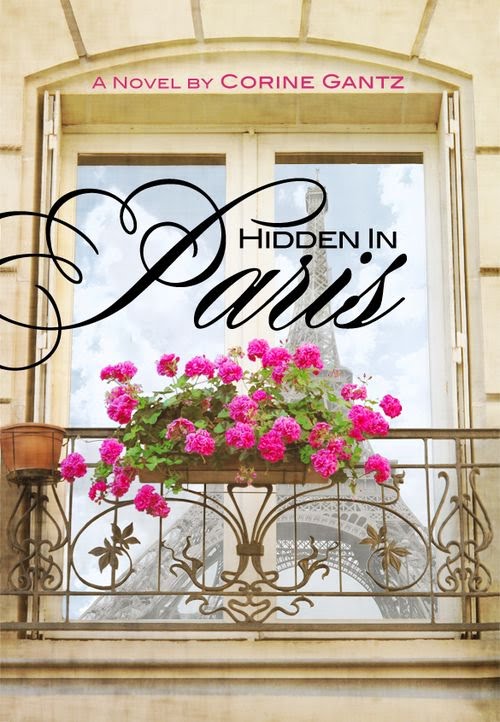
But looks can be deceiving — and the cover of Corine Gantz’s debut novel, Hidden in Paris, is quite a cunning ruse. It shows a Parisian balcony with French doors reflecting the Eiffel Tower, and a flower box bursting with hot-pink geraniums. What could possible be amiss within such a picture-perfect setting, you may wonder? Plenty, it turns out.

But before we get into that, let’s begin our fête in honor of Mme Gantz and her book. To put ourselves in the proper mood, we have prepared a special cocktail, a French 75. We’ve also gone all out with our canapés. There’s a savory gougère, brie en croûte, duck rillettes, chilled asparagus with mustard sauce, a Puy lentil salad — and, in honor of Mme Gantz, her family favorite, taramasalata on toast (see her father’s recipe below).

Okay, seats, please! Our honored guest has agreed to kick off the festivities by answering a few questions from The Displaced Nation team. After that, the floor is yours, dear reader.

Hidden in Paris coverYour new novel, Hidden in Paris, may not tell a gothic tale per se, but we think it relates to our theme because it centers on three women who are running away from their lives. Is that a fair assessment?
People who say they love to be scared amuse me. They have a fascination with horror flicks, they read vampire books, they ride roller coasters. Yet they might be the same people who walk great circles around a pile of bills or make every effort to avoid a difficult phone call. What can be scarier than real life?

I think there is a limit to what we can handle, and at some point the tendency is to want to run way, literally or figuratively. In Hidden in Paris three strangers — all American women — have reached the point of terminal discomfort, when tackling real issues feels more terrifying than running away abroad.

Lola is running away from her husband, Althea from an eating disorder, and Annie, although she pretends to be the most high functioning member of the group, is hiding the biggest secret of all. (Just to add some spice, there is also a male character, Lucas, who is hiding his love for Annie.)

People often fantasize that “elsewhere” — particularly Paris because of the attached notion of romance — will solve their problems, or at least make the problems go away for a while. Well, we long-term expats know better. Moving to another country brings great logistical changes to one’s life, which can distract you into thinking you’ve left your pathos behind, when, in fact, you’ve brought it along in your suitcase. Wherever you go, you bring your own personal gothic tale with you.

In the case of these three female characters, the disruptions to their routines, along with new encounters, bring them to the tipping point toward change.

The thing is, as in real life, my characters fight the change they need kicking and screaming, which makes for fun story telling.

Food is another obsession of ours at The Displaced Nation. We detect from reading an excerpt from Hidden in Paris that it also plays a big role in your book.
You detect correctly. For me, writing a novel is a barely disguised way for me to talk about food — the novel being a vehicle for food just as grilled toast is a vehicle for foie gras.

I grew up in France on my mother’s terrific cooking. But she is the type of cook who wants no help in the kitchen, so at age 23 I arrived in the United States never having cooked an egg. I was terribly homesick and depressed and needed to “taste home” again — so had no choice but to teach myself how to cook. The saving grace was that I had a copy of a recipe book filled with my mother’s recipes, so I proceeded to recreate the food, and jolly myself out of my depression. Cooking gave my life a purpose: it became my creative outlet.

I think the preparation of food can be extremely healing, meaningful and joyful. Food is, after all, the soul and spirit of a home. I enjoy cooking as much as I enjoy eating, and when I’m not doing one or the other I’m telling stories where food turns out to be one of the principal characters.

You are a Française who has been “displaced” to the Los Angeles area for a couple of decades, where you live with your American husband and two sons. Does your novel echo that experience?
Had I landed on an alien planet I doubt I would have been any more confused and out of place. I understood none of the codes, none of the cultural references, of Los Angeles. I could not understand people or express myself — and I resented them for that.

Writing sprouted from this: the frustrated need for self-expression and communication. Like my protagonist, Annie, I had to figure out how to function, and I would be lying to say I functioned well. Also like Annie, I resisted my country of adoption for years. I did not have both feet in it. A part of me felt in limbo: I was standing by for my eventual return to my home country.

Twenty years later I don’t even feel French anymore, but no one here lets me forget I’m not American either. Americans seem fascinated with my Frenchness, as though it defines me. For example, it’s often about how I say things rather than what I say. Yesterday I was saying to a friend: “On the envelope my husband gave me for mother’s day there was a…” She interrupted and said: “Could you repeat that?” I repeated and she fell into peals of laughter: “I just love how you said the word ‘envelope’!”

In Hidden in Paris, I wanted to transpose my experience and reverse it. I wanted to bring American women to France and see how well they coped with that set of codes and cultural idiosyncrasies. That’s only fair, don’t you think? I’m a little miffed to report that they are more adaptable than I was.

You have a popular blog, Hidden in France, where you’ve been entertaining Francophiles and others with stories of the writing life, décor, food, family, travel and all things French. In fact, The Displaced Nation has featured one of your posts — about the time you fell into your swimming pool when the first day of spring brought heavy rains to the LA area. Tell us, has your blog had an influence on your writing? Also, why have you chosen the trope “hidden in”?
The blog has everything to do with my writing. Before the blog, I was a closet writer, ashamed that my English was too imperfect. The blog gave me a sense of just how forgiving and supportive readers were. I have readers now, and I have fans! Had I based my self-worth as a writer on agent rejections, I would have changed my hobby to fly-fishing. Readers are what make someone a writer.

The word “hidden” is significant only in the sense that I was hiding for years behind an alias as a blogger, and I just recently came out as writer for the world to see (speaking of fear…).

When it came time to settle on a title for the book, it felt natural to give it the same title as the blog — but I decided against it because there was already a memoir by that name. So Hidden in France became Hidden in Paris.

Finally, The Displaced Nation supports a fictional character, Libby, who is about to move from London to Boston with her husband. Do you have any advice for her?
Well, how about if I let my own fictional character, Annie — who moved from Boston to Paris to follow her own husband twelve years ago — speak to Libby directly:

Don’t do it, Libby! Kidding! Well I would suggest you have more babies, some siblings for your son, Jack, and fast. They will keep you busy and busy is the name of the game: no time to think! And if you decide against having more babies, then take on a hobby (such as cooking and eating) to keep your sanity without demanding that your husband become your everything for companionship, friendship and intellectual stimulation.

Don’t be like me in other words. Don’t forget that the man has a job and he is tired at the end of the day and nobody needs a needy wife. (Sorry for the harsh words, Libby, but this is the truth.)

You could also take a run-down house and remodel it. I did. You will have no skin left on your fingers but lifting bags of concrete makes for pretty shapely biceps. The remodeling might bring you to financial ruin but if that becomes the case, you will always have eating, which you can become very good at.

Without further ado, let’s pour the champagne for a toast to Corine Gantz. Tchin-tchin! And now, patient reader, it’s your turn. Questions, please, for this très gentille debut novelist… If you want to check out her book a little more, go to her author’s site, and to buy it, go to her Amazon page.

Taramasalata on toast — Corine Gantz’s family recipe
You will need:

  • one packet of smoked cod roe (seriously, can you even find this in the US?)
  • 8 tablespoons safflower oil
  • 2 tablespoons lemon juice.

Mix fish roe and lemon juice, then slowly beat with a fork and add the oil as you would do to make mayonnaise.Spread thinly on toasts and serve with very good champagne, et voilà! Très festif.

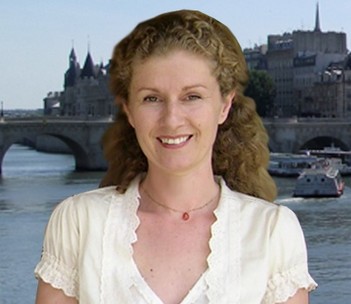
Images: Author’s photo; Hidden in Paris cover, artwork by Robin Pickens.

If you enjoyed this post, we invite you to subscribe to The Displaced Dispatch, a weekly round up of posts from The Displaced Nation, plus some extras such as seasonal recipes and occasional book giveaways. Sign up for The Displaced Dispatch by clicking here!

Related posts:

LIBBY’S LIFE: The first three episodes

It’s Life, all right, but not as I know it

April 1
Why is it, just as you get Life under control, Life decides you’re too complacent by far and snatches your security blanket away? And not only snatches it away, but rips it down the middle, throws it in a muddy puddle, and stamps around on it for good measure? Then Life hands you back the pieces and says, “How much in control do you feel now, Libby?”

Three months ago, after a Christmas spent pandering to everyone except me and receiving an assortment of kitchen gadgets instead of the anticipated spa- and nail salon gift vouchers, I decided Enough Was Enough.
This year, I vowed, as I stowed away a new banana slicer and mini-vac, I would no longer be merely “Jack’s Mummy”. No longer would I hand Oliver his packet of sandwiches in the morning and brush a hair from his suit collar, as if I were an extra in I Love Lucy.
This year, I promised myself, I would reclaim an identity that vanished three years ago in a maternity ward in Milton Keynes.
This year, I said, Libby Patrick would return.

Until last night, my pre-motherhood persona was making progress in her resurrection. I had my hair cut and my nails done. I chucked out grey nursing bras and went shopping in Debenhams’ lingerie department. I had lunch with my old boss who told me she would personally kill a fatted calf in celebration of my return to the office.
Then, last night, all progress stopped.

“The company wants me to take a job in another department,” Oliver announced over dinner.
Dinner is supposed to be a time when family members catch up with one another, but as any parent of a two-year-old knows, reality doesn’t work that way. While Oliver recited details of which job in what department, I was only half-listening, more concerned with stopping Jack from feeding Marmite toast to Fergus, our gluten-intolerant dog. So my response to Oliver was something like, “Lovely-darling-and-don’t-even-think-about-it-Jack” before grabbing Fergus by the collar and dragging him into the study where, with a bit of luck, he would eat final demand electricity bills instead.
This half-attention is all too common in our house, and it makes me feel guilty. I try not to feel guilty, but as a stay-at-home mother at present, I must be more supportive of my husband. Or that’s what my mother tells me. God knows what she was doing in the 1970s while other women were burning their bras. Out shopping for whalebone corsets, I imagine.
Oliver, naturally, is all in favour of the idea of supportive wives, and unashamedly sucks up to my mother to get her support as well. He once sent me an email, supposedly a page from a 1950s magazine, telling housewives how to treat their husbands properly. You’ve probably seen it. Wives are advised to hand their husbands a G&T the minute they walk through the door, tidy the children up and the toys away – or perhaps it’s the other way round – and to shut up while Hubby speaks because his opinions are more important. Oliver claimed the email was a joke. I told him it might have been, had I been employed and salaried, but right then, with baby-sick permanently welded to my shoulder, it wasn’t funny and Oliver was fooling no one. Millennia of male chauvinism can’t be wiped out by Harriet Harman, whatever she thinks, or by a few charred Cross Your Heart foundation garments.
But back to Oliver’s announcement. Once I was reseated at the table, Oliver said, “You didn’t hear what I said, did you, Libby?”
“Yes, I did.” I handed Jack a fresh triangle of Marmite toast. He mushed it into a ball and chucked it at the window behind me, where it stuck for a second before sliding down, leaving a greasy trail. “HR wants you to transfer.”
Oliver waved his hand around in a circle. “And…?”
I thought. “And you’ll get a pay rise?” I said hopefully. With his pay rise and my new job, we’d be able to go on holiday this year.
“Plus a relocation package.”
I stopped persuading Jack to eat, and stared across the table at Oliver, who seemed satisfied now he’d got a reaction.
“Relocation package? Relocation to where?” Most of the company’s offices are in Britain – with one exception. Please let it be Birmingham. We wouldn’t have to move house because Oliver could commute. Or Liverpool…or heck, even Aberdeen is commutable these days.
“The Massachusetts office,” Oliver said. “We’ll talk about it.”

And that was the point when Life snatched away my security blanket, hurled it in a swamp, and danced the mashed potato on it.

April 5
We’ve spent the weekend talking about this hypothetical move to America. Well. I say “hypothetical” but it isn’t. And I say “talking” although it isn’t really that, either. Oliver appears to have done most of the talking already with the Relocation Manager in his Human Resources department. (What happened to Personnel Departments? Have we come so far down the line of political correctness that we can’t acknowledge we have personalities?)
So when Oliver promised we’d talk about it, he meant we would talk about the after-effects of the decision, not the decision itself. That seems to be settled and all over, bar the shouting.
Bar the shouting wife.
“It’s a great opportunity,” Oliver says. “One of those chances you’ve got to take in life.”
“But what about me?” I say. “What about my life?”
Now I know how Jack feels during his tantrums. I want to lie on the carpet and kick and scream and shout “No! No! Go away!”
“You’ll have a lovely life. All the wives do.”
“But none of them go to work,” I say. “They’re not allowed to.”
“Why would you want to go to work when you can be at home with Jack?”
I think of my new haircut and freshly accumulated wardrobe of crisp work attire, and murmur, “Oh, I don’t know. Dignity. Independence. Self-worth. Stuff like that.”
Oliver stares at me for a while.
“I don’t understand.”
No. I know he doesn’t.
Instead of lying on the floor and shouting at him to go away, I lie on the sofa and cover my face with a cushion. It’s almost as good.

“We’ll live in a little town near Boston,” Oliver says when my rate of used tissues per minute has slowed. “You know Boston. It’s where the Cheers bar is, and where they filmed Ally McBeal. You love both those programmes.”
I tell him that he loves watching EastEnders, but he wouldn’t want to move to Walford.
He gives me a withering look. “Walford’s a made up place. It’s not real.”
“More real to me than Boston.”
“It wouldn’t be permanent,” Oliver says. “Think of it as a two-year holiday.”
This is pretty rich, coming from him. If I had to pick one characteristic in Oliver that I’d happily trade (excluding spur-of-moment, unilateral decisions to emigrate) it would be the homing pigeon tendencies. He gets culture shock if he goes farther north than Leicester. Take him to Spain and he’ll make a beeline for all the restaurants whose menu items end with “‘n’ chips.” We went to Disney World in Florida the year before Jack was born, and Oliver insisted on wearing his Beckham football shirt everywhere. Well, he and the rest of English-accented Orlando.
I didn’t intend to play the trump card so soon in the game, but my options are running out fast.
“You do know,” I say, “that they don’t sell roast chicken-flavoured crisps over there? No Quavers or Skips? No Hula Hoops?”
Oliver opens his mouth as if to say something, then shuts it again. For a moment, he looks uncertain. Is it possible our future teeters upon a specific combination of E-numbers and MSG?
Then he smiles; an indulgent smile, the sort I give Jack when he’s done something unbearably cute and naïve, and I know that even the threat of no Skips or Quavers to satisfy the midnight munchies isn’t going to work.
“Libby, love. It’s Boston. They have their own fantastic food. We don’t need chips.” Chips? Lord help us. He’s into the lingo already. “There’s lobster and crab cakes, and – what’s it called? Clam chunder.”
Not quite into the lingo, then.
“Chowder.”
“Whatever. My point is, who needs crap like prawn cocktail crisps when you can have the real deal fresh from the ocean there?”
I shake my head, resigned, knowing our fate is decided for the next two years. Oliver is basing a three-thousand-mile upheaval on…seafood.
And oh. Did I mention he’s allergic to fish?

April 19
Oliver and I are keeping quiet about the move until plans are definite. We each have different reasons; he doesn’t want to lose face if it doesn’t happen, and I want to pretend it won’t happen at all.
It’s ironic, the way we’ve switched roles. I used to be the one who liked going abroad and trying new food, whereas he’d eat burger-au-E-coli twice a day for a fortnight rather than pollute his digestive system with local cuisine. Once, in Ibiza, I tried to get him to eat a piece of morcilla. “Oooh, no, not that foreign stuff, thank you,” he said, shuddering as if he was a contestant on Fear Factor and I was trying to tempt him with deep-fried cockroach. Thing is, he didn’t realise it was Spanish sausage. He thought it was black pudding. Lancashire black pudding was foreign enough for Oliver.
But now it’s me dragging my heels about going abroad, while he’s suddenly turned into Gordon-bleeding-Ramsay, evangelising about fresh local produce that brings him out in a rash.
Calm. Breathe.
It’s difficult to keep this a secret, though. Take today, when Jack and I are at playgroup.
Carol Hunter corners me as I’m struggling to get Jack’s coat off.
Carol’s the sort of woman you’re glad to leave behind in the office rat race when you go on maternity leave. You think you’re entering a cocoon of babies, teddy bears, and Johnson’s products, unsullied by bossy women with expensive highlights. Then you discover these women have not only infiltrated your baby-powdered haven but established their own Mafia, ruling the playgroup, PTA, and school governing board.
Carol’s the Don of the local ring.
“Libby,” she says in a confidential tone, gripping me by the elbow in case I make a run for it. “Libby. We need to talk about your volunteer record. It’s somewhat…threadbare.”
Oh, hell. Everyone with a child in playgroup is supposed to sign up to help on a regular basis. That’s the idea. But what actually happens is you volunteer once or twice, spend two hours smiling through gritted teeth while Carol or one of her captains micromanages you in the art of finger-painting, and then forever after keep a low profile when volunteers are needed. There’s a lot of Mafia moaning goes on about it, of course. Usually over skinny lattes in Starbucks, while their little darlings sprinkle brown sugar packets on the floor, about how it’s always the same people who do all the work, and how this playgroup wouldn’t survive if it weren’t for Carol and her chums. But you ignore it. These women used to get their kicks playing the office martyr in their pre-baby lives, and they’d hate to be deprived of their sackcloths and ashes now.
“You’ve only done three sessions since last October,” Carol goes on, clamping down harder on my arm. “Can I put you down for the Play-Doh table next week, with Angie? Then two sessions in May, and a couple in June?”
I cough. “All with Angie?” Frankly, I’d rather sign up for evening classes in embalming than for six playgroup sessions with Captain Angie, who can’t go five minutes without dropping into conversation that she went to school with Supernanny’s cousin.
And then it strikes me. “Tell you what,” I say. “Let’s make it easy. I’ll do all of July, twice a week, until the schools finish for summer. Six sessions. How’s that?”
Carol opens and shuts her mouth a few times, but no sounds emerge, which is pretty satisfying. It’s not often she’s lost for words. No doubt she’s been revving up for a big fight about this, probably culminating in a hit job in Starbucks. Remind me to check the cisterns for firearms next time I’m in there.
“Fan-tast-ic,” she eventually murmurs, and wafts off to persecute a new mother of twins.
It’s all I can do to stop myself from shouting, “Because come July, Carol, I will most likely be eating lobster on the other side of the Atlantic, and not even you and your molls will be able to drag me back to the Play-Doh table.”
It’s as good a reason as any to emigrate, I suppose.

Want to read more? Head on over to Kate Allison’s own site, where you can find out more about Libby and the characters of Woodhaven, and where you can buy Taking Flight, the first year of Libby’s Life — now available as an ebook.

If you enjoyed this post, we invite you to subscribe for email delivery of The Displaced Dispatch, a round up of the week’s posts from The Displaced Nation. Sign up for The Displaced Dispatch by clicking here!

Image: Travel Map of the World by Salvatore Vuono / FreeDigitalPhotos.net

Me and my shadow – My life with Libby

I’ve been writing Libby’s Life for about six months, and at first it was serialized on my own blog, Marmite and Fluff (now sadly neglected). When The Displaced Nation went live, it became part of this Website instead.

While I could go into navel-gazing details of how I came up with Libby, Oliver, Sandra, et al, it wouldn’t be very interesting for anyone. For example, the short answer to how I came up with Sandra, the mother-in-law from hell, is easy: a deadline-induced state of adrenalized panic.

As for the fictitious town of Woodhaven, Massachusetts, well, I’m very familiar with the place. It’s the setting of my work-in-progress novel (which at the moment seems very far from anything resembling in-progress) and some of the characters from that manuscript have already appeared in Libby’s Life. Melissa Harvey — now Melissa Harvey Connor — is the girl I love to hate. Frankie Gianni, of the Maxwell Plum restaurant, is also an old friend of mine, along with his pig-toting mother, Carla. Poor Carla. She’s had a lot to cope with over the years. She wasn’t always the sad figure you met in Episode 11.

More characters will come along in due course, as Libby settles into life in this northern town.

For now, though, I’m going to tell you a bit more about our plucky little heroine. It’s easy to dismiss her as “just a housewife” but as anyone can see if they have read the last episode, she’s a fighter.

It would be a mistake to underestimate Libby.

I first met Libby in March this year. I was visiting friends in Milton Keynes, and had run out of reading material, so headed for a book shop. Libby was there at the same time, with her two-year-old, Jack — an adorable little thing, clutching a stuffed red car — and she struck me as a woman who had lost her way in life. Lost her identity, you could say, among the shelves of Pampers and Johnson’s baby products.

You can tell a lot about people from the books they buy. Although Libby and I met in the chick lit section, she already had three self-help books in her shopping basket. “Finding yourself after motherhood.” “How to be who you want to be.” “Living and Working in America.”

“Are you moving to America?” I asked.

To my discomfort, her eyes filled with tears. “I haven’t any choice,” she said.

In my experience, there is only one cure for the moving upheaval blues — coffee and lots of chocolate croissants. I took the books from her.

“We’ll come back later for those. Today’s your lucky day. You’ve met the right person to talk to.”

We went to Starbucks and, over a large vanilla latte and Danish pastry, Libby started to open up. Perhaps she was rather too open, considering we had only just met, but sometimes it’s easier to confide in a stranger than in your closest friend.

Her life had been turned upside down, she said.

She admitted that she was tired of being just a wife, just a mother, just a daughter. She had been a stay at home mother for three years, and in that time had felt her personality slowly being leached away.

Oliver had strongly encouraged her to stay home with Jack — Oliver wanted Jack to have the family life his own mother had never given him — but now Libby needed something else. Something for herself, beside finger painting and Play-doh.

She had just put the wheels in motion by talking to her old boss about returning to work when Oliver dropped the bombshell.

“I get my life in order again, and this happens. Massachusetts!” If Libby had said “Guantanamo Bay” she couldn’t have said it with more distaste. “This summer! Yes, I wanted a change in my life, but not like this. This is Oliver’s choice, not mine, but I don’t feel as if I have any right to object. Do you think he’s having a midlife crisis, even though he’s only thirty-three?”

I watched her stuff a piece of Danish pastry in Jack’s mouth. Libby has dainty hands that she waves about a lot, so you’re always half-reaching to move drinks cups out of her way. Her hair is in a mousy blonde pixie cut, and she has big blue eyes that make her look like a Disney cartoon animal. She’s Tinkerbell, without the attitude problem.

Personally, I thought her husband was not so much having a midlife crisis as taking advantage of a temporary imbalance of relationship power that, at the moment, favoured him.

The balance would shift one day, because pendulums of all kinds swing, but I knew it was pointless to tell Libby that her day of power would come.

“Massachusetts is a nice place,” I said. “It feels a lot like England, in many ways. You want my advice? Go. Enjoy the experience. Think of it as a door opening, not one closing. Besides –” she had already told me a little about Oliver’s mother “–wouldn’t it be a good thing to move away from your mother-in-law? The view from 3000 miles has to be an improvement.”

Libby nodded. I could see her watching the proverbial glass become half full, not half empty.

“But what will I do with my time there?” she asked. “Jack will be off to nursery school soon.”

I hadn’t the heart to tell her that most women I’d seen in her situation seemed to fill their time with serial pregnancies, so instead, I said, “You could start a blog.”

“A blog,” she repeated. “Yes, I could.” She thought a little more, gazing out of the window of the traffic.

“I’ll call it Libby’s Life,” she said. “I like the sound of that.”

Stay tuned for another Return Trip post tomorrow.

If you enjoyed this post, we invite you to subscribe for email delivery of The Displaced Dispatch, a round up of the week’s posts from The Displaced Nation. Sign up for The Displaced Dispatch by clicking here!

Img: Map of the World – Salvatore Vuono

6 celebrated women travel writers with the power to enchant you

Any wannabe expat/travel writer would do well to consult with Kristin Bair O’Keeffe, herself a novelist and former expat, before beginning their Great Works. Kristin offers a wealth of writing tips on Writerhead, a blog that she launched on April 1 of this year (which, coincidentally, was the same day we launched The Displaced Nation).

Of the helpful hints Kristin has offered thus far, I have many favorites, but if I had to pick one, it would be her post entitled “Write Wee.” In her breathlessly inimitable style, Kristin assures us that producing a multi-volume series on one’s overseas adventures is not the way to go:

Instead find a nugget. A moment. A single object. One exchange. One epiphany. One cultural revelation.

Find one story and tell it.

Just it.

The only thing I would add is that in general, women are better at extracting such nuggets than men.

Actually, what got me started in thinking about the difference in travel writing styles of the sexes was a post I wrote a couple of weeks ago on Edwardian novelist Elizabeth von Arnim, who penned the much-loved work, The Enchanted April, about four women who escape to a medieval castle in Italy for a much-needed break from their routines.

For me, von Arnim typifies one of characteristics that makes women’s travel writing so special (no doubt there are many more!). As she wandered far and wide across Europe and America, she paid extremely careful attention to the details of her surroundings.

A forerunner of what today we’d call a nature freak, she could get lost in telling the story of watching a “nightingale on a hornbeam, in loud raptures at the coming of the sun…” — I quote from her largely autobiographical novel The Solitary Summer, about a woman, also called Elizabeth, who is anything but solitary. She has a husband, to whom she refers as the Man of Wrath, small child and household to care for.

Perhaps such descriptive powers are born of necessity. Women have little choice but to make the most of spinning tales out of the moments they snatch from lives that are otherwise spent ministering to the needs of others — even when they’re technically on vacation.

Having combed through the pages of The Virago Book of Women Travellers (ed. Mary Morris with Larry O’Connor), I think I may be on to something. I discovered any number of women travel writers with the power to enchant their readers by capturing in their works the moments, exchanges, and personal ephiphanies their wanderings have yielded.

Here are six whose “nuggets” continue to gleam for us modern-day nomads:

Frances Trollope (1780-1863)

Who was she? Mother of Anthony and like her son, a prolific writer of novels (34 in total!).
Key work: Domestic Manners of the Americans, a travel book that made her name, about the four years she spent pursuing opportunities in the United States after her family suffered financial setbacks.

from DOMESTIC MANNERS OF THE AMERICANS
At length my wish of obtaining a house in the country was gratified….But even this was not enough to satisfy us when we first escaped from the city, and we determined upon having a day’s enjoyment of the wildest forest scenery we could find. So we packed up books, albums, pencils, and sandwiches, and, despite a burning sun, dragged up a hill so steep that we sometimes fancied we could rest ourselves against it by only leaning forward a little. In panting and in groaning we reached the top, hoping to be refreshed by the purest breath of heaven; but to have tasted the breath of heaven we must have climbed yet farther, even to the tops of the trees themselves, for we soon found that the air beneath them stirred not, nor ever had stirred, as it seemed to us, since first it settled there, so heavily did it weigh upon our lungs.

Still we were determined to enjoy ourselves, and forward we went, crunching knee deep through aboriginal leaves, hoping to reach some spot less perfectly air-tight than our landing place. Wearied with the fruitless search, we decided on reposing awhile on the trunk of a fallen tree; being all comfortably exhausted, the idea of sitting down on this tempting log was conceived and executed simultaneously by the whole party, and the whole party sunk together through its treacherous surface into a mass of rotten rubbish that had formed part of the pith and marrow of the eternal forest a hundred years before.

We were by no means the only sufferers from the accident; frogs, lizards, locusts, katydids, beetles, and hornets, had the whole of their various tenements disturbed, and testified their displeasure very naturally by annoying us as much as possible in return; we were bit, we were stung, we were scratched; and when, at last, we succeeded in raining ourselves from the venerable ruin, we presented as woeful a spectacle as can well be imagined. We shook our (not ambrosial) garments, and panting with heat, stings, and vexation, moved a few paces from the scene of our misfortune, and again sat down; but this time it was upon the solid earth.

We had no sooner begun to “chew the cud” of the bitter fancy that had beguiled us to these mountain solitudes than a new annoyance assailed us. A cloud of mosquitoes gathered round, and while each sharp proboscis sucked our blood, they teased us with their humming chorus, till we lost all patience, and started again on our feet, pretty firmly resolved never to try the al fresco joys of an American forest again.

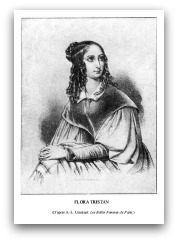
Flora Tristan (1803-1844)

Who was she? French reformer who campaigned for workers’ and women’s rights; grandmother to artist Paul Gauguin.
Key work: Peregrinations of a Pariah, about a trip she made alone to Peru to stake her claim to her family’s fortune.

from PEREGRINATIONS OF A PARIAH
Mr. Smith took me to the house of his correspondents, and here once more I found all of the luxury and comfort characteristic of the English. The servants were English, and like their masters they were dressed just as they would have been in England. The house had a verandah, as do all the houses in Lima, and this is very convenient in hot countries, as it gives shelter from the sun and enables one to walk all round the house to take the air. This particular verandah was embellished with pretty English blinds. I stayed there for some time and could survey in comfort the only long wide street which constitutes the whole of Callao. It was a Sunday, and sailors in holiday attire were strolling about; I saw groups of Englishmen, Americans, Frenchmen, Dutchmen, Germans — in short, a mixture from nearly every nation — and I heard snatches from every tongue. As I listened to these sailors, I began to understand the charm they find in their adventurous life… When I tired of looking at the street I cast a glance into the large drawing-room whose windows overlooked the verandah, where five or six immaculately dressed Englishmen, their handsome faces calm and impassive, were drinking grog and smoking excellent Havana cigars as they swung gently to and fro from hammocks from Guayaquil suspended from the ceiling.

Mary Anne Barker (1831 – 1911)

Who was she? Jamaica-born, England-educated author and journalist who with her second husband tried to run a sheep station in New Zealand (they later traveled to Mauritius, Western Australia, Barbados and Trinidad for his colonial appointments).
Key works: Station Life in New Zealand (1870); First Lessons in the Principles of Cooking (1874); A Year’s Housekeeping in South Africa (1880).

from STATION LIFE IN NEW ZEALAND
All this beauty would have been almost too oppressive, it was on such a large scale and the solitude was so intense, if it had not been for the pretty little touch of life and movement afforded by the hut belonging to the station we were bound for. It was only a rough building, made of slabs of wood with cob between; but there was a bit of fence and the corner of a garden and an English grass paddock, which looked about as big as a pocket-handkerchief from where we stood. A horse or two and a couple of cows were tethered near, and we could hear the bark of a dog. A more complete hermitage could not have been desired by Diogenes himself, and for the first time we felt ashamed of invading the recluse in such a formidable body, but ungrudging, open-handed hospitality is so universal in New Zealand that we took courage and began our descent. … We put the least scratched and most respectable-looking member of the party in the van, and followed him, amid much barking of dogs, to the low porch; and after hearing a cheery “Come in,” answering our modest tap at the door, we trooped in one after the other till the little room was quite full. I never saw such astonishment on any human face as on that of the poor master of the house, who could not stir from his chair by the fire, on account of a bad wound in his leg from an axe. There he sat quite helpless, a moment ago so solitary, and now finding himself the centre of a large, odd-looking crowd of strangers. He was a middle-aged Scotchman, probably of not a very elevated position in life, and had passed many years in this lonely spot, and yet he showed himself quite equal to the occasion.

After that first uncontrollable look of amazement he did the honours of his poor hut with the utmost courtesy… His only apology was for being unable to rise form his arm-chair (made out of half a barrel and an old flour-sack by the way); he made us perfectly welcome, took it for granted we were hungry — hunger is a very mild world to express my appetite, for one… I never felt more awkward in my life than when I stooped to enter that low doorway, and yet in a minute I was quite at my ease again; but of the whole party I was naturally the one who puzzled him the most. In the first place, I strongly suspect that he had doubts as to my being anything but a boy in a rather long kilt; and when this point was explained, he could not understand what a “female,” as he also called me, was doing on a rough hunting expedition. He particularly inquired more than once if I had come of my own free will, and could not understand what pleasure I found in walking so far.

Vivienne de Watteville (1900 – 1957)

Who was she? British writer and adventurer who accompanied her father on a safari in Kenya. After he was killed by a lion, she finished the trip on her own.
Key works: Out in the Blue (1927); Speak to the Earth: Wanderings and Reflections among Elephants and Mountains (1937).

from SPEAK TO THE EARTH
Finally, it was the boys themselves who pointed to the summit and said it was not very far.

Enviously, I admired the way they could climb. As for me, … I was badly spent; my knees trembled as I panted up through the reeling boulders. …

At last I climbed above the forest zone, passing beneath the last outposts — stunted trees ragged with beard-moss in whose chequered shade lay a carpet of tiny peas … whose blossoms were a lovely transparent blue. Above them flitted miniature butterflies, as though the petals themselves had taken wing. …

The top, when I at last reached it, was, after all, not really the top, and beyond a dipping saddle another granite head still frowned down upon me.

But meanwhile, below me the south side disclosed a grassing depression girt about by the two summits and bare granite screes; and amid that desolation the grass stretched so green and rural that you had looked there for shepherds with their flocks. Instead of which, on the far side of a quaking bog, I saw — grey among the grey slabs — two rhino.

… I drew to within forty yards of the rhino, yet they still looked like a couple of grey boulders as they browsed off an isolated patch of sere grass. …

The wind had risen to a tearing gale, and nosing straight into it I approached the rhino somewhat downhill. There was no chance of this steady blow jumping around to betray me, and it was strong enough to carry away any sound of my footsteps. Precaution was therefore unnecessary, and I walked boldly up to them. Just how close I was, it is hard to say; but I felt that I could have flipped a pebble at them, and I noted subconsciously that the eye of the one nearest me was not dark brown as I had imagined it, but the colour of sherry.

… he now came deliberately towards me nose to the ground, and horn foremost, full of suspicion. … In the finder [of my small cinema camera] I saw his tail go up, and knew that he was on the point of charging. Though it was the impression of a fraction of a second, it was unforgettable. …

… I read the danger signal, yet in a kind of trance of excitement I still held the camera against my forehead. Then Mohamed fired a shot over the rhino’s head to scare him, and I turned and fled for my very life.

M. F. K. Fisher (1908 – 1992)

Who was she? A preeminent American food writer, whose books are an amalgam of food literature, travel and memoir.
Key works: How to Cook a Wolf (1942); Map of Another Town: A Memoir of Provence (1964); Dubious Honors (1988); Long Ago in France: The Years in Dijon (1991).

from LONG AGO IN FRANCE
Monsieur Venot was a town character and was supposed to be the stingiest and most disagreeable man in Dijon, if not in the whole of France. But I did not know this, and I assumed that it was all right to treat him as if he were a polite and even generous person. I never bought much from him but textbooks, because I had no extra money, but I often spent hours in his cluttered shop, looking at books and asking him things, and sniffing the fine papers there, and even sitting copying things from books he would suggest I use at his worktable, with his compliments and his ink and often his paper. In other words, he was polite and generous to me, and I liked him. …

In Monsieur Venot’s shop I learned to like French books better than any others. They bent to the hand and had to be cut, page by page. I liked that; having to work to earn the reward, cutting impatiently through the cheap paper of a “train novel,” the kind bought in railroad stations to be thrown away and then as often kept for many years, precious for one reason or another. I liked the way the paper crumbled a little into my lap or my blanket or my plate, along the edges of each page.

Mary Lee Settle (1918 – 2005)

Who was she? American writer, novelist and expat, one of the founders of the PEN/Faulkner Award for Fiction.
Key works: “Beulah Quintet” novel series (1956-1982), about the history of her native West Virginia (and hence of America); Turkish Reflections: A Biography of Place (1991).

from TURKISH REFLECTIONS
I hadn’t heard anything move, yet he stood there in front of me, smiling, quite silent, a large strong Turkish man, holding in his hand a small bunch of sweet wild thyme. He held it toward me, saying nothing, still smiling. There was something so gentle about him that I could not be afraid. I took the wild thyme, and I thanked him, in Turkish. He smiled again and touched his mouth and his ear. He was deaf and dumb. I still have the wild thyme, pressed and dried, kept like a Victorian lady’s souvenir of the Holy Land.

Dumb was the wrong word for him. There was no need for speech. He was an actor, an eloquent mime. I pointed to the atrium below and held my hands apart to show I didn’t know how to get down into it. He took my arm, and carefully, slowly, led me down a steep pile of rubble.

He mimed the opening of a nonexistent door and ushered me through it. He showed me roofless room after roofless room after roofless room as if he had discovered them. …

I think he had scared people before, and he was happy that there was someone who would let him show his house, for it was his house. Maybe he didn’t sleep there. I don’t know. I only know that he treated me as a guest in a ruin ten feet below the levee of the ground, and that he took me from room to room where once there had been marble walls and now there was only stone, where he was host and owner for a little while.

He showed me a small pool, held out his hand the height of a small child, and then swam across the air. All the time he smiled. He took me to a larger pool and swam again. Then he grabbed my arm and led me through a dark corridor toward what I thought was at first a cave. It was not. He sat down in an niche in the corridor, and strained until his face was pink, to show me it was the toilet. Then he took me into the kitchen where there were two ovens. …

For the first one he rolled dough for bread, kneaded it in air, slapped it, and put it in the oven. Then he took it out, broke it, and shared it with me. I ate the air with him. …

When I gave my friend, my arkadaş, some money, he kissed my hand and held it to his forehead, and then, pleased with the sun and me, and the fact that someone had not run away from him who lived like Caliban in a ruin, he put his arms around me and kissed me on both cheeks. Then I went down the hill to Ephesus. When I looked back to wave he had disappeared.

STAY TUNED for tomorrow’s post, a tell-all from Kate Allison on what inspired her to create her fictional expat heroine, Libby.

If you enjoyed this post, we invite you to subscribe to The Displaced Dispatch, a weekly round up of posts from The Displaced Nation, plus some extras such as seasonal recipes and occasional book giveaways. Sign up for The Displaced Dispatch by clicking here!

Related posts:

Some enchanted reading: A round-the-world tour from 4 of our featured writers

For this month’s reading suggestions, we have compiled a list of books from four of our recent featured writers — all of different genres, and set in different parts of the world.

If you are stay-cationing this year, we hope one of these books will transport you for a while to a different place —  and all for a fraction of the cost of a plane ticket.

IRAN – Sons of the Great Satan – Anthony Roberts

Our featured writer in April, Tony Roberts spent his childhood in Saudi Arabia and Iran before the Islamic revolution forced him and his family back to their hometown in Kansas — which, to Tony, no longer seemed like home.

Now living in Hawai’i with his New Zealand wife and their son, Tony has published his first novel, Sons of the Great Satan. It tells the story of the friendship between two teenagers — one American, one Iranian — in the last hours before the fall of the Shah of Iran.

Amazon description:

“SONS OF THE GREAT SATAN is a tale of culture clash, international politics, heroism, friendship, cowardice and sinister betrayal. The character and beliefs of the Shah of Iran, President Jimmy Carter and the Ayatollah Khomeini are all put to the test as the whirlwind of chaos engulfs them all. The actions of these powerful men play out on the world stage and forever change the lives of those who called Tehran home in the late 1970s.”

NEW YORK – Exiled – Shireen Jilla

Third Culture Kid Shireen Jilla (half English, half Persian, and grew up in Germany, Holland and England) currently lives in London after being an expat in Paris, Rome, and New York.

Commenting on our May 7th article, Shireen said, “New York is a material fantasy that most wannabe expats have had. People imagine it to be an adventure laced only with IPad2s and lychee martinis. But, as many of you know, stepping outside your own cultural comfort zone is never as straight forward as those people, longing for it from the comfort of their three-piece sofa in the suburbs, imagine. So I choose to write about Anna, an eager expat looking for experience, but finding she sucked into a cultural nightmare that she neither could control, or understand.”

Amazon description:

“In love with her husband Jessie, an ambitious British diplomat, whose first posting brings them to New York, Anna begins the hectic, enjoyable life of a successful expat. But New York also brings her into contact with her husband’s manipulative and competitive stepmother Nancy, a powerful American socialite and philanthropist. When a silly incident with her only son Josh involves the Police Department, Anna’s seemingly perfect world begins to shatter. As Jessie’s journey to rediscover his New York roots draws him closer to Nancy, terrible and strange things keep happening to Anna. She begins to fear that someone is out to destroy her family.”

FRANCE – Hidden in Paris – Corine Gantz

Our second featured writer in May, Corine Gantz has just released her debut novel about a group of American women who try to start new lives in Paris.

A displaced Parisian in Los Angeles, where she lives with her husband and two sons, Corine blogs at Hidden in France.

Amazon description:

When bankruptcy threatens her beloved house, her one anchor in life, Annie has no choice but to find renters, and quick. Leave it to someone socially phobic to phrase a want ad in all the wrong ways. With shimmering promises of ‘Starting over in Paris’ –– a concept she has no intention of applying to her own life––Annie attracts tenants with the kind of baggage that doesn’t fit in suitcases.

THAILAND – Tone Deaf in Bangkok – Janet Brown

The last book on today’s list is by Janet Brown, whom we featured on June 10th.

In the article, Janet said: “My parents turned me into a gypsy before I was two, by taking me on their journey by jeep from New York City to Alaska when the 49th state was still a territory and the Alcan Highway was still an unpaved trail into the frozen north. I have wandered ever since, most recently in Southeast Asia with Bangkok as my home, writing down the stories I encounter as I explore.”

Amazon description:

“From her first bewildered hours to the moment that she reluctantly leaves, Janet Brown describes her experience of falling in love with, and in, Thailand’s largest city. Nana Chen’s evocative photographs provide illustrations of daily living in Bangkok.”
BC Magazine review:
“Janet Brown’s experiences in Thailand are chronicled in short essays that bypass the usual tourist spots and concepts and present an intimate and revealing understanding of Bangkok and the Thai way of life from a female foreigner’s fascinated point of view.”

If you enjoyed this post, we invite you to subscribe for email delivery of The Displaced Dispatch, a round up of the week’s posts from The Displaced Nation. Sign up for The Displaced Dispatch by clicking here!

Related posts:

Ho’ omaika’i ‘Ana to TCK writer Tony Roberts

Expat life as psychological thriller? An unholy appreciation of novelist Shireen Jilla

CLASSIC DISPLACED WRITING: Joy in the place — Elizabeth von Arnim

The novelist Elizabeth von Arnim (1866-1941) wrote many enchanting books, all of which were autobiographical to some extent, linked to persons or places she knew.

But does that necessarily mean that Elizabeth — born Mary Annette, nicknamed May, she called herself “Elizabeth” upon becoming a professional writer — led an enchanted life?

Yes and no. By all accounts, she was an enchanting person herself, constantly delighting other people with her sharp wit.

She also kept enchanting company: E.M. Forster was tutor to her children, Katherine Mansfield was her adopted cousin, and H.G. Wells was one of her lovers.

Displaced almost from birth (she was born in Kirribilli Point, Australia, and then moved to England at the age of three), she made a life-long habit of flitting from one enchanting locale to the next.

Having spent her formative years in London, she moved to Pomerania in Prussia (Germany) for her first marriage, where she raised five children.

Upon the death of her husband in 1910, she made her home in the Valais, Switzerland, living in a glamorous house, Chalet Soleil, which she’d built from her riches as an author.

With the failure of her second marriage, Elizabeth zigzagged between homes in the United States and Europe.

She died in Charleston, South Carolina.

A full measure of sorrows

But a peripatetic life isn’t always a charmed one, as many of us expats and former expats can attest. As her life progressed, Elizabeth experienced a full measure of sorrows.

Her first marriage — to a domineering Prussian count — wasn’t particularly happy. She nicknamed him the Man of Wrath, and they separated several years before his death.

Her second marriage, to Frank Russell, elder brother of Bertrand, was even more miserable (he proved to be a despotic egoist).

Her only true love she met when she was 54 — and he was nearly 30 years younger. (They never married.)

She also suffered the grievous deaths of a daughter and a brother.

By the time she died, Elizabeth was estranged from most of her children, crippled with arthritis, and almost forgotten by her adoring public.

Her only devoted companion was her dog, Billy.

Escape artist par excellence

But despite these tribulations, Elizabeth remained throughout her life, in the words of gardening writer Deborah Kellaway,

a steadfast hedonist, firmly suppressing sorrows. … Her journals and letters repeatedly record moments of happiness, usually associated with sunny days.

As Elizabeth once wrote in a letter to one of her daughters,

“What I really am by nature is an escapist.”

Thus what we can learn from Elizabeth’s life — and from her many autobiographical books — is the art of escaping into happier worlds.

As Kellaway explains:

[The heroines of her novels] escape from richness into the simple life, or from conventional home life into foreign travel; they escape from houses into caravans.

The most famous example, of course, is Elizabeth’s 1922 novel, The Enchanted April — from which we’ve taken our theme of enchantment on the blog this month.

As everyone knows who has read that book — or, more likely, seen the 1992 film or the 2003 Broadway play — four women who share only their unhappiness and a love of wisteria flee 1920s London and converge in Portofino, Italy, on a magical medieval villa overlooking the Mediterranean.

Simple pleasures are the best?

But while Italian castles can certainly be a tonic — if offered one, I’d be off like a shot — what most people don’t know is that Elizabeth was equally fond of much simpler escapes. In the first two books that made her reputation as a writer, the heroine escapes her marital, motherly and household duties by venturing into a German garden, set in a wide landscape.

Here is the most lyrical passage from the second of these, The Solitary Summer (1899):

Yesterday morning I got up at three o’clock and stole through the echoing passages and strange dark rooms, undid with trembling hands the bolts of the door to the verandah, and passed out into a wonderful, unknown world. I stood for a few minutes motionless on the steps, almost frightened by the awful purity of nature when all the sin and ugliness is shut up and asleep, and there is nothing but the beauty left. It was quite light, yet a bright moon hung in the cloudless, grey-blue sky; the flowers were all awake, saturating the air with scent; and a nightingale sat on a hornbeam quite close to me, in loud raptures at the coming of the sun. …

It was wonderfully quiet, and the nightingale on the hornbeam had everything to itself as I sat motionless watching that glow in the east burning redder; wonderfully quiet, and so wonderfully beautiful because one associates daylight with people, and voices and bustle, and hurrying to and fro, and the dreariness of working to feed our bodies, and feeding our bodies that we may be able to work to feed them again; but here was the world wide awake and yet only for me, all the fresh pure air only for me, all the fragrance breathed only by me, not a living soul hearing the nightingale but me, the sun in a few moments coming up to warm only me…

A lovely garden at just the right time of day — as I know from my own experience of enduring many city summers*, that’s all it sometimes takes to escape into happiness.

*On that note, I’d like to recommend a walk on the High Line in early morning or late afternoon, to anyone living in or traveling to New York City this month…

QUESTION: What does it take for you to escape the dog days of summer into happiness: a trip to Italy, a walk in the garden — or something else?

STAY TUNED for tomorrow’s post, on our new weekly newsletter, The Displaced Dispatch.

If you enjoyed this post, we invite you to subscribe for email delivery of The Displaced Nation. That way, you won’t miss a single issue. SPECIAL OFFER: New subscribers receive a FREE copy of “A Royally Displaced Tea.”

Related posts: