The Displaced Nation

A home for international creatives

Tag Archives: Expat interviews

12 NOMADS OF CHRISTMAS: Lyn Fuchs, American expat in Mexico (5/12)

Current home: Oaxaca, Mexico
Past overseas locations: India, Japan, Kenya, Canada
Cyberspace coordinates: Sacred Ground Travel Magazine (blog) and @LynFuchs (Twitter handle)
Most recent post: “Spice Girl Caravan to Srisailam India” [guest post by Evelyn Hills, author of Ivana and the Secret Lake Adventures: Magic vs. Love] (December 26, 2011)

Where are you spending the holidays this year?
I’ll be spending half the time at home in the jungle lowlands of Oaxaca and half the time climbing Mount Pico de Orizaba to gather material for my next book, Fresh Wind and Strange Fire.

What do you most like doing during the holidays?
Experiencing fresh snow, warm fires, soulful music and the goodness of family.

Will you be on or offline?
Online, drunk and probably naked.

What’s the thing you most look forward to eating?
Mashed yams with cashew sprinkles, steamed kale with olive oil/balsamic vinegar dressing, turkey with cranberry relish…

If you could travel anywhere for Christmas, where would it be?
Now that political-correctness has shown us how to rid the world of evil and suffering, I’d like to go back in time to when the cartoon Rudolph The Red-Nosed Reindeer was first broadcast, and fix a few things:

  1. I’d encourage Rudolph to walk off the job on Christmas Eve, find a lawyer and file a suit against Donner and Blitzen for bullying,
  2. I’d tell off Ms. Claus for turning a blind knitting eye to the hostile work environment and that fat cat Santa for sexual harassment in his constant ill-defined references to the North Pole.
  3. I’d rename the Abominable Snow Monster as the Indominable-spirited Snow Person of White Color.
  4. I’d dub the Island of Misfit Toys as the Differently-enabled Toy Cooperative and organize a special sports competition to which Barbie, Ken, and that machismo G.I. Joe are not invited.

Then we’d all live happily ever after — in a fairy-tale sense.

What famous person do you think it would be fun to spend New Year’s Eve with?
I’d like to be in a smoky cafe in Argentina with sultry music, steak, pasta and red wine, sharing literary conversation and long glances with Jane Austen.

Can you recommend any good books you’ve read this year?
Santa’s book of whose been naughty and nice in the expat and travel worlds.

What’s been your most displaced holiday experience?
On December 24th 2008, I was displaced from the palace of an elegant and voluptuous Saudi princess, after I attempted to demonstrate a “traditional Christmas goose.” I still fantasize about returning and showing her how to do a “traditional Christmas stuffing.”

How about the least displaced experience — when you’ve felt the true joy of the season?
When Displaced Nation contacted me about doing this, I immediately got misty-eyed and felt a part of this family of nomads, Bedouins, and international drug mules (hahahahaha). I fondly imagined the big cash payment Displaced Nation will send me so that my son Tiny Tim will finally have the operation he needs. Merry Christmas and God bless us every one.

On the first day of Christmas, my true love said to me:
FIVE GOOOOOOOFY EXPATS.
FOUR ENGLISH CHEESES,
THREE DECENT WHISKIES,
TWO CANDY BOXES,
& AN IRISHMAN IN A PALM TREE!

STAY TUNED for tomorrow’s featured nomad (6/12) in our 12 Nomads of Christmas series.

If you enjoyed this post, we invite you to register for The Displaced Dispatch, a round up of weekly posts from The Displaced Nation, with seasonal recipes, book giveaways and other extras. Register for The Displaced Dispatch by clicking here!

Related posts:

12 NOMADS OF CHRISTMAS: Michelle Garrett, American expat in England (4/12)

Current home: Essex, UK
Cyberspace coordinates: The American Resident (blog) and @michelloui (Twitter handle)
Most recent post: A Crazy British Christmas Tradition (December 23, 2011)

Where are you spending the holidays this year?
At home in the UK.

What do you most like doing during the holidays?
Enjoying family time without trying to juggle work commitments.

Will you be on or offline?
Offline as much as possible!

Are you sending any cards?
I generally don’t send cards anymore. Often an email note, or a text, or a phone call depending on the person.

What’s the thing you most look forward to eating?
Cheese. I know, weird, right? I love the British cheeseboard and one of my favorite “meals” or courses is the cheese, crackers, and fruit such as pears or grapes, along with some lovely wine. I think I also love this course so much because people are generally relaxed after the main meal, everyone is chatting, laughing, and usually in good spirits.

If you could travel anywhere for the holidays, where would it be?
Somewhere warm. I’m not a fan of the cold. Although I do really love the look of snowy landscapes — I find them some of the most beautiful scenery anywhere.

What famous person do you think it would be fun to spend New Year’s Eve with?
Someone who would be so distracting I would forget about all else and just enjoy the evening…perhaps Russell Brand!

What’s been your most displaced holiday experience?
Strangely, it was when I went home (Minnesota, USA) for Christmas for the first time in 10 years. I felt out of place. I couldn’t remember if the Christmas traditions in my head were American or British. I wondered what everyone in Britain was doing.

How about the least displaced experience — when you’ve felt the true joy of the season?
My husband and I have started a tradition of hosting a Christmas Eve party for our closest friends. It’s a very causal affair, people drop by on their way to/from places and some stay for the whole three hours. The Christmas tree is up, presents are under the tree, the fire is roaring, everyone is drinking mulled wine, the kids are high on the sugar from their treats table in the den and start to sneak food from the buffet meant for adults, and everyone is relaxed and happy. This is the moment, surrounded by family and friends in my home, when I feel most at home, and when I feel the true joy of the season.

How do you feel when the holidays are over?
Exhausted! And a bit relieved.

On the first day of Christmas, my true love said to me:
FOUR ENGLISH CHEESES,
THREE DECENT WHISKIES,
TWO CANDY BOXES,
& AN IRISHMAN IN A PALM TREE!

STAY TUNED for tomorrow’s featured nomad (5/12) in our 12 Nomads of Christmas series.

If you enjoyed this post, we invite you to register for The Displaced Dispatch, a round up of weekly posts from The Displaced Nation, with seasonal recipes, book giveaways and other extras. Register for The Displaced Dispatch by clicking here!

Related posts:

12 NOMADS OF CHRISTMAS: Brian Peter, Scottish expat in Brazil (3/12)

Current home: Rio das Ostras, RJ, Brazil
Past overseas location: Houston, Texas, USA
Cyberspace coordinates: A Kilt and a Camera | Travel tales, reviews, photos, interviews and crazy goings on. Because you never know what’s going to happen (blog) and @KiltandaCamera (Twitter handle)
Most recent post: Brazil — “Getting to know Aldeia Velha,” by Peg Peter [Brian’s American photographer wife] (December 19, 2011)

Where are you spending the holidays this year?
In Houston.

What will you do when you first arrive?
Peg will arrive three weeks before I do, so the first thing I want to do is hug my wife. After that I’ll put my feet up and relax after the long flight from Rio for a few hours. That night we will spend the evening with good friends we haven’t seen in way too long.

What do you most like doing during the holidays?
Relax. We are living in Brazil while I’m working as a manufacturing and production manager in the oil and gas field. The growth in the industry has been enormous. I’ve been working long hours, and long weeks, for too many months. I’m going to turn off my phone, keep my laptop shut and switch my mind off.

So you’ll be offline?
Pegs is the Internet junkie of the team so I trust she’ll let me know if anything important happens out in cyberworld.

Are you sending any cards?
Peg will send a few Christmas cards for us. As for a Christmas letter, we do too many things and go to too many places each year to write something brief. Our family and friends who want to know more about what we’re doing can take a look at our Web site.

What’s the thing you most look forward to eating?
A bloody decent whiskey, and a tin of haggis. If I can find a good smoked mackerel, I’ll eat that too. I really wish I could get my hands on an Orkney black pudding.

Can you recommend any good books other expats or “internationals” might enjoy?
Because of work I haven’t had time to read a single book all year, unless you count industrial engineering books as a good read. But Peg always has her nose in a book. Right now she says she’s really enjoying Barbara Kingsolver’s The Poisonwood Bible. The sense of stepping into another world is something any traveler or expat can relate to.

If you could travel anywhere for New Year’s Eve, where would it be?
I’d love to do an Old Year’s Night in Comrie, a small village in the Scottish highlands. As I remember, its Hogmanay ritual starts in the evening with the kids in a fancy-dress parade riding on the back of a lorrie — a kind of float. That goes on until nearly midnight, when the whole community gathers at the bridge on the side of town near Oban and throws three flambeaux (flaming torches) over it into the River Earn. Then there’s a procession through the village with a pipe band leading the way — the villagers in the middle, the float bringing up the rear. When they reach the bridge at the other end of town, they throw the remaining flambeaux into the river. The whole thing is a ritual to protect the village from evil spirits for the year. Back in the center of town the party, including a céilidh, will go on for hours.

My sister has lived there for the past twenty years. Someday I’ll take Peg back there to show her how my family of Scots does an old fashioned Old Year’s Night properly.

What’s been your most displaced celebration of the holidays?
My first Christmas in Houston. I spent the day in shorts, roasting by the pool. It just doesn’t feel like Christmas without freezing your b*******s off.

How about the least displaced — when you’ve felt the true joy of the season?
Even though we live in Brazil, we always go back to Houston to spend the holidays with Peg’s kids. I’ve enjoyed the last few holidays with them, among new family, but I still don’t feel at home as much as I did back in Scotland– especially since I’m so far away from my own adult sons.

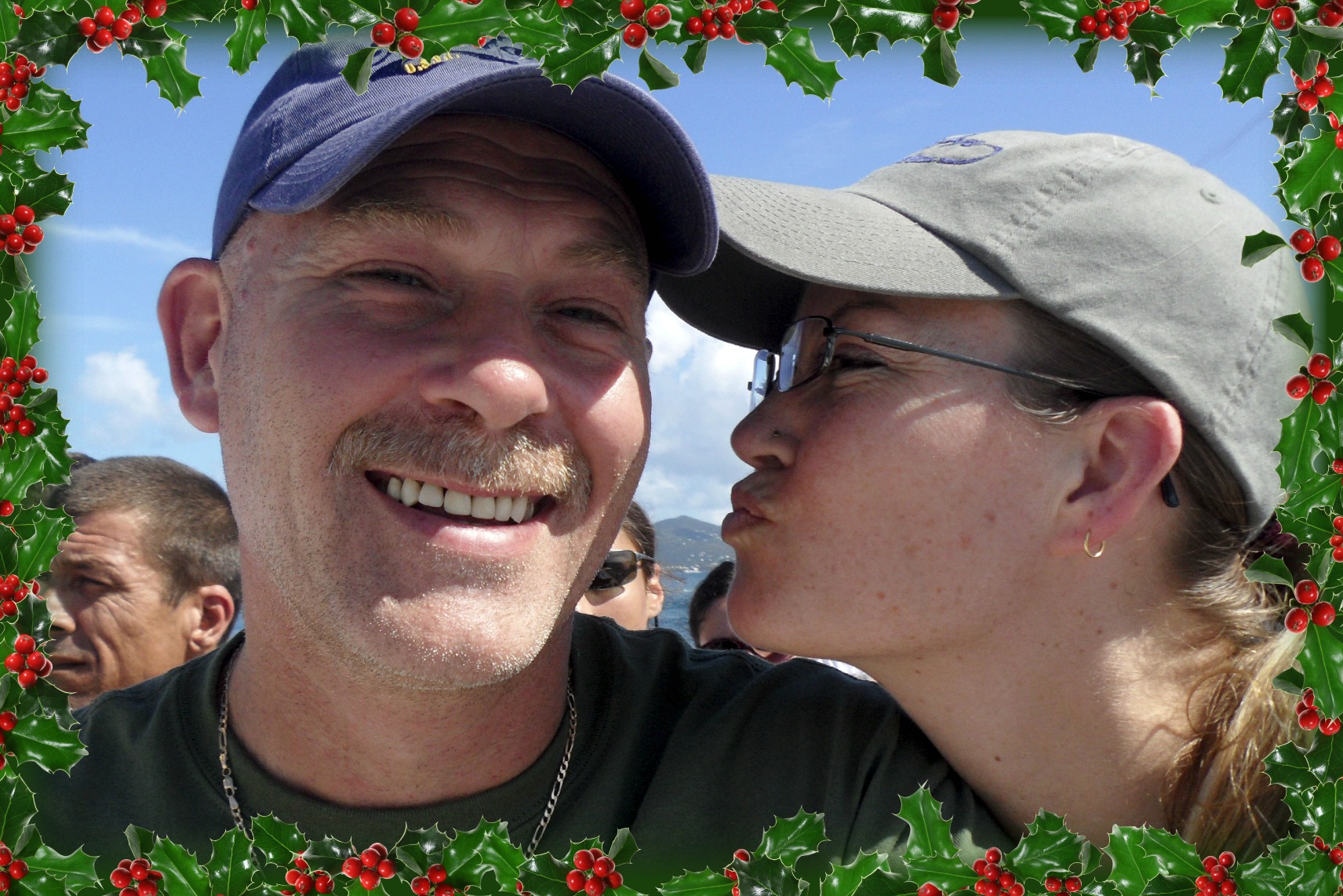
However, last year was a bit more exciting because Peg and I had a big secret plan between us. On Boxing Day we hopped on a plane and flew to the Caribbean. One long haul, three airports, three islands and one ferry later we arrived on St. John in the US Virgin Islands, where we eloped on the beach on December 28th. The photo above was taken of us on the ferry ride over to the courthouse in Charlotte Amalie to pick up our marriage license the day before. This year, of course, we’ll have our first anniversary!

How do you feel when the holidays are over?
It’s a bit anti-climactic. I start the new year with a long flight back to Brazil, which is a country we love living in, but it means back to work for a while. When my job is done there, we’ll have more time to travel when we please. In the meantime, we’ll enjoy as much of Brazil as we can. We both love to travel and look forward to the day when we can just keep going.

On the first day of Christmas, my true love said to me:
THREE DECENT WHISKIES,
TWO CANDY BOXES,
& AN IRISHMAN IN A PALM TREE!

STAY TUNED for tomorrow’s featured nomad (4/12) in our 12 Nomads of Christmas series.

If you enjoyed this post, we invite you to register for The Displaced Dispatch, a round up of weekly posts from The Displaced Nation, with seasonal recipes, book giveaways and other extras. Register for The Displaced Dispatch by clicking here!

Related posts:

12 NOMADS OF CHRISTMAS: Wendy Tokunaga, American Japanophile (2/12)

Current home: San Francisco Bay Area, USA
Past overseas location: Tokyo, Japan
Cyberspace coordinates: Wendy Nelson Tokunaga | Fiction writer and manuscript consultant (author site) and @Wendy_Tokunaga (Twitter handle)

Where are you spending the holidays this year?
At home, in the Bay Area.

What do you most like doing during the holidays?
Eating!

Will you be on or offline?
Good question. I spend so much time online (Twitter and Facebook mainly) networking with readers and other writers, but I do go offline when I’m on vacation. I’m thinking of foregoing social media between Christmas and New Year’s, even though I’ll be in town. We’ll see if I can hold out.

Are you sending any cards?
I used to love to send out Xmas cards and would give much thought each year as to which ones to choose. But now with keeping touch so much via social media, I’ve stopped sending cards and just exchange holiday greetings with people via Twitter, Facebook and email. My husband and I sometimes upload a holiday photo of the two of us. I have never in my life sent out the dreaded Xmas bragfest newsletter.

What’s the thing you most look forward to eating?
See’s Candies and my husband’s Xmas prime rib.

Can you recommend any good books other expats or “internationals” might enjoy?
I’m going to look so tacky here, but I’d like to plug my own e-book (blush), which is called Marriage in Translation: Foreign Wife, Japanese Husband. It consists of interviews with 14 Western women involved in cross-cultural relationships. It’s a fascinating (if I say so myself!) glimpse into these couples’ lives and will appeal to anyone interested in international marriage and culture shock.

If you could travel anywhere for the holidays, where would it be?
Maui!

What’s been your most favorite holiday experience — when you’ve felt the true joy of the season?
I don’t know about the true joy of the season, but I do have a fond memory of spending Xmas in Tokyo and having it be a regular workday, which I quite enjoyed. I sometimes get weary of the constant pressure and obligation in the U.S. to have a family-filled Xmas and be happy and spend money. In Tokyo there are plenty of Xmas trees and lights (my fave parts of Xmas), but it is just a regular day and that’s appealing.

How do you feel when the holidays are over?
I actually like it. There’s a new, fresh sense of energy in starting a new year and anticipating exciting things to come.

On the first day of Christmas, my true love said to me:
TWO CANDY BOXES,
& AN IRISHMAN IN A PALM TREE!

STAY TUNED for Monday’s featured nomad (3/12) in our 12 Nomads of Christmas series.

If you enjoyed this post, we invite you to register for The Displaced Dispatch, a round up of weekly posts from The Displaced Nation, with seasonal recipes, book giveaways and other extras. Register for The Displaced Dispatch by clicking here!

Related posts:

12 NOMADS OF CHRISTMAS: Robin Graham, Irish Expat in Spain (1/12)

Current home: Tarifa, Spain
Past overseas locations: UK, Netherlands, Israel, and a previous stay in Spain
Cyberspace coordinates: a lot of wind… (blog) and @robinjgraham (Twitter handle)
Most recent post: “Gran Bretaña” (December 21, 2011)

Where are you spending the holidays this year?
In Hampshire, England. My mother lives there now with her husband, as does my brother and his family.

What will you do when you first arrive?
Once all the greetings are out of the way I may well go for a walk. I’ll be in the town where I spent my adolescent years and there will be memories and perhaps one or two stories for my fiancée, who will be visiting for the first time.

What do you most like doing during the holidays?
TV off, lights off. Candles on, perhaps a fire. To sit in the near dark and talk; to feel connected to all the people who are doing that around the world and to those who have done it down through the centuries. I am not religious but something about gathering with loved ones in the depths of winter seems to run deep.

Will you be on or offline?
I will tell myself to be offline and will fail. Lessline? Halfline? Online Lite?

Are you sending any cards?
Don’t do cards as a result of a selfish and entirely misspent youth. Not going to start now.

What’s the thing you most look forward to eating?
Tricky. I don’t have much of a sweet tooth. If there’s goose I’ll be happy. Roast potatoes never hurt either.

Can you recommend any good books other expats or “internationals” might enjoy?
Ghosts of Spain (2008) is an account of a journalist’s (Giles Tremlett‘s) trips around the country in search of its hidden history, particularly with regard to the civil war and Franco era, and how the country has changed since that era ended with his death in the mid-seventies. It fills a gap that I would have thought was there for many expats in many countries; a chance to get under the skin of your adopted country in your own language.

Foreign Flavours is the second anthology from the online writers group Writers Abroad. The theme is food (and drink) as experienced by the expat, and the collection is nothing if not varied — from short stories to journalistic pieces to recipes; it’s a real kitchen companion. All of the proceeds from the book go to the Book Bus, a registered charity that aims to provide books to and increase literacy rates among children in the developing world.

If you could travel anywhere for Christmas, where would it be?
I was brought up on the premise that an ideal Christmas would involve snow and reindeer, so the notion of an isolated but cosy log cabin in the woods of Lapland has a distinct appeal. Family around me — great. Just my fiancée — better.

What famous person do you think it would be fun to spend some time time with over the holidays?
Richard Dawkins. We could pontificate on the merits of an atheist world view whilst getting tipsy on eggnog, pigging out on Advent chocolates and singing Christmas carols. I hear he does a mean rendition of “Silent Night,” and I’m sure he’d be good company.

What’s been your most displaced Christmas experience?
I spent one Christmas entirely alone in Holland. Broke. Cue violins — it was an episode in that misspent youth I mentioned. My least Christmassy Christmas.

How about the least displaced experience — when you’ve felt the true joy of the season?
When I was a child most Christmas cards, cookie tins and cake wrappers would, for some reason, feature images of snow-laden Bavarian countryside. Castles and cutesy villages with snowy candlelit windows in the darkness. So to find myself in Bavaria a few years ago with my fiancee’s folks, watching families sled down a nearby hill in the evening, attending midnight mass in a 14th century church with an exquisitely painted ceiling, sitting in the house with candles and glühwein and stollen; that would have to be the one that ticked all the boxes for me.

This Christmas coming will be special, too — a family gathering such as there hasn’t been for long time.

How do you feel when the holidays are over?
Honestly? Relieved, ready to get on with it!

On the first day of Christmas, my true love said to me:
AN IRISHMAN IN A PALM TREE!

STAY TUNED for tomorrow’s featured nomad (2/12) in our 12 Nomads of Christmas series.

If you enjoyed this post, we invite you to register for The Displaced Dispatch, a round up of weekly posts from The Displaced Nation, with seasonal recipes, book giveaways and other extras. Register for The Displaced Dispatch by clicking here!

Related posts:

RANDOM NOMAD: Turner Jansen, American Canine in Holland

Date & place of birth: November 2004, probably West Virginia*
Countries, states, cities lived in: West Virginia (Berkeley): 2004-05; Maryland (Knoxville): 2005-08; The Netherlands (Utrecht): 2008-11; (Amersfoort): 2011 – present.
Canine parentage: Boxer, Chinese Shar-Pei, Great Pyrenees, Retriever, Italian Spinone, English Springer Spaniel…any other guesses?!
Human parentage: Tiffany & Bram Jansen
Cyberspace coordinates: Clogs and Tulips | An American in Holland and @clogsandtulips (mother’s blog** and Twitter handle) ; @turnerinNL (my Twitter handle)
*I was dumped at a shelter when I was only a baby.
**She even has a post about me: “Expat’s Best Friend”

Tell us, how did you get the name Turner?
My brother and I were dropped off at the shelter in West Virginia together, and our two-legged caretakers named us Turner and Hooch after the Tom Hanks movie by the same name (for those who don’t know it, it’s a comedy!). Hooch was adopted before I was, so my mother, Tiffany, never got to meet him. She thought about changing my name, but in the end she decided that Turner was a unique name for a dog — and that it fit me somehow. /(^.^)\

What made you leave your homeland in the first place?
My dad is from the Netherlands, so after my parents got married, Mommy and I moved to be with him.

Describe for us the moment when you felt most displaced — when you asked yourself the question: what’s a nice dog like me doing in a place like this?
The first time I walked around the city of Utrecht. I came from the countryside in the US, and wasn’t used to all the people and cars. And there are so many bicycles here — bikes are scary!

Describe for us the moment when you felt least displaced — when you felt more at home in an adopted homeland than you had in the land of your birth.
We recently moved from an apartment in busy Utrecht to a house in quiet Amersfoort — with a backyard! Our house is a nice size — not too big, not too small. I love when we have friends or family over to visit, and I can show them my backyard and all my toys. Amersfoort is all the things I loved about living in Maryland plus all the things I loved about living in Utrecht.

You may bring one curiosity you’ve collected from each of your adopted countries into the Displaced Nation. What’s in your suitcase?
I have a squeaky toy that looks like the Dutch birthday cake tompouce that I love to play with. I would also bring my doggie musical chairs trophies from the US. They don’t have games like that for dogs here and I am very proud of the fact that I have so many of them!

The Displaced Nation will fix you a welcome meal. What would you like us to serve you?
I LOVE bread (croissants, krentenbollen, bagels, whole wheat bread) and French and Dutch cheeses. Here in the Netherlands, dishes where you boil and mash together vegetables with potatoes are very popular and I love them! The only one I can’t have is zuurkool stamppot (sauerkraut-and-potato mash with bacon) because sauerkraut makes dogs very very sick (my parents and I found that out the hard way!).

Have you learned any commands in other languages since going abroad, and if so can you give us an example?
Daddy talks to me in Dutch only if I’m being bad, so I don’t really care for the language. I have learned how to “shake” on both the English and Dutch commands of “paw” and “poot.” But for some reason, I only sit when given the command in English, even though the Dutch zit sounds almost the same. Mommy says I have a disease called Selective Hearing.

Have you made any new friends with canines or other creatures in your adopted land?
I don’t really play much with other dogs. I prefer being with humans and cats. I have seen my first hedgehogs since coming here and I love them! I just wish they weren’t so afraid of me. They always curl up so I can’t talk to them.

I see you’re already kitted out for the holidays. Where will you be celebrating?
I’m getting a (human) little sister in December, so we’re staying at home in the Netherlands.

That’s very exciting! I presume you’re looking forward to spending the holidays in your new home?
I love when friends and family come to visit, and I love getting presents and treats. We just now celebrated Sinterklaas, and I feasted on those special little ginger/spice cookies called pepernoten. My Dutch grandparents always get me my own bag! I also like seeing my Christmas stocking hung up next to Mommy’s and Daddy’s and listening to Christmas carols once Sinterklaas is over. And on Christmas morning, Mommy always makes waffles and even gives me a small waffle or two of my own mixed with milk and syrup! <:@)

Readers — yay or nay for letting Turner into The Displaced Nation? Tell us your reasons. (Note: It’s fine to vote “nay” as long as you couch your reasoning in terms we all — including Turner and his parents — find amusing.)

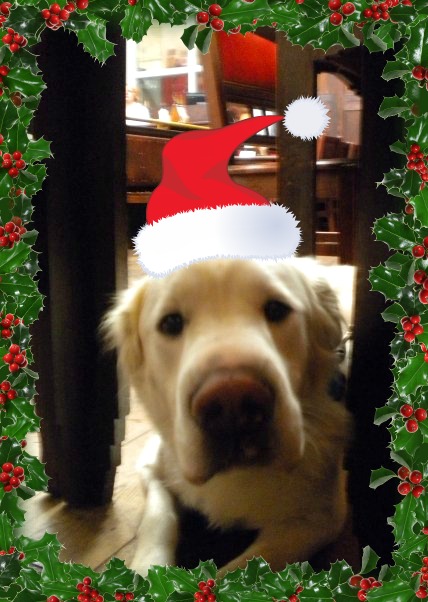
img: Turner Jansen under the table at Café Olivier Utrecht — taken in September 2009 but jazzed up for this post. (Turner’s comment: “Not sure I like this hat. Woof!”)

STAY TUNED for tomorrow’s installment from our displaced fictional heroine, Libby, who is still recovering from the shock of her mother-in-law’s body piercing. (What, not keeping up with Libby? Read the first three episodes of her expat adventures.)

If you enjoyed this post, we invite you to register for The Displaced Dispatch, a round up of weekly posts from The Displaced Nation, with seasonal recipes, book giveaways and other extras. Register for The Displaced Dispatch by clicking here!

Related posts:

An interview with Robin Wiszowaty: Kenya Program Director for Free The Children

Last week I had the privilege of speaking with a young woman called Robin Wiszowaty. She isn’t a household name. You won’t find her in newspaper gossip columns, or on celebrity chat shows, or sashaying down the red carpet at the Oscars.

Yet I came away from our 45-minute conversation quite star-struck – not even my treasured chance meeting with Paul McCartney could compete – and more inspired than I can say.

A brief bio: From Suburbia to Savannah

Robin Wiszowaty was born in 1981 and grew up in Schaumburg, Illinois: a predominantly white, middle-class suburb outside Chicago. Although on paper Schaumburg appears an ideal place to spend childhood, with its summer block parties and strong sense of neighborliness, Robin says she never quite fit in.

“From an early age, I was unsatisfied with my ordinary life….I could never find my niche or any comfortable sense of self.” [My Maasai Life]

This feeling of discontent followed her through her teen years and into college at the University of Illinois where she studied speech communications. Only after a two-week trip to Israel in December 2001, to explore her Jewish heritage, did Robin begin to understand what she wanted from life.

“It [reminded] me how fiercely I longed to break out of this Western mindset and find something else.” [My Maasai Life]

While her concerned and long-suffering parents assumed the trip would rid her system of dissatisfaction and wanderlust, those two weeks in Israel were, in fact, only the beginning of a lifetime of traveling.

To the dismay of her parents a few months later, through a program run by the University of Minnesota, Robin was on her way to Kenya. After two months with a host family in Nairobi, where she learned basic Swahili and took classes on Kenyan culture, she went to live for a year in rural Nkoyet-naiborr, a Maasai community in the Great Rift Valley – a community and lifestyle as far removed from her Illinois home as anyone can imagine.

Nevertheless, Nkoyet-naiborr became her second home, in the truest sense. Here she forged deep, lasting friendships with her host family and members of the community, and was bestowed with a Maasai name: Naserian, meaning “peaceful person.” Mama, the mother in her host family, became her Kenyan mother, and Robin refers to the children of the family to as her brothers and sisters.

Today, nearly a decade after first arriving in Nairobi, Robin divides her time between Toronto and Kenya, working as Kenya Program Director with the charity Free The Children, implementing long-term development projects in partnership with local communities.

* * *

I spoke to Robin while she was in Canada, a few hours before she made the long trip back to Kenya. Her voice is soft, gentle, diffident, and not exactly what I’d expected; she’s had to overcome a lot of hurdles to be where she is today and, after reading her autobiography, I’m aware that I’m talking to one very determined person.

On Free The Children…

Kate Allison: Tell us a little more about what you do for Free The Children.
Robin Wiszowaty: As Kenya Program Director, I oversee the Alternative Income projects for Kenyan women. We teach the women leadership, financial literacy, how to access loans; and by being able to earn their own money, the women can invest that extra income in their families, their homes and, importantly, their children’s education. They work in groups — there are around 120 women’s groups now — and one example of how they earn income is doing quality beadwork. The bracelets and necklaces they make are sold at the Me to We store in Toronto, and also at the online store. My own Mama, by the way, is one of the beaders — she’s a fantastic beader.

Craig and Marc Kielburger, the founders of Free The Children and Me to We, have more to say about Robin’s role:

We’ve seen her sitting in hushed, intimate conversation with village elders, whose trust she earned through empathy and understanding. We’ve seen her astonish visiting students and volunteers with stories of her adventures. And we’ve seen her embraced by the teary-eyed mamas who are eternally grateful for her hard work in her role as Free The Children’s Kenya Program Director.

On writing…

Eighteen months ago, Robin’s autobiography “My Maasai Life” was published by Me to We Books — publishing division of Me to We, the for-profit social enterprise that supports Free The Children — and having read the book, I wanted to know more about it.

KA: Your book, “My Maasai Life”, tells the story of your transition from the American suburbs to life in a Kenyan village. What made you decide to write it?
RW: Lots of people have said to me that I should write a book about my experiences, but it was at the prompting of Craig Kielburger that I eventually wrote it. Craig was looking for books with a social message to be published by Me To We. “My Maasai Life” was the result, and was actually one of the first books in the Me to We publishing stable.

KA: What audience did you have in mind for the book when you wrote it?
RW: I originally intended it for high-school-aged girls who wanted to see the world — and also for their mothers, to help them understand this.

KA: Yes…in your book, you say your relationship with your own mother was somewhat rocky when you were that age.
RW: It was. But I look at myself now, and I think I’ve become the kind of person my parents always wanted me to be – albeit on my own terms.

(In fact, Robin’s parents long ago accepted, and proudly support, their daughter’s unconventional life choices.)

KA: What other kinds of readers have been attracted to the book?
RW: Young adults, in their 20s and 30s, who want to find a deeper meaning from life than they find in the corporate world where they are at present. And teachers; they read my book in World Issues classes, and discuss it with their students.

KA: Have you written any other books, or are you intending to do so?
RW: “My Maasai Life” has been adapted into a children’s book, subtitled “A Child’s Adventure in Africa”, and I’m currently working on another book, which I hope to have published in another couple of years or so. I’m about halfway through writing it — I don’t know what it will be called, and it doesn’t have a working title — and although it’s also about Kenya, this book is from the perspective of the women there, focusing on the universal concepts of motherhood and womanhood.

On fitting in…

KA: Can you think of a particular occasion in Kenya when you wondered, “What’s a nice girl like me doing in a place like this?”
RW: [laughs] I can tell you exactly when that was. It was on my first night in Nkoyet-naiborr, when I was sleeping in the bed I shared with my sister, Faith, and I heard a wild animal howling outside…

“Faith! ” I whispered.
“Naserian . . . ?”
“What is that sound?”
Faith rolled over, annoyed at being woken. “Hyenas.”
Hyenas? Now sleep was even more impossible. I tried to block out those echoing wails, but my mind flooded with questions. Was I doing the right thing? Was I just substituting one set of frustrations for another? Had I made a terrible mistake?

KA: And what about the other way round — can you think of a moment when you felt more at home in Africa than in the United States?
RW: Oh yes…I’m “taken” by Kenya. There, I feel comfortable within my own soul, that I’m in the right spot. You could say that it’s a calling. The time I feel it most is when I’m sitting with the women, making tea over the fire, just talking…there’s so much soul, such a feeling of family and community.

When I first went to Kenya, I felt at home on the first occasion my Mama let me fetch the water on my own. It felt good to be a provider for the family who were hosting me.

Fetching the water is much easier said than done:

Transporting water, I saw from the women, is an art unto itself. The mitungi must be carefully balanced on two rocks beneath the spout and then held in place while the trickling water slowly fills it all the way to the top. And with water always in scarce supply, we could never afford to waste or spill a drop. When the cylindrical twenty litre container was full, it weighed more than twenty kilos.

More recently, I can think of an occasion at the Kisaruni High School, which is Free The Children’s first all-girls secondary school, and has 41 students who board there. When it first opened last spring, these girls came to the school and we all had a big sleepover party. It was such a lot of fun, and for many of these girls it was the first time they’d slept on a mattress.

It’s the feeling of true community in Kenya that I love. It seems to me that when people come together for the benefit of others, that’s when you get the most profound sense of community.

KA: What about repatriation? Do you find it difficult to adjust between living in your two different worlds?
RW: The first transition from Kenya back to Chicago was most difficult. I felt like a lost 8-year-old, trying to get used to life in America again after a year away. I found it hard to wear shoes, having been barefoot for so long. And I was full of anger, of judgment for the way things were done — for example, at people who ran the water for so long, at the extravagant amounts of food.

Huge wasteful, overpriced family dinners. Thoughtless waste of water, flushing the toilet so many times every day.

But I don’t feel that way now. Then, I was going through that time of life when everyone tries to work out who they are and feels a certain amount of anger. Now I accept that it’s not about everyone having the same; it’s about everyone having enough.

Today, whichever direction I travel in, I always feel that I’m going home to family.

On our November theme of Global Philanthropy…

KA: Over the last month, we’ve discussed — fairly heatedly — the growing trend towards volun-tourism. As part of your work with Free The Children and Me to We, you lead groups of people on international volunteer experience each year. Can the people who go on these trips, who lack language and cultural training, really accomplish much in such a short time?
RW: Volun-tourism can play a great part when it’s done responsibly. Our youth volunteer trips last three weeks, while our family and corporate trips are shorter at ten days. We regularly have employees of large companies like KPMG and Virgin Atlantic on our corporate trips.

After some orientation, our volunteers hit the ground running — they help with building schools, with clean water projects, they go into the community’s homes to help, they learn Swahili. For many of them, it is literally a life-changing experience. It gives them a different perspective on life and on their careers. It’s very positive for both the volunteers and for the communities they are helping.

Volun-tourism skeptics should maybe note that Robin herself first came to Kenya with an attitude of “What can Kenya do for me?” rather than “What can I do for Kenya?”, as can be seen in this extract from her book, describing an incident during her initial two months in Nairobi:

One street man nearby…said in Swahili, “What are you doing in Kenya, if you can’t help us?”

Despite my halting comprehension of the language, I understood his question. What was I doing here? Was I here to help Kenyans? I couldn’t remember any sort of altruistic impulse as my reason for being me here. I only pictured myself three months earlier, curled up on my family room couch reading books on cultural sensitivity, or shopping in neighbourhood department stores for appropriate clothing, thinking this was a chance for me to enlarge my experience and pick up others’ points of view. I’d been driven simply by a desire to escape, not to improve the lives of these poor people.

KA: Which person or people, dead or alive, do you look up to most in your work?
RW:
I would have to say the other team members of Free The Children and Me to We, both in Kenya and Toronto. They all work for the children, not the paycheck. The world may never know their names, but they work so hard and achieve so much for others.

KA: Are there any inspirational stories of theirs you can share with us?
RW: Spencer West, a speaker on the Me to We team, was born with a genetic disease, and lost both his legs at the hips when he was a child. We met in Kenya when he was on an international volunteer trip, helping to build a school there.

Next June, he is going to “Redefine Possible” and climb Mount Kilimanjaro in his wheelchair, in order to raise $500,000 to bring clean water programming to 12,500 people in East Africa.

You can’t get any more inspirational than that.

KA: And lastly — it’s the holiday season. We’re inundated with requests for giving. In your opinion, what’s the best way to spend our dollars (or pounds, or euros, or yen, or whatever) to help those in other parts of the world who have so much less than we do?
RW:
Well — you could sponsor Spencer West on his climb and help those affected by the drought in East Africa, which is the worst in 60 years. Or you could buy your holiday gifts from the Me to We store, either in Toronto or online at www.metowe.com/shop.

Epilogue

The interview ends, and I thank Robin for giving her time, even when she has a hundred other things she could probably be doing, since in a few hours she will be flying back to her Kenyan home. I am awed by our conversation, by how much she has achieved in her short life — she is only 30 — and I feel humbled.

I tell her this. “People like you, who do so much with your lives, make me feel very small.”

There’s a slight pause at the end of the phone, then Robin says, “But… you’re a mother.”

I can’t count the number of times over the last fifteen years when, in answer to the question “What do you do?” I’ve said, “I’m just a stay-at-home mom.” Emphasis on the “just” — an apology for the mundanity of my existence. The counter-reaction, so often, is “But that’s a very important job!” in a slightly condescending tone that makes me feel, even more, that motherhood is merely a consolation prize for missing out on life’s other, more important achievements.

Robin’s tone holds none of this condescension. “You’re a mother,” she says, and it’s a statement of the obvious, that being a mother is an achievement in itself.

It occurs to me that her years with the mamas in Kenya have taught Robin the value of motherhood — a lesson that maybe passes by the young women growing up in our “developed” culture. It’s an irony, perhaps, that in our Western pursuit of progress and women’s rights, we have devalued the most important women’s right of all — that of pride in raising a strong next generation.

Robin, thank you. It was wonderful to talk to you. I hope we meet in person one day.

.

Quotations from “My Maasai Life: From Suburbia to Savannah.” Wiszowaty, Robin (2010-07-01), Perseus Books Group.

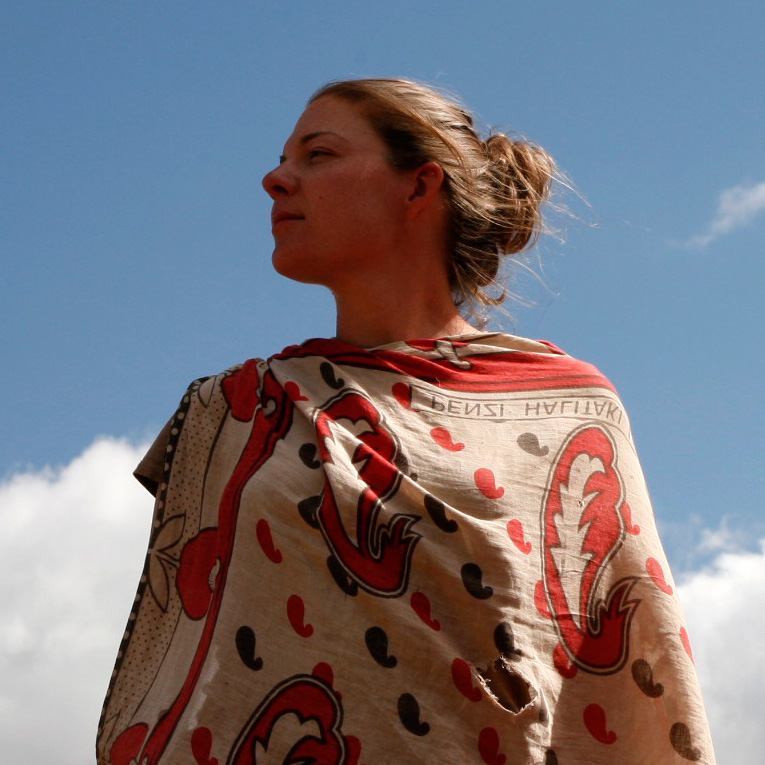
Img: Robin Wiszowaty — photo courtesy of www.metowe.com

Related posts:
RANDOM NOMAD: Aaron Ausland, NGO Research Director & Development Practitioner
RANDOM NOMAD: Adria Schmidt, Career Consultant at Violence Intervention Program & Former Peace Corps Volunteer

If you enjoyed this post, we invite you to subscribe for email delivery of The Displaced Dispatch, a round up of the week’s posts from The Displaced Nation. Sign up for The Displaced Dispatch by clicking here!

RANDOM NOMAD: Aaron Ausland, NGO Research Director & Development Practitioner

Born in: Eugene, Oregon (but raised in Plains, Montana, a town of 1,200)
Passport: USA*
Countries, states, cities lived in: Washington (Yakima, Tacoma, Spokane): 1989-95; Alaska (Anchorage): 1995-97; Bolivia (Bañado de la Cruz & Santa Cruz): 1997; 1998 – 2002; Washington (Seattle): 2002-03; Massachusetts (Cambridge): 2003-05; Guatemala (Guatemala City): 2004; California (Duarte): 2006-10; Colombia (Bogotá): 2010 – present.
Cyberspace coordinates: Staying for Tea | Good Principles and Practice of Community-based International Development (blog); @AaronAusland (Twitter handle); Aaron Ausland at Huffington Post (column)
*My passport is only three years old, but multiple entries to about 40 countries filled it right up and I’ve had to add more pages. By the end of this year, I will have slept somewhere other than home about 190 of the 365 nights.

What made you leave your homeland in the first place?
My late first wife and I wanted to make a difference in the world and were particularly passionate about issues of justice, peace, and poverty. After graduating from university, we decided that maybe the best place to match our greatest gifts with the world’s greatest needs was in the public policy arena. We thought it would be good to represent a view on behalf of the marginalized — those uninvited to the table where policy decisions are made that nevertheless affect their lives in profound ways. In particular, we were thinking of illiterate poor persons living in underdeveloped countries ruled by bad or incompetent leaders and subjected to all the crap that comes with weak institutions of governance.

But we realized it would be pretty lame to run off to graduate school straight out of undergrad and then find some job in a policy think tank or as a Congressional aide in the hopes of working our way up to having a place at the table with a mind to represent these unrepresented views when we really hadn’t a clue what they were.

So we made a three-year commitment with the Mennonite Central Committee to go live and serve in a Bolivian village with people who fit this description.

We were young, hopeful, idealistic, earnest, and naïve. I can say that I’m not so young anymore.

Is anyone else in your family a “displaced” person?
I have a brother who served in Iraq for a couple of years, but he now lives about a hundred meters from our dad’s house in Yakima, Washington. I’m really the only one in my family who has chosen a lifestyle for which the question “Where are you from?” generates a confusing jumble of explanation rather than a simple city-state combo. 

Unless you count my son, Thiago. He’s six and is definitely more “displaced” than me. He literally speaks of living in two different “worlds.” In one “world” he speaks Spanish, has a home and school in Colombia, where his sister was born, and has family in Bolivia (his mother is Bolivian). In the other world” — where he says he is really from — he speaks English and has friends in California and a large family on my side including a whole set from my late first wife. Yesterday he told his mother: “My brain is confused, I don’t know where I should live. All my friends are in California, but my cousins are in Bolivia, and I go to school in Colombia and have friends there, too.” Poor little nomad.

Describe the moment when you felt most displaced.
For me the question was “How the hell did a small town boy from Montana end up here?” Physically, at that moment, “here” was a stainless steel operating table in a dark and empty hospital room in Santa Cruz, Bolivia. But more profoundly, “here” was a situation so far from my expectations, I was literally struggling to connect the dots and figure out how I had gotten myself there. I was 25 years old. Somewhere in a ravine a hundred miles away lay the broken body of my wife. A few hours earlier, the public bus in which we were riding had missed a turn on the narrow, winding road that passes through the Andean foothills and tumbled 1,000 feet into the dark.

She and I had gone to Bolivia with a long-term vision of our lives together, and now I was here, in a foreign land, alone, the slate of the future wiped clean. It was so profoundly disorientating, I just kept coming back to the question: “How did I get here?” Maybe it was a way to push off the searing emotional pain that would come with facing into my new reality, but the question wouldn’t go away. What sequence of events and decisions led me here? Did I make a mistake?

I remembered scenes from my idyllic boyhood in small-town Montana when my whole world was contained in a 100- mile radius and a handful of friends and family members. How had the world gotten so big, so uncertain, so complicated? And what was I doing wandering around in it like a lost child? How had I gotten here?

Much later, I would decide that I hadn’t made any mistakes. My first wife and I had made decisions based on a set of values that we held in earnest and I continue to hold. The fact that those decisions led to tragedy does not diminish the certainty of those values — it just means that those who hold them are not exempt from catastrophic loss that come to all who live.

I know you were probably hoping for a funny anecdote about crazy food or wacky cultural misunderstanding, but this is my one true displacement story.

Describe the moment when you felt least displaced.
Nowadays, I feel a sort of indifference about the whole location thing, to be honest. Whether I’m living in Cambridge attending the Kennedy School of Government, or setting up a new home in Colombia, or sitting where I am at this moment at an outdoor bar in a hotel in Bamako, Mali, I feel neither particularly at home nor particularly displaced. Feeling at home has a lot less to do with place than it used to, and it’s often unpredictable. I can feel more at home in Albania when I have a good macchiato and an Internet connection to video Skype with my children than I might in a hotel in Atlanta after a missed flight, with a dead computer battery. I can feel more at home when I’m sharing a beer with a fellow expat I’ve just met in rural Cambodia than I might sharing a beer with an old friend I grew up with who never left Montana.

I’ve experienced profound moments in my adopted homelands — from becoming a widower, to getting married, to rejoicing at the birth of my daughter, to undergoing major medical treatment. In each of these, it was the people who surrounded me that made me feel at home, and the uniqueness of the event that made me feel displaced. The location or culture has ceased to hold much power over my perception of self at particular moments.

You may bring one curiosity you’ve collected from each of your adopted countries into the Displaced Nation. What’s in your suitcase?
I’ll bring my wife from Bolivia, my son from the USA, and my daughter from Colombia. They are certainly a curious bunch, but I can’t live without them.

You’re invited to prepare one meal based on your travels for other Displaced Nation members. What’s on the menu?
Well, the cuisines of places like India, Thailand, Ethiopia, and Mexico are always worth sharing. The rich complexities that have come from centuries of experimentation with combinations of local flavors as well as some exotic additions from old trade routes are heritage gifts to the world. But, I’m sure someone will bring a few dishes from these parts into the Displaced Nation, so maybe I’ll bring some less likely ones such as the rich Malian sauce made in part from the boiled fruit of the baobab tree; the surprisingly filling chicken hearts strung on a kabob, flavored with soy sauce and charcoal smoke, sold on the streets of Bolivia; or maybe a lesser known dish from Mexico — the corn smut omelet made with cuitlacoche, a purplish fungus that grows on corn; or maybe I’ll just bring the beer…

You may add one word or expression from the countries you’ve lived in to The Displaced Nation argot. What will you loan us?
I think I’ll pass on this one. Pole sana (so sorry!) as we say in Swahili. Actually, maybe that’s a good one. Pole (pronounced POH-lay) doesn’t have an exact English equivalent — it’s used to say you empathize and understand someone’s problems, without the connotation of inferiority that “I pity you” might have.

This month we are looking into “philanthropic displacement” — when people travel or become expats on behalf of helping others less fortunate than themselves. Do you have a role model you look up to when engaged in this kind of travel — whose words of advice you cherish?
I’ve never really had a specific role model for philanthropic displacement. That said, I’ve always been impressed with people who make long-term commitments to live among the people they wish to serve and voluntarily forego access to comforts and safety they might otherwise enjoy.

There are some famous examples like Mother Theresa, but the ones that have had the biggest personal impact on me are unknowns — volunteers and professionals I’ve met and worked with along the way. Such people taught me how to live with a kitchen stocked with just 12 items — that’s counting the spices. They taught me how to bring my water up from the river in the morning and hang it in a tree from a bucket painted black so that the sun would heat the water throughout the day, in preparation for a warm evening bucket shower. I learned how to capture rain water, how to build dry latrines, how to trust local medicinal practices, how to enjoy silence, how to walk the equivalent of a marathon a day to visit local families, how to sit and unhurriedly share tea over conversations that circle around rather than cut to the chase, how to embrace simplicity as a virtue… I also forgot how to complain and remembered to be grateful in the midst of scarcity.

Most of my role models didn’t do anything spectacular — they didn’t invent microfinance or the treadle pump, they didn’t negotiate peace accords or write a best seller. But the way they displaced themselves so thoroughly, the way they embraced their local communities with such authenticity — this had a big impact on how the communities valued their presence and their contribution, and on me.

Voluntourism is said to be the fastest growing segment of the travel industry (itself one of the world’s fastest growing industries). Do you think this kind of travel can help the uninitiated understand the problems our planet is facing?
No, not really. It’s not that I think voluntourism is unequivocally a bad thing, but I just don’t think you can expect people to gain a very accurate understanding of complex problems under such circumstances. In fact, I think it’s more likely to leave them with a distorted understanding. There is a saying I picked up somewhere that goes something like this:

Travel to a new place for three weeks and you can write a book, travel for three months and you can write an article, travel for three years and you’ll likely have nothing to say.

There’s just something about a short and intense exposure that seems to set very strong ideas into the minds of those who’ve experienced it. But their ideas are biased by the specificity, narrowness, and brevity of that experience.

For example, someone who has had a high-impact experience volunteering in an orphanage for a week may feel they know more about the issue than people who haven’t had that experience. In fact, they may actually know less due to the biases they have picked up. It’s like believing you know something about the average person in a country from a single observation.

Sometimes, people know just enough to be dangerous; they mistake their shallow knowledge for an actual understanding of some enormously complex problem, and they act on it in ways that are ultimately irresponsible.

The truth is, the problems facing our planet are complex and we should all be grateful for the specialists who have dedicated their lives to understanding and addressing them. Doing something serious about addressing these problems will require professionals, not hobbyists; lifers, not tourists.

Again, it’s not necessarily a bad thing to pass through as a tourist, but with regards to your question here, we need to guard against self-deception. I’ve taken a few tours of a number of hydro-electric projects across the Western USA. I think they are really interesting. But, I know better than to believe I know the first thing about harnessing the power of water to generate electricity while balancing the ecological, economic, legal, social and political interests of farmers, consumers, industry, and the environment.

Likewise, you can’t take a two-day tour of an urban slum in Kenya and think you understand poverty, urban migration, economic development, or whatever other angle one might give such a tour.

For a broader scope of my thoughts on voluntourism, I encourage you to see my blog posts:

Readers — yay or nay for letting Aaron Ausland into The Displaced Nation? Tell us your reasons. (Note: It’s fine to vote “nay” as long as you couch your reasoning in terms we all — including Aaron — find amusing.)

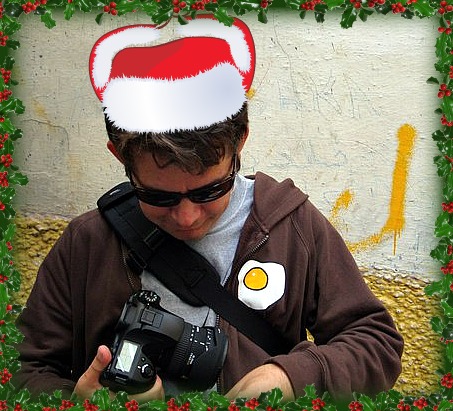
img: Aaron Ausland in Mexico City (he’s the suit!). While on a lunch break from her work conducting a month-long operations audit of an NGO office, Aaron happened upon a lucha libre wrestling match putting on an outdoor show, and decided it would be amusing to pose with the star luchadore.

STAY TUNED for tomorrow’s installment from our displaced fictional heroine, Libby, when we get to find out whether she’s recovered from eating her mother-in-law’s undercooked Thanksgiving turkey. (Not keeping up with Libby? Read the first three episodes of her expat adventures.)

If you enjoyed this post, we invite you to register for The Displaced Dispatch, a round up of weekly posts from The Displaced Nation, with seasonal recipes, book giveaways and other extras. Register for The Displaced Dispatch by clicking here!
Related posts:

RANDOM NOMAD: Adria Schmidt, Career Consultant at Violence Intervention Program & Former Peace Corps Volunteer

Born in: Phoenixville, Pennsylvania USA
Passport: USA
Countries, states, cities lived in: Pennsylvania (Collegeville & Landenberg): 1985-87 & 1996 – 2004; Ohio (Cincinnati): 1987-96; Massachusetts (Boston): 2004-06, 2008-09; Argentina (Buenos Aires): 2007-08; Dominican Republic (Cambita Garabitos, San Cristóbal province): 2009-11; New York (New York): June 2011 – present.

What made you leave your homeland in the first place?
I guess you can say I left my homeland in search of a home. I never felt very “at home” as a teenager in Pennsylvania, so when the opportunity came to travel to Spain on a class trip I went eagerly. On this short trip I found that I felt more comfortable with some parts of the Spanish culture than with my own. The seed of wanderlust was planted.

When I went to school in Boston at Northeastern University, I decided to study the Spanish language, partly because of my interest in the language and the culture of Ibero-America, and partly because of my wish to study abroad.

Under Northeastern’s “Dialogue of Civilizations” program, I worked in Puebla, Mexico in a women’s prison, as well as in a small indigenous village in the mountains of Cuetzalan, where the people spoke only Nahuati. Both were amazing experiences.

And under Northeastern’s study abroad program, I lived in Argentina for nearly a year — during which I decided I wanted to help impoverished people in developing countries so would try joining the Peace Corps. Two years and one Master’s degree later, I was finally accepted and sent off to the Dominican Republic.

So did I ever find that “home” I was looking for? To be honest, my travels have only nurtured that original seed of restlessness. The more I travel the more I discover about myself and others — and the more I realize how much I still have to learn. For now, at least, home is wherever I want it to be.

Is anyone else in your family a “displaced” person?
As far as my immediate family goes, no one is or has ever been “displaced” — although I do like to think that my travels have inspired family members to explore other countries. My father was always one of those people who felt it would never be necessary to leave the United States as he had everything he wanted or needed right here. But when I went to Argentina, my parents decided to visit, and my dad absolutely fell in love with the country. To this day, he tells people that Argentina has the best pastries in the world. Now when I tell my parents I’m going overseas, they no longer respond by saying: “Why do you want to go there?” Instead it’s “When can we visit?”

Describe the moment when you felt most displaced.
One night in Cambita my host sister’s husband brought me a guayaba (guava). He was really excited for me to try one for the first time, and I didn’t have the heart to tell him I had eaten this fruit before in Mexico. After I ate it I started to feel nauseous and dizzy. Soon my lips began to swell and my whole face was itchy. I was having an allergic reaction to a chemical (a fertilizer or pesticide) that had been used on the fruit. I called the Peace Corps doctor, who told me to take two Benadryl and then a shower to wash the chemicals off.

When I got to the shower — an outdoor zinc and cement block latrine with a drain in the middle — I hung my towel on the cement blocks and poured cold water from a bucket over my head. It was already dark and I couldn’t see anything.

As soon as I finished, I wrapped the towel around myself and as I was heading back to the house, I felt a small sting on my stomach, then another one on my back, and another one on my chest. Soon my whole body was burning with these sharp little stings. Inside my towel was a colony of fire ants! I ran to my room, only to find it occupied. My host parents, Doña Romita and Don Rafael, were busy adjusting a new table the latter had constructed from an old cabinet. All I wanted to do was rip off my towel, but I could not get naked in front of my 70-year-old hosts!

By that time, the ants were all over my body. I was jumping up and down, shaking my towel and yelling for them to get out of the room. In all the commotion the oil lamp was knocked over and shattered on the floor. Doña Romita refused to let me in the room with the glass on the floor. Still unsure of what was wrong with me, she rushed me to her room. I quickly closed the door and whipped the towel off, slapping the ants off my body.

Just when I thought the nightmare was over I looked up and realized the shades were wide open and everyone outside the house had seen me naked and jumping around. At that moment, Doña Romita knocked on the door to tell me that my project partner and his wife were there to see me.

Describe the moment when you felt least displaced.
After being in the Dominican Republic for more than a year, I came back to the States to visit my friends and family. One night, while out with some friends all the girls couldn’t stop talking about their weight. They were commenting about how beautiful one of our friends was because they had never seen her so skinny before. All I could think of was how sickly she looked and how much I wanted to feed her. I couldn’t understand why being skinny was considered better while in the Dominican Republic being called “fat” or (my favorite) “fatty” was a compliment. My view of what was healthy and beautiful had been altered from my time in the Peace Corps.

You may bring one curiosity you’ve collected from each of your adopted countries into the Displaced Nation. What’s in your suitcase?
From Argentina: All the ingredients and utensils for brewing maté, a drink made from the leaves of the yerba maté plant, containing caffeine and related compounds. (This is sadly ironic since I accidentally left behind my maté in my apartment in Buenos Aires.) The yerba is packed into a hallowed-out gourd, which is then filled with boiling water. You drink the mixture directly from the gourd using a metallic straw with a filter at the bottom, called a bombilla. Some people walk around with a thermos of hot water and the gourd to drink maté whenever they have the urge. It has a very strong, bitter taste, but you can add liquid sugar.

From the Dominican Republic: Some large jugs of the tree bark, sticks and herbs that can be used for making the classic Dominican drink mamajuana. I assume the Displaced Nation has honey and rum we can add to it? After filling with rum and honey, you let the jug sit for a few days. You can also add cinnamon sticks soaked in red wine and honey, or raw squid and seafood soaked in rum. Men use the seafood mamajuana to boost their virility. Regular mamajuana supposedly cleans the blood, provides a tonic for liver and kidneys, relieves menstruation pains, and cures many other ailments (depending on who you talk to).

You’re invited to prepare one meal based on your travels for other Displaced Nation members. What’s on the menu?
I would make the meal I ate the most of in the Dominican Republic: rice, beans, plantains, and overcooked spaghetti with carnation milk, canned tomatoes, and corn. It’s the perfect carb overload — are any of you marathon runners?

You may add one word or expression from the countries you’ve lived in to The Displaced Nation argot. What will you loan us?
From Argentina: Che, boludo. Che is similar to the American word “dude.” I love che because it means that whenever I’m talking to someone and can’t remember their name, I can just call them che. Boludo technically means “jerk” (or worse), but it can also be used in an endearing way. My Argentinian friends and I always used to greet each other with a “Che, boludo!”
From the Dominican Republic: Vaina — though it technically means the pod around pigeon peas (gandules), everyone uses it to mean a thing or object. If I ever got stuck and couldn’t think of the Spanish word for something, I would just call it vaina while pointing to the object with my lips. It’s a great word for anyone learning Spanish.

This month we are looking into “philanthropic displacement” — when people travel or become expats on behalf of helping others less fortunate than themselves. Do you have a role model you look up to when engaged in this kind of travel — whose words of advice you cherish?
Strangely, I have never had a role model for this kind of travel. I was always drawn to it — but for some reason never felt the need to seek out others who had done it before me. My family were against my joining the Peace Corps because of fears for my health and safety. A psychic I met at a Renaissance fair right before leaving for Argentina told me I was going to do the Peace Corps. I don’t really believe in psychics but everything she told me that day has come true. So perhaps it was simply a matter of fate?

Voluntourism is said to be the fastest growing segment of the travel industry (itself one of the world’s fastest growing industries). Do you think this kind of travel can help the uninitiated understand the problems our planet is facing?
Voluntourism is a tricky subject for me personally. On one hand I feel that it is ridiculous to pay someone’s plane ticket, lodging, food, and transportation at a more luxurious level than any host country national has ever experienced to have them “volunteer” and do a job that a local person would probably be more than willing and capable of doing had all that money been spent on their salary. On the other hand, I do realize the value of cross-cultural communications for both parties and that, on the occasions when it’s done correctly, the volunteer might actually be able to transfer a valuable skill to the host country nationals. In short, it all depends on how the voluntourism is being executed.

While in the Dominican Republic, I observed many volunteers who were asked to do jobs that could have been, and in some cases even were once done by Dominicans. It wasn’t that the local population didn’t have the knowledge or training to do some of these jobs; it was that they didn’t have the money to pay a salaried person and wanted a “free” volunteer instead.

Luckily, most Peace Corps volunteers were successfully trained to avoid taking jobs away from Dominicans, and instead focus on areas where they and their community felt the need was greatest.

Readers — yay or nay for letting Adria Schmidt into The Displaced Nation? Tell us your reasons. (Note: It’s fine to vote “nay” as long as you couch your reasoning in terms we all — including Adria — find amusing.)

img: Hair washing ritual in Constanza, a mountainous area of the Dominican Republic, in spring of this year. Adria Schmidt is the one getting her hair washed — the one doing the washing is Rebecca, a fellow Peace Corps volunteer, and they are in the home of another Peace Corps volunteer, Malia (not pictured). Due to the primitive plumbing conditions, hair washing has to be done in the kitchen, by heating water up on the stove.

STAY TUNED for tomorrow’s installment from our displaced fictional heroine, Libby, who finds herself celebrating her first Thanksgiving under less-than-ideal circumstances. (What, not keeping up with Libby? Read the first three episodes of her expat adventures.)

If you enjoyed this post, we invite you to register for The Displaced Dispatch, a round up of weekly posts from The Displaced Nation, with seasonal recipes, book giveaways and other extras. Register for The Displaced Dispatch by clicking here!

Related posts:

RANDOM NOMAD: Jennifer Lentfer, International Aid Consultant, Writer & Blogger

Born in: Bruning, Nebraska USA
Passports: USA
Countries, states, cities lived in: Zimbabwe (Mutare & Harare): 1999 & 2002-04; Michigan (Detroit): 1999-2000; Pennsylvania (Pittsburgh): 2000-2002; Namibia (Windhoek): a few months in 2001; Malawi (Lilongwe): 2004-05; California (Santa Cruz): 2005-10; Washington, DC: two weeks ago-present.
Cyberspace coordinates: How Matters | Aid effectiveness is not what we do, but HOW we do it (blog); @intldogooder (Twitter handle)

What made you leave your homeland in the first place?
I grew up on a pig farm in Bruning, Nebraska, population 248. The graduating class of my secondary school had 16 people. Every time the phrase “it takes a village to raise a child” is uttered, I think “If only they really knew…” Thinking back, there were two very important teachers, one in high school, and another at university, who were extremely influential in shaping and expanding my world view. And my parents certainly raised me to cultivate a curiosity about life. This, along with my insatiable, youthful desire to get as far away from Nebraska as possible, was a combustible mix that shaped my career and life path.

Is anyone else in your family a “displaced” person?
I was the first person in my family to go or live abroad. I don’t think I even knew anyone who had been to Africa before my first trip abroad, at age 19.

Describe the moment when you felt most displaced.
On the bustling Nelson Mandela Avenue in Harare, Zimbabwe, in 2003. I always hated driving to city centre, but a colleague and I had to go to the immigration office to update our work permits. When we came out of the office, our car was blocked by another on the street. So we just got into the car and waited.

Eventually a man came up my driver’s side window and tapped on the glass. Not knowing him, I rolled the window down a couple of inches. This seemed to anger him and he walked away to talk to another man, a companion of his, who started yelling out to walkers-by that this white woman [me] would not roll down my window — I must think Africans are “stinky,” on and on… Luckily people didn’t engage him. There was a dynamic going on that I didn’t understand — apparently, I had parked in the man’s space, and he felt justified in scolding and harassing me for that.

After a few more minutes, the original man came back to my window, pulled out his wallet and his War Veterans identification card, placed it up against the glass and menacingly dragged it across. And then it made sense. The card, along with the man’s demeanor, indicated that he was probably one of the veterans of Zimbabwe’s war for independence, who’d been recruited by the Mugabe government for help in brutally suppressing opposition demonstrations, in murdering and torturing opposition leaders, and in seizing land on behalf of the government elite.

Eventually, the man had had enough with me. He motioned for the car behind me to move, and I backed out and drove away very quickly.

Obviously, my experience that day was nothing compared to the very real and severe political violence and torture experienced then and now by Zimbabwe’s opposition supporters. If I felt displaced, imagine how black and white Zimbabweans felt who were violently displaced from their lands on behalf of so-called fast-track land resettlement. And on another level, my experience was nothing compared to the everyday torments of living in a country where in a sense everyone (war veterans included) has been displaced from a state of personal dignity and safety, through subtle yet deliberate expressions of power.

Describe the moment when you felt least displaced.
Also in Zimbabwe — when talking with a group of local leaders in 2008. We were sharing stories about the issues women face in their struggles to raise families and improve their communities. One woman shared a brilliant story of triumph from being a physically and emotionally abused wife to now owning her own hairdressing business. She cried as she bravely told us about her life, and many others shared her tears.

Because I was there as a visitor, I was expected to respond (through a translator), and I took a chance in trying to break the tension and make the moment a bit lighter. I told her that I could tell she was a hairdresser because her plaits [braids] looked so perfect.

After the pause in which the translator shared what I had said, the room erupted in laughter. We were all reminded, no matter where we were from, of the sweetness of laughter through tears.

You may bring one curiosity you’ve collected from each of your adopted countries into the Displaced Nation. What’s in your suitcase?
I had quite the African basket collection going for a while until they were stolen from my storage unit in Santa Cruz. That’s all the thieves got since I was in the process of moving at the time. Their house probably looks really cool now.

You’re invited to prepare one meal based on your travels for other Displaced Nation members. What’s on the menu?
Peanut butter vegetable stew is what I crave — from Zimbabwe. Let me know which of these recipes you fancy:

You may add one word or expression from the countries you’ve lived in to The Displaced Nation argot. What will you loan us?
Zvakaoma. This is a phrase in Shona that means, “it’s tough” or “it’s difficult.” It also roughly translates to “shucks” in English or “c’est la vie” in French. It was a phrase I heard often in Zimbabwe because of the severe economic downturn and the unavailability of basic commodities and cash during my time there. To my ears, it was a very compassionate phrase. Zvakaoma — I lament with you; I feel your frustration and pain. Sometimes a well-timed zvakaoma can get you through your day.

This month we are looking into “philanthropic displacement” — when people travel or become expats on behalf of helping others less fortunate than themselves. Do you have a role model you look up to when engaged in this kind of travel — whose words of advice you remember when you find yourself in a difficult situation?
Great question — one that we aid workers should always be asking themselves as well, because how we go about developing our role or calling can have an impact on our effectiveness as helpers. Helping is hard. Unfortunately, there aren’t any simple solutions to aiding the poor.

Having worked in international aid and philanthropy for over a decade, I’ve come to admire the people who have managed not to totally lose their idealism and commitment to the work. So many aid workers become jaded and cynical — I can’t help but wonder if this hinders their effectiveness in the field.

In addition, I really look up to the leaders of local nonprofits and grassroots organizations in the countries where I’ve worked. I’ve had the privilege of working with over three hundred such groups in southern and eastern Africa during my career. Most were linked to local churches, schools, or clinics though some were also independent. They extend support and services into areas that are not reached sufficiently by government or international agencies.

The web of local initiatives in the developing world is still largely undocumented, unrecognized and under-resourced. WiserEarth.org conservatively estimates there well may be over a million such groups around the world! In my experience, these local leaders are there for kids, families and communities, whether funding or support from outsiders is available or not. Watching them and their persistence keeps me going.

Voluntourism is said to be the fastest growing segment of the travel industry (itself one of the world’s fastest growing industries). Do you think this kind of travel can help the uninitiated understand the problems our planet is facing?
Aid workers easily get frustrated when we see harm being done by well-meaning but naive tourists. Though if we are honest, that is how many of us got our start in this work. A great article by writer J.B. MacKinnon, entitled “The Dark Side of Volunteer Tourism,” provides a reality check. He wrote:

First, nothing is likely to stop the increase in person-to-person contact between people of the richer nations and people of the poorer. Second, there is much to be gained on both sides from this exchange. Third, those gains will be made through a series of small, personal, humbling errors.

To anyone considering voluntourism, I can recommend PEPY Tours in Cambodia. It’s doing voluntourism responsibly, thoughtfully, and respectfully — and has a great blog to follow, Lessons I Learned.

In general, I’d advise volun-tourists to ask critical questions of whatever project or trip in which they’re involved. Link the big issues to what you’re trying to do locally. It’s important to be curious about the root causes of poverty and vulnerability and what is needed for long-term change. Commit yourself to this learning process and never stop asking the deeper questions, whether it’s your first trip abroad or you’ve been working “in the field” for decades.

It’s also vital to recognize that every community has important non-monetary assets. When we come from a perspective of “we have so much, they have so little,” it’s easy to miss this. So the question becomes: “Who are the local leaders who are already doing great work who need the resources I have to offer?”

Finally, don’t let your good work become all about you. Place local people’s efforts before your own, in order to foster ownership and sustainability. Remember that whatever you do will always be secondary to the relationships you build.

Readers — yay or nay for letting Jennifer Lentfer into The Displaced Nation? Tell us your reasons. (Note: It’s fine to vote “nay” as long as you couch your reasoning in terms we all — including Jennifer — find amusing.)

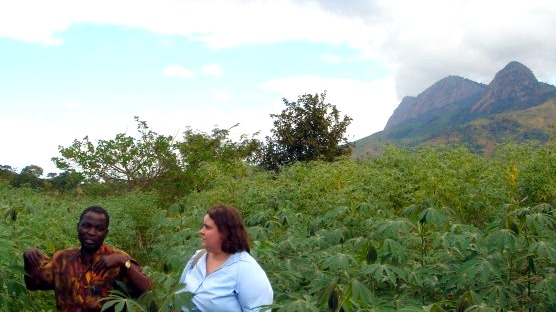
img: From corn to cassava — Jennifer Lentfer talking with farmer and local leader Jones Pilo in Zomba, Malawi (2007).

STAY TUNED for tomorrow’s installment from our displaced fictional heroine, Libby, who is hoping that Oliver’s visit back to Milton Keynes doesn’t result in any surprise guests (Sandra, for instance!) at their first Thanksgiving. (What, not keeping up with Libby? Read the first three episodes of her expat adventures.)

If you enjoyed this post, we invite you to register for The Displaced Dispatch, a round up of weekly posts from The Displaced Nation, with seasonal recipes, book giveaways and other extras. Register for The Displaced Dispatch by clicking here!
Related posts: