The Displaced Nation

A home for international creatives

Tag Archives: Europe

The light-hearted answer to Robert Pirsig — travel author Allie Sommerville

I know what you’re thinking. They can’t seriously be planning to feature Allie Sommerville in a month where they’re celebrating the joys of the open road?

For those who haven’t heard the news yet, Sommerville is the author of Uneasy Rider: Confessions of a Reluctant Traveller, and we’re doing an interview with her today, as well as an e-book giveaway (for DISPLACED DISPATCH subscribers only — sign up NOW!).

But before we proceed, allow me to say a few words in Sommerville’s — and our — defense.

As much as Sommerville may moan about her travel misadventures, as one of her Amazon reviewers puts it: “Methinks she doth protest too much.”

I would concur. In my own interactions with Sommerville, I’ve come to think of her as a gentler, more light-hearted version of Robert Pirsig, who penned the brilliant, if opaque, Zen and the Art of Motorcycle Maintenance, on which we’ve based many of our posts this month.

The two have much more in common than it may at first seem. Like Pirsig, Sommerville has faced the reality of sustained travel on the open road and the many challenges it entails — particularly if your vehicle of choice is a motorcycle or campervan.

Also like him, she has concluded that for a road trip to be a success, you must have a yin and a yang.

The main difference is that for Sommerville, these concepts are physical, not metaphysical — as in two people, herself and her Other Half, Harry.

She is the yin — the dancer, the poet, the writer — to poor Harry’s yang. He is the driver of the couple’s broken down but beloved RV, in charge of all repairs. And when things go awry, as they very often do, Sommerville injects a philosophical sense of humor for some perspective on the situation — a technique on a par with Pirsig’s philosophical musings.

Take, for instance, the very first road trip the couple made in this rickety vehicle, to Spain — all because Sommerville had developed an obsession with British poet Laurie Lee‘s memoir about tramping through Spain.

So far so predictable: Sommerville as driving force behind the adventure, her Other Half as driver. But then what happens when the campervan proves too wide for a Spanish street? He sweats it while she searches for an entertaining story in their predicament:

There was no room for manoeuvre. … With both sides of the van threatening to add a new dimension to the walls of the houses, it was nigh on impossible for either of us even to climb out…

By now we were becoming aware that we’d attracted the interest of several ancient and well-oiled patrons of a bar just up ahead, and our little drama turned into a full-scale pantomime as they began gesticulating and beckoning us on.

“Sí! Sí!…Se puede!” they exclaimed excitedly and at the same time doing what could only be described as some sort of grotesque ritual dance.

This was a good time to remember the meaning of those words in my favourite scene from the language video.

Se puede! They seem to think we can do it!” I translated helpfully.

So, without further ado, I give you the light-hearted Robert Pirsig: Allie Sommerville.

Tell me a little more about your background.
I was born in Croydon, which was in the county of Surrey at the time — now though, notoriously part of Greater London — and my husband is from London. After setting up home in Croydon for a few years, we moved to the Isle of Wight in 1976 to build our own house and give our two young children a better area to grow up in.

We are both, even after all this time, what Islanders call “overners” (an abbreviated form of “overlanders”). Only people actually born here qualify as “caulkheads.”

Uneasy Rider, which was published in 2009, was my first book. I’ve just published my second, a memoir about my childhood, on Kindle. It’s called To set my feet a-dancing and takes a light-hearted look at a time when children were allowed play in the park until dark, clothes were home made and owning a car meant you were rich. I draw a lot upon my time as a young amateur dancer, telling about my appearances with my older sister in shows arranged by our rather eccentric dancing teacher. I also look at schooldays, Christmases past and seaside holidays in an age of innocence.

I began this project after researching my family history for many years. It occurred to me that our children have no idea about how my generation lived as children in late 1950s England. Life has changed beyond anything we could imagine.

I conclude the book with the life stories of my grandparents and their predecessors — things I have gleaned from censuses, birth and marriage certificates, old photographs and conversations with my late mother. These are the lives of ordinary families: people whose lives are not in the history books.

I’m also in the process of writing about a trip my husband and I made around mainland Great Britain in the same old camper van, from the South (i.e., Isle of Wight) to the North (i.e., Scotland). The provisional title is: Miss Potter and the Mathematicians Rabbit — Allie Goes Oop North. The main title is taken from an experience we had in the Lake District.

Moving on to Uneasy Rider: How many road trips have you and your husband made together over the years?
We made six road trips in the converted Leyland Daf campervan of the book, from 1999 to 2004, though our very first trip in a motor caravan was in 1991, with our two teenagers on board.

Do you ever travel by other means?
Of course! We’ve traveled many times by car in France and Switzerland, staying in gîtes, chalets and apartments. My favorite “trip” of all though was on the Cunarder, Queen Mary 2, to New York. Much nicer than “roughing it” in a camper van! I absolutely loved New York and the glamour of the six-day Atlantic crossing, despite sailing through a force 11 gale.

So what made you decide to write a book about your campervan excursions?
During our trips, we had so many events that each time I said, “There’s a book in this!” Before we took off on our first trip (to Spain), I hadn’t found any similar book on the subject of campervanning or caravanning, apart from site-finder guides; it seemed there was a gap in the market.

Whom did you see as the primary audience?
I had in mind other campervanners who would identify with the joys, trials and tribulations of this type of independent travel. I didn’t want it to be one of those “everything is fantastic about travel” books. I hope I tell it like it REALLY is — the ups and downs, the good and the bad. Some campervan “purists” don’t appreciate hearing about the downside of their preferred method of holidaying though. They appear to have gotten together to leave negative reviews on Amazon. But I’m not too sure, by some of the comments, that they’ve actually read it…

Bill Bryson is the master of modern travel writing as far as I’m concerned, and it’s his light-hearted touch that I hope in some way to emulate. A tough act to follow!

Many people take road trips when they are young, to find out more about life and themselves. Does the purpose change once you become middle aged?
Middle aged? I still feel about 17!

As you’ve already mentioned, the purpose of our first trip (to Spain) was to follow in the footsteps of my literary hero, Laurie Lee. In As I Walked Out One Midsummer Morning, he tells of his walk across Spain on the cusp of the Civil War in the early 1930s. This book, for some reason, holds a big fascination for me.

That trip was meant to be a one-off. But afterwards we weren’t able to sell the van, so instead of letting it sit in the drive, I seized the opportunity to see as much of the art and architecture of Italy and France as I could. I suppose you could say my purpose was educational!

Which was your favorite place of all those you visited?
Florence has it all. I could never tire of it. We visited this amazing city three times. I was studying Art History at the time, specialist subject “The Early Renaissance.” The Italian people are fantastic, too!

Which was your least favorite?
Spain, especially the Costas (various coastlines), which were full of half-finished blocks of flats. Whether we were unlucky I don’t know, but it was not a friendly country — apart from a few honorable exceptions which I mention in the book: the helpful policeman in Seville who strode into and held up four lanes of speeding traffic for us, the patient shop assistant in the flamenco boutique. I have the feeling that relatively recent history may have altered the Spanish character: George Orwell in Homage to Catalonia found the Spanish people cheerful and friendly.

Robert Pirsig says “It’s a little better to travel than to arrive.” I’m guessing you might not agree with him?
Err…not really. Like Dorothy, my mantra is: there’s no place like home! Having the campervan, however, was almost like taking your home round with you. My best moments during these trips were when we found pleasant campsites to put down temporary roots.

Pirsig claimed there are two types of people: “classical” — practical, DIY fixers, boy-scout prepared types; and “romantic” — those who thrive on surface appearances, don’t want to get involved with the nitty-gritty, and thrive on gestalts.
As you noted in your introduction, I’m definitely “romantic,” and my husband is certainly “classical” — which probably explains why we work as a couple. He drives and sorts out problems, I look forward to seeing the Da Vincis.

Each chapter of your book is a stand-alone story, describing a particular incident. Do you have a favorite?
“The Parable of the Parador” is my stand-out favorite. As I said, it is typical that I get these romantic ideas — and my other half goes along with them, most of the time. That particular chapter though, sees a bit of role reversal, when we get “stuck” on the road into Arcos de la Frontera, to reach the parador (state-run hotel). For once he thinks it’s all hopeless, and I have to be the optimist. When he feels like this about a situation, I know we are REALLY in trouble.

Pirsig advocates traveling on a motorcycle because it puts you there, in the moment, without the barrier of a windscreen. What do you think of his philosophy?
To travel on a motorbike would be my nightmare! I just would feel too exposed. I like to be safe — hence the theme of Uneasy Rider.

Many of the Displaced Nation’s readers are expats. Can you imagine living anywhere besides the Isle of Wight?
We’ve often thought we should have relocated to France some years ago. I’d love to live in a place where you can walk to a baker’s every day for fresh baguettes and croissants. Now, the only place I’d move to is Central London: the London National Gallery and Covent Garden Royal Opera House are big draws.

How well do you fit back into the Isle of Wight after your journeys? Do you suffer from any counter culture shock?
The flippant answer is that being a “townie,” I suffer counter culture shock on the Island every day anyway… even after all this time. However, the main feeling after being in the ‘van for four weeks, though, was that our house did seem HUGE for the first few days .

So what’s next for your travels?
Next year I am fulfilling my long-time ambition of visiting St. Petersburg — on a cruise ship rather than by road. Russia and especially its Tsarist past, fascinates me. Hopefully there will be a book in this, though for all the right reasons!

Readers, do you have any questions for the Amazing Allie? Ask away, before she takes off again!

Images: Allie Sommerville’s author photo and book cover.

STAY TUNED for tomorrow’s installment from our displaced fictional heroine, Libby, as she prepares to welcome the pitter-patter of little feet. Clawed, furry feet, that is: Fergus is now a canine expat! What, not keeping up with Libby? Read the first three episodes of her expat adventures.

If you enjoyed this post, we invite you to subscribe to The Displaced Dispatch, a weekly round up of posts from The Displaced Nation, plus some extras such as seasonal recipes and occasional book giveaways. Sign up for The Displaced Dispatch by clicking here!

Related posts:

Gotta helmet? Time to burn some rubber, have a real travel adventure

The Displaced Nation has dedicated the month of September to the ideas within Robert Pirsig’s classic, Zen and the Art of Motorcycle Maintenance. But enough with theory. What’s it really like to see the world from the back of a motorcycle — and what are us more timid types missing out on? Rubber hits the road today with Matthew Cashmore, aka The London Biker. Braaaaown… brraaoom…… rrooaaarr………. Take it away, Matthew! NOTE: This post has not been edited for British spelling.

There are some things in life that just have to be done. Laying on your back staring at the stars, wondering which ones are dead and which are still blazing. Getting so drunk on cider that you can no longer stand (perhaps that’s just me). Or travelling the world by motorcycle.

The last, many people would say, is optional. But it’s not. If you feel as I do, motorcycle travel is as essential to life as water or food, then there is only one way to do it.

I’m not the first to point out that seeing the world from a motorcycle is better than any other means of travel — just dig out a copy of Zen and the Art of Motorcycle Maintenance or my personal favourite, Jupiter’s Travels, by Ted Simon.* You’ll only read a quarter of each book before you discover why this method of travel trumps the rest. You’re part of the world in which you’re travelling. There is nothing between you, the elements and the people with whom you interact.

I’ve been fortunate enough to see much of the world. I’ve backpacked, travelled by plane to amazing cities, jumped on buses or driven cars. But nothing, absolutely nothing, can match the experience of the wind rushing past your head trying to knock you off your bike, as you hurtle between towns and villages. And nothing can give you a greater grin than riding across the bay in San Francisco on the back of a growling Harley — safe in the knowledge that in a car this would be just another American highway.

If you don’t ride in the rain, you don’t ride…

It does take a certain amount of effort, though. This summer I did a short run from London out to Budapest via France, Germany, Austria and then into Hungry. The return leg took me through northern Croatia, Slovenia, back into Austria and up into the Alps over into Italy and then back over the Stelvio Pass into Switzerland, France and finally home. It rained the entire trip. Every single morning I was greeted with sheets of rain. I was beginning to suspect it was actually following me to Budapest. Each night I was soaked to the skin — even with the most expensive rain gear. Each night I was dog tired, and I really had to question what I was doing. What kind of a nut case chooses to spend his summer holiday riding a motorbike half way across Europe in the rain?

The reason I, and many others like me, do this is because you can ride for eight days in the rain — and then out of nowhere the clouds will clear and you’ll be presented with a road of perfect grace. A strip of tarmac that sings as you press on, a view that leaves you crying because of its beauty. Something you would never have seen had you been in a car or a bus. Something you’ve had to work to achieve — and it’s even more beautiful for that.

A parable of the hospitality shown to bikers

On the Budapest trip I found myself at the top of the Austrian Alps. I was running a day behind because I’d had a stomach bug back in Budapest. I was determined to make up that lost day so that I could still get over the pass into Switzerland ahead of a (yet another) rain front. I had been riding for ten hours, I had another six ahead of me, and I was already on my fourth change of clothes. I was incredibly fed up. Why on earth was I doing this?

I pulled into the first service stop I’d seen for about 150 miles, 2000 metres above sea level and hidden by cloud, rain and spray. Filling the bike up with petrol I spotted a small restaurant complete with a hotel — bliss, escape! I headed inside, dripping water everywhere. As I walked through the door I must have looked like a monster from the deep. I was dressed head to foot in every single piece of waterproof gear I could find — complete with an army surplus poncho. The restaurant manager took one look at me and ordered me onto a piece of lino, where I promptly created a rather large puddle. She demanded I remove my clothing leaving me standing there in just my thermals. I shivered, waiting for her next command. Did they have ways of making me warm?

My gear was whisked off (it came back nearly dry and very warm), and I was pointed in the direction of the shower and given a hot towel. I emerged a different man. Clean clothes, warm, and for the first time in two days, dry. Ushered to a seat, I took the opportunity to eat well — feasting on sausage and strudel, the best Austria had to offer. Buoyed by such amazing hospitality I got back on the bike and rode on. As I rounded the first corner the rain stopped and I hit Italy, sun, and the kind of twisty roads God clearly made for bikers.

I could say this was a one off, but the more I travel the world by motorbike the more I come to realise that the very thing that makes you vulnerable is the very thing that makes you approachable. It’s different if you’re travelling with other bikers, but when you’re on your own it’s a perfect combination of being totally exposed to the environment and more importantly to people.

This is what makes travelling by motorcycle so special. The openness, the access, the smells, the sounds, the people who are curious because you’ve rolled into town in something other than a bus or 4×4. If you want to experience, to imbibe, the world through which you travel…there is only one option. Gotta helmet?

* Suggested further reading:

Matthew Cashmore works in digital publishing. He keeps track of his “random thoughts” on his blog, The London Biker. He also has a YouTube channel, where he posts videos about his life on the road, camp cooking and related topics.

img: Matthew Cashmore in Budapest, July 2011.

STAY TUNED for Tuesday’s post, on the diner food that has played a part in many an American road trip.

If you enjoyed this post, we invite you to subscribe to The Displaced Dispatch, a weekly round up of posts from The Displaced Nation, plus some extras such as seasonal recipes and occasional book giveaways. Sign up for The Displaced Dispatch by clicking here!

Related posts:

RETURN TRIP: Even in Paris, expats can’t escape former lives: A celebration of displaced novelist Corine Gantz

As summer draws to a close, The Displaced Nation is reissuing some posts that, for one reason or another, have enchanted our readers. Enjoy these “return trips”!
This past spring, The Displaced Nation interviewed Corine Gantz, a popular expat blogger, about her newly published novel, Hidden in Paris. The action centers on a group of expat Americans trying to start their lives afresh in the City of Light. At that time, TDN was exploring the theme of Gothic Tales. We wanted Mme Gantz to tell us more about the premise at the heart of her book — the idea that people travel to other lands to escape their former lives. How does it usually play out: as a dream come true or as a recurring nightmare?

The Displaced Nation has been examining the “gothic” side of expat life over the past couple of weeks. Thus it may seem odd that today we have chosen to celebrate a book that takes place in La Ville-Lumière (“The City of Light” or “The Illuminated City”) by an author who lives near the City of Angels.

But looks can be deceiving — and the cover of Corine Gantz’s debut novel, Hidden in Paris, is quite a cunning ruse. It shows a Parisian balcony with French doors reflecting the Eiffel Tower, and a flower box bursting with hot-pink geraniums. What could possible be amiss within such a picture-perfect setting, you may wonder? Plenty, it turns out.

But before we get into that, let’s begin our fête in honor of Mme Gantz and her book. To put ourselves in the proper mood, we have prepared a special cocktail, a French 75. We’ve also gone all out with our canapés. There’s a savory gougère, brie en croûte, duck rillettes, chilled asparagus with mustard sauce, a Puy lentil salad — and, in honor of Mme Gantz, her family favorite, taramasalata on toast (see her father’s recipe below).

Okay, seats, please! Our honored guest has agreed to kick off the festivities by answering a few questions from The Displaced Nation team. After that, the floor is yours, dear reader.

Hidden in Paris coverYour new novel, Hidden in Paris, may not tell a gothic tale per se, but we think it relates to our theme because it centers on three women who are running away from their lives. Is that a fair assessment?
People who say they love to be scared amuse me. They have a fascination with horror flicks, they read vampire books, they ride roller coasters. Yet they might be the same people who walk great circles around a pile of bills or make every effort to avoid a difficult phone call. What can be scarier than real life?

I think there is a limit to what we can handle, and at some point the tendency is to want to run way, literally or figuratively. In Hidden in Paris three strangers — all American women — have reached the point of terminal discomfort, when tackling real issues feels more terrifying than running away abroad.

Lola is running away from her husband, Althea from an eating disorder, and Annie, although she pretends to be the most high functioning member of the group, is hiding the biggest secret of all. (Just to add some spice, there is also a male character, Lucas, who is hiding his love for Annie.)

People often fantasize that “elsewhere” — particularly Paris because of the attached notion of romance — will solve their problems, or at least make the problems go away for a while. Well, we long-term expats know better. Moving to another country brings great logistical changes to one’s life, which can distract you into thinking you’ve left your pathos behind, when, in fact, you’ve brought it along in your suitcase. Wherever you go, you bring your own personal gothic tale with you.

In the case of these three female characters, the disruptions to their routines, along with new encounters, bring them to the tipping point toward change.

The thing is, as in real life, my characters fight the change they need kicking and screaming, which makes for fun story telling.

Food is another obsession of ours at The Displaced Nation. We detect from reading an excerpt from Hidden in Paris that it also plays a big role in your book.
You detect correctly. For me, writing a novel is a barely disguised way for me to talk about food — the novel being a vehicle for food just as grilled toast is a vehicle for foie gras.

I grew up in France on my mother’s terrific cooking. But she is the type of cook who wants no help in the kitchen, so at age 23 I arrived in the United States never having cooked an egg. I was terribly homesick and depressed and needed to “taste home” again — so had no choice but to teach myself how to cook. The saving grace was that I had a copy of a recipe book filled with my mother’s recipes, so I proceeded to recreate the food, and jolly myself out of my depression. Cooking gave my life a purpose: it became my creative outlet.

I think the preparation of food can be extremely healing, meaningful and joyful. Food is, after all, the soul and spirit of a home. I enjoy cooking as much as I enjoy eating, and when I’m not doing one or the other I’m telling stories where food turns out to be one of the principal characters.

You are a Française who has been “displaced” to the Los Angeles area for a couple of decades, where you live with your American husband and two sons. Does your novel echo that experience?
Had I landed on an alien planet I doubt I would have been any more confused and out of place. I understood none of the codes, none of the cultural references, of Los Angeles. I could not understand people or express myself — and I resented them for that.

Writing sprouted from this: the frustrated need for self-expression and communication. Like my protagonist, Annie, I had to figure out how to function, and I would be lying to say I functioned well. Also like Annie, I resisted my country of adoption for years. I did not have both feet in it. A part of me felt in limbo: I was standing by for my eventual return to my home country.

Twenty years later I don’t even feel French anymore, but no one here lets me forget I’m not American either. Americans seem fascinated with my Frenchness, as though it defines me. For example, it’s often about how I say things rather than what I say. Yesterday I was saying to a friend: “On the envelope my husband gave me for mother’s day there was a…” She interrupted and said: “Could you repeat that?” I repeated and she fell into peals of laughter: “I just love how you said the word ‘envelope’!”

In Hidden in Paris, I wanted to transpose my experience and reverse it. I wanted to bring American women to France and see how well they coped with that set of codes and cultural idiosyncrasies. That’s only fair, don’t you think? I’m a little miffed to report that they are more adaptable than I was.

You have a popular blog, Hidden in France, where you’ve been entertaining Francophiles and others with stories of the writing life, décor, food, family, travel and all things French. In fact, The Displaced Nation has featured one of your posts — about the time you fell into your swimming pool when the first day of spring brought heavy rains to the LA area. Tell us, has your blog had an influence on your writing? Also, why have you chosen the trope “hidden in”?
The blog has everything to do with my writing. Before the blog, I was a closet writer, ashamed that my English was too imperfect. The blog gave me a sense of just how forgiving and supportive readers were. I have readers now, and I have fans! Had I based my self-worth as a writer on agent rejections, I would have changed my hobby to fly-fishing. Readers are what make someone a writer.

The word “hidden” is significant only in the sense that I was hiding for years behind an alias as a blogger, and I just recently came out as writer for the world to see (speaking of fear…).

When it came time to settle on a title for the book, it felt natural to give it the same title as the blog — but I decided against it because there was already a memoir by that name. So Hidden in France became Hidden in Paris.

Finally, The Displaced Nation supports a fictional character, Libby, who is about to move from London to Boston with her husband. Do you have any advice for her?
Well, how about if I let my own fictional character, Annie — who moved from Boston to Paris to follow her own husband twelve years ago — speak to Libby directly:

Don’t do it, Libby! Kidding! Well I would suggest you have more babies, some siblings for your son, Jack, and fast. They will keep you busy and busy is the name of the game: no time to think! And if you decide against having more babies, then take on a hobby (such as cooking and eating) to keep your sanity without demanding that your husband become your everything for companionship, friendship and intellectual stimulation.

Don’t be like me in other words. Don’t forget that the man has a job and he is tired at the end of the day and nobody needs a needy wife. (Sorry for the harsh words, Libby, but this is the truth.)

You could also take a run-down house and remodel it. I did. You will have no skin left on your fingers but lifting bags of concrete makes for pretty shapely biceps. The remodeling might bring you to financial ruin but if that becomes the case, you will always have eating, which you can become very good at.

Without further ado, let’s pour the champagne for a toast to Corine Gantz. Tchin-tchin! And now, patient reader, it’s your turn. Questions, please, for this très gentille debut novelist… If you want to check out her book a little more, go to her author’s site, and to buy it, go to her Amazon page.

Taramasalata on toast — Corine Gantz’s family recipe
You will need:

  • one packet of smoked cod roe (seriously, can you even find this in the US?)
  • 8 tablespoons safflower oil
  • 2 tablespoons lemon juice.

Mix fish roe and lemon juice, then slowly beat with a fork and add the oil as you would do to make mayonnaise.Spread thinly on toasts and serve with very good champagne, et voilà! Très festif.

Images: Author’s photo; Hidden in Paris cover, artwork by Robin Pickens.

If you enjoyed this post, we invite you to subscribe to The Displaced Dispatch, a weekly round up of posts from The Displaced Nation, plus some extras such as seasonal recipes and occasional book giveaways. Sign up for The Displaced Dispatch by clicking here!

Related posts:

RETURN TRIP: Random Nomad – Charlotte Day, High School Student (Sixth Former)

While our writers take off on what they hope will be enchanting August breaks, The Displaced Nation will occasionally be reissuing some posts that, for one reason or another, enchanted our readers. Enjoy these “return trips”!
As youngsters head back to school, we’re reissuing a Random Nomad interview ML Awanohara did with Charlotte Day, a displaced teenager in England. Charlotte spent a chunk of her summer taking a Russian-language course in St. Petersburg and living with a Russian family. She has produced a travel yarn on her adventures, which will appear on Monday.

Born in: Sydney, Australia
Passports: Australia, UK and US Green Card
Countries lived in: Australia (Sydney): 1994-2001; United States (New York, New York): 2001-2010; England (Sevenoaks, Kent): 2010-present

What made you leave your homeland in the first place?
My father is Australian and my mother English. They split up when I was two. When I was six, my mother met and married an Australian who had been living in New York for thirty years. I was rather disgruntled about moving to the United States and for two or three years, remained determined never to accept it as “home.” At that time, I was deeply patriotic to my native country — though this sentiment has dissipated since.

Is anyone else in your immediate family a “displaced” person?
My mother’s family, originally from England, has long been displaced. My mother herself was born in Kenya, in 1961. Following the Mau Mau Uprising, her parents were forced to relocate, and my grandfather, presented with a choice between Australia and Canada, chose the warmer of the two countries. My mother spent her childhood bouncing between schools in England and Australia. She eventually grew so fed up with packing and unpacking, she decided to leave school at the age of 16. Her father agreed to the plan provided she spend a final year at the school in Switzerland his own mother had attended as a girl. My mother moved on from Swiss finishing school to work in London, Paris and Sydney. But she appears to have made New York her last port of call. Indeed, we had a fairly solid life in the city until I decided to take myself off to boarding school in England.

Describe the moment when you felt most displaced over the course of your many displacements.
It must have been when I first arrived in New York as a six-year-old. I stepped out of the JFK arrivals terminal into a snowy March night. My stepfather was wearing a leather coat, the interior of his car smelled of leather — and the world outside the car window seemed an undulating stream of black and silver. Though it was the end of 2001’s warm winter, my Australian blood froze beneath my first-ever coat. And their apartment — that was all leather as well. It smelled of musk and cologne. Since that time, I have felt similar pangs of displacement, some of which lasted for considerable periods. But those first few moments in New York stand out as the most acute concentration of “displacedness” I have ever known.

Describe the moment when you felt least displaced.
For the last five or so years in New York, I have felt more at home than I ever did in Sydney. I ascribe this to growing up: at a certain age, one can take possession of a city, know its streets, bridges, tunnels and transportation system. I was too young when I lived in Sydney to reach that kind of comfort level. But when have I felt the most like a New Yorker? Perhaps it was the last time I came home for the holidays, and took the 4 train uptown for the first time in months. At that moment I realized how much this train had been a part of my life — conveying me home from school every day for two years. My old life would always be waiting for me on the subway, ready for me to pick it up again. That’s something only a New Yorker could say!

You may bring one curiosity you’ve collected from each of the countries where you’ve lived into the Displaced Nation. What’s in your suitcase?
From Australia: A miniature wooden wombat figurine — a gift from my grandfather. It conjures memories of a childhood spent beating about the bush (literally) and fishing for yabbies at the dam in the company of audacious dogs who stuck their heads down wombat holes, to no good end.
From New York: A pair of fake Harry Potter glasses. These defined my first six months in New York — I even wore them to my first day of school. I think it is telling that even at the age of six, I was unwilling to give all of my real self to this new home.
From England: My school tie — representative of the alternative universe I seem to have entered. At boarding school, the sense of removal from reality can be disconcerting — especially after having spent a decade in the city I regard as the world’s capital.

You’re invited to prepare one meal based on your travels for other Displaced Nation members. What’s on your menu?
I’d like to make you a Sydney breakfast: scrambled eggs, made with cream, salt and pepper and served on a bed of Turkish toast, with avocado and stewed tomato on the side (is this being greedy?). Our meal will be accompanied by a large “flat white”: what we call perfectly strong, milky coffee without excessive froth. I suggest we consume it overlooking a beach on a Sunday morning. At least, I assume The Displaced Nation has beaches?

You may add one word or expression from each of the countries you’ve lived in to The Displaced Nation argot. What words do you loan us?
From Australia: Daggy. I use this word all the time — and did not realize it was exclusively Australian until I was informed of the etymology. Apparently, it comes from trimming the soiled wool around a sheep’s bottom. Which part of this repugnant whole is actually the “dag,” I do not remember. (No, I’m not a proper Australian!) But as I understand it, “daggy” means sloppy in appearance or badly put together.
From New York: There are so many words, and most are second nature by now. However, I will choose grande-soy-chai-tea-latte because I still shudder to think of myself as the kind of person who can utter such a phrase, at great speed, with great insistence. In fact, I’m still in denial about my love for Starbucks: having known Sydney coffee, my standards should be higher.
From England: Banter. I still do not know the precise meaning of this word, but it seems to encapsulate everything that makes someone my age feel socially acceptable — and, of course, I have no banter whatsoever. I think it means the capacity for combining wit with meaningless conversation. But there are other components, too, which seem to me unfathomable.

Question: Readers, tell us what you think: should we welcome Charlotte Day to The Displaced Nation and if so, why? (Note: It’s fine to vote “no” as long as you couch your reasoning in terms you think we all — Charlotte included — will find amusing.)

img: Charlotte Day at her boarding school in southeast England

If you enjoyed this post, we invite you to subscribe to The Displaced Dispatch, a weekly round up of posts from The Displaced Nation, plus some extras such as seasonal recipes and occasional book giveaways. Sign up for The Displaced Dispatch by clicking here!

Related posts:
6 celebrated women travel writers with the power to enchant you

Any wannabe expat/travel writer would do well to consult with Kristin Bair O’Keeffe, herself a novelist and former expat, before beginning their Great Works. Kristin offers a wealth of writing tips on Writerhead, a blog that she launched on April 1 of this year (which, coincidentally, was the same day we launched The Displaced Nation).

Of the helpful hints Kristin has offered thus far, I have many favorites, but if I had to pick one, it would be her post entitled “Write Wee.” In her breathlessly inimitable style, Kristin assures us that producing a multi-volume series on one’s overseas adventures is not the way to go:

Instead find a nugget. A moment. A single object. One exchange. One epiphany. One cultural revelation.

Find one story and tell it.

Just it.

The only thing I would add is that in general, women are better at extracting such nuggets than men.

Actually, what got me started in thinking about the difference in travel writing styles of the sexes was a post I wrote a couple of weeks ago on Edwardian novelist Elizabeth von Arnim, who penned the much-loved work, The Enchanted April, about four women who escape to a medieval castle in Italy for a much-needed break from their routines.

For me, von Arnim typifies one of characteristics that makes women’s travel writing so special (no doubt there are many more!). As she wandered far and wide across Europe and America, she paid extremely careful attention to the details of her surroundings.

A forerunner of what today we’d call a nature freak, she could get lost in telling the story of watching a “nightingale on a hornbeam, in loud raptures at the coming of the sun…” — I quote from her largely autobiographical novel The Solitary Summer, about a woman, also called Elizabeth, who is anything but solitary. She has a husband, to whom she refers as the Man of Wrath, small child and household to care for.

Perhaps such descriptive powers are born of necessity. Women have little choice but to make the most of spinning tales out of the moments they snatch from lives that are otherwise spent ministering to the needs of others — even when they’re technically on vacation.

Having combed through the pages of The Virago Book of Women Travellers (ed. Mary Morris with Larry O’Connor), I think I may be on to something. I discovered any number of women travel writers with the power to enchant their readers by capturing in their works the moments, exchanges, and personal ephiphanies their wanderings have yielded.

Here are six whose “nuggets” continue to gleam for us modern-day nomads:

Frances Trollope (1780-1863)

Who was she? Mother of Anthony and like her son, a prolific writer of novels (34 in total!).
Key work: Domestic Manners of the Americans, a travel book that made her name, about the four years she spent pursuing opportunities in the United States after her family suffered financial setbacks.

from DOMESTIC MANNERS OF THE AMERICANS
At length my wish of obtaining a house in the country was gratified….But even this was not enough to satisfy us when we first escaped from the city, and we determined upon having a day’s enjoyment of the wildest forest scenery we could find. So we packed up books, albums, pencils, and sandwiches, and, despite a burning sun, dragged up a hill so steep that we sometimes fancied we could rest ourselves against it by only leaning forward a little. In panting and in groaning we reached the top, hoping to be refreshed by the purest breath of heaven; but to have tasted the breath of heaven we must have climbed yet farther, even to the tops of the trees themselves, for we soon found that the air beneath them stirred not, nor ever had stirred, as it seemed to us, since first it settled there, so heavily did it weigh upon our lungs.

Still we were determined to enjoy ourselves, and forward we went, crunching knee deep through aboriginal leaves, hoping to reach some spot less perfectly air-tight than our landing place. Wearied with the fruitless search, we decided on reposing awhile on the trunk of a fallen tree; being all comfortably exhausted, the idea of sitting down on this tempting log was conceived and executed simultaneously by the whole party, and the whole party sunk together through its treacherous surface into a mass of rotten rubbish that had formed part of the pith and marrow of the eternal forest a hundred years before.

We were by no means the only sufferers from the accident; frogs, lizards, locusts, katydids, beetles, and hornets, had the whole of their various tenements disturbed, and testified their displeasure very naturally by annoying us as much as possible in return; we were bit, we were stung, we were scratched; and when, at last, we succeeded in raining ourselves from the venerable ruin, we presented as woeful a spectacle as can well be imagined. We shook our (not ambrosial) garments, and panting with heat, stings, and vexation, moved a few paces from the scene of our misfortune, and again sat down; but this time it was upon the solid earth.

We had no sooner begun to “chew the cud” of the bitter fancy that had beguiled us to these mountain solitudes than a new annoyance assailed us. A cloud of mosquitoes gathered round, and while each sharp proboscis sucked our blood, they teased us with their humming chorus, till we lost all patience, and started again on our feet, pretty firmly resolved never to try the al fresco joys of an American forest again.

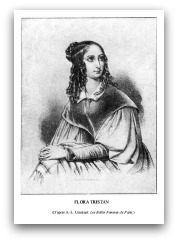
Flora Tristan (1803-1844)

Who was she? French reformer who campaigned for workers’ and women’s rights; grandmother to artist Paul Gauguin.
Key work: Peregrinations of a Pariah, about a trip she made alone to Peru to stake her claim to her family’s fortune.

from PEREGRINATIONS OF A PARIAH
Mr. Smith took me to the house of his correspondents, and here once more I found all of the luxury and comfort characteristic of the English. The servants were English, and like their masters they were dressed just as they would have been in England. The house had a verandah, as do all the houses in Lima, and this is very convenient in hot countries, as it gives shelter from the sun and enables one to walk all round the house to take the air. This particular verandah was embellished with pretty English blinds. I stayed there for some time and could survey in comfort the only long wide street which constitutes the whole of Callao. It was a Sunday, and sailors in holiday attire were strolling about; I saw groups of Englishmen, Americans, Frenchmen, Dutchmen, Germans — in short, a mixture from nearly every nation — and I heard snatches from every tongue. As I listened to these sailors, I began to understand the charm they find in their adventurous life… When I tired of looking at the street I cast a glance into the large drawing-room whose windows overlooked the verandah, where five or six immaculately dressed Englishmen, their handsome faces calm and impassive, were drinking grog and smoking excellent Havana cigars as they swung gently to and fro from hammocks from Guayaquil suspended from the ceiling.

Mary Anne Barker (1831 – 1911)

Who was she? Jamaica-born, England-educated author and journalist who with her second husband tried to run a sheep station in New Zealand (they later traveled to Mauritius, Western Australia, Barbados and Trinidad for his colonial appointments).
Key works: Station Life in New Zealand (1870); First Lessons in the Principles of Cooking (1874); A Year’s Housekeeping in South Africa (1880).

from STATION LIFE IN NEW ZEALAND
All this beauty would have been almost too oppressive, it was on such a large scale and the solitude was so intense, if it had not been for the pretty little touch of life and movement afforded by the hut belonging to the station we were bound for. It was only a rough building, made of slabs of wood with cob between; but there was a bit of fence and the corner of a garden and an English grass paddock, which looked about as big as a pocket-handkerchief from where we stood. A horse or two and a couple of cows were tethered near, and we could hear the bark of a dog. A more complete hermitage could not have been desired by Diogenes himself, and for the first time we felt ashamed of invading the recluse in such a formidable body, but ungrudging, open-handed hospitality is so universal in New Zealand that we took courage and began our descent. … We put the least scratched and most respectable-looking member of the party in the van, and followed him, amid much barking of dogs, to the low porch; and after hearing a cheery “Come in,” answering our modest tap at the door, we trooped in one after the other till the little room was quite full. I never saw such astonishment on any human face as on that of the poor master of the house, who could not stir from his chair by the fire, on account of a bad wound in his leg from an axe. There he sat quite helpless, a moment ago so solitary, and now finding himself the centre of a large, odd-looking crowd of strangers. He was a middle-aged Scotchman, probably of not a very elevated position in life, and had passed many years in this lonely spot, and yet he showed himself quite equal to the occasion.

After that first uncontrollable look of amazement he did the honours of his poor hut with the utmost courtesy… His only apology was for being unable to rise form his arm-chair (made out of half a barrel and an old flour-sack by the way); he made us perfectly welcome, took it for granted we were hungry — hunger is a very mild world to express my appetite, for one… I never felt more awkward in my life than when I stooped to enter that low doorway, and yet in a minute I was quite at my ease again; but of the whole party I was naturally the one who puzzled him the most. In the first place, I strongly suspect that he had doubts as to my being anything but a boy in a rather long kilt; and when this point was explained, he could not understand what a “female,” as he also called me, was doing on a rough hunting expedition. He particularly inquired more than once if I had come of my own free will, and could not understand what pleasure I found in walking so far.

Vivienne de Watteville (1900 – 1957)

Who was she? British writer and adventurer who accompanied her father on a safari in Kenya. After he was killed by a lion, she finished the trip on her own.
Key works: Out in the Blue (1927); Speak to the Earth: Wanderings and Reflections among Elephants and Mountains (1937).

from SPEAK TO THE EARTH
Finally, it was the boys themselves who pointed to the summit and said it was not very far.

Enviously, I admired the way they could climb. As for me, … I was badly spent; my knees trembled as I panted up through the reeling boulders. …

At last I climbed above the forest zone, passing beneath the last outposts — stunted trees ragged with beard-moss in whose chequered shade lay a carpet of tiny peas … whose blossoms were a lovely transparent blue. Above them flitted miniature butterflies, as though the petals themselves had taken wing. …

The top, when I at last reached it, was, after all, not really the top, and beyond a dipping saddle another granite head still frowned down upon me.

But meanwhile, below me the south side disclosed a grassing depression girt about by the two summits and bare granite screes; and amid that desolation the grass stretched so green and rural that you had looked there for shepherds with their flocks. Instead of which, on the far side of a quaking bog, I saw — grey among the grey slabs — two rhino.

… I drew to within forty yards of the rhino, yet they still looked like a couple of grey boulders as they browsed off an isolated patch of sere grass. …

The wind had risen to a tearing gale, and nosing straight into it I approached the rhino somewhat downhill. There was no chance of this steady blow jumping around to betray me, and it was strong enough to carry away any sound of my footsteps. Precaution was therefore unnecessary, and I walked boldly up to them. Just how close I was, it is hard to say; but I felt that I could have flipped a pebble at them, and I noted subconsciously that the eye of the one nearest me was not dark brown as I had imagined it, but the colour of sherry.

… he now came deliberately towards me nose to the ground, and horn foremost, full of suspicion. … In the finder [of my small cinema camera] I saw his tail go up, and knew that he was on the point of charging. Though it was the impression of a fraction of a second, it was unforgettable. …

… I read the danger signal, yet in a kind of trance of excitement I still held the camera against my forehead. Then Mohamed fired a shot over the rhino’s head to scare him, and I turned and fled for my very life.

M. F. K. Fisher (1908 – 1992)

Who was she? A preeminent American food writer, whose books are an amalgam of food literature, travel and memoir.
Key works: How to Cook a Wolf (1942); Map of Another Town: A Memoir of Provence (1964); Dubious Honors (1988); Long Ago in France: The Years in Dijon (1991).

from LONG AGO IN FRANCE
Monsieur Venot was a town character and was supposed to be the stingiest and most disagreeable man in Dijon, if not in the whole of France. But I did not know this, and I assumed that it was all right to treat him as if he were a polite and even generous person. I never bought much from him but textbooks, because I had no extra money, but I often spent hours in his cluttered shop, looking at books and asking him things, and sniffing the fine papers there, and even sitting copying things from books he would suggest I use at his worktable, with his compliments and his ink and often his paper. In other words, he was polite and generous to me, and I liked him. …

In Monsieur Venot’s shop I learned to like French books better than any others. They bent to the hand and had to be cut, page by page. I liked that; having to work to earn the reward, cutting impatiently through the cheap paper of a “train novel,” the kind bought in railroad stations to be thrown away and then as often kept for many years, precious for one reason or another. I liked the way the paper crumbled a little into my lap or my blanket or my plate, along the edges of each page.

Mary Lee Settle (1918 – 2005)

Who was she? American writer, novelist and expat, one of the founders of the PEN/Faulkner Award for Fiction.
Key works: “Beulah Quintet” novel series (1956-1982), about the history of her native West Virginia (and hence of America); Turkish Reflections: A Biography of Place (1991).

from TURKISH REFLECTIONS
I hadn’t heard anything move, yet he stood there in front of me, smiling, quite silent, a large strong Turkish man, holding in his hand a small bunch of sweet wild thyme. He held it toward me, saying nothing, still smiling. There was something so gentle about him that I could not be afraid. I took the wild thyme, and I thanked him, in Turkish. He smiled again and touched his mouth and his ear. He was deaf and dumb. I still have the wild thyme, pressed and dried, kept like a Victorian lady’s souvenir of the Holy Land.

Dumb was the wrong word for him. There was no need for speech. He was an actor, an eloquent mime. I pointed to the atrium below and held my hands apart to show I didn’t know how to get down into it. He took my arm, and carefully, slowly, led me down a steep pile of rubble.

He mimed the opening of a nonexistent door and ushered me through it. He showed me roofless room after roofless room after roofless room as if he had discovered them. …

I think he had scared people before, and he was happy that there was someone who would let him show his house, for it was his house. Maybe he didn’t sleep there. I don’t know. I only know that he treated me as a guest in a ruin ten feet below the levee of the ground, and that he took me from room to room where once there had been marble walls and now there was only stone, where he was host and owner for a little while.

He showed me a small pool, held out his hand the height of a small child, and then swam across the air. All the time he smiled. He took me to a larger pool and swam again. Then he grabbed my arm and led me through a dark corridor toward what I thought was at first a cave. It was not. He sat down in an niche in the corridor, and strained until his face was pink, to show me it was the toilet. Then he took me into the kitchen where there were two ovens. …

For the first one he rolled dough for bread, kneaded it in air, slapped it, and put it in the oven. Then he took it out, broke it, and shared it with me. I ate the air with him. …

When I gave my friend, my arkadaş, some money, he kissed my hand and held it to his forehead, and then, pleased with the sun and me, and the fact that someone had not run away from him who lived like Caliban in a ruin, he put his arms around me and kissed me on both cheeks. Then I went down the hill to Ephesus. When I looked back to wave he had disappeared.

STAY TUNED for tomorrow’s post, a tell-all from Kate Allison on what inspired her to create her fictional expat heroine, Libby.

If you enjoyed this post, we invite you to subscribe to The Displaced Dispatch, a weekly round up of posts from The Displaced Nation, plus some extras such as seasonal recipes and occasional book giveaways. Sign up for The Displaced Dispatch by clicking here!

Related posts:

Enchanting European escapes at the hands of Woody Allen, BBC & Jersey Shore(!)

I could easily have gotten in a crabby mood this summer while watching everyone (who’s anyone) escape the heat of New York City while I stayed put.

But what saved me, in addition to cocktails, were all the enchanting images of Europe on the big and small screen.

I could live vicariously through the works of film directors and TV producers who have packed up casts and crew and moved to foreign locales — all for my viewing pleasure.

So what if their works weren’t exactly exploring the kinds of themes that citizens of the displaced nation care about? We’re talking escape and enchantment here, and that means pleasant scenery, surely?

Woody Allen’s postcard Paris

Take, for instance, the new Woody Allen film, Midnight in Paris. I haven’t seen it yet but the trailer already has me in love with the idea of an escape within an escape, particularly as it involves Paris.

Woody’s hero, Gil, a disenchanted Hollywood screenwriter played by Owen Wilson, gets to escape to Paris — pretty nice even if he’s going as the guest of his pushy fiancée and her frightful parents. Especially as he gets to escape from them by traveling back in time to the sizzling city of the 1920s.

There he hobnobs with the brilliant expat crowd of that era, including on the American side, F. Scott and Zelda Fitzgerald, Ernest Hemingway, Gertrude Stein, and Cole Porter, and on the European side, Picasso, Salvador Dalí and T. S. Eliot.

In the course of this time-travel adventure, Gil picks up writing advice from Papa Hemingway and even has an affair with Picasso’s fictional mistress, played by the enchanting French actress Marion Cotillard.

But let’s get back to the scenery, which, to be honest, sounds like the real star of the film — or as one film critic put it:

What an enchanting movie — almost as enchanting as its location.

And indeed, the City of Light has never looked more glorious, from the opening montage of narrow streets, the Eiffel Tower and the Arc de Triomphe, to the vistas unfolding before Gil on his warm spring evening strolls.

Yes, it’s a mostly touristic view of the city, but that’s precisely what I’m after while living through a spell of hot, humid weather in New York City.

And speaking of New York, I’m further inspired that a kid from Brooklyn — someone who has always struck me as NOT being displaced — can abandon his hometown so completely in his twilight years. Woody Allen now seems to favor photogenic foreign locales for his films — e.g., London in Match Point and Barcelona in Vicky Cristina Barcelona.

Rumor has it that this is because New York has become too expensive and he’s found some European investors.

But even if Allen wasn’t yearning for it, he certainly seems to have been stimulated by his change of surroundings. I for one am still chuckling over Penélope Cruz’s constant defiance to speak English in front of her ex’s (American) girlfriend in VCB. Has Allen elicited that level of comic performance in an actress since Diane Keaton in Annie Hall? I personally don’t think so, and Oscar agrees with me!

The BBC’s postcard Rome


This summer PBS’s Masterpiece Mystery! carried a new crime series, Zen, produced for the BBC by Left Bank Films. The title refers to the hero, a Venetian-born Roman police detective by the name of Aurelio Zen (“Zen” is a Venetian way of shortening the surname “Zeno”).

Originally the creation of British crime writer Michael Dibdin, Zen attempts to bring justice to modern-day Italy whether the authorities — politicians, the Church, the Mafia — want it or not. (They don’t — and to make matters worse for poor Zen, his bosses, too, side with the outlaws.)

Now, Dibdin was as English as they come but he led a peripatetic life and wrote the Zen books after being an expat in Italy for four years, where he taught at a university in Perugia.

So we have him to thank for the chance to see some of Britain’s handsomest actors wearing sharp suits, talking sexy, and frolicking about in the Roman sunshine. I kept waiting for Rufus Sewell, who plays Zen, to wink at me as if to say, aren’t I lucky to be on this Roman holiday instead of making yet another London-based crime drama?

He even gets a dishy Italian girlfriend, played by the Italian actress Caterina Murino (see above clip).

As New York Times TV critic Gina Bellefonte observes,

The [Zen] films deploy a light comic sensibility and graphics that suggest a ‘60s caper. They situate us in a Rome where the weather always seems heavenly, blouses are always unbuttoned suggestively, and no lunch transpires without multiple courses and repeated instances of sexual innuendo. Risotto is eaten; cigarettes are smoked; espresso is consumed; public displays of lust are evident. There is little resistance to cliché in all this, but the cliché is so visually appealing that you’ll feel like a spoiled child if you complain.

Not to worry, Gina, I’m not complaining! A 1960s caper is exactly the kind of enchantment I’ve been so desperately seeking this summer.

Jersey Shore’s postcard Florence


Okay, I know I’m stretching the picture-perfect postcard idea here, but the fact is that MTV’s hit reality series — about eight housemates who spend their summers in a summer share on the Jersey shore — has opened its fourth season in Florence, Italy. It premiered on August 4.

And that’s a lot more enchanting than Seaside Heights, NJ, or Miami (where Season 2 took place) — I say that having never been to Seaside Heights or Miami, but still…

Ostensibly, Snooki, Vinny, and the rest are in Florence to find their Italian roots.

They certainly aren’t there to meet the natives, try the food, or tour the Uffizi or the Duomo. As New York Times TV critic Alessandra Stanley has it:

The road signs point to Florence but they should read “Welcome to the Jersey Shoro.” … Even in Florence, the producers are determined not to let anything under the Tuscan sun melt the parochial insularity of “Jersey Shore.”

But that doesn’t mean the rest of us can’t enjoy the setting, does it? Call me a snobbo, but watching Snooki, Sammi, Deena and Jenni negotiate the cobblestone streets of Florence in their six-inch leopard skin stilettos makes me appreciate the city’s quaint beauty even more.

And MTV has already announced that in the fifth season, the gang (many of the whom in fact hail from Staten Island or other outer NYC boroughs) will return to Seaside Heights. So for now, viva Italia — that’s what I say!

QUESTION: Can you recommend any more TV series or films that can serve as eye candy for the travel-starved this summer?

YouTube clips: Midnight in Paris trailer 2011, by MoviePediaTrailers; Rufus Sewell — Zen — Vendetta (2011) — Drinks, PrairieGirl1000; and Jersey shore season 4 sneak peek, by TheAdam419.

STAY TUNED for tomorrow’s post, a reprise of our popular post about seven deadly dishes — apparently, we didn’t kill enough of you off the first time around! 🙂

If you enjoyed this post, we invite you to subscribe to The Displaced Dispatch, a weekly round up of posts from The Displaced Nation, plus some extras such as seasonal recipes and occasional book giveaways. Sign up for The Displaced Dispatch by clicking here!

Related posts:
Random Nomads to the rescue! How to have an enchanted August (1/2)

Ah, summer — what power you have to make us suffer…and like it?!

I don’t know about you, but I’m not liking the mid-August dog days very much. For a start, I’m getting tired of watching my own two dogs panting instead of playing.

Thus I’ve turned to The Displaced Nation’s Random Nomads to help me find things to like during the remaining weeks of Summer 2011, which doesn’t technically end until September 23.

Besides asking them to report back on how their own summers have been, I begged them to share some tips for escaping one’s surroundings at times when one can’t manage a physical escape. I recall from my own expat days (in the UK and Japan) that global residents develop superhuman-reserves of stamina (the Japanese call it gaman, or “enduring the seemingly unendurable with patience and dignity”) to sustain them during less-than-pleasant interludes.

And I wasn’t disappointed — no less than five USA/Europe-based Random Nomads have come to my rescue! They’ve answered these three questions:
1) What has been your most enchanting moment of Summer 2011 thus far?
2) What has been your least enchanting moment?
3) Do you have any survival tips for people who can’t escape?

And next week, we’ll hear from three more, all of whom hang their hats in Asia.

NOTE: If you haven’t read the interviews with these five people about their “displacement,” be sure to do so by clicking on their names. They, and their lives, are fabulously inspiring regardless of what season it is!

BALAKA BASU — USA passport; current home: USA (New York City)
Most enchanting:
Swimming at Sandy Hook in New Jersey. The water out there at Gunnison Beach is green and gorgeous; the waves are gentle and warm, and they lap round you like a soft embrace. Over in the distance, you can see the skyline of NYC, wrapped in haze. It’s truly lovely, the closest you can come to the Caribbean in the metropolitan area, I think.

Least enchanting:
WASPS (the insects)! They built five(!) hives in our car, and we had to suit up in full sleeves, veils and boots — full-on winter armor in heat-stroke inducing weather — to kill them with poison as they boiled out of their hives. Not cool. Not cool at all.

Survival tip:
Find a cheap(ish) hotel with a bar and an outdoor pool — someplace no tourist would ever visit. Bring towels, bathing suits, a great beach read, and plastic cups — and pretend you’re on beachfront property in some place awesome: e.g., “Jamaica” without the plane ticket.

VICKI JEFFELS — New Zealand passport; current home: England (Tadley, Hampshire)
Most enchanting:
England had a couple of days of really tropical weather back in July — I loved it. For a brief time there was the lingering smell of BBQ wafting around our neighborhood, and I was even able to lie down on a towel in the garden and safely fill up my vitamin D reserves. Ah, bliss!

Least enchanting:
The following week the temperatures plummeted and it looked as if that was all the summer we were going to get.

Survival tips:
Ah yes, right down my alley! Many of my neighbors and friends were finding it really difficult to sleep in the humid weather, not helped at all by the BBC advising everyone to close their curtains! Whaaat? When you find it difficult to sleep, I advise a tepid (not cold!) shower to lower the body temperature before sleep. If possible (I know it’s not always possible), take a dip in a swimming pool — that’s ideal.

PIGLET IN PORTUGAL — English passport; current home: Portugal (Algarve)
Most enchanting:
To date, there are two special moments. Can I have two?

Yes, OK. Great!

Actually, one is magical and the other enchanting. Both slightly predate the summer months, but the effects still linger.

The most magical moment was the birth of our first grandchild, Lily-May, on the 28th of April in France. We drove as if possessed for two days from Portugal across Spain to the South of France to see her. Although I am not maternal by nature (I’m more of a practical Mom), when I held her in my arms for the first time, my heart melted. As recorded on my blog, she’s adorable!

The most enchanting moment was when I was singing to her and she gave me a big smile. Poor little thing — my singing is not that tuneful; I think she felt sorry for me!

Least enchanting:
The least enchanting because most worrying moment of Summer 2011 was the way our daughter’s health deteriorated after giving birth. Despite various consultations with doctors about the excruciating pain and the ongoing urine infections she was experiencing, they just prescribed antibiotics rather than trying to find the root cause. The local GPs were totally clueless! However, the answer quickly became apparent once her husband insisted she go to hospital for a proper examination. The maternity ward doctor, upon examining our daughter, quickly discovered that medical compresses, now rotting, had been left inside her! Once these were removed, she began to recover. But had they remained, I have since been informed septicaemia would have set in, with devastating consequences for both our daughter and breastfed baby granddaughter.

Survival tips:
This is difficult because adverse weather conditions to some could be absolute heaven for others. Weather, I tend to take as it comes as it is out of my control.

My own great escape would not be from the weather but from tourist areas. Living in a tourist area myself, I have renamed tourists “terrorists” because many leave their manners and consideration for others at home. They literally do “terrorize” the locals!

 Personally, I love wild and natural places far away from the mass concrete high-rise hotels, with rows of sun beds and parasols lining the beaches.

My idea of heaven is to take a picnic, a bottle of chilled white wine, our comfy chairs and a parasol down to one of the unspoilt beaches for a “sun-downer.”

Yes, there are other people there in July and August, but we all seem to appreciate the luxury of freedom from tourists, and peace…

So, if you are coming to the Algarve on holiday please check out some of my
“secret beaches.” I can show you how to escape the “maddening” crowds!

JACK SCOTT — British passport; current home: Bodrum, Turkey
Most enchanting:
Bodrum is the most secular and modern of Turkish towns. It’s where people come to escape the conformity of everyday Turkish society. Normal social rules don’t apply. However, scrape the surface and you will find magic of a different kind.

This summer, we were visiting a friend, a thoroughly modern Millie, who lives just a few hundred meters behind the bustling marina with its luxury yachts and raucous watering holes. Her home is set within a traditional quarter of whitewashed buildings huddled together along narrow lanes.

As we approached her door, we noticed an elderly neighbor dressed in traditional livery of floral headscarf, crocheted cardigan and capacious clashing pantaloons. She sat cross-legged in a shady spot of her bountiful garden and was busy plucking a fleece.

Being city boys and largely ignorant of country ways, we asked our friend what the old lady was doing. She was preparing the wool for hand carding, straightening and separating fibers for weaving on the spinning wheel she kept in her house.

She hummed as she plucked, happy under the cool of an ancient knotted olive tree and doing what women have done in Turkey for millennia.

Now you don’t get that in Blighty.

Least enchanting:
We were wandering down Bodrum’s bar street, a procession of cheap and cheerful bars and hassle shops.

We normally rush by; casual shopping in Turkey can be a bruising experience best only tried by the foolish and heroic. The cheaper outlets employ aggressive teenagers in tight, bright, white shirts to drag gullible punters in from the street. A firm refusal elicits a bellicose riposte. The posher shops employ mostly female staff whose sales technique is softer but no less annoying. Speculative browsing is unbearable when tailed by KGB-trained assistants and you are made to feel like a serial shoplifter.

On this occasion my partner, Liam, popped into a corner shop to buy some cigarettes. Keen to use the local lingo, he asked for them in very passable Turkish. The po-faced assistant looked at him blankly. Liam repeated the request. Another blank look. After a brief standoff, the assistant relented and repeated the order in English. He threw the cigarettes at Liam, snatched the payment and slammed the change on the counter.

Welcome to Turkey, where hospitality greets you at every corner. I know there are arse-holes in every country — but next time we’ll just shout loudly in English.

Survival tips:
During the height of the summer we’re like camp vampires and only venture out after dark. Earlier in the season we found ourselves sweltering in 40+C (104+F) heat with no air conditioning. Because our pretty little cottage has 18-inch thick stone and concrete walls it took us weeks to find a technical solution. In the meantime, I received a host of suggestions to help us through the sleepless, sweaty nights. I’d like to share a few:
• Wrap a gel-type freezer pack in a wet tea-towel and apply it to your hot bits (and watch them shrink).
• Buy a floor-standing industrial fan (but nail everything down).
• Bathe your feet in an ice bucket (and develop frostbite).
• Take a cold shower (except the cold water is hot at this time of year).
• Sleep on a wet towel (and rot the mattress).
• Decamp to the roof (and get eaten alive my mozzies).
• Emigrate to Sweden?!

SIMON WHEELER — English passport; current home: Slovakia (Plavé Vozokany)
Most enchanting:
I love the sound of the crickets chirping. Whenever I left for holidays from England as a kid, that sound always meant I was away and exploring. Now I have them every summer’s night, and I still cannot get used to it. I still get that thrill of being in a new place…

Least enchanting:
Mosquitoes — they love every bit of me!!!

Survival tip:
I’m afraid I need a physical escape from our 35C (95F) “phew, what a scorcher!” summer. Fortunately, one is available in North Slovakia — in the Tatra Mountains, on the border between Slovakia and Poland. Just a stunning part of the world, very quiet, largely undiscovered, a place that exudes old-fashioned peace. Being that bit higher in altitude, the temps are perfect.


STAY TUNED for tomorrow’s Displaced Q on enchanting expat summers.

If you enjoyed this post, we invite you to subscribe to The Displaced Dispatch, a weekly round up of posts from The Displaced Nation, plus some extras such as seasonal recipes and occasional book giveaways. Sign up for The Displaced Dispatch by clicking here!

Related posts:

Marriage, cross-cultural style: Two veterans tell all (Part 2)

A week is a long time in blogging, and since Part 1 of this post went up last Monday, horrifying events in Norway have delivered a chilling reminder of the venom that can be unleashed when cultures mix and values clash.

Thus I am full of renewed admiration for our two married couples — Gabriela & Daniel Smith, Jeffrey & Naoko Huffman — who have tested themselves more than most on cultural tolerance and openness.

Last week, we heard from Gabriela and Jeffrey, the nomadic halves of each partnership. Let’s introduce them again — along with their better halves, who this week have kindly agreed to “come in” and answer a few of my questions.


GABRIELA & DANIEL SMITH have been married for eight years. Gabriela was born in Venezuela to Spanish parents, but ended up in the UK, where she met Daniel and they currently live.


JEFFREY & NAOKO HUFFMAN have been married for 19 years. They met in Nagoya, Japan, where Jeffrey, an American, had journeyed for his work. They now live in Seattle.

Naoko and Daniel, I’d like ask you both a question I posed to your respective spouses last week: did you ever think you would marry someone from another culture?


NAOKO: My parents expected that I would agree to an arranged marriage, and when growing up, I thought I would do as they told me. But then I attended an English as a Second Language (ESL) program in San Francisco. After meeting lots of people from different countries, I became more open to the idea of an international marriage. But I don’t think I chose Jeff as my husband because he is a foreigner. I just wanted to be with him and spend the rest of our lives together.


DANIEL: I was drawn by Gabriela’s Latin charm, but what attracted me to her primarily was her personality and way of looking at life. I never experienced any inhibitions about asking her to marry me. I assume that whatever the background of your partner, if you make the decision you love someone and want to be with that person forever, there will always be a considerable amount of risk — as in not knowing how each person will change and how their values and perceptions will evolve. In reality could the “girl next door” be a higher risk? For example, I now know what it feels like to be an expat from having worked for six years in France, but I had no way of predicting my life would take that path.

How did you find your new in-laws?


NAOKO: Jeff’s parents were nice to me from the beginning, even though my English wasn’t good enough to communicate with them on a deep level. But while they treated me with respect, I think they were also wondering how Jeff’s two grandmothers would feel about me.


DANIEL: On our first visit to my new parents-in-law, the only true reservation I had was based on what type of food I would be offered and if there was a different etiquette I would be expected to follow. Navigating the new culture proved relatively straightforward, although I did discover that calamares — whether fried, baked or stewed — isn’t fit for human consumption.

Let’s bring in all the partners now and talk a little more about family life. As mentioned in Part 1, each of you has two kids, a girl and a boy. What’s been the biggest challenge in bringing up kids from two different cultural backgrounds? Have they adopted one of your cultures more than the other?


JEFFREY: At 9, I think our son is too young to have much “cultural consciousness.” He has Asian American, African American, and Muslim American classmates. He’s aware of the general differences, but none of it seems to matter at this point — although he was rooting for Japan, not the U.S., to win the women’s World Cup.

Our daughter, on the other hand, is quite proud of her Japanese heritage — while not being particularly well versed in the culture. She has at least four other haffu classmates and lots of Korean American and Chinese American classmates. Of her best friends, one is African American, and another is a half-Phillipina girl whose adoptive mother is a lesbian. Her cohort gives me hope for America’s future as an open and tolerant society.

Neither Naoko nor I is religious, so that’s never been much of an issue — less so, however, with my mother, who is Christian and probably believes we’re all going to hell.


NAOKO: I had a concern about how our kids would feel about being Japanese when they learned about WWII. But they just accepted as a fact and were okay with it. I was impressed. I do wish we’d started them on Japanese language training earlier, though. Our daughter was only 18 months old when we moved back to the U.S. After that, I stopped using Japanese at home and soon returned to work full time. They are just now beginning formal Japanese-language instruction.


GABRIELA: I was born in Venezuela to Spanish parents and have never been able to choose between my two — Spanish and Venezuelan — heritages. Perhaps our children will just take the best from each of these cultures, and from English culture. No doubt their choices will be influenced by where they live, the type of people they meet, and how they position themselves in the world. I don’t know if they will feel more one or the other, especially if we live in a neutral third country, which as I mentioned last week is our goal. Right now, for example, my daughter says she is French because she was born in France. I’m happy with that.


DANIEL: I don’t find it challenging at all to bring up children who are a mix of cultures. Of course I’m always noticing their Spanish looks and ways, inherited from Gabriela.

How about for meals? Do you try to blend your cultures in the foods you prepare for the family? Who cooks?


JEFFREY: We eat as much if not more Asian/Japanese food as we do Western. Our son would eat soba and shumai seven days a week. We both cook.


GABRIELA: I cook for our children and my husband cook for the two of us. Since I’m not much of a cook, my kids have to eat my invented meals (bless them!), and as for my husband, well, I let him decide what he wants to make. I just enjoy it and do the washing up afterwards! He occasionally makes Venezuelan and Spanish meals, perhaps as often as he does English ones.

Jeff and Naoko, do you think you’ll ever move back to Japan? Last time, Jeff hinted that you might like to one day.


JEFFREY: The longer we’ve been back in the U.S., the harder it’s become for us to return to Japan. That being said, even in today’s economy, Naoko would have little difficulty finding work in Japan — she’s in finance. Whereas I’m pretty much unsuited to anything in Japan that would pay all that well. The kids, particularly our daughter who is just entering high school, would probably mutiny as well if we uprooted them at this point. Maybe after retirement?


NAOKO: Jeff keeps telling me to get posted to London, so perhaps we could give that a try?

Gabriela, how often do you get back to Venezuela to see family and friends?


GABRIELA: The last time I visited was three years ago. After that, I decided not to go back due to the political situation and have been relying on telephone calls and the Internet to keep in touch. But, to be honest, I don’t communicate with my family all that often. I have been away 14 years, so am used to the distance.

How about your kids? Actually, that’s a question for Naoko, too, since both of you are living away from the countries where you grew up.


GABRIELA: Only some of my family come to the UK and visit, usually just once a year for a few days. Those are the only times my children see them.


NAOKO: We haven’t been able to go back to Japan as often as we would wish since it’s so expensive for a family of four to fly there. Over the last five years, we’ve gone back every other year. But from now we’ll be making more of an effort to visit my parents since my father is not doing so well. My family always talks about coming to see us in Seattle, but they haven’t done it yet. Only my mother has been here — for my wedding, 19 years ago.

Finally, we are honoring Pocahontas this month at The Displaced Nation for her expertise in cross-cultural relations. I’m wondering if each of you could offer some advice to other couples in cross-cultural relationships — preferably in the form of a Native American proverb.


GABRIELA & DANIEL:

Cultural barriers are in the eye of the beholder.


JEFFREY & NAOKO:

For cross-cultural marriage to work, there can be no shortcuts. Each partner must accept the other’s culture.

Warm thanks to both of our couples for allowing their marriages to be put under The Displaced Nation’s microscope for two weeks running. Readers, do you have any more questions or comments?

STAY TUNED for tomorrow’s post, Part 2 of the travel yarn “How foreign is Fez?” — by guest blogger Joy Richards.

If you enjoyed this post, we invite you to subscribe for email delivery of The Displaced Nation. That way, you won’t miss a single issue. SPECIAL OFFER: New subscribers receive a FREE copy of “A Royally Displaced Tea.”

Related posts:

Marriage, cross-cultural style: Two veterans tell all (Part 1)

In the life of the global traveler, one of the most thrilling escapades you can have is a romantic encounter with someone you meet in a far-flung land.

But should your story involve going the further step and hitching your wagon to a person from a completely different culture — well, that’s another level of adventure altogether.

For marriage, you will need the ability to stand by the courage of your convictions.

Or, as one of our Random Nomads, Helena Halme put it in her comment on last week’s post covering this topic, cross-cultural marriage tends to be “for the mad bad and young — or foolish.”

Today and next Monday, one half of each of two cross-cultural couples have agreed to take the floor and answer my questions about what made them take the plunge:


GABRIELA SMITH has been married to Daniel for eight years. She was born in Venezuela to Spanish parents, but ended up in the UK, where she met Daniel and they currently live.


JEFFREY HUFFMAN has been married to Naoko for 19 years. They met in Nagoya, Japan, where Jeffrey, an American, had journeyed for his work. They now live in Seattle.

How did you meet your spouse-to-be?


GABRIELA: We were working for the same company in the UK; we met on my first day at work.


JEFFREY: We’re something of a cliché couple. She was a student in the summer Teaching English as a Foreign Language (TOEFL) prep course I was teaching in Nagoya. She had just graduated from college and wanted to pursue a second degree at a university in the U.S. and needed to pass the TOEFL to do so.

What made you think that this is the person for me? Did culture have anything to do with it?


JEFFREY: Definitely, Naoko represented a tie to the Japanese culture that I wanted to have. Seattle has a pretty large Asian community, I had taken Japanese at university with dozens of nikkei-jin, and I had been to Japan on visits twice before. But it wasn’t until I went to live there that it all fell in place.


GABRIELA: I arrived in the UK at 23 — marriage was not even in my mind. Additionally, I had no wish to stay in the UK so wasn’t looking for an Englishman to marry. I was going to travel more. I actually had a one way ticket to Italy when I fell in love with my husband.

Did you have any reservations before deciding to tie the knot, having to do with the other person being a different nationality?


JEFFREY: No reservations on my side, probably because Naoko had lived in the States for a year as an undergrad by the time I met her, and because her English was so good.


GABRIELA: Not at all. I thought — and I still think — that culture has very little effect on the “amount of risk” in a relationship. Values are important, of course, and I considered my husband’s values as an individual — not by placing him within a category ruled by his nationality.

How long were you together before you decided to get married?


JEFFREY: A point of no small contention with my wife. We’d been together for four years, two in Japan and two in the States, before I finally got around to asking her formally. Naoko was just about to graduate from Seattle University, and I’d been accepted at Columbia for grad school when I finally woke up and realized the time had come…


GABRIELA: Exactly 12 months after the day we met for the first time. Daniel asked me.

Where were your weddings held? Did you have cross-cultural ceremonies?

GABRIELA: The civil wedding was held in England; from my side there was just me. The religious ceremony was held in Venezuela a week after; from my husband’s side there was just him. The ceremony was in Spanish, a language that he does not speak! We held the reception party three weeks later when we were back in England — again, just me from my side. I even looked for a wedding dress on my own, and was on my own at the hairdressers on my wedding day. People may have thought it was strange, but I never minded. I thought it was all very exciting.


JEFFREY: We were married in my parent’s living room by a family friend who was a county judge. He wrote the ceremony for us, and it was very nice – just family and a few friends. We did a recommitment ceremony a few years later in Hawaii. Naoko didn’t want any kind of ceremony in Japan. She comes from Aichi-ken, where weddings tend to be an extravaganza. (Of course the real reason is that she was embarrassed to be marrying me — just kidding.)

Which makes me think of another question… What was it like meeting your in-laws for the first time? Did you have any awkward moments?


GABRIELA: Of course we’ve had some communication barriers, but mainly been due to my accent. I just have to repeat several times a word, or get my husband to “translate” for me. Ah, and the fact that I never drink tea or eat Christmas pudding seems to surprise his family each time!


JEFFREY: I think her parents and older brother initially took a dim view of our relationship, because I didn’t speak Japanese very well. To this day, my wife is my conduit with her parents (their Aichi-ben still leaves me lost a lot of the time). Overall, though, I think they are comfortable with me as I’m pretty comfortable with the culture.

How much of your married life has been spent in each other’s countries? And have you also lived in countries that are foreign to both of you?


GABRIELA: I don’t exactly have a country as my parents are originally from Spain but I grew up in Venezuela. Daniel and I have yet to live in a Spanish-speaking culture. We did, however, spend six years of our married life in a country foreign to us both: France. Otherwise, we’ve been in the UK.


JEFFREY: We’ve never lived anywhere else besides our home countries, and we’ve lived much longer in the U.S. than in Japan. Our time in Japan as a married couple consisted of three years in the Greater Tokyo area in the mid-1990s.

Are you settled down where you are now, or do you think you will change countries again?

JEFFREY:
Seattle is home for the time being. That said, I know Naoko misses her family. We’ve had some very emotional send-offs by family and friends in Japan. If fortuitous circumstances presented themselves (i.e. we were both offered obscene amounts of money and guaranteed vacation time), we’d be fools to not go. Barring that Disney scenario, we fully expect to spend at least part of the year in Japan in retirement, which isn’t that far off. It’s just eight years until our youngest is in college.


GABRIELA: What attracted me the most to my husband is that he also wanted to travel and live in other countries. I think things would have been very different if he said he wanted to stay in England “forever.” Now that we’ve spent six years in France I’ve realized that the weather really influences the social life and, to some extent, how people behave. It would be easier for my career if I stayed in the UK, but I have always placed my lifestyle before my career. Thankfully, my husband is quite happy with the idea of having late dinners on a terrace, under the sun, with wine and cheese on the table! Being Spanish, I would love for us to live in Spain one day.

What language do you speak with your respective spouses?


JEFFREY: Painful as it is to admit, about 99% English.


GABRIELA: Always English.

Tell me more about your kids.


GABRIELA: We have two wonderful children — a girl, 6, and a boy, 2. They were born in France, I was five months pregnant when we moved. Communicating with the midwives during childbirth was … interesting.


JEFFREY: We also have a girl and a boy, but they are a little older. Our girl is 14, and our boy, 9. Our daughter was born in Kawasaki, and our son in Seattle.

What language do you and your partner speak with the kids?


JEFFREY: The children are just now taking formal Japanese lessons.


GABRIELA: Spanish and English with my children. Occasionally I tease them — and my husband — in French. I must say that no matter what language I speak they all reply to me in English.

We look forward to hearing more from Jeffrey and Gabriela — and their spouses — next week. Let them know any comments or questions in the meantime!

If you enjoyed this post, we invite you to subscribe for email delivery of The Displaced Nation. That way, you won’t miss a single issue. SPECIAL OFFER: New subscribers receive a FREE copy of “A Royally Displaced Tea.”

Related posts:

RANDOM NOMAD: Simon Wheeler, Steel Automotives Project Leader & Former Cricketer

Born in: Aylesbury, Bucks, England
Passport: English (never ever say British!)
Countries lived in: Australia (Adelaide): 1996-98; California (Newport Beach): 2006-09; Slovakia (Plavé Vozokany): 2006-present
Cyberspace coordinates: Rambling Thoughts of Moon | Englishman’s travelling thoughts from England, California and now Slovakia, Plavé Vozokany… Ahoj !! (blog)

What made you leave your homeland in the first place?
My initial travels to Australia came through boredom of work. Having worked in a large pharmaceutical company from 17, at 24 I realized that I needed to have some new adventures. I am a firm believer that if you don’t like your current situation, change it. When I was asked to go play cricket at Grade A level for the Fulham Cricket Club in Adelaide, I packed my bags and left. Actually, I got cold feet about two weeks before I was due to leave. But then a close friend was suddenly struck ill on a Friday, and sadly died two days later. That was the kick I needed.

Is anyone else in your immediate family displaced?
My sister is now a Canadian citizen living in Vancouver. She has been away from England for over 15 years.

Describe the moment when you felt most displaced over the course of your many displacements.
Can I have two? The first occurred just after I’d gotten married to my gorgeous wife on top of Grouse Mountain in Vancouver. After the wedding, she had to go back to her job in California, while I continued waiting in Vancouver for my visa to be approved. In those three months of waiting, the uncertainty of not knowing if I would be allowed to join her made for very stressful times. We could simply have flown back to England, where a job was being held for me in the City. That would have been so easy, but that said, we have never chosen the easy option.

The other time occurred much earlier: May 24th, 1997. A very precise date, but I remember it so well. I was on the road from Melbourne to Sydney, all on my own, on my birthday, and not one person said “Happy Birthday” or even knew it was my special day.

Describe the moment when you felt least displaced.
I’d have to say right now. We moved to my wife’s homeland two years ago. The culture shock, combined my lack of language skills, was daunting at first. The people, especially her family, have been incredible, but finding a life was very tough. Since we moved here, we have both found jobs in the same company; had our first child, the adorable Matej; and are about two months away from moving into the cottage we are renovating in the village next door to Plavé Vozokany (we’ve been living here with my wife’s parents since our arrival). So, right now, I am on the verge of having all I have ever wanted. To settle into a new country takes time, a lot of time, especially one that is so different to your homeland. I still have some time to go, but with the growing family, a supportive wife, a good job, and soon my dream house, I am ticking all the right boxes.

You may bring one curiosity you’ve collected from each of the countries where you’ve lived into the Displaced Nation. What’s in your suitcase?
From England: My St George’s flag — not because I wish to be associated with rowdy football supporters but because it’s a symbol of my country that I’m very proud of.
From Australia: My Ugg boots from the open-air market in Port Adelaide. I have them on right now!
From California: My photographs from the incredible national and state parks in the Western United States: Grand Canyon, Death Valley, Zion, Bryce, Joshua Tree, Big Sur… I could go on…
From Slovakia: A bottle of homemade Slivovica, a plum brandy strong enough to blow your socks off!

You’re invited to prepare one meal based on your travels for other Displaced Nation members. What’s on the menu?
Whoa, that’s tough… But let me try. To start, we’d have fresh prawns and seafood from Australia. As my main, I’d offer my Mum’s Christmas dinner: turkey, sausages and bacon, Brussels sprouts, veggies galore, roast potatoes, cranberries, stuffing… And if there’s still room, I’d throw in some sushi from Masa Sushi, a tiny, simple, dirty-looking place off 19th Street and Habour in Costa Mesa, California — the host/chef really knows what he’s doing. For dessert, we’d have fresh, homemade cream cakes from my mother-in-law here in Slovakia. It would all be washed down with an Australian white, a pint of Coopers (Southern Australian beer), and a couple of shots of Slivovica.

You may add one word or expression from each of the countries you’ve lived in to The Displaced Nation argot. What words do you loan us?
From Australia: Beauty (said in a heavy Aussie accent). It’s used all the time — but most especially on the cricket fields, after a player hits a good shot or the bowler gets a wicket.
From England“In England’s green and pleasant land…” We sang “Jerusulem” at my wedding and on many drunken occasions. It always takes me home…
From California: Awesome — but I’d advise that you restrict the usage to things that are truly awesome; otherwise, it loses its meaning. That pair of shoes is AWESOME; that TV show is AWESOME; You are AWESOME — no! The Grand Canyon is awesome — yes!

It’s Pocahontas month at The Displaced Nation, and we’re focusing on cross-cultural communications (or the lack). By living in your wife’s country, do you find that you’re relying on her to serve as your “interpreter” for Slovakian language and culture? Does this place a special stress on the marriage, and if so, how do the two of you cope with it?
Yes, it definitely does. When you go away on holiday and do, say, exploratory grocery shopping, it’s all a bit of fun trying to cope, but when you actually move to the country it’s totally different. So many things to sort out: banks, mortgages, identity cards, driving license — the list is endless. And she has to do all of this. Even if I have to make a trip to the doctor’s, she has to come. When you are sitting there having two people discuss your health, and you cannot understand what they’re saying, it’s very stressful. As I mentioned earlier, we are renovating an old Slovak cottage. But to communicate with all the different workers and tradesmen, again, she has to do it all… You can imagine what a workload she carries for this project, and the uselessness I feel in not being able to help her.

Our relationship, like so many others, works because one of us takes the lead, and in our case, that happens to be her. Imagine Monica Geller from Friends — well, that is my wife. She likes to be in control. Even when we were living in America, she was in charge. So for us, with some blips, it does work. But whenever I want to do things — relieve her of some of her workload and stress — it’s a struggle. My Slovak is improving, but it is not good enough to cope with these kinds of demands. It’s a very tough language, and at 40, I am a poor student.

QUESTION: Readers — yay or nay for letting Simon Wheeler into The Displaced Nation? Tell us your reasons. (Note: It’s fine to vote “nay” as long as you couch your reasoning in terms we all — including Simon — find amusing.)

img: Simon participating in the traditional slaughter of pigs that occurs in his Slovakian village every year. His comment: “Most village families rear a couple of pigs every year for this purpose. The custom was new to me, and I didn’t like the idea — never ever thought I’d be doing this kind of thing! But it does mean you can fill your freezer with good quality, home-bred meat and sausages, and I’ve gotten used to it.”

STAY TUNED for tomorrow’s installment from our displaced fictional heroine, Libby, who encounters her very first 4th of July celebrations.

If you enjoyed this post, we invite you to subscribe for email delivery of The Displaced Nation. That way, you won’t miss a single issue. SPECIAL OFFER: New subscribers receive a FREE copy of “A Royally Displaced Tea.”

Related posts: