The Displaced Nation

A home for international creatives

Tag Archives: Canada

Best of 2011: Books for, by and about expats

One of our Random Nomads in November, Aaron Ausland, had this to say about those of us who venture across borders:

Travel to a new place for three weeks and you can write a book, travel for three months and you can write an article, travel for three years and you’ll likely have nothing to say.

While that may be true, I’m afraid it hasn’t stopped many of us who’ve spent large chunks of our lives gallivanting around the globe trying out life in different countries, from taking up the pen.

As with any other group, some are born writers (and thrive on new surroundings), while others have become writers (attempting to make sense of their adventures), while still others have had writing thrust upon them (responding to invitations to share their experiences).

At the Displaced Nation, we revere people who publish books, fiction or non, that in some way assist those of us who are (or have been) engaged in overseas travel and residency. We feature — and do giveaways of — their works. And, for established writers with a global following, we’ve created a unique “category” called the Displaced Hall of Fame.

In this spirit — and in the December tradition of looking back at the past year’s highlights — I present the following (admittedly incomplete) list of books for, by, and about expats that were published in 2011, in these five sections (click on the title to go to each section):

  1. NOVELS ABOUT EXPATS
  2. NOVELS ABOUT “HOME”
  3. EXPAT MEMOIRS
  4. SELF-HELP, CROSS-CULTURAL & OTHER NONFICTION WORKS
  5. INSPIRATIONAL ANTHOLOGIES

A few more points to note:

  • Books in each category are arranged from most to least recent.
  • I’ve mixed indie books with those by conventional publishers (it suits our site’s somewhat irreverent tone).
  • To qualify for the list, authors must have been expats for at least six months at some point.

* * *

NOVELS ABOUT EXPATS

Three Questions: Because a quarter-life crisis needs answers (CreateSpace, October 2011)
Author: Meagan Adele Lopez
Genre: Women’s fiction
Synposis: A love story based loosely on the author’s own romance with a lad from Bristol, the action traverses continents through letters and features a quarter-life crisis, a road trip to Vegas, and two crazy BFFs.
Expat credentials: An American, Lopez lived as an expat in the UK for a while (she is now back in Chicago).
How we heard about it: Melissa of Smitten by Britain was a fan of Lopez’s blog (originally titled The Lady Who Lunches). The pair met her London in the summer of 2010, when Lopez was still living in England. Recently, Melissa has been supporting Lopez’s attempt to gain sponsorship for turning the novel into a screenplay.

Sunshine Soup: Nourishing the Global Soul (Summertime, October 2011)
Author: Jo Parfitt
Genre: Women’s fiction
Synopsis: Six expat women from the UK, US, Thailand, Ireland, Norway and Holland converge in Dubai in 2008. The action centers on a Brit, who is on her first posting, and an American, who is on her 25th. The Brit learns the ropes and settles in, while the American woman’s world begins to crumble.
Expat credentials: A prolific author, publisher and pioneer in addressing the issues of accompanying spouses and aspiring expat writers worldwide, Parfitt has been an expat for nearly a quarter of a century. Born British, she now lives in the Hague.
How we heard about it: We noticed a couple of interviews with Parfitt — one by expat coach Meg Fitzgerald and another by Expat Women.

The Beautiful One Has Come: Stories (Wyatt-MacKenzie Publishing, July 2011)
Author: Suzanne Kamata
Genre: Cross-cultural romance
Synopsis: Twelve short stories reveal the pains and the pleasures experienced by expat women, most of whom live in Japan.
Expat credentials: Kamata is an American who has lived in Japan for 20 years.
How we heard about it: Kamata and her book were featured on Kristin Bair O’Keeffe’s Writerhead Wednesday in July of this year.

Hidden in Paris (Carpenter Hill Publishing, April 2011)
Author: Corine Gantz
Genre: Women’s fiction
Synopsis: Three strangers — all American women — have reached the point of terminal discomfort with their lives so run away to Paris to begin anew.
Expat credentials: Gantz is a French expat living near Los Angeles. She is getting her own back by writing about American expats in Paris.
How we heard about it: We are long-time fans of Gantz’s blog, Hidden in France — in fact, we promoted one of her posts (about falling into her swimming pool) with the launch of TDN in April. We also interviewed her about her first novel as part of our “gothic tales” theme this past May.

Exiled (Quartet Books, April 2011)
Author: Shireen Jilla
Genre: Psychological thriller
Synopsis: The wife of an ambitious British diplomat, whose first posting brings them to New York, looks forward to escaping from Kent and leading the high-profile life of a successful expat — only to find her world being threatened by dark psychological forces on a par with those depicted in Rosemary’s Baby.
Expat credentials: A Third Culture Kid (she is half English, half Persian, and grew up in Germany, Holland and England), Jilla has also been an expat in Paris, Rome, and New York.
How we heard about it: TDN writer ML Awanohara read a review of Jilla’s novel by Kate Saunders in the Sunday Times. She approached Jilla in May about having an exchange with our readers about the gothic themes in her novel, in line with our site’s own delvings into the gothic aspects of expat life. Our readers loved her!

NOVELS ABOUT “HOME”

Lady Luck (Colorado Mountain Series)
Author: Kristen Ashley
Genre: Romance
Synopsis: Ex-con hero, wrongly imprisoned, gets mixed up with unlucky heroine, who will stop at nothing to help him get revenge.
Expat credentials: Born in Gary, Indiana, Ashley grew up in Brownburg and then moved to Denver, where she lived for 12 years. She now lives with her husband in a small seaside town in Britain’s West Country, where she has produced more than twenty books featuring rock-chick, Rocky Mountain, and other all-American heroines.
How we heard about it: Ashley is the friend of an old schoolfriend of TDN writer Kate Allison, who invited her to do a guest post for us on Britain’s (lack of) Royal Wedding preparations  for our Royal Wedding coverage.

Queen by Right: A Novel (Touchstone, May 2011)
Author: Anne Easter Smith
Genre: Historical romance
Synopsis: This is the fictional story of Cecily of York, mother of two kings and said to be one of the most intelligent and courageous women in English history.
Expat credentials: The daughter of an English army colonel, Easter Smith spent her childhood in England, Germany and Egypt. She came to New York City at age 24, and as she puts it:

Many years, two marriages, two children and five cross-country moves later I’m very definitely a permanent resident of the U.S. — but my love for English history remains.

(She now lives in Plattsburgh, New York.)
How we heard about it: Easter Smith and her book were featured on Kristin Bair O’Keeffe’s Writerhead Wednesday in October.

Dance Lessons (Syracuse University Press, March 2011)
Author: Áine Greaney
Genre: Irish Studies, Women’s Fiction
Synopsis: The action centers on a woman of French-Canadian background who marries an Irish emigrant who is working illegally in a bar in Boston. After his death by drowning, she visits Ireland for the first time and finds out what a shattered man he actually was.
Expat credentials: She may be a resident of Boston’s North Shore, but Greaney continues to identify herself as an Irish writer (County Mayo).
How we heard about it: Greaney and her book were featured on Kristin Bair O’Keeffe’s Writerhead Wednesday in October.

Pentecost: A Thriller (The Creative Penn, January 2011)
Author: Joanna Penn
Genre: Thriller
Synopsis: The Keepers of the stones from Jesus’s tomb — which enabled the Apostles to perform miracles — are being murdered. The stones have been stolen by those who would use them for evil in a world. An Oxford University psychologist spearheads a search for them in a race against time…
Expat credentials: English by birth, Penn grew up as a third-culture-kid and at the time of producing her first novel, was living in Australia.
How we heard about it: We are avid followers of Penn’s blog, The Creative Penn. Several months ago, TDN writer ML Awanohara deconstructed Penn’s post about what “home” means for writers for what it might teach expats and others who struggle with this issue as well. For Penn, home means some sort of spiritual kinship, which she has with two places: Oxford, where she went to university and near where her father now lives, and Jerusalem, which she’s visited at least ten times because she loves it there so much. Not surprisingly, she chose to set much of the action for her debut novel in these two cities.

EXPAT MEMOIRS

Perking the Pansies: Jack and Liam move to Turkey (Summertime Publishing, December 2011)
Author: Jack Scott
Synopsis: Dissatisfied with suburban life and middle management, Scott and his civil partner, Liam, abandon the sanctuary of liberal London for an uncertain future in Bodrum, Turkey. The book is based on Scott’s irreverent blog of the same name, which after its launch in 2010, quickly became one of the most popular English language blogs in Turkey.
How it came to our attention: Scott was featured as one of our Random Nomads in May of this year and since then, has done us the favor of commenting on and liking several of our posts. **Kate Allison will be reviewing his book for our site on Wednesday.**

Ramblings of a Deluded Soul (CreateSpace, September 2011)
Author: Jake Barton
Synopsis: In his inimitable style, the British-born Barton strings together snippets from new novels and try-outs with reminiscences and, for the first time, insight into his own remarkable experiences as a traveler and expat in Europe (he once owned a small French vineyard and had another job he’s not supposed to talk about). NOTE: Barton’s first novel, Burn, Baby, Burn, burned its way into the Top Ten of the Amazon All Books list.
How it came to our attention: Barton is an online acquaintance of TDN writer Kate Allison. We celebrated him in the early days of our blog for his insights on foreign-language learning in Spain.

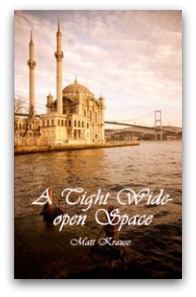
A Tight Wide-open Space: Finding Love in a Muslim Land (Delridge Press, August 2011)
Author: Matt Krause
Synopsis: A Californian who is now a Seattle-ite recounts how he became an Istanbullu, all for the love of a beautiful Turkish woman he met on a airplane. The year is 2003, and he can still hear the echoes of 9/11 as well as being acutely conscious of America’s engagement in two wars in Muslim countries. Eventually, he comes to love his new home more deeply than he might have expected.
How we heard about it: Linda Janssen, who writes the blog Adventures in Expatland, interviewed Krause about his book in October.

Planting Dandelions: Field Notes from a Semi-Domesticated Life (Penguin, April 2011)
Author: Kyran Pittman
Synopsis: A native of Newfoundland (her father was a well-known Newfoundler poet), Pittman writes about co-parenting with her charming Southern U.S. hubbie (they have three rambunctious boys); keeping the fiscal wolf from the door of their home in Little Rock, Arkansas; and honoring her marriage vows despite her refusal to give up her party-girl persona.
How we heard about it: Pittman came to our notice when she was a guest on Kelly Ryan Keegan‘s Bibliochat in late September.

Big in China: My Unlikely Adventures Raising a Family, Playing the Blues, and Becoming a Star in Beijing (Harper, March 2011)
Author: Alan Paul
Synopsis: Paul tells the story of trailing his journalist-wife to China and unwittingly becoming a rock star. His Chinese American blues rock band, called Woodie Alan, even earned the title of Beijing’s best band.
How we heard about it: We were early fans of Alan Paul’s back in the days of his Wall Street Journal online column, “The Expat Life.” Also, Paul and his book were featured on Kristin Bair O’Keeffe’s Writerhead Wednesday this past April.

The Foremost Good Fortune (Knopf, February 2011)
Author: Susan Conley
Synopsis: Conley, her husband, and their two young sons say good-bye to their friends, family, and house in Maine for a two-year stint in a high-rise apartment in Beijing. All goes well until Conley learns she has cancer. She goes home to Boston for treatment and then returns to Beijing, again as a foreigner — to her own body as well.
How we heard about it: Conley and her book were featured on Kristin Bair O’Keeffe’s Writerhead Wednesday in early October.

SELF-HELP, CROSS-CULTURAL AND OTHER NONFICTION WORKS

The Globalisation of Love (Summertime, November 2011)
Author: Wendy Williams
Genre: Relationships, self-help, humor
Synopsis: Williams interviews multicultural, interfaith and biracial partners from all over the world on what it feels like to “marry out” of one’s culture, religion and/or race. She also talks to experts on the topic and coins a term for it: “GloLo.”
Expat credentials: From a British-Ukrainian-Canadian family, Williams has been married to an Austrian for 13 years and lives in Vienna.
How we heard about it: TDN writer ML Awanohara listened to Jo Parfitt’s interview with Williams on her Writers Abroad show (Women’s International Network) and was attracted to the ideas of a book that treats this topic with humor. **TDN writer Anthony Windram will review the book for our site tomorrow (Tuesday).**

Modern Arab Women — The New Generation of the United Arab Emirates (Molden Verlag, November 2011)
Author: Judith Hornok
Genre: Women’s studies
Synopsis: The book consists of 20 chapters, each a stand-alone interview with an Emirati woman from disciplines as varied as business, film, medicine and politics. The women talk to Hornok about their careers, philosophies of life and plans for the future. The book, which is published in German and English, aims to dispel some of the Western myths surrounding Arab women.
Expat credentials: While not quite an expat, Hornok has been moving between the UAE and her home in Vienna, Austria, for eight years.
How we heard about it: TDN writer ML Awanohara read an article on the book in The National (UAE English-language publication) and became intrigued.

Expat Women: Confessions — 50 Answers to Your Real-life Questions about Living Abroad (Expat Women Enterprises Pty Ltd ATF Expat Women Trust, May 2011)
Authors: Andrea Martins and Victoria Hepworth (foreword by Robin Pascoe)
Genre: Women’s self-help, family, relationships
Synopsis: Experienced expats share wisdom and tips on topics that most expat women face, such as the trauma of leaving family back home, the challenges of transitioning quickly, intercultural relationships, parenting bilingual children and work-life balance. They also tackle more difficult issues such as expat infidelity, divorce, alcoholism and reverse culture shock. The book is based on the “confessions” page of Expat Women, the largest global Web site helping women living overseas.
Expat credentials: Andrea Martins is the director and co-founder of Expat Women. An Australian who has spent many years abroad, she began dreaming of connecting expat women worldwide when an expat in Mexico City. Victoria Hepworth is a New Zealander who has lived in Japan, China, Russia, Sweden, India and is currently living in Dubai, UAE. She is a trained psychologist who specializes in expat issues.
How we heard about it: Andrea Martins announced the publication of the book to much fanfare on Twitter and in other social media venues. It has been widely reviewed on expat blogs.

Marriage in Translation: Foreign Wife, Japanese Husband (CultureWave Press, April 2011)
Author: Wendy Nelson Tokunaga
Genre: Relationships, self-help
Synopsis: Tokunaga conducts a series of candid conversations with 14 Western women about the challenges in making cross-cultural marriages work both inside and outside Japan. She quizzes them about the frustrations, as well as the joys, of adapting to a different culture within married life.
Expat credentials: Born in San Francisco, Tokunaga has spent numerous years studying, living, working and playing in Japan. She is the author of two Japan-related novels, published by St. Martins Griffin. Oh, and did we mention her Japanese “surfer-dude” husband?
How we heard about it: Sometimes one tweet is all it takes! (We follow Wendy Tokunaga on Twitter.)

A Modern Fairytale: William, Kate and Three Generations of Royal Love (Hyperion/ABC Video Book, April 2011)
Author: Jane Green
Genre: Romance, royalty
Synopsis: In this video book for ABC News, produced just in time for the Royal Wedding in March, best-selling chick-lit novelist Jane Green follows the stories of three generations of royal love from their meeting up to and after their respective wedding days. She concludes that Kate and William have a much better chance than William’s parents of enjoying a relationship on their own terms.
Expat credentials: Born in London, Green worked as a feature writer for The Daily Express before trying her hand at writing novels. She now lives in Westport, Connecticut, with her second husband and their blended family.
How we heard about it: One of us noticed that Jane Green had been tapped to provide coverage of the Royal Wedding for ABC News. We then invited her to talk about her e-book and engage with our readers in a debate on whether women should still aspire to be “princesses” in the 21st century — a post that received a record number of comments.

INSPIRATIONAL ANTHOLOGIES

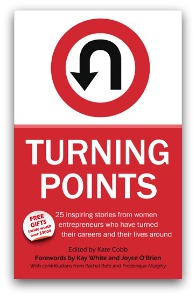
Turning Points: 25 inspiring stories from women entrepreneurs who have turned their careers and their lives around (Summertime Publishing, November 2011)
Editor: Kate Cobb
Synopsis: In this collection of stories from women all over the world, the focus is on the moments, or short passages of time, when a woman was facing something challenging and came out the other side smiling.
Expat credentials: Cobb is a British woman living in France, and about a third of the contributors — including Jo Parfitt and Linda Janssen — are expats who now run their own businesses.
How we heard about it: Linda Janssen promoted the book on her blog, Adventures in Expatland.

Indie Chicks: 25 Women 25 Personal Stories (Still Waters Publishing, October 2011)
Compiler: Cheryl Shireman
Synopsis: 25 indie novelists share personal stories in hopes of inspiring other women to live the life they were meant to live. (All proceeds go to the Susan G. Komen Foundation for breast cancer research.)
Expat credentials: Close to half of these indie authors are expats or have done significant overseas travel. To take a few examples: After living in Portland, Oregon, for most of her life, Shéa MacLeod now makes her home in an Edwardian town house in London just a stone’s throw from the local cemetery. Linda Welch was born in a country cottage in England, but then married a dashing young American airman, left her homeland, raised a family, and now lives in the mountains of Utah. Julia Crane is from the United States but recently moved to Dubai with her huband and family (her personal story concerns the adjustment process).
How we heard about it: Again, sometimes all it takes it a tweet (we picked up one of Linda Welch’s).

* * *

Questions: Have you read any of the above works and if so, what did you think of them? And can you suggest other works to add to the list? My colleagues and I look forward to reading your comments below!

STAY TUNED for tomorrow’s post, a review of The Globalisation of Love, by Wendy Williams, and for Wednesday’s post, a review of Perking the Pansies, by Jack Scott.

If you enjoyed this post, we invite you to subscribe to The Displaced Dispatch, a weekly round up of posts from The Displaced Nation, plus some extras such as seasonal recipes and occasional book giveaways. Sign up for The Displaced Dispatch by clicking here!

Related posts:

An interview with Robin Wiszowaty: Kenya Program Director for Free The Children

Last week I had the privilege of speaking with a young woman called Robin Wiszowaty. She isn’t a household name. You won’t find her in newspaper gossip columns, or on celebrity chat shows, or sashaying down the red carpet at the Oscars.

Yet I came away from our 45-minute conversation quite star-struck – not even my treasured chance meeting with Paul McCartney could compete – and more inspired than I can say.

A brief bio: From Suburbia to Savannah

Robin Wiszowaty was born in 1981 and grew up in Schaumburg, Illinois: a predominantly white, middle-class suburb outside Chicago. Although on paper Schaumburg appears an ideal place to spend childhood, with its summer block parties and strong sense of neighborliness, Robin says she never quite fit in.

“From an early age, I was unsatisfied with my ordinary life….I could never find my niche or any comfortable sense of self.” [My Maasai Life]

This feeling of discontent followed her through her teen years and into college at the University of Illinois where she studied speech communications. Only after a two-week trip to Israel in December 2001, to explore her Jewish heritage, did Robin begin to understand what she wanted from life.

“It [reminded] me how fiercely I longed to break out of this Western mindset and find something else.” [My Maasai Life]

While her concerned and long-suffering parents assumed the trip would rid her system of dissatisfaction and wanderlust, those two weeks in Israel were, in fact, only the beginning of a lifetime of traveling.

To the dismay of her parents a few months later, through a program run by the University of Minnesota, Robin was on her way to Kenya. After two months with a host family in Nairobi, where she learned basic Swahili and took classes on Kenyan culture, she went to live for a year in rural Nkoyet-naiborr, a Maasai community in the Great Rift Valley – a community and lifestyle as far removed from her Illinois home as anyone can imagine.

Nevertheless, Nkoyet-naiborr became her second home, in the truest sense. Here she forged deep, lasting friendships with her host family and members of the community, and was bestowed with a Maasai name: Naserian, meaning “peaceful person.” Mama, the mother in her host family, became her Kenyan mother, and Robin refers to the children of the family to as her brothers and sisters.

Today, nearly a decade after first arriving in Nairobi, Robin divides her time between Toronto and Kenya, working as Kenya Program Director with the charity Free The Children, implementing long-term development projects in partnership with local communities.

* * *

I spoke to Robin while she was in Canada, a few hours before she made the long trip back to Kenya. Her voice is soft, gentle, diffident, and not exactly what I’d expected; she’s had to overcome a lot of hurdles to be where she is today and, after reading her autobiography, I’m aware that I’m talking to one very determined person.

On Free The Children…

Kate Allison: Tell us a little more about what you do for Free The Children.
Robin Wiszowaty: As Kenya Program Director, I oversee the Alternative Income projects for Kenyan women. We teach the women leadership, financial literacy, how to access loans; and by being able to earn their own money, the women can invest that extra income in their families, their homes and, importantly, their children’s education. They work in groups — there are around 120 women’s groups now — and one example of how they earn income is doing quality beadwork. The bracelets and necklaces they make are sold at the Me to We store in Toronto, and also at the online store. My own Mama, by the way, is one of the beaders — she’s a fantastic beader.

Craig and Marc Kielburger, the founders of Free The Children and Me to We, have more to say about Robin’s role:

We’ve seen her sitting in hushed, intimate conversation with village elders, whose trust she earned through empathy and understanding. We’ve seen her astonish visiting students and volunteers with stories of her adventures. And we’ve seen her embraced by the teary-eyed mamas who are eternally grateful for her hard work in her role as Free The Children’s Kenya Program Director.

On writing…

Eighteen months ago, Robin’s autobiography “My Maasai Life” was published by Me to We Books — publishing division of Me to We, the for-profit social enterprise that supports Free The Children — and having read the book, I wanted to know more about it.

KA: Your book, “My Maasai Life”, tells the story of your transition from the American suburbs to life in a Kenyan village. What made you decide to write it?
RW: Lots of people have said to me that I should write a book about my experiences, but it was at the prompting of Craig Kielburger that I eventually wrote it. Craig was looking for books with a social message to be published by Me To We. “My Maasai Life” was the result, and was actually one of the first books in the Me to We publishing stable.

KA: What audience did you have in mind for the book when you wrote it?
RW: I originally intended it for high-school-aged girls who wanted to see the world — and also for their mothers, to help them understand this.

KA: Yes…in your book, you say your relationship with your own mother was somewhat rocky when you were that age.
RW: It was. But I look at myself now, and I think I’ve become the kind of person my parents always wanted me to be – albeit on my own terms.

(In fact, Robin’s parents long ago accepted, and proudly support, their daughter’s unconventional life choices.)

KA: What other kinds of readers have been attracted to the book?
RW: Young adults, in their 20s and 30s, who want to find a deeper meaning from life than they find in the corporate world where they are at present. And teachers; they read my book in World Issues classes, and discuss it with their students.

KA: Have you written any other books, or are you intending to do so?
RW: “My Maasai Life” has been adapted into a children’s book, subtitled “A Child’s Adventure in Africa”, and I’m currently working on another book, which I hope to have published in another couple of years or so. I’m about halfway through writing it — I don’t know what it will be called, and it doesn’t have a working title — and although it’s also about Kenya, this book is from the perspective of the women there, focusing on the universal concepts of motherhood and womanhood.

On fitting in…

KA: Can you think of a particular occasion in Kenya when you wondered, “What’s a nice girl like me doing in a place like this?”
RW: [laughs] I can tell you exactly when that was. It was on my first night in Nkoyet-naiborr, when I was sleeping in the bed I shared with my sister, Faith, and I heard a wild animal howling outside…

“Faith! ” I whispered.
“Naserian . . . ?”
“What is that sound?”
Faith rolled over, annoyed at being woken. “Hyenas.”
Hyenas? Now sleep was even more impossible. I tried to block out those echoing wails, but my mind flooded with questions. Was I doing the right thing? Was I just substituting one set of frustrations for another? Had I made a terrible mistake?

KA: And what about the other way round — can you think of a moment when you felt more at home in Africa than in the United States?
RW: Oh yes…I’m “taken” by Kenya. There, I feel comfortable within my own soul, that I’m in the right spot. You could say that it’s a calling. The time I feel it most is when I’m sitting with the women, making tea over the fire, just talking…there’s so much soul, such a feeling of family and community.

When I first went to Kenya, I felt at home on the first occasion my Mama let me fetch the water on my own. It felt good to be a provider for the family who were hosting me.

Fetching the water is much easier said than done:

Transporting water, I saw from the women, is an art unto itself. The mitungi must be carefully balanced on two rocks beneath the spout and then held in place while the trickling water slowly fills it all the way to the top. And with water always in scarce supply, we could never afford to waste or spill a drop. When the cylindrical twenty litre container was full, it weighed more than twenty kilos.

More recently, I can think of an occasion at the Kisaruni High School, which is Free The Children’s first all-girls secondary school, and has 41 students who board there. When it first opened last spring, these girls came to the school and we all had a big sleepover party. It was such a lot of fun, and for many of these girls it was the first time they’d slept on a mattress.

It’s the feeling of true community in Kenya that I love. It seems to me that when people come together for the benefit of others, that’s when you get the most profound sense of community.

KA: What about repatriation? Do you find it difficult to adjust between living in your two different worlds?
RW: The first transition from Kenya back to Chicago was most difficult. I felt like a lost 8-year-old, trying to get used to life in America again after a year away. I found it hard to wear shoes, having been barefoot for so long. And I was full of anger, of judgment for the way things were done — for example, at people who ran the water for so long, at the extravagant amounts of food.

Huge wasteful, overpriced family dinners. Thoughtless waste of water, flushing the toilet so many times every day.

But I don’t feel that way now. Then, I was going through that time of life when everyone tries to work out who they are and feels a certain amount of anger. Now I accept that it’s not about everyone having the same; it’s about everyone having enough.

Today, whichever direction I travel in, I always feel that I’m going home to family.

On our November theme of Global Philanthropy…

KA: Over the last month, we’ve discussed — fairly heatedly — the growing trend towards volun-tourism. As part of your work with Free The Children and Me to We, you lead groups of people on international volunteer experience each year. Can the people who go on these trips, who lack language and cultural training, really accomplish much in such a short time?
RW: Volun-tourism can play a great part when it’s done responsibly. Our youth volunteer trips last three weeks, while our family and corporate trips are shorter at ten days. We regularly have employees of large companies like KPMG and Virgin Atlantic on our corporate trips.

After some orientation, our volunteers hit the ground running — they help with building schools, with clean water projects, they go into the community’s homes to help, they learn Swahili. For many of them, it is literally a life-changing experience. It gives them a different perspective on life and on their careers. It’s very positive for both the volunteers and for the communities they are helping.

Volun-tourism skeptics should maybe note that Robin herself first came to Kenya with an attitude of “What can Kenya do for me?” rather than “What can I do for Kenya?”, as can be seen in this extract from her book, describing an incident during her initial two months in Nairobi:

One street man nearby…said in Swahili, “What are you doing in Kenya, if you can’t help us?”

Despite my halting comprehension of the language, I understood his question. What was I doing here? Was I here to help Kenyans? I couldn’t remember any sort of altruistic impulse as my reason for being me here. I only pictured myself three months earlier, curled up on my family room couch reading books on cultural sensitivity, or shopping in neighbourhood department stores for appropriate clothing, thinking this was a chance for me to enlarge my experience and pick up others’ points of view. I’d been driven simply by a desire to escape, not to improve the lives of these poor people.

KA: Which person or people, dead or alive, do you look up to most in your work?
RW:
I would have to say the other team members of Free The Children and Me to We, both in Kenya and Toronto. They all work for the children, not the paycheck. The world may never know their names, but they work so hard and achieve so much for others.

KA: Are there any inspirational stories of theirs you can share with us?
RW: Spencer West, a speaker on the Me to We team, was born with a genetic disease, and lost both his legs at the hips when he was a child. We met in Kenya when he was on an international volunteer trip, helping to build a school there.

Next June, he is going to “Redefine Possible” and climb Mount Kilimanjaro in his wheelchair, in order to raise $500,000 to bring clean water programming to 12,500 people in East Africa.

You can’t get any more inspirational than that.

KA: And lastly — it’s the holiday season. We’re inundated with requests for giving. In your opinion, what’s the best way to spend our dollars (or pounds, or euros, or yen, or whatever) to help those in other parts of the world who have so much less than we do?
RW:
Well — you could sponsor Spencer West on his climb and help those affected by the drought in East Africa, which is the worst in 60 years. Or you could buy your holiday gifts from the Me to We store, either in Toronto or online at www.metowe.com/shop.

Epilogue

The interview ends, and I thank Robin for giving her time, even when she has a hundred other things she could probably be doing, since in a few hours she will be flying back to her Kenyan home. I am awed by our conversation, by how much she has achieved in her short life — she is only 30 — and I feel humbled.

I tell her this. “People like you, who do so much with your lives, make me feel very small.”

There’s a slight pause at the end of the phone, then Robin says, “But… you’re a mother.”

I can’t count the number of times over the last fifteen years when, in answer to the question “What do you do?” I’ve said, “I’m just a stay-at-home mom.” Emphasis on the “just” — an apology for the mundanity of my existence. The counter-reaction, so often, is “But that’s a very important job!” in a slightly condescending tone that makes me feel, even more, that motherhood is merely a consolation prize for missing out on life’s other, more important achievements.

Robin’s tone holds none of this condescension. “You’re a mother,” she says, and it’s a statement of the obvious, that being a mother is an achievement in itself.

It occurs to me that her years with the mamas in Kenya have taught Robin the value of motherhood — a lesson that maybe passes by the young women growing up in our “developed” culture. It’s an irony, perhaps, that in our Western pursuit of progress and women’s rights, we have devalued the most important women’s right of all — that of pride in raising a strong next generation.

Robin, thank you. It was wonderful to talk to you. I hope we meet in person one day.

.

Quotations from “My Maasai Life: From Suburbia to Savannah.” Wiszowaty, Robin (2010-07-01), Perseus Books Group.

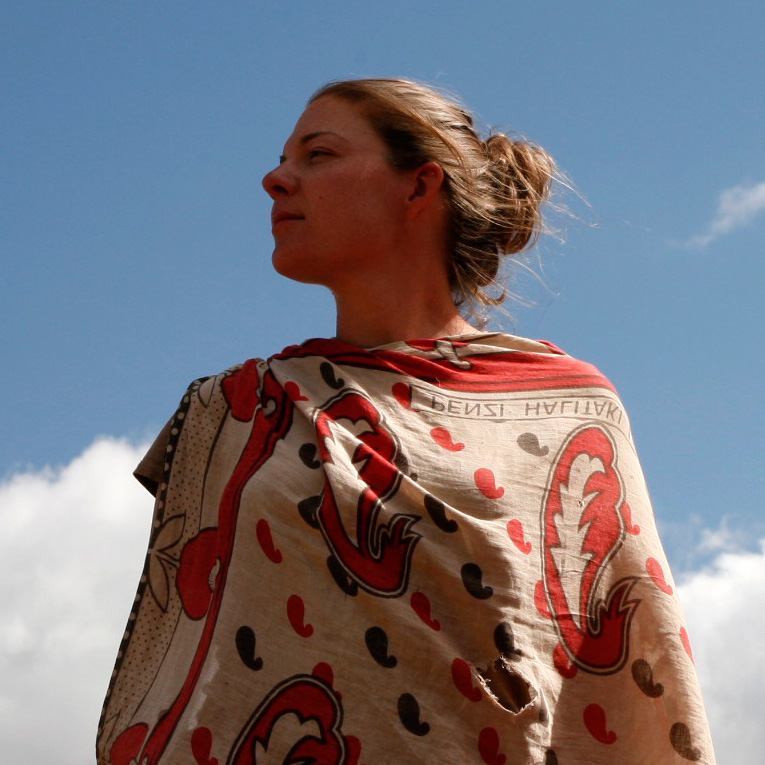
Img: Robin Wiszowaty — photo courtesy of www.metowe.com

Related posts:
RANDOM NOMAD: Aaron Ausland, NGO Research Director & Development Practitioner
RANDOM NOMAD: Adria Schmidt, Career Consultant at Violence Intervention Program & Former Peace Corps Volunteer

If you enjoyed this post, we invite you to subscribe for email delivery of The Displaced Dispatch, a round up of the week’s posts from The Displaced Nation. Sign up for The Displaced Dispatch by clicking here!

RANDOM NOMAD: Mardi Michels, Elementary School French Teacher, Home Cook, Writer, Photographer & Traveler

Born in: Adelaide, South Australia
Passports: Australia (by birth), Britain/EU (through my dad), Canada (I became a citizen in 2007)
Countries lived in: France (Paris): 1995-2000; Canada (Toronto): 2000-present
Cyberspace coordinates: eat. live. travel. write | my creative refuge from academia (blog); eatlivtravwrite (Twitter handle)

What made you leave your homeland in the first place?
I left Australia because I was working on my PhD in French literature and felt it made a lot more sense to be in the country of the language and culture I was studying. Soon after moving to Paris, I began working in a restaurant (Woolloomooloo Restaurant Australien — now closed) to supplement a meagre scholarship. About a year after moving to Paris, I got a job teaching English at Université Paris X and I was hooked on teaching English (I was already qualified to teach French) so I undertook my Dip TEFL [professional diploma in Teaching English as a Foreign Language] at the University of London Institute in Paris, eventually scoring a full time teaching job at the British Council. My PhD? Incomplete…

Is anyone else in your immediate family “displaced”?
My sister also left home when she was in her early 20s to complete a PhD at Oxford (which she did), and from there she worked in banking all over the world (England, Singapore, Japan). She has also traveled extensively in South America. She, too, has ended up in North America (New York City), teaching math!

How about your husband? Is he displaced?
He was when we first met — in Casablanca in December 1999. I was on a vacation in Morocco, and after that two-week jaunt, Mr Neil followed me back to Paris for a visit. He is the reason I am now in Canada. Six months after he visited me in Paris, I had a job teaching in French in Toronto lined up for the 2000-01 school year — and the rest, as they say is history. Neil is originally from Vancouver but has traveled the seven continents to some “out there” places. I mean, how many people do you know who have been to Easter Island?

Describe the moment when you felt most displaced.
The first time I had to do lunchtime outdoor yard duty the first year I was living in Toronto. I was ill equipped for the cold, wearing leather boots and a wool coat that was more than adequate in Paris. Not so much here. It was five years before I succumbed to the puffy coat and winter boots.

Describe the moment when you felt least displaced.
Honestly? Stepping off the plane this past summer when I arrived in Paris. I try to get back there every year or so (I completed my MA in Second and Foreign Language Teaching a few years ago, requiring me to take courses two summers in a row in Paris). Even though I have lived longer in Toronto now than I did in Paris (and I love my life in Toronto), and I don’t have any family there, Paris is still a place where I feel curiously “at home.”

You may bring one curiosity you’ve collected from each of your adopted countries into the Displaced Nation. What’s in your suitcase?
I’m thinking cookware from Mora (a treasure trove of ring molds, tart pans and other French pastry equipment) or A Simon (good selection of glassware and heavy-duty white French porcelain) — both on rue Montmartre; or else baking ingredients from G Detou, one of the world’s great food shops, in Les Halles.

You’re invited to prepare one meal based on your travels for other Displaced Nation members. What’s on the menu?
The meal I would prepare for you would include a dish inspired by each continent. My husband and I have visited all seven continents, and we actually hosted this luxury dinner last year, as documented on my blog:

  • Moroccan spiced chick peas
  • Vietnamese caramelized chili prawns
  • Italian polpette d’uova
  • Australian micro meat pies
  • Mexican tortilla chicken soup
  • Cuban ropa vieja
  • Panamanian (coconut) rice with pigeon peas
  • Jamaican jerk chicken
  • Île flottante

You may add one word or expression from the country you’re living in to The Displaced Nation argot. What will you loan us?
I couldn’t pick one specific one but some words that have crept into my vocabulary (and that of my students’) include hop là, aïeoh là là, et hop, and ouf — words that sound ridiculous removed from the context of everyday French vocabulary but that have turned out to be very useful in the context of my classroom 😉 Surely The Displaced Nation could use a few more interjections?

It’s French Cuisine month at The Displaced Nation. Who is your favorite French chef, living or dead, and why?
Whilst she is not French, it has to be Julia Child, mainly for her “can-do” attitude.

Julia Child is the role model for our posts this month — and has just now been inducted into our Displaced Hall of Fame. Of the following three quotes by her, which one do you most identify with?

1) The only time to eat diet food is when you’re waiting for the steak to cook.

2) The only real stumbling block is fear of failure. In cooking, you’ve got to have a what-the-hell attitude.

3) Until I discovered cooking, I was never really interested in anything.

I have to say the quote I most identify with is “The only real stumbling block is fear of failure. In cooking, you’ve got to have a what-the-hell attitude.”

I teach a once a week cooking class to nine-to-eleven-year-old boys, called Les Petits Chefs; and though my students are pretty young and cannot be expected to know a lot about cooking (yet!), I found myself thinking of them as I read this quote. What continues to amaze me about my group of little chefs is their willingness to try new things and their (mostly) complete lack of fear about being in the kitchen (well, science lab, in our case!). Yesterday, for example, I had five little boys cutting up raw chicken (thighs, no less, so much messier than neat clean breast meat), and I watched them attack the task with great gusto. No fear (though a few “ewws!”) — they just got on and did the job, trusting me that the icky meat would be turned into something delicious in about 30 minutes (it was!).

Readers — yay or nay for letting Mardi Michels into The Displaced Nation? Tell us your reasons. (Note: It’s fine to vote “nay” as long as you couch your reasoning in terms we all — including Mardi — find amusing.)

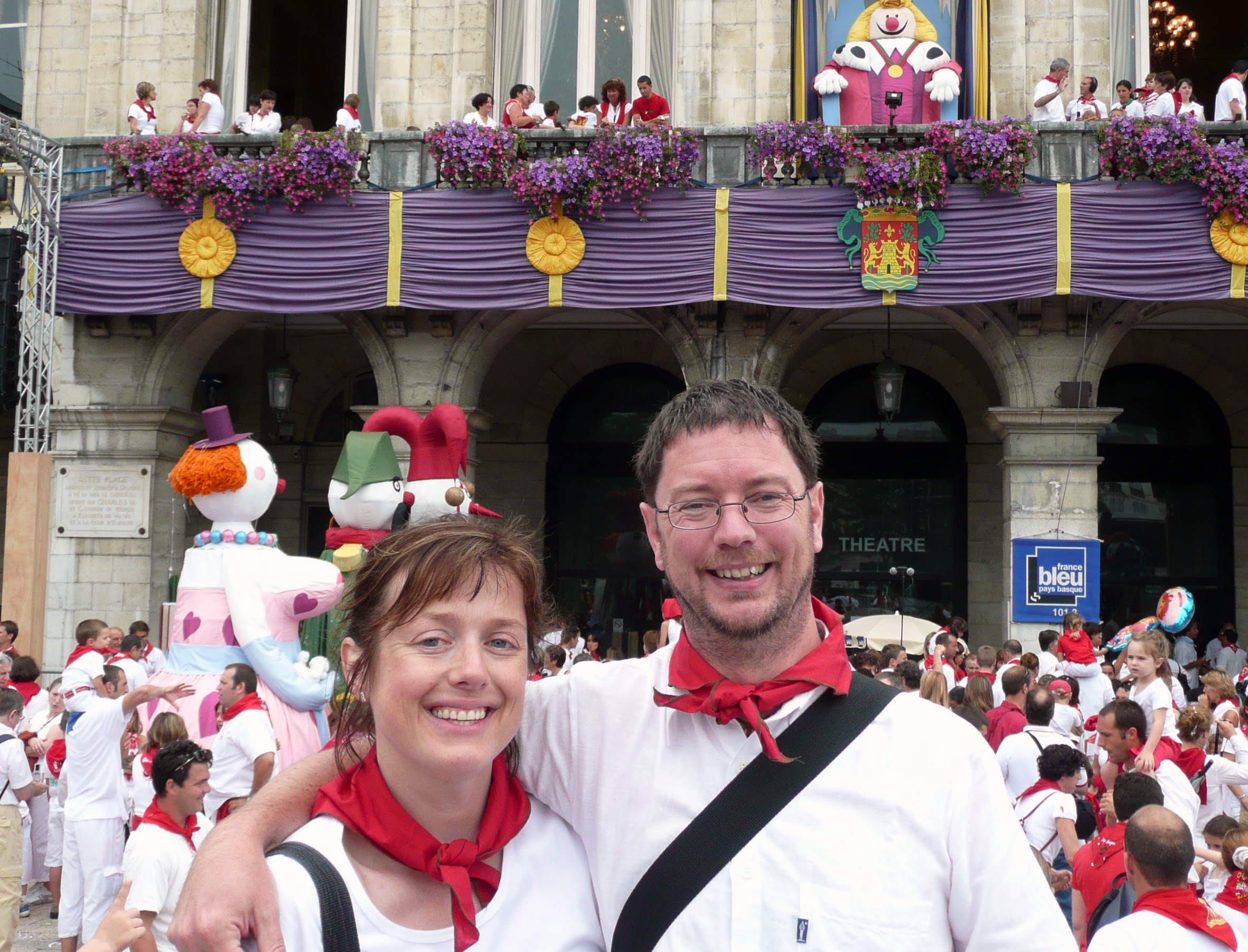
img: Mardi Michels and her mari, Mr Neil, at the Fêtes de Bayonne (2008).

STAY TUNED for tomorrow’s installment from our displaced fictional heroine, Libby, who seeks advice on her unexpected second pregnancy from someone who is older…if not altogether wiser. What, not keeping up with Libby? Read the first three episodes of her expat adventures.

If you enjoyed this post, we invite you to register for The Displaced Dispatch, a round up of weekly posts from The Displaced Nation. Includes seasonal recipes and book giveaways. Register for The Displaced Dispatch by clicking here!

Related posts:

RANDOM NOMAD: Kirsty Rice, Freelance Writer & Blogger

Born in: Renmark*, South Australia
Passport: Australia (no one else will have me!)
Countries lived in: Australia (Adelaide & Perth): 1997-98; Indonesia (Jakarta): 1999 – 2001; Malaysia (Kuala Lumpur): 2001-02; Libya (Tripoli): 2002-04; Canada (Calgary): 2004-08; USA (Houston): 2008-09; Qatar (Doha): 2010-present.
Cyberspace coordinates: 4 kids, 20 suitcases and a beagle (blog)
*A small town of 7,500; my parents still live there.

What made you leave your homeland in the first place?
I am married to a former expat child. I know the term is Third Culture Kid, but I don’t really think it applies to him. He was always keen on doing the “expat” thing. I, on the other hand, was raised in the same town that I was born in and wasn’t a great lover of change. Our first move was the result of a promotion for my husband and the fact that I was pregnant with our first child. The plan was to do a two-year posting in Indonesia and to return “home”. That was 7 countries and 12 years ago. I now thrive on change.

So your husband was already “displaced”?
My husband’s parents were expats. He was actually born in New Zealand and then they went to the Philippines for many years before moving to Sydney, then Melbourne, and finally to Brisbane.

How about your kids?
My children were all born in different countries. We were living in Jakarta when I had my first child, my second was born in KL, the third in Malta and the fourth in Canada. Although none of them have lived permanently in Australia (our longest stint has been during school holidays, so a maximum of 12 weeks), they all think of themselves as Australian. My husband and I have both worked hard for that to be the case.

Describe the moment when you felt most displaced.
When we first moved to Tripoli — it was the middle of summer and I had a two-week-old baby and a two-year-old. We then had to endure months of housing hell — we couldn’t find one! For a while, I shared a “guest house” with about sixty men who were rotating in and out of the desert: there were no other women. Breast feeding amongst men who hadn’t seen a woman for a couple of months was a rather unique experience. Due to the weather, fruit and vegetables were limited and small in size. I can remember standing in a fruit and vegetable stand with a screaming baby and a restless toddler wondering how I was going to cook carrots the size of my little finger. I was continually getting lost, and the simplest of tasks seemed very overwhelming. There were many days that I considered getting on a plane — but I’m so pleased I didn’t. Three months later, we had a house, the weather was better, I made friends, and I loved our life in Libya. I was devastated to leave.

Describe the moment when you felt least displaced.
I feel like that here in Qatar. Our children are at a fabulous school, I have a place to write, and my husband works for a Qatari company and really enjoys it. There is so much here in the community for expats, and we are made to feel very welcome. I have made local friends and love heading to the local souqs. I feel that this is very much our second home. In other locations I have felt that we were passing through, but not here.

You may bring one curiosity you’ve collected from your adopted country into The Displaced Nation. What’s in your suitcase?
From Indonesia: A jamu (traditional medicine) woman made of silver, given to me by a very dear friend.
From Malaysia: The Selangor pewter tea set I was given as a gift. Each time I use it I think of my friends.
From Libya: A wedding blanket with traditional jewellery pinned to it, which was given as a farewell present. It is such a unique gift and always a talking point when people spot it in our house.
From Canada: Nothing material, just the memory of what it was like to be back to work full time. In Calgary, I returned to the “old” me, remembering who I was pre children and travel. That was Canada’s gift — along with a huge appreciation of weather!
From the U.S. (Houston): A fantastic painting of an American flag that I picked up in San Antonio. It’s 3D and not in the traditional colors. It reminds me that America is far more layered and multidimensional that what I’d given it credit for.

You’re invited to prepare one meal based on your travels for other Displaced Nation members. What’s on the menu?
We’ll have some kind of soup for starters: either Indonesian soto ayam (chicken soup), Libyan soup* (I love it!), or the Canadian version of Italian wedding soup. Though I come from an area in Australia that has a large Italian community, I’d never heard of Italian Wedding Soup — turns out it’s more of a North American thing.

For the mains, perhaps I’ll offer a choice between Malaysian curry or maybe a nasi goreng from Indonesia.

And for drinks, we’ll have margaritas. I learned to make a mean margarita in Houston.

For dessert, a caramel cheesecake — a recipe I picked up from a fellow Aussie in Houston.

You may add one word or expression from the country you’re living in to The Displaced Nation argot. What will you loan us?
From Indonesia: Satu lagi (one more) — I said that way to often!
From Malaysia: I just loved how you could put lah on the end of everything and automatically make a sentence sound friendlier.
From Tripoli: Shokran (thank you). It was the first Arabic word I learned and makes me think of how special the people in Libya are — so kind and helpful. Incidentally, in learning how to say “pregnancy test,” I discovered that hamil is the word for “pregnant” in Indonesia, Malaysia and Tripoli.
From Canada: Hey — kind of the same as lah in Malaysian.
From the U.S. (Houston): I found myself describing things differently. It wasn’t just “the big tree out the front” but “the big ‘ol tree out the front.”
From Qatar: Right now I’m back to learning Arabic (unsuccessfully). Oh how I wish I had a chip I could just insert into my brain to switch languages. Why haven’t they invented that yet?

It’s Zen and the Art of the Road Trip month at The Displaced Nation. Robert M. Pirsig, author of Zen and the Art of Motorcycle Maintenance, famously said: “Sometimes it’s a little better to travel than to arrive.” Do you agree?
I disagree. I like to arrive, settle and learn how a city/country works. You can learn so much about a place just by trying to get the telephone connected! Traveling through is just a brief picture. I love that we’ve been able to become part of a community everywhere we have lived.

Pirsig’s book details two types of personalities: 1) those who are interested mostly in gestalts so focus on being in the moment, not rational analysis; and 2) those who seek to know the details, understand the inner workings, and master the mechanics. Which type are you?
If you read my blog you’ll see there is usually a romantic viewpoint or flowery end to a posting. I’m a big believer in things happening for a reason and not always being logical. Having said that, I am a stickler for details, I hate to enter into things blindly and have to know exactly what the story is. Which personality am I in my expat life? I’m a bit of both. I don’t believe that anyone can be a successful expat without having the flexibility to change with the situation. In our daily lives as expats we need to quickly learn the rules, find out the details, go with the flow and just enjoy the ride. You have to be both.

* Libyan soup is a tomato-based soup. There are many variations. The one I loved was with lamb.

Ingredients:
1/2 to 1/3 lb. lamb meat cut into small pieces
1/4 cup oil or “samn” (vegetable ghee)
one large onion
1 tablespoon tomato paste
2-3 tomatoes
1 lemon
1/2 cup orzo, salt, red pepper, Libyan spices (Hararat) or cinnamon

Directions:
Sauté the onion with meat in oil.
Add parsley and sauté until meet is brown.
Add chopped tomatoes, tomato paste, salt, spices, and stir while sizzling.
Add enough water to cover meat, simmer on medium heat until meat is cooked.
Add more water if needed, and bring to a boil.
Add orzo, simmer until cooked.
Before serving, sprinkle crushed dried mint leaves, and squeeze fresh lemon juice to taste.

Readers — yay or nay for letting Kirsty Rice into The Displaced Nation? Tell us your reasons. (Note: It’s fine to vote “nay” as long as you couch your reasoning in terms we all — including Kirsty — find amusing.)

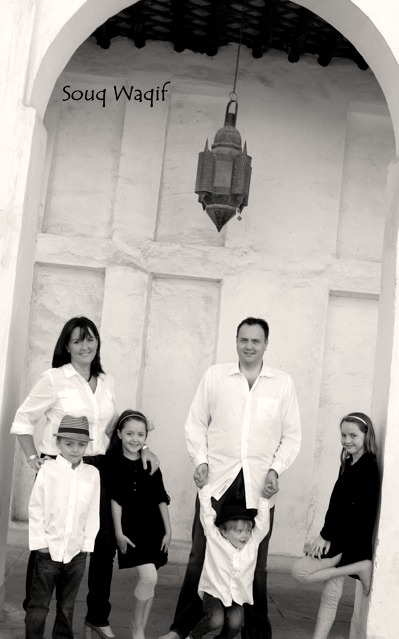
img: Kirsty Rice with her family (sans the beagle) at Souq Waqif, Doha, Qatar.

STAY TUNED for tomorrow’s installment from our displaced fictional heroine, Libby, whose rather dramatic road-trip adventure has come to an end. Time to face reality again in Woodhaven! What, not keeping up with Libby? Read the first three episodes of her expat adventures.

If you enjoyed this post, we invite you to register for The Displaced Dispatch, a round up of weekly posts from The Displaced Nation. Includes seasonal recipes and book giveaways. Register for The Displaced Dispatch by clicking here!

Related posts:

RANDOM NOMAD: Simon Wheeler, Steel Automotives Project Leader & Former Cricketer

Born in: Aylesbury, Bucks, England
Passport: English (never ever say British!)
Countries lived in: Australia (Adelaide): 1996-98; California (Newport Beach): 2006-09; Slovakia (Plavé Vozokany): 2006-present
Cyberspace coordinates: Rambling Thoughts of Moon | Englishman’s travelling thoughts from England, California and now Slovakia, Plavé Vozokany… Ahoj !! (blog)

What made you leave your homeland in the first place?
My initial travels to Australia came through boredom of work. Having worked in a large pharmaceutical company from 17, at 24 I realized that I needed to have some new adventures. I am a firm believer that if you don’t like your current situation, change it. When I was asked to go play cricket at Grade A level for the Fulham Cricket Club in Adelaide, I packed my bags and left. Actually, I got cold feet about two weeks before I was due to leave. But then a close friend was suddenly struck ill on a Friday, and sadly died two days later. That was the kick I needed.

Is anyone else in your immediate family displaced?
My sister is now a Canadian citizen living in Vancouver. She has been away from England for over 15 years.

Describe the moment when you felt most displaced over the course of your many displacements.
Can I have two? The first occurred just after I’d gotten married to my gorgeous wife on top of Grouse Mountain in Vancouver. After the wedding, she had to go back to her job in California, while I continued waiting in Vancouver for my visa to be approved. In those three months of waiting, the uncertainty of not knowing if I would be allowed to join her made for very stressful times. We could simply have flown back to England, where a job was being held for me in the City. That would have been so easy, but that said, we have never chosen the easy option.

The other time occurred much earlier: May 24th, 1997. A very precise date, but I remember it so well. I was on the road from Melbourne to Sydney, all on my own, on my birthday, and not one person said “Happy Birthday” or even knew it was my special day.

Describe the moment when you felt least displaced.
I’d have to say right now. We moved to my wife’s homeland two years ago. The culture shock, combined my lack of language skills, was daunting at first. The people, especially her family, have been incredible, but finding a life was very tough. Since we moved here, we have both found jobs in the same company; had our first child, the adorable Matej; and are about two months away from moving into the cottage we are renovating in the village next door to Plavé Vozokany (we’ve been living here with my wife’s parents since our arrival). So, right now, I am on the verge of having all I have ever wanted. To settle into a new country takes time, a lot of time, especially one that is so different to your homeland. I still have some time to go, but with the growing family, a supportive wife, a good job, and soon my dream house, I am ticking all the right boxes.

You may bring one curiosity you’ve collected from each of the countries where you’ve lived into the Displaced Nation. What’s in your suitcase?
From England: My St George’s flag — not because I wish to be associated with rowdy football supporters but because it’s a symbol of my country that I’m very proud of.
From Australia: My Ugg boots from the open-air market in Port Adelaide. I have them on right now!
From California: My photographs from the incredible national and state parks in the Western United States: Grand Canyon, Death Valley, Zion, Bryce, Joshua Tree, Big Sur… I could go on…
From Slovakia: A bottle of homemade Slivovica, a plum brandy strong enough to blow your socks off!

You’re invited to prepare one meal based on your travels for other Displaced Nation members. What’s on the menu?
Whoa, that’s tough… But let me try. To start, we’d have fresh prawns and seafood from Australia. As my main, I’d offer my Mum’s Christmas dinner: turkey, sausages and bacon, Brussels sprouts, veggies galore, roast potatoes, cranberries, stuffing… And if there’s still room, I’d throw in some sushi from Masa Sushi, a tiny, simple, dirty-looking place off 19th Street and Habour in Costa Mesa, California — the host/chef really knows what he’s doing. For dessert, we’d have fresh, homemade cream cakes from my mother-in-law here in Slovakia. It would all be washed down with an Australian white, a pint of Coopers (Southern Australian beer), and a couple of shots of Slivovica.

You may add one word or expression from each of the countries you’ve lived in to The Displaced Nation argot. What words do you loan us?
From Australia: Beauty (said in a heavy Aussie accent). It’s used all the time — but most especially on the cricket fields, after a player hits a good shot or the bowler gets a wicket.
From England“In England’s green and pleasant land…” We sang “Jerusulem” at my wedding and on many drunken occasions. It always takes me home…
From California: Awesome — but I’d advise that you restrict the usage to things that are truly awesome; otherwise, it loses its meaning. That pair of shoes is AWESOME; that TV show is AWESOME; You are AWESOME — no! The Grand Canyon is awesome — yes!

It’s Pocahontas month at The Displaced Nation, and we’re focusing on cross-cultural communications (or the lack). By living in your wife’s country, do you find that you’re relying on her to serve as your “interpreter” for Slovakian language and culture? Does this place a special stress on the marriage, and if so, how do the two of you cope with it?
Yes, it definitely does. When you go away on holiday and do, say, exploratory grocery shopping, it’s all a bit of fun trying to cope, but when you actually move to the country it’s totally different. So many things to sort out: banks, mortgages, identity cards, driving license — the list is endless. And she has to do all of this. Even if I have to make a trip to the doctor’s, she has to come. When you are sitting there having two people discuss your health, and you cannot understand what they’re saying, it’s very stressful. As I mentioned earlier, we are renovating an old Slovak cottage. But to communicate with all the different workers and tradesmen, again, she has to do it all… You can imagine what a workload she carries for this project, and the uselessness I feel in not being able to help her.

Our relationship, like so many others, works because one of us takes the lead, and in our case, that happens to be her. Imagine Monica Geller from Friends — well, that is my wife. She likes to be in control. Even when we were living in America, she was in charge. So for us, with some blips, it does work. But whenever I want to do things — relieve her of some of her workload and stress — it’s a struggle. My Slovak is improving, but it is not good enough to cope with these kinds of demands. It’s a very tough language, and at 40, I am a poor student.

QUESTION: Readers — yay or nay for letting Simon Wheeler into The Displaced Nation? Tell us your reasons. (Note: It’s fine to vote “nay” as long as you couch your reasoning in terms we all — including Simon — find amusing.)

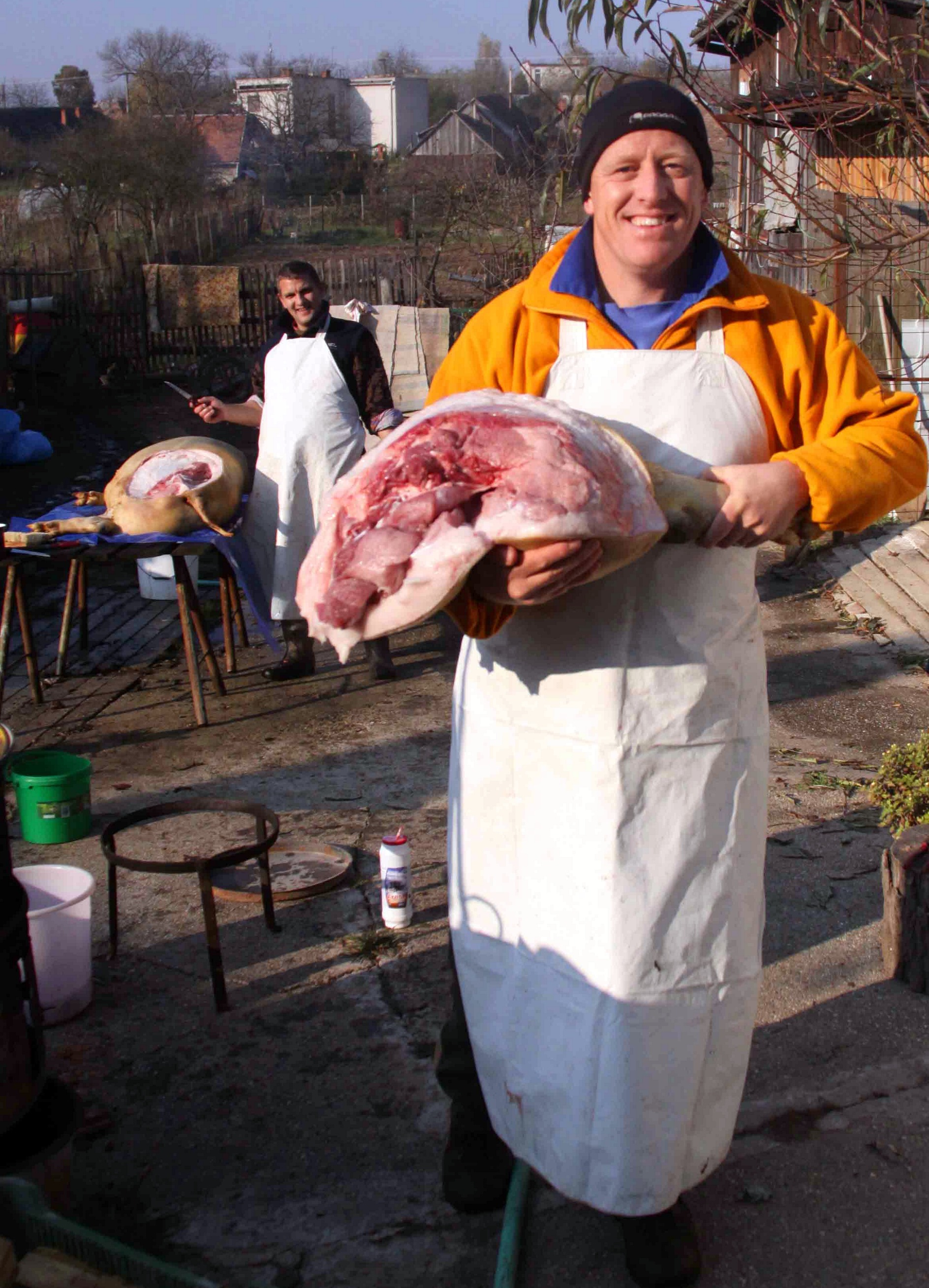
img: Simon participating in the traditional slaughter of pigs that occurs in his Slovakian village every year. His comment: “Most village families rear a couple of pigs every year for this purpose. The custom was new to me, and I didn’t like the idea — never ever thought I’d be doing this kind of thing! But it does mean you can fill your freezer with good quality, home-bred meat and sausages, and I’ve gotten used to it.”

STAY TUNED for tomorrow’s installment from our displaced fictional heroine, Libby, who encounters her very first 4th of July celebrations.

If you enjoyed this post, we invite you to subscribe for email delivery of The Displaced Nation. That way, you won’t miss a single issue. SPECIAL OFFER: New subscribers receive a FREE copy of “A Royally Displaced Tea.”

Related posts:

And the Alices go to … these 7 writers who get the curious, unreal side of international travel

 © Iamezan | Dreamstime.com Used under license

© Iamezan | Dreamstime.com
Used under license

Since founding The Displaced Nation on April Fool’s Day (no fooling?), Kate Allison, Anthony Windram and I have been coming across travel writers who understand just how befuddling the life of the global nomad can be.

We are inclined to think that they have channeled Lewis Carroll’s Alice.

Offering themselves up as examples, such writers talk about what’s it like for a crossborder traveler to be plagued with feelings akin to adolescent self-doubt: what am I doing here, and will I ever get over this feeling of displacedness?

And they’ve shown us how to emerge from such escapades as more fulfilled human beings, full of stories to tell, perhaps to our grandkids, one day…

In recognition of these models of displacedness, my colleagues and I have created a new accolade for the travel writing profession: the Alice’s Adventures in Wonderland Award, otherwise known as an “Alice.”

And The Displaced Nation‘s very first Alices go to…drumroll!…(listed in reverse chronological order)

1. ANABEL KANTARIA for Do we all need behavior lessons?, in the Daily Telegraph:

“Just remember, you’re not playing in your own backyard now,” my boss told me when I took my first job in the UAE. “You’re in someone else’s yard now, and you play by their rules.” It was probably the best piece of advice I was ever given about the UAE, and one that’s kept me out of trouble on numerous occasions.

Alice link: “I don’t think they play at all fairly,” Alice began, in rather a complaining tone, “… I should have croqueted the Queen’s hedgehog just now, only it ran away when it saw mine coming!”

2. SUZY GUESE for The Unexpected Benefits to Solo Travel, in Suzy Guese: Traveling with a redheaded temperament:

While I know people who travel with others can have their share of weird conversations, solo travel for some reason brings this about almost with every day. … From a musician at the Giant’s Causeway [Northern Ireland’s only UNESCO World Heritage Site] who started talking to me by insulting my shoes, to a B&B owner who told me her “journey of life”, leaving in all of the gory details, I have had some strange encounters.

Alice link: “Your hair wants cutting,” said the Hatter. He had been looking at Alice for some time with great curiosity, and this was his first speech.

3. ANDREA MARTINS for Expat women living the high life or secretly struggling?, in the Daily Telegraph:

In mid-2005, April Davidson’s world was turned upside down following her husband’s job transfer to Mexico City. … She could not understand what was happening to her and she started taking medication for anxiety and unexplained stomach problems. Little did April realise that her feelings represented a completely normal piece of the relocation jigsaw, and that taking medication to cope with the transition process was again, not uncommon.

Alice link: “You ought to be ashamed of yourself,” said Alice, “a great girl like you,” (she might well say this), “to go on crying in this way! Stop this moment, I tell you!” But she went on all the same, shedding gallons of tears, until there was a large pool all round her, about four inches deep and reaching half down the hall.

4. SEBASTIAN DOGGART for Elegy to English shepherd’s pie, in the Daily Telegraph:

One of the things I miss the most about living outside England is shepherd’s pie. … The greatest desecration is found in Quebec, where they call it “Chinese pâté” (pâté chinois). To suggest this sacred dish has anything Chinese about it is preposterous.

Alice link: “When I’m a Duchess,” she said to herself…”I won’t have any pepper in my kitchen at all. Soup does very well without…”

5. SALLY THELEN for 4 Tips on Embracing Your Inner Weirdo, in Unbrave Girl:

This morning, when I went running [in Wuxi, China], I happened upon a group of teenagers dressed up as anime characters. A crowd had formed around them to gape at their hot pink wigs, Nutcracker-like jackets and French maid dresses.

I stopped for a minute to stare slack-jawed with the rest of the crowd.

I was baffled.

I was confused.

And, frankly, I was a bit miffed. After all, didn’t these kids know that I was the main attraction at this park?

Alice link: This piece of rudeness was more than Alice could bear: she got up in great disgust, and walked off, the Dormouse fell asleep instantly, and neither of the others took the least notice of her going, though she looked back one or twice, half hoping that they would call after her…

6. SEZIN KOEHLER for My foreign body: geocharacteristics of a population, in Expat+HAREM:

When I first arrived in Prague I was a size 7, had an acceptable C-cup and chocolate-colored skin. Three years later I’ve become a size 12 and an overbearing DD-cup with skin the color of weak tea.

Aging plays only a small part….

Alice link: “Curiouser and curiouser!” cried Alice (she was so much surprised, that for the moment she quite forgot how to speak good English); now I’m opening out like the largest telescope that ever was! Good-bye, feet!”

7. JENNIFER EREMEEVA for Conversation is a One-way Street, in Dividing my time: finding the funnier side of life in Russia:

“Let me tell you about New York,” he [a Russian friend of my husband’s] said, “I was really impressed: the streets are completely strait, from one end of Manhattan to the other — ”

“– Well, except for the Village down to Wall Street,” I interjected absent-mindedly.

“Jennifer went to University in New York,” said my husband apologetically to the group.

Sergei squinted at me suspiciously, and then, changing tack, began to expand on the virtues of vacationing at Valaam on Lake Ladoga.

Alice link: “I’ve been to a day-school, too,” said Alice; “you needn’t be so proud as all that.” … “…[Y]ours wasn’t a really good school,” said the Mock Turtle in a tone of great relief. “Now at ours they had at the end of the bill, ‘French, music, and washing — extra.”

QUESTION: Do you have a favorite from the above, and do you have any other writers/posts to nominate for our next round of Alices? We’d love to hear your suggestions.

STAY TUNED for tomorrow’s interview with Random Nomad Balaka Basu. She appeals for citizenship in The Displaced Nation — and agrees to answer one Alice question!

If you enjoyed this post, we invite you to subscribe for email delivery of The Displaced Nation. That way, you won’t miss a single issue. SPECIAL OFFER: New subscribers receive a FREE copy of “A Royally Displaced Tea.”

Related post:

DISPLACED Q: What items from home can you not live without?

UK department store John Lewis recently announced it would soon launch versions of its Website for shoppers in 27 countries, including the USA, Australia, and Singapore. The company has no plans to open stores in these locations, however; all orders will be delivered by courier.

Marks and Spencer, another institution of the British High Street, already ships to 80 countries worldwide, even though it has over 300 international stores scattered around the globe.

It seems both John Lewis and M&S  understand something that all expats know — there are certain items you only feel comfortable buying from home.

Marks & Spencer, for example, accounts for around thirty percent of the UK lingerie market; it’s not unreasonable to assume that displaced Brits with diminishing lingerie supplies and no access to M&S stores make up a goodly proportion of the international shipping numbers. Meanwhile, John Lewis has the most popular gift list in the UK. How about some Conran bed linen or Denby pottery to make your relations feel at home in their Moscow abode? Sometimes only the familiar will do.

It’s not all about the goods, either. Expat in Germany, in her March 17 post, explained why she hesitated to buy a wedding dress in Germany instead of in her native Canada. It had nothing to do with the quality of wedding gowns and everything to do with the charming honesty of German sales assistants that made her pine for a gentler shopping experience at home.

But these facts and anecdotes made us wonder: No matter how displaced you have become, are there certain items — other than food — that you still prefer to import from your home country?

Two members of the Displaced Nation Team kick off the discussion:

Kate Allison: During my 15 years as a Brit in the US, I have been known to ask visitors to bring gifts of children’s cotton pyjamas. The cotton in the UK is much nicer, somehow, than in the US. I also had a brief sojourn into Next duvet covers, because duvets aren’t as popular in the US as they are in Europe.  Last time I was over, though, it was shoes that caught my eye. And yes, they came from Marks and Spencer. It’s not that they were any better than their American counterparts — just different, and not from Macy’s.

ML Awanohara: As far as wedding (and other special) dresses go, the more exotic the better. I was never an expat in Rome but went shopping for my wedding dress a few years back in a charming boutique, Maga Morgana, very near the Piazza Navona. (If I had it to do over, I’d have studied abroad in Italy — art history, of course. So perhaps I was playing out that fantasy…) Kate, it’s funny you mention shoes. While living in the UK and Japan, I always preferred to buy shoes in the US. It wasn’t that I didn’t like the shoes in those countries — I coveted them. But they made my feet hurt, something to do with the “last” not being big enough. I noticed recently on an expat news feed that displaced New Zealanders often head to a shop called Minnie Cooper’s as soon as they get home. This piqued my curiosity: is it for the styles, the NZ leather, or both?

Your turn to chime in: What homey items, apart from food, have you yet to wean yourself off?

If you enjoyed this post, we invite you to subscribe for email delivery of The Displaced Nation. That way, you won’t miss a single issue. SPECIAL OFFER: New subscribers receive a FREE copy of “A Royally Displaced Tea.”