The Displaced Nation

A home for international creatives

LIBBY’S LIFE #27.5 — A Halloween rehash

Greetings, Libby fans! If you’ve been following The Displaced Nation this week, you’ll know that we hashed our Halloween post because the writer — Libby’s creator, Kate Allison — went mysteriously missing. Thankfully, she hasn’t done an Agatha Christie, as Libby had feared, but is the victim of a freak snowstorm that left her without power. In a short communication of yesterday (from a McDonald’s near her house), Kate requested that we rehash Libby Life #9 because of the rather garish outfit sported by Libby’s mother-in-law. She thought it might compensate in some way for the post she was meant to do on “Halloween costumes for expats.” And perhaps it will also be a good chance for new Libby fans to catch up with what her life was like before she reached Woodhaven, and for her older fans, to indulge in some nostalgia?

The story so far: The Patrick family — Libby, Oliver, and their three-year-old, Jack — are in the process of moving from England to Massachusetts. Libby is now looking forward to the move but Oliver has developed cold feet, although he hasn’t been brave enough to tell his employer’s HR department — at least, not yet. Meanwhile, Libby has horrible suspicions that her nutty mother-in-law, Sandra, is about to move into their neighbour’s house. If Libby needs to pull out the stops to persuade Oliver that a transatlantic move is a good idea, now might be a good time.

To Sandra’s for tea.

We do this regularly. I don’t mean afternoon tea with fairy cakes, or mid-morning tea with a biscuit, but tea as in beans on toast, or egg and chips if she’s feeling ambitious. Oliver likes going to his mother’s for tea, even though I’m quite capable of rustling up beans on toast, but apparently there’s something about his mother’s cooking that I can’t compete with. I don’t know what it is. Maybe I don’t buy the same cheapo brand of baked beans, or maybe it’s because I’m left-handed and open the tin the wrong way. It’s a kitchen mystery that not even Miss Marple or Gordon Ramsay could solve.

Still haven’t voiced my suspicions to Oliver about his mother’s impending move to number sixteen. Although it’s my nightmare, I have a horrible feeling Oliver would like the idea and we’d be forced round there four times a week for school lunch.

The good thing is that he hasn’t said anything to his employer about his own doubts over our own move. I suppose if he comes out and says he doesn’t want to go, he will appear to lack company commitment, and look like a big wuss into the bargain, so for the moment, everything’s going ahead, even though Oliver is regretting his initial gung-ho spirit and fresh-lobster-worship .

So, off we went to Sandra’s. We took Boris The Spider with us, his little glass cage sealed in two black dustbin bags in case he escaped into the car boot. He’s been living behind the sofa where I can’t see him, and now I need to Hoover behind it because Jack’s been sprinkling squashed digestive biscuits all over the spider tank, so it’s time for Sandra to repossess him. Oliver started to object, saying it would hurt Sandra’s feelings, but stopped when I said that if the arachnid stayed, I’d see to it that he ended his days Cambodian-style, deep-fried, in the local Chinese takeaway that keeps getting prosecuted for dodgy hygiene standards. So Boris came along, without a murmur from Oliver.

It was all so easy that I’m considering making similar threats about Fergus.

When we arrived at Sandra’s house, the whole street was shaking. Not from an earthquake, but from Sandra’s hi-fi. She plays it loud. Sometimes it’s Mahler, sometimes it’s the Rolling Stones, sometimes it’s the Grateful Dead.

Today it was Lady Gaga, and Sandra was dressed to match.

If you’ve never seen your mother-in-law frying eggs while she’s dressed in hooker heels, Marks and Spencer’s bikini, and makeup that’s less Lady Gaga than Alice Cooper — think yourself very, very fortunate.

No wonder she’s moving house. Her present neighbours must have clubbed together for the deposit.

Oliver raised his eyebrows, but carefully avoided looking at me. Jack gawped at his granny, then buried his face in my neck and refused to let me put him down.

“Are you going to get dressed, Mum?” Oliver asked. “It’s probably not a good idea to fry eggs if you’re only wearing a swimming costume.” He gestured at his own midriff. “Hot oil splashes round there – it might sting a bit. The weather’s cooling off outside, too.”

Oliver’s a big noise in Customer Relations at his company, and I can see why. You don’t live thirty-four years with Sandra for a mother without learning something about tact.

Sandra beamed at him and pinched his cheek, then Jack’s, who had lifted his head to see if the apparition in streaky eyeliner was still there.

“I’ll just pop upstairs. Back in a minute.”

Oliver crossed the kitchen to the cooker and removed the frying pan from the heat.

“Do you think she’s…?” He jerked his head in the direction toward the stairs, where Sandra had gone. “You know. Going prematurely senile?”

I’m not in Customer Relations, and never could be. “She’s always been like that, Oliver. There’s no ‘going’ about it.”

He chewed the inside of his cheek. He does that when he’s worried. Bless him. I know I moan, but he only wants the best for everyone.

“I worry about what will happen to her when we go to America. I keep thinking I agreed to this move without thinking about it.”

Like mother, like son.

“You’re not your mother’s keeper, love,” I said, trying to find the right words. “She’s a grown woman, more capable than you think. And there are worse things than us moving to Boston for two years, you know.”

“Such as what?” Oliver asked, but was interrupted by Sandra coming back to the kitchen wearing a denim mini skirt and a T-shirt from French Connection that said FCUK on the front.

“What that say?” Jack demanded, pointing at Granny’s chest.

I’ve been teaching Jack his letters. He likes copying words around the house, like “Sony” from the TV, or “Dell” from the computer. Quite often he gets the letters mixed up, but he likes to treasure his masterpieces and show them to Carol Hunter at playgroup.

I rummaged in the drawer where Sandra keeps her tea towels and aprons, and handed her a PVC Union Jack apron. “You don’t want to get oil splashes on your nice T-shirt, either,” I said.

*

“We brought Boris The Spider back,” Oliver said over our egg and chips. “Jack’s allergic to him.”

Jack’s nothing of the sort, of course, but Sandra can’t dispute it one way or the other. All children have allergies now. It’s the law.

Sandra waved her hand dismissively. “I’ll give him back to Petra. Not to worry. I’ve got bigger things to think about.”

Oliver and I exchanged glances. Normally she’d have had a meltdown at this point and we’d have to reassure her that our rejection of her gift was not a rejection of herself.

“Is this the surprise you were talking about the other day?” he asked.

Sandra leaned toward us over the kitchen table.

“I’ve been trying to keep it a surprise until everything’s signed and sealed, but you know me. Can’t keep good news to myself.” She paused. “You know that house near you? Number sixteen? I’ve bought it.”

Silence from Oliver. Silence from me, as I wondered what Oliver would say. Squelchings from Jack as he picked up a cold chip and squashed it.

“Really?” said Oliver. “Wow. I mean, wow. That’s terrific news. Only…” He stared at the FCUK T-shirt, again on display, and at Sandra’s makeup. “Only I wish we’d known earlier. You see, we’ve got some news of our own. We’re moving too.”

*

Later, much later than we had planned, we left Sandra’s house to go home and put Jack to bed. We’d already put Sandra to bed, with some hot milk and Valium.

“We are doing the right thing, aren’t we?” Oliver asked for the fourth time.

“Oliver,” I said, barely holding on to my patience or elation. “I said there were worse things than moving to Boston. Your mother moving to Acacia Drive is one of them. Of course we’re doing the right thing. In fact, ” I said, turning around to adjust the blanket over a sleeping Jack, “I’ve never been so sure of anything in my life.”

If you enjoyed this post, we invite you to subscribe for email delivery of The Displaced Dispatch, a round up of the week’s posts from The Displaced Nation. Sign up for The Displaced Dispatch by clicking here!

Related posts:

Image: Travel – Map of the World by Salvatore Vuono / FreeDigitalPhotos.net

RANDOM NOMAD: Vilma Ilic, Research Associate for Sub-Saharan Africa (Social & Economic Development Projects)

Born in: Sarajevo, Bosnia (at the time of my birth, still Yugoslavia)
Passports: Happily, I carry a USA passport — and realize how lucky I am!
Cities/States/Countries lived in: Utah (Salt Lake City): 1985-90; Ohio (Columbus): 1991-99; Washington, DC: 2000-01; Washington (Randle*): 2002; Connecticut (Storrs & Hartford): 2003-05 & 2006-08; Germany (Hamburg): 2006; New York (New York): 2008-10, 2011-present; Uganda (Kalisizo Town, Rakai District): 2010-11.
Cyberspace coordinates: Still a work in progress, but stay tuned!
* A small community deep in the temperate rainforest of the Pacific Northwest, between Mt. St. Helen’s and Mt. Rainier.

What made you leave your homeland in the first place?
My mother was accepted to graduate school at the University of Utah. Both my mother and father yearned to leave Bosnia (formerly part of Yugoslavia), for no unusual reasons: they sought greater academic and career opportunities and a better future for their children. They also sensed the progressing demise of our country, which started promptly after Tito’s death. Unlike the rest of our family, friends, and neighbors, my family fled the country before the civil war and genocide began in the early 1990s.

Is anyone else in your immediate family “displaced”?
My parents are definitely displaced. Similar to other immigrants who’ve spent their childhood, adolescence, and young adult years in their home country and then lived more than thirty years in their adopted country, my parents have never quite fit into the United States. The extent to which immigrants like them do or do not have control over “fitting in” remains a mystery to me — resting as it does on so many social, racial, cultural, religious, economic, geographic, and ethnic variables. Maybe they are destined to always feel displaced? People like my parents tend to feel at “home” only when they have found pockets of people from their homeland who have created sub-communities in whatever locales they reside. But then when my parents actually do go home after spending so much time abroad, their friends and family regard them differently: “You’re an American now.” Comments like those — from your own family — can make you feel as though you’re living on the “moon.” You’re seen as something of a traitor, regardless of the amount of remittances you’ve sent home.

Describe the moment when you felt most displaced.
For me, feeling displaced has to do with suffering through a bad life decision — you only realize it’s a terrible choice when it’s too late. Call it poor planning or a penchant for ignoring sage advice, but unfortunately, I have a lot of experience in this realm. Working in Hamburg, Germany, was like that for me. I went there to teach English as a foreign language to Germans. I absolutely loathed the work — and also didn’t have a positive attitude. In retrospect, it’s pretty distressing to think that my time in Hamburg could have been much richer. Although it’s ethnically homogenous and the German culture is a tough one to crack, Hamburg is a wonderful northern European city with an abundance of parks, museums, delicious restaurants, festivals, free events, concerts, shopping, affordable living, social services, and whatever you wish for in a metropolis with enough space to never feel stifled. Yet I felt displaced the entire time I was there.

Describe the moment when you felt least displaced.
The moment I set foot in the Pearl of Africa. There’s something about Uganda. It’s a loving country — the people are warm, welcoming, celebratory — and the terrain itself, not to mention the climate, is extraordinarily beautiful. All of these elements combined — the beauty of the people, the country, the climate — made me feel instantly at home. Of course, in a place like Uganda, I stick out in the crowd — hence am always at the mercy of onlookers and of people incessantly yelling “Muzungu!” But even when I was the only muzungu for miles and miles, and didn’t understand the language, I felt more comfortable and at peace there, than I have anywhere in the world.

If I had to analyze it, I’d say my comfort level also had to do with the work I was doing in that country. I was on a small team that was part of the Suubi Research Project: we’d been given the task of designing a sustainable school-lunch program for 10 primary schools in southern Uganda. The majority of pupils don’t eat anything all day because their parents/caregivers cannot afford the nominal lunch fees. For those who can afford it, the midday meal consists of boiled maize-meal and water in a soupy consistency. Together with school teachers and administrators, pupils, and community members, we tried to come up with a program that would be nutritional but also generate a profit for schools in the long run.

To do this kind of work, I had to access parts of my brain, psyche, and heart that, in many highly-industrialized Western countries, are frequently subdued, or even sabotaged.

You may bring one curiosity you’ve collected from each of your adopted countries into the Displaced Nation. What’s in your suitcase?
From Zagreb, Croatia: A licitarka srce, an ornamental-sized heart-shaped cookie. Not intended for eating, it’s hardened, painted red, and adorned with loving phrases or sketches of historical sites in Zagreb. It’s a typical souvenir, but hasn’t lost its significance for me. And better yet, it’s small and lightweight.

From Sarajevo, Bosnia: A džezva, a pot used to make Turkish coffee, which locals consume about 4-5 times per day in the street cafes of Sarajevo. Pack it in your suitcase, and its uncomplicated design makes it possible to enjoy a strong Turkish coffee anywhere in the world — as long as there are finely ground coffee beans, water, and fire.

From Uganda: Handmade baskets woven from grasses, tree-bark hats, banana-fiber mats, and colorfully printed smocks. I would give all of these items away as gifts to Displaced Nation residents as I know I’ll keep returning to Uganda.

From the US: All of my iLife appendages — nothing else matters. But if there is still space, I’d pack a good pair of American blue jeans, running shoes, powdered electrolyte drink mixes, and probiotics.

You’re invited to prepare one meal based on your travels for other Displaced Nation members. What’s on the menu?
I’m going to choose the food from my home country, and various other parts of former Yugoslavia, which remains my favorite. I would prepare an assortment of meat, cheese and cabbage burek, with kajmak and kupus salata on the side.

For anyone needing to top off the meal with something sweet, I’d offer plates of oblande, tulumbe, kadaif, and krempite.

Beverages would include red wine from Macedonia and some sort of rakija (domestic spirits) as an aperitif.

And for an African touch, I’d consider including fresh tilapia from Lake Victoria, as well as fresh pineapples, avocado, mango, and papaya.

You may add one word or expression from the countries you’ve lived in to The Displaced Nation argot. What will you loan us?
From Uganda: You are lost. The first time a Ugandan said this to me (they say it in English), it took me some time to realize that in fact, I was very much found. After hearing it time and again, I interpreted it to mean: “I haven’t seen you in a while, where have you been?” or “I miss you.”
From American English: It’s not so much a word but the habit Americans have of inventing new words by converting nouns into verbs or combining two words/concepts: eg, voluntouring, voluntourism, professionalize, beveraging, tween…

This month we are looking into “philanthropic displacement” — when people travel or become expats on behalf of helping others less fortunate than themselves. Do you have a role model you look up to when engaged in this kind of travel — whose words of advice you remember when you find yourself in a difficult situation?
I would choose my father for this one. Some advice he has dished over the years has actually stuck. Many immigrant parents wish their displaced and nomadic offspring would settle down in the burbs already — but not my dad. He genuinely supports what I do. Here’s what he said:

Who you are, in terms of your skin color, gender, ethnicity, ability, whatever it may be, it’s all by chance. No one should be so attached to their position in society, because it could change at any moment, and you didn’t have a choice in the first place.

My interpretation of that is, regardless of how you position yourself or where other people place you in the ruthless global hierarchy, what you value in yourself, in other people, and in life, is of prime importance. You are not superior or inferior to anyone on this planet. We are all the same. With that approach, nothing is scary and everyone is valuable.

Voluntourism is said to be the fastest growing segment of the travel industry (itself one of the world’s fastest growing industries). Do you think this kind of travel can help the uninitiated understand the problems our planet is facing?
A lot people, myself included, scoff at the term “voluntourism.” We find it disturbing to think that privileged people are paying very large sums of money to spend a few weeks or months in a low-income country, somewhere in the global south or South/East Asia — to do what, exactly? How much of this money is being invested into the communities in which the voluntourists are traveling/visiting, and how much is supporting the Western-based organization? I think we know the answer.

On the other hand, I realize that this industry provides an organized, safe, and coordinated way for people who wouldn’t otherwise have the opportunity to visit certain parts of the world. I just don’t think the voluntourists should be misled. It is both their — and the organization’s — responsibility to fully understand the implications of their visit, and the impact of their visit on the community.

It’s difficult to measure how much this type of exposure can change one’s attitude toward and knowledge about a particular place and its inhabitants. I would advise anyone who has never left a highly-industrialized country and has enough resources, simply to board a flight to a poor developing country. The real learning and growing happens when you leave the comfort of a temporary expat community, the organized lodging, the capital cities and urban areas — and actually travel, by local means, to very remote and rural villages. It is these very raw, uncomfortable, and painful experiences — when people break the tourist habit of simply arriving, observing, interacting, taking, and leaving — that can lead to major epiphanies.

Readers — yay or nay for letting Vilma Ilic into The Displaced Nation? Tell us your reasons. (Note: It’s fine to vote “nay” as long as you couch your reasoning in terms we all — including Vilma — find amusing.)

img: Vilma Ilic and a friend from Zagreb nervously — owing to their leftover Catholic guilt — navigate the Virgin Mary’s blessed cove in the bluffs of Šibenik, a town on Croatia’s Dalmatian Coast (summer 2009).

STAY TUNED for what may or may not be tomorrow’s installment from our displaced fictional heroine, Libby, who has been in a state ever since her creator, Kate Allison, went missing on Halloween. Has she done an Agatha Christie on her? (What, not keeping up with Libby? Read the first three episodes of her expat adventures.)

If you enjoyed this post, we invite you to register for The Displaced Dispatch, a round up of weekly posts from The Displaced Nation. Includes seasonal recipes and book giveaways. Register for The Displaced Dispatch by clicking here!

Related posts:

All hail Sir Richard Branson, along with global nomads who delve into global misery — and welcome to November

The catalog for Heifer International has just landed in my mailbox, encouraging me to donate a sheep in honor of my nearest and dearest, to a family in need in Nepal, Romania, or Brazil. That family will in turn give away the sheep’s female offspring to other families in need, and so on — a benevolent pyramid scheme known as Passing on the Gift.

I get it. What’s more, as it’s All Saints’ Day, I sense I would feel considerably more beatific if I gifted a sheep on behalf of my loved ones than if I bought them yet another pair of Merino wool gloves they don’t really need. (Hey, but it wouldn’t have been any old gloves but a touchscreen pair from Muji, for using one’s iPhone in the dead of winter…)

Yet for some reason, the Heifer appeal doesn’t. Call me a hard-hearted skeptic, but I’ve always had trouble with the kind of philanthropy that poses simple solutions to complex, deep-seated problems — alleviating world hunger and poverty being at the top of the list.

A candid — or do I mean Candide? — appraisal

When it comes to philanthropy, I always wonder — is this more about you (and your need to assuage your guilt about having so much) or about them? And how much do you actually know about them?

That is probably why, when I went to live abroad, I didn’t go as an aid worker or a Peace Corps volunteer. In the UK I was a postgraduate student; in Japan, a trailing spouse.

That said, my expat life was never just about exotic travel. On the contrary, I aimed to broaden my horizons and educate myself about other cultures by becoming immersed in the everyday life. I got to know the “natives” — and even married a couple of them (in not-very-rapid succession). Ultimately, I tried to become more of an informed citizen — of the world as well as of my country (assuming I eventually returned — I did).

But saving the world? That wasn’t in my plan. Like Voltaire’s young man, Candide, I would start by cultivating my own garden and branch out (so to speak) from there.

The importance of being earnest

I suppose you could say I’ve never been that earnest.

Earnest people have a calling. They don’t have time for frivolity.

I always have time for frivolity. What’s more, I’m genetically predisposed toward light-hearted nonsense. (Despite what the Heifer International Catalog says, my mother is not the sort to enjoy having me donate a sheep to someone she’s never met. She’d rather I gave it to her as a pet!)

From my expat days in the UK, I remember a joke sometimes told of Princess Diana, that when she would arrive on one of her unannounced visits to a hospital, patients would hide beneath their beds, not wanting to be the next “victim” of her need for making the Grand Philanthropic Gesture.

I find that image amusing to this day.

Do you really want to make me cry?

But lest this post become all about me and my peculiar hang-ups, let’s move on to Richard Branson and TDN’s November theme.

Cue in 1980s Culture Club music. Rockstar businessman Sir Richard Branson has just now touched down on the shores of The Displaced Nation in his hot-air balloon, the Virgin Atlantic Flyer.

As the leading exemplar of a fun-loving philanthropist, he is about to disprove my theory that these two qualities, earnestness and fun, can’t be combined in one individual.

As anyone who’s had the privilege of traveling on Virgin Atlantic in upper class (as I did when I was a spoiled expat in Tokyo) will be aware, here is man who knows how to throw a good party.

But if letting the good times roll is a huge part of Sir Richard’s appeal, it’s not his whole story. As one of the world’s wealthiest people, Branson also believes in giving back:

Ridiculous yachts and private planes and big limousines won’t make people enjoy life more, and it sends out terrible messages to the people who work for [such people]. It would be so much better if that money was spent in Africa — and it’s about getting a balance.

Branson, of course, has spent has spent much of his adult life displaced in ways most of us can’t even imagine — in private jets, on a private island in the Caribbean, in boats and balloons in pursuit of daredevil adventure.

But then some years ago, with his 60th birthday approaching, he began diverting some of his formidable energy and funding resources to countries in need — particularly in Africa. He left behind rock bands to form a band of Elders — consisting of, among others, British rock musician and human-rights activist Peter Gabriel, Nelson Mandela, Jimmy Carter and Mary Robinson — to work on the African continent’s intractable problems.

At Ulusaba, the private game reserve that Branson now owns in South Africa, visitors are encouraged to get involved with the initiatives he has launched to help local villages that have been ravaged by unemployment, HIV and drought. As Branson told a Daily Mail reporter:

To come to Africa and not see Africans is just wrong. A lot of the game reserves don’t really allow you into the villages but I think it’s important.

In addition, Branson is using his business knowhow to incubate and seed promising business proposals from aspiring South African entrepreneurs.

Now, Sir Richard would have earned the right of entry to our Displaced Hall of Fame by virtue of his derring-do alone — have you heard of Virgin Galactic? (It’s not too late to book a seat on the first sub-orbital space flight.) But we’ve chosen this moment to honor him as we plan to spend November looking at the kind of global nomads with the courage and the fortitude to delve into global misery.

Such travelers have displaced themselves, often to far-flung corners of the globe, not for the sake of good times or narrow personal goals but for the sake of helping others — many of whom have been displaced from their homelands through tragic circumstances beyond their control.

Not the final word

The announcement of this month’s theme is not, however, tantamount to imposing a ban on skepticism — we skeptics still have a place at The Displaced Nation’s table. What’s more, our ranks will soon swell to include some of the very people who belong to the volunteer and aid communities. They, too, can have their doubts about the effectiveness of their work — and of the involvement of celebrities in global problems.

But for now, let’s save such issues for future posts.

Which means I can now go back to cultivating my little patch of grass. Hmmm… I wonder if it could use a sheep or two, after all?

STAY TUNED for Wednesday’s post, featuring the first of our philanthropic Random Nomads.

If you enjoyed this post, we invite you to subscribe to The Displaced Dispatch, a weekly round up of posts from The Displaced Nation, plus some extras such as seasonal recipes and occasional book giveaways. Sign up for The Displaced Dispatch by clicking here!

Related posts:

The Displaced Nation’s Halloween post is…mysteriously displaced!

Kate Allison was supposed to post today, for Halloween…but then, pouf, she vanished without a trace!

How very strange, we think you’ll agree…

Her topic was going to be Halloween costumes for expats. Given her offbeat sense of humor, none of us would have been the least bit surprised had she suggested we dress up as:

  • Dorothy, staggering around with a sign that says “I’m not in Kansas any more.”
  • Pocahontas &  John Rolfe — suitable for cross-cultural, bi-racial couples with large age differences.
  • Mary-Sue Wallace, to give ourselves a break from feeling displaced for a few hours.
  • A giant red snail, to signal enthusiastic support for the slow-food movement that began in Italy and is s-l-o-w-l-y spreading around the world.
  • Marcel Proust, carrying a madeleine and looking very displaced.

But instead of speculating what Kate might have written about, perhaps we should be spending our time wondering where she has gone. ML Awanohara and Anthony Windram have a few hypotheses — do let us know if you can think of any others!

  1. She enjoyed a repast of the seven deadly dishes from around the world, overdosed on snake wine, took a nap to recover, and hasn’t yet woken up.
  2. She is out flying on a broomstick with her fictional sidekick, Libby — or, even more likely, with Libby’s nemesis, Melissa (and they are evilly plotting Melissa’s next move on Libby).
  3. She was the victim of some sort of gothic expat tale — either a trick-or-treater dressed up as Hannibal Lecter, who thought she looked tasty and got carried away; or else some sort of natural disaster, such as a bizarre October blizzard, leading to widespread power outages.

Kate, chills are running down our spines as we fantasize about all the spooky things that might have befallen you on this All Hallows’ Eve. New England is not the same as Merry Olde, as no doubt you and your English family have discovered…

Of course, knowing you as well as we do, you may simply be playing a prank by not treating us with one of your posts.

But if that’s not the case and you truly have been spirited away, send us a signal, and the citizens of The Displaced Nation will perform some incantations on your behalf over a bubbling cauldron — a molten mix of Marmite, Fluff and chocolate, with the odd tongue-in-cheek thrown in…

STAY TUNED for Tuesday’s post, introducing November’s theme, on those who displace themselves on behalf of those less fortunate.

If you enjoyed this post, we invite you to subscribe to The Displaced Dispatch, a weekly round up of posts from The Displaced Nation, plus some extras such as seasonal recipes and occasional book giveaways. Sign up for The Displaced Dispatch by clicking here!

Image: MorgueFile

Bon appétit, really? A TCK’s encounter with French cuisine — and culture

Our Third Culture Kid columnist, Charlotte Day, regales us with stories of encounters with France and French cuisine that piqued her curiosity somewhat more than her palate.

My experience of France and of French food consists of a miserable trip to Paris and the Loire Valley with my mother and stepfather in cold, drizzly March, and an even more miserable language exchange to Lyon last February.

The first experience saw us through innumerable cafés au lait, pains au chocolat and frothy miracles of haute cuisine in the Loire Valley. Afterwards, my mother went on her first raw food diet.

The second was a mandatory school trip for all French-language students at my boarding school in England, which I faced with more optimism than most. Two weeks in Lyon, two weeks back in England, dramatic language improvement and cultural interchange — why ever not?

From the moment we boarded the Eurostar, however, things did not look promising. Two boys arrived sporting Union Jacks and carrying paper cut-outs of Wills and Kate. The rest had already scoured their exchange partners’ Facebook pages and resolved to dislike them.

I suppose I ought to have anticipated this Anglo-French clash, given the historical precedents. Yet the English contingent’s narrow-mindedness unsettled me.

Yes, we were sacrificing a holiday to spend two weeks with a stranger. But their genuine unwillingness to learn, Anglo-supremacist attitude and lack of curiosity were a little disturbing.

As we descended into the arrivals hall of Lyon Part-Dieu station, the smiles of expectant correspondents ought to have rebuffed the querulous English students. Yet each went through his or her initial greeting with as pronounced an English accent as possible.

You are what you eat

My exchange partner and her mother drove me back to their beautiful old farmhouse, in a village known for horse breeding. My bedroom was large and warm, my French not as bad as I’d feared it to be.

And yet one anxiety still plagued me: sustaining a gluten-and-dairy-free diet in England was sufficiently difficult, but in France, I imagined, next to impossible. I sat in my room, weighing the relative merits of two weeks’ stomach cramps against starvation — and how to explain in French the effects of wheat, barley and rye on the small intestine?

What I found in the dining room occasioned raw joy: steamed vegetables, fish and salad. Likewise in the kitchen: a refrigerator shelf full of yahourt au soja. To their question “Ça marche?” I would have poured forth encomiums had I mastered a suitable vocabulary set. But I could not move beyond “Oui, c’est fantastique” before we sat down to eat.

This first meal was to be the most talkative of my two-week sojourn. As the breakfasts and dinners succeeded one another in an endless cortège of fresh fruit, perfectly steamed broccoli and silence, I felt that either starvation or stomach cramps around a more convivial table would have been preferable.

My exchange partner was kind, but icy. Her fastidious and sparing eating habits made me feel a glutton in comparison. Her mother ate protein powder in yoghurt more often than a solid meal. Eventually, my mornings were characterized by a solitary repast of fruit salad — no one else seemed to be eating.

Ghosts at the feast

The occasional apparition flitted around the dinner table — some closer to human form than others. The first was Pierre, the former lover of my exchange’s mother, with whom she was still sharing living expenses. He was tall and corpulent with a thunderous voice. She had cast him from her life — but only driven him out as far as the other end of the house, where he entrenched himself in a study strewn with half-smoked cigars.

At least he ate like a Frenchman — belonged to the cult of taste, before that of health. Yet he vanished soon after his first appearance, driving off to see his mother in a neighboring town. He returned after five days, at two o’clock one morning, and left again the next day.

The second apparition was my exchange partner’s boyfriend, Samson — a thin, pale young man with an unruly mass of curls; a maths prodigy who’d set his sights on attending one of the grandes écoles.

Samson, too, was slightly less given to subsist on lettuce and pumpkin seeds. My exchange partner lovingly provided him with a baguette and chocolate — which he would munch while explaining to me the superiority of the French educational system.

He cross-examined me on my plans for the future. I had got as far as a spectral PhD in Russian Literature, when he stopped me with a shocking rejoinder:

Il faut réfléchir, Charlotte! La vie est sérieuse. (In essence: “Life will pass you by before you have accomplished anything.”)

I refrained from pointing out that he had not planned beyond the classes préparatoires, or prépas — two hellishly difficult years spent preparing for university entrance tests. Instinctively, I commended his ambition and drive — yet felt him ill qualified to condemn my lack of perspective given his own determination to sacrifice two years of his youth to a virtually unattainable goal.

My tryst with moules frites

Midway through my stay, our funereal meals were interrupted by my exchange’s mother taking us on her weekend-long tryst in Brussels. She’d discovered that a childhood sweetheart was living in Belgium’s capital, and over the past months, they’d re-cultivated their relations. My exchange and I were invited along as third and fourth wheels.

José, the new lover, was almost as much the gourmand as Pierre, his predecessor.

Yet of his guests, I was the only one who ate at all.

Our meals together included lunch in a traditional Belgian restaurant, where I unadvisedly ordered moules-frites without the butter, causing a scandal in the kitchen.

We had Thai for dinner — a first for my partner and her mother — after which I turned around to see the latter and José kissing passionately on the curb.

Resolving to see something of Brussels at all costs, I accompanied the couple on a walk to the markets, while my partner sat sullenly in José’s penthouse apartment. There, I stared mournfully at beautifully packaged jams, cheeses and Breton biscuits — knowing that we were to leave for Lyon that evening, where another week of salad and silence awaited.

I returned to England appreciably thinner, with an improved French accent and a block of Belgian chocolate for my mother.

Though my experience of France did not come floating in butter, it was more French than I could ever have anticipated.

Readers, any questions or suggestions for Charlotte, should she have any future encounters with France?

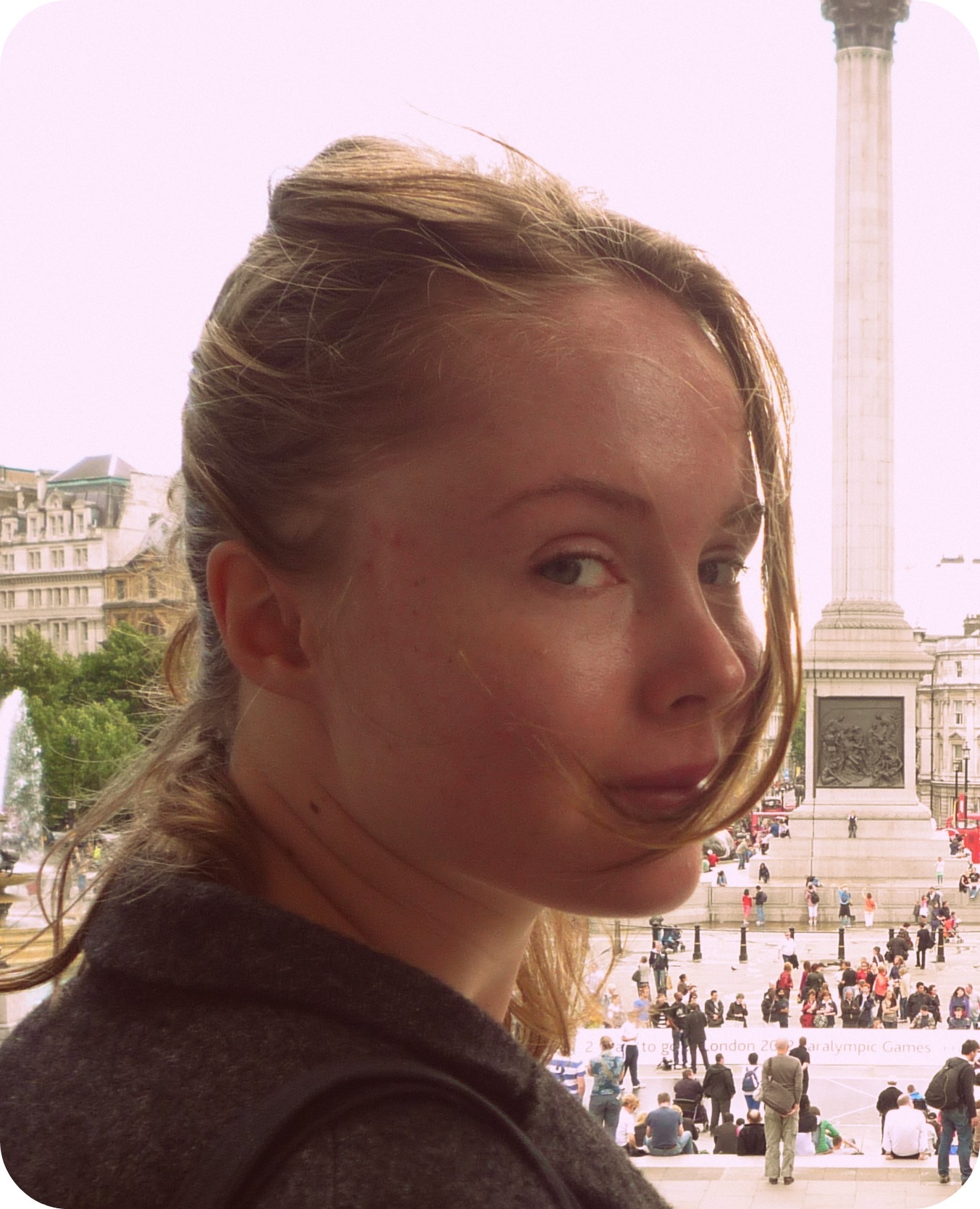
img: Charlotte Day surveying Trafalgar Square in London.

STAY TUNED for Monday’s post, offering a few last-minute Halloween costume suggestions for Displaced Nation citizens.

If you enjoyed this post, we invite you to subscribe to The Displaced Dispatch, a weekly round up of posts from The Displaced Nation, plus some extras such as seasonal recipes and occasional book giveaways. Sign up for The Displaced Dispatch by clicking here!

Related posts:

A Julia Child for our times: Expat author & French cookery expert Elizabeth Bard

Et voila. In a little less than a month, The Displaced Nation has gone from reminiscing over American expat in France Julia Child to engaging with American expat in France Elizabeth Bard.

Move over Julie Powell. At a pace rather like a simmering le Creuset pot of Child’s signature boeuf bourguignon, Bard is on the way to becoming the 21st-century’s answer to that towering figure of 20th-century cuisine Française.

The similarities between the two women are intriguing. Child went to France as a trailing spouse for an American diplomat. Bard went to France trailing a Frenchman.

Child was seduced by France. She found herself through French cuisine. Bard was seduced by France (after being seduced by a Frenchman). She found a way into French culture through the markets and cooking — and found herself in the process.

On this point, the line between the two women gets a little blurry. Which one, Child or Bard, said the following:

More than the museums, more than the ancient streets, these stalls of fruits and vegetables and spices were the Paris that inspired me.

As everyone knows, Child returned to the United States to launch a career in television. Whereas Bard has become a long-term resident of France — and has launched a brilliant writing career with the publication of Lunch in Paris: A Love Story, with Recipes, a New York Times and international bestseller, a Barnes & Noble “Discover Great New Writers” pick, and the recipient of the 2010 Gourmand World Cookbook Award for Best First Cookbook. NOTE: We are giving away copies to two lucky DISPLACED DISPATCH subscribers. Sign up today!

Child inspired Julie Powell to make all of her recipes. Bard has inspired, among others, two Displaced Nation writers — myself and Anthony Windram — to try out her recipes.

But here the comparison ends. A key difference is that Bard’s recipes are nowhere near as difficult as Child’s — which is exactly what makes Bard so perfect for our times. She’s approachable, and her cooking suggestions are doable. She also has a rich life outside cooking — the life of a woman who has displaced herself into another culture — and enjoys sharing that part of her story as well.

Mesdames et Messieurs, I would now like to offer you the fruits (not to mention veggies) of my exchange with expat author, chef and lifestyle muse Elizabeth Bard.

Tell me a little more about your background.
I grew up in Northern New Jersey and spent weekends with my father in New York City. I studied English Lit as an undergrad at Cornell, then art history at Christie’s and the Courtauld Institute in London. My dream was to be the chief curator of the Pierpont Morgan Library in Manhattan. I was always convinced I’d been born in the wrong century. I love old objects, lost worlds, so, of course, I was instantly seduced by Paris (and of course, my French husband).

Over the years, I’ve written on art, travel and food, and digital culture for the New York Times, International Herald Tribune, Harper’s Bazaar, Wired, Time Out and Huffington Post, among others. Lunch in Paris was my first book.

In July 2010, my husband and I and our baby son Augustin moved to a small village in Provence, to live in the wartime home of the famous poet and WWII Resistance leader René Char. At the time, we had no plans to leave Paris — it was a date with destiny. You can find the complete (completely crazy?) story of how we found the house on my blog.

How are you finding life in Provence as compared to Paris?
As a city girl, village life is a discovery for me. I’m still adjusting to hanging my undies in the sun, and learning the names of the local birds (they can’t all be pigeons…). I’m surrounded by wonderful cooks and gardeners; last week, I went on my first saffron harvest. The move has been a wonderful transition for us as a family — it has made me question many of the things I believe about work/life balance, health, and being close to nature. All things I hope to share (along with my neighbor’s recipe for Provençal soupe au pistou) in my next book.

Turning to Lunch in Paris: What made you decide to write a book telling the story of your transition to living in France?
I hope Lunch in Paris captures something real about what it means to build a life in another culture. As an American, I follow generations of women who all came from somewhere else. They learned to cook with new ingredients, speak a new language, manage in a new world. My Jewish grandmother learned to make spaghetti sauce with pork ribs from the Italian ladies she met on line at the butcher shop during the war; I’m simply another in a long line.

Did you ever think of writing a novel instead? I ask because in reading the book, I kept noticing your facility with dialogue and description.
It never occurred to me to write Lunch in Paris as a novel. Fantasy lives in France are easy to imagine — but I wanted to express some of the things I’d learned personally, about what it means to take risks, to put happiness first on your checklist. That’s not a fictional decision — that’s something we struggle with every day.

Why did you decide to include recipes in your book?
Almost as soon as I arrived in Paris, I knew that I wanted to write about the roller coaster of international living, and the richness of intercultural marriage. When I sat down to think about the moments that really helped me discover French life, I kept coming back to the dinner table, the markets, the recipes — so it seemed natural to structure Lunch in Paris around those experiences.

Do you still use the recipes from the book and which one is your favorite?
I’m always trying new recipes, which I share on the blog or Facebook page, but I do use my copy of Lunch in Paris as a cookbook — I keep it handy in the cabinet with the pasta. The recipes I go back to again and again: for summer, it’s the haricot verts with walnut oil, for winter, the lentils. The tagines are great for a party — and the molten chocolate cakes work anytime.

Which portion of your book — Paris, the love story, the recipes — have readers responded to most?
I’m so surprised, humbled, gratified by the fact that Lunch in Paris has found such a wide audience. I’m so pleased that the book has been a vivid piece of armchair (or bathtub) travel for those who love Paris — and a temptation for those who’d like to go. I’ve had many young readers say it inspired them hold on to their dream of living abroad, or simply doing something a bit outside the box with love or career.

I’m also thrilled that people are getting their books all greasy, using the recipes — and posting photos of their creations on the Lunch in Paris Facebook page. I’m a home cook; I tested all the recipes myself. I was determined that readers take as much pleasure (and as little stress) in preparing them as I did. Maybe the nicest thing anyone has said came from a friend in London:

“It’s nice for Augustin to have such a wonderful record of his parent’s romance.”

I’m proud to be passing that on.

The thing that has surprised me the most is the wonderful online community. Though the readers are all over the world, it really feels warm and personal to me. I love that social media allows people to share recipes and stories from all over the world. A few months ago, I got an email from a New Zealander living in Crete. I now follow her blog to learn about traditional Cretean cooking.

As I mentioned in my intro, Julia Child was the inspiration for TDN’s October theme — and you remind me of a 21st century version of her in some ways. I’m curious, do you have her Mastering the Art of French Cooking — and do you actually use it?
I have my mom’s copy of Mastering the Art, but at the moment – I’m too busy trying recipes from my French neighbors to actually use it!

What did you think of Julie Powell’s blogging about making all the recipes from that encyclopedic book?
I love a good project — especially one that gets a girl out of a rut — it was fun to read about how the random adventures we set for ourselves can change everything.

How about the film, Julie & Julia?
The film — well, it just proves that Meryl Streep can do ANYTHING.

We’ve been asking our Random Nomad interviewees this month if they identify with any of the following Julia Child quotes and why. Can we ask you as well?
I agree with the choice that both Mardi and Jennifer made:

The only real stumbling block is fear of failure. In cooking, you’ve got to have a what-the-hell attitude.

I’d say this goes for goes for life in general — not just cooking. With all of our “Just-do-it” attitude, Americans are particularly prone to fear of failure: everything is possible, so everything we don’t accomplish is our fault. Fear is paralyzing. I work every day to get the hell out of my own way.

Quite a few of our readers are long-term expats who’ve entered cross-cultural marriages. What do you think is the biggest challenge about marrying someone of another culture?
The Franco-American combination is a very powerful one. I gave my husband a bit of the American can-do spirit, permission to pursue his dreams based on his own qualities, instead of family or class. He gave me a bit of the French joie de vivre — permission to live in the moment, to consider happiness, rather than some abstract (and culturally relative) notion of “success”, as my ultimate goal.

Was language an obstacle at all?
I speak fluent French now. It was a struggle at the beginning — you feel a bit invisible. That’s one reason cooking became so important to me. During the early days of our marriage, I used food to welcome people. My husband’s friends didn’t know if I was intelligent, charming, witty, or warm. What they did know is that I made a mean sweet potato puree. There were times when I used the kitchen to hide. French dinner parties are marathons of cuisine and conversation — 4 or 5 hours minimum. With the rapid-fire French buzzing in my ears, and my brain foggy from the wine, it was just easier to say, “I’m just going to check the roast” than “Dear God, I’m so bored and exhausted I’m considering sticking my head in the oven.”

Do you think you could fit back into living in American culture after a decade of living in France?
I’ve been away for a long time — and like many expats, I find myself in a no-man’s land, not quite one or the other. Honestly, I think the hardest thing about moving back to the States would be the portions — even with a great farmer’s market nearby I think it would be a struggle to maintain our very healthy French eating habits. That and the hyper-competitive attitude about raising kids. I’m not sure I’m ready for preschool applications.

As it happens, on October 13 Travelers Night In (#TNI) was French inspired, and everyone tweeted their answers to 10 questions about the best of the best in France. Could you do us — and the traveling community at large — the honor of providing your own short answers?
Q1. The best thing about French people is…
Food is not fuel.
Q2. France is famous for food, what dish is your favorite? Best food city?
Give me a perfect, flaky, buttery croissant.
Q3. Favorite French countryside escape?
The rolling hills of Burgundy — with a stop at the cathedral in Vézelay.
Q4. What is the most overrated thing about France?
April in Paris (it rains)
Q5. What defines Paris?
PDA (does that still mean public display of affection?)
Q6. French museum or monument that shouldn’t be missed?
Musée Jacquemart-André, Paris
Q7. Perfect place to enjoy a glass of French wine? What varietal, region, winery?
People watching along the Canal Saint-Martin, any glass recommended at the Verre Vole (rue de Lancry)
Q8. Top way to spend a night out in Paris?
Walking along the banks of the Île Saint-Louis with a double scoop of Berthillon sorbet.
Q9. Best things to do on the French Riviera?
We avoid the French Riviera — over-crowded, over-priced, over.
Q10. Biggest misconception about the French?
French cooking is complicated.

Thank you so much for engaging in this tête-à-tête! Readers, do you have your own questions for this 21st-century answer to Julia Child? Hurry up, before she disappears into her kitchen or heads out to another saffron field!

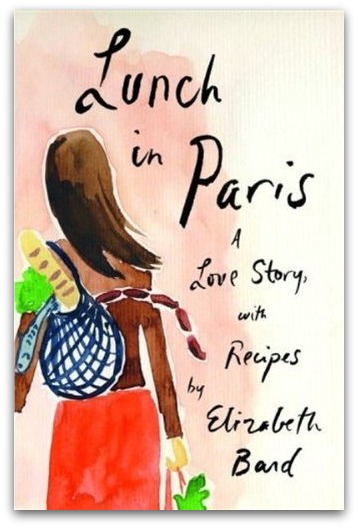
Images: Head shot of Elizabeth Bard by Cindi de Channes (2008); book cover.

STAY TUNED for tomorrow’s installment from our displaced fictional heroine, Libby, who is taking seriously her friend’s advice to make time for herself, and enjoying her freedom while Jack is in nursery school. Someone had better remind her that small babies tend to put a damper on such wanton activities. (Speaking of which, Libs — isn’t it time you saw a doctor?) What, not keeping up with Libby? Read the first three episodes of her expat adventures.

If you enjoyed this post, we invite you to subscribe for email delivery of The Displaced Dispatch, a round up of the week’s posts from The Displaced Nation, including seasonal recipes and book giveaways. Sign up for The Displaced Dispatch by clicking here!

Related posts:

A further Parisian lunch, à la displaced author Elizabeth Bard

As we’re continuing this month’s theme where we celebrate all culinary things Frenchie (well, you’ve got to really, the French are such a retiring lot — they’d never dream of singing their own praises), it seems like now is the time to let you into my shameful, dark secret. There is something in my past that I cannot escape from, no matter how much I may wish to. That secret, dear reader, is that I am, in fact, a quarter-French. Yes, some of my genetic make-up is Frenchie. Being a proud Englishman, this obviously churns me up inside.

Now my Gran, or Bonne-Maman as I called her, like many a Frenchie, thought of herself a good cook. Unfortunately for her she moved to England shortly after the end of the First World War. She left the bucolic center of France and found herself in the industrial paradise that is Teesside. It is somewhat redundant to note, but I will anyway, that England in the 1920s and 1930s was very different from the England of now. This is a time pre-Ainsley Harriot. Look at what passed for cookery films — not a single mention of Sally Salt or Percy Pepper. Even in the leafy climes of Islington you would be hard pressed to find a sun-dried tomato or a tub of hummus. These were dark, Ainsley Harriot-less times indeed.

So when I was instructed that as part of this blog I would be making a Parisian lunch using Elizabeth Bard recipes here in the Dennys-loving part of California that I call home, I thought back on my Bonne-Maman. Living in another country now is so easy. On my phone I can read English papers, I can, for the most part, try and approximate dishes that I’ve eaten in other countries. I can go into a supermarket in your average suburban strip-mall and I can guarantee I can find some exotic fruit or vegetable that it would have been unthinkable for this supermarket to stock 15 or 20 years ago. So when I received my recipes for an Omelette with Goat Cheese and Artichoke Hearts and for what Elizabeth Bard titles Better than French Onion Soup (after today’s Rugby World Cup Final, I’m guessing she means it should be called New Zealand Onion Soup), I’m struck by how easy it is to find all these ingredients and how easy it would be to find them in my hometown, where my Bonne-Maman spent the next 60 years of her life after moving there from France as a young adult.

But, for the most part, Bonne-Maman wasn’t able to get everything that she needed and so would make do with local alternatives. As a child in the early 80s when Bonne-Maman was still able to live in her own house and do her own cooking, I saw the end product of all of her years living in the north-east of England (hardly the gourmet capital of the world) and the compromises she had to make to recreate dishes from her French background. There was a whole repertoire that she had. One, in particular, that I recall was that when she would make a roast she would have a little side-dish to go alongside it that consisted of sliced onion doused in malt vinegar. It seems curious, though the way she made it, not at all unpleasant, and I am sure it has some French classic as its antecedents and for years could probably only buy malt vinegar in Hartlepool. The other thing I remember is steaks. Her steaks were bloody, which I think the neighbors rationalized as her being French (and they are such an odd sort). I seem to recall this being a source of contention in my parents’ relationship as my Dad favored the bloody steaks he had been brought up on, but my Mum insisted that they had to be cooked well-done. It was a debate that was only ended when the crisis over British beef in the late 80s saw my family dramatically reduce its beef consumption.

So as I follow Elizabeth’s recipes, I am just struck by how easy it is to buy and prepare all the ingredients that I need to recreate a delicious Parisian lunch, but my poor grandmother had to make do with malt vinegar, pease pudding and her own ingenuity.

STAY TUNED for tomorrow’s post on classic displaced writing.

If you enjoyed this post, we invite you to subscribe for email delivery of The Displaced Dispatch, a round up of the week’s posts from The Displaced Nation, including seasonal recipes and book giveaways. Sign up for The Displaced Dispatch by clicking here!

Related posts:

My Grand Tour through Italy on an art history student’s budget

Today Monika Frise — the daughter of one of our Random Nomads, Helena Halme — joins us as a guest blogger. Monika is an art history student in the UK. Here she tells of her trip to Italy last month with another art history student friend — a travel yarn that makes a welcome change from all the French foodie posts we’ve been doing of late. (That said, Monika does start out by talking about food — it’s Italy, after all!)

At the end of my first year at the University of Birmingham, facing a stressful exam period, I decided to book a holiday to Italy with a friend of mine, Liz. We planned to go in early September, after the summer crowds had ebbed and the weather would be somewhat cooler. We organized to visit five cities: Verona, Venice, Pisa, Florence, Siena and finally, Rome.

Both Liz and I are studying art history. Neither of us is specializing in Renaissance art — I’m studying Eastern European architecture/art and 19th-century French art this year (concentrating on the period just before the impressionists). However, we both loved the idea of making a Grand Tour through Italy to see the Grand Masters’ works, following in the footsteps of European aristocrats of centuries past — we just wished we had their riches to finance our journey!

The trip came around sooner than expected and I for one felt a little apprehensive about what it would be like moving to a different location every couple of days, on a student budget.

Buon appetito

Italians are famously passionate about their food, and despite having to watch our expenses, we were determined not to miss out — even if it meant eating a lot of pizza.

We made a determined effort to avoid restaurants close to large monuments and museums and seek out local eateries instead. We were somewhat taken aback at the prices of food, though — especially in Rome, where we had to search for a long time in order to find a cheap restaurant that also looked good.

Our first night in Verona, the plump, friendly hostel owner recommended a restaurant, Bella Napoli, for “having the best pizza in town.”

She also told us to “touch the left breast” of Juliet’s statue for good fortune in life.

We took her advice on both counts and weren’t sorry. At Bella Napoli, we shared the house specialty, pizza al metro (pizza by the meter), which arrived on its very own table on wheels.

Venice, however, posed more of a challenge. But, on our first night, after walking somewhat aimlessly through the narrow streets for some time, we chanced upon a small osteria offering home-cooked food at great value. For a change, we didn’t have pizza. I ordered gnocchi with tomato sauce: delicious.

The service, however, left a little to be desired — our waitress dumped our change on the table without even a smile. Likewise in Rome, service was rather hit or miss. We had excellent service at a pizzeria where they roll the dough right in front of you, but at a café close to Termini station we waited for our bill for such a long time we could have walked away without paying (yes, the thought did seriously cross our minds!).

Another affordable yet delectable treat is the famed gelato. The best we tasted — and we tasted a lot — was at a place called Rivareno just around the corner of our hostel in Rome . They soften the gelato with a palette knife before spooning it into the cup. There were so many different flavors on offer, but my favorite was probably caramelized fig and ricotta.

“Roughing” it

We students will walk miles to save money, but in a country like Italy that’s not such a bad thing. As Liz and I soon discovered, going everywhere on foot was the best way to take in the local color (not to mention work off all that pizza, pasta and gelato!).

In the small winding streets of Siena, we encountered a small boy playing the drums in little side street whilst a group of old men and women chatted nearby, seemingly oblivious to the racket he was making.

In Verona one night, we happened upon Juliet’s balcony (which we’d seen the day before in the daylight). The bronze statue of Juliet in the courtyard looked completely different when illuminated. Gazing through the gates at her peaceful shape summed up this city for me: bright and vibrant yet calm.

Walking was also a way of avoiding unwanted curiosities in the hostels where we stayed. The hostel in Venice, for instance, had a very bad case of bedbugs — so much so that we spent our second night sleeping on the dusty floor, with only a sheet beneath us. But even that didn’t stop the little blighters. At one point one of the other girls woke up with one of them on her cheek. Unfortunately, despite the beauty of Venetian art and architecture, it’s the bedbugs that made the most lasting impression, rather literally!

That said, walking also exposed us to some humans who behave like pests. More than once did we have to hurry away from some overeager men who were making kissing noises at us, and outside the Arena in Verona, the city of love, a “Roman gladiator” gave Liz a pat on the bum!

Art coming out of our ears

Tourism in Italy involves an endless parade in and out of churches. I reckon we saw about three in every city, apart from Siena where we saw only one, the Duomo di Siena.

We ended up appreciating the cathedral in Siena far more than the Basilica san Marco in Venice, which overwhelmed us with its abundance of Gold Romanesque mosaics and small adjoining rooms replete with countless treasures. Our guidebook had advised us to make several visits, but for me, a single visit was more than enough. Both interior and exterior reminded me of an over-sweet, over-decorated cake.

Since we are both interested in Renaissance art, Florence had a great deal to offer. My wise mother had advised that we pre-order tickets for both the Uffizi Gallery and the Accademia Gallery — the latter of course being the home of Michelangelo’s David.

After smugly walking past the long queue for the Accademia, Liz and I took a seat on a bench close to the David and watched as people circled around it, discussing its various aspects. (We even managed to sneak a picture of the statue whilst the guards weren’t looking, saving us a few extra cents on a postcard.)

At the Uffizi Gallery I particularly loved seeing Flora by Titian — so much better seeing it in a photo for appreciating the colors and brush strokes.

By the time we reached Rome, our enthusiasm for the Grand Tour had flagged somewhat. The Sistine Chapel, where everyone was herded around like sheep, especially disappointed us.

The best part of Rome was our trip to the Pantheon — fantastic! As we wandered around this circular building, I couldn’t take my eyes off the ceiling. I was transfixed.

First of many tours?

I would definitely like to return to Italy one day soon, and perhaps even try living there for a while.

Of the five cities we visited, I could really see myself in Siena even though it wasn’t my favorite place. It’s just that the atmosphere made me feel at home, I think because there were fewer tourists. (I particularly enjoyed my trip to the local supermarket, full of hustle and bustle and the smell of freshly baked bread.)

My Italian, which was very basic, got better as our trip progressed. However I would have to take a lot of classes if I were ever to brave living there!

NOTE: You can read Monika Frise’s art reviews on her new blog, Post Raphaelite, and/or follow her on twitter: @Shmonn.

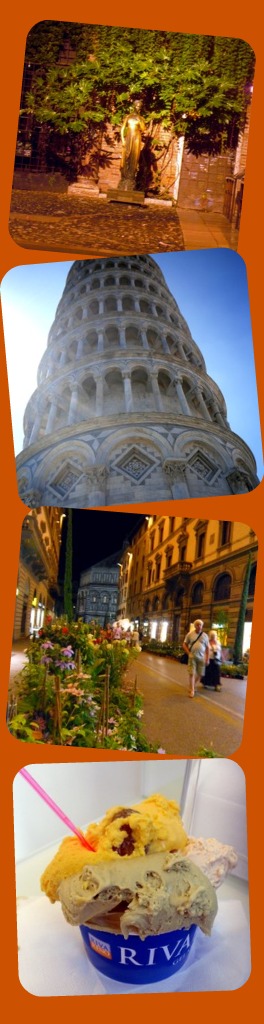
Images: Juliet’s statue in Verona by night; from the foot of the leaning Tower of Pisa; flower sellers in streets of Florence, near the Duomo; three flavors of Roman gelato: pistachio, caramelized fig and ricotta, and crema mediterranea (a Rivareno speciality).

STAY TUNED for Monday’s post, when founding contributing Anthony Windram reports on his attempt to make a Parisian lunch in California, following the recipes of Elizabeth Bard (see also ML Awanohara’s attempt).

If you enjoyed this post, we invite you to subscribe to The Displaced Dispatch, a weekly round up of posts from The Displaced Nation, with seasonal recipes and occasional book giveaways. Sign up for The Displaced Dispatch by clicking here!

Related posts:

RANDOM NOMAD: Jennifer Greco, Writer & French Cheese Specialist

Born in: Spokane, Washington, USA
Passports: USA and France
Cities/States/Countries lived in: Washington (Seattle): 1987-99; Louisiana (New Orleans): 1999-2003; France (Cesseras*): 2003-present
Cyberspace coordinates: Chez Loulou | A taste of life in the south of France (blog)
* A tiny village in the Languedoc-Roussillon region

What made you leave your homeland in the first place?
I’ve been a devoted Francophile ever since I was a teenager and knew that one day I would live in France. My husband and I bought a small holiday house in the south of France in 2001 and decided to move here permanently in 2003.

Is anyone else in your immediate family “displaced”?
I have no immediate family members who are “displaced”; however, my grandfather moved to America from Italy with his family at the age of 10.

How about your husband?
My husband was born and raised in New York City. He wasn’t a Francophile when we met, but as soon as I introduced him to Paris, he was hooked.

Describe the moment when you felt most displaced.
It wasn’t just a moment, but every single frustrating minute I had to spend in the the sous-préfecture, arguing with the woman behind the desk who didn’t want to do her job by helping me with my carte de séjour paperwork [visa for staying in France longer than a year].

Describe the moment when you felt least displaced.
The summer night that my husband and I sat at a long table in the center of the village with our neighbors, sharing wine, food, stories and laughter.

You may bring one curiosity you’ve collected from each of your adopted countries into the Displaced Nation. What’s in your suitcase?
From Seattle, Washington: If it wouldn’t spill, a caffè macchiato from Caffe Ladro.
From New Orleans: Mardi Gras throws and Crystal Hot Sauce.
From France: An olive wood Laguiole corkscrew.

You’re invited to prepare one meal based on your travels for other Displaced Nation members. What’s on the menu?
We’ll start out with a specialty of the Pacific Northwest: cracked Dungeness crab and clarified butter. Then we’ll each have half a Charentais melon filled with Muscat de Saint Jean de Minervois — a wonderful dessert wine from Narbonne, close to where I live in the south of France. For the main course, I’ll serve a jambalaya from New Orleans. Then we’ll have (mais oui) a Languedoc cheese course — including Roquefort, Pélardon and Tomette des Corbières. Dessert will be a New Orleans classic: bread pudding with Bourbon sauce.

You may add one word or expression from the country you’re living in to The Displaced Nation argot. What will you loan us?
From New Orleans: Makin’ groceries — meaning going grocery shopping. It’s one of the many colorful expressions that’s part of the local vernacular. I simply love it!
From France: Oh la vache! (Oh my gosh!) This one cracks me up — the literal translation is “Oh the cow!” I can’t say it without smiling.

It’s French Cuisine month at The Displaced Nation. Who is your favorite French chef of all time?
I love Jacques Pépin. He is an honest, down to earth chef, writer and instructor, and his recipes are always delicious. One of my favorites of his is the Skillet Apple Charlotte, a melange of Tarte Tatin and French toast. C’est délicieux!

Like you, Julia Child was an American who moved to France and fell in love with the food. (We have just now inducted her into our Displaced Hall of Fame.) Of the following three Julia Child quotes, which do you most identify with?

1) The only time to eat diet food is when you’re waiting for the steak to cook.

2) The only real stumbling block is fear of failure. In cooking, you’ve got to have a what-the-hell attitude.

3) Until I discovered cooking, I was never really interested in anything.

I most identify with: “The only real stumbling block is fear of failure. In cooking, you’ve got to have a what-the-hell attitude.” I believe in living life to its fullest and sometimes that means taking risks and ignoring the fear, whether it be in the kitchen or in life. Our decision to move to France meant leaving our comfort zone and embracing the challenge of learning a new culture. It hasn’t always been easy, but it’s definitely been worth it! As for the kitchen — readers of my blog will know that I’m now on a mission to taste every single French cheese. I’ve now tasted 205 (there are 600-1,000, depending on who’s counting).

Readers — yay or nay for letting Jennifer Greco into The Displaced Nation? Tell us your reasons. (Note: It’s fine to vote “nay” as long as you couch your reasoning in terms we all — including Jennifer — find amusing.)

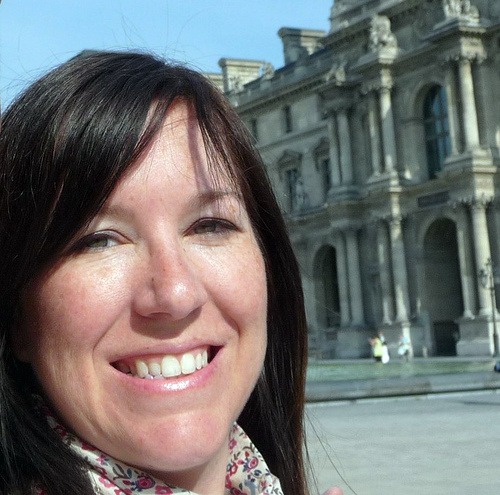
img: Jennifer Greco in Paris, in front of the Louvre (April 2010).

STAY TUNED for tomorrow’s installment from our displaced fictional heroine, Libby, who is taking last week’s advice from Maggie to heart and discovering that Woodhaven is her oyster. (A good thing she’s not allergic to shellfish like her husband, Oliver!) What, not keeping up with Libby? Read the first three episodes of her expat adventures.

If you enjoyed this post, we invite you to register for The Displaced Dispatch, a round up of weekly posts from The Displaced Nation. Includes seasonal recipes and book giveaways. Register for The Displaced Dispatch by clicking here!

Related posts:

CLASSIC DISPLACED WRITING: Proust — The Way by Swann’s

There is a  discernible whiff of Frenchiness to the blog this month. Doubtless you can smell it too, it’s that heady scent of garlic, Gauloises and ennui. Like any true-blooded Englishman it has certainly got my nostrils flaring and my back up too, but don’t worry, I’ll contest it as best I can with pig-headed jingoism and outrageous displays of xenophobia.

However, we did have a specific request to bring back this rather irregular series on Classic Displaced Writing with a post on Proust, and specifically (as French food is a topic this month) one featuring “the incident with the madeleine.”

Some of you may, however, may recall that this series has touched upon France, or more specifically Paris, previously. We looked at an esssay by Saul Bellow and a New York Times article on James Joyce’s Paris.  Now there’s no prizes for noticing that both of those posts are concerned with France as seen and lived by a foreigner. Indeed, considering the nature of this series of Classic Displaced Writing and its semi-regular appearance on an expat-centric blog this is pretty much what you would expect.

The question is, is Proust displaced enough to merit an appearance? While not displaced by geography, as most of our featured writers have been, Proust is displaced by time, by the present. A sickly child who grew into a man who always suffered with his health (the last years of his life were spent mostly confined to cork-lined bedroom), a closeted homosexual, at heart a nineteenth century aristocrat struggling with the France of the twentieth century, there’s plenty to Proust’s life that sets him at odds with his present time and announces him as a stranger to his homeland, and so it isn’t surprising that he retreats into the past.

The famous “incident with the madeleine” is one of many moments In Search of Lost Time where the Narrator of the novel has an incident of “involuntary memory.” It is based on an experience Proust had in his own life, though more prosacially it involved the dipping of a piece of dry toast rather than a madeleine. Up until the dipping of  the cake into his tea, the only memory that the Narrator has of his family’s country home in Combray is of his parent’s friend, Charles Swann, visiting. Due to the visit of Charles, the Narrator is denied of his usual goodnight kiss from his mother. It is only years later when he dips his madeleine cake into his tea that he remembers doing the same as a child at Combray with his Aunt Leonie — and from this, other memories return:

… It is the same with our past. It is a waste of effort for us to try to summon it, all the exertions of our intelligence are useless. The past is hidden outside the realm of our intelligence and beyond its reach, in some material object (in the sensation that this material object would give us) which we do not suspect. It depends on chance whether we encounter this object before we die, or do not encounter it.

For many years already, everything about Combray that was not the theatre and drama of my bedtime had ceased to exist for me, when one day in winter, as I came home, my mother, seeing that I was cold, suggested that, contrary to my habit, I have a little tea. I refused at first and then I do not know why, changed my mind. She sent for one of those squat, plump cakes called petites madeleines that look as though they have been moulded in the grooved valve of a scallop-shell. And soon, mechanically, oppressed by the gloomy day and the prospect of a sad future, I carried to my lips a spoonful of the tea in which I had let soften a piece of madeleine. But at that very instant when the mouthful of tea mixed with cake-crumbs touched my palate, I quivered, attentive to the extraordinary thing that was happening in me. A delicious pleasure had invaded me, isolated me, without my having any notion to its cause. It had immediately made the vicissitudes of life unimportant to me, its disasters innocuous, its brevity illusory, acting in the same way that love acts, by filling me with a precious essence: or rather this essence was not in me, it was me. I had ceased to feel I was mediocre, contingent, mortal. Where could it have come to me from — this powerful joy? I sensed that it was connected to the taste of the tea and the cake, but that it went infinitely far beyond it, could not be of the same nature. Where did it come from? What did it mean? How could I grasp it? I drink a second mouthful, in which I find nothing more than in the first, a third that gives me a little less than the second. It is time for me to stop, the virtue of the drink seems to be diminishing. It is clear that the truth I am seeking is not in the drink, but in me. The drink has awoken in me, but it does not know that truth, and cannot do more than repeat indefinitely, with less and less force, this same testimony which I do not know how to interpret and which I want at least to be able to ask of it again and find intact, available to me, soon, for a decisive clarification. I put down the cup and turn to my mind. It is up to my mind to find the truth…

And suddenly the memory appeared. The taste was the taste of the little piece of madeleine which on Sunday mornings at Combray (because that day I did not go out before it was time for Mass), when I went to say good morning to her in the bathroom, my Aunt Leonie would give me after dipping it in her infusion of tea or lime-blossom. The sight of the little madeleine had not recalled anything to me before I tasted it; perhaps because I had often seen them since, without eating them, on the pastry-cooks’ shelves, and their image had therefore left those days of Combray and attached itself to others more recent; perhaps because of these recollections abandoned so long outside my memory, nothing survived, everything had come apart; the forms — and the form, too, of the little shell made of cake, so fatly sensual within its severe and pious pleating — had been destroyed, or, still half asleep, had lost the force of expansion that would have allowed them to rejoin my consciousness. But when nothing subsists of an old past, after the death of people, after the destruction of things, alone, frailer but more endearing, more immaterial, more persistent, more faithful, smell and taste still remain for a long time, like souls remembering, waiting, hoping, on the ruin of all the rest, bearing without giving way, on their almost impalpable droplet, the immense edifice of memory.

And as soon as I had recognized the taste of the piece of madeleine dipped in lime-blossom tea that my aunt used to give me … the good people of the village and their little dwellings and the church and all of Combray and its surroundings, all of this which is assuming form and substance, emerged, towns and gardens alike, from my cup of tea.

Extract from Lydia Davis’ translation of The Way By Swann’s from Penguin’s In Search of Lost Time, edited by Christopher Prendergast. This is a fairly new translation of A la recherche du temps  perdu, and it’s one I’ve had more success with than Scott Moncrieff’s more famous translation. You can buy it here. And you should, you know.

STAY TUNED for Wednesday’s RANDOM NOMAD interview with an expat in France.

If you enjoyed this post, we invite you to subscribe for email delivery of The Displaced Dispatch, a round up of the week’s posts from The Displaced Nation, including seasonal recipes and book giveaways. Sign up for The Displaced Dispatch by clicking here!

Related posts:
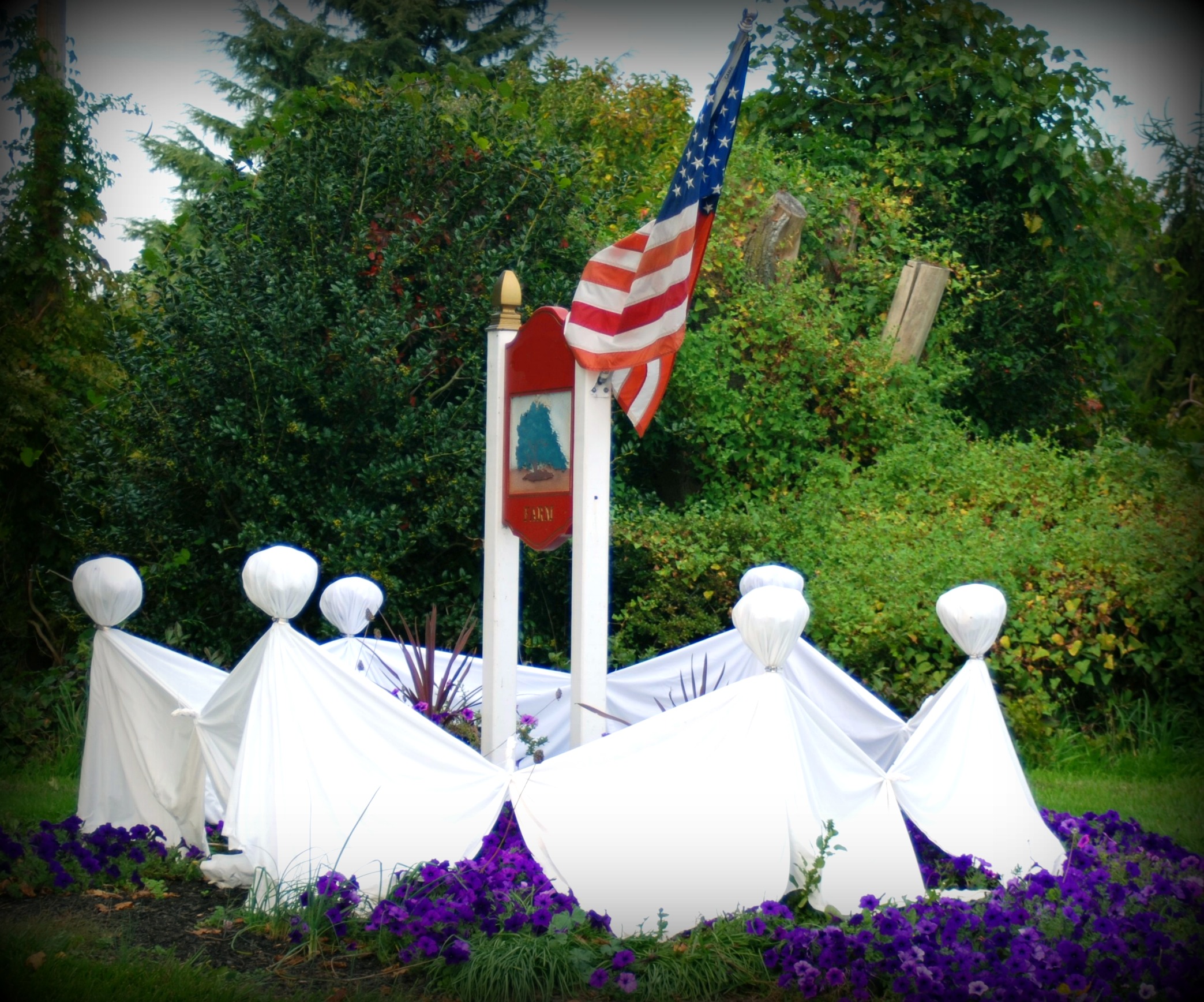
Image: MorgueFile