The Displaced Nation

A home for international creatives

Displace Yourself…to Tuscany

Welcome back to another in our occasional series, “Displace Yourself,” where we look at books by expats and travelers focusing on particular countries or regions, in hopes of displacing ourselves through their experiences. (One lifetime isn’t long enough to sample it all!)

This month, a place that’s on many of our wish lists: Tuscany, Italy.

Tuscany: Facts and figures

Capital: Florence
Area: 8,878 square miles
Population: 3,750,000
Language: Standard Italian/Tuscan Dialect
Demographic: 93% Italian; immigrants from Britain, America, and China.

*  *  *

To Tuscany from England:

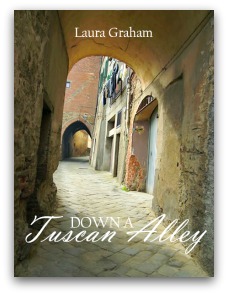
Down A Tuscan Alley (Fiction/memoir)
by Laura Graham
 Published June 2011

The Displaced Nation first met Laura Graham in May this year. Click here to read our interview with her.

About the author:
After the breakdown of a longterm relationship, Laura left England in search for a new life in Italy. With a distinguished acting career behind her, she now runs her own holiday property agency in Sinalunga, where the Tuscan tranquility inspires her writing.

Cyber coordinates:
Website: www.lauragraham.co.uk
Twitter: @LauraGraham7

Overview of book:
A long relationship ends. At 48, house taken by the bank, Lorri has little money. What can she do? And where can she go? Gathering her meager savings and her two beloved cats, she escapes England for a new life in a remote Italian village, never imagining the intrigue, passion and adventure she will find.

One reader’s review:
“The author’s use of dialogue enables the reader to form their own images of the characters to whom we are introduced. The reader is invited to share with [protagonist] Lorri as she develops her confidence, her new language, a knowledge of a different culture and her love for Ronaldo. The juxtaposition of romance and intrigue helps the book to flow to its end, and keeps the reader’s interest. The author brings her story to its conclusion using one of her characters to inform both the reader, and the protagonist herself.” (Amazon.co.uk reviewer)

To Tuscany from New York:

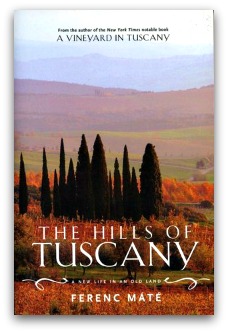
The Hills of Tuscany: A New Life in an Old Land (Autobiography)
by Ferenc Máté
Published November 1998

About the author:
Ferenc Máté  escaped Hungary after the 1956 revolution, and went with his mother to Vancouver, British Columbia. He now lives on a wine estate in Tuscany with his wife (painter and winemaker Candace Máté) and their son, Peter.

Cyber coordinates:
Website: www.ferencmate.com

Overview of book:
This hilarious, international bestseller is a true-life adventure of a New York City couple moving to Tuscany.  Ferenc Máté’s enthusiastic prose is infectious. He brings to life the real Tuscany: the contadini neighbors, country life—the harvest, grape, and olive picking, wine making, mushroom hunting, woodcutting—the holidays, and of course the never-ending, mouthwatering meals. (Amazon.com book description)

One reader’s review:
“As a second-generation Italian-American, I’m getting tired of the subtle patronizing attitudes that some prosperous expatriates to Italy emit via their memoirs. Reading this book, I felt that Ferenc Mate truly felt a genuine empathy with Italians. His ability to laugh at himself, and with his Italian neighbors — not at them — was a superb aspect of this work. He seemed to understand that being at home in Italy requires more than merely hobnobbing with other expatriates, and absorbing their prejudices.” (Amazon.com reviewer)

To Tuscany from California:

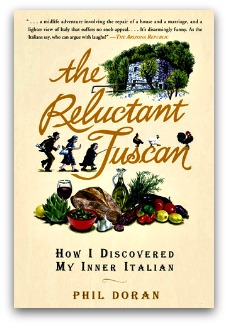
The Reluctant Tuscan: How I Discovered My Inner Italian (Humor/Autobiography)
by Phil Doran
Published March 2006

About the author:
Phil Doran worked in TV production for 25 years, as writer-producer for TV shows such as Sanford and Son, as a writer for The Wonder Years, and writing episodes of The Bob Newhart Show. He divides his time between California and Tuscany.

Cyber coordinates:
Website: www.reluctanttuscan.com

Overview of book:
After twenty-five years of losing her husband to Hollywood, Doran’s wife decided it was finally time for a change—so on one of her many solo trips to Italy she surprised her husband by purchasing a broken-down 300-year-old farmhouse for them to restore. The Reluctant Tuscan is about the author’s transition from being a successful but overworked writer-producer in Hollywood to rediscovering himself and his wife while in Italy, and finding happiness in the last place he expected. (Amazon.com book description)

Readers reviews:
Note: “The Reluctant Tuscan” appears to provoke a “Marmite” response from readers — they either love the book or hate it (or at least, are marginally lukewarm about it.) Here are two fairly typical reviews from both sides of the spectrum, from Amazon.com reviewers.

Love it:
“This is such a fresh, enjoyable book. Phil Doran is so honest & matter of fact about himself & his wife. I picked this book up to glance through & found I could not nor did I want to put it down. So I sat & read it non-stop, from cover to cover….My sides hurt from so much laughing. This is a must read book for anyone & any age….Enjoy!!!”

Lukewarm:
“The book recounts the period of time when the writer moved to a rural town in Tuscany and undertakes renovating a dilapidated farm house, mostly to appease his wife, who has bought the property without consulting him…There were some amusing bits but none that made me laugh out loud. Stereotypes and caricatures of Italians abound and there are multiple references to the Germans and WWII. Maybe it’s a generational thing, but I found these annoying.”

To Tuscany from Jerusalem:

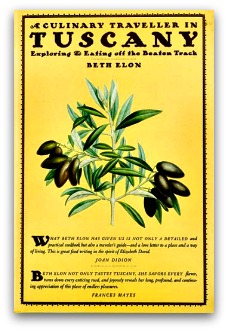
A Culinary Traveller in Tuscany: Exploring and Eating Off  the Beaten Track  (Travel guide/cookbook)
by Beth Elon
Published March 2009

About the author:
Former literary agent and her journalist husband Amos bought a neglected manor house in Tuscany in the late 1970s, long before the region became a desirable destination. Every summer, they would travel with their young family from their home in Jerusalem to spend two months in their Tuscan home, gradually renovating it as they were able. Eventually, the couple made Tuscany their permanent residence.

Overview of book:
“One might think that everything that can be written about Tuscany has been written. But here is a gem of a book in the tradition of M.F.K. Fisher that takes readers down Italian back roads and into private kitchens. There are 10 chapters that represent 10 itineraries into 10 different Tuscan regions. Included are more than 100 recipes and contact information and descriptions from private kitchens and restaurants, trattorias, gourmet shops, bakeries, wineries, and olive oil producers. Also included are days and dates when food festivals are held that celebrate chocolate, truffles, chestnuts and mushrooms. Warning: this book may contribute to an expanding waistline.” (Book Passage Bookstore review)

One reader’s review:
Beth Elton’s title isn’t just a cookbook – it takes a culinary tour of Tuscany into regions largely uncovered in other titles – and surveys the special kitchens and products of over fifty restaurants whose cooks produce original recipes revealed just for this title. All dishes have been adapted for home cooks but retain the authenticity of generations of development, so cooks seeking a blend of travelogue and new dishes to try will find delightful the blend of travel insights and easy dishes.” (Amazon.com reviewer)
.

STAY TUNED for Monday’s travel yarn from our very first Random Nomad, Anita McKay.

If you enjoyed this post, we invite you to subscribe for email delivery of The Displaced Dispatch, a round up of the week’s posts from The Displaced Nation. Sign up for The Displaced Dispatch by clicking here!

Related posts:

Image: MorgueFile

LIBBY’S LIFE #57 – Coming clean

“And then what happened?” Maggie tops up our glasses with Rioja. “Did he tell you all about his bigamist father and you said, ‘That’s fine, sweetheart’ and everything was tickety-boo between you again?”

Maggie’s summary isn’t incorrect, but it goes further than that.

“Something like that. He’s trying very hard, and…” I shrug.

“You mean,” Maggie says, “that the balance has shifted and you’ve got the upper hand for once?”

I consider this. I did the midnight feed last night, but this morning Oliver got up early to make breakfast for Jack and help him get dressed while I slept. I only woke up when Oliver brought a cup of tea and the twins to me in bed.

Does that mean I have the ‘upper hand’?

“No,” I say. “I mean that the balance, for once, is exactly right.”

* * *

Take this evening, for example. Tonight I’m at Maggie’s house, on my own, sans children, who are tucked up in bed while Oliver holds the fort and figures out the intricacies of mixing formula milk. This wouldn’t have happened a week ago, when the balance of power was tipped in his favour, when Oliver considered himself wronged, and behaved accordingly badly.

But all that has changed now.

Oh yes.

The evening after he had been to see Maggie, he told me about his father. He helped put the children to bed, and insisted on tidying up after dinner. “You go and put your feet up, Libs,” he said, and brought me, instead of an olive branch, a dish of ice cream. When he finally joined me, I was lounging on the sofa, taking up all the cushion space, and holding up a magazine in front of my face. After removing a few of Jack’s toys from a nearby armchair, Oliver also sat down.

“Libs.”

I turned a page. “Mmm-hmm.”

Ungracious? Yes, maybe. It takes more than a bit of washing up and Ben & Jerry’s to get round me these days.

“We should talk,” he said, then stopped. From behind my magazine, I saw him glance sideways at me. I said nothing, and continued flicking through the pages of Good Housekeeping. I was damned if I was going to make this easy for him.

He sat forward in his seat, elbows on his knees, hands dangling, his eyes fixed on a spot on the floor.

“He had three wives, you know. Mum was the third.”

A few seconds went by, then I said, “Yes. I do know, now. No thanks to you.”

His head drooped even lower. “I’m doing my best here, Libs. It’s very hard for me to talk about this. Don’t make it more difficult for me than it already is.”

I slapped the magazine down on my lap. “And don’t you lay that guilt trip rubbish on me! You’ve had ten years to tell me about your family history, but no, I had to watch our wedding outtakes video to find out why you were being such a shit about my little experiment with genealogy. So don’t preach at me about making things difficult.”

Oliver got up and walked out of the room. I think I was supposed to follow him at this point, and beg forgiveness. A very short time ago, I would have done — but not any longer. Instead, I picked up my magazine again and read an article about extreme bathroom makeovers; a pointless article when you live in rented accommodation. After about fifteen minutes, Oliver returned to the room.

“Shall we start again?” he asked in a quiet voice.

I sniffed.

“If you like.”

“Could you put the magazine down?”

I elaborately laid it on the side table, folded my arms, and raised my eyebrows at him. “Happy?”

He didn’t rise to my bait. It was a bit disappointing. “Mum was his third concurrent wife,” he said in a rush. “They’d been married for six years. The others had been married to him for nine and eleven years. None of them suspected a thing, despite the fact that they all lived within twenty-five miles of one another.” He paused. “If it hadn’t been for that pile-up on the M1, they might still be happily married today, for all I know.”

He flexed his fingers, then cracked his knuckles — a sure sign that Oliver’s under stress.

“Tell me.” I tried to make my tone offhand, but from the grateful expression on Oliver’s face, I must have injected more affection than intended.

“Mum saw the report on the local news about a big pile-up on the M1 at Luton,” he began, sounding hesitant. “Lots of pictures of cars crumpled up and skewed sideways in the road, ambulances and fire engines and police everywhere. The reporter said that four people had already been confirmed dead. Mum didn’t think much about it because Dad said he was working in the Lake District that week. Then, apparently — I don’t remember it, but she tells me this is what happened — I shouted that I could see Daddy’s car on the television.”

“And was it his car?” I asked.

“It shouldn’t have been. Dad had called Mum only an hour before from Carlisle — or at least, that’s where he said he was — so as far as she was concerned, there was no way he could have driven 300 miles in one hour. But yes. It was his car. The cameraman zoomed in on this bashed in blue Cortina, and Mum could make out the numbers on the licence plate.”

I was quiet again, but not in order to punish Oliver. I was visualising the scene in Sandra’s house, the turmoil in her mind as she wondered if her husband had survived the wreckage…

“Then what happened?”

Oliver squeezed his eyes shut. “She drove to the hospital that the news reports mentioned. Kicked up a fuss at reception, screaming that she’d just seen her husband’s car on TV in the pile up and she demanded to know where he was. The woman at the desk asked her what her husband’s name was, and when Mum told her, the woman got all confused and told her there must be some mistake because the family of that person had already been notified.”

Poor Sandra. I didn’t like her — never had — but no one deserved that.

“And if you think it couldn’t get any worse, the final wife turned up at the hospital twenty minutes later, having also seen the news and the picture of the car, and the same thing happened all over again. I can’t really remember what happened after that. Probably just as well, really. I only remember a lot of days that Mum either cried or threw things out of the window or into the street. Everything belonging to Dad, everything he had ever given me or Mum, it all disappeared from the house. I never saw him again.”

I thought of the toy tiger and the birthday card, the two hidden items that had sparked this whole mess between Oliver and me. I asked how they had escaped the evacuation.

“They turned up in the post a couple of days after my sixth birthday, a few months later, addressed to me. The postman rang the doorbell, and because it was Saturday and Mum was still in bed, I answered the door and got the parcel myself. I never told Mum I’d received them. By that time, I’d already lost my favourite teddy bear and lots of toys, just because Dad had bought them for me.”

My pity for Sandra evaporated as I thought of a little boy, not much older than Jack, trying to comprehend why all his beloved toys were being thrown in the dustbin.

I sat up and stretched my hand out to stroke Oliver’s arm.

“Poor you,” I said. “That’s awful. Really terrible.”

Oliver absently put his hand on top of mine.

“I found out, much later, that he must have sent that parcel just before he went to prison.”

“Prison?”

“Bigamy’s an prison offence. He was in for a few months, I believe.”

Sorry as I felt for Oliver, I still had to have my say.

“But why didn’t you tell me? Have you any idea how much you’ve hurt me by not trusting me like that?”

He rubbed his eyes, and squeezed my hand tighter.

“It’s got nothing to do with trust. It was all down to a promise I made to my mother, not to tell anyone. She was humiliated beyond belief — I see that now — and I didn’t want to break that promise by telling every girl I met.”

“But I wasn’t ‘every girl’!” I said. “I was your wife!”

“Not at first, you weren’t. And by the time I felt it was OK to tell you without also betraying Mum, we’d known each other for a long time, and by then — well, I felt it was too late. You’d always ask me why I hadn’t said anything before.”

Hmm. It sounded good, but I wasn’t completely convinced by this argument. Oliver’s doe-eyed love for his mother was so great that I couldn’t see him ever breaking that promise unless he was forced, like this fiasco had forced him. For the sake of familial peace and marital harmony, though, I was prepared to go along with his white lies — this time, anyway.

“Anything else you’d like to tell me?” I asked. “Anything other skeletons in the cupboard I should know about before I start on our family tree again?”

Oliver shook his head. “None that I know of. You might find something, but I promise you, it will be as much a surprise to me as to you.”

* * *

“And that was it?” Maggie asks.

“Not quite. I got up and went to the mall for three hours. Left him to sort out the twins, who apparently woke up the minute I closed the garage door and wouldn’t entertain the idea of going back to bed until ten minutes before I came back. When I got home, all three of them were asleep on the sofa with a Wiggles DVD still playing.”

I smiled at the memory. Oliver had been dying to complain and play the martyred father, but he didn’t dare.

“And that’s not even the best of it,” I said. “His mother emailed him yesterday, asking when she could come over to see her ‘new precious angels’, as she calls the twins.”

Maggie gasped. “Oh no! She’s not coming over again, is she? You’ve only just recovered from her last visit.”

“Damned right she’s not coming over again. We are going over to England instead. Do you realise I haven’t been home since we moved here, this time last year? We can’t go back to our old house, because the old witch is living in it, and I can’t face the idea of seeing the mess she’s made of it, so we’re renting a house in the Cotswolds for two weeks in September. If she wants to see her ‘new precious angels’”— I pretended to stick two fingers down my throat — “she can stay in the Travelodge down the road.”

Maggie clapped her hands. “Bravo, Libby!”

I grinned.

“Yes,” I said. “I think this qualifies as the first gold for Team LP.”

*  *  *

.

Next post: LIBBY’S LIFE #58 – Careless whispers

Previous post: LIBBY’S LIFE #56 – Falling up

A note for Libby addicts: Check out Woodhaven Happenings, where from time to time you will find more posts from other characters.  Want to remind yourself of Who’s Who in Woodhaven? Click here for the cast list!

Read Libby’s Life from the first episode.

STAY TUNED for Monday’s post, when our agony aunt, Mary-Sue, pays the Displaced Nation a visit to assist residents who may be suffering from the post-Olympics blues.

If you enjoyed this post, we invite you to subscribe for email delivery of The Displaced Dispatch, a round up of the week’s posts from The Displaced Nation. Sign up for The Displaced Dispatch by clicking here!

Image: Travel – Map of the World by Salvatore Vuono / FreeDigitalphotos.net
BOOK REVIEW: “Expat Life Slice By Slice” by Apple Gidley

TITLE: Expat Life Slice by Slice
AUTHOR: Apple Gidley
AUTHOR’S CYBER COORDINATES:
Website: www.expatapple.com
Blog: my.telegraph.co.uk/applegidley
Twitter: @ExpatApple
PUBLICATION DATE: March 2012 (Summertime Publishers)
FORMAT: Ebook (Kindle) and Paperback, available from Amazon
GENRE: Memoir
SOURCE: Review copy from author

Author Bio:

Apple Gidley became an expat at the tender age of one month old, in Kano, Nigeria. Since her early initiation into global wandering, she has relocated 26 times through 12 countries, acquiring a husband and two children en route.

Apple is known to thousands as ExpatApple, through her popular blog at the Daily Telegraph.

Summary:

“From marauding monkeys to strange men in her bedroom, from Africa to Australasia to America, with stops in Melanesia, the Caribbean and Europe along the way, Apple Gidley vividly sketches her itinerant global life. The challenges of expatriation, whether finding a home, a job, or a school are faced mostly with equanimity. Touched with humour and pathos, places come alive with stories of people met and cultures learned, with a few foreign faux pas added to the mix.”

(Source: Amazon.com book description)

Review:

If anyone is qualified to issue advice on expat life, Apple Gidley is that person. Born to an English father and Australian mother, she takes the label “Serial Expat” to new heights.  She was a TCK before the term was invented (instead classed unflatteringly as an “expat brat”) and continued the global wandering throughout her adult life, with 26 relocations through 12 countries to date.

Her memoir provides fascinating reading, about places and lifestyles that most of us will never experience, and at times is almost anachronistic:  reading her reminiscences about servants, voluntary work, and charity committees, there’s a time warp sensation of stepping into a Somerset Maugham short story.

Although the book is a record of Apple’s patchwork life, most expats will relate to the emotional experiences she describes, no matter where in the world they are or  how many countries they’ve lived in. For example, we worry that leaving our family and friends behind will increase the emotional distance as well as the physical. After a while, we realise that this is mostly not the case, and that those who allow physical distance to become an obstacle weren’t so emotionally close in the first place. In Chapter 8, “Eighth Slice: Staying Connected”, she says:

As we age we draw closer still. We believe in family but do not see each other for years at a time, and yet we are all aware of where each of us is in the world, still scattered and testaments to a global upbringing.

In “Ninth Slice: Death at a Distance”, Apple deals with the elephant-in-the-room topic: the illness or death of a family member while we are thousands of miles away. During such times, it’s easy to beat ourselves up for choosing a nomadic lifestyle;  if our associated guilt trips were eligible for air miles, we could afford to fly back and forth to be with our loved ones as often as we wanted. In describing her own experiences of bereavement, Apple’s practical, matter-of-fact approach, plus her insights gleaned from other cultures’ attitudes to old age and death, reminds us that the old cliché of “life goes on” holds true, even after “death at a distance”.

Whether you’re a veteran expat, a re-pat, or are just about to embark upon your first move to another country, “Expat Life Slice By Slice” should be on your reading list.

Words of wisdom:

On TCKs:

For those children brought up as TCKs…a nonjudgmental and accepting attitude to different customs, colours and cultures is the norm. As this demographic grows, let’s hope for an even greater understanding of cultural differences for all our children.

On voluntary work:

Volunteering is work, sometimes harder than a paid position because it is the cause keeping you there and not the salary.

On making new connections:

Picking up people around the world to share your life with is one of the greatest pleasures in life, and sometimes you know straight away they will continue to stay in it.

On “Home”

Home is with me wherever I go…It is not a single building or a single country, but many of them.

.

STAY TUNED for Wednesday’s post.

Image:  Book cover – “Expat Life Slice By Slice”

If you enjoyed this post, we invite you to register for The Displaced Dispatch, a round up of weekly posts from The Displaced Nation, with seasonal recipes, book giveaways and other extras. Register for The Displaced Dispatch by clicking here!

Related posts:


LIBBY’S LIFE #56 – Falling up

I’m trapped in a dream and am falling, falling, falling, towards a pit of boiling lava. It serves me right, I tell myself in my dream, for believing pink satin pointe shoes would be appropriate attire in which to climb Mount Etna. Having lost my balance while performing an arabesque on the rim of the volcano, I’m now drifting towards the centre of the earth at a languid pace. “If I’d only practised harder at ballet, this would never have happened,” I admonish myself on the way down, regardless of the fact that I’d never taken a ballet class in my life, and wouldn’t know an arabesque from the macarena.

With a jolt and a kick to the duvet, I wake myself up just before my satin-clad feet hit the churning lava.

Sweating slightly from the warm night, and from relief that the dark nightmare has ended, I lie still, breathing hard. The relief doesn’t last long, though, because after a few seconds, my brain kicks into semi-wakefulness and the real nightmare comes flooding back — the one in which my husband came home last night to a silent house, made a secretive phone call to a mystery woman — of course it was a woman — and immediately went out again to see her.

That is not a nightmare I can wake up from. When we were kids, we used to say that if you actually hit the ground in that falling dream, it would be too late and you’d be dead for real from a heart attack. For a second I contemplate the possibility of finding a high building, enacting the dream, hitting the ground and ending it for real, but the obligations of being a mother to Jack and the twins are too great, and—

The twins. I spring upright in bed, and strain my eyes to see the time on the digital alarm clock. It’s getting light outside; I have slept — I do a quick calculation — six hours straight, and neither twin has woken me for a wee hours feed.

I swing my legs out of bed, pull on a dressing-gown, and pad over to their matching Moses baskets, under the window in the alcove of the bedroom.

The baskets are empty, the covers pulled back.

I panic. You hear of these kidnap-to-order abductions. Then — oh, thank God! — I hear a muffled cry from somewhere else in the house. It’s George, not Beth; George’s cry is hoarse, loud, and very persistent.

I run out of the bedroom, in the direction of the stairs, and stop when I hear the cry again. It’s coming from the spare bedroom where Oliver has slept for the last six weeks or so.

Pushing the spare bedroom door open, I peer across the room. Oliver lies in the middle of the bed, a twin snuggled under each arm. His right hand is awkwardly curved round as he holds a bottle of milk to George’s mouth.

I reach to the side of the door and turn the landing light on. Oliver looks up. He gives me a half-smile, then mouths “Shhh.”

Shhh? I don’t think so. For the last three months, I have single-handedly looked after our three children and run our home while Oliver indulged himself in his midlife crisis. Knowing what I do now, after last night’s little secret-phone-call episode, I’m in no mood to Shhh.

“What are you doing?” I ask. My voice sounds very loud in the dawn quiet, when even the birds are still rubbing sleep from their eyes.

“I’m feeding the twins. This is George’s second bottle. He eats a lot, doesn’t he?”

If Oliver had paid any attention to his children over the last few weeks, this wouldn’t have been a revelation to him.

“Why are you doing that?” I ask.

Oliver shifts slightly in the queen-sized bed, and removes the bottle from George’s mouth with a gentle popping sound. George lies back, his eyes almost closed, a dribble of milk running from one side of his mouth. Automatically, I reach into my dressing-gown pocket for a clean tissue, and lean forward to wipe the dribble away before it solidifies in the folds of his fat little neck.

“You needed a break,” Oliver answers.

Sorry. It’s too late for that. “Guilty conscience at last, eh? Or did she tell you to keep me sweet? ‘Oliver, you must be nice to poor Libby.’ Well, I’m telling you, I’ve managed perfectly well since April, and just because your fancy woman tells you to feel sorry for me—”

“Wait.” Oliver tries to raise his head, but Beth whimpers in protest at the change in her sleeping position. “Wait. What woman?”

“The one you were out with last night!” My voice is raised now, but I don’t care. “I heard you on the phone, making plans for a hot date. ‘I can see you now,’ you said. ‘She’s in bed,’ you said. ‘See you in fifteen minutes,’ you said. Who is it? Did Melissa Harvey Connor finally get her claws into her latest victim?”

I stand back, arms folded.

To my astonishment, Oliver starts to laugh.

“How dare you laugh!” I shout, and both babies fling their arms out, startled. I can’t remember the last time I screamed like this at my husband, but it feels good. All the pent-up anger and frustration is coming out now — and yet all he can do is laugh?

Oliver stops laughing. “You thought I was out with Melissa? Please.”

“So who was it?”

He’s quiet for a moment.

“There is no one else. I was at Maggie’s.”

I’m silent. I can’t think what to say.

“Why?” I ask eventually. “Why with Maggie and not with me?”

He breathes in, holds it for a few seconds, then lets it out in a rush.

“Because she wanted to bawl me out. She thinks I’ve been a complete bastard.” He looks down at Beth and drops a kiss on her head. “And she’s right,” he said quietly.

I sit on the edge of the bed, but still don’t say anything.

“My father,” Oliver says hesitantly. He takes another deep breath. “I know you know about it. I should have told you before, but my mother made me promise never to say anything. You know what she’s like, not that it’s an excuse, but…I should have told you. I should have broken that promise to my mother.”

He stops. The light coming in at the window is stronger now, and I can see tears shining in his eyes.

I can’t help it. Despite everything I’ve gone through recently, despite the way he’s behaved, I feel sorry for him. When all’s said and done, he’s my Oliver, we have three children together, and we owe it to them, and ourselves, to make this work.

“When you’re ready,” I say, and reach across and squeeze his hand.

He squeezes mine in return. We glance shyly at each other, then look away.

It’s going to be all right, I think. It will take a while — but it’s going to be all right.

.

Next post: LIBBY’S LIFE #57 – Coming clean

Previous post: LIBBY’S LIFE  – Oliver’s side of the story 

A note for Libby addicts: Check out Woodhaven Happenings, where from time to time you will find more posts from other characters.  Want to remind yourself of Who’s Who in Woodhaven? Click here for the cast list!

Read Libby’s Life from the first episode.


STAY TUNED for Monday’s post.

If you enjoyed this post, we invite you to subscribe for email delivery of The Displaced Dispatch, a round up of the week’s posts from The Displaced Nation. Sign up for The Displaced Dispatch by clicking here!

Image: Travel – Map of the World by Salvatore Vuono / FreeDigitalPhotos.net

Summer reading list: an Olympic selection of books

Welcome to our summer list of reading suggestions. With only four days to go until the first official day of the 2012 London Olympics, we offer no prizes for guessing the theme of this list! What we have tried to do, however, is find you some books that are a little outside the usual “History of the Olympics” mold.

2012 London Olympics: Some fun facts and figures

8,000 torchbearers
26 sports
8.8 million tickets
10,490 athletes
350 miles of cabling
5,000 anti-doping samples
10,000 temporary toilets
356 pairs of boxing gloves
4 skeletons removed from prehistoric settlement on site
(Source: http://www.london2012.com

A spectator’s eye view:

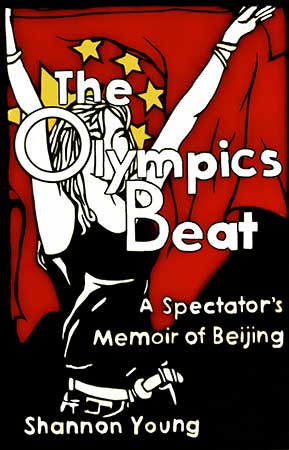
The Olympics Beat: A Spectator’s Memoir of Beijing
by Shannon Young

Published May 2012

About the author:
An American writer living in Hong Kong, Shannon Young writes a blog called A Kindle in Hong Kong, featuring her walking tours, book reviews, and bookspotting adventures.

Cyber coordinates:
Blog: A Kindle in Hong Kong
Twitter: @ShannonYoungHK
Facebook:  A Kindle in Hong Kong

Overview of book:
The drama, the variety, the spectacle – Shannon can’t get enough of it. She is an American student who has always been fascinated by the Olympic Games; her father has a lifelong love affair with China. They team up for the Beijing games and the adventure of a lifetime. Without the filter of a small screen, Shannon and her father are hypnotized by the passion of a great nation unveiling itself to the world. This mini travel memoir is a picture of a new China and the experiences that would change one American girl’s life forever.
(Amazon product description)

Displaced Nation review:
A search for “Olympics” on Amazon will bring up many hits: history of the Olympics, Olympics in ancient times, autobiographies of famous Olympic competitors, lots of picture books for children about the Olympics, and so on. Unique on this list, however, is Shannon Young’s autobiographical account of what it is like to be a spectator at the Games.

As a young university student, Shannon received a fellowship to go to the Beijing Olympics and study the effects the Games had on the city. The resultant academic paper, she felt, was dry and earnest and did nothing to capture the  excitement of the sights and atmosphere, so, three years later, she decided to write a memoir of her personal experience there. Although the book is mainly travelogue, there is also a touching glimpse into the relationship between Shannon and her father, with whom she traveled, and who wants to impart his love of China to his daughter.

At only 60 pages, this is a very short and easy read — quite manageable before the Games start in four days’ time. While Shannon traveled to Beijing for academic purposes, this memoir is not a commentary on the political situation in China in 2008. It is simply the honest observations of a twenty-year-old at the world’s most important sporting event, in a country that is trying to show its best, Botoxed, surgically enhanced face to the rest of that world. The final paragraph of the book sums this up so well:

We returned to the US TV coverage of the remaining events, and it focused on China’s problems: air quality, protesters confined to limited spaces, rumours of human rights violations and trouble. But that wasn’t the Olympics we witnessed. We saw a city full of people who were proud of their accomplishments… The athletes, volunteers, and spectators had poured their souls into welcoming people to their city, and they wanted the world to know how great China was. We knew it — because we were there.

A survivor’s eye view:

Running for My Life: One Lost Boy’s Journey from the Killing Fields of Sudan to the Olympic Games
by Lopez Lomong, Mark Tabb

Published July 2012

About the author:
Lopez Lomong was born in southern Sudan in 1985. After his village was attacked by rebel soldiers when he was 6 years old, he spent ten years in Kenyan refugee camp before moving to the United States, where he was fostered by a family in New York. He became a professional runner in 2007, and a US citizen in 2008, the year he also represented the US at the Beijing Olympics.

Cyber coordinates:
Website: lopezlomong.com
Twitter: @LopezLomong
Facebook: https://www.facebook.com/LopezLomong

Overview of book:
Lopez Lomong chronicles his inspiring ascent from a barefoot lost boy of the Sudanese Civil War to a Nike sponsored athlete on the US Olympic Team. Though most of us fall somewhere between the catastrophic lows and dizzying highs of Lomong’s incredible life, every reader will find in his story the human spark to pursue dreams that might seem unthinkable, even from circumstances that might appear hopeless. (Barnes and Noble product overview)

One reader’s review:
“Lopez Lomong’s story is certainly one of pain, suffering and hardship but all that is overshadowed by his tremendous drive, hope and selfless endeavors for the people of South Sudan.” (Review at “Reflecting from here”)


A stranger-than-fiction eye view:

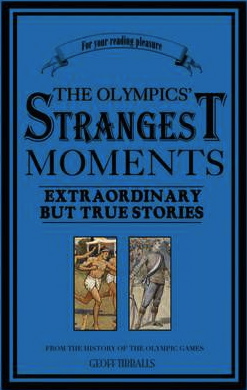
The Olympics’ Strangest Moments: Extraordinary but True Stories from the History of the Olympic Games
by Geoff Tibballs

Published July 2008

About the author:
Geoff Tibballs is a former sports journalist who has written nearly 100 books. He is “an accomplished armchair sportsman, [who] believes his life-long devotion to Millwall Football Club has enabled him to appreciate the ridiculous.” (Random House author bio)

Cyber coordinates:
Author’s page on publisher’s website: Random House/ Geoff Tibballs

Overview of book:
The Olympics’ Strangest Moments recounts the bizarre, controversial, inept, heroic and plain unlucky from the first modern games in 1896 to the return of the games to their birthplace in Athens in 2004 and up to the Beijing 2008 games. (Amazon book description)

One reader’s review:
“The early episodes offer a glimpse into a very different world than the one we know today… The 1900 Paris Olympics featured a cricket competition with only two teams entered…The swimming events were staged in the River Seine…This book is sometimes funny, occasionally tragic, but always entertaining. You don’t have to be fanatical about the Olympics to enjoy this book.” (Amazon.com review)

An insider’s eye view:

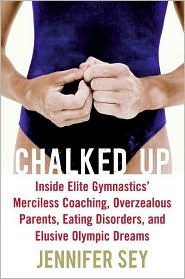
Chalked Up: Inside Elite Gymnastics’ Merciless Coaching, Overzealous Parents, Eating Disorders, and Elusive Olympic Dreams
by Jennifer Sey

Published October 2009

About the author:
Jennifer Sey is an American writer, producer and former gymnast. She began competing in the sport of gymnastics at the age of six and went on to become 1986 National Gymnastics Champion and seven-time national team member.  She lives with her husband and two sons in San Francisco. (Amazon/Wikipedia bio)

Cyber coordinates:
Author’s page on publisher’s website: Harper Collins/Jennifer Sey

Overview of book:
“Chalked Up” presents the story of the 1986 US National Gymnastics champion whose life long dream was to compete in the 1988 Olympics – until anorexia, injuries, coaching abuses, and parental hopes and neglect nearly destroyed her. (Amazon.com book description)

One reader’s review:
“Jennifer Sey is telling her story. She is not preaching nor is she telling you to remove your child from the sport of gymnastics. Although a painful side of gymnastics, which so many of us are scared to acknowledge, it is a reality in the elite world of gymnastics. Twenty two years after winning the national title, a crown that all elite gymnasts dream of, Sey still struggles with a love/hate gymnastics relationship.” (Amazon.com review)

.

Img: Olympic Torch with laurel wreath by nirots/freedigitalphotos.net

STAY TUNED for another Displaced Q!

If you enjoyed this post, we invite you to subscribe for email delivery of The Displaced Dispatch, a round up of the week’s posts from The Displaced Nation. Sign up for The Displaced Dispatch by clicking here!

Related posts:

Expat book review: “The Chalk Circle” by Tara L. Masih

Expat book reivew: “Chique Secrets of Dolce Amore” by Barbara Conelli

Expat book review: “Picky, Sticky or Just Plain Icky?” by Valerie Hamer

Expat book review: “A Tight Wide-open Space,” by Matt Krause

LIBBY’S LIFE: Oliver’s side of the story

A note from Kate: After the last episode, I thought Oliver should be given a chance to explain things, so this episode is told by the man himself. 

In the last episode, Libby waited up for Oliver, wanting to confront him about her recent discovery. Before she could make her presence known in the darkened house, she heard him on the phone making murmured plans with someone she could only assume was another woman. 

Here he is, at the other woman’s house.

*  *  *

I ring the doorbell, and after a couple of seconds the door opens.

“You took your time,” she says. “It doesn’t take fifteen minutes to get here.”

“Diversion to the liquor store.” I hold out a bottle of Pinot Grigio. “For you.”

I know how to get round women. A good bottle of white never fails.

She takes it from me. “We’ll open that later.”

I follow her along the hall and into the kitchen.

“And Libby doesn’t know you’re here?” she asks. She opens the fridge and puts the wine inside.

“She was asleep. The house was dark. She doesn’t even know I came home.”

“That makes things easier.”

She reaches into a cabinet and gets out two wine glasses, ready for later in the evening.

“Have you eaten tonight?” she asks.

I try to think. To be honest, I’m not sure when I last ate. I tell her this.

She shoots me a disapproving look. “You need to look after yourself, a young strapping man like you. I was about to have a tuna sandwich. Care to join me?”

I hate fish.

“Perfect,” I say.

She starts rattling baking trays and tin openers around, and I lean against the doorjamb, watching her.

“How long have you lived here?” I ask.

She stops banging stuff around long enough to think about the question. “In this house? A couple of years. In Woodhaven? Pretty much since 1976, give or take.”

She opens a tin of tuna and mashes it with mayonnaise. When she finishes with it, it looks like cat food.

“I’m going to make tea,” she says. “Could you get me one of those teapots from that shelf?”

I cross the kitchen and reach up to the high shelf above the window over the sink. “Any particular one?”

“The ginger tabby.”

The shelf is crammed with teapots shaped like cats. I’ve never seen anything so hideous.

“What’s the story with the cats?” I ask. “That’s quite an impressive collection you’ve got there. You must have an eye for antiques.”

Wrong thing to say. She’s not fooled for a minute.

“You’re so full of it,” she says. “They’re awful and you know it.”

She gives me a stern look that makes me feel as if I’m back in my junior school headmistress’s office, hauled onto the carpet for dipping Cheryl Atwood’s ponytail in red paint during art class.

“You’re not going to charm your way into my good books that easily,” Maggie says.

* * *

Oh, come on. Give me some credit. You didn’t think I was going out to meet some fancy woman tonight, did you? I saw Maggie this morning while I was out early walking the dog, and she asked me to come here tonight. Said she had something to tell me, but not to say anything to Libby.

If it was any other old biddy, I’d have told her to keep her nose out, but this is Maggie, and she’s not someone you can just say No to like that. Besides, she’s been good to Libs, so I supposed I owed her this much. And I thought I might get some decent food. Wrong again.

Now I wish I’d gone with my first instincts and told her to mind her own business. I’ve got a feeling that all she wants to do is give me a bollocking.

Can’t blame her, either, to be quite honest. If I’d been a fly on the wall of this house these last couple of months, I’d be thinking, “Oliver, you bastard” too. Any reasonable bloke would just sit down with the wife and try to sort things out, right?

But it’s not as simple as that.

Things never are.

* * *

“About this morning, when I saw you walking Fergus,” Maggie says, when we sit down in her living room, a plate of tuna sandwiches between us on the coffee table.

“What about it?” I ask. The smell of the fish makes me want to throw up.

“I asked you to come round here tonight because Libby told me something that I think you should know.”

I wonder what it could be. Perhaps Libby’s arranged an entire family reunion party at the Holiday Inn.

“And the thing is,” Maggie says, “it’s difficult for me to tell you because I promised her mother I wouldn’t interfere.”

I can’t help it. I snort, although I manage to turn it into a kind of sneeze. Again, Maggie isn’t fooled, and she fixes me with another of her headmistressy stares.

I straighten my face.

“As I was saying,” she continues after a pause, “I did promise her mother I wouldn’t interfere. But it seems that her mother, by not interfering herself, is just as much to blame for the circumstances you and Libby are currently in.”

She puts down her old-lady china plate decorated with gaudy red and orange roses, and starts to pour two cups of tea.

My headmistress never gave me tea after I’d dyed Cheryl’s ponytail.

Maggie passes a cup to me. “More sugar?” she asks.

I sip, then shake my head. This situation is bizarre. I wonder when she’s going to get the cane out. If Maggie ever needs a bit of extra income, she could always go in for private S&M sessions. She’s one scary lady.

She smiles at me. “Good.”

Sips her tea.

“She knows all about it, Oliver.”

The room, still warm from the heat of the day, suddenly feels icy cold.

“Knows what?” I ask, although it’s a rhetorical question. I’m only playing for time, putting off the moment.

“You know what,” Maggie says.

* * *

“I wanted to tell her,” I say after a few minutes have passed. Maggie’s a master in the art of silence, and eventually I had to break it. “But you see…that would have meant breaking a promise to my mother.”

“Tell me.”

“She made me promise I would never tell anyone about what really happened to my father. As far as anyone else was concerned, he ran off with a librarian when I was five.”

“Is your wife ‘anyone else’?”

I open my mouth to answer, “Of course she isn’t” and then stop.

Because if I haven’t told her what really happened to her father-in-law, then that’s what she is, right?

* * *

Most married men have two women in their lives. A wife and a mother. Some manage the two together without any problem.

The others have to make a choice. I thought I’d made my choice the first time I met Libs. She literally took my breath away. Every time I saw her, I had difficulty breathing. She’s the one, I thought.

Now, as Maggie tells me every last thing that Libby has found out from our hitherto unplayed wedding video, I realise I’ve been fooling myself for the last ten years.

More to the point, I’ve been fooling Libby.

.

This was originally published on July 8 at the Woodhaven Happenings site, a blog where you can find extra posts by other Libby’s Life characters. Need reminding of the characters? Check out the Who’s Who.

.

Next post: LIBBY’S LIFE #56 – Falling up

Previous post: LIBBY’S LIFE #55 – Dark Secrets

.

Stay tuned Monday’s guest post by Matt Krause, author of “A Tight Wide-open Space”!

If you enjoyed this post, we invite you to subscribe for email delivery of The Displaced Dispatch, a round up of the week’s posts from The Displaced Nation. Sign up for The Displaced Dispatch by clicking here!

Img: Map of the World – Salvatore Vuono

THE DISPLACED Q: How many of these Olympic travelers do you recognize?

It’s a strange thing about high-profile sporting events. They bring out the athlete in even the most unathletic of us. During Wimbledon fortnight, the normally deserted tennis courts in the local park are packed with Federer wannabes; driving back from a Grand Prix, drivers of Ford Fiestas morph into Jenson Button; and while the World Cup is on, everyone kicks random household objects around the kitchen and becomes temporarily expert on the offside rule.

During the Olympics, of course, there’s a much bigger menu of sports to choose from, and during those 16 days, not to mention the previous 70 days of torch relay, it becomes impossible not to see everybody in an Olympic (torch)light.

Especially — since this is our particular mindset– travelers.

So, how many of these Olympic travelers do you recognize?

The Greco-Roman Wrestler

Greco-Roman Wrestling — so-called because of its purported similarity to the wrestling at the ancient Greek Olympics, which lends dignity to an otherwise extremely undignified sport.

Greco-Roman Wrestling Travelers, while not engaging in unseemly public bear hugs and takedowns, are often found at locations of ancient ruins, fighting to hold down folding maps, and heaving around 30-pound guide books. Instead of wrestling headgear and ear guards, they wear sets of headphones, plugged into their audio tour devices.

Matches with other GRWTs are strictly intellectual, based on the Intellectual One-Upmanship system, and wins are determined only by Technical Superiority.

The Synchro Swimmer

Synchro swimming is the only sport where it’s obligatory to wear quantities of makeup that make Dame Edna Everage‘s layers of face paint seem subtle. While regular makeup is dubiously acceptable in  figure skating, this caked-on paint job is ridiculous in an aquatic sport.

The Synchro Traveler is invariably female, and insists on dressing up to the nines no matter how unsuitable for the circumstances.

Hiking boots and backpack for an all-day trek along the Great Wall of China?

No thank you, darling. Louboutins and this divine little Prada clutch will be just fine.

The Rugby Player

Rugby needs no introduction, unless it’s to spout that old joke about it being a game played by men with funny-shaped…but never mind.

The Rugby Traveler — actually, what am I talking about? There is no such thing as a Rugby Traveler Singular. They travel in packs. They also drink lots of beer, sing patriotic songs (out of tune, at 1 a.m.) and do manly guy-things together.

Usually found in their natural habitats of Ibiza and Cancun, hunting for females.

The Pentathlete

The Modern Pentathlon is a series of five events: pistol shooting, fencing, freestyle swimming, show jumping, and cross-country running. It’s athletics for the overachiever.

In traveling terms, the Pentathlete Traveler is the vacationer who will bore you for hours with their elaborate plans to see everything in Fodor’s Guide to Europe in ten days, traveling variously by airplane, train, helicopter, ferry, and pack mule.

Upon their return from said vacation, be prepared to sit through interminable soirees of home videos, accompanied by some marvelous duty-free Chianti Riserva all the way from Leonardo da Vinci-Fiumicino Airport.

Don’t spoil their fun by telling them the same stuff was on special offer at the local wine shop while they were away.

The Archer

Archery: the art of firing arrows from a bow. Requires great concentration and accuracy if you don’t want to poke someone’s eye out (see: King Harold, Hastings, 14th October 1066.)

As far as traveling goes, The Archer knows what he wants, where he wants to go, and how to get there. Easily spotted in airports, Archers are the ones pushing past you on the moving walkway so they get to the end before anyone else does.

They are expert, seasoned travelers and know the layout of every major international airport. Because of this, they are blasé about the arrive-two-hours-before-flight-time rule.

When the flight attendant at the boarding gate pages them by name — that’s more than time enough for The Archer.

.

Image: “Athletics On The Line” by hin255/FreeDigitalPhotos.net

STAY TUNED for Tuesday’s Question and Answer session with Mary-Sue!

If you enjoyed this post, we invite you to subscribe for email delivery of The Displaced Dispatch, a round up of the week’s posts from The Displaced Nation. Sign up for The Displaced Dispatch by clicking here!

Related posts:

Culture collision: How American is England?

Last week’s Random Nomad interview with Melissa Stoey spawned a lively discussion on the subject of loving the romantic image of a country — namely England — rather than loving that country “as it is.”

However,  the definition of “as it is” deserves its own debate. During the comments discussion, Melissa pointed us toward two posts on her site, Smitten By Britain: the first, “England Would Not Be England” by British gardening celebrity Alan Titchmarsh, and the second, “What England Is Really Like” by guest poster Tim Gillett, founder of Tourist Tracks.

They make interesting reading. Both are lists of items which in the authors’ opinions are representative of England, and yet, comparing the two lists, you could be forgiven for thinking they referred to different countries on opposite sides of the globe.

Titchmarsh’s version conjured up a gentle, genteel picture of eating cucumber sandwiches by a croquet lawn; indeed, his list included cucumber sandwiches (although not croquet.)  Gillett’s list brought to mind a less poetic image of England: a picture of stuffing your face with doner kebabs in the High Street on Saturday nights, while stepping over puddles of lager-infused vomit.

Perception — or memory — of a country?

The thing is, though, there’s little I’d disagree with on either list. Maybe the “knotted hankies” on Titchmarsh’s list belong to the seaside excursions of fifty years ago, when Titchmarsh himself was a youngster. Then again — how many Ford Cortinas, an item on Gillett’s list, are still driving around in the UK? 1,317, according to the data on howmanyleft.co.uk., so they’re not such an everyday sight as they were twenty years ago.

No doubt age plays a part. I don’t know how old Mr Gillett is, but I’m hazarding a wild guess that he’s younger than Alan Titchmarsh, who turned 63 in May. From my own experience of reverse culture shock, I know that current perception is often confused by past recollection — my fond imaginings of England are rooted somewhere around the time when people wore Walkmans and acid-wash jeans.

But what really is “Typically English”?

What really struck me about the list by Tim Gillett, however, was the number of items that, while English, could also typify other countries. Titchmarsh’s list, for the main part, was stoically English, with the inclusion of Jane Austen, The National Trust, The Beano, Chatsworth, and Blackpool rock. Whether or not you agree that they are important or representative of England, they are nevertheless unique to that country.

Gillett’s list, on the other hand, had items such as “Misogyny”, “Reality TV”,  and “Appalling public transport” — all of which could be placed on a list to typify America, when you consider the current abortion rights battles, the Kardashians, and the lack of buses everywhere. “‘Baby on Board‘ and other pointless car stickers”? Yes; and try the little stick figure families stuck on the rear window of every soccer mom’s SUV. “Almost everyone believing what they read in the papers”? Fox News. “Visible thongs”? OK, you’ve got me there — I’m hoping they will soon be a thing of the American past thanks to this tasteful little invention being sold on TV.

Coloring outside the cultural lines

What I’m saying here is not that Tim Gillett, in his funny, wry list, has come up with suggestions that are too general to be exclusively English (he also includes “EastEnders“, “Local pubs and real ale”, “Wayne Rooney“, and something so obviously English and cringeworthy I can’t believe I’ve never thought about it: “Ill-fitting brassieres”) but that cultural borders are gradually smudging.

I would love to know what a similar list would look like in another twenty years — so, please, let’s have your suggestions for how the American and English cultures will differ or be the same when the 2032 Olympics roll around!

.

 
STAY TUNED for Monday’s Displaced Q!

If you enjoyed this post, we invite you to subscribe for email delivery of The Displaced Dispatch, a round up of the week’s posts from The Displaced Nation. Sign up for The Displaced Dispatch by clicking here!

LIBBY’S LIFE #55 – Dark secrets

A note before Libby begins her journal entry: If you’re a Libby addict, check out Woodhaven Happenings, where from time to time you will find more posts from other characters. The latest is a post from Maggie, describing her side of the story of last week’s meeting with Libby. Want to remind yourself of Who’s Who in Woodhaven? Click here for the cast list!

*  *  *

The babies are in bed. They have been bathed, fed, patted, soothed, and tucked up for the night. After protesting at similar treatment at a too-early hour, Jack is also away for the night.

I sit in the gradually darkening den, watching the sun set behind the trees in the back yard, and wait for Oliver. This is the room he usually heads for when he comes through the door. The temptation to turn on the TV is great, but I resist, knowing I need to channel my thoughts and energy into the inevitable scene that lies ahead tonight, not into another episode of How I Met Your Mother. Also, if I am quiet, I will be able to hear him arrive home.

Oliver’s evening arrivals have been getting later and later. When I comment, mildly, upon this — I never question — he replies in a tone that indicates it’s hardly worth him opening his mouth. “Work,” he says. “Overtime.” “Customer with a problem.”

“What about a wife with a problem?” I want to scream. “Don’t I deserve some of your overtime too?”

But I never do. I’m my mother’s daughter, after all. After the brief interlude here when she abandoned her role as Dutiful Wife To Keith in favour of Fun-Loving Single Woman For Now, she’s back to tiptoeing around the house and fetching Dad his warmed slippers. She gave me the hint about Oliver’s parentage, but I can’t work out what I was supposed to do with the information. Silently store it and sympathise with Oliver, I think she meant.

Thankfully, I have another mother who is not afraid of sticking an oar in when necessary, even if it means breaking a promise to not interfere.

“I used to interfere,” Maggie said, after she had hauled me, the children, and Fergus back to her house earlier today. “All the time. Making that promise to your mother not to get involved nearly killed me.”

“But you decided to go ahead and get involved anyway.”

“You’re like a daughter,” Maggie said, “the daughter I haven’t had for twenty-five years. I could no more stand by and watch you fall to pieces than I was able to watch Sara.”

Maggie sat in her wooden rocking chair, gazing out of the window at the maple tree in the yard. Her eyes were open very wide, as people’s are when they are trying to make tears disobey gravity. Half of me wanted to ask more about the mysterious daughter, but the other half didn’t want to rake over old memories for Maggie.

Also — I have to be honest — I was more intent on getting my own life straightened out. Whatever happened to Maggie and her daughter twenty-five years ago has little to do with what is going on now between me and Oliver.

“What shall I do?” I asked her instead. “How do I talk to a man who won’t talk back?”

Maggie turned slightly, blinking.

“I can’t tell you that,” she said. “You know your own husband. At least, you thought you did. But however you do it, you have to keep telling yourself that you deserve better than this.”

I didn’t dare ask her what she meant by that.

* * *

The sun has been below the horizon for fifteen minutes now, and an occasional firefly flickers among the rhododendrons. The den is completely dark. Oliver is still not home. I curl up on the sofa without bothering to turn on the lamp beside me, and rehearse tonight’s conversation in my head. It’s difficult, of course, because in this imaginary exchange Oliver answers the way I would like him to. We have a reasoned, adult conversation, resulting in a reasoned, adult compromise. He does not mutter monosyllables, or stomp upstairs to the guest bedroom where he has taken to sleeping under the pretext of not getting enough sleep in the same room as the twins, who supposedly wake him up every time they murmur in the night.

I hear the rattle of the garage door and the hum of the car engine as it pulls into the parking bay. The back door opens, then closes again. Oliver’s uncertain footsteps into the unlit kitchen, heading into the hall, then back into the kitchen. Apart from a nightlight glowing on the landing upstairs, the house is in darkness.

Oliver’s footsteps stop. I hear the fridge door open, and the faint light from the fridge interior illuminates the hallway outside the den. Funny how a small light can make such a difference in a dark house. I am reminded of my grandfather’s stories of German air raids and belligerent blackout wardens.

The fridge door closes, the light goes off.

The pop and hiss of a Coke can top, some glugs. A stifled belch.

Another noise. Beeps — ten of them.

I stiffen, listening hard.

Then a quiet voice from the kitchen, speaking into a cellphone.

“Hey. It’s Oliver.” Silence, broken by the tossing of an empty Coke can into the recycling bin. “Change of plan. I can see you now…Yeah, no problem. She’s in bed. I’ll be there in fifteen minutes.”

The back door opens and closes, the garage door rattles open, and the car engine hums again as Oliver reverses onto the driveway.

I stay where I am, motionless, and watch the fireflies for a long time.

.

Next post: LIBBY’S LIFE: Oliver’s side of the story

Previous post: LIBBY’S LIFE #54 – Opening the cocoon 

Need the 411 on characters in Libby’s Life? Click here for  Kate’s page  of Who’s Who in Woodhaven.

Click here to read Libby’s Life from the first episode.


STAY TUNED for Monday’s post.

If you enjoyed this post, we invite you to subscribe for email delivery of The Displaced Dispatch, a round up of the week’s posts from The Displaced Nation. Sign up for The Displaced Dispatch by clicking here!

Image: Travel – Map of the World by Salvatore Vuono / FreeDigit

THE DISPLACED POLL: Who will win the Ladies’ Grunt Championship at Wimbledon?

Ah, the start of Wimbledon Fortnight. Two weeks of tennis whites, polite applause, Royalty, and strawberries and cream.

And grunts. Don’t forget the grunts. Especially the ladies’ grunts.

If some of the newspapers this week are to believed, that’s what modern tennis is all about.

The history of the grunt

Men’s tennis grunts started back in the 1970s with Jimmy Connors, and the popularity soon spread among the guys. In the 1988 US Open, Ivan Lendl complained about opponent Andre Agassi‘s grunts, saying they threw him, Lendl, off his timing.

Women’s tennis took a little longer to catch on, starting with Monica Seles‘s guttural shrieks in the 1990s. Once started, though, the women soon raised grunting to an art form, or at least another sport, putting the men’s feeble efforts to shame.

Serve in silence

Fans and media, however, are not amused by Centre Court’s soundtrack, and Martina Navratilova, a champion when women’s tennis was played in dignified silence, also disapproves. Her view is that the grunt masks the sound of the ball leaving the grunter’s racquet, putting the non-grunting opponent at a disadvantage.

“The grunting has reached an unacceptable level. It is cheating, pure and simple. It is time for something to be done.”

World Tennis Association chairman and chief executive, Stacey Allaster, agrees:

“It’s time for us to drive excessive grunting out of the game for future generations.”

Quite how this will be achieved, though, is rather vague. A fine for noisy players. perhaps? It would have to be a big one to have any effect. Michelle Larcher de Brito, the Portuguese player, and rumoured to be the next Maria Sharapova as far as grunt volume goes, reportedly said:

 “I’d rather get fined than lose a match because I had to stop grunting.”

The WTA is quick to point out that current players will not have to curb their on-court vocal emissions. The ban on grunts will be phased in after a period of educating up-and-coming players in grunt etiquette.

In the mean time, however, perhaps the solution would be to make Grunting an official Olympic sport, permissible only at Olympics (i.e. every four years) and not at Grand Slam tournaments.

With grunt decibel readings at similar levels to pneumatic drills, that would be music to everyone’s ears.

Judge for yourself:

Serena Williams and Victoria Azarenka

Maria Sharapova – Russia

And vote for the Gold Medal Winner in our poll!

Image: MorgueFile