The Displaced Nation

A home for international creatives

Look at little me on my gap year! I’m so superior to other kinds of tourists!

We welcome back Lawrence Hunt to the Displaced Nation, who wrote a popular post for us in September about what it’s like to grow up in England with a mum who is an expat American. Today, in keeping with our theme of global philanthropy, he offers some thoughts on why the UK’s educated youth seems so preoccupied with the authentic, meaningful travel experience.

It’s hard to pinpoint when and how it started, but more and more UK students feel compelled to spend at least part of their gap years between secondary school and university doing their bit to save the world.

The wealthiest students were the first to pioneer this trend. Many of you may be familiar with Prince William’s gap year in Southern Chile with Raleigh International, an organization started by his father, to help build schools and teach English; and Prince Harry’s gap year in Lesotho to further his mother’s work with AIDS orphans.

But have you watched “Gap Yah,” a comedy video that’s been dominating the British corner of YouTube?

“Tarquin, yes, I can’t come shopping on the King’s Road today, because, yes, I’m literally in Burma.” A traveling student is on the phone to a friend back home, droning on about being subject to various experiences of “spiritual, cultural and political” significance, such as meeting a malaria-suffering woman with flies around her eyes, and then having “chundered [vomited] everywhere” due to excessive partying the night before.

The notion of a Hooray Henry returning home with stories of his interactions with noble, primitive cultures has really struck a chord with university students. As one exasperated YouTube user from Manchester University comments under the video: “I know so many people like this! Worst kind of person.”

The offense is made infinitely worse by the fact these kids have been so brazenly insulated from the realities of these places by wads of their parents’ money all the way through.

I love animals. I love kids. I want to save the world.

I’m one to talk. I did a gap year in China before going off to Warwick University in 2008. I chose China as I wanted to learn Chinese and see what it’s like to live under a post-communism communist regime. I took on a job as a teacher in a city called Wuhu in Anhui Province, and spent the next five months struggling to make myself understood above the noise of 60-plus unruly teenagers.

And yes, my friends who saw the “gap yah” video said it reminded them of me! (But I worked to pay for my trip, damn it!)

Did I help the kids? Maybe a little. Did I have fun? For sure. But I also came back with the realization that not much can be accomplished in just a few months by people who don’t speak the language and have little cultural training.

Judith Brodie, the director of Voluntary Service Overseas, one of Britain’s leading charities, concurs. Voluntourism has become big business in the UK, with the average student paying out close to $10,000 for the opportunity to teach street children, rescue sea turtles, dig wells and the like. Brodie cautions that many of these projects have been designed to satisfy the demands of students rather than the needs of locals. As she told the Guardian:

“Young people want to make a difference, but they would be better off traveling and experiencing different cultures, rather than wasting time on projects that have no impact and can leave a big hole in their wallet.”

The desire for authenticity — whatever that means

Going hand in hand with this compulsion for doing good — as long as you can cram it into a half-year stint, preferably funded by your parents — is the desire to prove to others that you won’t settle for anything less than an “authentic” cultural experience.

During my own gap year, I spent some time walking around Beijing with a friend of mine, Josh, who was obsessed with the idea of “authenticity” — the acid test for which was the absence of any sort of commercial element aimed specifically at tourists.

Josh would thoroughly inspect any restaurant we went to before deciding whether it was “touristy” or the “real China.” It almost got to the point where if there was a suspect old Chinese man hunched up in the corner looking as though he needed serious medical attention, Josh would yelp excitedly and sit down, commenting on how he could taste the poverty in the noodle soup.

One particularly vivid memory from the experience was walking through the hutongs, the ancient lanes that revolve around the Forbidden City in a maze of houses and courtyards. They are a popular tourist attraction, and though they house half the city’s population of 18 million, many of them are being demolished to make room for more modern buildings.

Josh, at the behest of his trusty guidebook, was insistent that we take the chance to see them before they were modernized beyond recognition. While we walked, we were followed by an angry rickshaw driver who wanted to take us on a tour. We refused to pay for his services — not because the price he was asking was too high but because to accept his offer would be tantamount to admitting that we’d settle for a staged and commercial version of the “hutong experience.” And that would undermine our whole reason for being there.

Just a little too late, I realized the gross insensitivity of what we were doing. We were walking through people’s back gardens and peering over their fences on the pretext of digging beneath the veneer of their culture. Ultimately, however, what we were getting was exotic, and cheap, entertainment. And if that was the case, we might as well have allowed the locals to set the terms of their own commodification.

Unintended consequences

If I had any sort of epiphany myself from traveling, it was this: the search for the “authentic” experience outside of Western boundaries is itself the reason for these cultures’ destruction.

The way I see it, it happens in three phases:

  1. Travelers arrive at an undeveloped exotic location.
  2. They report on the experience as having been so “authentic” that other people follow them.
  3. Soon enough the locals catch on to this, and offer their services in delivering what people want — mountain treks, temple tours, and so on until eventually, it becomes an overly commercialized “tourist spot” and the landscape becomes dominated by souvenirs, maps, and information points.

And just about then, the original travelers, exasperated with all those damn tourists, leave in search of more fertile ground and the cycle repeats itself.

For years in this way, the counter-cultural traveler has served as the main shock trooper of mass tourism.

While there is nothing wrong with spreading a little Western wealth through tourism to places that need it — although admittedly the process of development does have its drawbacks — the idea that anti-materialist tourists are superior to the other kinds — well, that’s just pretentious, isn’t it?

Readers, any responses to Lawrence Hunt’s thoughts on gap years, voluntourism and the quest for the “authentic” travel experience?

STAY TUNED for Tuesday’s post, providing a humorous slant on the aid work profession.

If you enjoyed this post, we invite you to subscribe to The Displaced Dispatch, a weekly round up of posts from The Displaced Nation, plus seasonal recipes, book giveaways and other extras. Sign up for The Displaced Dispatch by clicking here!

Related posts:

Img: Lawrence Hunt playing the tourist in Beijing’s Forbidden City during his gap year (August 2008).

Journeys through nomadic Africa — a travel yarn in two parts (Part 1)

Today we welcome Kathleen Colson to The Displaced Nation as a guest blogger. Colson was in Kenya from September 8 to October 14 to lead a safari for her alma mater, St Lawrence University, and to meet with her staff and the participants of The BOMA Project — the micro-enterprise development organization that she founded in 2005. Colson has traveled to the African continent over 30 times.

In this, the first in a two-part series on her most recent travels, Colson shares some overall impressions of Kenya. In Part 2, to be published next week, she will report on her journeys related to the BOMA Project’s work.

For over a quarter of a century, I have traveled to Africa, visiting 11 African countries in the process. But East Africa — in particular, Kenya — is the place that keeps bringing me back.

Each time I’m in Kenya, there’s a moment when I feel overcome by the sheer physical beauty and rawness of the landscape. This time, that moment occurred when I was flying over the land that I had spent years driving through — northern Kenya. Now — only my second time to do so — I was seeing the land from the air.

Fractured volcanic mountains stood in stark contrast to the vast open spaces of desert and scrub brush. But for the occasional circle of villages inhabited by Samburu or Rendille nomads, the land looked uninhabited.

I was looking down on ancient untamed wilderness.

Land of infinite variety

Kenya is a land of varied terrains and climates. So it is always difficult to pack when you are traveling between the extremes — from the cold and damp nights in the village of Nanyuki (Kongoni Camp), at the base of Mount Kenya, to the heat and arid conditions of the nomadic villages of northern Kenya.

Millions of years ago, the African continent tore itself apart, creating a 5,400 mile trench that runs from Jordan in the north to Mozambique in the south. A 19th-century British explorer called the trench the Great Rift Valley. It is visible from the moon.

On either side of this crevice, great volcanic mountains erupted creating Kilimanjaro and Ol Donyo Lengai (Mountain of God) in Tanzania and Longonot, Menengai and Mount Kulal in Kenya.

Wake-up calls

Being in Kenya always heightens my sense of hearing — whether it is the sounds of the night that reach me through the thin barrier of tent canvas, or the sounds that come with the morning light.

In mid-October, while staying in South Horr, I was awakened by the muezzin calling the faithful to prayer at 4:30 a.m. In this village of mostly Catholic parishioners, South Horr was a typical village in northern Kenya with a diversity of spiritual practices.

As light filtered through the cracks of my wooden windows I heard the sounds of a village awakening — chickens and goats and the murmur of soft, gentle voices. A tropical bulbul, go-away birds and the honking of a hornbill joined the chorus. And then it came — the sound that has started almost every day that I have ever spent in Africa — the whisk, whisk of a palm branch broom.

By the next day, those noises were drowned out by the growl of winds blasting down the Rift Valley. I awakened from a night of Malarone-infused dreams to the sound of young fruit dropping onto the tin roof of my hut from the gnarled olive tree above it.

That day we would make the treacherous climb up Mt. Kulal to Gatab, a Samburu village perched on the edge of a sheer cliff. I was glad we would be staying in a solid cement house — the home of a doctor who had left the area but who allowed visitors, as long as they were approved by the missionaries, to use it.

That first night in Gatab, the thorn branches of a bougainvillea bush, brilliant with pink blossoms during the day, now clawed at the tin roof of the building, desperately trying to hang on as the wind blew and blew.

The missionaries’ dogs barked in desperate pleas for calm which eventually came with the dawn, as the winds quieted down and the mists descended from the forest, blanketing the village in an eerie white fog.

On safari

One of the purposes of my trip was to lead a safari of 22 people from September 16 to 28. After a costly snafu with my return flight from northern Kenya to Nairobi, I was finally able to check in with my head guide, Eutychus, and introduce myself to the group members, whom I recognized from their passport photos.

Our safari consisted of a mix of presentations on some of the good works being done in Kenya — Ken Okoth of St. Lawrence University started it off by giving us a tour of his facility in the Kibera slums of Nairobi — and animal sightings.

In the Samburu National Reserve, we saw cheetah, lion and leopard. We also had a sighting of rare wild dogs — unbelievable! One afternoon, we watched a delighted group of young elephants swim and bathe in the rushing waters of the Ewaso Nyiro River.

At a surprise sundowner setting in the hills surrounding Sekenani Camp, I awarded two of our travelers a rungu — the traditional club of Maasai and Samburu men — for carrying on with the trip despite becoming ill.

East African joie de vivre

Another purpose of my journey was to attend a training program for the Mentors of The BOMA Project. On our last night together, I paid for a case of Tusker beer and sodas. As it grew dark everyone straggled back to camp and gathered in a circle of chairs outside my hut. Song leaders like Teresa, our Mentor from Loiy, and Semeji, our security man, led us in rounds of music. Spirits were high by the time dinner was served — steaming bowls of rice, cabbage and goat meat.

After the meal, the dancing began. It started with sonar tenor chants and simple songs. Soon other guests staying at the club as well as people from the town joined in the celebration. Arms around waists, hands clasped and feet pounding in a circle of bodies, the ethnic mix of Samburu, Rendille, Ariaal and Turkana voices joined together in a shared chant — i-lee-um, il-ee-um, il-ee-um, il-ee-um.

Teresa and Semeji’s voices pierced the chanting voices with whoops and wails, connecting the voices to stories of love and longing and the battles of brave warriors.

Two young mothers handed me their babies and I held them close as the dancers pounded their feet and sang the songs of the nomadic people from the north. The dust from the dancers’ feet and the chanting voices rose into the night sky.

Rumblings of discontent

I arrived in Kenya in early September. By that time, the news of the East African drought that started over a year ago was bringing well-intended organizations into the region who had not spent time asking the people what they need. During my first few days, I heard many complaints from residents.

One organization, for instance, had proposed that the community build a greenhouse to grow vegetables.

“And where do we get water for the greenhouse?” the residents responded.

Another organization arrived with desks and chairs for the local primary boarding school.

“But we have desks and chairs,” the residents told them. “We need beds and mattresses for the dormitory so the children do not sleep on the ground.”

And those weren’t the only complaints I heard voiced against foreigners. In the remote mountain village of Gatab, I witnessed hundreds of residents quietly protesting the presence of one of the missionaries who has lived in the village with his family behind a tall chain-link fence.

I was only a casual observer and the circumstances were, I am sure, complicated.

But it is hard not to notice, in contrast to the poverty of this village, the relative wealth of a missionary family whom I am told do not interact socially with the villagers — multiple ATV and lorry vehicles, a backhoe, a wind tower, a satellite dish and a trampoline for children who do not attend the local school. All of this infrastructure was in support of a clinic and Haven Home — a boarding school for nomadic children and orphans.

A number of years ago a local woman had received a divorce after years of abuse by her husband. She was employed by this missionary family and had finally decided that she wanted to have a baby but would do so without a husband. She was fired. According to a number of village leaders that I spoke with, this was the last straw. “We’ve had enough,” the villagers told me again and again.

I tried to find out more and later that evening I did a search on the Web (yes, you can get slow Internet through a mobile phone modem), where I found this description:

Haven Home provides a Christian environment for these young people from many of the immoral and destructive tribal practices.

Before I started The BOMA Project, I spent two years traveling the district and listening to the people. We tried lots of things and we kept listening. Out of this came two founding principles — that we would focus on income as our development strategy and that we would remain committed to the local leadership of all BOMA programs.

But more on that in next week’s post…

For more details on Kathleen Colson’s recent East African journeys, go to the BOMA Project blog. Those familiar with the Matador Network may be curious to note that it recently listed the BOMA Project as one of the top 50 organizations “making a world of difference.”

Readers, any questions or comments for Kathleen Colson before next week’s installment?

STAY TUNED for Monday’s post by our guest blogger Lawrence Hunt, about gap years, voluntourism, and the search for the “authentic” travel experience.

If you enjoyed this post, we invite you to subscribe to The Displaced Dispatch, a weekly round up of posts from The Displaced Nation, plus some extras such as seasonal recipes and occasional book giveaways. Sign up for The Displaced Dispatch by clicking here!

Related posts:

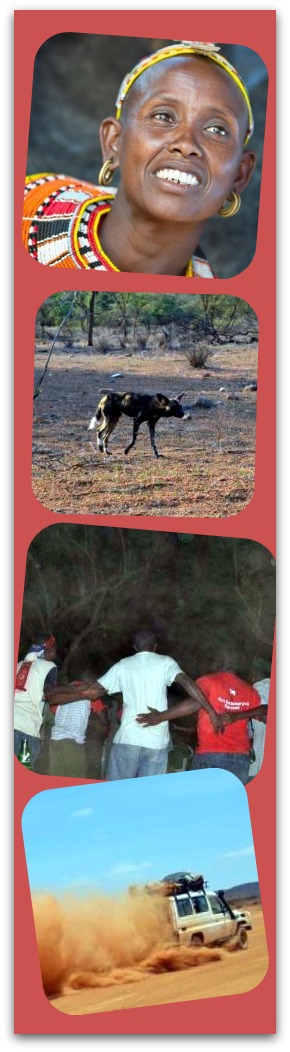
Images (top to bottom): Nalepicho from Lependera, a Rendille nomadic village in the Kaisut Desert; a rare sighting of a wild dogs in Samburu; dust from dancing feet during the BOMA Project’s celebration; GUMPS (the BOMA Project vehicle) crossing the desert on the way to Gatab.

LIBBY’S LIFE #27.5 — A Halloween rehash

Greetings, Libby fans! If you’ve been following The Displaced Nation this week, you’ll know that we hashed our Halloween post because the writer — Libby’s creator, Kate Allison — went mysteriously missing. Thankfully, she hasn’t done an Agatha Christie, as Libby had feared, but is the victim of a freak snowstorm that left her without power. In a short communication of yesterday (from a McDonald’s near her house), Kate requested that we rehash Libby Life #9 because of the rather garish outfit sported by Libby’s mother-in-law. She thought it might compensate in some way for the post she was meant to do on “Halloween costumes for expats.” And perhaps it will also be a good chance for new Libby fans to catch up with what her life was like before she reached Woodhaven, and for her older fans, to indulge in some nostalgia?

The story so far: The Patrick family — Libby, Oliver, and their three-year-old, Jack — are in the process of moving from England to Massachusetts. Libby is now looking forward to the move but Oliver has developed cold feet, although he hasn’t been brave enough to tell his employer’s HR department — at least, not yet. Meanwhile, Libby has horrible suspicions that her nutty mother-in-law, Sandra, is about to move into their neighbour’s house. If Libby needs to pull out the stops to persuade Oliver that a transatlantic move is a good idea, now might be a good time.

To Sandra’s for tea.

We do this regularly. I don’t mean afternoon tea with fairy cakes, or mid-morning tea with a biscuit, but tea as in beans on toast, or egg and chips if she’s feeling ambitious. Oliver likes going to his mother’s for tea, even though I’m quite capable of rustling up beans on toast, but apparently there’s something about his mother’s cooking that I can’t compete with. I don’t know what it is. Maybe I don’t buy the same cheapo brand of baked beans, or maybe it’s because I’m left-handed and open the tin the wrong way. It’s a kitchen mystery that not even Miss Marple or Gordon Ramsay could solve.

Still haven’t voiced my suspicions to Oliver about his mother’s impending move to number sixteen. Although it’s my nightmare, I have a horrible feeling Oliver would like the idea and we’d be forced round there four times a week for school lunch.

The good thing is that he hasn’t said anything to his employer about his own doubts over our own move. I suppose if he comes out and says he doesn’t want to go, he will appear to lack company commitment, and look like a big wuss into the bargain, so for the moment, everything’s going ahead, even though Oliver is regretting his initial gung-ho spirit and fresh-lobster-worship .

So, off we went to Sandra’s. We took Boris The Spider with us, his little glass cage sealed in two black dustbin bags in case he escaped into the car boot. He’s been living behind the sofa where I can’t see him, and now I need to Hoover behind it because Jack’s been sprinkling squashed digestive biscuits all over the spider tank, so it’s time for Sandra to repossess him. Oliver started to object, saying it would hurt Sandra’s feelings, but stopped when I said that if the arachnid stayed, I’d see to it that he ended his days Cambodian-style, deep-fried, in the local Chinese takeaway that keeps getting prosecuted for dodgy hygiene standards. So Boris came along, without a murmur from Oliver.

It was all so easy that I’m considering making similar threats about Fergus.

When we arrived at Sandra’s house, the whole street was shaking. Not from an earthquake, but from Sandra’s hi-fi. She plays it loud. Sometimes it’s Mahler, sometimes it’s the Rolling Stones, sometimes it’s the Grateful Dead.

Today it was Lady Gaga, and Sandra was dressed to match.

If you’ve never seen your mother-in-law frying eggs while she’s dressed in hooker heels, Marks and Spencer’s bikini, and makeup that’s less Lady Gaga than Alice Cooper — think yourself very, very fortunate.

No wonder she’s moving house. Her present neighbours must have clubbed together for the deposit.

Oliver raised his eyebrows, but carefully avoided looking at me. Jack gawped at his granny, then buried his face in my neck and refused to let me put him down.

“Are you going to get dressed, Mum?” Oliver asked. “It’s probably not a good idea to fry eggs if you’re only wearing a swimming costume.” He gestured at his own midriff. “Hot oil splashes round there – it might sting a bit. The weather’s cooling off outside, too.”

Oliver’s a big noise in Customer Relations at his company, and I can see why. You don’t live thirty-four years with Sandra for a mother without learning something about tact.

Sandra beamed at him and pinched his cheek, then Jack’s, who had lifted his head to see if the apparition in streaky eyeliner was still there.

“I’ll just pop upstairs. Back in a minute.”

Oliver crossed the kitchen to the cooker and removed the frying pan from the heat.

“Do you think she’s…?” He jerked his head in the direction toward the stairs, where Sandra had gone. “You know. Going prematurely senile?”

I’m not in Customer Relations, and never could be. “She’s always been like that, Oliver. There’s no ‘going’ about it.”

He chewed the inside of his cheek. He does that when he’s worried. Bless him. I know I moan, but he only wants the best for everyone.

“I worry about what will happen to her when we go to America. I keep thinking I agreed to this move without thinking about it.”

Like mother, like son.

“You’re not your mother’s keeper, love,” I said, trying to find the right words. “She’s a grown woman, more capable than you think. And there are worse things than us moving to Boston for two years, you know.”

“Such as what?” Oliver asked, but was interrupted by Sandra coming back to the kitchen wearing a denim mini skirt and a T-shirt from French Connection that said FCUK on the front.

“What that say?” Jack demanded, pointing at Granny’s chest.

I’ve been teaching Jack his letters. He likes copying words around the house, like “Sony” from the TV, or “Dell” from the computer. Quite often he gets the letters mixed up, but he likes to treasure his masterpieces and show them to Carol Hunter at playgroup.

I rummaged in the drawer where Sandra keeps her tea towels and aprons, and handed her a PVC Union Jack apron. “You don’t want to get oil splashes on your nice T-shirt, either,” I said.

*

“We brought Boris The Spider back,” Oliver said over our egg and chips. “Jack’s allergic to him.”

Jack’s nothing of the sort, of course, but Sandra can’t dispute it one way or the other. All children have allergies now. It’s the law.

Sandra waved her hand dismissively. “I’ll give him back to Petra. Not to worry. I’ve got bigger things to think about.”

Oliver and I exchanged glances. Normally she’d have had a meltdown at this point and we’d have to reassure her that our rejection of her gift was not a rejection of herself.

“Is this the surprise you were talking about the other day?” he asked.

Sandra leaned toward us over the kitchen table.

“I’ve been trying to keep it a surprise until everything’s signed and sealed, but you know me. Can’t keep good news to myself.” She paused. “You know that house near you? Number sixteen? I’ve bought it.”

Silence from Oliver. Silence from me, as I wondered what Oliver would say. Squelchings from Jack as he picked up a cold chip and squashed it.

“Really?” said Oliver. “Wow. I mean, wow. That’s terrific news. Only…” He stared at the FCUK T-shirt, again on display, and at Sandra’s makeup. “Only I wish we’d known earlier. You see, we’ve got some news of our own. We’re moving too.”

*

Later, much later than we had planned, we left Sandra’s house to go home and put Jack to bed. We’d already put Sandra to bed, with some hot milk and Valium.

“We are doing the right thing, aren’t we?” Oliver asked for the fourth time.

“Oliver,” I said, barely holding on to my patience or elation. “I said there were worse things than moving to Boston. Your mother moving to Acacia Drive is one of them. Of course we’re doing the right thing. In fact, ” I said, turning around to adjust the blanket over a sleeping Jack, “I’ve never been so sure of anything in my life.”

If you enjoyed this post, we invite you to subscribe for email delivery of The Displaced Dispatch, a round up of the week’s posts from The Displaced Nation. Sign up for The Displaced Dispatch by clicking here!

Related posts:

Image: Travel – Map of the World by Salvatore Vuono / FreeDigitalPhotos.net

The Displaced Nation’s Halloween post is…mysteriously displaced!

Kate Allison was supposed to post today, for Halloween…but then, pouf, she vanished without a trace!

How very strange, we think you’ll agree…

Her topic was going to be Halloween costumes for expats. Given her offbeat sense of humor, none of us would have been the least bit surprised had she suggested we dress up as:

  • Dorothy, staggering around with a sign that says “I’m not in Kansas any more.”
  • Pocahontas &  John Rolfe — suitable for cross-cultural, bi-racial couples with large age differences.
  • Mary-Sue Wallace, to give ourselves a break from feeling displaced for a few hours.
  • A giant red snail, to signal enthusiastic support for the slow-food movement that began in Italy and is s-l-o-w-l-y spreading around the world.
  • Marcel Proust, carrying a madeleine and looking very displaced.

But instead of speculating what Kate might have written about, perhaps we should be spending our time wondering where she has gone. ML Awanohara and Anthony Windram have a few hypotheses — do let us know if you can think of any others!

  1. She enjoyed a repast of the seven deadly dishes from around the world, overdosed on snake wine, took a nap to recover, and hasn’t yet woken up.
  2. She is out flying on a broomstick with her fictional sidekick, Libby — or, even more likely, with Libby’s nemesis, Melissa (and they are evilly plotting Melissa’s next move on Libby).
  3. She was the victim of some sort of gothic expat tale — either a trick-or-treater dressed up as Hannibal Lecter, who thought she looked tasty and got carried away; or else some sort of natural disaster, such as a bizarre October blizzard, leading to widespread power outages.

Kate, chills are running down our spines as we fantasize about all the spooky things that might have befallen you on this All Hallows’ Eve. New England is not the same as Merry Olde, as no doubt you and your English family have discovered…

Of course, knowing you as well as we do, you may simply be playing a prank by not treating us with one of your posts.

But if that’s not the case and you truly have been spirited away, send us a signal, and the citizens of The Displaced Nation will perform some incantations on your behalf over a bubbling cauldron — a molten mix of Marmite, Fluff and chocolate, with the odd tongue-in-cheek thrown in…

STAY TUNED for Tuesday’s post, introducing November’s theme, on those who displace themselves on behalf of those less fortunate.

If you enjoyed this post, we invite you to subscribe to The Displaced Dispatch, a weekly round up of posts from The Displaced Nation, plus some extras such as seasonal recipes and occasional book giveaways. Sign up for The Displaced Dispatch by clicking here!

Image: MorgueFile

Bon appétit, really? A TCK’s encounter with French cuisine — and culture

Our Third Culture Kid columnist, Charlotte Day, regales us with stories of encounters with France and French cuisine that piqued her curiosity somewhat more than her palate.

My experience of France and of French food consists of a miserable trip to Paris and the Loire Valley with my mother and stepfather in cold, drizzly March, and an even more miserable language exchange to Lyon last February.

The first experience saw us through innumerable cafés au lait, pains au chocolat and frothy miracles of haute cuisine in the Loire Valley. Afterwards, my mother went on her first raw food diet.

The second was a mandatory school trip for all French-language students at my boarding school in England, which I faced with more optimism than most. Two weeks in Lyon, two weeks back in England, dramatic language improvement and cultural interchange — why ever not?

From the moment we boarded the Eurostar, however, things did not look promising. Two boys arrived sporting Union Jacks and carrying paper cut-outs of Wills and Kate. The rest had already scoured their exchange partners’ Facebook pages and resolved to dislike them.

I suppose I ought to have anticipated this Anglo-French clash, given the historical precedents. Yet the English contingent’s narrow-mindedness unsettled me.

Yes, we were sacrificing a holiday to spend two weeks with a stranger. But their genuine unwillingness to learn, Anglo-supremacist attitude and lack of curiosity were a little disturbing.

As we descended into the arrivals hall of Lyon Part-Dieu station, the smiles of expectant correspondents ought to have rebuffed the querulous English students. Yet each went through his or her initial greeting with as pronounced an English accent as possible.

You are what you eat

My exchange partner and her mother drove me back to their beautiful old farmhouse, in a village known for horse breeding. My bedroom was large and warm, my French not as bad as I’d feared it to be.

And yet one anxiety still plagued me: sustaining a gluten-and-dairy-free diet in England was sufficiently difficult, but in France, I imagined, next to impossible. I sat in my room, weighing the relative merits of two weeks’ stomach cramps against starvation — and how to explain in French the effects of wheat, barley and rye on the small intestine?

What I found in the dining room occasioned raw joy: steamed vegetables, fish and salad. Likewise in the kitchen: a refrigerator shelf full of yahourt au soja. To their question “Ça marche?” I would have poured forth encomiums had I mastered a suitable vocabulary set. But I could not move beyond “Oui, c’est fantastique” before we sat down to eat.

This first meal was to be the most talkative of my two-week sojourn. As the breakfasts and dinners succeeded one another in an endless cortège of fresh fruit, perfectly steamed broccoli and silence, I felt that either starvation or stomach cramps around a more convivial table would have been preferable.

My exchange partner was kind, but icy. Her fastidious and sparing eating habits made me feel a glutton in comparison. Her mother ate protein powder in yoghurt more often than a solid meal. Eventually, my mornings were characterized by a solitary repast of fruit salad — no one else seemed to be eating.

Ghosts at the feast

The occasional apparition flitted around the dinner table — some closer to human form than others. The first was Pierre, the former lover of my exchange’s mother, with whom she was still sharing living expenses. He was tall and corpulent with a thunderous voice. She had cast him from her life — but only driven him out as far as the other end of the house, where he entrenched himself in a study strewn with half-smoked cigars.

At least he ate like a Frenchman — belonged to the cult of taste, before that of health. Yet he vanished soon after his first appearance, driving off to see his mother in a neighboring town. He returned after five days, at two o’clock one morning, and left again the next day.

The second apparition was my exchange partner’s boyfriend, Samson — a thin, pale young man with an unruly mass of curls; a maths prodigy who’d set his sights on attending one of the grandes écoles.

Samson, too, was slightly less given to subsist on lettuce and pumpkin seeds. My exchange partner lovingly provided him with a baguette and chocolate — which he would munch while explaining to me the superiority of the French educational system.

He cross-examined me on my plans for the future. I had got as far as a spectral PhD in Russian Literature, when he stopped me with a shocking rejoinder:

Il faut réfléchir, Charlotte! La vie est sérieuse. (In essence: “Life will pass you by before you have accomplished anything.”)

I refrained from pointing out that he had not planned beyond the classes préparatoires, or prépas — two hellishly difficult years spent preparing for university entrance tests. Instinctively, I commended his ambition and drive — yet felt him ill qualified to condemn my lack of perspective given his own determination to sacrifice two years of his youth to a virtually unattainable goal.

My tryst with moules frites

Midway through my stay, our funereal meals were interrupted by my exchange’s mother taking us on her weekend-long tryst in Brussels. She’d discovered that a childhood sweetheart was living in Belgium’s capital, and over the past months, they’d re-cultivated their relations. My exchange and I were invited along as third and fourth wheels.

José, the new lover, was almost as much the gourmand as Pierre, his predecessor.

Yet of his guests, I was the only one who ate at all.

Our meals together included lunch in a traditional Belgian restaurant, where I unadvisedly ordered moules-frites without the butter, causing a scandal in the kitchen.

We had Thai for dinner — a first for my partner and her mother — after which I turned around to see the latter and José kissing passionately on the curb.

Resolving to see something of Brussels at all costs, I accompanied the couple on a walk to the markets, while my partner sat sullenly in José’s penthouse apartment. There, I stared mournfully at beautifully packaged jams, cheeses and Breton biscuits — knowing that we were to leave for Lyon that evening, where another week of salad and silence awaited.

I returned to England appreciably thinner, with an improved French accent and a block of Belgian chocolate for my mother.

Though my experience of France did not come floating in butter, it was more French than I could ever have anticipated.

Readers, any questions or suggestions for Charlotte, should she have any future encounters with France?

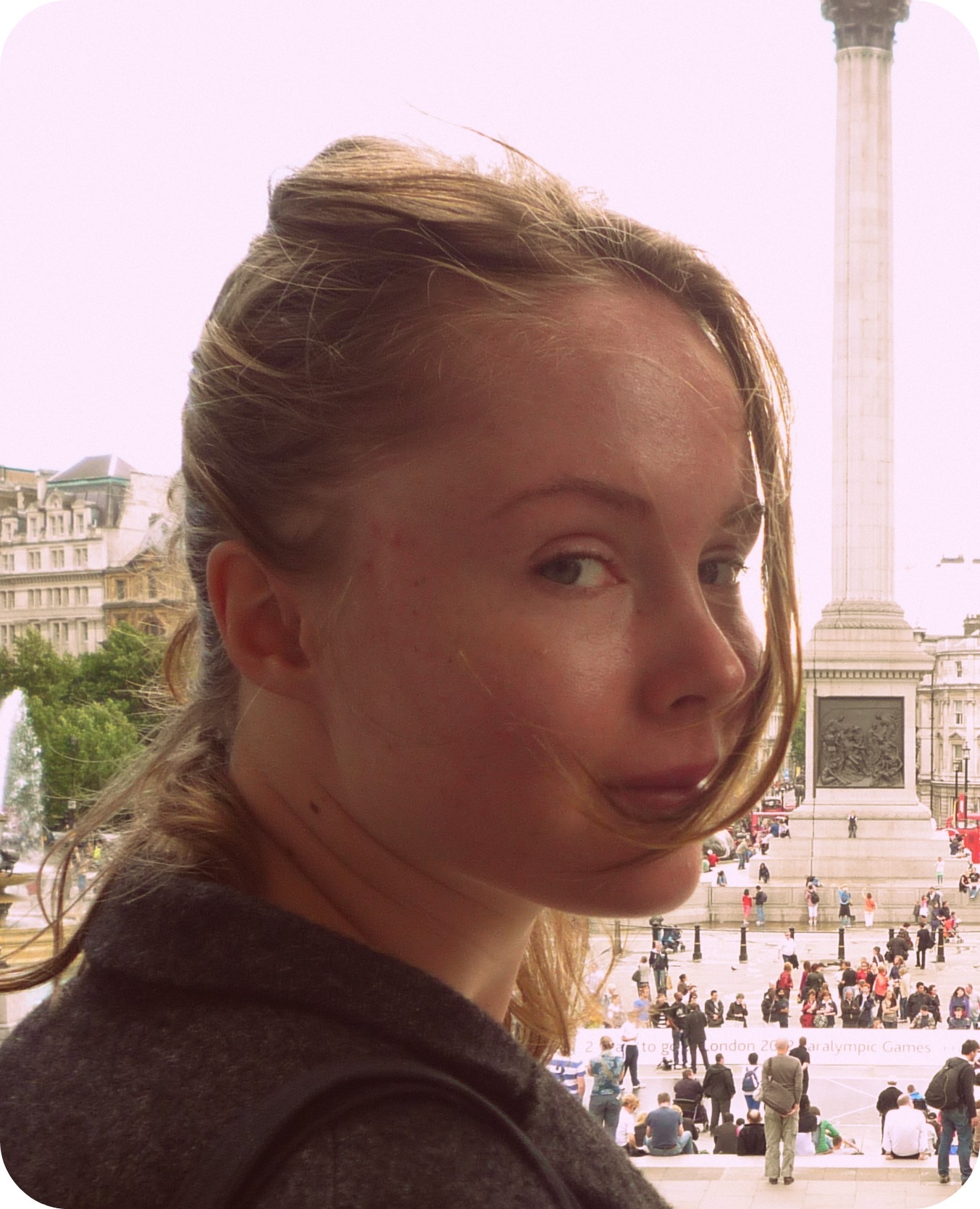
img: Charlotte Day surveying Trafalgar Square in London.

STAY TUNED for Monday’s post, offering a few last-minute Halloween costume suggestions for Displaced Nation citizens.

If you enjoyed this post, we invite you to subscribe to The Displaced Dispatch, a weekly round up of posts from The Displaced Nation, plus some extras such as seasonal recipes and occasional book giveaways. Sign up for The Displaced Dispatch by clicking here!

Related posts:

My Grand Tour through Italy on an art history student’s budget

Today Monika Frise — the daughter of one of our Random Nomads, Helena Halme — joins us as a guest blogger. Monika is an art history student in the UK. Here she tells of her trip to Italy last month with another art history student friend — a travel yarn that makes a welcome change from all the French foodie posts we’ve been doing of late. (That said, Monika does start out by talking about food — it’s Italy, after all!)

At the end of my first year at the University of Birmingham, facing a stressful exam period, I decided to book a holiday to Italy with a friend of mine, Liz. We planned to go in early September, after the summer crowds had ebbed and the weather would be somewhat cooler. We organized to visit five cities: Verona, Venice, Pisa, Florence, Siena and finally, Rome.

Both Liz and I are studying art history. Neither of us is specializing in Renaissance art — I’m studying Eastern European architecture/art and 19th-century French art this year (concentrating on the period just before the impressionists). However, we both loved the idea of making a Grand Tour through Italy to see the Grand Masters’ works, following in the footsteps of European aristocrats of centuries past — we just wished we had their riches to finance our journey!

The trip came around sooner than expected and I for one felt a little apprehensive about what it would be like moving to a different location every couple of days, on a student budget.

Buon appetito

Italians are famously passionate about their food, and despite having to watch our expenses, we were determined not to miss out — even if it meant eating a lot of pizza.

We made a determined effort to avoid restaurants close to large monuments and museums and seek out local eateries instead. We were somewhat taken aback at the prices of food, though — especially in Rome, where we had to search for a long time in order to find a cheap restaurant that also looked good.

Our first night in Verona, the plump, friendly hostel owner recommended a restaurant, Bella Napoli, for “having the best pizza in town.”

She also told us to “touch the left breast” of Juliet’s statue for good fortune in life.

We took her advice on both counts and weren’t sorry. At Bella Napoli, we shared the house specialty, pizza al metro (pizza by the meter), which arrived on its very own table on wheels.

Venice, however, posed more of a challenge. But, on our first night, after walking somewhat aimlessly through the narrow streets for some time, we chanced upon a small osteria offering home-cooked food at great value. For a change, we didn’t have pizza. I ordered gnocchi with tomato sauce: delicious.

The service, however, left a little to be desired — our waitress dumped our change on the table without even a smile. Likewise in Rome, service was rather hit or miss. We had excellent service at a pizzeria where they roll the dough right in front of you, but at a café close to Termini station we waited for our bill for such a long time we could have walked away without paying (yes, the thought did seriously cross our minds!).

Another affordable yet delectable treat is the famed gelato. The best we tasted — and we tasted a lot — was at a place called Rivareno just around the corner of our hostel in Rome . They soften the gelato with a palette knife before spooning it into the cup. There were so many different flavors on offer, but my favorite was probably caramelized fig and ricotta.

“Roughing” it

We students will walk miles to save money, but in a country like Italy that’s not such a bad thing. As Liz and I soon discovered, going everywhere on foot was the best way to take in the local color (not to mention work off all that pizza, pasta and gelato!).

In the small winding streets of Siena, we encountered a small boy playing the drums in little side street whilst a group of old men and women chatted nearby, seemingly oblivious to the racket he was making.

In Verona one night, we happened upon Juliet’s balcony (which we’d seen the day before in the daylight). The bronze statue of Juliet in the courtyard looked completely different when illuminated. Gazing through the gates at her peaceful shape summed up this city for me: bright and vibrant yet calm.

Walking was also a way of avoiding unwanted curiosities in the hostels where we stayed. The hostel in Venice, for instance, had a very bad case of bedbugs — so much so that we spent our second night sleeping on the dusty floor, with only a sheet beneath us. But even that didn’t stop the little blighters. At one point one of the other girls woke up with one of them on her cheek. Unfortunately, despite the beauty of Venetian art and architecture, it’s the bedbugs that made the most lasting impression, rather literally!

That said, walking also exposed us to some humans who behave like pests. More than once did we have to hurry away from some overeager men who were making kissing noises at us, and outside the Arena in Verona, the city of love, a “Roman gladiator” gave Liz a pat on the bum!

Art coming out of our ears

Tourism in Italy involves an endless parade in and out of churches. I reckon we saw about three in every city, apart from Siena where we saw only one, the Duomo di Siena.

We ended up appreciating the cathedral in Siena far more than the Basilica san Marco in Venice, which overwhelmed us with its abundance of Gold Romanesque mosaics and small adjoining rooms replete with countless treasures. Our guidebook had advised us to make several visits, but for me, a single visit was more than enough. Both interior and exterior reminded me of an over-sweet, over-decorated cake.

Since we are both interested in Renaissance art, Florence had a great deal to offer. My wise mother had advised that we pre-order tickets for both the Uffizi Gallery and the Accademia Gallery — the latter of course being the home of Michelangelo’s David.

After smugly walking past the long queue for the Accademia, Liz and I took a seat on a bench close to the David and watched as people circled around it, discussing its various aspects. (We even managed to sneak a picture of the statue whilst the guards weren’t looking, saving us a few extra cents on a postcard.)

At the Uffizi Gallery I particularly loved seeing Flora by Titian — so much better seeing it in a photo for appreciating the colors and brush strokes.

By the time we reached Rome, our enthusiasm for the Grand Tour had flagged somewhat. The Sistine Chapel, where everyone was herded around like sheep, especially disappointed us.

The best part of Rome was our trip to the Pantheon — fantastic! As we wandered around this circular building, I couldn’t take my eyes off the ceiling. I was transfixed.

First of many tours?

I would definitely like to return to Italy one day soon, and perhaps even try living there for a while.

Of the five cities we visited, I could really see myself in Siena even though it wasn’t my favorite place. It’s just that the atmosphere made me feel at home, I think because there were fewer tourists. (I particularly enjoyed my trip to the local supermarket, full of hustle and bustle and the smell of freshly baked bread.)

My Italian, which was very basic, got better as our trip progressed. However I would have to take a lot of classes if I were ever to brave living there!

NOTE: You can read Monika Frise’s art reviews on her new blog, Post Raphaelite, and/or follow her on twitter: @Shmonn.

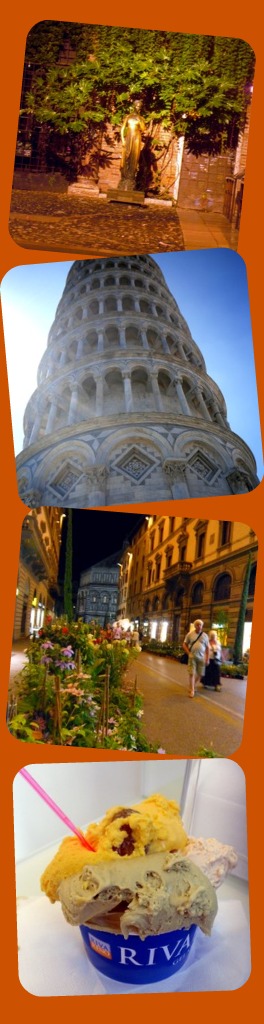
Images: Juliet’s statue in Verona by night; from the foot of the leaning Tower of Pisa; flower sellers in streets of Florence, near the Duomo; three flavors of Roman gelato: pistachio, caramelized fig and ricotta, and crema mediterranea (a Rivareno speciality).

STAY TUNED for Monday’s post, when founding contributing Anthony Windram reports on his attempt to make a Parisian lunch in California, following the recipes of Elizabeth Bard (see also ML Awanohara’s attempt).

If you enjoyed this post, we invite you to subscribe to The Displaced Dispatch, a weekly round up of posts from The Displaced Nation, with seasonal recipes and occasional book giveaways. Sign up for The Displaced Dispatch by clicking here!

Related posts:

Finding Paradise in Provence, Part 2: Our expat foodie asks – Patisserie or Pudding?

In the second of her guest posts this month, Joanna Masters-Maggs talks more about her recent culinary discoveries in France, as we ask her, “Is the foodie capital of the world everything it’s cracked up to be – or does the emperor need to put his clothes on?”

“I’m tired of these perfectly-glazed French tarts”, my husband declared last night. “I want a big, fat, English pudding.”

I looked up sharply. Was he making some untoward comparison between chic French ladies and less well-presented English women, such as myself? I hoped not, for his sake. But he was ruefully regarding the Mille Fueille on the plate before him.

“Some custard too. That would be nice.” He looked at me sadly.

I wasn’t sure how to react. “Get me some Golden Syrup and I’ll make steamed pudding,” I offered. Sixteen years overseas, but how English we are!

Just desserts…every Sunday

We have only been in Aix for six weeks and have held to our plan of finding the best food and drink it has to offer. Part of this includes buying a cake or tart from a patisserie each week for Sunday dinner. I reflected on what we have so far sampled: a chocolate Opera for the weekend of my daughter’s birthday, an open apple tart, another filled with patisserie cream and topped with fruit and, yes, glaze. We tried the Tropezienne which hails from St Tropez and was named by Brigitte Bardot.

Now this “thousand leaves of pastry” sat before us. Like its predecessors, it was pedigree in origin. Only the most shameless “bring–a-dish” guest would try to pass this off as homemade. Perfectly cut, evenly browned, you just knew it would not suffer from a soggy bottom or any similar such indignity.

So why is it that with these desserts fastidious restraint is so easy to find? My husband is right. If we had a steamed syrup pudding and some custard before us, we would have been slavering for second helpings. With this aristocrat, to do so would seem uncouth and unnecessary.

The proof of the pudding…

Perhaps, dare I even suggest, in terms of flavour and texture, if not the skill required to make it, Syrup Pudding and its like are superior as a pudding to their French counterparts. I am ducking the missiles I feel may be coming my way. But if I am unrefined in my tastes, surely I cannot be alone? Syrup Pudding may be simple, comfort food but it is also a divine comination of textures and flavours. The addition of custard, Crème Anglaise if you will, serves to cut any possible cloyingness of texture or the risk of oversweetness. Surprisingly light, but pleasingly substantial, there always seems room for another serving.

I have, on occasion, offered to clean up after dinner, singlehanded. Not some heroic act of self-sacrifice, offered at the shrine of my family’s comfort. Rather, the siren call of the dish the pudding was steamed in, enticing me to scrape it out. Can the same be said for the tin in which a Tarte Tatin was made? I fear not.

Leave it to the experts – or leave it to Mum?

I have been told that no French person would take along homemade pudding as a contribution to a dinner to which he or she had been invited. Such a thing would be to insult the host with a poor quality, amateur offering. Why take some ramshackle amateur affair when there are professionals to do a proper job?

It seems that we English – well, at least, my husband and I – feel differently. The “homemadeness” is what we enjoy. The time spent making it, the compliment to the host. As I cast my mind back to adverts for cakes and packaging for various factory-made cakes and puddings, it is clear that supermarkets and manufacturers are keen to stress their product is “Just like home” or “What Mum used to make.” The Brits will remember Mr. Kipling and his extraordinary cakes, which he liked to bring out for village fetes and cricket matches. It’s just that Mr. Kipling was a factory, somewhere fairly industrial in England, churning out Battenbergs by the thousand.

I have enjoyed and will continue to enjoy my foray into French patisseries. However, I feel it will not end my love of the home-baked, and what I will enjoy in most French bakeries are the comfortable croissants and brioches.

The best of both sides (of the English Channel)

For me food seems less about style and more about comfort and general “toothsomeness”. Is this another difference between England and France? I think it may be. I count myself lucky that, at the moment, I can enjoy both attitudes. But this weekend, my husband will get his syrup pudding and custard. Not, not just custard — make that “Crème Anglaise”!

Related posts:

Finding Paradise in Provence, Part I: An expat foodie’s views on French cuisine for the very young

Displaced Q: in modern French cuisine, who wins the race — the slow-food tortoise or the McDonald’s fast-food hare?

When a Julia Child-like curiosity about French cuisine leads to a displaced life — bienvenue au October theme

If you enjoyed this post, we invite you to subscribe for email delivery of The Displaced Dispatch, a round up of the week’s posts from The Displaced Nation. Sign up for The Displaced Dispatch by clicking here!

Img: MorgueFile

Finding Paradise in Provence, Part I: An expat foodie’s views on French cuisine for the very young

Continuing our theme of French cuisine, today we bring you the first of two guest posts from Joanna Masters-Maggs. Joanna and her husband are originally from England and have four children aged between seven and fourteen. Over the last fifteen years they have lived in seven different countries, and this summer they achieved what is considered by some to be the Holy Grail, the Paradise of company transfers: a two-year assignment in France. Despite her nomadic lifestyle, Joanna has stayed British at heart, and her post therefore is written in British English.

Oscar Wilde once famously said:

“When good Americans die they go to Paris.”

Paraphrasing him, I like to say of the employees of the company for which my husband works that

“If they are good, they will finally be transferred to Paris.”

After living in six other countries during our 15-year marriage, our family has been lucky enough – or perhaps well-behaved enough – to be transferred to France. Not Paris but, in terms of Paradise, close. In fact, some would say we have been even luckier, because we are now based in delightful Aix-en-Provence.

Having spent the last two years in Saudi Arabia, I was more than ready to reacquaint myself with the delights of French charcuterie and wine. While a six-week period of hotels and temporary apartments offered plenty of opportunities to try restaurants, bistros and cafes, there is no point waxing lyrical about Michelin-starred restaurants and the quality of basic ingredients in markets and delicatessens. It’s all been said before, and by people far more qualified than I.

Thankfully, more prosaic matters had piqued my interest before I was invited to write this guest post.

Developing a French palate? It’s child’s play.

One of our first purchases in France was a couple of board games for family game night. Not the usual Monopoly and Trivial Pursuit, however.

“How interesting!” I thought, as I looked at these things in the shop. “Tasting games and smelling games for children? I’ve never seen that before.”

Well, the instructions claimed these pastimes were suitable for young children, but little did I realise how demanding the games would be. I am not four years old (the lower end of the suggested age range for players) but I had trouble distinguishing between liquorice and aniseed. More trouble than I care to admit.

We travel to experience different cultures. But even after living in such various places as Holland, Brazil, and Saudi Arabia – among others – I realised with the purchase of these games that resettling in France with four children was going to be quite the cultural experience.

Out of the mouths of babes

This hunch was confirmed a few days later. My 7-year-old son, Patrick, recently started a new international school here in Aix. As we walked down the leafy lane that leads to the kind of shuttered and shabby chic building this part of France does so well, we met David, one of Patrick’s new friends.

During the ensuing conversation that covered the unoriginal topics we mums tend to ask about, I learned that David had spent his first year in a mainstream French school before attending international school.

“It was hard,” he solemnly informed me. “No one spoke any English, and they were strict. But I miss it.”

“You do?” I asked in the sing-song, too-bright way that mothers always adopt when talking to small children. “Why is that?”

He turned serious eyes on me.

“Well, the food, of course,” he replied.

He was too polite to add “stupid” but it hung in the air.

“The French, you see. They’re good at food. It’s nice here, but in French schools they have three courses and lots of different cheese. We get less cheese,” he added sadly.

If you cook it, they will come.

I was already impressed with the food served at the two international schools my four children attend, so I understood this was praise indeed from David. My children’s schools have resisted the usual route of chips, nuggets and pizza, and instead serve mainly simple grilled meats with vegetables and salads. Wednesdays tend to be more indulgent days, involving cheesy gratins and so forth. Puddings are sparse, and at their most indulgent involve only a small patisserie. No one is allowed second helpings, but fruit is plentiful.

The French are rightly proud of their reputation for good food and believe that appreciating it should form a part of the educational system.

School lunches: a social occasion, and rightly so.

Not since our days in Brazil have I been so enthused by a system of school lunches. Brazil took the whole process one step further. From the ages of 4 and 5, my children sat down at one table with their classmates, teacher, and assistants, and ate together, passing the vegetables and pouring water for one another.

How wonderful to take the time in the middle of the day to eat together and socialize in this way.

Between Brazil and France, I have spent a lot of time in various schools, agitating for better food and a more pleasant way of serving it. Jamie Oliver would have been proud of me. Time and again, though, I was told that the schools had tried switching to healthier food on the menu, but the children didn’t eat it.

“Children must have choice,” the mantra goes. Thus the healthy food, unappealingly presented, is placed next to the chips and baked beans. After a week or so of throwing it away, the contracted caterers stop serving it, to save money and maximize profits.

What the French and Brazilians understand, however, is if the choice is between eating well or going hungry for a few hours, most children will eventually adapt their tastes into healthy eating habits that will last a lifetime.

Good food, small portions, and time given to it. Simple.

Other countries could learn so much from this philosophy, especially those who constantly bewail an obesity problem among their population.

After all, it’s probably no coincidence that I see so few large French people – or saw so few large Brazilians.

.

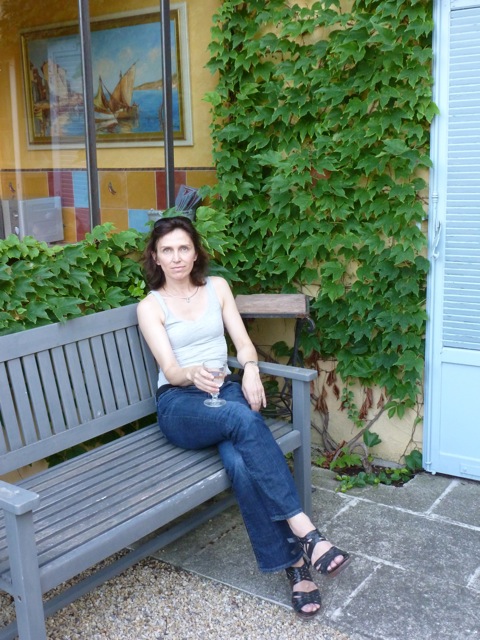
Img: Exhausted but happy! Joanna on her first afternoon in France.

STAY TUNED for tomorrow’s episode of Libby’s Life, when Oliver returns from Vancouver to some news from Libby. Good news — or not?

Related posts:

DISPLACED Q: In modern French cuisine, who wins the race — the Slow Food Tortoise or the McDonald’s Fast-Food Hare?

When a Julia Child-like curiosity about French cuisine leads to a displaced life — bienvenue au October theme

If you enjoyed this post, we invite you to subscribe to The Displaced Dispatch, a weekly round up of posts from The Displaced Nation, plus some extras such as seasonal recipes and occasional book giveaways. Sign up for The Displaced Dispatch by clicking here!

The road trip and the teenage soul

Beginning today, Charlotte Day joins The Displaced Nation as monthly columnist and will comment on our themes from her third culture kid (Australia-US-UK) perspective. September, of course, was road trip month. Though Charlotte has yet to earn her driver’s license, the prospect of free time between high school and university has begun to fuel her imagination…

Sitting at my English boarding school desk, with English boarding school weather drizzling down from the sky outside my window, the idea of a road trip seems utterly foreign. While I’ve been putting together my application for English universities over the past week, which involves a disgustingly trite “personal statement,” the post-exam summer has been jeering at me from behind an ever-growing pile of books.

The road trip represents all of a stressed and stifled sixth former’s ideals, the first being absolute freedom. This freedom is born more of security than anything else — exams finished, hopefully a university offer in the bag, five whole months to dispose of, no looming responsibilities. The image of the angst-ridden teenager is romanticized and misguided: we do not seek malaise and uncertainty but rather comfort and certainty.

Evaluated in this sense, the road trip is akin to a ghost story. The pleasure we take in listening to ghost stories comes from the knowledge that, though the tale itself may threaten, secure reality encircles and protects us. Teenagers nowadays go adventuring in South America, more often than not supervised by charitable organizations and subsidized by their parents. Setting off into the wilds, they seek a future that doesn’t seem vulnerable to any current of chance. Rather, adventure is a brief detour from a pre-set plan.

I have often contemplated my own post-exam adventure in the form of a road trip across the Australian desert with one of my oldest friends. Yet, I am tempted to wonder, what is the point of venturing into the unknown, if only to return to the comfort of the known?

A true coming-of-age adventure would take courage — and would not end in merely turning the van around and arriving home with several memory-sticks full of photographs. That said, I do not cancel the possibility of driving through my native country — an experience that would very likely prove both enjoyable and “life-changing” in a tame sense. But my phantom road trip, eschewing tameness and security, is, undoubtedly, more interesting material for this column.

Let us begin, then, with the road. (I can’t say I know much about roads, save that hairpin bends on a mountainside are as hair-raising as country dirt roads are romantic.) Given that this is the Displaced Nation, familiarity with the territory is out of the question. I will forcibly displace myself — ruling out the United States, England and Australia.

Setting out to conquer … Western Siberia?

This still leaves a huge selection of countries — and having done the electronic version of sticking a pin at random in a world atlas, I have settled on Western Siberia.

Given I am a passionate Russophile and speak a modicum of Russian, my cursor couldn’t have landed on a better country. But confronted with the expanse of Western Siberia, it is doubtful that either of these qualities will be of much use. Perhaps it is telling that Google maps cannot plot a journey from Yakutsk, through Irkutsk and Krasnoyarsk, to Novosibirsk.

One dilemma instantly presents itself: where would I stop and spend the night? I would doubtless end up sleeping in the car for the vast majority of the trip, which brings us to the car itself. In my perhaps misguided road-trip fantasies, I had always pictured one of those old Volkswagen vans — slightly falling apart, squeaking along an endless highway.

But the prospect of breaking down in the middle of Western Siberia does not appeal to me. I must settle for a more prosaic Winnebago-type vehicle, and seek excitement elsewhere. And, as traveling through a wooded desert of sorts, alone, would be not only foolhardy but isolating, a companion seems necessary.

But who, of my sensible friends and relatives, would jump at the chance to travel Siberia in a Winnebago with an insane Russophile?

Given this journey is a child of my fancy, I will not scruple to add another fantastic fabrication: someone whom the power of affection has persuaded to join me on my ill-advised quest. In short, a boyfriend: thoroughly idealized, as a genuine boy in his late teens would prove a terrible nuisance, stuck in a Winnebago from Yakutsk to Novosibirsk. (But of course, the conceit of the comfortable Winnebago is also absurd: such things are found with difficulty in Russia.)

Relishing the … monotony?

You may ask, save an endless parade of trees, open space, greyish vegetation, what would I hope to see? Just that, smattered with the odd town, church cupola, river, lake, blue sky, grey sky, sunrise and sunset.

Unlike Konstantin Levin of Anna Karenina, I do not see myself losing my heart to the Russian land, and devoting my future to wheat threshing. I would become an unfulfilled Chekhovian heroine, stifled in the provinces.

But I believe the fields must be seen, just as we must eat bread, where macaroons would bring more pleasure to the taste buds. Macaroons, far from nourishing, make us fat and complacent. Bread sustains, and makes us grateful to be alive and fed.

I would like to see land in all its endless, characterless glory, to drive from sunrise to sunset, and to talk the night through (although not literally, as I would be loath to crash my Winnebago through exhausted inattention).

I envisage some sort of talisman, suspended from my rear-view mirror—and not one of those scented pine trees, seen so frequently dangling from the rear-view mirrors of American cars. Perhaps an Australian gum leaf on a string, as a reminder of my greater journey’s starting point, now eleven years in the distance.

After all, if I am not to return to the known at the end of this journey, I must bring a fragment of it with me, into the dangerous, the blank, the uncharted space, from which discovery springs.

Readers, any questions or suggestions for Charlotte, before she sets out on any phantom — or real — road-trip adventures?

img: Charlotte Day surveying Trafalgar Square in London.

STAY TUNED for Monday’s post, the first in a new series on the joys and challenges of being an expat in France and attempting to master French cookery.

If you enjoyed this post, we invite you to subscribe to The Displaced Dispatch, a weekly round up of posts from The Displaced Nation, plus some extras such as seasonal recipes and occasional book giveaways. Sign up for The Displaced Dispatch by clicking here!

Related posts:

Gotta helmet? Time to burn some rubber, have a real travel adventure

The Displaced Nation has dedicated the month of September to the ideas within Robert Pirsig’s classic, Zen and the Art of Motorcycle Maintenance. But enough with theory. What’s it really like to see the world from the back of a motorcycle — and what are us more timid types missing out on? Rubber hits the road today with Matthew Cashmore, aka The London Biker. Braaaaown… brraaoom…… rrooaaarr………. Take it away, Matthew! NOTE: This post has not been edited for British spelling.

There are some things in life that just have to be done. Laying on your back staring at the stars, wondering which ones are dead and which are still blazing. Getting so drunk on cider that you can no longer stand (perhaps that’s just me). Or travelling the world by motorcycle.

The last, many people would say, is optional. But it’s not. If you feel as I do, motorcycle travel is as essential to life as water or food, then there is only one way to do it.

I’m not the first to point out that seeing the world from a motorcycle is better than any other means of travel — just dig out a copy of Zen and the Art of Motorcycle Maintenance or my personal favourite, Jupiter’s Travels, by Ted Simon.* You’ll only read a quarter of each book before you discover why this method of travel trumps the rest. You’re part of the world in which you’re travelling. There is nothing between you, the elements and the people with whom you interact.

I’ve been fortunate enough to see much of the world. I’ve backpacked, travelled by plane to amazing cities, jumped on buses or driven cars. But nothing, absolutely nothing, can match the experience of the wind rushing past your head trying to knock you off your bike, as you hurtle between towns and villages. And nothing can give you a greater grin than riding across the bay in San Francisco on the back of a growling Harley — safe in the knowledge that in a car this would be just another American highway.

If you don’t ride in the rain, you don’t ride…

It does take a certain amount of effort, though. This summer I did a short run from London out to Budapest via France, Germany, Austria and then into Hungry. The return leg took me through northern Croatia, Slovenia, back into Austria and up into the Alps over into Italy and then back over the Stelvio Pass into Switzerland, France and finally home. It rained the entire trip. Every single morning I was greeted with sheets of rain. I was beginning to suspect it was actually following me to Budapest. Each night I was soaked to the skin — even with the most expensive rain gear. Each night I was dog tired, and I really had to question what I was doing. What kind of a nut case chooses to spend his summer holiday riding a motorbike half way across Europe in the rain?

The reason I, and many others like me, do this is because you can ride for eight days in the rain — and then out of nowhere the clouds will clear and you’ll be presented with a road of perfect grace. A strip of tarmac that sings as you press on, a view that leaves you crying because of its beauty. Something you would never have seen had you been in a car or a bus. Something you’ve had to work to achieve — and it’s even more beautiful for that.

A parable of the hospitality shown to bikers

On the Budapest trip I found myself at the top of the Austrian Alps. I was running a day behind because I’d had a stomach bug back in Budapest. I was determined to make up that lost day so that I could still get over the pass into Switzerland ahead of a (yet another) rain front. I had been riding for ten hours, I had another six ahead of me, and I was already on my fourth change of clothes. I was incredibly fed up. Why on earth was I doing this?

I pulled into the first service stop I’d seen for about 150 miles, 2000 metres above sea level and hidden by cloud, rain and spray. Filling the bike up with petrol I spotted a small restaurant complete with a hotel — bliss, escape! I headed inside, dripping water everywhere. As I walked through the door I must have looked like a monster from the deep. I was dressed head to foot in every single piece of waterproof gear I could find — complete with an army surplus poncho. The restaurant manager took one look at me and ordered me onto a piece of lino, where I promptly created a rather large puddle. She demanded I remove my clothing leaving me standing there in just my thermals. I shivered, waiting for her next command. Did they have ways of making me warm?

My gear was whisked off (it came back nearly dry and very warm), and I was pointed in the direction of the shower and given a hot towel. I emerged a different man. Clean clothes, warm, and for the first time in two days, dry. Ushered to a seat, I took the opportunity to eat well — feasting on sausage and strudel, the best Austria had to offer. Buoyed by such amazing hospitality I got back on the bike and rode on. As I rounded the first corner the rain stopped and I hit Italy, sun, and the kind of twisty roads God clearly made for bikers.

I could say this was a one off, but the more I travel the world by motorbike the more I come to realise that the very thing that makes you vulnerable is the very thing that makes you approachable. It’s different if you’re travelling with other bikers, but when you’re on your own it’s a perfect combination of being totally exposed to the environment and more importantly to people.

This is what makes travelling by motorcycle so special. The openness, the access, the smells, the sounds, the people who are curious because you’ve rolled into town in something other than a bus or 4×4. If you want to experience, to imbibe, the world through which you travel…there is only one option. Gotta helmet?

* Suggested further reading:

Matthew Cashmore works in digital publishing. He keeps track of his “random thoughts” on his blog, The London Biker. He also has a YouTube channel, where he posts videos about his life on the road, camp cooking and related topics.

img: Matthew Cashmore in Budapest, July 2011.

STAY TUNED for Tuesday’s post, on the diner food that has played a part in many an American road trip.

If you enjoyed this post, we invite you to subscribe to The Displaced Dispatch, a weekly round up of posts from The Displaced Nation, plus some extras such as seasonal recipes and occasional book giveaways. Sign up for The Displaced Dispatch by clicking here!

Related posts: