The Displaced Nation

A home for international creatives

Give a dog a chocolate — why US-based expats shouldn’t use UK Chocolate Week to revive an old complaint

Continuing this month’s food-related theme — and in honor of National Chocolate Week in the UK — founding contributor Anthony Windram weighs in with some thoughts on the often contentious expat topic of American chocolate.

Though I do, like most people, enjoy a bit of chocolate, I’ve never been a connoisseur of the stuff. Any old rubbish will do for a quick fix, truth be told. I’m not one of those people looking for what percent of cocoa is in a bar. As a six year old, I remember my Nana — God bless her, then in the beginnings of dementia — had bought me a packet of chocolate from the corner shop. I can still recall the packet which, rather tellingly, was taken up with the picture of a happy dog. The chocolate inside was a little more out of the ordinary, a little grittier than normal. But it was chocolate and I was happy sat on the floor of my Nana’s living room munching away while watching TV, my mouth doubtless covered in chocolate. My dad, however, happened to notice the packet of chocolate and asked me if he could see it for a moment. Being a trusting child I made the mistake of giving him the packet of chocolate. I was never to see it again.

Nana, I was later to learn, had inadvertently purchased for me some chocolatey dog treats. However, as I recall they really weren’t too bad. Yes, the texture was more gritty than you’d prefer, but I had been as happy as Larry eating them. That should have been the moment that I realized that I was not, and never would be, a chocolate aficionado. When I was older and the only chocolate that I could find in the house was cooking chocolate, I was more than happy to snack on that, too. Coincidentally, its grittier taste reminded me of the dog treats I’d been given all those years before.

In its own way eating that chocolatey dog treat turned out to be good preparation for living in the US. The European expat now often seems to have strong views about chocolate in the US. Without any prompting they’ll bring the subject up and scrunch their face in disgust. “American chocolate,” they’ll say, spitting out the words like they probably do the chocolate itself, “is disgusting.”  And yes, I will admit, that it’s not great. Hershey’s chocolate has a lingering, bitter aftertaste that after eating it I often think I’m suffering from GERD. But you can eat a Milky Way and for the most part it is fine. You’ll possibly suffer from cognitive dissonance from the fact that an American Milky Way is, in fact, like a British Mars bar rather than a British Milky Way bar which is, in turn, like an American Three Musketeers Bar…oh, the confusion! But the chocolate in a Milky Way, while different, isn’t necessarily worse. It’s just in the grand scheme of things in the world of chocolate, American chocolate is the chocolate dog treats my confused Nana bought — and that isn’t something I’m going to complain too much about.

Question: What are your thoughts on American chocolate?

Image: MorgueFile

STAY TUNED for tomorrow’s post, part 2 of Joanna Masters-Maggs’ quest to find paradise in Provence.

If you enjoyed this post, we invite you to subscribe to The Displaced Dispatch, a weekly round up of posts from The Displaced Nation, plus some extras such as seasonal recipes and occasional book giveaways. Sign up for The Displaced Dispatch by clicking here!

Related posts:

Dear Mary-Sue: Things to do in Paris

Mary-Sue Wallace is back and she’s dishing out advice to the helpless like it were soup, soup from a big tureen of common sense in the soup kitchen we call the blogosphere … or something like that. If you are looking for solace, then you need Mary-Sue Wallace. Submit your questions and comments here, or if you are a shy bunny requesting anonymity then you can email Mary-Sue directly at thedisplacednation@gmail.com.

Dear Mary-Sue,

Growing up here in Japan as a big-time Francophile, all my life I’ve wanted to visit Paris. This fall I finally have a chance to go visit it for myself. I am so happy at the thought. I will get to stroll the streets and eat plenty of good food. Being such a travel expert could you give me a list of the top things you think I should do when visiting Paris?

— PA, Kyoto

Dear PA,

Ol’ Coley Porter put it best when he wrote that lovely classic of his, I love Paris. “I love Paris in the springtime / I love Paris in the fall / I love Paris in the winter when it drizzles / I love Paris in the summer when it sizzles.” And that sums up so perfectly and so succinctly my own thoughts about this darlin’ city. No matter the time of year, I fall in love with it. Whenever I arrive in Paris, I always make sure on that first night that I go for a stroll along the Seine. Ah, bliss. And when that’s over I go to a little cafe that I adore that is called…

….wait a moment….

….hmm….

….I’m sorry about this, PA, but I just noticed that you wrote that you’re from Japan. In that case, forget Paris. It’s overrated. Have you thought of visiting Malmo? I hear there’s also an interesting cement works in Frankfurt, you could go there. I’m sure it’s fascinating. And people keep telling me Swansea is the Paris of south Wales…

…Aw, shoot. As a loyal Mary-Sue-ite, you deserve a fuller explanation from me, PA. A Japanese Francophile finally visiting Paris after a lifetime of waiting? Aw, honey, sounds like you could be a prime candidate for Paris syndrome. Certain places just seem to have a strange effect on people. Believe me, I know this only too well. It’s why I’m never going back to Jerusalem. Went on a cruise there with my hubby Jake a few years back. Darn it if he didn’t come over all Messianic on me – thought he could walk on water. Well, the fine people at Cunard weren’t too impressed when he went overboard when trying to be all Matthew 14.

And Paris syndrome ‘aint no picnic either, honey. You can end up psychologically destabilized, suffering anxiety, hallucinations, feelings of persecution. Many Japanese visitors to Paris go there with such a romanticized image of the city and its occupants, that it’s a place of sophistication and politeness, that when they finally get there and see for themself the surly, rude reality of Paris they simply can’t cope. 

So PA, I ask again, have you thought about going to Frankfurt? 

— Mary-Sue

Anyhoo, that’s all from me readers. I’m so keen to hear about your cultural issues and all your juicy problems. Do drop me a line with any problems you have.

Mary-Sue is a retired travel agent who lives in Tulsa with her husband Jake. She has taken a credited course in therapy from Tulsa Community College and is the best-selling author of Traveling Made Easy, Low-Fat Chicken Soup for the Traveler’s Soul The Art of War: The Authorized Biography of Samantha Brown, and William Shatner’s TekWar: An Unofficial Guide. If you have any questions that you would like Mary-Sue to answer, you can contact her at thedisplacednation@gmail.com, or by adding to the comments below.

img: Close, by Corina Sanchez.

STAY TUNED for Monday’s post.

If you enjoyed this post, we invite you to subscribe to The Displaced Dispatch, a weekly round up of posts from The Displaced Nation, plus some extras such as seasonal recipes and occasional book giveaways. Sign up for The Displaced Dispatch by clicking here!

Related post:

An un-American in an All-American diner

Continuing this month’s theme on road trips founding contributor Anthony Windram weighs in with some thoughts on the American diner.

There’s neon tubing that emits a purple glow around the clock that tells me it’s nearly 10pm. The dinner service is long over, the families now dispersed and only a scattering of drifters and loners are left. It’s still, at least, another 45 minutes before the late-night drunken crowd makes an appearance.  This diner is more Edward Hopper than Norman Rockwell. Across the parking lot is a strip club, as the night draws on and into morning some of its patrons, I imagine, will head over here to have a burger or to take advantage of that most American of institutions – the 24-hour breakfast.

There’s a still sadness to the place despite the best efforts of the waitress who exudes a friendly busyness. She could be anything from her late-40s to her early-60s. She calls me “sweetheart” when she comes over to give me a refill of greased coffee. She doesn’t, however, call it “a cup of Joe” — that would be one cliché too many.

Mentally, I take a step back from this scene and try to view all around me as a tableau and can’t but help but think this is Americana that I am sat in, this is America.

Perhaps this is the “real” America; a banal phrase uttered by a banal politician, but a phrase that does strike at something deep in the American psyche.

Dr George Lewis, director of American Studies at Leicester University, has started what the Guardian claims is the “first sustained historical analysis of the term un-American.” While there may be some confusion over quite how one defines being “un-American,” what seems certain to me is that this cold burger and this diner is decidedly the opposite of “un-American”. Though I am in Bakersfield, California, I could be anywhere in the Union, be it red state or blue state.

When I first moved to the US, to my now shame, I found myself fascinated by the Food Network show Diners, Drive-Ins and Dives, hosted by the hyperactive Guy Fieri, a man with the cholesterol levels of someone twice his age. Fieri is a TV host with absolutely no sense of discernment. Everything that he comes across, everything that he tastes, must be spoken about in glowing terms to the point that nothing that Fieri says has any real meaning whatsoever.

And yet I did find myself compelled by the show for illuminating further for me the American diner and showing me places that occupy a place in the country’s cultural milieu that the English cafe doesn’t even come close to back home. I soon stopped watching Diners, Drive-ins and Dives — not because my view of diners changed, but because it was (and is) a God-awful program and there’s only so many times you can watch an overweight Fieri eat some barbequed pork and then pronounce it “awesome”. But there was one thing in particular about Fieri’s show that they always got wrong. They would always show the diners when they were packed and buzzing with a family friendly atmosphere. And while I wouldn’t suggest that that’s not the case, what I find interesting is that when you roll into a strange town late at night and find yourself at a diner, regional and political difference tend to dissolve. You are in a place that is resolutely American rather than California, or Colorado, or Vermont, or…I could go on.

Fieri’s show, a sort of televisual equivalent of Pravda which can only emphasize the positive, misses out on what I am experiencing here in Bakersfield as the clock, that has neon tubing wrapped around it, hits 10 and I ask for my check. Here, and which Fieri always misses, is a quiet efficiency mixed with a low-burning malevolence. It’s that mixture of warmth and fear you get when your waitress flashes you a warm smile but you know you’re in a moment going to be stepping out back into that parking lot — and in the back of your mind you’re just a little concerned that this might be the night where you get shot by a drunk coming out of the strip club.

Question: What’s your experience of American diners?

Image by awindram.

STAY TUNED for tomorrow’s interview with the travel writer Allie Sommerville. NOTE: All DISPLACED DISPATCH subscribers will be entered in our giveaway of Allie’s book, Uneasy Rider.

If you enjoyed this post, we invite you to subscribe to The Displaced Dispatch, a weekly round up of posts from The Displaced Nation, plus some extras such as seasonal recipes and occasional book giveaways. Sign up for The Displaced Dispatch by clicking here!

Related posts:

Dear Mary-Sue: Tempted to make invidious cross-cultural comparisons

Mary-Sue Wallace, The Displaced Nation’s agony aunt is back. Her thoughtful advice eases and soothes any cross-cultural quandary or travel-related confusion you may have. Submit your questions and comments here, or else by emailing her at thedisplacednation@gmail.com.

Dear Wallace-sensei,
As a Japanese expat living in New York, I’m finding myself becoming increasingly unsympathetic to my adopted city. Don’t get me wrong, Wallace-sama, I love it here. It’s just that I’ve found the hysteria surrounding first the earthquake and then Hurricane Irene a little hard to take considering the natural disasters Japan has had to deal with this year. Any advice for how I could stop these uncharitable thoughts that I am having?
— SY, New York City (originally Tokyo)

Dear SY-san,

Let me tell you a little story. There was once an attractive, physically fit young girl. She wasn’t from anywhere exciting, just a small town girl from West Virginia. Her father was a police officer in the town. When this young girl was 10, her father was shot and killed when apprehending a robbery. The girl was sent to Montana to live with her uncle. She didn’t like it in Montana, certainly not on the sheep farm her uncle owned. She tried to run away, to where she didn’t know, she just knew she wanted to be anywhere but Montana. But as she ran she witnessed something awful, the lambs from her uncle’s farm being slaughtered for market. She heard their cries, she still does, SY. She still does — when she dreams. It didn’t stop her running, though — she kept running this small girl.

The girl spent the rest of her childhood in a Lutheran orphanage. It was okay, though she still dreamt of the lambs. The girl was smart, though: she had gumption, she had tenacity and she was able to enroll into the University of Virginia on a full scholarship. When she left college, she applied to the FBI’s training academy. It was the late 70s, it wasn’t easy being one of the only women in the academy. But this girl got on with it. She was uncomplaining, and she was the best, she knew that. None of that sexist bull sticks when you know that.

On completing the training, this girl, now a young woman, joined the Behavioral Science Unit. She was part of a team that traced down serial killers — tried to get in their heads, think like they think. She was sent to a Baltimore asylum for her first interview, to meet with a serial killer who just might be able to help her with the case she had been assigned…

…Sorry, I digress, but the point, SY-san, is that that young girl was, in fact, little ol’ me. Yes, hard to believe, I know. I wasn’t always an agony aunt. Anyhoo, the point is some serious s**t went down. Some really creepy, really heavy stuff. So when I get invited round to Valerie Johnson’s for our book club meeting (second Tuesday of the month — we’re reading The Help at the moment; FABULOUS, you MUST read it), and Valerie starts recounting how she thought there was a robber in her garden the other day and she feared she was going to die — even though it just turned out to be Miguel, her 60-year-old Hispanic gardener — I just bite my tongue. Of course, I want to tell Valerie that she doesn’t know fear until she’s been trapped in a house with a serial killer knowing only one of you is going to get out of there alive. No, that would be rude. So I just sip my raspberry lemonade and nod politely as Valerie talks. New York, dear SY, is your Valerie Johnson. Tolerate her, SY, no matter how much you’d like to wring her neck.
— Mary-Sue

Anyhoo, that’s all from me readers. I’m so keen to hear about your cultural issues and all your juicy problems. Do drop me a line with any problems you have, or if you want to share your fave meatloaf recipe with me (yum! yum!). As they say in Italy, “ciao!” — or, as my (still!) unmarried youngest son (he’s nearly thirty, I despair of him, I really do) might say: “See you on the flip.”

Mary-Sue is a retired travel agent who lives in Tulsa with her husband Jake. She has taken a credited course in therapy from Tulsa Community College and is the best-selling author of Traveling Made Easy, Low-Fat Chicken Soup for the Traveler’s Soul The Art of War: The Authorized Biography of Samantha Brown, and William Shatner’s TekWar: An Unofficial Guide. If you have any questions that you would like Mary-Sue to answer, you can contact her at thedisplacednation@gmail.com, or by adding to the comments below.

img: Close, by Corina Sanchez.

STAY TUNED for Monday’s post, on the wide variety of vehicles that have been used for road trips.

If you enjoyed this post, we invite you to subscribe to The Displaced Dispatch, a weekly round up of posts from The Displaced Nation, plus some extras such as seasonal recipes and occasional book giveaways. Sign up for The Displaced Dispatch by clicking here!

Related post:
The Displaced Nation’s Agony Aunt: Introducing Mary-Sue

Please give a warm welcome to Mary-Sue Wallace, The Displaced Nation’s agony aunt. We’re delighted to have Mary-Sue on board and know that her thoughtful advice will be able to ease and soothe our readers with any cross-cultural quandary or travel-related confusion that they may have.

Mary-Sue is a retired travel agent who lives in Tulsa with her husband Jake. She has taken a credited course in therapy from Tulsa Community College and is the best-selling author of Traveling Made Easy, Low-Fat Chicken Soup for the Traveler’s Soul, The Art of War: The Authorized Biography of Samantha Brown, and William Shatner’s TekWar: An Unofficial Guide. If you have any questions that you would like Mary-Sue to answer, you can contact her at thedisplacednation@gmail.com, or by adding to the comments below.

I’m a 68-year-old retired insurance salesman from Buffalo, NY. Six months ago I got married for a second time to a woman that I met on www.meetukranianbrides.com, an international matchmaking site. My new wife, Oksana, is 24 and she seems increasingly distant with me. I’m worried that she doesn’t like Buffalo as much as I thought she would and that she’s having second thoughts about me. What can I do? DP, Buffalo.

Oh, DP, I think it’s time to start turning that frown upside down, don’t you? As you write in your letter, you’re a retired insurance salesman from Buffalo. What’s not to love about that? How can that fail to get the passion inflamed? My husband, Jake, is a retired insurance salesman from Tulsa, and let me tell you, I could not be happier — both in and out of the bedroom.

I bet you have a nice little pension from a life spent working hard. Now is the time to open up that wallet and throw the moolah around a bit. That way you can have a romantic time while also showing off all the best that Buffalo has to offer. Take her to Country Buffet or to Cracker Barrel, order her the meatloaf, she’ll soon stop her pining for Odessa. And over your romantic all-you-can-eat buffet, why not take this time to open up about yourself. Us gals love to know how our hubbys tick, believe me. Tell Oksana about your time as an insurance salesman. Tell her precisely how premiums work. Explain how your job was to give peace of mind to your average Joe. Believe me, Oksana will be reminded of just why she fell in love with you in the first place, that magical moment when she logged into her email and saw the JPEG file of your passport photo you’d sent her.

As an Irish Expat in Austria I sometimes have a hard time connecting with people. It seems humour-wise I’m on a different wavelength to everyone else. I’m used to using humour to diffuse situations or to put people at ease, but every time I make a joke here it’s met with stony silence. The sort of stuff that they laugh at I get really confused by. How can I bridge this humour gap? MA, Vienna.

It’s Austria, stony silence is a good thing. It’s when they start laughing at your jokes you’ve got a problem — that’s the time you really need to ask for help.

img: Close, by Corina Sanchez.

STAY TUNED for tomorrow’s post, on celebrated women travel writers of old.

If you enjoyed this post, we invite you to subscribe to The Displaced Dispatch, a weekly round up of posts from The Displaced Nation, plus some extras such as seasonal recipes and occasional book giveaways. Sign up for The Displaced Dispatch by clicking here!

A glowing moment of enchantment in a displaced summer

Continuing this month’s theme on Enchanted Summer, contributor Anthony Windram weighs in with his opinion.

Elizabeth von Arnim, who wrote The Enchanted April, was right in selecting April as the month of enchantment. Spring charms me in a way that summer doesn’t. The budding boughs are full of fresh scents, to borrow from Christina Rossetti, and the land restores itself. Nature, in a universe governed by entropy, pulls off a majestic conjuring trick.

By contrast, I find summer a little unenchanting. Let’s face it, it’s not a good time for the English. We can’t really be trusted with summer. We should be banned from it, it’d be for the best. Pack us all up and send us to the Arctic for three months. That way we might avoid the collective fever that descends upon us where we dehydrate our bodies with copious quantities of lager and show off our sun blistered skin and bad tattoos.

So, as you probably have gathered, I’m not much of a summer fan and that hasn’t changed having now lived in places that have actual, proper summers as opposed to England’s illusion of a summer. I can usually be found in the summer months (when not enjoying a self-imposed seasonal exile in the Arctic) wandering from one airconditioned building to another. If I do have to venture out into the heat, I only do so after liberally applying sunblock (factor 100).

But this post is about enchantment with the summer, and it’s only when the sun has set and the temperature has lowered that such moments have occurred. I share Simon Wheeler’s thoughts on the sounds of crickets. To me, it’s a foreign sound. A memory of childhood holidays abroad. Hearing that rhythmic sound each evening reminds me that I am in a foreign country, and as I listen the everyday mundanity of my setting dissolves away.

I am not, despite what this post might suggest, an amateur entomologist. If anything, I have an immediate revulsion with most creepy crawlies, but my second summer enchantment also involves them and like the music of the crickets it was a fleeting moment that stripped me of cynicism and returned me to childhood. It was my first summer in the US, I was in my in-laws’ garden. I was listening to the crickets and feeling very happy with myself when an insect flew past me, its lower abdomen pulsating a yellow, illuminiscent light. I knew the answer, but I couldn’t be certain as I had never seen one before. “Is that a firefly?” I asked.

And where there had been one, there was another, and then another. Looking around, thrilled in the same way I would have been as a child, it seemed that there was a swarm of fireflies captivating me utterly — a glowing moment of enchantment in the summer evening.

DISPLACED Q: What’s your most enchanting memory of a summer spent in your adopted homeland(s)?

STAY TUNED for tomorrow’s discussion of The Displaced Nation’s themed posts.

If you enjoyed this post, we invite you to subscribe to The Displaced Dispatch, a weekly round up of posts from The Displaced Nation, plus some extras such as seasonal recipes and occasional book giveaways. Sign up for The Displaced Dispatch by clicking here!

Related posts:

CONTEMPORARY DISPLACED WRITING: David Foster Wallace – A Supposedly Fun Thing I’ll Never Do Again

A few weeks ago I found myself in Claremont, California. I hadn’t intentionally planned to stop there, it was a spur-of-the-moment thing. I’d been at a wedding in Southern California the day before, and as I made the long drive back home the next day my stomach began to rumble, and there were signs on the highway for Claremont. That name rang a bell with me, but I couldn’t quite recall why. Possibly, being not the world’s greatest driver, I was too busy concentrating on the road, and the suicidal, kamikaze driving of the locals, to really stop and think on why the name Claremont was so familiar to me. My wife told me that it was probably because I’d heard of Ponoma College, a liberal arts university, which is based in downtown Claremont. That certainly sounds familiar. Yep, it must be that, I thought. And being a college town, it seemed like the perfect place to stop for lunch on a Sunday afternoon.

It was only as after lunch as I was getting back into my car – already dreading the thought of getting back onto the highway, staying on it for another 6 hours, and sharing it with mad men – that I realised why the name Claremont and Ponoma College had seemed so familiar. It wasn’t through a synapse suddenly working, finally passing a neuron to that part of my brain that stores all my thoughts on Claremont. No, it was my wife googling Ponoma College on her iPhone. Reading its Wikipedia entry, she said, “Oh, David Foster Wallace was a professor here. You must have known that, surely?”

David Foster Wallace had taught at Ponoma College, and it was in Claremont that he had sadly taken his life in 2008. You probably already know about him, so I won’t waste time repeating things here that you already know. What I will note is what an important writer he has been for me. Foster Wallace was not, as far as I know (or as far as I can remember, and as we have established, it’s not clear if we can really trust my synapses) an expat, which is what this blog focuses on. His writing does, at least to me, convey better than any other writer of his generation a sense of displacement with himself and with his America.

Moving to the U.S. in 2007, Foster Wallace’s essays were something I eagerly reconsumed. I’d read them early, but that was from the position of being a young Englishman in his early 20s who had never been to the U.S. Somehow, it didn’t count as much. Now with an I-551 visa stamped in my passport, Foster Wallace’s essays, along with de Tocqueville were the first books off my shelf as an American resident. Like de Tocqueville, Foster Wallace, though American, gave me an outsider’s perspective on my new homeland.

So this week’s displaced writing is David Foster Wallace’s essay “A Supposedly Fun Thing I’ll Never Do Again.” It was first published in Harpers and has since been republished in book form along with other Foster Wallace essays. It’s the Harpers version that I’m going to link to as it’s still available for free on the web. The essay details an assignment Foster Wallace had, trapped and displaced, on a Carribean cruiseliner and which is the supposedly fun thing he’ll never do again.

Click below to read.

“I have seen sucrose beaches and water a very bright blue. I have seen an all-red leisure suit with flared lapels. I have smelled what suntan lotion smells like spread over 21000 pounds of hot flesh. I have been addressed as “Mon” in three different nations. I have watched 500 upscale Americans dance the Electric Slide. I have seen sunsets that looked computer-enhanced and a tropical moon that looked more like a sort of obscenely large and dangling lemon than like the good old stony U.S. moon I’m used to. I have (very briefly) joined a Conga Line.”

STAY TUNED for Monday’s post, when we explore next month’s theme: “An Enchanted August.”

If you enjoyed this post, we invite you to subscribe for email delivery of The Displaced Nation. That way, you won’t miss a single issue. SPECIAL OFFER: New subscribers receive a FREE copy of “A Royally Displaced Tea.”

Related posts:

DISPLACED Q: Is the “noble savage” trope still relevant to today’s expats?

As the July theme for The Displaced Nation is Pocahontas, it seems a fitting moment to ask whether tourists and expats still cling to some kind of notion of the “noble savage” in the countries where they visit and live.

The answer of course should be a resounding “no” — because today’s global nomads (or anyone for that matter) have no business treating the people they meet in other countries in a condescending, racist manner.

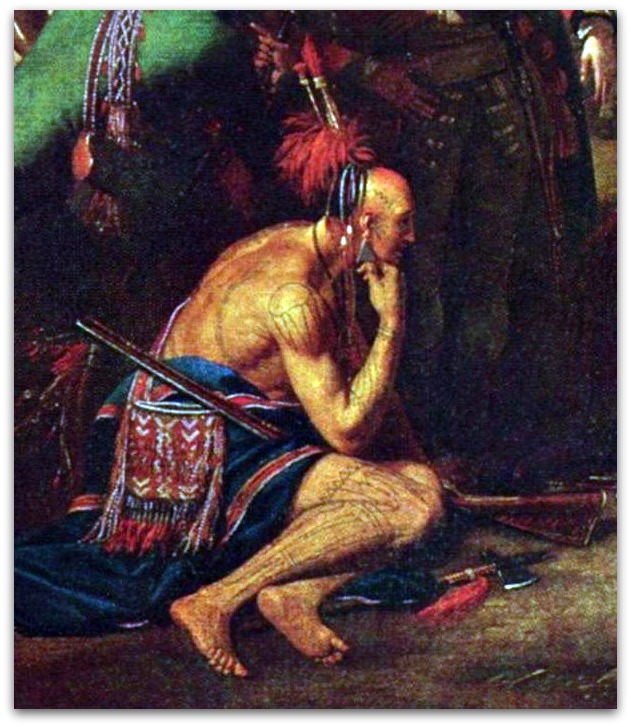
To quote from Merriam-Webster to give a brief introduction to the underlying idea, the noble savage is a “mythic conception of people belonging to non-European cultures as having innate natural simplicity and virtue uncorrupted by European civilization.” It’s an idea that was wonderfully useful for racist scientists in the 19th century. It romanticizes primitivism.

Most expats these days seem to be fairly well-educated, well-positioned people who either for reasons of career, lifestyle or marriage have moved to another country. Although there may be constant befuddlement and discombobulation at living in another country, you probably have some existing frame of reference for wherever you are going and for what sights you will see. You are inescapably a product of the late 20th and early 21st centuries —  and I would argue that the noble savage trope absolutely has no relevance to you.


EDITOR’S NOTE: But is awindram right — or do some of you romanticize the natives in the countries where you’re staying?

img: Cropped version of Benjamin West’s “The Death of General Wolfe,” showing the Native American — a portrayal that has often been cited as an example of the “noble savage,” courtesy Wikimedia.

If you enjoyed this post, we invite you to subscribe for email delivery of The Displaced Nation. That way, you won’t miss a single issue. SPECIAL OFFER: New subscribers receive a FREE copy of “A Royally Displaced Tea.”

Related posts:

CLASSIC DISPLACED WRITING: Ian Fleming

As The Displaced Nation has been serializing Sebastian Doggart’s article (part 1 and part 2) about visiting Ian Feming’s Goldeneye estate in Jamaica, it seemed like a good time to take a brief look at Fleming’s writing with a Classic Displaced Writing Post.

Sebastian’s posts have been concerned with Fleming and his love of Jamaica, and while Jamaica and the Caribbean is used numerous times as a backdrop in the Bond novels, through the course of the novels Bond visits dozens of  different countries that Fleming has to conjure up for the reader.

What is clear on reading Fleming is just how important food and drink is to Fleming in order to allow him to describes new and exotic (at least for the vast majority of readers in austerity Britain of that time) locations. I don’t think it’s unfair of me to say that Fleming fetishes food and drink. At times, reading a Bond novel is like reading food porn. While the Bond films now do an expert and cynical job of name dropping as many brands as they can in 2 hours, the Bond novels don’t shy away with the name dropping of food or of alcoholic brand names. The Bond of the novels isn’t solely a Martini drinker. He’s aways one to try anything local that’s on offer. In Jamaica he’ll drink a glass of Red Stripe, in the US he’ll have a Millers Highlife beer. Throughout the novels Fleming uses food and drink to convey an alien culture, demonstrate social status, show Bond’s mood and his sophistication and ease with the world.

For ten minutes Bond stood and gazed out across the sparkling water barrier between Europe and Asia, then he turned back into the room, now bright with sunshine, and telephoned for his breakfast. His English was not understood, but his French at last got through. He turned on a cold bath and shaved patiently with cold water and hoped that the exotic breakfast he had ordered would not be a fiasco.

He was not disappointed. The yoghourt, in a blue china bowl, was a deep yellow and with the consistency of thick cream. The green figs, ready peeled, were bursting with ripeness, and the Turkish coffee was jet black and with the burned taste that showed it had been freshly ground. Bond ate the delicious meal on a table drawn up beside the open-window.

From Russia with Love (1957)

Video of some more examples –

STAY TUNED for Monday’s post, when guest blogger Sezin Koehler riffs off Alice in Wonderland to capture the curious, unreal aspects of her life in Prague.

If you enjoyed this post, we invite you to subscribe for email delivery of The Displaced Nation. That way, you won’t miss a single issue. SPECIAL OFFER: New subscribers receive a FREE copy of “A Royally Displaced Tea.”

Related posts:

Funny foreigners: A response to “Is English really the international language it claims to be?”

Last week Displaced Nation writer Kate Allison wrote about sarcasm. She expressed an idea I’ve heard before that the UK and US are not so much separated by a common language, but by different understandings of sarcasm and irony, the idea being that British humour and American humor are fundamentally very different beasts.

While I enjoyed Kate’s post, I can’t help but feel that she was perhaps being a little unfair on a country that has produced among many others Gore Vidal, Groucho Marx and Stephen Colbert.

Eddie Izzard, noted comedian, marathon runner and jam enthusiast claims that there is absolutely no difference between the two countries when it comes to humour. I’ve seen him perform the same material on different sides of the Atlantic, and while in both cases the audience had that happy, warm and disturbing feeling of having pissed their pants (in both the US and UK sense of the word, unless some of the audience attended the show commando) at Izzard’s brand of surreal lunacy, if I’m honest I thought it was noticeable that different parts of the act got very different responses in Philadelphia than they did in London.

I’m not convinced I can extrapolate that into fundamental differences between the two countries, there’s a strange alchemy that occurs between a stand up audience and a comic, and sometimes — as I felt when I saw Izzard in Philadelphia — it just doesn’t gel as well as it could, but the same could have happened in London too.

Of course, we need to keep all of this quiet. We’re among friends here so I’ll let you into a little secret. It is in the interest of British self-esteem for us to let Americans think that there’s a huge chasm between the British and the American sense of humour. We, the country that gave the world 29 Carry On films, like to project onto ourselves this idea that we have a sophisticated, dry humour unique to our soil. We (Brits) talk about “irony” in the similarly loose, off-putting, undefined, making-it-on-the-sly way that the French talk about “terroir.”

And yes, I wouldn’t for a moment contest that, in general, the rhythm and beats that make up my humour are not necessarily the rhythm and beats that make up my friends’ American humor.  For instance that time-honoured, equal opportunity offender, “taking the piss” doesn’t translate that well to the US. But it’s a giant leap from that to saying that the Americans don’t “get” irony as well as the British. The UK is not a land of 60 million Oscar Wildes all excelling in the arts of irony, witticisms and dry put downs. We’re a country that to our eternal shame has commissioned five seasons of Celebrity Juice — and with each season the carcass of comedy putrifies further.

Yes, we may use irony far more socially than is normal for Americans, and this is of course surprising and befuddling for the poor American who wasn’t expecting an ironic response when they politely asked if you’d had a nice weekend, but that is a very different from the idea that Americans don’t “get” it. Smart people get irony, and there’s plenty of smart people in the US, and no, that’s not me being ironic.

For anyone who is still curious on this subject you may be interested in this video via Big Think: “Ricky Gervais on British and American humo(u)r and their differences.”

STAY TUNED for Tuesday’s post, Part 2 of Sebastian Doggart’s Bond-worthy quest to track down traces of Ian Fleming in today’s Jamaica.

If you enjoyed this post, we invite you to subscribe for email delivery of The Displaced Nation. That way, you won’t miss a single issue. SPECIAL OFFER: New subscribers receive a FREE copy of “A Royally Displaced Tea.”

Related post: