The Displaced Nation

A home for international creatives

Tag Archives: What a Displaced World

Dear Mary-Sue: Gap year destinations and learning to speak properly

Mary-Sue Wallace, The Displaced Nation’s agony aunt is back. Her thoughtful advice eases and soothes any cross-cultural quandary or travel-related confusion you may have. Submit your questions and comments here, or else by emailing her at thedisplacednation@gmail.com.

Dear Mary-Sue,

I’m in my last year of school, but instead of just mundanely heading off to university next September I’m planning on taking a gap year. I have some older friends who went on gap years and I was really impressed with how it rounded out their CVs. I was initially thinking of going to an ashram, but then I thought that I should go to where I can be the most useful. As I’ve heard you’re such a font of knowledge when it comes to matters of travel and international relations. Any suggestions?

Archie, Bath, England.

Dear Archie,

Go where you are most needed, sweet noble prince.  I say Somalia. Or Fresno.

Dear Mary-Sue,

I love reading the little globules of wisdom you spit out for us. I think we must have been separated at birth! We’re like two peas in a pod. Like you, I live in Arizona and I love all things British. Even the crap stuff like Torchwood. Anyhoo (wonder who I learned that term from? I love it! Use it all the time) I have one teeny query re: my one little teeny — my 13-year-old son, Scott. The other day I was watching Harry Potter and the Half-Blood Prince for, like, the thousandth time and I was thinking: why can’t my Scott speak like one of those lovely Harry Potter teenagers? I want him to sound a little more Dan Radcliffe and a little less Dan Ackroyd.

Susie-May, Arizona

p.s. Want to meet up?

Dear Susie May,

I have two words for you: Nicholas Witchell. Being a committed member of the sisterhood of the tea cosy (that’s the Mary-Sue term for an anglophile), you doubtless knew about the divine Nicholas W. His fiery red hair matching his fiery red passion. He’s clearly sex-on-legs — am I right or am I right, girls? Being the BBC Royal Correspondent, Nicholas not only has brains but also a healthy, deferential respect for constitutional monarchies. Now what I suggest is that you go onto YouTube and find all the Nicholas Witchell footage that you can find. Now your son Scott needs to spend at least an hour a day listening to Nicholas’s dulcet tones. Hopefully, he’ll do it willingly, but if he doesn’t then you may need to strap him down to a gurney. Also, if you take the audio from the videos and burn it onto a CD, you can make sure when Scott goes to bed, he turns on the CD. While he’s asleep the soothing voice of Nicky W. will be playing in Scott’s ears. Subconsciously, Scott’s brain will absorb all of Nicholas Witchell’s good speaking habits and before you know it little Scott will be like your own Little Lord Fauntleroy.

Mary-Sue

p.s. No.

Anyhoo, that’s all from me readers. I’m so keen to hear about your cultural issues and all your juicy problems. Do drop me a line with any problems you have, or if you want to share your fave meatloaf recipe with me (yum! yum!). As they say in Italy, “ciao!”

Mary-Sue is a retired travel agent who lives in Tulsa with her husband Jake. She has taken a credited course in therapy from Tulsa Community College and is the best-selling author of Traveling Made Easy, Low-Fat Chicken Soup for the Traveler’s Soul, The Art of War: The Authorized Biography of Samantha Brown, and William Shatner’s TekWar: An Unofficial Guide. If you have any questions that you would like Mary-Sue to answer, you can contact her at thedisplacednation@gmail.com, or by adding to the comments below.

STAY TUNED for Monday’s post.

If you enjoyed this post, we invite you to subscribe to The Displaced Dispatch, a weekly round up of posts from The Displaced Nation, plus some extras such as seasonal recipes and occasional book giveaways. Sign up for The Displaced Dispatch by clicking here!

Related posts:

All hail Sir Richard Branson, along with global nomads who delve into global misery — and welcome to November

The catalog for Heifer International has just landed in my mailbox, encouraging me to donate a sheep in honor of my nearest and dearest, to a family in need in Nepal, Romania, or Brazil. That family will in turn give away the sheep’s female offspring to other families in need, and so on — a benevolent pyramid scheme known as Passing on the Gift.

I get it. What’s more, as it’s All Saints’ Day, I sense I would feel considerably more beatific if I gifted a sheep on behalf of my loved ones than if I bought them yet another pair of Merino wool gloves they don’t really need. (Hey, but it wouldn’t have been any old gloves but a touchscreen pair from Muji, for using one’s iPhone in the dead of winter…)

Yet for some reason, the Heifer appeal doesn’t. Call me a hard-hearted skeptic, but I’ve always had trouble with the kind of philanthropy that poses simple solutions to complex, deep-seated problems — alleviating world hunger and poverty being at the top of the list.

A candid — or do I mean Candide? — appraisal

When it comes to philanthropy, I always wonder — is this more about you (and your need to assuage your guilt about having so much) or about them? And how much do you actually know about them?

That is probably why, when I went to live abroad, I didn’t go as an aid worker or a Peace Corps volunteer. In the UK I was a postgraduate student; in Japan, a trailing spouse.

That said, my expat life was never just about exotic travel. On the contrary, I aimed to broaden my horizons and educate myself about other cultures by becoming immersed in the everyday life. I got to know the “natives” — and even married a couple of them (in not-very-rapid succession). Ultimately, I tried to become more of an informed citizen — of the world as well as of my country (assuming I eventually returned — I did).

But saving the world? That wasn’t in my plan. Like Voltaire’s young man, Candide, I would start by cultivating my own garden and branch out (so to speak) from there.

The importance of being earnest

I suppose you could say I’ve never been that earnest.

Earnest people have a calling. They don’t have time for frivolity.

I always have time for frivolity. What’s more, I’m genetically predisposed toward light-hearted nonsense. (Despite what the Heifer International Catalog says, my mother is not the sort to enjoy having me donate a sheep to someone she’s never met. She’d rather I gave it to her as a pet!)

From my expat days in the UK, I remember a joke sometimes told of Princess Diana, that when she would arrive on one of her unannounced visits to a hospital, patients would hide beneath their beds, not wanting to be the next “victim” of her need for making the Grand Philanthropic Gesture.

I find that image amusing to this day.

Do you really want to make me cry?

But lest this post become all about me and my peculiar hang-ups, let’s move on to Richard Branson and TDN’s November theme.

Cue in 1980s Culture Club music. Rockstar businessman Sir Richard Branson has just now touched down on the shores of The Displaced Nation in his hot-air balloon, the Virgin Atlantic Flyer.

As the leading exemplar of a fun-loving philanthropist, he is about to disprove my theory that these two qualities, earnestness and fun, can’t be combined in one individual.

As anyone who’s had the privilege of traveling on Virgin Atlantic in upper class (as I did when I was a spoiled expat in Tokyo) will be aware, here is man who knows how to throw a good party.

But if letting the good times roll is a huge part of Sir Richard’s appeal, it’s not his whole story. As one of the world’s wealthiest people, Branson also believes in giving back:

Ridiculous yachts and private planes and big limousines won’t make people enjoy life more, and it sends out terrible messages to the people who work for [such people]. It would be so much better if that money was spent in Africa — and it’s about getting a balance.

Branson, of course, has spent has spent much of his adult life displaced in ways most of us can’t even imagine — in private jets, on a private island in the Caribbean, in boats and balloons in pursuit of daredevil adventure.

But then some years ago, with his 60th birthday approaching, he began diverting some of his formidable energy and funding resources to countries in need — particularly in Africa. He left behind rock bands to form a band of Elders — consisting of, among others, British rock musician and human-rights activist Peter Gabriel, Nelson Mandela, Jimmy Carter and Mary Robinson — to work on the African continent’s intractable problems.

At Ulusaba, the private game reserve that Branson now owns in South Africa, visitors are encouraged to get involved with the initiatives he has launched to help local villages that have been ravaged by unemployment, HIV and drought. As Branson told a Daily Mail reporter:

To come to Africa and not see Africans is just wrong. A lot of the game reserves don’t really allow you into the villages but I think it’s important.

In addition, Branson is using his business knowhow to incubate and seed promising business proposals from aspiring South African entrepreneurs.

Now, Sir Richard would have earned the right of entry to our Displaced Hall of Fame by virtue of his derring-do alone — have you heard of Virgin Galactic? (It’s not too late to book a seat on the first sub-orbital space flight.) But we’ve chosen this moment to honor him as we plan to spend November looking at the kind of global nomads with the courage and the fortitude to delve into global misery.

Such travelers have displaced themselves, often to far-flung corners of the globe, not for the sake of good times or narrow personal goals but for the sake of helping others — many of whom have been displaced from their homelands through tragic circumstances beyond their control.

Not the final word

The announcement of this month’s theme is not, however, tantamount to imposing a ban on skepticism — we skeptics still have a place at The Displaced Nation’s table. What’s more, our ranks will soon swell to include some of the very people who belong to the volunteer and aid communities. They, too, can have their doubts about the effectiveness of their work — and of the involvement of celebrities in global problems.

But for now, let’s save such issues for future posts.

Which means I can now go back to cultivating my little patch of grass. Hmmm… I wonder if it could use a sheep or two, after all?

STAY TUNED for Wednesday’s post, featuring the first of our philanthropic Random Nomads.

If you enjoyed this post, we invite you to subscribe to The Displaced Dispatch, a weekly round up of posts from The Displaced Nation, plus some extras such as seasonal recipes and occasional book giveaways. Sign up for The Displaced Dispatch by clicking here!

Related posts:

The Displaced Nation’s Halloween post is…mysteriously displaced!

Kate Allison was supposed to post today, for Halloween…but then, pouf, she vanished without a trace!

How very strange, we think you’ll agree…

Her topic was going to be Halloween costumes for expats. Given her offbeat sense of humor, none of us would have been the least bit surprised had she suggested we dress up as:

  • Dorothy, staggering around with a sign that says “I’m not in Kansas any more.”
  • Pocahontas &  John Rolfe — suitable for cross-cultural, bi-racial couples with large age differences.
  • Mary-Sue Wallace, to give ourselves a break from feeling displaced for a few hours.
  • A giant red snail, to signal enthusiastic support for the slow-food movement that began in Italy and is s-l-o-w-l-y spreading around the world.
  • Marcel Proust, carrying a madeleine and looking very displaced.

But instead of speculating what Kate might have written about, perhaps we should be spending our time wondering where she has gone. ML Awanohara and Anthony Windram have a few hypotheses — do let us know if you can think of any others!

  1. She enjoyed a repast of the seven deadly dishes from around the world, overdosed on snake wine, took a nap to recover, and hasn’t yet woken up.
  2. She is out flying on a broomstick with her fictional sidekick, Libby — or, even more likely, with Libby’s nemesis, Melissa (and they are evilly plotting Melissa’s next move on Libby).
  3. She was the victim of some sort of gothic expat tale — either a trick-or-treater dressed up as Hannibal Lecter, who thought she looked tasty and got carried away; or else some sort of natural disaster, such as a bizarre October blizzard, leading to widespread power outages.

Kate, chills are running down our spines as we fantasize about all the spooky things that might have befallen you on this All Hallows’ Eve. New England is not the same as Merry Olde, as no doubt you and your English family have discovered…

Of course, knowing you as well as we do, you may simply be playing a prank by not treating us with one of your posts.

But if that’s not the case and you truly have been spirited away, send us a signal, and the citizens of The Displaced Nation will perform some incantations on your behalf over a bubbling cauldron — a molten mix of Marmite, Fluff and chocolate, with the odd tongue-in-cheek thrown in…

STAY TUNED for Tuesday’s post, introducing November’s theme, on those who displace themselves on behalf of those less fortunate.

If you enjoyed this post, we invite you to subscribe to The Displaced Dispatch, a weekly round up of posts from The Displaced Nation, plus some extras such as seasonal recipes and occasional book giveaways. Sign up for The Displaced Dispatch by clicking here!

Image: MorgueFile

Bon appétit, really? A TCK’s encounter with French cuisine — and culture

Our Third Culture Kid columnist, Charlotte Day, regales us with stories of encounters with France and French cuisine that piqued her curiosity somewhat more than her palate.

My experience of France and of French food consists of a miserable trip to Paris and the Loire Valley with my mother and stepfather in cold, drizzly March, and an even more miserable language exchange to Lyon last February.

The first experience saw us through innumerable cafés au lait, pains au chocolat and frothy miracles of haute cuisine in the Loire Valley. Afterwards, my mother went on her first raw food diet.

The second was a mandatory school trip for all French-language students at my boarding school in England, which I faced with more optimism than most. Two weeks in Lyon, two weeks back in England, dramatic language improvement and cultural interchange — why ever not?

From the moment we boarded the Eurostar, however, things did not look promising. Two boys arrived sporting Union Jacks and carrying paper cut-outs of Wills and Kate. The rest had already scoured their exchange partners’ Facebook pages and resolved to dislike them.

I suppose I ought to have anticipated this Anglo-French clash, given the historical precedents. Yet the English contingent’s narrow-mindedness unsettled me.

Yes, we were sacrificing a holiday to spend two weeks with a stranger. But their genuine unwillingness to learn, Anglo-supremacist attitude and lack of curiosity were a little disturbing.

As we descended into the arrivals hall of Lyon Part-Dieu station, the smiles of expectant correspondents ought to have rebuffed the querulous English students. Yet each went through his or her initial greeting with as pronounced an English accent as possible.

You are what you eat

My exchange partner and her mother drove me back to their beautiful old farmhouse, in a village known for horse breeding. My bedroom was large and warm, my French not as bad as I’d feared it to be.

And yet one anxiety still plagued me: sustaining a gluten-and-dairy-free diet in England was sufficiently difficult, but in France, I imagined, next to impossible. I sat in my room, weighing the relative merits of two weeks’ stomach cramps against starvation — and how to explain in French the effects of wheat, barley and rye on the small intestine?

What I found in the dining room occasioned raw joy: steamed vegetables, fish and salad. Likewise in the kitchen: a refrigerator shelf full of yahourt au soja. To their question “Ça marche?” I would have poured forth encomiums had I mastered a suitable vocabulary set. But I could not move beyond “Oui, c’est fantastique” before we sat down to eat.

This first meal was to be the most talkative of my two-week sojourn. As the breakfasts and dinners succeeded one another in an endless cortège of fresh fruit, perfectly steamed broccoli and silence, I felt that either starvation or stomach cramps around a more convivial table would have been preferable.

My exchange partner was kind, but icy. Her fastidious and sparing eating habits made me feel a glutton in comparison. Her mother ate protein powder in yoghurt more often than a solid meal. Eventually, my mornings were characterized by a solitary repast of fruit salad — no one else seemed to be eating.

Ghosts at the feast

The occasional apparition flitted around the dinner table — some closer to human form than others. The first was Pierre, the former lover of my exchange’s mother, with whom she was still sharing living expenses. He was tall and corpulent with a thunderous voice. She had cast him from her life — but only driven him out as far as the other end of the house, where he entrenched himself in a study strewn with half-smoked cigars.

At least he ate like a Frenchman — belonged to the cult of taste, before that of health. Yet he vanished soon after his first appearance, driving off to see his mother in a neighboring town. He returned after five days, at two o’clock one morning, and left again the next day.

The second apparition was my exchange partner’s boyfriend, Samson — a thin, pale young man with an unruly mass of curls; a maths prodigy who’d set his sights on attending one of the grandes écoles.

Samson, too, was slightly less given to subsist on lettuce and pumpkin seeds. My exchange partner lovingly provided him with a baguette and chocolate — which he would munch while explaining to me the superiority of the French educational system.

He cross-examined me on my plans for the future. I had got as far as a spectral PhD in Russian Literature, when he stopped me with a shocking rejoinder:

Il faut réfléchir, Charlotte! La vie est sérieuse. (In essence: “Life will pass you by before you have accomplished anything.”)

I refrained from pointing out that he had not planned beyond the classes préparatoires, or prépas — two hellishly difficult years spent preparing for university entrance tests. Instinctively, I commended his ambition and drive — yet felt him ill qualified to condemn my lack of perspective given his own determination to sacrifice two years of his youth to a virtually unattainable goal.

My tryst with moules frites

Midway through my stay, our funereal meals were interrupted by my exchange’s mother taking us on her weekend-long tryst in Brussels. She’d discovered that a childhood sweetheart was living in Belgium’s capital, and over the past months, they’d re-cultivated their relations. My exchange and I were invited along as third and fourth wheels.

José, the new lover, was almost as much the gourmand as Pierre, his predecessor.

Yet of his guests, I was the only one who ate at all.

Our meals together included lunch in a traditional Belgian restaurant, where I unadvisedly ordered moules-frites without the butter, causing a scandal in the kitchen.

We had Thai for dinner — a first for my partner and her mother — after which I turned around to see the latter and José kissing passionately on the curb.

Resolving to see something of Brussels at all costs, I accompanied the couple on a walk to the markets, while my partner sat sullenly in José’s penthouse apartment. There, I stared mournfully at beautifully packaged jams, cheeses and Breton biscuits — knowing that we were to leave for Lyon that evening, where another week of salad and silence awaited.

I returned to England appreciably thinner, with an improved French accent and a block of Belgian chocolate for my mother.

Though my experience of France did not come floating in butter, it was more French than I could ever have anticipated.

Readers, any questions or suggestions for Charlotte, should she have any future encounters with France?

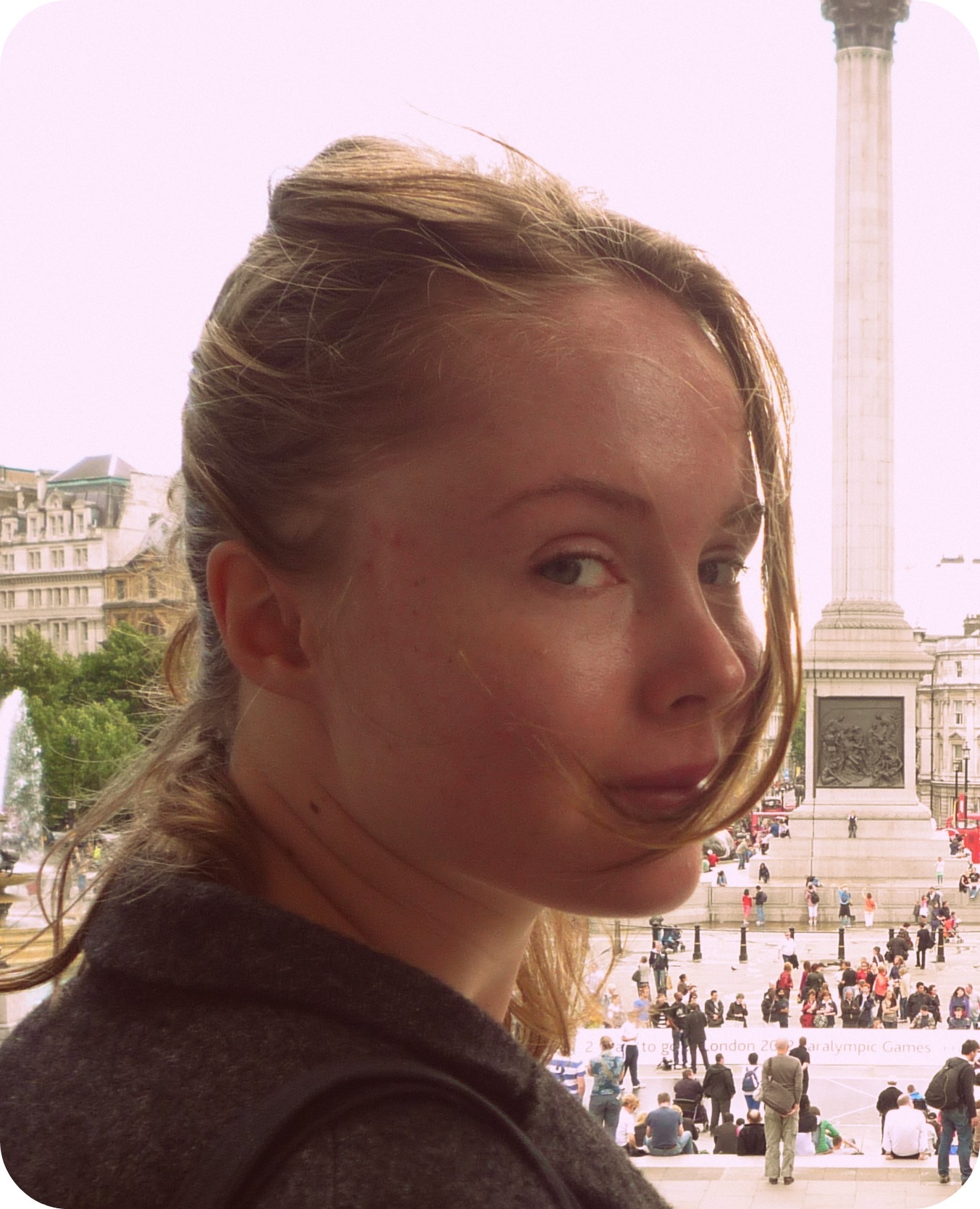
img: Charlotte Day surveying Trafalgar Square in London.

STAY TUNED for Monday’s post, offering a few last-minute Halloween costume suggestions for Displaced Nation citizens.

If you enjoyed this post, we invite you to subscribe to The Displaced Dispatch, a weekly round up of posts from The Displaced Nation, plus some extras such as seasonal recipes and occasional book giveaways. Sign up for The Displaced Dispatch by clicking here!

Related posts:

A Julia Child for our times: Expat author & French cookery expert Elizabeth Bard

Et voila. In a little less than a month, The Displaced Nation has gone from reminiscing over American expat in France Julia Child to engaging with American expat in France Elizabeth Bard.

Move over Julie Powell. At a pace rather like a simmering le Creuset pot of Child’s signature boeuf bourguignon, Bard is on the way to becoming the 21st-century’s answer to that towering figure of 20th-century cuisine Française.

The similarities between the two women are intriguing. Child went to France as a trailing spouse for an American diplomat. Bard went to France trailing a Frenchman.

Child was seduced by France. She found herself through French cuisine. Bard was seduced by France (after being seduced by a Frenchman). She found a way into French culture through the markets and cooking — and found herself in the process.

On this point, the line between the two women gets a little blurry. Which one, Child or Bard, said the following:

More than the museums, more than the ancient streets, these stalls of fruits and vegetables and spices were the Paris that inspired me.

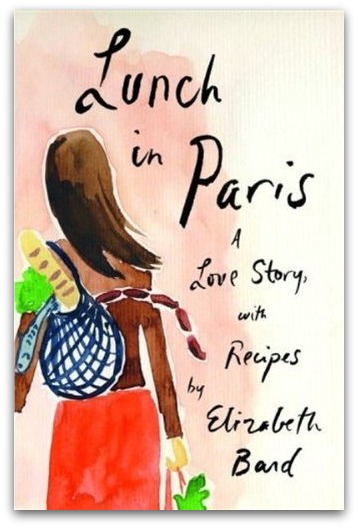
As everyone knows, Child returned to the United States to launch a career in television. Whereas Bard has become a long-term resident of France — and has launched a brilliant writing career with the publication of Lunch in Paris: A Love Story, with Recipes, a New York Times and international bestseller, a Barnes & Noble “Discover Great New Writers” pick, and the recipient of the 2010 Gourmand World Cookbook Award for Best First Cookbook. NOTE: We are giving away copies to two lucky DISPLACED DISPATCH subscribers. Sign up today!

Child inspired Julie Powell to make all of her recipes. Bard has inspired, among others, two Displaced Nation writers — myself and Anthony Windram — to try out her recipes.

But here the comparison ends. A key difference is that Bard’s recipes are nowhere near as difficult as Child’s — which is exactly what makes Bard so perfect for our times. She’s approachable, and her cooking suggestions are doable. She also has a rich life outside cooking — the life of a woman who has displaced herself into another culture — and enjoys sharing that part of her story as well.

Mesdames et Messieurs, I would now like to offer you the fruits (not to mention veggies) of my exchange with expat author, chef and lifestyle muse Elizabeth Bard.

Tell me a little more about your background.
I grew up in Northern New Jersey and spent weekends with my father in New York City. I studied English Lit as an undergrad at Cornell, then art history at Christie’s and the Courtauld Institute in London. My dream was to be the chief curator of the Pierpont Morgan Library in Manhattan. I was always convinced I’d been born in the wrong century. I love old objects, lost worlds, so, of course, I was instantly seduced by Paris (and of course, my French husband).

Over the years, I’ve written on art, travel and food, and digital culture for the New York Times, International Herald Tribune, Harper’s Bazaar, Wired, Time Out and Huffington Post, among others. Lunch in Paris was my first book.

In July 2010, my husband and I and our baby son Augustin moved to a small village in Provence, to live in the wartime home of the famous poet and WWII Resistance leader René Char. At the time, we had no plans to leave Paris — it was a date with destiny. You can find the complete (completely crazy?) story of how we found the house on my blog.

How are you finding life in Provence as compared to Paris?
As a city girl, village life is a discovery for me. I’m still adjusting to hanging my undies in the sun, and learning the names of the local birds (they can’t all be pigeons…). I’m surrounded by wonderful cooks and gardeners; last week, I went on my first saffron harvest. The move has been a wonderful transition for us as a family — it has made me question many of the things I believe about work/life balance, health, and being close to nature. All things I hope to share (along with my neighbor’s recipe for Provençal soupe au pistou) in my next book.

Turning to Lunch in Paris: What made you decide to write a book telling the story of your transition to living in France?
I hope Lunch in Paris captures something real about what it means to build a life in another culture. As an American, I follow generations of women who all came from somewhere else. They learned to cook with new ingredients, speak a new language, manage in a new world. My Jewish grandmother learned to make spaghetti sauce with pork ribs from the Italian ladies she met on line at the butcher shop during the war; I’m simply another in a long line.

Did you ever think of writing a novel instead? I ask because in reading the book, I kept noticing your facility with dialogue and description.
It never occurred to me to write Lunch in Paris as a novel. Fantasy lives in France are easy to imagine — but I wanted to express some of the things I’d learned personally, about what it means to take risks, to put happiness first on your checklist. That’s not a fictional decision — that’s something we struggle with every day.

Why did you decide to include recipes in your book?
Almost as soon as I arrived in Paris, I knew that I wanted to write about the roller coaster of international living, and the richness of intercultural marriage. When I sat down to think about the moments that really helped me discover French life, I kept coming back to the dinner table, the markets, the recipes — so it seemed natural to structure Lunch in Paris around those experiences.

Do you still use the recipes from the book and which one is your favorite?
I’m always trying new recipes, which I share on the blog or Facebook page, but I do use my copy of Lunch in Paris as a cookbook — I keep it handy in the cabinet with the pasta. The recipes I go back to again and again: for summer, it’s the haricot verts with walnut oil, for winter, the lentils. The tagines are great for a party — and the molten chocolate cakes work anytime.

Which portion of your book — Paris, the love story, the recipes — have readers responded to most?
I’m so surprised, humbled, gratified by the fact that Lunch in Paris has found such a wide audience. I’m so pleased that the book has been a vivid piece of armchair (or bathtub) travel for those who love Paris — and a temptation for those who’d like to go. I’ve had many young readers say it inspired them hold on to their dream of living abroad, or simply doing something a bit outside the box with love or career.

I’m also thrilled that people are getting their books all greasy, using the recipes — and posting photos of their creations on the Lunch in Paris Facebook page. I’m a home cook; I tested all the recipes myself. I was determined that readers take as much pleasure (and as little stress) in preparing them as I did. Maybe the nicest thing anyone has said came from a friend in London:

“It’s nice for Augustin to have such a wonderful record of his parent’s romance.”

I’m proud to be passing that on.

The thing that has surprised me the most is the wonderful online community. Though the readers are all over the world, it really feels warm and personal to me. I love that social media allows people to share recipes and stories from all over the world. A few months ago, I got an email from a New Zealander living in Crete. I now follow her blog to learn about traditional Cretean cooking.

As I mentioned in my intro, Julia Child was the inspiration for TDN’s October theme — and you remind me of a 21st century version of her in some ways. I’m curious, do you have her Mastering the Art of French Cooking — and do you actually use it?
I have my mom’s copy of Mastering the Art, but at the moment – I’m too busy trying recipes from my French neighbors to actually use it!

What did you think of Julie Powell’s blogging about making all the recipes from that encyclopedic book?
I love a good project — especially one that gets a girl out of a rut — it was fun to read about how the random adventures we set for ourselves can change everything.

How about the film, Julie & Julia?
The film — well, it just proves that Meryl Streep can do ANYTHING.

We’ve been asking our Random Nomad interviewees this month if they identify with any of the following Julia Child quotes and why. Can we ask you as well?
I agree with the choice that both Mardi and Jennifer made:

The only real stumbling block is fear of failure. In cooking, you’ve got to have a what-the-hell attitude.

I’d say this goes for goes for life in general — not just cooking. With all of our “Just-do-it” attitude, Americans are particularly prone to fear of failure: everything is possible, so everything we don’t accomplish is our fault. Fear is paralyzing. I work every day to get the hell out of my own way.

Quite a few of our readers are long-term expats who’ve entered cross-cultural marriages. What do you think is the biggest challenge about marrying someone of another culture?
The Franco-American combination is a very powerful one. I gave my husband a bit of the American can-do spirit, permission to pursue his dreams based on his own qualities, instead of family or class. He gave me a bit of the French joie de vivre — permission to live in the moment, to consider happiness, rather than some abstract (and culturally relative) notion of “success”, as my ultimate goal.

Was language an obstacle at all?
I speak fluent French now. It was a struggle at the beginning — you feel a bit invisible. That’s one reason cooking became so important to me. During the early days of our marriage, I used food to welcome people. My husband’s friends didn’t know if I was intelligent, charming, witty, or warm. What they did know is that I made a mean sweet potato puree. There were times when I used the kitchen to hide. French dinner parties are marathons of cuisine and conversation — 4 or 5 hours minimum. With the rapid-fire French buzzing in my ears, and my brain foggy from the wine, it was just easier to say, “I’m just going to check the roast” than “Dear God, I’m so bored and exhausted I’m considering sticking my head in the oven.”

Do you think you could fit back into living in American culture after a decade of living in France?
I’ve been away for a long time — and like many expats, I find myself in a no-man’s land, not quite one or the other. Honestly, I think the hardest thing about moving back to the States would be the portions — even with a great farmer’s market nearby I think it would be a struggle to maintain our very healthy French eating habits. That and the hyper-competitive attitude about raising kids. I’m not sure I’m ready for preschool applications.

As it happens, on October 13 Travelers Night In (#TNI) was French inspired, and everyone tweeted their answers to 10 questions about the best of the best in France. Could you do us — and the traveling community at large — the honor of providing your own short answers?
Q1. The best thing about French people is…
Food is not fuel.
Q2. France is famous for food, what dish is your favorite? Best food city?
Give me a perfect, flaky, buttery croissant.
Q3. Favorite French countryside escape?
The rolling hills of Burgundy — with a stop at the cathedral in Vézelay.
Q4. What is the most overrated thing about France?
April in Paris (it rains)
Q5. What defines Paris?
PDA (does that still mean public display of affection?)
Q6. French museum or monument that shouldn’t be missed?
Musée Jacquemart-André, Paris
Q7. Perfect place to enjoy a glass of French wine? What varietal, region, winery?
People watching along the Canal Saint-Martin, any glass recommended at the Verre Vole (rue de Lancry)
Q8. Top way to spend a night out in Paris?
Walking along the banks of the Île Saint-Louis with a double scoop of Berthillon sorbet.
Q9. Best things to do on the French Riviera?
We avoid the French Riviera — over-crowded, over-priced, over.
Q10. Biggest misconception about the French?
French cooking is complicated.

Thank you so much for engaging in this tête-à-tête! Readers, do you have your own questions for this 21st-century answer to Julia Child? Hurry up, before she disappears into her kitchen or heads out to another saffron field!

Images: Head shot of Elizabeth Bard by Cindi de Channes (2008); book cover.

STAY TUNED for tomorrow’s installment from our displaced fictional heroine, Libby, who is taking seriously her friend’s advice to make time for herself, and enjoying her freedom while Jack is in nursery school. Someone had better remind her that small babies tend to put a damper on such wanton activities. (Speaking of which, Libs — isn’t it time you saw a doctor?) What, not keeping up with Libby? Read the first three episodes of her expat adventures.

If you enjoyed this post, we invite you to subscribe for email delivery of The Displaced Dispatch, a round up of the week’s posts from The Displaced Nation, including seasonal recipes and book giveaways. Sign up for The Displaced Dispatch by clicking here!

Related posts:

My Grand Tour through Italy on an art history student’s budget

Today Monika Frise — the daughter of one of our Random Nomads, Helena Halme — joins us as a guest blogger. Monika is an art history student in the UK. Here she tells of her trip to Italy last month with another art history student friend — a travel yarn that makes a welcome change from all the French foodie posts we’ve been doing of late. (That said, Monika does start out by talking about food — it’s Italy, after all!)

At the end of my first year at the University of Birmingham, facing a stressful exam period, I decided to book a holiday to Italy with a friend of mine, Liz. We planned to go in early September, after the summer crowds had ebbed and the weather would be somewhat cooler. We organized to visit five cities: Verona, Venice, Pisa, Florence, Siena and finally, Rome.

Both Liz and I are studying art history. Neither of us is specializing in Renaissance art — I’m studying Eastern European architecture/art and 19th-century French art this year (concentrating on the period just before the impressionists). However, we both loved the idea of making a Grand Tour through Italy to see the Grand Masters’ works, following in the footsteps of European aristocrats of centuries past — we just wished we had their riches to finance our journey!

The trip came around sooner than expected and I for one felt a little apprehensive about what it would be like moving to a different location every couple of days, on a student budget.

Buon appetito

Italians are famously passionate about their food, and despite having to watch our expenses, we were determined not to miss out — even if it meant eating a lot of pizza.

We made a determined effort to avoid restaurants close to large monuments and museums and seek out local eateries instead. We were somewhat taken aback at the prices of food, though — especially in Rome, where we had to search for a long time in order to find a cheap restaurant that also looked good.

Our first night in Verona, the plump, friendly hostel owner recommended a restaurant, Bella Napoli, for “having the best pizza in town.”

She also told us to “touch the left breast” of Juliet’s statue for good fortune in life.

We took her advice on both counts and weren’t sorry. At Bella Napoli, we shared the house specialty, pizza al metro (pizza by the meter), which arrived on its very own table on wheels.

Venice, however, posed more of a challenge. But, on our first night, after walking somewhat aimlessly through the narrow streets for some time, we chanced upon a small osteria offering home-cooked food at great value. For a change, we didn’t have pizza. I ordered gnocchi with tomato sauce: delicious.

The service, however, left a little to be desired — our waitress dumped our change on the table without even a smile. Likewise in Rome, service was rather hit or miss. We had excellent service at a pizzeria where they roll the dough right in front of you, but at a café close to Termini station we waited for our bill for such a long time we could have walked away without paying (yes, the thought did seriously cross our minds!).

Another affordable yet delectable treat is the famed gelato. The best we tasted — and we tasted a lot — was at a place called Rivareno just around the corner of our hostel in Rome . They soften the gelato with a palette knife before spooning it into the cup. There were so many different flavors on offer, but my favorite was probably caramelized fig and ricotta.

“Roughing” it

We students will walk miles to save money, but in a country like Italy that’s not such a bad thing. As Liz and I soon discovered, going everywhere on foot was the best way to take in the local color (not to mention work off all that pizza, pasta and gelato!).

In the small winding streets of Siena, we encountered a small boy playing the drums in little side street whilst a group of old men and women chatted nearby, seemingly oblivious to the racket he was making.

In Verona one night, we happened upon Juliet’s balcony (which we’d seen the day before in the daylight). The bronze statue of Juliet in the courtyard looked completely different when illuminated. Gazing through the gates at her peaceful shape summed up this city for me: bright and vibrant yet calm.

Walking was also a way of avoiding unwanted curiosities in the hostels where we stayed. The hostel in Venice, for instance, had a very bad case of bedbugs — so much so that we spent our second night sleeping on the dusty floor, with only a sheet beneath us. But even that didn’t stop the little blighters. At one point one of the other girls woke up with one of them on her cheek. Unfortunately, despite the beauty of Venetian art and architecture, it’s the bedbugs that made the most lasting impression, rather literally!

That said, walking also exposed us to some humans who behave like pests. More than once did we have to hurry away from some overeager men who were making kissing noises at us, and outside the Arena in Verona, the city of love, a “Roman gladiator” gave Liz a pat on the bum!

Art coming out of our ears

Tourism in Italy involves an endless parade in and out of churches. I reckon we saw about three in every city, apart from Siena where we saw only one, the Duomo di Siena.

We ended up appreciating the cathedral in Siena far more than the Basilica san Marco in Venice, which overwhelmed us with its abundance of Gold Romanesque mosaics and small adjoining rooms replete with countless treasures. Our guidebook had advised us to make several visits, but for me, a single visit was more than enough. Both interior and exterior reminded me of an over-sweet, over-decorated cake.

Since we are both interested in Renaissance art, Florence had a great deal to offer. My wise mother had advised that we pre-order tickets for both the Uffizi Gallery and the Accademia Gallery — the latter of course being the home of Michelangelo’s David.

After smugly walking past the long queue for the Accademia, Liz and I took a seat on a bench close to the David and watched as people circled around it, discussing its various aspects. (We even managed to sneak a picture of the statue whilst the guards weren’t looking, saving us a few extra cents on a postcard.)

At the Uffizi Gallery I particularly loved seeing Flora by Titian — so much better seeing it in a photo for appreciating the colors and brush strokes.

By the time we reached Rome, our enthusiasm for the Grand Tour had flagged somewhat. The Sistine Chapel, where everyone was herded around like sheep, especially disappointed us.

The best part of Rome was our trip to the Pantheon — fantastic! As we wandered around this circular building, I couldn’t take my eyes off the ceiling. I was transfixed.

First of many tours?

I would definitely like to return to Italy one day soon, and perhaps even try living there for a while.

Of the five cities we visited, I could really see myself in Siena even though it wasn’t my favorite place. It’s just that the atmosphere made me feel at home, I think because there were fewer tourists. (I particularly enjoyed my trip to the local supermarket, full of hustle and bustle and the smell of freshly baked bread.)

My Italian, which was very basic, got better as our trip progressed. However I would have to take a lot of classes if I were ever to brave living there!

NOTE: You can read Monika Frise’s art reviews on her new blog, Post Raphaelite, and/or follow her on twitter: @Shmonn.

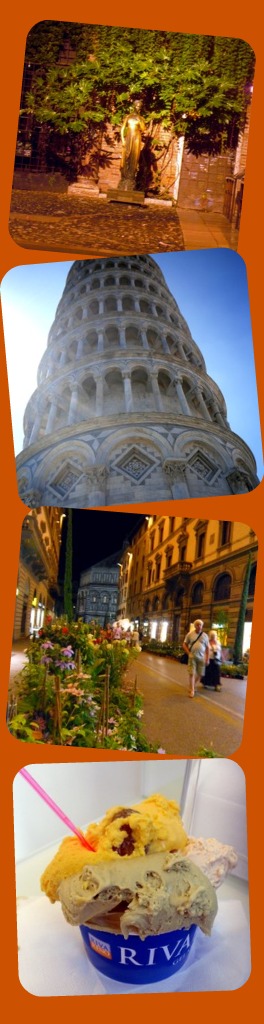
Images: Juliet’s statue in Verona by night; from the foot of the leaning Tower of Pisa; flower sellers in streets of Florence, near the Duomo; three flavors of Roman gelato: pistachio, caramelized fig and ricotta, and crema mediterranea (a Rivareno speciality).

STAY TUNED for Monday’s post, when founding contributing Anthony Windram reports on his attempt to make a Parisian lunch in California, following the recipes of Elizabeth Bard (see also ML Awanohara’s attempt).

If you enjoyed this post, we invite you to subscribe to The Displaced Dispatch, a weekly round up of posts from The Displaced Nation, with seasonal recipes and occasional book giveaways. Sign up for The Displaced Dispatch by clicking here!

Related posts:

Dear Mary-Sue: Things to do in Paris

Mary-Sue Wallace is back and she’s dishing out advice to the helpless like it were soup, soup from a big tureen of common sense in the soup kitchen we call the blogosphere … or something like that. If you are looking for solace, then you need Mary-Sue Wallace. Submit your questions and comments here, or if you are a shy bunny requesting anonymity then you can email Mary-Sue directly at thedisplacednation@gmail.com.

Dear Mary-Sue,

Growing up here in Japan as a big-time Francophile, all my life I’ve wanted to visit Paris. This fall I finally have a chance to go visit it for myself. I am so happy at the thought. I will get to stroll the streets and eat plenty of good food. Being such a travel expert could you give me a list of the top things you think I should do when visiting Paris?

— PA, Kyoto

Dear PA,

Ol’ Coley Porter put it best when he wrote that lovely classic of his, I love Paris. “I love Paris in the springtime / I love Paris in the fall / I love Paris in the winter when it drizzles / I love Paris in the summer when it sizzles.” And that sums up so perfectly and so succinctly my own thoughts about this darlin’ city. No matter the time of year, I fall in love with it. Whenever I arrive in Paris, I always make sure on that first night that I go for a stroll along the Seine. Ah, bliss. And when that’s over I go to a little cafe that I adore that is called…

….wait a moment….

….hmm….

….I’m sorry about this, PA, but I just noticed that you wrote that you’re from Japan. In that case, forget Paris. It’s overrated. Have you thought of visiting Malmo? I hear there’s also an interesting cement works in Frankfurt, you could go there. I’m sure it’s fascinating. And people keep telling me Swansea is the Paris of south Wales…

…Aw, shoot. As a loyal Mary-Sue-ite, you deserve a fuller explanation from me, PA. A Japanese Francophile finally visiting Paris after a lifetime of waiting? Aw, honey, sounds like you could be a prime candidate for Paris syndrome. Certain places just seem to have a strange effect on people. Believe me, I know this only too well. It’s why I’m never going back to Jerusalem. Went on a cruise there with my hubby Jake a few years back. Darn it if he didn’t come over all Messianic on me – thought he could walk on water. Well, the fine people at Cunard weren’t too impressed when he went overboard when trying to be all Matthew 14.

And Paris syndrome ‘aint no picnic either, honey. You can end up psychologically destabilized, suffering anxiety, hallucinations, feelings of persecution. Many Japanese visitors to Paris go there with such a romanticized image of the city and its occupants, that it’s a place of sophistication and politeness, that when they finally get there and see for themself the surly, rude reality of Paris they simply can’t cope. 

So PA, I ask again, have you thought about going to Frankfurt? 

— Mary-Sue

Anyhoo, that’s all from me readers. I’m so keen to hear about your cultural issues and all your juicy problems. Do drop me a line with any problems you have.

Mary-Sue is a retired travel agent who lives in Tulsa with her husband Jake. She has taken a credited course in therapy from Tulsa Community College and is the best-selling author of Traveling Made Easy, Low-Fat Chicken Soup for the Traveler’s Soul The Art of War: The Authorized Biography of Samantha Brown, and William Shatner’s TekWar: An Unofficial Guide. If you have any questions that you would like Mary-Sue to answer, you can contact her at thedisplacednation@gmail.com, or by adding to the comments below.

img: Close, by Corina Sanchez.

STAY TUNED for Monday’s post.

If you enjoyed this post, we invite you to subscribe to The Displaced Dispatch, a weekly round up of posts from The Displaced Nation, plus some extras such as seasonal recipes and occasional book giveaways. Sign up for The Displaced Dispatch by clicking here!

Related post:

DISPLACED Q: In modern French cuisine, who wins the race — the slow-food tortoise or the McDonald’s fast-food hare?

In yesterday’s post on French cooking guru Julia Child, ML Awanohara wrote about the Slow Food movement, which began life in the 1980s in resistance against big international interests and, more specifically, the opening of a McDonald’s near the Spanish Steps in Rome.

Today, on its website, Slow Food states it aims to

counter the rise of fast food and fast life, the disappearance of local food traditions and people’s dwindling interest in the food they eat, where it comes from, how it tastes and how our food choices affect the rest of the world.

Valid and valiant aims in an eco-conscious world that nevertheless marches toward global homogenization.

Slow and steady? Or just slow?

Yesterday, ML also expressed her bemusement that the movement started in Italy, not France — a reaction I share with her, because if one traditional cuisine takes le gateau when it comes to drawn-out toiling over a hot stove, it’s the French.

Learning the nuances of French cooking isn’t something I’ve ever yearned to do. While I am full of admiration for Julie Powell and her quest to conquer all 524 recipes in Julia Child’s tome of French cooking, I have no desire to repeat the exercise myself.

Well, perhaps that is no more you would expect of me. I am British, after all — Brits aren’t famed for their good food, although of course I feel this reputation is undeserved — and I have lived much of my life in America, home of fast foods such as Burger King and McDonald’s.

Do I exist on cheeseburgers and fries, though? Absolutely not. Rarely, in fact. I cook most things, from traditional English cakes and roast dinners to an authentic variety of Indian, Chinese, and Thai dishes. When it comes to French cuisine, though, my repertoire is limited to creme brulee and cherry clafoutis.

My reason? I’m not prepared to spend vast swathes of my evening preparing an eighteen-ingredient, three-page recipe when I can get an enthusiastic reception from my family by cooking a Ken Hom stir fry in one-third of the time.

But no matter the nationality of food I cook, it’s rare that our family does not sit down together in the dining room and eat together. The way I see it, rather less time spent in the kitchen means more time eating and conversing as a family.

Could it be that French cuisine has shot itself in the foot with its complicated nature?

Winning by a hare’s breadbun?

In his 2008 article in The Times, Hugo Rifkind describes McDonald’s as

“France’s dirty secret.”

Three years ago, Paris had around 70 McDonald’s — or McDoh’s, as they’re known there — which is the same number as in London, in a city with a third of London’s population.

Rifkind says:

Stop any Frenchman on the street…and he will shrug and snarl and say that he doesn’t eat in McDonald’s.

But someone does, and it can’t be just the tourists.

Evidence suggests that the image of the French businessman taking a two-hour, multi-course lunch is gradually being consigned to the past, and instead of lingering over a bottle of fine red and runny camembert, Monsieur is adopting the regrettable Anglo-American habit of lunch on the hop.

One oft-quoted statistic is that the length of the average French meal has fallen from 1 hour 22 minutes in 1978 to a mere 38 minutes today.

A sad statistic indeed.

While McDonald’s is trying to cater to the French palate by introducing the McBaguette and the Croque McDo, I feel this is missing the point.

Food is not just about fueling the body.

It is about taking time out of your day to enjoy time and conversation with friends. It should be about savoring the taste of good flavors, not about stuffing a sandwich down your gullet as fast as possible so you can make that meeting at one o’clock.

In Aesop’s fable, the tortoise eventually won the race.

In this race, I hope the Snail does.

STAY TUNED for Wednesday’s guest post by a serial expat who has recently moved to Provence.

Related post:

When a Julia Child-like curiosity about French cuisine leads to a displaced life — bienvenue au October theme

If you enjoyed this post, we invite you to subscribe for email delivery of The Displaced Dispatch, a round up of the week’s posts from The Displaced Nation. Sign up for The Displaced Dispatch by clicking here!

Img: MorgueFile

The road trip and the teenage soul

Beginning today, Charlotte Day joins The Displaced Nation as monthly columnist and will comment on our themes from her third culture kid (Australia-US-UK) perspective. September, of course, was road trip month. Though Charlotte has yet to earn her driver’s license, the prospect of free time between high school and university has begun to fuel her imagination…

Sitting at my English boarding school desk, with English boarding school weather drizzling down from the sky outside my window, the idea of a road trip seems utterly foreign. While I’ve been putting together my application for English universities over the past week, which involves a disgustingly trite “personal statement,” the post-exam summer has been jeering at me from behind an ever-growing pile of books.

The road trip represents all of a stressed and stifled sixth former’s ideals, the first being absolute freedom. This freedom is born more of security than anything else — exams finished, hopefully a university offer in the bag, five whole months to dispose of, no looming responsibilities. The image of the angst-ridden teenager is romanticized and misguided: we do not seek malaise and uncertainty but rather comfort and certainty.

Evaluated in this sense, the road trip is akin to a ghost story. The pleasure we take in listening to ghost stories comes from the knowledge that, though the tale itself may threaten, secure reality encircles and protects us. Teenagers nowadays go adventuring in South America, more often than not supervised by charitable organizations and subsidized by their parents. Setting off into the wilds, they seek a future that doesn’t seem vulnerable to any current of chance. Rather, adventure is a brief detour from a pre-set plan.

I have often contemplated my own post-exam adventure in the form of a road trip across the Australian desert with one of my oldest friends. Yet, I am tempted to wonder, what is the point of venturing into the unknown, if only to return to the comfort of the known?

A true coming-of-age adventure would take courage — and would not end in merely turning the van around and arriving home with several memory-sticks full of photographs. That said, I do not cancel the possibility of driving through my native country — an experience that would very likely prove both enjoyable and “life-changing” in a tame sense. But my phantom road trip, eschewing tameness and security, is, undoubtedly, more interesting material for this column.

Let us begin, then, with the road. (I can’t say I know much about roads, save that hairpin bends on a mountainside are as hair-raising as country dirt roads are romantic.) Given that this is the Displaced Nation, familiarity with the territory is out of the question. I will forcibly displace myself — ruling out the United States, England and Australia.

Setting out to conquer … Western Siberia?

This still leaves a huge selection of countries — and having done the electronic version of sticking a pin at random in a world atlas, I have settled on Western Siberia.

Given I am a passionate Russophile and speak a modicum of Russian, my cursor couldn’t have landed on a better country. But confronted with the expanse of Western Siberia, it is doubtful that either of these qualities will be of much use. Perhaps it is telling that Google maps cannot plot a journey from Yakutsk, through Irkutsk and Krasnoyarsk, to Novosibirsk.

One dilemma instantly presents itself: where would I stop and spend the night? I would doubtless end up sleeping in the car for the vast majority of the trip, which brings us to the car itself. In my perhaps misguided road-trip fantasies, I had always pictured one of those old Volkswagen vans — slightly falling apart, squeaking along an endless highway.

But the prospect of breaking down in the middle of Western Siberia does not appeal to me. I must settle for a more prosaic Winnebago-type vehicle, and seek excitement elsewhere. And, as traveling through a wooded desert of sorts, alone, would be not only foolhardy but isolating, a companion seems necessary.

But who, of my sensible friends and relatives, would jump at the chance to travel Siberia in a Winnebago with an insane Russophile?

Given this journey is a child of my fancy, I will not scruple to add another fantastic fabrication: someone whom the power of affection has persuaded to join me on my ill-advised quest. In short, a boyfriend: thoroughly idealized, as a genuine boy in his late teens would prove a terrible nuisance, stuck in a Winnebago from Yakutsk to Novosibirsk. (But of course, the conceit of the comfortable Winnebago is also absurd: such things are found with difficulty in Russia.)

Relishing the … monotony?

You may ask, save an endless parade of trees, open space, greyish vegetation, what would I hope to see? Just that, smattered with the odd town, church cupola, river, lake, blue sky, grey sky, sunrise and sunset.

Unlike Konstantin Levin of Anna Karenina, I do not see myself losing my heart to the Russian land, and devoting my future to wheat threshing. I would become an unfulfilled Chekhovian heroine, stifled in the provinces.

But I believe the fields must be seen, just as we must eat bread, where macaroons would bring more pleasure to the taste buds. Macaroons, far from nourishing, make us fat and complacent. Bread sustains, and makes us grateful to be alive and fed.

I would like to see land in all its endless, characterless glory, to drive from sunrise to sunset, and to talk the night through (although not literally, as I would be loath to crash my Winnebago through exhausted inattention).

I envisage some sort of talisman, suspended from my rear-view mirror—and not one of those scented pine trees, seen so frequently dangling from the rear-view mirrors of American cars. Perhaps an Australian gum leaf on a string, as a reminder of my greater journey’s starting point, now eleven years in the distance.

After all, if I am not to return to the known at the end of this journey, I must bring a fragment of it with me, into the dangerous, the blank, the uncharted space, from which discovery springs.

Readers, any questions or suggestions for Charlotte, before she sets out on any phantom — or real — road-trip adventures?

img: Charlotte Day surveying Trafalgar Square in London.

STAY TUNED for Monday’s post, the first in a new series on the joys and challenges of being an expat in France and attempting to master French cookery.

If you enjoyed this post, we invite you to subscribe to The Displaced Dispatch, a weekly round up of posts from The Displaced Nation, plus some extras such as seasonal recipes and occasional book giveaways. Sign up for The Displaced Dispatch by clicking here!

Related posts:

The light-hearted answer to Robert Pirsig — travel author Allie Sommerville

I know what you’re thinking. They can’t seriously be planning to feature Allie Sommerville in a month where they’re celebrating the joys of the open road?

For those who haven’t heard the news yet, Sommerville is the author of Uneasy Rider: Confessions of a Reluctant Traveller, and we’re doing an interview with her today, as well as an e-book giveaway (for DISPLACED DISPATCH subscribers only — sign up NOW!).

But before we proceed, allow me to say a few words in Sommerville’s — and our — defense.

As much as Sommerville may moan about her travel misadventures, as one of her Amazon reviewers puts it: “Methinks she doth protest too much.”

I would concur. In my own interactions with Sommerville, I’ve come to think of her as a gentler, more light-hearted version of Robert Pirsig, who penned the brilliant, if opaque, Zen and the Art of Motorcycle Maintenance, on which we’ve based many of our posts this month.

The two have much more in common than it may at first seem. Like Pirsig, Sommerville has faced the reality of sustained travel on the open road and the many challenges it entails — particularly if your vehicle of choice is a motorcycle or campervan.

Also like him, she has concluded that for a road trip to be a success, you must have a yin and a yang.

The main difference is that for Sommerville, these concepts are physical, not metaphysical — as in two people, herself and her Other Half, Harry.

She is the yin — the dancer, the poet, the writer — to poor Harry’s yang. He is the driver of the couple’s broken down but beloved RV, in charge of all repairs. And when things go awry, as they very often do, Sommerville injects a philosophical sense of humor for some perspective on the situation — a technique on a par with Pirsig’s philosophical musings.

Take, for instance, the very first road trip the couple made in this rickety vehicle, to Spain — all because Sommerville had developed an obsession with British poet Laurie Lee‘s memoir about tramping through Spain.

So far so predictable: Sommerville as driving force behind the adventure, her Other Half as driver. But then what happens when the campervan proves too wide for a Spanish street? He sweats it while she searches for an entertaining story in their predicament:

There was no room for manoeuvre. … With both sides of the van threatening to add a new dimension to the walls of the houses, it was nigh on impossible for either of us even to climb out…

By now we were becoming aware that we’d attracted the interest of several ancient and well-oiled patrons of a bar just up ahead, and our little drama turned into a full-scale pantomime as they began gesticulating and beckoning us on.

“Sí! Sí!…Se puede!” they exclaimed excitedly and at the same time doing what could only be described as some sort of grotesque ritual dance.

This was a good time to remember the meaning of those words in my favourite scene from the language video.

Se puede! They seem to think we can do it!” I translated helpfully.

So, without further ado, I give you the light-hearted Robert Pirsig: Allie Sommerville.

Tell me a little more about your background.
I was born in Croydon, which was in the county of Surrey at the time — now though, notoriously part of Greater London — and my husband is from London. After setting up home in Croydon for a few years, we moved to the Isle of Wight in 1976 to build our own house and give our two young children a better area to grow up in.

We are both, even after all this time, what Islanders call “overners” (an abbreviated form of “overlanders”). Only people actually born here qualify as “caulkheads.”

Uneasy Rider, which was published in 2009, was my first book. I’ve just published my second, a memoir about my childhood, on Kindle. It’s called To set my feet a-dancing and takes a light-hearted look at a time when children were allowed play in the park until dark, clothes were home made and owning a car meant you were rich. I draw a lot upon my time as a young amateur dancer, telling about my appearances with my older sister in shows arranged by our rather eccentric dancing teacher. I also look at schooldays, Christmases past and seaside holidays in an age of innocence.

I began this project after researching my family history for many years. It occurred to me that our children have no idea about how my generation lived as children in late 1950s England. Life has changed beyond anything we could imagine.

I conclude the book with the life stories of my grandparents and their predecessors — things I have gleaned from censuses, birth and marriage certificates, old photographs and conversations with my late mother. These are the lives of ordinary families: people whose lives are not in the history books.

I’m also in the process of writing about a trip my husband and I made around mainland Great Britain in the same old camper van, from the South (i.e., Isle of Wight) to the North (i.e., Scotland). The provisional title is: Miss Potter and the Mathematicians Rabbit — Allie Goes Oop North. The main title is taken from an experience we had in the Lake District.

Moving on to Uneasy Rider: How many road trips have you and your husband made together over the years?
We made six road trips in the converted Leyland Daf campervan of the book, from 1999 to 2004, though our very first trip in a motor caravan was in 1991, with our two teenagers on board.

Do you ever travel by other means?
Of course! We’ve traveled many times by car in France and Switzerland, staying in gîtes, chalets and apartments. My favorite “trip” of all though was on the Cunarder, Queen Mary 2, to New York. Much nicer than “roughing it” in a camper van! I absolutely loved New York and the glamour of the six-day Atlantic crossing, despite sailing through a force 11 gale.

So what made you decide to write a book about your campervan excursions?
During our trips, we had so many events that each time I said, “There’s a book in this!” Before we took off on our first trip (to Spain), I hadn’t found any similar book on the subject of campervanning or caravanning, apart from site-finder guides; it seemed there was a gap in the market.

Whom did you see as the primary audience?
I had in mind other campervanners who would identify with the joys, trials and tribulations of this type of independent travel. I didn’t want it to be one of those “everything is fantastic about travel” books. I hope I tell it like it REALLY is — the ups and downs, the good and the bad. Some campervan “purists” don’t appreciate hearing about the downside of their preferred method of holidaying though. They appear to have gotten together to leave negative reviews on Amazon. But I’m not too sure, by some of the comments, that they’ve actually read it…

Bill Bryson is the master of modern travel writing as far as I’m concerned, and it’s his light-hearted touch that I hope in some way to emulate. A tough act to follow!

Many people take road trips when they are young, to find out more about life and themselves. Does the purpose change once you become middle aged?
Middle aged? I still feel about 17!

As you’ve already mentioned, the purpose of our first trip (to Spain) was to follow in the footsteps of my literary hero, Laurie Lee. In As I Walked Out One Midsummer Morning, he tells of his walk across Spain on the cusp of the Civil War in the early 1930s. This book, for some reason, holds a big fascination for me.

That trip was meant to be a one-off. But afterwards we weren’t able to sell the van, so instead of letting it sit in the drive, I seized the opportunity to see as much of the art and architecture of Italy and France as I could. I suppose you could say my purpose was educational!

Which was your favorite place of all those you visited?
Florence has it all. I could never tire of it. We visited this amazing city three times. I was studying Art History at the time, specialist subject “The Early Renaissance.” The Italian people are fantastic, too!

Which was your least favorite?
Spain, especially the Costas (various coastlines), which were full of half-finished blocks of flats. Whether we were unlucky I don’t know, but it was not a friendly country — apart from a few honorable exceptions which I mention in the book: the helpful policeman in Seville who strode into and held up four lanes of speeding traffic for us, the patient shop assistant in the flamenco boutique. I have the feeling that relatively recent history may have altered the Spanish character: George Orwell in Homage to Catalonia found the Spanish people cheerful and friendly.

Robert Pirsig says “It’s a little better to travel than to arrive.” I’m guessing you might not agree with him?
Err…not really. Like Dorothy, my mantra is: there’s no place like home! Having the campervan, however, was almost like taking your home round with you. My best moments during these trips were when we found pleasant campsites to put down temporary roots.

Pirsig claimed there are two types of people: “classical” — practical, DIY fixers, boy-scout prepared types; and “romantic” — those who thrive on surface appearances, don’t want to get involved with the nitty-gritty, and thrive on gestalts.
As you noted in your introduction, I’m definitely “romantic,” and my husband is certainly “classical” — which probably explains why we work as a couple. He drives and sorts out problems, I look forward to seeing the Da Vincis.

Each chapter of your book is a stand-alone story, describing a particular incident. Do you have a favorite?
“The Parable of the Parador” is my stand-out favorite. As I said, it is typical that I get these romantic ideas — and my other half goes along with them, most of the time. That particular chapter though, sees a bit of role reversal, when we get “stuck” on the road into Arcos de la Frontera, to reach the parador (state-run hotel). For once he thinks it’s all hopeless, and I have to be the optimist. When he feels like this about a situation, I know we are REALLY in trouble.

Pirsig advocates traveling on a motorcycle because it puts you there, in the moment, without the barrier of a windscreen. What do you think of his philosophy?
To travel on a motorbike would be my nightmare! I just would feel too exposed. I like to be safe — hence the theme of Uneasy Rider.

Many of the Displaced Nation’s readers are expats. Can you imagine living anywhere besides the Isle of Wight?
We’ve often thought we should have relocated to France some years ago. I’d love to live in a place where you can walk to a baker’s every day for fresh baguettes and croissants. Now, the only place I’d move to is Central London: the London National Gallery and Covent Garden Royal Opera House are big draws.

How well do you fit back into the Isle of Wight after your journeys? Do you suffer from any counter culture shock?
The flippant answer is that being a “townie,” I suffer counter culture shock on the Island every day anyway… even after all this time. However, the main feeling after being in the ‘van for four weeks, though, was that our house did seem HUGE for the first few days .

So what’s next for your travels?
Next year I am fulfilling my long-time ambition of visiting St. Petersburg — on a cruise ship rather than by road. Russia and especially its Tsarist past, fascinates me. Hopefully there will be a book in this, though for all the right reasons!

Readers, do you have any questions for the Amazing Allie? Ask away, before she takes off again!

Images: Allie Sommerville’s author photo and book cover.

STAY TUNED for tomorrow’s installment from our displaced fictional heroine, Libby, as she prepares to welcome the pitter-patter of little feet. Clawed, furry feet, that is: Fergus is now a canine expat! What, not keeping up with Libby? Read the first three episodes of her expat adventures.

If you enjoyed this post, we invite you to subscribe to The Displaced Dispatch, a weekly round up of posts from The Displaced Nation, plus some extras such as seasonal recipes and occasional book giveaways. Sign up for The Displaced Dispatch by clicking here!

Related posts: