The Displaced Nation

A home for international creatives

Tag Archives: UK

Finding Paradise in Provence, Part 2: Our expat foodie asks – Patisserie or Pudding?

In the second of her guest posts this month, Joanna Masters-Maggs talks more about her recent culinary discoveries in France, as we ask her, “Is the foodie capital of the world everything it’s cracked up to be – or does the emperor need to put his clothes on?”

“I’m tired of these perfectly-glazed French tarts”, my husband declared last night. “I want a big, fat, English pudding.”

I looked up sharply. Was he making some untoward comparison between chic French ladies and less well-presented English women, such as myself? I hoped not, for his sake. But he was ruefully regarding the Mille Fueille on the plate before him.

“Some custard too. That would be nice.” He looked at me sadly.

I wasn’t sure how to react. “Get me some Golden Syrup and I’ll make steamed pudding,” I offered. Sixteen years overseas, but how English we are!

Just desserts…every Sunday

We have only been in Aix for six weeks and have held to our plan of finding the best food and drink it has to offer. Part of this includes buying a cake or tart from a patisserie each week for Sunday dinner. I reflected on what we have so far sampled: a chocolate Opera for the weekend of my daughter’s birthday, an open apple tart, another filled with patisserie cream and topped with fruit and, yes, glaze. We tried the Tropezienne which hails from St Tropez and was named by Brigitte Bardot.

Now this “thousand leaves of pastry” sat before us. Like its predecessors, it was pedigree in origin. Only the most shameless “bring–a-dish” guest would try to pass this off as homemade. Perfectly cut, evenly browned, you just knew it would not suffer from a soggy bottom or any similar such indignity.

So why is it that with these desserts fastidious restraint is so easy to find? My husband is right. If we had a steamed syrup pudding and some custard before us, we would have been slavering for second helpings. With this aristocrat, to do so would seem uncouth and unnecessary.

The proof of the pudding…

Perhaps, dare I even suggest, in terms of flavour and texture, if not the skill required to make it, Syrup Pudding and its like are superior as a pudding to their French counterparts. I am ducking the missiles I feel may be coming my way. But if I am unrefined in my tastes, surely I cannot be alone? Syrup Pudding may be simple, comfort food but it is also a divine comination of textures and flavours. The addition of custard, Crème Anglaise if you will, serves to cut any possible cloyingness of texture or the risk of oversweetness. Surprisingly light, but pleasingly substantial, there always seems room for another serving.

I have, on occasion, offered to clean up after dinner, singlehanded. Not some heroic act of self-sacrifice, offered at the shrine of my family’s comfort. Rather, the siren call of the dish the pudding was steamed in, enticing me to scrape it out. Can the same be said for the tin in which a Tarte Tatin was made? I fear not.

Leave it to the experts – or leave it to Mum?

I have been told that no French person would take along homemade pudding as a contribution to a dinner to which he or she had been invited. Such a thing would be to insult the host with a poor quality, amateur offering. Why take some ramshackle amateur affair when there are professionals to do a proper job?

It seems that we English – well, at least, my husband and I – feel differently. The “homemadeness” is what we enjoy. The time spent making it, the compliment to the host. As I cast my mind back to adverts for cakes and packaging for various factory-made cakes and puddings, it is clear that supermarkets and manufacturers are keen to stress their product is “Just like home” or “What Mum used to make.” The Brits will remember Mr. Kipling and his extraordinary cakes, which he liked to bring out for village fetes and cricket matches. It’s just that Mr. Kipling was a factory, somewhere fairly industrial in England, churning out Battenbergs by the thousand.

I have enjoyed and will continue to enjoy my foray into French patisseries. However, I feel it will not end my love of the home-baked, and what I will enjoy in most French bakeries are the comfortable croissants and brioches.

The best of both sides (of the English Channel)

For me food seems less about style and more about comfort and general “toothsomeness”. Is this another difference between England and France? I think it may be. I count myself lucky that, at the moment, I can enjoy both attitudes. But this weekend, my husband will get his syrup pudding and custard. Not, not just custard — make that “Crème Anglaise”!

Related posts:

Finding Paradise in Provence, Part I: An expat foodie’s views on French cuisine for the very young

Displaced Q: in modern French cuisine, who wins the race — the slow-food tortoise or the McDonald’s fast-food hare?

When a Julia Child-like curiosity about French cuisine leads to a displaced life — bienvenue au October theme

If you enjoyed this post, we invite you to subscribe for email delivery of The Displaced Dispatch, a round up of the week’s posts from The Displaced Nation. Sign up for The Displaced Dispatch by clicking here!

Img: MorgueFile

Give a dog a chocolate — why US-based expats shouldn’t use UK Chocolate Week to revive an old complaint

Continuing this month’s food-related theme — and in honor of National Chocolate Week in the UK — founding contributor Anthony Windram weighs in with some thoughts on the often contentious expat topic of American chocolate.

Though I do, like most people, enjoy a bit of chocolate, I’ve never been a connoisseur of the stuff. Any old rubbish will do for a quick fix, truth be told. I’m not one of those people looking for what percent of cocoa is in a bar. As a six year old, I remember my Nana — God bless her, then in the beginnings of dementia — had bought me a packet of chocolate from the corner shop. I can still recall the packet which, rather tellingly, was taken up with the picture of a happy dog. The chocolate inside was a little more out of the ordinary, a little grittier than normal. But it was chocolate and I was happy sat on the floor of my Nana’s living room munching away while watching TV, my mouth doubtless covered in chocolate. My dad, however, happened to notice the packet of chocolate and asked me if he could see it for a moment. Being a trusting child I made the mistake of giving him the packet of chocolate. I was never to see it again.

Nana, I was later to learn, had inadvertently purchased for me some chocolatey dog treats. However, as I recall they really weren’t too bad. Yes, the texture was more gritty than you’d prefer, but I had been as happy as Larry eating them. That should have been the moment that I realized that I was not, and never would be, a chocolate aficionado. When I was older and the only chocolate that I could find in the house was cooking chocolate, I was more than happy to snack on that, too. Coincidentally, its grittier taste reminded me of the dog treats I’d been given all those years before.

In its own way eating that chocolatey dog treat turned out to be good preparation for living in the US. The European expat now often seems to have strong views about chocolate in the US. Without any prompting they’ll bring the subject up and scrunch their face in disgust. “American chocolate,” they’ll say, spitting out the words like they probably do the chocolate itself, “is disgusting.”  And yes, I will admit, that it’s not great. Hershey’s chocolate has a lingering, bitter aftertaste that after eating it I often think I’m suffering from GERD. But you can eat a Milky Way and for the most part it is fine. You’ll possibly suffer from cognitive dissonance from the fact that an American Milky Way is, in fact, like a British Mars bar rather than a British Milky Way bar which is, in turn, like an American Three Musketeers Bar…oh, the confusion! But the chocolate in a Milky Way, while different, isn’t necessarily worse. It’s just in the grand scheme of things in the world of chocolate, American chocolate is the chocolate dog treats my confused Nana bought — and that isn’t something I’m going to complain too much about.

Question: What are your thoughts on American chocolate?

Image: MorgueFile

STAY TUNED for tomorrow’s post, part 2 of Joanna Masters-Maggs’ quest to find paradise in Provence.

If you enjoyed this post, we invite you to subscribe to The Displaced Dispatch, a weekly round up of posts from The Displaced Nation, plus some extras such as seasonal recipes and occasional book giveaways. Sign up for The Displaced Dispatch by clicking here!

Related posts:

The road trip and the teenage soul

Beginning today, Charlotte Day joins The Displaced Nation as monthly columnist and will comment on our themes from her third culture kid (Australia-US-UK) perspective. September, of course, was road trip month. Though Charlotte has yet to earn her driver’s license, the prospect of free time between high school and university has begun to fuel her imagination…

Sitting at my English boarding school desk, with English boarding school weather drizzling down from the sky outside my window, the idea of a road trip seems utterly foreign. While I’ve been putting together my application for English universities over the past week, which involves a disgustingly trite “personal statement,” the post-exam summer has been jeering at me from behind an ever-growing pile of books.

The road trip represents all of a stressed and stifled sixth former’s ideals, the first being absolute freedom. This freedom is born more of security than anything else — exams finished, hopefully a university offer in the bag, five whole months to dispose of, no looming responsibilities. The image of the angst-ridden teenager is romanticized and misguided: we do not seek malaise and uncertainty but rather comfort and certainty.

Evaluated in this sense, the road trip is akin to a ghost story. The pleasure we take in listening to ghost stories comes from the knowledge that, though the tale itself may threaten, secure reality encircles and protects us. Teenagers nowadays go adventuring in South America, more often than not supervised by charitable organizations and subsidized by their parents. Setting off into the wilds, they seek a future that doesn’t seem vulnerable to any current of chance. Rather, adventure is a brief detour from a pre-set plan.

I have often contemplated my own post-exam adventure in the form of a road trip across the Australian desert with one of my oldest friends. Yet, I am tempted to wonder, what is the point of venturing into the unknown, if only to return to the comfort of the known?

A true coming-of-age adventure would take courage — and would not end in merely turning the van around and arriving home with several memory-sticks full of photographs. That said, I do not cancel the possibility of driving through my native country — an experience that would very likely prove both enjoyable and “life-changing” in a tame sense. But my phantom road trip, eschewing tameness and security, is, undoubtedly, more interesting material for this column.

Let us begin, then, with the road. (I can’t say I know much about roads, save that hairpin bends on a mountainside are as hair-raising as country dirt roads are romantic.) Given that this is the Displaced Nation, familiarity with the territory is out of the question. I will forcibly displace myself — ruling out the United States, England and Australia.

Setting out to conquer … Western Siberia?

This still leaves a huge selection of countries — and having done the electronic version of sticking a pin at random in a world atlas, I have settled on Western Siberia.

Given I am a passionate Russophile and speak a modicum of Russian, my cursor couldn’t have landed on a better country. But confronted with the expanse of Western Siberia, it is doubtful that either of these qualities will be of much use. Perhaps it is telling that Google maps cannot plot a journey from Yakutsk, through Irkutsk and Krasnoyarsk, to Novosibirsk.

One dilemma instantly presents itself: where would I stop and spend the night? I would doubtless end up sleeping in the car for the vast majority of the trip, which brings us to the car itself. In my perhaps misguided road-trip fantasies, I had always pictured one of those old Volkswagen vans — slightly falling apart, squeaking along an endless highway.

But the prospect of breaking down in the middle of Western Siberia does not appeal to me. I must settle for a more prosaic Winnebago-type vehicle, and seek excitement elsewhere. And, as traveling through a wooded desert of sorts, alone, would be not only foolhardy but isolating, a companion seems necessary.

But who, of my sensible friends and relatives, would jump at the chance to travel Siberia in a Winnebago with an insane Russophile?

Given this journey is a child of my fancy, I will not scruple to add another fantastic fabrication: someone whom the power of affection has persuaded to join me on my ill-advised quest. In short, a boyfriend: thoroughly idealized, as a genuine boy in his late teens would prove a terrible nuisance, stuck in a Winnebago from Yakutsk to Novosibirsk. (But of course, the conceit of the comfortable Winnebago is also absurd: such things are found with difficulty in Russia.)

Relishing the … monotony?

You may ask, save an endless parade of trees, open space, greyish vegetation, what would I hope to see? Just that, smattered with the odd town, church cupola, river, lake, blue sky, grey sky, sunrise and sunset.

Unlike Konstantin Levin of Anna Karenina, I do not see myself losing my heart to the Russian land, and devoting my future to wheat threshing. I would become an unfulfilled Chekhovian heroine, stifled in the provinces.

But I believe the fields must be seen, just as we must eat bread, where macaroons would bring more pleasure to the taste buds. Macaroons, far from nourishing, make us fat and complacent. Bread sustains, and makes us grateful to be alive and fed.

I would like to see land in all its endless, characterless glory, to drive from sunrise to sunset, and to talk the night through (although not literally, as I would be loath to crash my Winnebago through exhausted inattention).

I envisage some sort of talisman, suspended from my rear-view mirror—and not one of those scented pine trees, seen so frequently dangling from the rear-view mirrors of American cars. Perhaps an Australian gum leaf on a string, as a reminder of my greater journey’s starting point, now eleven years in the distance.

After all, if I am not to return to the known at the end of this journey, I must bring a fragment of it with me, into the dangerous, the blank, the uncharted space, from which discovery springs.

Readers, any questions or suggestions for Charlotte, before she sets out on any phantom — or real — road-trip adventures?

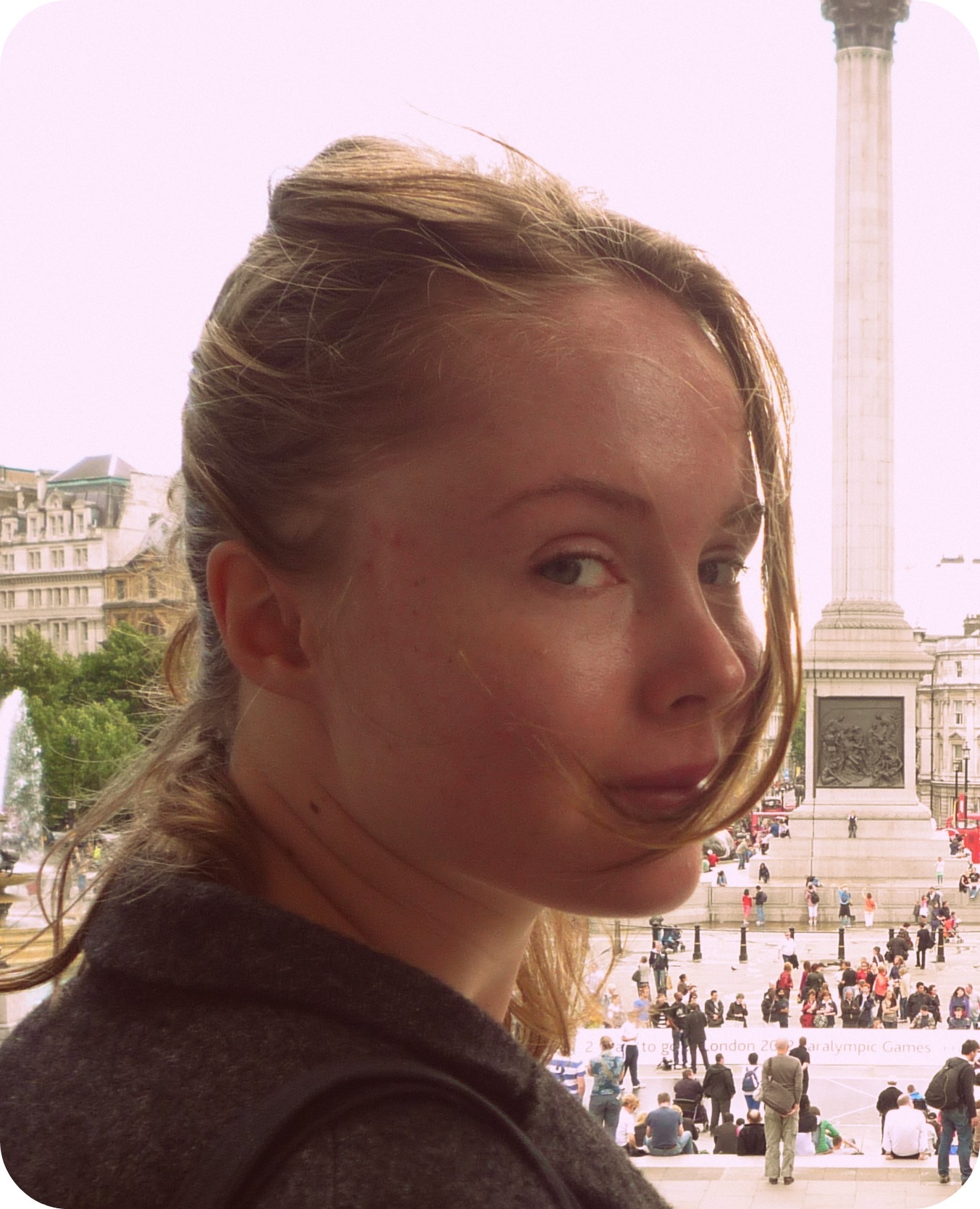
img: Charlotte Day surveying Trafalgar Square in London.

STAY TUNED for Monday’s post, the first in a new series on the joys and challenges of being an expat in France and attempting to master French cookery.

If you enjoyed this post, we invite you to subscribe to The Displaced Dispatch, a weekly round up of posts from The Displaced Nation, plus some extras such as seasonal recipes and occasional book giveaways. Sign up for The Displaced Dispatch by clicking here!

Related posts:

The light-hearted answer to Robert Pirsig — travel author Allie Sommerville

I know what you’re thinking. They can’t seriously be planning to feature Allie Sommerville in a month where they’re celebrating the joys of the open road?

For those who haven’t heard the news yet, Sommerville is the author of Uneasy Rider: Confessions of a Reluctant Traveller, and we’re doing an interview with her today, as well as an e-book giveaway (for DISPLACED DISPATCH subscribers only — sign up NOW!).

But before we proceed, allow me to say a few words in Sommerville’s — and our — defense.

As much as Sommerville may moan about her travel misadventures, as one of her Amazon reviewers puts it: “Methinks she doth protest too much.”

I would concur. In my own interactions with Sommerville, I’ve come to think of her as a gentler, more light-hearted version of Robert Pirsig, who penned the brilliant, if opaque, Zen and the Art of Motorcycle Maintenance, on which we’ve based many of our posts this month.

The two have much more in common than it may at first seem. Like Pirsig, Sommerville has faced the reality of sustained travel on the open road and the many challenges it entails — particularly if your vehicle of choice is a motorcycle or campervan.

Also like him, she has concluded that for a road trip to be a success, you must have a yin and a yang.

The main difference is that for Sommerville, these concepts are physical, not metaphysical — as in two people, herself and her Other Half, Harry.

She is the yin — the dancer, the poet, the writer — to poor Harry’s yang. He is the driver of the couple’s broken down but beloved RV, in charge of all repairs. And when things go awry, as they very often do, Sommerville injects a philosophical sense of humor for some perspective on the situation — a technique on a par with Pirsig’s philosophical musings.

Take, for instance, the very first road trip the couple made in this rickety vehicle, to Spain — all because Sommerville had developed an obsession with British poet Laurie Lee‘s memoir about tramping through Spain.

So far so predictable: Sommerville as driving force behind the adventure, her Other Half as driver. But then what happens when the campervan proves too wide for a Spanish street? He sweats it while she searches for an entertaining story in their predicament:

There was no room for manoeuvre. … With both sides of the van threatening to add a new dimension to the walls of the houses, it was nigh on impossible for either of us even to climb out…

By now we were becoming aware that we’d attracted the interest of several ancient and well-oiled patrons of a bar just up ahead, and our little drama turned into a full-scale pantomime as they began gesticulating and beckoning us on.

“Sí! Sí!…Se puede!” they exclaimed excitedly and at the same time doing what could only be described as some sort of grotesque ritual dance.

This was a good time to remember the meaning of those words in my favourite scene from the language video.

Se puede! They seem to think we can do it!” I translated helpfully.

So, without further ado, I give you the light-hearted Robert Pirsig: Allie Sommerville.

Tell me a little more about your background.
I was born in Croydon, which was in the county of Surrey at the time — now though, notoriously part of Greater London — and my husband is from London. After setting up home in Croydon for a few years, we moved to the Isle of Wight in 1976 to build our own house and give our two young children a better area to grow up in.

We are both, even after all this time, what Islanders call “overners” (an abbreviated form of “overlanders”). Only people actually born here qualify as “caulkheads.”

Uneasy Rider, which was published in 2009, was my first book. I’ve just published my second, a memoir about my childhood, on Kindle. It’s called To set my feet a-dancing and takes a light-hearted look at a time when children were allowed play in the park until dark, clothes were home made and owning a car meant you were rich. I draw a lot upon my time as a young amateur dancer, telling about my appearances with my older sister in shows arranged by our rather eccentric dancing teacher. I also look at schooldays, Christmases past and seaside holidays in an age of innocence.

I began this project after researching my family history for many years. It occurred to me that our children have no idea about how my generation lived as children in late 1950s England. Life has changed beyond anything we could imagine.

I conclude the book with the life stories of my grandparents and their predecessors — things I have gleaned from censuses, birth and marriage certificates, old photographs and conversations with my late mother. These are the lives of ordinary families: people whose lives are not in the history books.

I’m also in the process of writing about a trip my husband and I made around mainland Great Britain in the same old camper van, from the South (i.e., Isle of Wight) to the North (i.e., Scotland). The provisional title is: Miss Potter and the Mathematicians Rabbit — Allie Goes Oop North. The main title is taken from an experience we had in the Lake District.

Moving on to Uneasy Rider: How many road trips have you and your husband made together over the years?
We made six road trips in the converted Leyland Daf campervan of the book, from 1999 to 2004, though our very first trip in a motor caravan was in 1991, with our two teenagers on board.

Do you ever travel by other means?
Of course! We’ve traveled many times by car in France and Switzerland, staying in gîtes, chalets and apartments. My favorite “trip” of all though was on the Cunarder, Queen Mary 2, to New York. Much nicer than “roughing it” in a camper van! I absolutely loved New York and the glamour of the six-day Atlantic crossing, despite sailing through a force 11 gale.

So what made you decide to write a book about your campervan excursions?
During our trips, we had so many events that each time I said, “There’s a book in this!” Before we took off on our first trip (to Spain), I hadn’t found any similar book on the subject of campervanning or caravanning, apart from site-finder guides; it seemed there was a gap in the market.

Whom did you see as the primary audience?
I had in mind other campervanners who would identify with the joys, trials and tribulations of this type of independent travel. I didn’t want it to be one of those “everything is fantastic about travel” books. I hope I tell it like it REALLY is — the ups and downs, the good and the bad. Some campervan “purists” don’t appreciate hearing about the downside of their preferred method of holidaying though. They appear to have gotten together to leave negative reviews on Amazon. But I’m not too sure, by some of the comments, that they’ve actually read it…

Bill Bryson is the master of modern travel writing as far as I’m concerned, and it’s his light-hearted touch that I hope in some way to emulate. A tough act to follow!

Many people take road trips when they are young, to find out more about life and themselves. Does the purpose change once you become middle aged?
Middle aged? I still feel about 17!

As you’ve already mentioned, the purpose of our first trip (to Spain) was to follow in the footsteps of my literary hero, Laurie Lee. In As I Walked Out One Midsummer Morning, he tells of his walk across Spain on the cusp of the Civil War in the early 1930s. This book, for some reason, holds a big fascination for me.

That trip was meant to be a one-off. But afterwards we weren’t able to sell the van, so instead of letting it sit in the drive, I seized the opportunity to see as much of the art and architecture of Italy and France as I could. I suppose you could say my purpose was educational!

Which was your favorite place of all those you visited?
Florence has it all. I could never tire of it. We visited this amazing city three times. I was studying Art History at the time, specialist subject “The Early Renaissance.” The Italian people are fantastic, too!

Which was your least favorite?
Spain, especially the Costas (various coastlines), which were full of half-finished blocks of flats. Whether we were unlucky I don’t know, but it was not a friendly country — apart from a few honorable exceptions which I mention in the book: the helpful policeman in Seville who strode into and held up four lanes of speeding traffic for us, the patient shop assistant in the flamenco boutique. I have the feeling that relatively recent history may have altered the Spanish character: George Orwell in Homage to Catalonia found the Spanish people cheerful and friendly.

Robert Pirsig says “It’s a little better to travel than to arrive.” I’m guessing you might not agree with him?
Err…not really. Like Dorothy, my mantra is: there’s no place like home! Having the campervan, however, was almost like taking your home round with you. My best moments during these trips were when we found pleasant campsites to put down temporary roots.

Pirsig claimed there are two types of people: “classical” — practical, DIY fixers, boy-scout prepared types; and “romantic” — those who thrive on surface appearances, don’t want to get involved with the nitty-gritty, and thrive on gestalts.
As you noted in your introduction, I’m definitely “romantic,” and my husband is certainly “classical” — which probably explains why we work as a couple. He drives and sorts out problems, I look forward to seeing the Da Vincis.

Each chapter of your book is a stand-alone story, describing a particular incident. Do you have a favorite?
“The Parable of the Parador” is my stand-out favorite. As I said, it is typical that I get these romantic ideas — and my other half goes along with them, most of the time. That particular chapter though, sees a bit of role reversal, when we get “stuck” on the road into Arcos de la Frontera, to reach the parador (state-run hotel). For once he thinks it’s all hopeless, and I have to be the optimist. When he feels like this about a situation, I know we are REALLY in trouble.

Pirsig advocates traveling on a motorcycle because it puts you there, in the moment, without the barrier of a windscreen. What do you think of his philosophy?
To travel on a motorbike would be my nightmare! I just would feel too exposed. I like to be safe — hence the theme of Uneasy Rider.

Many of the Displaced Nation’s readers are expats. Can you imagine living anywhere besides the Isle of Wight?
We’ve often thought we should have relocated to France some years ago. I’d love to live in a place where you can walk to a baker’s every day for fresh baguettes and croissants. Now, the only place I’d move to is Central London: the London National Gallery and Covent Garden Royal Opera House are big draws.

How well do you fit back into the Isle of Wight after your journeys? Do you suffer from any counter culture shock?
The flippant answer is that being a “townie,” I suffer counter culture shock on the Island every day anyway… even after all this time. However, the main feeling after being in the ‘van for four weeks, though, was that our house did seem HUGE for the first few days .

So what’s next for your travels?
Next year I am fulfilling my long-time ambition of visiting St. Petersburg — on a cruise ship rather than by road. Russia and especially its Tsarist past, fascinates me. Hopefully there will be a book in this, though for all the right reasons!

Readers, do you have any questions for the Amazing Allie? Ask away, before she takes off again!

Images: Allie Sommerville’s author photo and book cover.

STAY TUNED for tomorrow’s installment from our displaced fictional heroine, Libby, as she prepares to welcome the pitter-patter of little feet. Clawed, furry feet, that is: Fergus is now a canine expat! What, not keeping up with Libby? Read the first three episodes of her expat adventures.

If you enjoyed this post, we invite you to subscribe to The Displaced Dispatch, a weekly round up of posts from The Displaced Nation, plus some extras such as seasonal recipes and occasional book giveaways. Sign up for The Displaced Dispatch by clicking here!

Related posts:
An un-American in an All-American diner

Continuing this month’s theme on road trips founding contributor Anthony Windram weighs in with some thoughts on the American diner.

There’s neon tubing that emits a purple glow around the clock that tells me it’s nearly 10pm. The dinner service is long over, the families now dispersed and only a scattering of drifters and loners are left. It’s still, at least, another 45 minutes before the late-night drunken crowd makes an appearance.  This diner is more Edward Hopper than Norman Rockwell. Across the parking lot is a strip club, as the night draws on and into morning some of its patrons, I imagine, will head over here to have a burger or to take advantage of that most American of institutions – the 24-hour breakfast.

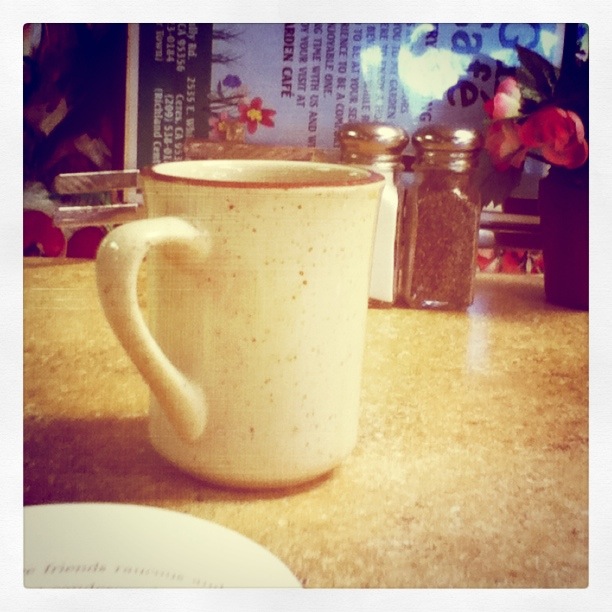
There’s a still sadness to the place despite the best efforts of the waitress who exudes a friendly busyness. She could be anything from her late-40s to her early-60s. She calls me “sweetheart” when she comes over to give me a refill of greased coffee. She doesn’t, however, call it “a cup of Joe” — that would be one cliché too many.

Mentally, I take a step back from this scene and try to view all around me as a tableau and can’t but help but think this is Americana that I am sat in, this is America.

Perhaps this is the “real” America; a banal phrase uttered by a banal politician, but a phrase that does strike at something deep in the American psyche.

Dr George Lewis, director of American Studies at Leicester University, has started what the Guardian claims is the “first sustained historical analysis of the term un-American.” While there may be some confusion over quite how one defines being “un-American,” what seems certain to me is that this cold burger and this diner is decidedly the opposite of “un-American”. Though I am in Bakersfield, California, I could be anywhere in the Union, be it red state or blue state.

When I first moved to the US, to my now shame, I found myself fascinated by the Food Network show Diners, Drive-Ins and Dives, hosted by the hyperactive Guy Fieri, a man with the cholesterol levels of someone twice his age. Fieri is a TV host with absolutely no sense of discernment. Everything that he comes across, everything that he tastes, must be spoken about in glowing terms to the point that nothing that Fieri says has any real meaning whatsoever.

And yet I did find myself compelled by the show for illuminating further for me the American diner and showing me places that occupy a place in the country’s cultural milieu that the English cafe doesn’t even come close to back home. I soon stopped watching Diners, Drive-ins and Dives — not because my view of diners changed, but because it was (and is) a God-awful program and there’s only so many times you can watch an overweight Fieri eat some barbequed pork and then pronounce it “awesome”. But there was one thing in particular about Fieri’s show that they always got wrong. They would always show the diners when they were packed and buzzing with a family friendly atmosphere. And while I wouldn’t suggest that that’s not the case, what I find interesting is that when you roll into a strange town late at night and find yourself at a diner, regional and political difference tend to dissolve. You are in a place that is resolutely American rather than California, or Colorado, or Vermont, or…I could go on.

Fieri’s show, a sort of televisual equivalent of Pravda which can only emphasize the positive, misses out on what I am experiencing here in Bakersfield as the clock, that has neon tubing wrapped around it, hits 10 and I ask for my check. Here, and which Fieri always misses, is a quiet efficiency mixed with a low-burning malevolence. It’s that mixture of warmth and fear you get when your waitress flashes you a warm smile but you know you’re in a moment going to be stepping out back into that parking lot — and in the back of your mind you’re just a little concerned that this might be the night where you get shot by a drunk coming out of the strip club.

Question: What’s your experience of American diners?

Image by awindram.

STAY TUNED for tomorrow’s interview with the travel writer Allie Sommerville. NOTE: All DISPLACED DISPATCH subscribers will be entered in our giveaway of Allie’s book, Uneasy Rider.

If you enjoyed this post, we invite you to subscribe to The Displaced Dispatch, a weekly round up of posts from The Displaced Nation, plus some extras such as seasonal recipes and occasional book giveaways. Sign up for The Displaced Dispatch by clicking here!

Related posts:

Gotta helmet? Time to burn some rubber, have a real travel adventure

The Displaced Nation has dedicated the month of September to the ideas within Robert Pirsig’s classic, Zen and the Art of Motorcycle Maintenance. But enough with theory. What’s it really like to see the world from the back of a motorcycle — and what are us more timid types missing out on? Rubber hits the road today with Matthew Cashmore, aka The London Biker. Braaaaown… brraaoom…… rrooaaarr………. Take it away, Matthew! NOTE: This post has not been edited for British spelling.

There are some things in life that just have to be done. Laying on your back staring at the stars, wondering which ones are dead and which are still blazing. Getting so drunk on cider that you can no longer stand (perhaps that’s just me). Or travelling the world by motorcycle.

The last, many people would say, is optional. But it’s not. If you feel as I do, motorcycle travel is as essential to life as water or food, then there is only one way to do it.

I’m not the first to point out that seeing the world from a motorcycle is better than any other means of travel — just dig out a copy of Zen and the Art of Motorcycle Maintenance or my personal favourite, Jupiter’s Travels, by Ted Simon.* You’ll only read a quarter of each book before you discover why this method of travel trumps the rest. You’re part of the world in which you’re travelling. There is nothing between you, the elements and the people with whom you interact.

I’ve been fortunate enough to see much of the world. I’ve backpacked, travelled by plane to amazing cities, jumped on buses or driven cars. But nothing, absolutely nothing, can match the experience of the wind rushing past your head trying to knock you off your bike, as you hurtle between towns and villages. And nothing can give you a greater grin than riding across the bay in San Francisco on the back of a growling Harley — safe in the knowledge that in a car this would be just another American highway.

If you don’t ride in the rain, you don’t ride…

It does take a certain amount of effort, though. This summer I did a short run from London out to Budapest via France, Germany, Austria and then into Hungry. The return leg took me through northern Croatia, Slovenia, back into Austria and up into the Alps over into Italy and then back over the Stelvio Pass into Switzerland, France and finally home. It rained the entire trip. Every single morning I was greeted with sheets of rain. I was beginning to suspect it was actually following me to Budapest. Each night I was soaked to the skin — even with the most expensive rain gear. Each night I was dog tired, and I really had to question what I was doing. What kind of a nut case chooses to spend his summer holiday riding a motorbike half way across Europe in the rain?

The reason I, and many others like me, do this is because you can ride for eight days in the rain — and then out of nowhere the clouds will clear and you’ll be presented with a road of perfect grace. A strip of tarmac that sings as you press on, a view that leaves you crying because of its beauty. Something you would never have seen had you been in a car or a bus. Something you’ve had to work to achieve — and it’s even more beautiful for that.

A parable of the hospitality shown to bikers

On the Budapest trip I found myself at the top of the Austrian Alps. I was running a day behind because I’d had a stomach bug back in Budapest. I was determined to make up that lost day so that I could still get over the pass into Switzerland ahead of a (yet another) rain front. I had been riding for ten hours, I had another six ahead of me, and I was already on my fourth change of clothes. I was incredibly fed up. Why on earth was I doing this?

I pulled into the first service stop I’d seen for about 150 miles, 2000 metres above sea level and hidden by cloud, rain and spray. Filling the bike up with petrol I spotted a small restaurant complete with a hotel — bliss, escape! I headed inside, dripping water everywhere. As I walked through the door I must have looked like a monster from the deep. I was dressed head to foot in every single piece of waterproof gear I could find — complete with an army surplus poncho. The restaurant manager took one look at me and ordered me onto a piece of lino, where I promptly created a rather large puddle. She demanded I remove my clothing leaving me standing there in just my thermals. I shivered, waiting for her next command. Did they have ways of making me warm?

My gear was whisked off (it came back nearly dry and very warm), and I was pointed in the direction of the shower and given a hot towel. I emerged a different man. Clean clothes, warm, and for the first time in two days, dry. Ushered to a seat, I took the opportunity to eat well — feasting on sausage and strudel, the best Austria had to offer. Buoyed by such amazing hospitality I got back on the bike and rode on. As I rounded the first corner the rain stopped and I hit Italy, sun, and the kind of twisty roads God clearly made for bikers.

I could say this was a one off, but the more I travel the world by motorbike the more I come to realise that the very thing that makes you vulnerable is the very thing that makes you approachable. It’s different if you’re travelling with other bikers, but when you’re on your own it’s a perfect combination of being totally exposed to the environment and more importantly to people.

This is what makes travelling by motorcycle so special. The openness, the access, the smells, the sounds, the people who are curious because you’ve rolled into town in something other than a bus or 4×4. If you want to experience, to imbibe, the world through which you travel…there is only one option. Gotta helmet?

* Suggested further reading:

Matthew Cashmore works in digital publishing. He keeps track of his “random thoughts” on his blog, The London Biker. He also has a YouTube channel, where he posts videos about his life on the road, camp cooking and related topics.

img: Matthew Cashmore in Budapest, July 2011.

STAY TUNED for Tuesday’s post, on the diner food that has played a part in many an American road trip.

If you enjoyed this post, we invite you to subscribe to The Displaced Dispatch, a weekly round up of posts from The Displaced Nation, plus some extras such as seasonal recipes and occasional book giveaways. Sign up for The Displaced Dispatch by clicking here!

Related posts:

“My country, ’tis of thee” applies to my expat mum but not to me

We take a break from road trips today with this guest post from Lawrence Hunt, a recent graduate of Warwick University (UK). Followers of The Displaced Nation may recall that we interviewed two cross-cultural married couples last summer. Hunt is the product of a cross-cultural union between an American mother and an English father. Let’s listen to what he has to say regarding the oft-perplexing matter of cultural identity. NOTE: This post has not been edited for British spelling or punctuation.

One of the things that expats like to tell themselves is that home is a state of mind.

But for me, the child of an English father and an American mother, home stands for a physical place: the one where I was born and grew up, England.

For years my mother has sipped her morning coffee from the same extravagantly large mug, Stars and Stripes boldly printed around the outside. She picked it up at an airport in Washington DC where we were visiting her sister. It’s curvaceous and welcoming, a daily caffeinated hit of homeland comfort. I’ve started drinking from it, too — but more as an ironic gesture.

Mum grew up reciting the Pledge of Allegiance in class, but in ultra-PC Britain, patriotism has to be decidedly lower key. It seems commonplace to see flags hoisted outside American homes, but over here the very act of being seen with a St George’s flag in any context other than sporting events or royal weddings is infrequent enough to draw stares. People see you with it and instantly wonder what fanatical scheme for national purification you’re plotting behind closed doors.

Now, I don’t fault my mum for being proud of her cultural upbringing. I think in some ways her extended absence makes her all the more keen to assert her identity and share it with us.

She did some family history research recently that confirmed we’re the distant descendants of Charles Carroll of Carrollton, the only Catholic and longest surviving signatory of the Declaration of Independence. That’s my strongest claim to fame, and I’m holding onto it.

Chocolate — the way to an English child’s heart

That said, America has never played much of a role in our regular family rituals. For one thing, traditions like the Fourth of July and Labour Day just aren’t compatible with the British calendar.

I do remember Mum hosted a wonderful Thanksgiving dinner once with some other American expats when I was little. Without having the next day off to recuperate, however, everyone left early and I think she found the mountain of washing up too colossal to repeat the effort.

The one institution she has passed down to us (and this is something I cannot thank her enough for) was the American Easter basket hunt. The concept, as I explain it to my friends, is simple but ingenious – essentially, it’s what all kids in England do but with two key differences: 1) More chocolate, and 2) Baskets.

While other English kids were being handed single Cadbury creme eggs in flimsy cardboard boxes, my brothers and I were racing around the garden looking for mighty hoards of chocolate hidden among the shrubbery by a miraculously literate bunny that knew how to spell our names on post-it notes.

As American as everyone else in Britain?

Basket cases aside, it’s difficult to say exactly how ‘Americanized’ I am as a result of my mother, and how much of it is just living in a country where America’s influence pervades almost every cultural platform.

The most differentiating feature of mum’s background has always been her accent. I can do a pretty convincing American accent on a good day, and I used to mimic my mother so often when I was a child that I still lapse into it sometimes without realising.

But even my mother, having lived here for almost thirty years, isn’t really that American any more in her diction. I think the few Americanisms I sometimes find myself using, like ‘movie’ rather than ‘film’, or ‘take-out’ rather than ‘takeaway’, are more because I hear them in American movies and prefer them than because I’ve picked them up from her.

I certainly feel something for the States — a fondness and a familiarity, I suppose. I’ve been lucky enough to go with her on visits to her family almost every other year since I was a baby. Some of my favourite memories have come from spending summers at lake houses in North Carolina, climbing the mountains of West Virginia and walking down endless blocks of New York.

When I was seventeen I took a position teaching at a French camp in the woods in Minnesota, and made friends who I still keep in contact with.

America as distant entity

But America lives for me, as it does for many Brits, more in fiction than in reality. From the moment I read JD Salinger, I was hooked, and I’ve probably read more American writers than British ones: Steinbeck, Fitzgerald and Kerouac, right through to more recent contemporaries like Bret Easton Ellis, David Foster Wallace and Jonathan Franzen.

They all essentially seem to be commenting on the same thing: the tragic failure of American life to live up to its promises. Paradoxically though, in the richness of the characters and landscapes they describe, they evoke a utopia in my mind that’s been hard to shake.

In my final year at university I enrolled in a contemporary American Literature module — ‘States of Damage — US Writing and Culture in the Post 9/11 Context’. I didn’t know what I was getting myself into. It was a step-by-step dissection of everything wrong with free market America, from George Trow’s attack on media culture in ‘Within the Context of No Context’ to Naomi Klein’s The Shock Doctrine, an expose on America’s foreign policy over the past 40 years.

The critique seemed appallingly one-sided to me, and an hour a week for an entire year I felt compelled to fight America’s corner against the scathing intellects of my fellow students. Truth be told, I just like a good debate, and this was a difficult one. There’s a lot about American politics that we find objectionable in British culture — even though we’re implicated in most of the same hypocrisies ourselves.

To be fair, however, my fellow students showed a very different side on Obama’s inauguration night. The Students Union had been decked out in American flags and YESWECAN posters, and multitudes of students were queuing up to buy hotdogs and other American staples. I voted in that election, and it was a night when I felt nothing but pride to be half American.

My mum’s sweet land of liberty

I sometimes think it would be nice to use my dual citizenship and live on the other side of the Atlantic for a while, preferably near the coast. Mum believes that on the whole, Americans are more open, friendlier (at least on the outside) and more honest than British people. She’s even been known to point out these qualities in my brothers and me, when they appear, as our ‘American side’.

I’m sceptical that you can generalise about such vast groups of people in any meaningful way, especially as the world becomes increasingly mixed.

Ultimately, I think when you spend very little time in a place, and you miss it greatly, you begin to feel connected to a idealised version of it, one that’s perhaps better than the reality. When I ask about America, the memories my mother recalls from behind the vapours of her star-spangled mug are those of the pioneering Midwest. She tells me she always wanted to be one of the pioneers in Little House on the Prairie, struggling against the elements and striking out on her own.

That adventurousness is, ironically, probably part of what made her leave America for pastures new in the first place.

I can see the real things she’s had to give up in establishing her new life here — the family, the friends, the holiday traditions, a million different flavours and details that in some cases are only slightly different here from what she grew up with. Those are also the things I take for granted about my own life in Britain.

I was born here, and that counts for a great deal more than where my mother was born.

img: Lawrence Hunt with his mum’s stars-and-stripes mug, at home in Chorley Wood

STAY TUNED for Monday’s post, in which Matthew Cashmore, aka The London Biker, relays his personal “Zen” of this rather risky, albeit exhilarating, mode of travel.

If you enjoyed this post, we invite you to subscribe to The Displaced Dispatch, a weekly round up of posts from The Displaced Nation, plus some extras such as seasonal recipes and occasional book giveaways. Sign up for The Displaced Dispatch by clicking here!

Related posts:
RANDOM NOMAD: Camden Luxford, Hostel Owner, Freelance Writer/Blogger & Student

Born in: Mackay, Queensland, Australia
Passport: Australia
Countries lived in: United Kingdom (Brighton, Oxford, Edinburgh, and a country hotel near Crickhowell, Powys, Mid Wales): 2005-06; Peru (Cusco): 2009-present.
Cyberspace coordinates: The Brink of Something Else (blog)

What made you leave your homeland in the first place?
I left, at 20, because I’d always had an itch. As a kid, I’d poured over National Geographics and Lonely Planets, plotting these exotic routes across strange lands. I think I imagined myself some kind of Lara Croft-type figure. Then I grew up and didn’t really know what I wanted to do with the rest of my life, so I boringly did what thousands of Australian 20-somethings do every year — took off to the UK for a couple of years.

Is anyone else in your immediate family displaced?
Dad’s displaced — in a jet-setting, corporate type of way. He always traveled a lot for work when I was young, domestically and internationally, and now he’s semi-retired and living most of the year in Italy. It’s handy, ‘cos now I have a great place to stay close to really good pizza and wine.

Describe the moment when you felt most displaced.
Waiting at the police station to report an alcoholic Latino ex for threatening to kill me, and having the cops not really care. I just thought in that moment, what I wouldn’t do to be back home, away from this machismo, in a place were I instinctively understand how men and women relate to each other.

Describe the moment when you felt least displaced.
Every Wednesday I get together with my closest friends here in Cusco for lunch. We cook, open a few bottles of wine, and laugh away all the week’s problems and dramas. It’s my Cusco family, and when we sit around the table, teasing each other mercilessly, I feel completely at home.

You may bring one curiosity you’ve collected from your adopted country into The Displaced Nation. What’s in your suitcase?
I tend not to hold on to things, just memories — and a hard drive full of photos. So I’ll describe a treasured photo from each country, instead.

From England: One of myself and my friends on the pebbly beach of Brighton. It’s a candid, and nobody’s posing, we’re just scattered about doing our thing. A couple of the boys are playing chess, a small group is talking, I’m reading a book, someone’s playing guitar. It’s a lovely slice of our lives that summer.

From Wales: Tintern Abbey caught just as the sun set. I was driving, turned a corner, and that sight took my breath away.

From Scotland: An entire album covering my 22nd birthday — from the moment my roommates woke me up with fairy bread and beer until about 4:00 a.m. the following morning. The deteriorating respectability is spectacularly documented.

From Peru: A Photoshopped-together photo of “Yamanyá,” the name of my hostel, spelled out in fire. We were camping by the Templo de la Luna (Moon Temple) outside of Cusco, and after half a bottle of rum I pulled out the camera and an Argentinian friend lit a stick on fire. It kept us entertained for more than an hour.

You’re invited to prepare one meal based on your travels for other Displaced Nation members. What’s on the menu?
Definitely a starter of ceviche: thin fish strips flash-marinated in lime with a touch of coriander, a load of chile, and a pile of fresh red onion, accompanied by a very cold Cusqueña beer. Served on the sand within spraying distance of the waves.

Then, in anticipation of my upcoming move to Buenos Aires, it’s a thick Argentinian steak cooked rare, with a glass of Malbec. Good meat is hard to come by in Cusco, and I miss it.

For dessert we’ll visit Dad in Italy: tiramisu, and then a strong espresso to finish the caffeine kick.

Then the Pisco gets opened, and it’s chilcanos all round: Pisco, ginger ale, a drop of Angostura bitters and a squeeze of lime.

You may add one word or expression from the country you’re living in to The Displaced Nation argot. What will you loan us?
From the UK: Minging has always stuck with me; I have no idea why. For the uninitiated it means disgusting, ugly, gross.
From Peru: Sí, no? — a delightfully Limeñan turn of phrase whose English translation (yes, no?) doesn’t make any sense at all.

It’s Zen and the Art of the Road Trip month at The Displaced Nation. Robert M. Pirsig, author of Zen and the Art of Motorcycle Maintenance, famously said: “Sometimes it’s a little better to travel than to arrive.” Do you agree?
I’ve always loved long, uncomfortable journeys, whether in car, train, bus, boat, or on foot — the process of being in transit, of movement, of change. I even have a sick fascination with long stopovers in airports: sleeping curled up on an uncomfortable bench, announcements blaring over the loudspeakers.

So for me, yes, the journey is a little better. Having been here, in Cusco, for almost two years, I’m growing uncomfortably restless. My mother argues that this is fear of commitment on an epic scale, but I like my life most — feel like I’m learning the most — when I’m on the move, and in the first blush of a new life in a new place.

I will point out in my own defense that I maintain my work and studies even while on the road. In a very stop-start sort of fashion, I’m finishing a Bachelor of Arts in International Studies and a Bachelor of Commerce in Economics from Deakin University in Melbourne, as part of their off-campus program. So I’m not completely irresponsible. (So there, Mum.)

Pirsig’s book details two types of personalities: 1) those who are interested mostly in gestalts so focus on being in the moment, not rational analysis; and 2) those who seek to know the details, understand the inner workings, and master the mechanics. Which type are you?
Despite a thoroughly scientific upbringing and education — Dad’s an engineer — and a very rational approach to my studies, when it comes to travel and expat life I’m all about the gestalts. I stayed in Cusco on little more than a whim, and recently returned from an ill-planned but exhilaratingly unpredictable road trip to Ecuador in a Volkswagen Kombi. Every moment of that road trip was a surprise — the cast of characters, a rotating mix of backpackers and South American musicians and circus performers. We followed the sun north, took a minor detour inland to teach a music and clowning workshop to the children in a poor community, and played music on the beach.

But although I laughed and made wonderful new friends and was constantly surrounded by music, this road trip, with its constant visits to mechanics, was also the reminder I needed of the importance of the rational type of personality. Road trips in general are a wonderful encapsulation of this duality, I think. Driving with the windows down on the highway with the music blaring, going where the wind takes you…but going there in a machine that needs care and understanding and maintenance. I’ve leaned too heavily to the romantic side, and it’s time to start taking better care of my machine.

Readers — yay or nay for letting Camden Luxford into The Displaced Nation? Tell us your reasons. (Note: It’s fine to vote “nay” as long as you couch your reasoning in terms we all — including Camden — find amusing.)

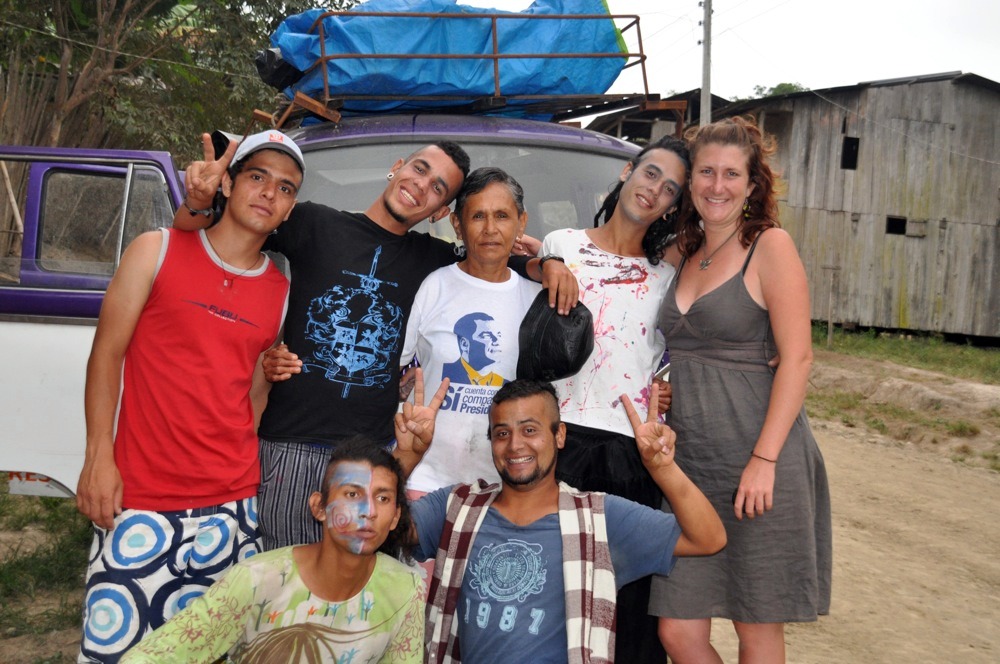
img: Camden Luxford on her recent road trip — in a tiny community about two hours form Pedernales in Ecuador, where she helped put on a juggling (among other things) workshop. She is posing with some of the kids and a teacher, along with members of the Colombian cumbia band she had as passengers for a couple of weeks. Yes, that’s the famous Kombi in the background!

STAY TUNED for tomorrow’s installment from our displaced fictional heroine, Libby, whose road-trip adventure of last week ended on a dramatic note. What, not keeping up with Libby? Read the first three episodes of her expat adventures.

If you enjoyed this post, we invite you to register for The Displaced Dispatch, a round up of weekly posts from The Displaced Nation. Includes seasonal recipes and book giveaways. Register for The Displaced Dispatch by clicking here!

Related posts:

LIBBY’S LIFE: The first three episodes

It’s Life, all right, but not as I know it

April 1
Why is it, just as you get Life under control, Life decides you’re too complacent by far and snatches your security blanket away? And not only snatches it away, but rips it down the middle, throws it in a muddy puddle, and stamps around on it for good measure? Then Life hands you back the pieces and says, “How much in control do you feel now, Libby?”

Three months ago, after a Christmas spent pandering to everyone except me and receiving an assortment of kitchen gadgets instead of the anticipated spa- and nail salon gift vouchers, I decided Enough Was Enough.
This year, I vowed, as I stowed away a new banana slicer and mini-vac, I would no longer be merely “Jack’s Mummy”. No longer would I hand Oliver his packet of sandwiches in the morning and brush a hair from his suit collar, as if I were an extra in I Love Lucy.
This year, I promised myself, I would reclaim an identity that vanished three years ago in a maternity ward in Milton Keynes.
This year, I said, Libby Patrick would return.

Until last night, my pre-motherhood persona was making progress in her resurrection. I had my hair cut and my nails done. I chucked out grey nursing bras and went shopping in Debenhams’ lingerie department. I had lunch with my old boss who told me she would personally kill a fatted calf in celebration of my return to the office.
Then, last night, all progress stopped.

“The company wants me to take a job in another department,” Oliver announced over dinner.
Dinner is supposed to be a time when family members catch up with one another, but as any parent of a two-year-old knows, reality doesn’t work that way. While Oliver recited details of which job in what department, I was only half-listening, more concerned with stopping Jack from feeding Marmite toast to Fergus, our gluten-intolerant dog. So my response to Oliver was something like, “Lovely-darling-and-don’t-even-think-about-it-Jack” before grabbing Fergus by the collar and dragging him into the study where, with a bit of luck, he would eat final demand electricity bills instead.
This half-attention is all too common in our house, and it makes me feel guilty. I try not to feel guilty, but as a stay-at-home mother at present, I must be more supportive of my husband. Or that’s what my mother tells me. God knows what she was doing in the 1970s while other women were burning their bras. Out shopping for whalebone corsets, I imagine.
Oliver, naturally, is all in favour of the idea of supportive wives, and unashamedly sucks up to my mother to get her support as well. He once sent me an email, supposedly a page from a 1950s magazine, telling housewives how to treat their husbands properly. You’ve probably seen it. Wives are advised to hand their husbands a G&T the minute they walk through the door, tidy the children up and the toys away – or perhaps it’s the other way round – and to shut up while Hubby speaks because his opinions are more important. Oliver claimed the email was a joke. I told him it might have been, had I been employed and salaried, but right then, with baby-sick permanently welded to my shoulder, it wasn’t funny and Oliver was fooling no one. Millennia of male chauvinism can’t be wiped out by Harriet Harman, whatever she thinks, or by a few charred Cross Your Heart foundation garments.
But back to Oliver’s announcement. Once I was reseated at the table, Oliver said, “You didn’t hear what I said, did you, Libby?”
“Yes, I did.” I handed Jack a fresh triangle of Marmite toast. He mushed it into a ball and chucked it at the window behind me, where it stuck for a second before sliding down, leaving a greasy trail. “HR wants you to transfer.”
Oliver waved his hand around in a circle. “And…?”
I thought. “And you’ll get a pay rise?” I said hopefully. With his pay rise and my new job, we’d be able to go on holiday this year.
“Plus a relocation package.”
I stopped persuading Jack to eat, and stared across the table at Oliver, who seemed satisfied now he’d got a reaction.
“Relocation package? Relocation to where?” Most of the company’s offices are in Britain – with one exception. Please let it be Birmingham. We wouldn’t have to move house because Oliver could commute. Or Liverpool…or heck, even Aberdeen is commutable these days.
“The Massachusetts office,” Oliver said. “We’ll talk about it.”

And that was the point when Life snatched away my security blanket, hurled it in a swamp, and danced the mashed potato on it.

April 5
We’ve spent the weekend talking about this hypothetical move to America. Well. I say “hypothetical” but it isn’t. And I say “talking” although it isn’t really that, either. Oliver appears to have done most of the talking already with the Relocation Manager in his Human Resources department. (What happened to Personnel Departments? Have we come so far down the line of political correctness that we can’t acknowledge we have personalities?)
So when Oliver promised we’d talk about it, he meant we would talk about the after-effects of the decision, not the decision itself. That seems to be settled and all over, bar the shouting.
Bar the shouting wife.
“It’s a great opportunity,” Oliver says. “One of those chances you’ve got to take in life.”
“But what about me?” I say. “What about my life?”
Now I know how Jack feels during his tantrums. I want to lie on the carpet and kick and scream and shout “No! No! Go away!”
“You’ll have a lovely life. All the wives do.”
“But none of them go to work,” I say. “They’re not allowed to.”
“Why would you want to go to work when you can be at home with Jack?”
I think of my new haircut and freshly accumulated wardrobe of crisp work attire, and murmur, “Oh, I don’t know. Dignity. Independence. Self-worth. Stuff like that.”
Oliver stares at me for a while.
“I don’t understand.”
No. I know he doesn’t.
Instead of lying on the floor and shouting at him to go away, I lie on the sofa and cover my face with a cushion. It’s almost as good.

“We’ll live in a little town near Boston,” Oliver says when my rate of used tissues per minute has slowed. “You know Boston. It’s where the Cheers bar is, and where they filmed Ally McBeal. You love both those programmes.”
I tell him that he loves watching EastEnders, but he wouldn’t want to move to Walford.
He gives me a withering look. “Walford’s a made up place. It’s not real.”
“More real to me than Boston.”
“It wouldn’t be permanent,” Oliver says. “Think of it as a two-year holiday.”
This is pretty rich, coming from him. If I had to pick one characteristic in Oliver that I’d happily trade (excluding spur-of-moment, unilateral decisions to emigrate) it would be the homing pigeon tendencies. He gets culture shock if he goes farther north than Leicester. Take him to Spain and he’ll make a beeline for all the restaurants whose menu items end with “‘n’ chips.” We went to Disney World in Florida the year before Jack was born, and Oliver insisted on wearing his Beckham football shirt everywhere. Well, he and the rest of English-accented Orlando.
I didn’t intend to play the trump card so soon in the game, but my options are running out fast.
“You do know,” I say, “that they don’t sell roast chicken-flavoured crisps over there? No Quavers or Skips? No Hula Hoops?”
Oliver opens his mouth as if to say something, then shuts it again. For a moment, he looks uncertain. Is it possible our future teeters upon a specific combination of E-numbers and MSG?
Then he smiles; an indulgent smile, the sort I give Jack when he’s done something unbearably cute and naïve, and I know that even the threat of no Skips or Quavers to satisfy the midnight munchies isn’t going to work.
“Libby, love. It’s Boston. They have their own fantastic food. We don’t need chips.” Chips? Lord help us. He’s into the lingo already. “There’s lobster and crab cakes, and – what’s it called? Clam chunder.”
Not quite into the lingo, then.
“Chowder.”
“Whatever. My point is, who needs crap like prawn cocktail crisps when you can have the real deal fresh from the ocean there?”
I shake my head, resigned, knowing our fate is decided for the next two years. Oliver is basing a three-thousand-mile upheaval on…seafood.
And oh. Did I mention he’s allergic to fish?

April 19
Oliver and I are keeping quiet about the move until plans are definite. We each have different reasons; he doesn’t want to lose face if it doesn’t happen, and I want to pretend it won’t happen at all.
It’s ironic, the way we’ve switched roles. I used to be the one who liked going abroad and trying new food, whereas he’d eat burger-au-E-coli twice a day for a fortnight rather than pollute his digestive system with local cuisine. Once, in Ibiza, I tried to get him to eat a piece of morcilla. “Oooh, no, not that foreign stuff, thank you,” he said, shuddering as if he was a contestant on Fear Factor and I was trying to tempt him with deep-fried cockroach. Thing is, he didn’t realise it was Spanish sausage. He thought it was black pudding. Lancashire black pudding was foreign enough for Oliver.
But now it’s me dragging my heels about going abroad, while he’s suddenly turned into Gordon-bleeding-Ramsay, evangelising about fresh local produce that brings him out in a rash.
Calm. Breathe.
It’s difficult to keep this a secret, though. Take today, when Jack and I are at playgroup.
Carol Hunter corners me as I’m struggling to get Jack’s coat off.
Carol’s the sort of woman you’re glad to leave behind in the office rat race when you go on maternity leave. You think you’re entering a cocoon of babies, teddy bears, and Johnson’s products, unsullied by bossy women with expensive highlights. Then you discover these women have not only infiltrated your baby-powdered haven but established their own Mafia, ruling the playgroup, PTA, and school governing board.
Carol’s the Don of the local ring.
“Libby,” she says in a confidential tone, gripping me by the elbow in case I make a run for it. “Libby. We need to talk about your volunteer record. It’s somewhat…threadbare.”
Oh, hell. Everyone with a child in playgroup is supposed to sign up to help on a regular basis. That’s the idea. But what actually happens is you volunteer once or twice, spend two hours smiling through gritted teeth while Carol or one of her captains micromanages you in the art of finger-painting, and then forever after keep a low profile when volunteers are needed. There’s a lot of Mafia moaning goes on about it, of course. Usually over skinny lattes in Starbucks, while their little darlings sprinkle brown sugar packets on the floor, about how it’s always the same people who do all the work, and how this playgroup wouldn’t survive if it weren’t for Carol and her chums. But you ignore it. These women used to get their kicks playing the office martyr in their pre-baby lives, and they’d hate to be deprived of their sackcloths and ashes now.
“You’ve only done three sessions since last October,” Carol goes on, clamping down harder on my arm. “Can I put you down for the Play-Doh table next week, with Angie? Then two sessions in May, and a couple in June?”
I cough. “All with Angie?” Frankly, I’d rather sign up for evening classes in embalming than for six playgroup sessions with Captain Angie, who can’t go five minutes without dropping into conversation that she went to school with Supernanny’s cousin.
And then it strikes me. “Tell you what,” I say. “Let’s make it easy. I’ll do all of July, twice a week, until the schools finish for summer. Six sessions. How’s that?”
Carol opens and shuts her mouth a few times, but no sounds emerge, which is pretty satisfying. It’s not often she’s lost for words. No doubt she’s been revving up for a big fight about this, probably culminating in a hit job in Starbucks. Remind me to check the cisterns for firearms next time I’m in there.
“Fan-tast-ic,” she eventually murmurs, and wafts off to persecute a new mother of twins.
It’s all I can do to stop myself from shouting, “Because come July, Carol, I will most likely be eating lobster on the other side of the Atlantic, and not even you and your molls will be able to drag me back to the Play-Doh table.”
It’s as good a reason as any to emigrate, I suppose.

Want to read more? Head on over to Kate Allison’s own site, where you can find out more about Libby and the characters of Woodhaven, and where you can buy Taking Flight, the first year of Libby’s Life — now available as an ebook.

If you enjoyed this post, we invite you to subscribe for email delivery of The Displaced Dispatch, a round up of the week’s posts from The Displaced Nation. Sign up for The Displaced Dispatch by clicking here!

Image: Travel Map of the World by Salvatore Vuono / FreeDigitalPhotos.net

RETURN TRIP: Random Nomad – Charlotte Day, High School Student (Sixth Former)

While our writers take off on what they hope will be enchanting August breaks, The Displaced Nation will occasionally be reissuing some posts that, for one reason or another, enchanted our readers. Enjoy these “return trips”!
As youngsters head back to school, we’re reissuing a Random Nomad interview ML Awanohara did with Charlotte Day, a displaced teenager in England. Charlotte spent a chunk of her summer taking a Russian-language course in St. Petersburg and living with a Russian family. She has produced a travel yarn on her adventures, which will appear on Monday.

Born in: Sydney, Australia
Passports: Australia, UK and US Green Card
Countries lived in: Australia (Sydney): 1994-2001; United States (New York, New York): 2001-2010; England (Sevenoaks, Kent): 2010-present

What made you leave your homeland in the first place?
My father is Australian and my mother English. They split up when I was two. When I was six, my mother met and married an Australian who had been living in New York for thirty years. I was rather disgruntled about moving to the United States and for two or three years, remained determined never to accept it as “home.” At that time, I was deeply patriotic to my native country — though this sentiment has dissipated since.

Is anyone else in your immediate family a “displaced” person?
My mother’s family, originally from England, has long been displaced. My mother herself was born in Kenya, in 1961. Following the Mau Mau Uprising, her parents were forced to relocate, and my grandfather, presented with a choice between Australia and Canada, chose the warmer of the two countries. My mother spent her childhood bouncing between schools in England and Australia. She eventually grew so fed up with packing and unpacking, she decided to leave school at the age of 16. Her father agreed to the plan provided she spend a final year at the school in Switzerland his own mother had attended as a girl. My mother moved on from Swiss finishing school to work in London, Paris and Sydney. But she appears to have made New York her last port of call. Indeed, we had a fairly solid life in the city until I decided to take myself off to boarding school in England.

Describe the moment when you felt most displaced over the course of your many displacements.
It must have been when I first arrived in New York as a six-year-old. I stepped out of the JFK arrivals terminal into a snowy March night. My stepfather was wearing a leather coat, the interior of his car smelled of leather — and the world outside the car window seemed an undulating stream of black and silver. Though it was the end of 2001’s warm winter, my Australian blood froze beneath my first-ever coat. And their apartment — that was all leather as well. It smelled of musk and cologne. Since that time, I have felt similar pangs of displacement, some of which lasted for considerable periods. But those first few moments in New York stand out as the most acute concentration of “displacedness” I have ever known.

Describe the moment when you felt least displaced.
For the last five or so years in New York, I have felt more at home than I ever did in Sydney. I ascribe this to growing up: at a certain age, one can take possession of a city, know its streets, bridges, tunnels and transportation system. I was too young when I lived in Sydney to reach that kind of comfort level. But when have I felt the most like a New Yorker? Perhaps it was the last time I came home for the holidays, and took the 4 train uptown for the first time in months. At that moment I realized how much this train had been a part of my life — conveying me home from school every day for two years. My old life would always be waiting for me on the subway, ready for me to pick it up again. That’s something only a New Yorker could say!

You may bring one curiosity you’ve collected from each of the countries where you’ve lived into the Displaced Nation. What’s in your suitcase?
From Australia: A miniature wooden wombat figurine — a gift from my grandfather. It conjures memories of a childhood spent beating about the bush (literally) and fishing for yabbies at the dam in the company of audacious dogs who stuck their heads down wombat holes, to no good end.
From New York: A pair of fake Harry Potter glasses. These defined my first six months in New York — I even wore them to my first day of school. I think it is telling that even at the age of six, I was unwilling to give all of my real self to this new home.
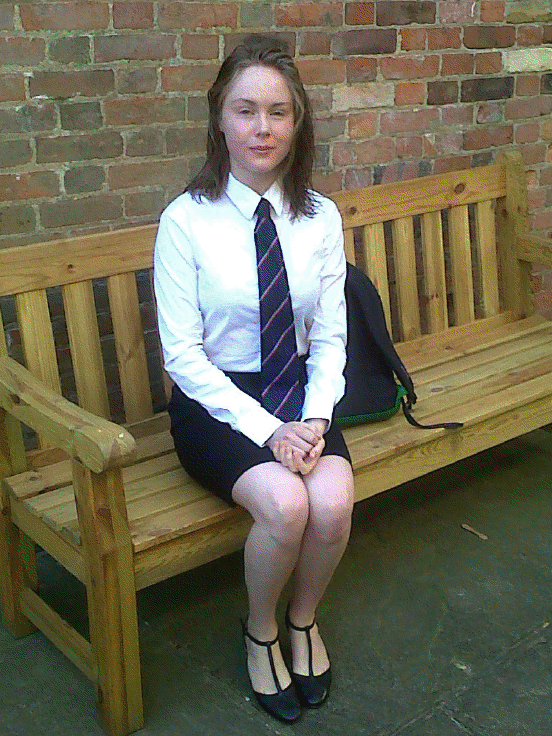
From England: My school tie — representative of the alternative universe I seem to have entered. At boarding school, the sense of removal from reality can be disconcerting — especially after having spent a decade in the city I regard as the world’s capital.

You’re invited to prepare one meal based on your travels for other Displaced Nation members. What’s on your menu?
I’d like to make you a Sydney breakfast: scrambled eggs, made with cream, salt and pepper and served on a bed of Turkish toast, with avocado and stewed tomato on the side (is this being greedy?). Our meal will be accompanied by a large “flat white”: what we call perfectly strong, milky coffee without excessive froth. I suggest we consume it overlooking a beach on a Sunday morning. At least, I assume The Displaced Nation has beaches?

You may add one word or expression from each of the countries you’ve lived in to The Displaced Nation argot. What words do you loan us?
From Australia: Daggy. I use this word all the time — and did not realize it was exclusively Australian until I was informed of the etymology. Apparently, it comes from trimming the soiled wool around a sheep’s bottom. Which part of this repugnant whole is actually the “dag,” I do not remember. (No, I’m not a proper Australian!) But as I understand it, “daggy” means sloppy in appearance or badly put together.
From New York: There are so many words, and most are second nature by now. However, I will choose grande-soy-chai-tea-latte because I still shudder to think of myself as the kind of person who can utter such a phrase, at great speed, with great insistence. In fact, I’m still in denial about my love for Starbucks: having known Sydney coffee, my standards should be higher.
From England: Banter. I still do not know the precise meaning of this word, but it seems to encapsulate everything that makes someone my age feel socially acceptable — and, of course, I have no banter whatsoever. I think it means the capacity for combining wit with meaningless conversation. But there are other components, too, which seem to me unfathomable.

Question: Readers, tell us what you think: should we welcome Charlotte Day to The Displaced Nation and if so, why? (Note: It’s fine to vote “no” as long as you couch your reasoning in terms you think we all — Charlotte included — will find amusing.)

img: Charlotte Day at her boarding school in southeast England

If you enjoyed this post, we invite you to subscribe to The Displaced Dispatch, a weekly round up of posts from The Displaced Nation, plus some extras such as seasonal recipes and occasional book giveaways. Sign up for The Displaced Dispatch by clicking here!

Related posts: