The Displaced Nation

A home for international creatives

Tag Archives: Turkey

Best of 2011: Books for, by and about expats

One of our Random Nomads in November, Aaron Ausland, had this to say about those of us who venture across borders:

Travel to a new place for three weeks and you can write a book, travel for three months and you can write an article, travel for three years and you’ll likely have nothing to say.

While that may be true, I’m afraid it hasn’t stopped many of us who’ve spent large chunks of our lives gallivanting around the globe trying out life in different countries, from taking up the pen.

As with any other group, some are born writers (and thrive on new surroundings), while others have become writers (attempting to make sense of their adventures), while still others have had writing thrust upon them (responding to invitations to share their experiences).

At the Displaced Nation, we revere people who publish books, fiction or non, that in some way assist those of us who are (or have been) engaged in overseas travel and residency. We feature — and do giveaways of — their works. And, for established writers with a global following, we’ve created a unique “category” called the Displaced Hall of Fame.

In this spirit — and in the December tradition of looking back at the past year’s highlights — I present the following (admittedly incomplete) list of books for, by, and about expats that were published in 2011, in these five sections (click on the title to go to each section):

  1. NOVELS ABOUT EXPATS
  2. NOVELS ABOUT “HOME”
  3. EXPAT MEMOIRS
  4. SELF-HELP, CROSS-CULTURAL & OTHER NONFICTION WORKS
  5. INSPIRATIONAL ANTHOLOGIES

A few more points to note:

  • Books in each category are arranged from most to least recent.
  • I’ve mixed indie books with those by conventional publishers (it suits our site’s somewhat irreverent tone).
  • To qualify for the list, authors must have been expats for at least six months at some point.

* * *

NOVELS ABOUT EXPATS

Three Questions: Because a quarter-life crisis needs answers (CreateSpace, October 2011)
Author: Meagan Adele Lopez
Genre: Women’s fiction
Synposis: A love story based loosely on the author’s own romance with a lad from Bristol, the action traverses continents through letters and features a quarter-life crisis, a road trip to Vegas, and two crazy BFFs.
Expat credentials: An American, Lopez lived as an expat in the UK for a while (she is now back in Chicago).
How we heard about it: Melissa of Smitten by Britain was a fan of Lopez’s blog (originally titled The Lady Who Lunches). The pair met her London in the summer of 2010, when Lopez was still living in England. Recently, Melissa has been supporting Lopez’s attempt to gain sponsorship for turning the novel into a screenplay.
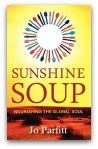
Sunshine Soup: Nourishing the Global Soul (Summertime, October 2011)
Author: Jo Parfitt
Genre: Women’s fiction
Synopsis: Six expat women from the UK, US, Thailand, Ireland, Norway and Holland converge in Dubai in 2008. The action centers on a Brit, who is on her first posting, and an American, who is on her 25th. The Brit learns the ropes and settles in, while the American woman’s world begins to crumble.
Expat credentials: A prolific author, publisher and pioneer in addressing the issues of accompanying spouses and aspiring expat writers worldwide, Parfitt has been an expat for nearly a quarter of a century. Born British, she now lives in the Hague.
How we heard about it: We noticed a couple of interviews with Parfitt — one by expat coach Meg Fitzgerald and another by Expat Women.

The Beautiful One Has Come: Stories (Wyatt-MacKenzie Publishing, July 2011)
Author: Suzanne Kamata
Genre: Cross-cultural romance
Synopsis: Twelve short stories reveal the pains and the pleasures experienced by expat women, most of whom live in Japan.
Expat credentials: Kamata is an American who has lived in Japan for 20 years.
How we heard about it: Kamata and her book were featured on Kristin Bair O’Keeffe’s Writerhead Wednesday in July of this year.

Hidden in Paris (Carpenter Hill Publishing, April 2011)
Author: Corine Gantz
Genre: Women’s fiction
Synopsis: Three strangers — all American women — have reached the point of terminal discomfort with their lives so run away to Paris to begin anew.
Expat credentials: Gantz is a French expat living near Los Angeles. She is getting her own back by writing about American expats in Paris.
How we heard about it: We are long-time fans of Gantz’s blog, Hidden in France — in fact, we promoted one of her posts (about falling into her swimming pool) with the launch of TDN in April. We also interviewed her about her first novel as part of our “gothic tales” theme this past May.

Exiled (Quartet Books, April 2011)
Author: Shireen Jilla
Genre: Psychological thriller
Synopsis: The wife of an ambitious British diplomat, whose first posting brings them to New York, looks forward to escaping from Kent and leading the high-profile life of a successful expat — only to find her world being threatened by dark psychological forces on a par with those depicted in Rosemary’s Baby.
Expat credentials: A Third Culture Kid (she is half English, half Persian, and grew up in Germany, Holland and England), Jilla has also been an expat in Paris, Rome, and New York.
How we heard about it: TDN writer ML Awanohara read a review of Jilla’s novel by Kate Saunders in the Sunday Times. She approached Jilla in May about having an exchange with our readers about the gothic themes in her novel, in line with our site’s own delvings into the gothic aspects of expat life. Our readers loved her!

NOVELS ABOUT “HOME”

Lady Luck (Colorado Mountain Series)
Author: Kristen Ashley
Genre: Romance
Synopsis: Ex-con hero, wrongly imprisoned, gets mixed up with unlucky heroine, who will stop at nothing to help him get revenge.
Expat credentials: Born in Gary, Indiana, Ashley grew up in Brownburg and then moved to Denver, where she lived for 12 years. She now lives with her husband in a small seaside town in Britain’s West Country, where she has produced more than twenty books featuring rock-chick, Rocky Mountain, and other all-American heroines.
How we heard about it: Ashley is the friend of an old schoolfriend of TDN writer Kate Allison, who invited her to do a guest post for us on Britain’s (lack of) Royal Wedding preparations  for our Royal Wedding coverage.

Queen by Right: A Novel (Touchstone, May 2011)
Author: Anne Easter Smith
Genre: Historical romance
Synopsis: This is the fictional story of Cecily of York, mother of two kings and said to be one of the most intelligent and courageous women in English history.
Expat credentials: The daughter of an English army colonel, Easter Smith spent her childhood in England, Germany and Egypt. She came to New York City at age 24, and as she puts it:

Many years, two marriages, two children and five cross-country moves later I’m very definitely a permanent resident of the U.S. — but my love for English history remains.

(She now lives in Plattsburgh, New York.)
How we heard about it: Easter Smith and her book were featured on Kristin Bair O’Keeffe’s Writerhead Wednesday in October.

Dance Lessons (Syracuse University Press, March 2011)
Author: Áine Greaney
Genre: Irish Studies, Women’s Fiction
Synopsis: The action centers on a woman of French-Canadian background who marries an Irish emigrant who is working illegally in a bar in Boston. After his death by drowning, she visits Ireland for the first time and finds out what a shattered man he actually was.
Expat credentials: She may be a resident of Boston’s North Shore, but Greaney continues to identify herself as an Irish writer (County Mayo).
How we heard about it: Greaney and her book were featured on Kristin Bair O’Keeffe’s Writerhead Wednesday in October.
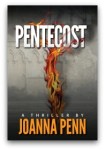
Pentecost: A Thriller (The Creative Penn, January 2011)
Author: Joanna Penn
Genre: Thriller
Synopsis: The Keepers of the stones from Jesus’s tomb — which enabled the Apostles to perform miracles — are being murdered. The stones have been stolen by those who would use them for evil in a world. An Oxford University psychologist spearheads a search for them in a race against time…
Expat credentials: English by birth, Penn grew up as a third-culture-kid and at the time of producing her first novel, was living in Australia.
How we heard about it: We are avid followers of Penn’s blog, The Creative Penn. Several months ago, TDN writer ML Awanohara deconstructed Penn’s post about what “home” means for writers for what it might teach expats and others who struggle with this issue as well. For Penn, home means some sort of spiritual kinship, which she has with two places: Oxford, where she went to university and near where her father now lives, and Jerusalem, which she’s visited at least ten times because she loves it there so much. Not surprisingly, she chose to set much of the action for her debut novel in these two cities.

EXPAT MEMOIRS
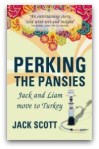
Perking the Pansies: Jack and Liam move to Turkey (Summertime Publishing, December 2011)
Author: Jack Scott
Synopsis: Dissatisfied with suburban life and middle management, Scott and his civil partner, Liam, abandon the sanctuary of liberal London for an uncertain future in Bodrum, Turkey. The book is based on Scott’s irreverent blog of the same name, which after its launch in 2010, quickly became one of the most popular English language blogs in Turkey.
How it came to our attention: Scott was featured as one of our Random Nomads in May of this year and since then, has done us the favor of commenting on and liking several of our posts. **Kate Allison will be reviewing his book for our site on Wednesday.**

Ramblings of a Deluded Soul (CreateSpace, September 2011)
Author: Jake Barton
Synopsis: In his inimitable style, the British-born Barton strings together snippets from new novels and try-outs with reminiscences and, for the first time, insight into his own remarkable experiences as a traveler and expat in Europe (he once owned a small French vineyard and had another job he’s not supposed to talk about). NOTE: Barton’s first novel, Burn, Baby, Burn, burned its way into the Top Ten of the Amazon All Books list.
How it came to our attention: Barton is an online acquaintance of TDN writer Kate Allison. We celebrated him in the early days of our blog for his insights on foreign-language learning in Spain.

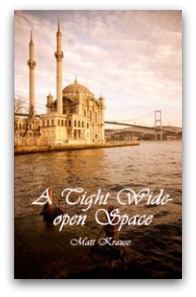
A Tight Wide-open Space: Finding Love in a Muslim Land (Delridge Press, August 2011)
Author: Matt Krause
Synopsis: A Californian who is now a Seattle-ite recounts how he became an Istanbullu, all for the love of a beautiful Turkish woman he met on a airplane. The year is 2003, and he can still hear the echoes of 9/11 as well as being acutely conscious of America’s engagement in two wars in Muslim countries. Eventually, he comes to love his new home more deeply than he might have expected.
How we heard about it: Linda Janssen, who writes the blog Adventures in Expatland, interviewed Krause about his book in October.

Planting Dandelions: Field Notes from a Semi-Domesticated Life (Penguin, April 2011)
Author: Kyran Pittman
Synopsis: A native of Newfoundland (her father was a well-known Newfoundler poet), Pittman writes about co-parenting with her charming Southern U.S. hubbie (they have three rambunctious boys); keeping the fiscal wolf from the door of their home in Little Rock, Arkansas; and honoring her marriage vows despite her refusal to give up her party-girl persona.
How we heard about it: Pittman came to our notice when she was a guest on Kelly Ryan Keegan‘s Bibliochat in late September.

Big in China: My Unlikely Adventures Raising a Family, Playing the Blues, and Becoming a Star in Beijing (Harper, March 2011)
Author: Alan Paul
Synopsis: Paul tells the story of trailing his journalist-wife to China and unwittingly becoming a rock star. His Chinese American blues rock band, called Woodie Alan, even earned the title of Beijing’s best band.
How we heard about it: We were early fans of Alan Paul’s back in the days of his Wall Street Journal online column, “The Expat Life.” Also, Paul and his book were featured on Kristin Bair O’Keeffe’s Writerhead Wednesday this past April.

The Foremost Good Fortune (Knopf, February 2011)
Author: Susan Conley
Synopsis: Conley, her husband, and their two young sons say good-bye to their friends, family, and house in Maine for a two-year stint in a high-rise apartment in Beijing. All goes well until Conley learns she has cancer. She goes home to Boston for treatment and then returns to Beijing, again as a foreigner — to her own body as well.
How we heard about it: Conley and her book were featured on Kristin Bair O’Keeffe’s Writerhead Wednesday in early October.

SELF-HELP, CROSS-CULTURAL AND OTHER NONFICTION WORKS

The Globalisation of Love (Summertime, November 2011)
Author: Wendy Williams
Genre: Relationships, self-help, humor
Synopsis: Williams interviews multicultural, interfaith and biracial partners from all over the world on what it feels like to “marry out” of one’s culture, religion and/or race. She also talks to experts on the topic and coins a term for it: “GloLo.”
Expat credentials: From a British-Ukrainian-Canadian family, Williams has been married to an Austrian for 13 years and lives in Vienna.
How we heard about it: TDN writer ML Awanohara listened to Jo Parfitt’s interview with Williams on her Writers Abroad show (Women’s International Network) and was attracted to the ideas of a book that treats this topic with humor. **TDN writer Anthony Windram will review the book for our site tomorrow (Tuesday).**

Modern Arab Women — The New Generation of the United Arab Emirates (Molden Verlag, November 2011)
Author: Judith Hornok
Genre: Women’s studies
Synopsis: The book consists of 20 chapters, each a stand-alone interview with an Emirati woman from disciplines as varied as business, film, medicine and politics. The women talk to Hornok about their careers, philosophies of life and plans for the future. The book, which is published in German and English, aims to dispel some of the Western myths surrounding Arab women.
Expat credentials: While not quite an expat, Hornok has been moving between the UAE and her home in Vienna, Austria, for eight years.
How we heard about it: TDN writer ML Awanohara read an article on the book in The National (UAE English-language publication) and became intrigued.

Expat Women: Confessions — 50 Answers to Your Real-life Questions about Living Abroad (Expat Women Enterprises Pty Ltd ATF Expat Women Trust, May 2011)
Authors: Andrea Martins and Victoria Hepworth (foreword by Robin Pascoe)
Genre: Women’s self-help, family, relationships
Synopsis: Experienced expats share wisdom and tips on topics that most expat women face, such as the trauma of leaving family back home, the challenges of transitioning quickly, intercultural relationships, parenting bilingual children and work-life balance. They also tackle more difficult issues such as expat infidelity, divorce, alcoholism and reverse culture shock. The book is based on the “confessions” page of Expat Women, the largest global Web site helping women living overseas.
Expat credentials: Andrea Martins is the director and co-founder of Expat Women. An Australian who has spent many years abroad, she began dreaming of connecting expat women worldwide when an expat in Mexico City. Victoria Hepworth is a New Zealander who has lived in Japan, China, Russia, Sweden, India and is currently living in Dubai, UAE. She is a trained psychologist who specializes in expat issues.
How we heard about it: Andrea Martins announced the publication of the book to much fanfare on Twitter and in other social media venues. It has been widely reviewed on expat blogs.

Marriage in Translation: Foreign Wife, Japanese Husband (CultureWave Press, April 2011)
Author: Wendy Nelson Tokunaga
Genre: Relationships, self-help
Synopsis: Tokunaga conducts a series of candid conversations with 14 Western women about the challenges in making cross-cultural marriages work both inside and outside Japan. She quizzes them about the frustrations, as well as the joys, of adapting to a different culture within married life.
Expat credentials: Born in San Francisco, Tokunaga has spent numerous years studying, living, working and playing in Japan. She is the author of two Japan-related novels, published by St. Martins Griffin. Oh, and did we mention her Japanese “surfer-dude” husband?
How we heard about it: Sometimes one tweet is all it takes! (We follow Wendy Tokunaga on Twitter.)

A Modern Fairytale: William, Kate and Three Generations of Royal Love (Hyperion/ABC Video Book, April 2011)
Author: Jane Green
Genre: Romance, royalty
Synopsis: In this video book for ABC News, produced just in time for the Royal Wedding in March, best-selling chick-lit novelist Jane Green follows the stories of three generations of royal love from their meeting up to and after their respective wedding days. She concludes that Kate and William have a much better chance than William’s parents of enjoying a relationship on their own terms.
Expat credentials: Born in London, Green worked as a feature writer for The Daily Express before trying her hand at writing novels. She now lives in Westport, Connecticut, with her second husband and their blended family.
How we heard about it: One of us noticed that Jane Green had been tapped to provide coverage of the Royal Wedding for ABC News. We then invited her to talk about her e-book and engage with our readers in a debate on whether women should still aspire to be “princesses” in the 21st century — a post that received a record number of comments.

INSPIRATIONAL ANTHOLOGIES

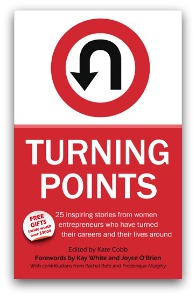
Turning Points: 25 inspiring stories from women entrepreneurs who have turned their careers and their lives around (Summertime Publishing, November 2011)
Editor: Kate Cobb
Synopsis: In this collection of stories from women all over the world, the focus is on the moments, or short passages of time, when a woman was facing something challenging and came out the other side smiling.
Expat credentials: Cobb is a British woman living in France, and about a third of the contributors — including Jo Parfitt and Linda Janssen — are expats who now run their own businesses.
How we heard about it: Linda Janssen promoted the book on her blog, Adventures in Expatland.

Indie Chicks: 25 Women 25 Personal Stories (Still Waters Publishing, October 2011)
Compiler: Cheryl Shireman
Synopsis: 25 indie novelists share personal stories in hopes of inspiring other women to live the life they were meant to live. (All proceeds go to the Susan G. Komen Foundation for breast cancer research.)
Expat credentials: Close to half of these indie authors are expats or have done significant overseas travel. To take a few examples: After living in Portland, Oregon, for most of her life, Shéa MacLeod now makes her home in an Edwardian town house in London just a stone’s throw from the local cemetery. Linda Welch was born in a country cottage in England, but then married a dashing young American airman, left her homeland, raised a family, and now lives in the mountains of Utah. Julia Crane is from the United States but recently moved to Dubai with her huband and family (her personal story concerns the adjustment process).
How we heard about it: Again, sometimes all it takes it a tweet (we picked up one of Linda Welch’s).

* * *

Questions: Have you read any of the above works and if so, what did you think of them? And can you suggest other works to add to the list? My colleagues and I look forward to reading your comments below!

STAY TUNED for tomorrow’s post, a review of The Globalisation of Love, by Wendy Williams, and for Wednesday’s post, a review of Perking the Pansies, by Jack Scott.

If you enjoyed this post, we invite you to subscribe to The Displaced Dispatch, a weekly round up of posts from The Displaced Nation, plus some extras such as seasonal recipes and occasional book giveaways. Sign up for The Displaced Dispatch by clicking here!

Related posts:

6 celebrated women travel writers with the power to enchant you

Any wannabe expat/travel writer would do well to consult with Kristin Bair O’Keeffe, herself a novelist and former expat, before beginning their Great Works. Kristin offers a wealth of writing tips on Writerhead, a blog that she launched on April 1 of this year (which, coincidentally, was the same day we launched The Displaced Nation).

Of the helpful hints Kristin has offered thus far, I have many favorites, but if I had to pick one, it would be her post entitled “Write Wee.” In her breathlessly inimitable style, Kristin assures us that producing a multi-volume series on one’s overseas adventures is not the way to go:

Instead find a nugget. A moment. A single object. One exchange. One epiphany. One cultural revelation.

Find one story and tell it.

Just it.

The only thing I would add is that in general, women are better at extracting such nuggets than men.

Actually, what got me started in thinking about the difference in travel writing styles of the sexes was a post I wrote a couple of weeks ago on Edwardian novelist Elizabeth von Arnim, who penned the much-loved work, The Enchanted April, about four women who escape to a medieval castle in Italy for a much-needed break from their routines.

For me, von Arnim typifies one of characteristics that makes women’s travel writing so special (no doubt there are many more!). As she wandered far and wide across Europe and America, she paid extremely careful attention to the details of her surroundings.

A forerunner of what today we’d call a nature freak, she could get lost in telling the story of watching a “nightingale on a hornbeam, in loud raptures at the coming of the sun…” — I quote from her largely autobiographical novel The Solitary Summer, about a woman, also called Elizabeth, who is anything but solitary. She has a husband, to whom she refers as the Man of Wrath, small child and household to care for.

Perhaps such descriptive powers are born of necessity. Women have little choice but to make the most of spinning tales out of the moments they snatch from lives that are otherwise spent ministering to the needs of others — even when they’re technically on vacation.

Having combed through the pages of The Virago Book of Women Travellers (ed. Mary Morris with Larry O’Connor), I think I may be on to something. I discovered any number of women travel writers with the power to enchant their readers by capturing in their works the moments, exchanges, and personal ephiphanies their wanderings have yielded.

Here are six whose “nuggets” continue to gleam for us modern-day nomads:

Frances Trollope (1780-1863)

Who was she? Mother of Anthony and like her son, a prolific writer of novels (34 in total!).
Key work: Domestic Manners of the Americans, a travel book that made her name, about the four years she spent pursuing opportunities in the United States after her family suffered financial setbacks.

from DOMESTIC MANNERS OF THE AMERICANS
At length my wish of obtaining a house in the country was gratified….But even this was not enough to satisfy us when we first escaped from the city, and we determined upon having a day’s enjoyment of the wildest forest scenery we could find. So we packed up books, albums, pencils, and sandwiches, and, despite a burning sun, dragged up a hill so steep that we sometimes fancied we could rest ourselves against it by only leaning forward a little. In panting and in groaning we reached the top, hoping to be refreshed by the purest breath of heaven; but to have tasted the breath of heaven we must have climbed yet farther, even to the tops of the trees themselves, for we soon found that the air beneath them stirred not, nor ever had stirred, as it seemed to us, since first it settled there, so heavily did it weigh upon our lungs.

Still we were determined to enjoy ourselves, and forward we went, crunching knee deep through aboriginal leaves, hoping to reach some spot less perfectly air-tight than our landing place. Wearied with the fruitless search, we decided on reposing awhile on the trunk of a fallen tree; being all comfortably exhausted, the idea of sitting down on this tempting log was conceived and executed simultaneously by the whole party, and the whole party sunk together through its treacherous surface into a mass of rotten rubbish that had formed part of the pith and marrow of the eternal forest a hundred years before.

We were by no means the only sufferers from the accident; frogs, lizards, locusts, katydids, beetles, and hornets, had the whole of their various tenements disturbed, and testified their displeasure very naturally by annoying us as much as possible in return; we were bit, we were stung, we were scratched; and when, at last, we succeeded in raining ourselves from the venerable ruin, we presented as woeful a spectacle as can well be imagined. We shook our (not ambrosial) garments, and panting with heat, stings, and vexation, moved a few paces from the scene of our misfortune, and again sat down; but this time it was upon the solid earth.

We had no sooner begun to “chew the cud” of the bitter fancy that had beguiled us to these mountain solitudes than a new annoyance assailed us. A cloud of mosquitoes gathered round, and while each sharp proboscis sucked our blood, they teased us with their humming chorus, till we lost all patience, and started again on our feet, pretty firmly resolved never to try the al fresco joys of an American forest again.

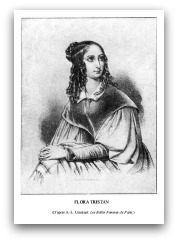
Flora Tristan (1803-1844)

Who was she? French reformer who campaigned for workers’ and women’s rights; grandmother to artist Paul Gauguin.
Key work: Peregrinations of a Pariah, about a trip she made alone to Peru to stake her claim to her family’s fortune.

from PEREGRINATIONS OF A PARIAH
Mr. Smith took me to the house of his correspondents, and here once more I found all of the luxury and comfort characteristic of the English. The servants were English, and like their masters they were dressed just as they would have been in England. The house had a verandah, as do all the houses in Lima, and this is very convenient in hot countries, as it gives shelter from the sun and enables one to walk all round the house to take the air. This particular verandah was embellished with pretty English blinds. I stayed there for some time and could survey in comfort the only long wide street which constitutes the whole of Callao. It was a Sunday, and sailors in holiday attire were strolling about; I saw groups of Englishmen, Americans, Frenchmen, Dutchmen, Germans — in short, a mixture from nearly every nation — and I heard snatches from every tongue. As I listened to these sailors, I began to understand the charm they find in their adventurous life… When I tired of looking at the street I cast a glance into the large drawing-room whose windows overlooked the verandah, where five or six immaculately dressed Englishmen, their handsome faces calm and impassive, were drinking grog and smoking excellent Havana cigars as they swung gently to and fro from hammocks from Guayaquil suspended from the ceiling.

Mary Anne Barker (1831 – 1911)

Who was she? Jamaica-born, England-educated author and journalist who with her second husband tried to run a sheep station in New Zealand (they later traveled to Mauritius, Western Australia, Barbados and Trinidad for his colonial appointments).
Key works: Station Life in New Zealand (1870); First Lessons in the Principles of Cooking (1874); A Year’s Housekeeping in South Africa (1880).

from STATION LIFE IN NEW ZEALAND
All this beauty would have been almost too oppressive, it was on such a large scale and the solitude was so intense, if it had not been for the pretty little touch of life and movement afforded by the hut belonging to the station we were bound for. It was only a rough building, made of slabs of wood with cob between; but there was a bit of fence and the corner of a garden and an English grass paddock, which looked about as big as a pocket-handkerchief from where we stood. A horse or two and a couple of cows were tethered near, and we could hear the bark of a dog. A more complete hermitage could not have been desired by Diogenes himself, and for the first time we felt ashamed of invading the recluse in such a formidable body, but ungrudging, open-handed hospitality is so universal in New Zealand that we took courage and began our descent. … We put the least scratched and most respectable-looking member of the party in the van, and followed him, amid much barking of dogs, to the low porch; and after hearing a cheery “Come in,” answering our modest tap at the door, we trooped in one after the other till the little room was quite full. I never saw such astonishment on any human face as on that of the poor master of the house, who could not stir from his chair by the fire, on account of a bad wound in his leg from an axe. There he sat quite helpless, a moment ago so solitary, and now finding himself the centre of a large, odd-looking crowd of strangers. He was a middle-aged Scotchman, probably of not a very elevated position in life, and had passed many years in this lonely spot, and yet he showed himself quite equal to the occasion.

After that first uncontrollable look of amazement he did the honours of his poor hut with the utmost courtesy… His only apology was for being unable to rise form his arm-chair (made out of half a barrel and an old flour-sack by the way); he made us perfectly welcome, took it for granted we were hungry — hunger is a very mild world to express my appetite, for one… I never felt more awkward in my life than when I stooped to enter that low doorway, and yet in a minute I was quite at my ease again; but of the whole party I was naturally the one who puzzled him the most. In the first place, I strongly suspect that he had doubts as to my being anything but a boy in a rather long kilt; and when this point was explained, he could not understand what a “female,” as he also called me, was doing on a rough hunting expedition. He particularly inquired more than once if I had come of my own free will, and could not understand what pleasure I found in walking so far.

Vivienne de Watteville (1900 – 1957)

Who was she? British writer and adventurer who accompanied her father on a safari in Kenya. After he was killed by a lion, she finished the trip on her own.
Key works: Out in the Blue (1927); Speak to the Earth: Wanderings and Reflections among Elephants and Mountains (1937).

from SPEAK TO THE EARTH
Finally, it was the boys themselves who pointed to the summit and said it was not very far.

Enviously, I admired the way they could climb. As for me, … I was badly spent; my knees trembled as I panted up through the reeling boulders. …

At last I climbed above the forest zone, passing beneath the last outposts — stunted trees ragged with beard-moss in whose chequered shade lay a carpet of tiny peas … whose blossoms were a lovely transparent blue. Above them flitted miniature butterflies, as though the petals themselves had taken wing. …

The top, when I at last reached it, was, after all, not really the top, and beyond a dipping saddle another granite head still frowned down upon me.

But meanwhile, below me the south side disclosed a grassing depression girt about by the two summits and bare granite screes; and amid that desolation the grass stretched so green and rural that you had looked there for shepherds with their flocks. Instead of which, on the far side of a quaking bog, I saw — grey among the grey slabs — two rhino.

… I drew to within forty yards of the rhino, yet they still looked like a couple of grey boulders as they browsed off an isolated patch of sere grass. …

The wind had risen to a tearing gale, and nosing straight into it I approached the rhino somewhat downhill. There was no chance of this steady blow jumping around to betray me, and it was strong enough to carry away any sound of my footsteps. Precaution was therefore unnecessary, and I walked boldly up to them. Just how close I was, it is hard to say; but I felt that I could have flipped a pebble at them, and I noted subconsciously that the eye of the one nearest me was not dark brown as I had imagined it, but the colour of sherry.

… he now came deliberately towards me nose to the ground, and horn foremost, full of suspicion. … In the finder [of my small cinema camera] I saw his tail go up, and knew that he was on the point of charging. Though it was the impression of a fraction of a second, it was unforgettable. …

… I read the danger signal, yet in a kind of trance of excitement I still held the camera against my forehead. Then Mohamed fired a shot over the rhino’s head to scare him, and I turned and fled for my very life.

M. F. K. Fisher (1908 – 1992)

Who was she? A preeminent American food writer, whose books are an amalgam of food literature, travel and memoir.
Key works: How to Cook a Wolf (1942); Map of Another Town: A Memoir of Provence (1964); Dubious Honors (1988); Long Ago in France: The Years in Dijon (1991).

from LONG AGO IN FRANCE
Monsieur Venot was a town character and was supposed to be the stingiest and most disagreeable man in Dijon, if not in the whole of France. But I did not know this, and I assumed that it was all right to treat him as if he were a polite and even generous person. I never bought much from him but textbooks, because I had no extra money, but I often spent hours in his cluttered shop, looking at books and asking him things, and sniffing the fine papers there, and even sitting copying things from books he would suggest I use at his worktable, with his compliments and his ink and often his paper. In other words, he was polite and generous to me, and I liked him. …

In Monsieur Venot’s shop I learned to like French books better than any others. They bent to the hand and had to be cut, page by page. I liked that; having to work to earn the reward, cutting impatiently through the cheap paper of a “train novel,” the kind bought in railroad stations to be thrown away and then as often kept for many years, precious for one reason or another. I liked the way the paper crumbled a little into my lap or my blanket or my plate, along the edges of each page.

Mary Lee Settle (1918 – 2005)

Who was she? American writer, novelist and expat, one of the founders of the PEN/Faulkner Award for Fiction.
Key works: “Beulah Quintet” novel series (1956-1982), about the history of her native West Virginia (and hence of America); Turkish Reflections: A Biography of Place (1991).

from TURKISH REFLECTIONS
I hadn’t heard anything move, yet he stood there in front of me, smiling, quite silent, a large strong Turkish man, holding in his hand a small bunch of sweet wild thyme. He held it toward me, saying nothing, still smiling. There was something so gentle about him that I could not be afraid. I took the wild thyme, and I thanked him, in Turkish. He smiled again and touched his mouth and his ear. He was deaf and dumb. I still have the wild thyme, pressed and dried, kept like a Victorian lady’s souvenir of the Holy Land.

Dumb was the wrong word for him. There was no need for speech. He was an actor, an eloquent mime. I pointed to the atrium below and held my hands apart to show I didn’t know how to get down into it. He took my arm, and carefully, slowly, led me down a steep pile of rubble.

He mimed the opening of a nonexistent door and ushered me through it. He showed me roofless room after roofless room after roofless room as if he had discovered them. …

I think he had scared people before, and he was happy that there was someone who would let him show his house, for it was his house. Maybe he didn’t sleep there. I don’t know. I only know that he treated me as a guest in a ruin ten feet below the levee of the ground, and that he took me from room to room where once there had been marble walls and now there was only stone, where he was host and owner for a little while.

He showed me a small pool, held out his hand the height of a small child, and then swam across the air. All the time he smiled. He took me to a larger pool and swam again. Then he grabbed my arm and led me through a dark corridor toward what I thought was at first a cave. It was not. He sat down in an niche in the corridor, and strained until his face was pink, to show me it was the toilet. Then he took me into the kitchen where there were two ovens. …

For the first one he rolled dough for bread, kneaded it in air, slapped it, and put it in the oven. Then he took it out, broke it, and shared it with me. I ate the air with him. …

When I gave my friend, my arkadaş, some money, he kissed my hand and held it to his forehead, and then, pleased with the sun and me, and the fact that someone had not run away from him who lived like Caliban in a ruin, he put his arms around me and kissed me on both cheeks. Then I went down the hill to Ephesus. When I looked back to wave he had disappeared.

STAY TUNED for tomorrow’s post, a tell-all from Kate Allison on what inspired her to create her fictional expat heroine, Libby.

If you enjoyed this post, we invite you to subscribe to The Displaced Dispatch, a weekly round up of posts from The Displaced Nation, plus some extras such as seasonal recipes and occasional book giveaways. Sign up for The Displaced Dispatch by clicking here!

Related posts:

Random Nomads to the rescue! How to have an enchanted August (1/2)

Ah, summer — what power you have to make us suffer…and like it?!

I don’t know about you, but I’m not liking the mid-August dog days very much. For a start, I’m getting tired of watching my own two dogs panting instead of playing.

Thus I’ve turned to The Displaced Nation’s Random Nomads to help me find things to like during the remaining weeks of Summer 2011, which doesn’t technically end until September 23.

Besides asking them to report back on how their own summers have been, I begged them to share some tips for escaping one’s surroundings at times when one can’t manage a physical escape. I recall from my own expat days (in the UK and Japan) that global residents develop superhuman-reserves of stamina (the Japanese call it gaman, or “enduring the seemingly unendurable with patience and dignity”) to sustain them during less-than-pleasant interludes.

And I wasn’t disappointed — no less than five USA/Europe-based Random Nomads have come to my rescue! They’ve answered these three questions:
1) What has been your most enchanting moment of Summer 2011 thus far?
2) What has been your least enchanting moment?
3) Do you have any survival tips for people who can’t escape?

And next week, we’ll hear from three more, all of whom hang their hats in Asia.

NOTE: If you haven’t read the interviews with these five people about their “displacement,” be sure to do so by clicking on their names. They, and their lives, are fabulously inspiring regardless of what season it is!

BALAKA BASU — USA passport; current home: USA (New York City)
Most enchanting:
Swimming at Sandy Hook in New Jersey. The water out there at Gunnison Beach is green and gorgeous; the waves are gentle and warm, and they lap round you like a soft embrace. Over in the distance, you can see the skyline of NYC, wrapped in haze. It’s truly lovely, the closest you can come to the Caribbean in the metropolitan area, I think.

Least enchanting:
WASPS (the insects)! They built five(!) hives in our car, and we had to suit up in full sleeves, veils and boots — full-on winter armor in heat-stroke inducing weather — to kill them with poison as they boiled out of their hives. Not cool. Not cool at all.

Survival tip:
Find a cheap(ish) hotel with a bar and an outdoor pool — someplace no tourist would ever visit. Bring towels, bathing suits, a great beach read, and plastic cups — and pretend you’re on beachfront property in some place awesome: e.g., “Jamaica” without the plane ticket.

VICKI JEFFELS — New Zealand passport; current home: England (Tadley, Hampshire)
Most enchanting:
England had a couple of days of really tropical weather back in July — I loved it. For a brief time there was the lingering smell of BBQ wafting around our neighborhood, and I was even able to lie down on a towel in the garden and safely fill up my vitamin D reserves. Ah, bliss!

Least enchanting:
The following week the temperatures plummeted and it looked as if that was all the summer we were going to get.

Survival tips:
Ah yes, right down my alley! Many of my neighbors and friends were finding it really difficult to sleep in the humid weather, not helped at all by the BBC advising everyone to close their curtains! Whaaat? When you find it difficult to sleep, I advise a tepid (not cold!) shower to lower the body temperature before sleep. If possible (I know it’s not always possible), take a dip in a swimming pool — that’s ideal.

PIGLET IN PORTUGAL — English passport; current home: Portugal (Algarve)
Most enchanting:
To date, there are two special moments. Can I have two?

Yes, OK. Great!

Actually, one is magical and the other enchanting. Both slightly predate the summer months, but the effects still linger.

The most magical moment was the birth of our first grandchild, Lily-May, on the 28th of April in France. We drove as if possessed for two days from Portugal across Spain to the South of France to see her. Although I am not maternal by nature (I’m more of a practical Mom), when I held her in my arms for the first time, my heart melted. As recorded on my blog, she’s adorable!

The most enchanting moment was when I was singing to her and she gave me a big smile. Poor little thing — my singing is not that tuneful; I think she felt sorry for me!

Least enchanting:
The least enchanting because most worrying moment of Summer 2011 was the way our daughter’s health deteriorated after giving birth. Despite various consultations with doctors about the excruciating pain and the ongoing urine infections she was experiencing, they just prescribed antibiotics rather than trying to find the root cause. The local GPs were totally clueless! However, the answer quickly became apparent once her husband insisted she go to hospital for a proper examination. The maternity ward doctor, upon examining our daughter, quickly discovered that medical compresses, now rotting, had been left inside her! Once these were removed, she began to recover. But had they remained, I have since been informed septicaemia would have set in, with devastating consequences for both our daughter and breastfed baby granddaughter.

Survival tips:
This is difficult because adverse weather conditions to some could be absolute heaven for others. Weather, I tend to take as it comes as it is out of my control.

My own great escape would not be from the weather but from tourist areas. Living in a tourist area myself, I have renamed tourists “terrorists” because many leave their manners and consideration for others at home. They literally do “terrorize” the locals!

 Personally, I love wild and natural places far away from the mass concrete high-rise hotels, with rows of sun beds and parasols lining the beaches.

My idea of heaven is to take a picnic, a bottle of chilled white wine, our comfy chairs and a parasol down to one of the unspoilt beaches for a “sun-downer.”

Yes, there are other people there in July and August, but we all seem to appreciate the luxury of freedom from tourists, and peace…

So, if you are coming to the Algarve on holiday please check out some of my
“secret beaches.” I can show you how to escape the “maddening” crowds!

JACK SCOTT — British passport; current home: Bodrum, Turkey
Most enchanting:
Bodrum is the most secular and modern of Turkish towns. It’s where people come to escape the conformity of everyday Turkish society. Normal social rules don’t apply. However, scrape the surface and you will find magic of a different kind.

This summer, we were visiting a friend, a thoroughly modern Millie, who lives just a few hundred meters behind the bustling marina with its luxury yachts and raucous watering holes. Her home is set within a traditional quarter of whitewashed buildings huddled together along narrow lanes.

As we approached her door, we noticed an elderly neighbor dressed in traditional livery of floral headscarf, crocheted cardigan and capacious clashing pantaloons. She sat cross-legged in a shady spot of her bountiful garden and was busy plucking a fleece.

Being city boys and largely ignorant of country ways, we asked our friend what the old lady was doing. She was preparing the wool for hand carding, straightening and separating fibers for weaving on the spinning wheel she kept in her house.

She hummed as she plucked, happy under the cool of an ancient knotted olive tree and doing what women have done in Turkey for millennia.

Now you don’t get that in Blighty.

Least enchanting:
We were wandering down Bodrum’s bar street, a procession of cheap and cheerful bars and hassle shops.

We normally rush by; casual shopping in Turkey can be a bruising experience best only tried by the foolish and heroic. The cheaper outlets employ aggressive teenagers in tight, bright, white shirts to drag gullible punters in from the street. A firm refusal elicits a bellicose riposte. The posher shops employ mostly female staff whose sales technique is softer but no less annoying. Speculative browsing is unbearable when tailed by KGB-trained assistants and you are made to feel like a serial shoplifter.

On this occasion my partner, Liam, popped into a corner shop to buy some cigarettes. Keen to use the local lingo, he asked for them in very passable Turkish. The po-faced assistant looked at him blankly. Liam repeated the request. Another blank look. After a brief standoff, the assistant relented and repeated the order in English. He threw the cigarettes at Liam, snatched the payment and slammed the change on the counter.

Welcome to Turkey, where hospitality greets you at every corner. I know there are arse-holes in every country — but next time we’ll just shout loudly in English.

Survival tips:
During the height of the summer we’re like camp vampires and only venture out after dark. Earlier in the season we found ourselves sweltering in 40+C (104+F) heat with no air conditioning. Because our pretty little cottage has 18-inch thick stone and concrete walls it took us weeks to find a technical solution. In the meantime, I received a host of suggestions to help us through the sleepless, sweaty nights. I’d like to share a few:
• Wrap a gel-type freezer pack in a wet tea-towel and apply it to your hot bits (and watch them shrink).
• Buy a floor-standing industrial fan (but nail everything down).
• Bathe your feet in an ice bucket (and develop frostbite).
• Take a cold shower (except the cold water is hot at this time of year).
• Sleep on a wet towel (and rot the mattress).
• Decamp to the roof (and get eaten alive my mozzies).
• Emigrate to Sweden?!

SIMON WHEELER — English passport; current home: Slovakia (Plavé Vozokany)
Most enchanting:
I love the sound of the crickets chirping. Whenever I left for holidays from England as a kid, that sound always meant I was away and exploring. Now I have them every summer’s night, and I still cannot get used to it. I still get that thrill of being in a new place…

Least enchanting:
Mosquitoes — they love every bit of me!!!

Survival tip:
I’m afraid I need a physical escape from our 35C (95F) “phew, what a scorcher!” summer. Fortunately, one is available in North Slovakia — in the Tatra Mountains, on the border between Slovakia and Poland. Just a stunning part of the world, very quiet, largely undiscovered, a place that exudes old-fashioned peace. Being that bit higher in altitude, the temps are perfect.


STAY TUNED for tomorrow’s Displaced Q on enchanting expat summers.

If you enjoyed this post, we invite you to subscribe to The Displaced Dispatch, a weekly round up of posts from The Displaced Nation, plus some extras such as seasonal recipes and occasional book giveaways. Sign up for The Displaced Dispatch by clicking here!

Related posts:

RANDOM NOMAD: Jack Scott, Former Bureaucrat & Soon to Be Published Author

Born in: Canterbury, England
Passport(s): British with official Turkish Residency
Countries lived in: Malaysia (Malacca): 1967-1969; Turkey (Bodrum): 2010-present
Cyberspace coordinates: Perking the Pansies | A comical narrative of expat life (blog)

What made you leave your homeland in the first place?
I moved to Bodrum in Turkey with my civil partner, Liam. I was a petty bureaucrat for 30 years gently ascending a career ladder to middle management, middle income and a middling London suburban terrace; comfortable, secure and passionately dissatisfying. We thought it high time to take a break from our labors, put our feet up and watch the pansies grow while we were young enough to enjoy it.

Is anyone else in your immediate family a “displaced” person?
My father more or less ran away from home when he was 16 to join the army. If he hadn’t, he probably would have ended up down a mine or in a factory (the days when Britain had such things). He (and then we) traveled widely — to Northern Ireland, where he met and married my mother and where my eldest brother was born; then on to Germany, where my second brother was born and contracted polio; then on to Malaya (before independence), where my elder sister was born; then back to England (Canterbury), where I was born. Our family then moved to Pimlico, in Central London, living in a barracks that is now the Chelsea School of Art(!). Finally, we went to Malaysia, where my younger sister was born. In Malaysia, we lived in a large, self-contained complex on the coast near Malacca called Terendak Camp. The camp had been built along miles of golden sands overlooking the Malacca Straights for army personnel and their families from Britain and across the Commonwealth — we shared it with Aussies, Kiwis and a few people from Malta. It was all very colonial, unimaginable today. I also seem to remember Dad traveling on his own to Cyprus, Aden (in Yemen), and Egypt. He died some years ago. Maybe I’ll write something about him one day…

Describe the moment when you felt most displaced over the course of your many displacements.
It was right here in Bodrum. We were spited by a storm of Biblical proportions that was punctured by a spectacular light-and-sound show that lit up the sopping sky and cut the power. Prodigious pulses of horizontal rain assailed every crack and cranny of our house, through every easterly window frame and beneath every threshold. It was freezing, so Liam and I hid under the duvet and fought over the hot water bottle. All Turkish houses leak, have no insulation and precious little heating. Of course, it rains in England, too — but not like that. Now, that’s not in the guidebooks and travelogues.

Describe the moment when you felt least displaced.
Liam and I were chuffed when our Turkish neighbors invited us over for dinner. Our grasp of Turkish remains lamentably poor and their English is virtually non-existent — but they made us feel very welcome and the food was delicious. There was much waving of hands and furious gesticulation. We used a Turkish-English dictionary to chuck random words into the conversation just for the hell of it. Turks are blessed with an honorable tradition of hospitality long abandoned in the West. In London I hardly knew my neighbors.

You may bring one curiosity you’ve collected from the country where you’ve lived into the Displaced Nation. What’s in your suitcase?
I was very young when I lived in Malaysia. I haven’t been back since though would love to. Sadly, I’ve kept nothing from those distant days. As for Turkey, our prized possession is the fragment of an ancient Ionian capital in our garden. It’s a bit heavy to put in a suitcase, and I’d be arrested if tried. Turkey is an incredible land where history lies casually underfoot.

You’re invited to prepare one meal based on your travels for other Displaced Nation members. What’s on the menu?
Turkish cuisine is up there with the best in the world. I would offer a meze plate of tasty Turkish fare using the best produce from the local market seasoned with exotic herbs and spices you just can’t get at Sainsburys. My guests would be offered:

  • roasted aubergine blended with garlic puree; artichoke hearts with herb dressing, peas and lemons
  • seaweed with a tangy vinaigrette
  • vine leaves stuffed with spiced rice
  • sauteed beans with olive oil and tomatoes
  • white cheese with olives drizzled in olive oil and garnished with oregano
  • finally, the ubiquitous but delicious sigara borek – shallow, fried, cigar-shaped mixed-cheese pastries.

It makes my mouth water just thinking about it. Yours?

You may add one word or expression from each of the countries you’ve lived in to the Displaced Nation argot. What words do you loan us?
Avustralyalılaştıramadıklarımızdanmışsınızcasına. This is a Turkish term pronounced as a single word and an extreme example of agglutination, the process of adding affixes to the base of a word. This word translated into English means “as if you were one of those whom we could not make resemble the Australian people.” Though rhythmic and poetic on the ear, Turkish is not an easy language for Europeans to assimilate as it is thought to belong to the Altaic language family and is distantly related to Mongolian, Korean and other inscrutable Asiatic tongues. Despite Atatürk’s valiant 1928 adoption of the Latin alphabet and the fact that the language is phonetic and mostly regular, the word order, agglutinations and the absence of familiar sounds all conspire to make learning Turkish a very daunting prospect. I’ve chosen it specially for The Displaced Nation to torture, to amuse and to remind everyone how completely hopeless many of us — particularly native English speakers — are with foreign tongues.

Question: Readers — yay or nay for letting Jack Scott into The Displaced Nation? Tell us your reasons. (Note: It’s fine to vote “nay” as long as you couch your reasoning in terms we all — including Jack — find amusing.)

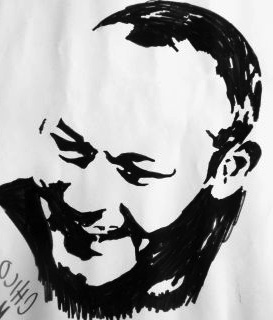
img: Pencil sketch of Jack Scott by a local Turkish artist

If you enjoyed this post, we invite you to subscribe for email delivery of The Displaced Nation. That way, you won’t miss a single issue. SPECIAL OFFER: New subscribers receive a FREE copy of “A Royally Displaced Tea.”

Related posts: