 As regular readers of The Displaced Nation will know, Pocahontas is the heroine of our blog this month. Sprightly, playful, well-featured and solicitous — unencumbered by the corrupting influences of civilization, in tune with Nature — she, and other women of her ilk, conformed to the vision Europeans held of the New World.
They were also the subject of many a European man’s romantic fantasy.
After meeting a Pocahontas, a European could brag to his friends back home that he’d found Paradise on Earth.
Flash forward almost four hundred years, and we find something similar going on with certain groups of international travelers. I speak of those who are restlessly searching for places that have yet to be touched by Western materialism and other corrupting ideas — where people lead simpler lives and are more decent.
And for male travelers, that vision usually encompasses finding their own Pocahontas: a native woman with long, dark hair, who unlike her Western sisters, still knows how to care for a man…
 Against this background, we welcome author Mark Damaroyd to The Displaced Nation. As an expat in Thailand, Damaroyd lives — and has written about — the utopian life to which no small number of men who’ve ventured into foreign countries aspire.
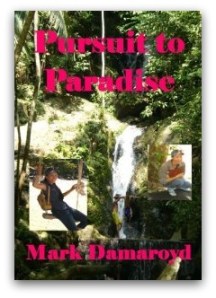
His first work of fiction, published in 2010, is called Pursuit to Paradise. Described by one reviewer as a “tale of romantic intrigue that keeps the pages turning,” the novel takes place in Thailand and the UK, and centers around an Englishman’s relationship with an exotic Thai woman.
Mark Damaroyd has kindly agreed to answer some of my questions about his life and book, and about the challenges of cross-cultural relationships more generally. After that, the floor is open — be sure to chime in!
Can you tell us something about yourself?
Firstly, ML, thank you so much for your invitation to be interviewed by The Displaced Nation.
I’m English, born in Cambridge, but not lucky enough to go to university there. I spent many years in Devon, a beautiful county in Southwest England. I still sometimes miss the thatched country pubs, pasties and cider.
Bitten by the travel bug in 1968 — yes, I really am that old! — I traveled overland from England to India in a camper van. You may have heard about the “Hippie Era,” the “Make love not war” days. I was a short-haired, beardless hippie.
In those days, we got our thrills journeying as a group through countries like the former Yugoslavia, Iran and Afghanistan — so many treasured memories.
Since those days, I’ve lived and worked in Australia, Spain, Portugal and Thailand, taking periods out to sail round the world in a couple of the old passenger ships, now out of service.
Back home in 2005, I found myself jobless at an age where finding new employment was just about impossible. In the wake of failed marriages that produced three offspring, adult and doing their own thing now, I packed my bags, gave up everything in the UK and headed for Thailand, where sales jobs in the holiday industry happened to be available.
I met my Thai bride-to-be in 2007, married the next year, inherited two stepsons, now aged ten and five, and live happily in Isaan, Northeast Thailand, not far from the Laos border.
Having retired a couple of years ago, after a lifetime in sales and marketing, I decided to write Pursuit to Paradise my first published novel, released in 2010.
If I ever get the next book off the drawing board, it’ll be about an English family uprooting to make a new life in Thailand. I envision it as a comedy drama, suitable for family reading.
What made you decide to write a novel rather than a travel book about Thailand?
I’ve always enjoyed writing fiction; a couple of earlier manuscripts still sit on the shelf gathering dust. In addition, there are numerous travel books about the country. I doubt I’d find a loophole in that area.
And why did you decide on the genre of romance?
I sort of fell into that genre by accident. I started out intending to write a mildly erotic action adventure. As the characters developed, the plot veered more towards romance and relationships.
Did you have a real island in mind when creating the “paradise island” of Koh Pimaan?
The Gulf of Thailand has several islands, mostly with similar features. But, having lived on Koh Samui, I think the settings for the book resemble that island more than the rest.
Koh Samui? That’s the kind of place where supermodels go because they like the snorkeling.
It even gets Angelina Jolie popping over for tattoos!
Tell us a little more about your protagonist, Ben. To what extent is he based on your own experiences? Is there anything of you in him?
Ben is hotheaded – I created him that way. He’s also fearful of failure in business and relationships. When he finds himself in a bit of a predicament, his snap reaction hurtles him into an adventure beggaring belief. I must admit there’s a bit of myself in him.
Do you think that most Western men who go to Thailand in search of love and adventure will relate to Ben?
Some Western men who come to Thailand will relate to him. It’s a fact this country attracts men of all ages. Older men come seeking new partners, often ending up with women many years younger. The media understandably focuses on this aspect in order to achieve a bit of sensationalism. But there are also younger guys in their 20’s to 40’s who find the lifestyle, business opportunities and the local girls suit them.
And now let’s talk about the women in the book. Again, did you have any real-life models in mind for Ben’s English ex-girlfriend, Gail, and his Thai love interest, Nataya?
No, there were absolutely no real-life models for these women. I portrayed Gail as something of a nuisance purely to add drama to the story. She’s linked with another character causing headaches for Ben. Nataya can be contrasted with her best friend, Kanita: they have completely different personalities and backgrounds – essential to the story. Western men who are keen to meet Thai girls think they all have beautiful faces, long, shiny black hair, flashing white teeth and slender bodies. The girls in my book fit this description. Obviously, the nation’s females aren’t all like this!
Would it have been possible to write the same kind of novel without exploring the “steamy” side of life in Thailand including erotic moviemaking?
The story could work without mentioning the steamy side of life. To be honest, it was a late decision to introduce erotic moviemaking. I guess it occurred on a day when I felt bored with the plot! However, by adding this element, several new characters emerged that seemed to fit in nicely.
Is the sex industry integral to life in Thailand, especially as seen from the foreign perspective?
Although the glitzy nightlife is famous, Thailand has an abundance of fascinating places to visit far off the beaten track. Many tourists come purely for the history and culture.
Whom did you see as the primary audience for your book?
Originally, I aimed the book at a male readership made up of expats and those with connections or interest in Thailand. That was before I secured a publishing contract with an American company specializing in romantic fiction for women. Their marketing focused on American female readers, so we ended up with a mishmash promotion. Now the book has a new publisher in Bangkok, whose target is much the same as my initial plan.
Will the book ever be translated into Thai?
No.
How does your book compare to other Westerners’ novels about Thailand?
Over the years, many Western men have written novels concentrating almost exclusively on relationships with Thai girls. Generally, they break down into subject matter best described as Sexy Encounters, Finding My Thai Dream Girl, or Humorous/Amorous Adventures. Some authors have moved away from these well-worn genres, producing quality thrillers and mysteries, often set in Bangkok.
A number of female writers have created brilliant stories based on their own experience of life in Thailand. A fine example is Mai Pen Rai Means Never Mind, written by American Carol Hollinger back in 1965 but still relevant, with a reprint in 2000. Her honest and lively anecdotes of this exotic country and its people, and the difficulties and delights foreigners have in adjusting to life in a completely new environment, is refreshingly different.
In my book, I’ve attempted to incorporate a little sensuality, humor, action, mystery and romance. Some scenes are set in England, providing a sharply contrasting backdrop to the sunny paradise locations concealing shady goings on. A strong subplot should keep the reader guessing to the end.
This month, The Displaced Nation has been exploring Pocahontas as a symbol for cross-cultural communications and marriages. In your experience, what are the biggest sources of miscommunication between Westerners and Thais — and can you give some examples?
A huge problem arises from language barriers. Some Westerners make no effort to learn Thai, yet expect their partners to learn English – or whatever the chap’s native language happens to be. Amazingly, Thais manage to grasp passable English extremely quickly, eager to improve communication. Another source of miscommunication is lack of respect or understanding of cultural differences. In Thailand, the Buddhist religion teaches respect, love and compassion. Top of the list is respect for parents and elders. Love and compassion encompasses providing financial support should it be required at any stage in life, as well as physically taking care of parents in old age. Foreigners often misinterpret this obligation, depicting Thai women as money-grabbers. Countless numbers of girls working bars in tourist areas do so because they have no other way to earn money. Yes, it’s fair to say some do attempt to exploit Westerners. On the other hand, many Westerners take advantage, so why accuse the girls?
Finally, from your own experience, what would you say is the top challenge of an interracial, intercultural marriage, and can you recommend any coping strategies?
In the majority of Western-Thai relationships, one partner will be living in a foreign land. The ability to accept that many things are going to be a million miles removed from your own preferences, habits and requirements is essential. Your partner will need to accept that you, too, have some cultural differences. You may not want to eat rice for breakfast, and your partner may consider sausage, bacon, eggs, beans and hash browns a trifle unhealthy. If you see rising early to houseclean or pray to Buddha as unnecessary, then bury your head in the pillow and enjoy an extra hour in bed, knowing the chores are in capable hands.
Being willing to give and take, and having a genuine desire to understand a different culture, will be rewarded by firm bonding and appreciation. Never state that your own way of life is — or was — the best. We can all glean much from each other if we care to do so.
Can you sum it all up in a Native American-style proverb?
“Blending the familiar with the unfamiliar can lead to a more purposeful existence.”
img: Book cover and photo of Mark Damaroyd in Isaan.
STAY TUNED for tomorrow’s installment of our displaced fictional heroine, Libby, who has escaped from her prison of cardboard boxes and is busy exploring her new habitat of small town New England.
If you enjoyed this post, we invite you to subscribe for email delivery of The Displaced Nation. That way, you won’t miss a single issue. SPECIAL OFFER: New subscribers receive a FREE copy of “A Royally Displaced Tea.”
Related posts:








 The Displaced Nation