The Displaced Nation

A home for international creatives

Tag Archives: Expat novelists

Talking with author Sonia Taitz about home, abroad, and the healing properties of travel

Today we welcome Sonia Taitz to The Displaced Nation’s interview chair.  Sonia is an author, playwright, and essayist; her writing has been featured in publications such as The New York Times, The New York Observer, and O: The Oprah Magazine. She is also a regular guest on NBC’s TODAY show, CNN, and National Public Radio.

The Watchmaker’s Daughter is Sonia’s third book, published today. A memoir of growing up as the child of European holocaust survivors, The Watchmaker’s Daughter has already received glowing reviews, such as this from New Yorker and Vanity Fair cultural critic James Wolcott:

A heartbreaking memoir of healing power and redeeming devotion, Sonia Taitz’s The Watchmaker’s Daughter has the dovish beauty and levitating spirit of a psalm…A past is here reborn and tenderly restored with the love and absorption of a daughter with a final duty to perform, a last act of fidelity.

Intrigued? So were we. You’ll be happy to hear that Sonia has agreed to participate in this month’s prize draw, and has let us have a copy of The Watchmaker’s Daughter for October’s giveaway. See the end of this interview for details of how to enter the draw!

But now, over to Sonia.

Sonia, welcome to TDN. Could you tell us a little about your early life?
I was born in New York City. My parents had emigrated here from Germany, where they lived as displaced people after World War II.

And what was your parents’ reaction when they first arrived in America? How did the country make them feel?
They felt they had found refuge and harbor at last. When they saw the Statue of Liberty, they understood, for the first time in their adult lives, that they could be safe in the world.

Growing up in America must have been full of cultural contradictions for you. As a TCK and child of Holocaust survivors, did you feel at home in or removed from American culture?
Both. I felt American in contrast to my parents, to whom I had to translate things big and small (various cultural revolutions; why you don’t wear socks with sandals). At the same time, I felt different from American children whose parents were not from somewhere else. There was a deep rift between the “light” attitude shown on television (my strongest link to the culture) and the serious and weighted way my parents tended to see the world. I lived on both sides of that rift. Sometimes it was tiring; sometimes it was exciting.

You helped your parents get over their trauma of being in the concentration camp through travel. Where did you go, and how did you react to the other cultures?
I left my safe milieu in NY (we lived in a cozy Jewish immigrant neighborhood) and crossed the Atlantic to the Old World, Europe. My parents had experienced deep and savage hatred in Lithuania, under the Nazi regime, and both had survived ghettos and concentration camps. They had seen neighbors turn their backs on them, or even turn against them. To my parents, America was free of these horrors. Here, everyone had a chance. Here, no one could ever round you up and kill you. Europe, they felt deeply, was a checkerboard of blood-hatreds, and they had rejected it as much as it had rejected them. So that’s where I went at 21, sure that the world was no longer as bad as they had thought – that it was, in a sense – safe to trust again.

Although I traveled to Germany (and later, to Lithuania), my journey centered on Oxford, England, where I studied for two years. And while I made many close friendships there, I did feel displaced. I was frightened by the depths of snobbery, prejudice, and even hatred that I sometimes felt – not only directed toward Jews like myself but toward blacks, “Asians” (as they indiscriminately called anyone from Pakistan to Polynesia), and even Southern Europeans. I particularly remember the phrase “the wogs start at Calais.” And the student I fell deeply in love with had parents who rejected me as a “Jewess.”

You might be wondering how all this was helpful to my parents. The story is told in my memoir, The Watchmaker’s Daughter, but the upshot is, I married the Englishman, and everyone ended up happy ever after.

You say your journey centered on Oxford, England — in fact, you did a degree at Oxford University. How did you find living in the UK, and what were the biggest adjustments you had to make?
I loved it and I hated it. There was no place more seductive, in the sense of misty fog, the flowing river Isis on which proud swans drifted, dreamy willow trees and – on the inside – fireplaces, hot mulled wine, the tinkling sounds of poetry and a golden sense of age. But it was all very foreign to me. My culture (not only Jewish but American) was louder, franker, more ambitious, less resentful. Where I came from, you openly tried to succeed, and could crow about how and what you did to “make it.” In fact, we cheered the rags-to-riches hero. England liked to dampen this enthusiasm. I got in over my head sometimes, and I remember feeling lost and bereft. My currency wasn’t worth the same in this place. But learning to adapt to another culture was intriguing. Travel can make you feel rootless and alone – but it can also make you soar. Best of all is when you come to feel at home in somewhere you once thought so strange. I did, eventually, come to that place.

I think everyone at this site knows what you mean by that. So — do you still like “soaring”? Do you still like to travel? 
I love to travel, and still feel that it is the best way to understand the world – and the world inside you. Wherever I go, I try to be porous, to float, to leave my safety zone and almost pretend I live somewhere new. I eat the food, listen to the music, even try to speak the language. Being comfortable is not my main goal in life – it is to experience and learn. So I feel exhilarated as a traveler, even with the physical or emotional discomforts that come with it.

Where is your home now — and where do you feel most “at home”?
I feel most at home in my hometown, Manhattan, where all cultures are enthusiastically represented (it’s a world tour in itself). I also love to go to a small lakeside cabin, less than an hour from the city. You don’t need to be in Switzerland or Kenya to feel the overall majesty of the world.

You married a non-Jewish man, an Englishman. How did you both adjust to the religious differences, as well as the cultural ones?
When we met each other, it felt less like a culture “gap” than opposites attracting. The man in question had always been interested in the Jewish Bible, which he knew better than most. He confessed that he had always had “envious aspirations” towards the Jewish people. But in a real sense, even after more than 25 years of marriage, he is still very English (in attitude and accent), and his sense of being Jewish feels different to him than my own. He doesn’t have the weight of being “of immigrant stock,” or of being the child of refugees, castaways. After all, Americans tend to be intimidated by English people, and not the other way around. My husband has been embraced by this culture.

After your own experience, what do you now see as the biggest challenge facing someone who is marrying into a different culture?
The problem usually manifests in the broader family sense. Between the man and woman, there may be only perfect love, but you do have to add parents and, later, children to the mix. My parents were as horrified as his by our romantic “exogamy.” Although they came to love my husband, he was not the “nice Jewish boy” they had dreamed of. And then, when there are children, new questions arise — how do you raise them? That seemed easier in my case; my husband was now Jewish and wanted, as I did, to raise them in that tradition. But even so, his parents had to deal with the fact that we did not celebrate Christmas. Our children have to deal with the paradox that while they are Jewish, their English family is not.

Our October theme is based around the tales of regret by those who travel. Do you have any regrets about traveling or studying abroad? What would you do differently — if anything?
Unlike Edith Piaf, I regret so much. While my parents grew to love my husband, and – most movingly – his parents and mine grew to love each other, my going away caused immediate hurt. I still can feel guilty about my taking that step away. My parents were immigrants with a tiny remnant of a family. Yet, I had sailed off to explore the world, leaving them far behind. On the other hand, that is what children do. Mine are beginning to do the same, and I try not to hold them back.

I also wish I had been more sensitive to my husband’s parents. They didn’t want me for their son, and I thought that made them prejudiced and “bad.” I mixed them up with those who had hurt my parents and millions of other Jews. Now that I have raised children, worried about whom they dated and how it would impact our family, I understand both sets of parents better. Youth makes us callous and cocky, and now, I hope, I am neither.

Could you tell us about your memoir being published today, The Watchmaker’s Daughter? Is this always something you’ve wanted to write?
The memoir is something I had wanted to write since my parents died. For many years after they were gone, I couldn’t put pen to paper about anything. Still, thoughts about our odd and interesting lives began to form. Death gives a shape to existence – a beginning, middle, and a punctuated end – and I began to see a story coming through. A circle away and back home. The classic Ulysses story, but seen from the eyes of a little girl in a Jewish ghetto in New York City, and the larger world she longs to understand. After the voyage, the return.

What made this book almost impossible to write was the duty I felt to be fair to everyone in the story, while doing justice to the story itself. This wasn’t my personal journal either – I wrote it as a coherent work that would resonate with others, regardless of their background. I needed to transmit what I had experienced and learned. I wanted to give the reader a tale of suffering, love, redemption, and renewal.

You have also published a novel, In the King’s Arms, about an American Jewish woman who goes to England and marries into the aristocracy. How much of this was based on your own life? Did you find it easier to write the memoir or the novel, and why?
The novel takes my real trip to Oxford and enhances it with far more dramatic plotlines. Many characters are invented, others are conflated from different people. Much of the drama that happens in that book never happened to me (although funnily, many people assume it did).

I found both the novel and memoir enjoyable to write. Novels are fun; you can play with your characters and make them say or do anything you want. I love this freedom to create a new world. Memoirs are deeply rewarding in that emotional chaos is translated, ideally, into art. It’s a darker assignment, but a deeply satisfying one. Notice that I didn’t respond to the question of which was “easier.” I guess I enjoy intense engagement, which may be why I like travel, or the difficult task of writing.

What audience did you have in mind for In the King’s Arms? Did you end up attracting those sorts of readers, and to which part of the story had the audience responded the most ?
I felt the novel had a universal theme — young love, Romeo and Juliet, the sorrows of the broken heart. All sorts of people have responded to it in all kinds of ways. Some find it very English, comparing it to Evelyn Waugh. Some find it as Jewish as Philip Roth. Some treat it as a satisfying read, and others as a moral fable.

Were you surprised at the book’s reception?
The biggest surprise was that people responded to it at all. The book had almost been published 25 years ago, but the contract had fallen through, and I had thought it would never see the light of day. To see it come back to life, be read, and even garner critical praise, was the biggest and happiest surprise.

Do you hope to attract another kind of audience with The Watchmaker’s Daughter?
I hope to attract a bigger and more diverse audience than a small literary novel tends to. I am now decades older than the author of the novel, and I hope this book reflects that.

You’re a very diverse writer, and have had some theatrical works produced at the Oxford Playhouse and at the National Theatre in Washington, DC. Could you tell us a little about them?
The Oxford experience was one of the greatest ones of my life; I was given license to write a play that would be seen not only by the sophisticated body, but also by the London press. My husband-to-be acted in it (he was part of the Oxford University Dramatic Society), and it was an incomparable experience to watch him onstage giving life to my work. It was my first full-length play, my first public experience as an artist.

The play at the National Theatre was part of a series that took place on Monday nights, when theatres are typically dark. Our troupe – author, actors, director — took the train down from New York, rehearsing all the way. The audience was great — the play was a farce about jealousy, kind of madcap and packed with complicated jokes and stage business – and they responded well to all of it. People who go to see new plays are adventurous, and people who’d go on a Monday night to see one they’d never read about are even more so.

And finally: what next? Are you working on another book or play, and if so, can you tell us anything about it?
My next book is a tragicomic novel based on a real public figure (a very famous actor), but the story is largely invented. Starting with his childhood, I create the background that made this man become an unbalanced anti-Semite. His father abuses him mentally and physically, and is a nightmarish tyrant. As a teenager, the boy falls in love with a Jewish girl from a good family, but something happens that affects both their lives. The novel is called DOWN UNDER, and it’s been a real treat to bring this story to life.

We’re already looking forward to it! Thank you, Sonia, for being so honest and giving us such an insight into your life and your writing. We wish you and The Watchmaker’s Daughter every success.

To win a copy of The Watchmaker’s Daughter, you can:

We will announce all the winners in a couple of weeks!
.

STAY TUNED for Monday’s post, Anthony Windram’s musings on films, horror and the displaced life!

If you enjoyed this post, we invite you to register for The Displaced Dispatch, a round up of weekly posts from The Displaced Nation, with seasonal recipes, book giveaways and other extras. Register for The Displaced Dispatch by clicking here!

Related posts:

Images: Sonia Taitz author photo; The Watchmaker’s Daughter book cover.

RANDOM NOMAD: Larissa Reinhart, Former Expat, Midwestern Southern Belle & Crime Novelist

Place of birth: Silvis, Illinois USA (I’m actually from nearby Andover, but it’s too small to have a hospital!)
Passport: USA only — but I’m on my third edition!
Overseas history: Japan (Yokohama, Kameoka, Nagoya): 1995-96; 1998-99; 2008-10.
Occupation: Mother and author of the Cherry Tucker Mystery Series. I’m also working on a mystery series set in contemporary Japan.
Cyberspace coordinates: The Expat Returneth — Sharing my life overseas, my life at home, and the other world that lives between my head and paper (blog); Larissa Reinhart: Writing mysteries and romance south of the sweet tea line (author site) @riswrites (Twitter handle); Larissa Reinhart (FB page); and Larissa Reinhart (Good Reads).

What made you leave the United States to live in a faraway land?
I’ve always wanted to live overseas. Before I got the chance to do it physically, I traveled through books — for instance, The Crane Maiden, by Miyoko Matsutani, and The Laughing Dragon, by Kenneth Mahood (I have passed them to my children). When I got older, I loved Elizabeth Peters mysteries, which are set in Egypt.

Was anyone else in your immediate family displaced?
My family is firmly rooted in Illinois, but was always interested in other cultures. My father was a history teacher, and I had a good understanding of geography and world history from him. I also had a grandfather who loved to travel. As a kid, I read his National Geographic collection and was fascinated by the countries he visited, particularly Egypt. He probably would have loved to have been displaced, but had to wait until retirement to travel.

Tell me about the moment during your various stays in Japan when you felt the most displaced.
My husband had a scholarship from the Monbu-shō to study at Keio University, so I applied to the JET (Japan Exchange and Teaching) Programme — and ended up getting to Japan a few weeks before he did. I lived with a homestay family. They spoke no English. I spoke no Japanese. They were very sweet, but they swung between helicopter-parent smothering and leaving me for long periods of time alone in a tatami room. I had horrible jet lag and felt so isolated and helpless. Once I moved into an apartment, my jet lag abated and I began enjoying myself. I had traveled to Egypt previously — but hadn’t experienced that kind of debilitating jet lag that comes with a 13-hour time difference. It’s a killer!

When did you feel the least displaced?
We have two young daughters from China. Four years ago, we took them to Nagoya to live for a couple of years. We saw it as a chance for them to experience life in Asia at a time in their lives when it was still easy to move around and adjust. They loved Japan. By the end of our two years, we all wanted to stay, but unfortunately couldn’t. There is no one particular instance, but lots of little, everyday moments we hark back to and can’t seem to reproduce back here — our family living comfortably in our tiny house, walking to shops and restaurants in the neighborhood, my children riding their bikes with the local kids to play at the neighborhood park…

You may bring one curiosity you’ve collected from each of the countries where you’ve traveled or lived into The Displaced Nation. What’s in your suitcase?
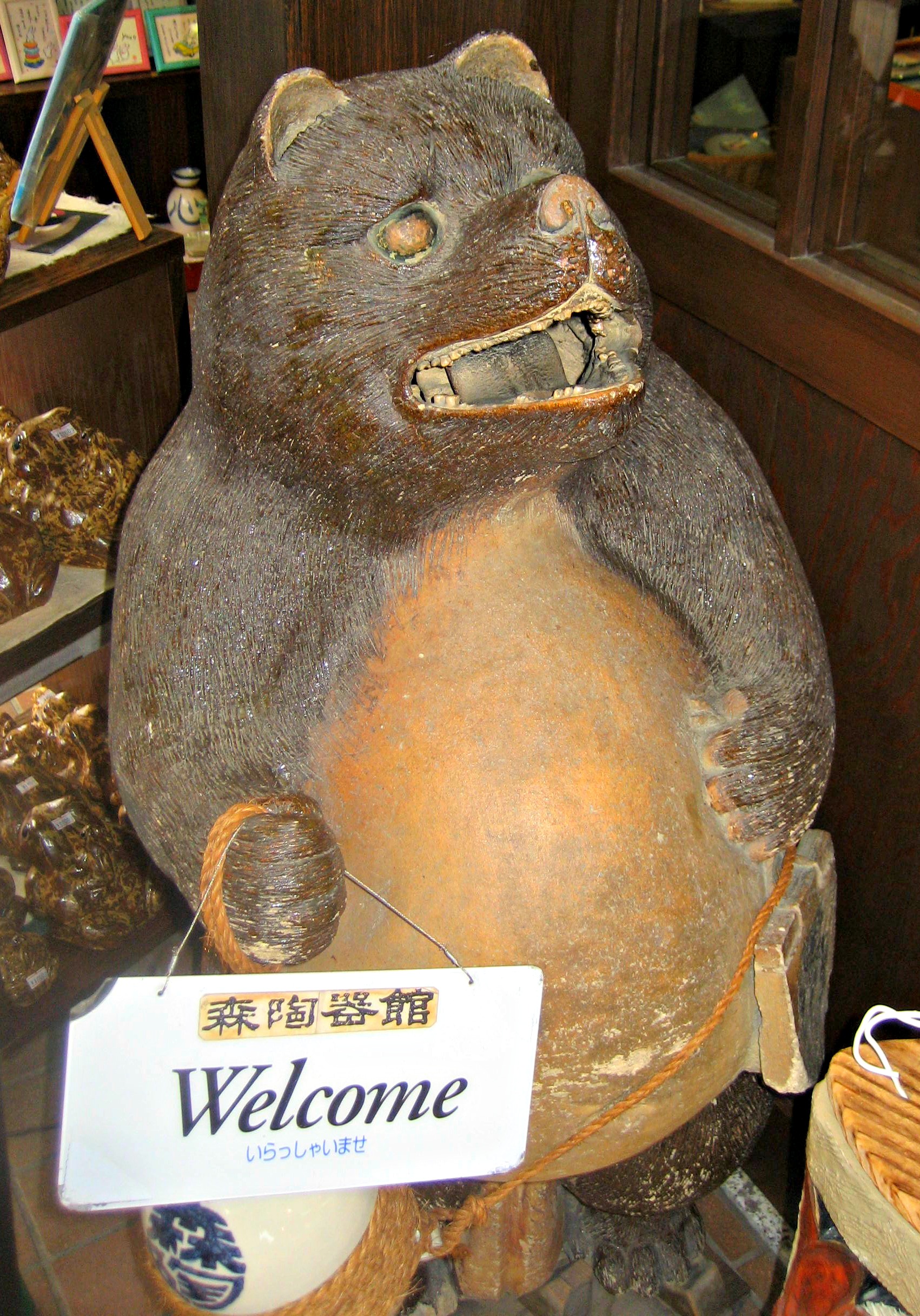
A ceramic tanuki (Japanese raccoon-dog). Japanese families and businesses keep them in front of their doors to welcome guests. It’s similar to the Maneki-neko (beckoning cat), but more fun because of their sake bottle and large kintama (golden testicles), which are meant to bring good fortune.

Hmmm…moving right along: You are also invited to prepare one meal based on your travels for other members of The Displaced Nation. What’s on the menu?

I like Japanese bar food, so we’ll have a meal based on that.
Appetizer: Edamame (boiled & salted green soy beans) and a Grapefruit Sour to drink. My favorite bars in Japan will give you a glass of ice, seltzer, and shōchū (grain alcohol) and a half-grapefruit with a strainer for you to squeeze the juice into the glass. Really refreshing.
Main: A bunch of Japanese tapas dishes — yaki-gyōza (fried potstickers), tebasaki (grilled wings), pari pari renkon chips (spicy, deep fried lotus root), tsukune (grilled chicken meatballs), and yakitori (skewered grilled chicken)
Dessert: Japan isn’t big into dessert, so we’ll have a savory bowl of ramen instead. And maybe another Grapefruit Sour. Or two.

Yum, you’ve brought me back to my own izakaya days… And now can you please suggest a Japanese word or expression for the Displaced Nation’s argot?
Chuto-hanpa. It literally means half-measure, but is used to describe doing something half-assed. I love this word.

We’re getting into a bit of a Halloweeny mood at the Displaced Nation. Tell me, did you keep the American Halloween tradition alive while living in Japan?
We did celebrate Halloween in Japan with our children. It’s becoming popular there in terms of decorations and parties (we even found an American-type pumpkin for $20), but trick-or-treating is an oddity. You don’t request gifts from people — certainly not door-to-door. Our neighbors would deliver snacks in a plastic jack-o-lanterns to our house instead. One expat friend arranged a trick-or-treating excursion for the children as part of a Halloween party. But first we mothers delivered bowls of candy to the businesses and homes in the area so that, when we brought the children round to trick-or-treat, they would have something to give them. People probably thought we were crazy, but at least they found the children in costume adorable.

Also in keeping with the season, we’ve started exchanging expat horror stories on the site. What’s the creepiest situation you’ve encountered on your travels?
It was on a trip to Thailand. My husband and I hung out on a beach at Koh Samui for a few days. To get back to the mainland, we had to hike across the island to catch a boat. We were proceeding along the dirt road, chatting…when I felt something grab my arm. Without breaking stride, I glanced down and saw a monkey, teeth bared, ready to bite me. Suddenly it flew off my arm, and I screamed. It had been chained to the side of the road, and was ripped away as it reached the end of its tether. Its vicious eyes and sharp teeth will forever be burned in my memory. That nasty monkey must have been someone’s pet. My husband saw it standing next to its stake before it jumped on my arm. Too busy talking, I totally missed it and walked within its perimeter. You can bet I have remained vigilant for monkeys ever since. I had a close call with some snow monkeys in Nagano, as well. I am not a fan.

The first book in your Cherry Tucker mystery series is called Portrait of a Dead Guy. That sounds a little creepy. Is it?
It’s actually a humorous mystery, but the idea of painting a coffin portrait is creepy even for my heroine, a sassy Southern artist named Cherry Tucker. However, she’s desperate for a commission, which is why she offers her services. The dead guy has been murdered, and his stepmother felt that a final portrait would be a fitting commemoration. Cherry ends up as another potential victim of the murderer because of her proximity to the corpse. That said, she does have one spooky scene at night in a funeral home, alone with the dead body, which ends badly.

Painting a portrait of a dead man — how did you think that one up?
In truth, coffin portraits are not all that unusual, depending on your culture. Many cultures use a portrait of the deceased with their memorialization. I know a family friend who was asked to photograph a coffin portrait to send to the deceased’s family in Asia. They would probably place the photo in a family shrine and burn incense for a specific number of days along with other rites.

Tell me about your plans for the Japanese mystery series.
I’m a humorous mystery writer, so I look at the lighter side of crime. Did you know that the Japanese love mysteries? I think it’s because they have so little crime. I have another Southern heroine for the Japanese series, which will bring an interesting cross-cultural twist. I love the interplay of cultures.

Say, what is this thing about you and Southern ladies? Aren’t you an Illinois girl? Is this another displacement?
It is another displacement! We moved to Georgia between trips to Japan, about fifteen years ago. Small town South is very similar to small town Midwest, except for the Southerner’s extravagant use of hyperbole and simile in conversation. I can’t imagine living anywhere else in the U.S. now, although I can place myself in some foreign spots quite easily. 🙂

Readers — yay or nay for letting Larissa Reinhart into The Displaced Nation? She has an affinity for dead bodies, true — but in a humorous sense! And she doesn’t monkey around… (Note: It’s fine to vote “nay” as long as you couch your reasoning in terms we all — including Larissa — find amusing!)

STAY TUNED for tomorrow’s post, an interview with another former expat author.

If you enjoyed this post, we invite you to register for The Displaced Dispatch, a round up of weekly posts from The Displaced Nation, with seasonal recipes, book giveaways and other extras. Register for The Displaced Dispatch by clicking here!

Related posts:

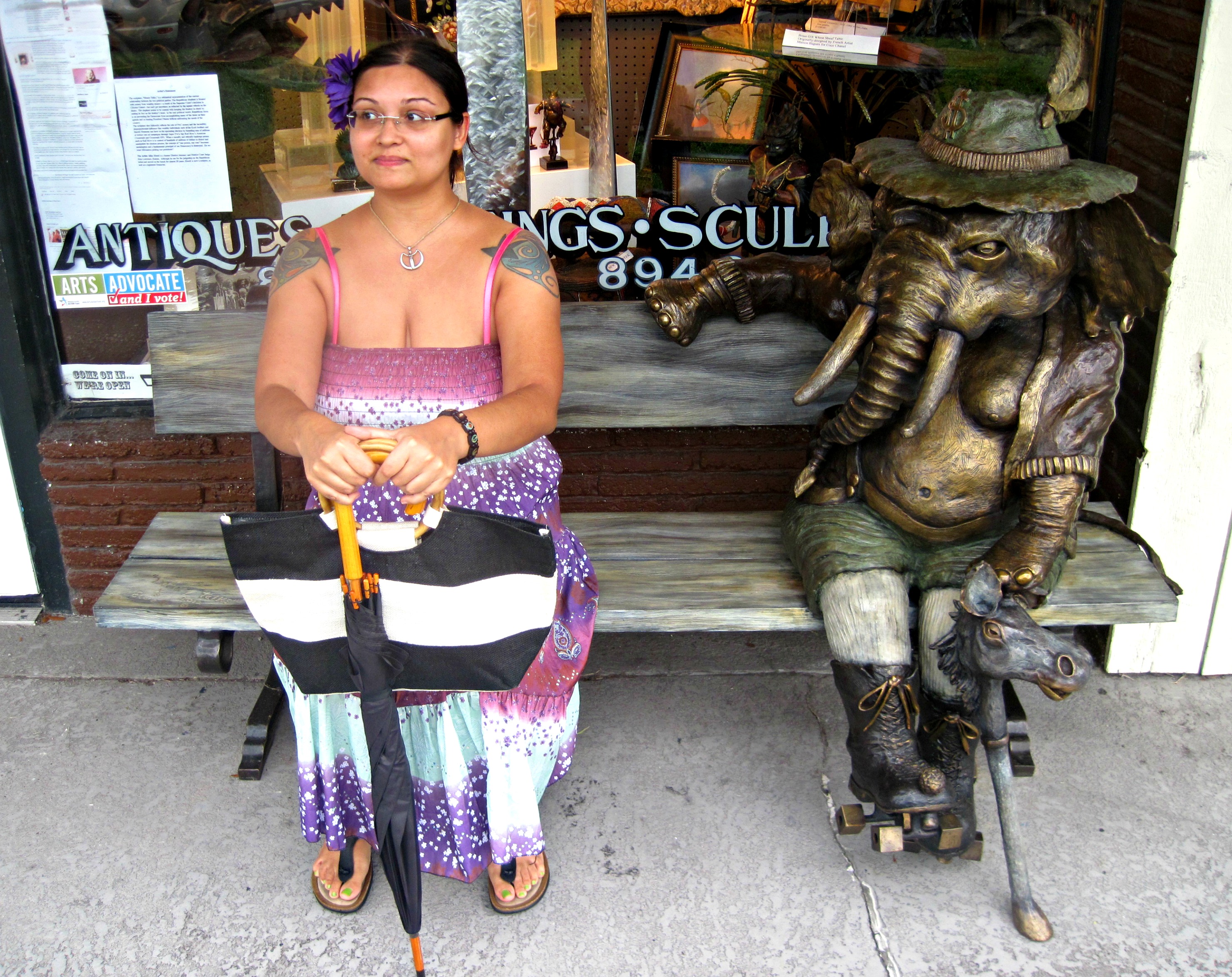
Images: Larissa Reinhart inside a subway station in Nagoya; her favorite tanuki (cute or creepy?); her book cover.

LIBBY’S LIFE #61 – A voice in the dark

Something has woken me. A voice.

I lie in bed and stare around the semi-darkness, wondering if an old, lost spirit lingers in the whitewashed walls of this Georgian cottage. I have no idea what time it is; the only clock in the room is that on Oliver’s cell phone which is lying on the window seat in our bedroom, its little green light flashing every few seconds. With no phone signal in the village, Oliver’s phone has become merely an expensive timepiece. The idea that the Voice might not be of this world discourages me from getting up to check its display, so it could be the middle of the night or nearly dawn for all I know; morning arrives later here than in Massachusetts, and winter, it feels, will not be long coming.

Perhaps one of the children has had a bad dream? I strain to listen for any sounds of wakefulness from the little bedroom next to us, where the three of them are tucked up. Hearing nothing, I decide I must have been dreaming myself, or that the jackdaws who helpfully drop twigs down the chimney into the fireplace are on night duty, cawing and pacing on the roof. I am about to turn over and reclaim some precious sleep when the Voice comes again: outside, under our bedroom window. A hoarse whisper, no doubt fondly intended to be quiet, but in reality raucous enough to awaken the whole street and the dead in the churchyard opposite.

“Yoohoo! Coo-ee! It’s me! Oliver — are you awake?”

I stay still for a second, not believing or wanting to believe what’s outside. Something that shouldn’t have been here for another three days. Should I ignore it? Will the voice and its owner go away if they get no response?

Chance would be a fine thing.

I sigh, resigned to our family’s fate for the rest of the day — the week, even — and nudge Oliver awake less gently than he’d like or is used to.

“Wake up, O dearest one. Rise and shine. Go open the front door. Your mother’s here.”

* * *

“So yesterday I said to this girl in your office, Oliver — Melinda, I think her name was — I said, ‘But he’s not arriving in England until tomorrow, so he must be there with you.’ And she said, ‘No, he definitely left last Sunday and he’s staying in the goonies in the back of beyond for two weeks.”

“Melissa, not Melinda. Boonies, not goonies.”

I shift George onto my other hip, and one-handedly fill the kettle. It had proved impossible to return to sleep once Sandra entered the house, screeching and cackling, so with bad grace I’d got out of bed and dumped some small children on her. If she was going to arrive three days early, she could make herself useful.

“Melissa, that’s it. She sounded like a lovely girl. Anyway, she said Oliver would be here all week, so why didn’t I ring him on his mobile phone? But I couldn’t get through, I just kept getting his answerphone message, so I thought, sod it, I’ll get an early train tomorrow to Bath. It’ll be a nice surprise for them.”

As if I didn’t already have enough reasons to murder Melissa Harvey Connor in cold blood.

I sit George in the rental cottage’s one highchair and get the teapot ready, putting an extra teabag in for Sandra who likes her brew a violent shade of orange.

“Oh, no tea for me, please!”

I turn, surprised. “No?”

“Not unless you’ve got green tea.”

I hold up the box of PG Tips.

“Evil stuff,” she says. She who once gave my three-year-old Red Bull. “Haven’t drunk it for a week now. I’m on a health kick. Green tea only for me, please.”

I pour boiling water into the teapot. “Haven’t got any.” If you’re going to turn up out of the blue and visit people unannounced, you’ve got to have what you’re given. “It’s PG Tips or apple juice. Or you can have the twins’ Cow and Gate if you’re desperate.”

It’s funny, I think — at one time I’d have been polite, even offering to run out and find some in the village. The health food shop at the other end of the high street probably sells green tea, after all, and as it’s now 8:30, the shops will be open.

But after the crisis that Oliver and I have had, all due to Sandra’s insistence upon Oliver’s silence about his family history? Sandra can damn well sing for her green tea.

“Are you sure you don’t want a cup?” I ask.

Sandra leans over to Beth who is kicking one foot in a bouncy chair, and strokes her cheek.

“Evil stuff,” she says again. “Give me a glass of water and I’ll go outside for a smoke.”

* * *

“What are we supposed to do with her?” I ask Oliver in an emergency conference in our bedroom. “We were going to Windsor to Legoland tomorrow, but I really don’t want her tagging along, moaning about nowhere to smoke and them not having herbal tea. Anyway, the car’s not big enough for all of us. Thoughtless woman.”

Oliver opens his mouth then shuts it again. Presumably he was going to defend Sandra, but over the last few weeks he’s learned that my sympathy threshold for his mother has plummeted. Her mention of Melissa only serves to make things worse.

Since we arrived, I have tried to worm information out of Oliver about Melissa, but every time I bring her name up — casually, nothing accusatory, asking about her job — he shoots a hunted, sideways glance at a random object in the room and changes the subject. I am getting nowhere, not to mention frustrated as hell and more suspicious by the minute.

“I could stay here and you take her out with the children. Go round Bath or someth—” He trails off. I imagine my expression reflects the outrage I feel.

“Your mother, your problem,” I say. “How about you take her round Bath and I stay here with the children and go to the park?”

He nods.

At least he’s getting to know when he’s lost an argument.

* * *

They’ve gone. The house is quiet, or as quiet as it gets with a preschooler and two six-month-olds. But it’s significantly quieter than when an overgrown teenager in her fifties is added to the equation.

“Can we go to the park now?” Jack asks.

I smile at him. “Of course. Put your jacket and shoes on while I get the twins ready. I’ll just nip upstairs and get changed.”

I strap Beth and George into their double pushchair, then run up the stairs.

In the bedroom, I pull on a sweatshirt, straighten the bed, then cross to the window to draw back the curtains — and stop. In the few days without a phone signal, Oliver has evidently lost his habit of taking his phone everywhere he goes. The phone is still lying on the window seat, its green light winking.

Because I’ve had to turn the alarm off on it every morning, I know Oliver’s password to unlock it.

I unplug the phone, slip it into my jeans pocket, and run back downstairs.

“Let’s go,” I say to Jack.

*  *  *

.

Next post: LIBBY’S LIFE #62 – Private investigations

Previous post: LIBBY’S LIFE #60 – Cotswold espionage

A note for Libby addicts: Check out Woodhaven Happenings, where from time to time you will find more posts from other characters.  Want to remind yourself of Who’s Who in Woodhaven? Click here for the cast list!

Read Libby’s Life from the first episode.

STAY TUNED for Monday’s post: a review of Helena Halme’s new book, The Englishman.

If you enjoyed this post, we invite you to subscribe for email delivery of The Displaced Dispatch, a round up of the week’s posts from The Displaced Nation. Sign up for The Displaced Dispatch by clicking here!

Image: Travel – Map of the World by Salvatore Vuono / FreeDigitalPhotos.net

LIBBY’S LIFE #60 – Cotswold espionage

You can take the girl out of England, but you’ll never take England out of the girl. It’s home, and always will be.

At least, that’s what I thought until Oliver and I landed at a major British airport at stupid o’clock yesterday morning, after a night flight with a cranky four-year-old and two wailing five-month-olds in tow.

“Welcome home!” the uniformed bloke on passport control said to us. “This is your first time back in nearly eighteen months? Well, it’s great to have you in the country!”

OK, I’m lying. He said nothing of the sort. He scowled at me and Oliver, then shot a death-glare at Beth and George. “They’re American,” he said suspiciously, holding Beth’s blue passport by one corner as if it were radioactive.

“Well, technically they have dual–” I began, before he interrupted me.

“No UK passports?”

This visit was planned quite quickly, and although we’d got the twins official and legal as US citizens, they didn’t have the British paperwork yet.

“No, I haven’t got around to registering the birth with–”

The uniform held up one hand to silence me.

“How long will they be in the United Kingdom?”

Oliver passed him our travel itinerary which stated we would be going back to America in two weeks’ time.

“And you’re all travelling together for the duration of your visit?” the uniform asked.

“That’s right,” Oliver said.

“They’re five months old,” I said, sotto voce. “We thought we’d give them another couple of years before we sent them InterRailing round Europe on their own, but if you think they’re up to it now…”

Oliver trod heavily on my foot, and I muffled a squeal. My feet were swollen after a six hour flight with George asleep on my lap.

Another official wandered up to the booth.

“Have you got a problem, Derek?” she asked.

“He certainly has,” I muttered, and Oliver trod on my other foot.

The second official looked from Beth to her passport photo. Good luck to her trying to find the resemblance between Beth’s two month old self and as she was now, three months later. “They’ll need to be registered as UK citizens as soon as possible,” she said, “or it could cause a lot of problems.”

Goodness. The grilling now was not, therefore, classed as a “problem”?

“OK,” she said reluctantly to the first uniform. “Let them in.”

I gazed at my blameless infants as their passports were stamped and grudgingly handed back again.

“Poor little things,” I cooed at them as we walked away towards the baggage carousel. “You came home for a little light espionage, and they spoiled all your fun.”

Thankfully, I had run out of feet for Oliver to tread on.

* * *

So here I am, back in England, in the Cotswolds. It’s an unfamiliar region to me, as I’ve never been farther west than Reading before, so it isn’t technically “home”; but they still drive on the left, and I can buy Crunchie bars in the corner shop. It’s home enough for me.

You’d think that, given my extended absence, I’d have some introspective observations to bring you — Libby’s Thoughts On Returning Home — but all I can observe is how small everything is. The roads are Victoria Beckham-slim, the cars are like Matchbox toys, and as for the bed Oliver and I are sleeping in…Well. Give me King Size over Cosy, any day.

But the bed has to be cosy. King Size wouldn’t get up the narrow staircase in our rented cottage which, according to the plaque over the door, was built in 1723. It’s a tiny chocolate box house, all honey stone and honeysuckle on the outside, and low ceilings, plaster walls, and unexpected beams inside. Oliver is already sporting a lump on his bald patch.

Egg-sized lumps aside, though, it’s an idyllic place to spend two weeks. The front window looks out onto the high street, with its ancient market square cross, medieval church, and Ye Olde Gifte Shoppe selling tea towels and corn dollies to gullible tourists. For a real village — as opposed to Harry Potter’s Hogsmeade — this is as escapist as they get.

Better make the most of it before Mum and Sandra arrive next week, though. Thank God the house is too small for them to stay overnight, and they will be forced to sleep at the bed-and-breakfast down the road. For this first week, however, Oliver, the children, and I are on our own in this little Wiltshire backwater that has managed to bypass social evolution for the last 200 years.

OK, maybe not social evolution. They wear jeans and T-shirts, not smocks and straw hats, which is how everyone in Milton Keynes imagines West Country types. But they’re a bit behind in the technology race in Chipping Magna. There’s still a working red phone box in the High Street, which I thought was very quaint and sweet, because most red phone boxes have been bought up by Hollywood luvvies and converted to shower cubicles.

After half an hour in the cottage, we discovered the reason why the last non-shower phone box stood in this village. There’s no mobile phone signal in Chipping Magna.

“This is a disaster!” Oliver held out his useless cell phone in one hand and raked his — decidedly thinning, I noticed — hair with the other. “I’m supposed to be on a conference call with Seattle on Monday! How am I supposed to check my emails? Does this house have wi-fi?”

I gave him a pitying look. “I’d say this place has only just been hooked up to the national grid, wouldn’t you? Think yourself lucky that we’ve got electric lights instead of tallow candles.”

Then I turned away before Oliver could see me smirk.

I could be helpful and tell him that there was an internet cafe in the supermarket five miles away, where we stopped to get bread and milk. But here’s the thing. I don’t want him to be on the phone or emailing — and it’s not just because he’s on holiday and shouldn’t have to work for the next two weeks.

No. You see, if he can’t phone or email, he can’t communicate with Melissa Harvey Connor.

Bet you thought I’d decided to let that one lie, hadn’t you? Come on. You know me better than that. I’ve been doing some quiet investigations back in Woodhaven. That she started working for Oliver at precisely the same time that we were having marital problems, together with her husband Jeffrey stomping out of the house two weeks after she began, did little to allay my suspicions. No wonder the Posse had decided that she and Oliver were an item. But still — this is Oliver we are talking about. He’s no saint, but Melissa just isn’t his type. He might be OK as her boss, but I know that in a social (or more) situation, she would terrify him. I just can’t see it. He’d be mincemeat.

And yet — as my dad would say — there’s no smoke without fire. The question is: where did the fire start, and who lit the match?

I’m hoping that these two weeks with limited social opportunity — no phone, no internet, no texting — two weeks of Oliver and me being forced to sit and talk to each other, in other words, might give me a clue about what’s going on.

Because when the next coffee morning rolls around, I need to be able to stand up to the Posse and say, “Guess what, ladies? You owe me and my husband an apology.”

The jobsworth at the airport, worrying that our baby twins were here for some 007 spying, was barking up the wrong tree.

I’m the queen of espionage round here.

* * *

.

Next post: LIBBY’S LIFE #61 – A voice in the dark

Previous post: LIBBY’S LIFE #59 – Fanning the flames

A note for Libby addicts: Check out Woodhaven Happenings, where from time to time you will find more posts from other characters. Want to remind yourself of Who’s Who in Woodhaven? Click here for the cast list!

Read Libby’s Life from the first episode.

STAY TUNED for Monday’s round-up of the web’s top food posts!

If you enjoyed this post, we invite you to subscribe for email delivery of The Displaced Dispatch, a round up of the week’s posts from The Displaced Nation. Sign up for The Displaced Dispatch by clicking here!

Image: Travel – Map of the World by Salvatore Vuono / FreeDigitalPhotos.net

The accidental repatriate

Last time Sezin Koehler wrote for us, she was bidding farewell to “strange, Lovecraftian” Prague, where she and her husband had lived for four years. Also in the Czech Republic, Koehler succeeded in producing her first (horror) novel, American Monsters. After a short stint in Germany, the couple is now saying hello to sunny, but bugbear-filled, Florida. Koehler describes the emotional transition.

When I left the US for Europe in 2002 I had no intention of ever again living in America. Violence, backwards politics, a horrible job market, and a provincial outlook on the world made an extreme contrast with my global, Third Culture Kid background. I am half American, half Sri Lankan, and my mother worked for UNICEF, so the family lived all over the world.

Not to mention I was suffering from extreme post-traumatic stress disorder after witnessing the murder of a dear friend when the two of us were robbed at gunpoint by a gang banger in Hollywood.

Ten years later and a forced repatriation determined by economics rather than desire, I am at a loss for how much worse off this country is since I left. I know a decade is a long time — but surely not long enough to usher in political rhetoric that would take this nation back to pre-1950s? My mind boggles.

One big dark nation

Gun violence has ever increased — to the point where we find so-called Stand Your Ground laws that allow citizens to kill each other with impunity, under the guise of “I felt threatened” — even when that threat consists merely of a young African-American boy, armed with nothing but iced tea and a bag of Skittles.

I’m back in the world of mad gunmen going on shooting sprees. Sikhs mistaken for Muslims and murdered. Women getting abducted and raped at gunpoint while waiting for a bus — this happened just recently not far from where I live.

Post-9/11 America has seen the sharpest increase in the infringement of civil liberties as matters of homeland security and anti-terrorism. The arrests of journalists covering Occupy Wall Street events brought the US’s rank of journalistic freedom down 27 points, putting the country at 47, just behind Comoros and Romania.

Xenophobia abounds as states pass laws against the teaching of ethnic studies, and even literature written by Native and Mexican Americans, in schools. Such developments are exponentially more ironic when considering that this country’s immigrant history.

The worst (and rudest!) of times

After college it took me almost a year to get a proper job. Upon returning, I’ve had trouble securing even a retail job: all applications are now submitted online and don’t give you an option to upload a cover letter or even your full resume. Not only are American jobs outsourced to China, the application process has been tech-sourced to boot, as machines vet your application — even if you live right down the street from the store to which you’re applying.

I was shocked to find that retail jobs pay exactly what they did a whole ten years ago. Way to move forward, America.

America might have progressed in terms of technology; I see a smart phone in every hand. However, common courtesy has gone out the window as people text, Facebook, Tweet, right in the middle of an actual face-to-face interaction, without even a twinge of remorse.

Call me old fashioned, or a kindred spirit to Hannibal Lecter, in believing it’s the epitome of rude to fiddle with one’s phone (or any other such object of distraction) whilst another human being is talking to you.

The wheels on the bus go back-backwards.

Monsters are the best friends I ever had

To add insult to injury, I find myself in a particularly devoid area of Florida, easily one of the most vapid places on the planet. Plastic people who can spend an hour telling you about their lunch salad are the antithesis of the cultured individuals with whom I spent my time while living elsewhere.

Who would have thought the rabbit hole I fell down when I left Prague would lead to a place scarily resembling Hell, with its torturous circles and its staggering temperatures?

Each day I force myself to review the positives:

It seems incredible that the America I left ten years ago — the one that traumatized me so badly — is actually a better version than the one in which I live now.

So frustrated have I been by absurd American conservatism and the zombie hordes of consumerism around me, I’ve resorted to a new persona: Zuzu Grimm, a creature who writes wicked dystopic visions of where this country is headed if it continues down this current path of willful ignorance and fear mongering.

Bored now

But that’s not been the only struggle: For years I defined myself as an expat. My blog was filled with anthropological tales of living in Switzerland, France, Spain, Turkey, the Czech Republic and Germany. More than that: stories of growing up in Sri Lanka, Zambia, Thailand, Pakistan, India.

While I’m still a Third Culture Kid — never really at home anywhere — my expat identity became a cornerstone of who I was. It worked, and was so much less confusing to explain. The expat label made me feel ultimately more interesting. Writing a novel in Prague sounds infinitely more exotic than writing from an essentially retiree community of ten thousand.

Oy vey.

Accepting that this is who I am now, and this is where I am, has been even harder than the absolute culture shock upon repatriation.

Being an expat gives a person a sense of uniqueness that may or may not be deserved. Yes, you’re a foreigner who must negotiate language/cultural/social barriers. But it’s also your choice. And for many people economics determines whether you can or can’t participate.

Kind of like having kids. You can complain all you want about how hard it is, but it’s something you elected to do, not something that was forced upon you.

(Well…unless Republicans head up the White house; with their insane ideas on abortion there’ll be thousands more women forced to carry rapists’ babies to term. Disgusting. Terrifying. Yet another grotesque example of the New America I find on return.)

I’m nobody, who are you?

My former life as an expat has taken on so many more shades of meaning as I consider how it must have seemed to those in my position right now: How glamorous. How decadent. How lucky. How dare they criticize my government when they’ve jumped ship. I have to live here. I’m thousands of dollars in debt. I don’t have the luxury of leaving.

Maybe one day when my husband wins the lottery, that’s just what we’ll do. Leave. Maybe for Buenos Aires, or Addis Ababa. Maybe in the meantime we’ll find a better city in the US, one that offers more by way of creativity, culture, and history — the things I miss most about life in Europe.

Until then, I have to make peace with being plain old Sezin Koehler who lives in and writes from Florida. Hopefully some time soon I’ll be okay with that. Any minute now. It’s going to happen.

That’s fine. I’ll wait.

And pray I don’t get sick in the meantime, because even with Obamacare, I still can’t afford health insurance.

Sezin Koehler, author of American Monsters, is a woman either on the verge of a breakdown or breakthrough writing from Lighthouse Point, Florida. Culture shock aside, she’s working on four follow-up novels to her first, progress of which you can follow on her Pinterest boards. Her other online haunts are Zuzu’s Petals‘, Twitter, and Facebook — all of which feature eclectic bon mots, rants and raves.

STAY TUNED for tomorrow’s post, another displaced Q from anti-foodie Tony James Slater.

If you enjoyed this post, we invite you to register for The Displaced Dispatch, a round up of weekly posts from The Displaced Nation, with seasonal recipes, book giveaways and other extras. Register for The Displaced Dispatch by clicking here!

Related posts:

img: Sezin Koehler in St. Petersburg, Florida, by Steven Koehler (2012).

LIBBY’S LIFE #59 – Fanning the flames

Somehow, I manage to get away from that hideous coffee morning. As I drive, I automatically answer Jack’s questions about the finer details of Ironman’s personal habits — “I have no idea how he goes to the bathroom. No, I can’t imagine Ironman wearing Pampers.  Yes, I suppose he might go rusty if he’s not careful.” — but I’m not really paying attention.

Anita’s words keep looping around in my head.

“Jeffrey Connor’s gone back to Shelley,” she’d said. Shelley, his first wife, whom he’d left for Melissa Harvey. Jeffrey and Shelley Connor had been Melissa’s tenants — just as Oliver and I are now.

I cringe every time I replay my innocent reply:

“Why? What happened to him and Melissa?”

And Anita’s embarrassed answer: “We all assumed you would know about that.”

Her meaning was unmistakable: We assumed you knew because you are involved in this situation. Or, rather, not me, but Oliver.

It was as if someone had smacked me over the head with a large stick. Everything made sense: the sudden silence as I entered Anita’s house, as if they had been talking about me; Charlie’s protectiveness, as she loudly emphasised my “post-natal depression” as the excuse for my four-month absence from Posse society.

It wasn’t post-natal depression, not in the conventional sense. It was my inability to face anyone because of the issues Oliver and I were having about his father’s marital history.

Now, though, I wish I’d been brave enough to venture onto the coffee morning rounds. Without me there to set the story straight, rumours had flourished like unattended dandelions. In my absence, everyone had gossiped behind my back, assuming I wasn’t showing my face in public because Melissa Harvey Connor was having it away with yet another tenant of hers: Oliver.

How ridiculous. Right? I mean — when would Oliver see Melissa?

Yet here’s the thing: while I can keep telling myself that it’s all conjecture and careless whispers amongst silly women with too much time and not enough brain cells, and I don’t believe a word of it, at the back of my head a little voice of paranoia insists that rumours have to come from somewhere.  As my Dad would say: “There’s no smoke without fire, Libby.”

What to do now? I wonder.

Do I ignore the smoke? Douse the embers? Or — fan the flames?

If the topic comes up, I decide, I will probe.

*  *  *

“How was your day?” Oliver asks over dinner. “Did you go to Charlie’s leaving do?”

I pause. “Yep,” I say, trying to keep my voice light and casual, and instead hearing it come out high-pitched and tense.

“Everything all right?” Oliver shoots me a look which I interpret as concerned.

Concerned for whom? Me? Or him?

“Fine,” I say, hoping my voice sounds more natural.

“OK,” he says. Oliver tends to take things at face value. If I say I’m fine, then I must be.

“I hear Jeffrey’s gone back to England.” I cut into a piece of chicken on my plate, and glance up quickly to watch Oliver’s expression, which is a study in nonchalance.

“Yeah. He decided our landlady wasn’t a good enough trade-in for his first wife. Gone back with his tail between his legs.”

“It took him this long to work that out? Everyone else could have told him Melissa’s a complete bitch.”

Oliver raises his eyebrows. “She’s not that bad. A bit overbearing, maybe. Jeffrey didn’t handle her right. You’ve got to be firm with her.”

I choke, cough, and run into the kitchen where I splutter out a wad of half-chewed chicken.

“And you’d know about this, I suppose,” I say, when I return to the table.

“Well, yes. Of course I would.” He looks around the table for ketchup. Honestly, it drives me nuts how Oliver insists on drowning everything with ketchup. If I took him to Alain Ducasse, he’d be asking for ketchup to go with the foie gras. “Seeing as she’s been working at the company for — what?  Three months now.”

I lean back in my chair, aware that my jaw is dropping open unattractively.

“She works at your place? Why? She’s a realtor. You never told me.”

Oliver shrugs. “Housing market has tanked around here, and Jeffrey got her this admin job. I suppose she joined when we…when you and I weren’t talking much to each other.”

And whose fault was that? I want to scream, but instead I count to ten, very slowly, because I need to know more.

Suddenly the Posse’s whispers don’t seem so careless any more.

“Do you see much of her at work?” I ask in that same fake-casual voice.

“She works for me. Technically, I’m her boss.”

“And there is no connection between that and the fact that Jeffrey has decided to return to his first wife.”

He hesitates, just a fraction of a second too long, and my internal bullshit radar switches to high alert.

“Now you’re just being silly,” he says, sticking out his chin.

We finish our meal.

There is silence in the room, marred only for me by my internal radar’s sirens and red flashing strobe lights.

*  *  *

.

Next post: LIBBY’S LIFE #60 – Cotswold espionage

Previous post: LIBBY’S LIFE #58 – Careless whispers

A note for Libby addicts: Check out Woodhaven Happenings, where from time to time you will find more posts from other characters.  Want to remind yourself of Who’s Who in Woodhaven? Click here for the cast list!

Read Libby’s Life from the first episode.

STAY TUNED for Monday’s food-related Displaced Q!

If you enjoyed this post, we invite you to subscribe for email delivery of The Displaced Dispatch, a round up of the week’s posts from The Displaced Nation. Sign up for The Displaced Dispatch by clicking here!

Image: Travel – Map of the World by Salvatore Vuono / FreeDigitalPhotos.net

LIBBY’S LIFE #58 – Careless whispers

OK. Let’s do this.

My finger hovers over the doorbell for a couple of seconds before I push the button. Inside, a torrent of barks from Anita’s dog, Champion, reminds me of the morning at this house, nearly a year ago, when the same dog diagnosed my pregnancy, literally sniffing it out.

Approaching footsteps in the hall, accompanied by the skittering of doggy claws on slippery wooden floorboards.

Anita opens the front door wide, and I catch a glimpse of the Coffee Morning Posse chattering in the kitchen, at the end of the corridor behind her. Everyone turns to see who’s arrived, and the chatter stops; as if someone flicked a volume switch to “Mute”.

“Libby,” Anita says, at first looking at me, then quickly averting her eyes. “We didn’t… expect you. Come in.”

She takes Jack’s hand and the twins’ changing bag, and leads the way to the back of the house. I follow, feeling like Scarlett O’Hara when Rhett forces her to go to Melanie’s party after she and Ashley are caught in a clandestine clinch. It’s clear from the silence and Anita’s awkwardness that I’ve been the subject of conversation.

Could they know about Oliver and his bigamist father? I wonder. No. That would be impossible. No one in Woodhaven knew about that except Maggie, and she would never say anything to anyone — least of all to the Posse.

I haven’t seen any of the Posse since early May, a couple of weeks after the twins’ birth, when Anita brought round a Tupperware-encased casserole for our freezer. Two days after the arrival of that Chicken a la King, Oliver’s half-sister Tania paid us her fateful surprise visit, and my life turned towards the sign marked “Hades on Earth”. Hanging out with the Expat Sisters over lattes, pretending everything was hunky dory chez Patrick, didn’t feature on my agenda after that.

Silly to assume my absence went unnoticed, though. I’ve turned down so many invitations to coffee, dinner, and pot luck lunches that the gossip machine must have been working overtime. “Bring all the children, and let’s have dinner!” the phone conversations would start, and my inner reaction would be Let’s not. Let me just hide. Outwardly, I would mumble an excuse, but since I’m no Meryl Streep, the other person surely knew I was fobbing them off. “Another time, then,” they would say.

Except that after a while, of course, there were no other times.

Naturally, it was Maggie who set me back on the path to social redemption.

“You can’t hide away forever,” she said to me at regular intervals over the last few weeks. “You need more company. You need people your own age.”

Eventually, after Oliver and I reached our tenuous truce, I felt my wounds had been sufficiently licked and the time was right to enter the outside world again. An email from Anita, sent to all the English Posse wives, offered the opportunity I needed.

Charlie and Lee are heading back to sunny Milton Keynes! the email said. We will be holding a farewell party for Charlie on August 23 at my house. Please RSVP…..etc etc etc

I didn’t RSVP, though. I didn’t trust myself to keep a promise to attend. Glancing round Anita’s kitchen now, meeting the curious stares and false smiles, I wish I hadn’t come.

“How they’ve grown!” Charlie appears at my side, gives me a hug, and bends down to take a better look at the twins. “They’re — what, about three months now?”

“Four months. Exactly.” I wish with all my heart that it was someone else’s farewell party. Anyone except Charlie. Caroline would be my top pick of people to dispatch back to Milton Keynes. I can see her on the other side of the family room, standing next to her awful brat who’d made Jack’s life a misery. She’s holding her own new baby, which is dressed in a black Harley Davidson onesie with fake leather boots and a kelly-green elasticated headband. Boy or girl? It’s still anyone’s guess.

“They’re beautiful,” she says. “And you look very well, too. Post-natal blues are such a curse — I hope you’re feeling a bit better now?”

Charlie speaks the last sentence in a slightly louder tone, as if to make sure the rest of the room hears clearly. She nods slightly at me, encouraging me to say something, to play along with her.

“Much better,” I say, wondering where this is leading.

“Good! I hear there are some wonderful drugs available for depression these days. I expect you know all about that, though.”

“Well, I’m not actually—”

“Come and sit down where it’s quieter.” Charlie interrupts me, then picks up George’s car seat and carries it through to Anita’s formal living room. I follow with Beth. As I sidle past the basement door, I hear Jack issuing orders about the rules of a made-up game involving Ironman and Captain America. Sad, I think. Has Lightning McQueen had his day in Jack’s world?

“I think you should know,” Charlie says, flopping down next to me on Anita’s leather sofa, “that there’ve been a lot of theories about your absence. Rumours spread very quickly around here, as you know, but as soon as anyone voiced an opinion, I simply stepped in and told them you’ve been suffering from PND. I figured that it probably wasn’t too far from the truth.”

I reflect on this. Yes — I’d been depressed following the twins’ birth, although the two events weren’t connected.

“That’s about right,” I say.

“And I presumed you’d rather have that circulating as general knowledge than the real reason.”

I nod, before remembering that no one could possibly know about Oliver and Tania.

“Wait — what ‘real reason’?” I ask, but Charlie is already getting up.

“They’re calling me,” she says. “Time to cut the cake.” And off she rushes, back to the kitchen.

By the time I’ve gathered up the two baby seats and lumbered with them towards the cake room, Anita is in full flow with an emotional goodbye-to-Charlie speech.

“The best thing about being here in Woodhaven,” she says, blinking hard, “is the lovely people you meet. The worst thing is when you have to say goodbye to them.” She sniffs. “I’m going to miss you so much, Charlie.”

You and me both, I think.

Julia passes a couple of large gift-wrapped boxes to Charlie.

“This is from all of us,” Julia says, and I feel guilty, because I haven’t contributed anything.

Charlie murmurs her slightly embarrassed thanks, and begins unwrapping them. There’s a big coffee-table book full of photos of Massachusetts; a lace tablecloth which I recognise as being from the craft store in Woodhaven; a pottery house — a miniature of the one on Main street that belongs to the Historic Society. Right at the bottom of the second box, there’s a map of Milton Keynes and a copy of the Highway Code. A joke, of course — Charlie doesn’t need either, but it’s a reminder that she’s been away from her home town for nearly five years, and she might need a refresher course in driving on the left.

“Give our love to Milton Keynes,” Julia says.

“And to Jeffrey and Shelley, of course,” pipes up Caroline from the back of the room. She looks over at me and smirks, but I don’t know why.

Everyone else in the room knows, though. The heavy silence descends again.

Jeffrey and Shelley? I think. I only know one Jeffrey, the one who is married to Melissa Harvey Connor.

“Does she mean Jeffrey Connor?” I whisper to Anita, who’s standing next to me.

Anita casts a glance around, as if searching for a door to take her into a parallel universe, far away from here. “That’s right,” she says.

“So — he’s in England now?” Oliver never mentioned it. “What about Melissa? Has she gone too?”

It’s so long since I’ve seen Melissa. The last time I saw her was the week of the early winter storm, when I caught her sniffing Oliver’s sweatshirt in our bedroom, and I got the locks changed the following week.

Anita stares at the floor. Perhaps she can see the door to the other universe. “He’s gone back to Shelley,” she says at last. “The wife he had when he first came out here, five years ago.”

“Goodness.” So much scandal for such a small town. “So what happened to him and Melissa?” I ask.

Anita’s very quiet, for a long time. “We all assumed you would know about that,” she says at last. “I’m sorry, Libby.”

.

Next post: LIBBY’S LIFE #59 – Fanning the flames

Previous post: LIBBY’S LIFE #57 – Coming clean

A note for Libby addicts: Check out Woodhaven Happenings, where from time to time you will find more posts from other characters.  Want to remind yourself of Who’s Who in Woodhaven? Click here for the cast list!

Read Libby’s Life from the first episode.

STAY TUNED for Monday’s post.

If you enjoyed this post, we invite you to subscribe for email delivery of The Displaced Dispatch, a round up of the week’s posts from The Displaced Nation. Sign up for The Displaced Dispatch by clicking here!

Image: Travel – Map of the World by Salvatore Vuono / FreeDigitalPhotos.net

Displace Yourself…to Tuscany

Welcome back to another in our occasional series, “Displace Yourself,” where we look at books by expats and travelers focusing on particular countries or regions, in hopes of displacing ourselves through their experiences. (One lifetime isn’t long enough to sample it all!)

This month, a place that’s on many of our wish lists: Tuscany, Italy.

Tuscany: Facts and figures

Capital: Florence
Area: 8,878 square miles
Population: 3,750,000
Language: Standard Italian/Tuscan Dialect
Demographic: 93% Italian; immigrants from Britain, America, and China.

*  *  *

To Tuscany from England:

Down A Tuscan Alley (Fiction/memoir)
by Laura Graham
 Published June 2011

The Displaced Nation first met Laura Graham in May this year. Click here to read our interview with her.

About the author:
After the breakdown of a longterm relationship, Laura left England in search for a new life in Italy. With a distinguished acting career behind her, she now runs her own holiday property agency in Sinalunga, where the Tuscan tranquility inspires her writing.

Cyber coordinates:
Website: www.lauragraham.co.uk
Twitter: @LauraGraham7

Overview of book:
A long relationship ends. At 48, house taken by the bank, Lorri has little money. What can she do? And where can she go? Gathering her meager savings and her two beloved cats, she escapes England for a new life in a remote Italian village, never imagining the intrigue, passion and adventure she will find.

One reader’s review:
“The author’s use of dialogue enables the reader to form their own images of the characters to whom we are introduced. The reader is invited to share with [protagonist] Lorri as she develops her confidence, her new language, a knowledge of a different culture and her love for Ronaldo. The juxtaposition of romance and intrigue helps the book to flow to its end, and keeps the reader’s interest. The author brings her story to its conclusion using one of her characters to inform both the reader, and the protagonist herself.” (Amazon.co.uk reviewer)

To Tuscany from New York:

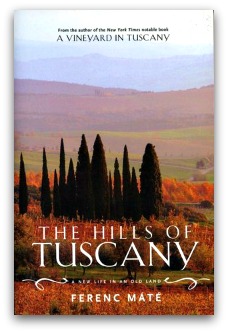
The Hills of Tuscany: A New Life in an Old Land (Autobiography)
by Ferenc Máté
Published November 1998

About the author:
Ferenc Máté  escaped Hungary after the 1956 revolution, and went with his mother to Vancouver, British Columbia. He now lives on a wine estate in Tuscany with his wife (painter and winemaker Candace Máté) and their son, Peter.

Cyber coordinates:
Website: www.ferencmate.com

Overview of book:
This hilarious, international bestseller is a true-life adventure of a New York City couple moving to Tuscany.  Ferenc Máté’s enthusiastic prose is infectious. He brings to life the real Tuscany: the contadini neighbors, country life—the harvest, grape, and olive picking, wine making, mushroom hunting, woodcutting—the holidays, and of course the never-ending, mouthwatering meals. (Amazon.com book description)

One reader’s review:
“As a second-generation Italian-American, I’m getting tired of the subtle patronizing attitudes that some prosperous expatriates to Italy emit via their memoirs. Reading this book, I felt that Ferenc Mate truly felt a genuine empathy with Italians. His ability to laugh at himself, and with his Italian neighbors — not at them — was a superb aspect of this work. He seemed to understand that being at home in Italy requires more than merely hobnobbing with other expatriates, and absorbing their prejudices.” (Amazon.com reviewer)

To Tuscany from California:

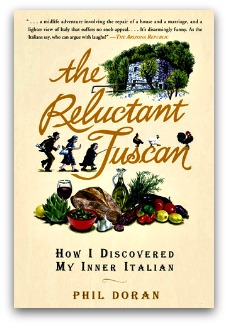
The Reluctant Tuscan: How I Discovered My Inner Italian (Humor/Autobiography)
by Phil Doran
Published March 2006

About the author:
Phil Doran worked in TV production for 25 years, as writer-producer for TV shows such as Sanford and Son, as a writer for The Wonder Years, and writing episodes of The Bob Newhart Show. He divides his time between California and Tuscany.

Cyber coordinates:
Website: www.reluctanttuscan.com

Overview of book:
After twenty-five years of losing her husband to Hollywood, Doran’s wife decided it was finally time for a change—so on one of her many solo trips to Italy she surprised her husband by purchasing a broken-down 300-year-old farmhouse for them to restore. The Reluctant Tuscan is about the author’s transition from being a successful but overworked writer-producer in Hollywood to rediscovering himself and his wife while in Italy, and finding happiness in the last place he expected. (Amazon.com book description)

Readers reviews:
Note: “The Reluctant Tuscan” appears to provoke a “Marmite” response from readers — they either love the book or hate it (or at least, are marginally lukewarm about it.) Here are two fairly typical reviews from both sides of the spectrum, from Amazon.com reviewers.

Love it:
“This is such a fresh, enjoyable book. Phil Doran is so honest & matter of fact about himself & his wife. I picked this book up to glance through & found I could not nor did I want to put it down. So I sat & read it non-stop, from cover to cover….My sides hurt from so much laughing. This is a must read book for anyone & any age….Enjoy!!!”

Lukewarm:
“The book recounts the period of time when the writer moved to a rural town in Tuscany and undertakes renovating a dilapidated farm house, mostly to appease his wife, who has bought the property without consulting him…There were some amusing bits but none that made me laugh out loud. Stereotypes and caricatures of Italians abound and there are multiple references to the Germans and WWII. Maybe it’s a generational thing, but I found these annoying.”

To Tuscany from Jerusalem:

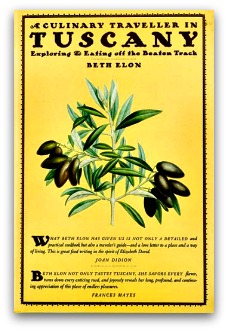
A Culinary Traveller in Tuscany: Exploring and Eating Off  the Beaten Track  (Travel guide/cookbook)
by Beth Elon
Published March 2009

About the author:
Former literary agent and her journalist husband Amos bought a neglected manor house in Tuscany in the late 1970s, long before the region became a desirable destination. Every summer, they would travel with their young family from their home in Jerusalem to spend two months in their Tuscan home, gradually renovating it as they were able. Eventually, the couple made Tuscany their permanent residence.

Overview of book:
“One might think that everything that can be written about Tuscany has been written. But here is a gem of a book in the tradition of M.F.K. Fisher that takes readers down Italian back roads and into private kitchens. There are 10 chapters that represent 10 itineraries into 10 different Tuscan regions. Included are more than 100 recipes and contact information and descriptions from private kitchens and restaurants, trattorias, gourmet shops, bakeries, wineries, and olive oil producers. Also included are days and dates when food festivals are held that celebrate chocolate, truffles, chestnuts and mushrooms. Warning: this book may contribute to an expanding waistline.” (Book Passage Bookstore review)

One reader’s review:
Beth Elton’s title isn’t just a cookbook – it takes a culinary tour of Tuscany into regions largely uncovered in other titles – and surveys the special kitchens and products of over fifty restaurants whose cooks produce original recipes revealed just for this title. All dishes have been adapted for home cooks but retain the authenticity of generations of development, so cooks seeking a blend of travelogue and new dishes to try will find delightful the blend of travel insights and easy dishes.” (Amazon.com reviewer)
.

STAY TUNED for Monday’s travel yarn from our very first Random Nomad, Anita McKay.

If you enjoyed this post, we invite you to subscribe for email delivery of The Displaced Dispatch, a round up of the week’s posts from The Displaced Nation. Sign up for The Displaced Dispatch by clicking here!

Related posts:

Image: MorgueFile

LIBBY’S LIFE #57 – Coming clean

“And then what happened?” Maggie tops up our glasses with Rioja. “Did he tell you all about his bigamist father and you said, ‘That’s fine, sweetheart’ and everything was tickety-boo between you again?”

Maggie’s summary isn’t incorrect, but it goes further than that.

“Something like that. He’s trying very hard, and…” I shrug.

“You mean,” Maggie says, “that the balance has shifted and you’ve got the upper hand for once?”

I consider this. I did the midnight feed last night, but this morning Oliver got up early to make breakfast for Jack and help him get dressed while I slept. I only woke up when Oliver brought a cup of tea and the twins to me in bed.

Does that mean I have the ‘upper hand’?

“No,” I say. “I mean that the balance, for once, is exactly right.”

* * *

Take this evening, for example. Tonight I’m at Maggie’s house, on my own, sans children, who are tucked up in bed while Oliver holds the fort and figures out the intricacies of mixing formula milk. This wouldn’t have happened a week ago, when the balance of power was tipped in his favour, when Oliver considered himself wronged, and behaved accordingly badly.

But all that has changed now.

Oh yes.

The evening after he had been to see Maggie, he told me about his father. He helped put the children to bed, and insisted on tidying up after dinner. “You go and put your feet up, Libs,” he said, and brought me, instead of an olive branch, a dish of ice cream. When he finally joined me, I was lounging on the sofa, taking up all the cushion space, and holding up a magazine in front of my face. After removing a few of Jack’s toys from a nearby armchair, Oliver also sat down.

“Libs.”

I turned a page. “Mmm-hmm.”

Ungracious? Yes, maybe. It takes more than a bit of washing up and Ben & Jerry’s to get round me these days.

“We should talk,” he said, then stopped. From behind my magazine, I saw him glance sideways at me. I said nothing, and continued flicking through the pages of Good Housekeeping. I was damned if I was going to make this easy for him.

He sat forward in his seat, elbows on his knees, hands dangling, his eyes fixed on a spot on the floor.

“He had three wives, you know. Mum was the third.”

A few seconds went by, then I said, “Yes. I do know, now. No thanks to you.”

His head drooped even lower. “I’m doing my best here, Libs. It’s very hard for me to talk about this. Don’t make it more difficult for me than it already is.”

I slapped the magazine down on my lap. “And don’t you lay that guilt trip rubbish on me! You’ve had ten years to tell me about your family history, but no, I had to watch our wedding outtakes video to find out why you were being such a shit about my little experiment with genealogy. So don’t preach at me about making things difficult.”

Oliver got up and walked out of the room. I think I was supposed to follow him at this point, and beg forgiveness. A very short time ago, I would have done — but not any longer. Instead, I picked up my magazine again and read an article about extreme bathroom makeovers; a pointless article when you live in rented accommodation. After about fifteen minutes, Oliver returned to the room.

“Shall we start again?” he asked in a quiet voice.

I sniffed.

“If you like.”

“Could you put the magazine down?”

I elaborately laid it on the side table, folded my arms, and raised my eyebrows at him. “Happy?”

He didn’t rise to my bait. It was a bit disappointing. “Mum was his third concurrent wife,” he said in a rush. “They’d been married for six years. The others had been married to him for nine and eleven years. None of them suspected a thing, despite the fact that they all lived within twenty-five miles of one another.” He paused. “If it hadn’t been for that pile-up on the M1, they might still be happily married today, for all I know.”

He flexed his fingers, then cracked his knuckles — a sure sign that Oliver’s under stress.

“Tell me.” I tried to make my tone offhand, but from the grateful expression on Oliver’s face, I must have injected more affection than intended.

“Mum saw the report on the local news about a big pile-up on the M1 at Luton,” he began, sounding hesitant. “Lots of pictures of cars crumpled up and skewed sideways in the road, ambulances and fire engines and police everywhere. The reporter said that four people had already been confirmed dead. Mum didn’t think much about it because Dad said he was working in the Lake District that week. Then, apparently — I don’t remember it, but she tells me this is what happened — I shouted that I could see Daddy’s car on the television.”

“And was it his car?” I asked.

“It shouldn’t have been. Dad had called Mum only an hour before from Carlisle — or at least, that’s where he said he was — so as far as she was concerned, there was no way he could have driven 300 miles in one hour. But yes. It was his car. The cameraman zoomed in on this bashed in blue Cortina, and Mum could make out the numbers on the licence plate.”

I was quiet again, but not in order to punish Oliver. I was visualising the scene in Sandra’s house, the turmoil in her mind as she wondered if her husband had survived the wreckage…

“Then what happened?”

Oliver squeezed his eyes shut. “She drove to the hospital that the news reports mentioned. Kicked up a fuss at reception, screaming that she’d just seen her husband’s car on TV in the pile up and she demanded to know where he was. The woman at the desk asked her what her husband’s name was, and when Mum told her, the woman got all confused and told her there must be some mistake because the family of that person had already been notified.”

Poor Sandra. I didn’t like her — never had — but no one deserved that.

“And if you think it couldn’t get any worse, the final wife turned up at the hospital twenty minutes later, having also seen the news and the picture of the car, and the same thing happened all over again. I can’t really remember what happened after that. Probably just as well, really. I only remember a lot of days that Mum either cried or threw things out of the window or into the street. Everything belonging to Dad, everything he had ever given me or Mum, it all disappeared from the house. I never saw him again.”

I thought of the toy tiger and the birthday card, the two hidden items that had sparked this whole mess between Oliver and me. I asked how they had escaped the evacuation.

“They turned up in the post a couple of days after my sixth birthday, a few months later, addressed to me. The postman rang the doorbell, and because it was Saturday and Mum was still in bed, I answered the door and got the parcel myself. I never told Mum I’d received them. By that time, I’d already lost my favourite teddy bear and lots of toys, just because Dad had bought them for me.”

My pity for Sandra evaporated as I thought of a little boy, not much older than Jack, trying to comprehend why all his beloved toys were being thrown in the dustbin.

I sat up and stretched my hand out to stroke Oliver’s arm.

“Poor you,” I said. “That’s awful. Really terrible.”

Oliver absently put his hand on top of mine.

“I found out, much later, that he must have sent that parcel just before he went to prison.”

“Prison?”

“Bigamy’s an prison offence. He was in for a few months, I believe.”

Sorry as I felt for Oliver, I still had to have my say.

“But why didn’t you tell me? Have you any idea how much you’ve hurt me by not trusting me like that?”

He rubbed his eyes, and squeezed my hand tighter.

“It’s got nothing to do with trust. It was all down to a promise I made to my mother, not to tell anyone. She was humiliated beyond belief — I see that now — and I didn’t want to break that promise by telling every girl I met.”

“But I wasn’t ‘every girl’!” I said. “I was your wife!”

“Not at first, you weren’t. And by the time I felt it was OK to tell you without also betraying Mum, we’d known each other for a long time, and by then — well, I felt it was too late. You’d always ask me why I hadn’t said anything before.”

Hmm. It sounded good, but I wasn’t completely convinced by this argument. Oliver’s doe-eyed love for his mother was so great that I couldn’t see him ever breaking that promise unless he was forced, like this fiasco had forced him. For the sake of familial peace and marital harmony, though, I was prepared to go along with his white lies — this time, anyway.

“Anything else you’d like to tell me?” I asked. “Anything other skeletons in the cupboard I should know about before I start on our family tree again?”

Oliver shook his head. “None that I know of. You might find something, but I promise you, it will be as much a surprise to me as to you.”

* * *

“And that was it?” Maggie asks.

“Not quite. I got up and went to the mall for three hours. Left him to sort out the twins, who apparently woke up the minute I closed the garage door and wouldn’t entertain the idea of going back to bed until ten minutes before I came back. When I got home, all three of them were asleep on the sofa with a Wiggles DVD still playing.”

I smiled at the memory. Oliver had been dying to complain and play the martyred father, but he didn’t dare.

“And that’s not even the best of it,” I said. “His mother emailed him yesterday, asking when she could come over to see her ‘new precious angels’, as she calls the twins.”

Maggie gasped. “Oh no! She’s not coming over again, is she? You’ve only just recovered from her last visit.”

“Damned right she’s not coming over again. We are going over to England instead. Do you realise I haven’t been home since we moved here, this time last year? We can’t go back to our old house, because the old witch is living in it, and I can’t face the idea of seeing the mess she’s made of it, so we’re renting a house in the Cotswolds for two weeks in September. If she wants to see her ‘new precious angels’”— I pretended to stick two fingers down my throat — “she can stay in the Travelodge down the road.”

Maggie clapped her hands. “Bravo, Libby!”

I grinned.

“Yes,” I said. “I think this qualifies as the first gold for Team LP.”

*  *  *

.

Next post: LIBBY’S LIFE #58 – Careless whispers

Previous post: LIBBY’S LIFE #56 – Falling up

A note for Libby addicts: Check out Woodhaven Happenings, where from time to time you will find more posts from other characters.  Want to remind yourself of Who’s Who in Woodhaven? Click here for the cast list!

Read Libby’s Life from the first episode.

STAY TUNED for Monday’s post, when our agony aunt, Mary-Sue, pays the Displaced Nation a visit to assist residents who may be suffering from the post-Olympics blues.

If you enjoyed this post, we invite you to subscribe for email delivery of The Displaced Dispatch, a round up of the week’s posts from The Displaced Nation. Sign up for The Displaced Dispatch by clicking here!

Image: Travel – Map of the World by Salvatore Vuono / FreeDigitalphotos.net

LIBBY’S LIFE #56 – Falling up

I’m trapped in a dream and am falling, falling, falling, towards a pit of boiling lava. It serves me right, I tell myself in my dream, for believing pink satin pointe shoes would be appropriate attire in which to climb Mount Etna. Having lost my balance while performing an arabesque on the rim of the volcano, I’m now drifting towards the centre of the earth at a languid pace. “If I’d only practised harder at ballet, this would never have happened,” I admonish myself on the way down, regardless of the fact that I’d never taken a ballet class in my life, and wouldn’t know an arabesque from the macarena.

With a jolt and a kick to the duvet, I wake myself up just before my satin-clad feet hit the churning lava.

Sweating slightly from the warm night, and from relief that the dark nightmare has ended, I lie still, breathing hard. The relief doesn’t last long, though, because after a few seconds, my brain kicks into semi-wakefulness and the real nightmare comes flooding back — the one in which my husband came home last night to a silent house, made a secretive phone call to a mystery woman — of course it was a woman — and immediately went out again to see her.

That is not a nightmare I can wake up from. When we were kids, we used to say that if you actually hit the ground in that falling dream, it would be too late and you’d be dead for real from a heart attack. For a second I contemplate the possibility of finding a high building, enacting the dream, hitting the ground and ending it for real, but the obligations of being a mother to Jack and the twins are too great, and—

The twins. I spring upright in bed, and strain my eyes to see the time on the digital alarm clock. It’s getting light outside; I have slept — I do a quick calculation — six hours straight, and neither twin has woken me for a wee hours feed.

I swing my legs out of bed, pull on a dressing-gown, and pad over to their matching Moses baskets, under the window in the alcove of the bedroom.

The baskets are empty, the covers pulled back.

I panic. You hear of these kidnap-to-order abductions. Then — oh, thank God! — I hear a muffled cry from somewhere else in the house. It’s George, not Beth; George’s cry is hoarse, loud, and very persistent.

I run out of the bedroom, in the direction of the stairs, and stop when I hear the cry again. It’s coming from the spare bedroom where Oliver has slept for the last six weeks or so.

Pushing the spare bedroom door open, I peer across the room. Oliver lies in the middle of the bed, a twin snuggled under each arm. His right hand is awkwardly curved round as he holds a bottle of milk to George’s mouth.

I reach to the side of the door and turn the landing light on. Oliver looks up. He gives me a half-smile, then mouths “Shhh.”

Shhh? I don’t think so. For the last three months, I have single-handedly looked after our three children and run our home while Oliver indulged himself in his midlife crisis. Knowing what I do now, after last night’s little secret-phone-call episode, I’m in no mood to Shhh.

“What are you doing?” I ask. My voice sounds very loud in the dawn quiet, when even the birds are still rubbing sleep from their eyes.

“I’m feeding the twins. This is George’s second bottle. He eats a lot, doesn’t he?”

If Oliver had paid any attention to his children over the last few weeks, this wouldn’t have been a revelation to him.

“Why are you doing that?” I ask.

Oliver shifts slightly in the queen-sized bed, and removes the bottle from George’s mouth with a gentle popping sound. George lies back, his eyes almost closed, a dribble of milk running from one side of his mouth. Automatically, I reach into my dressing-gown pocket for a clean tissue, and lean forward to wipe the dribble away before it solidifies in the folds of his fat little neck.

“You needed a break,” Oliver answers.

Sorry. It’s too late for that. “Guilty conscience at last, eh? Or did she tell you to keep me sweet? ‘Oliver, you must be nice to poor Libby.’ Well, I’m telling you, I’ve managed perfectly well since April, and just because your fancy woman tells you to feel sorry for me—”

“Wait.” Oliver tries to raise his head, but Beth whimpers in protest at the change in her sleeping position. “Wait. What woman?”

“The one you were out with last night!” My voice is raised now, but I don’t care. “I heard you on the phone, making plans for a hot date. ‘I can see you now,’ you said. ‘She’s in bed,’ you said. ‘See you in fifteen minutes,’ you said. Who is it? Did Melissa Harvey Connor finally get her claws into her latest victim?”

I stand back, arms folded.

To my astonishment, Oliver starts to laugh.

“How dare you laugh!” I shout, and both babies fling their arms out, startled. I can’t remember the last time I screamed like this at my husband, but it feels good. All the pent-up anger and frustration is coming out now — and yet all he can do is laugh?

Oliver stops laughing. “You thought I was out with Melissa? Please.”

“So who was it?”

He’s quiet for a moment.

“There is no one else. I was at Maggie’s.”

I’m silent. I can’t think what to say.

“Why?” I ask eventually. “Why with Maggie and not with me?”

He breathes in, holds it for a few seconds, then lets it out in a rush.

“Because she wanted to bawl me out. She thinks I’ve been a complete bastard.” He looks down at Beth and drops a kiss on her head. “And she’s right,” he said quietly.

I sit on the edge of the bed, but still don’t say anything.

“My father,” Oliver says hesitantly. He takes another deep breath. “I know you know about it. I should have told you before, but my mother made me promise never to say anything. You know what she’s like, not that it’s an excuse, but…I should have told you. I should have broken that promise to my mother.”

He stops. The light coming in at the window is stronger now, and I can see tears shining in his eyes.

I can’t help it. Despite everything I’ve gone through recently, despite the way he’s behaved, I feel sorry for him. When all’s said and done, he’s my Oliver, we have three children together, and we owe it to them, and ourselves, to make this work.

“When you’re ready,” I say, and reach across and squeeze his hand.

He squeezes mine in return. We glance shyly at each other, then look away.

It’s going to be all right, I think. It will take a while — but it’s going to be all right.

.

Next post: LIBBY’S LIFE #57 – Coming clean

Previous post: LIBBY’S LIFE  – Oliver’s side of the story 

A note for Libby addicts: Check out Woodhaven Happenings, where from time to time you will find more posts from other characters.  Want to remind yourself of Who’s Who in Woodhaven? Click here for the cast list!

Read Libby’s Life from the first episode.


STAY TUNED for Monday’s post.

If you enjoyed this post, we invite you to subscribe for email delivery of The Displaced Dispatch, a round up of the week’s posts from The Displaced Nation. Sign up for The Displaced Dispatch by clicking here!

Image: Travel – Map of the World by Salvatore Vuono / FreeDigitalPhotos.net