The word “displaced” connotes being forcibly removed from one’s home or homeland. Fleeing from war or natural disaster, displaced people have little in common with the expats we encounter at the Displaced Nation, most of whom have voluntarily chosen a life of displacement and adventure.
Japanese architect Shigeru Ban belongs in the tradition of Japanese fashion designers and other creative people who have chosen to live outside their native land, gravitating to artistic enclaves in Paris or Manhattan.
But if Ban is displaced by choice, he does not hesitate to help his countrymen who’ve been displaced by fate. When an earthquake struck Kobe in 1995, Ban was there, building emergency housing for survivors with beer-crate foundations and walls made of recycled cardboard paper tubes. (The paper tube is a Ban speciality. He got the idea of using paper tubes after observing the solidity of rolls of fax paper and experimenting with the idea for several years.)
And now Ban is in Japan again, lending a helping hand to those made homeless by the Tōhoku earthquake and tsunami. He is building simple partitions to place between families who have been evacuated to gymnasiums and other large-roof facilities. He hopes that by enjoying more privacy, they will experience greater peace of mind.
Ban prides himself on the ability to work quickly and well when the exigency of circumstances demands it. Asked in a March 24 New York Times interview to comment on why in the wake of disaster, innovative ideas designers present for shelters never get built, he said:
We don’t need innovative ideas. We just need to build normal things that can be made easily and quickly. A house is a house.
And if you’re lucky enough to land in one of Ban’s shelters, it’s a house that brings you one step closer to having a home again.
If you enjoyed this post, we invite you to subscribe for email delivery of The Displaced Nation. That way, you won’t miss a single issue.
News has just reached the Displaced Nation — via a dog-eared copy of the Village Voice dated March 7 — about a new commercial for Miracle Whip that is in fact a rip-off of Marmite’s “love it or hate it” ad campaign. (Marmite of course being the savory spread made from waste yeast from the brewing industry, on which millions of Brits are weaned at an early age.)
Like Marmite before it, Miracle Whip is asking: do you love the not-quite-mayonnaise or hate it?
Kraft, the citizens of the Displaced Nation would like you to know: we are aware of your craftiness and we think it’s pretty cheesy of you to produce such a blatant imitation of Unilever’s brilliant Marmite campaign.
We also think it’s too bad that your marketing people didn’t consult with any Brits who are living in the United States, or they’d have set you straight on where Marmite belongs in the pantheon of branded foods: i.e., far above Miracle Whip.
Take, for instance, Kate Allison, a member of the Displaced Nation team. She chose to call her personal blog Marmite & Fluff. Marmite stands for Kate’s British heritage, while Fluff represents the past fifteen years she has spent living in the United States.
Notably, Kate decided to elevate Durkee-Mower’s Marshmallow Fluff — not Kraft’s Miracle Whip — to the level of her beloved Marmite because she believes the Fluffernutter sandwich has the same iconic status for American children as Marmite on toast does for their counterparts in Britain.
Another example is Lucy Sisman, a British resident of Manhattan who edits WWWORD.com, a site for anyone who uses, abuses, loves and hates the English Language.
Lucy includes the Marmite jar in her recent post listing objects from her kitchen cupboard that belong to the leave-us-as-we-are-hall-of-fame for their genius packaging. (Traditionally, Marmite was supplied in an earthenware pot, on which its glass, and now plastic, jars are modeled.)
Hmmm….when was the last time any of us heard an American wax nostalgic about a Miracle Whip jar?
Of Kraft’s many food products, only the Oreo comes anywhere near to arousing the kinds of passions that Marmite does, if expat blogs are anything to go by. But one doesn’t sense that Oreo lovers sit up and take umbrage whenever Kraft introduces a new variety, such as mini Oreos, chocolate creme Oreos, golden Oreos… Not so with the Marmite minions. Kate, for instance, had this to say of some new-fangled Marmite combos:
I thought Marmite and Fluff sandwiches were bad. Now I’ve discovered you can buy Marmite chocolate. And champagne Marmite, anyone? Or Marmite with Marston’s Pedigree?
Besides Oreos, Americans abroad also say they miss Kraft’s macaroni-and-cheese mix — though a surprising number go on to say that their nostalgia dissipates with each successive bite.
Robyn Lee, a foodie who lived in Taiwan as a kid, described her first experience with Kraft’s mac-cheese in a post for Serious Eats last October:
The first time I tried the iconic American foodstuff was in middle school when I was living in Taipei, out of some desperate longing to eat something American. It was an exciting experience, until I ate it.
Compare this to what Kate says about her favorite yeast sludge: “Isn’t the point of Marmite that it overrides all other flavours?”
Love it, hate it, or find it insipid? Kraft should have included a third option when tweaking the Marmite ads for Miracle Whip.
Question: Does Marmite stand alone, or are there other branded foods that inspire intense nationalistic feelings, which in no way diminish upon becoming displaced? (On the contrary, absence can make the palate grow even fonder…)
If you enjoyed this post, we invite you to subscribe for email delivery of The Displaced Nation. That way, you won’t miss a single issue.
It was an eventful time for Corine, a French expat in LA. As reported in her March 21 post to her blog, Hidden in France:
Yesterday, at precisely 8 p.m. Eastern Standard time, in pitch darkness and 50 degree temperature, dressed in head to toe rain suit, boots, plastic pants and all, I fell, headfirst, into my pool.
At the time of taking this rather ignominious plunge, Corine was attempting to put garden hoses into the pool to syphon out some of the water, which was already overflowing and creeping towards her house. She was freaking out about the possibility of damage to her wooden floors.
How did the normally tres chic Corine end up making such a faux pas? (The title of this post comes from Corine’s own tweet.) She blames her klutziness on the combination of bad vision and the fact that someone had moved the pool to the left by a couple of feet.
Still, all’s well that ends well. Despite bruises to her self-esteem (and self?), Corine was happy to report that her floors remained undamaged, the “tsuna-mini” having been averted. Comme il faut…
If you enjoyed this post, we invite you to subscribe for email delivery of The Displaced Nation. That way, you won’t miss a single issue.
When I was an expat in Japan, I enjoyed going to talks at various expat clubs. It made me feel more in touch with thinkers and trends from my former world.
Sometimes, however, this “old reality” dose can highlight just how displaced you are.
Nancy Lewis, who teaches English in Shanghai, furnishes a brilliant example of this in a March 9 post on her blog, Wandering Solo, about a book talk hosted by Shanghai Dolls Book Club. The speaker was Emma Donoghue, an Irish writer who lives in Canada. Her most recent novel, Room, was shortlisted for last year’s Man Booker Prize. It tells the story of a woman who is trapped in a close, sustained relationship with her captor-rapist from the point of view of the five-year-old child, Jack, who is the offspring of their union. Jack has lived in the 11-by-11-foot room of the title with his mother since the day he was born.
Donoghue acknowledges that she was inspired to write the book by the Elisabeth Fritzle case.
Lewis enjoyed Donoghue’s talk so much — she found her “warm and engaging, with a great sense of humor” — that she went home and downloaded the book on her Kindle, spending the rest of the evening engrossed in the story.
What’s more, Lewis concluded that the boy’s view — he sees everything inside the Room as real, and everything outside as TV, fantasy — has something in common with how she views her own life in Shanghai:
When I’m at home, I’m alone in my 10-foot by 10-foot bedroom, reading or studying or chatting with friends on Skype. When I’m at work, I’m surrounded by Westerners – people like me. (Since we’re writing English language learning materials, we’re all native speakers of English.)
My contact with Chinese life is short & intermittent – the morning commute on the subway, a 10-second conversation with a shop keeper, giving directions to the taxi driver. …
Every once in a while, I have to remind myself that I live in China. China! CHINA?! How did that happen? It’s not an altogether real part of my life. My job is real, my room is real, my Western friends are real. But China? China is just TV. Fantasy.
If you enjoyed this post, we invite you to subscribe for email delivery of The Displaced Nation. That way, you won’t miss a single issue.
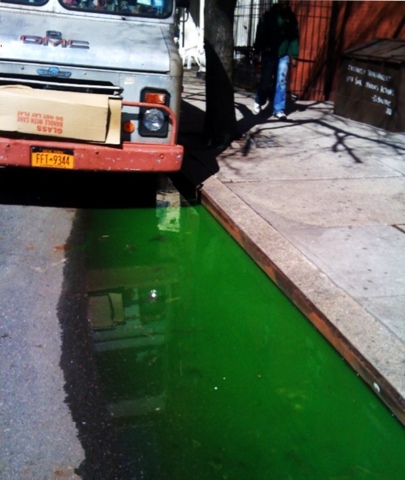
For the past 43 years, the Chicago River has turned green on March 17. So the residents of New York City’s East Village didn’t blink an eye when the water in the street near an Irish bar turned green this year as well. It seemed plausible to many of us that a leprechaun had been crying a river wondering why Irish Americans are more Irish than the Irish. (His eyes had not been smiling…)
“Is it a case of far away hills being greener?” he lamented with a keen.
You see, Dublin is quiet on St. Patrick’s Day, but American cities are anything but…
UPDATE: By the following morning, the green water had magically evaporated, proving we’d been right to give short shrift to the skeptic who insisted it was an antifreeze leak.
image: E. 10th St., NYC, by mlawanohara
If you enjoyed this post, we invite you to subscribe for email delivery of The Displaced Nation. That way, you won’t miss a single issue.
The two-year-old blogging relationship between UK-based American Mike Harling and US-based Brit Toni Summers Hargis has entered a sweet phase. Mike wrote on Pond Parleys the other day:
I was surprised, on our recent visit, at how sweet America was: the beer, the bread, the pretzels (sugar-coated pretzels—honest to God) and even, oddly enough, the candy. And if it wasn’t infused with sugar, it was too salty and/or covered in cinnamon. After nearly ten years in UK, I found it all a bit too cloying.
Toni agreed, throwing in a recipe for marshmallow fruit salad, while also defending British food against its reputation for being too bland.
Most commentators agreed that American food is too sweet but less because of sugar as of additives like high fructose corn syrup and trans fats. One US-based Brit opined:
The epitome of American sugary ‘candy’ … has to be the easter ‘peeps’ that my dear mother-in-law is guaranteed to give us and which will stay in the cupboard in all their food-colouring sugariness until I throw them out next year to make space for the more recent offering.
Another British expat to the U.S., however, noted that she can’t tolerate canned baked beans in either country because of their over-sweetness. She went on to say she’d developed a liking for America’s apple pretzels as well as cinnamon flavoring. “I may have to make apple crumble tomorrow,” she wrote.
If you enjoyed this post, we invite you to subscribe for email delivery of The Displaced Nation. That way, you won’t miss a single issue.
Not if it’s Japan, apparently. More and more foreigners are opting to leave in the wake of the nuclear radiation threat — even those who aren’t being relocated by their companies.
My message is don’t listen to the Japanese media, don’t listen to the Japanese Government because they’re trying to keep Japanese people calm, which I completely understand, but I don’t think that they’re giving the full truth. I think that by not telling people the complete truth, people aren’t able to make rational decisions, and the only rational decision at the moment is to get out.
If you enjoyed this post, we invite you to subscribe for email delivery of The Displaced Nation. That way, you won’t miss a single issue.
CLICK HERE TO REGISTER for THE DISPLACED DISPATCH. It’s delivered to your inbox and features:
* new works by expats or other international creatives;
* debate-worthy topics in the expat realm;
* surprising discoveries expats have made; &
* a couple of the latest Displaced Nation posts. SIGN UP NOW. (On temporary hiatus; next issue to appear in Spring 2018)
FOR, BY & ABOUT DISPLACED CREATIVES
We have interviewed many displaced creatives: memoirists, novelists, entrepreneurs & artists of various kinds. Check out the collection for possible soulmates!
About The Displaced Nation
The founders of The Displaced Nation share a passion for what we call the "displaced life" of global residency and travel—particularly when it leads to creative pursuits, be it writing, art, food, business or even humo(u)r.







 The Displaced Nation