The Displaced Nation

A home for international creatives

Pay no mind to the travel experts — beauty is in the eye of the beholder!

Matador Network published an article last month bemoaning “travel pornography” — in other words, the kinds of photos one often sees in polished travel guides, making an exotic place look so much better than it does in reality.

This is significant because many of us make our decisions about where or where not to go on the basis of travel Web sites, guidebooks and even Pinterest boards — with their slick photography and accompanying reviews.

As the Swiss-born British philosopher Alain de Botton noted in his book The Art of Travel:

Where guidebooks praised a site, they pressured a visitor to match their authoritative enthusiasm, and where they were silent, pleasure or interest seemed unwarranted.

Case-in-point: São Paulo vs Rio

In Brazil the travel experts have influenced and help perpetuate contrasting perceptions about the country’s two biggest cities: São Paulo (where I live with my Brazilian wife) and Rio de Janeiro.

In most instances you’ll read that Rio is the jewel in the nation’s metaphorical crown, the princess; whereas São Paulo is the ugly stepsister that is best avoided at all costs.

To be honest, when I moved to São Paulo just over a year ago, my own first impressions were not much different. It struck me as a place with ugly skylines, overwhelming traffic and polluted rivers. However, as time went by and I got to know the city better, those impressions changed.

And when I recently went traveling around Brazil with a visiting friend from London, I discovered something quite interesting — I was actually becoming as defensive of São Paulo as the natives.

The bad rap on SP

I started to notice this shift when my friend and I encountered other travelers. Anyone who has traveled recently will know that it’s common to meet all sorts. Typically, your first interactions — long before you decide to become best friends and end up downing shots of tequila in some godforsaken bar (even though you’ll probably never see each other again) — consist of small talk along the lines of:

“Where do you come from?”
“What do you do?”
“How long will you be in [insert city, town, country, etc]?”
“Which football team do you support?”
“Who the hell are Gillingham?”

On this trip, when the mundanities came my way, I had to explain why I resided in São Paulo rather than in London. Then I would get the inevitable “Why the hell are you there?” along with repeated denouncements of São Paulo and how it is a city of doom and gloom, a modern day Sodom and Gomorrah:

“I couldn’t live there” | “I don’t like the sound of living there” [delete phrase depending upon whether you’ve actually been to São Paulo].
“There’s too much/many…. [insert one of the following: traffic|pollution|cars|people].”
“It’s not a tourist city, there’s nothing to do or see.”
“It’s just a big, ugly city.”
“It’s too dangerous.”

There is, of course, an element of truth to most of these points. However, don’t these criticisms (apart from the lack of tourist sights) reflect the reality of 21st-century urban life the world over? I mean, isn’t the debate a matter of degrees?

I blame the travel pornography/travel guidebooks. Cities like São Paulo are constantly maligned because no one has taken the time to dig beneath the surface, or because they are not as immediately captivating as their outwardly attractive neighbors (namely, Rio).

Is beauty an illusion?

But whilst anyone can see that Rio is beautiful, it takes a keener to eye to observe beauty or virtue where it is embodied in less obvious forms. You need to become an explorer of the sort James Murray described in his post of yesterday.

Besides, as is the case of many places that are subject to so-called travel porn, Rio may not actually be as stunning as you first thought. It’s often said of that much-visited city that it is beautiful from afar but rather less so when you get up close.

Copacabana, for example, with its world-famous beach, may have once been the home of the glamorous, but today it’s tatty and parts of it, especially at night, are seedy and not massively safe.

And São Paulo?

Well, if Rio is beautiful from afar but less so up close, then I’d say SP is the opposite. As you approach Brazil’s largest city, its skyline advances towards and then engulfs you in its beige blandness, overwhelming and unending — an effect made more noticeable due to the city’s ban on outdoor advertising.

That said, once you get used to it, SP’s vastness actually becomes one of its marvels.

SP at its most splendid

When I moved here just over a year ago, I vividly remember my sister-in-law saying that living and working in São Paulo makes her feel like a “citizen of the world” — like a small part of something big and important.

What she said is true. Whilst I love venturing into the wild, I am more fascinated by cities — mainly because they are man-made and hence symbolize the complexity of the human condition (I’m a typical sociology graduate!).

Returning to our friend de Botton: he introduces the notion of the sublime in his book on travel, pointing out that certain landscapes can provoke sublime thoughts. Places, he says, can “gently move us to acknowledge limitations that we might otherwise encounter with anxiety or anger in the ordinary flow of events.” (He sees this as a kind of substitute for traditional religious worship.)

For most people, the sight of a desert, canyon or rainforest is enough to elevate them to the sublime, helping to put their daily woes into perspective. But for me it has taken an encounter with a mega-city like São Paulo.

And then there’s that street art!

Whenever I start feeling this way — that SP has put me in touch with something sublime — I begin to appreciate the beauty in the things around me. (I’d missed those things before because of feeling overwhelmed.)

For example, I became acutely aware of the quantity and quality of São Paulo’s street art, which I think must rank amongst the finest, if not the finest, anywhere in the world. You can find fascinating street art everywhere and if you exclude pichação (wall writings done in angry protest), then on the whole it enhances one’s enjoyment of the city’s neighborhoods.

In my view, the street art alone is a good enough reason to visit São Paulo.

But if street art doesn’t take your fancy, rest assured the city also offers plenty of good food, culture and entertainment. Indeed, I cannot think of a place I’ve been to in the continent with as wide a range of quality museums and art galleries.

At weekends you can go for a walk in Parque Ibiraquera (SP’s Central Park), watch a top South American football team, catch a film at an IMAX or, if culture is more your thing, go to a play, opera or ballet. And if you’re a music fan, you’re in luck. Artists who tour South America usually have São Paulo as one of the first dates on their itinerary.

The thing about São Paulo is that whilst it can be intimidating and is perennially frustrating, it’s also pretty cool. As displaced actress Marlene Dietrich once said:

Rio is a beauty — but São Paulo, ah … São Paulo is a city.

And for me, there’s something rather exciting, not to mention awe-inspiring, about that.

STAY TUNED for Tuesday’s post.

If you enjoyed this post, we invite you to register for The Displaced Dispatch, a round up of weekly posts from The Displaced Nation, with seasonal recipes, book giveaways and other extras. Register for The Displaced Dispatch by clicking here!

Related posts:


Is it cooler to be married to someone from another country? Yes, particularly if they’re Brazilian!

Is it cooler being married to someone from another country? In my experience, it’s often everyone else who seems to think so, although maybe that’s because I happen to be married to someone from a country whose people are perennially voted the coolest nationality on the planet.

Typically, as soon as I mention that I’m married to a Brazilian the almost universal reaction is:

“Cool! I’ve always wanted to go to Brazil!”

Such reactions inevitably tend to be informed by the idealized images most people have about Brazil and Brazilians:

  • Carnaval
  • Samba
  • Football
  • Exotic beaches frequented by beautiful people wearing minuscule pieces of beach attire.

Brazil is, of course, far more complex than this. It’s as equally well-known for its

  • Favelas
  • Drugs
  • Gang violence
  • And…errr…films about favelas, drugs and gang violence.

Naturally though, people tend to assume that I probably haven’t married a gun-wielding, drug-pusher from the favelas, and so it’s the cool, beach-loving Brazilians they tend to envisage whenever I mention my marital status.

So, in everyone else’s eyes at least, my story of marrying the Brazilian girl I met in Argentina is way cooler than that about the girl they met in their local boozer in London.

And to be fair, it is a pretty cool story.

Cool as in mind-expanding

Yes, the samba, the beaches and the football (especially the football!) make life exciting, but what’s even cooler is that marriage to a Brazilian woman has been a life-changer — in a good way. For instance:

1) My horizons have been broadened immeasurably.
I’ve learned to view things through the eyes of someone who’s experienced them within another country and culture. Thus, things you may have previously found exotic, unusual or irrational become familiar, normal and logical.

2) I now see “cultural differences” in a positive light.
True, cultural differences have the potential to make a relationship fractious. But in our case, these cultural differences help to fill in certain gaps that we’d always looked for in the people we’d dated.

As a self-conscious Brit (British stereotype No 1: tick), I find it appealing to have a naturally sociable and confident wife (Brazilian stereotype No 1: tick), who is able to take control of social situations in which I’d otherwise feel uncomfortable. Her effortless sociability is the perfect counterbalance to my stuttering inability to engage in anything other than mindless small talk with most strangers.

By the same token, she appears to have found it a pleasant surprise to encounter a man who was a little less “forward” than what she had been used to in Brazil.

That, and the fact that I was the only man she’d ever met who could cook, I imagine.

3) I also think that cultural differences are often overdone.
Despite the perceived and real differences between our countries and cultures, there are occasions when I realize that in many ways, my wife and I aren’t all that different. As a football geek, I’ve found my wife’s interest in watching football one of life’s great blessings (Brazilian stereotype No. 2: tick; British stereotype No. 2: tick). I’ve lost count of the number of times I’ve come home to find her watching a game on the telly.

Cool as in constant adventure

Another cool thing about marrying someone from another country is that life becomes more adventurous — at times rather literally. For example:

1) I’ve had the opportunity to learn and explore a culture and country with what effectively amounts to having a free tour guide.
And, let’s face it, where would you rather go when you have to go and visit the in-laws: Brazil or another boring town in England?

2) I’ve now embarked on the adventure of learning another language.
This is something I’d always wanted to do but was too lazy. Also, language schooling is pretty appalling in the UK — I can barely remember any of the French of German that I learnt all those years ago.

Whilst it’s still a work in progress, my Portuguese is now at least functional — and improving everyday.

3) I’ve been able to do something I always wanted to do, live abroad.
Indeed, my language learning has been significantly aided by our recent relocation from London to São Paulo. Would I have done this without my wife? Maybe not, because of circumstances and/or apprehension of moving countries on my own. For me, the option to live in Brazil was instantly made more manageable by my wife being from the country we moved to — my own personal relocation advisor if you will. As explained it my Random Nomad interview, it makes me feel a lot less displaced.

But, not always as cool as it sounds

However, despite how cool all this sounds it’s not to say that marrying someone from another country doesn’t come without its own particular challenges. Here are two that really stand out for me:

1) The early days weren’t easy.
Once we’d both returned home, following what was effectively a holiday romance, there was the little issue of us both living in different continents — a mere 6,000 miles apart.

And then, once we’d decided to give the whole (very) long-distance relationship a go, there was the feeling, similar to the one expressed by fellow Brit James Murray in his column last month, that the few weeks here and there we occasionally managed to spend together consisted mainly of getting re-acclimatized, rather than enjoying each other’s company.

And, of course, there were the usual issues that complicate long-distance relationships: loneliness, uncertainty, jealousy, lack of communication, etc. Fortunately, we had the Internet — a relationship like ours would have been unimaginable 15 years ago.

2) UK immigration laws — need I say more?
When my wife made the crunch decision to move to the UK, there was the added complication of the navigating a Kafka-esque immigration system that does its best to keep out anyone deemed to be from a “developing country.” Four years, various visa refusals, threats of deportation and thousands of pounds later, my wife was finally able to settle her status permanently in the UK.

Rather ironically, as soon as she received permanent status, we scarpered from the economic crisis in Europe to the relative calm in Brazil — where they’ve been far happier to accept me as a resident.

But hey! That’s pretty cool, too.

* * *

Readers, having witnessed Andy’s valentine to his Brazilian wife, what do you think? Are you in a cross-cultural relationship and if so, do you perceive similar benefits? Or are you more jaded than he is — suspecting that the challenges can outweigh the benefits once the “cool factor” wears off? Please leave your thoughts in the comments!

STAY TUNED for tomorrow’s post, when a Random Nomad with a finely-tuned sense of romance joins us!

If you enjoyed this post, we invite you to register for The Displaced Dispatch, a round up of weekly posts from The Displaced Nation, with seasonal recipes, book giveaways and other extras. Register for The Displaced Dispatch by clicking here!

Related posts:

5 movies for expats and world travelers looking to stir up romance this Valentine’s Day

Editor’s note: Today we are happy to welcome a new member to the Displaced Nation team, Andy Martin. His debut post introduces our two favorite February’s themes: Valentine’s Day (aka expat love) and displaced movies (in honor of Oscar season). For those who haven’t read Andy’s Random Nomad interview with us, it’s worth knowing that he’s a UK-qualified social worker who now lives in Brazil with his Brazilian wife, and a self-professed football geek.

One of the things I discovered when I moved to Brazil is that Valentine’s Day is not actually celebrated here until 12th June, where it is instead known as Dia dos Namorados (Boyfriend’s/Girlfriend’s Day). The reasoning for this is that 12th June is the eve of St. Anthony’s Day, the saint otherwise known as “the marriage saint.”

Additionally, what the rest of us know as Valentine’s Day (14th February) typically falls during or around the time of Carnaval, and anyone who knows anything about the excesses of Carnaval knows that a holiday to celebrate fidelity may probably be best left until later in the year — say, June time.

Anyhow, seeing as my wife has lived in the UK and now openly embraces British culture she’s suggested that it would only be proper to celebrate both the British and Brazilian holidays — she’s a clever one! And what more traditional way to celebrate than a trip to the cinema?

Bearing this in mind, I’ve made a list of 5 films that couples like us — multicultural, expat, glolo and/or nomadic — might like to watch this coming Valentine’s Day, to stir up the romance of travel that brought you together in the first place…

The one about adventure

IndianaJones_small1) Indiana Jones and the Raiders of the Lost Ark (1981), dir. Steven Spielberg
An action-adventure drama that pits Indiana Jones (played by Harrison Ford) against a group of Nazis who are searching for the Ark of the Covenant because Adolf Hitler believes it will make their army invincible.

Why I like it: The original Indiana Jones trilogy was released between 1981 and 1989, and despite the pointless release of Indiana Jones and the Kingdom of the Crystal Skull in 2008, it will forever remain, for my generation at least, what introduced us to the potential excitement of exploring the unknown.

Personal note: I love my in-laws but they neglected their parenting duties in one pretty big way: their failure to introduce my wife to Indiana Jones (a situation that has, thankfully, now been rectified).

Most stunning aspect: Let’s face it, any film that can make archaeology seem like the coolest profession in the world has got to be doing something right hasn’t it?

The ones with the romantic clichés

The traveler is often accused of being a romantic, an idealist and of someone who is running away from life and all the problems and commitments that go with it. The alternative argument is that the traveler is actually taking life by the scruff of the neck and living it to the full.

Either way, two films that best capture this dialectic are the two that often most lionized by today’s generation of travelers:
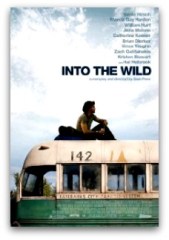
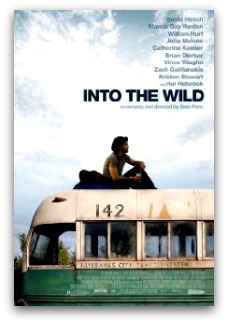
IntotheWild_small2) Into the Wild (2007), dir. Sean Penn
An adaptation (also by Penn) of the book of the same name, by Jon Krakauer, depicting the true story of Chris McCandless, a 24 year-old American and persistent wanderer whom believed that there was more to life than settling for the 9-5 grind in an office.

Why I like it: My wife introduced me to it (her riposte to my Indiana Jones exasperation). She had watched it early on in our relationship, when she was in Brazil and I was in London — a genuinely long distance relationship.

Personal note: She said that the film’s protagonist, Chris McCandless, reminded her of me — although fortunately our story has had a bit of a happier ending than his (I’ll say no more in order not to ruin it for you).

No half-measures: Boy did McCandless walk the walk, giving away his $24,000 college fund to charity before hitchhiking to Alaska and plunging into the wilderness, gradually seeking the means to remove himself from the “real world. ”

TheMotorcyleDiaries_small3) The Motorcycle Diaries (Spanish: Diarios de motocicleta) (2004), dir. Walter Salles
A biopic of Ernesto “Che” Guevara as a young man, representing an adaptation of Che’s memoir of the same name, recounting the trip he made around South America with his best friend, Alberto Granado.

Why I like it: Whatever you view of Che is, there is actually relatively little politics in the film, although one is introduced to some of the experiences that started to inform what he later became in life. Instead, for the most part, this is a film which perfectly captures what is to be young and curious of the world outside your own town or city. Che and Alberto chase beautiful landscapes and beautiful people, but also volunteer their time to those less fortunate than themselves.

Personal note: This film was the tipping point in inspiring me to travel around South America.

Memorable scene: There’s a great scene that highlights the dichotomy between the travel romanticized by “travelers” and that which is driven by the needs of most other migrants around the world — the topic of my guest post last month for The Displaced Nation. In it Che and Alberto meet an indigenous couple who have been forced from their lands and who are traveling in order to find work. When the couple ask Alberto and Che why they are traveling, they reply: “We travel just to travel.” Confused, the wife replies: “God bless you.”

The one about being displaced
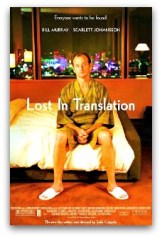
Lost_in_Translation_small4) Lost in Translation (2003), dir. Sofia Coppola
The story of the unlikely bond between an aging movie star, played by the awesome Bill Murray, and a trailing spouse (Scarlett Johansson), after they meet in the bar of their five star hotel in Tokyo.

Why I like it: Life as a nomad is not all about romantic adventures and life-changing experiences — there are also just as many challenges and struggles: homesickness, culture shock and loss being just some of them. Lost in Translation is, perhaps, one of the films that best explores some of these issues.

Additional benefits: The story is poignant, and the film is beautifully shot.

The one that’s not actually about travel or expats

Blood_into_Wine_small5) Blood Into Wine (2010), dirs. Ryan Page & Christopher Pomerenke
A documentary about the Northern Arizona wine industry focusing on the musician Maynard James Keenan and Eric Glomski and their winery, Caduceus Cellers.

Why I like it: This film doesn’t really have anything to do with either travel or expat life, but I’m including it here because it’s about one of my favorite artists: Maynard James Keenan. A slightly biased choice perhaps, but I think it deserves a merit for the way it encapsulates the spirit of those people who have dreams and then act upon them to make them happen — a spirit which, I think, drives many of us travelers and expats.

Maynard’s dream: Maynard dreams of starting a vineyard in Arizona. Yes, Arizona. Despite the doubts and concerns of the experts he consulted Maynard invested almost his entire fortune, made from working with the bands Tool and A Perfect Circle, to start a vineyard in Arizona — a state entirely unknown for growing wine.

Does he succeed? You’ll have to watch it, I guess… And don’t forget to invite a date!

* * *

Readers, what do you think of Andy’s suggestions? Are these the sorts of films that make you feel romantic, or do you think he’s bonkers? We’re open to any and all comments…as well as to further recommendations of films likely to bring out the romantic side in us glomads!

STAY TUNED for tomorrow’s post from our monthly columnist, James Murray, who right now can be found in front of his fireplace in Boston — and not because he’s in a romantic mood! Far from it…

If you enjoyed this post, we invite you to register for The Displaced Dispatch, a round up of weekly posts from The Displaced Nation, with seasonal recipes, book giveaways and other extras. Register for The Displaced Dispatch by clicking here!

Related posts: