The Displaced Nation

A home for international creatives

Tag Archives: What a Displaced World

Living La Dolce Vita with Heather Hamilton — Writer, Sailor & Adventurer

One year ago almost to the day, Heather Hamilton and her husband cast off their docklines in Annapolis, Maryland, in their 40-foot ketch. Since then, they’ve covered over 3,500 miles, up the east coast of the U.S. and down through the Caribbean island chain. Life on the open seas with nary a care in the world — sounds like La Dolce Vita, doesn’t it? I asked Hamilton to share the sensory highlights of her nautical adventures, along with a few “sweet life” tips for confirmed landlubbers.

Most heart-stopping sights

On the terrifyingly heart-stopping end of the spectrum: the sight of my mizzen-mast rocking back and forth (definitely something you don’t want) while the boat lurched in 12-foot seas and 45-knot winds. It nearly caused a heart attack. It was our first coastal offshore passage, and we were already sleep deprived and exhausted by the time the storm blew up overnight. We hove-to — that is, basically set the sails so that the boat could kind of “park” and wait out the blow. Pip was below, trying to get some rest, when I noticed that the mizzen sail just kept getting looser and looser, despite my many attempts to tighten it. Then I noticed the mast moving. PANIC!

Turns out, we had just had the rigging replaced, and during the big storm the new rig decided to undergo its initial stretching. The loosening of the stays had allowed the chocks to fall out of the mast’s base.

Despite the howling wind and lurching seas, Pip was able to tighten the rig and replace the chocks — only to discover that the pounding into the waves had splintered the bowsprit platform. After hours of work, we had finally secured the boat. We collapsed in a heap for some rest.

On the heart-stoppingly beautiful side of the spectrum: the hundreds of dolphins that danced around us on our trip down the Chesapeake Bay from Annapolis to Norfolk, Virginia. Despite having spent my childhood sailing with my dad in California and having sailed for five years on the Chesapeake, I’d never seen dolphins in the wild. On this particular day, I saw more than I’ve ever seen since: the pod stretched literally further than the eye could see. We radioed a sailing buddy who was two miles ahead of us and he was also surrounded. They played in our bow wave and did acrobatic flips around the boat — but the most astounding thing was their sheer numbers. Hundreds is probably an understatement; there may well have been a thousand dolphins frolicking around us. It was magic.

Most intoxicating scent

Ganja. It’s ever-present in many of the Caribbean islands, and its characteristic skunky smell is nothing if not intoxicating. Local youths and gnarled old rastas alike lounge around the town square smoking their joints; in certain places you get the impression that half the population is stoned. Boat vendors — the men who approach your boat in an anchorage to help you anchor, sell you fish/fruit/veggies, do your laundry, or otherwise do just about anything you will pay them for (uh, no thanks…) — seem particularly fond of weed, often puffing away as they row their boats along.

As we entered a bay in St. Vincent, one particularly ill-mannered vendor shouted at me for declining his services. He sported a spliff literally the size of a stogie, leading Pip to dub him “Stoner Churchill.” His aggression was surprising. Given the amount of weed he’d clearly ingested, one would have expected a much mellower response!

Dreamiest sounds

When I was at home, I had a fancy-schmancy alarm clock that allowed you to fall asleep or awaken to different sounds, like a Zen bell or running water. My two favorites to listen to while falling asleep were the ocean waves and the frogs. Who doesn’t love to fall asleep to the sound of surf? And the sound of the frogs reminded me of the few weeks every spring when the spring peepers went wild in the remote Appalachian area where I grew up.

One night, when we were moored in the national park in St. John, U.S. Virgin Islands, I fell asleep in the cockpit to these two sounds playing in harmony: the real surf gently breaking on the rocks only a hundred yards from the boat, and the nighttime frogs’ chorus providing the treble counterpoint. Heaven.

Most delicate flavors

Tree-ripened mango in Dominica — actually, the taste itself is nowhere near delicate, but I enjoyed the subtle distinctions between the different kinds of mango the island has. We arrived in Dominica in mid-April, just as these tropical fruits were coming into season. Everywhere you looked, sticky children and adults were peeling mangoes and gnawing the flesh off the seed as they walked down the street, chilled on their porches, or waited for the bus. Mangoes rolled in the gutters, where they became treats for street dogs and chickens. Since mango trees are everywhere, it’s simple to pick up a long stick and knock down a few ripe ones anytime you get the craving.

One day, we hiked several miles to the top of a hill where we were greeted by the sight of a stunningly beautiful little farm nestled in the jungle. There were coconut palms, banana trees, taro and sweet potato plants cascading down the steep hills. The farm’s owner, Ti-Babe, was a gnarled old man with approximately six remaining teeth and the warmest smile and eyes you can imagine. Ti-Babe answered all of our questions about his farm before insisting that he load us up with mangoes, peeling open both the large and small mangoes he grew so that we could taste the difference between the two. (The smaller mango had an amazing flavor, with a little sour to balance the sickly sweetness characteristic of a really ripe mango, but was very fibrous.) We sucked on mangoes the whole way back, arriving back at the boat exhausted, sticky and sated.


Softest physical sensations

The feel of the current across my skin while floating along snorkeling in perfectly clear turquoise waters, bright tropical fish flitting underneath in the dappled sunlight. (Pretty much every other physical sensation on a cruising sailboat is intense, painful, or just uncomfortable!)

Most interesting unexpected encounter with a stranger

The other day, I talked the owner of a local beach bar in Bequia, the largest island in the Grenadines, into allowing me to write an article about how she makes her roti, which are a flat bread wrapped around curried fillings, a kind of West Indian burrito. I’d heard that her roti were excellent, but was most intrigued as other sailors had cautioned me that she took a long time to make them — mixing and rolling out the tortilla-like dough for each order rather than making several in a batch. We’d chatted with Ruthie briefly at the bar the day before, when her eight-year old son proudly served us our beers. Her wicked sense of humor promised a fun afternoon in the kitchen.

Ruthie chopped ingredients for the fillings and then walked me through the labor-intensive process of creating the dough, which involves folding cooked, mashed yellow split peas into a flour dough and then rolling it out carefully. While the dough rested, she demonstrated how to make the fillings — both the vegetarian (black-eyed pea/pumpkin) and fish kind, both of which are strongly flavored with Trinidadian curry powder, which is milder and sweeter than the spices used for Indian curries in the States.

As Pip and I tucked into the final, delicious product, we invited Ruthie to sit with us and chat — and that’s when the real fun started. She regaled us with stories of island life, including a side-splitting story about a gay dog she once had. We talked about life and politics and travel, laughing the afternoon away over beers and her delicious food. It was the first serious conversation I’ve had with a local that lasted more than ten minutes, and I know that when we return to Bequia in the future, I’ll seek out Ruthie right away to catch up and continue building our friendship.

The place that stimulates all five senses

Because my life is constant travel, my boat is that place. Living on a voyaging sailboat means that your senses are constantly being stimulated — and not always in pleasant ways. You are stimulated for instance by the smell of a full holding tank, the sight of an approaching squall, the sound of a storm howling in the rigging, the sensation of a rough anchorage that makes you seasick in your own home, and the bitter, dry taste of fear. On the other hand, taking your home with you opens amazing possibilities: staying in one place for long enough to really get to know it; taking days off to do nothing, knowing that another hike or snorkel or town will be there the next day to explore; meeting not just locals but adventurers who have sailed from all over the world; and — most importantly — going to sleep every night in a bed of your very own, cats cuddled at your side. A sailor’s life is bittersweet.

Favorite artist with a sense of dolce vita

In the British Virgin Islands, I was entranced by the art of a man named Aragorn, who had started an artists’ cooperative, complete with pottery studio and organic garden, in the town of Trellis Bay. Every month, Aragorn’s Studio hosts a full moon party, a traditional Caribbean jump-up held on the beach. Trellis Bay’s party is legendary because of Aragorn’s art. Known for his sculpture, Aragorn recently started creating large outdoor fire sculptures: steel spheres, pyramids or cubes that come to life with fire. He hand cuts elaborate silhouetted shapes into the steel to tell a story. On full-moon night, he mounts these sculptures in the sea just beyond the shoreline, fuels them with firewood and sets them ablaze. The roaring fire within the sculptures, each of which is the height of a man, makes the almost prehistoric-style figures seem to dance in the darkness, evoking the earliest cave paintings. All of the elements — water, earth, wind, fire — combine to evoke a kind of primal beauty.

Favorite travel quote

“Every great and commanding moment is the product of some enthusiasm.”

— Ralph Waldo Emerson

I truly believe that without enthusiasm, life risks not only being terribly boring, but meaningless as well. Great things do not generally occur because one stumbles into them, but instead are the product of passion. Travel, with its many discomforts and trials, requires that one persevere with enthusiasm and passion. If you manage to do that, you’ll be rewarded accordingly — with great and commanding moments.

Advice for living la dolce vita under more mundane circumstances

The very same thing that makes travel great — but takes the most work — is something you can do at home: seek out new experiences and take the time to talk with people you meet while having them. I spent 15 years in Washington, DC, and while I hit the art museums more than some people would, I certainly didn’t begin to plumb the depths of experiences I could have had in that city. I wish I had taken the time to attend a service at the African-Methodist-Episcopalian church around the corner, whose rockin’ gospel shook the neighborhood windows every Sunday morning. I didn’t take any funky, historical tours or visit the off-the-beaten-path attractions. Most importantly, I didn’t take as much time to talk to people about their lives as I would have liked. When I travel, I’m good at asking questions and drawing people out; at home, I was in such a hurry to get things done that I didn’t take the time to ask the quirky characters omnipresent in any city about their lives. Travel is definitely a state of mind, a way of becoming an observer rather than a doer. Take a day now and then to become a traveler in your home town; it’s amazing what stories people have to tell.

A self-described “overachieving save-the-worlder” who used to run an international affairs advocacy group in Washington, D.C., Heather Hamilton is enjoying her newest incarnation as a writer, sailor and adventurer in the company of her husband, Pip Fryers. (Fryers has been sailing since he was a wee laddie in the Lake District of northern England.) You can learn more about this adventuresome pair and see where their boat is right now on their Picaroon Blog.

STAY TUNED for tomorrow’s post, another expat book review, by Kate Allison.

If you enjoyed this post, we invite you to register for The Displaced Dispatch, a round up of weekly posts from The Displaced Nation, with seasonal recipes, book giveaways and other extras. Register for The Displaced Dispatch by clicking here!

Related posts:
Staring at the sun — and 3 little “nothing” moments in my displaced life

Yesterday in San Francisco, at the corner of Folsom and 8th, I saw a middle-aged man holding up a sheet of dark glass and staring at the sun through it. “It’s beautiful,” he said to me as I passed him on the sidewalk, “so beautiful.”

I smiled in reply to him, secretly wary that he just another cracked, panhandling prophet in a city full of them.

“Do you want to look at the sun through it?” he asked, indicating his sheet of glass. I looked at him confused. “It’s welder’s glass,” he said by way of explanation.

Yes, he must be mad, I thought, and just before I was about to smile a “no, thank you,” and carry on walking, albeit at a hurried pace, he held the glass up at me, and through it, like some wonderful magic trick, the sun appeared as dark disc apart from a brilliant cresent of light at the bottom. That there was a partial solar eclipse had completely passed me by. I hadn’t been able to see the effect with the naked eye, the sun looked larger, a little hazier, but nothing out of the ordinary and it would have passed me by, but here on this particularly street corner was this happy, smiling man performing what at first seemed like a magic trick, and making sure that a small moment of joy wouldn’t pass me. So I took hold of this stranger’s sheet of glass and looked straight at the sun through it, and he was right — it was so beautiful.

This week, The Displaced Nation asked if I could write about three chance encounters experienced in my adopted homeland that I found moving or bittersweet. Moments like I experienced yesterday on Folsom and 8th.

This ties in with an idea that has long interested me, and inspires my personal blog, Culturally Discombobulated — it’s what I think of as little moments of nothing*. Moments that on the surface may seem mundane, or insignificant, but that move you or are the catalyst for deeper thoughts. My own little dipped madeleines.

As this is something I do at times on my personal blog, I am going to reproduce here three little moments of nothing that I have already been posted over there.

—————————————————————————————————————————————————-

1) A rock and a hard place

A garage forecourt in Kingman, Arizona is not the sort of place you expect to visit on a sightseeing tour. But a sightseeing tour is precisely what I am on, and a garage forecourt in Kingman, Arizona, is precisely where I find myself. In fact, this is the second time today I’ve found myself on this same depressing patch of asphalt.

To be fair, I should clarify that I have been on a bus tour of the Grand Canyon and now, late in the day, we are making our way back to Nevada. We’re certainly not stopping in Kingman for reasons of historical interest. We are not here to learn that it was in Kingman that Clark Gable and Carole Lombard were married. Gable driving the two of them all the way here from Hollywood in his cream-colored roadster during a break in the filming of Gone with the Wind. In the town they purchased a marriage license from a dumb struck clerk named Viola Olsen before being married by the nearest Methodist Minister they could find. We are not here to learn about the town’s connection with Route 66. We are not here to learn that it was in Kingman that Timothy McVeigh renounced his US citizenship, turned his home into a bunker and began making homemade bombs.

No, this is a purely pragmatic stop; a convenient place on the I40 to stretch the legs, grab a bite to eat, and empty the bladder. In the morning on our way out to the Canyon we stopped here. I bought a ham sandwich at a Chevron garage as I couldn’t stomach the thought of my other option — McDonald’s — that early. The women working in the garage were pleasant, hefty, corn-fed girls. All three had the same hairstyle, an architectural triumph of ringlets and hairspray piled high atop their heads, it looked like it belonged in a 1987 High School Prom. Once back outside on the forecourt a number of men tried to pan-handle me. There was, I thought, something off about the place. By its very nature, you expect a stop like this to be full of folks on the move, but instead there was an unsettling stillness. A number of the people gave off the impression that they’ve been standing around in this same forecourt all their adulthood. It could be that some of the sketchier elements in the town have a rough idea of what the sightseeing bus’s itinerary is — and they come especially and try and get some change out of the tourists.

And now after a long day, we’re back. A bus load of predominantly foreign tourists, here to pay a brief visit like some cut-price UN delegation: Japanese, Thai, Italian, Canadian, French, Australian and British make up our contingent. Some of us are loud and overbearing, and some of us think that everything needs to be documented by our cameras, and some of us have spent all day complaining, and some of us have spent all day gushing in delight, and some of us — if the snoring has been anything to go by — have spent all day asleep, and we are all thoroughly sick of the sight of each other.

Thanks to the evening breeze, the forecourt smells even more strongly of gasoline, pitch and fried grease than it did earlier. Off we all trot, against my better judgment, to the McDonald’s. Every night it’s a different cast, but it’s always the same show that the locals get to enjoy when the sightseeing tour stops here: a tired group of hungry tourists that mewl and bark and garble in their strange tongues and accents. We soon take over and overwhelm the McDonald’s; we create long lines for the toilets, even longer lines for the food along with a white noise of strongly accented English and misunderstood orders.

It’s all too much for one Arizonian. I think it’s one of the men that pan-handled me early in the day. He has a similar looking beard, the same sun-blistered complexion, and the same jittery demeanor.  He is angry with the Frenchman queuing behind him for what he perceives as an invasion of his personal space, and he is getting irate with how long it is taking the Turkish family in front of him to order, but their English is poor and they and the cashier are struggling to make themselves understood. When he finally gets to place his order and is waiting for his chicken McNuggets, he scans carefully all of the other people waiting in line, and scowls at these interlopers with their ridiculous anoraks and backpacks. He takes his McNuggets and barges his way out through the line, needlessly aggressive. As he passes, he elbows me. “F***in’ furriners,” he mutters.

——————————————————————————————————————————————

2) “In my father’s house.”

The shoes of the man sat opposite me on the “E” train are made from black leather, long since scuffed to grey. They are on the whole unexceptional, but for a large fleur-de-lis that has been embossed below the lacing. Their one time appropriateness for special occasions has been worn away.

On the subway and on the underground I often find myself staring intently at the shoes of my fellow passengers. It is not from a fetish, it is just that I keep my eyes on the floor, avoiding eye contact with those around me, or I keep my eyes on the page of a book I am reading. A few minutes before, when we pulled into a station, I stopped reading, put my book on my lap, and cast my eyes to the floor. Occasionally a glance is stolen, such as the one I make at the man wearing the fleur-de-lis shoes. He is a thin, middle-aged black man wearing a blue suit that like his shoes is faded by wear.  He sings “In my father’s house.” Well, he sort of sings “In my father’s house.” It is not the whole hymn that he regales the train with, it is just that one phrase — half-sung, half-shouted every thirty seconds or so. Looking up I see that most of the other passengers have their eyes to the ground, particularly when he sing/shouts “In my father’s house,” though every time he does that he looks around. I don’t feel he looks around for a reaction, but for recognition. Perhaps feeling that things have descended again into commuter quietness, he again sing/shouts “In my father’s house.” I put my eyes to the floor and look at the fleur-de-lis pattern.

Queens Plaza is his stop. As he leaves the train, he notices the book in my lap — God: A Biography, by Jack Miles. He seems happy with my reading material and looking at me, he sings/shouts “In my father’s house” as if I’m the only of his “E” train flock that understands the importance and virtue of his ministry. Then he leaves the train before I have time to explain that reading a book called God does not make me virtuous as he might think it does, and that the book is a critical look at the Old Testament. It considers God a literary character and so casts him in the light of literary theory. Not that I would have said that if I had the time.

————————————————————————————————————————————————–

3) Angels and iced tea

In this almost empty coffee shop three elderly women, lifelong friends perhaps, crowd round a table and converse over iced tea. They talk at length about their new pastor, about his energy and his youthfulness. They talk at length about angels, about their unwavering belief in them and their experiences of them. The loudest of the women, her hair an unconvincing shade of red, starts to talk about her youngest granddaughter — about how she’s as sharp as a tack, but hasn’t she started asking the trickiest of questions. The red-haired woman confides to her two companions that she has spoken with their youthful and energetic pastor about how to respond to these questions.

For instance, she tells the other two, only the other day the granddaughter had said, “Grandma, why do we have to go to Church?”

She was, she freely admits, flummoxed by how to answer, but then she remembered the pastor’s words. “Aw, sweetie, that’s a matter of faith.”

Yesterday, she continues, when she was driving her granddaughter home from school the girl had asked, “Grandma, why do we call trees trees?”

She once again patiently said to her granddaughter, “Aw, sweetie, that’s a matter of faith.”

In the almost empty coffee shop the three women gently laugh at the ridiculous things that children say, take a sip of iced tea, and start talking about angels again.

*The film director Max Ophüls once wrote about art: “Details, details, details! The most insignificant, the most unobtrusive among them are often the most evocative, characteristic and even decisive. Exact details, an artful little nothing, make art.” Most of my life I seem to spend in search of moments of little nothings that I end up attaching great importance to. It probably makes me a nightmare to deal with it as a friend or companion.

STAY TUNED for tomorrow’s post, an account of la dolce vita from a fresh perspective!

If you enjoyed this post, we invite you to register for The Displaced Dispatch, a round up of weekly posts from The Displaced Nation, with seasonal recipes, book giveaways and other extras. Register for The Displaced Dispatch by clicking here!

Related posts:
THE DISPLACED Q: What’s the most intoxicating scent you’ve encountered on your travels?

It’s Friday here at the Displaced Nation — La Dolce Vita time!

For the past couple of weeks, I’ve been doing a series of posts in aid of living the sweet life — even if you’re feeling displaced! The key, of course, lies in cultivating an approach to travel involving the five senses.

We began with the eyes and the ears, and we’re now moving on to the nose. Have you ever had the experience of catching a whiff of something and instantly being transported back to a specific moment in time — to a memory so sharp and clear you can picture it exactly? And then it’s gone, almost as quickly, as the smell wafts away and your other senses take over again, feeding the real world back into the loop…

Smell is the oldest sense, it touches the most emotional part of the brain.

– Roja Dove, the world’s sole Professeur de Parfums

Smell, like taste, is tied very closely to memory. Actually smell and taste are almost the same sense, but we won’t get into that right now — largely because we’d be talking about how in order to smell something, you have to get tiny particles of it up your nose. And that particular conversation rarely ends well…

Because smells create such strong associations with individual memories, your ideas and my ideas of an intoxicating smell are probably rather different.

Ah, the smell of…Thai petrol?!

For example, everyone loves the smell of freshly mown grass; but how many of you like the smell of petrol (gasoline, for those of you across the pond)?

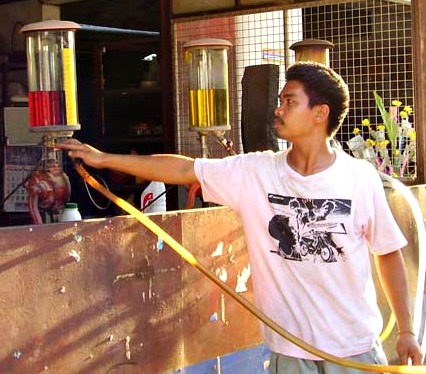
I love it. I associate it with long, busy days in Thailand, running errands for the animal clinic where I was volunteering, driving around looking for stray dogs in need of vaccinating — on my tiny little Yamaha motor scooter.

I could always smell the petrol when filling up the scooter tank — because most of the gas stations had only one barrel of the stuff, with a hand-pump and a rubber hose just long enough to reach your tank.

So that smell always brings back happy memories…even though it’s not widely considered a delicate fragrance!

The most noxious of odors — bread?!

Here’s another odd one. I’ll say it slow, in case anyone is likely to faint from pure, unadulterated, lust: Freshly. Baked. Bread.

Mmmmmm! Right?

Wrong. For me, anyway! To afford my trip to Thailand (and Fiji), I had a job working shifts in a bread factory in Australia, where that gorgeous smell permeated the whole building 24 hours a day. Perhaps because I was the only guy, and therefore resilient (or expendable?), I got to be in charge of the enormous, stainless-steel walk-in ovens. I put the bread trolleys in and, twenty minutes later, took them out again. It’s a process that has to be done quickly, or else the oven loses too much heat — but the trolleys themselves get rather warm in the process, and of the four of them, two had broken wheels.

You know how hard it is to steer a supermarket shopping trolley with a jammed wheel, right? Now imagine trying to do it fast — very fast — with a trolley approaching 200 degrees Celsius…and for 12 hours straight. Even my burns had burns.

I survived a whole two weeks in that job, and then as soon as my paycheck hit the bank, I fled straight to Bali to spend it!

To this day I can’t smell baking bread without thinking that pain — the kind that accompanies searing, scorching flesh — is about to follow…

Another smell to avoid: live jaguar!

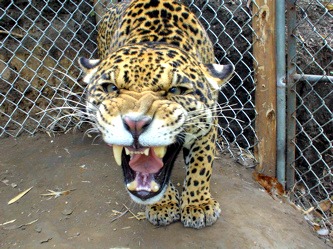
Now I’ll tell you something you don’t ever want to smell: anywhere a jaguar is living! When a jaguar is confined in, say, a remote mountain-top rescue centre in Ecuador (such as the one I worked in and on which my book is based), you have to clean the enclosure out pretty regularly. Now what goes into a jaguar — especially when you’re doing this on behalf of a nonprofit that’s operating on a shoe-string budget — isn’t particularly wholesome.

To begin with, the jaguar’s body odor isn’t noted for its appeal, unless perhaps you’re another jaguar. And of course they scent-mark everything.

But what comes out of them? Bearing in mind they are pure carnivores, living exclusively (in captivity) on carrion. It’s not…I mean, it’s just…. Look. Just don’t ever go there. Trust me on this!

And now for some winners!

Okay, back to the good. Toward the top of my list of intoxicating smells is that of the traditional Australian Sausage Sizzle. Usually held as a fund-raiser for some charity or other, they never fail to rake in the dough because the smell — of frying meat and frying onions — is utterly delicious, utterly irresistible, and carries for miles.

Now that I’m living as an expat in Perth, I get to experience this smell on a regular basis, as there’s a Sausage Sizzle held directly opposite the entrance to my gym every Saturday morning.

The moment I finish my hard-core workout, I come outside and walk full-tilt into that heavenly smell…at just the point when my body is starting to crave sustenance.

It’s almost as though those cooks are waging a personal crusade against my willpower. And my waistline.

And you know what? They win every bloomin’ time.

But my absolute favorite? I’ve got to tell you mine, right? Then you can tell me yours… It’s food again (of course!): the aroma of fresh donuts!

This dense, cakey scent takes me right back to one small stand in Morecambe Bay, in the north of England, where I went on holiday as a child. Yes, to one of my very earliest trips with my parents. I loved that I could get three donuts for £1! And, if I ate them quickly enough, I could pretend as thought I’d never had them, and convince my parents to give me another pound to buy three more! Ah, happy days indeed.

So there you have it. Now it’s your turn to describe the most delicious smells you’ve encountered on your travels — meadows, Himalayan incense, sunlight on rainbows…? Tell us in the comments! And if you happen to have a photo to illustrate this intoxicating scent, send it to me at tony@thedisplacednation.com. Yes, I may make that “la dolce vita” slideshow I’ve been promising before too long…

STAY TUNED for Monday’s post, when expat Anthony Windram recalls some chance encounters with “locals” that have enhanced his sense of the bittersweetness of life in his adopted home.

If you enjoyed this post, we invite you to register for The Displaced Dispatch, a round up of weekly posts from The Displaced Nation, with seasonal recipes, book giveaways and other extras. Register for The Displaced Dispatch by clicking here!

Related posts:
Images: photos of the gas pump and the jaguar are from Tony James Slater’s personal collection.

BOOK REVIEW: “Chique Secrets of Dolce Amore” by Barbara Conelli

TITLE: Chique Secrets of Dolce Amore
AUTHOR: Barbara Conelli
AUTHOR’S CYBER COORDINATES:
Website: www.barbaraconelli.com
Twitter: @BarbaraConelli
Facebook: www.facebook.com/AuthorBarbaraConelli
PUBLICATION DATE: May 2012
FORMAT: Ebook (Kindle) and Paperback, available from Amazon
GENRE: Travel
SOURCE: Review copy from author

Author Bio:

Born in London to an Austrian mother and an Italian father, Barb now splits her time between Milan and New York. Her first book, Chique Secrets of Dolce Vita, was published in 2011. She is the host of  Chique Show at Blog Talk Radio, where she interviews authors and talks about life in and her passion for Italy.

Summary:

Fascinating, enthralling and seductive travel and life tales about unexpected encounters with the capricious, unpredictable and extravagant city of Milan, its glamorous feminine secrets, the everyday magic of its dreamy streets, the passionate romance of its elegant hideaways, and the sweet Italian art of delightfully falling in love with your life wherever you go.

(Amazon product description)

Review:

In their instructions for describing someone’s appearance, “How To Write” gurus advise you not to reel off physical characteristics in a shopping list. Don’t write “blond hair, brown eyes, even teeth”, they say, but focus on a couple of arresting features: stripy but chipped nail polish, or a wrist laden with silver bangles.

By describing in detail only personal, quirky aspects of the whole, these teachers rightly insist, you create a vivid picture for your readers.

This is exactly how Barb Conelli brings to life the Milan she knows and loves.

Instead of reciting a shopping list of Places You Must See, which you could find in any guide to Milan, Conelli figuratively takes you by the hand and says, “Forget the official tour. Let me show you my Milan, the people and places I love.”

On this off-the-beaten-track tour of Milan’s streets, we visit The Paradise of Pink Feathers: the garden in Via die Cappuccini number nine, with its many flamingos, whose owner’s identity nobody really knows. We eat panettone at Marchesi’s, while Conelli relates the fascinating legends behind the pastry’s origin. (Tip: you should first try it on 3rd February, because on this day panettone has magic powers. Who knew?) On one day, she brings you along to visit the studio of an artist friend; on another, we go to the ballet school of Annamaria Bruno and her daughter Liliana to live out our dreams and become ballerinas in point shoes for a day. We meet the ghost of Mrs. Giuseppina Luini, an enterprising baker from Puglia who came to Milan in 1949, and turned the family recipe of Panzerotti into a Milanese legend.

Milan’s beauty, Conelli says, does not just lie in its breathtaking architecture, but in its inhabitants, past and present.

To me, the city is not an inanimate cluster of buildings and their architectural elements; the city is a living organism boiling with energy, its features are being recreated every day by the people who walk its streets.

It’s a city full of secret corners and quiet clusters of serenity; of shadows of people long dead, and the vibrance of those living today.

In taking a walk with Barbara, we discover the magic that is Milan.

Words of wisdom:

In order to see the world, you must know how to look at it.

~

When the streets of Milan ask you to dance, there’s nothing else to do but put on your ballet shoes and surrender with confidence to the arms of the city.

~

As an Italian, [my father] had rich experience with diabolic temptation and enjoyed surrendering to it very often and with great delight.

~

Despite its fickleness, vanity, unpredictability, and fancy for sophisticated elegance, Milan is an immensely simple city whose inhabitants know that real joy means seeing miraculous moments in everyday ordinariness.

Verdict:

At 76 pages, this book is a short but very satisfying read. If you have not been to Milan, it will make you want to visit; if you’re not a newcomer to the city, you will want to rediscover it.

Chique Secrets of Dolce Amore can be purchased here.

Or you can register for The Displaced Dispatch and hope you’ll be one of this month’s lucky winners!

Editor’s note: Kate Allison interviewed Barbara Conelli in March: “An Italian with a passion: How to live the Dolce Vita, with Barbara Conelli,” which is what inspired this month’s Displaced Nation theme of La Dolce Vita.

STAY TUNED for Wednesday’s Random Nomad interview with mid-life gap year expert, Jeff Jung.

If you enjoyed this post, we invite you to register for The Displaced Dispatch, a round up of weekly posts from The Displaced Nation, with seasonal recipes, book giveaways and other extras. Register for The Displaced Dispatch by clicking here!

Image:  Book cover – “Chique Secrets of Dolce Amore”

Related posts:

Kidding yourself over La Dolce Vita

As you are doubtless aware, this month’s theme is la dolce vita, an Italian phrase meaning the sweet life. It would be remiss of us to choose that theme without referring to Fellini’s 1960 masterpiece of the same name.

Regular readers of The Displaced Nation may not be surprised to learn that I was a somewhat pretentious teenager. A thin youth, callow and pallid, I could be found most nights ensconced in my bedroom reading the novels of Thomas Hardy or writing in a notebook my own cringe-worthy poetry. However, I would sometimes, late at night, usually on a Friday, descend from my literary lair and head down to the living room where I would turn the TV to BBC2 or Channel 4 to watch some classic foreign film that I felt I ought to know about.

Though my teenage years aren’t that far behind me (the late 90s, if you must know) they exist in another epoch, a time of old media, where nobody normal blogged, where there was no twitter and there was most definitely no streaming online of every movie you could ever wish to watch. Instead my cultural endevours were rationed. The northern town that I grew up in had no bookstore (unless we rather generously classify W.H. Smith as a bookstore) or cinema, so I found myself spending a lot of my time in my local library or scanning the Radio Times to see what (if any) interesting examples of world cinema where being shown on either of the two niche channels (BBC2 and C4). Invariably, something was being shown late most Friday nights. It was in these circumstances that I first came across Fellini’s La Dolce Vita.

I can’t in all honesty say that I “got it” when watching it for the first time that night, but on a superficial level, I loved it. More particularly, I loved the effortlessly cool, brooding Marcello Mastroianni who anchors the film. This, I reasoned, was how manhood should be, how I should live my life: apertifs in the cafes, dances at the Cha-Cha-Cha Club, a midnight wade into the Trevi Fountain with an Anita Ekberg figure, two lonely souls enjoying a fleeing moment of warmth.

So I pondered about how one goes about affecting a similar style to Mr Mastroianni. The problems quickly became apparent. My clothes came from Marks and Spencer’s men’s department and gave me more the appearance of a Mormon missionary than Italian heartthrob. Then there was the impossibility of finding in Hartlepool a Cha-Cha-Cha Club that played the music of Nino Rota — now, the Bikini Fun Bar played 2Unlimited, but between you and me that wasn’t quite the same. Most disappointingly, I had no Anita Ekberg; none of the girls in school would take up my invitation to wade with me in the duck pond in Ward Jackson Park.  So the attempt to give my teenage years a Fellini spin were dashed. I couldn’t recreate the Rome of 1960 as seen through Fellini’s lens in the Hartlepool of 1998 (hardly a surprise).

But if I stopped pretending to act like I’d stepped out of a Fellini film, still I think this might have been when I was unknowingly inoculated with wanderlust — and the thought that somewhere out there is a place where cafes serve apertifs, not sausage rolls, where the club plays Nino Rota, not 2Unlimited, and where Anita Ekberg is waiting. That’s the sweet life.

STAY TUNED for tomorrow’s post, Kate Allison’s review of Chique Secrets of Dolce Amore, by Barbara Conelli — the book that inspired this month’s theme!

If you enjoyed this post, we invite you to register for The Displaced Dispatch, a round up of weekly posts from The Displaced Nation, with seasonal recipes, book giveaways and other extras. Register for The Displaced Dispatch by clicking here!

Related posts:

THE DISPLACED Q: What’s the most delightful sound you’ve heard on your travels?

Have you ever just stopped and listened — really listened, I mean? Yes, of course you have! Because you’re Displaced Nation readers, which automatically means you’re closely in touch with all five senses. After all, that’s what travel is all about!

But just in case those ears of yours have been missing some vital input — of the kind that would help you to appreciate life’s sweetness — let’s do an exercise in aural comprehension and memory.

Yes, it’s time to pay some attention to those great big flappy things on the sides of your head — you know, the ones that help cartoon elephants to fly? Yes, friends (Romans and countrymen), I’m asking you to lend me your ears. Don’t worry — I’ll give them back. And, by the time I do, you will understand why there’s a photo of wet grapes on this page!

Today, in the service of living a fuller Dolce Vita, our question is: What is the dreamiest, most beautiful sound you’ve heard in the course of your travels?

Beauty in serendipity

Now, because La Dolce Vita is all about finding beauty in unexpected things, I won’t wax lyrical about waves lapping on foreign shores, morning birdsong in uninhabited fields, or other somewhat clichéd ideas of a “dreamy sounds.”

True, it was incredibly sweet to hear my girlfriend say “yes” when I asked her to marry me; I’m sure the same is true for everyone who’s been through this stage in their life. In fact, I hardly heard her at all because she was crying so much. (I was crying too as it happens, but that was because I was kneeling in an ants’ nest at the time and Australian ants really hurt when they bite! Damn them!)

Now, I’m the sort of person who takes great delight in discovering life’s hidden treasures in the moments you’d least expect them. And I take even greater delight in pointing them out to everyone else, which apparently is one of the most annoying qualities a person can have. Especially if you’re having a bad day.

So, what’s the most delightful sound you’ve heard recently? Is it some gentle-voiced stranger, mentioning how bright and sunny the day is, even though the train is making you horribly late for work? Or is it the sound of someone telling that well-spring of positivity to shut the f@&8 up and p*$$ off?!

I apologize in advance for being that guy. I should try to keep my happy-happy joy-joy observations to myself more often!

But in terms of the most wondrous sounds I have come across, I’ve decided not to opt for the obvious — the soft harp music at my wedding in England; the sound my footstep makes in deep, fresh snow at 10,000 feet; or the poignant jingling of a Spanish music box, dearly remembered from my childhood, which I inherited from my granddad when he passed last month.

Instead I’ll go for the unexpected: the sound of rain on my tent.

Raindrops are falling on my tent!

After three months of living under canvas, doing agricultural work in the hope of extending my Australian Working Holiday visa, hearing that particular sound would fill my entire being with joy. Why did it have such an effect on me, you may ask? Was I looking forward to soggy clothes on the washing line or to a cold, wet sprint to the block of toilets? No, even a cheerful person like me isn’t that much of a glutton for punishment.

For me, the sound of raindrops simply meant…FREEDOM!

Because as any budding grape-picker knows, you can’t pick ’em when they’re wet — so any downpour of sufficient strength to wake me meant a day off work, for sure! No hours of bending over in the scorching summer sun; no cuts and prickles of delicate fingertips; no hauling of endless buckets, boredom, drudgery and indelible purple juice on everything. (Trust me, there are parts of you that just shouldn’t be purple — ever.)

Most of all it meant 6:00 a.m. was not the time to be wriggling out of bed, out of a nice warm sleeping bag into the miserable grey dawn — and into a set of filthy work clothes. No! 6:00 a.m., when the rain fell, rattling the flysheet and threatening to overwhelm its scant moisture resistance, meant only one thing: time to go back to sleep.

For me, that hard, driving rain was the world’s most blissful lullaby!

So there you have it. No magnificent concertos, no first cries of your first-born baby — even though no one will dispute the loveliness of those sounds.

My challenge to you today is to think of a sound that holds an interesting story about your travels abroad. What’s a sound that struck you as the dreamiest and most beautiful, but that’s unique to your own wanderings?

Let me know in the comments! And if you have a photo that accompanies that sound, send it to me at tony@thedisplacednation.com. As mentioned in last week’s post, I hope to be staging a “la dolce vita slideshow” before too long!

STAY TUNED for Monday’s post — a contrarian view of La Dolce Vita by none other than Anthony Windram!

If you enjoyed this post, we invite you to register for The Displaced Dispatch, a round up of weekly posts from The Displaced Nation, with seasonal recipes, book giveaways and other extras. Register for The Displaced Dispatch by clicking here!

Related posts:


Living La Dolce Vita with Susan Ross Donohue, Canadian Artist & Francophile

The artist Susan Ross Donohue revels in city life, art, literature and anything that makes her laugh. She lives physically in Montreal but mentally in Paris. As she has such a good handle on La Dolce Vita, I asked her to share the sensory highlights of her travels and some advice on enjoying the sweet life even if you stay at home…

Most heart-stopping sight

Our first visit to Paris. My husband and I were very young, and this was our first time abroad. Upon arrival, we took the métro to Charles de Gaulle Étoile, the station closest to where our hotel was located. We walked up the stairs et voilà — there was the Arc de Triomphe just as I imagined it would be, only better. I was stunned. Speechless actually. But I have to say that this still applies. The Arc and the Eiffel still bring tears to my eyes, I’m not sure why.

Most intoxicating scent

The flowers — jasmine, lavendar, roses — in Grasse, in the south of France. Grasse is considered France’s perfume capital as it produces over two-thirds of the natural aromas used in perfumes. Touring Parfumerie Molinard is an education in itself. I thought I knew scents until I took the tour but then I found out how much more there is to learn! But, you don’t have to be an expert to appreciate the aromas of this area. Just breathe in and enjoy.

Dreamiest sound

This is strange — it wasn’t in France! My husband and I had driven from Nice to Sanremo, Italy, just across the border. While wandering through the town, we heard strains of a violin coming from the art gallery (which is what we were looking for in the first place). We went in to check out the art work only to discover the music was “live.” A girl was practicing the violin and she continued to play while we looked at the exhibition. No one in the gallery, which was called Tunnel Dell’Arte, spoke English or French, and our Italian is nil — but we did manage to understand she was practicing for a concert that night. We bought a small painting and the owner mimed that he could send it to us by air (with much flapping of the arms to get the idea across).

Most delicate flavors

It’s a toss-up between the hot dogs at Harry’s New York Bar in Paris and a white wine served at a dinner in the Loire Valley (unfortunately, I can’t remember the name).

Softest physical sensations

Walking in the Tuileries one day, we came across a man feeding the birds out of his hand. We were watching him when he motioned to me to put my hand out, and he filled it with seeds. Sure enough, these tiny little birds landed on my fingers to have their lunch. This was an amazing feeling. Very delicate, very soft, very special.

Most interesting unexpected encounter with another human being

There is no one particular person that I can single out because we’ve always had nothing but good experiences with people during our travels — I’m remembering, for instance, an entire café full of people trying to find a street address for us.

A place that stimulates all five senses

Montmartre stimulates all five senses with the mixture of music, art and restaurants. Further up the hill in Montmartre is the local vineyard, the wonderful restaurant La Maison Rose and the Lapin Agile cabaret, with its fascinating history. I couldn’t go to Paris without some time in Montmartre. I especially like going on a week night, when it’s a bit quieter, and I can picture Picasso, Modigliani or Utrillo sitting at a café talking about art. Bliss.

Favorite contemporary artist with a sense of dolce vita

The American pop artist Jim Dine is a favorite. I’ve loved his work for years and have met him a few time at exhibition openings. He is equally talented in printmaking, painting and sculpture. His work is very personal, but the viewer doesn’t feel like an intruder.

Favorite historical artist

Who had more heart and soul than Van Gogh? To see a real Van Gogh is a totally different experience from seeing a reproduction. This is something else that led me to tears the first time I saw one of his canvases. (Truly, I don’t cry a lot — Paris seems to do that to me!)

Favorite travel quote

″A traveler without observation is a bird without wings.”
– Moslih Eddin Saadi

We travel to open our minds and hearts, and to learn from the experience. For me observation is the whole point of traveling.

Advice for living la dolce vita at home

La dolce vita is whatever you want it to be. Try evenings with a particular country theme — a Spanish night with paella, a Parisian evening with raclette, French wine and music. All the information you need is on the Internet: recipes, lessons for learning a foreign language, instructions for adding a foreign touch to your decor… The possibilities are endless.

Susan Ross Donohue is an artist who lives in Montréal, Canada. She makes frequent trips to Paris, a city she considers her second home. Her travels are recorded in her blog Life, Laughter and Paris, and you can see her artwork — much of which is inspired by the sights and sounds of Paris — at her art site, Susan Ross Donohue. Follow Susan on Twitter (@srossdon) and on Facebook.

STAY TUNED for tomorrow’s bulletin from Woodhaven, where our fictional heroine, Libby, is not so much courting trouble as dragging it handcuffed to the altar. (What, not keeping up with Libby? Read the first three episodes of her expat adventures.)

If you enjoyed this post, we invite you to register for The Displaced Dispatch, a round up of weekly posts from The Displaced Nation, with seasonal recipes, book giveaways and other extras. Register for The Displaced Dispatch by clicking here!

Related posts:

Images: Susan Ross Donohue in her favorite city;  “L’Accordéoniste,” one of her paintings.

Ask Mary-Sue: Is the mid-life gap year a good idea?

Mary-Sue Wallace, The Displaced Nation’s agony aunt, is back. Her thoughtful advice eases and soothes any cross-cultural quandary or travel-related confusion you may have. Submit your questions and comments here, or else by emailing her at thedisplacednation@gmail.com.

Welcome to May, dearest readers. I’m sure like me you find this to be an absolutely delightful time of year as a long and delicious summer stretches out before us. This month’s theme is la dolce vita — or the sweet life in American. For me that means a summer making full use of my grill and dusting off my Paula Dean cookbook. Anyhoo, let’s get on with the queries that you’ve sent in for me, hopefully I can turn someone’s frown upside down — if anything, that’s the real sweet life. Ha, who am I kidding? It’s still baby back ribs!

__________________________________________

Dear Mary-Sue,

My wife and I are middle-aged, middle class Americans with two kids and a house and jobs. But now that our kids are grown up with lives of their own, my wife seems to have gotten it into her head that we should quit our jobs, sell the house, and have an adventure. I said, “Don’t be silly, gap years are for kids,” but she seems determined to do this. I wonder if I can talk her into taking a “gap year” at home. What do you think?

Dan from Denver

Dear Dan,

It sounds to me like you’re not that excited by your wife’s suggestion. This really needs to be a joint decision between the two of you for it to work, otherwise you’ll end up resenting your wife and she’ll feel hurt that you never shared your reservations with her initially. Talk to your wife about your misgivings. It’s a big step to quit your jobs and “have an adventure.” What does that mean anyway? Does she want you to move somewhere entirely different or travel the world? Take your wife out to your favorite restaurant, your local waffle house say, and over pistachio and strawberry waffles find out if there’s anything that excites you both. If it’s that you want to buy motorcycles and travel across the US, then maybe you could look into hiring bikes and doing a few long weekends. Find your common ground and then dip your toes a few times before you decide to take the plunge.

Mary-Sue

———————————-

Dear Mary-Sue,

I am an American who has lived in England for the past twenty odd years. Initially, I was married to an Englishman but that didn’t last. Now that the big 5-0 is approaching, I’d like to take a break from this place — having had my fill of rainy weather and jobs that don’t pay well. I’m thinking about volunteering at an orphanage in Africa or somewhere like that. I told my best friend, who is English, about the plan the other day, and she said: “Why do you want to reinvent yourself in the years when you should be winding down?” Do you think she has a point or is just being negative?

Elaine from Essex

Dear Elaine,

As a committed Anglophile with a younger son who has shown me how to download from torrent sites, I have unfortunately watched The Only Way is Essex and as such it’s my considered opinion that spending a few years in an orphanage in Africa is preferable to remaining in Essex.

Yours in commiseration,

Mary Sue

———————————-


Dear Mary-Sue,

I recently finished reading Susan Griffith’s Gap Years for Grown Ups, and now I’m torn between three different ideas for my mid-life gap year: 1) build walkways in the Costa Rican rainforest; 2) crew a yacht across the Atlantic; or 3) take a gourmet cookery course in the Loire Valley. Can you give me any advice on which one to choose? I should tell you that I’m a middle-aged German, twice divorced, and hoping this gap year will lead to meeting a significant other, preferably from a different culture.

Helmut from Hamburg

Dear Helmut,

I suspect that your true intentions lie in the end of your letter where you write, “I’m…twice-divorced, and hoping this gap year will lead to meeting a significant other, preferably from a different culture.” Let’s  face it Helmut, you’re a little horny, aren’t you? Don’t be shy, there’s no shame in that. I’m convinced that Mellisa from my Tuesday night Bible class who is always so excited about going to Marrakech once a year isn’t just looking forward to her “voluntary work” if you know what I mean. Wink, wink. 

Well, let’s take each option that you’ve presented me with. This idea of taking a yacht across the Atlantic? Hmm, well unless you’re planning on dating a sperm whale, I think you might find the Atlantic slim pickings. Maybe if you ended up yacht-wrecked off the Azores you might have a chance, but really let’s forget this one. Second thought, a cookery course in the Loire Valley. Well, as we’re seeing with President Hollande and Chancellor Merkel, I’m not sure about the long-term benefits of a Franco-German relationship. So that leaves Costa Rica. Last time I visited Costa Rica I was stunned by the amount of sad, lonely, pasty-faced middle-aged men in garish Hawaiian shirts who were on my flight into San Jose. Apparently, they’re getting action, so I don’t see why you shouldn’t as well.

Mary-Sue

___________________________________________

Anyhoo, that’s all from me readers. I’m so keen to hear about your cultural issues and all your juicy problems. Do drop me a line with any problems you have, or if you want to talk smack about Delilah Rene.

Mary-Sue is a retired travel agent who lives in Tulsa with her husband Jake. She is the best-selling author of Traveling Made Easy, Low-Fat Chicken Soup for the Traveler’s Soul, The Art of War: The Authorized Biography of Samantha Brown, and William Shatner’s TekWar: An Unofficial Guide. If you have any questions that you would like Mary-Sue to answer, you can contact her at thedisplacednation@gmail.com, or by adding to the comments below.

STAY TUNED for Tuesday’s post. Mary-Sue has heard it’s going to be great.

If you enjoyed this post, we invite you to register for The Displaced Dispatch, a round up of weekly posts from The Displaced Nation, with seasonal recipes, book giveaways and other extras. Register for The Displaced Dispatch by clicking here!

Related posts:
 

THE DISPLACED Q: What’s the most heart-stopping view you’ve seen on your travels?

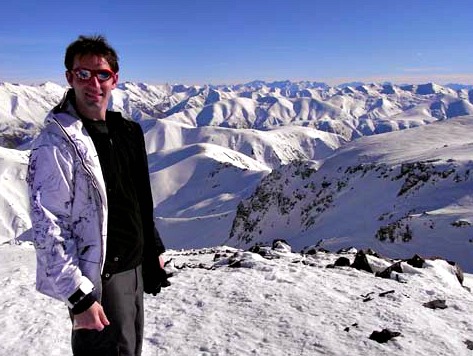
It was the perfect day. The weather was incredible. We’d looked beyond the ski area boundary signs before, of course, but this — the crystal clear visibility — meant we could see for hundreds of miles.

From this high up — the very pinnacle of Mount Hutt, in the New Zealand Alps — we could actually see the curvature of the earth. And it looked like the snow-wrapped mountains extended the whole way there.

The photo at right can’t come close to doing the view justice — especially as some idiot couldn’t resist parking himself in the frame! (Sorry, folks!)

Every time I look at this picture I well up, not because it’s good but because the memory — of unspoilt nature at its most breathtaking — is so special. I was living what The Displaced Nation likes to call la dolce vita.

Today and for the remainder of the month, I’ll be urging you to live la dolce vita as well, by conjuring up the sensory aspects of travel.

This week, I’m talking up the need to train your eyes to see the beauty all around you when you travel. In my case, in fact, this requirement of la dolce vita comes rather naturally. I see beauty everywhere I go — in nature, in ancient structures, even in the occasional female of the species(!). In 1878, the Irish writer Margaret Wolfe Hungerford coined the following phrase in her novel Molly Bawm:

Beauty is in the eye of the beholder.

One of the meanings I take from it is that you see what you look for; so, look for beauty and you’ll find it almost everywhere. (The reverse, of course, is also true.)

But that’s just my tin-pot philosophy, and this week we’re asking you to come up with the most heart-stopping view from your travels. Now that narrows it down considerably, because for me a “view” means a landscape — and I find there are elements a landscape has to have for me to really put it up on that pedestal:

1) It has to be isolated. Maybe that’s just me, but I love the wilderness, that connection to nature, that feeling that this view may not have changed for a thousand years or more.

2) It has it be high-up. I love to be high (no double entendre intended!). A bit of altitude can reveal the magnificence of even a tortured landscape. How peaceful does the Earth look from space, eh?

3) It has to be dramatic. What separates one pretty landscape from another? In my humble opinion, there needs to be some drama, something visually astounding: the scale of the place; the way color dominates it; the patterns of light and dark; the capture of elemental forces at work… Drama is in most places if you look for it.

I very rarely take pictures — which doesn’t exactly lend itself well to a life of writing and blogging. I’d been in Thailand for six months and taken only one photo when my parents (in despair!) sent me a camera for Christmas. It was great! I gave it to a friend.

Luckily, I am now married to one of the afore-mentioned beautiful women — and the pictures I don’t take, she makes up for in spades. Seriously. She has been known to take over a hundred pictures just to ensure having one good one (but she keeps them all). She takes photos of flowers! Of swans! Of cows! And of yours truly! Thank goodness — otherwise, I wouldn’t have been able to share with you the above alpine view, except with words.

So, please — tell us about your favorite views! Where is the most beautiful, jaw-dropping place you’ve seen with your own two eyes? I’d especially love to know, as I plan on visiting a few of them :0)

Please tell all in the comments! In addition, I urge you to send me a photo of that view: tony@thedisplacednation.com. With the help of my better half, I may be staging a “la dolce vita slideshow” before long!

STAY TUNED…for Monday when The Displaced Nation’s agony aunt, Mary-Sue Wallace, will be addressing cross-cultural quandaries and travel-related confusion.

If you enjoyed this post, we invite you to register for The Displaced Dispatch, a round up of weekly posts from The Displaced Nation, with seasonal recipes, book giveaways and other extras. Register for The Displaced Dispatch by clicking here!

Related posts:

Img: Tony James Slater in the New Zealand Alps, taken at the top of Mount Hutt (December 2009).

Welcome to May: A month of living La Dolce Vita

After a month of partying, we’re ready for a quieter life. Fewer late nights and hangovers, and more self-TLC: more sleep, more relaxation, more stopping to smell the roses, more broccoli on our dinner plates…

OK. Maybe not the broccoli. You can have too much of a good thing.

But the sleep, relaxation, and sniffing the roses — they’re all part of living a good life.

A sweet life.

In other words: La dolce vita.

A gateway to the sweet life

A “displaced” life, by definition, is a gateway into experiences we probably wouldn’t have had if we’d stayed home: new places, new people, new perspectives.

While for some this means pushing excitement and new experiences out of your personal comfort zone somewhere into the moon’s orbit — yes, Tony James Slater, I’m thinking of you! — for others, this gateway is one that leads to la dolce vita.

A life of self-indulgence, or indulging yourself in Life?

How do we define la dolce vita?

It’s a phrase that entered the English language after the 1960 Federico Fellini film of the same name, and literally translates to “The sweet life.” It sounds harmless enough, if a little vague.

The Merriam-Webster dictionary takes a more Puritanical view of the translation, and condemns it as “a life of indolence and self-indulgence.”

For our purposes this month, however, we’re going with the definition Barbara Conelli gives at the beginning of her book, Chique Secrets of Dolce Vita:

To live a dolce vita means living with an open heart and soul, indulging in life with all your senses. It means having the eyes to see real beauty, having the nose to smell intoxicating scents, having the ears to hear dreamy sounds, having the mouth to taste delicate flavors, having the body to perceive soft sensations. It means being aware of yourself, of your emotions and desires. It means finding happiness in ordinary yet unique things.

What sort of things are we talking about? Well, I guess it depends on the person.

Respite. Sleep. A massage. Meals you don’t have to cook or cater. Looking up at a different sky. Heart-stopping views. Silence. Walking barefoot on the beach at sunrise. Or sunset. Or midnight.

Another way of putting it?  “A life that caters to the pleasures of the senses” — that’s the definition of “Hedonism.”

How TDN will be living la dolce vita in May

Later this month, we will be reviewing Barbara Conelli’s new book, Chique Secrets of Dolce Amore, and interviewing best-selling author Douglas Kennedy, whose book Temptation reveals downsides of the materialistic dolce vita. We will also be talking to several global nomads about how they define, and live, their own dolce vita.

One of these Random Nomads will be Jeff Jung. Many people who’ve reached mid-life realize that they haven’t smelled the roses in a while, and some are now taking time out of the rat race in order to do just that.  Jeff, who specializes in mid-life gap years, is now settled in Bogota, Columbia, where he markets instructional videos for people preparing for career breaks.  You can read more about Jeff and his philosophy on mid-life gap years here.

Until tomorrow’s interview with another Random Nomad, though, I’ll leave you with more words from Barbara Conelli:

Live your own dolce vita no matter where you are in the world. Because la vita e bella, life is beautiful, and the most amazing wonders of this world often hide in the simplest things.

STAY TUNED for Wednesday’s Random Nomad interview with artist Isabelle Bryer, French expat in the City of Angels.

If you enjoyed this post, we invite you to register for The Displaced Dispatch, a round up of weekly posts from The Displaced Nation, with seasonal recipes, book giveaways and other extras. Register for The Displaced Dispatch by clicking here!

Related posts:

