The Displaced Nation

A home for international creatives

Tag Archives: USA

RANDOM NOMAD: Jennifer Greco, Writer & French Cheese Specialist

Born in: Spokane, Washington, USA
Passports: USA and France
Cities/States/Countries lived in: Washington (Seattle): 1987-99; Louisiana (New Orleans): 1999-2003; France (Cesseras*): 2003-present
Cyberspace coordinates: Chez Loulou | A taste of life in the south of France (blog)
* A tiny village in the Languedoc-Roussillon region

What made you leave your homeland in the first place?
I’ve been a devoted Francophile ever since I was a teenager and knew that one day I would live in France. My husband and I bought a small holiday house in the south of France in 2001 and decided to move here permanently in 2003.

Is anyone else in your immediate family “displaced”?
I have no immediate family members who are “displaced”; however, my grandfather moved to America from Italy with his family at the age of 10.

How about your husband?
My husband was born and raised in New York City. He wasn’t a Francophile when we met, but as soon as I introduced him to Paris, he was hooked.

Describe the moment when you felt most displaced.
It wasn’t just a moment, but every single frustrating minute I had to spend in the the sous-préfecture, arguing with the woman behind the desk who didn’t want to do her job by helping me with my carte de séjour paperwork [visa for staying in France longer than a year].

Describe the moment when you felt least displaced.
The summer night that my husband and I sat at a long table in the center of the village with our neighbors, sharing wine, food, stories and laughter.

You may bring one curiosity you’ve collected from each of your adopted countries into the Displaced Nation. What’s in your suitcase?
From Seattle, Washington: If it wouldn’t spill, a caffè macchiato from Caffe Ladro.
From New Orleans: Mardi Gras throws and Crystal Hot Sauce.
From France: An olive wood Laguiole corkscrew.

You’re invited to prepare one meal based on your travels for other Displaced Nation members. What’s on the menu?
We’ll start out with a specialty of the Pacific Northwest: cracked Dungeness crab and clarified butter. Then we’ll each have half a Charentais melon filled with Muscat de Saint Jean de Minervois — a wonderful dessert wine from Narbonne, close to where I live in the south of France. For the main course, I’ll serve a jambalaya from New Orleans. Then we’ll have (mais oui) a Languedoc cheese course — including Roquefort, Pélardon and Tomette des Corbières. Dessert will be a New Orleans classic: bread pudding with Bourbon sauce.

You may add one word or expression from the country you’re living in to The Displaced Nation argot. What will you loan us?
From New Orleans: Makin’ groceries — meaning going grocery shopping. It’s one of the many colorful expressions that’s part of the local vernacular. I simply love it!
From France: Oh la vache! (Oh my gosh!) This one cracks me up — the literal translation is “Oh the cow!” I can’t say it without smiling.

It’s French Cuisine month at The Displaced Nation. Who is your favorite French chef of all time?
I love Jacques Pépin. He is an honest, down to earth chef, writer and instructor, and his recipes are always delicious. One of my favorites of his is the Skillet Apple Charlotte, a melange of Tarte Tatin and French toast. C’est délicieux!

Like you, Julia Child was an American who moved to France and fell in love with the food. (We have just now inducted her into our Displaced Hall of Fame.) Of the following three Julia Child quotes, which do you most identify with?

1) The only time to eat diet food is when you’re waiting for the steak to cook.

2) The only real stumbling block is fear of failure. In cooking, you’ve got to have a what-the-hell attitude.

3) Until I discovered cooking, I was never really interested in anything.

I most identify with: “The only real stumbling block is fear of failure. In cooking, you’ve got to have a what-the-hell attitude.” I believe in living life to its fullest and sometimes that means taking risks and ignoring the fear, whether it be in the kitchen or in life. Our decision to move to France meant leaving our comfort zone and embracing the challenge of learning a new culture. It hasn’t always been easy, but it’s definitely been worth it! As for the kitchen — readers of my blog will know that I’m now on a mission to taste every single French cheese. I’ve now tasted 205 (there are 600-1,000, depending on who’s counting).

Readers — yay or nay for letting Jennifer Greco into The Displaced Nation? Tell us your reasons. (Note: It’s fine to vote “nay” as long as you couch your reasoning in terms we all — including Jennifer — find amusing.)

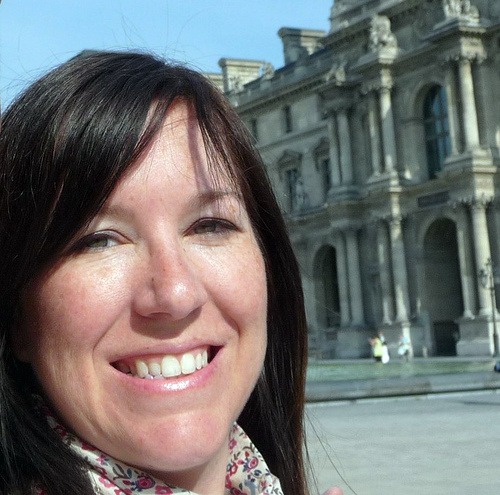
img: Jennifer Greco in Paris, in front of the Louvre (April 2010).

STAY TUNED for tomorrow’s installment from our displaced fictional heroine, Libby, who is taking last week’s advice from Maggie to heart and discovering that Woodhaven is her oyster. (A good thing she’s not allergic to shellfish like her husband, Oliver!) What, not keeping up with Libby? Read the first three episodes of her expat adventures.

If you enjoyed this post, we invite you to register for The Displaced Dispatch, a round up of weekly posts from The Displaced Nation. Includes seasonal recipes and book giveaways. Register for The Displaced Dispatch by clicking here!

Related posts:

Give a dog a chocolate — why US-based expats shouldn’t use UK Chocolate Week to revive an old complaint

Continuing this month’s food-related theme — and in honor of National Chocolate Week in the UK — founding contributor Anthony Windram weighs in with some thoughts on the often contentious expat topic of American chocolate.

Though I do, like most people, enjoy a bit of chocolate, I’ve never been a connoisseur of the stuff. Any old rubbish will do for a quick fix, truth be told. I’m not one of those people looking for what percent of cocoa is in a bar. As a six year old, I remember my Nana — God bless her, then in the beginnings of dementia — had bought me a packet of chocolate from the corner shop. I can still recall the packet which, rather tellingly, was taken up with the picture of a happy dog. The chocolate inside was a little more out of the ordinary, a little grittier than normal. But it was chocolate and I was happy sat on the floor of my Nana’s living room munching away while watching TV, my mouth doubtless covered in chocolate. My dad, however, happened to notice the packet of chocolate and asked me if he could see it for a moment. Being a trusting child I made the mistake of giving him the packet of chocolate. I was never to see it again.

Nana, I was later to learn, had inadvertently purchased for me some chocolatey dog treats. However, as I recall they really weren’t too bad. Yes, the texture was more gritty than you’d prefer, but I had been as happy as Larry eating them. That should have been the moment that I realized that I was not, and never would be, a chocolate aficionado. When I was older and the only chocolate that I could find in the house was cooking chocolate, I was more than happy to snack on that, too. Coincidentally, its grittier taste reminded me of the dog treats I’d been given all those years before.

In its own way eating that chocolatey dog treat turned out to be good preparation for living in the US. The European expat now often seems to have strong views about chocolate in the US. Without any prompting they’ll bring the subject up and scrunch their face in disgust. “American chocolate,” they’ll say, spitting out the words like they probably do the chocolate itself, “is disgusting.”  And yes, I will admit, that it’s not great. Hershey’s chocolate has a lingering, bitter aftertaste that after eating it I often think I’m suffering from GERD. But you can eat a Milky Way and for the most part it is fine. You’ll possibly suffer from cognitive dissonance from the fact that an American Milky Way is, in fact, like a British Mars bar rather than a British Milky Way bar which is, in turn, like an American Three Musketeers Bar…oh, the confusion! But the chocolate in a Milky Way, while different, isn’t necessarily worse. It’s just in the grand scheme of things in the world of chocolate, American chocolate is the chocolate dog treats my confused Nana bought — and that isn’t something I’m going to complain too much about.

Question: What are your thoughts on American chocolate?

Image: MorgueFile

STAY TUNED for tomorrow’s post, part 2 of Joanna Masters-Maggs’ quest to find paradise in Provence.

If you enjoyed this post, we invite you to subscribe to The Displaced Dispatch, a weekly round up of posts from The Displaced Nation, plus some extras such as seasonal recipes and occasional book giveaways. Sign up for The Displaced Dispatch by clicking here!

Related posts:

Dear Mary-Sue: Things to do in Paris

Mary-Sue Wallace is back and she’s dishing out advice to the helpless like it were soup, soup from a big tureen of common sense in the soup kitchen we call the blogosphere … or something like that. If you are looking for solace, then you need Mary-Sue Wallace. Submit your questions and comments here, or if you are a shy bunny requesting anonymity then you can email Mary-Sue directly at thedisplacednation@gmail.com.

Dear Mary-Sue,

Growing up here in Japan as a big-time Francophile, all my life I’ve wanted to visit Paris. This fall I finally have a chance to go visit it for myself. I am so happy at the thought. I will get to stroll the streets and eat plenty of good food. Being such a travel expert could you give me a list of the top things you think I should do when visiting Paris?

— PA, Kyoto

Dear PA,

Ol’ Coley Porter put it best when he wrote that lovely classic of his, I love Paris. “I love Paris in the springtime / I love Paris in the fall / I love Paris in the winter when it drizzles / I love Paris in the summer when it sizzles.” And that sums up so perfectly and so succinctly my own thoughts about this darlin’ city. No matter the time of year, I fall in love with it. Whenever I arrive in Paris, I always make sure on that first night that I go for a stroll along the Seine. Ah, bliss. And when that’s over I go to a little cafe that I adore that is called…

….wait a moment….

….hmm….

….I’m sorry about this, PA, but I just noticed that you wrote that you’re from Japan. In that case, forget Paris. It’s overrated. Have you thought of visiting Malmo? I hear there’s also an interesting cement works in Frankfurt, you could go there. I’m sure it’s fascinating. And people keep telling me Swansea is the Paris of south Wales…

…Aw, shoot. As a loyal Mary-Sue-ite, you deserve a fuller explanation from me, PA. A Japanese Francophile finally visiting Paris after a lifetime of waiting? Aw, honey, sounds like you could be a prime candidate for Paris syndrome. Certain places just seem to have a strange effect on people. Believe me, I know this only too well. It’s why I’m never going back to Jerusalem. Went on a cruise there with my hubby Jake a few years back. Darn it if he didn’t come over all Messianic on me – thought he could walk on water. Well, the fine people at Cunard weren’t too impressed when he went overboard when trying to be all Matthew 14.

And Paris syndrome ‘aint no picnic either, honey. You can end up psychologically destabilized, suffering anxiety, hallucinations, feelings of persecution. Many Japanese visitors to Paris go there with such a romanticized image of the city and its occupants, that it’s a place of sophistication and politeness, that when they finally get there and see for themself the surly, rude reality of Paris they simply can’t cope. 

So PA, I ask again, have you thought about going to Frankfurt? 

— Mary-Sue

Anyhoo, that’s all from me readers. I’m so keen to hear about your cultural issues and all your juicy problems. Do drop me a line with any problems you have.

Mary-Sue is a retired travel agent who lives in Tulsa with her husband Jake. She has taken a credited course in therapy from Tulsa Community College and is the best-selling author of Traveling Made Easy, Low-Fat Chicken Soup for the Traveler’s Soul The Art of War: The Authorized Biography of Samantha Brown, and William Shatner’s TekWar: An Unofficial Guide. If you have any questions that you would like Mary-Sue to answer, you can contact her at thedisplacednation@gmail.com, or by adding to the comments below.

img: Close, by Corina Sanchez.

STAY TUNED for Monday’s post.

If you enjoyed this post, we invite you to subscribe to The Displaced Dispatch, a weekly round up of posts from The Displaced Nation, plus some extras such as seasonal recipes and occasional book giveaways. Sign up for The Displaced Dispatch by clicking here!

Related post:

When a Julia Child-like curiosity about French cuisine leads to a displaced life — bienvenue au October theme

The first time I was introduced to the Slow Food movement was in the land of its birth, Italy. My husband and I were in Florence for the wedding of his niece, and we ended up befriending and dining out with a couple of the other guests: a Chinese-American brother and sister from California who were serious gourmets and would only go to Slow-Food restaurants.

Ever since then, I’ve been puzzled.

Not by the concept of Slow Food itself. I get the idea of savoring a meal that is cooked from fresh, locally-sourced ingredients and that has not been prepared in advance — we’re talking the anti-Fast Food.

What’s more, I had enormous fun in Florence peering at all the restaurant doorways to see if they had a snail symbol. “No snail? Well then we’re not eating there,” I would declare to my husband.

No, what I find confounding is that the movement started in Italy, not in France.

For me, Italian food, with its pizzas, anti-pastas and gelatos, comes fairly close to being the fast food of Europe.

That could never be true, of course, of French cooking. (And what better symbol of French cooking than a snail, btw?)

I feel certain Julia Child would agree with me. An expat in Paris for many years, Julia belongs in the Displaced Nation’s Hall of Fame because of her refusal to be satisfied with her native country’s Anglo-derived plain food consisting of meat and potatoes and two veggies — let alone the fast-food version: meat (as it were), bun, French (quel insult!) fries, no veg.

Addressing just one of these nefarious ingredients, Julia once said:

How can a nation be called great if its bread tastes like Kleenex?

For Julia, France was a spiritual as well as culinary homeland. As she wrote in her memoir, My Life in France:

I fell in love with French food — the tastes, the processes, the history, the endless variations, the rigorous discipline, the creativity, the wonderful people, the equipment, the rituals.

A date with destiny

Julia’s first forays into foreign cuisine occurred when she worked for the Office of Strategic Services (the precursor to the CIA) during World War II.

She was posted first to Kandy, Ceylon (now Sri Lanka), and then to Kunming, China. Along the way, she met, and fell in love with, Paul Child, an early example of a foodie. At Paul’s initiative, they entertained themselves by exploring Ceylonese and Chinese cuisine and culture.

The pair married the year after the war ended, and Paul went to work for the American Embassy in Paris — a move that proved fortuitous in the extreme for his wife’s career.

For their first meal on French soil, Paul ordered sole meunière. For Julia, it was an epiphany — “the most exciting meal of my life.” The scales fell not just from the fish but from her eyes. She could see what American WASPs like herself were missing out on: sauces made with fresh herbs, butter, wine, and so forth.

The rest is history.

Bon appétit — say what?

Well, not quite. To be honest, I don’t think Julia’s approach to French cooking ever really took hold here in the U.S. We pretended that it did because we loved Julia so much. We loved her for her jolly-jape sense of humor and melodious voice.

But half the time, we didn’t understand what she was wittering on about.

Now, Julia knew that her fellow citizens were mostly flimsies (her word for people who aren’t serious about food). But she thought that the key to converting us was to provide a step-by-step outline of the centuries-old techniques that the French learn like a language: how to make foundation sauces, how to do a roux, how to lay in flavor, how to be patient.

The blogger Julie Powell tried to cook all 524 recipes in Child’s encyclopedic Mastering the Art of French Cooking, in a single year. Some say it was a gimmick, but I say, hey, she deserves the fame — including the honor of having Amy Adams play her in the ensuing Nora Ephron film, Julie & Julia.

‘Fess up: when was the last time you cracked open Julia Child’s magnum opus and gave her recipes a try?

Food writer Regina Schrambling wrote in a post for Slate just after the film’s release, analyzing the problem:

Consider the boeuf bourguignon depicted so romantically in the movie… The ingredients and instructions for its recipe span three pages, and that is before you hit the fine print: The beef stock, braised pearl onions, and sautéed mushrooms all require separate procedures. Step 1 involves making lardons and simmering them for 10 minutes in a precise amount of water; seven steps later, the fat is finally skimmed off the sauce, which is either boiled down to thicken or adjusted with liquid if it’s too thick.

And this is considered an entry-level recipe….Even simple sautéed veal scallops with mushrooms involve 18 ingredients and implements and two pages of instruction.

TDN’s October theme

Still, if expat blogs are anything to go by, a Julia Child-like curiosity with France and French cuisine has continued unabated since Julia’s own time. There is no shortage of Americans (also some Canadians and South Americans) who have relocated to France and intend to stay for as long as it takes to learn the art of French cooking at some level.

Partly out of curiosity, partly out of jealousy, The Displaced Nation will peer into the lives — and kitchens — of several of these expats during October.

What is it actually like to make the Ultimate Slow Food your focus? It any less daunting because of living in France and adopting the French lifestyle? And like Displaced Hall of Famer Julia Child, do today’s expats have (or hope to have) a spoon in the soup back here: are they planning to stir things up and convert us?

Readers, do you have any questions you’d like us to explore on this theme? Vas-y! Let us know!

If you enjoyed this post, we invite you to subscribe to The Displaced Dispatch, a weekly round up of posts from The Displaced Nation, plus some extras such as seasonal recipes and occasional book giveaways. Sign up for The Displaced Dispatch by clicking here!

Image: MorgueFile

An un-American in an All-American diner

Continuing this month’s theme on road trips founding contributor Anthony Windram weighs in with some thoughts on the American diner.

There’s neon tubing that emits a purple glow around the clock that tells me it’s nearly 10pm. The dinner service is long over, the families now dispersed and only a scattering of drifters and loners are left. It’s still, at least, another 45 minutes before the late-night drunken crowd makes an appearance.  This diner is more Edward Hopper than Norman Rockwell. Across the parking lot is a strip club, as the night draws on and into morning some of its patrons, I imagine, will head over here to have a burger or to take advantage of that most American of institutions – the 24-hour breakfast.

There’s a still sadness to the place despite the best efforts of the waitress who exudes a friendly busyness. She could be anything from her late-40s to her early-60s. She calls me “sweetheart” when she comes over to give me a refill of greased coffee. She doesn’t, however, call it “a cup of Joe” — that would be one cliché too many.

Mentally, I take a step back from this scene and try to view all around me as a tableau and can’t but help but think this is Americana that I am sat in, this is America.

Perhaps this is the “real” America; a banal phrase uttered by a banal politician, but a phrase that does strike at something deep in the American psyche.

Dr George Lewis, director of American Studies at Leicester University, has started what the Guardian claims is the “first sustained historical analysis of the term un-American.” While there may be some confusion over quite how one defines being “un-American,” what seems certain to me is that this cold burger and this diner is decidedly the opposite of “un-American”. Though I am in Bakersfield, California, I could be anywhere in the Union, be it red state or blue state.

When I first moved to the US, to my now shame, I found myself fascinated by the Food Network show Diners, Drive-Ins and Dives, hosted by the hyperactive Guy Fieri, a man with the cholesterol levels of someone twice his age. Fieri is a TV host with absolutely no sense of discernment. Everything that he comes across, everything that he tastes, must be spoken about in glowing terms to the point that nothing that Fieri says has any real meaning whatsoever.

And yet I did find myself compelled by the show for illuminating further for me the American diner and showing me places that occupy a place in the country’s cultural milieu that the English cafe doesn’t even come close to back home. I soon stopped watching Diners, Drive-ins and Dives — not because my view of diners changed, but because it was (and is) a God-awful program and there’s only so many times you can watch an overweight Fieri eat some barbequed pork and then pronounce it “awesome”. But there was one thing in particular about Fieri’s show that they always got wrong. They would always show the diners when they were packed and buzzing with a family friendly atmosphere. And while I wouldn’t suggest that that’s not the case, what I find interesting is that when you roll into a strange town late at night and find yourself at a diner, regional and political difference tend to dissolve. You are in a place that is resolutely American rather than California, or Colorado, or Vermont, or…I could go on.

Fieri’s show, a sort of televisual equivalent of Pravda which can only emphasize the positive, misses out on what I am experiencing here in Bakersfield as the clock, that has neon tubing wrapped around it, hits 10 and I ask for my check. Here, and which Fieri always misses, is a quiet efficiency mixed with a low-burning malevolence. It’s that mixture of warmth and fear you get when your waitress flashes you a warm smile but you know you’re in a moment going to be stepping out back into that parking lot — and in the back of your mind you’re just a little concerned that this might be the night where you get shot by a drunk coming out of the strip club.

Question: What’s your experience of American diners?

Image by awindram.

STAY TUNED for tomorrow’s interview with the travel writer Allie Sommerville. NOTE: All DISPLACED DISPATCH subscribers will be entered in our giveaway of Allie’s book, Uneasy Rider.

If you enjoyed this post, we invite you to subscribe to The Displaced Dispatch, a weekly round up of posts from The Displaced Nation, plus some extras such as seasonal recipes and occasional book giveaways. Sign up for The Displaced Dispatch by clicking here!

Related posts:

“My country, ’tis of thee” applies to my expat mum but not to me

We take a break from road trips today with this guest post from Lawrence Hunt, a recent graduate of Warwick University (UK). Followers of The Displaced Nation may recall that we interviewed two cross-cultural married couples last summer. Hunt is the product of a cross-cultural union between an American mother and an English father. Let’s listen to what he has to say regarding the oft-perplexing matter of cultural identity. NOTE: This post has not been edited for British spelling or punctuation.

One of the things that expats like to tell themselves is that home is a state of mind.

But for me, the child of an English father and an American mother, home stands for a physical place: the one where I was born and grew up, England.

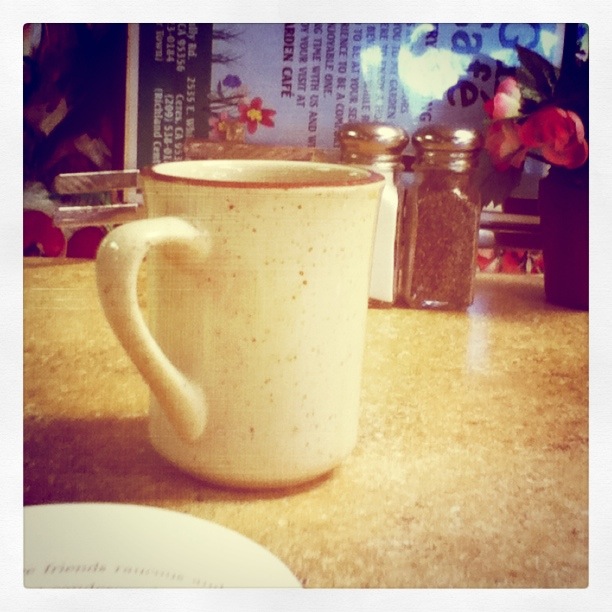
For years my mother has sipped her morning coffee from the same extravagantly large mug, Stars and Stripes boldly printed around the outside. She picked it up at an airport in Washington DC where we were visiting her sister. It’s curvaceous and welcoming, a daily caffeinated hit of homeland comfort. I’ve started drinking from it, too — but more as an ironic gesture.

Mum grew up reciting the Pledge of Allegiance in class, but in ultra-PC Britain, patriotism has to be decidedly lower key. It seems commonplace to see flags hoisted outside American homes, but over here the very act of being seen with a St George’s flag in any context other than sporting events or royal weddings is infrequent enough to draw stares. People see you with it and instantly wonder what fanatical scheme for national purification you’re plotting behind closed doors.

Now, I don’t fault my mum for being proud of her cultural upbringing. I think in some ways her extended absence makes her all the more keen to assert her identity and share it with us.

She did some family history research recently that confirmed we’re the distant descendants of Charles Carroll of Carrollton, the only Catholic and longest surviving signatory of the Declaration of Independence. That’s my strongest claim to fame, and I’m holding onto it.

Chocolate — the way to an English child’s heart

That said, America has never played much of a role in our regular family rituals. For one thing, traditions like the Fourth of July and Labour Day just aren’t compatible with the British calendar.

I do remember Mum hosted a wonderful Thanksgiving dinner once with some other American expats when I was little. Without having the next day off to recuperate, however, everyone left early and I think she found the mountain of washing up too colossal to repeat the effort.

The one institution she has passed down to us (and this is something I cannot thank her enough for) was the American Easter basket hunt. The concept, as I explain it to my friends, is simple but ingenious – essentially, it’s what all kids in England do but with two key differences: 1) More chocolate, and 2) Baskets.

While other English kids were being handed single Cadbury creme eggs in flimsy cardboard boxes, my brothers and I were racing around the garden looking for mighty hoards of chocolate hidden among the shrubbery by a miraculously literate bunny that knew how to spell our names on post-it notes.

As American as everyone else in Britain?

Basket cases aside, it’s difficult to say exactly how ‘Americanized’ I am as a result of my mother, and how much of it is just living in a country where America’s influence pervades almost every cultural platform.

The most differentiating feature of mum’s background has always been her accent. I can do a pretty convincing American accent on a good day, and I used to mimic my mother so often when I was a child that I still lapse into it sometimes without realising.

But even my mother, having lived here for almost thirty years, isn’t really that American any more in her diction. I think the few Americanisms I sometimes find myself using, like ‘movie’ rather than ‘film’, or ‘take-out’ rather than ‘takeaway’, are more because I hear them in American movies and prefer them than because I’ve picked them up from her.

I certainly feel something for the States — a fondness and a familiarity, I suppose. I’ve been lucky enough to go with her on visits to her family almost every other year since I was a baby. Some of my favourite memories have come from spending summers at lake houses in North Carolina, climbing the mountains of West Virginia and walking down endless blocks of New York.

When I was seventeen I took a position teaching at a French camp in the woods in Minnesota, and made friends who I still keep in contact with.

America as distant entity

But America lives for me, as it does for many Brits, more in fiction than in reality. From the moment I read JD Salinger, I was hooked, and I’ve probably read more American writers than British ones: Steinbeck, Fitzgerald and Kerouac, right through to more recent contemporaries like Bret Easton Ellis, David Foster Wallace and Jonathan Franzen.

They all essentially seem to be commenting on the same thing: the tragic failure of American life to live up to its promises. Paradoxically though, in the richness of the characters and landscapes they describe, they evoke a utopia in my mind that’s been hard to shake.

In my final year at university I enrolled in a contemporary American Literature module — ‘States of Damage — US Writing and Culture in the Post 9/11 Context’. I didn’t know what I was getting myself into. It was a step-by-step dissection of everything wrong with free market America, from George Trow’s attack on media culture in ‘Within the Context of No Context’ to Naomi Klein’s The Shock Doctrine, an expose on America’s foreign policy over the past 40 years.

The critique seemed appallingly one-sided to me, and an hour a week for an entire year I felt compelled to fight America’s corner against the scathing intellects of my fellow students. Truth be told, I just like a good debate, and this was a difficult one. There’s a lot about American politics that we find objectionable in British culture — even though we’re implicated in most of the same hypocrisies ourselves.

To be fair, however, my fellow students showed a very different side on Obama’s inauguration night. The Students Union had been decked out in American flags and YESWECAN posters, and multitudes of students were queuing up to buy hotdogs and other American staples. I voted in that election, and it was a night when I felt nothing but pride to be half American.

My mum’s sweet land of liberty

I sometimes think it would be nice to use my dual citizenship and live on the other side of the Atlantic for a while, preferably near the coast. Mum believes that on the whole, Americans are more open, friendlier (at least on the outside) and more honest than British people. She’s even been known to point out these qualities in my brothers and me, when they appear, as our ‘American side’.

I’m sceptical that you can generalise about such vast groups of people in any meaningful way, especially as the world becomes increasingly mixed.

Ultimately, I think when you spend very little time in a place, and you miss it greatly, you begin to feel connected to a idealised version of it, one that’s perhaps better than the reality. When I ask about America, the memories my mother recalls from behind the vapours of her star-spangled mug are those of the pioneering Midwest. She tells me she always wanted to be one of the pioneers in Little House on the Prairie, struggling against the elements and striking out on her own.

That adventurousness is, ironically, probably part of what made her leave America for pastures new in the first place.

I can see the real things she’s had to give up in establishing her new life here — the family, the friends, the holiday traditions, a million different flavours and details that in some cases are only slightly different here from what she grew up with. Those are also the things I take for granted about my own life in Britain.

I was born here, and that counts for a great deal more than where my mother was born.

img: Lawrence Hunt with his mum’s stars-and-stripes mug, at home in Chorley Wood

STAY TUNED for Monday’s post, in which Matthew Cashmore, aka The London Biker, relays his personal “Zen” of this rather risky, albeit exhilarating, mode of travel.

If you enjoyed this post, we invite you to subscribe to The Displaced Dispatch, a weekly round up of posts from The Displaced Nation, plus some extras such as seasonal recipes and occasional book giveaways. Sign up for The Displaced Dispatch by clicking here!

Related posts:

RANDOM NOMAD: Kirsty Rice, Freelance Writer & Blogger

Born in: Renmark*, South Australia
Passport: Australia (no one else will have me!)
Countries lived in: Australia (Adelaide & Perth): 1997-98; Indonesia (Jakarta): 1999 – 2001; Malaysia (Kuala Lumpur): 2001-02; Libya (Tripoli): 2002-04; Canada (Calgary): 2004-08; USA (Houston): 2008-09; Qatar (Doha): 2010-present.
Cyberspace coordinates: 4 kids, 20 suitcases and a beagle (blog)
*A small town of 7,500; my parents still live there.

What made you leave your homeland in the first place?
I am married to a former expat child. I know the term is Third Culture Kid, but I don’t really think it applies to him. He was always keen on doing the “expat” thing. I, on the other hand, was raised in the same town that I was born in and wasn’t a great lover of change. Our first move was the result of a promotion for my husband and the fact that I was pregnant with our first child. The plan was to do a two-year posting in Indonesia and to return “home”. That was 7 countries and 12 years ago. I now thrive on change.

So your husband was already “displaced”?
My husband’s parents were expats. He was actually born in New Zealand and then they went to the Philippines for many years before moving to Sydney, then Melbourne, and finally to Brisbane.

How about your kids?
My children were all born in different countries. We were living in Jakarta when I had my first child, my second was born in KL, the third in Malta and the fourth in Canada. Although none of them have lived permanently in Australia (our longest stint has been during school holidays, so a maximum of 12 weeks), they all think of themselves as Australian. My husband and I have both worked hard for that to be the case.

Describe the moment when you felt most displaced.
When we first moved to Tripoli — it was the middle of summer and I had a two-week-old baby and a two-year-old. We then had to endure months of housing hell — we couldn’t find one! For a while, I shared a “guest house” with about sixty men who were rotating in and out of the desert: there were no other women. Breast feeding amongst men who hadn’t seen a woman for a couple of months was a rather unique experience. Due to the weather, fruit and vegetables were limited and small in size. I can remember standing in a fruit and vegetable stand with a screaming baby and a restless toddler wondering how I was going to cook carrots the size of my little finger. I was continually getting lost, and the simplest of tasks seemed very overwhelming. There were many days that I considered getting on a plane — but I’m so pleased I didn’t. Three months later, we had a house, the weather was better, I made friends, and I loved our life in Libya. I was devastated to leave.

Describe the moment when you felt least displaced.
I feel like that here in Qatar. Our children are at a fabulous school, I have a place to write, and my husband works for a Qatari company and really enjoys it. There is so much here in the community for expats, and we are made to feel very welcome. I have made local friends and love heading to the local souqs. I feel that this is very much our second home. In other locations I have felt that we were passing through, but not here.

You may bring one curiosity you’ve collected from your adopted country into The Displaced Nation. What’s in your suitcase?
From Indonesia: A jamu (traditional medicine) woman made of silver, given to me by a very dear friend.
From Malaysia: The Selangor pewter tea set I was given as a gift. Each time I use it I think of my friends.
From Libya: A wedding blanket with traditional jewellery pinned to it, which was given as a farewell present. It is such a unique gift and always a talking point when people spot it in our house.
From Canada: Nothing material, just the memory of what it was like to be back to work full time. In Calgary, I returned to the “old” me, remembering who I was pre children and travel. That was Canada’s gift — along with a huge appreciation of weather!
From the U.S. (Houston): A fantastic painting of an American flag that I picked up in San Antonio. It’s 3D and not in the traditional colors. It reminds me that America is far more layered and multidimensional that what I’d given it credit for.

You’re invited to prepare one meal based on your travels for other Displaced Nation members. What’s on the menu?
We’ll have some kind of soup for starters: either Indonesian soto ayam (chicken soup), Libyan soup* (I love it!), or the Canadian version of Italian wedding soup. Though I come from an area in Australia that has a large Italian community, I’d never heard of Italian Wedding Soup — turns out it’s more of a North American thing.

For the mains, perhaps I’ll offer a choice between Malaysian curry or maybe a nasi goreng from Indonesia.

And for drinks, we’ll have margaritas. I learned to make a mean margarita in Houston.

For dessert, a caramel cheesecake — a recipe I picked up from a fellow Aussie in Houston.

You may add one word or expression from the country you’re living in to The Displaced Nation argot. What will you loan us?
From Indonesia: Satu lagi (one more) — I said that way to often!
From Malaysia: I just loved how you could put lah on the end of everything and automatically make a sentence sound friendlier.
From Tripoli: Shokran (thank you). It was the first Arabic word I learned and makes me think of how special the people in Libya are — so kind and helpful. Incidentally, in learning how to say “pregnancy test,” I discovered that hamil is the word for “pregnant” in Indonesia, Malaysia and Tripoli.
From Canada: Hey — kind of the same as lah in Malaysian.
From the U.S. (Houston): I found myself describing things differently. It wasn’t just “the big tree out the front” but “the big ‘ol tree out the front.”
From Qatar: Right now I’m back to learning Arabic (unsuccessfully). Oh how I wish I had a chip I could just insert into my brain to switch languages. Why haven’t they invented that yet?

It’s Zen and the Art of the Road Trip month at The Displaced Nation. Robert M. Pirsig, author of Zen and the Art of Motorcycle Maintenance, famously said: “Sometimes it’s a little better to travel than to arrive.” Do you agree?
I disagree. I like to arrive, settle and learn how a city/country works. You can learn so much about a place just by trying to get the telephone connected! Traveling through is just a brief picture. I love that we’ve been able to become part of a community everywhere we have lived.

Pirsig’s book details two types of personalities: 1) those who are interested mostly in gestalts so focus on being in the moment, not rational analysis; and 2) those who seek to know the details, understand the inner workings, and master the mechanics. Which type are you?
If you read my blog you’ll see there is usually a romantic viewpoint or flowery end to a posting. I’m a big believer in things happening for a reason and not always being logical. Having said that, I am a stickler for details, I hate to enter into things blindly and have to know exactly what the story is. Which personality am I in my expat life? I’m a bit of both. I don’t believe that anyone can be a successful expat without having the flexibility to change with the situation. In our daily lives as expats we need to quickly learn the rules, find out the details, go with the flow and just enjoy the ride. You have to be both.

* Libyan soup is a tomato-based soup. There are many variations. The one I loved was with lamb.

Ingredients:
1/2 to 1/3 lb. lamb meat cut into small pieces
1/4 cup oil or “samn” (vegetable ghee)
one large onion
1 tablespoon tomato paste
2-3 tomatoes
1 lemon
1/2 cup orzo, salt, red pepper, Libyan spices (Hararat) or cinnamon

Directions:
Sauté the onion with meat in oil.
Add parsley and sauté until meet is brown.
Add chopped tomatoes, tomato paste, salt, spices, and stir while sizzling.
Add enough water to cover meat, simmer on medium heat until meat is cooked.
Add more water if needed, and bring to a boil.
Add orzo, simmer until cooked.
Before serving, sprinkle crushed dried mint leaves, and squeeze fresh lemon juice to taste.

Readers — yay or nay for letting Kirsty Rice into The Displaced Nation? Tell us your reasons. (Note: It’s fine to vote “nay” as long as you couch your reasoning in terms we all — including Kirsty — find amusing.)

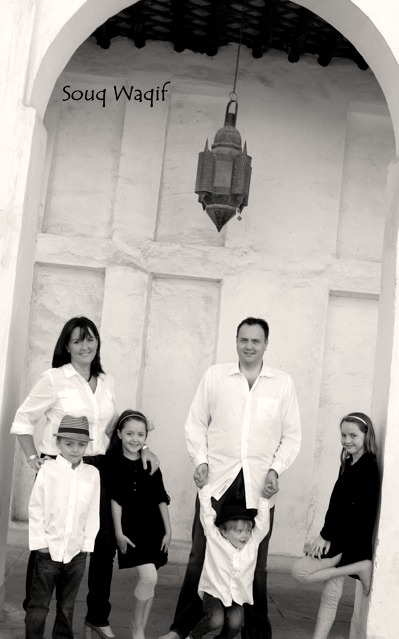
img: Kirsty Rice with her family (sans the beagle) at Souq Waqif, Doha, Qatar.

STAY TUNED for tomorrow’s installment from our displaced fictional heroine, Libby, whose rather dramatic road-trip adventure has come to an end. Time to face reality again in Woodhaven! What, not keeping up with Libby? Read the first three episodes of her expat adventures.

If you enjoyed this post, we invite you to register for The Displaced Dispatch, a round up of weekly posts from The Displaced Nation. Includes seasonal recipes and book giveaways. Register for The Displaced Dispatch by clicking here!

Related posts:

Dear Mary-Sue: Tempted to make invidious cross-cultural comparisons

Mary-Sue Wallace, The Displaced Nation’s agony aunt is back. Her thoughtful advice eases and soothes any cross-cultural quandary or travel-related confusion you may have. Submit your questions and comments here, or else by emailing her at thedisplacednation@gmail.com.

Dear Wallace-sensei,
As a Japanese expat living in New York, I’m finding myself becoming increasingly unsympathetic to my adopted city. Don’t get me wrong, Wallace-sama, I love it here. It’s just that I’ve found the hysteria surrounding first the earthquake and then Hurricane Irene a little hard to take considering the natural disasters Japan has had to deal with this year. Any advice for how I could stop these uncharitable thoughts that I am having?
— SY, New York City (originally Tokyo)

Dear SY-san,

Let me tell you a little story. There was once an attractive, physically fit young girl. She wasn’t from anywhere exciting, just a small town girl from West Virginia. Her father was a police officer in the town. When this young girl was 10, her father was shot and killed when apprehending a robbery. The girl was sent to Montana to live with her uncle. She didn’t like it in Montana, certainly not on the sheep farm her uncle owned. She tried to run away, to where she didn’t know, she just knew she wanted to be anywhere but Montana. But as she ran she witnessed something awful, the lambs from her uncle’s farm being slaughtered for market. She heard their cries, she still does, SY. She still does — when she dreams. It didn’t stop her running, though — she kept running this small girl.

The girl spent the rest of her childhood in a Lutheran orphanage. It was okay, though she still dreamt of the lambs. The girl was smart, though: she had gumption, she had tenacity and she was able to enroll into the University of Virginia on a full scholarship. When she left college, she applied to the FBI’s training academy. It was the late 70s, it wasn’t easy being one of the only women in the academy. But this girl got on with it. She was uncomplaining, and she was the best, she knew that. None of that sexist bull sticks when you know that.

On completing the training, this girl, now a young woman, joined the Behavioral Science Unit. She was part of a team that traced down serial killers — tried to get in their heads, think like they think. She was sent to a Baltimore asylum for her first interview, to meet with a serial killer who just might be able to help her with the case she had been assigned…

…Sorry, I digress, but the point, SY-san, is that that young girl was, in fact, little ol’ me. Yes, hard to believe, I know. I wasn’t always an agony aunt. Anyhoo, the point is some serious s**t went down. Some really creepy, really heavy stuff. So when I get invited round to Valerie Johnson’s for our book club meeting (second Tuesday of the month — we’re reading The Help at the moment; FABULOUS, you MUST read it), and Valerie starts recounting how she thought there was a robber in her garden the other day and she feared she was going to die — even though it just turned out to be Miguel, her 60-year-old Hispanic gardener — I just bite my tongue. Of course, I want to tell Valerie that she doesn’t know fear until she’s been trapped in a house with a serial killer knowing only one of you is going to get out of there alive. No, that would be rude. So I just sip my raspberry lemonade and nod politely as Valerie talks. New York, dear SY, is your Valerie Johnson. Tolerate her, SY, no matter how much you’d like to wring her neck.
— Mary-Sue

Anyhoo, that’s all from me readers. I’m so keen to hear about your cultural issues and all your juicy problems. Do drop me a line with any problems you have, or if you want to share your fave meatloaf recipe with me (yum! yum!). As they say in Italy, “ciao!” — or, as my (still!) unmarried youngest son (he’s nearly thirty, I despair of him, I really do) might say: “See you on the flip.”

Mary-Sue is a retired travel agent who lives in Tulsa with her husband Jake. She has taken a credited course in therapy from Tulsa Community College and is the best-selling author of Traveling Made Easy, Low-Fat Chicken Soup for the Traveler’s Soul The Art of War: The Authorized Biography of Samantha Brown, and William Shatner’s TekWar: An Unofficial Guide. If you have any questions that you would like Mary-Sue to answer, you can contact her at thedisplacednation@gmail.com, or by adding to the comments below.

img: Close, by Corina Sanchez.

STAY TUNED for Monday’s post, on the wide variety of vehicles that have been used for road trips.

If you enjoyed this post, we invite you to subscribe to The Displaced Dispatch, a weekly round up of posts from The Displaced Nation, plus some extras such as seasonal recipes and occasional book giveaways. Sign up for The Displaced Dispatch by clicking here!

Related post:

The John Steinbeck Encyclopedia of Road Trips

When we announced this month’s theme — road trips — some of you may have wondered if we’d gone around the bend. Zen and the Art of Motorcycle Maintenance — really? That’s a book for roadgeeks or — if you get into its philosophical meanderings — Roads Scholars, not for Displaced Nation types, most of whom equate travel with boarding an international flight.

Besides, road trips are for the young and restless — something you do when you’ve just graduated college.

But before you put the brakes on the road-trip idea again, let me convince you to take one more test drive. Only this time, instead of riding pillion on Robert Persig’s motorcycle, you’ll be seated in John Steinbeck’s camper station wagon next to his pet dog, Charley, on a 10,000-mile journey across America — from Long Island to Maine to Chicago to Seattle to California to Texas to New Orleans and back to New York City.

As the Nobel prize-winning writer puts his engine in gear, may I invite you to peruse our specially compiled John Steinbeck Encyclopedia of Road Trips.

A is for Autumn

John Steinbeck made a road trip across America in the autumn season and in the autumn of his life. He set out from his home in Sag Harbor, Long Island, shortly after Labor Day in 1960. He was 58 years old and not in the best of health. As Edward Weeks wrote of Steinbeck’s expedition in The Atlantic:

He set out with some misgiving, not sure his health would stand up to the 10,000-mile journey he envisioned; as he traveled, the years sloughed off him…

B is for Bestseller

Steinbeck wrote a book about his journey, Travels with Charley. It reached #1 on the New York Times bestseller list for non-fiction on October 21, 1962. To this day, the book retains a special place in the American imagination, despite attempts to challenge its categorization as “non-fiction” (see F).

C is for Charley

Meet Charley, Steinbeck’s middle-aged French poodle, one of the most civilized and attractive dogs in literature. He’s the genuine article, a real French poodle, having been born on the outskirts of Paris, where he also received his training. As his proud owner once said:

…while he knows a little Poodle-English, he responds quickly only to commands in French. Otherwise he has to translate, and that slows him down.

D is for Dog

For Steinbeck, a dog is an ideal companion on the open road as well as being an effective ice breaker:

A dog is a bond between strangers. Many conversations en route began with “What degree of dog is that?”

E is for Environment

Steinbeck was extremely attuned to the intimate connection between people’s lives and the rhythms of nature — weather, geography, the cycles of the seasons. But while nature animates his picaresque tale of his travels with his dog, one of his key observations was the the high price Americans would eventually pay for lives filled with ease and convenience. He felt they were trashing their environment for the sake of material prosperity. (A tad prescient, might we say?)

F is for Fictions

Journalist Bill Steigerwald set out to retrace Steinbeck’s steps on the 50th anniversary of his road trip. He concluded that not only had the Nobel laureate invented characters, he’d also embellished the hardships of his cross-country journey with Charley. In other words, this brilliant author’s much-loved book is loaded with creative fictions. (Wait, I thought all travel writers used some creative license — is there anything wrong with a novelist-turned-travel-writer using some?)

G is for Giant Redwoods

After sorting out his flat tire in Oregon (see O), Steinbeck visited the giant redwoods and ancient Sequoias and found them as awe inspiring as ever:

The vainest, most slap-happy and irreverent of men, in the presence of redwoods, goes under a spell of wonder and respect.

Steinbeck was further impressed when his dog, Charley, refused to urinate on the trees…

H is for Hurricane

The best-laid schemes of mice and men go oft awry, and Steinbeck had to delay the start of his trip slightly due to Hurricane Donna, which made a direct hit on Long Island. (Still, it could have been worse. It could have been Hurricane Irene!)

I is for International

While he never became an expat, Steinbeck moved to New York City and took quite a few international trips, mostly to Europe. He hoped that his road trip would enable him to reconnect with both the people and the landscape of his native land. He also wanted to see his birthplace — Salinas, California — one last time.

J is for Jamming

Steinbeck’s journey concluded with jamming Rocinante (see R) across a busy New York City street, during a failed attempt at making a U-turn. He reports having said to the traffic policeman:

Officer, I’ve driven this thing all over the country — mountains, plains, deserts. And now I’m back in my own town, where I live — and I’m lost.

K is for Knight-errant

A mainstay of medieval romance literature, the knight-errant wanders the land in search of adventures to prove himself a worthy warrior. Don Quixote is a famous example (see Q). Likewise, Steinbeck hoped to recapture his youth, the spirit of a knight-errant, through his travels. (Makes sense if you’re middle aged and your health is rapidly deteriorating — see P.)

L is for Language (of Road Signs)

Steinbeck closely observes the language of road signs during his trip across country. In New York State, he notes that the road signs are commands: “Stop! No turning!” But in Ohio, the language is gentler, with friendly advice rather than curt demands.

M is for Maine

Steinbeck reports that he learned not to ask for directions in Maine because locals don’t like tourists and tend to give them the wrong directions — another example of regional differences (see L).

N is for North Dakota

Upon arriving at Fargo, North Dakota, Steinbeck declares that the mentality of the American nation has grown “bland.” He fell head over heels in love with Montana, however. NOTE: Steinbeck’s account of meeting an itinerant Shakespearean actor outside the town of Alice, North Dakota, is disputed by the journalist Bill Steigerwald (see F).

O is for Oregon

Having his first flat tire on a remote back road in Oregon inspired Steinbeck to write a send-up of similarly desperate scenes in his most famous novel, The Grapes of Wrath:

It was obvious that the other tire might go at any minute, and it was Sunday and it was raining and it was Oregon.

P is for Poignancy

When Steinbeck set out on his road trip, he knew he could have died at any point along the way because of his heart condition. This knowledge suffuses Travels with Charley with a certain poignancy, and perhaps explains why it’s such a beloved book.

Q is for Quixote

As one might expect of a man who won a Nobel Prize in Literature, Steinbeck had a literary hero in mind when he set out on his road trip: Don Quixote. Like the ingenious gentleman of La Mancha, it seems that Steinbeck fancied himself a knight-errant in search of adventure (see K). He even named his camper truck for Quixote‘s steed (see R).

R is for Rocinante

As the narrator of Don Quixote explains, its hero feels obliged to find the right name for his horse:

Four days were spent in thinking what name to give it, because (as he said to himself) it was not right that a horse belonging to a knight so famous, and one with such merits of his own, should be without some distinctive name…

At last, Don Quixote calls the skinny steed Rocinante. In a nod to this fictional knight-errant (see K), Steinbeck christened the vehicle for his journey — a green GMC truck, which he’d had custom-fitted with a camper — Rocinante. He even painted the name across the side of the truck in 16th-century Spanish script.

S is for Salinas

Steinbeck was born in Salinas, California. He wrote his first stories about the Salinas Valley and was determined to see his hometown one last time before he died. Visiting a bar from his youth, he lamented the loss of several regulars as well as quite a few of his childhood chums, wondering if perhaps Thomas Wolfe was right (see Y).

T is for Texas

Steinbeck remarked of Texas that it was the kind of state that “people either passionately love or passionately hate.” He went on:

Texas is a state of mind. Texas is an obsession. Above all, Texas is a nation in every sense of the word. … A Texan outside of Texas is a foreigner.

Texas was also where Charley (see C) became ill for a few days and stayed in a veterinary hospital. NOTE: From Texas onwards, Steinbeck’s travel writing gives way to social commentary, culminating in the account of a school integration crisis he witnesses firsthand in New Orleans.

U is for U.S. Route 66

In mid-November of 1960, Steinbeck crossed the Mojave Desert and picked up the historical U.S. Route 66 at Barstow, California. He and Charley then drove 1,300 miles to arrive in time for a Texas-style Thanksgiving on a cattle ranch near Amarillo. U.S. Route 66, known colloquially as the “Main Street of America” or the “Mother Road” was a major path for those who migrated west. In Steinbeck’s classic novel The Grapes of Wrath, the poor family of sharecroppers, the Joads, make their way west from Oklahoma to California on U.S. Route 66.

V is for Viking Press

Travels with Charley was published by the Viking Press in mid-summer of 1962, several months before Steinbeck was awarded the Nobel Prize in Literature.

W is for Wanderlust

Steinbeck begins Travels with Charley by describing his wanderlust, saying he’s had a life-long impulse to travel and explore the world.

X is for Xena the Warrior Princess

This entry has nothing to do with John Steinbeck, but I have included it in case there are any women travelers who are having trouble identifying with the adventures of a rugged, broad-shouldered, six-foot-tall writer, and his desire to be seen as a knight-errant (see K). Xena the Warrior Princess reminds me of the title of Debbie Anderson’s best-selling guide for women who travel the open road: Simple Rules for…The Road-Warrior Princess.

Y is for “You can’t go home again”

When Steinbeck reached his birthplace of Salinas, he discovered the truth of Thomas Wolfe’s words “You can’t go home again.” Saying good-bye to his hometown for the last time was a bittersweet experience:

I printed once more on my eyes, south, west, and north, and then we hurried away from the permanent and changeless past where my mother is always shooting a wildcat and my father is always burning his name with his love.

Z is for Zzzzz (under the stars)

Steinbeck reports that camping out with Charley in the American outback — where they enjoyed lots of zzzzz under the stars — was one of the highlights of their trip (though the veracity of that experience is now disputed — see F). But, despite the magnificent setting, both he and Charley often suffered moments of crushing loneliness. Ultimately, man and dog concurred that however much they relished their adventure, home is where the heart is.

So…are you inspired? Can you now see yourself motoring across country in the autumn and/or autumn of your life? And how about attempting a best-selling travelogue? (Or am I still driving you bonkers?!)

STAY TUNED for tomorrow’s post, a Displaced Q about none else than road trips(!).

If you enjoyed this post, we invite you to register for The Displaced Dispatch, a round up of weekly posts from The Displaced Nation. Includes seasonal recipes and book giveaways. Register for The Displaced Dispatch by clicking here!

Related posts:

Image: MorgueFile

The Displaced Nation observes the 10th anniversary of 9/11

Two members of The Displaced Nation team, ML Awanohara and Kate Allison, were living in the United States at the time of 9/11 — Kate as an expatriate from the UK, and ML as a recent repatriate. In commemoration of Sunday’s 10th anniversary, they recount where they were on that day, as well as the impact it’s had on their lives for the past 10 years.

ML AWANOHARA:
I moved to New York City about a year before the 9/11 attacks occurred. Though an American, I’d spent a big chunk of my life abroad, in England and Japan.

But on that fateful day, just as the planes crashed into the towers, I was sitting at an outdoor table at a hotel on the island of Santorini, sipping retsina and savoring the sweetness of the tomatoes in my salad while admiring the hotel’s cliff-perched views of the sea.

The man who would become my second husband and I had gone to Crete for vacation. We’d traveled to this extraordinary cycladic island by ferry for the day.

After lunch, we made our way through the winding streets of Fira to the cable car station — we had to take the cable car back down to the beach to catch the ferry back home to Crete. We decided we needed more film and went into a little souvenir shop near the cable car entrance. The man behind the counter said something excitedly in Greek and gestured at the little TV on his wall.

The screen contained a surreal image of a plane crashing into the twin towers and billows of smoke.

I then had to do one of the hardest things I’ve ever done: get on a ferry for six hours, without any way of finding out what was going on. By the time we reached Crete, I had worked myself up into a state of panic over my sister and her young family, who were living in Battery Park City, right next to the twin towers. (Fortunately, my sister and her two-week-old baby were evacuated.)

We spent the rest of our holiday glued to CNN. On the occasions when we ventured out, many Cretans would offer words of sympathy. I remember in particular talking to the proprietor of one of the many open-fronted shops on Souliou Street, in the old quarter of Rethymno. She confessed to me how frightened 9/11 had made her feel. “If they can do that to America, then how can any of us be safe?” she said, gesturing at her wares, mostly hand-made sweaters.

Dogs, buses and other neuroses

In the aftermath of 9/11, I got my very first dog — a black-and-tan cocker spaniel, whom I named Cadbury for his sweetness (that was before I knew he had moods).

There’s nothing more comforting than a pet when undergoing trauma, and like everyone else in New York, I felt traumatized by the knowledge that there were people out there who hated our country enough to target civilians.

I also started riding the bus home from work. In the months following 9/11, there were constant rumors of threats against the subway. I’d lived through the sarin gas attacks on the Tokyo subway, and didn’t fancy another round of underground terror.

I liked the bus culture and have been taking buses ever since.

The attacks also deepened my interest in politics and foreign affairs. I understood for the first time how vulnerable cities are in general, and New York in particular. Shouldn’t the opinion of New Yorkers, who are on the front lines, count for more than those of people who live in states that aren’t vulnerable to terrorism? Especially when it comes to choosing our nation’s leaders…

That said, city politics are no better. How many city officials does it take to construct a 9/11 memorial? In fact, fewer (or none at all!) would have been more effective.

But I think what I found most disturbing was the role of religion in international affairs. What was all this talk of “holy wars” and crusades? Were we back in the Middle Ages? No doubt I was influenced by all my years of living in the polytheistic Far East, but I just kept thinking: this monotheism embraced by the West and the Middle East has a lot to answer for. (Give me Buddhism any day!)

A noisy anniversary

We’ve made it 10 years, and that’s a relief. At least, I assume that’s why so many people, along with the mainstream media, are making such a loud noise over this. (Are all ten-year anniversaries commemorated this vociferously?)

What I crave right now, to be honest, is some quiet time, away from all these celebratory undercurrents.

When I first came to NYC in 2000, I lived in Greenwich Village. Whenever I looked down 6th Avenue, the twin towers loomed in the distance, helping to orient me in the right direction.

I now live in the East Village, but perhaps I’ll head toward 6th Avenue this Sunday with my two dogs (Cadbury now has a younger companion) and reflect on my lost landmark.

I may also reflect on the snippet of Zen wisdom that appeared in The Displaced Nation’s Monday post, on road trips:

The place to improve the world is first in one’s own heart and head and hands, and then work outward from there.

KATE ALLISON:

Summer 2001 marked our five year anniversary of living in the USA. Nine months before the attacks, we moved from New England to Leesburg, Virginia – a busy, rapidly expanding town about forty minutes west of Washington DC. I loved our new location. There were fields, and cows, and rolling hills; narrow streets and brick houses in the town. It was, dare I say it, very English.

September 11 started as a normal, beautiful, sunny day. I put my eight-year-old on the school bus, and went back home with my preschooler.

A little before 10 a.m., a friend phoned me. We chatted for a moment, then she asked where my husband was; since he worked with her husband, and they both traveled abroad in their jobs, this question wasn’t unusual. It’s what expat wives with traveling spouses talk about.

“At the Virginia office this week,” I said. “Yours?”

“India. He left yesterday from Dulles…thank goodness.”

Here, I should explain that I’m not a big TV watcher, especially when it comes to daytime programming, so the TV wasn’t on. If it had been, most likely it would have been tuned to Teletubbies.

“Why ’thank goodness’?” I asked.

Silence at the end of the phone, then “Haven’t you heard? Turn your TV on. It’s unbelievable.”

So I turned the TV on. I stared at the picture of the Twin Towers, not quite comprehending. I heard the announcement that a plane had crashed into the Pentagon, just forty miles away. The plane was believed to have taken off from Dulles – the airport my husband, his colleagues, and our friends flew from every week. There but for the grace of God.

“World War Three’s just started,” said my friend.

*

My memories of the rest of that day are disjointed. I tried several times to phone family in England to let them know that we were safe, that no one was traveling this week, and eventually, after many busy signals, I got through. My husband came home from work and I breathed more easily. I didn’t want to be alone with just a four-year-old for company while this was going on.

Reports were vague, rumors rife. There were eleven hijacked planes in the air, there were six hijacked planes in the air. The USAF had shot some down; another two hijacked planes were on the way to Washington. Thirty thousand had died in the towers.

What was clear, however, was that airspace was gradually being cleared, and all planes had to land.

The silence from the skies as this happened was deafening. You don’t realize how much noise comes from overhead aircraft – particularly near a busy airport like Dulles – until the noise isn’t there.

In the early afternoon, rumors were still circulating about a rogue flight on its way to the White House or the Capitol. I went outside into our garden for a moment, and was panicked to hear aircraft engines overhead, because by this time all planes in US airspace had been grounded.

Only later did I discover I had heard Air Force One and its accompanying fighter jets, bringing the President back to Washington.

Our daughter returned from school and wanted to know what was going on. Something was going on, she said; she knew it was, because her teacher was being much nicer than usual and had let the kids draw pictures all day.

How do you explain something like this to a child? For the first time, I wondered at the wisdom of bringing children into this world at all.

Two weeks later, still pondering this question, I discovered we were expecting our third baby. Perhaps it was the answer I needed.

*

Déjà vu

No one we personally knew died that day, but because of where we had lived in the US, close to both attacks, many people we knew lost friends or relatives. Their grief makes me uneasy when I see movies being made about 9/11. It’s too soon, too raw. I’m not sure when it will ever be anything else.

Something I was asked a lot in the aftermath – Will you be coming back to live in England after this?

The answer was always No. I grew up in Britain during the 70s and 80s, when IRA bombings on the mainland occurred all too often. These things can happen anywhere.

This attitude was somewhat justified four years later, on July 7, 2005. I was in London that day, having arrived at Heathrow the night before. Had I not been jet lagged and so overslept, my children and I could have been on one of those trains that were torn apart by suicide bombers – we had planned some sightseeing that day.

Like I said before – there but for the grace of God…whatever you conceive Him to be.

STAY TUNED for Monday’s post, when we return to the theme of road trips.

If you enjoyed this post, we invite you to register for The Displaced Dispatch, a round up of weekly posts from The Displaced Nation. Includes seasonal recipes and book giveaways. Register for The Displaced Dispatch by clicking here!

img: Remember — a September 11th memorial image (the New York skyline is reflected in the eye from a silhouette placed on a window), by David Hepworth.