The Displaced Nation

A home for international creatives

Tag Archives: UK

Me and my shadow – My life with Libby

I’ve been writing Libby’s Life for about six months, and at first it was serialized on my own blog, Marmite and Fluff (now sadly neglected). When The Displaced Nation went live, it became part of this Website instead.

While I could go into navel-gazing details of how I came up with Libby, Oliver, Sandra, et al, it wouldn’t be very interesting for anyone. For example, the short answer to how I came up with Sandra, the mother-in-law from hell, is easy: a deadline-induced state of adrenalized panic.

As for the fictitious town of Woodhaven, Massachusetts, well, I’m very familiar with the place. It’s the setting of my work-in-progress novel (which at the moment seems very far from anything resembling in-progress) and some of the characters from that manuscript have already appeared in Libby’s Life. Melissa Harvey — now Melissa Harvey Connor — is the girl I love to hate. Frankie Gianni, of the Maxwell Plum restaurant, is also an old friend of mine, along with his pig-toting mother, Carla. Poor Carla. She’s had a lot to cope with over the years. She wasn’t always the sad figure you met in Episode 11.

More characters will come along in due course, as Libby settles into life in this northern town.

For now, though, I’m going to tell you a bit more about our plucky little heroine. It’s easy to dismiss her as “just a housewife” but as anyone can see if they have read the last episode, she’s a fighter.

It would be a mistake to underestimate Libby.

I first met Libby in March this year. I was visiting friends in Milton Keynes, and had run out of reading material, so headed for a book shop. Libby was there at the same time, with her two-year-old, Jack — an adorable little thing, clutching a stuffed red car — and she struck me as a woman who had lost her way in life. Lost her identity, you could say, among the shelves of Pampers and Johnson’s baby products.

You can tell a lot about people from the books they buy. Although Libby and I met in the chick lit section, she already had three self-help books in her shopping basket. “Finding yourself after motherhood.” “How to be who you want to be.” “Living and Working in America.”

“Are you moving to America?” I asked.

To my discomfort, her eyes filled with tears. “I haven’t any choice,” she said.

In my experience, there is only one cure for the moving upheaval blues — coffee and lots of chocolate croissants. I took the books from her.

“We’ll come back later for those. Today’s your lucky day. You’ve met the right person to talk to.”

We went to Starbucks and, over a large vanilla latte and Danish pastry, Libby started to open up. Perhaps she was rather too open, considering we had only just met, but sometimes it’s easier to confide in a stranger than in your closest friend.

Her life had been turned upside down, she said.

She admitted that she was tired of being just a wife, just a mother, just a daughter. She had been a stay at home mother for three years, and in that time had felt her personality slowly being leached away.

Oliver had strongly encouraged her to stay home with Jack — Oliver wanted Jack to have the family life his own mother had never given him — but now Libby needed something else. Something for herself, beside finger painting and Play-doh.

She had just put the wheels in motion by talking to her old boss about returning to work when Oliver dropped the bombshell.

“I get my life in order again, and this happens. Massachusetts!” If Libby had said “Guantanamo Bay” she couldn’t have said it with more distaste. “This summer! Yes, I wanted a change in my life, but not like this. This is Oliver’s choice, not mine, but I don’t feel as if I have any right to object. Do you think he’s having a midlife crisis, even though he’s only thirty-three?”

I watched her stuff a piece of Danish pastry in Jack’s mouth. Libby has dainty hands that she waves about a lot, so you’re always half-reaching to move drinks cups out of her way. Her hair is in a mousy blonde pixie cut, and she has big blue eyes that make her look like a Disney cartoon animal. She’s Tinkerbell, without the attitude problem.

Personally, I thought her husband was not so much having a midlife crisis as taking advantage of a temporary imbalance of relationship power that, at the moment, favoured him.

The balance would shift one day, because pendulums of all kinds swing, but I knew it was pointless to tell Libby that her day of power would come.

“Massachusetts is a nice place,” I said. “It feels a lot like England, in many ways. You want my advice? Go. Enjoy the experience. Think of it as a door opening, not one closing. Besides –” she had already told me a little about Oliver’s mother “–wouldn’t it be a good thing to move away from your mother-in-law? The view from 3000 miles has to be an improvement.”

Libby nodded. I could see her watching the proverbial glass become half full, not half empty.

“But what will I do with my time there?” she asked. “Jack will be off to nursery school soon.”

I hadn’t the heart to tell her that most women I’d seen in her situation seemed to fill their time with serial pregnancies, so instead, I said, “You could start a blog.”

“A blog,” she repeated. “Yes, I could.” She thought a little more, gazing out of the window of the traffic.

“I’ll call it Libby’s Life,” she said. “I like the sound of that.”

Stay tuned for another Return Trip post tomorrow.

If you enjoyed this post, we invite you to subscribe for email delivery of The Displaced Dispatch, a round up of the week’s posts from The Displaced Nation. Sign up for The Displaced Dispatch by clicking here!

Img: Map of the World – Salvatore Vuono

6 celebrated women travel writers with the power to enchant you

Any wannabe expat/travel writer would do well to consult with Kristin Bair O’Keeffe, herself a novelist and former expat, before beginning their Great Works. Kristin offers a wealth of writing tips on Writerhead, a blog that she launched on April 1 of this year (which, coincidentally, was the same day we launched The Displaced Nation).

Of the helpful hints Kristin has offered thus far, I have many favorites, but if I had to pick one, it would be her post entitled “Write Wee.” In her breathlessly inimitable style, Kristin assures us that producing a multi-volume series on one’s overseas adventures is not the way to go:

Instead find a nugget. A moment. A single object. One exchange. One epiphany. One cultural revelation.

Find one story and tell it.

Just it.

The only thing I would add is that in general, women are better at extracting such nuggets than men.

Actually, what got me started in thinking about the difference in travel writing styles of the sexes was a post I wrote a couple of weeks ago on Edwardian novelist Elizabeth von Arnim, who penned the much-loved work, The Enchanted April, about four women who escape to a medieval castle in Italy for a much-needed break from their routines.

For me, von Arnim typifies one of characteristics that makes women’s travel writing so special (no doubt there are many more!). As she wandered far and wide across Europe and America, she paid extremely careful attention to the details of her surroundings.

A forerunner of what today we’d call a nature freak, she could get lost in telling the story of watching a “nightingale on a hornbeam, in loud raptures at the coming of the sun…” — I quote from her largely autobiographical novel The Solitary Summer, about a woman, also called Elizabeth, who is anything but solitary. She has a husband, to whom she refers as the Man of Wrath, small child and household to care for.

Perhaps such descriptive powers are born of necessity. Women have little choice but to make the most of spinning tales out of the moments they snatch from lives that are otherwise spent ministering to the needs of others — even when they’re technically on vacation.

Having combed through the pages of The Virago Book of Women Travellers (ed. Mary Morris with Larry O’Connor), I think I may be on to something. I discovered any number of women travel writers with the power to enchant their readers by capturing in their works the moments, exchanges, and personal ephiphanies their wanderings have yielded.

Here are six whose “nuggets” continue to gleam for us modern-day nomads:

Frances Trollope (1780-1863)

Who was she? Mother of Anthony and like her son, a prolific writer of novels (34 in total!).
Key work: Domestic Manners of the Americans, a travel book that made her name, about the four years she spent pursuing opportunities in the United States after her family suffered financial setbacks.

from DOMESTIC MANNERS OF THE AMERICANS
At length my wish of obtaining a house in the country was gratified….But even this was not enough to satisfy us when we first escaped from the city, and we determined upon having a day’s enjoyment of the wildest forest scenery we could find. So we packed up books, albums, pencils, and sandwiches, and, despite a burning sun, dragged up a hill so steep that we sometimes fancied we could rest ourselves against it by only leaning forward a little. In panting and in groaning we reached the top, hoping to be refreshed by the purest breath of heaven; but to have tasted the breath of heaven we must have climbed yet farther, even to the tops of the trees themselves, for we soon found that the air beneath them stirred not, nor ever had stirred, as it seemed to us, since first it settled there, so heavily did it weigh upon our lungs.

Still we were determined to enjoy ourselves, and forward we went, crunching knee deep through aboriginal leaves, hoping to reach some spot less perfectly air-tight than our landing place. Wearied with the fruitless search, we decided on reposing awhile on the trunk of a fallen tree; being all comfortably exhausted, the idea of sitting down on this tempting log was conceived and executed simultaneously by the whole party, and the whole party sunk together through its treacherous surface into a mass of rotten rubbish that had formed part of the pith and marrow of the eternal forest a hundred years before.

We were by no means the only sufferers from the accident; frogs, lizards, locusts, katydids, beetles, and hornets, had the whole of their various tenements disturbed, and testified their displeasure very naturally by annoying us as much as possible in return; we were bit, we were stung, we were scratched; and when, at last, we succeeded in raining ourselves from the venerable ruin, we presented as woeful a spectacle as can well be imagined. We shook our (not ambrosial) garments, and panting with heat, stings, and vexation, moved a few paces from the scene of our misfortune, and again sat down; but this time it was upon the solid earth.

We had no sooner begun to “chew the cud” of the bitter fancy that had beguiled us to these mountain solitudes than a new annoyance assailed us. A cloud of mosquitoes gathered round, and while each sharp proboscis sucked our blood, they teased us with their humming chorus, till we lost all patience, and started again on our feet, pretty firmly resolved never to try the al fresco joys of an American forest again.

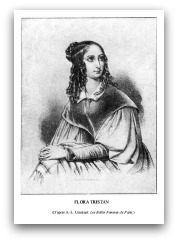
Flora Tristan (1803-1844)

Who was she? French reformer who campaigned for workers’ and women’s rights; grandmother to artist Paul Gauguin.
Key work: Peregrinations of a Pariah, about a trip she made alone to Peru to stake her claim to her family’s fortune.

from PEREGRINATIONS OF A PARIAH
Mr. Smith took me to the house of his correspondents, and here once more I found all of the luxury and comfort characteristic of the English. The servants were English, and like their masters they were dressed just as they would have been in England. The house had a verandah, as do all the houses in Lima, and this is very convenient in hot countries, as it gives shelter from the sun and enables one to walk all round the house to take the air. This particular verandah was embellished with pretty English blinds. I stayed there for some time and could survey in comfort the only long wide street which constitutes the whole of Callao. It was a Sunday, and sailors in holiday attire were strolling about; I saw groups of Englishmen, Americans, Frenchmen, Dutchmen, Germans — in short, a mixture from nearly every nation — and I heard snatches from every tongue. As I listened to these sailors, I began to understand the charm they find in their adventurous life… When I tired of looking at the street I cast a glance into the large drawing-room whose windows overlooked the verandah, where five or six immaculately dressed Englishmen, their handsome faces calm and impassive, were drinking grog and smoking excellent Havana cigars as they swung gently to and fro from hammocks from Guayaquil suspended from the ceiling.

Mary Anne Barker (1831 – 1911)

Who was she? Jamaica-born, England-educated author and journalist who with her second husband tried to run a sheep station in New Zealand (they later traveled to Mauritius, Western Australia, Barbados and Trinidad for his colonial appointments).
Key works: Station Life in New Zealand (1870); First Lessons in the Principles of Cooking (1874); A Year’s Housekeeping in South Africa (1880).

from STATION LIFE IN NEW ZEALAND
All this beauty would have been almost too oppressive, it was on such a large scale and the solitude was so intense, if it had not been for the pretty little touch of life and movement afforded by the hut belonging to the station we were bound for. It was only a rough building, made of slabs of wood with cob between; but there was a bit of fence and the corner of a garden and an English grass paddock, which looked about as big as a pocket-handkerchief from where we stood. A horse or two and a couple of cows were tethered near, and we could hear the bark of a dog. A more complete hermitage could not have been desired by Diogenes himself, and for the first time we felt ashamed of invading the recluse in such a formidable body, but ungrudging, open-handed hospitality is so universal in New Zealand that we took courage and began our descent. … We put the least scratched and most respectable-looking member of the party in the van, and followed him, amid much barking of dogs, to the low porch; and after hearing a cheery “Come in,” answering our modest tap at the door, we trooped in one after the other till the little room was quite full. I never saw such astonishment on any human face as on that of the poor master of the house, who could not stir from his chair by the fire, on account of a bad wound in his leg from an axe. There he sat quite helpless, a moment ago so solitary, and now finding himself the centre of a large, odd-looking crowd of strangers. He was a middle-aged Scotchman, probably of not a very elevated position in life, and had passed many years in this lonely spot, and yet he showed himself quite equal to the occasion.

After that first uncontrollable look of amazement he did the honours of his poor hut with the utmost courtesy… His only apology was for being unable to rise form his arm-chair (made out of half a barrel and an old flour-sack by the way); he made us perfectly welcome, took it for granted we were hungry — hunger is a very mild world to express my appetite, for one… I never felt more awkward in my life than when I stooped to enter that low doorway, and yet in a minute I was quite at my ease again; but of the whole party I was naturally the one who puzzled him the most. In the first place, I strongly suspect that he had doubts as to my being anything but a boy in a rather long kilt; and when this point was explained, he could not understand what a “female,” as he also called me, was doing on a rough hunting expedition. He particularly inquired more than once if I had come of my own free will, and could not understand what pleasure I found in walking so far.

Vivienne de Watteville (1900 – 1957)

Who was she? British writer and adventurer who accompanied her father on a safari in Kenya. After he was killed by a lion, she finished the trip on her own.
Key works: Out in the Blue (1927); Speak to the Earth: Wanderings and Reflections among Elephants and Mountains (1937).

from SPEAK TO THE EARTH
Finally, it was the boys themselves who pointed to the summit and said it was not very far.

Enviously, I admired the way they could climb. As for me, … I was badly spent; my knees trembled as I panted up through the reeling boulders. …

At last I climbed above the forest zone, passing beneath the last outposts — stunted trees ragged with beard-moss in whose chequered shade lay a carpet of tiny peas … whose blossoms were a lovely transparent blue. Above them flitted miniature butterflies, as though the petals themselves had taken wing. …

The top, when I at last reached it, was, after all, not really the top, and beyond a dipping saddle another granite head still frowned down upon me.

But meanwhile, below me the south side disclosed a grassing depression girt about by the two summits and bare granite screes; and amid that desolation the grass stretched so green and rural that you had looked there for shepherds with their flocks. Instead of which, on the far side of a quaking bog, I saw — grey among the grey slabs — two rhino.

… I drew to within forty yards of the rhino, yet they still looked like a couple of grey boulders as they browsed off an isolated patch of sere grass. …

The wind had risen to a tearing gale, and nosing straight into it I approached the rhino somewhat downhill. There was no chance of this steady blow jumping around to betray me, and it was strong enough to carry away any sound of my footsteps. Precaution was therefore unnecessary, and I walked boldly up to them. Just how close I was, it is hard to say; but I felt that I could have flipped a pebble at them, and I noted subconsciously that the eye of the one nearest me was not dark brown as I had imagined it, but the colour of sherry.

… he now came deliberately towards me nose to the ground, and horn foremost, full of suspicion. … In the finder [of my small cinema camera] I saw his tail go up, and knew that he was on the point of charging. Though it was the impression of a fraction of a second, it was unforgettable. …

… I read the danger signal, yet in a kind of trance of excitement I still held the camera against my forehead. Then Mohamed fired a shot over the rhino’s head to scare him, and I turned and fled for my very life.

M. F. K. Fisher (1908 – 1992)

Who was she? A preeminent American food writer, whose books are an amalgam of food literature, travel and memoir.
Key works: How to Cook a Wolf (1942); Map of Another Town: A Memoir of Provence (1964); Dubious Honors (1988); Long Ago in France: The Years in Dijon (1991).

from LONG AGO IN FRANCE
Monsieur Venot was a town character and was supposed to be the stingiest and most disagreeable man in Dijon, if not in the whole of France. But I did not know this, and I assumed that it was all right to treat him as if he were a polite and even generous person. I never bought much from him but textbooks, because I had no extra money, but I often spent hours in his cluttered shop, looking at books and asking him things, and sniffing the fine papers there, and even sitting copying things from books he would suggest I use at his worktable, with his compliments and his ink and often his paper. In other words, he was polite and generous to me, and I liked him. …

In Monsieur Venot’s shop I learned to like French books better than any others. They bent to the hand and had to be cut, page by page. I liked that; having to work to earn the reward, cutting impatiently through the cheap paper of a “train novel,” the kind bought in railroad stations to be thrown away and then as often kept for many years, precious for one reason or another. I liked the way the paper crumbled a little into my lap or my blanket or my plate, along the edges of each page.

Mary Lee Settle (1918 – 2005)

Who was she? American writer, novelist and expat, one of the founders of the PEN/Faulkner Award for Fiction.
Key works: “Beulah Quintet” novel series (1956-1982), about the history of her native West Virginia (and hence of America); Turkish Reflections: A Biography of Place (1991).

from TURKISH REFLECTIONS
I hadn’t heard anything move, yet he stood there in front of me, smiling, quite silent, a large strong Turkish man, holding in his hand a small bunch of sweet wild thyme. He held it toward me, saying nothing, still smiling. There was something so gentle about him that I could not be afraid. I took the wild thyme, and I thanked him, in Turkish. He smiled again and touched his mouth and his ear. He was deaf and dumb. I still have the wild thyme, pressed and dried, kept like a Victorian lady’s souvenir of the Holy Land.

Dumb was the wrong word for him. There was no need for speech. He was an actor, an eloquent mime. I pointed to the atrium below and held my hands apart to show I didn’t know how to get down into it. He took my arm, and carefully, slowly, led me down a steep pile of rubble.

He mimed the opening of a nonexistent door and ushered me through it. He showed me roofless room after roofless room after roofless room as if he had discovered them. …

I think he had scared people before, and he was happy that there was someone who would let him show his house, for it was his house. Maybe he didn’t sleep there. I don’t know. I only know that he treated me as a guest in a ruin ten feet below the levee of the ground, and that he took me from room to room where once there had been marble walls and now there was only stone, where he was host and owner for a little while.

He showed me a small pool, held out his hand the height of a small child, and then swam across the air. All the time he smiled. He took me to a larger pool and swam again. Then he grabbed my arm and led me through a dark corridor toward what I thought was at first a cave. It was not. He sat down in an niche in the corridor, and strained until his face was pink, to show me it was the toilet. Then he took me into the kitchen where there were two ovens. …

For the first one he rolled dough for bread, kneaded it in air, slapped it, and put it in the oven. Then he took it out, broke it, and shared it with me. I ate the air with him. …

When I gave my friend, my arkadaş, some money, he kissed my hand and held it to his forehead, and then, pleased with the sun and me, and the fact that someone had not run away from him who lived like Caliban in a ruin, he put his arms around me and kissed me on both cheeks. Then I went down the hill to Ephesus. When I looked back to wave he had disappeared.

STAY TUNED for tomorrow’s post, a tell-all from Kate Allison on what inspired her to create her fictional expat heroine, Libby.

If you enjoyed this post, we invite you to subscribe to The Displaced Dispatch, a weekly round up of posts from The Displaced Nation, plus some extras such as seasonal recipes and occasional book giveaways. Sign up for The Displaced Dispatch by clicking here!

Related posts:

Enchanting European escapes at the hands of Woody Allen, BBC & Jersey Shore(!)

I could easily have gotten in a crabby mood this summer while watching everyone (who’s anyone) escape the heat of New York City while I stayed put.

But what saved me, in addition to cocktails, were all the enchanting images of Europe on the big and small screen.

I could live vicariously through the works of film directors and TV producers who have packed up casts and crew and moved to foreign locales — all for my viewing pleasure.

So what if their works weren’t exactly exploring the kinds of themes that citizens of the displaced nation care about? We’re talking escape and enchantment here, and that means pleasant scenery, surely?

Woody Allen’s postcard Paris

Take, for instance, the new Woody Allen film, Midnight in Paris. I haven’t seen it yet but the trailer already has me in love with the idea of an escape within an escape, particularly as it involves Paris.

Woody’s hero, Gil, a disenchanted Hollywood screenwriter played by Owen Wilson, gets to escape to Paris — pretty nice even if he’s going as the guest of his pushy fiancée and her frightful parents. Especially as he gets to escape from them by traveling back in time to the sizzling city of the 1920s.

There he hobnobs with the brilliant expat crowd of that era, including on the American side, F. Scott and Zelda Fitzgerald, Ernest Hemingway, Gertrude Stein, and Cole Porter, and on the European side, Picasso, Salvador Dalí and T. S. Eliot.

In the course of this time-travel adventure, Gil picks up writing advice from Papa Hemingway and even has an affair with Picasso’s fictional mistress, played by the enchanting French actress Marion Cotillard.

But let’s get back to the scenery, which, to be honest, sounds like the real star of the film — or as one film critic put it:

What an enchanting movie — almost as enchanting as its location.

And indeed, the City of Light has never looked more glorious, from the opening montage of narrow streets, the Eiffel Tower and the Arc de Triomphe, to the vistas unfolding before Gil on his warm spring evening strolls.

Yes, it’s a mostly touristic view of the city, but that’s precisely what I’m after while living through a spell of hot, humid weather in New York City.

And speaking of New York, I’m further inspired that a kid from Brooklyn — someone who has always struck me as NOT being displaced — can abandon his hometown so completely in his twilight years. Woody Allen now seems to favor photogenic foreign locales for his films — e.g., London in Match Point and Barcelona in Vicky Cristina Barcelona.

Rumor has it that this is because New York has become too expensive and he’s found some European investors.

But even if Allen wasn’t yearning for it, he certainly seems to have been stimulated by his change of surroundings. I for one am still chuckling over Penélope Cruz’s constant defiance to speak English in front of her ex’s (American) girlfriend in VCB. Has Allen elicited that level of comic performance in an actress since Diane Keaton in Annie Hall? I personally don’t think so, and Oscar agrees with me!

The BBC’s postcard Rome


This summer PBS’s Masterpiece Mystery! carried a new crime series, Zen, produced for the BBC by Left Bank Films. The title refers to the hero, a Venetian-born Roman police detective by the name of Aurelio Zen (“Zen” is a Venetian way of shortening the surname “Zeno”).

Originally the creation of British crime writer Michael Dibdin, Zen attempts to bring justice to modern-day Italy whether the authorities — politicians, the Church, the Mafia — want it or not. (They don’t — and to make matters worse for poor Zen, his bosses, too, side with the outlaws.)

Now, Dibdin was as English as they come but he led a peripatetic life and wrote the Zen books after being an expat in Italy for four years, where he taught at a university in Perugia.

So we have him to thank for the chance to see some of Britain’s handsomest actors wearing sharp suits, talking sexy, and frolicking about in the Roman sunshine. I kept waiting for Rufus Sewell, who plays Zen, to wink at me as if to say, aren’t I lucky to be on this Roman holiday instead of making yet another London-based crime drama?

He even gets a dishy Italian girlfriend, played by the Italian actress Caterina Murino (see above clip).

As New York Times TV critic Gina Bellefonte observes,

The [Zen] films deploy a light comic sensibility and graphics that suggest a ‘60s caper. They situate us in a Rome where the weather always seems heavenly, blouses are always unbuttoned suggestively, and no lunch transpires without multiple courses and repeated instances of sexual innuendo. Risotto is eaten; cigarettes are smoked; espresso is consumed; public displays of lust are evident. There is little resistance to cliché in all this, but the cliché is so visually appealing that you’ll feel like a spoiled child if you complain.

Not to worry, Gina, I’m not complaining! A 1960s caper is exactly the kind of enchantment I’ve been so desperately seeking this summer.

Jersey Shore’s postcard Florence


Okay, I know I’m stretching the picture-perfect postcard idea here, but the fact is that MTV’s hit reality series — about eight housemates who spend their summers in a summer share on the Jersey shore — has opened its fourth season in Florence, Italy. It premiered on August 4.

And that’s a lot more enchanting than Seaside Heights, NJ, or Miami (where Season 2 took place) — I say that having never been to Seaside Heights or Miami, but still…

Ostensibly, Snooki, Vinny, and the rest are in Florence to find their Italian roots.

They certainly aren’t there to meet the natives, try the food, or tour the Uffizi or the Duomo. As New York Times TV critic Alessandra Stanley has it:

The road signs point to Florence but they should read “Welcome to the Jersey Shoro.” … Even in Florence, the producers are determined not to let anything under the Tuscan sun melt the parochial insularity of “Jersey Shore.”

But that doesn’t mean the rest of us can’t enjoy the setting, does it? Call me a snobbo, but watching Snooki, Sammi, Deena and Jenni negotiate the cobblestone streets of Florence in their six-inch leopard skin stilettos makes me appreciate the city’s quaint beauty even more.

And MTV has already announced that in the fifth season, the gang (many of the whom in fact hail from Staten Island or other outer NYC boroughs) will return to Seaside Heights. So for now, viva Italia — that’s what I say!

QUESTION: Can you recommend any more TV series or films that can serve as eye candy for the travel-starved this summer?

YouTube clips: Midnight in Paris trailer 2011, by MoviePediaTrailers; Rufus Sewell — Zen — Vendetta (2011) — Drinks, PrairieGirl1000; and Jersey shore season 4 sneak peek, by TheAdam419.

STAY TUNED for tomorrow’s post, a reprise of our popular post about seven deadly dishes — apparently, we didn’t kill enough of you off the first time around! 🙂

If you enjoyed this post, we invite you to subscribe to The Displaced Dispatch, a weekly round up of posts from The Displaced Nation, plus some extras such as seasonal recipes and occasional book giveaways. Sign up for The Displaced Dispatch by clicking here!

Related posts:

A glowing moment of enchantment in a displaced summer

Continuing this month’s theme on Enchanted Summer, contributor Anthony Windram weighs in with his opinion.

Elizabeth von Arnim, who wrote The Enchanted April, was right in selecting April as the month of enchantment. Spring charms me in a way that summer doesn’t. The budding boughs are full of fresh scents, to borrow from Christina Rossetti, and the land restores itself. Nature, in a universe governed by entropy, pulls off a majestic conjuring trick.

By contrast, I find summer a little unenchanting. Let’s face it, it’s not a good time for the English. We can’t really be trusted with summer. We should be banned from it, it’d be for the best. Pack us all up and send us to the Arctic for three months. That way we might avoid the collective fever that descends upon us where we dehydrate our bodies with copious quantities of lager and show off our sun blistered skin and bad tattoos.

So, as you probably have gathered, I’m not much of a summer fan and that hasn’t changed having now lived in places that have actual, proper summers as opposed to England’s illusion of a summer. I can usually be found in the summer months (when not enjoying a self-imposed seasonal exile in the Arctic) wandering from one airconditioned building to another. If I do have to venture out into the heat, I only do so after liberally applying sunblock (factor 100).

But this post is about enchantment with the summer, and it’s only when the sun has set and the temperature has lowered that such moments have occurred. I share Simon Wheeler’s thoughts on the sounds of crickets. To me, it’s a foreign sound. A memory of childhood holidays abroad. Hearing that rhythmic sound each evening reminds me that I am in a foreign country, and as I listen the everyday mundanity of my setting dissolves away.

I am not, despite what this post might suggest, an amateur entomologist. If anything, I have an immediate revulsion with most creepy crawlies, but my second summer enchantment also involves them and like the music of the crickets it was a fleeting moment that stripped me of cynicism and returned me to childhood. It was my first summer in the US, I was in my in-laws’ garden. I was listening to the crickets and feeling very happy with myself when an insect flew past me, its lower abdomen pulsating a yellow, illuminiscent light. I knew the answer, but I couldn’t be certain as I had never seen one before. “Is that a firefly?” I asked.

And where there had been one, there was another, and then another. Looking around, thrilled in the same way I would have been as a child, it seemed that there was a swarm of fireflies captivating me utterly — a glowing moment of enchantment in the summer evening.

DISPLACED Q: What’s your most enchanting memory of a summer spent in your adopted homeland(s)?

STAY TUNED for tomorrow’s discussion of The Displaced Nation’s themed posts.

If you enjoyed this post, we invite you to subscribe to The Displaced Dispatch, a weekly round up of posts from The Displaced Nation, plus some extras such as seasonal recipes and occasional book giveaways. Sign up for The Displaced Dispatch by clicking here!

Related posts:

Random Nomads to the rescue! How to have an enchanted August (1/2)

Ah, summer — what power you have to make us suffer…and like it?!

I don’t know about you, but I’m not liking the mid-August dog days very much. For a start, I’m getting tired of watching my own two dogs panting instead of playing.

Thus I’ve turned to The Displaced Nation’s Random Nomads to help me find things to like during the remaining weeks of Summer 2011, which doesn’t technically end until September 23.

Besides asking them to report back on how their own summers have been, I begged them to share some tips for escaping one’s surroundings at times when one can’t manage a physical escape. I recall from my own expat days (in the UK and Japan) that global residents develop superhuman-reserves of stamina (the Japanese call it gaman, or “enduring the seemingly unendurable with patience and dignity”) to sustain them during less-than-pleasant interludes.

And I wasn’t disappointed — no less than five USA/Europe-based Random Nomads have come to my rescue! They’ve answered these three questions:
1) What has been your most enchanting moment of Summer 2011 thus far?
2) What has been your least enchanting moment?
3) Do you have any survival tips for people who can’t escape?

And next week, we’ll hear from three more, all of whom hang their hats in Asia.

NOTE: If you haven’t read the interviews with these five people about their “displacement,” be sure to do so by clicking on their names. They, and their lives, are fabulously inspiring regardless of what season it is!

BALAKA BASU — USA passport; current home: USA (New York City)
Most enchanting:
Swimming at Sandy Hook in New Jersey. The water out there at Gunnison Beach is green and gorgeous; the waves are gentle and warm, and they lap round you like a soft embrace. Over in the distance, you can see the skyline of NYC, wrapped in haze. It’s truly lovely, the closest you can come to the Caribbean in the metropolitan area, I think.

Least enchanting:
WASPS (the insects)! They built five(!) hives in our car, and we had to suit up in full sleeves, veils and boots — full-on winter armor in heat-stroke inducing weather — to kill them with poison as they boiled out of their hives. Not cool. Not cool at all.

Survival tip:
Find a cheap(ish) hotel with a bar and an outdoor pool — someplace no tourist would ever visit. Bring towels, bathing suits, a great beach read, and plastic cups — and pretend you’re on beachfront property in some place awesome: e.g., “Jamaica” without the plane ticket.

VICKI JEFFELS — New Zealand passport; current home: England (Tadley, Hampshire)
Most enchanting:
England had a couple of days of really tropical weather back in July — I loved it. For a brief time there was the lingering smell of BBQ wafting around our neighborhood, and I was even able to lie down on a towel in the garden and safely fill up my vitamin D reserves. Ah, bliss!

Least enchanting:
The following week the temperatures plummeted and it looked as if that was all the summer we were going to get.

Survival tips:
Ah yes, right down my alley! Many of my neighbors and friends were finding it really difficult to sleep in the humid weather, not helped at all by the BBC advising everyone to close their curtains! Whaaat? When you find it difficult to sleep, I advise a tepid (not cold!) shower to lower the body temperature before sleep. If possible (I know it’s not always possible), take a dip in a swimming pool — that’s ideal.

PIGLET IN PORTUGAL — English passport; current home: Portugal (Algarve)
Most enchanting:
To date, there are two special moments. Can I have two?

Yes, OK. Great!

Actually, one is magical and the other enchanting. Both slightly predate the summer months, but the effects still linger.

The most magical moment was the birth of our first grandchild, Lily-May, on the 28th of April in France. We drove as if possessed for two days from Portugal across Spain to the South of France to see her. Although I am not maternal by nature (I’m more of a practical Mom), when I held her in my arms for the first time, my heart melted. As recorded on my blog, she’s adorable!

The most enchanting moment was when I was singing to her and she gave me a big smile. Poor little thing — my singing is not that tuneful; I think she felt sorry for me!

Least enchanting:
The least enchanting because most worrying moment of Summer 2011 was the way our daughter’s health deteriorated after giving birth. Despite various consultations with doctors about the excruciating pain and the ongoing urine infections she was experiencing, they just prescribed antibiotics rather than trying to find the root cause. The local GPs were totally clueless! However, the answer quickly became apparent once her husband insisted she go to hospital for a proper examination. The maternity ward doctor, upon examining our daughter, quickly discovered that medical compresses, now rotting, had been left inside her! Once these were removed, she began to recover. But had they remained, I have since been informed septicaemia would have set in, with devastating consequences for both our daughter and breastfed baby granddaughter.

Survival tips:
This is difficult because adverse weather conditions to some could be absolute heaven for others. Weather, I tend to take as it comes as it is out of my control.

My own great escape would not be from the weather but from tourist areas. Living in a tourist area myself, I have renamed tourists “terrorists” because many leave their manners and consideration for others at home. They literally do “terrorize” the locals!

 Personally, I love wild and natural places far away from the mass concrete high-rise hotels, with rows of sun beds and parasols lining the beaches.

My idea of heaven is to take a picnic, a bottle of chilled white wine, our comfy chairs and a parasol down to one of the unspoilt beaches for a “sun-downer.”

Yes, there are other people there in July and August, but we all seem to appreciate the luxury of freedom from tourists, and peace…

So, if you are coming to the Algarve on holiday please check out some of my
“secret beaches.” I can show you how to escape the “maddening” crowds!

JACK SCOTT — British passport; current home: Bodrum, Turkey
Most enchanting:
Bodrum is the most secular and modern of Turkish towns. It’s where people come to escape the conformity of everyday Turkish society. Normal social rules don’t apply. However, scrape the surface and you will find magic of a different kind.

This summer, we were visiting a friend, a thoroughly modern Millie, who lives just a few hundred meters behind the bustling marina with its luxury yachts and raucous watering holes. Her home is set within a traditional quarter of whitewashed buildings huddled together along narrow lanes.

As we approached her door, we noticed an elderly neighbor dressed in traditional livery of floral headscarf, crocheted cardigan and capacious clashing pantaloons. She sat cross-legged in a shady spot of her bountiful garden and was busy plucking a fleece.

Being city boys and largely ignorant of country ways, we asked our friend what the old lady was doing. She was preparing the wool for hand carding, straightening and separating fibers for weaving on the spinning wheel she kept in her house.

She hummed as she plucked, happy under the cool of an ancient knotted olive tree and doing what women have done in Turkey for millennia.

Now you don’t get that in Blighty.

Least enchanting:
We were wandering down Bodrum’s bar street, a procession of cheap and cheerful bars and hassle shops.

We normally rush by; casual shopping in Turkey can be a bruising experience best only tried by the foolish and heroic. The cheaper outlets employ aggressive teenagers in tight, bright, white shirts to drag gullible punters in from the street. A firm refusal elicits a bellicose riposte. The posher shops employ mostly female staff whose sales technique is softer but no less annoying. Speculative browsing is unbearable when tailed by KGB-trained assistants and you are made to feel like a serial shoplifter.

On this occasion my partner, Liam, popped into a corner shop to buy some cigarettes. Keen to use the local lingo, he asked for them in very passable Turkish. The po-faced assistant looked at him blankly. Liam repeated the request. Another blank look. After a brief standoff, the assistant relented and repeated the order in English. He threw the cigarettes at Liam, snatched the payment and slammed the change on the counter.

Welcome to Turkey, where hospitality greets you at every corner. I know there are arse-holes in every country — but next time we’ll just shout loudly in English.

Survival tips:
During the height of the summer we’re like camp vampires and only venture out after dark. Earlier in the season we found ourselves sweltering in 40+C (104+F) heat with no air conditioning. Because our pretty little cottage has 18-inch thick stone and concrete walls it took us weeks to find a technical solution. In the meantime, I received a host of suggestions to help us through the sleepless, sweaty nights. I’d like to share a few:
• Wrap a gel-type freezer pack in a wet tea-towel and apply it to your hot bits (and watch them shrink).
• Buy a floor-standing industrial fan (but nail everything down).
• Bathe your feet in an ice bucket (and develop frostbite).
• Take a cold shower (except the cold water is hot at this time of year).
• Sleep on a wet towel (and rot the mattress).
• Decamp to the roof (and get eaten alive my mozzies).
• Emigrate to Sweden?!

SIMON WHEELER — English passport; current home: Slovakia (Plavé Vozokany)
Most enchanting:
I love the sound of the crickets chirping. Whenever I left for holidays from England as a kid, that sound always meant I was away and exploring. Now I have them every summer’s night, and I still cannot get used to it. I still get that thrill of being in a new place…

Least enchanting:
Mosquitoes — they love every bit of me!!!

Survival tip:
I’m afraid I need a physical escape from our 35C (95F) “phew, what a scorcher!” summer. Fortunately, one is available in North Slovakia — in the Tatra Mountains, on the border between Slovakia and Poland. Just a stunning part of the world, very quiet, largely undiscovered, a place that exudes old-fashioned peace. Being that bit higher in altitude, the temps are perfect.


STAY TUNED for tomorrow’s Displaced Q on enchanting expat summers.

If you enjoyed this post, we invite you to subscribe to The Displaced Dispatch, a weekly round up of posts from The Displaced Nation, plus some extras such as seasonal recipes and occasional book giveaways. Sign up for The Displaced Dispatch by clicking here!

Related posts:

CLASSIC DISPLACED WRITING: Joy in the place — Elizabeth von Arnim

The novelist Elizabeth von Arnim (1866-1941) wrote many enchanting books, all of which were autobiographical to some extent, linked to persons or places she knew.

But does that necessarily mean that Elizabeth — born Mary Annette, nicknamed May, she called herself “Elizabeth” upon becoming a professional writer — led an enchanted life?

Yes and no. By all accounts, she was an enchanting person herself, constantly delighting other people with her sharp wit.

She also kept enchanting company: E.M. Forster was tutor to her children, Katherine Mansfield was her adopted cousin, and H.G. Wells was one of her lovers.

Displaced almost from birth (she was born in Kirribilli Point, Australia, and then moved to England at the age of three), she made a life-long habit of flitting from one enchanting locale to the next.

Having spent her formative years in London, she moved to Pomerania in Prussia (Germany) for her first marriage, where she raised five children.

Upon the death of her husband in 1910, she made her home in the Valais, Switzerland, living in a glamorous house, Chalet Soleil, which she’d built from her riches as an author.

With the failure of her second marriage, Elizabeth zigzagged between homes in the United States and Europe.

She died in Charleston, South Carolina.

A full measure of sorrows

But a peripatetic life isn’t always a charmed one, as many of us expats and former expats can attest. As her life progressed, Elizabeth experienced a full measure of sorrows.

Her first marriage — to a domineering Prussian count — wasn’t particularly happy. She nicknamed him the Man of Wrath, and they separated several years before his death.

Her second marriage, to Frank Russell, elder brother of Bertrand, was even more miserable (he proved to be a despotic egoist).

Her only true love she met when she was 54 — and he was nearly 30 years younger. (They never married.)

She also suffered the grievous deaths of a daughter and a brother.

By the time she died, Elizabeth was estranged from most of her children, crippled with arthritis, and almost forgotten by her adoring public.

Her only devoted companion was her dog, Billy.

Escape artist par excellence

But despite these tribulations, Elizabeth remained throughout her life, in the words of gardening writer Deborah Kellaway,

a steadfast hedonist, firmly suppressing sorrows. … Her journals and letters repeatedly record moments of happiness, usually associated with sunny days.

As Elizabeth once wrote in a letter to one of her daughters,

“What I really am by nature is an escapist.”

Thus what we can learn from Elizabeth’s life — and from her many autobiographical books — is the art of escaping into happier worlds.

As Kellaway explains:

[The heroines of her novels] escape from richness into the simple life, or from conventional home life into foreign travel; they escape from houses into caravans.

The most famous example, of course, is Elizabeth’s 1922 novel, The Enchanted April — from which we’ve taken our theme of enchantment on the blog this month.

As everyone knows who has read that book — or, more likely, seen the 1992 film or the 2003 Broadway play — four women who share only their unhappiness and a love of wisteria flee 1920s London and converge in Portofino, Italy, on a magical medieval villa overlooking the Mediterranean.

Simple pleasures are the best?

But while Italian castles can certainly be a tonic — if offered one, I’d be off like a shot — what most people don’t know is that Elizabeth was equally fond of much simpler escapes. In the first two books that made her reputation as a writer, the heroine escapes her marital, motherly and household duties by venturing into a German garden, set in a wide landscape.

Here is the most lyrical passage from the second of these, The Solitary Summer (1899):

Yesterday morning I got up at three o’clock and stole through the echoing passages and strange dark rooms, undid with trembling hands the bolts of the door to the verandah, and passed out into a wonderful, unknown world. I stood for a few minutes motionless on the steps, almost frightened by the awful purity of nature when all the sin and ugliness is shut up and asleep, and there is nothing but the beauty left. It was quite light, yet a bright moon hung in the cloudless, grey-blue sky; the flowers were all awake, saturating the air with scent; and a nightingale sat on a hornbeam quite close to me, in loud raptures at the coming of the sun. …

It was wonderfully quiet, and the nightingale on the hornbeam had everything to itself as I sat motionless watching that glow in the east burning redder; wonderfully quiet, and so wonderfully beautiful because one associates daylight with people, and voices and bustle, and hurrying to and fro, and the dreariness of working to feed our bodies, and feeding our bodies that we may be able to work to feed them again; but here was the world wide awake and yet only for me, all the fresh pure air only for me, all the fragrance breathed only by me, not a living soul hearing the nightingale but me, the sun in a few moments coming up to warm only me…

A lovely garden at just the right time of day — as I know from my own experience of enduring many city summers*, that’s all it sometimes takes to escape into happiness.

*On that note, I’d like to recommend a walk on the High Line in early morning or late afternoon, to anyone living in or traveling to New York City this month…

QUESTION: What does it take for you to escape the dog days of summer into happiness: a trip to Italy, a walk in the garden — or something else?

STAY TUNED for tomorrow’s post, on our new weekly newsletter, The Displaced Dispatch.

If you enjoyed this post, we invite you to subscribe for email delivery of The Displaced Nation. That way, you won’t miss a single issue. SPECIAL OFFER: New subscribers receive a FREE copy of “A Royally Displaced Tea.”

Related posts:

How foreign is Fez? A travel yarn in two parts (Part 2)

We welcome back Joy Richards to The Displaced Nation for the second part of her travel yarn about a trip she made in May to visit a British expat friend in Fez, Morocco. In Part 1, Richards learns about the Moroccan concept of hshuma (forbidden, shameful) and reveals she rather likes “covering up.” In Part 2, she discovers she has an innate bargaining instinct while shopping in the Fez medina, but then an incident occurs on a day trip to the Roman ruins that gets her thinking…   

My traveling companions and I are about to go shopping in the Fez medina (walled city), and I wonder to myself: is this how I might feel if I were to attend a football match in England as a lone woman? Actually, women are even less obvious in Fez than they are in British football stadiums.

Morocco prizes its reputation as a “modern” country. It is so modern that the King of Morocco took a computer engineer from Fez, Salma Bennani, as his wife.

However, here in the Medina, where women wear traditional dress and all of the shopkeepers are male, the occupation of the King’s wife seems beside the point.

Shopping until you, or the price, drop

Not as confrontational as football but requiring almost as much as strategy and skill, shopping in Fez is an interactive game. Rarely will any item have a price tag on it, so buying does not happen quickly. Typically, the interchange goes something like:

“How much is this?”

“It is very beautiful.” Seller places the item into your hands. “You like?”

“It depends how much it is.”

“I give you best price. I give you very good price because your friend lives here.”

“What is your best price?”

“She” — gesturing to my friend — “is like family. I give you best price.” Seller begins to wrap the item.

“Don’t wrap it. How much is it?”

“200 dirhams, very good price, best in medina.”

“No, too expensive.”

“No, very good price.”

“100 dirhams.”

“No no. 200 dirhams best price.”

“Ok. No thank you.”

“For you 190 dirhams. Yes.” Begins wrapping again.

“No. Too expensive. 150 dirhams…”

This will continue, and may include either buyer or seller declaring that they are no longer interested and even walking away, until a price is agreed. Probably around 170 if the starting point is 200.

I start bargaining for a scarf, and somewhere through the process, I lose sight of the exchange rate and feel that haggling for ten minutes to get a reduction of 10 dirhams (about 70p) is worth it.

So I take the scarf and put it in my bag with the rest of my loot, the result of a morning’s hard bargaining.

As someone who has haggled over the price of a laptop in PC World (the UK’s largest computing store) — and done so successfully — I have slipped into this mode of shopping rather easily.

Somewhere in my memory is my Mum’s belief that any shopkeeper would “rob you blind if given half a chance.” As a child, shopping was frequently interrupted by Mum asking for a reduction in price on the basis of some imperceptible fault or inadequacy with the proposed purchase. Obtaining the reduction was accompanied by a sense of pride and challenging social injustice.

Ah, Mother, you would have been proud of me.

However as one of my traveling companions points out: “We are not in Kansas any more!”

No, not in Kansas, or in Northampton where my parents lived and I grew up — but I reckon my Mum could have popped on her headscarf, picked up her handbag and got her week’s shopping at a good price.

Mind you, she probably wouldn’t have bought her sausages at the stall with the camel’s head hanging up.

An excursion, and a close encounter

My English friend who lives in Fez suggests that we venture into the countryside to visit nearby towns and the amazing Roman remains of Volublis. We have a great day out. The roads are chaotic, and we feel fortunate to have a friendly and helpful driver, Mustapha, who repeatedly saves us from serious accidents.

But then, as we are driving past the orange farms on our way back to Fez, the police pull us over.

Mustapha has been talking to the police officers for some time and is clearly becoming agitated. He comes back for his wallet and informs us they claim he was speeding.

My friend asks him in Arabic if he has to pay a “back hander.” Yes, he has to pay 200 dirhams (probably 2-3 day’s pay for him).

He goes back over with the money, and the discussion grows even more heated. When he finally comes back, he reports that the policeman said: “You and your f***ing taxi with your f***ing tourists! You should pay 500 dirham. Perhaps we will get you stopped again.”

“These are our police,” he shrugs. “They do what they want and make money for themselves. We cannot trust them, and they are part of our government. It is not right.”

At that very moment, a 1965 country song by Roger Miller, telling of a swinging England with “bobbies on bicycles two by two” pops into my head. The reality it depicts is of course a long way from today’s Britain, where our police are accused of using excessive force in managing demonstrations and of taking payments from journalists for information.

But even if the British law enforcement system isn’t all squeaky clean, I know that when my partner was done for speeding recently, it was not due to the whim of a corrupt police officer. The evidence was fair and reliable, and the fine went to the court — not into the pocket of any policeman.

A plethora of questions, and precious few answers

I’ve been in Fez for a couple of days, and I still have very little idea of the forces that govern people’s behavior: the modern state and its representatives, the traditions of the medina and the controls of hshuma, or both?

Many Westerners are now living in Fez, some of whom are buying up cheap traditional properties. I wonder how they perceive fitting in to the future of this medieval city.

Reviewing the events of the past couple of days, I realize I have many more questions than answers:

  • Was it simply an accident that one of my female friends, who refused to be hshuma-ed out of smoking on the street, got hit on the hand by a stone?
  • Why does the babysitter my friend employs for her daughter, Francesca, have to stay the night rather than walk home through the medina?
  • Will the young boys who, according to some expat observers, sniff glue — and who now have access to satellite TV — uphold the traditional values? How many of Morocco’s young men respond to the call to prayer?
  • Moving on to the country’s young women: how do they make sense of the various and contradictory influences on their lives — and decide what to wear? What do they want, and are they allowed to want it?

The friend whom I visited, who is English and a single mother, told me that as a Western woman, she is a “third sex” in the Fez medina, neither male nor female in terms of what she is allowed and expected to do. She sees opportunities in this strange and wonderful place that would not be there for her in England. She also acknowledges that there will be a point when this way of living is too claustrophobic for her and Francesca.

Overall, Fez is a “find” for a tourist like me — I was delighted to find somewhere so exotic and so accessible from Britain. And, if I step back into my memories of traditional working class culture of the 50s and 60s, I think that we Brits were not always so different to the people of Fez medina. Our world has changed, and theirs is apparently changing now as well.

Or is it? I am left with a feeling that modernity poses a considerable threat to those living and working in this walled city, many of whom would find it easier to maintain the status quo of a traditional Muslim culture.

Would I go back to visit? Yes. Would I live there? No. When I said good-bye to my friend, I was sad to leave her. Our visit had been memorable as well as highly stimulating. I hope she can continue to live safely in her chosen city, and I also hope, and pray, that if the cracks in this fragile society become too wide, she will notice them and remember as Dorothy said, “There’s no place like home.”

Images (top to bottom): The markets of the Fez medina; camel meat for sale; the ruins of the Roman town of Volubilis (Oualili); and the Royal Palace at Meknes, about 60km north of Fez.

STAY TUNED for tomorrow’s interview with Australian author Gabrielle Wang, whose books for children and young adults encourage them to broaden their cultural horizons.

If you enjoyed this post, we invite you to subscribe for email delivery of The Displaced Nation. That way, you won’t miss a single issue. SPECIAL OFFER: New subscribers receive a FREE copy of “A Royally Displaced Tea.”

Related posts:

Marriage, cross-cultural style: Two veterans tell all (Part 2)

A week is a long time in blogging, and since Part 1 of this post went up last Monday, horrifying events in Norway have delivered a chilling reminder of the venom that can be unleashed when cultures mix and values clash.

Thus I am full of renewed admiration for our two married couples — Gabriela & Daniel Smith, Jeffrey & Naoko Huffman — who have tested themselves more than most on cultural tolerance and openness.

Last week, we heard from Gabriela and Jeffrey, the nomadic halves of each partnership. Let’s introduce them again — along with their better halves, who this week have kindly agreed to “come in” and answer a few of my questions.


GABRIELA & DANIEL SMITH have been married for eight years. Gabriela was born in Venezuela to Spanish parents, but ended up in the UK, where she met Daniel and they currently live.


JEFFREY & NAOKO HUFFMAN have been married for 19 years. They met in Nagoya, Japan, where Jeffrey, an American, had journeyed for his work. They now live in Seattle.

Naoko and Daniel, I’d like ask you both a question I posed to your respective spouses last week: did you ever think you would marry someone from another culture?


NAOKO: My parents expected that I would agree to an arranged marriage, and when growing up, I thought I would do as they told me. But then I attended an English as a Second Language (ESL) program in San Francisco. After meeting lots of people from different countries, I became more open to the idea of an international marriage. But I don’t think I chose Jeff as my husband because he is a foreigner. I just wanted to be with him and spend the rest of our lives together.


DANIEL: I was drawn by Gabriela’s Latin charm, but what attracted me to her primarily was her personality and way of looking at life. I never experienced any inhibitions about asking her to marry me. I assume that whatever the background of your partner, if you make the decision you love someone and want to be with that person forever, there will always be a considerable amount of risk — as in not knowing how each person will change and how their values and perceptions will evolve. In reality could the “girl next door” be a higher risk? For example, I now know what it feels like to be an expat from having worked for six years in France, but I had no way of predicting my life would take that path.

How did you find your new in-laws?


NAOKO: Jeff’s parents were nice to me from the beginning, even though my English wasn’t good enough to communicate with them on a deep level. But while they treated me with respect, I think they were also wondering how Jeff’s two grandmothers would feel about me.


DANIEL: On our first visit to my new parents-in-law, the only true reservation I had was based on what type of food I would be offered and if there was a different etiquette I would be expected to follow. Navigating the new culture proved relatively straightforward, although I did discover that calamares — whether fried, baked or stewed — isn’t fit for human consumption.

Let’s bring in all the partners now and talk a little more about family life. As mentioned in Part 1, each of you has two kids, a girl and a boy. What’s been the biggest challenge in bringing up kids from two different cultural backgrounds? Have they adopted one of your cultures more than the other?


JEFFREY: At 9, I think our son is too young to have much “cultural consciousness.” He has Asian American, African American, and Muslim American classmates. He’s aware of the general differences, but none of it seems to matter at this point — although he was rooting for Japan, not the U.S., to win the women’s World Cup.

Our daughter, on the other hand, is quite proud of her Japanese heritage — while not being particularly well versed in the culture. She has at least four other haffu classmates and lots of Korean American and Chinese American classmates. Of her best friends, one is African American, and another is a half-Phillipina girl whose adoptive mother is a lesbian. Her cohort gives me hope for America’s future as an open and tolerant society.

Neither Naoko nor I is religious, so that’s never been much of an issue — less so, however, with my mother, who is Christian and probably believes we’re all going to hell.


NAOKO: I had a concern about how our kids would feel about being Japanese when they learned about WWII. But they just accepted as a fact and were okay with it. I was impressed. I do wish we’d started them on Japanese language training earlier, though. Our daughter was only 18 months old when we moved back to the U.S. After that, I stopped using Japanese at home and soon returned to work full time. They are just now beginning formal Japanese-language instruction.


GABRIELA: I was born in Venezuela to Spanish parents and have never been able to choose between my two — Spanish and Venezuelan — heritages. Perhaps our children will just take the best from each of these cultures, and from English culture. No doubt their choices will be influenced by where they live, the type of people they meet, and how they position themselves in the world. I don’t know if they will feel more one or the other, especially if we live in a neutral third country, which as I mentioned last week is our goal. Right now, for example, my daughter says she is French because she was born in France. I’m happy with that.


DANIEL: I don’t find it challenging at all to bring up children who are a mix of cultures. Of course I’m always noticing their Spanish looks and ways, inherited from Gabriela.

How about for meals? Do you try to blend your cultures in the foods you prepare for the family? Who cooks?


JEFFREY: We eat as much if not more Asian/Japanese food as we do Western. Our son would eat soba and shumai seven days a week. We both cook.


GABRIELA: I cook for our children and my husband cook for the two of us. Since I’m not much of a cook, my kids have to eat my invented meals (bless them!), and as for my husband, well, I let him decide what he wants to make. I just enjoy it and do the washing up afterwards! He occasionally makes Venezuelan and Spanish meals, perhaps as often as he does English ones.

Jeff and Naoko, do you think you’ll ever move back to Japan? Last time, Jeff hinted that you might like to one day.


JEFFREY: The longer we’ve been back in the U.S., the harder it’s become for us to return to Japan. That being said, even in today’s economy, Naoko would have little difficulty finding work in Japan — she’s in finance. Whereas I’m pretty much unsuited to anything in Japan that would pay all that well. The kids, particularly our daughter who is just entering high school, would probably mutiny as well if we uprooted them at this point. Maybe after retirement?


NAOKO: Jeff keeps telling me to get posted to London, so perhaps we could give that a try?

Gabriela, how often do you get back to Venezuela to see family and friends?


GABRIELA: The last time I visited was three years ago. After that, I decided not to go back due to the political situation and have been relying on telephone calls and the Internet to keep in touch. But, to be honest, I don’t communicate with my family all that often. I have been away 14 years, so am used to the distance.

How about your kids? Actually, that’s a question for Naoko, too, since both of you are living away from the countries where you grew up.


GABRIELA: Only some of my family come to the UK and visit, usually just once a year for a few days. Those are the only times my children see them.


NAOKO: We haven’t been able to go back to Japan as often as we would wish since it’s so expensive for a family of four to fly there. Over the last five years, we’ve gone back every other year. But from now we’ll be making more of an effort to visit my parents since my father is not doing so well. My family always talks about coming to see us in Seattle, but they haven’t done it yet. Only my mother has been here — for my wedding, 19 years ago.

Finally, we are honoring Pocahontas this month at The Displaced Nation for her expertise in cross-cultural relations. I’m wondering if each of you could offer some advice to other couples in cross-cultural relationships — preferably in the form of a Native American proverb.


GABRIELA & DANIEL:

Cultural barriers are in the eye of the beholder.


JEFFREY & NAOKO:

For cross-cultural marriage to work, there can be no shortcuts. Each partner must accept the other’s culture.

Warm thanks to both of our couples for allowing their marriages to be put under The Displaced Nation’s microscope for two weeks running. Readers, do you have any more questions or comments?

STAY TUNED for tomorrow’s post, Part 2 of the travel yarn “How foreign is Fez?” — by guest blogger Joy Richards.

If you enjoyed this post, we invite you to subscribe for email delivery of The Displaced Nation. That way, you won’t miss a single issue. SPECIAL OFFER: New subscribers receive a FREE copy of “A Royally Displaced Tea.”

Related posts:

How foreign is Fez? A travel yarn in two parts (Part 1)

We welcome Joy Richards to The Displaced Nation as a guest blogger. Though she lives and works in the town of Harrogate in North Yorkshire, UK, Richards seizes the opportunity to travel whenever she can. In May, she journeyed to Fez, Morocco, to visit an English friend who lives in that city. It was her first foray into North Africa and her first time in an Arab country. Richards found herself thinking deeply about one of the topics raised in our blog this month: the challenge of bridging two cultures that have developed separately over thousands of years and therefore do not share the same basic beliefs and values.

My trip to Morocco was full of uncertainties. I was traveling with two friends I had worked with in the past but had very little contact with in the last three years. God bless Facebook for bringing us together again — but I was unsure how holidaying together would work.

We were staying with another ex-work colleague who lives as a single parent with her little girl in the ancient medina (walled city) of Fez. She has lived here for about three years earning an income by arranging tours for visitors to experience the food of Fez. I knew nothing about her home and again had not had any regular contact in three years.

But most worrying of all, we were traveling not long after the major events of the Arab Spring and only a few weeks after the suicide bomb in the main square of the Moroccan city of Marrakesh. Would our short time together be safe and enjoyable?

As the plane landed in Morocco, I immediately noticed the sun was unlike the British sun. It had “photo-shopped” the scenery around me to the maximum color intensity, contrast and brightness.

The black glove treatment

Screwing up my eyes in the late afternoon light, I walked into the small and crowded airport and began queuing for immigration. Ability to queue is clearly a skill shared by Brits and Moroccans.

By the time I got to the baggage area, I could see that that the Moroccan women from our flight were all more covered than when they had left England. (My female friend and I had taken advice from our host in Fez and had traveled in trousers and loose tops with sleeves.)

One lady was totally covered — including her hands, which were in black gloves. As she chatted to her small son in Arabic and he replied in English, with a slight northern accent, it was not the veil or the long black gown that looked strange to me, but the gloves.

Black gloves on a hot May afternoon in an airport in Morocco — and yet I’m old enough to remember summer gloves. Lacy or nylon with a frill, they were worn for church and weddings, even for parties. Polite British gloves worn by polite, fashion-conscious British women in the 1950s and 1960s.

But soon my travel companions and I would be slipping back in time much further than the 50s or 60s, as our taxi dropped us at the entrance to the world’s most intact Islamic medieval city, the Fez medina.

The winding mysteries of the medina

Our friend and her little girl, Francesca, met our little threesome at the gate. We plunged head on into narrow, crowded alleyways full of donkeys, skinny cats, open fronted shops, chickens, vegetables… There were children playing, men selling — and so many smells.

Fez’s medina is said to be the world’s largest contiguous car-free area, and no wonder. Cars couldn’t have squeezed through even if allowed.

I was excited, confused, aware of being female and English and of not knowing this place.

I had read my guidebook, which warned of unwanted and persistent attention from shopkeepers and “faux guides,” and walked on purposefully, not making eye contact with any of the locals. I determinedly ignored every greeting whether in Arabic, French or (occasionally) in English.

My friend and her daughter had clearly not read the same guidebook as they stopped and chatted to several men on the way to their house.

As we turned up a narrow, dusty alley which was to take us to my friend’s house, there was another greeting shouted by a man on the street: “Welcome to Fez.” And then: “Welcome to Fez, family of Francesca.”

I turned, smiled and said hello. Suddenly it had dawned on me that intense, close living in this way required constant greeting. Relationships must be established and confirmed for everyone to feel safe and comfortable.

My friend’s home, at the end of a dark alley, was deceptively unappealing. Inside, it turned out to be a beautiful traditional house decorated with carved wood and traditional Moroccan tiles. That evening, we talked and ate and drank wine as friends do.

Our hostess had bought the wine in one of the large modern supermarkets in the Ville Nouvelle — the modern and rapidly developing part of Fez that has spread out around the Medina.

Alcohol is not illegal in the Medina but is disapproved of. Or, to put it in the Moroccan Arabic dialect (Dirja), alcohol is hshuma (pronounced h’shoo-mah). A very useful phrase, it’s equivalent to a very loud British “Tch, tut, tut” (or the American tsk-tsk) — but, unlike our expressions, hshuma carries the further connotation of being shamed by one’s peers. It’s used when someone has been drinking, smoking, hanging out at a café (women, mainly in small towns), wearing shorts (men or women), dancing with the opposite sex, or engaging in other forbidden acts.

My friend had been heard “clinking” as she tried to get a taxi back to the medina and was evicted from the cab as she had alcohol with her — hshuma.

I work as a psychotherapist and much of my work includes challenging personal shame and its destructive effects, but here in this intense and exotic environment the social control of hshuma in some ways made sense, as a way of navigating the social structure.

Thank goodness for my mum and her directives

The following day my friends and I set out into the Medina, shoulders and legs covered so as not to offend and not to attract unwanted attention.

As foreigners we would not be expected to wear the djellaba (traditional long, hooded outer robe) and headscarf of the local women. Nevertheless, we were expected to be discreet. Skimpy clothes would be hshuma.

My mother brought me up with a good understanding of what was “common” as well as a clear directive that I was not to be “common.” The list of “common” characteristics and behaviours could fill several pages but included: dyed hair, bright lipstick, exposed cleavage, short skirts, a “lot of thigh,” swearing, smoking in public, bare shoulders (unless at the seaside or a dinner dance).

Any woman being common is this way was “no better than she ought to be” and would probably “get into trouble” (some sort of sexual misadventure).

So, stepping out into the medina, I was able to apply my mother’s rule about not looking “common” so as not to be socially ostracized.

A throwback or a step forward?

I wrestled with trying to decide if I minded applying these guidelines to myself in this traditional, Muslim city. Was I being respected or controlled?

I have been, in my youth, a dedicated follower of fashion and have worn mini-skirts, hot pants and many other items of clothing that exposed my body to the casual view of all.

Even now, as a woman of a certain age, I know that I can attract male attention with a bit of cleavage. That is, of course, my choice — but what is the message the Western media delivers to women of all ages? We must be young, slim and, above all, sexy. Boobs, booty and thighs…get them displayed.

So what was the message in the Fez medina? Women’s bodies are private, respected, not to be displayed.

I don’t like being told what to wear, but I realized that I — and I can only speak for myself — felt more comfortable and relaxed with less of my flesh exposed.

As a Western woman, I am glad that I am free to be divorced (as I am) and to have a career (as I do). But does that mean I want my granddaughters to be free to put their bodies on display when they are pubescent, as so many British girls do?

As I hear the call to prayer echoing over the medina, I am being prompted to challenge my assumptions about, my expectations of, this society.

I am an outsider, and as a non-Muslim I can only peer through the entrances into any of the mosques in the city, catching glimpses of beauty and faith, unquestioning perhaps — Inshallah (as God wills it).

My will, society’s will, God’s will — that requires a lot of untangling.

Images (clockwise from top left): The gateway into the Fez medina; a chick-pea salesman inside the medina; Richards’s mother, Thelma Browett, in headscarf while on holiday in Scotland (taken by Ron Browett); and the inner courtyard of the home where Richards stayed in Fez.

STAY TUNED for next week’s installment of Joy Richards’s travel yarn, and on Monday, for Part 2 of “Marriage, cross-cultural style: Two veterans tell all.”

If you enjoyed this post, we invite you to subscribe for email delivery of The Displaced Nation. That way, you won’t miss a single issue. SPECIAL OFFER: New subscribers receive a FREE copy of “A Royally Displaced Tea.”

Related posts:

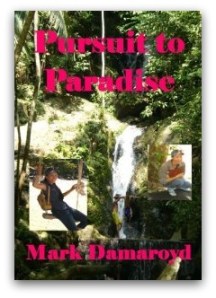
In fiction and in life, this expat pursues paradise

As regular readers of The Displaced Nation will know, Pocahontas is the heroine of our blog this month. Sprightly, playful, well-featured and solicitous — unencumbered by the corrupting influences of civilization, in tune with Nature — she, and other women of her ilk, conformed to the vision Europeans held of the New World.

They were also the subject of many a European man’s romantic fantasy.

After meeting a Pocahontas, a European could brag to his friends back home that he’d found Paradise on Earth.

Flash forward almost four hundred years, and we find something similar going on with certain groups of international travelers. I speak of those who are restlessly searching for places that have yet to be touched by Western materialism and other corrupting ideas — where people lead simpler lives and are more decent.

And for male travelers, that vision usually encompasses finding their own Pocahontas: a native woman with long, dark hair, who unlike her Western sisters, still knows how to care for a man…

Mark DamaroydAgainst this background, we welcome author Mark Damaroyd to The Displaced Nation. As an expat in Thailand, Damaroyd lives — and has written about — the utopian life to which no small number of men who’ve ventured into foreign countries aspire.

His first work of fiction, published in 2010, is called Pursuit to Paradise. Described by one reviewer as a “tale of romantic intrigue that keeps the pages turning,” the novel takes place in Thailand and the UK, and centers around an Englishman’s relationship with an exotic Thai woman.

Mark Damaroyd has kindly agreed to answer some of my questions about his life and book, and about the challenges of cross-cultural relationships more generally. After that, the floor is open — be sure to chime in!

Can you tell us something about yourself?
Firstly, ML, thank you so much for your invitation to be interviewed by The Displaced Nation.

I’m English, born in Cambridge, but not lucky enough to go to university there. I spent many years in Devon, a beautiful county in Southwest England. I still sometimes miss the thatched country pubs, pasties and cider.

Bitten by the travel bug in 1968 — yes, I really am that old! — I traveled overland from England to India in a camper van. You may have heard about the “Hippie Era,” the “Make love not war” days. I was a short-haired, beardless hippie.

In those days, we got our thrills journeying as a group through countries like the former Yugoslavia, Iran and Afghanistan — so many treasured memories.

Since those days, I’ve lived and worked in Australia, Spain, Portugal and Thailand, taking periods out to sail round the world in a couple of the old passenger ships, now out of service.

Back home in 2005, I found myself jobless at an age where finding new employment was just about impossible. In the wake of failed marriages that produced three offspring, adult and doing their own thing now, I packed my bags, gave up everything in the UK and headed for Thailand, where sales jobs in the holiday industry happened to be available.

I met my Thai bride-to-be in 2007, married the next year, inherited two stepsons, now aged ten and five, and live happily in Isaan, Northeast Thailand, not far from the Laos border.

Having retired a couple of years ago, after a lifetime in sales and marketing, I decided to write Pursuit to Paradise my first published novel, released in 2010.

If I ever get the next book off the drawing board, it’ll be about an English family uprooting to make a new life in Thailand. I envision it as a comedy drama, suitable for family reading.

What made you decide to write a novel rather than a travel book about Thailand?
I’ve always enjoyed writing fiction; a couple of earlier manuscripts still sit on the shelf gathering dust. In addition, there are numerous travel books about the country. I doubt I’d find a loophole in that area.

And why did you decide on the genre of romance?
I sort of fell into that genre by accident. I started out intending to write a mildly erotic action adventure. As the characters developed, the plot veered more towards romance and relationships.

Did you have a real island in mind when creating the “paradise island” of Koh Pimaan?
The Gulf of Thailand has several islands, mostly with similar features. But, having lived on Koh Samui, I think the settings for the book resemble that island more than the rest.

Koh Samui? That’s the kind of place where supermodels go because they like the snorkeling.
It even gets Angelina Jolie popping over for tattoos!

Tell us a little more about your protagonist, Ben. To what extent is he based on your own experiences? Is there anything of you in him?
Ben is hotheaded – I created him that way. He’s also fearful of failure in business and relationships. When he finds himself in a bit of a predicament, his snap reaction hurtles him into an adventure beggaring belief. I must admit there’s a bit of myself in him.

Do you think that most Western men who go to Thailand in search of love and adventure will relate to Ben?
Some Western men who come to Thailand will relate to him. It’s a fact this country attracts men of all ages. Older men come seeking new partners, often ending up with women many years younger. The media understandably focuses on this aspect in order to achieve a bit of sensationalism. But there are also younger guys in their 20’s to 40’s who find the lifestyle, business opportunities and the local girls suit them.

And now let’s talk about the women in the book. Again, did you have any real-life models in mind for Ben’s English ex-girlfriend, Gail, and his Thai love interest, Nataya?
No, there were absolutely no real-life models for these women. I portrayed Gail as something of a nuisance purely to add drama to the story. She’s linked with another character causing headaches for Ben. Nataya can be contrasted with her best friend, Kanita: they have completely different personalities and backgrounds – essential to the story. Western men who are keen to meet Thai girls think they all have beautiful faces, long, shiny black hair, flashing white teeth and slender bodies. The girls in my book fit this description. Obviously, the nation’s females aren’t all like this!

Would it have been possible to write the same kind of novel without exploring the “steamy” side of life in Thailand including erotic moviemaking?
The story could work without mentioning the steamy side of life. To be honest, it was a late decision to introduce erotic moviemaking. I guess it occurred on a day when I felt bored with the plot! However, by adding this element, several new characters emerged that seemed to fit in nicely.

Is the sex industry integral to life in Thailand, especially as seen from the foreign perspective?
Although the glitzy nightlife is famous, Thailand has an abundance of fascinating places to visit far off the beaten track. Many tourists come purely for the history and culture.

Whom did you see as the primary audience for your book?
Originally, I aimed the book at a male readership made up of expats and those with connections or interest in Thailand. That was before I secured a publishing contract with an American company specializing in romantic fiction for women. Their marketing focused on American female readers, so we ended up with a mishmash promotion. Now the book has a new publisher in Bangkok, whose target is much the same as my initial plan.

Will the book ever be translated into Thai?
No.

How does your book compare to other Westerners’ novels about Thailand?
Over the years, many Western men have written novels concentrating almost exclusively on relationships with Thai girls. Generally, they break down into subject matter best described as Sexy Encounters, Finding My Thai Dream Girl, or Humorous/Amorous Adventures. Some authors have moved away from these well-worn genres, producing quality thrillers and mysteries, often set in Bangkok.

A number of female writers have created brilliant stories based on their own experience of life in Thailand. A fine example is Mai Pen Rai Means Never Mind, written by American Carol Hollinger back in 1965 but still relevant, with a reprint in 2000. Her honest and lively anecdotes of this exotic country and its people, and the difficulties and delights foreigners have in adjusting to life in a completely new environment, is refreshingly different.

In my book, I’ve attempted to incorporate a little sensuality, humor, action, mystery and romance. Some scenes are set in England, providing a sharply contrasting backdrop to the sunny paradise locations concealing shady goings on. A strong subplot should keep the reader guessing to the end.

This month, The Displaced Nation has been exploring Pocahontas as a symbol for cross-cultural communications and marriages. In your experience, what are the biggest sources of miscommunication between Westerners and Thais — and can you give some examples?
A huge problem arises from language barriers. Some Westerners make no effort to learn Thai, yet expect their partners to learn English – or whatever the chap’s native language happens to be. Amazingly, Thais manage to grasp passable English extremely quickly, eager to improve communication. Another source of miscommunication is lack of respect or understanding of cultural differences. In Thailand, the Buddhist religion teaches respect, love and compassion. Top of the list is respect for parents and elders. Love and compassion encompasses providing financial support should it be required at any stage in life, as well as physically taking care of parents in old age. Foreigners often misinterpret this obligation, depicting Thai women as money-grabbers. Countless numbers of girls working bars in tourist areas do so because they have no other way to earn money. Yes, it’s fair to say some do attempt to exploit Westerners. On the other hand, many Westerners take advantage, so why accuse the girls?

Finally, from your own experience, what would you say is the top challenge of an interracial, intercultural marriage, and can you recommend any coping strategies?
In the majority of Western-Thai relationships, one partner will be living in a foreign land. The ability to accept that many things are going to be a million miles removed from your own preferences, habits and requirements is essential. Your partner will need to accept that you, too, have some cultural differences. You may not want to eat rice for breakfast, and your partner may consider sausage, bacon, eggs, beans and hash browns a trifle unhealthy. If you see rising early to houseclean or pray to Buddha as unnecessary, then bury your head in the pillow and enjoy an extra hour in bed, knowing the chores are in capable hands.

Being willing to give and take, and having a genuine desire to understand a different culture, will be rewarded by firm bonding and appreciation. Never state that your own way of life is — or was — the best. We can all glean much from each other if we care to do so.

Can you sum it all up in a Native American-style proverb?
“Blending the familiar with the unfamiliar can lead to a more purposeful existence.”

img: Book cover and photo of Mark Damaroyd in Isaan.

STAY TUNED for tomorrow’s installment of our displaced fictional heroine, Libby, who has escaped from her prison of cardboard boxes and is busy exploring her new habitat of small town New England.

If you enjoyed this post, we invite you to subscribe for email delivery of The Displaced Nation. That way, you won’t miss a single issue. SPECIAL OFFER: New subscribers receive a FREE copy of “A Royally Displaced Tea.”

Related posts: