The Displaced Nation

A home for international creatives

Tag Archives: Strange sightings

My Grand Tour through Italy on an art history student’s budget

Today Monika Frise — the daughter of one of our Random Nomads, Helena Halme — joins us as a guest blogger. Monika is an art history student in the UK. Here she tells of her trip to Italy last month with another art history student friend — a travel yarn that makes a welcome change from all the French foodie posts we’ve been doing of late. (That said, Monika does start out by talking about food — it’s Italy, after all!)

At the end of my first year at the University of Birmingham, facing a stressful exam period, I decided to book a holiday to Italy with a friend of mine, Liz. We planned to go in early September, after the summer crowds had ebbed and the weather would be somewhat cooler. We organized to visit five cities: Verona, Venice, Pisa, Florence, Siena and finally, Rome.

Both Liz and I are studying art history. Neither of us is specializing in Renaissance art — I’m studying Eastern European architecture/art and 19th-century French art this year (concentrating on the period just before the impressionists). However, we both loved the idea of making a Grand Tour through Italy to see the Grand Masters’ works, following in the footsteps of European aristocrats of centuries past — we just wished we had their riches to finance our journey!

The trip came around sooner than expected and I for one felt a little apprehensive about what it would be like moving to a different location every couple of days, on a student budget.

Buon appetito

Italians are famously passionate about their food, and despite having to watch our expenses, we were determined not to miss out — even if it meant eating a lot of pizza.

We made a determined effort to avoid restaurants close to large monuments and museums and seek out local eateries instead. We were somewhat taken aback at the prices of food, though — especially in Rome, where we had to search for a long time in order to find a cheap restaurant that also looked good.

Our first night in Verona, the plump, friendly hostel owner recommended a restaurant, Bella Napoli, for “having the best pizza in town.”

She also told us to “touch the left breast” of Juliet’s statue for good fortune in life.

We took her advice on both counts and weren’t sorry. At Bella Napoli, we shared the house specialty, pizza al metro (pizza by the meter), which arrived on its very own table on wheels.

Venice, however, posed more of a challenge. But, on our first night, after walking somewhat aimlessly through the narrow streets for some time, we chanced upon a small osteria offering home-cooked food at great value. For a change, we didn’t have pizza. I ordered gnocchi with tomato sauce: delicious.

The service, however, left a little to be desired — our waitress dumped our change on the table without even a smile. Likewise in Rome, service was rather hit or miss. We had excellent service at a pizzeria where they roll the dough right in front of you, but at a café close to Termini station we waited for our bill for such a long time we could have walked away without paying (yes, the thought did seriously cross our minds!).

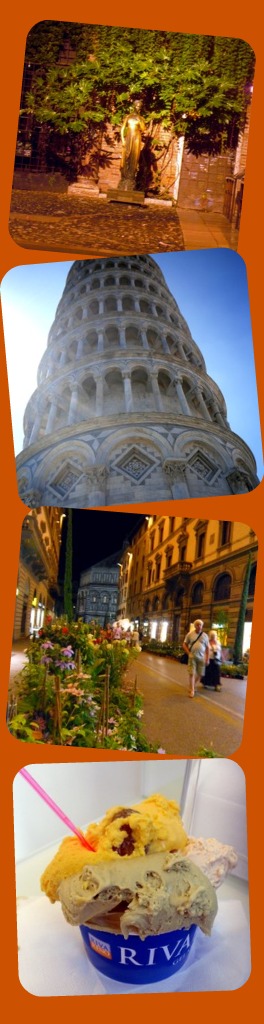
Another affordable yet delectable treat is the famed gelato. The best we tasted — and we tasted a lot — was at a place called Rivareno just around the corner of our hostel in Rome . They soften the gelato with a palette knife before spooning it into the cup. There were so many different flavors on offer, but my favorite was probably caramelized fig and ricotta.

“Roughing” it

We students will walk miles to save money, but in a country like Italy that’s not such a bad thing. As Liz and I soon discovered, going everywhere on foot was the best way to take in the local color (not to mention work off all that pizza, pasta and gelato!).

In the small winding streets of Siena, we encountered a small boy playing the drums in little side street whilst a group of old men and women chatted nearby, seemingly oblivious to the racket he was making.

In Verona one night, we happened upon Juliet’s balcony (which we’d seen the day before in the daylight). The bronze statue of Juliet in the courtyard looked completely different when illuminated. Gazing through the gates at her peaceful shape summed up this city for me: bright and vibrant yet calm.

Walking was also a way of avoiding unwanted curiosities in the hostels where we stayed. The hostel in Venice, for instance, had a very bad case of bedbugs — so much so that we spent our second night sleeping on the dusty floor, with only a sheet beneath us. But even that didn’t stop the little blighters. At one point one of the other girls woke up with one of them on her cheek. Unfortunately, despite the beauty of Venetian art and architecture, it’s the bedbugs that made the most lasting impression, rather literally!

That said, walking also exposed us to some humans who behave like pests. More than once did we have to hurry away from some overeager men who were making kissing noises at us, and outside the Arena in Verona, the city of love, a “Roman gladiator” gave Liz a pat on the bum!

Art coming out of our ears

Tourism in Italy involves an endless parade in and out of churches. I reckon we saw about three in every city, apart from Siena where we saw only one, the Duomo di Siena.

We ended up appreciating the cathedral in Siena far more than the Basilica san Marco in Venice, which overwhelmed us with its abundance of Gold Romanesque mosaics and small adjoining rooms replete with countless treasures. Our guidebook had advised us to make several visits, but for me, a single visit was more than enough. Both interior and exterior reminded me of an over-sweet, over-decorated cake.

Since we are both interested in Renaissance art, Florence had a great deal to offer. My wise mother had advised that we pre-order tickets for both the Uffizi Gallery and the Accademia Gallery — the latter of course being the home of Michelangelo’s David.

After smugly walking past the long queue for the Accademia, Liz and I took a seat on a bench close to the David and watched as people circled around it, discussing its various aspects. (We even managed to sneak a picture of the statue whilst the guards weren’t looking, saving us a few extra cents on a postcard.)

At the Uffizi Gallery I particularly loved seeing Flora by Titian — so much better seeing it in a photo for appreciating the colors and brush strokes.

By the time we reached Rome, our enthusiasm for the Grand Tour had flagged somewhat. The Sistine Chapel, where everyone was herded around like sheep, especially disappointed us.

The best part of Rome was our trip to the Pantheon — fantastic! As we wandered around this circular building, I couldn’t take my eyes off the ceiling. I was transfixed.

First of many tours?

I would definitely like to return to Italy one day soon, and perhaps even try living there for a while.

Of the five cities we visited, I could really see myself in Siena even though it wasn’t my favorite place. It’s just that the atmosphere made me feel at home, I think because there were fewer tourists. (I particularly enjoyed my trip to the local supermarket, full of hustle and bustle and the smell of freshly baked bread.)

My Italian, which was very basic, got better as our trip progressed. However I would have to take a lot of classes if I were ever to brave living there!

NOTE: You can read Monika Frise’s art reviews on her new blog, Post Raphaelite, and/or follow her on twitter: @Shmonn.

Images: Juliet’s statue in Verona by night; from the foot of the leaning Tower of Pisa; flower sellers in streets of Florence, near the Duomo; three flavors of Roman gelato: pistachio, caramelized fig and ricotta, and crema mediterranea (a Rivareno speciality).

STAY TUNED for Monday’s post, when founding contributing Anthony Windram reports on his attempt to make a Parisian lunch in California, following the recipes of Elizabeth Bard (see also ML Awanohara’s attempt).

If you enjoyed this post, we invite you to subscribe to The Displaced Dispatch, a weekly round up of posts from The Displaced Nation, with seasonal recipes and occasional book giveaways. Sign up for The Displaced Dispatch by clicking here!

Related posts:

The light-hearted answer to Robert Pirsig — travel author Allie Sommerville

I know what you’re thinking. They can’t seriously be planning to feature Allie Sommerville in a month where they’re celebrating the joys of the open road?

For those who haven’t heard the news yet, Sommerville is the author of Uneasy Rider: Confessions of a Reluctant Traveller, and we’re doing an interview with her today, as well as an e-book giveaway (for DISPLACED DISPATCH subscribers only — sign up NOW!).

But before we proceed, allow me to say a few words in Sommerville’s — and our — defense.

As much as Sommerville may moan about her travel misadventures, as one of her Amazon reviewers puts it: “Methinks she doth protest too much.”

I would concur. In my own interactions with Sommerville, I’ve come to think of her as a gentler, more light-hearted version of Robert Pirsig, who penned the brilliant, if opaque, Zen and the Art of Motorcycle Maintenance, on which we’ve based many of our posts this month.

The two have much more in common than it may at first seem. Like Pirsig, Sommerville has faced the reality of sustained travel on the open road and the many challenges it entails — particularly if your vehicle of choice is a motorcycle or campervan.

Also like him, she has concluded that for a road trip to be a success, you must have a yin and a yang.

The main difference is that for Sommerville, these concepts are physical, not metaphysical — as in two people, herself and her Other Half, Harry.

She is the yin — the dancer, the poet, the writer — to poor Harry’s yang. He is the driver of the couple’s broken down but beloved RV, in charge of all repairs. And when things go awry, as they very often do, Sommerville injects a philosophical sense of humor for some perspective on the situation — a technique on a par with Pirsig’s philosophical musings.

Take, for instance, the very first road trip the couple made in this rickety vehicle, to Spain — all because Sommerville had developed an obsession with British poet Laurie Lee‘s memoir about tramping through Spain.

So far so predictable: Sommerville as driving force behind the adventure, her Other Half as driver. But then what happens when the campervan proves too wide for a Spanish street? He sweats it while she searches for an entertaining story in their predicament:

There was no room for manoeuvre. … With both sides of the van threatening to add a new dimension to the walls of the houses, it was nigh on impossible for either of us even to climb out…

By now we were becoming aware that we’d attracted the interest of several ancient and well-oiled patrons of a bar just up ahead, and our little drama turned into a full-scale pantomime as they began gesticulating and beckoning us on.

“Sí! Sí!…Se puede!” they exclaimed excitedly and at the same time doing what could only be described as some sort of grotesque ritual dance.

This was a good time to remember the meaning of those words in my favourite scene from the language video.

Se puede! They seem to think we can do it!” I translated helpfully.

So, without further ado, I give you the light-hearted Robert Pirsig: Allie Sommerville.

Tell me a little more about your background.
I was born in Croydon, which was in the county of Surrey at the time — now though, notoriously part of Greater London — and my husband is from London. After setting up home in Croydon for a few years, we moved to the Isle of Wight in 1976 to build our own house and give our two young children a better area to grow up in.

We are both, even after all this time, what Islanders call “overners” (an abbreviated form of “overlanders”). Only people actually born here qualify as “caulkheads.”

Uneasy Rider, which was published in 2009, was my first book. I’ve just published my second, a memoir about my childhood, on Kindle. It’s called To set my feet a-dancing and takes a light-hearted look at a time when children were allowed play in the park until dark, clothes were home made and owning a car meant you were rich. I draw a lot upon my time as a young amateur dancer, telling about my appearances with my older sister in shows arranged by our rather eccentric dancing teacher. I also look at schooldays, Christmases past and seaside holidays in an age of innocence.

I began this project after researching my family history for many years. It occurred to me that our children have no idea about how my generation lived as children in late 1950s England. Life has changed beyond anything we could imagine.

I conclude the book with the life stories of my grandparents and their predecessors — things I have gleaned from censuses, birth and marriage certificates, old photographs and conversations with my late mother. These are the lives of ordinary families: people whose lives are not in the history books.

I’m also in the process of writing about a trip my husband and I made around mainland Great Britain in the same old camper van, from the South (i.e., Isle of Wight) to the North (i.e., Scotland). The provisional title is: Miss Potter and the Mathematicians Rabbit — Allie Goes Oop North. The main title is taken from an experience we had in the Lake District.

Moving on to Uneasy Rider: How many road trips have you and your husband made together over the years?
We made six road trips in the converted Leyland Daf campervan of the book, from 1999 to 2004, though our very first trip in a motor caravan was in 1991, with our two teenagers on board.

Do you ever travel by other means?
Of course! We’ve traveled many times by car in France and Switzerland, staying in gîtes, chalets and apartments. My favorite “trip” of all though was on the Cunarder, Queen Mary 2, to New York. Much nicer than “roughing it” in a camper van! I absolutely loved New York and the glamour of the six-day Atlantic crossing, despite sailing through a force 11 gale.

So what made you decide to write a book about your campervan excursions?
During our trips, we had so many events that each time I said, “There’s a book in this!” Before we took off on our first trip (to Spain), I hadn’t found any similar book on the subject of campervanning or caravanning, apart from site-finder guides; it seemed there was a gap in the market.

Whom did you see as the primary audience?
I had in mind other campervanners who would identify with the joys, trials and tribulations of this type of independent travel. I didn’t want it to be one of those “everything is fantastic about travel” books. I hope I tell it like it REALLY is — the ups and downs, the good and the bad. Some campervan “purists” don’t appreciate hearing about the downside of their preferred method of holidaying though. They appear to have gotten together to leave negative reviews on Amazon. But I’m not too sure, by some of the comments, that they’ve actually read it…

Bill Bryson is the master of modern travel writing as far as I’m concerned, and it’s his light-hearted touch that I hope in some way to emulate. A tough act to follow!

Many people take road trips when they are young, to find out more about life and themselves. Does the purpose change once you become middle aged?
Middle aged? I still feel about 17!

As you’ve already mentioned, the purpose of our first trip (to Spain) was to follow in the footsteps of my literary hero, Laurie Lee. In As I Walked Out One Midsummer Morning, he tells of his walk across Spain on the cusp of the Civil War in the early 1930s. This book, for some reason, holds a big fascination for me.

That trip was meant to be a one-off. But afterwards we weren’t able to sell the van, so instead of letting it sit in the drive, I seized the opportunity to see as much of the art and architecture of Italy and France as I could. I suppose you could say my purpose was educational!

Which was your favorite place of all those you visited?
Florence has it all. I could never tire of it. We visited this amazing city three times. I was studying Art History at the time, specialist subject “The Early Renaissance.” The Italian people are fantastic, too!

Which was your least favorite?
Spain, especially the Costas (various coastlines), which were full of half-finished blocks of flats. Whether we were unlucky I don’t know, but it was not a friendly country — apart from a few honorable exceptions which I mention in the book: the helpful policeman in Seville who strode into and held up four lanes of speeding traffic for us, the patient shop assistant in the flamenco boutique. I have the feeling that relatively recent history may have altered the Spanish character: George Orwell in Homage to Catalonia found the Spanish people cheerful and friendly.

Robert Pirsig says “It’s a little better to travel than to arrive.” I’m guessing you might not agree with him?
Err…not really. Like Dorothy, my mantra is: there’s no place like home! Having the campervan, however, was almost like taking your home round with you. My best moments during these trips were when we found pleasant campsites to put down temporary roots.

Pirsig claimed there are two types of people: “classical” — practical, DIY fixers, boy-scout prepared types; and “romantic” — those who thrive on surface appearances, don’t want to get involved with the nitty-gritty, and thrive on gestalts.
As you noted in your introduction, I’m definitely “romantic,” and my husband is certainly “classical” — which probably explains why we work as a couple. He drives and sorts out problems, I look forward to seeing the Da Vincis.

Each chapter of your book is a stand-alone story, describing a particular incident. Do you have a favorite?
“The Parable of the Parador” is my stand-out favorite. As I said, it is typical that I get these romantic ideas — and my other half goes along with them, most of the time. That particular chapter though, sees a bit of role reversal, when we get “stuck” on the road into Arcos de la Frontera, to reach the parador (state-run hotel). For once he thinks it’s all hopeless, and I have to be the optimist. When he feels like this about a situation, I know we are REALLY in trouble.

Pirsig advocates traveling on a motorcycle because it puts you there, in the moment, without the barrier of a windscreen. What do you think of his philosophy?
To travel on a motorbike would be my nightmare! I just would feel too exposed. I like to be safe — hence the theme of Uneasy Rider.

Many of the Displaced Nation’s readers are expats. Can you imagine living anywhere besides the Isle of Wight?
We’ve often thought we should have relocated to France some years ago. I’d love to live in a place where you can walk to a baker’s every day for fresh baguettes and croissants. Now, the only place I’d move to is Central London: the London National Gallery and Covent Garden Royal Opera House are big draws.

How well do you fit back into the Isle of Wight after your journeys? Do you suffer from any counter culture shock?
The flippant answer is that being a “townie,” I suffer counter culture shock on the Island every day anyway… even after all this time. However, the main feeling after being in the ‘van for four weeks, though, was that our house did seem HUGE for the first few days .

So what’s next for your travels?
Next year I am fulfilling my long-time ambition of visiting St. Petersburg — on a cruise ship rather than by road. Russia and especially its Tsarist past, fascinates me. Hopefully there will be a book in this, though for all the right reasons!

Readers, do you have any questions for the Amazing Allie? Ask away, before she takes off again!

Images: Allie Sommerville’s author photo and book cover.

STAY TUNED for tomorrow’s installment from our displaced fictional heroine, Libby, as she prepares to welcome the pitter-patter of little feet. Clawed, furry feet, that is: Fergus is now a canine expat! What, not keeping up with Libby? Read the first three episodes of her expat adventures.

If you enjoyed this post, we invite you to subscribe to The Displaced Dispatch, a weekly round up of posts from The Displaced Nation, plus some extras such as seasonal recipes and occasional book giveaways. Sign up for The Displaced Dispatch by clicking here!

Related posts:
An un-American in an All-American diner

Continuing this month’s theme on road trips founding contributor Anthony Windram weighs in with some thoughts on the American diner.

There’s neon tubing that emits a purple glow around the clock that tells me it’s nearly 10pm. The dinner service is long over, the families now dispersed and only a scattering of drifters and loners are left. It’s still, at least, another 45 minutes before the late-night drunken crowd makes an appearance.  This diner is more Edward Hopper than Norman Rockwell. Across the parking lot is a strip club, as the night draws on and into morning some of its patrons, I imagine, will head over here to have a burger or to take advantage of that most American of institutions – the 24-hour breakfast.

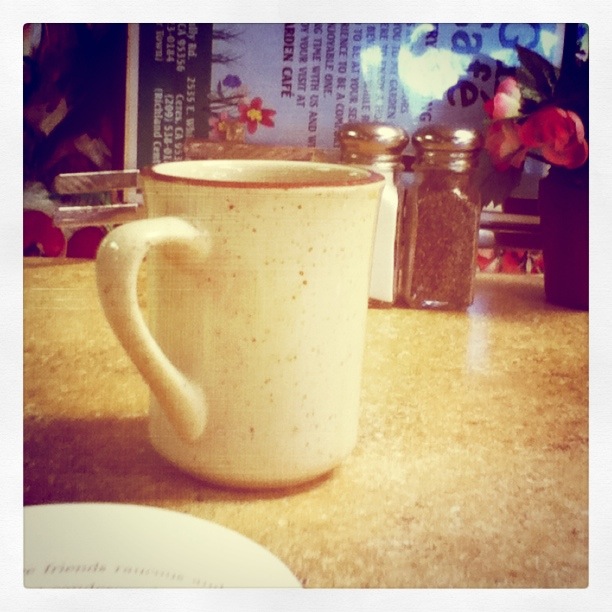
There’s a still sadness to the place despite the best efforts of the waitress who exudes a friendly busyness. She could be anything from her late-40s to her early-60s. She calls me “sweetheart” when she comes over to give me a refill of greased coffee. She doesn’t, however, call it “a cup of Joe” — that would be one cliché too many.

Mentally, I take a step back from this scene and try to view all around me as a tableau and can’t but help but think this is Americana that I am sat in, this is America.

Perhaps this is the “real” America; a banal phrase uttered by a banal politician, but a phrase that does strike at something deep in the American psyche.

Dr George Lewis, director of American Studies at Leicester University, has started what the Guardian claims is the “first sustained historical analysis of the term un-American.” While there may be some confusion over quite how one defines being “un-American,” what seems certain to me is that this cold burger and this diner is decidedly the opposite of “un-American”. Though I am in Bakersfield, California, I could be anywhere in the Union, be it red state or blue state.

When I first moved to the US, to my now shame, I found myself fascinated by the Food Network show Diners, Drive-Ins and Dives, hosted by the hyperactive Guy Fieri, a man with the cholesterol levels of someone twice his age. Fieri is a TV host with absolutely no sense of discernment. Everything that he comes across, everything that he tastes, must be spoken about in glowing terms to the point that nothing that Fieri says has any real meaning whatsoever.

And yet I did find myself compelled by the show for illuminating further for me the American diner and showing me places that occupy a place in the country’s cultural milieu that the English cafe doesn’t even come close to back home. I soon stopped watching Diners, Drive-ins and Dives — not because my view of diners changed, but because it was (and is) a God-awful program and there’s only so many times you can watch an overweight Fieri eat some barbequed pork and then pronounce it “awesome”. But there was one thing in particular about Fieri’s show that they always got wrong. They would always show the diners when they were packed and buzzing with a family friendly atmosphere. And while I wouldn’t suggest that that’s not the case, what I find interesting is that when you roll into a strange town late at night and find yourself at a diner, regional and political difference tend to dissolve. You are in a place that is resolutely American rather than California, or Colorado, or Vermont, or…I could go on.

Fieri’s show, a sort of televisual equivalent of Pravda which can only emphasize the positive, misses out on what I am experiencing here in Bakersfield as the clock, that has neon tubing wrapped around it, hits 10 and I ask for my check. Here, and which Fieri always misses, is a quiet efficiency mixed with a low-burning malevolence. It’s that mixture of warmth and fear you get when your waitress flashes you a warm smile but you know you’re in a moment going to be stepping out back into that parking lot — and in the back of your mind you’re just a little concerned that this might be the night where you get shot by a drunk coming out of the strip club.

Question: What’s your experience of American diners?

Image by awindram.

STAY TUNED for tomorrow’s interview with the travel writer Allie Sommerville. NOTE: All DISPLACED DISPATCH subscribers will be entered in our giveaway of Allie’s book, Uneasy Rider.

If you enjoyed this post, we invite you to subscribe to The Displaced Dispatch, a weekly round up of posts from The Displaced Nation, plus some extras such as seasonal recipes and occasional book giveaways. Sign up for The Displaced Dispatch by clicking here!

Related posts:

RETURN TRIP: Random Nomad – Charlotte Day, High School Student (Sixth Former)

While our writers take off on what they hope will be enchanting August breaks, The Displaced Nation will occasionally be reissuing some posts that, for one reason or another, enchanted our readers. Enjoy these “return trips”!
As youngsters head back to school, we’re reissuing a Random Nomad interview ML Awanohara did with Charlotte Day, a displaced teenager in England. Charlotte spent a chunk of her summer taking a Russian-language course in St. Petersburg and living with a Russian family. She has produced a travel yarn on her adventures, which will appear on Monday.

Born in: Sydney, Australia
Passports: Australia, UK and US Green Card
Countries lived in: Australia (Sydney): 1994-2001; United States (New York, New York): 2001-2010; England (Sevenoaks, Kent): 2010-present

What made you leave your homeland in the first place?
My father is Australian and my mother English. They split up when I was two. When I was six, my mother met and married an Australian who had been living in New York for thirty years. I was rather disgruntled about moving to the United States and for two or three years, remained determined never to accept it as “home.” At that time, I was deeply patriotic to my native country — though this sentiment has dissipated since.

Is anyone else in your immediate family a “displaced” person?
My mother’s family, originally from England, has long been displaced. My mother herself was born in Kenya, in 1961. Following the Mau Mau Uprising, her parents were forced to relocate, and my grandfather, presented with a choice between Australia and Canada, chose the warmer of the two countries. My mother spent her childhood bouncing between schools in England and Australia. She eventually grew so fed up with packing and unpacking, she decided to leave school at the age of 16. Her father agreed to the plan provided she spend a final year at the school in Switzerland his own mother had attended as a girl. My mother moved on from Swiss finishing school to work in London, Paris and Sydney. But she appears to have made New York her last port of call. Indeed, we had a fairly solid life in the city until I decided to take myself off to boarding school in England.

Describe the moment when you felt most displaced over the course of your many displacements.
It must have been when I first arrived in New York as a six-year-old. I stepped out of the JFK arrivals terminal into a snowy March night. My stepfather was wearing a leather coat, the interior of his car smelled of leather — and the world outside the car window seemed an undulating stream of black and silver. Though it was the end of 2001’s warm winter, my Australian blood froze beneath my first-ever coat. And their apartment — that was all leather as well. It smelled of musk and cologne. Since that time, I have felt similar pangs of displacement, some of which lasted for considerable periods. But those first few moments in New York stand out as the most acute concentration of “displacedness” I have ever known.

Describe the moment when you felt least displaced.
For the last five or so years in New York, I have felt more at home than I ever did in Sydney. I ascribe this to growing up: at a certain age, one can take possession of a city, know its streets, bridges, tunnels and transportation system. I was too young when I lived in Sydney to reach that kind of comfort level. But when have I felt the most like a New Yorker? Perhaps it was the last time I came home for the holidays, and took the 4 train uptown for the first time in months. At that moment I realized how much this train had been a part of my life — conveying me home from school every day for two years. My old life would always be waiting for me on the subway, ready for me to pick it up again. That’s something only a New Yorker could say!

You may bring one curiosity you’ve collected from each of the countries where you’ve lived into the Displaced Nation. What’s in your suitcase?
From Australia: A miniature wooden wombat figurine — a gift from my grandfather. It conjures memories of a childhood spent beating about the bush (literally) and fishing for yabbies at the dam in the company of audacious dogs who stuck their heads down wombat holes, to no good end.
From New York: A pair of fake Harry Potter glasses. These defined my first six months in New York — I even wore them to my first day of school. I think it is telling that even at the age of six, I was unwilling to give all of my real self to this new home.
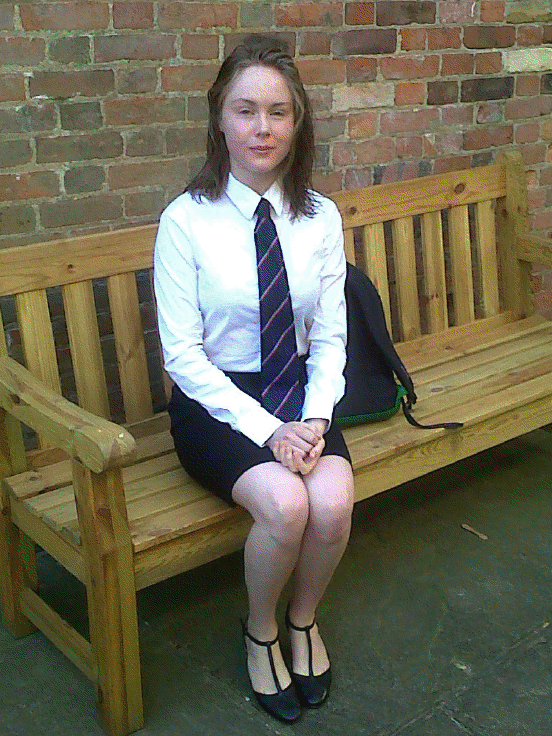
From England: My school tie — representative of the alternative universe I seem to have entered. At boarding school, the sense of removal from reality can be disconcerting — especially after having spent a decade in the city I regard as the world’s capital.

You’re invited to prepare one meal based on your travels for other Displaced Nation members. What’s on your menu?
I’d like to make you a Sydney breakfast: scrambled eggs, made with cream, salt and pepper and served on a bed of Turkish toast, with avocado and stewed tomato on the side (is this being greedy?). Our meal will be accompanied by a large “flat white”: what we call perfectly strong, milky coffee without excessive froth. I suggest we consume it overlooking a beach on a Sunday morning. At least, I assume The Displaced Nation has beaches?

You may add one word or expression from each of the countries you’ve lived in to The Displaced Nation argot. What words do you loan us?
From Australia: Daggy. I use this word all the time — and did not realize it was exclusively Australian until I was informed of the etymology. Apparently, it comes from trimming the soiled wool around a sheep’s bottom. Which part of this repugnant whole is actually the “dag,” I do not remember. (No, I’m not a proper Australian!) But as I understand it, “daggy” means sloppy in appearance or badly put together.
From New York: There are so many words, and most are second nature by now. However, I will choose grande-soy-chai-tea-latte because I still shudder to think of myself as the kind of person who can utter such a phrase, at great speed, with great insistence. In fact, I’m still in denial about my love for Starbucks: having known Sydney coffee, my standards should be higher.
From England: Banter. I still do not know the precise meaning of this word, but it seems to encapsulate everything that makes someone my age feel socially acceptable — and, of course, I have no banter whatsoever. I think it means the capacity for combining wit with meaningless conversation. But there are other components, too, which seem to me unfathomable.

Question: Readers, tell us what you think: should we welcome Charlotte Day to The Displaced Nation and if so, why? (Note: It’s fine to vote “no” as long as you couch your reasoning in terms you think we all — Charlotte included — will find amusing.)

img: Charlotte Day at her boarding school in southeast England

If you enjoyed this post, we invite you to subscribe to The Displaced Dispatch, a weekly round up of posts from The Displaced Nation, plus some extras such as seasonal recipes and occasional book giveaways. Sign up for The Displaced Dispatch by clicking here!

Related posts:

Random Nomads to the rescue! How to have an enchanted August (2/2)

Every year in mid-August, I swear I can still hear the beat of the taiko drums, even though it’s been years since I lived in Japan as an expat.

As I mentioned in my comment on Anthony Windram’s post of last week, the Japanese hold their Obon Festival in the dead of August. Appropriately, it’s the Buddhist version of the Festival of the Dead — when the dead are supposed to come back and visit.

That said, I have always thought of obon festivities as an attempt to arouse the living dead, which is what most people are after enduring the agonies of a Japanese summer. Just hearing the lively drumbeat can be revitalizing, getting one’s blood flowing again.

I am therefore personally curious to see how The Displaced Nation’s Random Nomads who live in Asia are doing. Are they managing to have some enchanting moments despite the heat — which, if anything, appears to be even more brutal in that part of the world than it was in my day? And what advice can they impart to the rest of us? (Besides the fact that compared to them, we shouldn’t really be complaining…)

Three of them got back with answers to these questions:
1) What has been your most enchanting moment of Summer 2011 thus far?
2) What has been your least enchanting moment?
3) Do you have any survival tips for people who can’t escape?

Please note:
a. You can read interviews with each of these three Random Nomads about their “displacement” by clicking on their names. They, and their lives, are fabulously inspiring regardless of season.
b. In Part 1 of this post, five US/Europe-based Random Nomads answered the same three questions. Check it out!

KIM ANDREASSON — Swedish passport; current home: Vietnam (Saigon)
Most enchanting:
Vacationing in my native Sweden with my wife. It was the longest time I have spent in my homeland in over a decade, and I have a new-found appreciation for the proverb: “Away is good, but home is best.”

Least enchanting:
Trying to do work while vacationing in Italy. An hour before an important conference call, the Internet went down at our 4-star hotel, and the hotel manager airily proclaimed, “That’s what usually happens when it rains.”

Survival tips:
We live in Saigon, where it’s basically 90 degrees all the time so there are only two options: stay inside and use AC; or if you go outside, wear light-colored clothes and drink lots of liquid.

EMILY CANNELL — U.S. passport; current home: Japan (Tokyo)
Most enchanting:
In spite of not being terribly interested in the rainforest or the quest to save it, I found myself smack dab in the middle of Borneo, Malaysia, on an Ecotour. Searching for the endangered orang-utans, we happened upon what became one of the highlights of my summer — and life. A pygmy elephant emerged from the trees, and just like the rest of us, he was hot. Slowly, he ambled in to the river where he proceeded to entertain us with his cooling down antics — scratching his ears on the trees, blowing water out of his trunk, and completely submerging himself while only 10 feet away from our boat. What a gift! I got out my checkbook then and there.

Least enchanting:
Getting up at 4:00 a.m. for the fifth time this summer in order to catch a 7:00 a.m. flight to somewhere. Once is okay, but five times?

Survival tips:
Currently I’m writing from the complete darkness of the guest bedroom, fan on high. Keep the curtains closed and the fans on high to circulate the air. When outside, wear a hat to keep the sun off the top of the head. It’ll do wonders.

JO GAN — U.S. passport; current home: China (Yuyao City, Zhejiang Province)
Most enchanting:
Since my summer is usually spent teaching high school and university students on their summer holidays, I usually don’t get many enchanting moments.  However, I did have one thing that was kind of nice.  After a long day at the language school, I walked down to the Yaojiang River that flows through the downtown area, with some fellow expat teachers and a couple of our adult students.  To our great surprise, white plastic chairs and tables had been set up all along the river underneath the willow trees. Cold beer and hot tea was being served, and there was a lone guitarist playing Chinese folk music for all to enjoy. We sat down and chatted, drank our beers, and watched the river float by with a slight breeze. The servers kept the beggars at bay so we were not hounded for money.

The best part of the evening was around midnight when they started shooting fireworks over the river.

It wasn’t a special occasion or even a special event — just the right mix of people and location, at just the right moment.

Least enchanting:
That would have to be when it rained for a month. I don’t know what was going on with the weather, but in the month of June I thought we were going to have to build an ark. It rained for three weeks straight every day without stopping. I didn’t want to do anything, but had to trek in the rain and puddles all the way to school every day. One day was particularly miserable because the electricity went out.  So it was hot and rainy, and we had no lights. I just kept thinking, why me?

Survival tips:
In the small Chinese city where I live, it’s the little things that count. Taking a trip around the city center in a rickshaw may cost you a little, but you get to sit back and survey the different things going on — and if that special person joins you, it can be romantic.

Another option is going out to the local parks every evening from 7:00 to 8:30 p.m. to dance with the older locals. They are almost always playing some salsa or pop music and dancing the cha cha, or there’s some line dancing action. It is actually kind of fun to join them even if your are not in their age set. They always are excited to teach you their moves.

Lastly, we live close to Siming Mountain. You can take a trolley bus to the top and then float down the small river in a little orange raft. The river has added twists, turns and drops that make you scream out for your mama to help you. It makes for an interesting day, and you are bound to get wet and cool off.

STAY TUNED for tomorrow’s post, in which Anthony Windram debuts his new Agony Aunt column!

If you enjoyed this post, we invite you to subscribe to The Displaced Dispatch, a weekly round up of posts from The Displaced Nation, plus some extras such as seasonal recipes and occasional book giveaways. Sign up for The Displaced Dispatch by clicking here!

Related posts:
A glowing moment of enchantment in a displaced summer

Continuing this month’s theme on Enchanted Summer, contributor Anthony Windram weighs in with his opinion.

Elizabeth von Arnim, who wrote The Enchanted April, was right in selecting April as the month of enchantment. Spring charms me in a way that summer doesn’t. The budding boughs are full of fresh scents, to borrow from Christina Rossetti, and the land restores itself. Nature, in a universe governed by entropy, pulls off a majestic conjuring trick.

By contrast, I find summer a little unenchanting. Let’s face it, it’s not a good time for the English. We can’t really be trusted with summer. We should be banned from it, it’d be for the best. Pack us all up and send us to the Arctic for three months. That way we might avoid the collective fever that descends upon us where we dehydrate our bodies with copious quantities of lager and show off our sun blistered skin and bad tattoos.

So, as you probably have gathered, I’m not much of a summer fan and that hasn’t changed having now lived in places that have actual, proper summers as opposed to England’s illusion of a summer. I can usually be found in the summer months (when not enjoying a self-imposed seasonal exile in the Arctic) wandering from one airconditioned building to another. If I do have to venture out into the heat, I only do so after liberally applying sunblock (factor 100).

But this post is about enchantment with the summer, and it’s only when the sun has set and the temperature has lowered that such moments have occurred. I share Simon Wheeler’s thoughts on the sounds of crickets. To me, it’s a foreign sound. A memory of childhood holidays abroad. Hearing that rhythmic sound each evening reminds me that I am in a foreign country, and as I listen the everyday mundanity of my setting dissolves away.

I am not, despite what this post might suggest, an amateur entomologist. If anything, I have an immediate revulsion with most creepy crawlies, but my second summer enchantment also involves them and like the music of the crickets it was a fleeting moment that stripped me of cynicism and returned me to childhood. It was my first summer in the US, I was in my in-laws’ garden. I was listening to the crickets and feeling very happy with myself when an insect flew past me, its lower abdomen pulsating a yellow, illuminiscent light. I knew the answer, but I couldn’t be certain as I had never seen one before. “Is that a firefly?” I asked.

And where there had been one, there was another, and then another. Looking around, thrilled in the same way I would have been as a child, it seemed that there was a swarm of fireflies captivating me utterly — a glowing moment of enchantment in the summer evening.

DISPLACED Q: What’s your most enchanting memory of a summer spent in your adopted homeland(s)?

STAY TUNED for tomorrow’s discussion of The Displaced Nation’s themed posts.

If you enjoyed this post, we invite you to subscribe to The Displaced Dispatch, a weekly round up of posts from The Displaced Nation, plus some extras such as seasonal recipes and occasional book giveaways. Sign up for The Displaced Dispatch by clicking here!

Related posts:
Random Nomads to the rescue! How to have an enchanted August (1/2)

Ah, summer — what power you have to make us suffer…and like it?!

I don’t know about you, but I’m not liking the mid-August dog days very much. For a start, I’m getting tired of watching my own two dogs panting instead of playing.

Thus I’ve turned to The Displaced Nation’s Random Nomads to help me find things to like during the remaining weeks of Summer 2011, which doesn’t technically end until September 23.

Besides asking them to report back on how their own summers have been, I begged them to share some tips for escaping one’s surroundings at times when one can’t manage a physical escape. I recall from my own expat days (in the UK and Japan) that global residents develop superhuman-reserves of stamina (the Japanese call it gaman, or “enduring the seemingly unendurable with patience and dignity”) to sustain them during less-than-pleasant interludes.

And I wasn’t disappointed — no less than five USA/Europe-based Random Nomads have come to my rescue! They’ve answered these three questions:
1) What has been your most enchanting moment of Summer 2011 thus far?
2) What has been your least enchanting moment?
3) Do you have any survival tips for people who can’t escape?

And next week, we’ll hear from three more, all of whom hang their hats in Asia.

NOTE: If you haven’t read the interviews with these five people about their “displacement,” be sure to do so by clicking on their names. They, and their lives, are fabulously inspiring regardless of what season it is!

BALAKA BASU — USA passport; current home: USA (New York City)
Most enchanting:
Swimming at Sandy Hook in New Jersey. The water out there at Gunnison Beach is green and gorgeous; the waves are gentle and warm, and they lap round you like a soft embrace. Over in the distance, you can see the skyline of NYC, wrapped in haze. It’s truly lovely, the closest you can come to the Caribbean in the metropolitan area, I think.

Least enchanting:
WASPS (the insects)! They built five(!) hives in our car, and we had to suit up in full sleeves, veils and boots — full-on winter armor in heat-stroke inducing weather — to kill them with poison as they boiled out of their hives. Not cool. Not cool at all.

Survival tip:
Find a cheap(ish) hotel with a bar and an outdoor pool — someplace no tourist would ever visit. Bring towels, bathing suits, a great beach read, and plastic cups — and pretend you’re on beachfront property in some place awesome: e.g., “Jamaica” without the plane ticket.

VICKI JEFFELS — New Zealand passport; current home: England (Tadley, Hampshire)
Most enchanting:
England had a couple of days of really tropical weather back in July — I loved it. For a brief time there was the lingering smell of BBQ wafting around our neighborhood, and I was even able to lie down on a towel in the garden and safely fill up my vitamin D reserves. Ah, bliss!

Least enchanting:
The following week the temperatures plummeted and it looked as if that was all the summer we were going to get.

Survival tips:
Ah yes, right down my alley! Many of my neighbors and friends were finding it really difficult to sleep in the humid weather, not helped at all by the BBC advising everyone to close their curtains! Whaaat? When you find it difficult to sleep, I advise a tepid (not cold!) shower to lower the body temperature before sleep. If possible (I know it’s not always possible), take a dip in a swimming pool — that’s ideal.

PIGLET IN PORTUGAL — English passport; current home: Portugal (Algarve)
Most enchanting:
To date, there are two special moments. Can I have two?

Yes, OK. Great!

Actually, one is magical and the other enchanting. Both slightly predate the summer months, but the effects still linger.

The most magical moment was the birth of our first grandchild, Lily-May, on the 28th of April in France. We drove as if possessed for two days from Portugal across Spain to the South of France to see her. Although I am not maternal by nature (I’m more of a practical Mom), when I held her in my arms for the first time, my heart melted. As recorded on my blog, she’s adorable!

The most enchanting moment was when I was singing to her and she gave me a big smile. Poor little thing — my singing is not that tuneful; I think she felt sorry for me!

Least enchanting:
The least enchanting because most worrying moment of Summer 2011 was the way our daughter’s health deteriorated after giving birth. Despite various consultations with doctors about the excruciating pain and the ongoing urine infections she was experiencing, they just prescribed antibiotics rather than trying to find the root cause. The local GPs were totally clueless! However, the answer quickly became apparent once her husband insisted she go to hospital for a proper examination. The maternity ward doctor, upon examining our daughter, quickly discovered that medical compresses, now rotting, had been left inside her! Once these were removed, she began to recover. But had they remained, I have since been informed septicaemia would have set in, with devastating consequences for both our daughter and breastfed baby granddaughter.

Survival tips:
This is difficult because adverse weather conditions to some could be absolute heaven for others. Weather, I tend to take as it comes as it is out of my control.

My own great escape would not be from the weather but from tourist areas. Living in a tourist area myself, I have renamed tourists “terrorists” because many leave their manners and consideration for others at home. They literally do “terrorize” the locals!

 Personally, I love wild and natural places far away from the mass concrete high-rise hotels, with rows of sun beds and parasols lining the beaches.

My idea of heaven is to take a picnic, a bottle of chilled white wine, our comfy chairs and a parasol down to one of the unspoilt beaches for a “sun-downer.”

Yes, there are other people there in July and August, but we all seem to appreciate the luxury of freedom from tourists, and peace…

So, if you are coming to the Algarve on holiday please check out some of my
“secret beaches.” I can show you how to escape the “maddening” crowds!

JACK SCOTT — British passport; current home: Bodrum, Turkey
Most enchanting:
Bodrum is the most secular and modern of Turkish towns. It’s where people come to escape the conformity of everyday Turkish society. Normal social rules don’t apply. However, scrape the surface and you will find magic of a different kind.

This summer, we were visiting a friend, a thoroughly modern Millie, who lives just a few hundred meters behind the bustling marina with its luxury yachts and raucous watering holes. Her home is set within a traditional quarter of whitewashed buildings huddled together along narrow lanes.

As we approached her door, we noticed an elderly neighbor dressed in traditional livery of floral headscarf, crocheted cardigan and capacious clashing pantaloons. She sat cross-legged in a shady spot of her bountiful garden and was busy plucking a fleece.

Being city boys and largely ignorant of country ways, we asked our friend what the old lady was doing. She was preparing the wool for hand carding, straightening and separating fibers for weaving on the spinning wheel she kept in her house.

She hummed as she plucked, happy under the cool of an ancient knotted olive tree and doing what women have done in Turkey for millennia.

Now you don’t get that in Blighty.

Least enchanting:
We were wandering down Bodrum’s bar street, a procession of cheap and cheerful bars and hassle shops.

We normally rush by; casual shopping in Turkey can be a bruising experience best only tried by the foolish and heroic. The cheaper outlets employ aggressive teenagers in tight, bright, white shirts to drag gullible punters in from the street. A firm refusal elicits a bellicose riposte. The posher shops employ mostly female staff whose sales technique is softer but no less annoying. Speculative browsing is unbearable when tailed by KGB-trained assistants and you are made to feel like a serial shoplifter.

On this occasion my partner, Liam, popped into a corner shop to buy some cigarettes. Keen to use the local lingo, he asked for them in very passable Turkish. The po-faced assistant looked at him blankly. Liam repeated the request. Another blank look. After a brief standoff, the assistant relented and repeated the order in English. He threw the cigarettes at Liam, snatched the payment and slammed the change on the counter.

Welcome to Turkey, where hospitality greets you at every corner. I know there are arse-holes in every country — but next time we’ll just shout loudly in English.

Survival tips:
During the height of the summer we’re like camp vampires and only venture out after dark. Earlier in the season we found ourselves sweltering in 40+C (104+F) heat with no air conditioning. Because our pretty little cottage has 18-inch thick stone and concrete walls it took us weeks to find a technical solution. In the meantime, I received a host of suggestions to help us through the sleepless, sweaty nights. I’d like to share a few:
• Wrap a gel-type freezer pack in a wet tea-towel and apply it to your hot bits (and watch them shrink).
• Buy a floor-standing industrial fan (but nail everything down).
• Bathe your feet in an ice bucket (and develop frostbite).
• Take a cold shower (except the cold water is hot at this time of year).
• Sleep on a wet towel (and rot the mattress).
• Decamp to the roof (and get eaten alive my mozzies).
• Emigrate to Sweden?!

SIMON WHEELER — English passport; current home: Slovakia (Plavé Vozokany)
Most enchanting:
I love the sound of the crickets chirping. Whenever I left for holidays from England as a kid, that sound always meant I was away and exploring. Now I have them every summer’s night, and I still cannot get used to it. I still get that thrill of being in a new place…

Least enchanting:
Mosquitoes — they love every bit of me!!!

Survival tip:
I’m afraid I need a physical escape from our 35C (95F) “phew, what a scorcher!” summer. Fortunately, one is available in North Slovakia — in the Tatra Mountains, on the border between Slovakia and Poland. Just a stunning part of the world, very quiet, largely undiscovered, a place that exudes old-fashioned peace. Being that bit higher in altitude, the temps are perfect.


STAY TUNED for tomorrow’s Displaced Q on enchanting expat summers.

If you enjoyed this post, we invite you to subscribe to The Displaced Dispatch, a weekly round up of posts from The Displaced Nation, plus some extras such as seasonal recipes and occasional book giveaways. Sign up for The Displaced Dispatch by clicking here!

Related posts:

Some enchanted drinking: Summer cocktails that send you round the world

After spending many a summer in England (summer, what summer?) and Japan (beyond brutal!), I now live in New York City, where summers can best be described as a hot mess.

As the dog days set in, I’ve been known to sing out: “Drinks, glorious drinks! Don’t care what they look like!”

Actually, that’s not quite true.

Well, the part about my singing aloud is true — we’re all barking mad in this city, especially around mid-August.

And the part about drinks being glorious is also true —  what could be more glorious than an icy cold drink that cuts through the moisture-laden air, offering the possibility that this steam bath may end one day.

(I’m talking about alcoholic drinks, of course — anyone of a puritanical frame of mind can slake their thirst at one of the city’s fancy new portable water fountains, connected to fire hydrants.)

But the part about not caring what my drinks look like — that’s simply not true. For me, the ultimate summer refreshment is a well-made, well-presented cocktail.

As Penelope Wisner writes in her introduction to Summer Cocktails: 50 Tantalizing Recipes,

Everything matters: the taste of the spirit, the taste of the ice, the temperature of the drink, and the look of the drink.

My drinking history, in brief

During my expat years, I would happily down a half pint of lager in the pub with my English friends, or drink Kirin beer and sake on outings with my Japanese office mates.

That all changed when I moved back to my homeland.

Maybe it’s in my cultural DNA. The cocktail — a mixed drink with two or more ingredients, one of which must be a spirit — is one of America’s more inspired culinary accomplishments.

Or could it be my actual DNA — one of my earliest memories is of asking my father if I could chew on the lemon peel he put in his night-time martini.

In any case, not long after I became a resident of New York City — home of speakeasies and the only city I know of with a cocktail to its name — I was driven to drinking…cocktails. Particularly during summers.

You see, I’ve never been one of the lucky ones who can escape to the Hamptons or the Jersey shore.

Instead of the sea, sun, sand, and sky, I’ve had to grapple with sweat, smog, dirt, and skyscrapers.

Now, I could have gone the conventional route and drowned my sorrows in a beer. But why do that when a cocktail is so much pleasanter, and can transport you to places you’d rather be in — places much more exotic than an overcrowded beach?

Cocktails are a trip

My hunt for the transcendent cocktail experience has yielded several noteworthy finds, among them:

1) The mojito at Victor’s Cafe on West 52nd St. A single sip transported me to 1950s Havana, where I found myself salsa dancing with a Ricky Ricardo-look-alike. (And that was before I’d sampled the roast suckling pig!)

2) The vodka martini in the Russian Vodka Room, also on West 52nd St. I thought I was in Moscow from the moment I entered this swanky establishment, greeted by the sight of a curved bar at which many natives are downing shots, and behind which are these enormous jars of flavor-infused vodkas. Once I’d tasted my martini, I was well on my way to an enriching cultural experience. Oh, so that’s how they get through daily life in Russia. It all comes down to homemade vodka and to music — sublime combination! (Misha Tsiganov, a prize-winning jazz pianist who studied in St. Petersburg, is the bar’s official piano player.)

3) The classic martini at Angel’s Share, a tiny gem of a bar in the East Village. This drink made me feel I was in Tokyo again, even though I wasn’t really a cocktail person there. The Japanese bartenders had the mix, shake and stir down to an art form — which is soooo Japanese. And no one is allowed to stand at the bar — ditto. But by the time I’d polished off my divinely-inspired drink, I’d left Japan far behind for heaven itself — an effect enhanced by a ceiling mural that appears to have been inspired by Botticelli’s playful cherubs.

4) The Negroni at The Smith on 3rd Avenue. The Negroni — one part gin, one part sweet vermouth and one part Campari — is said to have originated in Florence in 1919, the invention of one Count Camillo Negroni. The first time I sampled one at the bar at The Smith, I fancied I’d become E.M. Forster’s Lucy Honeychurch at the very moment when she witnesses a murder on the Florentine streets, and is about to faint. (Where is George Emerson when you need him?) You see, the Smith version is anything but aristocratic: it packs quite a punch.

Next up? I hope it will be the Mexican martini, which I read about it in the New York Times last month. Basically, it’s a margarita served in a martini glass, with olives on a spear.

The drink is said to have been introduced from Matamoros, Mexico, just across from Brownsville, Texas, when a bartender from Austin visited there and was served a margarita in a martini glass.

It has since become Austin’s signature drink. Being Texan, it’s twice as large as a regular drink, so customers are given the cocktail shaker and urged to pour the drink themselves.

I haven’t been to Austin — and would love to go (though preferably not in the summer). I reckon a Mexican martini may be just the ticket…

The only issue is, the drink hasn’t really made it out of Austin yet.

So if you happen to hear of any Austin expats working behind Manhattan bars (yes, that’s how they’d refer to themselves), be sure to inform me.

For now though would you kindly join me in a refrain of “Drinks, glorious drinks, wonderful drinks!”

QUESTION: Can you recommend some summer cocktails you think have the makings of a mini-escape?

If you enjoyed this post, we invite you to subscribe to The Displaced Dispatch, a weekly round up of posts from The Displaced Nation, plus some extras such as seasonal recipes and occasional book giveaways. Sign up for The Displaced Dispatch by clicking here!

Related posts:

RETURN TRIP: Mobile in America

While our writers take off on what they hope will be enchanting August breaks, The Displaced Nation will occasionally be reissuing some posts that, for one reason or another, enchanted our readers. Enjoy these “return trips”!
Mandy Rogers wrote this post — about what it’s like to be a Southerner in New York City — in response to Kate Allison’s “The Domestic Expat.” Since then, her domestic expat adventure has entered a new phase. She and her husband, Kerry, packed up pets and belongings again at the end of July and set out on across-country trip to their new home — in San Francisco. We hope to hear back from Mandy before too long…

I don’t always understand what people are saying. I’m temperamentally unsuited to the noise and lack of personal space. I don’t think I’ll ever completely fit in. What am I?

A Mississippian in Manhattan!

My husband, Kary, and I moved to New York City two-and-a-half years ago, when we were in our early thirties. Until then, we had spent our entire lives in Mississippi. We loved it and had a great community of friends, whom we still miss.

Making the move

What possessed us to pick up stakes and try out life somewhere else?

Kary and I met in the marching band at Mississippi State. I played the flute and he the trumpet. We both landed jobs at the university immediately upon graduation. But there was something in each of us, a kind of restlessness. We knew we couldn’t be content with staying in Starkville forever. Was it a passion for travel or a fear of growing too complacent? Perhaps a bit of both…

There was also a practical reason for making the move. I’d gone back to school in my late twenties to do a masters in landscape architecture. I discovered I really enjoyed doing projects involving public spaces, such as parks, gardens, and streetscapes. Public green space isn’t a priority in Mississippi, where most people have their own land.

During my graduate studies, I’d taken a road trip with Kary and my sister to New York City, visiting Central Park, Paley Park, and Bryant Park. The amount of green space was a surprise to me. It’s something my mother, another garden lover, noticed during her first visit to the city, too.

In the end, it all happened rather quickly. Kary was offered the first job in New York he applied for. He actually got it via Twitter!

We packed up our belongings in a rental car — our cocker spaniel, Callie, in her seat belt harness and our three cats in their carriers — and traveled over three days to our new home in the Big Apple, staying in pet-friendly hotels along the way. (We’d flown out to find an apartment just beforehand, signing a lease for one in Brooklyn, which several of our friends had recommended as a great place to live.)

When we first moved, I didn’t have a job so spent the time exploring gardens and parks in Brooklyn, the Bronx and Staten Island. Even now that I’m working for a landscape architecture firm in Manhattan, I escape to the Brooklyn Botanic Garden whenever I can to see what’s in bloom. My dad gave me a membership there just before he died. We had a complicated relationship so it’s a nice reminder of him and our common love of gardens.

The adjustment process

People still ask me: where are you from? They usually guess North Carolina or Georgia; no one has guessed Mississippi yet.

I’m still picking up new vocabulary and pronunciations. “House-ton” instead of “Hue-ston” Street; standing “on line” at the grocery store (in the South we say “in line”).

And I continue to be amazed that the number of people living in Brooklyn equals the entire population of Mississippi (2.5 million). No wonder one of our most difficult adjustments has been to the noise and (by our standards) overcrowding.

Still, there are lots of things we love in this part of the world, beginning with the climate. Thunder and tornadoes are much less frequent here. And believe it or not, even after this rough winter, we still can’t get enough of snow.

We’ve adjusted very quickly to living without a car. You can see and experience so much more on foot than behind the wheel. That said, I usually did most of my singing in the car, and I miss that! (I don’t sing around my apartment too much, as the neighbors could hear me.)

And, although the South is renowned for its hospitality, I am often surprised by how much nicer, friendlier, and helpful New Yorkers are than they are given credit for being.

Moving right along…

Despite these many “likes,” I don’t think we’ll ever be true New Yorkers. To this day, I always relish running into other Southerners. The past two years, Kary and I have attended the annual picnic held in Central Park for folks from Mississippi. There’s always a blues band and plenty of fried catfish, sweet tea, and other Southern delicacies.

Not all Mississippians have exactly the same values, but each of us knows what it was like growing up in that neck of the woods, and it gives us a powerful bond.

During the year, Kary and I congregate with fellow Mississippi State alumni at a local bar to watch our alma mater compete in football or basketball. We’ve made some new acquaintances that way, such as a native New Yorker who went to MSU in the 1970s to run track.

Like most expats, Kary and I debate about the right moment to move on and where to go next. Will we try the West Coast, or consider moving back south? Every time I visit Mississippi these days — I’ve been back three times since we left — I realize how much I’ve missed its hospitality, beautiful forests, and tranquility. Plus it’s been nice catching up with family and friends over hearty Southern meals.

Still, the hot, humid summer would take some getting used to again. And now that we’ve been bitten by the travel bug, we’re contemplating our wish list again. We visited San Francisco last year and liked what we saw.

Being mobile in America — it’s a trip, in more ways than one. Tell me, why do so many Americans seek adventure overseas when it’s perfectly possible to be an expat here?

Question: Can being an “expat” within your own borders be just as enriching as becoming one by crossing borders?

Mandy doesn’t have a blog but you can follow her on Twitter: @mandyluvsplants

img: Mandy (right) and a friend she ran into at a Central Park picnic for Mississippians in New York. Mandy’s comment: “My friend still lives in Mississippi but was here with her daughter, who was attending the picnic as part of her duties as Mississippi’s Miss Hospitality. My mom says I can’t go anywhere without running into someone I know — I guess she’s right!”

STAY TUNED for Some Enchanted Reading on Monday! 

If you enjoyed this post, we invite you to subscribe for email delivery of The Displaced Dispatch, a round up of the week’s posts from The Displaced Nation, including some extras such as quiz questions, recipes, and occasional book giveaways. Sign up for The Displaced Dispatch by clicking here!

How foreign is Fez? A travel yarn in two parts (Part 2)

We welcome back Joy Richards to The Displaced Nation for the second part of her travel yarn about a trip she made in May to visit a British expat friend in Fez, Morocco. In Part 1, Richards learns about the Moroccan concept of hshuma (forbidden, shameful) and reveals she rather likes “covering up.” In Part 2, she discovers she has an innate bargaining instinct while shopping in the Fez medina, but then an incident occurs on a day trip to the Roman ruins that gets her thinking…   

My traveling companions and I are about to go shopping in the Fez medina (walled city), and I wonder to myself: is this how I might feel if I were to attend a football match in England as a lone woman? Actually, women are even less obvious in Fez than they are in British football stadiums.

Morocco prizes its reputation as a “modern” country. It is so modern that the King of Morocco took a computer engineer from Fez, Salma Bennani, as his wife.

However, here in the Medina, where women wear traditional dress and all of the shopkeepers are male, the occupation of the King’s wife seems beside the point.

Shopping until you, or the price, drop

Not as confrontational as football but requiring almost as much as strategy and skill, shopping in Fez is an interactive game. Rarely will any item have a price tag on it, so buying does not happen quickly. Typically, the interchange goes something like:

“How much is this?”

“It is very beautiful.” Seller places the item into your hands. “You like?”

“It depends how much it is.”

“I give you best price. I give you very good price because your friend lives here.”

“What is your best price?”

“She” — gesturing to my friend — “is like family. I give you best price.” Seller begins to wrap the item.

“Don’t wrap it. How much is it?”

“200 dirhams, very good price, best in medina.”

“No, too expensive.”

“No, very good price.”

“100 dirhams.”

“No no. 200 dirhams best price.”

“Ok. No thank you.”

“For you 190 dirhams. Yes.” Begins wrapping again.

“No. Too expensive. 150 dirhams…”

This will continue, and may include either buyer or seller declaring that they are no longer interested and even walking away, until a price is agreed. Probably around 170 if the starting point is 200.

I start bargaining for a scarf, and somewhere through the process, I lose sight of the exchange rate and feel that haggling for ten minutes to get a reduction of 10 dirhams (about 70p) is worth it.

So I take the scarf and put it in my bag with the rest of my loot, the result of a morning’s hard bargaining.

As someone who has haggled over the price of a laptop in PC World (the UK’s largest computing store) — and done so successfully — I have slipped into this mode of shopping rather easily.

Somewhere in my memory is my Mum’s belief that any shopkeeper would “rob you blind if given half a chance.” As a child, shopping was frequently interrupted by Mum asking for a reduction in price on the basis of some imperceptible fault or inadequacy with the proposed purchase. Obtaining the reduction was accompanied by a sense of pride and challenging social injustice.

Ah, Mother, you would have been proud of me.

However as one of my traveling companions points out: “We are not in Kansas any more!”

No, not in Kansas, or in Northampton where my parents lived and I grew up — but I reckon my Mum could have popped on her headscarf, picked up her handbag and got her week’s shopping at a good price.

Mind you, she probably wouldn’t have bought her sausages at the stall with the camel’s head hanging up.

An excursion, and a close encounter

My English friend who lives in Fez suggests that we venture into the countryside to visit nearby towns and the amazing Roman remains of Volublis. We have a great day out. The roads are chaotic, and we feel fortunate to have a friendly and helpful driver, Mustapha, who repeatedly saves us from serious accidents.

But then, as we are driving past the orange farms on our way back to Fez, the police pull us over.

Mustapha has been talking to the police officers for some time and is clearly becoming agitated. He comes back for his wallet and informs us they claim he was speeding.

My friend asks him in Arabic if he has to pay a “back hander.” Yes, he has to pay 200 dirhams (probably 2-3 day’s pay for him).

He goes back over with the money, and the discussion grows even more heated. When he finally comes back, he reports that the policeman said: “You and your f***ing taxi with your f***ing tourists! You should pay 500 dirham. Perhaps we will get you stopped again.”

“These are our police,” he shrugs. “They do what they want and make money for themselves. We cannot trust them, and they are part of our government. It is not right.”

At that very moment, a 1965 country song by Roger Miller, telling of a swinging England with “bobbies on bicycles two by two” pops into my head. The reality it depicts is of course a long way from today’s Britain, where our police are accused of using excessive force in managing demonstrations and of taking payments from journalists for information.

But even if the British law enforcement system isn’t all squeaky clean, I know that when my partner was done for speeding recently, it was not due to the whim of a corrupt police officer. The evidence was fair and reliable, and the fine went to the court — not into the pocket of any policeman.

A plethora of questions, and precious few answers

I’ve been in Fez for a couple of days, and I still have very little idea of the forces that govern people’s behavior: the modern state and its representatives, the traditions of the medina and the controls of hshuma, or both?

Many Westerners are now living in Fez, some of whom are buying up cheap traditional properties. I wonder how they perceive fitting in to the future of this medieval city.

Reviewing the events of the past couple of days, I realize I have many more questions than answers:

  • Was it simply an accident that one of my female friends, who refused to be hshuma-ed out of smoking on the street, got hit on the hand by a stone?
  • Why does the babysitter my friend employs for her daughter, Francesca, have to stay the night rather than walk home through the medina?
  • Will the young boys who, according to some expat observers, sniff glue — and who now have access to satellite TV — uphold the traditional values? How many of Morocco’s young men respond to the call to prayer?
  • Moving on to the country’s young women: how do they make sense of the various and contradictory influences on their lives — and decide what to wear? What do they want, and are they allowed to want it?

The friend whom I visited, who is English and a single mother, told me that as a Western woman, she is a “third sex” in the Fez medina, neither male nor female in terms of what she is allowed and expected to do. She sees opportunities in this strange and wonderful place that would not be there for her in England. She also acknowledges that there will be a point when this way of living is too claustrophobic for her and Francesca.

Overall, Fez is a “find” for a tourist like me — I was delighted to find somewhere so exotic and so accessible from Britain. And, if I step back into my memories of traditional working class culture of the 50s and 60s, I think that we Brits were not always so different to the people of Fez medina. Our world has changed, and theirs is apparently changing now as well.

Or is it? I am left with a feeling that modernity poses a considerable threat to those living and working in this walled city, many of whom would find it easier to maintain the status quo of a traditional Muslim culture.

Would I go back to visit? Yes. Would I live there? No. When I said good-bye to my friend, I was sad to leave her. Our visit had been memorable as well as highly stimulating. I hope she can continue to live safely in her chosen city, and I also hope, and pray, that if the cracks in this fragile society become too wide, she will notice them and remember as Dorothy said, “There’s no place like home.”

Images (top to bottom): The markets of the Fez medina; camel meat for sale; the ruins of the Roman town of Volubilis (Oualili); and the Royal Palace at Meknes, about 60km north of Fez.

STAY TUNED for tomorrow’s interview with Australian author Gabrielle Wang, whose books for children and young adults encourage them to broaden their cultural horizons.

If you enjoyed this post, we invite you to subscribe for email delivery of The Displaced Nation. That way, you won’t miss a single issue. SPECIAL OFFER: New subscribers receive a FREE copy of “A Royally Displaced Tea.”

Related posts:

