The Displaced Nation

A home for international creatives

Tag Archives: Southeast Asia

Talking with author Dave Prager about his — deliriously unspiritual — expat experience in India

Reading like the work of a hipster Bill Bryson, Delirious Delhi is an account of Dave Prager and his wife Jenny’s move from New York to Delhi — the largest city in India by area and second largest by population — as they become what they term “New Delhi Yankees.” On arrival in their new home they, like so many expats, started a blog: Our Delhi Struggle. Detailing ther occasional bewilderment and occasional delight as two thirtysomethings acclimatizing to life in Delhi, their online musings quickly became popular.

Dave set about expanding Our Delhi Struggle into a book, and Delirious Delhi was the result. Those eagle-eyed among our readers may recall the book being featured under “expat memoirs” in one of the lists ML Awanohara compiled of 2011 books for, by, and about expats.

Earlier this month I spoke with author Dave Prager to discuss his book and his thoughts on Delhi — including the extent to which the expat life he and his wife led in India fits the Displaced Nation’s January theme of spiritual reawakenings.

How did you end up in Delhi and then later on Singapore?
I volunteered. My company needed a copywriter in Delhi. A week later I found myself in the city for the first time. We left Delhi for Singapore because we weren’t ready to return home to the US just yet, but we knew that if we didn’t force ourselves to leave India, then we’d never experience living anywhere else in Asia. So we quit our jobs in the middle of the recession, left Delhi, and flew to Singapore where we were both lucky enough to find work.

What made you decide to write a book telling the story of your transition to living in Delhi?
We had so many growing pains when we first moved to Delhi that we started our blog to share our lessons with everyone who would come after us. It became very popular — not just with expats, as we expected, but with Indians. As we were getting ready to leave, someone suggested we write a book. So I did. Ninety percent of the book is fresh content, never before seen until now. It’s very different from the blog. The blog posts are 500-word essays, where this is a single, 100,000-word narrative.

Delirious Delhi is your second book. Any plans for another one?
I’ve had some ideas I’ve been noodling away at. I have an idea about an American who finds himself living in rural India and doesn’t have a clue what’s going on. Which is how I felt every time we went out to the villages.

No plans to write about your time in Singapore?
There’s no plans for anything about Singapore. Don’t get me wrong, I enjoyed my time there, but it didn’t get my creative juices flowing in the way Delhi did. It didn’t inspire me like India inspired me.

What audience did you have in mind for the book?
When I was writing, I knew exactly who my intended audience was and I pictured them in my head as I wrote. It was two people that I know. The first was an American friend who was back in the US and was curious about India and my experiences; the other was an Indian co-worker who was always fascinated with how I — as an American — found life in his country.

I noticed you did a brief book tour in Delhi. Did you experience any negativity to your views?
Generally the response has been really good. There’s a minority who takes exception to a Westerner writing critically about India. But the book is not a criticism of India, it’s a recollection of the experiences — the good ones and the bad ones. Every country has good and bad, including the US. It’s disingenuous to focus on one and not the other — in both extremes.

This month’s theme for the Displaced Nation is the quest for spiritual enlightenment. At the beginning of the book, you say you would never describe India as “spiritual” as many do. What do you think of writers like Elizabeth Gilbert who present India as the ideal place for spiritual tourism?
It’s not that I wouldn’t describe India as spiritual — it’s that I never found it to be spiritual. Maybe because that wasn’t what I was looking for. In many ways, India is a blank slate, and travelers paint it with the colors they want to see. If you go looking for poverty, you’ll find it. If you go looking for wealth and globalization, you’ll find it. If you want spirituality, you’ll find it. India is the perfect place to find whatever it is you seek. The question is, what else do you have to ignore in order to see only one aspect of the country?

One of the most powerful parts of the book for me was the part where you detailed your wife Jenny’s work for a school that lifts girls out of poverty, and how shocked you were by the poverty. Did you find that after your time in Delhi you more politicized than when you first arrived?
Good question. I certainly arrived in India with a very liberal Western outlook of the world. My approach to the world was one of moral relativism — that everyone can to a certain extent be justified in their views. But the longer I stayed in South Asia, the more I began to believe that they are moral absolutes and that there can be certain aspects of a culture that are simply morally wrong — the treatment of rural girls in India being a case in point. So that really is how I changed politically over those 18 months. I moved from moral relativism to moral absolutism, in certain circumstances.

In the book Delhi reads like the main character in a novel  — with an ever-changing personality that is hard to truly get to know. Is that how you saw it?
One of main points with Delhi is how little you can understand it. It really is what you make it to be. New York, by comparison, is easier to understand. With New York you can find a narrative. Every New Yorker thinks that they are the star of the city, and the city aligns itself around them. Delhi has no overarching narrative; you’re more rooted to your neighborhood rather than the city as a whole and so everyone in Delhi is having different experiences and coming to different conclusions. I don’t think there’s a shared Delhi experience like there is a shared New York experience.

Now that you are back in the US, how do you see Delhi?
I have a sense of wasted opportunity. I think about all the things that we didn’t do when we were there, all those Saturdays when we went to the mall rather than explored different parts of the city. That I didn’t attend a cricket match or that I didn’t travel to a village outside of Delhi that’s famous for its Indian wrestling. And now thinking back on it all, I sometimes have an overwhelming sense of missing Delhi.

And how have you found it as a “repat” in the US? Any reverse culture shock?
What’s struck me is that the US just seems so empty. It’s not that India is always intensely crowded; rather, it’s that India you’re never completely alone. There’s always someone to be seen walking or selling something or cooking chai. Outside of a few select cities in the US, it’s not like that here. We now live in Denver and some mornings I find myself wandering around the middle of the city and I have moments when I stop and notice that I’m alone. I look around me and I just wonder where everyone is. All these tall buildings and nobody around.

Delirious Delhi can be purchased here.

STAY TUNED for Wednesday’s post, an interview with Chicago acupuncturist Jennifer Dubowsky, who believes the West can benefit from importing Eastern concepts of natural healing as an alternative to more invasive medical treatments.

If you enjoyed this post, we invite you to register for The Displaced Dispatch, a round up of weekly posts from The Displaced Nation, with seasonal recipes, book giveaways and other extras. Register for The Displaced Dispatch by clicking here!

Related posts:

Images: Used with kind permission of Dave Prager

The Displaced Q: Can travel and the expat life lead to a healthier diet?

Part of the formula for feeling better about oneself — TDN’s theme this month — is eating a healthier diet. Today Tony James Slater, the newest addition to our team, poses a Displaced Q on the eating habits of travelers and expats.

I’m not sure what qualifies me to pose a question about food, since my idea of healthy eating is using low-fat mayonnaise on a full English breakfast — but hey, I’d love to hear your side of the story…

I think I have what you might consider to be a rather controversial point of view, which is that traveling and leading an expat lifestyle can lead to a healthier diet — but for the most part do not.

WAIT! Before you hit the comments with that vitriolic reply — hear me out. I may be wrong (my past wrongness is legendary), but I believe I have a point. Tell you what — I’ll lay out my opinion (which I’ve put a lot of thought into), and then you can tell me if I’m talking out of my asparagus.

Chopping veggies: too much like hard work?

Plenty of people see travel as a way to reinvent themselves. I should know, I did exactly that, as explained in my last post about volunteering in Ecuador.

But reinventing your lifestyle is one thing — your diet is something else. I think statistically speaking (and I’m no expert) 99.9% of us have struggled with our diet at some point or other.

It’s not a change like deciding to make more “me time,” or adding the beach into your daily itinerary. We struggle because changing our diet requires that dreaded thing: commitment.

And the enemy of commitment is convenience.

Ah, convenience…the single biggest factor driving the fast-food phenomenon worldwide. Is it easier to swing past KFC on your way home from work than it is to get home and start chopping vegetables?

You bet it is.

What’s more, this instant gratification factor appeals not just to the terminally lazy — like me — but to an awful lot of people in a world where free time is increasingly under pressure.

The food you know…

So you’re in a new country. You tour the neighborhood. What’s the first thing you’ll recognize — whether in Cairo, Bangkok, Buenos Aires or Paris? Chances are it’ll be a fast-food joint. It’s just so easy. Nothing new to challenge you — either your palette or your linguistic skills. Just point and grunt, to be rewarded with something you could have bought within five minute’s drive of the last place you lived.

Don’t get me wrong. As I travel I make an effort to eat everything — including, on occasion, things I shouldn’t. (Apparently, the wings stay on the locust, even if they have got most of the soy sauce on them — who knew?)

Still, there is the part of me that, after a few days dining from street vendors, really craves a burger. Or a pizza. Something Western, that tastes of home.

As British writer George Miller once remarked:

The trouble with eating Italian food is that five or six days later you’re hungry again.

Asia — the exception?

There are certain countries with a deserved reputation as a mecca for healthy eating — yes, I’m talking about Japan here. In fact, most Asian countries are considered to have a healthy yet appealing diet, with an emphasis on seafood and simplicity.

For the better part of a year in Thailand I lived like a king. Fresh fruit for breakfast every morning, compared with jam on toast, bacon and sausage back home — score one for healthier eating!

Simple meals of chicken and rice, or noodles from street vendors were my staples. They were as cheap as they were delicious!

And yet… It was all fried. The rice was fried. The chicken was fried. The noodles… Is it possible to overdose on MSG?

I had no control over how my food was cooked and no kitchen to prepare it myself. Back home I fry things occasionally, but I’m a path-of-least-resistance kinda guy. My food isn’t always healthy (burgers, schnitzels, chips) — but I’d stick it in the oven or grill it. So the score…is tricky to say on this one.

And then there’s the booze…

Thailand is famous — at least amongst the 18-35 age group — less for its culinary marvels than for its parties. Score one (a large ONE) + a whisky chaser for the unhealthy diet.

Do you drink more when you travel? Cocktail by the pool? Glass of wine or two in the evening, because why not — you feel so free? Yeah, you do. Don’t worry — so does everyone else. But that’s another nail in the coffin of a healthier diet…

(And yes, I know all about anti-oxidants. That’s how I justify red wine too.)

* * *

In my experience, to eat anything decent, you have to work for it. The easier food is to find, and the more recognizable, the less healthy it tends to be.

If you’re prepared to experiment with different recipes and ingredients, different cooking apparatus and utensils, to learn a few words in the local language and risk using them in the market — then you can manage it.

But if you’re prepared to do all that for the sake of eating healthy, chances are you do it at home too, in which case you’ll eat healthily wherever you are. And probably outlive me by at least a decade.

So, as I said at the beginning: can travel encourage one to adopt a healthier diet? Well, I think it can…but doesn’t.

Am I full of carp? Am I talking sushi? What do you think?

TONY JAMES SLATER is a self-confessed adventureholic. For the last six years he’s been traveling nonstop around the world, working at a variety of jobs including yacht deliverer in the Mediterranean, professional diver in Thailand and snow boarder in New Zealand. He even deprived the world of sandalwood one tree at a time in Australia (though he still maintains it was an accident). Last year, Slater published his first book, That Bear Ate My Pants!, an account of his misadventures while volunteering at the animal refuge in Ecuador. (The book was featured in The Displaced Nation’s list of 2011 expat books.) He is currently working on a second book set in Thailand, while exploring his new home in Perth, Australia.

STAY TUNED for Wednesday’s post, an opinion piece by Lawrence Hunt on what drives today’s young people to seek spiritual enlightenment abroad.

If you enjoyed this post, we invite you to register for The Displaced Dispatch, a round up of weekly posts from The Displaced Nation, with seasonal recipes, book giveaways and other extras. Register for The Displaced Dispatch by clicking here!

Related posts:

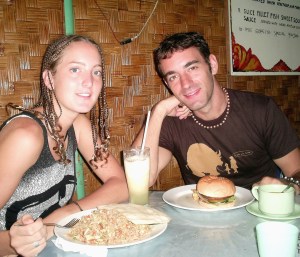
Image: Tony Slater with his girlfriend (now wife), Krista, in an open shack-style cafe in Kuta Beach, Bali, Indonesia. Krista is eating nasi goreng, a Balinese veggie curry (over fried rice), whereas Tony has ordered a burger (but will it be too Asianized for his tastes?).

12 NOMADS OF CHRISTMAS: David Hagerman, American expat in Malaysia (11/12)

Current home: Penang, Malaysia
Past overseas locations: Vietnam (Ho Chi Minh City), Thailand (Bangkok), Malaysia once before (Kuala Lumpur), Hong Kong, China (Shanghai, Chengdu), Philippines (Los Baños)
Cyberspace coordinates: David Hagerman Photography (business site), SkyBlueSky (blog) and @DaveHagerman (Twitter handle)
Recent posts: “My Date with the Bachelorette” (December 17, 2011); “Day Dreaming” [includes a work-in-progress: “The Ferry Boats of Istanbul”] (November 29, 2011)

Where are you spending the holidays this year?
Chiang Mai, on assignment.

What will you do when you first arrive?
I’ll be scoping out shots as soon as I drop my bags.

What do you most like doing during the holidays?
Eating. My wife, Robyn Eckhardt, is a great cook and she always makes something a bit special, if not necessarily traditional, around Christmas and New Year. (She writes about food and food culture, and has a food blog, EatingAsia, for which I take the photos.) For example, she might make devil’s curry, or curry debal, which is part of the Eurasian Kristang cuisine of Singapore and Malaysia, and is often served during Christmas.

Will you be on or offline?
This year I will be working during the holidays. I’m shooting a hotel in Penang and a travel story in northern Thailand with edits in between. I’ll need to be online for most of that time to send images and file the story.

Are you sending any cards?
I’ll admit that I’m terrible about mailers, promotional and personal. Getting better about doing that is a New Year’s resolution.

Can you recommend any good films or books other expats or “internationals” might enjoy?
The BBC mini-series Michael Palin: Himalaya. Palin has a wonderful way of having fun with a place without making fun of a place. I like it when an actor or a writer can transport you to a place and have you meet the people while not making themselves the center of attention in the narrative.

If you could travel anywhere for the holidays, where would it be?
Turkey. I’ve been three times in the past 18 months and it’s become a bit of an obsession.

What famous person do you think it would be fun to spend the holidays with?
The Ventures‘ guitarist, Nokie Edwards. His version of “Frosty the Snowman” is a reason to listen to Christmas music, and if I could talk him into playing “Telstar” as the ball drops on New Year’s Eve then I’d be a pretty happy guy.

What’s been your most displaced holiday experience?
Christmas in Southeast Asia always feels wrong to me. Too much heat, too much sun, too much Christmas for the sake of nothing but shopping. Except for the Philippines. Filipinos know how to do Christmas better than any people I know.

How about the least displaced experience — when you’ve felt the true joy of the season?
In rural northern Italy, where I’ve spent three Christmases, the holiday felt just as it should: a time for eating and drinking and being together with family and friends. The consumerist frenzy was minimal, and everyone was in a great mood, showing kindness to each other and to me. Even on Christmas Eve, when everyone was out food shopping, there was no pushing, no rudeness, no impatience. I’d like to be in Italy again for the holidays.

How do you feel when the holidays are over?
Robyn and I don’t make a big deal of Christmas or New Year’s, so January 2nd feels pretty much like any other day.

On the first day of Christmas, my true love said to me:
ELEVEN CAMERAS CLICKING,
TEN SPROUTS A-BRUSSELING,
NINE CELLPHONES DANCING,
EIGHT WHOOPHIS WHOOPING,
SEVEN SKIERS A-PARTYING,
SIX SPOUSES TRAILING,
FIVE GOOOOOOOFY EXPATS.
FOUR ENGLISH CHEESES,
THREE DECENT WHISKIES,
TWO CANDY BOXES,
& AN IRISHMAN IN A PALM TREE!

STAY TUNED for tomorrow’s featured nomad, the last (12/12) in our 12 Nomads of Christmas series.

If you enjoyed this post, we invite you to register for The Displaced Dispatch, a round up of weekly posts from The Displaced Nation, with seasonal recipes, book giveaways and other extras. Register for The Displaced Dispatch by clicking here!

Related posts: