The Displaced Nation

A home for international creatives

Tag Archives: South America

RANDOM NOMAD: Tom Frost, Kindergarten Teacher & Expat Blogger

Born in: Hillsboro, Oregon USA
Passport: USA
Countries lived in: India (Belgaum): 1979-80; Japan (Mutsu and Hachinohe): 1983-88; Mexico (Mazatlán):2005-06; Argentina (Buenos Aires): 2006-09; Uruguay (Colonia del Sacramento): 2009-10; Asia (Japan, Thailand, Malaysia, Laos, Hong Kong): 2010-2011; China (Beijing): July 2011 – present.
Cyberspace coordinates: Expat Alley (blog)

What made you leave your homeland in the first place?
My wife, Maya Frost, and I left the US to give our children a taste of the world outside and to supercharge their brains with new languages, new challenges and new experiences. Maya wrote the book The New Global Student: Skip the SAT, Save Thousands on Tuition, and Get a Truly International Education, detailing our experiences getting the kids — we have four daughters — through high school and college without going the traditional route. Two of them are now working in Buenos Aires and Abu Dhabi. The other two are in New York, one of whom has just completed a couple of years working as a multilingual events coordinator on Norwegian Cruise Lines — she was craving some “land time.” Maya and I have settled in Beijing for the time being.

Is anyone else in your immediate family displaced?
My wife and I were both displaced Oregonians living in Japan when we first met. All of my family have traveled quite extensively. Like me, my three siblings were all Rotary exchange students for a year in France, Philippines and South Africa (I lived in India). For a time one of my siblings lived in Japan for several years. I have a niece in Barcelona, a nephew in Japan, a cousin in Africa…

Describe the moment when you felt most displaced.
Getting off a plane in Miami after being in South America for two years. It was overwhelming to understand everything that was going on around me. All the magazine racks were screaming that I was too fat, too old, too poor and too poorly dressed. I wanted so much just to get back on the plane and go “home” to Buenos Aires.

Describe the moment when you felt least displaced.
The longer I stay out of the US the more this is happening. The “normal” feeling for me now is to feel displaced. Not understanding the language, not feeling like one of the crowd, not recognizing anything on a menu — that is when I feel at home.

You may bring one curiosity you’ve collected from your adopted country into the Displaced Nation. What’s in your suitcase?
My wife and I are obsessively light travelers. Even when moving to a new place to live for an extended period of time, we never have more than one carry-on each. I am a firm believer in the old adage that “you don’t own stuff, your stuff owns you.” I have a compass that was left to me by my father and about 30 photographs (unframed) of our family — we buy new frames each time we set up a new home. Beyond those items we take nothing more than a few changes of clothes and our laptops.

You’re invited to prepare one meal based on your travels for other Displaced Nation members. What’s on the menu?
Let’s start with the drinks because they generally taste the same each time they come out of the bottle, unlike my favorite meals which are those have not yet tasted.

A bucket of iced Mexican Pacifico [a Pilsner-style beer] for the appetizer, chilled sake for the cold course, a hearty Uruguayan Tannat for the main, Argentine fernet for dessert — and a couple of Tylenol for a nightcap.

I love to cook and am in charge of all the meals in our house. But I do not use recipes and generally do not make the same thing twice. Each time I go to the grocery store I buy at least one item I do not recognize. Past favorites have included:

My current craving is for shrimp Chinese dumpling, purple cabbage and cucumber in a spicy chili sauce, with cut chives for garnish. How does that sound?

You may add one word or expression from the country you’re living in to The Displaced Nation argot. What will you loan us?
My ability with languages is less than stellar so I’d prefer to loan you a few body language motions.

From Japan: Sucking air through gritted teeth and turning your head to the side — this means you are giving something a great deal of thought but also buys time to figure out what what was just said. Even if you cannot come up with a reply, you get points for showing you are thinking hard about the subject at hand.

From Argentina: The shoulder shrug — a good way of masking your ignorance of an indecipherable comment. Essentially it means: “Sometimes shit just happens, you know?”

From India: The head bobble — it can be construed as an affirmation but is ambivalent enough that you can later change your mind and renege on whatever you agreed to. It is also fun to practice in the mirror for your own amusement when bored.

It’s Zen and the Art of the Road Trip month at The Displaced Nation. Robert M. Pirsig, author of Zen and the Art of Motorcycle Maintenance, famously said: “Sometimes it’s a little better to travel than to arrive.” Do you agree?
I dislike traveling without arriving.

There are certain things I immediately look for in any destination to make me feel at home, but in reality, it is silly I look for them — why bother traveling if I want to feel at home?

I love this paradox.

Pirsig’s book details two types of personalities: 1) those who are interested mostly in gestalts so focus on being in the moment, not rational analysis; and 2) those who seek to know the details, understand the inner workings, and master the mechanics. Which type are you?
I definitely lean more toward the rational mindset. I love getting to know transportation — specifically, bus routes and subways — as well as getting a handle on how traffic patterns have developed over time. As a child of the US suburbs, I used to equate riding public transportation with being a loser, but now I know it is freedom. And it’s not just rational, it can also be “in the moment.” Life happens on public transportation — the grateful glance from an elderly woman you give up your seat to on a subway in Tokyo, the giggles of the small child you play peek-a-boo with on the train in Kuala Lumpur, the strains of the guitarist serenading bus riders on a Friday afternoon in Buenos Aires. Nothing interesting has ever happened to me by myself in a car.

Readers — yay or nay for letting Tom Frost into The Displaced Nation? Tell us your reasons. (Note: It’s fine to vote “nay” as long as you couch your reasoning in terms we all — including Tom — find amusing.)

img: Tom Frost becoming displaced yet again — by an elephant in Pai, Thailand (June 2011).

STAY TUNED for tomorrow’s installment from our displaced fictional heroine, Libby, who is just back from a road trip with Oliver and Jack, during which she has pondered her new life and the Melissa situation. What, not keeping up with Libby’s expat adventures? Read the first three episodes here.

If you enjoyed this post, we invite you to register for The Displaced Dispatch, a round up of weekly posts from The Displaced Nation. Includes seasonal recipes and book giveaways. Register for The Displaced Dispatch by clicking here!

Related posts:

6 celebrated women travel writers with the power to enchant you

Any wannabe expat/travel writer would do well to consult with Kristin Bair O’Keeffe, herself a novelist and former expat, before beginning their Great Works. Kristin offers a wealth of writing tips on Writerhead, a blog that she launched on April 1 of this year (which, coincidentally, was the same day we launched The Displaced Nation).

Of the helpful hints Kristin has offered thus far, I have many favorites, but if I had to pick one, it would be her post entitled “Write Wee.” In her breathlessly inimitable style, Kristin assures us that producing a multi-volume series on one’s overseas adventures is not the way to go:

Instead find a nugget. A moment. A single object. One exchange. One epiphany. One cultural revelation.

Find one story and tell it.

Just it.

The only thing I would add is that in general, women are better at extracting such nuggets than men.

Actually, what got me started in thinking about the difference in travel writing styles of the sexes was a post I wrote a couple of weeks ago on Edwardian novelist Elizabeth von Arnim, who penned the much-loved work, The Enchanted April, about four women who escape to a medieval castle in Italy for a much-needed break from their routines.

For me, von Arnim typifies one of characteristics that makes women’s travel writing so special (no doubt there are many more!). As she wandered far and wide across Europe and America, she paid extremely careful attention to the details of her surroundings.

A forerunner of what today we’d call a nature freak, she could get lost in telling the story of watching a “nightingale on a hornbeam, in loud raptures at the coming of the sun…” — I quote from her largely autobiographical novel The Solitary Summer, about a woman, also called Elizabeth, who is anything but solitary. She has a husband, to whom she refers as the Man of Wrath, small child and household to care for.

Perhaps such descriptive powers are born of necessity. Women have little choice but to make the most of spinning tales out of the moments they snatch from lives that are otherwise spent ministering to the needs of others — even when they’re technically on vacation.

Having combed through the pages of The Virago Book of Women Travellers (ed. Mary Morris with Larry O’Connor), I think I may be on to something. I discovered any number of women travel writers with the power to enchant their readers by capturing in their works the moments, exchanges, and personal ephiphanies their wanderings have yielded.

Here are six whose “nuggets” continue to gleam for us modern-day nomads:

Frances Trollope (1780-1863)

Who was she? Mother of Anthony and like her son, a prolific writer of novels (34 in total!).
Key work: Domestic Manners of the Americans, a travel book that made her name, about the four years she spent pursuing opportunities in the United States after her family suffered financial setbacks.

from DOMESTIC MANNERS OF THE AMERICANS
At length my wish of obtaining a house in the country was gratified….But even this was not enough to satisfy us when we first escaped from the city, and we determined upon having a day’s enjoyment of the wildest forest scenery we could find. So we packed up books, albums, pencils, and sandwiches, and, despite a burning sun, dragged up a hill so steep that we sometimes fancied we could rest ourselves against it by only leaning forward a little. In panting and in groaning we reached the top, hoping to be refreshed by the purest breath of heaven; but to have tasted the breath of heaven we must have climbed yet farther, even to the tops of the trees themselves, for we soon found that the air beneath them stirred not, nor ever had stirred, as it seemed to us, since first it settled there, so heavily did it weigh upon our lungs.

Still we were determined to enjoy ourselves, and forward we went, crunching knee deep through aboriginal leaves, hoping to reach some spot less perfectly air-tight than our landing place. Wearied with the fruitless search, we decided on reposing awhile on the trunk of a fallen tree; being all comfortably exhausted, the idea of sitting down on this tempting log was conceived and executed simultaneously by the whole party, and the whole party sunk together through its treacherous surface into a mass of rotten rubbish that had formed part of the pith and marrow of the eternal forest a hundred years before.

We were by no means the only sufferers from the accident; frogs, lizards, locusts, katydids, beetles, and hornets, had the whole of their various tenements disturbed, and testified their displeasure very naturally by annoying us as much as possible in return; we were bit, we were stung, we were scratched; and when, at last, we succeeded in raining ourselves from the venerable ruin, we presented as woeful a spectacle as can well be imagined. We shook our (not ambrosial) garments, and panting with heat, stings, and vexation, moved a few paces from the scene of our misfortune, and again sat down; but this time it was upon the solid earth.

We had no sooner begun to “chew the cud” of the bitter fancy that had beguiled us to these mountain solitudes than a new annoyance assailed us. A cloud of mosquitoes gathered round, and while each sharp proboscis sucked our blood, they teased us with their humming chorus, till we lost all patience, and started again on our feet, pretty firmly resolved never to try the al fresco joys of an American forest again.

Flora Tristan (1803-1844)
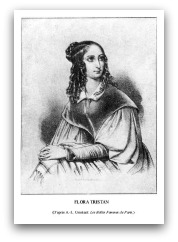
Who was she? French reformer who campaigned for workers’ and women’s rights; grandmother to artist Paul Gauguin.
Key work: Peregrinations of a Pariah, about a trip she made alone to Peru to stake her claim to her family’s fortune.

from PEREGRINATIONS OF A PARIAH
Mr. Smith took me to the house of his correspondents, and here once more I found all of the luxury and comfort characteristic of the English. The servants were English, and like their masters they were dressed just as they would have been in England. The house had a verandah, as do all the houses in Lima, and this is very convenient in hot countries, as it gives shelter from the sun and enables one to walk all round the house to take the air. This particular verandah was embellished with pretty English blinds. I stayed there for some time and could survey in comfort the only long wide street which constitutes the whole of Callao. It was a Sunday, and sailors in holiday attire were strolling about; I saw groups of Englishmen, Americans, Frenchmen, Dutchmen, Germans — in short, a mixture from nearly every nation — and I heard snatches from every tongue. As I listened to these sailors, I began to understand the charm they find in their adventurous life… When I tired of looking at the street I cast a glance into the large drawing-room whose windows overlooked the verandah, where five or six immaculately dressed Englishmen, their handsome faces calm and impassive, were drinking grog and smoking excellent Havana cigars as they swung gently to and fro from hammocks from Guayaquil suspended from the ceiling.

Mary Anne Barker (1831 – 1911)
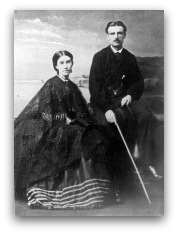
Who was she? Jamaica-born, England-educated author and journalist who with her second husband tried to run a sheep station in New Zealand (they later traveled to Mauritius, Western Australia, Barbados and Trinidad for his colonial appointments).
Key works: Station Life in New Zealand (1870); First Lessons in the Principles of Cooking (1874); A Year’s Housekeeping in South Africa (1880).

from STATION LIFE IN NEW ZEALAND
All this beauty would have been almost too oppressive, it was on such a large scale and the solitude was so intense, if it had not been for the pretty little touch of life and movement afforded by the hut belonging to the station we were bound for. It was only a rough building, made of slabs of wood with cob between; but there was a bit of fence and the corner of a garden and an English grass paddock, which looked about as big as a pocket-handkerchief from where we stood. A horse or two and a couple of cows were tethered near, and we could hear the bark of a dog. A more complete hermitage could not have been desired by Diogenes himself, and for the first time we felt ashamed of invading the recluse in such a formidable body, but ungrudging, open-handed hospitality is so universal in New Zealand that we took courage and began our descent. … We put the least scratched and most respectable-looking member of the party in the van, and followed him, amid much barking of dogs, to the low porch; and after hearing a cheery “Come in,” answering our modest tap at the door, we trooped in one after the other till the little room was quite full. I never saw such astonishment on any human face as on that of the poor master of the house, who could not stir from his chair by the fire, on account of a bad wound in his leg from an axe. There he sat quite helpless, a moment ago so solitary, and now finding himself the centre of a large, odd-looking crowd of strangers. He was a middle-aged Scotchman, probably of not a very elevated position in life, and had passed many years in this lonely spot, and yet he showed himself quite equal to the occasion.

After that first uncontrollable look of amazement he did the honours of his poor hut with the utmost courtesy… His only apology was for being unable to rise form his arm-chair (made out of half a barrel and an old flour-sack by the way); he made us perfectly welcome, took it for granted we were hungry — hunger is a very mild world to express my appetite, for one… I never felt more awkward in my life than when I stooped to enter that low doorway, and yet in a minute I was quite at my ease again; but of the whole party I was naturally the one who puzzled him the most. In the first place, I strongly suspect that he had doubts as to my being anything but a boy in a rather long kilt; and when this point was explained, he could not understand what a “female,” as he also called me, was doing on a rough hunting expedition. He particularly inquired more than once if I had come of my own free will, and could not understand what pleasure I found in walking so far.

Vivienne de Watteville (1900 – 1957)
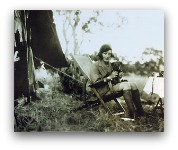
Who was she? British writer and adventurer who accompanied her father on a safari in Kenya. After he was killed by a lion, she finished the trip on her own.
Key works: Out in the Blue (1927); Speak to the Earth: Wanderings and Reflections among Elephants and Mountains (1937).

from SPEAK TO THE EARTH
Finally, it was the boys themselves who pointed to the summit and said it was not very far.

Enviously, I admired the way they could climb. As for me, … I was badly spent; my knees trembled as I panted up through the reeling boulders. …

At last I climbed above the forest zone, passing beneath the last outposts — stunted trees ragged with beard-moss in whose chequered shade lay a carpet of tiny peas … whose blossoms were a lovely transparent blue. Above them flitted miniature butterflies, as though the petals themselves had taken wing. …

The top, when I at last reached it, was, after all, not really the top, and beyond a dipping saddle another granite head still frowned down upon me.

But meanwhile, below me the south side disclosed a grassing depression girt about by the two summits and bare granite screes; and amid that desolation the grass stretched so green and rural that you had looked there for shepherds with their flocks. Instead of which, on the far side of a quaking bog, I saw — grey among the grey slabs — two rhino.

… I drew to within forty yards of the rhino, yet they still looked like a couple of grey boulders as they browsed off an isolated patch of sere grass. …

The wind had risen to a tearing gale, and nosing straight into it I approached the rhino somewhat downhill. There was no chance of this steady blow jumping around to betray me, and it was strong enough to carry away any sound of my footsteps. Precaution was therefore unnecessary, and I walked boldly up to them. Just how close I was, it is hard to say; but I felt that I could have flipped a pebble at them, and I noted subconsciously that the eye of the one nearest me was not dark brown as I had imagined it, but the colour of sherry.

… he now came deliberately towards me nose to the ground, and horn foremost, full of suspicion. … In the finder [of my small cinema camera] I saw his tail go up, and knew that he was on the point of charging. Though it was the impression of a fraction of a second, it was unforgettable. …

… I read the danger signal, yet in a kind of trance of excitement I still held the camera against my forehead. Then Mohamed fired a shot over the rhino’s head to scare him, and I turned and fled for my very life.

M. F. K. Fisher (1908 – 1992)
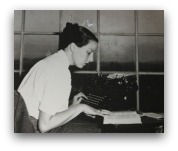
Who was she? A preeminent American food writer, whose books are an amalgam of food literature, travel and memoir.
Key works: How to Cook a Wolf (1942); Map of Another Town: A Memoir of Provence (1964); Dubious Honors (1988); Long Ago in France: The Years in Dijon (1991).

from LONG AGO IN FRANCE
Monsieur Venot was a town character and was supposed to be the stingiest and most disagreeable man in Dijon, if not in the whole of France. But I did not know this, and I assumed that it was all right to treat him as if he were a polite and even generous person. I never bought much from him but textbooks, because I had no extra money, but I often spent hours in his cluttered shop, looking at books and asking him things, and sniffing the fine papers there, and even sitting copying things from books he would suggest I use at his worktable, with his compliments and his ink and often his paper. In other words, he was polite and generous to me, and I liked him. …

In Monsieur Venot’s shop I learned to like French books better than any others. They bent to the hand and had to be cut, page by page. I liked that; having to work to earn the reward, cutting impatiently through the cheap paper of a “train novel,” the kind bought in railroad stations to be thrown away and then as often kept for many years, precious for one reason or another. I liked the way the paper crumbled a little into my lap or my blanket or my plate, along the edges of each page.

Mary Lee Settle (1918 – 2005)

Who was she? American writer, novelist and expat, one of the founders of the PEN/Faulkner Award for Fiction.
Key works: “Beulah Quintet” novel series (1956-1982), about the history of her native West Virginia (and hence of America); Turkish Reflections: A Biography of Place (1991).

from TURKISH REFLECTIONS
I hadn’t heard anything move, yet he stood there in front of me, smiling, quite silent, a large strong Turkish man, holding in his hand a small bunch of sweet wild thyme. He held it toward me, saying nothing, still smiling. There was something so gentle about him that I could not be afraid. I took the wild thyme, and I thanked him, in Turkish. He smiled again and touched his mouth and his ear. He was deaf and dumb. I still have the wild thyme, pressed and dried, kept like a Victorian lady’s souvenir of the Holy Land.

Dumb was the wrong word for him. There was no need for speech. He was an actor, an eloquent mime. I pointed to the atrium below and held my hands apart to show I didn’t know how to get down into it. He took my arm, and carefully, slowly, led me down a steep pile of rubble.

He mimed the opening of a nonexistent door and ushered me through it. He showed me roofless room after roofless room after roofless room as if he had discovered them. …

I think he had scared people before, and he was happy that there was someone who would let him show his house, for it was his house. Maybe he didn’t sleep there. I don’t know. I only know that he treated me as a guest in a ruin ten feet below the levee of the ground, and that he took me from room to room where once there had been marble walls and now there was only stone, where he was host and owner for a little while.

He showed me a small pool, held out his hand the height of a small child, and then swam across the air. All the time he smiled. He took me to a larger pool and swam again. Then he grabbed my arm and led me through a dark corridor toward what I thought was at first a cave. It was not. He sat down in an niche in the corridor, and strained until his face was pink, to show me it was the toilet. Then he took me into the kitchen where there were two ovens. …

For the first one he rolled dough for bread, kneaded it in air, slapped it, and put it in the oven. Then he took it out, broke it, and shared it with me. I ate the air with him. …

When I gave my friend, my arkadaş, some money, he kissed my hand and held it to his forehead, and then, pleased with the sun and me, and the fact that someone had not run away from him who lived like Caliban in a ruin, he put his arms around me and kissed me on both cheeks. Then I went down the hill to Ephesus. When I looked back to wave he had disappeared.

STAY TUNED for tomorrow’s post, a tell-all from Kate Allison on what inspired her to create her fictional expat heroine, Libby.

If you enjoyed this post, we invite you to subscribe to The Displaced Dispatch, a weekly round up of posts from The Displaced Nation, plus some extras such as seasonal recipes and occasional book giveaways. Sign up for The Displaced Dispatch by clicking here!

Related posts:

Marriage, cross-cultural style: Two veterans tell all (Part 2)

A week is a long time in blogging, and since Part 1 of this post went up last Monday, horrifying events in Norway have delivered a chilling reminder of the venom that can be unleashed when cultures mix and values clash.

Thus I am full of renewed admiration for our two married couples — Gabriela & Daniel Smith, Jeffrey & Naoko Huffman — who have tested themselves more than most on cultural tolerance and openness.

Last week, we heard from Gabriela and Jeffrey, the nomadic halves of each partnership. Let’s introduce them again — along with their better halves, who this week have kindly agreed to “come in” and answer a few of my questions.


GABRIELA & DANIEL SMITH have been married for eight years. Gabriela was born in Venezuela to Spanish parents, but ended up in the UK, where she met Daniel and they currently live.


JEFFREY & NAOKO HUFFMAN have been married for 19 years. They met in Nagoya, Japan, where Jeffrey, an American, had journeyed for his work. They now live in Seattle.

Naoko and Daniel, I’d like ask you both a question I posed to your respective spouses last week: did you ever think you would marry someone from another culture?


NAOKO: My parents expected that I would agree to an arranged marriage, and when growing up, I thought I would do as they told me. But then I attended an English as a Second Language (ESL) program in San Francisco. After meeting lots of people from different countries, I became more open to the idea of an international marriage. But I don’t think I chose Jeff as my husband because he is a foreigner. I just wanted to be with him and spend the rest of our lives together.


DANIEL: I was drawn by Gabriela’s Latin charm, but what attracted me to her primarily was her personality and way of looking at life. I never experienced any inhibitions about asking her to marry me. I assume that whatever the background of your partner, if you make the decision you love someone and want to be with that person forever, there will always be a considerable amount of risk — as in not knowing how each person will change and how their values and perceptions will evolve. In reality could the “girl next door” be a higher risk? For example, I now know what it feels like to be an expat from having worked for six years in France, but I had no way of predicting my life would take that path.

How did you find your new in-laws?


NAOKO: Jeff’s parents were nice to me from the beginning, even though my English wasn’t good enough to communicate with them on a deep level. But while they treated me with respect, I think they were also wondering how Jeff’s two grandmothers would feel about me.


DANIEL: On our first visit to my new parents-in-law, the only true reservation I had was based on what type of food I would be offered and if there was a different etiquette I would be expected to follow. Navigating the new culture proved relatively straightforward, although I did discover that calamares — whether fried, baked or stewed — isn’t fit for human consumption.

Let’s bring in all the partners now and talk a little more about family life. As mentioned in Part 1, each of you has two kids, a girl and a boy. What’s been the biggest challenge in bringing up kids from two different cultural backgrounds? Have they adopted one of your cultures more than the other?


JEFFREY: At 9, I think our son is too young to have much “cultural consciousness.” He has Asian American, African American, and Muslim American classmates. He’s aware of the general differences, but none of it seems to matter at this point — although he was rooting for Japan, not the U.S., to win the women’s World Cup.

Our daughter, on the other hand, is quite proud of her Japanese heritage — while not being particularly well versed in the culture. She has at least four other haffu classmates and lots of Korean American and Chinese American classmates. Of her best friends, one is African American, and another is a half-Phillipina girl whose adoptive mother is a lesbian. Her cohort gives me hope for America’s future as an open and tolerant society.

Neither Naoko nor I is religious, so that’s never been much of an issue — less so, however, with my mother, who is Christian and probably believes we’re all going to hell.


NAOKO: I had a concern about how our kids would feel about being Japanese when they learned about WWII. But they just accepted as a fact and were okay with it. I was impressed. I do wish we’d started them on Japanese language training earlier, though. Our daughter was only 18 months old when we moved back to the U.S. After that, I stopped using Japanese at home and soon returned to work full time. They are just now beginning formal Japanese-language instruction.


GABRIELA: I was born in Venezuela to Spanish parents and have never been able to choose between my two — Spanish and Venezuelan — heritages. Perhaps our children will just take the best from each of these cultures, and from English culture. No doubt their choices will be influenced by where they live, the type of people they meet, and how they position themselves in the world. I don’t know if they will feel more one or the other, especially if we live in a neutral third country, which as I mentioned last week is our goal. Right now, for example, my daughter says she is French because she was born in France. I’m happy with that.


DANIEL: I don’t find it challenging at all to bring up children who are a mix of cultures. Of course I’m always noticing their Spanish looks and ways, inherited from Gabriela.

How about for meals? Do you try to blend your cultures in the foods you prepare for the family? Who cooks?


JEFFREY: We eat as much if not more Asian/Japanese food as we do Western. Our son would eat soba and shumai seven days a week. We both cook.


GABRIELA: I cook for our children and my husband cook for the two of us. Since I’m not much of a cook, my kids have to eat my invented meals (bless them!), and as for my husband, well, I let him decide what he wants to make. I just enjoy it and do the washing up afterwards! He occasionally makes Venezuelan and Spanish meals, perhaps as often as he does English ones.

Jeff and Naoko, do you think you’ll ever move back to Japan? Last time, Jeff hinted that you might like to one day.


JEFFREY: The longer we’ve been back in the U.S., the harder it’s become for us to return to Japan. That being said, even in today’s economy, Naoko would have little difficulty finding work in Japan — she’s in finance. Whereas I’m pretty much unsuited to anything in Japan that would pay all that well. The kids, particularly our daughter who is just entering high school, would probably mutiny as well if we uprooted them at this point. Maybe after retirement?


NAOKO: Jeff keeps telling me to get posted to London, so perhaps we could give that a try?

Gabriela, how often do you get back to Venezuela to see family and friends?


GABRIELA: The last time I visited was three years ago. After that, I decided not to go back due to the political situation and have been relying on telephone calls and the Internet to keep in touch. But, to be honest, I don’t communicate with my family all that often. I have been away 14 years, so am used to the distance.

How about your kids? Actually, that’s a question for Naoko, too, since both of you are living away from the countries where you grew up.


GABRIELA: Only some of my family come to the UK and visit, usually just once a year for a few days. Those are the only times my children see them.


NAOKO: We haven’t been able to go back to Japan as often as we would wish since it’s so expensive for a family of four to fly there. Over the last five years, we’ve gone back every other year. But from now we’ll be making more of an effort to visit my parents since my father is not doing so well. My family always talks about coming to see us in Seattle, but they haven’t done it yet. Only my mother has been here — for my wedding, 19 years ago.

Finally, we are honoring Pocahontas this month at The Displaced Nation for her expertise in cross-cultural relations. I’m wondering if each of you could offer some advice to other couples in cross-cultural relationships — preferably in the form of a Native American proverb.


GABRIELA & DANIEL:

Cultural barriers are in the eye of the beholder.


JEFFREY & NAOKO:

For cross-cultural marriage to work, there can be no shortcuts. Each partner must accept the other’s culture.

Warm thanks to both of our couples for allowing their marriages to be put under The Displaced Nation’s microscope for two weeks running. Readers, do you have any more questions or comments?

STAY TUNED for tomorrow’s post, Part 2 of the travel yarn “How foreign is Fez?” — by guest blogger Joy Richards.

If you enjoyed this post, we invite you to subscribe for email delivery of The Displaced Nation. That way, you won’t miss a single issue. SPECIAL OFFER: New subscribers receive a FREE copy of “A Royally Displaced Tea.”

Related posts:

Marriage, cross-cultural style: Two veterans tell all (Part 1)

In the life of the global traveler, one of the most thrilling escapades you can have is a romantic encounter with someone you meet in a far-flung land.

But should your story involve going the further step and hitching your wagon to a person from a completely different culture — well, that’s another level of adventure altogether.

For marriage, you will need the ability to stand by the courage of your convictions.

Or, as one of our Random Nomads, Helena Halme put it in her comment on last week’s post covering this topic, cross-cultural marriage tends to be “for the mad bad and young — or foolish.”

Today and next Monday, one half of each of two cross-cultural couples have agreed to take the floor and answer my questions about what made them take the plunge:


GABRIELA SMITH has been married to Daniel for eight years. She was born in Venezuela to Spanish parents, but ended up in the UK, where she met Daniel and they currently live.


JEFFREY HUFFMAN has been married to Naoko for 19 years. They met in Nagoya, Japan, where Jeffrey, an American, had journeyed for his work. They now live in Seattle.

How did you meet your spouse-to-be?


GABRIELA: We were working for the same company in the UK; we met on my first day at work.


JEFFREY: We’re something of a cliché couple. She was a student in the summer Teaching English as a Foreign Language (TOEFL) prep course I was teaching in Nagoya. She had just graduated from college and wanted to pursue a second degree at a university in the U.S. and needed to pass the TOEFL to do so.

What made you think that this is the person for me? Did culture have anything to do with it?


JEFFREY: Definitely, Naoko represented a tie to the Japanese culture that I wanted to have. Seattle has a pretty large Asian community, I had taken Japanese at university with dozens of nikkei-jin, and I had been to Japan on visits twice before. But it wasn’t until I went to live there that it all fell in place.


GABRIELA: I arrived in the UK at 23 — marriage was not even in my mind. Additionally, I had no wish to stay in the UK so wasn’t looking for an Englishman to marry. I was going to travel more. I actually had a one way ticket to Italy when I fell in love with my husband.

Did you have any reservations before deciding to tie the knot, having to do with the other person being a different nationality?


JEFFREY: No reservations on my side, probably because Naoko had lived in the States for a year as an undergrad by the time I met her, and because her English was so good.


GABRIELA: Not at all. I thought — and I still think — that culture has very little effect on the “amount of risk” in a relationship. Values are important, of course, and I considered my husband’s values as an individual — not by placing him within a category ruled by his nationality.

How long were you together before you decided to get married?


JEFFREY: A point of no small contention with my wife. We’d been together for four years, two in Japan and two in the States, before I finally got around to asking her formally. Naoko was just about to graduate from Seattle University, and I’d been accepted at Columbia for grad school when I finally woke up and realized the time had come…


GABRIELA: Exactly 12 months after the day we met for the first time. Daniel asked me.

Where were your weddings held? Did you have cross-cultural ceremonies?

GABRIELA: The civil wedding was held in England; from my side there was just me. The religious ceremony was held in Venezuela a week after; from my husband’s side there was just him. The ceremony was in Spanish, a language that he does not speak! We held the reception party three weeks later when we were back in England — again, just me from my side. I even looked for a wedding dress on my own, and was on my own at the hairdressers on my wedding day. People may have thought it was strange, but I never minded. I thought it was all very exciting.


JEFFREY: We were married in my parent’s living room by a family friend who was a county judge. He wrote the ceremony for us, and it was very nice – just family and a few friends. We did a recommitment ceremony a few years later in Hawaii. Naoko didn’t want any kind of ceremony in Japan. She comes from Aichi-ken, where weddings tend to be an extravaganza. (Of course the real reason is that she was embarrassed to be marrying me — just kidding.)

Which makes me think of another question… What was it like meeting your in-laws for the first time? Did you have any awkward moments?


GABRIELA: Of course we’ve had some communication barriers, but mainly been due to my accent. I just have to repeat several times a word, or get my husband to “translate” for me. Ah, and the fact that I never drink tea or eat Christmas pudding seems to surprise his family each time!


JEFFREY: I think her parents and older brother initially took a dim view of our relationship, because I didn’t speak Japanese very well. To this day, my wife is my conduit with her parents (their Aichi-ben still leaves me lost a lot of the time). Overall, though, I think they are comfortable with me as I’m pretty comfortable with the culture.

How much of your married life has been spent in each other’s countries? And have you also lived in countries that are foreign to both of you?


GABRIELA: I don’t exactly have a country as my parents are originally from Spain but I grew up in Venezuela. Daniel and I have yet to live in a Spanish-speaking culture. We did, however, spend six years of our married life in a country foreign to us both: France. Otherwise, we’ve been in the UK.


JEFFREY: We’ve never lived anywhere else besides our home countries, and we’ve lived much longer in the U.S. than in Japan. Our time in Japan as a married couple consisted of three years in the Greater Tokyo area in the mid-1990s.

Are you settled down where you are now, or do you think you will change countries again?

JEFFREY:
Seattle is home for the time being. That said, I know Naoko misses her family. We’ve had some very emotional send-offs by family and friends in Japan. If fortuitous circumstances presented themselves (i.e. we were both offered obscene amounts of money and guaranteed vacation time), we’d be fools to not go. Barring that Disney scenario, we fully expect to spend at least part of the year in Japan in retirement, which isn’t that far off. It’s just eight years until our youngest is in college.


GABRIELA: What attracted me the most to my husband is that he also wanted to travel and live in other countries. I think things would have been very different if he said he wanted to stay in England “forever.” Now that we’ve spent six years in France I’ve realized that the weather really influences the social life and, to some extent, how people behave. It would be easier for my career if I stayed in the UK, but I have always placed my lifestyle before my career. Thankfully, my husband is quite happy with the idea of having late dinners on a terrace, under the sun, with wine and cheese on the table! Being Spanish, I would love for us to live in Spain one day.

What language do you speak with your respective spouses?


JEFFREY: Painful as it is to admit, about 99% English.


GABRIELA: Always English.

Tell me more about your kids.


GABRIELA: We have two wonderful children — a girl, 6, and a boy, 2. They were born in France, I was five months pregnant when we moved. Communicating with the midwives during childbirth was … interesting.


JEFFREY: We also have a girl and a boy, but they are a little older. Our girl is 14, and our boy, 9. Our daughter was born in Kawasaki, and our son in Seattle.

What language do you and your partner speak with the kids?


JEFFREY: The children are just now taking formal Japanese lessons.


GABRIELA: Spanish and English with my children. Occasionally I tease them — and my husband — in French. I must say that no matter what language I speak they all reply to me in English.

We look forward to hearing more from Jeffrey and Gabriela — and their spouses — next week. Let them know any comments or questions in the meantime!

If you enjoyed this post, we invite you to subscribe for email delivery of The Displaced Nation. That way, you won’t miss a single issue. SPECIAL OFFER: New subscribers receive a FREE copy of “A Royally Displaced Tea.”

Related posts:

My first flirtation with the lawlessness of global travel: 4 painful lessons

Today we welcome Lara Sterling to The Displaced Nation as a guest blogger. She wrote this post as part of our series on Gothic Tales, anchored by ML Awanohara’s “What did Agatha Christie know? Expats make great criminals.”  A native Californian, Sterling is an inveterate traveler. Her many adventures include a round-the-world trip and a stint as an expat in Spain (2001-2005).

Have you ever traveled to a foreign country, thinking you could get away with murder?

Maybe that’s what Amanda Knox was thinking…

Regardless of whether you believe Knox is guilty or not, I’m talking about getting away with murder on a trip I made to Guatemala.

Well, not actual murder — just a little bypassing of the laws.

War-torn tourism

This was Guatemala in 1993. The country was in the last days of a decades-long civil war. The nation’s social fabric had been torn apart. That meant there weren’t many laws anyhow. Or at least laws that anyone was abiding.
I remember one time drinking at a bar in Antigua, a city in the Guatemalan highlands. Plainclothes cops showed up to get bribes from the travelers who didn’t have passports.

I was twenty-three. I was a female traveling alone in a dangerous country. It was appealing to team up with the handsome German man I’d met in Antigua.

His name was Fritz. He wanted me to travel with him to the pyramids in Tikal, in the north.

I was nervous about travel to Tikal. I had heard many terrible stories about travel outside of the cities. Buses were high-jacked by bandits. Women were raped. But Fritz was gorgeous! I couldn’t resist.

Lesson #1: Don’t trust handsome Germans

Fritz and I traveled to Tikal without problems. I agreed to travel more, to Livingston, on the coast.

Livingston is an enclave in Guatemala. A slave ship wrecked there in a past century. The inhabitants speak a local patois, the Garifuna language.

Fritz and I disembarked the boat. There were men with machetes everywhere. They were returning home from work in the fields. My overactive tourist imagination went crazy. I thought we were going to be robbed at every corner.

Muggings and rapes were known to take place on the trails outside of town. Fritz wanted to hike, but I was nervous. We spent our afternoons at the beach and drinking coffees in the local cafes.

At some point, we were approached by one of the natives, a guy named Billy. He had a business proposition.

“Ya want to buy yaself some fun?” Billy asked.

“What’s that?” asked Fritz in English.

The man bent in close. “Crack.”

Crack cocaine? I asked myself. Surely, Fritz will say no.

He didn’t.

Lesson #2: Give a wide berth to a man with a machete

Before I knew it, Fritz and I were following Billy into a cluster of trees off of a back street. Billy’s eyes were bloodshot. He was armed with his machete. I was terrified.

Fritz handed over some quetzales. Billy handed over a small, plastic baggie.

Fritz and I retired to the room we were renting. I watched as Fritz got out some tin foil and a lighter. He began to smoke. The odor was metallic, and the smoke was blue. Fritz’s eyes glazed over.

I told him I was going for a walk.

I walked down to where the women washed their clothes in a community well. I can leave, I thought. I can get another room.

I couldn’t. I had a serious crush on Fritz.

Luckily, by the time I returned, the effects of the drugs had worn off of Fritz. He wanted to go out again.

It was still light. We walked to the edge of town. Fritz pointed to a small swathe of beige that looked like it was miles away.

“There’s a beach over there,” he said.

Between us and the beach was jungle.

Maybe in kilometers, it seemed shorter.

Lesson #3: Dogs are not the same the world over

Fritz and I began our hike. Because of the infamy of the trails, I was a nervous wreck. But I was also tired of buying into my fears. I had traveled all the way here. I might as well have some fun.

The sounds of birds chirping in the trees and of leaves rustling in the breeze calmed me.

Suddenly, two mutts appeared. They were small, and their coats were white and black. They were growling, barking.

I hoped they would go away, like the dogs I knew from home. They didn’t. The dogs moved closer, encroaching.

The mutts leapt at our bodies. One of the canines sank his incisors into my behind. I screamed.

Fritz was bitten too, in the leg.

A couple of Guatemalan children emerged from the jungle. They beat the dogs off with sticks. The dogs retreated behind the palms.

My bottom was bleeding. I needed stitches. Luckily, someone had called the local doctor. He was waiting for us on the street at the edge of the jungle.

The doctor led us to his office. I climbed onto his examining table. He numbed my butt, then sewed my loose flesh back up again.

“You must return to Guatemala City for rabies shots,” the doctor said.

I felt woozy, weak. “We’ll have to leave tonight,” I told Fritz.

“I can’t,” Fritz said. “I have to get to El Salvador.”

El Salvador?

“But what if you get rabies?” I asked.

“Then I will come and bite you,” Fritz responded.

He flashed me the same mischievous smile I had fallen for.

Lesson #4: Make sure you have a cubicle waiting for you back home

Fritz and I parted ways, never to meet again. Alone, I suffered through a week of visits to the Guatemalan hospital.

Each day, I took the bus to the hospital, then waited in the hours-long lines. Finally, I’d get my shot in the stomach.

The employees of the hospital were on strike. I was lucky I was treated at all.

It wasn’t until weeks afterward that I mustered up the gumption to leave the country.

Guatemala had changed me. I had learned a lot. A lot of lessons.

But I was also the same person: young, hungry, ambitious, confused.

I thanked my lucky stars there was a job waiting for me at home. In some cubicle!

I couldn’t wait.

Question: Have you ever encountered world travelers who think that the laws of the lands they visit don’t apply to them — and, time to ‘fess up, have you ever been in their ranks? We’d love to hear your stories.

Lara Sterling has contributed to many magazines, was a columnist for Spanish Playboy, and published one of Spain’s first non-fiction books on fetish sexuality. She currently teaches writing at www.yourplotthickens.com.

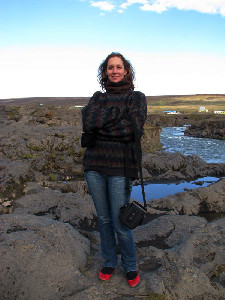
img: Lara Sterling on a lava bed in Iceland, on one of her many trips.

If you enjoyed this post, we invite you to subscribe for email delivery of The Displaced Nation. That way, you won’t miss a single issue. SPECIAL OFFER: New subscribers receive a FREE copy of “A Royally Displaced Tea.”

Related posts: