The Displaced Nation

A home for international creatives

Tag Archives: Republic of Ireland

12 NOMADS OF CHRISTMAS: Robin Graham, Irish Expat in Spain (1/12)

Current home: Tarifa, Spain
Past overseas locations: UK, Netherlands, Israel, and a previous stay in Spain
Cyberspace coordinates: a lot of wind… (blog) and @robinjgraham (Twitter handle)
Most recent post: “Gran Bretaña” (December 21, 2011)

Where are you spending the holidays this year?
In Hampshire, England. My mother lives there now with her husband, as does my brother and his family.

What will you do when you first arrive?
Once all the greetings are out of the way I may well go for a walk. I’ll be in the town where I spent my adolescent years and there will be memories and perhaps one or two stories for my fiancée, who will be visiting for the first time.

What do you most like doing during the holidays?
TV off, lights off. Candles on, perhaps a fire. To sit in the near dark and talk; to feel connected to all the people who are doing that around the world and to those who have done it down through the centuries. I am not religious but something about gathering with loved ones in the depths of winter seems to run deep.

Will you be on or offline?
I will tell myself to be offline and will fail. Lessline? Halfline? Online Lite?

Are you sending any cards?
Don’t do cards as a result of a selfish and entirely misspent youth. Not going to start now.

What’s the thing you most look forward to eating?
Tricky. I don’t have much of a sweet tooth. If there’s goose I’ll be happy. Roast potatoes never hurt either.

Can you recommend any good books other expats or “internationals” might enjoy?
Ghosts of Spain (2008) is an account of a journalist’s (Giles Tremlett‘s) trips around the country in search of its hidden history, particularly with regard to the civil war and Franco era, and how the country has changed since that era ended with his death in the mid-seventies. It fills a gap that I would have thought was there for many expats in many countries; a chance to get under the skin of your adopted country in your own language.

Foreign Flavours is the second anthology from the online writers group Writers Abroad. The theme is food (and drink) as experienced by the expat, and the collection is nothing if not varied — from short stories to journalistic pieces to recipes; it’s a real kitchen companion. All of the proceeds from the book go to the Book Bus, a registered charity that aims to provide books to and increase literacy rates among children in the developing world.

If you could travel anywhere for Christmas, where would it be?
I was brought up on the premise that an ideal Christmas would involve snow and reindeer, so the notion of an isolated but cosy log cabin in the woods of Lapland has a distinct appeal. Family around me — great. Just my fiancée — better.

What famous person do you think it would be fun to spend some time time with over the holidays?
Richard Dawkins. We could pontificate on the merits of an atheist world view whilst getting tipsy on eggnog, pigging out on Advent chocolates and singing Christmas carols. I hear he does a mean rendition of “Silent Night,” and I’m sure he’d be good company.

What’s been your most displaced Christmas experience?
I spent one Christmas entirely alone in Holland. Broke. Cue violins — it was an episode in that misspent youth I mentioned. My least Christmassy Christmas.

How about the least displaced experience — when you’ve felt the true joy of the season?
When I was a child most Christmas cards, cookie tins and cake wrappers would, for some reason, feature images of snow-laden Bavarian countryside. Castles and cutesy villages with snowy candlelit windows in the darkness. So to find myself in Bavaria a few years ago with my fiancee’s folks, watching families sled down a nearby hill in the evening, attending midnight mass in a 14th century church with an exquisitely painted ceiling, sitting in the house with candles and glühwein and stollen; that would have to be the one that ticked all the boxes for me.

This Christmas coming will be special, too — a family gathering such as there hasn’t been for long time.

How do you feel when the holidays are over?
Honestly? Relieved, ready to get on with it!

On the first day of Christmas, my true love said to me:
AN IRISHMAN IN A PALM TREE!

STAY TUNED for tomorrow’s featured nomad (2/12) in our 12 Nomads of Christmas series.

If you enjoyed this post, we invite you to register for The Displaced Dispatch, a round up of weekly posts from The Displaced Nation, with seasonal recipes, book giveaways and other extras. Register for The Displaced Dispatch by clicking here!

Related posts:

The Displaced Nation’s Agony Aunt: Introducing Mary-Sue

Please give a warm welcome to Mary-Sue Wallace, The Displaced Nation’s agony aunt. We’re delighted to have Mary-Sue on board and know that her thoughtful advice will be able to ease and soothe our readers with any cross-cultural quandary or travel-related confusion that they may have.

Mary-Sue is a retired travel agent who lives in Tulsa with her husband Jake. She has taken a credited course in therapy from Tulsa Community College and is the best-selling author of Traveling Made Easy, Low-Fat Chicken Soup for the Traveler’s Soul, The Art of War: The Authorized Biography of Samantha Brown, and William Shatner’s TekWar: An Unofficial Guide. If you have any questions that you would like Mary-Sue to answer, you can contact her at thedisplacednation@gmail.com, or by adding to the comments below.

I’m a 68-year-old retired insurance salesman from Buffalo, NY. Six months ago I got married for a second time to a woman that I met on www.meetukranianbrides.com, an international matchmaking site. My new wife, Oksana, is 24 and she seems increasingly distant with me. I’m worried that she doesn’t like Buffalo as much as I thought she would and that she’s having second thoughts about me. What can I do? DP, Buffalo.

Oh, DP, I think it’s time to start turning that frown upside down, don’t you? As you write in your letter, you’re a retired insurance salesman from Buffalo. What’s not to love about that? How can that fail to get the passion inflamed? My husband, Jake, is a retired insurance salesman from Tulsa, and let me tell you, I could not be happier — both in and out of the bedroom.

I bet you have a nice little pension from a life spent working hard. Now is the time to open up that wallet and throw the moolah around a bit. That way you can have a romantic time while also showing off all the best that Buffalo has to offer. Take her to Country Buffet or to Cracker Barrel, order her the meatloaf, she’ll soon stop her pining for Odessa. And over your romantic all-you-can-eat buffet, why not take this time to open up about yourself. Us gals love to know how our hubbys tick, believe me. Tell Oksana about your time as an insurance salesman. Tell her precisely how premiums work. Explain how your job was to give peace of mind to your average Joe. Believe me, Oksana will be reminded of just why she fell in love with you in the first place, that magical moment when she logged into her email and saw the JPEG file of your passport photo you’d sent her.

As an Irish Expat in Austria I sometimes have a hard time connecting with people. It seems humour-wise I’m on a different wavelength to everyone else. I’m used to using humour to diffuse situations or to put people at ease, but every time I make a joke here it’s met with stony silence. The sort of stuff that they laugh at I get really confused by. How can I bridge this humour gap? MA, Vienna.

It’s Austria, stony silence is a good thing. It’s when they start laughing at your jokes you’ve got a problem — that’s the time you really need to ask for help.

img: Close, by Corina Sanchez.

STAY TUNED for tomorrow’s post, on celebrated women travel writers of old.

If you enjoyed this post, we invite you to subscribe to The Displaced Dispatch, a weekly round up of posts from The Displaced Nation, plus some extras such as seasonal recipes and occasional book giveaways. Sign up for The Displaced Dispatch by clicking here!

DISPLACED Q: In the words of The Clash, “Should I stay or should I go?”; When reality bites in your adopted country, are you more — or less — determined to stay as an expat?

In our post on March 20, When in doubt, have a pint of Guinness, we drew attention to the Britons who resolutely stayed in post-earthquake Japan rather than fleeing with the majority of their expat countrymen back to the UK. Despite the danger of the nuclear situation, one man interviewed by the Telegraph said

“I actually feel a bit of a duty not to leave.”

Friends in need

Although this person’s mother couldn’t see his point, I understand this mentality. The events of September 11, 2001, so close to our home in Virginia, made me defensive of my adopted country, and outraged at such an audacious attack. To leave at this stage was unthinkable. That would mean we were just fair weather friends of the USA.

Instead, we taped a small American flag to our mailbox, as the rest of our neighbors did to theirs. It couldn’t help the 3,000 who died that day, but it showed our sympathy and solidarity, which didn’t go unnoticed: a neighbor made a point of telling me how touched she was that I, a foreigner, had done this.

Yet I suppose expats here did leave to go back home after 9/11, because it’s human nature to think the grass is greener – or safer – on the other side.

More trolls, not greener grass

It’s not greener or safer, of course. I know this from years of frequent news reports of IRA bombings.  The Spanish know this from decades of Basque separatist attacks. 2009 saw 10,999 terrorist attacks worldwide, and while 60 percent of these occurred in Iraq, Afghanistan, and Pakistan, that still leaves over 4,000 to be shared by the rest of the globe.

As chance had it, I arrived at Heathrow the day before the 2005 bombings of London’s transport system, and had planned to take the tube into the city the following morning to do some sightseeing with my children. Had we not been tired from jetlag and therefore overslept on July 7th, we could easily have been on one of the trains that were destroyed.

Was I as upset by 7/7 as I had been by 9/11? Undoubtedly. Yet there was something else, too – a feeling of deja vu, of “here we go again” or – dare I say it? – resignation.

Whether you run or stay, there is a difference between enduring atrocities in your own country and suffering them on another’s turf.

Not all disasters are manmade

It doesn’t have to be a terrorist atrocity, as our friends drinking Guinness in Tokyo can testify. Perhaps you were an expat in Christchurch, New Zealand during the last two earthquakes; perhaps you were posted to New Orleans just before Katrina hit the Gulf Coast. Only two days ago, Joplin, Missouri was devastated by a deadly tornado.

The world is a dangerous place. There are no certainties, especially when it comes to safety. To quote The Clash again:

“If I go there will be trouble

And if I stay it will be double.”

So, tell us:  What’s an expat to do when disaster strikes?

If you enjoyed this post, we invite you to subscribe for email delivery of The Displaced Nation. That way, you won’t miss a single issue. SPECIAL OFFER: New subscribers receive a FREE copy of “A Royally Displaced Tea.”

Related posts:

CLASSIC EXPAT WRITING: James Joyce’s Paris

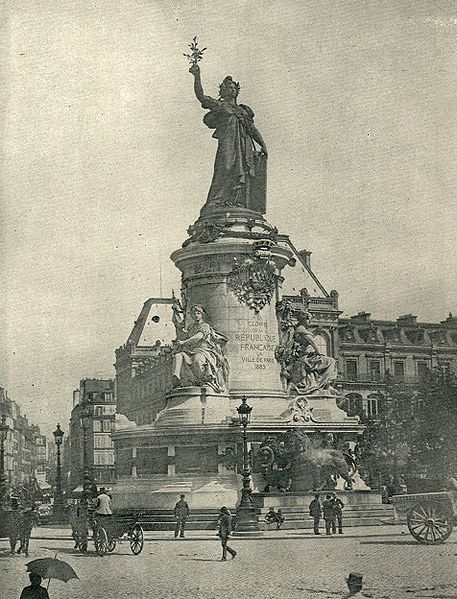
Statue of the Republic, Paris, c. 1890, from Wikimedia Commons (Public domain)

In producing this small, slightly piffling series of blog posts dedicated to expat writing, or members of the literati that we might class as expats, one thing that keeps holding me back somewhat and that is that I frankly dislike the term “expat writer”.

Expat writer: say it quietly to yourself and no doubt it conjures up thoughts about Peter Mayle and his numerous imitators, and do we really want to be conjuring up thoughts about Peter Mayle and his numerous imitators? If it’s not careful, expat writing can seem to be  mostly about a rather self-satisfied soul who is a little too pleased with himself and a little too enchanted with his surrounding. And if, like me, you’re one of those fusty souls who thinks that any writer worth their salt is more concerned with internalising thoughts and emotions, poor expat writers, who seem interested purely in the external, can drive you mad.

I was reminded a little about what this expat writer conundrum when on Twitter I stumbled across a discussion led by some of this parish about whether James Joyce should be considered an expat writer or not. Of course, it seems simple. Joyce spent most of his adult life living in continental Europe. It logically follows that we can lay claim to the title of expat writer for Joyce on account of him being both an expat and a writer. But it seems others would argue that Joyce is not an expat writer. And it is true, I grant you, that he certainly not in the Peter Mayle mould of expat writer. Paris, on the surface, does not seem to have inspired him. It never nourished, on the surface, his work in the way that Dublin did. But we could argue that Joyce needed the intellectual climate of France in the 20s and 30s to feed his own modernist work. If we were to be glib we might say that Finnegans Wake was conceived in Dublin, but Paris was its midwife.

With this in mind, for this week I’m drawing attention to an interesting essay from the New York Times first published in 1982 which takes a closer look at Joyce’s Paris and its effect on his work. An extract follows, but the full article can be found here at the New York Times Website.

N o. 7, Rue Edmond Valentin. A six-story facade, heavy ornamental moldings, a wrought-iron grille door, the Eiffel Tower in sight down the street: the heartland of upper-bourgeois Paris. Poodleland. Beneath the city’s winter overcast, these arrondissements – the 7th, the 8th, the 16th, the 17th -are an endless yellow-gray undercast: bland and impermeable. They are a chilly mask: and for the later James Joyce, who cloaked his turbulence with formality, they made an oddly appropriate residence.

Joyce spent 20 years in Paris – almost as long as in Dublin – but that is like counting the time we sleep. In 1922, two years after he arrived from Zurich, he immersed himself in the elusive dream that took him 16 years to finish: ”Finnegans Wake.”

In ”Ulysses,” the tangible presence of Dublin is memorialized: paving-stone and brick wall, legend and grilled kidneys, gab and gossip. ”Finnegans Wake” is a sleeping packrat dragging the world in, bit by bit. There are slivers of Paris in the pack but they are transmuted, as a dream transmutes the sound of a passing car into an army in flight.

So how is the pilgrim to find Joyce in Paris? There is, of course, his biographical presence, which will be attended to in a moment. But mostly what we look for in a literary pilgrimage is the cafe the characters drank in, not the one where the author did. Not, that is, unless the author is materially incorporated in the characters. We follow the characters Stephen and Bloom in and about Dublin; and we follow Joyce too, because he gave them his meanderings. In Paris, Joyce’s work and his life diverge d. How do you follow the sleeping Hum- phrey Chimpden Earwicker, whose dream is ”Finnegans Wake”? Strictly speaking: by eating an indigestible dinner, falling asleep, and letting the toots and stirrings outside and an uneasy memory infiltrate your dreams.

By the time Joyce got to Paris he was approaching middle age and near-blindness. He was not inactive, but he did not throw himself into the life of the city in order to find himself or his subjects or his art. He had them already. He used Paris for its quiet, its elegance and the congenial atmosphere it offered a writer.

He had company and diversion. He had the material support of Harriet Weaver, who sent him astonishing sums from London, and of Sylvia Beach and Adrienne Monnier, who got ”Ulysses” into print when nobody else dared to. He had a reasonable amount of lionizing; but he also had the privacy and aloofness that Paris allows to its lions, because it possesses so many of them.

Mostly, except for brief visits in 1902 and 1903, Joyce’s Paris geography is a series of respectable apartments, such as the one on Edmond Valentin, where he sat and wrote. They were havens of a sort, but invaded more and more by shadows. Literal ones: He had at least 10 eye operations, and at times could barely see to write. Correcting proofs, he would lay his head sideways on the page to achieve the only odd angle at which he still had some vision.

There were other troubles. The lion grew moth-eaten, as his Herculean labors on ”Finnegans Wake” were rewarded by puzzlement and distress on the part of many of his admirers. Even the American poet Ezra Pound, not exactly a clear-running stream, wrote him: ”I will have another go at it, but up to present I make nothing of it whatever … I don’t see what which has to do with where …”

Question: I’d be fascinated to know your own thoughts on what constitutes an expat writer. Do you need to focus your work on the expat life to be one?
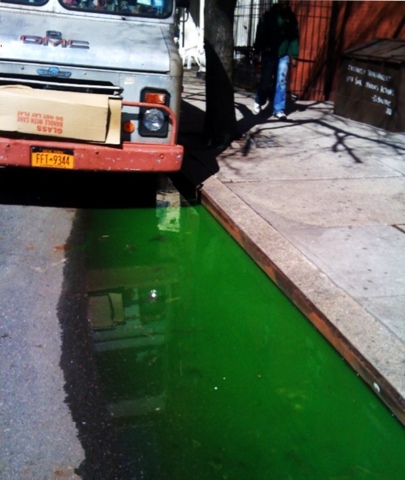
PHOTO: Sea of green

For the past 43 years, the Chicago River has turned green on March 17. So the residents of New York City’s East Village didn’t blink an eye when the water in the street near an Irish bar turned green this year as well. It seemed plausible to many of us that a leprechaun had been crying a river wondering why Irish Americans are more Irish than the Irish. (His eyes had not been smiling…)

“Is it a case of far away hills being greener?” he lamented with a keen.

You see, Dublin is quiet on St. Patrick’s Day, but American cities are anything but…

UPDATE: By the following morning, the green water had magically evaporated, proving we’d been right to give short shrift to the skeptic who insisted it was an antifreeze leak.

image: E. 10th St., NYC, by mlawanohara

If you enjoyed this post, we invite you to subscribe for email delivery of The Displaced Nation. That way, you won’t miss a single issue.