The Displaced Nation

A home for international creatives

Tag Archives: New Zealand

THE DISPLACED Q: Where did you meet your honey abroad?

It can be hard to make new friends abroad — let alone find a significant other. Thus it’s always inspiring to hear from nomads who’ve found that special someone hiding under a shamrock drinking green beer, or in other such fanciful locales. One such lucky fellow is Tony James Slater, the newest addition to the TDN team. Here is his story — can’t wait to hear yours!

There’s always a great story behind a travel romance, I find, often running the full gamut of emotions, from anguish to bliss. From experiencing a breathless holiday whirlwind romance to finding a soul mate in a distant land, nothing beats a tale of love — true and requited, tragically unrequited or trapped agonizingly somewhere in between.

And today I would very much like to hear yours!

Because our February theme is LOVE — and because it’s rapidly approaching That Day, when you should have bought something a bit special for your other half — I would like to invite EVERYONE to share their tale of passion and/or romance abroad!

Now, I can’t ask you folks to do something I wouldn’t do myself — so here’s an interesting tale of my own…

Once upon a time, in a faraway land…

I first met my wife in America. I know, right? Fascinating! But wait, I’m English — and the young lady in question, Krista, is from Australia, as evidenced by her nickname: Roo.

Roo had been working for Camp America, which supports summer work adventures in the United States. She was teaching kids how to ride horses at a summer school in Maine. And, as fate would have it, that was where she met…my sister!

My sis, whose name is Gillian, was doing Camp America at the same time, and was the only other staff member who wasn’t scared of horses!

Roo and Gill got to know each other quite well — so much so that the pair of them went traveling around the US after the job finished, which is where they met…Richie! An awesome, Kung-Fu kicking dude, muscle-bound and handsome, Roo fell for him immediately and the two became an item.

Which could have turned out rather differently for me, except this unexpected romance kept the couple in America for much longer than expected. You see, at the time some of this was happening, I was in Ecuador volunteering at an animal shelter. On my way home to the UK, I called in to the States to visit my sister, when I also met Roo and Richie. We traveled together for a couple of weeks and had a lot of fun.

Then Richie left, Roo left, and I followed my sister back to the UK, where, as explained in a previous post, I grew bored and dissatisfied with my hollow, consumer-led lifestyle.

(In other words, I was broke.)

Twists and turns worthy of Shakespearean comedy

So Gill remained close friends with Roo, inviting her over to England the following summer. She arrived just in time to be part of my farewell party — I’d finally scraped together enough cash to go to Thailand, where I planned to volunteer at an animal clinic and learn to dive. I would be gone for three months — exactly the same length of time that Roo would be in England.

Which was a pity, as she’s recently broken up with Richie and I rather liked her.

Gill and Roo explored every corner of my native country together, and Roo went back to Australia having elicited a promise from my sister that she would travel to Oz as soon as she could afford it.

I, meanwhile, had missed my flight home. It was accidentally on purpose — my subconscious clearly didn’t want me to leave Thailand just then. My regular conscious didn’t want me to leave either, being rather more aware of my income — or at least, the lack.

Volunteering for a living is notoriously unprofitable, and I couldn’t earn money from diving until I could afford to get qualified. A bit of a Catch 22!

But then — we came into some money. Both my sister and I profited from the sale of a house we’d helped renovate since getting back from America. I used the money to become a Divemaster (and for just a little bit of partying!), while Gillian, rather more sensibly, used hers to buy a ticket to Australia. She stopped off in Thailand on her way through, found me drunk in a bar and gave me such a talking to that I promised to come to Australia just to get her off my back. She was determined to save me from myself, which was probably for the best (I had very little intention of saving myself!).

I dallied for another three months while Gill met up with Roo in Oz and started to explore. They bought a beat-up old van between them and called it Rusty because, well, it was. Seriously — you could see daylight through bits of it.

To the ends of the earth — well, the Great Southern Land

That’s when I showed up. Penniless again, I arrived in Perth airport without the price of a cup of coffee to my name. I’d been living in Thailand for a year by this point, and all I owned was a bulging bag full of dive gear. It was winter in Australia and I didn’t even own a pair of shoes, or anything at all with sleeves.

Not in the least bit phased by me looking like a homeless person, Roo found me work with a local temp agency and within a few weeks I had enough money to travel.

The three of us piled into that crumbling van and set off for horizons unknown…and somewhere along the line, Roo and I fell in love.

Which thrilled my sister of course, as we were all sharing a tent. (But don’t worry — we got our own tent before long!)

Poor Gill left us, in disgust, in Sydney. She’d always hated being around couples in love — romance just wasn’t her thing. I still feel a little guilty for this…well, almost. But not quite!

Epi(c)logue

Since then, Roo and I have visited more than a dozen countries together. We married last July — in England because only Roo’s immediate family is in Oz. (She’s of Dutch descent, so all her rellies from Holland came over — including some she’s never met before! Her Aussie family — all four of them — flew over to the UK for the ceremony. ) And we now live in Perth — for a while in Roo’s family home but we now have a flat of our own. People always ask where we met — out of politeness more than interest, I feel — but it usually surprises them when we both say “America!”.

And as for Gill…well, she lingered in Sydney long after Roo and I left. Then she grew bored and flew to New Zealand, to a job in the ski fields, where she met a short blonde ski technician from Hampshire, UK, called Chris. They hit it off rather well as it happens — Gill had always liked short men — and four years later, the pair of them were married, a month before us and less than fifty miles away.

Roo got to be my sister’s Maid of Honor!

And because I’d been out of the country for so long that I’d lost touch with all my male friends, Gill — poor, suffering Gill — had to be my Best Man!

* * *

Your turn!

So. Let me hear it! Tales of love in far-flung and exotic locations: the triumphs, the failures and the ones that got away! We want to hear them all — post them in the comments section please, so everyone can read ’em and weep! (They don’t have to be as long and waffley as mine — I’ve been told I can be verbose.)

Oh, and keep it clean — some of these expat love stories lasted long enough to have children, and even grandchildren.

Love,
Tony xo

TONY JAMES SLATER is a self-confessed adventureholic. For the last six years he’s been traveling nonstop around the world, working at a variety of jobs including yacht deliverer in the Mediterranean, professional diver in Thailand and snow boarder in New Zealand. Last year, Slater published his first book, That Bear Ate My Pants!, an account of his misadventures while volunteering at the animal refuge in Ecuador. (The book was featured in The Displaced Nation’s list of 2011 expat books.) He is currently working on a second book set in Thailand, while exploring his new home in Perth, Australia.

STAY TUNED for Tuesday’s post, on 7 of the world’s most seductive foods — for seducing that valentine of yours.

If you enjoyed this post, we invite you to register for The Displaced Dispatch, a round up of weekly posts from The Displaced Nation, with seasonal recipes, book giveaways and other extras. Register for The Displaced Dispatch by clicking here!

Related posts:

Image: Tony Slater and Krista (Roo) participating in the traditional European ceremony of handfasting where the couple’s hands are tied together (in their case, with a garland of flowers), at their medieval-themed wedding last summer.

6 celebrated women travel writers with the power to enchant you

Any wannabe expat/travel writer would do well to consult with Kristin Bair O’Keeffe, herself a novelist and former expat, before beginning their Great Works. Kristin offers a wealth of writing tips on Writerhead, a blog that she launched on April 1 of this year (which, coincidentally, was the same day we launched The Displaced Nation).

Of the helpful hints Kristin has offered thus far, I have many favorites, but if I had to pick one, it would be her post entitled “Write Wee.” In her breathlessly inimitable style, Kristin assures us that producing a multi-volume series on one’s overseas adventures is not the way to go:

Instead find a nugget. A moment. A single object. One exchange. One epiphany. One cultural revelation.

Find one story and tell it.

Just it.

The only thing I would add is that in general, women are better at extracting such nuggets than men.

Actually, what got me started in thinking about the difference in travel writing styles of the sexes was a post I wrote a couple of weeks ago on Edwardian novelist Elizabeth von Arnim, who penned the much-loved work, The Enchanted April, about four women who escape to a medieval castle in Italy for a much-needed break from their routines.

For me, von Arnim typifies one of characteristics that makes women’s travel writing so special (no doubt there are many more!). As she wandered far and wide across Europe and America, she paid extremely careful attention to the details of her surroundings.

A forerunner of what today we’d call a nature freak, she could get lost in telling the story of watching a “nightingale on a hornbeam, in loud raptures at the coming of the sun…” — I quote from her largely autobiographical novel The Solitary Summer, about a woman, also called Elizabeth, who is anything but solitary. She has a husband, to whom she refers as the Man of Wrath, small child and household to care for.

Perhaps such descriptive powers are born of necessity. Women have little choice but to make the most of spinning tales out of the moments they snatch from lives that are otherwise spent ministering to the needs of others — even when they’re technically on vacation.

Having combed through the pages of The Virago Book of Women Travellers (ed. Mary Morris with Larry O’Connor), I think I may be on to something. I discovered any number of women travel writers with the power to enchant their readers by capturing in their works the moments, exchanges, and personal ephiphanies their wanderings have yielded.

Here are six whose “nuggets” continue to gleam for us modern-day nomads:

Frances Trollope (1780-1863)

Who was she? Mother of Anthony and like her son, a prolific writer of novels (34 in total!).
Key work: Domestic Manners of the Americans, a travel book that made her name, about the four years she spent pursuing opportunities in the United States after her family suffered financial setbacks.

from DOMESTIC MANNERS OF THE AMERICANS
At length my wish of obtaining a house in the country was gratified….But even this was not enough to satisfy us when we first escaped from the city, and we determined upon having a day’s enjoyment of the wildest forest scenery we could find. So we packed up books, albums, pencils, and sandwiches, and, despite a burning sun, dragged up a hill so steep that we sometimes fancied we could rest ourselves against it by only leaning forward a little. In panting and in groaning we reached the top, hoping to be refreshed by the purest breath of heaven; but to have tasted the breath of heaven we must have climbed yet farther, even to the tops of the trees themselves, for we soon found that the air beneath them stirred not, nor ever had stirred, as it seemed to us, since first it settled there, so heavily did it weigh upon our lungs.

Still we were determined to enjoy ourselves, and forward we went, crunching knee deep through aboriginal leaves, hoping to reach some spot less perfectly air-tight than our landing place. Wearied with the fruitless search, we decided on reposing awhile on the trunk of a fallen tree; being all comfortably exhausted, the idea of sitting down on this tempting log was conceived and executed simultaneously by the whole party, and the whole party sunk together through its treacherous surface into a mass of rotten rubbish that had formed part of the pith and marrow of the eternal forest a hundred years before.

We were by no means the only sufferers from the accident; frogs, lizards, locusts, katydids, beetles, and hornets, had the whole of their various tenements disturbed, and testified their displeasure very naturally by annoying us as much as possible in return; we were bit, we were stung, we were scratched; and when, at last, we succeeded in raining ourselves from the venerable ruin, we presented as woeful a spectacle as can well be imagined. We shook our (not ambrosial) garments, and panting with heat, stings, and vexation, moved a few paces from the scene of our misfortune, and again sat down; but this time it was upon the solid earth.

We had no sooner begun to “chew the cud” of the bitter fancy that had beguiled us to these mountain solitudes than a new annoyance assailed us. A cloud of mosquitoes gathered round, and while each sharp proboscis sucked our blood, they teased us with their humming chorus, till we lost all patience, and started again on our feet, pretty firmly resolved never to try the al fresco joys of an American forest again.

Flora Tristan (1803-1844)
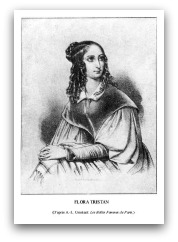
Who was she? French reformer who campaigned for workers’ and women’s rights; grandmother to artist Paul Gauguin.
Key work: Peregrinations of a Pariah, about a trip she made alone to Peru to stake her claim to her family’s fortune.

from PEREGRINATIONS OF A PARIAH
Mr. Smith took me to the house of his correspondents, and here once more I found all of the luxury and comfort characteristic of the English. The servants were English, and like their masters they were dressed just as they would have been in England. The house had a verandah, as do all the houses in Lima, and this is very convenient in hot countries, as it gives shelter from the sun and enables one to walk all round the house to take the air. This particular verandah was embellished with pretty English blinds. I stayed there for some time and could survey in comfort the only long wide street which constitutes the whole of Callao. It was a Sunday, and sailors in holiday attire were strolling about; I saw groups of Englishmen, Americans, Frenchmen, Dutchmen, Germans — in short, a mixture from nearly every nation — and I heard snatches from every tongue. As I listened to these sailors, I began to understand the charm they find in their adventurous life… When I tired of looking at the street I cast a glance into the large drawing-room whose windows overlooked the verandah, where five or six immaculately dressed Englishmen, their handsome faces calm and impassive, were drinking grog and smoking excellent Havana cigars as they swung gently to and fro from hammocks from Guayaquil suspended from the ceiling.

Mary Anne Barker (1831 – 1911)
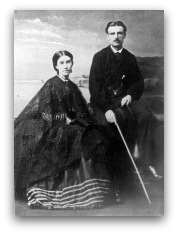
Who was she? Jamaica-born, England-educated author and journalist who with her second husband tried to run a sheep station in New Zealand (they later traveled to Mauritius, Western Australia, Barbados and Trinidad for his colonial appointments).
Key works: Station Life in New Zealand (1870); First Lessons in the Principles of Cooking (1874); A Year’s Housekeeping in South Africa (1880).

from STATION LIFE IN NEW ZEALAND
All this beauty would have been almost too oppressive, it was on such a large scale and the solitude was so intense, if it had not been for the pretty little touch of life and movement afforded by the hut belonging to the station we were bound for. It was only a rough building, made of slabs of wood with cob between; but there was a bit of fence and the corner of a garden and an English grass paddock, which looked about as big as a pocket-handkerchief from where we stood. A horse or two and a couple of cows were tethered near, and we could hear the bark of a dog. A more complete hermitage could not have been desired by Diogenes himself, and for the first time we felt ashamed of invading the recluse in such a formidable body, but ungrudging, open-handed hospitality is so universal in New Zealand that we took courage and began our descent. … We put the least scratched and most respectable-looking member of the party in the van, and followed him, amid much barking of dogs, to the low porch; and after hearing a cheery “Come in,” answering our modest tap at the door, we trooped in one after the other till the little room was quite full. I never saw such astonishment on any human face as on that of the poor master of the house, who could not stir from his chair by the fire, on account of a bad wound in his leg from an axe. There he sat quite helpless, a moment ago so solitary, and now finding himself the centre of a large, odd-looking crowd of strangers. He was a middle-aged Scotchman, probably of not a very elevated position in life, and had passed many years in this lonely spot, and yet he showed himself quite equal to the occasion.

After that first uncontrollable look of amazement he did the honours of his poor hut with the utmost courtesy… His only apology was for being unable to rise form his arm-chair (made out of half a barrel and an old flour-sack by the way); he made us perfectly welcome, took it for granted we were hungry — hunger is a very mild world to express my appetite, for one… I never felt more awkward in my life than when I stooped to enter that low doorway, and yet in a minute I was quite at my ease again; but of the whole party I was naturally the one who puzzled him the most. In the first place, I strongly suspect that he had doubts as to my being anything but a boy in a rather long kilt; and when this point was explained, he could not understand what a “female,” as he also called me, was doing on a rough hunting expedition. He particularly inquired more than once if I had come of my own free will, and could not understand what pleasure I found in walking so far.

Vivienne de Watteville (1900 – 1957)
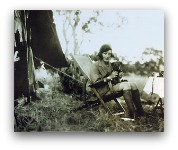
Who was she? British writer and adventurer who accompanied her father on a safari in Kenya. After he was killed by a lion, she finished the trip on her own.
Key works: Out in the Blue (1927); Speak to the Earth: Wanderings and Reflections among Elephants and Mountains (1937).

from SPEAK TO THE EARTH
Finally, it was the boys themselves who pointed to the summit and said it was not very far.

Enviously, I admired the way they could climb. As for me, … I was badly spent; my knees trembled as I panted up through the reeling boulders. …

At last I climbed above the forest zone, passing beneath the last outposts — stunted trees ragged with beard-moss in whose chequered shade lay a carpet of tiny peas … whose blossoms were a lovely transparent blue. Above them flitted miniature butterflies, as though the petals themselves had taken wing. …

The top, when I at last reached it, was, after all, not really the top, and beyond a dipping saddle another granite head still frowned down upon me.

But meanwhile, below me the south side disclosed a grassing depression girt about by the two summits and bare granite screes; and amid that desolation the grass stretched so green and rural that you had looked there for shepherds with their flocks. Instead of which, on the far side of a quaking bog, I saw — grey among the grey slabs — two rhino.

… I drew to within forty yards of the rhino, yet they still looked like a couple of grey boulders as they browsed off an isolated patch of sere grass. …

The wind had risen to a tearing gale, and nosing straight into it I approached the rhino somewhat downhill. There was no chance of this steady blow jumping around to betray me, and it was strong enough to carry away any sound of my footsteps. Precaution was therefore unnecessary, and I walked boldly up to them. Just how close I was, it is hard to say; but I felt that I could have flipped a pebble at them, and I noted subconsciously that the eye of the one nearest me was not dark brown as I had imagined it, but the colour of sherry.

… he now came deliberately towards me nose to the ground, and horn foremost, full of suspicion. … In the finder [of my small cinema camera] I saw his tail go up, and knew that he was on the point of charging. Though it was the impression of a fraction of a second, it was unforgettable. …

… I read the danger signal, yet in a kind of trance of excitement I still held the camera against my forehead. Then Mohamed fired a shot over the rhino’s head to scare him, and I turned and fled for my very life.

M. F. K. Fisher (1908 – 1992)
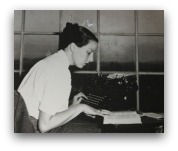
Who was she? A preeminent American food writer, whose books are an amalgam of food literature, travel and memoir.
Key works: How to Cook a Wolf (1942); Map of Another Town: A Memoir of Provence (1964); Dubious Honors (1988); Long Ago in France: The Years in Dijon (1991).

from LONG AGO IN FRANCE
Monsieur Venot was a town character and was supposed to be the stingiest and most disagreeable man in Dijon, if not in the whole of France. But I did not know this, and I assumed that it was all right to treat him as if he were a polite and even generous person. I never bought much from him but textbooks, because I had no extra money, but I often spent hours in his cluttered shop, looking at books and asking him things, and sniffing the fine papers there, and even sitting copying things from books he would suggest I use at his worktable, with his compliments and his ink and often his paper. In other words, he was polite and generous to me, and I liked him. …

In Monsieur Venot’s shop I learned to like French books better than any others. They bent to the hand and had to be cut, page by page. I liked that; having to work to earn the reward, cutting impatiently through the cheap paper of a “train novel,” the kind bought in railroad stations to be thrown away and then as often kept for many years, precious for one reason or another. I liked the way the paper crumbled a little into my lap or my blanket or my plate, along the edges of each page.

Mary Lee Settle (1918 – 2005)

Who was she? American writer, novelist and expat, one of the founders of the PEN/Faulkner Award for Fiction.
Key works: “Beulah Quintet” novel series (1956-1982), about the history of her native West Virginia (and hence of America); Turkish Reflections: A Biography of Place (1991).

from TURKISH REFLECTIONS
I hadn’t heard anything move, yet he stood there in front of me, smiling, quite silent, a large strong Turkish man, holding in his hand a small bunch of sweet wild thyme. He held it toward me, saying nothing, still smiling. There was something so gentle about him that I could not be afraid. I took the wild thyme, and I thanked him, in Turkish. He smiled again and touched his mouth and his ear. He was deaf and dumb. I still have the wild thyme, pressed and dried, kept like a Victorian lady’s souvenir of the Holy Land.

Dumb was the wrong word for him. There was no need for speech. He was an actor, an eloquent mime. I pointed to the atrium below and held my hands apart to show I didn’t know how to get down into it. He took my arm, and carefully, slowly, led me down a steep pile of rubble.

He mimed the opening of a nonexistent door and ushered me through it. He showed me roofless room after roofless room after roofless room as if he had discovered them. …

I think he had scared people before, and he was happy that there was someone who would let him show his house, for it was his house. Maybe he didn’t sleep there. I don’t know. I only know that he treated me as a guest in a ruin ten feet below the levee of the ground, and that he took me from room to room where once there had been marble walls and now there was only stone, where he was host and owner for a little while.

He showed me a small pool, held out his hand the height of a small child, and then swam across the air. All the time he smiled. He took me to a larger pool and swam again. Then he grabbed my arm and led me through a dark corridor toward what I thought was at first a cave. It was not. He sat down in an niche in the corridor, and strained until his face was pink, to show me it was the toilet. Then he took me into the kitchen where there were two ovens. …

For the first one he rolled dough for bread, kneaded it in air, slapped it, and put it in the oven. Then he took it out, broke it, and shared it with me. I ate the air with him. …

When I gave my friend, my arkadaş, some money, he kissed my hand and held it to his forehead, and then, pleased with the sun and me, and the fact that someone had not run away from him who lived like Caliban in a ruin, he put his arms around me and kissed me on both cheeks. Then I went down the hill to Ephesus. When I looked back to wave he had disappeared.

STAY TUNED for tomorrow’s post, a tell-all from Kate Allison on what inspired her to create her fictional expat heroine, Libby.

If you enjoyed this post, we invite you to subscribe to The Displaced Dispatch, a weekly round up of posts from The Displaced Nation, plus some extras such as seasonal recipes and occasional book giveaways. Sign up for The Displaced Dispatch by clicking here!

Related posts:

RANDOM NOMAD: Vicki Jeffels, blogger, freelance writer & social media consultant

Vicki JeffelsBorn in: Auckland, New Zealand
Passport: New Zealand (only, and proud of it!)
Countries lived in: Fiji Islands (Vatukoula): 1973-77; Australia (Brisbane): 1996-98; England (Tadley, Hampshire): 2008-present
Cyberspace coordinates: Vegemite Vix | A Kiwi expat in the UK licking the Vegemite off life’s fingers (blog); Digital Discussions (start-up consultancy)

What made you leave your homeland in the first place?
I first became an expat at the tender age of 3.5, when my family moved to the Fijian Islands for my father’s work: he had a contract with the Emperor Gold Mines in Vatukoula. I have wonderful memories of expat life as a child. The days were honeyed with heat, we munched sugar cane off the back of the cane truck, and we swam with the tropical fish through the intricate coral reef. Of course, a child’s experience is so very different from an adult’s, and now I’m a parent, I’m more aware of the challenges my parents faced — which included being robbed, almost being airlifted out in civil unrest, and sheltering under the house during the monstrous Hurricane Bebe in 1972.

I moved overseas again — to Brisbane, Australia — with my first husband in 1996, with a two year old and two-week-old baby in tow. On reflection, that wasn’t brilliant timing. We struggled to make a home for ourselves particularly as my (then) husband was working in Perth, an eight-hour flight away — leaving me to cope on my own in a new country with two babies. I did it, though. I made friends through the children’s networks and found work for myself — until two years later, when my husband was suddenly made redundant and we limped back to New Zealand with our tails between our legs.

My most recent expat adventure started on a holiday in Paris in 2007 when I met a rather scrumptious Englishman. We chatted, we flirted, we kept in touch long after we’d returned home — and our long-distance relationship soon blossomed. A year later, I packed up my three kids (two teens and a tweenie), dog, cat and 20 boxes of books and moved to Hampshire to live with my Englishman. After a romantic engagement atop Mt Hellvellyan (yes, he made me climb a mountain to get the engagement ring!), we married in his village church in North Yorkshire in 2009.  I’ve written about our story on my blog and am currently writing it up as a memoir — hopefully coming to a bookstore near you, shortly.

Is anyone else in your immediate family displaced?
All of my immediate family currently live outside of New Zealand. My mother, father and sister all live in Australia, but I wouldn’t say they are “displaced.” They are all happy living there and hold Australian passports, and my mother is an Australian by birth.

Describe the moment when you felt most displaced over the course of your many displacements.
When I found myself standing in front of the judge at the Asylum and Immigration Tribunal in London three weeks after our wedding, having swapped my wedding bouquet for brickbats from the UK Border Agency, as they probed and prodded and demanded to find fault with our story. Standing there pleading to stay in the UK with my husband and kids — when everything in my body was screaming “Get me out of here!” and “Get me home!” — was one of the hardest things I’ve ever done. It was dissonant not only because we were newly married — and I longed to go home and celebrate with my friends and family but had been restricted from leaving the country — but also because I’m the archetypical “good girl” who has barely ever had a parking ticket. What was I doing standing in front of a judge being cross-examined by solicitors? It was scary stuff and deeply disturbing — as if the entire nation wanted me to just leave. It was the final straw after a year’s worth of feeling displaced — of saying the wrong thing and being laughed out of the room, and of breaking unwritten rules of conduct in the supermarket that resulted in an elderly woman throwing limes at me! Who knew there were rules about how and when you should put your shopping on the checkout counter?

Describe the moment when you felt least displaced.
This is a telling question, because although I’ve had some great times whilst living here in England, I can’t say that I’ve ever experienced feeling “at home.” My most recent trip Down Under highlighted for me how displaced I truly feel living in the UK, and how exhausting it can be spending one’s days trying to “fit in.” It was wonderful to have a break from explaining myself all day every day. It doesn’t help that I moved from an upmarket suburb of a large seaside multicultural city, to a parochial town in the English countryside. I wonder if I would feel more at home in London where there is a far more multicultural vibe? At times I wonder about moving again, perhaps to the US or Australia. (Is it itchy feet, or failure to fit in, that’s behind those feelings?)

You may bring one curiosity you’ve collected from each of the countries where you’ve lived into the Displaced Nation. What’s in your suitcase?
From Fiji: A frangipani flower. We used to make them into wreaths when I was a child. The smell reminds me of the South Pacific and makes me smile.
From New Zealand (which, though home, is now something of a foreign country): A pāua shell to remind me of the ocean and the beautiful Kiwi beaches.
From Australia: A boomerang because it will remind me that there is always a home behind me as well as in front of me.
From England:St George’s cross to remind me that I too can fight and defeat the dragons.

You’re invited to prepare one meal based on your travels for other Displaced Nation members. What’s on the menu?
I hope you like seafood! For starters I’ve prepared a Fijian raw fish meal called kokoda, which is “cooked” in coconut milk and lime juice. It’s divine. On the side there’s a dozen Bluff oysters from New Zealand. For mains we’ll have barbequed prawns, Moreton Bay bugs (Australia), and good quality pork sausages (British). We’d probably toast the meal with a New Zealand champenoise and down the sausages with a Margaret River Shiraz.

You may add one word or expression from each of the countries you’ve lived in to The Displaced Nation argot. What words do you loan us?
From Fiji: Bula — one of those indispensable words. It means “hello” and “thank you” and “How are you?” and “See you later” and “Good luck.” In fact, it’s a phonetic smile.
From New Zealand: Wopwops, meaning out in the bush away from everyone and everything else, preferably where there is no mobile signal and Internet. We all need to lose ourselves in the wopwops from time to time.
From Australia: Barbie — colloquial for barbecue, or BBQ. Particularly when eaten outside in the glorious fresh air and sunshine, with sand between your toes and the sound of the surf crashing on the beach, a barbie is one of the finest meals you can have.
From England: Bless — because the English have a way of saying it that sounds nice but is really derogatory. It’s so English to hear someone recount the story about how they did something stupid, and have the listener respond with “Bless” — really meaning “You moron!” I offer it to The Displaced Nation as a reminder of the need to master some of the local lingo, without which you’ll have a tough time understanding the folkgeist of the country you’re in.

It’s Alice in Wonderland month at The Displaced Nation. In closing, can you tell us your worst “Pool of Tears” moment, when you wondered, how did I end up in such a predicament and will I ever escape?
It, too, occurred during my struggles with the UK immigration authorities. Having moved to the UK to be with my Englishman, I was awaiting a valid work visa so was restricted from working. At the same time, my ex stopped paying child support. As we were struggling financially, I was stuck at home feeling terribly isolated. One day I received the news that I had been served with a deportation order and had 28 days to leave the country and return to NZ with my three children. I collapsed in tears, wondering how on earth I was ever going to afford going back to NZ where I no longer had property or anywhere to go. My savings had been eaten away by legal fees, and I had no income. I felt utterly dispossessed. In the end, we won the appeal against the deportation — my most displaced moment — and I was granted a valid visa, after which I regained the self-confidence I feared had been lost in transit.

Like Alice, did you encounter a Mouse who helped you ashore?
My Mouse would have to be the first friend I made in my English town after living here for almost two years. All that time I would cheerily smile hello at strangers — and they’d run away as if I were brandishing a knife. I was bitterly lonely and would live for Facebook chats with the many friends I’d left in New Zealand. Finally, on the school sports day I met an Englishwoman who had relatively recently returned from expat adventures in Canada. We bonded over our shared status as outsiders in a town where the majority of local people have family connections back through several generations. I refer to her as Strawberry Munchkin in my blog and am so very grateful for her friendship. I think of her as an honorary Kiwi.

QUESTION: Readers — yay or nay for letting Vicki Jeffels into The Displaced Nation? Tell us your reasons. (Note: It’s fine to vote “nay” as long as you couch your reasoning in terms we all — including Vicki — find amusing.)

img: Vicki Jeffels, taken in the UK for use on her blog.

STAY TUNED for tomorrow’s installment from our displaced fictional heroine, Libby.

If you enjoyed this post, we invite you to subscribe for email delivery of The Displaced Nation. That way, you won’t miss a single issue. SPECIAL OFFER: New subscribers receive a FREE copy of “A Royally Displaced Tea.”

Related posts:

RANDOM NOMAD: Nerissa Muijs, Business Development Specialist

Born in: Kingston S.E., a wee town in South Australia
Passport: Australian, but will be eligible to become a dual Australian-Dutch citizen this year
Countries lived in: Malaysia (Shah Alam): 1997; New Zealand (Christchurch): 2003; England (Plymouth): 2006-2007; Scotland (Edinburgh): 2007-2008; Netherlands (Almere): 2008-present
Cyberspace coordinates: Adventures in Integration (blog)

What made you leave your homeland in the first place?
I grew up in a small town in South Australia called Lucindale (just 300 people). I don’t feel like I was ever a good fit. I have always had a feeling of wanderlust and being able to go on an AFS exchange to Malaysia when I was 17 added more fuel to the fire, rather than sating my taste for experiencing new places. Once I returned home, I never really settled down again. I was constantly planning my next adventure.

Is anyone else in your immediate family a “displaced” person?
One of my Fabulous Aunts is also perfectly displaced. She lives on a yacht with her partner and two cats. They are currently floating around the Colombian coast, preparing for hurricane season before braving the Panama Canal to head back into the Pacific and beyond.

Describe the moment when you felt most displaced over the course of your many displacements.
Perhaps it was sitting in a restaurant in Malaysia with my wonderful Chinese host family. They had taken me out especially to eat shark’s fin soup. Or it could be the time I was the only Australian sitting in a bar in Christchurch watching the Wallabies beat the All Blacks in the semi finals of the 2003 Rugby World Cup. But seriously, it was probably when I found myself in the immigration offices in Amsterdam realizing I was making a potentially permanent commitment by moving to my husband’s homeland — it was time to grow up!

Describe the moment when you felt least displaced.
On my birthday in 2007. I was living in Edinburgh at the time. My Dutch boyfriend, who is now my husband — we met in Australia when he joined one of my tours to Uluru — was visiting from the Netherlands. A group of my friends took us out to celebrate. In that moment I was happy, I was at home. I find I don’t have the sense of “home” when I return to my hometown in Australia any more. I feel at home with people, not places. Having a cup of tea with my best friend, for example. We’ve done that in at least four countries together and it’s always the same.

You may bring one curiosity you’ve collected from each of the countries where you’ve lived into the Displaced Nation. What’s in your suitcase?
From Malaysia: A batik sarong. I’ve been wearing the same one weekly since 1997, and I love it just as much as the day I paid 5RM for it.
From NZ: The jade pendant I got from Hokitika. It feels cool or warm on my skin and is smooth and comforting.
From England: A cream tea with scones and Cornish clotted cream. A cream tea will always make me think of my elderly great aunts at home and of England.
From Scotland: A “hairy coo” fluffy toy. (Actually, I’d prefer to bring a real-life hairy coo, but I imagine you have strict quarantine rules…)
From Netherlands: Rookworst (a type of smoked sausage, similar to bratwurst).

You’re invited to prepare one meal based on your travels for other Displaced Nation members. What’s on your menu?
Being Australian, I will have to say a barbie. We’ll eat steak, snags [sausages], lamb chops and onions. We’ll tip our hats to Malaysia with some satay sticks. We’ll have bread and my grandma’s hot potato salad. There will be noodle salad that my mum made and sliced beetroot on the side, which I’ll drop on my shirt. Of course, because I live in the Netherlands, we’ll have garlic sauce along with our tomato sauce. And because of the UK influence it will probably be raining, but there will be beer. Lots of beer. And it won’t end for two days. I’ll be up early to cook bacon and eggs again the next morning for the people who just won’t leave. (Dad, I’m talking to you!) It will be fun — care to join me?

You may add one word or expression from each of the countries you’ve lived in to The Displaced Nation argot. What words do you loan us?
From Malaysia: Adding a “la” onto words and sentences: “Okay-la.”
From New Zealand: “Chur bro.” Depending on the context, it can mean “thanks,” “nice,” or “cheers, mate.”
From England: “I’m not trying to be funny, but [insert random passive aggressive insult here].”
From Scotland: Any swear word you can imagine.
From Netherlands: Gezellig, the most important word in the Dutch language. There is no real English translation, though “cosy” is sometimes used. It’s a word people use to describe a pleasant situation. Going out with friends is gezellig. Sitting around having a nice dinner with family is gezellig. Anything that gives you a nice warm fuzzy happy feeling inside can be described as gezellig. Wonderful word.

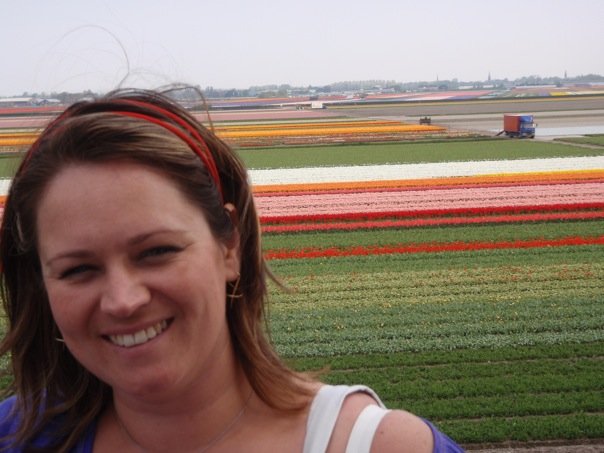
img: Nerissa Muijs at tulip fields outside Lisse, Netherlands.

If you enjoyed this post, we invite you to subscribe for email delivery of The Displaced Nation. That way, you won’t miss a single issue. SPECIAL OFFER: New subscribers receive a FREE copy of “A Royally Displaced Tea.”

Related posts: