The Displaced Nation

A home for international creatives

Tag Archives: Acquired tastes

GLOBAL FOOD GOSSIP: Gourmet coffee vs The Pod — France’s answer to England’s “Lapsang Souchong vs PG Tips”

global food gossipJoanna Masters-Maggs, our resident repeat-expat Food Gossip and Creative Chef, is back with her column for like-minded food lovers. This month: Coffee, the Achilles heel of French cuisine.

* * *

“I wouldn’t mind French coffee being quite so terrible, if they would just admit it,”  my English friend said in exasperation as she clicked her cup back into its saucer.  “It’s the equivalent of British tea, from an urn, at a railway station in 1930s Huddersfield.”  There was a pause as she picked up her croissant for my inspection. “But I suppose there are compensations.”

If you have spent any significant time in France, you will have noticed that it is very difficult to find a really good cup of coffee.  If you have never visited, I’m sure you will find that difficult to believe, such is France’s reputation for wonderful food, wine and coffee.  So, take a breath, retrieve your eyebrows from your hairline and trust me on this one:

If you’re not a fan of Starbucks, France might just be the place to drive you there.  If you can find one, that is.

Why is French coffee in so unpalatable?  It has the power to cause involuntary facial spasms and to make my stomach roil.  At first I put these symptoms down to my taste buds being insufficiently sophisticated to appreciate its forceful nature.  After two and half years, my friend’s comment helped me to recover some self-esteem and quit making a victim of myself.

Maybejust maybeit’s not only me.

Tea: A Brit’s second language

IMG_2742

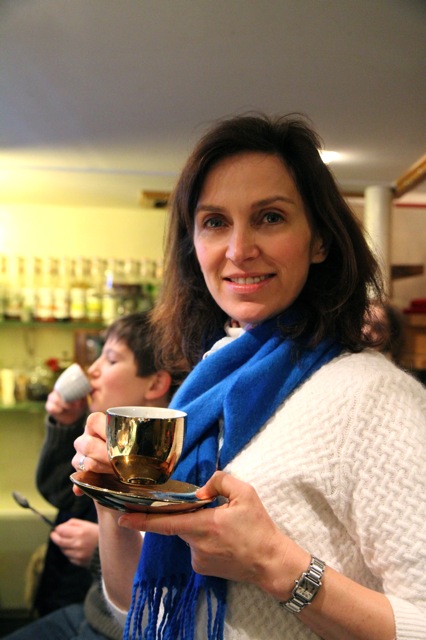
Joanna, apparently mildly surprised at her enjoyment of French coffee

I drink the tea this way, because that’s how I was brought up drinking it.  We drink it for comfort, to stay awake, to go to sleep, or to get over a nasty shock.  It comes with its own social language.  Offering tea to an upset friend shows concern when we cannot find words.  Failing to offer it to an unexpected guest says they should not expect to stay long.  Giving some to a workman is a way to show your respect for them and to ensure a good job.  Thus, overseas, tea is a rock of sameness I cannot let go of.  In fact, it is the only overseas product I really must have if I must have something from home.  It works for me.

Coffee: A rough guide

The coffee in France, therefore, should appeal to my rough taste in beverages.  It is largely made from robusta beans which are recklessly roasted until the flavor verges on the acridity of all things cremated.  It is drunk black, the addition of milk or cream deemed unsophisticated; ironic, given the rough, bad manners of the coffee itself.  The tiny cups are instead dangerously laced with extreme amounts of sugar or sweetener and then downed rapidly in a way Mary Poppins would have approved of.  And why not?  Sometimes even the French should be allowed a break from tasting and judging good food and drink.  My tea gives me the comfort and hit I demand, so why can’t I accept that the French should also be allowed, sometimes, to demand substance over style?

With coffee, the French give themselves a break from the world’s demand for them to be so effortlessly chic.  Coffee is not approached as is, say, wine, with a sort of intellectual or artistic mindset.   The routines of coffee tasting are not observed.  Whereas wine is lifted to the light, swirled, inhaled luxuriously and sucked over the tongue, coffee is knocked back as if by a Russian soldier engaged in long evening of vodka toasting. Coffee is not cupped with the hand to prevent the aroma escaping prematurely before the nose is lowered to inhale the intensified aromas.  It is not sucked over the tongue to seek the full range of flavor.

I must admit, it does the heart good to see the French behaving so badly.

Coffee climate change in Montpellier

IMG_2736

Coffee in Montpellier

I understand, though, that this is changing.  There are increasing numbers of little cafés which roast their own beans and grind to order.  Little places where robusta beans are eschewed for the more subtle delights of arabicas.  It’s been a while since I have had the time to hunt down these places in Paris.  However, last week I was in Montpellier and had the great good fortune to find two of these hallowed places.

Café Solo is an adorable place where the smell of coffee can be enjoyed a considerable distance from the front door even on a rainy February day.  I had forgotten this smell.  You don’t get it in a Starbucks or a Costa or any of the many similar establishments.  The tiny interior is crammed with drawers of beans, a counter of homemade delights in little covered cake stands and, in a corner, a large roasting machine.   My family and I discovered it quite by chance while exploring the streets of Montpellier.

Here we enjoyed what can only be described as a consultation with the artiste who would make our drinks.  She listened to what we like and do not like, and pronounced her judgement on what would suit.  Describing the flavours of each of the beans in that day’s selection, she guided our choice.   Then we waited and watched while our coffee was made.  It arrived in charming mismatched espresso cups and, thoughtfully, with little jugs of frothed milk– just in case.  Hmmmthere was me thinking I am a coffee hooligan who needs the milky stuff, just like a kid, but I absolutely did not need a drop of it.  My mocha bean from Ethiopia was soft and smooth with a tumble of flavours which lasted in the most pleasant way.   It was a delightful surprise.  I am so accustomed to a punch in the back of the throat from a tough one-dimensional over-roast.  Not so here.

“You see,” explained the artiste behind our coffees, “we French make terrible coffee.  We just don’t know how to make it.”    She smiled broadly, knowing full well that we could not agree with her.

We found a similar place a few streets later and just had to go in to try another.  Would it be possible to find two great coffees in one day?  Yes, it was. This time Columbian for me; a bit more acidity, but absolutely no acridity. Lovely.  Again, intoxicating smell of roasting coffee beans.

As we returned to our hotel, nursing the residual flavor of our coffees, we saw a Nespresso shop and just had to go in.  We knew that the chic, modern interior with its rows geometrically displayed and pristine pods as well as the absolute absence of the smell of real coffee would round off our day perfectly.  Today that clinical chicness, instead of depressing us, would only intensify the memory of the delightful little stores we had just left.  How deliciously wonderful it is to confirm how right I was.  Clutching my bags of beans from Café Solo to my nose, I knew in that moment I would never succumb to the clinical pod.  May my work surfaces be forever stained by the work of my little espresso machine and my walls stained by the periodic explosions to which the enthusiastic amateur is prone.

I thought I had no sophistication when it comes to coffee, but, perhaps because I don’t drink tea for the tea itself, I do drink coffee for the coffee itself.  I am much more open to trying different flavours and I am very willing to drink a lot of bad coffee until I find it.  Since I can manage without coffee, I am not lured by the siren call of Nespresso machines, Starbucks, or any of the lesser places.  I found absolute delight in those two shops which sell the stuff the way it should be sold.  I am willing to keep trying everywhere, until I next hit coffee gold.

Perhaps the next big discovery I will make is that the French acceptance of routinely bad coffee has freed them to become gourmet tea drinkers.  It would be fun to think so.

* * *

Joanna was displaced from her native England 16 years ago, and has since attempted to re-place herself and blend into the USA, Holland, Brazil, Malaysia, Venezuela, Saudi Arabia, and now France. She describes herself as a “food gossip”, saying: “I’ve always enjoyed cooking and trying out new recipes. Overseas, I am curious as to what people buy and from where. What is in the baskets of my fellow shoppers? What do they eat when they go home at night?”

Fellow Food Gossips, share your own stories with us!

STAY TUNED for tomorrow’s post!

If you enjoyed this post, we invite you to register for The Displaced Dispatch, a round up of weekly posts from The Displaced Nation, with seasonal recipes, book giveaways and other extras. Register for The Displaced Dispatch by clicking here!

Related posts:

Images: All images from Joanna’s personal photo albums, and used here with her permission

GLOBAL FOOD GOSSIP: The Mysterious Case of the Missing Pastries

global food gossipJoanna Masters-Maggs, our resident repeat-expat Food Gossip and Creative Chef, is back with her column for like-minded food lovers.

This month: The regrettable global takeover of the Cronut, and what should be getting the publicity instead.

* * *

“What in dog-breeding hell is a Cronut?” demanded my son Seb, reading over my shoulder while swigging milk from the bottle in that annoying way 16-year-olds have. Baffled for a second, I realized the confusion and laughed.  My German Shepherd, Sophie, is my obsession and I am always reading articles about breeding and training.  Today, though, I was reading a food magazine which discussed trends for the New Year. Seb had seen a headline that asked:

“2013 was the year of the Cronut and Duffin but what does 2014 hold?”

Those of you elsewhere — anywhere except France, that is — may laugh, but Seb’s assumption that a Cronut is German Shepherd-related rather than food-related was completely justifiable.  My own ignorance of Cronuts and other “blended” pastries was only brought to my attention in December, when a friend living in Kuala Lumpur posted that they had finally arrived there.

I think it true to say that the Cronut hasn’t yet arrived in France and probably never will.

Some dishes deserve to go global

I do hope the same will not be the case for other treats that, my magazine suggested, will be sweeping tastebuds worldwide this year.  I was particularly happy to see the arepa from Venezuela and Columbia on the list. My hips might not want to revisit my interest in these delectable goodies, but I am smacking my lips in anticipation.

I first met arepas in Maracaibo, Venezuela, and our friendship deepened while I lived in Caracas.  These flattened balls of unleavened maize flour-based dough are fried and then filled with a cornucopia of ingredients, depending on the region. North Western Venezuela, where I first fell in love with the arepa, has its own speciality, the Arepa Cabimera, whose filling consists of the improbable combination of cheese, jam, chicken and boiled eggs.  You know when someone is eating a Cabimera as the arepas are unusually square.  Other varieties often include queso guayanés  — a mild, medium-soft cheese similar to mozzarella, shredded chicken and, if you are very lucky, crispy pork rind.

Global — with the exception of France, that is

The idea that I will miss such delights as they sweep the world is distressing, but our ignorance of the Cronut is a sad portent of what might come.  How had the Year of the Cross-bred Pastry missed France? Perhaps it’s not such a surprise; France is not culturally inclined to faddy trends as is, say, London or New York.  Why a “need-to-please” hybrid, when a classic, small, and delightfully buttery croissant is available?  How intolerably vulgar to take such perfection and, presumably, add jam and deep-fry it.

I can feel a thousand thin and elegantly clad Parisian shoulders shudder at the thought.

Hybrid – it’s the new pedigree

On further reflection, my less-thin shoulders shudder too.  As my son’s comment shows, cross-bred dogs are very much at the front of people’s minds at the moment.  Maybe the Cockerpoo, Labradoodle, and Schitzpoo are the canine equivalents of our human desire to have our cake and eat it.  A dog that doesn’t shed and mess up the carpet and sinuses, and a croissant that doesn’t — oh, wait. It does crumble.  Well, a pastry that isn’t a croissant or a doughnut but which still makes a crumbly mess…

Why?  Why make a mash-up of existing pastries when you could come up with something less plagiaristic or stick with what already works?  Oh, listen to me: maybe I do belong in France!  After all, for each hybrid that works there are the unlucky ones in each batch which fail to inherit the best of both worlds and instead exhibit the worst of each.  A croissant where the delicate buttery flavor has been killed by over-sweetening?  A  Labradoodle which sheds anyway and isn’t a pedigree but which costs the same and has the potential to inherit the congenital defects of two different breeds?

What’s more, the frying of such a delicate thing as croissant pastry is not for amateurs.  Getting the layers of pastry and butter to open in the heat of an oven is no mean feat; getting them to do the same in hot fat is entirely different.  Apart from that, think how easily butter burns.  That’s a lot of worry when pâtissierières across France already have mastered the art of injecting chocolate into croissants to make pain au chocolate or, better, almond paste.

For me the almond croissant is the pinnacle of pastry pleasure.  This marriage of crisp pastry with nutty and unctuous almond paste represents the Paul Newman and Joanne Woodward of the Pâtisserie.

The Cronut is, as yet, a Brangelina wannabe and everyone is already asking how much longer is it going to last.

“New” but not necessarily “improved”

The French disdain for change for change’s sake can be seen everywhere.  Fashion classics which stand the test of time are valued over the new and the shocking.  London fashion is all about iconoclasm and rebellion, rather than restraint.   Surely, when it comes to food, good taste should not be derided.  Maybe the French are right not to jump on the bandwagon of each new craze, instead waiting to see what stands the test of time and has what it takes to become part of the pâtisserie canon.

I doubt that the Duffin will ever be the Little Black Dress of the pâtisserie world; certainly not with a name that makes it sound like something an ageing hippie would wear on a cold winter day in Glastonbury, UK.

Hmm, pause for thought indeed.  At least with baking, we can bin the rejects; we cannot do the same with our canine friends who don’t pass the successful hybrid test.

How, then, can a modern culinary classic find acceptance in France?

So, let me find order to my reasoning.  The French, so far, have not accepted the hybrid pastry which tries too hard to please and lacks the elegant restraint of better behaved French patisserie staples.  However, history reveals that the French will eventually accept what will not go away: dishes with an enduring appeal, such as the pizza so…

…let’s return to my arepa whose pedigree cannot be questioned.  This is a traditional, tried and tested, and regionally variable dish.  Given time, I am hopeful that the French, who enjoy regional variety in cheese and wine, should be open to accepting this newcomer.  France has already embraced with overwhelming enthusiasm the pizza and tweaked it to French tastes – crème fraiche anyone?  There is a little van with a wood burning stove on most street corners in every city, town and village of the country.  For every Domino there are scores of restaurants, parlours, and vans, nearly all of them French owned and run.

For the arepa this is hopeful news indeed. I may have to wait longer than a resident of London, Birmingham or, indeed, Kuala Lumpur, but I have hope that the Venezuelans are coming to Aix.

* * *

Joanna was displaced from her native England 16 years ago, and has since attempted to re-place herself and blend into the USA, Holland, Brazil, Malaysia, Venezuela, Saudi Arabia, and now France. She describes herself as a “food gossip”, saying: “I’ve always enjoyed cooking and trying out new recipes. Overseas, I am curious as to what people buy and from where. What is in the baskets of my fellow shoppers? What do they eat when they go home at night?”

Fellow Food Gossips, share your own stories with us!

STAY TUNED for tomorrow’s post!

If you enjoyed this post, we invite you to register for The Displaced Dispatch, a round up of weekly posts from The Displaced Nation, with seasonal recipes, book giveaways and other extras. Register for The Displaced Dispatch by clicking here!

Related posts:

Images: All images from Joanna’s personal photo albums, and used here with her permission

GLOBAL FOOD GOSSIP: Stuffing a chair with boar’s hair, and your face with Charlotte Royale – British style, bien sûr.

global food gossipJoanna Masters-Maggs, our resident repeat-expat Food Gossip and Creative Chef, is back with her column for like-minded food lovers, which includes pretty much every expat we’ve ever encountered.

This month: Upholstering armchairs to the tune of Mary Berry.

* * *

I haven’t been cooking much this month.

This is because, instead, I have been totally absorbed in reupholstering an armchair for my daughter’s bedroom.

Like so many “trailing spouses”, I am an International Jack of All Trades and, possibly, Masters of None.  Work visas are rarely applied to spouses and we must do what the current location allows us if we wish to work.

In my time I have taught English (yes, I have a qualification), arranged flowers (basic qualification), taught exercise classes on a Saudi compound (absolutely qualified with first aid certificates to boot) and baked and decorated birthday cakes (the qualification here is hard to pin down, but I am very enthusiastic).

My latest enterprise, however, is gripping me, and might well be what saves me from permanent life as an expat dilettante.

A family history, as recorded on sofa cushions

Over the years my four children have wrought destruction on all our soft furnishing, but the sofas have suffered the worst.  In part, I have been loath to recover them, as they represent something of both the material culture and culinary history of our family.  The stains, ever more poorly hidden by artfully draped throws and cushions, track the growth of the children from breast to solids. Here and there are the stains of snacks smuggled from the pantry or the marks made by friends I felt woefully too weak to upbraid.   Perhaps I’m just too English to tell off other people’s kids successfully.  My “Take the hamburger back to the kitchen before I am forced to beat you” delivered mildly with a smile and a wink, is taken as face value and ignored – I should expect no more, really.   Anyway, confronted with an upholstery bill that reached into five digits, I decided to take another “Have a go, Jo” course.

The result is that I can no longer visit a friend’s house, or watch a film or TV, without becoming entirely distracted by the chairs and sofas on display.

Thanksgiving stuffing? Not unless it’s made of boar’s hair

This new interest has caused me to all but abandon the kitchen.  Meals are late and gracelessly served.  Plates generally consist of pasta with a side of chopped tomatoes, cucumber, and sundry vegetables dragged from the back of the fridge or freezer – anything to make up the 5 a day and free me to return to the basement.  I’m amazed that my family is bored by this approach.  Perhaps they need a little footstool project of their own.

Thankfully for this webpage, this dearth of food-related happenings in my household has been tempered by my need to listen to radio or TV while I work.

This month I caught up with Great British Bake Off: the perfect accompaniment for the stripping and recovering process.  If you haven’t yet discovered the delights of this quintessentially British of “competitions”, I recommend a quick rifle through YouTube.  I’m sure you too will be hooked.

None of the competitors claim that winning the show is their dream, or assure us that they must win because they want it so bad. That they don’t do so on a televised competition comes as a surprise and seems to suggest that things back home have changed more than I could ever have guessed.  So accustomed are we all to naked ambition and self-puffery despite slender talents that the shock of modesty seems inconceivable.  This year there was even a competitor, Ruby, who was so self-effacing that she became a hate figure in the press.  Holding up her various offerings and apologizing for their variously burned, dry or just plain terrible states, she seemed to hail from a bygone age, ignorant of Simon Cowell.  But today this is mistrusted and seems to be insincere, even manipulative.  Interestingly, Mary Berry, the rather strict octogenarian judge, was quick to comfort and reassure.  Modesty has been lost to the British TV in 15 years of TV competitions in music, food, modeling and god-knows-what.

The public might mistrust Ruby’s handwringing over her uselessness, but Mary did the proper thing and bucked her up.

What, really, is so wrong with such a world?

Killing two oiseaux

IMG_2070

Joanna and her impressive reason
for a lack of cooking this month

Where am I going with this?  Welcome to the wandering mind of someone whose hands are deep in boar’s hair and webbing.  I’ll tell you where, though.  It occurred to me that, since this hugely successful show had been spun off to many countries, each tweaking it to its own tastes and state of mind, I could find the French version and improve my lamentable French while never pausing in my upholstery endeavours.

The first two hour episode proved to be a deeply comforting and successful experiment in language acquisition — mal cuit, anyone?  But then, halfway through the next episode I received a bit of a douche froide, so to speak.  The announcer, thankfully less humorous than her British counterparts as my French is barely up to understanding French slapstick let alone gentle, self-deprecating humour, announced that the Challenge Technique would be English in origin.  Cue the endless pause so beloved of such shows, then:

“Le challenge est……….  Charlotte aux fruits rouge.

Well, strike me down with a langue de chat.  You see, Charlotte Royale wasn’t English, it was French.  I knew this, because it had appeared only a week before on English T.V. and during French Week, no less.

Charlotte? C’est un French name, non?

Finally, something had occurred which made me look up from my stitching.  What gave Charlotte her ambiguous status between the French and the Brits, while retaining value as a challenge worth attempting?  The British show gave no clue.  Although their Charlotte involved Swiss Roll and looked like one of the illustrations in your mother’s 1970s copy of, er, a Mary Berry recipe book, it was accepted without demur by all as French.  Similarly, the French contestants, while sucking in their breath and declaring they were going to have to concentrate hard on this one, they failed to cry as one patissier,  “Zut alors, c’est un recet francais!”

The French presenter thickened the plot further, introducing a historian to explain the English origins of the dish.  Apparently, it was invented by Antoine Carême (yes, the father of the art of patisserie) who worked at both the English and Russian courts for a time.  You see?  Strange, no?  He made it for either a Queen Charlotte, a Princess Charlotte, a cousin Charlotte and then at some point tagged on Russe to include the Tsar in his flattery.

So why is this not considered French if a French man really did invent it?

Unearthing Charlotte’s origins in my own kitchen
IMG_2042

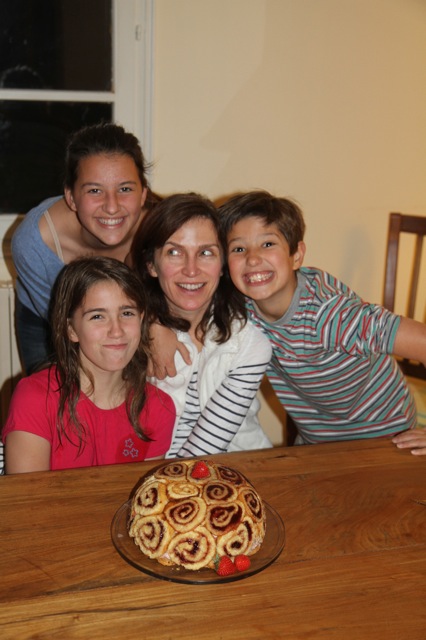
Patrick sharing his British Charlotte Royale. In France.

Patrick, my 9 year old, and I, decided to make the British version.  Doing it for myself cleared up all my questions.  It was, let’s say, a woman of substance.  French Women Do Not Get Fat, and their puddings cannot be hefty either.

My own Charlotte Royal was no slip of a thing.

The Swiss Roll lining was easily managed by Patrick working alone with our trusty KitchenAid.  While the French contestants piped boudoir biscuits to surround their moulds for the light bavarois filling, Patrick sliced up jammy sponge rolls which gave the pud a slightly cerebral air when turned out. How can you cut a petite tranche from that?  Piping even biscuits would be much more of a challenge for child and adult alike.  The Swiss Roll is infinitely more forgiving.

The difference between the French version and the English became clearer.  Simiar amounts of work and skill are involved, but one must be elegant and the other must be generous.  One should look preternaturally perfect, and the other is valued for comfort.  A French dessert should perhaps make you feel you are not quite elegant enough to eat it, while the English makes you feel better because you do not look like the Duchess of Windsor.  Ha ha –  it is not generosity of spirit that holds the French back from planting the tricolor on this this dish.  They are anxious that it is a recipe that can look unfinished, so trifle-like.

When Carême returned to France, he apparently rechristened the dish Charlotte á la Parisienne, probably to soothe the nerves of alarmed locals who may have heard a thing or two about the English king Carême had worked for.  I have no doubt when Charlotte arrived on French shores she resembled a trifle as little as possible.

Carême’s Charlotte is a little rootless, like so many of us expats.  Like us, it is unsure where it belongs and if home will ever be home again.  The Charlotte is perhaps a sort of Third Culture Dessert.

But at least I think I may have found the name for my upholstery business if I ever start one.

Here’s to Third Culture Sofas.

* * *

Joanna was displaced from her native England 16 years ago, and has since attempted to re-place herself and blend into the USA, Holland, Brazil, Malaysia, Venezuela, Saudi Arabia, and now France. She describes herself as a “food gossip”, saying: “I’ve always enjoyed cooking and trying out new recipes. Overseas, I am curious as to what people buy and from where. What is in the baskets of my fellow shoppers? What do they eat when they go home at night?”

Fellow Food Gossips, share your own stories with us!

STAY TUNED for tomorrow’s post!

If you enjoyed this post, we invite you to register for The Displaced Dispatch, a round up of weekly posts from The Displaced Nation, with seasonal recipes, book giveaways and other extras. Register for The Displaced Dispatch by clicking here!

Related posts:

Images: All images from Joanna’s personal photo albums, and used here with her permission

GLOBAL FOOD GOSSIP: Keeping food real in Brazil

JoannaJoanna Masters-Maggs, our resident repeat-expat Food Gossip and Creative Chef, is back with her column for like-minded food lovers, which includes pretty much every expat we’ve ever encountered. This month: Authenticity, Brazilian-style.

* * *

“What’s the most depressing thing I’ve seen this morning?” I demanded of my husband as we arrived at our hotel on that first day in Brazil.

Was it something in my tone of voice that made my husband stick out his jaw? Having your wife positive about a new location is always a good thing. Any hint of wifely discontent can put the terrors into most expat husbands, even the most rufty-tufty oil field types.

“The favelas on either side of the motorway for the entire journey from the airport?” His voice had a slight tone of —  could it be? — belligerence. He’d decided to meet head on what he feared was my Western European squeamishness over visible poverty. I’d agreed to come, after all; it wasn’t his doing that the favelas existed.

“Oh.” I felt a pin pricking my outrage. “Actually no. It was the model of the Statue of Liberty outside the shopping mall we passed, the one with the Hard Rock Café.”

Not the voice of a woman with a strong social conscience, then.

“Aren’t we in Brazil?” I asked lamely.

Living in the shadow of the USA

In my defense, I was afraid that this most exciting and culturally rich of countries appeared in thrall to the ego of a foreign superpower. Here, where Christ the Redeemer looks down calmly over Rio and Guanabara Bay, it distressed me that he was unable to turn his cheek from the abominable reproduction Liberty. Such are the drawbacks of being made of stone.

My frustration really hadn’t abated much by the time we left several years later, but it was tempered. Here was a country that had its own great music, landscape, history and food. Brazil’s son Santos Dumont’s first flight had been overshadowed by the earlier but aided take off of the Wright Brothers’ heavier than air plan.

But surely the same could not happen to Brazilian fast food – and at their own hands?

Coxinha  — wins the Pepsi Challenge against the Chicken McNugget, any day

When I was in Brazil, workers could fill a canteen with beans, rice, a little meat and some pasta for 5 reais. A meal from McD costs four times that and cannot keep a belly as full for as long. Yet not only was there a Hard Rock Café, Dominos and McDonald’s, but the bloody Statue of Liberty to boot, holding her torch triumphantly aloft as if lighting the invasion of foreign fast food. (I know, I need to get over that tacky statue.)

Brazilian fast food choices, which can be grabbed on the run in a similar way to a hamburger, are extensive. Kibe consists of meat and bulgur wheat shaped into rugby balls and deep-fried. Empadhinas are little pastry pies often filled with palm hearts but options are endless. There are bollinhas de arroz (rice balls) and, a slightly more costly option these days, bollinhas de bacallao (salt cod).

Then there is the coxinha. Oooh, heaven. It is a pear-shaped, breadcrumb-coated, deep-fried confection of pulverized chicken, creamy catupiry cheese, and onion. I don’t want to be rude, but for heaven’s sake, Brazil — how could you choose a chicken nugget over that?

Please. It’s time for a Coxinhas R Brazil brand to sweep all before it.

Turn the milk sour with your grouse? Or simply dance the samba?

Brazilians probably have a greater openness and sense of fun than I do. They seem to tolerate kitschy statues and dodgy food for what it is, just a bit of fun not to be taken as a serious threat to national pride. There is a great deal of pride in being Brazilian and, I’m told, there are as many Americans trying to emigrate to Brazil as vice versa – it is a new land of opportunity.

Brazilians seem less sulky or passive aggressive than many in dealing with what they don’t like. One amusing example came in the immediate aftermath of 9/11 when America required passengers arriving on planes to America from Brazil to be subject to the same security searches, and delays, as planes coming from countries deemed a threat. Brazil has no history of terrorism and people were offended. However a cheerful approach was chosen. Officials simply decided to apply the same principle to American planes landing in Sao Paolo, Brazilian style. To ease the pain of the wait, passengers were treated to smiling samba bands and charming dancers. Nothing was ever going to change, but the point was made and relations not permanently soured.

A meal fit for a (Burger) King

Perhaps this non-confrontational approach is best. The invasion of American fast food is all-conquering everywhere. Its advance hasn’t been slowed by a thousand angry French farmers and restauranteurs, or by the Italian Slow Food movement. But its growth in Brazil alongside a rapidly emerging obesity crisis comes alongside economic improvements. According to a recent BBC Programme on the rise of obesity around the world and particularly in developing and BRIC countries, the answer is to be found less in the innate appeal of the food, but in the message that is sent out when you’re seen eating it. McDonald’s is an “aspirational food”.

(You might notice that I started a new paragraph rather suddenly. It was to give you a moment to recover from the shock of seeing the words “McDonalds” and “aspiration”, not only in the same sentence, but right next to each other. The idea of being proud to be seen eating fast food is a difficult one that takes time to absorb. I too enjoy the odd foray into the depths of culinary depravity, but I hide the bags – I admit hypocrisy right here. May I continue now?)

You might think you would aspire to a Wolf oven or even a Meile vacuum cleaner, but McDonald’s? No — bear with me. A Brazilian McDonald’s meal costs four times that of a plate of rice and beans. Its cost would buy you any number of coxinhas. It is impressive conspicuous consumption. You pay to eat a meal which won’t actually fill you and you will have to pay to eat again soon after, but the point is: you can.

It’s a fairly modest aspiration for the new middle class. Thousands of Brazilians have been lifted out of poverty over the last 10 years. But potential hunger is still a recent memory and the fear of slipping back must be strong for many. An outrageously priced Big Mac is still less expensive than a ritzy restaurant in Leblon and it’s certainly easier to avoid potentially embarrassing etiquette gaffes for those not yet accustomed to what is known in America as “fine dining”. This is what fast food companies can trade on, and before you know it, new habits are formed.

If you’re going to gain Brazilian pounds, make them worthwhile

Why get fat on this so-so food, though, when you can get gloriously fat on real cooking? You can easily pile on the pounds with Brazilian feijoida, Let the weight gain be a result of leisurely, indulgent meals and not sandwiches grabbed in plastic furnished, fluorescent lighted “restaurants” that are tiled like public lavatories.

I’d say the same to America. Ditch the McD and get fat on Southern and Soul Food, some of the most luscious food in the world. Wow, those Southerners know how to take a healthy low-calorie green vegetable and give it the cholesterol punch of cheesecake. My two personal favourites: collard greens cooked in fatty port cuts and sweet potatoes mashed with butter and topped with a crumble made of brown sugar pecans and a handful of marshmallows. Sounds appalling, but it is the closest thing to ambrosia since Zeus was a viable god to worship.

Both Brazilian and American Soul food has the opulence and indulgence to deaden and dazzle the senses at the same time. It has what a dried up hamburger and flabby white bun bread cannot hope to rival even with liberal dollops of ketchup.

Oh please. Get fat on real fat and be patriotic about that: your nation’s fat.

Make it worth your while.

Make it worth your money.

Aspire.

* * *

Joanna was displaced from her native England 16 years ago, and has since attempted to re-place herself and blend into the USA, Holland, Brazil, Malaysia, Venezuela, Saudi Arabia, and now France. She describes herself as a “food gossip”, saying: “I’ve always enjoyed cooking and trying out new recipes. Overseas, I am curious as to what people buy and from where. What is in the baskets of my fellow shoppers? What do they eat when they go home at night?”

Fellow Food Gossips, share your own stories with us!

STAY TUNED for tomorrow’s post!

If you enjoyed this post, we invite you to register for The Displaced Dispatch, a round up of weekly posts from The Displaced Nation, with seasonal recipes, book giveaways and other extras. Register for The Displaced Dispatch by clicking here!

Related posts:

GLOBAL FOOD GOSSIP: How (not) to feed a convalescent expat

JoannaJoanna Masters-Maggs, our resident Food Gossip, is back with her column for like-minded food gossips.

This month: The state of worldwide hospital food.

* * *

“The last thing you need on top of everything else when you are in hospital is red wee.”

So ended my husband’s texted tirade after a few days in an Abu Dhabi hospital following an emergency appendectomy which turned out to be less than straightforward.  The indignities, pain, and discomfort could be handled with fortitude, but the food had caused the British stiff upper lip some serious challenges.  Beetroot was served at every meal and in every conceivable form — none of which was remotely welcome to this convalescent.

Almost unbelievably, the day after my husband was admitted to a Middle Eastern hospital, my 9-year-old son was diagnosed with the same condition and admitted to Taunton Hospital, in Somerset, England, for the same operation.  Patrick took it all in his stride, only threatening mutiny when a disposable bottle, apparently made of the same recycled cardboard as egg cartons, was proffered in response to his request to go to the loo.  With furious determination he heaved himself upright  and made his way to the bathrooms, wheeling his drip ahead of him and making my heart swell with maternal pride.

Several hours later, when wrinkled potato wedges and bright orange fish fingers confronted him, Patrick’s attitude was rather different.  My husband’s texted complaint lacked the colour a human voice could give the words.  My son’s anguished “Why, why, why?” however, provided a glimpse of  The Husband’s state of mind when he composed his text.  The pitch of “Why can’t I just have a tuna sandwich?”  swung from already-stressed contralto to end-of-tether soprano.

KISS: Keep It Simple, Sandwich

This question is one I ask myself every time I face airline food.  Why not a sandwich? A simple sandwich is perfect food for those on the go; ask any hill-walker. It is easily transported and eaten and requires little in the way of tableware.  It certainly beats sub-standard wannabe home-cooking, or, more depressingly, wannabe gourmet cooking.  KLM used to do a nice sandwich on granary, a little oatcake and a good cup of tea or coffee on their London to Schiphol shuttle.  I have never enjoyed airborne eating as much.  Flights since, even champagne-soaked upgrades, have never hit the spot as well.

Hospitals, like airlines, are susceptible to the curse of being the girl who tries too hard at parties and embarrasses everyone, for different reasons of course.  Airlines because they feel they are part of the same package as the business trip or holiday and have to provide something special.  Hospitals, being in the health business. feel under pressure to produce something healthy and balanced.  Easy healthy and balanced is a lump of protein, a lump of carbohydrate and some boiled veg.  Each element can be whatever is readily to hand in the locale.  Obviously, beetroot is easy to come by in Abu Dhabi – who’d have thought?

A few years ago I found myself admitted with an unpleasant stomach bug to a hospital in Kuala Lumpur.  During my recovery, meal after meal was placed in front of me,  each consisting of overdone, indigestible chicken in glutinous sauce with rice and boiled vegetables. (Never talk to me again about English food.) Not appetizing at any time, but certainly not in the recovery period.  At the end of day two I was begging for cream crackers and jelly.  Even if I was unable to eat them, they were easier to tolerate the look of in the post-prandial two hours that the staff took to remove the debris.

The Victorians –now, they knew how to run a sickroom

When I’m sick I crave the ideal Victorian sickroom.  I want chicken soup, broth, and little crustless sandwiches cut into triangles.  I want food that makes me feel pampered and I want it in miniature form.  What I don’t want is big hunks of meat that I have to take a hacksaw to.  I don’t want to bother with a knife and fork.  I’d like little sips of water, or tea and maybe the odd ginger biscuit.  Some soft-boiled eggs and soldiers (fingers of toast) would be nice too.  In short, give me the whole Victorian sickroom vibe complete with flowery china and a little vase of flowers.  Do that and I’ll put on a white nighty, brush my hair and smarten up my convalescent act accordingly.

What explains this wanton disregard for dainty and light in preference for The Undigestibles? I suggest it is because hospitals the world over want us out, and want us out fast. In cash-strapped UK NHS land, beds are at a premium and waiting lists must be kept down.  Make things too comfortable and delicious and who knows how long malingering patients will stay?  I also imagine American insurance companies would like to minimize the number of nights their customers spend in hospitals which are often more costly than excellent hotels.

If you can’t keep it simple, keep it real

So, what’s my point talking about all this in our “displaced” world?  I suppose it is simple, really.  I want any experience that takes place outside of my own country to be distinctive and of that place.  If a hospital cannot, or will not, convert its menu into something I might find in Little Women, I want to lose my appetite for something distinctive.  If I have some indescribably unpleasant stomach complaint and find myself again in hospital in KL, I want to be unable to eat Malaysian food, truly Malaysian food.  If I’m not eating, give me beef rendang to reject and not boiled chicken breasts.  If I am in Rio, I want to lose my appetite for black beans and chiffonade of couve (actually, that will never happen) and if I ever end up in a  Abu Dhabi hospital, I want to reject grated raw beetroot.

You see, be it Victorian pampered convalescent on a chaise longue, or expat overseas, I yearn to feel special when I am sick.  Is that really too much to ask?

* * *

Joanna was displaced from her native England 16 years ago, and has since attempted to re-place herself and blend into the USA, Holland, Brazil, Malaysia, Venezuela, Saudi Arabia, and now France. She describes herself as a “food gossip”, saying: “I’ve always enjoyed cooking and trying out new recipes. Overseas, I am curious as to what people buy and from where. What is in the baskets of my fellow shoppers? What do they eat when they go home at night?”

Fellow Food Gossips, share your own stories with us!

Image:

STAY TUNED for tomorrow’s post!

If you enjoyed this post, we invite you to register for The Displaced Dispatch, a round up of weekly posts from The Displaced Nation, with seasonal recipes, book giveaways and other extras. Register for The Displaced Dispatch by clicking here!

Related posts:

NEW VS OLDE WORLDS: The “expat ten” can work both ways!

Libby Collage New&OldEvery two weeks, the Displaced Nation publishes an episode in the life of fictional expat Libby Patrick, a 30-something British woman who has relocated with her spouse to a town outside Boston. Her diary, Libby’s Life, by Kate Allison, is replete with observations about life in New England vs. England. In the weeks when Libby isn’t published, we are featuring posts by writers who are sensitive to the subtle yet powerful differences between new and “olde” worlds. Today Bobbi Leder, an American trailing spouse, responds to Claire Bolden’s post of two weeks ago, in which she claimed that a tour in the United States inevitably entails a ten-pound weight gain. Turns out, it goes both ways!

—ML Awanohara

* * *

Bobbi with sausage and friesMexico has just surpassed the United States as the fattest country in the world, according to new UN figures released last month.

It’s an honor another country can have as far as I’m concerned, but when America was the fattest in the land I was truly perplexed.

Yes, you heard that right: perplexed. Now I know there’s a lot of unhealthy food in the States (e.g., BBQ ribs, deep-fried everything-you-can-possibly-think-of, junk food galore) and many Americans are addicted to their sugar, fat and salt. But conversely there’s also a lot of very healthy food available in the States.

At the end of the day, it’s about making a choice.

When I expatriated to the UK over a decade ago—I moved from the Washington, D.C., metro area to Southampton, on the south coast of England—I didn’t have many healthy choices. Over a decade ago, that part of England simply didn’t have health food stores, nor were there restaurants catering to those of us who sought out low-fat, low-salt meals. As for vegetarian dishes, these were practically non-existent.

It was impossible to find a sandwich where the bread wasn’t smothered in butter or the fillings weren’t loaded with fatty meats or (full fat) mayonnaise. I found it very difficult to eat well because the food options I was used to simply weren’t available.

Cheery bye to Size 2!

Before moving to England I was thin, some would even say skinny at a size 2 (an American size 2 that is); but after living in Southampton for a few months, my weight crept up on me like a burglar in the night, and before I knew it, I was two sizes heavier.

And if you think I was binging on fish and chips, think again. I never touched any of the stereotypical British foods because they loaded with saturated fat. I still remember never being able to eat breakfast at the Southampton airport because all they served was the greasy English breakfast. The sight of a full English breakfast made me nauseous: back bacon, sausages, beans, two fried eggs, mushrooms, and fried bread, all cooked in grease—and they say America is the capital of fried food?

There was a reason why we went out for Thai food every Friday. It was the only place we could find that didn’t serve fatty meals and they’d alter any dish to suit their customers. Forget about trying to find a healthy item on the typical pub menu or in the food court of the local mall.

Even in the supermarkets I couldn’t find the healthy choices I was used to, like veggie burgers, soy cheese, and low-calorie bread.

Before moving to Southampton, I’d eaten a mostly ovo-vegetarian diet, with the occasional lean poultry and fish. When I wanted “junk food,” I would buy lower calorie options like baked potato chips.

After the move, I felt as if I had no choice but to start eating ingredients I never would have eaten otherwise including pork, beef and cheese. And food prices were higher compared to the States, which made grocery shopping a challenge—even at Asda, a British supermarket chain owned by Walmart. The produce was often not up to par, and grocery costs were higher than we’d budgeted for.

So I found myself eating things that made me gain weight—despite going to the gym four times a week, and either walking or biking to most places—and I wasn’t happy about it.

New diet, new regimen

After receiving an invitation to my cousin’s wedding in the States, I knew I had to lose weight in just a few months, so I did something I never had the time to do before: I learned how to cook.

I looked for low-fat recipes online that included ingredients I could realistically obtain. I took charge of what I was eating despite my location and its limitations.

Eventually, the weight came off, and after living in Southampton for a year and a half, we moved to London, where healthier food choices were more readily available.

I even took my cooking to the next level after watching British culinary shows—I knew the Brits could make healthy food—and began to make gourmet meals that were not only tasty but low in calories and fat.

After London we moved to Wales and wound up being in the United Kingdom for six years. Not once during that time did I have:

I did, however, have one British staple: the Sunday roast, which consists of roasted vegetables, potatoes and lean beef or chicken.

It was actually one of my favorite meals.

My cup of tea

Today, after moving a few more times (ah, the life of a trailing spouse!), I live in St. John’s, Newfoundland, where I’m fortunate that the times have changed and health food as well as vegetarian options are the norm in most supermarkets and restaurants.

I have no idea if Southampton now offers healthier choices in their restaurants and supermarkets—one can only hope so for the sake of the university students who make up a large population of its city.

The moral of my story is that even though you might move to a country (or an area of that country) where fatty food is the staple, it doesn’t mean you have to eat it.

Looking back, I’m grateful for my experience in Southampton because even though I saw beef and cheese as the enemy when I first moved there, I still eat both today (just in moderation alongside my usual healthy diet), which makes life so much easier when dining out and moving around the globe as an expat.

* * *

Thanks, Bobbi, for making us realize that America is not the only country that fosters weight gain. Readers, what do you make of her observations? Are we global nomads destined to balloon in size as we move around the globe—has that been your experience? Do tell! (A good thing Bobbi hasn’t ended up in Mexico yet, that’s all I can say…)

Bobbi Leder, 43, is originally from New York and grew up in New Jersey. She has moved at least 11 times (she lost count after the fifth move) in the last 18 years thanks to her husband’s job in the oil and gas industry. Leder is a freelance writer and the author of the children’s book, The Secret Police-Dog, but her most important roles are those of cocker mom (to her very high maintenance English cocker spaniel or just cocker spaniel to everyone outside of North America) and wife to her workaholic husband. Leder still exercises several times a week, eats well most of the time—hey, a gal has to treat herself every now and then—and does something British daily: she drinks tea.

STAY TUNED for next week’s fab posts!

If you enjoyed this post, we invite you to register for The Displaced Dispatch, a round up of weekly posts from The Displaced Nation, with seasonal recipes, book giveaways and other extras. Register for The Displaced Dispatch by clicking here!

Related posts:

img: Bobbi Leder enjoying(?!) a sausage and fries during a trip to Germany while living in the UK.

Portrait of woman from MorgueFile; Lighthouse (R) from MorgueFile; Lighthouse (L) from MorgueFile

GLOBAL FOOD GOSSIP: Winning the war of Global Food One-upmanship

JoannaJoanna Masters-Maggs, our resident Food Gossip, is back with her column for like-minded food gossips.

This month: The war of foodie one-upmanship, or “Who’s travelled the most?”

* * *

“I’m doing it the Malaysian way” said my friend with satisfaction as she poured her too hot tea from one cup to another and back again to cool it.

It was my cue to ask “How do you mean?” thus allowing her to launch into (yet another) story of how things are done in some place or other she had visited.

It was hot, I was grumpy, and my friend’s tone was just a touch too self-satisfied.

The pause grew as I busied myself with milk and sugar.  It extended into a grim silence as I resolutely avoided asking.  Not generous of me, I know, but in my defense I have never pretended to be Pollyanna, and sometimes those “we found this marvelous place just off the beaten track” stories just get on your nerves.

It would be another 5 years before I lived in Malaysia and discovered Teh Tarik for myself.  The pouring trick was not to do with cooling, but with the mixing and frothing of a sort of tea made with condensed milk.  An environmentally friendly cuppotino, I suppose.

Look where I’ve been — and you have not!

All expats have probably found themselves on one side or another, or both, of this conversation.  Expats and serious travellers are all engaged in an endless war of covert operations.  We maneuver for superiority by exposing snippets of our discoveries and being impressed, or not, by those of others.  We certainly don’t like to admit to this unedifying trait of One-upmanship, preferring instead to see ourselves as laid back free spirits and survivors of alien situations.  Yet, the truth is, it is our Achilles heel.

Expat tales of unusual foods, which hopefully Waitrose will not discover before we get home, allow us to say “look where I’ve been, and you have not”. While appearing to share generously of our experience, we want to show what we know and what those who stayed at home do not.

Calling bluff on Bi Bim Bap

“You’ll never go hungry in a Korean restaurant if you can just remember to ask for Bi Bim Bap.  After all, who could forget a word like Bi Bim Bap?”

My friend’s hands spread out, palms up.  Her shoulders and eyebrows rose in perfect synchronicity.  The gesture suggested that not only was it impossible to forget such a word once heard, but that not knowing about Bi Bim Bap was unimaginable in itself.  We had reached the point that expats will recognise from the cold war of One-upmanship.

I faced a difficult choice.  Was I going to expose my lack of knowledge over “Bi Bim Bap” and lose a little position in the “most well travelled”, or was I going to take the dangerous but potentially game-winning risk of pretending that I knew what it was and indeed had been taught to produce one by a well-known Korean chef whom I had just happened to bump into?

The advantage of the first approach is  the warm glow of generosity of giving another a moment to shine. That and the fact you might actually learn something interesting.  The second approach means you avoid having to listen to a long-winded boast.

Does she actually think she invented the Bi Bim Bap? you mutter darkly to yourself.

Of course, in not asking, you remain in frustrating ignorance, especially if you forget to Google it upon returning home.  More seriously, you risk exposure as a fraud.  That is enough to chill the heart.

You might be thinking that the example of Bi Bim Bap was a little repetitive, following so quickly as it does on the heels of Teh Tarek.  I’m afraid I couldn’t resist the opportunity to show off – again.  As I say, it is a hazard of being an expat with an unfortunate interest in food.

Expats 1, Tourists 0

Hari Raya Aidilfitri:  outlying suburb of KL far from the Tourist Zone.  These stalls offer traditional foods for  to locals and a wealth of boasting opportunities for the lucky expat passerby.

Hari Raya Aidilfitri: outlying suburb of KL far from the Tourist Zone. These stalls offer traditional foods for to locals and a wealth of boasting opportunities for the lucky expat passerby.

Expats like to think that living overseas gives you a window on a world that tourists or those who remain at home will never see.  Tourists will never have to face the problems of daily life in a strange language or culture.  They will never have to get the electricity turned on, find a plumber, or do the weekly family shop.  A tourist’s world in many respects doesn’t differ hugely from place to place.   Pre-booked hotels, transport from airports, organized trips on air-conditioned buses.  Even backpackers travels follow a familiar path.

The wonderful Nasi Lemak (coconut rice to you) of a tourist hotel was doubtless an experience, just not the same as the hawker stall the expat discovers in the backstreet to which they have been directed to find a furniture repair store.

That, we believe is the uniqueness of living overseas.

Expats trump tourists.

How naughtily satisfying.  One-upmanship indeed.

A Tower of Babel for the food industry

As the globalization of food companies and supermarkets continues to homogenise world food experiences, the expats’ territory is further threatened.  The same products appear the world over and are marketed similarly in the name of brand identity.

Take the confectionary market.  An advert for Maynards Sour Patch Kids is currently airing on UK television.  It has been voiced over in an American accent and uses American vocabulary such as “soda”. It upsets me. Maynards was bought by Cadbury, which in turn was bought by American Kraft, but why did a company with a uniquely English Quaker social and economic philosophy have to be marketed in England in much the same way as it is probably marketed in America?  How could this happen to the company of a man who had invented the wine gum to help wean the impoverished working class off the demon drink?

Sour Patch Kids should be sold in America to American kids.  Maynards should be selling wine gums to English kids, using an English accent.  Kids should be allowed the thrill of receiving a unique item from granny or auntie when she returns from her travels.   They should be asking friends visiting those countries to “bring us back a packet”.  They should be learning at an early age the delicate game of Travellers’ One-upmanship.

The joy unbounded of discovering a packet of a long remembered treat is equal to the joy of a pig that unearths a truffle.  These are the experiences of travel and expatness that must not be lost.  They will be lost, mark my words, if Haribo takes over the world as it threatens to do so, with their gummy bears and fizzy cola.  Brands unique to different countries must be guarded jealously, much as France guards the name “champagne”.  Mexican Chili sweets, English Trebor mints and American Peanut Butter Cups can then keep their allure and remain in production.  The thrill of the chase and the discovery of the new should not be lost.  A world of confectionary should there for us all.

Expat living: A licence to boast

Expats have a sneaky feeling that knowledge of and access to certain foods is our earned right.  It is cheating if the supermarkets bring them to homebodies and tourists collect them at the airport on the way out.

I feel I have earned the right to drone on about wonderful Venezuelan coffee and why it is so difficult to find because I survived Caracas’ toilet roll shortage of 2009.  Really, every day for weeks I drove around all the supermarkets of the city searching out any flushable paper products.  Like the natives of the city, I bought my one allocated packet in one supermarket, got in the car and drove to the next.  If there was none, I bought none.   Expat and local as one in a shared quest.  It was while diligently scouring the shelves of every aisle in one that I found the white shrink-wrapped bricks of Venezuelan coffee nirvana.  They represented the ideal pick-me-up after shopping, the ideal gift for home, the ideal story to tell.   I had earned my licence to boast.

As I say, I’m far from perfect, but I’m not alone.  Global Food One-upmanship is not a truly bad fault in the great scheme of things and we combatants do ameliorate our annoyingness with gifts of the delicious foods we have found whenever we can.

Be gentle when you judge us.

P.S.  Bi bim bap is a Korean dish meaning “mixed rice”.  Rice is topped with vegetables and raw or fried egg and different meats.  The sauce is chilli based.

* * *

Joanna was displaced from her native England 16 years ago, and has since attempted to re-place herself and blend into the USA, Holland, Brazil, Malaysia, Venezuela, Saudi Arabia, and now France. She describes herself as a “food gossip”, saying: “I’ve always enjoyed cooking and trying out new recipes. Overseas, I am curious as to what people buy and from where. What is in the baskets of my fellow shoppers? What do they eat when they go home at night?”

Fellow Food Gossips, share your own stories with us!

Image:

STAY TUNED for tomorrow’s post!

If you enjoyed this post, we invite you to register for The Displaced Dispatch, a round up of weekly posts from The Displaced Nation, with seasonal recipes, book giveaways and other extras. Register for The Displaced Dispatch by clicking here!

Related posts:

And the July 2013 Alices go to … these 4 international creatives

 © Iamezan | Dreamstime.com Used under license

© Iamezan | Dreamstime.com
Used under license

As subscribers to our weekly newsletter know, each week our Displaced Dispatch presents an “Alice Award” to a writer who we think has a special handle on the curious and unreal aspects of the displaced life of global residency and travel. Not only that, but this person likes to use their befuddlement as a spur to creativity.

Today’s post honors July’s four Alice recipients, beginning with the most recent and this time including citations.

So, without further ado: The July 2013 Alices go to (drumroll…):

1) HELENA HALME, author and Finnish expat in London

For her latest novel: The Red King of Helsinki
Published: March 2013
From the book description:

Nordic Noir meets Cold War Espionage.

Pia’s ambitions to win a gymnastics competition between her Helsinki college and a school from Moscow trigger a set of dangerous events when her best friend disappears and a violent KGB spy, The Red King of Helsinki, threatens her. Will a friendly British ex-navy officer, Iain, be able to save Pia before its too late?

This fast-moving novel set in Finland has everything—a young, feisty protagonist, Nordic Noir and old-fashioned chivalry.

Citation: Helena, how could we not award you an Alice once we heard you’d written a story revolving around a Red King? While we do not know whether you purposely modeled your Red King of Helsinki on the Red King of Lewis Carroll’s Through the Looking Glass, it almost doesn’t matter. The point is, you present us with a classic through-the-looking-glass situation, having set the action during the Cold War and made your Red King into a Soviet spy. Will Pia/Alice checkmate the Red King with the help of that kindly British military gentleman? Or will she go out—bang—like a candle? No need for Tweedledum/dee to explicate. What’s more, you are the perfect person to take us on this particular fictional journey. With your thick blonde locks and acute appreciation for the curious and unreal in your adopted country, it’s not much of a stretch to dub you the Finnish Alice!

2) TRACEY CROKE, Manchester-born, Australia-based freelance journalist and blogger

Source: “A Pom versus the pests” in Telegraph‘s Expat Life
Posted on: 12 June 2013
Snippet:

Small self-amputating lizards dart out of my fruit bowl. Ants march in to weightlift a few missed crumbs off my floor. Possums push their cute limits with roof-dancing antics.

While the elusive ghost bug remains a mystery, large “harmless” spiders, innocent-sounding paper wasps and alien insects get the boot or get spiked by my neighbour’s stilettoes.

It’s just a few of the ways to deal with uninvited houseguests in the subtropics.

Citation: Tracey, your description of the critters of Aussie-land is almost as fascinating as Alice’s account of Wonderland’s inhabitants. In fact, in many ways it sounds as though you have it worse than Alice, who at least didn’t have lizards and hairy hunstman spiders to contend with, though she did have the Caterpillar. Still, on the plus side, you’re lucky that these various creatures do not interact, apart from the Hunstman spiders, that is, who like to eat cockroaches and geckos. Poor Alice, in watching a large plate come out of the door of the Duchess’s house and graze the nose of her footman, couldn’t help but mutter to herself: “It’s really dreadful, the way all the creatures argue. It’s enough to drive one crazy!”

3) STEPHEN CLARKE, an Englishman who grew up in Bournemouth and now lives in Paris; author and Telegraph Expat blogger

Source: “If you listen carefully, you can hear French cheese breathing,” in his Telegraph Expat blog
Posted on: 6 July 2013
Snippet:

A friend sent me the link to a BBC report about American food officials declaring French cheese “filthy” and inedible. The funniest thing was that it was Mimolette, a hard Edam-like cheese that even I as a Brit find a bit bland. It’s usually sold in small semi-circular slices with a curve of rind, or the kind of rectangular rindless blocks that you would think the Americans might enjoy. It’s the last cheese you would expect to get an import ban.

Citation: Stephen, we agree with you that anything bland does not deserve an import ban. For Alice, the most objectionable food in Wonderland was the Duchess’s soup, which had so much pepper that she, the Duchess, and the Duchess’s baby couldn’t stop sneezing. That would hardly do for a roomful of customs officials! Also, since you did such a good job in writing about cheese, we hope you will write about mushrooms next—a food close to Alice’s heart, and also, we believe, very important to the French. Only, do they have any varieties that can alter one’s size? (As long as they don’t alter speed, Americans may not object…)

4) TORRE DE ROCHE, Australian-American TCK and author

Source: “Blogger to Watch: Torre de Roche talks about her journey to big publishing deal”: interview by Jade Craven on ProBlogger.net
Posted on: 22 June 2013
Snippet:

Art is uncertain. Sometimes, in order to feel the delicious comfort of certainty, you might try to make art while grasping onto some idea or technique that seems safe. If you do that, your writing will come out stiff and contrived because you’re not creating, you’re imitating.

Loosen your grip. Let go of control. Embrace the freefalling sensation of having no idea where you’re going with something.

Good art comes from risk, experimentation, and play.

Citation: Torre, we love the way you took your own advice and embraced the free-falling sensation of having no idea where you were going when you fell for a handsome Argentinean man with a humble sailboat and agreed to join him in pursuing the dream of setting off to explore the world, this despite your morbid fear of water. You’ve had a series of adventures to rival Alice’s. Also like her, you’ve lived to tell the story for subsequent generations of wannabe free-falling adventurers, via both your highly successful blog, which you aptly refer to as a “literary potluck party, Mad Hatter style,” and now memoir, Love with a Chance of Drowning. Kudos!

* * *

So, readers, do you have a favorite from the above, and do you have any posts you’d like to see among August’s Alice Awards? We’d love to hear your suggestions! And don’t miss out on these weekly sources of inspiration. Get on our subscription list now!

STAY TUNED for tomorrow’s post!

Writers and other international creatives: If you want to know in advance whether you’re one of our Alice Award winners, sign up to receive The Displaced Dispatch, a round up of weekly posts from The Displaced Nation, with news of book giveaways, future posts, and of course, our weekly Alice Award!. Register for The Displaced Dispatch by clicking here!

Related posts:

NEW VS OLDE WORLDS: How not to be a victim of the 10-pound Tour, aka the Expat 10

Libby Collage New&OldRegular readers of the Displaced Nation are treated every other week to a new episode in the life of fictional expat Libby Patrick, a 30-something British woman who has relocated with her spouse to a town outside Boston. Her diary, Libby’s Life, by Kate Allison, is replete with observations about life in New England vs. England. In the weeks when Libby isn’t published, we are featuring posts by writers who are sensitive to the subtle yet powerful differences between new and “olde” worlds. Today we hear from a new contributor, Claire Bolden, a Brit who lives in the Washington, D.C., area and blogs regularly on such matters. She is also a fitness expert, which, as you will see, explains a lot!

—ML Awanohara

* * *

We Brits call it the “Ten Pound Tour.” You’re here in the United States for three years; expect to gain ten pounds, that’s what they say.

I’m in the USA for three years; how is this possible? Well, let me tell you…pull up a chair and grab a cup of tea (hot is preferable—none of that iced nonsense) and a biscuit (that is a BISCUIT, not a cookie or any other sweet treat, which will be pumped full of sugar and additives).

Firstly, I’m British, so our culinary delights are much to be sniffed at. Especially boiled cabbage, I find. We’re partial to fish and chips, but it has to be soaked in vinegar and wrapped in yesterday’s news (not fake newspaper, like a fake British pub in the USA deigned to provide me with recently) and curries.

Yes, yes, I know curries are not traditional British fare, but they’ve become so ingrained in our eating out and eating in culture, that I think they are now a fully-fledged, ghee-butter-infused part of the British diet.

Claire B CollageJust thinking of growing fat…

In the USA…hmm, what culinary delights was I to chance upon? Pulled pork. I’ll have some of that.

Corn dogs…sigh, this batter-wrapped-sausage-thing-on-a-stick filled me first with joy, then dread, then Zantac.

Less a feast on a stick; more a beast on a stick. A beast of untold gastronomic consequences.

But the real devil in disguise is hidden away, tucked and folded and processed beyond belief into many, many of the foods in the Land of the Free. High Fructose Corn Syrup (HFCS).

This is not, as I understand it, part of the UK diet. Then what on earth is it doing being fed to millions of Americans? And how did I chance upon it?

The American version of “sweetbread”

Here’s the tale:

“There is sugar in bread,” a friend told me whilst I was chomping on a sandwich.

“Surely not,” I replied.

“There bloody well is,” she confirmed with vigour (she’s British, hence the “bloody” and the “u” in “vigour”).

She’s right, don’t you know. I looked more closely at the contents…

In a normal UK loaf there is stuff and nonsense, of course there is. But no sugar.

By comparison, an American grocery store’s loaf of bread ingredients will wrack up a whole host on unpronounceable allsorts, with the dearly beloved HFCS topping out as Ingredient No. 3!

And the blighter is everywhere!

HFCS has reared its nasty, cavity-making, gut-increasing syrupy head since I’ve been in the USA, and I’m not liking it too much…

What is it? Basically, HFCS goes in processed foods and is said to rot your teeth. It causes many health and obesity issues in the USA.

And so, to the cupboard to see what’s what in the food I have obtained since being in the USA. Yes, it is true, this sweetener is in all sorts of stuff.

“Out, damn HFCS. Be gone!” I’ve gone all Lady Macbeth about it

So, I see now why an expat stint in the USA has been christened the “Ten Pound Tour”—Americans might like to think of it as the “Expat 10,” after their expression the “Freshman 10” (actually it’s now the Freshman 15 as most freshmen put on at least 15 pounds during their first year of college).

Food glorious food: don’t care what it looks like!

Add to this the food porn issue. When I first heard of “food porn,” I thought it might refer to food that:
a) is so big it would make your eyes water,
b) is difficult to swallow, and/or
c) is indecent to look at, let alone put in one’s mouth.

But as my first encounter with The Cheesecake Factory (this place tops the list for calorie content) proved—it is all about the size, and, to set the record straight, size does matter.

We all know American portions are large, but in this restaurant chain, they are HUGE. My Asian chicken salad was the size of my husband’s head AND his sideburns AND his fluffy hair after he’s been swimming. That is V V V large.

Everyone eats as much as they can stuff their faces with and then takes the rest home in take-out boxes, because there is enough left for three more meals and you could potentially invite the neighbors, if they’re not already drowning in their own quagmire of take-out food porn and HFCS-infused products themselves.

So, take the food porn home. Indulge in the privacy of your own home—go on, no one’s watching…

Our senses go reeling…

As already mentioned, we’re no angels in the UK with our food and eating habits. On the healthier side, I crave a roast dinner now and then…roast lamb with all the trimmings.

Food is so much an inherent part of our cultures. It helps define us, but as expats we have to sample and pig out on what’s available in the country in which we reside.

That’s only right, is it not?

If I were in China, I’d certainly want to take advantage of the cuisine on offer there. Now, I wonder if they call it “Ten Pound Tour” in Bejing…?

American food and the custom of eating out makes the previous fortnightly little treat in the UK of a Value Meal curry for two from Tesco’s seem a right measly affair.

But maybe one day, when I return to my homeland, I will savour stabbing that plastic cover of the curry before I microwave it and pouring the egg cup-sized portion of “meat” into a dish and spooning in some hard-as-nails rice and enjoy every mouthful.

Just maybe…

* * *

Thanks, Claire, for reminding us about the dangers of high fructose corn syrup, which is lurking inside so many American foods! Readers, do you have anything to add to Claire’s observations? Also, is 10 pounds really enoughisn’t it more like 20 these days?

Claire, 38, left the UK shores a year ago in August and is living with her husband and son near Washington, D.C. They will be there for three years and have a bucket list of things to do and see in the USA during that time. Though a Brit, Claire is a flip-flop-wearing, cowboy-hat-totin’ sun worshipper who has already sampled a lot of US cuisine, including corn dogs and crab, but she still enjoys a Rich Tea biscuit with a cuppa. She spends her time talking to Americans and confusing them with her British colloquialisms, as well as writing her blog ukdesperatehousewifeusa, which takes a light-hearted look at the cultural differences between the USA and the UK.

STAY TUNED for next week’s series of posts!

If you enjoyed this post, we invite you to register for The Displaced Dispatch, a round up of weekly posts from The Displaced Nation, with seasonal recipes, book giveaways and other extras. Register for The Displaced Dispatch by clicking here!

Related posts:

Images (from left): Claire enjoying a corn dog; an all-American breakfast of pancakes and grits; a sinful dessert at The Cheesecake Factory.

Portrait of woman from MorgueFile; Lighthouse (R) from MorgueFile; Lighthouse (L) from MorgueFile

GLOBAL FOOD GOSSIP: Pastry or pie dough? Whatever you call it, it’s child’s play.

JoannaJoanna Masters-Maggs, our resident Food Gossip, is back with her monthly column for like-minded food gossips.

This month, Joanna comes clean about the reasons for her dissatisfaction with the world today. Who knew that pastry (that’s pie dough to Americans) could be such a contentious subject?

* * *

You know how it is when you have known someone for a while.  Not long, but a while.  Things are so pleasant, and positive and fun, you can’t imagine ever getting irritated with them.  Then one day, you just are.  I’m afraid, my darlings, it is the day of revelation of a certain grumpiness in my personality.  A grumpiness that I usually do backbends to hide, but now I feel our relationship demands a little more honesty.

What on earth, you must be asking, could make Sunshine Lady feel less than, well, sunshiney?  Well, if you must know (and you know you must)  — it’s the sad state of the world’s flaky pastry.  We have come to a point in our culinary evolution where we have all but lost respect for the art of pastry making.  Supermarket shelves are heaving with the frozen stuff, and ready-made pie-crusts are to be found in abundance.  Marie-Antoine Carême, that French master of the art of the Mille Feuille  or thousand leaves of pastry, must be turning in his grave like a poorly controlled rotary whisk. That his peaceful rest is being tampered with can only make me feel justified in my fury.

Child’s play (doh)

Flaky pastry is a subject dear to my heart.  I first learned the rudiments of the art at the tender age of 12.  It was the pinnacle of a year’s pastry training.  We began with scones, worked up to shortcrust, then rough puff or cheat’s flaky, and then to flaky.  By the age of 15 or 16 we were all capable of producing a three course meal which included bread, a béchamel or similar sauce and pastry from scratch in a space of but 2 ½ hours.  Having survived this exam it’s difficult to be impressed by the stresses of Masterchef, or indeed the controlling of flight patterns at Heathrow. I may be exaggerating with the Air Traffic Controller bit, but I stand by my comments on Masterchef.  You see, flaky pastry wasn’t even the star of the show, it was just a skill to be demonstrated alongside the rest — in a very short space of time.

Nowadays, I like to make a day of my pastry making.  I download some good Radio 4 programmes to listen to.  In Our Time with Melvyn Bragg always hits the spot, and I take far longer than 2 ½ hours to make a large batch to use and freeze.  I find the rolling, addition of butter, folding and rolling, a therapeutic, meditational and endlessly gratifying process.  Best, is that the end, the product, homemade, without additives and addictively light, is without parallel.

I’ll repeat that. Homemade pastry is without equal — and I dare to write that, albeit behind locked shutters, in France.

A pastry protest

A few years ago I cancelled my subscription to BBC Good Food magazine.  It was in protest against their increasingly habitual calls for frozen pastry in their recipes.  Not “or you can buy some frozen pastry if pushed for time”, but brazenly, “2 sheets of good frozen pastry” as if it was the most reasonable thing in the world.  “Good frozen pastry” should be a shocker of an oxymoron to anyone who takes their food even halfway seriously.  For heaven’s sake, that their readers bought a magazine with the title “Good Food” suggests not only they have an interest in GOOD Food but that they might be open to the gentle suggestion they make their own pastry?  Indeed, BBC, it is possible that they expect to make their own pastry and require a recipe for it?

If I am wrong — and in this mood it’s hard to own the possibility — might I politely suggest the title is renamed BBC  OK, But Not Quite Good Enough FoodBBC Good Food is not the only transgressor, of course, but it is the only magazine for which I had a subscription and thus the opportunity to register my grievances.

French frozen pastry — it’s got to be better, right?

I can understand why you would buy pastries from a patissier here in France.  A qualified patissier is well-trained and takes a pride in being in the van of pastry production.  A patissier’s products are worlds away from frozen products mass-produced in some factory on the outskirts of Dijon. I believe the patissiers of France share my outrage at the frozen product of which I speak.  (Surely, surely they must?) 

In the spirit of fairness and a desire to appear reasonable, I decided to try a few samples of available frozen pastry here in France.  The stuff has taken over in the same depressing way the Nespresso machine has sidelined truly great coffee, and the world seems to be willing to accept mediocre as long as it is reliably so.

I tried to pick out the pure butter pastries or the ones that advertised themselves as Granny’s best, as if I were a BBC Good Food reader searching for two good sheets.  I took them home, baked them, carefully labeled them to avoid mix-ups and then herded my four kids into the kitchen for the taste test.   I had some misgivings about that last part.  They can be annoying at times, but they are my own, and by now, I had read the ingredients on the packets.  Despite the promises of “sans additives” and “pur buerre” I was perturbed by some of the contents. What flavourings do you need in a butter pastry other than butter itself ?  As for Granny, well — she evidently swapped the butter for palm and sunflower oil, and spent the savings on gin.  She certainly wasn’t sober when she made the thick and flabby batch I sampled, which cooked up into an oily mess.

Happily the kids survived, and the general consensus was that the pastry samples were all “OK” — just not very tasty.  Generally, the pastries rose into crisp puffs with an empty hollow where 947 leaves would have been expected. But OK, I take the point that not all of us have the time or inclination to spend a day listening to Melvyn in the kitchen, no matter how divine he might be.  If that is your case and pastry-making is a bother to you, I think it would be better to whip up a simple bowl of pasta or salad with some nice bread and forget about the quiches and tarts.

Homemade — it really is best.

Mass produced, marketed, and well-travelled frozen flaky pastry doesn’t have a hope in hell of bettering anything made at home. If you are going down the frozen route, just be sure to read the packets carefully.  Even some of the pure butter brands slip in various extras and a great deal of salt, if my raging thirst that night was anything to go by.

But stop!  Why issue advice on how to buy this stuff?   The top advice is to get into the kitchen and discover that most of the hours involved in making this kind of pastry are actually spent waiting for it to chill in the fridge between rollings.  An ideal time for a cup of tea or a glass of rose – and you’re still, technically, ‘working’.

It’s a win-win situation.

“If a  Bunch of 12 year Old Girls Can Do It, So Can You” Flaky Pastry Recipe

IMG_0091I can’t accept any credit for this recipe. It’s the first I learned.  Since then I have tried many other wonderful recipes and many methods of making flaky pastry, but this one is delicious and reliable.  The lard gives the pastry the short crispiness which one should demand in a flaky pastry, while the butter gives the flavor.  Lard is fat from the stomach of the pig.  It is clarified for use in much the same way as ghee is clarified.  If you are American, you might well be asking if Crisco is lard.  The short answer is “no”.  Crisco is vegetable based and lard is an animal fat.  Neither should be eaten in vast quantity, but at least lard is natural.  Use Crisco if you will, but use lard if you want excellence.

I should have mentioned that if you are worried about the fat content, you are in the wrong place.  It’s the fat that gives the flavour and texture.  If you are unhappy about it, go and buy a lettuce.

You will need:

  • 225 g plain flour pinch of salt
  • 80 g lard
  • 80 g butter      (blend both fats together and chill well)
  • Chilled water — about 120 mls
  • Dash of lemon juice

Rub a quarter of the fat into the flour and salt.  Then slowly add enough chilled water (about 120 mls) with a dash of lemon juice to bring the mixture together into a messy ball.  Now roll out into a rectangle shape about the size of a brownie pan.  Use a knife to score lines 1/3 and 2/3 down.  Use about a ¼ of the remaining butter to “dob” over the top two-thirds.  Fold up the bottom layer and down the top layer to form an envelope.  Turn the dough around to the vertical and repeat the process twice, but without butter.  Wrap in cling film and chill for 10 minutes.

Repeat the process until you have used up the remaining two quarters of fat. Wrap well and chill for at least an hour.

After the first few rollings you will find this pastry very easy to handle.  That’s the thing about flaky pastry, despite its reputation — it is very easy-going.

You can use this basic flaky for any recipe that calls for frozen pastry!  I love to make beef pies with it, but it is equally useful for sweet recipes.

Once you have mastered it, you can start to explore other methods.  This, though, is a good start..  Do try it and, please, never go back to frozen.   I hope that my work is done here.

Joanna was displaced from her native England 16 years ago, and has since attempted to re-place herself and blend into the USA, Holland, Brazil, Malaysia, Venezuela, Saudi Arabia, and now France. She describes herself as a “food gossip”, saying: “I’ve always enjoyed cooking and trying out new recipes. Overseas, I am curious as to what people buy and from where. What is in the baskets of my fellow shoppers? What do they eat when they go home at night?”

Fellow Food Gossips, share your own stories with us!

STAY TUNED for tomorrow’s post!

If you enjoyed this post, we invite you to register for The Displaced Dispatch, a round up of weekly posts from The Displaced Nation, with seasonal recipes, book giveaways and other extras. Register for The Displaced Dispatch by clicking here!

Related posts:

Images: Joanna’s daughter, Catherine, proving that even 11-year-olds can make flaky pastry