The Displaced Nation

A home for international creatives

Marriage, cross-cultural style: Two veterans tell all (Part 2)

A week is a long time in blogging, and since Part 1 of this post went up last Monday, horrifying events in Norway have delivered a chilling reminder of the venom that can be unleashed when cultures mix and values clash.

Thus I am full of renewed admiration for our two married couples — Gabriela & Daniel Smith, Jeffrey & Naoko Huffman — who have tested themselves more than most on cultural tolerance and openness.

Last week, we heard from Gabriela and Jeffrey, the nomadic halves of each partnership. Let’s introduce them again — along with their better halves, who this week have kindly agreed to “come in” and answer a few of my questions.


GABRIELA & DANIEL SMITH have been married for eight years. Gabriela was born in Venezuela to Spanish parents, but ended up in the UK, where she met Daniel and they currently live.


JEFFREY & NAOKO HUFFMAN have been married for 19 years. They met in Nagoya, Japan, where Jeffrey, an American, had journeyed for his work. They now live in Seattle.

Naoko and Daniel, I’d like ask you both a question I posed to your respective spouses last week: did you ever think you would marry someone from another culture?


NAOKO: My parents expected that I would agree to an arranged marriage, and when growing up, I thought I would do as they told me. But then I attended an English as a Second Language (ESL) program in San Francisco. After meeting lots of people from different countries, I became more open to the idea of an international marriage. But I don’t think I chose Jeff as my husband because he is a foreigner. I just wanted to be with him and spend the rest of our lives together.


DANIEL: I was drawn by Gabriela’s Latin charm, but what attracted me to her primarily was her personality and way of looking at life. I never experienced any inhibitions about asking her to marry me. I assume that whatever the background of your partner, if you make the decision you love someone and want to be with that person forever, there will always be a considerable amount of risk — as in not knowing how each person will change and how their values and perceptions will evolve. In reality could the “girl next door” be a higher risk? For example, I now know what it feels like to be an expat from having worked for six years in France, but I had no way of predicting my life would take that path.

How did you find your new in-laws?


NAOKO: Jeff’s parents were nice to me from the beginning, even though my English wasn’t good enough to communicate with them on a deep level. But while they treated me with respect, I think they were also wondering how Jeff’s two grandmothers would feel about me.


DANIEL: On our first visit to my new parents-in-law, the only true reservation I had was based on what type of food I would be offered and if there was a different etiquette I would be expected to follow. Navigating the new culture proved relatively straightforward, although I did discover that calamares — whether fried, baked or stewed — isn’t fit for human consumption.

Let’s bring in all the partners now and talk a little more about family life. As mentioned in Part 1, each of you has two kids, a girl and a boy. What’s been the biggest challenge in bringing up kids from two different cultural backgrounds? Have they adopted one of your cultures more than the other?


JEFFREY: At 9, I think our son is too young to have much “cultural consciousness.” He has Asian American, African American, and Muslim American classmates. He’s aware of the general differences, but none of it seems to matter at this point — although he was rooting for Japan, not the U.S., to win the women’s World Cup.

Our daughter, on the other hand, is quite proud of her Japanese heritage — while not being particularly well versed in the culture. She has at least four other haffu classmates and lots of Korean American and Chinese American classmates. Of her best friends, one is African American, and another is a half-Phillipina girl whose adoptive mother is a lesbian. Her cohort gives me hope for America’s future as an open and tolerant society.

Neither Naoko nor I is religious, so that’s never been much of an issue — less so, however, with my mother, who is Christian and probably believes we’re all going to hell.


NAOKO: I had a concern about how our kids would feel about being Japanese when they learned about WWII. But they just accepted as a fact and were okay with it. I was impressed. I do wish we’d started them on Japanese language training earlier, though. Our daughter was only 18 months old when we moved back to the U.S. After that, I stopped using Japanese at home and soon returned to work full time. They are just now beginning formal Japanese-language instruction.


GABRIELA: I was born in Venezuela to Spanish parents and have never been able to choose between my two — Spanish and Venezuelan — heritages. Perhaps our children will just take the best from each of these cultures, and from English culture. No doubt their choices will be influenced by where they live, the type of people they meet, and how they position themselves in the world. I don’t know if they will feel more one or the other, especially if we live in a neutral third country, which as I mentioned last week is our goal. Right now, for example, my daughter says she is French because she was born in France. I’m happy with that.


DANIEL: I don’t find it challenging at all to bring up children who are a mix of cultures. Of course I’m always noticing their Spanish looks and ways, inherited from Gabriela.

How about for meals? Do you try to blend your cultures in the foods you prepare for the family? Who cooks?


JEFFREY: We eat as much if not more Asian/Japanese food as we do Western. Our son would eat soba and shumai seven days a week. We both cook.


GABRIELA: I cook for our children and my husband cook for the two of us. Since I’m not much of a cook, my kids have to eat my invented meals (bless them!), and as for my husband, well, I let him decide what he wants to make. I just enjoy it and do the washing up afterwards! He occasionally makes Venezuelan and Spanish meals, perhaps as often as he does English ones.

Jeff and Naoko, do you think you’ll ever move back to Japan? Last time, Jeff hinted that you might like to one day.


JEFFREY: The longer we’ve been back in the U.S., the harder it’s become for us to return to Japan. That being said, even in today’s economy, Naoko would have little difficulty finding work in Japan — she’s in finance. Whereas I’m pretty much unsuited to anything in Japan that would pay all that well. The kids, particularly our daughter who is just entering high school, would probably mutiny as well if we uprooted them at this point. Maybe after retirement?


NAOKO: Jeff keeps telling me to get posted to London, so perhaps we could give that a try?

Gabriela, how often do you get back to Venezuela to see family and friends?


GABRIELA: The last time I visited was three years ago. After that, I decided not to go back due to the political situation and have been relying on telephone calls and the Internet to keep in touch. But, to be honest, I don’t communicate with my family all that often. I have been away 14 years, so am used to the distance.

How about your kids? Actually, that’s a question for Naoko, too, since both of you are living away from the countries where you grew up.


GABRIELA: Only some of my family come to the UK and visit, usually just once a year for a few days. Those are the only times my children see them.


NAOKO: We haven’t been able to go back to Japan as often as we would wish since it’s so expensive for a family of four to fly there. Over the last five years, we’ve gone back every other year. But from now we’ll be making more of an effort to visit my parents since my father is not doing so well. My family always talks about coming to see us in Seattle, but they haven’t done it yet. Only my mother has been here — for my wedding, 19 years ago.

Finally, we are honoring Pocahontas this month at The Displaced Nation for her expertise in cross-cultural relations. I’m wondering if each of you could offer some advice to other couples in cross-cultural relationships — preferably in the form of a Native American proverb.


GABRIELA & DANIEL:

Cultural barriers are in the eye of the beholder.


JEFFREY & NAOKO:

For cross-cultural marriage to work, there can be no shortcuts. Each partner must accept the other’s culture.

Warm thanks to both of our couples for allowing their marriages to be put under The Displaced Nation’s microscope for two weeks running. Readers, do you have any more questions or comments?

STAY TUNED for tomorrow’s post, Part 2 of the travel yarn “How foreign is Fez?” — by guest blogger Joy Richards.

If you enjoyed this post, we invite you to subscribe for email delivery of The Displaced Nation. That way, you won’t miss a single issue. SPECIAL OFFER: New subscribers receive a FREE copy of “A Royally Displaced Tea.”

Related posts:

How foreign is Fez? A travel yarn in two parts (Part 1)

We welcome Joy Richards to The Displaced Nation as a guest blogger. Though she lives and works in the town of Harrogate in North Yorkshire, UK, Richards seizes the opportunity to travel whenever she can. In May, she journeyed to Fez, Morocco, to visit an English friend who lives in that city. It was her first foray into North Africa and her first time in an Arab country. Richards found herself thinking deeply about one of the topics raised in our blog this month: the challenge of bridging two cultures that have developed separately over thousands of years and therefore do not share the same basic beliefs and values.

My trip to Morocco was full of uncertainties. I was traveling with two friends I had worked with in the past but had very little contact with in the last three years. God bless Facebook for bringing us together again — but I was unsure how holidaying together would work.

We were staying with another ex-work colleague who lives as a single parent with her little girl in the ancient medina (walled city) of Fez. She has lived here for about three years earning an income by arranging tours for visitors to experience the food of Fez. I knew nothing about her home and again had not had any regular contact in three years.

But most worrying of all, we were traveling not long after the major events of the Arab Spring and only a few weeks after the suicide bomb in the main square of the Moroccan city of Marrakesh. Would our short time together be safe and enjoyable?

As the plane landed in Morocco, I immediately noticed the sun was unlike the British sun. It had “photo-shopped” the scenery around me to the maximum color intensity, contrast and brightness.

The black glove treatment

Screwing up my eyes in the late afternoon light, I walked into the small and crowded airport and began queuing for immigration. Ability to queue is clearly a skill shared by Brits and Moroccans.

By the time I got to the baggage area, I could see that that the Moroccan women from our flight were all more covered than when they had left England. (My female friend and I had taken advice from our host in Fez and had traveled in trousers and loose tops with sleeves.)

One lady was totally covered — including her hands, which were in black gloves. As she chatted to her small son in Arabic and he replied in English, with a slight northern accent, it was not the veil or the long black gown that looked strange to me, but the gloves.

Black gloves on a hot May afternoon in an airport in Morocco — and yet I’m old enough to remember summer gloves. Lacy or nylon with a frill, they were worn for church and weddings, even for parties. Polite British gloves worn by polite, fashion-conscious British women in the 1950s and 1960s.

But soon my travel companions and I would be slipping back in time much further than the 50s or 60s, as our taxi dropped us at the entrance to the world’s most intact Islamic medieval city, the Fez medina.

The winding mysteries of the medina

Our friend and her little girl, Francesca, met our little threesome at the gate. We plunged head on into narrow, crowded alleyways full of donkeys, skinny cats, open fronted shops, chickens, vegetables… There were children playing, men selling — and so many smells.

Fez’s medina is said to be the world’s largest contiguous car-free area, and no wonder. Cars couldn’t have squeezed through even if allowed.

I was excited, confused, aware of being female and English and of not knowing this place.

I had read my guidebook, which warned of unwanted and persistent attention from shopkeepers and “faux guides,” and walked on purposefully, not making eye contact with any of the locals. I determinedly ignored every greeting whether in Arabic, French or (occasionally) in English.

My friend and her daughter had clearly not read the same guidebook as they stopped and chatted to several men on the way to their house.

As we turned up a narrow, dusty alley which was to take us to my friend’s house, there was another greeting shouted by a man on the street: “Welcome to Fez.” And then: “Welcome to Fez, family of Francesca.”

I turned, smiled and said hello. Suddenly it had dawned on me that intense, close living in this way required constant greeting. Relationships must be established and confirmed for everyone to feel safe and comfortable.

My friend’s home, at the end of a dark alley, was deceptively unappealing. Inside, it turned out to be a beautiful traditional house decorated with carved wood and traditional Moroccan tiles. That evening, we talked and ate and drank wine as friends do.

Our hostess had bought the wine in one of the large modern supermarkets in the Ville Nouvelle — the modern and rapidly developing part of Fez that has spread out around the Medina.

Alcohol is not illegal in the Medina but is disapproved of. Or, to put it in the Moroccan Arabic dialect (Dirja), alcohol is hshuma (pronounced h’shoo-mah). A very useful phrase, it’s equivalent to a very loud British “Tch, tut, tut” (or the American tsk-tsk) — but, unlike our expressions, hshuma carries the further connotation of being shamed by one’s peers. It’s used when someone has been drinking, smoking, hanging out at a café (women, mainly in small towns), wearing shorts (men or women), dancing with the opposite sex, or engaging in other forbidden acts.

My friend had been heard “clinking” as she tried to get a taxi back to the medina and was evicted from the cab as she had alcohol with her — hshuma.

I work as a psychotherapist and much of my work includes challenging personal shame and its destructive effects, but here in this intense and exotic environment the social control of hshuma in some ways made sense, as a way of navigating the social structure.

Thank goodness for my mum and her directives

The following day my friends and I set out into the Medina, shoulders and legs covered so as not to offend and not to attract unwanted attention.

As foreigners we would not be expected to wear the djellaba (traditional long, hooded outer robe) and headscarf of the local women. Nevertheless, we were expected to be discreet. Skimpy clothes would be hshuma.

My mother brought me up with a good understanding of what was “common” as well as a clear directive that I was not to be “common.” The list of “common” characteristics and behaviours could fill several pages but included: dyed hair, bright lipstick, exposed cleavage, short skirts, a “lot of thigh,” swearing, smoking in public, bare shoulders (unless at the seaside or a dinner dance).

Any woman being common is this way was “no better than she ought to be” and would probably “get into trouble” (some sort of sexual misadventure).

So, stepping out into the medina, I was able to apply my mother’s rule about not looking “common” so as not to be socially ostracized.

A throwback or a step forward?

I wrestled with trying to decide if I minded applying these guidelines to myself in this traditional, Muslim city. Was I being respected or controlled?

I have been, in my youth, a dedicated follower of fashion and have worn mini-skirts, hot pants and many other items of clothing that exposed my body to the casual view of all.

Even now, as a woman of a certain age, I know that I can attract male attention with a bit of cleavage. That is, of course, my choice — but what is the message the Western media delivers to women of all ages? We must be young, slim and, above all, sexy. Boobs, booty and thighs…get them displayed.

So what was the message in the Fez medina? Women’s bodies are private, respected, not to be displayed.

I don’t like being told what to wear, but I realized that I — and I can only speak for myself — felt more comfortable and relaxed with less of my flesh exposed.

As a Western woman, I am glad that I am free to be divorced (as I am) and to have a career (as I do). But does that mean I want my granddaughters to be free to put their bodies on display when they are pubescent, as so many British girls do?

As I hear the call to prayer echoing over the medina, I am being prompted to challenge my assumptions about, my expectations of, this society.

I am an outsider, and as a non-Muslim I can only peer through the entrances into any of the mosques in the city, catching glimpses of beauty and faith, unquestioning perhaps — Inshallah (as God wills it).

My will, society’s will, God’s will — that requires a lot of untangling.

Images (clockwise from top left): The gateway into the Fez medina; a chick-pea salesman inside the medina; Richards’s mother, Thelma Browett, in headscarf while on holiday in Scotland (taken by Ron Browett); and the inner courtyard of the home where Richards stayed in Fez.

STAY TUNED for next week’s installment of Joy Richards’s travel yarn, and on Monday, for Part 2 of “Marriage, cross-cultural style: Two veterans tell all.”

If you enjoyed this post, we invite you to subscribe for email delivery of The Displaced Nation. That way, you won’t miss a single issue. SPECIAL OFFER: New subscribers receive a FREE copy of “A Royally Displaced Tea.”

Related posts:

In fiction and in life, this expat pursues paradise

As regular readers of The Displaced Nation will know, Pocahontas is the heroine of our blog this month. Sprightly, playful, well-featured and solicitous — unencumbered by the corrupting influences of civilization, in tune with Nature — she, and other women of her ilk, conformed to the vision Europeans held of the New World.

They were also the subject of many a European man’s romantic fantasy.

After meeting a Pocahontas, a European could brag to his friends back home that he’d found Paradise on Earth.

Flash forward almost four hundred years, and we find something similar going on with certain groups of international travelers. I speak of those who are restlessly searching for places that have yet to be touched by Western materialism and other corrupting ideas — where people lead simpler lives and are more decent.

And for male travelers, that vision usually encompasses finding their own Pocahontas: a native woman with long, dark hair, who unlike her Western sisters, still knows how to care for a man…

Mark DamaroydAgainst this background, we welcome author Mark Damaroyd to The Displaced Nation. As an expat in Thailand, Damaroyd lives — and has written about — the utopian life to which no small number of men who’ve ventured into foreign countries aspire.

His first work of fiction, published in 2010, is called Pursuit to Paradise. Described by one reviewer as a “tale of romantic intrigue that keeps the pages turning,” the novel takes place in Thailand and the UK, and centers around an Englishman’s relationship with an exotic Thai woman.

Mark Damaroyd has kindly agreed to answer some of my questions about his life and book, and about the challenges of cross-cultural relationships more generally. After that, the floor is open — be sure to chime in!

Can you tell us something about yourself?
Firstly, ML, thank you so much for your invitation to be interviewed by The Displaced Nation.

I’m English, born in Cambridge, but not lucky enough to go to university there. I spent many years in Devon, a beautiful county in Southwest England. I still sometimes miss the thatched country pubs, pasties and cider.

Bitten by the travel bug in 1968 — yes, I really am that old! — I traveled overland from England to India in a camper van. You may have heard about the “Hippie Era,” the “Make love not war” days. I was a short-haired, beardless hippie.

In those days, we got our thrills journeying as a group through countries like the former Yugoslavia, Iran and Afghanistan — so many treasured memories.

Since those days, I’ve lived and worked in Australia, Spain, Portugal and Thailand, taking periods out to sail round the world in a couple of the old passenger ships, now out of service.

Back home in 2005, I found myself jobless at an age where finding new employment was just about impossible. In the wake of failed marriages that produced three offspring, adult and doing their own thing now, I packed my bags, gave up everything in the UK and headed for Thailand, where sales jobs in the holiday industry happened to be available.

I met my Thai bride-to-be in 2007, married the next year, inherited two stepsons, now aged ten and five, and live happily in Isaan, Northeast Thailand, not far from the Laos border.

Having retired a couple of years ago, after a lifetime in sales and marketing, I decided to write Pursuit to Paradise my first published novel, released in 2010.

If I ever get the next book off the drawing board, it’ll be about an English family uprooting to make a new life in Thailand. I envision it as a comedy drama, suitable for family reading.

What made you decide to write a novel rather than a travel book about Thailand?
I’ve always enjoyed writing fiction; a couple of earlier manuscripts still sit on the shelf gathering dust. In addition, there are numerous travel books about the country. I doubt I’d find a loophole in that area.

And why did you decide on the genre of romance?
I sort of fell into that genre by accident. I started out intending to write a mildly erotic action adventure. As the characters developed, the plot veered more towards romance and relationships.

Did you have a real island in mind when creating the “paradise island” of Koh Pimaan?
The Gulf of Thailand has several islands, mostly with similar features. But, having lived on Koh Samui, I think the settings for the book resemble that island more than the rest.

Koh Samui? That’s the kind of place where supermodels go because they like the snorkeling.
It even gets Angelina Jolie popping over for tattoos!

Tell us a little more about your protagonist, Ben. To what extent is he based on your own experiences? Is there anything of you in him?
Ben is hotheaded – I created him that way. He’s also fearful of failure in business and relationships. When he finds himself in a bit of a predicament, his snap reaction hurtles him into an adventure beggaring belief. I must admit there’s a bit of myself in him.

Do you think that most Western men who go to Thailand in search of love and adventure will relate to Ben?
Some Western men who come to Thailand will relate to him. It’s a fact this country attracts men of all ages. Older men come seeking new partners, often ending up with women many years younger. The media understandably focuses on this aspect in order to achieve a bit of sensationalism. But there are also younger guys in their 20’s to 40’s who find the lifestyle, business opportunities and the local girls suit them.

And now let’s talk about the women in the book. Again, did you have any real-life models in mind for Ben’s English ex-girlfriend, Gail, and his Thai love interest, Nataya?
No, there were absolutely no real-life models for these women. I portrayed Gail as something of a nuisance purely to add drama to the story. She’s linked with another character causing headaches for Ben. Nataya can be contrasted with her best friend, Kanita: they have completely different personalities and backgrounds – essential to the story. Western men who are keen to meet Thai girls think they all have beautiful faces, long, shiny black hair, flashing white teeth and slender bodies. The girls in my book fit this description. Obviously, the nation’s females aren’t all like this!

Would it have been possible to write the same kind of novel without exploring the “steamy” side of life in Thailand including erotic moviemaking?
The story could work without mentioning the steamy side of life. To be honest, it was a late decision to introduce erotic moviemaking. I guess it occurred on a day when I felt bored with the plot! However, by adding this element, several new characters emerged that seemed to fit in nicely.

Is the sex industry integral to life in Thailand, especially as seen from the foreign perspective?
Although the glitzy nightlife is famous, Thailand has an abundance of fascinating places to visit far off the beaten track. Many tourists come purely for the history and culture.

Whom did you see as the primary audience for your book?
Originally, I aimed the book at a male readership made up of expats and those with connections or interest in Thailand. That was before I secured a publishing contract with an American company specializing in romantic fiction for women. Their marketing focused on American female readers, so we ended up with a mishmash promotion. Now the book has a new publisher in Bangkok, whose target is much the same as my initial plan.

Will the book ever be translated into Thai?
No.

How does your book compare to other Westerners’ novels about Thailand?
Over the years, many Western men have written novels concentrating almost exclusively on relationships with Thai girls. Generally, they break down into subject matter best described as Sexy Encounters, Finding My Thai Dream Girl, or Humorous/Amorous Adventures. Some authors have moved away from these well-worn genres, producing quality thrillers and mysteries, often set in Bangkok.

A number of female writers have created brilliant stories based on their own experience of life in Thailand. A fine example is Mai Pen Rai Means Never Mind, written by American Carol Hollinger back in 1965 but still relevant, with a reprint in 2000. Her honest and lively anecdotes of this exotic country and its people, and the difficulties and delights foreigners have in adjusting to life in a completely new environment, is refreshingly different.

In my book, I’ve attempted to incorporate a little sensuality, humor, action, mystery and romance. Some scenes are set in England, providing a sharply contrasting backdrop to the sunny paradise locations concealing shady goings on. A strong subplot should keep the reader guessing to the end.

This month, The Displaced Nation has been exploring Pocahontas as a symbol for cross-cultural communications and marriages. In your experience, what are the biggest sources of miscommunication between Westerners and Thais — and can you give some examples?
A huge problem arises from language barriers. Some Westerners make no effort to learn Thai, yet expect their partners to learn English – or whatever the chap’s native language happens to be. Amazingly, Thais manage to grasp passable English extremely quickly, eager to improve communication. Another source of miscommunication is lack of respect or understanding of cultural differences. In Thailand, the Buddhist religion teaches respect, love and compassion. Top of the list is respect for parents and elders. Love and compassion encompasses providing financial support should it be required at any stage in life, as well as physically taking care of parents in old age. Foreigners often misinterpret this obligation, depicting Thai women as money-grabbers. Countless numbers of girls working bars in tourist areas do so because they have no other way to earn money. Yes, it’s fair to say some do attempt to exploit Westerners. On the other hand, many Westerners take advantage, so why accuse the girls?

Finally, from your own experience, what would you say is the top challenge of an interracial, intercultural marriage, and can you recommend any coping strategies?
In the majority of Western-Thai relationships, one partner will be living in a foreign land. The ability to accept that many things are going to be a million miles removed from your own preferences, habits and requirements is essential. Your partner will need to accept that you, too, have some cultural differences. You may not want to eat rice for breakfast, and your partner may consider sausage, bacon, eggs, beans and hash browns a trifle unhealthy. If you see rising early to houseclean or pray to Buddha as unnecessary, then bury your head in the pillow and enjoy an extra hour in bed, knowing the chores are in capable hands.

Being willing to give and take, and having a genuine desire to understand a different culture, will be rewarded by firm bonding and appreciation. Never state that your own way of life is — or was — the best. We can all glean much from each other if we care to do so.

Can you sum it all up in a Native American-style proverb?
“Blending the familiar with the unfamiliar can lead to a more purposeful existence.”

img: Book cover and photo of Mark Damaroyd in Isaan.

STAY TUNED for tomorrow’s installment of our displaced fictional heroine, Libby, who has escaped from her prison of cardboard boxes and is busy exploring her new habitat of small town New England.

If you enjoyed this post, we invite you to subscribe for email delivery of The Displaced Nation. That way, you won’t miss a single issue. SPECIAL OFFER: New subscribers receive a FREE copy of “A Royally Displaced Tea.”

Related posts:

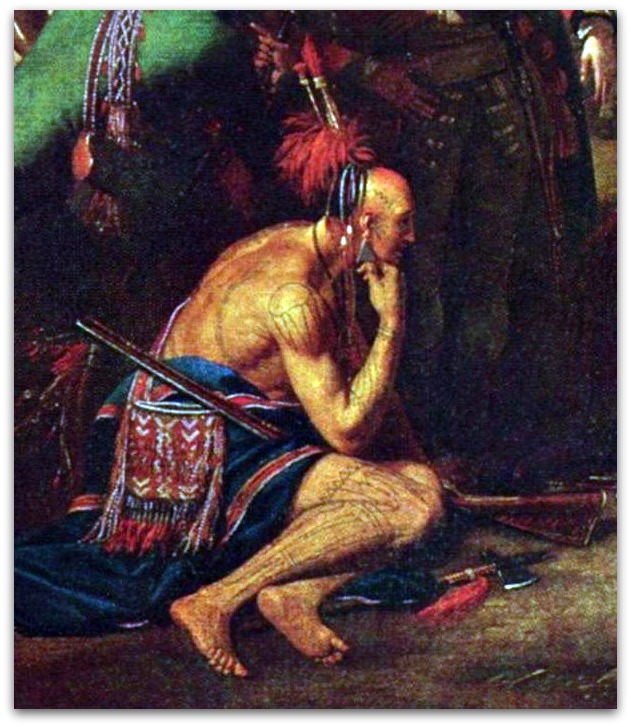
DISPLACED Q: Is the “noble savage” trope still relevant to today’s expats?

As the July theme for The Displaced Nation is Pocahontas, it seems a fitting moment to ask whether tourists and expats still cling to some kind of notion of the “noble savage” in the countries where they visit and live.

The answer of course should be a resounding “no” — because today’s global nomads (or anyone for that matter) have no business treating the people they meet in other countries in a condescending, racist manner.

To quote from Merriam-Webster to give a brief introduction to the underlying idea, the noble savage is a “mythic conception of people belonging to non-European cultures as having innate natural simplicity and virtue uncorrupted by European civilization.” It’s an idea that was wonderfully useful for racist scientists in the 19th century. It romanticizes primitivism.

Most expats these days seem to be fairly well-educated, well-positioned people who either for reasons of career, lifestyle or marriage have moved to another country. Although there may be constant befuddlement and discombobulation at living in another country, you probably have some existing frame of reference for wherever you are going and for what sights you will see. You are inescapably a product of the late 20th and early 21st centuries —  and I would argue that the noble savage trope absolutely has no relevance to you.


EDITOR’S NOTE: But is awindram right — or do some of you romanticize the natives in the countries where you’re staying?

img: Cropped version of Benjamin West’s “The Death of General Wolfe,” showing the Native American — a portrayal that has often been cited as an example of the “noble savage,” courtesy Wikimedia.

If you enjoyed this post, we invite you to subscribe for email delivery of The Displaced Nation. That way, you won’t miss a single issue. SPECIAL OFFER: New subscribers receive a FREE copy of “A Royally Displaced Tea.”

Related posts:

Marriage, cross-cultural style: Two veterans tell all (Part 1)

In the life of the global traveler, one of the most thrilling escapades you can have is a romantic encounter with someone you meet in a far-flung land.

But should your story involve going the further step and hitching your wagon to a person from a completely different culture — well, that’s another level of adventure altogether.

For marriage, you will need the ability to stand by the courage of your convictions.

Or, as one of our Random Nomads, Helena Halme put it in her comment on last week’s post covering this topic, cross-cultural marriage tends to be “for the mad bad and young — or foolish.”

Today and next Monday, one half of each of two cross-cultural couples have agreed to take the floor and answer my questions about what made them take the plunge:


GABRIELA SMITH has been married to Daniel for eight years. She was born in Venezuela to Spanish parents, but ended up in the UK, where she met Daniel and they currently live.


JEFFREY HUFFMAN has been married to Naoko for 19 years. They met in Nagoya, Japan, where Jeffrey, an American, had journeyed for his work. They now live in Seattle.

How did you meet your spouse-to-be?


GABRIELA: We were working for the same company in the UK; we met on my first day at work.


JEFFREY: We’re something of a cliché couple. She was a student in the summer Teaching English as a Foreign Language (TOEFL) prep course I was teaching in Nagoya. She had just graduated from college and wanted to pursue a second degree at a university in the U.S. and needed to pass the TOEFL to do so.

What made you think that this is the person for me? Did culture have anything to do with it?


JEFFREY: Definitely, Naoko represented a tie to the Japanese culture that I wanted to have. Seattle has a pretty large Asian community, I had taken Japanese at university with dozens of nikkei-jin, and I had been to Japan on visits twice before. But it wasn’t until I went to live there that it all fell in place.


GABRIELA: I arrived in the UK at 23 — marriage was not even in my mind. Additionally, I had no wish to stay in the UK so wasn’t looking for an Englishman to marry. I was going to travel more. I actually had a one way ticket to Italy when I fell in love with my husband.

Did you have any reservations before deciding to tie the knot, having to do with the other person being a different nationality?


JEFFREY: No reservations on my side, probably because Naoko had lived in the States for a year as an undergrad by the time I met her, and because her English was so good.


GABRIELA: Not at all. I thought — and I still think — that culture has very little effect on the “amount of risk” in a relationship. Values are important, of course, and I considered my husband’s values as an individual — not by placing him within a category ruled by his nationality.

How long were you together before you decided to get married?


JEFFREY: A point of no small contention with my wife. We’d been together for four years, two in Japan and two in the States, before I finally got around to asking her formally. Naoko was just about to graduate from Seattle University, and I’d been accepted at Columbia for grad school when I finally woke up and realized the time had come…


GABRIELA: Exactly 12 months after the day we met for the first time. Daniel asked me.

Where were your weddings held? Did you have cross-cultural ceremonies?

GABRIELA: The civil wedding was held in England; from my side there was just me. The religious ceremony was held in Venezuela a week after; from my husband’s side there was just him. The ceremony was in Spanish, a language that he does not speak! We held the reception party three weeks later when we were back in England — again, just me from my side. I even looked for a wedding dress on my own, and was on my own at the hairdressers on my wedding day. People may have thought it was strange, but I never minded. I thought it was all very exciting.


JEFFREY: We were married in my parent’s living room by a family friend who was a county judge. He wrote the ceremony for us, and it was very nice – just family and a few friends. We did a recommitment ceremony a few years later in Hawaii. Naoko didn’t want any kind of ceremony in Japan. She comes from Aichi-ken, where weddings tend to be an extravaganza. (Of course the real reason is that she was embarrassed to be marrying me — just kidding.)

Which makes me think of another question… What was it like meeting your in-laws for the first time? Did you have any awkward moments?


GABRIELA: Of course we’ve had some communication barriers, but mainly been due to my accent. I just have to repeat several times a word, or get my husband to “translate” for me. Ah, and the fact that I never drink tea or eat Christmas pudding seems to surprise his family each time!


JEFFREY: I think her parents and older brother initially took a dim view of our relationship, because I didn’t speak Japanese very well. To this day, my wife is my conduit with her parents (their Aichi-ben still leaves me lost a lot of the time). Overall, though, I think they are comfortable with me as I’m pretty comfortable with the culture.

How much of your married life has been spent in each other’s countries? And have you also lived in countries that are foreign to both of you?


GABRIELA: I don’t exactly have a country as my parents are originally from Spain but I grew up in Venezuela. Daniel and I have yet to live in a Spanish-speaking culture. We did, however, spend six years of our married life in a country foreign to us both: France. Otherwise, we’ve been in the UK.


JEFFREY: We’ve never lived anywhere else besides our home countries, and we’ve lived much longer in the U.S. than in Japan. Our time in Japan as a married couple consisted of three years in the Greater Tokyo area in the mid-1990s.

Are you settled down where you are now, or do you think you will change countries again?

JEFFREY:
Seattle is home for the time being. That said, I know Naoko misses her family. We’ve had some very emotional send-offs by family and friends in Japan. If fortuitous circumstances presented themselves (i.e. we were both offered obscene amounts of money and guaranteed vacation time), we’d be fools to not go. Barring that Disney scenario, we fully expect to spend at least part of the year in Japan in retirement, which isn’t that far off. It’s just eight years until our youngest is in college.


GABRIELA: What attracted me the most to my husband is that he also wanted to travel and live in other countries. I think things would have been very different if he said he wanted to stay in England “forever.” Now that we’ve spent six years in France I’ve realized that the weather really influences the social life and, to some extent, how people behave. It would be easier for my career if I stayed in the UK, but I have always placed my lifestyle before my career. Thankfully, my husband is quite happy with the idea of having late dinners on a terrace, under the sun, with wine and cheese on the table! Being Spanish, I would love for us to live in Spain one day.

What language do you speak with your respective spouses?


JEFFREY: Painful as it is to admit, about 99% English.


GABRIELA: Always English.

Tell me more about your kids.


GABRIELA: We have two wonderful children — a girl, 6, and a boy, 2. They were born in France, I was five months pregnant when we moved. Communicating with the midwives during childbirth was … interesting.


JEFFREY: We also have a girl and a boy, but they are a little older. Our girl is 14, and our boy, 9. Our daughter was born in Kawasaki, and our son in Seattle.

What language do you and your partner speak with the kids?


JEFFREY: The children are just now taking formal Japanese lessons.


GABRIELA: Spanish and English with my children. Occasionally I tease them — and my husband — in French. I must say that no matter what language I speak they all reply to me in English.

We look forward to hearing more from Jeffrey and Gabriela — and their spouses — next week. Let them know any comments or questions in the meantime!

If you enjoyed this post, we invite you to subscribe for email delivery of The Displaced Nation. That way, you won’t miss a single issue. SPECIAL OFFER: New subscribers receive a FREE copy of “A Royally Displaced Tea.”

Related posts:

4 lessons Harry Potter can teach us about tolerance – cross-cultural and otherwise

Yesterday, our Random Nomad, Jo Gan said:

“If something one of us does bothers the other person, we compromise… If you really want to make a relationship to work, any relationship, it takes respect, consideration, and a willingness to compromise.”

Wise words, Jo, and sentiments which another Jo – Jo Rowling, better known as JK Rowling – would agree with.

Love them?

Since 1997 and the publication of Harry Potter and the Philosopher’s Stone, we have been engulfed in the world of Hogwarts, wizards, witches, and muggles. With today’s movie release of  Harry Potter and the Deathly Hallows (Part 2), however, this week marks the end of the Harry Potter era.

Perhaps I was just at the right stage of family life to love Harry Potter. My children were toddlers when Philosopher’s Stone was published; this month, as Harry, Ron, and Hermione reach school-leaving age, so do they.  Together, over the last fourteen years, we have read the books, seen the movies, and queued at midnight in bookstores.

Or hate them?

It’s apparent, though, that not everyone shares this affection. While I understand we all have different tastes and Harry Potter cannot possibly be everyone’s cup of butterbeer, in too many cases this aversion has gone far past simple dislike into the realms of…well, ‘hatred’ isn’t too strong a word for it.

Pretty ironic, really, when one of the main Harry Potter themes is Tolerance.

Could it be that the very people who claim to detest Harry Potter are, perhaps, those who most need to read the books?

1. Tolerance of things we fear

Harry’s aunt and uncle, the Dursleys, fear all things magic. They won’t even permit Harry to use the M word – “Magic” – in their presence, and they confiscate his Hogwarts textbooks over summer vacations.

These actions are not unlike those of some fundamentalist churches, who periodically burn Harry Potter books. One Baptist pastor claims:

“The Potter series is worse than pornography. The books are even more dangerous than the Satanic Bible. At least with the Satanic Bible, young people know that the book was written by Satan. The Devil just changed his name to J.K. Rowling this time.”

Satan needn’t have bothered. It won’t help him get a share of the royalties.

2. Tolerance of infirmities

Professor Lupin, a teacher at Hogwarts, is humiliated and discriminated against because, through no fault of his own, he has a chronic disease – lycanthropy. In other words, once a month, he will turn into a wolf, bay at the moon, and run around biting people. The disease is now fully controlled by potions, but Professor Snape still regards it as his duty to inform Hogwarts pupils of Professor Lupin’s  condition.

Sadly, many AIDS sufferers can probably empathize with Professor Lupin’s plight.

However, we learn that in his teenage years, when no potion was available for his disease, Professor Lupin had three friends who developed their own ability to change into animal form, so they could keep Lupin company during full moon.

A true friend, like a life partner, will be tolerant of you in both sickness and in health.

3. Tolerance of other races

Voldemort followers in the Potter series want to rid the world of muggle magicians – wizards and witches who are not born into aristocratic magical families, but born in the real world and who display magical talent. Hermione is one of these, as was Harry Potter’s mother – both brilliant witches, but their talents apparently not good enough for Voldemort’s approval.

The parallels between Voldemort and Hitler, between the uprising of Voldemort followers and the Nazi party, between the desires for a master race and for pure-blood magicians, are only too evident.

4. Tolerance of things we envy

Lastly, a lesson not in the text of the books, but from reactions to the books.

There is wide criticism from both writers and ‘readers’ (I use quotes because generally these people haven’t read the books at all, but are prepared to offer criticism nevertheless) that the books have a clunky writing style, use too many adverbs – in short, name a writing sin, and JKR has committed it, it seems, and therefore does not deserve all the acclaim she has received.

No matter that this woman had an idea, worked on it determinedly for many years under far from ideal conditions, and finally achieved her goal of turning this idea into seven books. How dare someone rise from single motherhood on welfare to happily married, multimillionaire author?

In other words: How dare JK Rowling not be me?

As Jo Gan also said yesterday:

We have learned to accept each other’s differences.

If only everyone could say the same.

STAY TUNED for the first part in our series of interviews with cross-cultural couples.

If you enjoyed this post, we invite you to subscribe for email delivery of The Displaced Nation. That way, you won’t miss a single issue. SPECIAL OFFER: New subscribers receive a FREE copy of “A Royally Displaced Tea.”
Related Posts:

RANDOM NOMAD: Jo Gan, Director of Foreign Teachers, Author and Blogger

Cross-cultural marriage? 4 good reasons not to rush into it…

The Displaced Reads: 7 Books with a twist of Alice

RANDOM NOMAD: Jo Gan, Director of Foreign Teachers, Author & Blogger

Born in: Columbia, Missouri USA
Passport: USA
Country lived in: China (Yuyao City, Zhejiang Province): 2009-11
Cyberspace coordinates: Life Behind the Wall | Thoughts and Experiences of a Black American Woman in China (blog)

What made you leave your homeland in the first place?
I left America due to the economy. I worked in the mortgage field and when the housing market crashed, I needed to find something else to do…or be on unemployment. So I chose to take a job teaching English in China. Two years ago, I got married to a Chinese man whom I met in Yuyao. No, he wasn’t one of my students, as most people assume. I met him in a bar. He came over and asked if he could buy me a beer. We exchanged telephone numbers, and he started calling me every day, three times a day… Six months later, we were married. Yes, it was fast by most people’s standards but I’m not one to waste time — nor is he. It’s been an interesting couple of years.

Is anyone else in your immediate family displaced?
No one else in my family — except a great uncle who lived in Germany most of his life — has ever lived abroad for a long period. Some have been in the military and traveled around, but they always lived on base.

Describe the moment when you felt most displaced.
When I arrived at the airport in Shanghai — it was my very first time coming to China. My luggage had been lost, and I couldn’t communicate with anyone to tell them or report it. I felt frustrated and angry. Then once I got all the paperwork finished, I needed to take a bus to the next city. I couldn’t find the bus station, and no one could understand what I was saying. At that point, I wanted to just get back on the plane and go home.

Describe the moment when you felt least displaced.
When I went home to visit for the first time. Everything looked familiar but felt unfamiliar. I had spent a lot of time missing home, but when I finally got there, it didn’t feel right. In Yuyao, as I walk through the streets or sit in a restaurant and people recognize me, it makes me feel part of the community.

You may bring one curiosity you’ve collected from your adopted country into the Displaced Nation. What’s in your suitcase?
Wow! I guess I’d like to take a Chinese person — if you’d let me in with a companion rather than a suitcase. Yeah…the way they think and perceive things is so different from us Americans. Their ideas of “face,” status, and beauty are so alien to me that I am sometimes at a loss for words to explain it. I can’t get used to the fact that face — losing face, giving face and having face — is of the utmost importance to them. Also, their standard of beauty is so different: very white and very thin. The only way for you to get an accurate view of Chinese culture would be for me to bring a Chinese person along to explain it all to you.

You’re invited to prepare one meal based on your travels for other Displaced Nation members. What’s on the menu?
Since I live in Southeast China, the menu would have to consist of:

  • Steamed seafood. (I apologize in advance for its high salt content.)
  • Chicken feet that have been boiled and then fried.
  • Four kinds of eggs: tea eggs, thousand-year-old eggs, fried eggs with tomato, and boiled salted eggs that have been fertilized (there’s a chicken embryo inside).
  • And of course green vegetables… (By the way, the Chinese call all green leafy veggies “green vegetables.”)

For dessert we would have yangmei  (yumberry fruit), the local favorite.

And for drinks, a choice of:

You may add one word or expression from the country you’re living in to The Displaced Nation argot. What will you loan us?
I will choose Ni chifan le ma? (Have you eaten yet?). Everywhere you go in China, people greet you with Ni chifan le ma? Food is just so important to this culture. Weddings, birthdays, funerals — all of these events involve banquets lasting several hours. Everything tends to be associated with food, and there are many food idioms.

It’s Pocahontas month at The Displaced Nation, and we’re focusing on cross-cultural communications (or the lack). What would you say is the top challenge of an interracial, intercultural marriage — and can you recommend any coping techniques?
First I will say that the most challenging part of being in an intercultural marriage is the people around you. Usually, other people are more concerned about your marriage situation than you are, especially if you live in China. They tend to spend a lot of time telling you what is wrong, or can go wrong, with your marriage. They question the reasons you got married. For example, Chinese people will ask my husband if he married me to get a green card. He tells them: “We live in China, not America. How would a green card help me here?”

As for our personal relationship, we have learned to accept each other’s differences. If something one of us does bothers the other person, we compromise. For example, Chinese men have the tendency to put pork bones, chicken bones, sunflower seed shells, and fish bones directly on the dinner table when they are eating; I find this disgusting. So now we put a bowl beside my husband’s plate for him to discard these things. If you really want to make a relationship to work, any relationship, it takes respect, consideration, and a willingness to compromise.

QUESTION: Readers — yay or nay for letting Jo Gan into The Displaced Nation? Tell us your reasons. (Note: It’s fine to vote “nay” as long as you couch your reasoning in terms we all — including Jo — find amusing.)

img: Jo Gan hamming it up in the classroom by trying on her student’s sunglasses, taken by the student on her iPhone.

STAY TUNED for tomorrow’s installment from our displaced fictional heroine, Libby, when the Patrick family is held to ransom by an army of packing crates from their new home.

If you enjoyed this post, we invite you to subscribe for email delivery of The Displaced Nation. That way, you won’t miss a single issue. SPECIAL OFFER: New subscribers receive a FREE copy of “A Royally Displaced Tea.”

Related posts:

Cross-cultural marriage? 4 good reasons not to rush into it…

painting of Pocahontas and John Rolfe, by J.W. GlassAs announced last week, The Displaced Nation is honoring Pocahontas this month for the role she played in advancing communications between two very different cultures.

This week, we take a closer look at Pocahontas’s decision to marry the Jamestown settler John Rolfe.

Did the Rolfes have an easy time of it in their married life? History doesn’t tell us, but as the veteran of two cross-cultural marriages myself (first to a Brit, now to a Japanese), I tend to think not.

Sure, the union had its advantages for both parties. We know for a fact that two years after marrying Rolfe, Pocahontas was invited to voyage to England with her husband, where she met many prominent people, including King James I.

We know also that Pocahontas’s father, King Powhatan, gave the newlyweds property just across the James River from Jamestown, spanning thousands of acres.

But being in the mood to play devil’s advocate, today I will make the case for why Pocahontas and Rolfe should have hesitated before tying the knot.

Here are my top four reasons for cautioning against cross-cultural marriages like theirs:

1. Marriage across cultures is rarely seen as one of equals.

Rolfe felt he had to defend his decision to marry Pocahontas to his fellow colonists. Here’s what he wrote in a letter addressed to Sir Thomas Dale:

Nor was I ignorant of the heavie displeasure which almightie God conceived against the sonnes of Levie and Israel for marrying strange wives, nor of the inconveniences which may thereby arise,…which made me looke about warily and with good circumspection, into the grounds…which thus should provoke me to be in love with one whose education hath bin rude, her manners barbarous, her generation accursed, and so discrepant in all nurtriture frome my self.

After much soul searching, Rolfe decided he could marry Pocahontas despite her crude education, barbarous manners and different colored skin — as long as she converted to Christianity.

In the above portrait of the couple, by J.W. Glass, Rolfe is instructing Pocahontas in Christian doctrines.

And now let’s turn to Pocahontas. Did she see Rolfe as her equal, given that he was a mere tobacco farmer, and a foreign invader, and she was the daughter of the most powerful chief in the region?

According to historical records, the news of the liaison was well received by the Powhatan tribes, helping to create a climate of peace toward the Jamestown colonists for several years.

I find it instructive to compare Pocahontas with Cleopatra on this point.  Faced with the rising tide of Roman expansionism, Cleopatra seduced Julius Caesar and Marc Anthony to protect her country from being swallowed up. Likewise, Pocahontas may have seen it as her duty to marry John Rolfe, as it meant she could continue working on behalf of her people. (In that sense, Disney may have been right about Pocahontas’s preference for Captain John Smith — but only because he had more power than Rolfe.)

2. The fantasy quotient in such marriages can lead to huge disappointments.

In Glass’s portrait of the couple, John Rolfe gazes down lovingly into the eyes of a young woman with long, straight, dark hair. He seems to be thinking of Pocahontas as his trophy Indian princess — how exotic she is compared to his English wife (who died on the boat coming over).

But what if, at that very moment, Pocahontas is calculating the advantages that could accrue to her and her tribe from their liaison — including representing her father’s tribes to the powers-that-be in London and arguing against their displacement.

Would it crush Rolfe to learn the practical agenda she had in mind for their marriage?

At the same time, though, the painting shows Pocahontas gazing upwards at her husband-to-be. A young girl, she must have harbored a few fantasies as well. Maybe she found Rolfe much more refined than the Indian men she had known — she’d already had an Algonquian husband by then.

In that case, how disappointed she must have felt when, after the wedding, she discovered his habit of chewing and spitting tobacco, overheard him swearing like the sailor he once was, and noticed his tendency to stomp around the place. Why can’t he be more like an Algonquian man and walk as quietly as a leopard?

3. Sons tend to turn into their fathers, and daughters into their mothers — but how can you possibly anticipate this if you can’t read the culture?

Having been married to a Brit myself, I find it amusing to pretend that Pocahontas met Rolfe’s parents before deciding whether to marry him. In my imagination, she, like me, fails to pick up on all the important cues — things like the necessity of being able to produce a Sunday dinner of roasted meat, potatoes, and two veggies, while her husband rests up from his weekly labors. (Rolfe, by the way, is credited with the first successful cultivation of tobacco from the colony of Virginia.)

Likewise, had Rolfe been able to meet Pocahontas’s mother, I imagine he would have thought of her as a kindly Indian squaw — having no idea of her ability to control, coerce and manipulate others to her will.

4. In times of strife, the last thing you want is a cross-cultural misunderstanding.

We marry for better or for worse, but during the worst of times, most of us could do without a partner who is culturally clueless.

For example, if Pocahontas received word that one of her close relations had died — how would she feel if Rolfe resorted to trying to cheer her up with sarcastic British humor: “Well, at least that’s one less Injun for us to worry about!”

By the same token, if Rolfe’s tobacco crop failed due to drought, he may not have felt like dancing with Pocahontas, despite her insistence it would bring on the rains.

* * *

Most of the above, of course, is pure conjecture, but it is also based very closely on my own observations. I’ve witnessed quite a few romances in the Rolfe-Pocahontas mould — particularly while living in Japan. And I’ve seen quite a few of them turn sour.

I’ve also experienced firsthand how devastating it can be if one’s spouse can’t communicate properly when the going gets rough and you don’t have the energy to make allowances for the fact that they come from a different culture.

In my experience, the most important quality one needs to have for a successful cross-cultural marriage is that of being a glutton for punishment — a quality I just so happen to have in spades.

Not wanting an easy life — that’s what it all boils down to. And, unless you have a calling for handling complication piled on complication, then I would suggest choosing a mate who lived in the same neighborhood as you growing up — preferably next door.

Question: Do you agree that cross-cultural marriages are unusually challenging?

img: Detail of “John Rolfe and Pocahontas,” by James William Glass (early 1850s), courtesy Wikipedia (public domain)

STAY TUNED for tomorrow’s RANDOM NOMAD interview, in which our special guest will answer a Pocahontas-related question.

If you enjoyed this post, we invite you to subscribe for email delivery of The Displaced Nation. That way, you won’t miss a single issue. SPECIAL OFFER: New subscribers receive a FREE copy of “A Royally Displaced Tea.”

Related posts:

Two displaced royals, William & Kate, in la-la land

We welcome Emily Henry to The Displaced Nation as a guest blogger. In this post on the royal visit to California that just took place, Emily neatly combines two of our blog’s favorite topics: what Alice in Wonderland can teach us about the displaced life, and how to assess royalty from within a global framework. A US citizen with an English mother, Emily grew up in the UK. She has been living in California, first in LA and now Oakland, for about 5 years.

In Chapter 3 of Lewis Carroll’s Alice’s Adventures in Wonderland, Alice experiences a “Caucus Race,” as the Dodo calls it. This race — run with the intention of getting all of the sopping wet animals dry — goes nowhere but round and round in a circle.

Despite making a ridiculous scene for themselves, the animals treat the affair with as much pomp and circumstance as they can muster. Although there is no clear winner,

“Everyone has won,” declares the Dodo, and “must be given prizes.”

A race with no rules and no winner, but drowned in ceremony and self-congratulation, might be somewhat similar to a royal tour. Watching the Duke and Duchess of Cambridge land in Los Angeles Friday afternoon made me wonder just how tiring it must be to run around in circles in another world — this time, California rather than Wonderland.

When I first heard that William and Kate would be visiting California, I imagined a sunny adventure for the new faces of the Royal Family. After all, I thought we had all agreed that these newlyweds were to be the modern, affectionate royal couple, not a re-enactment of the traditional frigid romance of yore.

They had proved themselves to be sufficiently “unstuffy” in Canada, so in California I imagined them sipping cocktails on the rooftop of the Standard Hotel, running hand-in-hand along the beach, or munching popcorn during a movie premier at the Chinese Theatre.

But then their schedule was released, and it turned out to be a Caucus Race. William and Kate must spend their few days in California running around in circles for the high and mighty: California Governor Jerry Brown was there to greet them from the plane, along with Los Angeles Mayor Antonio Villaraigosa. A bunch of flowers were presented. No doubt the weather was mentioned, as it would be — no doubt — in almost every instance of small talk throughout the rest of the trip.

Instead of cocktails and a rooftop bar, Friday night meant discussions of “innovation,” “communication” and “technology” at Variety’s Venture Capital and New Media Summit.

If these conceptual, “big picture” lectures weren’t enough to “dry” the couple out, the Duke and Duchess of Cambridge had an evening with businessmen and politicians to look forward to at the British Consular General’s house.

William, of course, is used to this sort of thing.

But much like Alice, who had arrived in Wonderland only to be forced to listen to a boring lecture on William the Conqueror given by a mouse, Kate must be stifling her yawns in disappointment.

However, she is doing an excellent job.

Perhaps what is most endearing about Kate Middleton is her ability to appease the pomp-loving self-congratulators while at the same time revealing the sense of humor and personality bubbling beneath her regal smile.

I knew I liked her from the moment she flashed a secret smile at William during their wedding as the couple shared a private joke. Amid the ridiculousness of her enormous wedding, the long-winded prayers, songs and sermons followed by more prayers, songs and sermons, Kate seemed to appreciate the funny side. She played her part beautifully, maintaining the airs of the occasion but accepting her wedding ring with an inward giggle.

Alice, too, accepts her self-given “prize” after the Caucus Race with the same sense of irony:

Alice thought the whole thing very absurd, but they all looked so grave that she did not dare to laugh; and, as she could not think of anything to say, she simply bowed, and took the thimble, looking as solemn as she could.

QUESTION: How did Kate and William’s first royal tour look from your displaced perspective — and do you agree with Emily that they, particularly Kate, managed it wonderfully?

Emily Henry is an associate local editor for Patch.com, reporting and editing for 11 hyper-local news Web sites in the East Bay area of California. She is currently running the Berkeley Patch site.

STAY TUNED for tomorrow’s post, when we return to our Pocahontas theme and consider some of the perils of cross-cultural marriage.

If you enjoyed this post, we invite you to subscribe for email delivery of The Displaced Nation. That way, you won’t miss a single issue. SPECIAL OFFER: New subscribers receive a FREE copy of “A Royally Displaced Tea.”

Related posts:

THE DISPLACED READS: 7 books with a twist of Alice

As it’s that time of year when (depending on your hemisphere) poolside or fireside books are a must, and since we’re not quite ready to let go of the Alice theme, we at TDN have come up with our own version of a summer (or winter) reading list.

In our usual perverse manner, we haven’t chosen books on the current New York Times bestsellers list, but, quite simply, books with the name “Alice” in the title.

We haven’t read them yet, either, so this list is as much a journey of discovery for us as it is for you.

Let us know what you think!

1. Alice in Verse: The Lost Rhymes of Wonderland by J. T. Holden and Andrew Johnson

Average Amazon rating: 5 stars

Have you ever wondered…
Who really stole the Queen’s tarts? Whatever did become of the Walrus & the Carpenter after their nefarious jot down the briny beach with the little Oysters? Is there truly any sense to be found in nonsense at all? (Amazon product description)

“The rumored ‘lost rhymes’ of Lewis Carroll are the inspiration behind Alice in Verse: The Lost Rhymes of Wonderland, a compilation of masterful poetry. While adding new and interesting elements, Holden has managed to keep the timeless appeal of the original works, allowing true fans to insatiably dig in. From the absurdity of the verse to the well-composed rhyme to the shrewd black-and-white illustrations, this book is certainly a literature lover’s delight.” The Children’s Book Review)

2. The Logic of Alice: Clear Thinking in Wonderland by Bernard M Patten

Average Amazon rating: 4 stars

“Alice in Wonderland may well be the most interpreted book in history, but there are always new depths to be plumbed. Bernard Patten dazzles us with his analysis of key episodes in the book. Like Lewis Carroll, Patten obviously loves logic and uses wit and humor to draw serious lessons about the principles of clear and logical thinking.” —Clare Imholtz, Secretary, Lewis Carroll Society of North America

“As Patten makes clear, Alice’s Adventures in Wonderland, far from being just an entertaining children’s book, is more complex and deeply reflective of Dodgson’s character than it may seem. By making an effort to understand its deeper layers, both children and adults may profit from this masterful tale by learning to think better and, along the way, having fun.” (Amazon product description)

3. Alice in Wonderland and Philosophy: Curiouser and Curiouser by William Irwin

Average Amazon rating: 4 stars

From the back cover:

  • Should the Cheshire Cat’s grin make us reconsider the nature of reality?
  • Can Humpty Dumpty make words mean whatever he says they mean?
  • Can drugs take us down the rabbit-hole?
  • Is Alice a feminist icon?

This book probes the deeper underlying meaning in the Alice books and reveals a world rich with philosophical life lessons. Tapping into some of the greatest philosophical minds that ever lived—Aristotle, Hume, Hobbes, and Nietzsche—Alice in Wonderland and Philosophy explores life’s ultimate questions through the eyes of perhaps the most endearing heroine in all of literature.

4. Alice I Have Been: A Novel  by Melanie Benjamin

Average Amazon rating: 4 stars

“Benjamin draws on one of the most enduring relationships in children’s literature in her excellent debut, spinning out the heartbreaking story of Alice from Alice’s Adventures in Wonderland…Focusing on three eras in Alice’s life, Benjamin offers a finely wrought portrait of Alice that seamlessly blends fact with fiction. This is book club gold.” (Publisher’s Weekly)

5. Alice Bliss: A Novel by Laura Harrington

Average Amazon rating: 5 stars

“When Alice Bliss learns that her father, Matt, is being deployed to Iraq, she’s heartbroken. Alice idolizes her father, loves working beside him in their garden, accompanying him on the occasional roofing job, playing baseball. When he ships out, Alice is faced with finding a way to fill the emptiness he has left behind.” (Amazon product description)

6. What Alice Forgot by Liane Moriarty

Average Amazon rating: 4.5 stars

“What would happen if you were visited by your younger self, and got a chance for a do-over?
Alice Love is twenty-nine years old, madly in love with her husband, and pregnant with their first child. So imagine her surprise when, after a fall, she comes to on the floor of a gym (a gym! she HATES the gym!) and discovers that she’s actually thirty-nine, has three children, and is in the midst of an acrimonious divorce.
A knock on the head has misplaced ten years of her life, and Alice isn’t sure she likes who she’s become. It turns out, though, that forgetting might be the most memorable thing that has ever happened to Alice.” (Amazon product description)

7. About Alice by Calvin Trillin

Average Amazon rating: 4 stars

Trillin, a staff writer at The New Yorker since 1963, regularly wrote about his family members, particularly his wife Alice, who lost her battle with lung cancer on September 11, 2001. This book, an homage to Alice, was published five years after her death.

“This succinct account of Alice’s upbringing, their meeting, their romance, their family, and her career beyond that of Trillin’s helpmeet, offers glimpses into a multifaceted character.” (Booklist)

“In his writing, she was sometimes his subject and always his muse. The dedication of the first book he published after her death read, ‘I wrote this for Alice. Actually, I wrote everything for Alice.’
In that spirit, Calvin Trillin has, with About Alice, created a gift to the wife he adored and to his readers.” (Amazon product review)

.

STAY TUNED for Monday’s account of the two displaced royals, William and Kate.

If you enjoyed this post, we invite you to subscribe for email delivery of The Displaced Nation. That way, you won’t miss a single issue. SPECIAL OFFER: New subscribers receive a FREE copy of “A Royally Displaced Tea.”