The Displaced Nation

A home for international creatives

7 extraordinary women travelers with a passion to save souls

A week ago, I announced that The Displaced Nation will be dedicating the month of November to exploring the displaced lives of those who travel the world to do good works on behalf of those less fortunate.

Blame it on the years I spent as an expat in England, but the whole time I was writing that post, I had the sense of a Victorian couple — the man in a top hat, the woman in a full skirt — looking over my shoulder, whispering in my ear: “We tried to save the world, too, you know.”

To be fair, those phantoms of mine have a point. The Victorians ventured into the wilds of Africa, Asia and the Americas not just as imperialists looking for riches but also as missionaries looking to save souls.

And, just as we 21st-century people think we have the answers for people who live in developing countries — microfinance, entrepreneurship, mosquito nets, gifts of sheep and goats — our forbears thought they had the answers, too: Christianity, coupled with a strong belief in the universality of basic human freedoms.

Today I will attempt to put said ghosts to rest by paying tribute to 7 women missionaries from the 19th and early 20th centuries, from both sides of the Atlantic.

So, why the women and not the men? Three reasons:

  1. Being women, they tended to stand up for the rights of women and children wherever they went.
  2. Many also learned the language and assimilated to the local culture, thereby winning respect.
  3. And many were further willing to acknowledge the blunders committed by missionaries when attempting to penetrate the world’s most remote communities. As missiologist Ruth Tucker, who has read many missionary memoirs by women, observes:

These women writers one after another have allowed themselves to be vulnerable in painting a sometimes messy picture of their own character and of their missionary work. [Their] raw memoirs have much to say to us in the 21st century.

I’m going to take Tucker’s words to mean that even if you’re not religious, disapprove of proselytizing, or are something other than Christian, you might still concede that, on derring-do, fortitude, and decency alone, the following women deserve a place in the Displaced Hall of Fame.

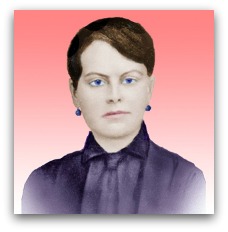
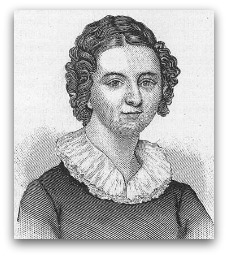
Ann Haseltine Judson (1789 – 1826)

Who was she? A Bradford, Massachusetts native, teacher, and the wife of Andoiram Judson. Two weeks after they married, the couple set out on a mission trip — first to India, then to Burma.
Key achievements: While her husband was imprisoned in Burma under suspicion of being a spy, Judson wrote stories of the struggles she faced on her own in the mission field. She included tragic descriptions of child marriages, female infanticide, and the trials of the Burmese women who had no rights except for those their husbands gave them.
How she died: Of smallpox in Burma, at age 37.
Interesting fact: At least 16 biographies of Judson were published in the 19th century, the most famous of which had a new edition printed almost every year from 1830 to 1856. She and Andoiram were American celebrities.

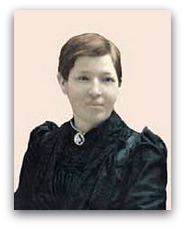
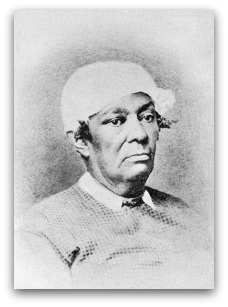
Betsey Stockton (c. 1798 – 1865)

Who was she? A freed slave who left domestic service to travel as America’s first single female missionary to Hawaii, then known as the Sandwich Islands. In fact, she went partly as a missionary and partly as a servant to one of the couples on the mission, the Reverend and Mrs. Stewart.
Key achievement: After being asked by the son of the Hawaiian king to teach him English, Stockton started up a school at Lahaina (in West Maui) for the makeainana — fishermen, farmers and craftsmen who lived off the land — which continued after she left.
Why her mission ended: Stockton’s service in Hawaii was cut short when Mrs. Stewart became ill. The party decided to return to the States in 1826.
Where she died: In Princeton, NJ. She is buried in the Stuarts’ plot in Cooperstown, NY.
Stockton’s diary: Stockton kept a detailed written record of the mission, which conveys her somewhat turbulent, occasionally agonized, inner spiritual life; her interest in the natural world — including the kinds of fish caught from the ship, the color of the waves, and various bird life; and her spirit of adventure. Like others on board she was frightened at her first sight of the Hawaiian men who come out in canoes to greet the ship:

half man and half beast—naked—except a narrow strip of tapa round their loins…

But then she adds: “They are men and have souls.”

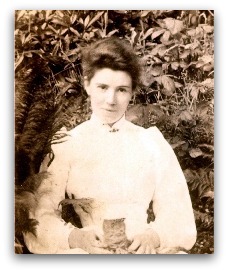
Adele Marion Fielde (1839 – 1916)

Who was she? A working-class native of Rodman, NY, who followed her fiancé, a Baptist missionary, to Bangkok, Thailand (then Siam) — only to discover he’d died of typhoid fever 10 days after she’d set sail from New York. She carried on nevertheless, remaining in Siam for a couple of years.  Later she went on a mission to China for training Bible women.
Key achievement: Fielde mastered the Chinese language and was also a powerful writer. She encouraged each of her Chinese Bible women to tell their stories, and then translated these stories and got them published in magazines back home. As one of her biographers puts it:

Their heart-rending sagas proved enormously appealing to American women, who could sympathize with their suffering Chinese sisters.

Where her life ended: In the United States. She retired from missionary work, went home, and became involved in scientific research.
Strange twists and turns: A free thinker since childhood, Fielde broke away from her family’s Baptist roots — only to return after becoming engaged to a Baptist missionary candidate. She faithfully served as a Baptist missionary for two decades — and then turned to science. Notably, the Baptists for a a long time sensed that she wasn’t quite one of them, accusing her of indulging in card-playing and dancing when she lived in Siam. She responded:

“I desire to be good. But I do not wish to be Pious.”

Lottie Moon (1840 – 1912)

Who was she? A highly educated Virginia native (she was born “Charlotte Digges Moon” on her family’s ancestral slave-run tobacco plantation). She became a teacher and then was called, at age 33, to serve for decades in China with the Southern Baptist Convention. Initially she went to join to her sister, Eddie, who was stationed at the North China Mission in the treaty port of Dengzhou.
Remarkable turnaround: When she first arrived at the mission, Moon made a point of wearing Western clothes to distance herself from the “heathens.” But then she mastered the language, became an admirer of Chinese culture and history, and started wearing Chinese clothes and adopted many of their customs.
Commendable behavior: When China was facing plague, famine, revolution, and war, Moon shared her personal finances and food with anyone in need around her.
How she died: Of starvation, in the harbor of Kobe, Japan, while en route back to the United States. (At that point she weighed only 50 pounds!)
Impressive statistic: Southern Baptists have named their annual mission fund after Lottie Moon. It finances half the entire Southern Baptist missions budget every year.
Part of her lore: She used to tell people she was 4′ 3″ tall. While something of an exaggeration, she was definitely petite!
Lottie Moon Cookies: Moon won over the children in her Chinese village by making tea cakes for them — they called her “the cookie lady” instead of “foreign devil.” Baptist families bake Lottie Moon Cookies for Christmas.

Mary Slessor (1848 – 1915)

Who was she? A Victorian mill girl who left the slums of Dundee to live among the tribes of Calabar, Nigeria, to take up the mantle of David Livingstone two years after he died.
Noteworthy friendship: While in Africa, Slessor became acquainted with the writer Mary Kingsley. Although the latter had never been baptized and hadn’t even been brought up a Christian, their common status — both were single females living among native populations with little company — presumably created the basis for lasting friendship.
Key achievement: The tribal people believed that if a woman gave birth to twins, one of the twins was the offspring of the devil who had secretly mated with the mother — and since the innocent child was impossible to distinguish, both should be killed (the mother was often killed as well). Slessor fought hard to end this practice.
Where she died: In Nigeria, at age 67. There was great mourning among the tribes to whom she’d dedicated her life.
A tribute from an unexpected source: During London Fashion Week in 2010, Nigerian-born designers Bunmi Olaye and Francis Udom named Slessor as one of the muses behind their collection, which fused Victorian costume with furs of the African tribe Slesson had lived in. The reason? Slessor had rescued Francis’s great-grandmother, who was born a twin, from human sacrifice.

Amy Carmichael (1867 – 1951)

Who was she? A small-village girl from a devout Presbyterian family in County Down, Northern Ireland (her father founded an evangelical church in Belfast). She was called first to work among the mill girls of Manchester and then overseas, finding her life-long vocation in India.
Key achievement: In those days, Hindu priests kept “temple children” — mostly young girls who were forced into prostitution to earn money for them. Carmichael tried to rescue them by setting up a sanitarium in Tamil Nadu, thirty miles from the southern tip of India.
Bold behavior: She would dress in Indian clothes, dye her skin with dark coffee, and travel long distances on hot, dusty roads to save just one child from suffering.
How she died: In India at the age of 83. She asked that no stone be put over her grave. Instead, the children she had cared for put a bird bath over it with the single inscription Amma, meaning “mother” in Tamil.
Cryptic remark: While serving in India, Carmichael received a letter from a young lady who was considering life as a missionary. She asked, “What is missionary life like?” Carmichael wrote back saying simply,

“Missionary life is simply a chance to die.”

A measure of her fortitude: Carmichael served in India 55 years without furlough and produced a total of 35 published books about her experiences.

Gladys Aylward (1902 – 1970)

Who was she? A working class London girl who left domestic service for to Yuncheng, Shanxi Province, China, in the tumultuous years leading up to World War II. She worked with an older missionary, Jeannie Lawson, to found an inn where traveling merchants could get a hot meal and hear stories from the Bible. Notably, Aylward was initially rejected as a potential missionary to China because of her lack of education. She spent her life savings on her passage.
Key achievements: Appointed by the local mandarin to serve as a “foot inspector,” she toured the countryside to enforce the new law against foot binding and met with much success. She also took in orphans and adopted several herself, and she intervened in a volatile prison riot, advocating for prison reform. When the region was invaded by Japanese forces in 1938, Aylward led around a hundred children to safety over the mountains, despite being wounded herself.
How her life ended: She returned to England in the 1940s, then tried to go back to China but was re-denied entry by the Communist government. She ended up in Taiwan, where she started another orphanage. She lived in Taiwan until her death.
Chinese nickname: She was known in China as Ai-weh-deh, or Virtuous One.
Celebrations of her life: Numerous books, short stories and movies have been created about the life and work of Gladys Aylward, including the film The Inn of the Sixth Happiness.
Not easily flattered: For Aylward, this 1957 movie was a thorn in her side: she resented being played by the tall, Swedish Ingrid Bergman (small in stature, she had dark hair and a cockney accent) and was further horrified to discover she’d been portrayed in “love scenes” with the Chinese Colonel Linnan.

Readers, what do you think of these 7 women? Have they inspired you?

STAY TUNED for tomorrow’s post, a Displaced Q on the “pornography of poverty.”

If you enjoyed this post, we invite you to subscribe to The Displaced Dispatch, a weekly round up of posts from The Displaced Nation, plus some extras such as seasonal recipes and occasional book giveaways. Sign up for The Displaced Dispatch by clicking here!

Related posts:

Image: MorgueFile

RANDOM NOMAD: Vilma Ilic, Research Associate for Sub-Saharan Africa (Social & Economic Development Projects)

Born in: Sarajevo, Bosnia (at the time of my birth, still Yugoslavia)
Passports: Happily, I carry a USA passport — and realize how lucky I am!
Cities/States/Countries lived in: Utah (Salt Lake City): 1985-90; Ohio (Columbus): 1991-99; Washington, DC: 2000-01; Washington (Randle*): 2002; Connecticut (Storrs & Hartford): 2003-05 & 2006-08; Germany (Hamburg): 2006; New York (New York): 2008-10, 2011-present; Uganda (Kalisizo Town, Rakai District): 2010-11.
Cyberspace coordinates: Still a work in progress, but stay tuned!
* A small community deep in the temperate rainforest of the Pacific Northwest, between Mt. St. Helen’s and Mt. Rainier.

What made you leave your homeland in the first place?
My mother was accepted to graduate school at the University of Utah. Both my mother and father yearned to leave Bosnia (formerly part of Yugoslavia), for no unusual reasons: they sought greater academic and career opportunities and a better future for their children. They also sensed the progressing demise of our country, which started promptly after Tito’s death. Unlike the rest of our family, friends, and neighbors, my family fled the country before the civil war and genocide began in the early 1990s.

Is anyone else in your immediate family “displaced”?
My parents are definitely displaced. Similar to other immigrants who’ve spent their childhood, adolescence, and young adult years in their home country and then lived more than thirty years in their adopted country, my parents have never quite fit into the United States. The extent to which immigrants like them do or do not have control over “fitting in” remains a mystery to me — resting as it does on so many social, racial, cultural, religious, economic, geographic, and ethnic variables. Maybe they are destined to always feel displaced? People like my parents tend to feel at “home” only when they have found pockets of people from their homeland who have created sub-communities in whatever locales they reside. But then when my parents actually do go home after spending so much time abroad, their friends and family regard them differently: “You’re an American now.” Comments like those — from your own family — can make you feel as though you’re living on the “moon.” You’re seen as something of a traitor, regardless of the amount of remittances you’ve sent home.

Describe the moment when you felt most displaced.
For me, feeling displaced has to do with suffering through a bad life decision — you only realize it’s a terrible choice when it’s too late. Call it poor planning or a penchant for ignoring sage advice, but unfortunately, I have a lot of experience in this realm. Working in Hamburg, Germany, was like that for me. I went there to teach English as a foreign language to Germans. I absolutely loathed the work — and also didn’t have a positive attitude. In retrospect, it’s pretty distressing to think that my time in Hamburg could have been much richer. Although it’s ethnically homogenous and the German culture is a tough one to crack, Hamburg is a wonderful northern European city with an abundance of parks, museums, delicious restaurants, festivals, free events, concerts, shopping, affordable living, social services, and whatever you wish for in a metropolis with enough space to never feel stifled. Yet I felt displaced the entire time I was there.

Describe the moment when you felt least displaced.
The moment I set foot in the Pearl of Africa. There’s something about Uganda. It’s a loving country — the people are warm, welcoming, celebratory — and the terrain itself, not to mention the climate, is extraordinarily beautiful. All of these elements combined — the beauty of the people, the country, the climate — made me feel instantly at home. Of course, in a place like Uganda, I stick out in the crowd — hence am always at the mercy of onlookers and of people incessantly yelling “Muzungu!” But even when I was the only muzungu for miles and miles, and didn’t understand the language, I felt more comfortable and at peace there, than I have anywhere in the world.

If I had to analyze it, I’d say my comfort level also had to do with the work I was doing in that country. I was on a small team that was part of the Suubi Research Project: we’d been given the task of designing a sustainable school-lunch program for 10 primary schools in southern Uganda. The majority of pupils don’t eat anything all day because their parents/caregivers cannot afford the nominal lunch fees. For those who can afford it, the midday meal consists of boiled maize-meal and water in a soupy consistency. Together with school teachers and administrators, pupils, and community members, we tried to come up with a program that would be nutritional but also generate a profit for schools in the long run.

To do this kind of work, I had to access parts of my brain, psyche, and heart that, in many highly-industrialized Western countries, are frequently subdued, or even sabotaged.

You may bring one curiosity you’ve collected from each of your adopted countries into the Displaced Nation. What’s in your suitcase?
From Zagreb, Croatia: A licitarka srce, an ornamental-sized heart-shaped cookie. Not intended for eating, it’s hardened, painted red, and adorned with loving phrases or sketches of historical sites in Zagreb. It’s a typical souvenir, but hasn’t lost its significance for me. And better yet, it’s small and lightweight.

From Sarajevo, Bosnia: A džezva, a pot used to make Turkish coffee, which locals consume about 4-5 times per day in the street cafes of Sarajevo. Pack it in your suitcase, and its uncomplicated design makes it possible to enjoy a strong Turkish coffee anywhere in the world — as long as there are finely ground coffee beans, water, and fire.

From Uganda: Handmade baskets woven from grasses, tree-bark hats, banana-fiber mats, and colorfully printed smocks. I would give all of these items away as gifts to Displaced Nation residents as I know I’ll keep returning to Uganda.

From the US: All of my iLife appendages — nothing else matters. But if there is still space, I’d pack a good pair of American blue jeans, running shoes, powdered electrolyte drink mixes, and probiotics.

You’re invited to prepare one meal based on your travels for other Displaced Nation members. What’s on the menu?
I’m going to choose the food from my home country, and various other parts of former Yugoslavia, which remains my favorite. I would prepare an assortment of meat, cheese and cabbage burek, with kajmak and kupus salata on the side.

For anyone needing to top off the meal with something sweet, I’d offer plates of oblande, tulumbe, kadaif, and krempite.

Beverages would include red wine from Macedonia and some sort of rakija (domestic spirits) as an aperitif.

And for an African touch, I’d consider including fresh tilapia from Lake Victoria, as well as fresh pineapples, avocado, mango, and papaya.

You may add one word or expression from the countries you’ve lived in to The Displaced Nation argot. What will you loan us?
From Uganda: You are lost. The first time a Ugandan said this to me (they say it in English), it took me some time to realize that in fact, I was very much found. After hearing it time and again, I interpreted it to mean: “I haven’t seen you in a while, where have you been?” or “I miss you.”
From American English: It’s not so much a word but the habit Americans have of inventing new words by converting nouns into verbs or combining two words/concepts: eg, voluntouring, voluntourism, professionalize, beveraging, tween…

This month we are looking into “philanthropic displacement” — when people travel or become expats on behalf of helping others less fortunate than themselves. Do you have a role model you look up to when engaged in this kind of travel — whose words of advice you remember when you find yourself in a difficult situation?
I would choose my father for this one. Some advice he has dished over the years has actually stuck. Many immigrant parents wish their displaced and nomadic offspring would settle down in the burbs already — but not my dad. He genuinely supports what I do. Here’s what he said:

Who you are, in terms of your skin color, gender, ethnicity, ability, whatever it may be, it’s all by chance. No one should be so attached to their position in society, because it could change at any moment, and you didn’t have a choice in the first place.

My interpretation of that is, regardless of how you position yourself or where other people place you in the ruthless global hierarchy, what you value in yourself, in other people, and in life, is of prime importance. You are not superior or inferior to anyone on this planet. We are all the same. With that approach, nothing is scary and everyone is valuable.

Voluntourism is said to be the fastest growing segment of the travel industry (itself one of the world’s fastest growing industries). Do you think this kind of travel can help the uninitiated understand the problems our planet is facing?
A lot people, myself included, scoff at the term “voluntourism.” We find it disturbing to think that privileged people are paying very large sums of money to spend a few weeks or months in a low-income country, somewhere in the global south or South/East Asia — to do what, exactly? How much of this money is being invested into the communities in which the voluntourists are traveling/visiting, and how much is supporting the Western-based organization? I think we know the answer.

On the other hand, I realize that this industry provides an organized, safe, and coordinated way for people who wouldn’t otherwise have the opportunity to visit certain parts of the world. I just don’t think the voluntourists should be misled. It is both their — and the organization’s — responsibility to fully understand the implications of their visit, and the impact of their visit on the community.

It’s difficult to measure how much this type of exposure can change one’s attitude toward and knowledge about a particular place and its inhabitants. I would advise anyone who has never left a highly-industrialized country and has enough resources, simply to board a flight to a poor developing country. The real learning and growing happens when you leave the comfort of a temporary expat community, the organized lodging, the capital cities and urban areas — and actually travel, by local means, to very remote and rural villages. It is these very raw, uncomfortable, and painful experiences — when people break the tourist habit of simply arriving, observing, interacting, taking, and leaving — that can lead to major epiphanies.

Readers — yay or nay for letting Vilma Ilic into The Displaced Nation? Tell us your reasons. (Note: It’s fine to vote “nay” as long as you couch your reasoning in terms we all — including Vilma — find amusing.)

img: Vilma Ilic and a friend from Zagreb nervously — owing to their leftover Catholic guilt — navigate the Virgin Mary’s blessed cove in the bluffs of Šibenik, a town on Croatia’s Dalmatian Coast (summer 2009).

STAY TUNED for what may or may not be tomorrow’s installment from our displaced fictional heroine, Libby, who has been in a state ever since her creator, Kate Allison, went missing on Halloween. Has she done an Agatha Christie on her? (What, not keeping up with Libby? Read the first three episodes of her expat adventures.)

If you enjoyed this post, we invite you to register for The Displaced Dispatch, a round up of weekly posts from The Displaced Nation. Includes seasonal recipes and book giveaways. Register for The Displaced Dispatch by clicking here!

Related posts:

All hail Sir Richard Branson, along with global nomads who delve into global misery — and welcome to November

The catalog for Heifer International has just landed in my mailbox, encouraging me to donate a sheep in honor of my nearest and dearest, to a family in need in Nepal, Romania, or Brazil. That family will in turn give away the sheep’s female offspring to other families in need, and so on — a benevolent pyramid scheme known as Passing on the Gift.

I get it. What’s more, as it’s All Saints’ Day, I sense I would feel considerably more beatific if I gifted a sheep on behalf of my loved ones than if I bought them yet another pair of Merino wool gloves they don’t really need. (Hey, but it wouldn’t have been any old gloves but a touchscreen pair from Muji, for using one’s iPhone in the dead of winter…)

Yet for some reason, the Heifer appeal doesn’t. Call me a hard-hearted skeptic, but I’ve always had trouble with the kind of philanthropy that poses simple solutions to complex, deep-seated problems — alleviating world hunger and poverty being at the top of the list.

A candid — or do I mean Candide? — appraisal

When it comes to philanthropy, I always wonder — is this more about you (and your need to assuage your guilt about having so much) or about them? And how much do you actually know about them?

That is probably why, when I went to live abroad, I didn’t go as an aid worker or a Peace Corps volunteer. In the UK I was a postgraduate student; in Japan, a trailing spouse.

That said, my expat life was never just about exotic travel. On the contrary, I aimed to broaden my horizons and educate myself about other cultures by becoming immersed in the everyday life. I got to know the “natives” — and even married a couple of them (in not-very-rapid succession). Ultimately, I tried to become more of an informed citizen — of the world as well as of my country (assuming I eventually returned — I did).

But saving the world? That wasn’t in my plan. Like Voltaire’s young man, Candide, I would start by cultivating my own garden and branch out (so to speak) from there.

The importance of being earnest

I suppose you could say I’ve never been that earnest.

Earnest people have a calling. They don’t have time for frivolity.

I always have time for frivolity. What’s more, I’m genetically predisposed toward light-hearted nonsense. (Despite what the Heifer International Catalog says, my mother is not the sort to enjoy having me donate a sheep to someone she’s never met. She’d rather I gave it to her as a pet!)

From my expat days in the UK, I remember a joke sometimes told of Princess Diana, that when she would arrive on one of her unannounced visits to a hospital, patients would hide beneath their beds, not wanting to be the next “victim” of her need for making the Grand Philanthropic Gesture.

I find that image amusing to this day.

Do you really want to make me cry?

But lest this post become all about me and my peculiar hang-ups, let’s move on to Richard Branson and TDN’s November theme.

Cue in 1980s Culture Club music. Rockstar businessman Sir Richard Branson has just now touched down on the shores of The Displaced Nation in his hot-air balloon, the Virgin Atlantic Flyer.

As the leading exemplar of a fun-loving philanthropist, he is about to disprove my theory that these two qualities, earnestness and fun, can’t be combined in one individual.

As anyone who’s had the privilege of traveling on Virgin Atlantic in upper class (as I did when I was a spoiled expat in Tokyo) will be aware, here is man who knows how to throw a good party.

But if letting the good times roll is a huge part of Sir Richard’s appeal, it’s not his whole story. As one of the world’s wealthiest people, Branson also believes in giving back:

Ridiculous yachts and private planes and big limousines won’t make people enjoy life more, and it sends out terrible messages to the people who work for [such people]. It would be so much better if that money was spent in Africa — and it’s about getting a balance.

Branson, of course, has spent has spent much of his adult life displaced in ways most of us can’t even imagine — in private jets, on a private island in the Caribbean, in boats and balloons in pursuit of daredevil adventure.

But then some years ago, with his 60th birthday approaching, he began diverting some of his formidable energy and funding resources to countries in need — particularly in Africa. He left behind rock bands to form a band of Elders — consisting of, among others, British rock musician and human-rights activist Peter Gabriel, Nelson Mandela, Jimmy Carter and Mary Robinson — to work on the African continent’s intractable problems.

At Ulusaba, the private game reserve that Branson now owns in South Africa, visitors are encouraged to get involved with the initiatives he has launched to help local villages that have been ravaged by unemployment, HIV and drought. As Branson told a Daily Mail reporter:

To come to Africa and not see Africans is just wrong. A lot of the game reserves don’t really allow you into the villages but I think it’s important.

In addition, Branson is using his business knowhow to incubate and seed promising business proposals from aspiring South African entrepreneurs.

Now, Sir Richard would have earned the right of entry to our Displaced Hall of Fame by virtue of his derring-do alone — have you heard of Virgin Galactic? (It’s not too late to book a seat on the first sub-orbital space flight.) But we’ve chosen this moment to honor him as we plan to spend November looking at the kind of global nomads with the courage and the fortitude to delve into global misery.

Such travelers have displaced themselves, often to far-flung corners of the globe, not for the sake of good times or narrow personal goals but for the sake of helping others — many of whom have been displaced from their homelands through tragic circumstances beyond their control.

Not the final word

The announcement of this month’s theme is not, however, tantamount to imposing a ban on skepticism — we skeptics still have a place at The Displaced Nation’s table. What’s more, our ranks will soon swell to include some of the very people who belong to the volunteer and aid communities. They, too, can have their doubts about the effectiveness of their work — and of the involvement of celebrities in global problems.

But for now, let’s save such issues for future posts.

Which means I can now go back to cultivating my little patch of grass. Hmmm… I wonder if it could use a sheep or two, after all?

STAY TUNED for Wednesday’s post, featuring the first of our philanthropic Random Nomads.

If you enjoyed this post, we invite you to subscribe to The Displaced Dispatch, a weekly round up of posts from The Displaced Nation, plus some extras such as seasonal recipes and occasional book giveaways. Sign up for The Displaced Dispatch by clicking here!

Related posts:

A Julia Child for our times: Expat author & French cookery expert Elizabeth Bard

Et voila. In a little less than a month, The Displaced Nation has gone from reminiscing over American expat in France Julia Child to engaging with American expat in France Elizabeth Bard.

Move over Julie Powell. At a pace rather like a simmering le Creuset pot of Child’s signature boeuf bourguignon, Bard is on the way to becoming the 21st-century’s answer to that towering figure of 20th-century cuisine Française.

The similarities between the two women are intriguing. Child went to France as a trailing spouse for an American diplomat. Bard went to France trailing a Frenchman.

Child was seduced by France. She found herself through French cuisine. Bard was seduced by France (after being seduced by a Frenchman). She found a way into French culture through the markets and cooking — and found herself in the process.

On this point, the line between the two women gets a little blurry. Which one, Child or Bard, said the following:

More than the museums, more than the ancient streets, these stalls of fruits and vegetables and spices were the Paris that inspired me.

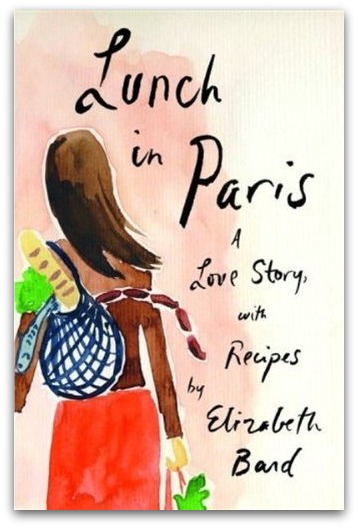
As everyone knows, Child returned to the United States to launch a career in television. Whereas Bard has become a long-term resident of France — and has launched a brilliant writing career with the publication of Lunch in Paris: A Love Story, with Recipes, a New York Times and international bestseller, a Barnes & Noble “Discover Great New Writers” pick, and the recipient of the 2010 Gourmand World Cookbook Award for Best First Cookbook. NOTE: We are giving away copies to two lucky DISPLACED DISPATCH subscribers. Sign up today!

Child inspired Julie Powell to make all of her recipes. Bard has inspired, among others, two Displaced Nation writers — myself and Anthony Windram — to try out her recipes.

But here the comparison ends. A key difference is that Bard’s recipes are nowhere near as difficult as Child’s — which is exactly what makes Bard so perfect for our times. She’s approachable, and her cooking suggestions are doable. She also has a rich life outside cooking — the life of a woman who has displaced herself into another culture — and enjoys sharing that part of her story as well.

Mesdames et Messieurs, I would now like to offer you the fruits (not to mention veggies) of my exchange with expat author, chef and lifestyle muse Elizabeth Bard.

Tell me a little more about your background.
I grew up in Northern New Jersey and spent weekends with my father in New York City. I studied English Lit as an undergrad at Cornell, then art history at Christie’s and the Courtauld Institute in London. My dream was to be the chief curator of the Pierpont Morgan Library in Manhattan. I was always convinced I’d been born in the wrong century. I love old objects, lost worlds, so, of course, I was instantly seduced by Paris (and of course, my French husband).

Over the years, I’ve written on art, travel and food, and digital culture for the New York Times, International Herald Tribune, Harper’s Bazaar, Wired, Time Out and Huffington Post, among others. Lunch in Paris was my first book.

In July 2010, my husband and I and our baby son Augustin moved to a small village in Provence, to live in the wartime home of the famous poet and WWII Resistance leader René Char. At the time, we had no plans to leave Paris — it was a date with destiny. You can find the complete (completely crazy?) story of how we found the house on my blog.

How are you finding life in Provence as compared to Paris?
As a city girl, village life is a discovery for me. I’m still adjusting to hanging my undies in the sun, and learning the names of the local birds (they can’t all be pigeons…). I’m surrounded by wonderful cooks and gardeners; last week, I went on my first saffron harvest. The move has been a wonderful transition for us as a family — it has made me question many of the things I believe about work/life balance, health, and being close to nature. All things I hope to share (along with my neighbor’s recipe for Provençal soupe au pistou) in my next book.

Turning to Lunch in Paris: What made you decide to write a book telling the story of your transition to living in France?
I hope Lunch in Paris captures something real about what it means to build a life in another culture. As an American, I follow generations of women who all came from somewhere else. They learned to cook with new ingredients, speak a new language, manage in a new world. My Jewish grandmother learned to make spaghetti sauce with pork ribs from the Italian ladies she met on line at the butcher shop during the war; I’m simply another in a long line.

Did you ever think of writing a novel instead? I ask because in reading the book, I kept noticing your facility with dialogue and description.
It never occurred to me to write Lunch in Paris as a novel. Fantasy lives in France are easy to imagine — but I wanted to express some of the things I’d learned personally, about what it means to take risks, to put happiness first on your checklist. That’s not a fictional decision — that’s something we struggle with every day.

Why did you decide to include recipes in your book?
Almost as soon as I arrived in Paris, I knew that I wanted to write about the roller coaster of international living, and the richness of intercultural marriage. When I sat down to think about the moments that really helped me discover French life, I kept coming back to the dinner table, the markets, the recipes — so it seemed natural to structure Lunch in Paris around those experiences.

Do you still use the recipes from the book and which one is your favorite?
I’m always trying new recipes, which I share on the blog or Facebook page, but I do use my copy of Lunch in Paris as a cookbook — I keep it handy in the cabinet with the pasta. The recipes I go back to again and again: for summer, it’s the haricot verts with walnut oil, for winter, the lentils. The tagines are great for a party — and the molten chocolate cakes work anytime.

Which portion of your book — Paris, the love story, the recipes — have readers responded to most?
I’m so surprised, humbled, gratified by the fact that Lunch in Paris has found such a wide audience. I’m so pleased that the book has been a vivid piece of armchair (or bathtub) travel for those who love Paris — and a temptation for those who’d like to go. I’ve had many young readers say it inspired them hold on to their dream of living abroad, or simply doing something a bit outside the box with love or career.

I’m also thrilled that people are getting their books all greasy, using the recipes — and posting photos of their creations on the Lunch in Paris Facebook page. I’m a home cook; I tested all the recipes myself. I was determined that readers take as much pleasure (and as little stress) in preparing them as I did. Maybe the nicest thing anyone has said came from a friend in London:

“It’s nice for Augustin to have such a wonderful record of his parent’s romance.”

I’m proud to be passing that on.

The thing that has surprised me the most is the wonderful online community. Though the readers are all over the world, it really feels warm and personal to me. I love that social media allows people to share recipes and stories from all over the world. A few months ago, I got an email from a New Zealander living in Crete. I now follow her blog to learn about traditional Cretean cooking.

As I mentioned in my intro, Julia Child was the inspiration for TDN’s October theme — and you remind me of a 21st century version of her in some ways. I’m curious, do you have her Mastering the Art of French Cooking — and do you actually use it?
I have my mom’s copy of Mastering the Art, but at the moment – I’m too busy trying recipes from my French neighbors to actually use it!

What did you think of Julie Powell’s blogging about making all the recipes from that encyclopedic book?
I love a good project — especially one that gets a girl out of a rut — it was fun to read about how the random adventures we set for ourselves can change everything.

How about the film, Julie & Julia?
The film — well, it just proves that Meryl Streep can do ANYTHING.

We’ve been asking our Random Nomad interviewees this month if they identify with any of the following Julia Child quotes and why. Can we ask you as well?
I agree with the choice that both Mardi and Jennifer made:

The only real stumbling block is fear of failure. In cooking, you’ve got to have a what-the-hell attitude.

I’d say this goes for goes for life in general — not just cooking. With all of our “Just-do-it” attitude, Americans are particularly prone to fear of failure: everything is possible, so everything we don’t accomplish is our fault. Fear is paralyzing. I work every day to get the hell out of my own way.

Quite a few of our readers are long-term expats who’ve entered cross-cultural marriages. What do you think is the biggest challenge about marrying someone of another culture?
The Franco-American combination is a very powerful one. I gave my husband a bit of the American can-do spirit, permission to pursue his dreams based on his own qualities, instead of family or class. He gave me a bit of the French joie de vivre — permission to live in the moment, to consider happiness, rather than some abstract (and culturally relative) notion of “success”, as my ultimate goal.

Was language an obstacle at all?
I speak fluent French now. It was a struggle at the beginning — you feel a bit invisible. That’s one reason cooking became so important to me. During the early days of our marriage, I used food to welcome people. My husband’s friends didn’t know if I was intelligent, charming, witty, or warm. What they did know is that I made a mean sweet potato puree. There were times when I used the kitchen to hide. French dinner parties are marathons of cuisine and conversation — 4 or 5 hours minimum. With the rapid-fire French buzzing in my ears, and my brain foggy from the wine, it was just easier to say, “I’m just going to check the roast” than “Dear God, I’m so bored and exhausted I’m considering sticking my head in the oven.”

Do you think you could fit back into living in American culture after a decade of living in France?
I’ve been away for a long time — and like many expats, I find myself in a no-man’s land, not quite one or the other. Honestly, I think the hardest thing about moving back to the States would be the portions — even with a great farmer’s market nearby I think it would be a struggle to maintain our very healthy French eating habits. That and the hyper-competitive attitude about raising kids. I’m not sure I’m ready for preschool applications.

As it happens, on October 13 Travelers Night In (#TNI) was French inspired, and everyone tweeted their answers to 10 questions about the best of the best in France. Could you do us — and the traveling community at large — the honor of providing your own short answers?
Q1. The best thing about French people is…
Food is not fuel.
Q2. France is famous for food, what dish is your favorite? Best food city?
Give me a perfect, flaky, buttery croissant.
Q3. Favorite French countryside escape?
The rolling hills of Burgundy — with a stop at the cathedral in Vézelay.
Q4. What is the most overrated thing about France?
April in Paris (it rains)
Q5. What defines Paris?
PDA (does that still mean public display of affection?)
Q6. French museum or monument that shouldn’t be missed?
Musée Jacquemart-André, Paris
Q7. Perfect place to enjoy a glass of French wine? What varietal, region, winery?
People watching along the Canal Saint-Martin, any glass recommended at the Verre Vole (rue de Lancry)
Q8. Top way to spend a night out in Paris?
Walking along the banks of the Île Saint-Louis with a double scoop of Berthillon sorbet.
Q9. Best things to do on the French Riviera?
We avoid the French Riviera — over-crowded, over-priced, over.
Q10. Biggest misconception about the French?
French cooking is complicated.

Thank you so much for engaging in this tête-à-tête! Readers, do you have your own questions for this 21st-century answer to Julia Child? Hurry up, before she disappears into her kitchen or heads out to another saffron field!

Images: Head shot of Elizabeth Bard by Cindi de Channes (2008); book cover.

STAY TUNED for tomorrow’s installment from our displaced fictional heroine, Libby, who is taking seriously her friend’s advice to make time for herself, and enjoying her freedom while Jack is in nursery school. Someone had better remind her that small babies tend to put a damper on such wanton activities. (Speaking of which, Libs — isn’t it time you saw a doctor?) What, not keeping up with Libby? Read the first three episodes of her expat adventures.

If you enjoyed this post, we invite you to subscribe for email delivery of The Displaced Dispatch, a round up of the week’s posts from The Displaced Nation, including seasonal recipes and book giveaways. Sign up for The Displaced Dispatch by clicking here!

Related posts:
RANDOM NOMAD: Jennifer Greco, Writer & French Cheese Specialist

Born in: Spokane, Washington, USA
Passports: USA and France
Cities/States/Countries lived in: Washington (Seattle): 1987-99; Louisiana (New Orleans): 1999-2003; France (Cesseras*): 2003-present
Cyberspace coordinates: Chez Loulou | A taste of life in the south of France (blog)
* A tiny village in the Languedoc-Roussillon region

What made you leave your homeland in the first place?
I’ve been a devoted Francophile ever since I was a teenager and knew that one day I would live in France. My husband and I bought a small holiday house in the south of France in 2001 and decided to move here permanently in 2003.

Is anyone else in your immediate family “displaced”?
I have no immediate family members who are “displaced”; however, my grandfather moved to America from Italy with his family at the age of 10.

How about your husband?
My husband was born and raised in New York City. He wasn’t a Francophile when we met, but as soon as I introduced him to Paris, he was hooked.

Describe the moment when you felt most displaced.
It wasn’t just a moment, but every single frustrating minute I had to spend in the the sous-préfecture, arguing with the woman behind the desk who didn’t want to do her job by helping me with my carte de séjour paperwork [visa for staying in France longer than a year].

Describe the moment when you felt least displaced.
The summer night that my husband and I sat at a long table in the center of the village with our neighbors, sharing wine, food, stories and laughter.

You may bring one curiosity you’ve collected from each of your adopted countries into the Displaced Nation. What’s in your suitcase?
From Seattle, Washington: If it wouldn’t spill, a caffè macchiato from Caffe Ladro.
From New Orleans: Mardi Gras throws and Crystal Hot Sauce.
From France: An olive wood Laguiole corkscrew.

You’re invited to prepare one meal based on your travels for other Displaced Nation members. What’s on the menu?
We’ll start out with a specialty of the Pacific Northwest: cracked Dungeness crab and clarified butter. Then we’ll each have half a Charentais melon filled with Muscat de Saint Jean de Minervois — a wonderful dessert wine from Narbonne, close to where I live in the south of France. For the main course, I’ll serve a jambalaya from New Orleans. Then we’ll have (mais oui) a Languedoc cheese course — including Roquefort, Pélardon and Tomette des Corbières. Dessert will be a New Orleans classic: bread pudding with Bourbon sauce.

You may add one word or expression from the country you’re living in to The Displaced Nation argot. What will you loan us?
From New Orleans: Makin’ groceries — meaning going grocery shopping. It’s one of the many colorful expressions that’s part of the local vernacular. I simply love it!
From France: Oh la vache! (Oh my gosh!) This one cracks me up — the literal translation is “Oh the cow!” I can’t say it without smiling.

It’s French Cuisine month at The Displaced Nation. Who is your favorite French chef of all time?
I love Jacques Pépin. He is an honest, down to earth chef, writer and instructor, and his recipes are always delicious. One of my favorites of his is the Skillet Apple Charlotte, a melange of Tarte Tatin and French toast. C’est délicieux!

Like you, Julia Child was an American who moved to France and fell in love with the food. (We have just now inducted her into our Displaced Hall of Fame.) Of the following three Julia Child quotes, which do you most identify with?

1) The only time to eat diet food is when you’re waiting for the steak to cook.

2) The only real stumbling block is fear of failure. In cooking, you’ve got to have a what-the-hell attitude.

3) Until I discovered cooking, I was never really interested in anything.

I most identify with: “The only real stumbling block is fear of failure. In cooking, you’ve got to have a what-the-hell attitude.” I believe in living life to its fullest and sometimes that means taking risks and ignoring the fear, whether it be in the kitchen or in life. Our decision to move to France meant leaving our comfort zone and embracing the challenge of learning a new culture. It hasn’t always been easy, but it’s definitely been worth it! As for the kitchen — readers of my blog will know that I’m now on a mission to taste every single French cheese. I’ve now tasted 205 (there are 600-1,000, depending on who’s counting).

Readers — yay or nay for letting Jennifer Greco into The Displaced Nation? Tell us your reasons. (Note: It’s fine to vote “nay” as long as you couch your reasoning in terms we all — including Jennifer — find amusing.)

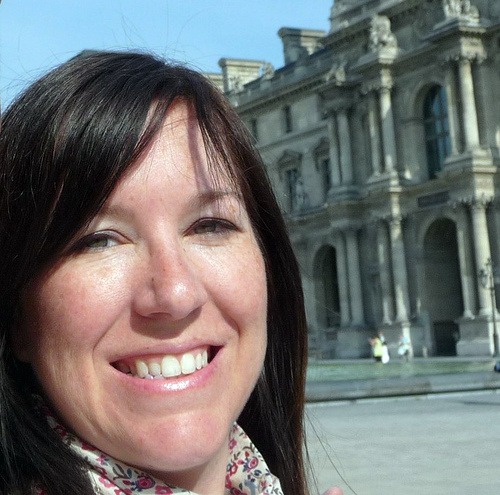
img: Jennifer Greco in Paris, in front of the Louvre (April 2010).

STAY TUNED for tomorrow’s installment from our displaced fictional heroine, Libby, who is taking last week’s advice from Maggie to heart and discovering that Woodhaven is her oyster. (A good thing she’s not allergic to shellfish like her husband, Oliver!) What, not keeping up with Libby? Read the first three episodes of her expat adventures.

If you enjoyed this post, we invite you to register for The Displaced Dispatch, a round up of weekly posts from The Displaced Nation. Includes seasonal recipes and book giveaways. Register for The Displaced Dispatch by clicking here!

Related posts:

A Parisian lunch in Manhattan, à la displaced author Elizabeth Bard

I have a confession to make. I have a bit of fluff on the side. I’ve had it for many years now — and the flame of my passion never diminishes. The love burns in my soul, aches in my flesh, and ignites my nerves.

Why am I revealing this now, and in such a public way? As you may know, the Displaced Nation is dedicating many of its October posts to the joys of moving to France and learning French cooking.

I take this as a sign that the time has arrived for me to own up to my own rather torrid relationship with La Belle Cuisine Française — she of infinite variety, who makes hungry where she most satisfies.

Admittedly, I do feel a little guilty talking so openly about our affair while my husband, who is Japanese, is away on a business trip. (Because I’m so practiced at hiding it, I think he assumes that, like him, I would always choose Asian food over Western, Italian over French.)

But there you have it, my little secret. And now that it’s out in the open, allow me to report on my most recent tryst — a Parisian lunch I hosted in Manhattan yesterday using the recipes of Elizabeth Bard, who will be featured on this blog next week. A former New Yorker who now lives in Provence with her French husband, Bard is the author of Lunch in Paris: A Love Story, with Recipes.

Friday, Oct 7 — plotting my assignation

I download Bard’s book to my Kindle and retreat to bed — mais oui! — for a read.

I am instantly enchanted. Bard is a woman after my own heart: she went to Europe to study and then fell head over heels for the culture, a man, the food…

I’m having a hard time choosing among Bard’s recipes, though.

The guest list is easy: my sister (who will go into the hospital on Wednesday for an operation, after which she won’t be able to enjoy food for a while) and two foodie friends, a couple, with whom I’ve collaborated on some lovely meals.

Except this time I’ll be going solo, especially as my husband is away (though maybe that’s just as well as he tends to dismiss French food out of hand, and therefore out of kitchen, for being too rich and creamy).

Actually, it’s the main course I’m dithering about — not the starter or the dessert.

I know I want to do mussels for the opening course as that’s one of my sister’s favorites, and Bard has a classic recipe for Mussels with White Wine and Fennel (and fennel is now in season).

I see that on her Web site, Bard has a recipe for Spicy Chocolate Pots with Fresh Figs — and quickly decide to make that my dessert. Like most sane people, I consider chocolate (along with champagne and oysters) to be the perfect food for revving up the libido.

And figs — Bard says that every autumn, around this time, she stages her own mini Figapalooza. I like the sound of that orgy. The more I think about it, the more convinced I become that the Bible got it wrong: Eve must have seduced Adam with a fig, not an apple. Didn’t he cover himself up with a fig leaf afterwards?

Speaking of apples, the recipe of Bard’s I’m most attracted to for the main course is her Pork Tenderloin with Four Kinds of Apples. The only thing holding me back is that my sister has a pet pig. For a moment, I imagine being able to persuade her to partake of this forbidden meat. “Oh, go on, just one little taste…” But then I realize how offended I’d be, as a dog owner and lover, if I were invited to lunch at a Korean household and they were serving dog.

No, not a good idea. So I opt for Bard’s Pasta with Fresh Peas, Arugula, and Goat Cheese for my main. To be honest, I feel a little sheepish about it. Surely my infatuation with La Belle Cuisine should drive me to my boldest feats of exploration and invention?

But then I remember Bard’s story about her husband-to-be inviting her to lunch at a Parisian restaurant that specializes in du porc noir de Bigorre. She refuses to indulge, even (especially?) when the waitress tells her he’s a happy pig, ordering the cassoulet instead.

Pasta it is, even though the only thing French about it involves topping the pasta with extravagantly big gobs of goat cheese.

Saturday, Oct 8 — shopping for just the right ingredients

I head to the green market in Union Square very early, my two dogs in tow. Just before I reach the Patches of Star Dairy stand, which sells fresh goat cheeses and goat cheese ice cream, one of them, my cocker spaniel, scavenges a brussels sprout and someone asks me if he is a vegetarian. (I wonder if his English springer spaniel heritage is kicking in, and he’s registering his disapproval of my love affair with France?)

Other green market finds include freshly picked arugula (also for the pasta), onions and fennel (for the mussels), and heavy cream (for the dessert).

I see some blue salvia at the flower stall that remind me of postcards I’ve seen of Provence, and appropriate these for the table decor.

I still need to get peas (they aren’t in season), so leave the dogs at home and go out again. Bard makes a curious observation at the start of her pasta recipe:

Five years ago, if someone told me I would take this much satisfaction in shelling my own peas, I would have laughed out loud. How times have changed.

I guess I’m not quite there yet (or perhaps I was there when I was younger — am I getting too old for these affairs?), as I find myself heading to the Trader Joe’s on 14th Street for a bag of freshly shelled English peas (yes, English — apparently there are limits to my love).

Actually, waiting on the line at Trader Joe’s on a Saturday is almost as tedious as shelling peas, and I almost laugh out loud — but then console myself by noting that I’ve also managed to score the bow tie pasta. It’s not whole wheat, though, as Bard recommends. I’m not sure if I’ve ever seen whole wheat farfalle, TBH. (I wonder where Bard gets hers?)

It still remains to get fresh pesto (from the Italian specialty store on E 11th St), Green & Black’s 70% organic chocolate and ras el hanout for the dessert. I find both of these items at the Indian grocery around the corner from Little India. The ras el hanout is labeled “couscous spice” and smells appropriately exotic.

I stay up late infusing the ras el hanout in the heavy cream and melting the chocolate in that mixture for the dessert. Heaven!

Sunday, Oct 9 (morning) — final mad preparations

Another early start. I swing by the East Village Cheese store for a fresh whole wheat baguette, and then it’s off to the green market at Tompkins Square Park, to buy fresh mussels at the fishmonger’s.

There’s a spring in my step as I approach his stall. I am a woman in love, a woman possessed. Little do I know that disaster is about to strike — he had only a small supply of mussels and sold them all first thing.

Aïe. I stumble away from his stall trying to hide my tears. But then, American ingenuity kicks in: why don’t I try using Bard’s recipe but for little neck clams, which are in large supply? I go back and discuss with the fishmonger, who’s a friendly sort, très sympathique. He ends up giving me 40 clams for the price of three dozen.

But I’m not out of the woods yet. I have forgotten the figs — those delectable little fruits that ooze with flesh and seeds when you cut them open. Despite trying three grocery stores, I can’t find a single fig in the East Village — and this is fig season. Go figure!

On this ingredient, I cannot compromise. I text my foodie friends who are coming to the lunch (they live in the West Village) and ask them to scour the shops for the fleshiest, freshest figs they can find. They come through for me, confirming my long-held belief that West Village is the city’s epicurean center.

Sunday Oct 9 (1 p.m. onwards) — ah, quel plaisir!

My sister and friends arrive, the wine (initially the Muscadet I’m cooking the clams in) flows, and conversation does as well, ranging from tales of our misspent youths to the Wall Street protests.

I produce the first course, and it’s judged a big success. Does anyone mind that it’s clams and not mussels, I ask? All agree that it’s the broth that counts — and the broth, a mix of fennel, onions, garlic and white wine, is divine.

Despite being a little tipsy on the wine — we have now progressed to a bottle of red from the family domaine of Robert Sérol, au cœur de la Côte Roannaise — I manage to make the bow tie pasta al dente. I stir in the peas and the pesto, divide among four plates and then dollop on the lightly salted chevre. My guests and I gorge ourselves on this latest creation, exclaiming as several nuances emerge and caress our taste-buds — oh là là!

I suggest that we take a short break before the dessert. My cocker spaniel is nipping at my pant legs — signaling that it’s time for the guests to go home as he needs my full attention (and some treat toys with the leftovers).

But my other dog, who is mostly poodle, is having the time of her life (bien sûr), making several rounds with the guests for extended petting sessions.

Enfin, it’s back to the table for my chocolate dessert, which, I’m sorry to say, falls a little flat because — absolument incroyable! — it’s too chocolatey. Is that our fault (we don’t know chocolate from chocolate) or could the recipe use some sugar?

But the purplish-brown figs, which are ripe and ever-so-sweet, save the day.

Over little cups of coffee we all agree that my Parisian lunch at the hands of Elizabeth Bard has been an affair to remember.

Monday, Oct 10 — the morning after

My husband calls in the wee hours of the morning. He is now in Tokyo, with another week to go on his business trip.

“How was your Sunday?” he asks.

“Well, I had some my sister and some friends over for a little lunch,” I reply, thinking to myself: what he doesn’t know won’t hurt him.

I go back to bed and awaken several hours later, at around 8:00 a.m. I lie there for a few minutes, basking in the afterglow of yesterday’s tryst.

When I at last rouse myself and face the mounds of dishes still to be done, I realize that this little flirtation of mine has its costs (not to mention my exhaustion at having to clean the apartment).

At least the hole in my pocketbook isn’t too bad. I reckon this particular fling has cost me around $80, including the wine — not bad considering what it would cost for four people to go out for a proper French lunch in Manhattan.

Hmmm… I wonder if I can fit in one more quickie meal before my husband gets home on Friday?

As Mario Cuomo, former New York State governor and father of our current governor, once said:

When you’ve parked the second car in the garage, and installed the hot tub, and skied in Colorado, and wind-surfed in the Caribbean, when you’ve had your first love affair and your second and your third, the question will remain, where does the dream end for me?

Touché — only I don’t think he’s ever been seduced by French cuisine à la Elizabeth Bard?

Images (top to bottom): Friendly fishmonger at Tompkins Square Park; little neck clams in fennel; an enthusiastic canine participant; chocolate pot with figs.

STAY TUNED for Tuesday’s post on classic displaced writing.

If you enjoyed this post, we invite you to subscribe for email delivery of The Displaced Dispatch, a round up of the week’s posts from The Displaced Nation, including seasonal recipes and book giveaways. Sign up for The Displaced Dispatch by clicking here!

Related posts:
RANDOM NOMAD: Mardi Michels, Elementary School French Teacher, Home Cook, Writer, Photographer & Traveler

Born in: Adelaide, South Australia
Passports: Australia (by birth), Britain/EU (through my dad), Canada (I became a citizen in 2007)
Countries lived in: France (Paris): 1995-2000; Canada (Toronto): 2000-present
Cyberspace coordinates: eat. live. travel. write | my creative refuge from academia (blog); eatlivtravwrite (Twitter handle)

What made you leave your homeland in the first place?
I left Australia because I was working on my PhD in French literature and felt it made a lot more sense to be in the country of the language and culture I was studying. Soon after moving to Paris, I began working in a restaurant (Woolloomooloo Restaurant Australien — now closed) to supplement a meagre scholarship. About a year after moving to Paris, I got a job teaching English at Université Paris X and I was hooked on teaching English (I was already qualified to teach French) so I undertook my Dip TEFL [professional diploma in Teaching English as a Foreign Language] at the University of London Institute in Paris, eventually scoring a full time teaching job at the British Council. My PhD? Incomplete…

Is anyone else in your immediate family “displaced”?
My sister also left home when she was in her early 20s to complete a PhD at Oxford (which she did), and from there she worked in banking all over the world (England, Singapore, Japan). She has also traveled extensively in South America. She, too, has ended up in North America (New York City), teaching math!

How about your husband? Is he displaced?
He was when we first met — in Casablanca in December 1999. I was on a vacation in Morocco, and after that two-week jaunt, Mr Neil followed me back to Paris for a visit. He is the reason I am now in Canada. Six months after he visited me in Paris, I had a job teaching in French in Toronto lined up for the 2000-01 school year — and the rest, as they say is history. Neil is originally from Vancouver but has traveled the seven continents to some “out there” places. I mean, how many people do you know who have been to Easter Island?

Describe the moment when you felt most displaced.
The first time I had to do lunchtime outdoor yard duty the first year I was living in Toronto. I was ill equipped for the cold, wearing leather boots and a wool coat that was more than adequate in Paris. Not so much here. It was five years before I succumbed to the puffy coat and winter boots.

Describe the moment when you felt least displaced.
Honestly? Stepping off the plane this past summer when I arrived in Paris. I try to get back there every year or so (I completed my MA in Second and Foreign Language Teaching a few years ago, requiring me to take courses two summers in a row in Paris). Even though I have lived longer in Toronto now than I did in Paris (and I love my life in Toronto), and I don’t have any family there, Paris is still a place where I feel curiously “at home.”

You may bring one curiosity you’ve collected from each of your adopted countries into the Displaced Nation. What’s in your suitcase?
I’m thinking cookware from Mora (a treasure trove of ring molds, tart pans and other French pastry equipment) or A Simon (good selection of glassware and heavy-duty white French porcelain) — both on rue Montmartre; or else baking ingredients from G Detou, one of the world’s great food shops, in Les Halles.

You’re invited to prepare one meal based on your travels for other Displaced Nation members. What’s on the menu?
The meal I would prepare for you would include a dish inspired by each continent. My husband and I have visited all seven continents, and we actually hosted this luxury dinner last year, as documented on my blog:

  • Moroccan spiced chick peas
  • Vietnamese caramelized chili prawns
  • Italian polpette d’uova
  • Australian micro meat pies
  • Mexican tortilla chicken soup
  • Cuban ropa vieja
  • Panamanian (coconut) rice with pigeon peas
  • Jamaican jerk chicken
  • Île flottante

You may add one word or expression from the country you’re living in to The Displaced Nation argot. What will you loan us?
I couldn’t pick one specific one but some words that have crept into my vocabulary (and that of my students’) include hop là, aïeoh là là, et hop, and ouf — words that sound ridiculous removed from the context of everyday French vocabulary but that have turned out to be very useful in the context of my classroom 😉 Surely The Displaced Nation could use a few more interjections?

It’s French Cuisine month at The Displaced Nation. Who is your favorite French chef, living or dead, and why?
Whilst she is not French, it has to be Julia Child, mainly for her “can-do” attitude.

Julia Child is the role model for our posts this month — and has just now been inducted into our Displaced Hall of Fame. Of the following three quotes by her, which one do you most identify with?

1) The only time to eat diet food is when you’re waiting for the steak to cook.

2) The only real stumbling block is fear of failure. In cooking, you’ve got to have a what-the-hell attitude.

3) Until I discovered cooking, I was never really interested in anything.

I have to say the quote I most identify with is “The only real stumbling block is fear of failure. In cooking, you’ve got to have a what-the-hell attitude.”

I teach a once a week cooking class to nine-to-eleven-year-old boys, called Les Petits Chefs; and though my students are pretty young and cannot be expected to know a lot about cooking (yet!), I found myself thinking of them as I read this quote. What continues to amaze me about my group of little chefs is their willingness to try new things and their (mostly) complete lack of fear about being in the kitchen (well, science lab, in our case!). Yesterday, for example, I had five little boys cutting up raw chicken (thighs, no less, so much messier than neat clean breast meat), and I watched them attack the task with great gusto. No fear (though a few “ewws!”) — they just got on and did the job, trusting me that the icky meat would be turned into something delicious in about 30 minutes (it was!).

Readers — yay or nay for letting Mardi Michels into The Displaced Nation? Tell us your reasons. (Note: It’s fine to vote “nay” as long as you couch your reasoning in terms we all — including Mardi — find amusing.)

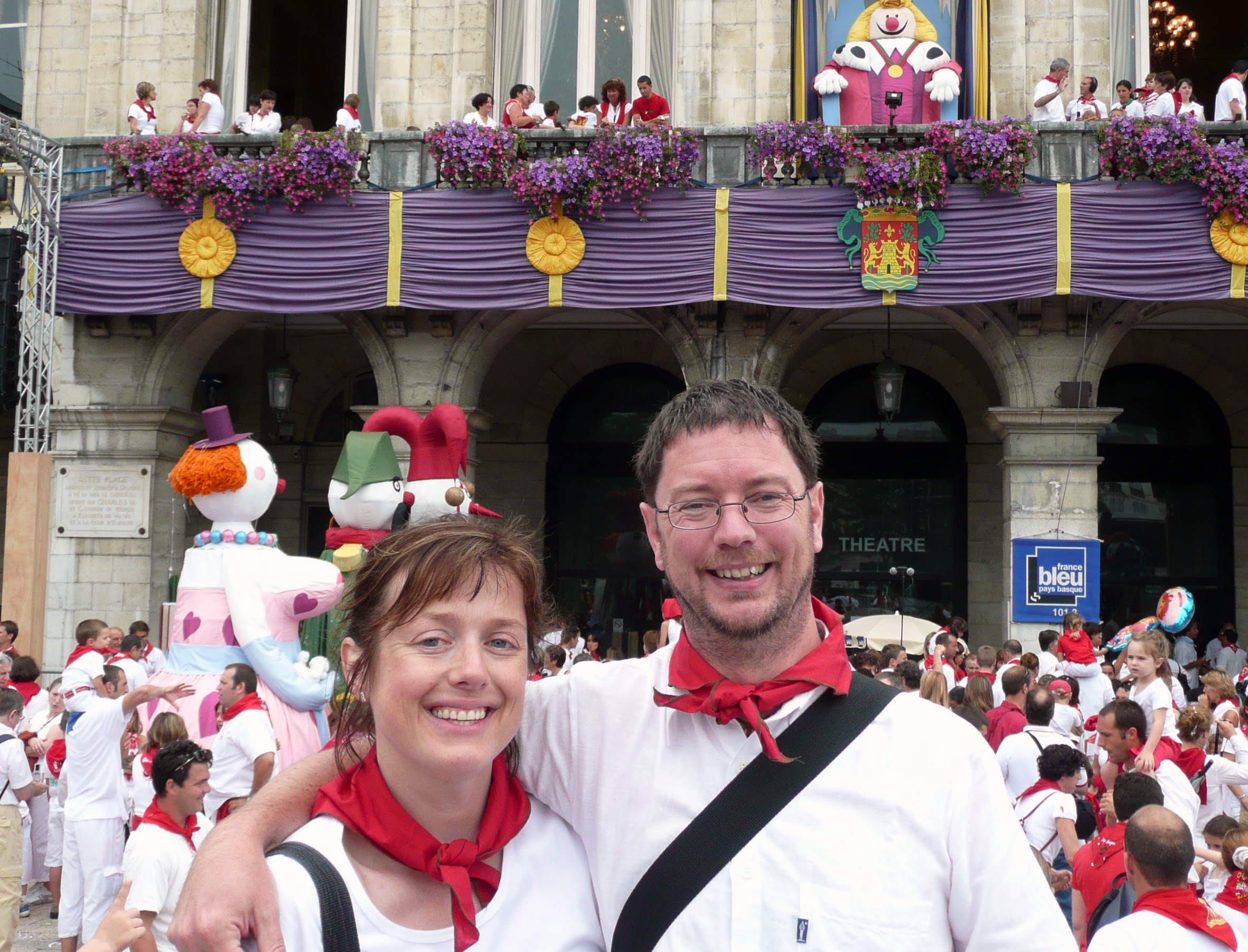
img: Mardi Michels and her mari, Mr Neil, at the Fêtes de Bayonne (2008).

STAY TUNED for tomorrow’s installment from our displaced fictional heroine, Libby, who seeks advice on her unexpected second pregnancy from someone who is older…if not altogether wiser. What, not keeping up with Libby? Read the first three episodes of her expat adventures.

If you enjoyed this post, we invite you to register for The Displaced Dispatch, a round up of weekly posts from The Displaced Nation. Includes seasonal recipes and book giveaways. Register for The Displaced Dispatch by clicking here!

Related posts:
When a Julia Child-like curiosity about French cuisine leads to a displaced life — bienvenue au October theme

The first time I was introduced to the Slow Food movement was in the land of its birth, Italy. My husband and I were in Florence for the wedding of his niece, and we ended up befriending and dining out with a couple of the other guests: a Chinese-American brother and sister from California who were serious gourmets and would only go to Slow-Food restaurants.

Ever since then, I’ve been puzzled.

Not by the concept of Slow Food itself. I get the idea of savoring a meal that is cooked from fresh, locally-sourced ingredients and that has not been prepared in advance — we’re talking the anti-Fast Food.

What’s more, I had enormous fun in Florence peering at all the restaurant doorways to see if they had a snail symbol. “No snail? Well then we’re not eating there,” I would declare to my husband.

No, what I find confounding is that the movement started in Italy, not in France.

For me, Italian food, with its pizzas, anti-pastas and gelatos, comes fairly close to being the fast food of Europe.

That could never be true, of course, of French cooking. (And what better symbol of French cooking than a snail, btw?)

I feel certain Julia Child would agree with me. An expat in Paris for many years, Julia belongs in the Displaced Nation’s Hall of Fame because of her refusal to be satisfied with her native country’s Anglo-derived plain food consisting of meat and potatoes and two veggies — let alone the fast-food version: meat (as it were), bun, French (quel insult!) fries, no veg.

Addressing just one of these nefarious ingredients, Julia once said:

How can a nation be called great if its bread tastes like Kleenex?

For Julia, France was a spiritual as well as culinary homeland. As she wrote in her memoir, My Life in France:

I fell in love with French food — the tastes, the processes, the history, the endless variations, the rigorous discipline, the creativity, the wonderful people, the equipment, the rituals.

A date with destiny

Julia’s first forays into foreign cuisine occurred when she worked for the Office of Strategic Services (the precursor to the CIA) during World War II.

She was posted first to Kandy, Ceylon (now Sri Lanka), and then to Kunming, China. Along the way, she met, and fell in love with, Paul Child, an early example of a foodie. At Paul’s initiative, they entertained themselves by exploring Ceylonese and Chinese cuisine and culture.

The pair married the year after the war ended, and Paul went to work for the American Embassy in Paris — a move that proved fortuitous in the extreme for his wife’s career.

For their first meal on French soil, Paul ordered sole meunière. For Julia, it was an epiphany — “the most exciting meal of my life.” The scales fell not just from the fish but from her eyes. She could see what American WASPs like herself were missing out on: sauces made with fresh herbs, butter, wine, and so forth.

The rest is history.

Bon appétit — say what?

Well, not quite. To be honest, I don’t think Julia’s approach to French cooking ever really took hold here in the U.S. We pretended that it did because we loved Julia so much. We loved her for her jolly-jape sense of humor and melodious voice.

But half the time, we didn’t understand what she was wittering on about.

Now, Julia knew that her fellow citizens were mostly flimsies (her word for people who aren’t serious about food). But she thought that the key to converting us was to provide a step-by-step outline of the centuries-old techniques that the French learn like a language: how to make foundation sauces, how to do a roux, how to lay in flavor, how to be patient.

The blogger Julie Powell tried to cook all 524 recipes in Child’s encyclopedic Mastering the Art of French Cooking, in a single year. Some say it was a gimmick, but I say, hey, she deserves the fame — including the honor of having Amy Adams play her in the ensuing Nora Ephron film, Julie & Julia.

‘Fess up: when was the last time you cracked open Julia Child’s magnum opus and gave her recipes a try?

Food writer Regina Schrambling wrote in a post for Slate just after the film’s release, analyzing the problem:

Consider the boeuf bourguignon depicted so romantically in the movie… The ingredients and instructions for its recipe span three pages, and that is before you hit the fine print: The beef stock, braised pearl onions, and sautéed mushrooms all require separate procedures. Step 1 involves making lardons and simmering them for 10 minutes in a precise amount of water; seven steps later, the fat is finally skimmed off the sauce, which is either boiled down to thicken or adjusted with liquid if it’s too thick.

And this is considered an entry-level recipe….Even simple sautéed veal scallops with mushrooms involve 18 ingredients and implements and two pages of instruction.

TDN’s October theme

Still, if expat blogs are anything to go by, a Julia Child-like curiosity with France and French cuisine has continued unabated since Julia’s own time. There is no shortage of Americans (also some Canadians and South Americans) who have relocated to France and intend to stay for as long as it takes to learn the art of French cooking at some level.

Partly out of curiosity, partly out of jealousy, The Displaced Nation will peer into the lives — and kitchens — of several of these expats during October.

What is it actually like to make the Ultimate Slow Food your focus? It any less daunting because of living in France and adopting the French lifestyle? And like Displaced Hall of Famer Julia Child, do today’s expats have (or hope to have) a spoon in the soup back here: are they planning to stir things up and convert us?

Readers, do you have any questions you’d like us to explore on this theme? Vas-y! Let us know!

If you enjoyed this post, we invite you to subscribe to The Displaced Dispatch, a weekly round up of posts from The Displaced Nation, plus some extras such as seasonal recipes and occasional book giveaways. Sign up for The Displaced Dispatch by clicking here!

Image: MorgueFile

The light-hearted answer to Robert Pirsig — travel author Allie Sommerville

I know what you’re thinking. They can’t seriously be planning to feature Allie Sommerville in a month where they’re celebrating the joys of the open road?

For those who haven’t heard the news yet, Sommerville is the author of Uneasy Rider: Confessions of a Reluctant Traveller, and we’re doing an interview with her today, as well as an e-book giveaway (for DISPLACED DISPATCH subscribers only — sign up NOW!).

But before we proceed, allow me to say a few words in Sommerville’s — and our — defense.

As much as Sommerville may moan about her travel misadventures, as one of her Amazon reviewers puts it: “Methinks she doth protest too much.”

I would concur. In my own interactions with Sommerville, I’ve come to think of her as a gentler, more light-hearted version of Robert Pirsig, who penned the brilliant, if opaque, Zen and the Art of Motorcycle Maintenance, on which we’ve based many of our posts this month.

The two have much more in common than it may at first seem. Like Pirsig, Sommerville has faced the reality of sustained travel on the open road and the many challenges it entails — particularly if your vehicle of choice is a motorcycle or campervan.

Also like him, she has concluded that for a road trip to be a success, you must have a yin and a yang.

The main difference is that for Sommerville, these concepts are physical, not metaphysical — as in two people, herself and her Other Half, Harry.

She is the yin — the dancer, the poet, the writer — to poor Harry’s yang. He is the driver of the couple’s broken down but beloved RV, in charge of all repairs. And when things go awry, as they very often do, Sommerville injects a philosophical sense of humor for some perspective on the situation — a technique on a par with Pirsig’s philosophical musings.

Take, for instance, the very first road trip the couple made in this rickety vehicle, to Spain — all because Sommerville had developed an obsession with British poet Laurie Lee‘s memoir about tramping through Spain.

So far so predictable: Sommerville as driving force behind the adventure, her Other Half as driver. But then what happens when the campervan proves too wide for a Spanish street? He sweats it while she searches for an entertaining story in their predicament:

There was no room for manoeuvre. … With both sides of the van threatening to add a new dimension to the walls of the houses, it was nigh on impossible for either of us even to climb out…

By now we were becoming aware that we’d attracted the interest of several ancient and well-oiled patrons of a bar just up ahead, and our little drama turned into a full-scale pantomime as they began gesticulating and beckoning us on.

“Sí! Sí!…Se puede!” they exclaimed excitedly and at the same time doing what could only be described as some sort of grotesque ritual dance.

This was a good time to remember the meaning of those words in my favourite scene from the language video.

Se puede! They seem to think we can do it!” I translated helpfully.

So, without further ado, I give you the light-hearted Robert Pirsig: Allie Sommerville.

Tell me a little more about your background.
I was born in Croydon, which was in the county of Surrey at the time — now though, notoriously part of Greater London — and my husband is from London. After setting up home in Croydon for a few years, we moved to the Isle of Wight in 1976 to build our own house and give our two young children a better area to grow up in.

We are both, even after all this time, what Islanders call “overners” (an abbreviated form of “overlanders”). Only people actually born here qualify as “caulkheads.”

Uneasy Rider, which was published in 2009, was my first book. I’ve just published my second, a memoir about my childhood, on Kindle. It’s called To set my feet a-dancing and takes a light-hearted look at a time when children were allowed play in the park until dark, clothes were home made and owning a car meant you were rich. I draw a lot upon my time as a young amateur dancer, telling about my appearances with my older sister in shows arranged by our rather eccentric dancing teacher. I also look at schooldays, Christmases past and seaside holidays in an age of innocence.

I began this project after researching my family history for many years. It occurred to me that our children have no idea about how my generation lived as children in late 1950s England. Life has changed beyond anything we could imagine.

I conclude the book with the life stories of my grandparents and their predecessors — things I have gleaned from censuses, birth and marriage certificates, old photographs and conversations with my late mother. These are the lives of ordinary families: people whose lives are not in the history books.

I’m also in the process of writing about a trip my husband and I made around mainland Great Britain in the same old camper van, from the South (i.e., Isle of Wight) to the North (i.e., Scotland). The provisional title is: Miss Potter and the Mathematicians Rabbit — Allie Goes Oop North. The main title is taken from an experience we had in the Lake District.

Moving on to Uneasy Rider: How many road trips have you and your husband made together over the years?
We made six road trips in the converted Leyland Daf campervan of the book, from 1999 to 2004, though our very first trip in a motor caravan was in 1991, with our two teenagers on board.

Do you ever travel by other means?
Of course! We’ve traveled many times by car in France and Switzerland, staying in gîtes, chalets and apartments. My favorite “trip” of all though was on the Cunarder, Queen Mary 2, to New York. Much nicer than “roughing it” in a camper van! I absolutely loved New York and the glamour of the six-day Atlantic crossing, despite sailing through a force 11 gale.

So what made you decide to write a book about your campervan excursions?
During our trips, we had so many events that each time I said, “There’s a book in this!” Before we took off on our first trip (to Spain), I hadn’t found any similar book on the subject of campervanning or caravanning, apart from site-finder guides; it seemed there was a gap in the market.

Whom did you see as the primary audience?
I had in mind other campervanners who would identify with the joys, trials and tribulations of this type of independent travel. I didn’t want it to be one of those “everything is fantastic about travel” books. I hope I tell it like it REALLY is — the ups and downs, the good and the bad. Some campervan “purists” don’t appreciate hearing about the downside of their preferred method of holidaying though. They appear to have gotten together to leave negative reviews on Amazon. But I’m not too sure, by some of the comments, that they’ve actually read it…

Bill Bryson is the master of modern travel writing as far as I’m concerned, and it’s his light-hearted touch that I hope in some way to emulate. A tough act to follow!

Many people take road trips when they are young, to find out more about life and themselves. Does the purpose change once you become middle aged?
Middle aged? I still feel about 17!

As you’ve already mentioned, the purpose of our first trip (to Spain) was to follow in the footsteps of my literary hero, Laurie Lee. In As I Walked Out One Midsummer Morning, he tells of his walk across Spain on the cusp of the Civil War in the early 1930s. This book, for some reason, holds a big fascination for me.

That trip was meant to be a one-off. But afterwards we weren’t able to sell the van, so instead of letting it sit in the drive, I seized the opportunity to see as much of the art and architecture of Italy and France as I could. I suppose you could say my purpose was educational!

Which was your favorite place of all those you visited?
Florence has it all. I could never tire of it. We visited this amazing city three times. I was studying Art History at the time, specialist subject “The Early Renaissance.” The Italian people are fantastic, too!

Which was your least favorite?
Spain, especially the Costas (various coastlines), which were full of half-finished blocks of flats. Whether we were unlucky I don’t know, but it was not a friendly country — apart from a few honorable exceptions which I mention in the book: the helpful policeman in Seville who strode into and held up four lanes of speeding traffic for us, the patient shop assistant in the flamenco boutique. I have the feeling that relatively recent history may have altered the Spanish character: George Orwell in Homage to Catalonia found the Spanish people cheerful and friendly.

Robert Pirsig says “It’s a little better to travel than to arrive.” I’m guessing you might not agree with him?
Err…not really. Like Dorothy, my mantra is: there’s no place like home! Having the campervan, however, was almost like taking your home round with you. My best moments during these trips were when we found pleasant campsites to put down temporary roots.

Pirsig claimed there are two types of people: “classical” — practical, DIY fixers, boy-scout prepared types; and “romantic” — those who thrive on surface appearances, don’t want to get involved with the nitty-gritty, and thrive on gestalts.
As you noted in your introduction, I’m definitely “romantic,” and my husband is certainly “classical” — which probably explains why we work as a couple. He drives and sorts out problems, I look forward to seeing the Da Vincis.

Each chapter of your book is a stand-alone story, describing a particular incident. Do you have a favorite?
“The Parable of the Parador” is my stand-out favorite. As I said, it is typical that I get these romantic ideas — and my other half goes along with them, most of the time. That particular chapter though, sees a bit of role reversal, when we get “stuck” on the road into Arcos de la Frontera, to reach the parador (state-run hotel). For once he thinks it’s all hopeless, and I have to be the optimist. When he feels like this about a situation, I know we are REALLY in trouble.

Pirsig advocates traveling on a motorcycle because it puts you there, in the moment, without the barrier of a windscreen. What do you think of his philosophy?
To travel on a motorbike would be my nightmare! I just would feel too exposed. I like to be safe — hence the theme of Uneasy Rider.

Many of the Displaced Nation’s readers are expats. Can you imagine living anywhere besides the Isle of Wight?
We’ve often thought we should have relocated to France some years ago. I’d love to live in a place where you can walk to a baker’s every day for fresh baguettes and croissants. Now, the only place I’d move to is Central London: the London National Gallery and Covent Garden Royal Opera House are big draws.

How well do you fit back into the Isle of Wight after your journeys? Do you suffer from any counter culture shock?
The flippant answer is that being a “townie,” I suffer counter culture shock on the Island every day anyway… even after all this time. However, the main feeling after being in the ‘van for four weeks, though, was that our house did seem HUGE for the first few days .

So what’s next for your travels?
Next year I am fulfilling my long-time ambition of visiting St. Petersburg — on a cruise ship rather than by road. Russia and especially its Tsarist past, fascinates me. Hopefully there will be a book in this, though for all the right reasons!

Readers, do you have any questions for the Amazing Allie? Ask away, before she takes off again!

Images: Allie Sommerville’s author photo and book cover.

STAY TUNED for tomorrow’s installment from our displaced fictional heroine, Libby, as she prepares to welcome the pitter-patter of little feet. Clawed, furry feet, that is: Fergus is now a canine expat! What, not keeping up with Libby? Read the first three episodes of her expat adventures.

If you enjoyed this post, we invite you to subscribe to The Displaced Dispatch, a weekly round up of posts from The Displaced Nation, plus some extras such as seasonal recipes and occasional book giveaways. Sign up for The Displaced Dispatch by clicking here!

Related posts:

RANDOM NOMAD: Kirsty Rice, Freelance Writer & Blogger

Born in: Renmark*, South Australia
Passport: Australia (no one else will have me!)
Countries lived in: Australia (Adelaide & Perth): 1997-98; Indonesia (Jakarta): 1999 – 2001; Malaysia (Kuala Lumpur): 2001-02; Libya (Tripoli): 2002-04; Canada (Calgary): 2004-08; USA (Houston): 2008-09; Qatar (Doha): 2010-present.
Cyberspace coordinates: 4 kids, 20 suitcases and a beagle (blog)
*A small town of 7,500; my parents still live there.

What made you leave your homeland in the first place?
I am married to a former expat child. I know the term is Third Culture Kid, but I don’t really think it applies to him. He was always keen on doing the “expat” thing. I, on the other hand, was raised in the same town that I was born in and wasn’t a great lover of change. Our first move was the result of a promotion for my husband and the fact that I was pregnant with our first child. The plan was to do a two-year posting in Indonesia and to return “home”. That was 7 countries and 12 years ago. I now thrive on change.

So your husband was already “displaced”?
My husband’s parents were expats. He was actually born in New Zealand and then they went to the Philippines for many years before moving to Sydney, then Melbourne, and finally to Brisbane.

How about your kids?
My children were all born in different countries. We were living in Jakarta when I had my first child, my second was born in KL, the third in Malta and the fourth in Canada. Although none of them have lived permanently in Australia (our longest stint has been during school holidays, so a maximum of 12 weeks), they all think of themselves as Australian. My husband and I have both worked hard for that to be the case.

Describe the moment when you felt most displaced.
When we first moved to Tripoli — it was the middle of summer and I had a two-week-old baby and a two-year-old. We then had to endure months of housing hell — we couldn’t find one! For a while, I shared a “guest house” with about sixty men who were rotating in and out of the desert: there were no other women. Breast feeding amongst men who hadn’t seen a woman for a couple of months was a rather unique experience. Due to the weather, fruit and vegetables were limited and small in size. I can remember standing in a fruit and vegetable stand with a screaming baby and a restless toddler wondering how I was going to cook carrots the size of my little finger. I was continually getting lost, and the simplest of tasks seemed very overwhelming. There were many days that I considered getting on a plane — but I’m so pleased I didn’t. Three months later, we had a house, the weather was better, I made friends, and I loved our life in Libya. I was devastated to leave.

Describe the moment when you felt least displaced.
I feel like that here in Qatar. Our children are at a fabulous school, I have a place to write, and my husband works for a Qatari company and really enjoys it. There is so much here in the community for expats, and we are made to feel very welcome. I have made local friends and love heading to the local souqs. I feel that this is very much our second home. In other locations I have felt that we were passing through, but not here.

You may bring one curiosity you’ve collected from your adopted country into The Displaced Nation. What’s in your suitcase?
From Indonesia: A jamu (traditional medicine) woman made of silver, given to me by a very dear friend.
From Malaysia: The Selangor pewter tea set I was given as a gift. Each time I use it I think of my friends.
From Libya: A wedding blanket with traditional jewellery pinned to it, which was given as a farewell present. It is such a unique gift and always a talking point when people spot it in our house.
From Canada: Nothing material, just the memory of what it was like to be back to work full time. In Calgary, I returned to the “old” me, remembering who I was pre children and travel. That was Canada’s gift — along with a huge appreciation of weather!
From the U.S. (Houston): A fantastic painting of an American flag that I picked up in San Antonio. It’s 3D and not in the traditional colors. It reminds me that America is far more layered and multidimensional that what I’d given it credit for.

You’re invited to prepare one meal based on your travels for other Displaced Nation members. What’s on the menu?
We’ll have some kind of soup for starters: either Indonesian soto ayam (chicken soup), Libyan soup* (I love it!), or the Canadian version of Italian wedding soup. Though I come from an area in Australia that has a large Italian community, I’d never heard of Italian Wedding Soup — turns out it’s more of a North American thing.

For the mains, perhaps I’ll offer a choice between Malaysian curry or maybe a nasi goreng from Indonesia.

And for drinks, we’ll have margaritas. I learned to make a mean margarita in Houston.

For dessert, a caramel cheesecake — a recipe I picked up from a fellow Aussie in Houston.

You may add one word or expression from the country you’re living in to The Displaced Nation argot. What will you loan us?
From Indonesia: Satu lagi (one more) — I said that way to often!
From Malaysia: I just loved how you could put lah on the end of everything and automatically make a sentence sound friendlier.
From Tripoli: Shokran (thank you). It was the first Arabic word I learned and makes me think of how special the people in Libya are — so kind and helpful. Incidentally, in learning how to say “pregnancy test,” I discovered that hamil is the word for “pregnant” in Indonesia, Malaysia and Tripoli.
From Canada: Hey — kind of the same as lah in Malaysian.
From the U.S. (Houston): I found myself describing things differently. It wasn’t just “the big tree out the front” but “the big ‘ol tree out the front.”
From Qatar: Right now I’m back to learning Arabic (unsuccessfully). Oh how I wish I had a chip I could just insert into my brain to switch languages. Why haven’t they invented that yet?

It’s Zen and the Art of the Road Trip month at The Displaced Nation. Robert M. Pirsig, author of Zen and the Art of Motorcycle Maintenance, famously said: “Sometimes it’s a little better to travel than to arrive.” Do you agree?
I disagree. I like to arrive, settle and learn how a city/country works. You can learn so much about a place just by trying to get the telephone connected! Traveling through is just a brief picture. I love that we’ve been able to become part of a community everywhere we have lived.

Pirsig’s book details two types of personalities: 1) those who are interested mostly in gestalts so focus on being in the moment, not rational analysis; and 2) those who seek to know the details, understand the inner workings, and master the mechanics. Which type are you?
If you read my blog you’ll see there is usually a romantic viewpoint or flowery end to a posting. I’m a big believer in things happening for a reason and not always being logical. Having said that, I am a stickler for details, I hate to enter into things blindly and have to know exactly what the story is. Which personality am I in my expat life? I’m a bit of both. I don’t believe that anyone can be a successful expat without having the flexibility to change with the situation. In our daily lives as expats we need to quickly learn the rules, find out the details, go with the flow and just enjoy the ride. You have to be both.

* Libyan soup is a tomato-based soup. There are many variations. The one I loved was with lamb.

Ingredients:
1/2 to 1/3 lb. lamb meat cut into small pieces
1/4 cup oil or “samn” (vegetable ghee)
one large onion
1 tablespoon tomato paste
2-3 tomatoes
1 lemon
1/2 cup orzo, salt, red pepper, Libyan spices (Hararat) or cinnamon

Directions:
Sauté the onion with meat in oil.
Add parsley and sauté until meet is brown.
Add chopped tomatoes, tomato paste, salt, spices, and stir while sizzling.
Add enough water to cover meat, simmer on medium heat until meat is cooked.
Add more water if needed, and bring to a boil.
Add orzo, simmer until cooked.
Before serving, sprinkle crushed dried mint leaves, and squeeze fresh lemon juice to taste.

Readers — yay or nay for letting Kirsty Rice into The Displaced Nation? Tell us your reasons. (Note: It’s fine to vote “nay” as long as you couch your reasoning in terms we all — including Kirsty — find amusing.)

img: Kirsty Rice with her family (sans the beagle) at Souq Waqif, Doha, Qatar.

STAY TUNED for tomorrow’s installment from our displaced fictional heroine, Libby, whose rather dramatic road-trip adventure has come to an end. Time to face reality again in Woodhaven! What, not keeping up with Libby? Read the first three episodes of her expat adventures.

If you enjoyed this post, we invite you to register for The Displaced Dispatch, a round up of weekly posts from The Displaced Nation. Includes seasonal recipes and book giveaways. Register for The Displaced Dispatch by clicking here!

Related posts: