The Displaced Nation

A home for international creatives

Tag Archives: It’s Food!

GLOBAL FOOD GOSSIP: How (not) to feed a convalescent expat

JoannaJoanna Masters-Maggs, our resident Food Gossip, is back with her column for like-minded food gossips.

This month: The state of worldwide hospital food.

* * *

“The last thing you need on top of everything else when you are in hospital is red wee.”

So ended my husband’s texted tirade after a few days in an Abu Dhabi hospital following an emergency appendectomy which turned out to be less than straightforward.  The indignities, pain, and discomfort could be handled with fortitude, but the food had caused the British stiff upper lip some serious challenges.  Beetroot was served at every meal and in every conceivable form — none of which was remotely welcome to this convalescent.

Almost unbelievably, the day after my husband was admitted to a Middle Eastern hospital, my 9-year-old son was diagnosed with the same condition and admitted to Taunton Hospital, in Somerset, England, for the same operation.  Patrick took it all in his stride, only threatening mutiny when a disposable bottle, apparently made of the same recycled cardboard as egg cartons, was proffered in response to his request to go to the loo.  With furious determination he heaved himself upright  and made his way to the bathrooms, wheeling his drip ahead of him and making my heart swell with maternal pride.

Several hours later, when wrinkled potato wedges and bright orange fish fingers confronted him, Patrick’s attitude was rather different.  My husband’s texted complaint lacked the colour a human voice could give the words.  My son’s anguished “Why, why, why?” however, provided a glimpse of  The Husband’s state of mind when he composed his text.  The pitch of “Why can’t I just have a tuna sandwich?”  swung from already-stressed contralto to end-of-tether soprano.

KISS: Keep It Simple, Sandwich

This question is one I ask myself every time I face airline food.  Why not a sandwich? A simple sandwich is perfect food for those on the go; ask any hill-walker. It is easily transported and eaten and requires little in the way of tableware.  It certainly beats sub-standard wannabe home-cooking, or, more depressingly, wannabe gourmet cooking.  KLM used to do a nice sandwich on granary, a little oatcake and a good cup of tea or coffee on their London to Schiphol shuttle.  I have never enjoyed airborne eating as much.  Flights since, even champagne-soaked upgrades, have never hit the spot as well.

Hospitals, like airlines, are susceptible to the curse of being the girl who tries too hard at parties and embarrasses everyone, for different reasons of course.  Airlines because they feel they are part of the same package as the business trip or holiday and have to provide something special.  Hospitals, being in the health business. feel under pressure to produce something healthy and balanced.  Easy healthy and balanced is a lump of protein, a lump of carbohydrate and some boiled veg.  Each element can be whatever is readily to hand in the locale.  Obviously, beetroot is easy to come by in Abu Dhabi – who’d have thought?

A few years ago I found myself admitted with an unpleasant stomach bug to a hospital in Kuala Lumpur.  During my recovery, meal after meal was placed in front of me,  each consisting of overdone, indigestible chicken in glutinous sauce with rice and boiled vegetables. (Never talk to me again about English food.) Not appetizing at any time, but certainly not in the recovery period.  At the end of day two I was begging for cream crackers and jelly.  Even if I was unable to eat them, they were easier to tolerate the look of in the post-prandial two hours that the staff took to remove the debris.

The Victorians –now, they knew how to run a sickroom

When I’m sick I crave the ideal Victorian sickroom.  I want chicken soup, broth, and little crustless sandwiches cut into triangles.  I want food that makes me feel pampered and I want it in miniature form.  What I don’t want is big hunks of meat that I have to take a hacksaw to.  I don’t want to bother with a knife and fork.  I’d like little sips of water, or tea and maybe the odd ginger biscuit.  Some soft-boiled eggs and soldiers (fingers of toast) would be nice too.  In short, give me the whole Victorian sickroom vibe complete with flowery china and a little vase of flowers.  Do that and I’ll put on a white nighty, brush my hair and smarten up my convalescent act accordingly.

What explains this wanton disregard for dainty and light in preference for The Undigestibles? I suggest it is because hospitals the world over want us out, and want us out fast. In cash-strapped UK NHS land, beds are at a premium and waiting lists must be kept down.  Make things too comfortable and delicious and who knows how long malingering patients will stay?  I also imagine American insurance companies would like to minimize the number of nights their customers spend in hospitals which are often more costly than excellent hotels.

If you can’t keep it simple, keep it real

So, what’s my point talking about all this in our “displaced” world?  I suppose it is simple, really.  I want any experience that takes place outside of my own country to be distinctive and of that place.  If a hospital cannot, or will not, convert its menu into something I might find in Little Women, I want to lose my appetite for something distinctive.  If I have some indescribably unpleasant stomach complaint and find myself again in hospital in KL, I want to be unable to eat Malaysian food, truly Malaysian food.  If I’m not eating, give me beef rendang to reject and not boiled chicken breasts.  If I am in Rio, I want to lose my appetite for black beans and chiffonade of couve (actually, that will never happen) and if I ever end up in a  Abu Dhabi hospital, I want to reject grated raw beetroot.

You see, be it Victorian pampered convalescent on a chaise longue, or expat overseas, I yearn to feel special when I am sick.  Is that really too much to ask?

* * *

Joanna was displaced from her native England 16 years ago, and has since attempted to re-place herself and blend into the USA, Holland, Brazil, Malaysia, Venezuela, Saudi Arabia, and now France. She describes herself as a “food gossip”, saying: “I’ve always enjoyed cooking and trying out new recipes. Overseas, I am curious as to what people buy and from where. What is in the baskets of my fellow shoppers? What do they eat when they go home at night?”

Fellow Food Gossips, share your own stories with us!

Image:

STAY TUNED for tomorrow’s post!

If you enjoyed this post, we invite you to register for The Displaced Dispatch, a round up of weekly posts from The Displaced Nation, with seasonal recipes, book giveaways and other extras. Register for The Displaced Dispatch by clicking here!

Related posts:

NEW VS OLDE WORLDS: The “expat ten” can work both ways!

Libby Collage New&OldEvery two weeks, the Displaced Nation publishes an episode in the life of fictional expat Libby Patrick, a 30-something British woman who has relocated with her spouse to a town outside Boston. Her diary, Libby’s Life, by Kate Allison, is replete with observations about life in New England vs. England. In the weeks when Libby isn’t published, we are featuring posts by writers who are sensitive to the subtle yet powerful differences between new and “olde” worlds. Today Bobbi Leder, an American trailing spouse, responds to Claire Bolden’s post of two weeks ago, in which she claimed that a tour in the United States inevitably entails a ten-pound weight gain. Turns out, it goes both ways!

—ML Awanohara

* * *

Bobbi with sausage and friesMexico has just surpassed the United States as the fattest country in the world, according to new UN figures released last month.

It’s an honor another country can have as far as I’m concerned, but when America was the fattest in the land I was truly perplexed.

Yes, you heard that right: perplexed. Now I know there’s a lot of unhealthy food in the States (e.g., BBQ ribs, deep-fried everything-you-can-possibly-think-of, junk food galore) and many Americans are addicted to their sugar, fat and salt. But conversely there’s also a lot of very healthy food available in the States.

At the end of the day, it’s about making a choice.

When I expatriated to the UK over a decade ago—I moved from the Washington, D.C., metro area to Southampton, on the south coast of England—I didn’t have many healthy choices. Over a decade ago, that part of England simply didn’t have health food stores, nor were there restaurants catering to those of us who sought out low-fat, low-salt meals. As for vegetarian dishes, these were practically non-existent.

It was impossible to find a sandwich where the bread wasn’t smothered in butter or the fillings weren’t loaded with fatty meats or (full fat) mayonnaise. I found it very difficult to eat well because the food options I was used to simply weren’t available.

Cheery bye to Size 2!

Before moving to England I was thin, some would even say skinny at a size 2 (an American size 2 that is); but after living in Southampton for a few months, my weight crept up on me like a burglar in the night, and before I knew it, I was two sizes heavier.

And if you think I was binging on fish and chips, think again. I never touched any of the stereotypical British foods because they loaded with saturated fat. I still remember never being able to eat breakfast at the Southampton airport because all they served was the greasy English breakfast. The sight of a full English breakfast made me nauseous: back bacon, sausages, beans, two fried eggs, mushrooms, and fried bread, all cooked in grease—and they say America is the capital of fried food?

There was a reason why we went out for Thai food every Friday. It was the only place we could find that didn’t serve fatty meals and they’d alter any dish to suit their customers. Forget about trying to find a healthy item on the typical pub menu or in the food court of the local mall.

Even in the supermarkets I couldn’t find the healthy choices I was used to, like veggie burgers, soy cheese, and low-calorie bread.

Before moving to Southampton, I’d eaten a mostly ovo-vegetarian diet, with the occasional lean poultry and fish. When I wanted “junk food,” I would buy lower calorie options like baked potato chips.

After the move, I felt as if I had no choice but to start eating ingredients I never would have eaten otherwise including pork, beef and cheese. And food prices were higher compared to the States, which made grocery shopping a challenge—even at Asda, a British supermarket chain owned by Walmart. The produce was often not up to par, and grocery costs were higher than we’d budgeted for.

So I found myself eating things that made me gain weight—despite going to the gym four times a week, and either walking or biking to most places—and I wasn’t happy about it.

New diet, new regimen

After receiving an invitation to my cousin’s wedding in the States, I knew I had to lose weight in just a few months, so I did something I never had the time to do before: I learned how to cook.

I looked for low-fat recipes online that included ingredients I could realistically obtain. I took charge of what I was eating despite my location and its limitations.

Eventually, the weight came off, and after living in Southampton for a year and a half, we moved to London, where healthier food choices were more readily available.

I even took my cooking to the next level after watching British culinary shows—I knew the Brits could make healthy food—and began to make gourmet meals that were not only tasty but low in calories and fat.

After London we moved to Wales and wound up being in the United Kingdom for six years. Not once during that time did I have:

I did, however, have one British staple: the Sunday roast, which consists of roasted vegetables, potatoes and lean beef or chicken.

It was actually one of my favorite meals.

My cup of tea

Today, after moving a few more times (ah, the life of a trailing spouse!), I live in St. John’s, Newfoundland, where I’m fortunate that the times have changed and health food as well as vegetarian options are the norm in most supermarkets and restaurants.

I have no idea if Southampton now offers healthier choices in their restaurants and supermarkets—one can only hope so for the sake of the university students who make up a large population of its city.

The moral of my story is that even though you might move to a country (or an area of that country) where fatty food is the staple, it doesn’t mean you have to eat it.

Looking back, I’m grateful for my experience in Southampton because even though I saw beef and cheese as the enemy when I first moved there, I still eat both today (just in moderation alongside my usual healthy diet), which makes life so much easier when dining out and moving around the globe as an expat.

* * *

Thanks, Bobbi, for making us realize that America is not the only country that fosters weight gain. Readers, what do you make of her observations? Are we global nomads destined to balloon in size as we move around the globe—has that been your experience? Do tell! (A good thing Bobbi hasn’t ended up in Mexico yet, that’s all I can say…)

Bobbi Leder, 43, is originally from New York and grew up in New Jersey. She has moved at least 11 times (she lost count after the fifth move) in the last 18 years thanks to her husband’s job in the oil and gas industry. Leder is a freelance writer and the author of the children’s book, The Secret Police-Dog, but her most important roles are those of cocker mom (to her very high maintenance English cocker spaniel or just cocker spaniel to everyone outside of North America) and wife to her workaholic husband. Leder still exercises several times a week, eats well most of the time—hey, a gal has to treat herself every now and then—and does something British daily: she drinks tea.

STAY TUNED for next week’s fab posts!

If you enjoyed this post, we invite you to register for The Displaced Dispatch, a round up of weekly posts from The Displaced Nation, with seasonal recipes, book giveaways and other extras. Register for The Displaced Dispatch by clicking here!

Related posts:

img: Bobbi Leder enjoying(?!) a sausage and fries during a trip to Germany while living in the UK.

Portrait of woman from MorgueFile; Lighthouse (R) from MorgueFile; Lighthouse (L) from MorgueFile

GLOBAL FOOD GOSSIP: Winning the war of Global Food One-upmanship

JoannaJoanna Masters-Maggs, our resident Food Gossip, is back with her column for like-minded food gossips.

This month: The war of foodie one-upmanship, or “Who’s travelled the most?”

* * *

“I’m doing it the Malaysian way” said my friend with satisfaction as she poured her too hot tea from one cup to another and back again to cool it.

It was my cue to ask “How do you mean?” thus allowing her to launch into (yet another) story of how things are done in some place or other she had visited.

It was hot, I was grumpy, and my friend’s tone was just a touch too self-satisfied.

The pause grew as I busied myself with milk and sugar.  It extended into a grim silence as I resolutely avoided asking.  Not generous of me, I know, but in my defense I have never pretended to be Pollyanna, and sometimes those “we found this marvelous place just off the beaten track” stories just get on your nerves.

It would be another 5 years before I lived in Malaysia and discovered Teh Tarik for myself.  The pouring trick was not to do with cooling, but with the mixing and frothing of a sort of tea made with condensed milk.  An environmentally friendly cuppotino, I suppose.

Look where I’ve been — and you have not!

All expats have probably found themselves on one side or another, or both, of this conversation.  Expats and serious travellers are all engaged in an endless war of covert operations.  We maneuver for superiority by exposing snippets of our discoveries and being impressed, or not, by those of others.  We certainly don’t like to admit to this unedifying trait of One-upmanship, preferring instead to see ourselves as laid back free spirits and survivors of alien situations.  Yet, the truth is, it is our Achilles heel.

Expat tales of unusual foods, which hopefully Waitrose will not discover before we get home, allow us to say “look where I’ve been, and you have not”. While appearing to share generously of our experience, we want to show what we know and what those who stayed at home do not.

Calling bluff on Bi Bim Bap

“You’ll never go hungry in a Korean restaurant if you can just remember to ask for Bi Bim Bap.  After all, who could forget a word like Bi Bim Bap?”

My friend’s hands spread out, palms up.  Her shoulders and eyebrows rose in perfect synchronicity.  The gesture suggested that not only was it impossible to forget such a word once heard, but that not knowing about Bi Bim Bap was unimaginable in itself.  We had reached the point that expats will recognise from the cold war of One-upmanship.

I faced a difficult choice.  Was I going to expose my lack of knowledge over “Bi Bim Bap” and lose a little position in the “most well travelled”, or was I going to take the dangerous but potentially game-winning risk of pretending that I knew what it was and indeed had been taught to produce one by a well-known Korean chef whom I had just happened to bump into?

The advantage of the first approach is  the warm glow of generosity of giving another a moment to shine. That and the fact you might actually learn something interesting.  The second approach means you avoid having to listen to a long-winded boast.

Does she actually think she invented the Bi Bim Bap? you mutter darkly to yourself.

Of course, in not asking, you remain in frustrating ignorance, especially if you forget to Google it upon returning home.  More seriously, you risk exposure as a fraud.  That is enough to chill the heart.

You might be thinking that the example of Bi Bim Bap was a little repetitive, following so quickly as it does on the heels of Teh Tarek.  I’m afraid I couldn’t resist the opportunity to show off – again.  As I say, it is a hazard of being an expat with an unfortunate interest in food.

Expats 1, Tourists 0

Hari Raya Aidilfitri:  outlying suburb of KL far from the Tourist Zone.  These stalls offer traditional foods for  to locals and a wealth of boasting opportunities for the lucky expat passerby.

Hari Raya Aidilfitri: outlying suburb of KL far from the Tourist Zone. These stalls offer traditional foods for to locals and a wealth of boasting opportunities for the lucky expat passerby.

Expats like to think that living overseas gives you a window on a world that tourists or those who remain at home will never see.  Tourists will never have to face the problems of daily life in a strange language or culture.  They will never have to get the electricity turned on, find a plumber, or do the weekly family shop.  A tourist’s world in many respects doesn’t differ hugely from place to place.   Pre-booked hotels, transport from airports, organized trips on air-conditioned buses.  Even backpackers travels follow a familiar path.

The wonderful Nasi Lemak (coconut rice to you) of a tourist hotel was doubtless an experience, just not the same as the hawker stall the expat discovers in the backstreet to which they have been directed to find a furniture repair store.

That, we believe is the uniqueness of living overseas.

Expats trump tourists.

How naughtily satisfying.  One-upmanship indeed.

A Tower of Babel for the food industry

As the globalization of food companies and supermarkets continues to homogenise world food experiences, the expats’ territory is further threatened.  The same products appear the world over and are marketed similarly in the name of brand identity.

Take the confectionary market.  An advert for Maynards Sour Patch Kids is currently airing on UK television.  It has been voiced over in an American accent and uses American vocabulary such as “soda”. It upsets me. Maynards was bought by Cadbury, which in turn was bought by American Kraft, but why did a company with a uniquely English Quaker social and economic philosophy have to be marketed in England in much the same way as it is probably marketed in America?  How could this happen to the company of a man who had invented the wine gum to help wean the impoverished working class off the demon drink?

Sour Patch Kids should be sold in America to American kids.  Maynards should be selling wine gums to English kids, using an English accent.  Kids should be allowed the thrill of receiving a unique item from granny or auntie when she returns from her travels.   They should be asking friends visiting those countries to “bring us back a packet”.  They should be learning at an early age the delicate game of Travellers’ One-upmanship.

The joy unbounded of discovering a packet of a long remembered treat is equal to the joy of a pig that unearths a truffle.  These are the experiences of travel and expatness that must not be lost.  They will be lost, mark my words, if Haribo takes over the world as it threatens to do so, with their gummy bears and fizzy cola.  Brands unique to different countries must be guarded jealously, much as France guards the name “champagne”.  Mexican Chili sweets, English Trebor mints and American Peanut Butter Cups can then keep their allure and remain in production.  The thrill of the chase and the discovery of the new should not be lost.  A world of confectionary should there for us all.

Expat living: A licence to boast

Expats have a sneaky feeling that knowledge of and access to certain foods is our earned right.  It is cheating if the supermarkets bring them to homebodies and tourists collect them at the airport on the way out.

I feel I have earned the right to drone on about wonderful Venezuelan coffee and why it is so difficult to find because I survived Caracas’ toilet roll shortage of 2009.  Really, every day for weeks I drove around all the supermarkets of the city searching out any flushable paper products.  Like the natives of the city, I bought my one allocated packet in one supermarket, got in the car and drove to the next.  If there was none, I bought none.   Expat and local as one in a shared quest.  It was while diligently scouring the shelves of every aisle in one that I found the white shrink-wrapped bricks of Venezuelan coffee nirvana.  They represented the ideal pick-me-up after shopping, the ideal gift for home, the ideal story to tell.   I had earned my licence to boast.

As I say, I’m far from perfect, but I’m not alone.  Global Food One-upmanship is not a truly bad fault in the great scheme of things and we combatants do ameliorate our annoyingness with gifts of the delicious foods we have found whenever we can.

Be gentle when you judge us.

P.S.  Bi bim bap is a Korean dish meaning “mixed rice”.  Rice is topped with vegetables and raw or fried egg and different meats.  The sauce is chilli based.

* * *

Joanna was displaced from her native England 16 years ago, and has since attempted to re-place herself and blend into the USA, Holland, Brazil, Malaysia, Venezuela, Saudi Arabia, and now France. She describes herself as a “food gossip”, saying: “I’ve always enjoyed cooking and trying out new recipes. Overseas, I am curious as to what people buy and from where. What is in the baskets of my fellow shoppers? What do they eat when they go home at night?”

Fellow Food Gossips, share your own stories with us!

Image:

STAY TUNED for tomorrow’s post!

If you enjoyed this post, we invite you to register for The Displaced Dispatch, a round up of weekly posts from The Displaced Nation, with seasonal recipes, book giveaways and other extras. Register for The Displaced Dispatch by clicking here!

Related posts:

NEW VS OLDE WORLDS: How not to be a victim of the 10-pound Tour, aka the Expat 10

Libby Collage New&OldRegular readers of the Displaced Nation are treated every other week to a new episode in the life of fictional expat Libby Patrick, a 30-something British woman who has relocated with her spouse to a town outside Boston. Her diary, Libby’s Life, by Kate Allison, is replete with observations about life in New England vs. England. In the weeks when Libby isn’t published, we are featuring posts by writers who are sensitive to the subtle yet powerful differences between new and “olde” worlds. Today we hear from a new contributor, Claire Bolden, a Brit who lives in the Washington, D.C., area and blogs regularly on such matters. She is also a fitness expert, which, as you will see, explains a lot!

—ML Awanohara

* * *

We Brits call it the “Ten Pound Tour.” You’re here in the United States for three years; expect to gain ten pounds, that’s what they say.

I’m in the USA for three years; how is this possible? Well, let me tell you…pull up a chair and grab a cup of tea (hot is preferable—none of that iced nonsense) and a biscuit (that is a BISCUIT, not a cookie or any other sweet treat, which will be pumped full of sugar and additives).

Firstly, I’m British, so our culinary delights are much to be sniffed at. Especially boiled cabbage, I find. We’re partial to fish and chips, but it has to be soaked in vinegar and wrapped in yesterday’s news (not fake newspaper, like a fake British pub in the USA deigned to provide me with recently) and curries.

Yes, yes, I know curries are not traditional British fare, but they’ve become so ingrained in our eating out and eating in culture, that I think they are now a fully-fledged, ghee-butter-infused part of the British diet.

Claire B CollageJust thinking of growing fat…

In the USA…hmm, what culinary delights was I to chance upon? Pulled pork. I’ll have some of that.

Corn dogs…sigh, this batter-wrapped-sausage-thing-on-a-stick filled me first with joy, then dread, then Zantac.

Less a feast on a stick; more a beast on a stick. A beast of untold gastronomic consequences.

But the real devil in disguise is hidden away, tucked and folded and processed beyond belief into many, many of the foods in the Land of the Free. High Fructose Corn Syrup (HFCS).

This is not, as I understand it, part of the UK diet. Then what on earth is it doing being fed to millions of Americans? And how did I chance upon it?

The American version of “sweetbread”

Here’s the tale:

“There is sugar in bread,” a friend told me whilst I was chomping on a sandwich.

“Surely not,” I replied.

“There bloody well is,” she confirmed with vigour (she’s British, hence the “bloody” and the “u” in “vigour”).

She’s right, don’t you know. I looked more closely at the contents…

In a normal UK loaf there is stuff and nonsense, of course there is. But no sugar.

By comparison, an American grocery store’s loaf of bread ingredients will wrack up a whole host on unpronounceable allsorts, with the dearly beloved HFCS topping out as Ingredient No. 3!

And the blighter is everywhere!

HFCS has reared its nasty, cavity-making, gut-increasing syrupy head since I’ve been in the USA, and I’m not liking it too much…

What is it? Basically, HFCS goes in processed foods and is said to rot your teeth. It causes many health and obesity issues in the USA.

And so, to the cupboard to see what’s what in the food I have obtained since being in the USA. Yes, it is true, this sweetener is in all sorts of stuff.

“Out, damn HFCS. Be gone!” I’ve gone all Lady Macbeth about it

So, I see now why an expat stint in the USA has been christened the “Ten Pound Tour”—Americans might like to think of it as the “Expat 10,” after their expression the “Freshman 10” (actually it’s now the Freshman 15 as most freshmen put on at least 15 pounds during their first year of college).

Food glorious food: don’t care what it looks like!

Add to this the food porn issue. When I first heard of “food porn,” I thought it might refer to food that:
a) is so big it would make your eyes water,
b) is difficult to swallow, and/or
c) is indecent to look at, let alone put in one’s mouth.

But as my first encounter with The Cheesecake Factory (this place tops the list for calorie content) proved—it is all about the size, and, to set the record straight, size does matter.

We all know American portions are large, but in this restaurant chain, they are HUGE. My Asian chicken salad was the size of my husband’s head AND his sideburns AND his fluffy hair after he’s been swimming. That is V V V large.

Everyone eats as much as they can stuff their faces with and then takes the rest home in take-out boxes, because there is enough left for three more meals and you could potentially invite the neighbors, if they’re not already drowning in their own quagmire of take-out food porn and HFCS-infused products themselves.

So, take the food porn home. Indulge in the privacy of your own home—go on, no one’s watching…

Our senses go reeling…

As already mentioned, we’re no angels in the UK with our food and eating habits. On the healthier side, I crave a roast dinner now and then…roast lamb with all the trimmings.

Food is so much an inherent part of our cultures. It helps define us, but as expats we have to sample and pig out on what’s available in the country in which we reside.

That’s only right, is it not?

If I were in China, I’d certainly want to take advantage of the cuisine on offer there. Now, I wonder if they call it “Ten Pound Tour” in Bejing…?

American food and the custom of eating out makes the previous fortnightly little treat in the UK of a Value Meal curry for two from Tesco’s seem a right measly affair.

But maybe one day, when I return to my homeland, I will savour stabbing that plastic cover of the curry before I microwave it and pouring the egg cup-sized portion of “meat” into a dish and spooning in some hard-as-nails rice and enjoy every mouthful.

Just maybe…

* * *

Thanks, Claire, for reminding us about the dangers of high fructose corn syrup, which is lurking inside so many American foods! Readers, do you have anything to add to Claire’s observations? Also, is 10 pounds really enoughisn’t it more like 20 these days?

Claire, 38, left the UK shores a year ago in August and is living with her husband and son near Washington, D.C. They will be there for three years and have a bucket list of things to do and see in the USA during that time. Though a Brit, Claire is a flip-flop-wearing, cowboy-hat-totin’ sun worshipper who has already sampled a lot of US cuisine, including corn dogs and crab, but she still enjoys a Rich Tea biscuit with a cuppa. She spends her time talking to Americans and confusing them with her British colloquialisms, as well as writing her blog ukdesperatehousewifeusa, which takes a light-hearted look at the cultural differences between the USA and the UK.

STAY TUNED for next week’s series of posts!

If you enjoyed this post, we invite you to register for The Displaced Dispatch, a round up of weekly posts from The Displaced Nation, with seasonal recipes, book giveaways and other extras. Register for The Displaced Dispatch by clicking here!

Related posts:

Images (from left): Claire enjoying a corn dog; an all-American breakfast of pancakes and grits; a sinful dessert at The Cheesecake Factory.

Portrait of woman from MorgueFile; Lighthouse (R) from MorgueFile; Lighthouse (L) from MorgueFile

GLOBAL FOOD GOSSIP: Pastry or pie dough? Whatever you call it, it’s child’s play.

JoannaJoanna Masters-Maggs, our resident Food Gossip, is back with her monthly column for like-minded food gossips.

This month, Joanna comes clean about the reasons for her dissatisfaction with the world today. Who knew that pastry (that’s pie dough to Americans) could be such a contentious subject?

* * *

You know how it is when you have known someone for a while.  Not long, but a while.  Things are so pleasant, and positive and fun, you can’t imagine ever getting irritated with them.  Then one day, you just are.  I’m afraid, my darlings, it is the day of revelation of a certain grumpiness in my personality.  A grumpiness that I usually do backbends to hide, but now I feel our relationship demands a little more honesty.

What on earth, you must be asking, could make Sunshine Lady feel less than, well, sunshiney?  Well, if you must know (and you know you must)  — it’s the sad state of the world’s flaky pastry.  We have come to a point in our culinary evolution where we have all but lost respect for the art of pastry making.  Supermarket shelves are heaving with the frozen stuff, and ready-made pie-crusts are to be found in abundance.  Marie-Antoine Carême, that French master of the art of the Mille Feuille  or thousand leaves of pastry, must be turning in his grave like a poorly controlled rotary whisk. That his peaceful rest is being tampered with can only make me feel justified in my fury.

Child’s play (doh)

Flaky pastry is a subject dear to my heart.  I first learned the rudiments of the art at the tender age of 12.  It was the pinnacle of a year’s pastry training.  We began with scones, worked up to shortcrust, then rough puff or cheat’s flaky, and then to flaky.  By the age of 15 or 16 we were all capable of producing a three course meal which included bread, a béchamel or similar sauce and pastry from scratch in a space of but 2 ½ hours.  Having survived this exam it’s difficult to be impressed by the stresses of Masterchef, or indeed the controlling of flight patterns at Heathrow. I may be exaggerating with the Air Traffic Controller bit, but I stand by my comments on Masterchef.  You see, flaky pastry wasn’t even the star of the show, it was just a skill to be demonstrated alongside the rest — in a very short space of time.

Nowadays, I like to make a day of my pastry making.  I download some good Radio 4 programmes to listen to.  In Our Time with Melvyn Bragg always hits the spot, and I take far longer than 2 ½ hours to make a large batch to use and freeze.  I find the rolling, addition of butter, folding and rolling, a therapeutic, meditational and endlessly gratifying process.  Best, is that the end, the product, homemade, without additives and addictively light, is without parallel.

I’ll repeat that. Homemade pastry is without equal — and I dare to write that, albeit behind locked shutters, in France.

A pastry protest

A few years ago I cancelled my subscription to BBC Good Food magazine.  It was in protest against their increasingly habitual calls for frozen pastry in their recipes.  Not “or you can buy some frozen pastry if pushed for time”, but brazenly, “2 sheets of good frozen pastry” as if it was the most reasonable thing in the world.  “Good frozen pastry” should be a shocker of an oxymoron to anyone who takes their food even halfway seriously.  For heaven’s sake, that their readers bought a magazine with the title “Good Food” suggests not only they have an interest in GOOD Food but that they might be open to the gentle suggestion they make their own pastry?  Indeed, BBC, it is possible that they expect to make their own pastry and require a recipe for it?

If I am wrong — and in this mood it’s hard to own the possibility — might I politely suggest the title is renamed BBC  OK, But Not Quite Good Enough FoodBBC Good Food is not the only transgressor, of course, but it is the only magazine for which I had a subscription and thus the opportunity to register my grievances.

French frozen pastry — it’s got to be better, right?

I can understand why you would buy pastries from a patissier here in France.  A qualified patissier is well-trained and takes a pride in being in the van of pastry production.  A patissier’s products are worlds away from frozen products mass-produced in some factory on the outskirts of Dijon. I believe the patissiers of France share my outrage at the frozen product of which I speak.  (Surely, surely they must?) 

In the spirit of fairness and a desire to appear reasonable, I decided to try a few samples of available frozen pastry here in France.  The stuff has taken over in the same depressing way the Nespresso machine has sidelined truly great coffee, and the world seems to be willing to accept mediocre as long as it is reliably so.

I tried to pick out the pure butter pastries or the ones that advertised themselves as Granny’s best, as if I were a BBC Good Food reader searching for two good sheets.  I took them home, baked them, carefully labeled them to avoid mix-ups and then herded my four kids into the kitchen for the taste test.   I had some misgivings about that last part.  They can be annoying at times, but they are my own, and by now, I had read the ingredients on the packets.  Despite the promises of “sans additives” and “pur buerre” I was perturbed by some of the contents. What flavourings do you need in a butter pastry other than butter itself ?  As for Granny, well — she evidently swapped the butter for palm and sunflower oil, and spent the savings on gin.  She certainly wasn’t sober when she made the thick and flabby batch I sampled, which cooked up into an oily mess.

Happily the kids survived, and the general consensus was that the pastry samples were all “OK” — just not very tasty.  Generally, the pastries rose into crisp puffs with an empty hollow where 947 leaves would have been expected. But OK, I take the point that not all of us have the time or inclination to spend a day listening to Melvyn in the kitchen, no matter how divine he might be.  If that is your case and pastry-making is a bother to you, I think it would be better to whip up a simple bowl of pasta or salad with some nice bread and forget about the quiches and tarts.

Homemade — it really is best.

Mass produced, marketed, and well-travelled frozen flaky pastry doesn’t have a hope in hell of bettering anything made at home. If you are going down the frozen route, just be sure to read the packets carefully.  Even some of the pure butter brands slip in various extras and a great deal of salt, if my raging thirst that night was anything to go by.

But stop!  Why issue advice on how to buy this stuff?   The top advice is to get into the kitchen and discover that most of the hours involved in making this kind of pastry are actually spent waiting for it to chill in the fridge between rollings.  An ideal time for a cup of tea or a glass of rose – and you’re still, technically, ‘working’.

It’s a win-win situation.

“If a  Bunch of 12 year Old Girls Can Do It, So Can You” Flaky Pastry Recipe

IMG_0091I can’t accept any credit for this recipe. It’s the first I learned.  Since then I have tried many other wonderful recipes and many methods of making flaky pastry, but this one is delicious and reliable.  The lard gives the pastry the short crispiness which one should demand in a flaky pastry, while the butter gives the flavor.  Lard is fat from the stomach of the pig.  It is clarified for use in much the same way as ghee is clarified.  If you are American, you might well be asking if Crisco is lard.  The short answer is “no”.  Crisco is vegetable based and lard is an animal fat.  Neither should be eaten in vast quantity, but at least lard is natural.  Use Crisco if you will, but use lard if you want excellence.

I should have mentioned that if you are worried about the fat content, you are in the wrong place.  It’s the fat that gives the flavour and texture.  If you are unhappy about it, go and buy a lettuce.

You will need:

  • 225 g plain flour pinch of salt
  • 80 g lard
  • 80 g butter      (blend both fats together and chill well)
  • Chilled water — about 120 mls
  • Dash of lemon juice

Rub a quarter of the fat into the flour and salt.  Then slowly add enough chilled water (about 120 mls) with a dash of lemon juice to bring the mixture together into a messy ball.  Now roll out into a rectangle shape about the size of a brownie pan.  Use a knife to score lines 1/3 and 2/3 down.  Use about a ¼ of the remaining butter to “dob” over the top two-thirds.  Fold up the bottom layer and down the top layer to form an envelope.  Turn the dough around to the vertical and repeat the process twice, but without butter.  Wrap in cling film and chill for 10 minutes.

Repeat the process until you have used up the remaining two quarters of fat. Wrap well and chill for at least an hour.

After the first few rollings you will find this pastry very easy to handle.  That’s the thing about flaky pastry, despite its reputation — it is very easy-going.

You can use this basic flaky for any recipe that calls for frozen pastry!  I love to make beef pies with it, but it is equally useful for sweet recipes.

Once you have mastered it, you can start to explore other methods.  This, though, is a good start..  Do try it and, please, never go back to frozen.   I hope that my work is done here.

Joanna was displaced from her native England 16 years ago, and has since attempted to re-place herself and blend into the USA, Holland, Brazil, Malaysia, Venezuela, Saudi Arabia, and now France. She describes herself as a “food gossip”, saying: “I’ve always enjoyed cooking and trying out new recipes. Overseas, I am curious as to what people buy and from where. What is in the baskets of my fellow shoppers? What do they eat when they go home at night?”

Fellow Food Gossips, share your own stories with us!

STAY TUNED for tomorrow’s post!

If you enjoyed this post, we invite you to register for The Displaced Dispatch, a round up of weekly posts from The Displaced Nation, with seasonal recipes, book giveaways and other extras. Register for The Displaced Dispatch by clicking here!

Related posts:

Images: Joanna’s daughter, Catherine, proving that even 11-year-olds can make flaky pastry


GLOBAL FOOD GOSSIP: Water, water, everywhere, Nor any drop to drink.

JoannaJoanna Masters-Maggs, our resident Food Gossip, is back with her monthly column for like-minded food gossips.

This month, Joanna addresses the issues facing a wine-loving girl who finds herself living in a dry country for two years.

* * *

“I don’t think I can do this,” I whined to my husband casting my eyes around the restaurant in something close to desperation.  “I think it must be time for repatriation, don’t you?”

My husband had taken me to a smart restaurant in Al-Khobar, Saudi Arabia, on our first night in The Kingdom.  It was such an attractive place: lovely china and glasses, a chic wooden floor, attentive waiters and delightful food. Yet it was all, so, so wrongIt wasn’t just that I was clad in a form-engulfing abaya, the sleeves of which kept getting in the way of everything.  It wasn’t that we had been ushered to the less well-appointed “Family Section” without views over the The Gulf.  Annoying as those facts were, they weren’t the only irritant.

“Look.” I held up my large balloon shaped wine glass for inspection. Full of San Pellegrino, it shimmered under the tasteful lighting. “What’s the point of all this wonderful food if you just wash it away with water?”

“It’s nice water. Italian,” encouraged David, whose heart must have already been sinking in the knowledge that he had two more years to live with a discontented missus.

“It’s. Not. Wine.” I enunciated my words carefully. “And I have beef.”

More to the point, I had a beef. Let me make this clear for anyone who has not had the Saudi experience: there is no alcohol to be had anywhere.  It is forbidden, interdit, prohibido, indeed, haram.  Occasionally a hapless supermarket manager might mistakenly stock chocolate liqueurs, but who wants those, with or without a good Chateaubriand?

Home-brewing, the expats’ hobby

I’m all for fitting into the lifestyles of the places where I wash up, but I like a bit of give and take. Several years without wine or bacon didn’t seem like give and take for a girl who is half English and half Irish. On that first night, I would have considered raiding a Church’s communion wine but, of course, there are no churches in Saudi either.

So started a two-year quest to find an acceptable alcoholic drink which would inject a little of the warmth wine offers to a dinner party, and a little of the naughty fun that oils the wheels of a party the rest of the world over.

Our starting point was the homemade wine with which most expats become acquainted.  I won’t bore you with the recipe; suffice to say it involves a water cooler bottle, gallons of red or white grape juice, lemon, lots of sugar, yeast and a handful of teabags – for the tannin, of  course.  This lot is heated up then transferred to the water bottle and bunged up with the special cork and an impressive-looking glass “curly wurly” tube.  After four or five weeks, when the smell of yeast has subsided, the wine can be bottled.

The resulting wines can vary surprisingly, but in one thing they are identical: each is truly appalling.  It doesn’t matter the method used, the care taken or the expensive ingredients experimented with — fresh blueberries in Saudi, anyone? — it is just dreadful.  We knew someone who actually made a batch from grapes he had trodden himself. Well, perhaps that never did sound promising.

Vimto — with a Tixylix chaser

During the weeks of waiting for our wine to ferment, I realized why even cough mixture was banned in The Kingdom.  A few dry company dinners complete with presentations and speeches convinced me that teetotalism is not advisable, at least not before retirement. If you must spend dinner with a bunch of people not entirely of your choosing, a slug of Tixylix would be welcome.

I began to view anything sold in bulk with grave suspicion.  Why, for example, would anyone wish to buy large quantities of Vimto, a cordial traditionally found in fish and chip shops in Northern England?  Could it be possible that it was the secret to a sloe gin sort of drink?  The adverts on massive billboards throughout the city suggested a sophistication more readily associated with champagne than a fruit squash. That observation led to an ill-advised attempt at a Vimto-based wine. Sadly, and perhaps predictably, the result was the cough mixture a million sleepless Saudi parents would have been grateful for. Never mind; undeterred, we continued our experiments with a dedication and wanton disregard for our health that the Curies would have admired.

Putting the fizz in compound life

Early in our stay in Saudi, I heard rumours of “The Champagne Lady” of another compound.  She had, so it was said, perfected a sort of sparkling wine which, if not exactly champagne, was a far more pleasant drink than Saudi Ordinaire.  My search for her was rewarded in time and she proved generous with her recipe.  The key requirements were a strong lemonade bottle with a wired cork, unsweetened white grape juice and just two grains of yeast. Even one grain over requirements could result in a nasty glass-shattering explosion.  One must resolve to keep the fledgling beverage in the fridge and not agitate it for two weeks — harder than it sounds in a household with four kids. After guarding the fridge door like an over-zealous Rottweiler for the required time, I could pull down the wire to cork the bottle then leave it in its comatose state for a further two weeks.  The  “pop” on opening was deeply gratifying; the flavor, surprisingly, “not so bad”. Rather like Appeltiser, it did not cause one’s face to reflexively contort while downing it.  Champagne it was not, but drinkable it was.

Add the Perrier and face the grapes of wrath

Two years of experimentation taught us two things.  Firstly, the only way to make a drink that approximated a bone fide drink one might find on sale elsewhere was not to serve our wine straight but to make a “Pimms” cocktail from it.  We would pour it over a glassful of ice and top up with lemonade.  After adding plenty of mint, cucumber and any other vegetation to hand, we could, at a stretch, imagine ourselves at Wimbledon.  Unlike the wine alone, it was vaguely similar to what we wished it was.  That alone justified the considerable number of Pimms parties we hosted in our time.

The second thing we learned, as a direct consequence of the first thing we learned, is that a wine snob is a wine snob whatever his situation.  Making our “cocktail” on occasion caused as much offence as if we had used a Grand Cru as the base, especially if mixed it with someone else’s wine.  The snorts of outrage could have been no stronger.  Indeed cutting someone else’s wine with anything from Perrier to club soda to ice, was to run the risk of causing deep and enduring offense.  There are certain people (and you know who you are) who should remember wine is meant to be fun.  You need every laugh you can get in certain circumstances, and a dodgy Saudi Red ought to be the perfect vehicle for hilarity.

Postscript

Oh, and in case you were wondering — why the popularity of Vimto? It turns out that it is the Saudi drink of choice during the Iftar breakfast enjoyed at sundown each day of Ramadan.  It addresses low blood sugar levels after a day of fasting and stands up well to the full flavoured food on offer – and it doesn’t make you screw up your face when you drink it.

Joanna was displaced from her native England 16 years ago, and has since attempted to re-place herself and blend into the USA, Holland, Brazil, Malaysia, Venezuela, Saudi Arabia, and now France. She describes herself as a “food gossip”, saying: “I’ve always enjoyed cooking and trying out new recipes. Overseas, I am curious as to what people buy and from where. What is in the baskets of my fellow shoppers? What do they eat when they go home at night?”

Fellow Food Gossips, share your own stories with us!

Image: Joanna in her abaya, celebrating an English goal during the World Cup

STAY TUNED for tomorrow’s post!

If you enjoyed this post, we invite you to register for The Displaced Dispatch, a round up of weekly posts from The Displaced Nation, with seasonal recipes, book giveaways and other extras. Register for The Displaced Dispatch by clicking here!

Related posts:

GLOBAL FOOD GOSSIP: There’s no taste like home

global food gossipJoanna Masters-Maggs, our resident Food Gossip, is back with her monthly column for like-minded food gossips.

Today’s topic for discussion in the kitchen is something very dear to Joanna’s heart: English food.

Before I left the shores of England over 16 years ago, I never gave a thought to British recipes and ingredients as long as I had a supply of strong English teabags. And once I left England and adopted a “displaced” lifestyle, not being able to find ingredients for familiar English recipes simply meant an opportunity to try something new and wonderful, because I love cooking. I tasted and cooked my way around the world and lost touch with food from home.

Now, some people might be unkind enough to suggest that this was for the best, given England’s reputation for lacklustre food. How unfair! A difficult century of war and rationing, followed by the arrival of new convenience foods had an adverse affect on home cooking and restaurants alike. If I had to collect my rations for weeks in order to make a cake, I would probably lose interest within days. The new packets and tins must have seemed welcome relief from the effort of thinking about how to put a meal together. But that’s another story. For now, take it from me that properly cooked English food made with quality ingredients and which doesn’t substitute homemade for pre-packed, is a wonderful thing. It is a wonderful thing.

However. Back to me, living overseas: I felt it was important to learn to cook the local food, and I took this task very seriously. So seriously, in fact, that one day the realization hit me that, in eight years of motherhood, I couldn’t recall having made a single traditional English dish for my kids. Why on earth not? This was the culinary equivalent of refusing to speak to your child in your native tongue, and potentially just as psychologically damaging.

We had just arrived in Malaysia. Kuala Lumpur has a large expat population, and a certain supermarket, Hock Choon, caters to it shamelessly. During one expedition there, I picked up a distinctive green and gold tin of Golden Syrup.

“What’s that?” asked my kids, crowding around, eager to look at this strange foreign product.

Oh dear. What woeful ignorance of an iconic British product. My own children didn’t know that Golden Syrup is to foie gras what corn syrup is to Spam.

Clearly there was some cultural awareness to be taught.

A taste of home

On the drive home I began to feel a tingle of excitement. A quest had begun. A project is a good thing to have in the difficult first few months in a new country. It keeps you from mourning over your lost life elsewhere. I determined that I would cook English favourites for my kids and I would cook them well. No corner cutting, no packets, and certainly no shop bought pastry—one thing thankfully, that was conspicuous by its absence at Hock Choon.

That Sunday I produced my kids’ first-ever Sunday roast. It was simple stuff: just chicken, roast potatoes and green beans, but I just felt such a damn capable mother as I carried it to the dining table. Steamed syrup pudding came next, and custard too — the real deal, made with cream, eggs and a steady nerve.

My children stared with fixed intensity as I lifted the dish to reveal the pudding in its full golden glory. Accustomed to tarts and tortes, they were unsure what they were facing.

“Umm…what is it called?” asked six-year-old Isabel, as I poured custard on her serving.

Seconds later she discovered what everyone does when they try this delight of English baking. The name gives no hint of its tender lightness. It doesn’t swamp the vanilla delicacy of custard. Here was something that looked as though it could break storefronts for ram raiders, but which in reality was a frou-frou pussycat of buttery, light delight. With relief, I surveyed the smiles of my family. There would be no pudding mutiny that night.

Over the months that came, aided by the marvelously stocked Hock Choon, I mastered steak and kidney pie with homemade suet pastry, roast racks of lamb, and liver and onions. On the pudding side, Bakewell tart became a firm favourite and more than adequate British competition for a tarte au citron.

Bravely, I served English food for my children’s Korean and Japanese friends and found they delighted in the names of some of the dishes. I lost count of the number of children who couldn’t wait to tell their parents they had eaten “toads” and that they were delicious. Toad in the Hole, if the fat and oven are hot enough, is a glorious combination of light and golden batter, meaty sausages and sweet onion gravy. I remember one lovely Chinese mum being genuinely disappointed to learn that it was a pork dish and not a spin on frog legs.

Now, my children have favourites recipes from England and are fiercely defensive of their national dishes. Criticism is met with an invitation home for dinner and on those nights I cook with extra care. I am happy to report that we have enjoyed quite a lot of success. No longer are we bashful when our food or produce is knocked—we talk back. That’s important. Food forges a sense of belonging to somewhere.

One more thing before I go: Clotted Cream

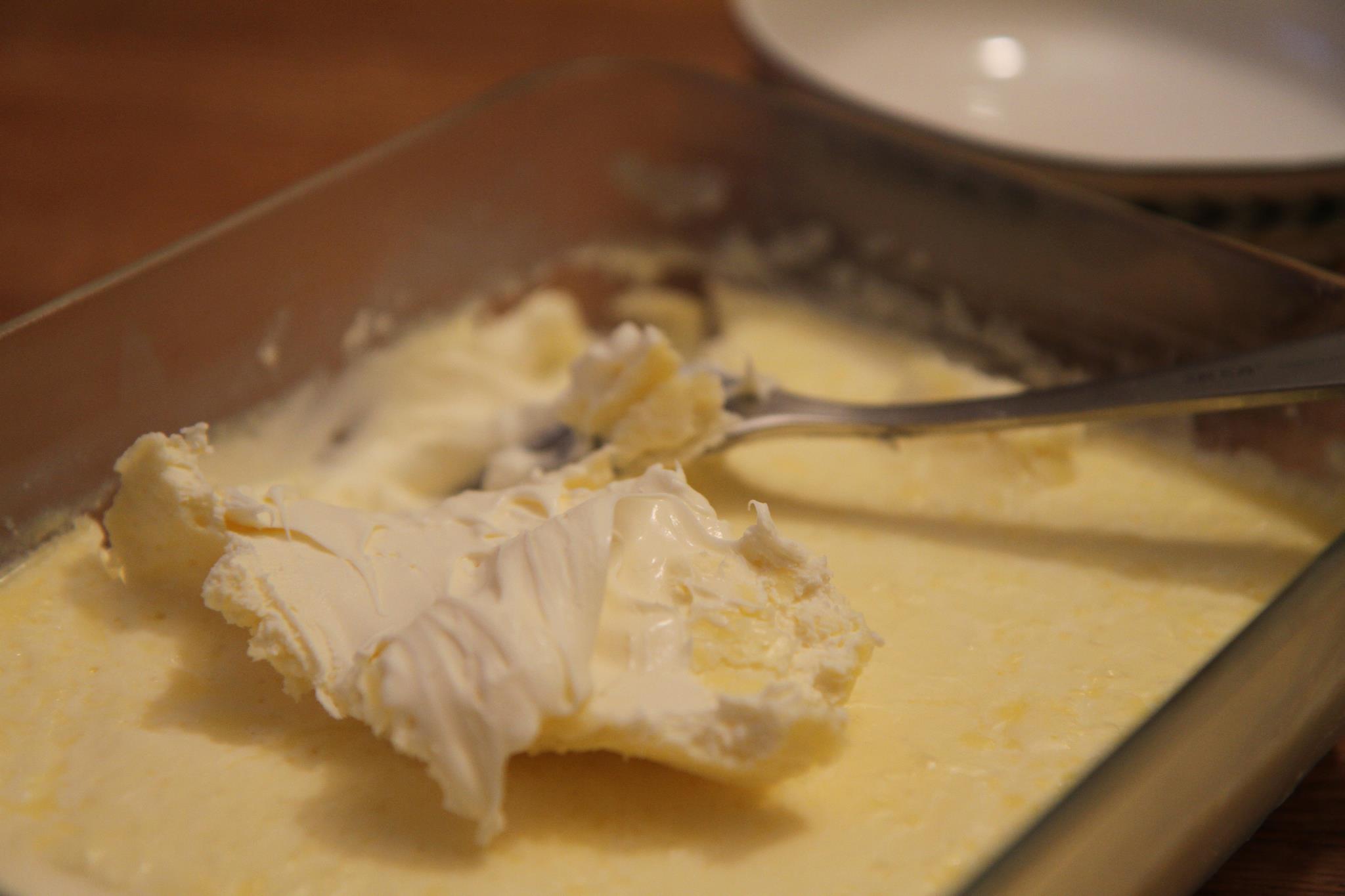
905482_10151362556866828_2018383220_oEngland is rightly famous for its dairy products, king of which is clotted cream. It hails from South West England, particularly Devon, but also Dorset and South Somerset. This is the stuff traditionally served with scones and for which ‘cream tea’ is named. I like to serve it with fruit tarts at dinner and — oh, let’s be frank, this is the cream that goes anywhere. Just don’t waste it in cooking.

It’s quite difficult to find outside Britain, but not to worry—you can make your own.

RECIPE FOR CLOTTED CREAM

You need “raw” cream. It can be called heavy, whipping, double or single cream, just as long as it isn’t UHT (ultra heat treated). UHT won’t separate, and you need to separate the cream from the milk.

Now put that cream in an ovenproof dish and cover. Place it in an oven preheated to 180°F or 80°C and leave for 8-12 hours—yes, you read that correctly.

When a thick, yellowish crust of mascarpone-like consistency has been achieved, remove the dish, wait for it to cool, then refrigerate for a minimum of 8 hours. Scoop it in to jars, cover and eat within a few days.

That should be the easiest part of all.

Joanna was displaced from her native England 16 years ago, and has since attempted to re-place herself and blend into the USA, Holland, Brazil, Malaysia, Venezuela, Saudi Arabia, and now France. She describes herself as a “food gossip”, saying: “I’ve always enjoyed cooking and trying out new recipes. Overseas, I am curious as to what people buy and from where. What is in the baskets of my fellow shoppers? What do they eat when they go home at night?”

Fellow Food Gossips, share your own stories with us!

STAY TUNED for tomorrow’s post!

If you enjoyed this post, we invite you to register for The Displaced Dispatch, a round up of weekly posts from The Displaced Nation, with seasonal recipes, book giveaways and other extras. Register for The Displaced Dispatch by clicking here!

Related posts:

Images: all photos by Joanna and used with her permission

GLOBAL FOOD GOSSIP: Brigadeiros, the essential element of every Brazilian child’s party

Brazil, Brigadeiros, FoodToday we introduce Global Food Gossip: a new monthly food column by Joanna Masters-Maggs, who was our guest in October 2011 with a two-part post about her culinary observations in Provence.

Joanna was displaced from her native England 16 years ago, and has since attempted to re-place herself and blend into the USA, Holland, Brazil, Malaysia, Venezuela, Saudi Arabia, and now France. She describes herself as a “food gossip”, saying:

“I’ve always enjoyed cooking and trying out new recipes. Overseas, I am curious as to what people buy and from where. What is in the baskets of my fellow shoppers? What do they eat when they go home at night? What sort of kitchen appliances do they use — if any?”

Today, she takes us to Rio for her youngest son’s favourite dessert, Brigadeiros — a dish without which no Brazilian child’s party is complete.

The inner Carioca

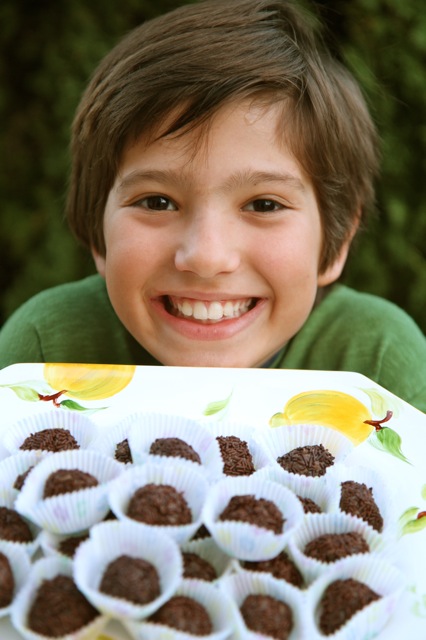
“Is there something you want to tell me about Sergio?” my husband teased, in reference to our Brazilian gardener. Our son Patrick [pictured] had just been born in Rio de Janeiro. Nine years later Patrickzinho  — little Patrick — can still pass as a Brazilian. Not only are his eyes as dark as his pupils and his skin the type that tans successfully, but he has the open friendliness typical of the people we came to know and love.

Patrick is a Carioca, the name given to those born in Rio. He wears the name with pride.

More than once have I had to dissuade his friends’ parents that Patrick is not half Brazilian, he just feels it. That feeling has curled itself in and around him like a particularly persistent Virginia creeper.

Patrick’s inner Carioca is why I have spent the morning in the kitchen, surrounded by empty cans of condensed milk, chocolate powder and mini-cake papers. I am making brigadeiros. Brigadeiros are simple truffle-like chocolates as integral to children’s parties as bikinis are to Copacabana Beach. Forgo the birthday clown if you must, but the brigadeiros cannot be skipped.

Perfecting the role of Brazilian mother

Tomorrow, Patrick’s school is throwing a farewell party for a friend who is returning to Japan. The children have been asked to bring a treat from their country of origin. Well, it’s a party, and Brazil is his country of origin, so what else is he to request from the Maggs kitchen?

Over the years I have played the role of Brazilian mother more than once. I have given school presentations on Brazil, sung Brazilian songs and made countless brigadeiros – all with varying degrees of success but always with great deal of enthusiasm.

The brigadeiro was so named for a chocolate loving army officer. Neither his army career nor his sweet tooth were successful enough for his actual name to be remembered. The brigadeiro, however, has gained iconic status.

I have been making these chocolate treats for years, but it is only recently I perfected the technique. Brazilians insist they are very easy to make, but mine always tended to be a little flat. Then, on moving to Saudi Arabia, I discovered my beautiful and charming neighbor, Yamara, was a Brazilian. An afternoon in the kitchen making a countless number of these sticky balls for yet another “My Country” presentation, and I’ve never looked back. The problem was that my consistency was too soft and I had to be braver about cooking the mixture a little longer. My little chocolate balls now have the correct mixture of stickiness and shape, but never a toffee-like chewiness.

So, it is Yamara’s instructions I am sharing with you. I hope you enjoy them as much as Patrick’s class did. Brigadeiro-making is a fun project for all ages and now that Patrick is making his own, I pass the wooden spoon on to you.

To make Brigadeiros you will need:

I can of condensed milk

3 tbsp of chocolate powder (I use Nesquik)

1 tsp of butter.

Put over a gentle flame and heat until the mixture begins to thicken. Don’t stop stirring. Brazilians say you must heat until “you can see the bottom of the pan”. This is when the heat gently lifts the mixture from the pan and you can make a wide “path” in the mixture with a wooden spoon. It takes about 5 minutes.

Let the mixture cool until you can handle it. You will see it will firm up a little, so avoid the temptation to cook too long. If it is too firm the chocolate strands will not stick. If you have got it right you can take small teaspoons of the cooled mixture and it roll into balls between your hands. Finish by rolling the balls in chocolate strands. Cheerful mini paper baking cases add the final touch. Well, let’s be honest, you need the paper cases for authenticity. Really.

Brazilians also like to make a softer version of the this mixture to make a decadent topping and filling for cakes. Just cook for a couple of minutes less so you achieve a rich pouring consistency. On a rich, soft chocolate cake and sprinkled with chocolate strands you have Brigadeiro Cake, another Brazilian staple. I defy anyone to eat two pieces and live to tell the tale.

Fellow Food Gossips, share your own stories with us!

.

STAY TUNED for tomorrow’s author interview and a new giveaway!

If you enjoyed this post, we invite you to register for The Displaced Dispatch, a round up of weekly posts from The Displaced Nation, with seasonal recipes, book giveaways and other extras. Register for The Displaced Dispatch by clicking here!

Related posts:

Image: Joanna’s son Patrick, with his Brigadeiros

The 12 Stodges of Christmas: Global foods to pack on the pounds this December!

ID-100101223

Today, we bring you a helpful list of the most stodgy, calorie-intense dishes that make their way onto holiday dinner tables around the world.

The way we see it, if you’re going to eat celery and spend all January on a treadmill — and it’s pretty much the law that you do — you might as well make December’s crime fit January’s punishment..

On the 1st day of Christmas my true love sent to me…

A Christmas Pudding from England. Also known as Plum Pudding or Plum Duff, although plums do not feature in the  approved list of ingredients, which includes assorted nuts and dried fruits, suet, and a small keg of brandy. The pudding is steam-cooked for approximately four days before being doused in more brandy and set alight at the dinner table. Accompanied by brandy sauce, brandy butter, and the contents of a fire extinguisher.

My True Love only sent one of these because of their extreme density. If Christmas Puddings were chemical elements, they would lie somewhere between osmium and iridium.

On the 2nd day of Christmas…

Two bowls of Kutia from Ukraine. Often the first dish in the traditional 12-dish Christmas Eve supper served in many Eastern European cultures, Kutia is traditionally made from wheatberries, poppy seeds, nuts, raisins, and honey. Apparently,  it should be made about two weeks in advance. Presumably by the time it is ready it has begun the fermentation process and so adds to the seasonal merriment.

On the 3rd day of Christmas…

Three servings of Julgrøt from Norway. Christmas rice pudding, made from rice, sugar, cream, ground almonds, and containing a single whole almond. The person who finds the almond wins a prize…perhaps a crash course in how to perform the Heimlich Maneuver.

On the 4th day of Christmas…

Four pieces of Stollen from Germany. It’s fruit cake, people. Fruit cake gets a bad press, particularly in the USA, as Anthony Windram pointed out on his own blog this week, but if you call it Stollen, it’s all Bavarian and Christmassy and wonderful.

On the 5th day of Christmas…

Five Mince Pies. A Christmas delicacy from Britain: small pies containing dried fruit, sugar, a healthy dose of brandy, and, if you’re going to do it properly, that weird ingredient suet again. Americans find it very difficult to wrap their heads around the idea of fatty bird fodder going into foods for human consumption, so when I offer my American friends my homemade mince pies, filled with made-from-scratch mincemeat, I wait until they’ve eaten a few before enlightening them that they’ve just eaten the contents of their bird feeder.

On the 6th day of Christmas…

Six buckets of KFC from Japan. Orders are placed two months in advance, and people line up outside the Colonel’s place to get their hands on this delicacy, which over the last 40 years has become a Christmas tradition in Japan.

“Our holiday sales are five to ten times higher than other months,” said spokesman Sumeo Yokokawa. “In Japan, Christmas equals KFC.” (ABC News)

A miracle of marketing by KFC, if nothing else.

On the 7th day of Christmas…

Seven Karelian Pasties from Finland. Originally from Russian Karelia, these pasties have a thin crust of rye or rye/wheat and a filling of barley, potato, buckwheat, or rice (the most popular modern filling.) Toppings include cheese, ham, shrimp, and slices of reindeer.

Yes, reindeer. I guess the buck — and Santa Claus — stops in Finland.

On the 8th day of Christmas…

Eight bibingka from the Philippines – a traditional Christmas dessert made from rice flour and coconut milk, baked in banana leaves. A generously-sized bibingka would serve four people. The bibingka made by residents of Mandaue in Cebu, in May 2011, would serve considerably more. It contanined 50 sacks of rice, 50 sacks of sugar, and the milk from 13,500 coconuts.

Now there’s a town that takes its holiday stodge seriously.

On the 9th day of Christmas…

Nine bread puddings from Puerto Rico. Bread Pudding can be found in many variations around the globe; this Puerto Rican version, made with coconut milk and sliced mango, manages to make the ultimate stodgy pudding into something exotic.

Having hankered after a Caribbean Christmas for more years than I can remember, I fear this dessert only serves to strengthen my resolve.

On the 10th day of Christmas…

Ten Bolo Rei from Portugal. Bolo Rei – King Cake. Crown-shaped cakes, encrusted with raisins, nuts, and crystallized fruit. Contains a small metallic toy and a fava bean. Whoever finds the fava bean is supposed to pay for the bolo rei the following year — talk about adding insult to injury.

On the 11th day of Christmas…

Eleven lussekatter from Sweden. These saffron and quark buns are eaten to celebrate Saint Lucy’s Day, the shortest day of the year which, according to the Julian Calendar, was December 13th. When the Gregorian Calendar changed this to December 21st, Saint Lucy’s Day defiantly remained on the 13th. The Swedes’ cavalier attitude to dates and solstices is why I don’t feel too bad about suggesting you eat these delicious morsels on January 4th.

On the 12th day of Christmas…

And finally, if your True Love has really showered you with all these carbs, the only thing he should be giving you on Day 12 is a year’s subscription to Weight Watchers.

.

STAY TUNED for more Random Nomad highlights from 2012!

If you enjoyed this post, we invite you to register for The Displaced Dispatch, a round up of weekly posts from The Displaced Nation, with seasonal recipes, book giveaways and other extras. Register for The Displaced Dispatch by clicking here!

Related posts:

Image: Woman Standing on Weighing Scale – stockimages / FreeDigitalPhotos.net

THE DISPLACED Q: Expats, repats, what’s the most outlandish tweak you’ve made to your Thanksgiving menu?

Since my repatriation to America, Thanksgiving has become my very favorite holiday here. This is partly because of a tweak that I make to the menu, but we’ll get to that later.

I wasn’t always so thankful for Thanksgiving. I only celebrated this American holiday twice while living abroad for many years, first in England and then in Japan — and to be honest, I didn’t really miss it.

Both celebrations took place when I was pursuing graduate studies at a British university.

The first time was for my very first Thanksgiving away from my family. I joined several other American grad students in preparing a traditional Thanksgiving dinner to serve in the dorm. Our guests were mostly other international students who were curious to experience an authentic version of this quintessentially American custom — as I recall, there were very few Brits.

At one point, a rather bitter argument erupted between Anna, a Harvard-educated woman who was pursuing a higher degree in feminist studies, and Andy, a Georgetown-educated man who was doing an M.A. in politics.

Andy didn’t like the fact that Anna was carving the turkey, proclaiming to the assembled guests:

It can’t be Thanksgiving if a WOMAN is carving the turkey.

I don’t really remember what happened after that — whether Andy insisted upon taking over, or Anna stormed out of the room. But it did cast a bit of a pall over the proceedings.

The food, though, was a close facsimile to the meals I’d enjoyed at home. And the arguing part? That was something I could relate to as well.

And there was snow, which we could see through the huge dorm windows, covering the panoramic Constable (literally) landscape below.

Thanksgiving-on-the-Hill

The only other time occurred a few years later, when an American friend came to live in North London on a teaching exchange with the Harrow School.

He, too, was spending his first Thanksgiving away from home, so decided to host a potluck Thanksgiving dinner in his living quarters.

Again, I think the food was good, but as I recall, the guests, most of whom were English, thought that potluck was a funny way to do a formal dinner. And the setting wasn’t exactly conducive to re-creating a New World feast. Walking from Harrow-on-the-Hill station, we passed by boys in the quaint Harrow uniform, including black ties (allegedly they are still in mourning for Queen Victoria!).

My Thankgiving-less years

After that rather harrowing (sorry, couldn’t resist) experience, I stopped doing Thanksgiving. I married a Brit and we invariably went to his family for Christmas dinner, which — probably not coincidentally — resembles the Thanksgiving meal enjoyed by the Pilgrims. Turkey is the most popular main, cranberry sauce and all. (No pumpkin pie, though!)

Even when we moved to Japan, where there were more Americans, I didn’t reinstate the custom. It seemed too much like hard work competing at the international grocery stores for vastly overpriced frozen turkeys (specially imported for the occasion) and cans of pumpkin.

What’s more — and I probably should have mentioned this earlier — I’ve never been especially keen on turkey. Once, when I was an early teen, I got food poisoning from an undercooked bird, a memory I’ve found hard to erase.

Something else I forgot to mention is that although I enjoy cooking, I’m not a roaster or a baker. I have never achieved the requisite culinary skills to produce a Thanksgiving dinner on my lonesome — even to this day, when I’m living in the U.S. again.

Nor did I especially enjoy the production such a big meal entails. If I’m going to spend a lot of time in the kitchen, I’d prefer to be producing something a little less bland than a roasted turkey, such as a Madhur Jaffrey Indian spread.

New thought: Maybe going abroad gave me the chance to escape from Thanksgiving? I wonder…

Giving thanks for Thanksgiving…but for one tweak!

So it is strange, the inordinate fondness I now have for this late November holiday. I like it because, unlike Christmas, it’s secular, so you don’t have to hesitate in wishing someone a happy Thanksgiving. It’s also less commercial, consisting primarily of an elegant meal with family and friends (I’m good at tuning out football).

I even enjoy eating turkey more than I used to — especially the dark meat. According to the Wall Street Journal, it’s the sides that American people sometimes tweak. But I like the sides. My absolute favorites are the stuffing and mashed potatoes, in that order.

All of that said, I do feel compelled to make one major tweak because of my hybrid background. Instead of turkey sandwiches the day after, I prefer chirashi-turkey-zushi!!!

Chirashi is Japanese for “scattered” — a scattered bowl of assorted fresh ingredients. Most likely you have tried chirashizushi: a bowl of sushi rice topped with a variety of sashimi (raw fish) and other garnishes. (See #2 in the photo.)

What my (second) husband, who is Japanese, and I like to do, on the day after Thanksgiving, is to substitute leftover turkey for the raw fish.

Chirashi-turkey-zushi is tasty, fast, and easy to make — particularly if you can get ahold of:

  • microwavable Japanese rice (use two or three packets for four people)
  • chirashi seasoning mix, containing five vegetables — typically, carrots, lotus, bamboo shoots, and shiitake mushrooms — sushi vinegar, seasoning, and nori (seaweed).
  • Kizami nori (shredded seaweed), to use as a topping.

There are no hard and fast rules as long as you get the seasoning right. And in my (admittedly rather biased) view, turkey goes as well with that seasoning as raw fish does!

* * *

Okay, your turn to tell me: what’s your idiosyncratic contribution to America’s national feast? Or if you’re not American, what do you do to internationalize your native festive spreads this time of year? I’m all ears, and tastebuds…!

STAY TUNED for another Thanksgiving post, by guest blogger Kristin Bair O’Keeffe.

If you enjoyed this post, we invite you to register for The Displaced Dispatch, a round up of weekly posts from The Displaced Nation, with seasonal recipes, book giveaways and other extras. Register for The Displaced Dispatch by clicking here!

Related posts: