The Displaced Nation

A home for international creatives

Tag Archives: Fiction Writers

LIBBY’S LIFE #61 – A voice in the dark

Something has woken me. A voice.

I lie in bed and stare around the semi-darkness, wondering if an old, lost spirit lingers in the whitewashed walls of this Georgian cottage. I have no idea what time it is; the only clock in the room is that on Oliver’s cell phone which is lying on the window seat in our bedroom, its little green light flashing every few seconds. With no phone signal in the village, Oliver’s phone has become merely an expensive timepiece. The idea that the Voice might not be of this world discourages me from getting up to check its display, so it could be the middle of the night or nearly dawn for all I know; morning arrives later here than in Massachusetts, and winter, it feels, will not be long coming.

Perhaps one of the children has had a bad dream? I strain to listen for any sounds of wakefulness from the little bedroom next to us, where the three of them are tucked up. Hearing nothing, I decide I must have been dreaming myself, or that the jackdaws who helpfully drop twigs down the chimney into the fireplace are on night duty, cawing and pacing on the roof. I am about to turn over and reclaim some precious sleep when the Voice comes again: outside, under our bedroom window. A hoarse whisper, no doubt fondly intended to be quiet, but in reality raucous enough to awaken the whole street and the dead in the churchyard opposite.

“Yoohoo! Coo-ee! It’s me! Oliver — are you awake?”

I stay still for a second, not believing or wanting to believe what’s outside. Something that shouldn’t have been here for another three days. Should I ignore it? Will the voice and its owner go away if they get no response?

Chance would be a fine thing.

I sigh, resigned to our family’s fate for the rest of the day — the week, even — and nudge Oliver awake less gently than he’d like or is used to.

“Wake up, O dearest one. Rise and shine. Go open the front door. Your mother’s here.”

* * *

“So yesterday I said to this girl in your office, Oliver — Melinda, I think her name was — I said, ‘But he’s not arriving in England until tomorrow, so he must be there with you.’ And she said, ‘No, he definitely left last Sunday and he’s staying in the goonies in the back of beyond for two weeks.”

“Melissa, not Melinda. Boonies, not goonies.”

I shift George onto my other hip, and one-handedly fill the kettle. It had proved impossible to return to sleep once Sandra entered the house, screeching and cackling, so with bad grace I’d got out of bed and dumped some small children on her. If she was going to arrive three days early, she could make herself useful.

“Melissa, that’s it. She sounded like a lovely girl. Anyway, she said Oliver would be here all week, so why didn’t I ring him on his mobile phone? But I couldn’t get through, I just kept getting his answerphone message, so I thought, sod it, I’ll get an early train tomorrow to Bath. It’ll be a nice surprise for them.”

As if I didn’t already have enough reasons to murder Melissa Harvey Connor in cold blood.

I sit George in the rental cottage’s one highchair and get the teapot ready, putting an extra teabag in for Sandra who likes her brew a violent shade of orange.

“Oh, no tea for me, please!”

I turn, surprised. “No?”

“Not unless you’ve got green tea.”

I hold up the box of PG Tips.

“Evil stuff,” she says. She who once gave my three-year-old Red Bull. “Haven’t drunk it for a week now. I’m on a health kick. Green tea only for me, please.”

I pour boiling water into the teapot. “Haven’t got any.” If you’re going to turn up out of the blue and visit people unannounced, you’ve got to have what you’re given. “It’s PG Tips or apple juice. Or you can have the twins’ Cow and Gate if you’re desperate.”

It’s funny, I think — at one time I’d have been polite, even offering to run out and find some in the village. The health food shop at the other end of the high street probably sells green tea, after all, and as it’s now 8:30, the shops will be open.

But after the crisis that Oliver and I have had, all due to Sandra’s insistence upon Oliver’s silence about his family history? Sandra can damn well sing for her green tea.

“Are you sure you don’t want a cup?” I ask.

Sandra leans over to Beth who is kicking one foot in a bouncy chair, and strokes her cheek.

“Evil stuff,” she says again. “Give me a glass of water and I’ll go outside for a smoke.”

* * *

“What are we supposed to do with her?” I ask Oliver in an emergency conference in our bedroom. “We were going to Windsor to Legoland tomorrow, but I really don’t want her tagging along, moaning about nowhere to smoke and them not having herbal tea. Anyway, the car’s not big enough for all of us. Thoughtless woman.”

Oliver opens his mouth then shuts it again. Presumably he was going to defend Sandra, but over the last few weeks he’s learned that my sympathy threshold for his mother has plummeted. Her mention of Melissa only serves to make things worse.

Since we arrived, I have tried to worm information out of Oliver about Melissa, but every time I bring her name up — casually, nothing accusatory, asking about her job — he shoots a hunted, sideways glance at a random object in the room and changes the subject. I am getting nowhere, not to mention frustrated as hell and more suspicious by the minute.

“I could stay here and you take her out with the children. Go round Bath or someth—” He trails off. I imagine my expression reflects the outrage I feel.

“Your mother, your problem,” I say. “How about you take her round Bath and I stay here with the children and go to the park?”

He nods.

At least he’s getting to know when he’s lost an argument.

* * *

They’ve gone. The house is quiet, or as quiet as it gets with a preschooler and two six-month-olds. But it’s significantly quieter than when an overgrown teenager in her fifties is added to the equation.

“Can we go to the park now?” Jack asks.

I smile at him. “Of course. Put your jacket and shoes on while I get the twins ready. I’ll just nip upstairs and get changed.”

I strap Beth and George into their double pushchair, then run up the stairs.

In the bedroom, I pull on a sweatshirt, straighten the bed, then cross to the window to draw back the curtains — and stop. In the few days without a phone signal, Oliver has evidently lost his habit of taking his phone everywhere he goes. The phone is still lying on the window seat, its green light winking.

Because I’ve had to turn the alarm off on it every morning, I know Oliver’s password to unlock it.

I unplug the phone, slip it into my jeans pocket, and run back downstairs.

“Let’s go,” I say to Jack.

*  *  *

.

Next post: LIBBY’S LIFE #62 – Private investigations

Previous post: LIBBY’S LIFE #60 – Cotswold espionage

A note for Libby addicts: Check out Woodhaven Happenings, where from time to time you will find more posts from other characters.  Want to remind yourself of Who’s Who in Woodhaven? Click here for the cast list!

Read Libby’s Life from the first episode.

STAY TUNED for Monday’s post: a review of Helena Halme’s new book, The Englishman.

If you enjoyed this post, we invite you to subscribe for email delivery of The Displaced Dispatch, a round up of the week’s posts from The Displaced Nation. Sign up for The Displaced Dispatch by clicking here!

Image: Travel – Map of the World by Salvatore Vuono / FreeDigitalPhotos.net

LIBBY’S LIFE #60 – Cotswold espionage

You can take the girl out of England, but you’ll never take England out of the girl. It’s home, and always will be.

At least, that’s what I thought until Oliver and I landed at a major British airport at stupid o’clock yesterday morning, after a night flight with a cranky four-year-old and two wailing five-month-olds in tow.

“Welcome home!” the uniformed bloke on passport control said to us. “This is your first time back in nearly eighteen months? Well, it’s great to have you in the country!”

OK, I’m lying. He said nothing of the sort. He scowled at me and Oliver, then shot a death-glare at Beth and George. “They’re American,” he said suspiciously, holding Beth’s blue passport by one corner as if it were radioactive.

“Well, technically they have dual–” I began, before he interrupted me.

“No UK passports?”

This visit was planned quite quickly, and although we’d got the twins official and legal as US citizens, they didn’t have the British paperwork yet.

“No, I haven’t got around to registering the birth with–”

The uniform held up one hand to silence me.

“How long will they be in the United Kingdom?”

Oliver passed him our travel itinerary which stated we would be going back to America in two weeks’ time.

“And you’re all travelling together for the duration of your visit?” the uniform asked.

“That’s right,” Oliver said.

“They’re five months old,” I said, sotto voce. “We thought we’d give them another couple of years before we sent them InterRailing round Europe on their own, but if you think they’re up to it now…”

Oliver trod heavily on my foot, and I muffled a squeal. My feet were swollen after a six hour flight with George asleep on my lap.

Another official wandered up to the booth.

“Have you got a problem, Derek?” she asked.

“He certainly has,” I muttered, and Oliver trod on my other foot.

The second official looked from Beth to her passport photo. Good luck to her trying to find the resemblance between Beth’s two month old self and as she was now, three months later. “They’ll need to be registered as UK citizens as soon as possible,” she said, “or it could cause a lot of problems.”

Goodness. The grilling now was not, therefore, classed as a “problem”?

“OK,” she said reluctantly to the first uniform. “Let them in.”

I gazed at my blameless infants as their passports were stamped and grudgingly handed back again.

“Poor little things,” I cooed at them as we walked away towards the baggage carousel. “You came home for a little light espionage, and they spoiled all your fun.”

Thankfully, I had run out of feet for Oliver to tread on.

* * *

So here I am, back in England, in the Cotswolds. It’s an unfamiliar region to me, as I’ve never been farther west than Reading before, so it isn’t technically “home”; but they still drive on the left, and I can buy Crunchie bars in the corner shop. It’s home enough for me.

You’d think that, given my extended absence, I’d have some introspective observations to bring you — Libby’s Thoughts On Returning Home — but all I can observe is how small everything is. The roads are Victoria Beckham-slim, the cars are like Matchbox toys, and as for the bed Oliver and I are sleeping in…Well. Give me King Size over Cosy, any day.

But the bed has to be cosy. King Size wouldn’t get up the narrow staircase in our rented cottage which, according to the plaque over the door, was built in 1723. It’s a tiny chocolate box house, all honey stone and honeysuckle on the outside, and low ceilings, plaster walls, and unexpected beams inside. Oliver is already sporting a lump on his bald patch.

Egg-sized lumps aside, though, it’s an idyllic place to spend two weeks. The front window looks out onto the high street, with its ancient market square cross, medieval church, and Ye Olde Gifte Shoppe selling tea towels and corn dollies to gullible tourists. For a real village — as opposed to Harry Potter’s Hogsmeade — this is as escapist as they get.

Better make the most of it before Mum and Sandra arrive next week, though. Thank God the house is too small for them to stay overnight, and they will be forced to sleep at the bed-and-breakfast down the road. For this first week, however, Oliver, the children, and I are on our own in this little Wiltshire backwater that has managed to bypass social evolution for the last 200 years.

OK, maybe not social evolution. They wear jeans and T-shirts, not smocks and straw hats, which is how everyone in Milton Keynes imagines West Country types. But they’re a bit behind in the technology race in Chipping Magna. There’s still a working red phone box in the High Street, which I thought was very quaint and sweet, because most red phone boxes have been bought up by Hollywood luvvies and converted to shower cubicles.

After half an hour in the cottage, we discovered the reason why the last non-shower phone box stood in this village. There’s no mobile phone signal in Chipping Magna.

“This is a disaster!” Oliver held out his useless cell phone in one hand and raked his — decidedly thinning, I noticed — hair with the other. “I’m supposed to be on a conference call with Seattle on Monday! How am I supposed to check my emails? Does this house have wi-fi?”

I gave him a pitying look. “I’d say this place has only just been hooked up to the national grid, wouldn’t you? Think yourself lucky that we’ve got electric lights instead of tallow candles.”

Then I turned away before Oliver could see me smirk.

I could be helpful and tell him that there was an internet cafe in the supermarket five miles away, where we stopped to get bread and milk. But here’s the thing. I don’t want him to be on the phone or emailing — and it’s not just because he’s on holiday and shouldn’t have to work for the next two weeks.

No. You see, if he can’t phone or email, he can’t communicate with Melissa Harvey Connor.

Bet you thought I’d decided to let that one lie, hadn’t you? Come on. You know me better than that. I’ve been doing some quiet investigations back in Woodhaven. That she started working for Oliver at precisely the same time that we were having marital problems, together with her husband Jeffrey stomping out of the house two weeks after she began, did little to allay my suspicions. No wonder the Posse had decided that she and Oliver were an item. But still — this is Oliver we are talking about. He’s no saint, but Melissa just isn’t his type. He might be OK as her boss, but I know that in a social (or more) situation, she would terrify him. I just can’t see it. He’d be mincemeat.

And yet — as my dad would say — there’s no smoke without fire. The question is: where did the fire start, and who lit the match?

I’m hoping that these two weeks with limited social opportunity — no phone, no internet, no texting — two weeks of Oliver and me being forced to sit and talk to each other, in other words, might give me a clue about what’s going on.

Because when the next coffee morning rolls around, I need to be able to stand up to the Posse and say, “Guess what, ladies? You owe me and my husband an apology.”

The jobsworth at the airport, worrying that our baby twins were here for some 007 spying, was barking up the wrong tree.

I’m the queen of espionage round here.

* * *

.

Next post: LIBBY’S LIFE #61 – A voice in the dark

Previous post: LIBBY’S LIFE #59 – Fanning the flames

A note for Libby addicts: Check out Woodhaven Happenings, where from time to time you will find more posts from other characters. Want to remind yourself of Who’s Who in Woodhaven? Click here for the cast list!

Read Libby’s Life from the first episode.

STAY TUNED for Monday’s round-up of the web’s top food posts!

If you enjoyed this post, we invite you to subscribe for email delivery of The Displaced Dispatch, a round up of the week’s posts from The Displaced Nation. Sign up for The Displaced Dispatch by clicking here!

Image: Travel – Map of the World by Salvatore Vuono / FreeDigitalPhotos.net

LIBBY’S LIFE #59 – Fanning the flames

Somehow, I manage to get away from that hideous coffee morning. As I drive, I automatically answer Jack’s questions about the finer details of Ironman’s personal habits — “I have no idea how he goes to the bathroom. No, I can’t imagine Ironman wearing Pampers.  Yes, I suppose he might go rusty if he’s not careful.” — but I’m not really paying attention.

Anita’s words keep looping around in my head.

“Jeffrey Connor’s gone back to Shelley,” she’d said. Shelley, his first wife, whom he’d left for Melissa Harvey. Jeffrey and Shelley Connor had been Melissa’s tenants — just as Oliver and I are now.

I cringe every time I replay my innocent reply:

“Why? What happened to him and Melissa?”

And Anita’s embarrassed answer: “We all assumed you would know about that.”

Her meaning was unmistakable: We assumed you knew because you are involved in this situation. Or, rather, not me, but Oliver.

It was as if someone had smacked me over the head with a large stick. Everything made sense: the sudden silence as I entered Anita’s house, as if they had been talking about me; Charlie’s protectiveness, as she loudly emphasised my “post-natal depression” as the excuse for my four-month absence from Posse society.

It wasn’t post-natal depression, not in the conventional sense. It was my inability to face anyone because of the issues Oliver and I were having about his father’s marital history.

Now, though, I wish I’d been brave enough to venture onto the coffee morning rounds. Without me there to set the story straight, rumours had flourished like unattended dandelions. In my absence, everyone had gossiped behind my back, assuming I wasn’t showing my face in public because Melissa Harvey Connor was having it away with yet another tenant of hers: Oliver.

How ridiculous. Right? I mean — when would Oliver see Melissa?

Yet here’s the thing: while I can keep telling myself that it’s all conjecture and careless whispers amongst silly women with too much time and not enough brain cells, and I don’t believe a word of it, at the back of my head a little voice of paranoia insists that rumours have to come from somewhere.  As my Dad would say: “There’s no smoke without fire, Libby.”

What to do now? I wonder.

Do I ignore the smoke? Douse the embers? Or — fan the flames?

If the topic comes up, I decide, I will probe.

*  *  *

“How was your day?” Oliver asks over dinner. “Did you go to Charlie’s leaving do?”

I pause. “Yep,” I say, trying to keep my voice light and casual, and instead hearing it come out high-pitched and tense.

“Everything all right?” Oliver shoots me a look which I interpret as concerned.

Concerned for whom? Me? Or him?

“Fine,” I say, hoping my voice sounds more natural.

“OK,” he says. Oliver tends to take things at face value. If I say I’m fine, then I must be.

“I hear Jeffrey’s gone back to England.” I cut into a piece of chicken on my plate, and glance up quickly to watch Oliver’s expression, which is a study in nonchalance.

“Yeah. He decided our landlady wasn’t a good enough trade-in for his first wife. Gone back with his tail between his legs.”

“It took him this long to work that out? Everyone else could have told him Melissa’s a complete bitch.”

Oliver raises his eyebrows. “She’s not that bad. A bit overbearing, maybe. Jeffrey didn’t handle her right. You’ve got to be firm with her.”

I choke, cough, and run into the kitchen where I splutter out a wad of half-chewed chicken.

“And you’d know about this, I suppose,” I say, when I return to the table.

“Well, yes. Of course I would.” He looks around the table for ketchup. Honestly, it drives me nuts how Oliver insists on drowning everything with ketchup. If I took him to Alain Ducasse, he’d be asking for ketchup to go with the foie gras. “Seeing as she’s been working at the company for — what?  Three months now.”

I lean back in my chair, aware that my jaw is dropping open unattractively.

“She works at your place? Why? She’s a realtor. You never told me.”

Oliver shrugs. “Housing market has tanked around here, and Jeffrey got her this admin job. I suppose she joined when we…when you and I weren’t talking much to each other.”

And whose fault was that? I want to scream, but instead I count to ten, very slowly, because I need to know more.

Suddenly the Posse’s whispers don’t seem so careless any more.

“Do you see much of her at work?” I ask in that same fake-casual voice.

“She works for me. Technically, I’m her boss.”

“And there is no connection between that and the fact that Jeffrey has decided to return to his first wife.”

He hesitates, just a fraction of a second too long, and my internal bullshit radar switches to high alert.

“Now you’re just being silly,” he says, sticking out his chin.

We finish our meal.

There is silence in the room, marred only for me by my internal radar’s sirens and red flashing strobe lights.

*  *  *

.

Next post: LIBBY’S LIFE #60 – Cotswold espionage

Previous post: LIBBY’S LIFE #58 – Careless whispers

A note for Libby addicts: Check out Woodhaven Happenings, where from time to time you will find more posts from other characters.  Want to remind yourself of Who’s Who in Woodhaven? Click here for the cast list!

Read Libby’s Life from the first episode.

STAY TUNED for Monday’s food-related Displaced Q!

If you enjoyed this post, we invite you to subscribe for email delivery of The Displaced Dispatch, a round up of the week’s posts from The Displaced Nation. Sign up for The Displaced Dispatch by clicking here!

Image: Travel – Map of the World by Salvatore Vuono / FreeDigitalPhotos.net

LIBBY’S LIFE #58 – Careless whispers

OK. Let’s do this.

My finger hovers over the doorbell for a couple of seconds before I push the button. Inside, a torrent of barks from Anita’s dog, Champion, reminds me of the morning at this house, nearly a year ago, when the same dog diagnosed my pregnancy, literally sniffing it out.

Approaching footsteps in the hall, accompanied by the skittering of doggy claws on slippery wooden floorboards.

Anita opens the front door wide, and I catch a glimpse of the Coffee Morning Posse chattering in the kitchen, at the end of the corridor behind her. Everyone turns to see who’s arrived, and the chatter stops; as if someone flicked a volume switch to “Mute”.

“Libby,” Anita says, at first looking at me, then quickly averting her eyes. “We didn’t… expect you. Come in.”

She takes Jack’s hand and the twins’ changing bag, and leads the way to the back of the house. I follow, feeling like Scarlett O’Hara when Rhett forces her to go to Melanie’s party after she and Ashley are caught in a clandestine clinch. It’s clear from the silence and Anita’s awkwardness that I’ve been the subject of conversation.

Could they know about Oliver and his bigamist father? I wonder. No. That would be impossible. No one in Woodhaven knew about that except Maggie, and she would never say anything to anyone — least of all to the Posse.

I haven’t seen any of the Posse since early May, a couple of weeks after the twins’ birth, when Anita brought round a Tupperware-encased casserole for our freezer. Two days after the arrival of that Chicken a la King, Oliver’s half-sister Tania paid us her fateful surprise visit, and my life turned towards the sign marked “Hades on Earth”. Hanging out with the Expat Sisters over lattes, pretending everything was hunky dory chez Patrick, didn’t feature on my agenda after that.

Silly to assume my absence went unnoticed, though. I’ve turned down so many invitations to coffee, dinner, and pot luck lunches that the gossip machine must have been working overtime. “Bring all the children, and let’s have dinner!” the phone conversations would start, and my inner reaction would be Let’s not. Let me just hide. Outwardly, I would mumble an excuse, but since I’m no Meryl Streep, the other person surely knew I was fobbing them off. “Another time, then,” they would say.

Except that after a while, of course, there were no other times.

Naturally, it was Maggie who set me back on the path to social redemption.

“You can’t hide away forever,” she said to me at regular intervals over the last few weeks. “You need more company. You need people your own age.”

Eventually, after Oliver and I reached our tenuous truce, I felt my wounds had been sufficiently licked and the time was right to enter the outside world again. An email from Anita, sent to all the English Posse wives, offered the opportunity I needed.

Charlie and Lee are heading back to sunny Milton Keynes! the email said. We will be holding a farewell party for Charlie on August 23 at my house. Please RSVP…..etc etc etc

I didn’t RSVP, though. I didn’t trust myself to keep a promise to attend. Glancing round Anita’s kitchen now, meeting the curious stares and false smiles, I wish I hadn’t come.

“How they’ve grown!” Charlie appears at my side, gives me a hug, and bends down to take a better look at the twins. “They’re — what, about three months now?”

“Four months. Exactly.” I wish with all my heart that it was someone else’s farewell party. Anyone except Charlie. Caroline would be my top pick of people to dispatch back to Milton Keynes. I can see her on the other side of the family room, standing next to her awful brat who’d made Jack’s life a misery. She’s holding her own new baby, which is dressed in a black Harley Davidson onesie with fake leather boots and a kelly-green elasticated headband. Boy or girl? It’s still anyone’s guess.

“They’re beautiful,” she says. “And you look very well, too. Post-natal blues are such a curse — I hope you’re feeling a bit better now?”

Charlie speaks the last sentence in a slightly louder tone, as if to make sure the rest of the room hears clearly. She nods slightly at me, encouraging me to say something, to play along with her.

“Much better,” I say, wondering where this is leading.

“Good! I hear there are some wonderful drugs available for depression these days. I expect you know all about that, though.”

“Well, I’m not actually—”

“Come and sit down where it’s quieter.” Charlie interrupts me, then picks up George’s car seat and carries it through to Anita’s formal living room. I follow with Beth. As I sidle past the basement door, I hear Jack issuing orders about the rules of a made-up game involving Ironman and Captain America. Sad, I think. Has Lightning McQueen had his day in Jack’s world?

“I think you should know,” Charlie says, flopping down next to me on Anita’s leather sofa, “that there’ve been a lot of theories about your absence. Rumours spread very quickly around here, as you know, but as soon as anyone voiced an opinion, I simply stepped in and told them you’ve been suffering from PND. I figured that it probably wasn’t too far from the truth.”

I reflect on this. Yes — I’d been depressed following the twins’ birth, although the two events weren’t connected.

“That’s about right,” I say.

“And I presumed you’d rather have that circulating as general knowledge than the real reason.”

I nod, before remembering that no one could possibly know about Oliver and Tania.

“Wait — what ‘real reason’?” I ask, but Charlie is already getting up.

“They’re calling me,” she says. “Time to cut the cake.” And off she rushes, back to the kitchen.

By the time I’ve gathered up the two baby seats and lumbered with them towards the cake room, Anita is in full flow with an emotional goodbye-to-Charlie speech.

“The best thing about being here in Woodhaven,” she says, blinking hard, “is the lovely people you meet. The worst thing is when you have to say goodbye to them.” She sniffs. “I’m going to miss you so much, Charlie.”

You and me both, I think.

Julia passes a couple of large gift-wrapped boxes to Charlie.

“This is from all of us,” Julia says, and I feel guilty, because I haven’t contributed anything.

Charlie murmurs her slightly embarrassed thanks, and begins unwrapping them. There’s a big coffee-table book full of photos of Massachusetts; a lace tablecloth which I recognise as being from the craft store in Woodhaven; a pottery house — a miniature of the one on Main street that belongs to the Historic Society. Right at the bottom of the second box, there’s a map of Milton Keynes and a copy of the Highway Code. A joke, of course — Charlie doesn’t need either, but it’s a reminder that she’s been away from her home town for nearly five years, and she might need a refresher course in driving on the left.

“Give our love to Milton Keynes,” Julia says.

“And to Jeffrey and Shelley, of course,” pipes up Caroline from the back of the room. She looks over at me and smirks, but I don’t know why.

Everyone else in the room knows, though. The heavy silence descends again.

Jeffrey and Shelley? I think. I only know one Jeffrey, the one who is married to Melissa Harvey Connor.

“Does she mean Jeffrey Connor?” I whisper to Anita, who’s standing next to me.

Anita casts a glance around, as if searching for a door to take her into a parallel universe, far away from here. “That’s right,” she says.

“So — he’s in England now?” Oliver never mentioned it. “What about Melissa? Has she gone too?”

It’s so long since I’ve seen Melissa. The last time I saw her was the week of the early winter storm, when I caught her sniffing Oliver’s sweatshirt in our bedroom, and I got the locks changed the following week.

Anita stares at the floor. Perhaps she can see the door to the other universe. “He’s gone back to Shelley,” she says at last. “The wife he had when he first came out here, five years ago.”

“Goodness.” So much scandal for such a small town. “So what happened to him and Melissa?” I ask.

Anita’s very quiet, for a long time. “We all assumed you would know about that,” she says at last. “I’m sorry, Libby.”

.

Next post: LIBBY’S LIFE #59 – Fanning the flames

Previous post: LIBBY’S LIFE #57 – Coming clean

A note for Libby addicts: Check out Woodhaven Happenings, where from time to time you will find more posts from other characters.  Want to remind yourself of Who’s Who in Woodhaven? Click here for the cast list!

Read Libby’s Life from the first episode.

STAY TUNED for Monday’s post.

If you enjoyed this post, we invite you to subscribe for email delivery of The Displaced Dispatch, a round up of the week’s posts from The Displaced Nation. Sign up for The Displaced Dispatch by clicking here!

Image: Travel – Map of the World by Salvatore Vuono / FreeDigitalPhotos.net

LIBBY’S LIFE #57 – Coming clean

“And then what happened?” Maggie tops up our glasses with Rioja. “Did he tell you all about his bigamist father and you said, ‘That’s fine, sweetheart’ and everything was tickety-boo between you again?”

Maggie’s summary isn’t incorrect, but it goes further than that.

“Something like that. He’s trying very hard, and…” I shrug.

“You mean,” Maggie says, “that the balance has shifted and you’ve got the upper hand for once?”

I consider this. I did the midnight feed last night, but this morning Oliver got up early to make breakfast for Jack and help him get dressed while I slept. I only woke up when Oliver brought a cup of tea and the twins to me in bed.

Does that mean I have the ‘upper hand’?

“No,” I say. “I mean that the balance, for once, is exactly right.”

* * *

Take this evening, for example. Tonight I’m at Maggie’s house, on my own, sans children, who are tucked up in bed while Oliver holds the fort and figures out the intricacies of mixing formula milk. This wouldn’t have happened a week ago, when the balance of power was tipped in his favour, when Oliver considered himself wronged, and behaved accordingly badly.

But all that has changed now.

Oh yes.

The evening after he had been to see Maggie, he told me about his father. He helped put the children to bed, and insisted on tidying up after dinner. “You go and put your feet up, Libs,” he said, and brought me, instead of an olive branch, a dish of ice cream. When he finally joined me, I was lounging on the sofa, taking up all the cushion space, and holding up a magazine in front of my face. After removing a few of Jack’s toys from a nearby armchair, Oliver also sat down.

“Libs.”

I turned a page. “Mmm-hmm.”

Ungracious? Yes, maybe. It takes more than a bit of washing up and Ben & Jerry’s to get round me these days.

“We should talk,” he said, then stopped. From behind my magazine, I saw him glance sideways at me. I said nothing, and continued flicking through the pages of Good Housekeeping. I was damned if I was going to make this easy for him.

He sat forward in his seat, elbows on his knees, hands dangling, his eyes fixed on a spot on the floor.

“He had three wives, you know. Mum was the third.”

A few seconds went by, then I said, “Yes. I do know, now. No thanks to you.”

His head drooped even lower. “I’m doing my best here, Libs. It’s very hard for me to talk about this. Don’t make it more difficult for me than it already is.”

I slapped the magazine down on my lap. “And don’t you lay that guilt trip rubbish on me! You’ve had ten years to tell me about your family history, but no, I had to watch our wedding outtakes video to find out why you were being such a shit about my little experiment with genealogy. So don’t preach at me about making things difficult.”

Oliver got up and walked out of the room. I think I was supposed to follow him at this point, and beg forgiveness. A very short time ago, I would have done — but not any longer. Instead, I picked up my magazine again and read an article about extreme bathroom makeovers; a pointless article when you live in rented accommodation. After about fifteen minutes, Oliver returned to the room.

“Shall we start again?” he asked in a quiet voice.

I sniffed.

“If you like.”

“Could you put the magazine down?”

I elaborately laid it on the side table, folded my arms, and raised my eyebrows at him. “Happy?”

He didn’t rise to my bait. It was a bit disappointing. “Mum was his third concurrent wife,” he said in a rush. “They’d been married for six years. The others had been married to him for nine and eleven years. None of them suspected a thing, despite the fact that they all lived within twenty-five miles of one another.” He paused. “If it hadn’t been for that pile-up on the M1, they might still be happily married today, for all I know.”

He flexed his fingers, then cracked his knuckles — a sure sign that Oliver’s under stress.

“Tell me.” I tried to make my tone offhand, but from the grateful expression on Oliver’s face, I must have injected more affection than intended.

“Mum saw the report on the local news about a big pile-up on the M1 at Luton,” he began, sounding hesitant. “Lots of pictures of cars crumpled up and skewed sideways in the road, ambulances and fire engines and police everywhere. The reporter said that four people had already been confirmed dead. Mum didn’t think much about it because Dad said he was working in the Lake District that week. Then, apparently — I don’t remember it, but she tells me this is what happened — I shouted that I could see Daddy’s car on the television.”

“And was it his car?” I asked.

“It shouldn’t have been. Dad had called Mum only an hour before from Carlisle — or at least, that’s where he said he was — so as far as she was concerned, there was no way he could have driven 300 miles in one hour. But yes. It was his car. The cameraman zoomed in on this bashed in blue Cortina, and Mum could make out the numbers on the licence plate.”

I was quiet again, but not in order to punish Oliver. I was visualising the scene in Sandra’s house, the turmoil in her mind as she wondered if her husband had survived the wreckage…

“Then what happened?”

Oliver squeezed his eyes shut. “She drove to the hospital that the news reports mentioned. Kicked up a fuss at reception, screaming that she’d just seen her husband’s car on TV in the pile up and she demanded to know where he was. The woman at the desk asked her what her husband’s name was, and when Mum told her, the woman got all confused and told her there must be some mistake because the family of that person had already been notified.”

Poor Sandra. I didn’t like her — never had — but no one deserved that.

“And if you think it couldn’t get any worse, the final wife turned up at the hospital twenty minutes later, having also seen the news and the picture of the car, and the same thing happened all over again. I can’t really remember what happened after that. Probably just as well, really. I only remember a lot of days that Mum either cried or threw things out of the window or into the street. Everything belonging to Dad, everything he had ever given me or Mum, it all disappeared from the house. I never saw him again.”

I thought of the toy tiger and the birthday card, the two hidden items that had sparked this whole mess between Oliver and me. I asked how they had escaped the evacuation.

“They turned up in the post a couple of days after my sixth birthday, a few months later, addressed to me. The postman rang the doorbell, and because it was Saturday and Mum was still in bed, I answered the door and got the parcel myself. I never told Mum I’d received them. By that time, I’d already lost my favourite teddy bear and lots of toys, just because Dad had bought them for me.”

My pity for Sandra evaporated as I thought of a little boy, not much older than Jack, trying to comprehend why all his beloved toys were being thrown in the dustbin.

I sat up and stretched my hand out to stroke Oliver’s arm.

“Poor you,” I said. “That’s awful. Really terrible.”

Oliver absently put his hand on top of mine.

“I found out, much later, that he must have sent that parcel just before he went to prison.”

“Prison?”

“Bigamy’s an prison offence. He was in for a few months, I believe.”

Sorry as I felt for Oliver, I still had to have my say.

“But why didn’t you tell me? Have you any idea how much you’ve hurt me by not trusting me like that?”

He rubbed his eyes, and squeezed my hand tighter.

“It’s got nothing to do with trust. It was all down to a promise I made to my mother, not to tell anyone. She was humiliated beyond belief — I see that now — and I didn’t want to break that promise by telling every girl I met.”

“But I wasn’t ‘every girl’!” I said. “I was your wife!”

“Not at first, you weren’t. And by the time I felt it was OK to tell you without also betraying Mum, we’d known each other for a long time, and by then — well, I felt it was too late. You’d always ask me why I hadn’t said anything before.”

Hmm. It sounded good, but I wasn’t completely convinced by this argument. Oliver’s doe-eyed love for his mother was so great that I couldn’t see him ever breaking that promise unless he was forced, like this fiasco had forced him. For the sake of familial peace and marital harmony, though, I was prepared to go along with his white lies — this time, anyway.

“Anything else you’d like to tell me?” I asked. “Anything other skeletons in the cupboard I should know about before I start on our family tree again?”

Oliver shook his head. “None that I know of. You might find something, but I promise you, it will be as much a surprise to me as to you.”

* * *

“And that was it?” Maggie asks.

“Not quite. I got up and went to the mall for three hours. Left him to sort out the twins, who apparently woke up the minute I closed the garage door and wouldn’t entertain the idea of going back to bed until ten minutes before I came back. When I got home, all three of them were asleep on the sofa with a Wiggles DVD still playing.”

I smiled at the memory. Oliver had been dying to complain and play the martyred father, but he didn’t dare.

“And that’s not even the best of it,” I said. “His mother emailed him yesterday, asking when she could come over to see her ‘new precious angels’, as she calls the twins.”

Maggie gasped. “Oh no! She’s not coming over again, is she? You’ve only just recovered from her last visit.”

“Damned right she’s not coming over again. We are going over to England instead. Do you realise I haven’t been home since we moved here, this time last year? We can’t go back to our old house, because the old witch is living in it, and I can’t face the idea of seeing the mess she’s made of it, so we’re renting a house in the Cotswolds for two weeks in September. If she wants to see her ‘new precious angels’”— I pretended to stick two fingers down my throat — “she can stay in the Travelodge down the road.”

Maggie clapped her hands. “Bravo, Libby!”

I grinned.

“Yes,” I said. “I think this qualifies as the first gold for Team LP.”

*  *  *

.

Next post: LIBBY’S LIFE #58 – Careless whispers

Previous post: LIBBY’S LIFE #56 – Falling up

A note for Libby addicts: Check out Woodhaven Happenings, where from time to time you will find more posts from other characters.  Want to remind yourself of Who’s Who in Woodhaven? Click here for the cast list!

Read Libby’s Life from the first episode.

STAY TUNED for Monday’s post, when our agony aunt, Mary-Sue, pays the Displaced Nation a visit to assist residents who may be suffering from the post-Olympics blues.

If you enjoyed this post, we invite you to subscribe for email delivery of The Displaced Dispatch, a round up of the week’s posts from The Displaced Nation. Sign up for The Displaced Dispatch by clicking here!

Image: Travel – Map of the World by Salvatore Vuono / FreeDigitalphotos.net

LIBBY’S LIFE #56 – Falling up

I’m trapped in a dream and am falling, falling, falling, towards a pit of boiling lava. It serves me right, I tell myself in my dream, for believing pink satin pointe shoes would be appropriate attire in which to climb Mount Etna. Having lost my balance while performing an arabesque on the rim of the volcano, I’m now drifting towards the centre of the earth at a languid pace. “If I’d only practised harder at ballet, this would never have happened,” I admonish myself on the way down, regardless of the fact that I’d never taken a ballet class in my life, and wouldn’t know an arabesque from the macarena.

With a jolt and a kick to the duvet, I wake myself up just before my satin-clad feet hit the churning lava.

Sweating slightly from the warm night, and from relief that the dark nightmare has ended, I lie still, breathing hard. The relief doesn’t last long, though, because after a few seconds, my brain kicks into semi-wakefulness and the real nightmare comes flooding back — the one in which my husband came home last night to a silent house, made a secretive phone call to a mystery woman — of course it was a woman — and immediately went out again to see her.

That is not a nightmare I can wake up from. When we were kids, we used to say that if you actually hit the ground in that falling dream, it would be too late and you’d be dead for real from a heart attack. For a second I contemplate the possibility of finding a high building, enacting the dream, hitting the ground and ending it for real, but the obligations of being a mother to Jack and the twins are too great, and—

The twins. I spring upright in bed, and strain my eyes to see the time on the digital alarm clock. It’s getting light outside; I have slept — I do a quick calculation — six hours straight, and neither twin has woken me for a wee hours feed.

I swing my legs out of bed, pull on a dressing-gown, and pad over to their matching Moses baskets, under the window in the alcove of the bedroom.

The baskets are empty, the covers pulled back.

I panic. You hear of these kidnap-to-order abductions. Then — oh, thank God! — I hear a muffled cry from somewhere else in the house. It’s George, not Beth; George’s cry is hoarse, loud, and very persistent.

I run out of the bedroom, in the direction of the stairs, and stop when I hear the cry again. It’s coming from the spare bedroom where Oliver has slept for the last six weeks or so.

Pushing the spare bedroom door open, I peer across the room. Oliver lies in the middle of the bed, a twin snuggled under each arm. His right hand is awkwardly curved round as he holds a bottle of milk to George’s mouth.

I reach to the side of the door and turn the landing light on. Oliver looks up. He gives me a half-smile, then mouths “Shhh.”

Shhh? I don’t think so. For the last three months, I have single-handedly looked after our three children and run our home while Oliver indulged himself in his midlife crisis. Knowing what I do now, after last night’s little secret-phone-call episode, I’m in no mood to Shhh.

“What are you doing?” I ask. My voice sounds very loud in the dawn quiet, when even the birds are still rubbing sleep from their eyes.

“I’m feeding the twins. This is George’s second bottle. He eats a lot, doesn’t he?”

If Oliver had paid any attention to his children over the last few weeks, this wouldn’t have been a revelation to him.

“Why are you doing that?” I ask.

Oliver shifts slightly in the queen-sized bed, and removes the bottle from George’s mouth with a gentle popping sound. George lies back, his eyes almost closed, a dribble of milk running from one side of his mouth. Automatically, I reach into my dressing-gown pocket for a clean tissue, and lean forward to wipe the dribble away before it solidifies in the folds of his fat little neck.

“You needed a break,” Oliver answers.

Sorry. It’s too late for that. “Guilty conscience at last, eh? Or did she tell you to keep me sweet? ‘Oliver, you must be nice to poor Libby.’ Well, I’m telling you, I’ve managed perfectly well since April, and just because your fancy woman tells you to feel sorry for me—”

“Wait.” Oliver tries to raise his head, but Beth whimpers in protest at the change in her sleeping position. “Wait. What woman?”

“The one you were out with last night!” My voice is raised now, but I don’t care. “I heard you on the phone, making plans for a hot date. ‘I can see you now,’ you said. ‘She’s in bed,’ you said. ‘See you in fifteen minutes,’ you said. Who is it? Did Melissa Harvey Connor finally get her claws into her latest victim?”

I stand back, arms folded.

To my astonishment, Oliver starts to laugh.

“How dare you laugh!” I shout, and both babies fling their arms out, startled. I can’t remember the last time I screamed like this at my husband, but it feels good. All the pent-up anger and frustration is coming out now — and yet all he can do is laugh?

Oliver stops laughing. “You thought I was out with Melissa? Please.”

“So who was it?”

He’s quiet for a moment.

“There is no one else. I was at Maggie’s.”

I’m silent. I can’t think what to say.

“Why?” I ask eventually. “Why with Maggie and not with me?”

He breathes in, holds it for a few seconds, then lets it out in a rush.

“Because she wanted to bawl me out. She thinks I’ve been a complete bastard.” He looks down at Beth and drops a kiss on her head. “And she’s right,” he said quietly.

I sit on the edge of the bed, but still don’t say anything.

“My father,” Oliver says hesitantly. He takes another deep breath. “I know you know about it. I should have told you before, but my mother made me promise never to say anything. You know what she’s like, not that it’s an excuse, but…I should have told you. I should have broken that promise to my mother.”

He stops. The light coming in at the window is stronger now, and I can see tears shining in his eyes.

I can’t help it. Despite everything I’ve gone through recently, despite the way he’s behaved, I feel sorry for him. When all’s said and done, he’s my Oliver, we have three children together, and we owe it to them, and ourselves, to make this work.

“When you’re ready,” I say, and reach across and squeeze his hand.

He squeezes mine in return. We glance shyly at each other, then look away.

It’s going to be all right, I think. It will take a while — but it’s going to be all right.

.

Next post: LIBBY’S LIFE #57 – Coming clean

Previous post: LIBBY’S LIFE  – Oliver’s side of the story 

A note for Libby addicts: Check out Woodhaven Happenings, where from time to time you will find more posts from other characters.  Want to remind yourself of Who’s Who in Woodhaven? Click here for the cast list!

Read Libby’s Life from the first episode.


STAY TUNED for Monday’s post.

If you enjoyed this post, we invite you to subscribe for email delivery of The Displaced Dispatch, a round up of the week’s posts from The Displaced Nation. Sign up for The Displaced Dispatch by clicking here!

Image: Travel – Map of the World by Salvatore Vuono / FreeDigitalPhotos.net

Trying — but failing — to keep up with Wendy Nelson Tokunaga, Olympic e-book author and karaoke star

**Announcing a giveaway of one of Wendy Nelson Tokunaga’s Kindle e-books. open to DISPLACED DISPATCH SUBSCRIBERS  & ANYONE WHO COMMENTS. And guess what? You get to take your pick! Woo hoo!!**

During this summer’s London Olympics there will be endless displays of speed grace, strength, masochism, endurance, pain, and perseverance.

Just the the thought of it makes me feel exhausted and a little bit nauseous.

But I don’t necessarily have to look toward the Orbit (I refer to the “eyeful tower” that looms over London’s Olympic Stadium) to feel that way. Instead I can direct my weary gaze towards the Golden Gate Bridge, near to where the once-displaced Wendy Nelson Tokunaga resides.

Tokunaga was a special guest at The Displaced Nation before as one of our 12 Nomads of Christmas. We have invited her back today to showcase what it means to be an “Olympian author.” She has just completed the marathon-like feat of publishing three e-books — two novels and one work of nonfiction — in a period of 12 months.

Has she tired you out yet?

I ask because that’s not the whole story. A talented writer, Tokunaga is what the Japanese call a talento: she can sing jazz as well as j-pop and enka (a type of sentimental ballad). Put it this way: you do not want to compete with her in a karaoke contest!

If you don’t believe me, listen to her singing this enka she composed for one of her novels — you would never know that Tokunaga is a native-born Californian who’d spent time in Japan!

Just one of the many reasons why you’ll never keep up with her…or if you dare to try, you’ll be huffing and puffing, just as I am. (Why oh why did I agree to sing a few bars of “My Way” with her?)

* * *

[Catching my breath…] Thank you, Wendy, for agreeing to this interview with The Displaced Nation. While I rest for a bit, can you tell me a little more about yourself — where you were born and how you ended up living in Japan?
I was born in San Francisco and have lived in the Bay Area all my life except for when I lived in Tokyo during the early 1980s. I had been studying Japanese language and culture at San Francisco State University when I won a prize in a songwriting contest sponsored by Japan Victor Records. It allowed me to perform my song at Nakano Sun Plaza in Tokyo. After that I moved to Japan to pursue music, teach English and do narration work.

While I’m still catching my breath — let’s hope I don’t have a heart attack here — why don’t you tell us about all your books? I understand you’ve published eight of them in the past 12 years, of which three of them came out in the past 12 months?
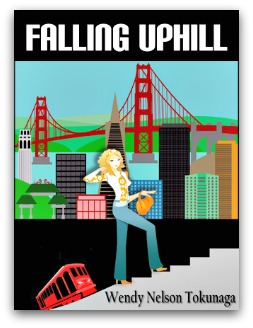
I self-published my first novel, No Kidding, in 2000 with iUniverse. Then I wrote two books for elementary-school students with Kid Haven Press: Famous People: Christine Aguilera (2003) and Wonders of the World: Niagra Falls (2004). Next came two novels that featured Japan, both of which were published by St. Martin’s Griffin: Midori by Moonlight and Love in Translation. And then I self-published three Kindle e-books within the past 12 months: Marriage in Translation: Foreign Wife, Japanese Husband, in 2011; Falling Uphill and His Wife and Daughters, both in 2012.

I suppose you’re working on another book right now?
Yes, a mystery/thriller.

Crossing publishing platforms…

Turning to your three recent books: what made you decide to join the Kindle e-book world?
Falling Uphill was a “trunk novel” I wrote in 2004 that never got published. With the popularity of e-books I decided to revise it a bit and put it out instead of having it gather dust on my hard drive. My agent at the time came close to selling His Wife and Daughters to a major publisher in 2011, but in the end things didn’t work out. I still wanted to bring the book out, so making it available as an e-book seemed like a great idea. I’d gotten a few bites from publishers regarding Marriage in Translation, which was based on a series of blog interviews I’d done of Western women married to Japanese men. But dealing with a publisher would mean the book would take at least a year to come out and would probably need to be longer. I just wanted to get it out as soon as I could to take advantage of the momentum of the blog. Coincidentally, when I was in the finishing stages, the disastrous earthquake and tsunami occurred in Japan. I brought out the book shortly after and for a time gave 50 percent of the proceeds to Japan relief.

Do you think you can reach a different audience through self-publishing?
What’s exciting about e-books is that I can reach an audience! For various reasons, these books wouldn’t have seen the light of day, so I’m happy to continually find readers for them. And, yes, I think I’m reaching a wider geographical audience. And another bonus is that in the e-book world, unlike in the traditional publishing world, the pub date is irrelevant — people can continue to discover my books and I can promote them as summer reads, fall reads or whatever. And e-books don’t ever go “out of print.” I couldn’t be happier with this platform, but it doesn’t mean that I don’t still appreciate traditional publishing and don’t rule out traditional publishing in the future.

Crossing genres…

You got your MFA in creative writing. You also teach and consult on creative writing. What was it like trying your hand at a nonfiction book Marriage in Translation?
These days, non-fiction written in the manner of creative non-fiction and/or narrative non-fiction has lots in common with novels. I think it can be easier for fiction writers to tackle non-fiction, but there might be more challenges for the strictly non-fiction writer to undertake writing fiction.

Why is it so challenging for nonfiction writers to switch over to fiction?
Some — not all — non-fiction writers find it difficult to “make things up” and use their imagination after being so ingrained at using “just the facts.” And, for journalists, I think it can be a challenge to structure a novel that doesn’t reveal everything at once and fight the tendency to go about verifying each point.

Crossing cultures…

Turning to Japan and its influence on your writing. For a while there, Japan was your lodestar. Both Midori by Moonlight and Love in Translation had strong Japanese themes, as does Marriage in Translation. But in your two latest novels your protagonists are all Americans. I’ve read His Wife and Daughters — and enjoyed it very much. There was a scene set in Japan — involving one of the daughters, Phoebe — but otherwise it’s about an American politician who has an affair that causes him to lose his job. I haven’t read Falling Uphill — does it have any Japanese references?
Falling Uphill doesn’t have any Japanese references, at least that I can recall! And in His Wife and Daughters, I thought that for the particular purpose of depicting a certain time in Phoebe’s life that setting it in Tokyo made sense because of the bar hostess culture there. Otherwise, Japan really wouldn’t have played any part in that novel.

Are you moving away from Japan, or will it always be something you write about?
There have been times when I’ve felt that I’ve said all I can say about Japan and need to move on, though it will always be a part of me. I’ve enjoyed writing about Japan and Japanese culture and I even had a Japan-themed short story published in the recent Tomo anthology published by Stone Bridge Press, but I do enjoy writing about topics other than Japan. Yet I am careful to “never say never” about most things.

That said, I think Japanese might enjoy His Wife and Daughters. They have plenty of sex scandals, the most recent one involving the political kingpin Ichiro Ozawa. But in that case, the wife has spoken out — and is trying to poison his career. What was the inspiration behind the book —  do you like politics?
I don’t see His Wife and Daughters as a particularly political book. I was more attracted to the theme of exploring why some women stand by their men in these situations and withstand the humiliation, as well as the fascinating dynamics of a dysfunctional family affected by serial adultery and public scandal.

Crossing art forms…

And now I’ve just got to ask you about your musical career. Are you still pursuing music alongside all this writing?
I’ve been singing and playing music for longer than I’ve been writing. And music is what originally got me to Japan so it’s very important to me. But I don’t have as much time to devote to music right now. My husband and I occasionally play together at home for fun (he plays keyboards), but we haven’t done any gigs for several years. And I wish I had time to keep up with J-pop and enka and go to karaoke! I do manage to catch some music shows via the TV-Japan satellite service, but that’s about it.

Didn’t you and your husband collaborate on a theme song for your book Love in Translation?
Yes we did. That was our last major musical project.

Do you listen to music when you’re writing?
Not usually, but I often have Pandora playing quietly downstairs from my office (the cat likes it!) on a variety of eclectic stations: piano jazz, trip hop, ambient, etc.

Last but not least, I’d like to quiz you about your reading and writing habits:
Last truly great book you read: Gone Girl, by Gillian Flynn
Favorite literary genre: Books that are well written, fast paced and full of surprises.
Reading habits on a plane: I read on my iPad.
The one book you’d require the president to read: He’s so well read that I think he’s way ahead of me.
Favorite books as a child: I especially liked the Edward Eager Magic Series (Half Magic, Magic by the Lake, Seven Day Magic, etc.) as well as The Borrowers series by Mary Norton and The Summer Birds by Penelope Farmer.
Favorite heroine: I always liked books about girls who had special magical powers or mysterious backgrounds.
The writer, dead or alive, you’d most like to meet: I’m constantly networking with fellow writers and have gotten the opportunity to meet with many that I admire, but I suppose it would be quite fascinating to talk with Joan Didion, a writer who definitely excels at both fiction and non-fiction.
Your reading habits: I’m a pretty fast reader. I sometimes take notes and I am mainly reading electronically now. I do find myself constantly analyzing the books I read for craft and structure so it’s sometimes hard to get lost in a good book like I used to be able to back in those Edward Eager days.
Your favorite of your own books: Always the latest one: His Wife and Daughters.
The book of yours you’d most like to see as a film: Any of them!!!
The book you plan to read next: The Expats, by Chris Pavone.

Say, would you do a review for The Displaced Nation on what you think of Chris Pavone’s book?
I’m happy to do a review, but I can’t promise any time soon. I’m in the midst of some very big projects right now. So if there’s not a firm deadline, then I can say yes. 🙂

(See what I mean about how you just can’t keep up with her?) Okay, one final question before I let you go. Since you’ve been so prolific of late, I wonder if you have any advice to impart to other writers who struggle to wrap up their books?
I wish I knew the secret! I’m struggling with my current book and don’t know when the heck I’ll finish it. Writing takes discipline and there’s no magic formula, I’m afraid. And some books come quicker than others.

* * *

Readers, any more questions for Wendy? Please put them in the comments. To reiterate, we are doing a giveaway of one of Wendy’s Kindle e-books to Displaced Dispatch subscribers and to ANYONE WHO COMMENTS! As I can assure you from my own experience, you WANT TO WIN one of these books — they are THE PERFECT SUMMER READS!!!

STAY TUNED for some more fiction tomorrow, with another episode in the life of our fictional expat heroine, Libby. (What, not keeping up with Libby? Read the first three episodes of her expat adventures.)

If you enjoyed this post, we invite you to register for The Displaced Dispatch, a round up of weekly posts from The Displaced Nation, with seasonal recipes, book giveaways and other extras. Register for The Displaced Dispatch by clicking here!

Related posts:

img: Wendy Nelson Tokunaga throwing her considerable energy into yet another round of karaoke…

LIBBY’S LIFE: Oliver’s side of the story

A note from Kate: After the last episode, I thought Oliver should be given a chance to explain things, so this episode is told by the man himself. 

In the last episode, Libby waited up for Oliver, wanting to confront him about her recent discovery. Before she could make her presence known in the darkened house, she heard him on the phone making murmured plans with someone she could only assume was another woman. 

Here he is, at the other woman’s house.

*  *  *

I ring the doorbell, and after a couple of seconds the door opens.

“You took your time,” she says. “It doesn’t take fifteen minutes to get here.”

“Diversion to the liquor store.” I hold out a bottle of Pinot Grigio. “For you.”

I know how to get round women. A good bottle of white never fails.

She takes it from me. “We’ll open that later.”

I follow her along the hall and into the kitchen.

“And Libby doesn’t know you’re here?” she asks. She opens the fridge and puts the wine inside.

“She was asleep. The house was dark. She doesn’t even know I came home.”

“That makes things easier.”

She reaches into a cabinet and gets out two wine glasses, ready for later in the evening.

“Have you eaten tonight?” she asks.

I try to think. To be honest, I’m not sure when I last ate. I tell her this.

She shoots me a disapproving look. “You need to look after yourself, a young strapping man like you. I was about to have a tuna sandwich. Care to join me?”

I hate fish.

“Perfect,” I say.

She starts rattling baking trays and tin openers around, and I lean against the doorjamb, watching her.

“How long have you lived here?” I ask.

She stops banging stuff around long enough to think about the question. “In this house? A couple of years. In Woodhaven? Pretty much since 1976, give or take.”

She opens a tin of tuna and mashes it with mayonnaise. When she finishes with it, it looks like cat food.

“I’m going to make tea,” she says. “Could you get me one of those teapots from that shelf?”

I cross the kitchen and reach up to the high shelf above the window over the sink. “Any particular one?”

“The ginger tabby.”

The shelf is crammed with teapots shaped like cats. I’ve never seen anything so hideous.

“What’s the story with the cats?” I ask. “That’s quite an impressive collection you’ve got there. You must have an eye for antiques.”

Wrong thing to say. She’s not fooled for a minute.

“You’re so full of it,” she says. “They’re awful and you know it.”

She gives me a stern look that makes me feel as if I’m back in my junior school headmistress’s office, hauled onto the carpet for dipping Cheryl Atwood’s ponytail in red paint during art class.

“You’re not going to charm your way into my good books that easily,” Maggie says.

* * *

Oh, come on. Give me some credit. You didn’t think I was going out to meet some fancy woman tonight, did you? I saw Maggie this morning while I was out early walking the dog, and she asked me to come here tonight. Said she had something to tell me, but not to say anything to Libby.

If it was any other old biddy, I’d have told her to keep her nose out, but this is Maggie, and she’s not someone you can just say No to like that. Besides, she’s been good to Libs, so I supposed I owed her this much. And I thought I might get some decent food. Wrong again.

Now I wish I’d gone with my first instincts and told her to mind her own business. I’ve got a feeling that all she wants to do is give me a bollocking.

Can’t blame her, either, to be quite honest. If I’d been a fly on the wall of this house these last couple of months, I’d be thinking, “Oliver, you bastard” too. Any reasonable bloke would just sit down with the wife and try to sort things out, right?

But it’s not as simple as that.

Things never are.

* * *

“About this morning, when I saw you walking Fergus,” Maggie says, when we sit down in her living room, a plate of tuna sandwiches between us on the coffee table.

“What about it?” I ask. The smell of the fish makes me want to throw up.

“I asked you to come round here tonight because Libby told me something that I think you should know.”

I wonder what it could be. Perhaps Libby’s arranged an entire family reunion party at the Holiday Inn.

“And the thing is,” Maggie says, “it’s difficult for me to tell you because I promised her mother I wouldn’t interfere.”

I can’t help it. I snort, although I manage to turn it into a kind of sneeze. Again, Maggie isn’t fooled, and she fixes me with another of her headmistressy stares.

I straighten my face.

“As I was saying,” she continues after a pause, “I did promise her mother I wouldn’t interfere. But it seems that her mother, by not interfering herself, is just as much to blame for the circumstances you and Libby are currently in.”

She puts down her old-lady china plate decorated with gaudy red and orange roses, and starts to pour two cups of tea.

My headmistress never gave me tea after I’d dyed Cheryl’s ponytail.

Maggie passes a cup to me. “More sugar?” she asks.

I sip, then shake my head. This situation is bizarre. I wonder when she’s going to get the cane out. If Maggie ever needs a bit of extra income, she could always go in for private S&M sessions. She’s one scary lady.

She smiles at me. “Good.”

Sips her tea.

“She knows all about it, Oliver.”

The room, still warm from the heat of the day, suddenly feels icy cold.

“Knows what?” I ask, although it’s a rhetorical question. I’m only playing for time, putting off the moment.

“You know what,” Maggie says.

* * *

“I wanted to tell her,” I say after a few minutes have passed. Maggie’s a master in the art of silence, and eventually I had to break it. “But you see…that would have meant breaking a promise to my mother.”

“Tell me.”

“She made me promise I would never tell anyone about what really happened to my father. As far as anyone else was concerned, he ran off with a librarian when I was five.”

“Is your wife ‘anyone else’?”

I open my mouth to answer, “Of course she isn’t” and then stop.

Because if I haven’t told her what really happened to her father-in-law, then that’s what she is, right?

* * *

Most married men have two women in their lives. A wife and a mother. Some manage the two together without any problem.

The others have to make a choice. I thought I’d made my choice the first time I met Libs. She literally took my breath away. Every time I saw her, I had difficulty breathing. She’s the one, I thought.

Now, as Maggie tells me every last thing that Libby has found out from our hitherto unplayed wedding video, I realise I’ve been fooling myself for the last ten years.

More to the point, I’ve been fooling Libby.

.

This was originally published on July 8 at the Woodhaven Happenings site, a blog where you can find extra posts by other Libby’s Life characters. Need reminding of the characters? Check out the Who’s Who.

.

Next post: LIBBY’S LIFE #56 – Falling up

Previous post: LIBBY’S LIFE #55 – Dark Secrets

.

Stay tuned Monday’s guest post by Matt Krause, author of “A Tight Wide-open Space”!

If you enjoyed this post, we invite you to subscribe for email delivery of The Displaced Dispatch, a round up of the week’s posts from The Displaced Nation. Sign up for The Displaced Dispatch by clicking here!

Img: Map of the World – Salvatore Vuono

Culture collision: How American is England?

Last week’s Random Nomad interview with Melissa Stoey spawned a lively discussion on the subject of loving the romantic image of a country — namely England — rather than loving that country “as it is.”

However,  the definition of “as it is” deserves its own debate. During the comments discussion, Melissa pointed us toward two posts on her site, Smitten By Britain: the first, “England Would Not Be England” by British gardening celebrity Alan Titchmarsh, and the second, “What England Is Really Like” by guest poster Tim Gillett, founder of Tourist Tracks.

They make interesting reading. Both are lists of items which in the authors’ opinions are representative of England, and yet, comparing the two lists, you could be forgiven for thinking they referred to different countries on opposite sides of the globe.

Titchmarsh’s version conjured up a gentle, genteel picture of eating cucumber sandwiches by a croquet lawn; indeed, his list included cucumber sandwiches (although not croquet.)  Gillett’s list brought to mind a less poetic image of England: a picture of stuffing your face with doner kebabs in the High Street on Saturday nights, while stepping over puddles of lager-infused vomit.

Perception — or memory — of a country?

The thing is, though, there’s little I’d disagree with on either list. Maybe the “knotted hankies” on Titchmarsh’s list belong to the seaside excursions of fifty years ago, when Titchmarsh himself was a youngster. Then again — how many Ford Cortinas, an item on Gillett’s list, are still driving around in the UK? 1,317, according to the data on howmanyleft.co.uk., so they’re not such an everyday sight as they were twenty years ago.

No doubt age plays a part. I don’t know how old Mr Gillett is, but I’m hazarding a wild guess that he’s younger than Alan Titchmarsh, who turned 63 in May. From my own experience of reverse culture shock, I know that current perception is often confused by past recollection — my fond imaginings of England are rooted somewhere around the time when people wore Walkmans and acid-wash jeans.

But what really is “Typically English”?

What really struck me about the list by Tim Gillett, however, was the number of items that, while English, could also typify other countries. Titchmarsh’s list, for the main part, was stoically English, with the inclusion of Jane Austen, The National Trust, The Beano, Chatsworth, and Blackpool rock. Whether or not you agree that they are important or representative of England, they are nevertheless unique to that country.

Gillett’s list, on the other hand, had items such as “Misogyny”, “Reality TV”,  and “Appalling public transport” — all of which could be placed on a list to typify America, when you consider the current abortion rights battles, the Kardashians, and the lack of buses everywhere. “‘Baby on Board‘ and other pointless car stickers”? Yes; and try the little stick figure families stuck on the rear window of every soccer mom’s SUV. “Almost everyone believing what they read in the papers”? Fox News. “Visible thongs”? OK, you’ve got me there — I’m hoping they will soon be a thing of the American past thanks to this tasteful little invention being sold on TV.

Coloring outside the cultural lines

What I’m saying here is not that Tim Gillett, in his funny, wry list, has come up with suggestions that are too general to be exclusively English (he also includes “EastEnders“, “Local pubs and real ale”, “Wayne Rooney“, and something so obviously English and cringeworthy I can’t believe I’ve never thought about it: “Ill-fitting brassieres”) but that cultural borders are gradually smudging.

I would love to know what a similar list would look like in another twenty years — so, please, let’s have your suggestions for how the American and English cultures will differ or be the same when the 2032 Olympics roll around!

.

 
STAY TUNED for Monday’s Displaced Q!

If you enjoyed this post, we invite you to subscribe for email delivery of The Displaced Dispatch, a round up of the week’s posts from The Displaced Nation. Sign up for The Displaced Dispatch by clicking here!

LIBBY’S LIFE #55 – Dark secrets

A note before Libby begins her journal entry: If you’re a Libby addict, check out Woodhaven Happenings, where from time to time you will find more posts from other characters. The latest is a post from Maggie, describing her side of the story of last week’s meeting with Libby. Want to remind yourself of Who’s Who in Woodhaven? Click here for the cast list!

*  *  *

The babies are in bed. They have been bathed, fed, patted, soothed, and tucked up for the night. After protesting at similar treatment at a too-early hour, Jack is also away for the night.

I sit in the gradually darkening den, watching the sun set behind the trees in the back yard, and wait for Oliver. This is the room he usually heads for when he comes through the door. The temptation to turn on the TV is great, but I resist, knowing I need to channel my thoughts and energy into the inevitable scene that lies ahead tonight, not into another episode of How I Met Your Mother. Also, if I am quiet, I will be able to hear him arrive home.

Oliver’s evening arrivals have been getting later and later. When I comment, mildly, upon this — I never question — he replies in a tone that indicates it’s hardly worth him opening his mouth. “Work,” he says. “Overtime.” “Customer with a problem.”

“What about a wife with a problem?” I want to scream. “Don’t I deserve some of your overtime too?”

But I never do. I’m my mother’s daughter, after all. After the brief interlude here when she abandoned her role as Dutiful Wife To Keith in favour of Fun-Loving Single Woman For Now, she’s back to tiptoeing around the house and fetching Dad his warmed slippers. She gave me the hint about Oliver’s parentage, but I can’t work out what I was supposed to do with the information. Silently store it and sympathise with Oliver, I think she meant.

Thankfully, I have another mother who is not afraid of sticking an oar in when necessary, even if it means breaking a promise to not interfere.

“I used to interfere,” Maggie said, after she had hauled me, the children, and Fergus back to her house earlier today. “All the time. Making that promise to your mother not to get involved nearly killed me.”

“But you decided to go ahead and get involved anyway.”

“You’re like a daughter,” Maggie said, “the daughter I haven’t had for twenty-five years. I could no more stand by and watch you fall to pieces than I was able to watch Sara.”

Maggie sat in her wooden rocking chair, gazing out of the window at the maple tree in the yard. Her eyes were open very wide, as people’s are when they are trying to make tears disobey gravity. Half of me wanted to ask more about the mysterious daughter, but the other half didn’t want to rake over old memories for Maggie.

Also — I have to be honest — I was more intent on getting my own life straightened out. Whatever happened to Maggie and her daughter twenty-five years ago has little to do with what is going on now between me and Oliver.

“What shall I do?” I asked her instead. “How do I talk to a man who won’t talk back?”

Maggie turned slightly, blinking.

“I can’t tell you that,” she said. “You know your own husband. At least, you thought you did. But however you do it, you have to keep telling yourself that you deserve better than this.”

I didn’t dare ask her what she meant by that.

* * *

The sun has been below the horizon for fifteen minutes now, and an occasional firefly flickers among the rhododendrons. The den is completely dark. Oliver is still not home. I curl up on the sofa without bothering to turn on the lamp beside me, and rehearse tonight’s conversation in my head. It’s difficult, of course, because in this imaginary exchange Oliver answers the way I would like him to. We have a reasoned, adult conversation, resulting in a reasoned, adult compromise. He does not mutter monosyllables, or stomp upstairs to the guest bedroom where he has taken to sleeping under the pretext of not getting enough sleep in the same room as the twins, who supposedly wake him up every time they murmur in the night.

I hear the rattle of the garage door and the hum of the car engine as it pulls into the parking bay. The back door opens, then closes again. Oliver’s uncertain footsteps into the unlit kitchen, heading into the hall, then back into the kitchen. Apart from a nightlight glowing on the landing upstairs, the house is in darkness.

Oliver’s footsteps stop. I hear the fridge door open, and the faint light from the fridge interior illuminates the hallway outside the den. Funny how a small light can make such a difference in a dark house. I am reminded of my grandfather’s stories of German air raids and belligerent blackout wardens.

The fridge door closes, the light goes off.

The pop and hiss of a Coke can top, some glugs. A stifled belch.

Another noise. Beeps — ten of them.

I stiffen, listening hard.

Then a quiet voice from the kitchen, speaking into a cellphone.

“Hey. It’s Oliver.” Silence, broken by the tossing of an empty Coke can into the recycling bin. “Change of plan. I can see you now…Yeah, no problem. She’s in bed. I’ll be there in fifteen minutes.”

The back door opens and closes, the garage door rattles open, and the car engine hums again as Oliver reverses onto the driveway.

I stay where I am, motionless, and watch the fireflies for a long time.

.

Next post: LIBBY’S LIFE: Oliver’s side of the story

Previous post: LIBBY’S LIFE #54 – Opening the cocoon 

Need the 411 on characters in Libby’s Life? Click here for  Kate’s page  of Who’s Who in Woodhaven.

Click here to read Libby’s Life from the first episode.


STAY TUNED for Monday’s post.

If you enjoyed this post, we invite you to subscribe for email delivery of The Displaced Dispatch, a round up of the week’s posts from The Displaced Nation. Sign up for The Displaced Dispatch by clicking here!

Image: Travel – Map of the World by Salvatore Vuono / FreeDigit