The Displaced Nation

A home for international creatives

Tag Archives: Expat novelists

Trying — but failing — to keep up with Wendy Nelson Tokunaga, Olympic e-book author and karaoke star

**Announcing a giveaway of one of Wendy Nelson Tokunaga’s Kindle e-books. open to DISPLACED DISPATCH SUBSCRIBERS  & ANYONE WHO COMMENTS. And guess what? You get to take your pick! Woo hoo!!**

During this summer’s London Olympics there will be endless displays of speed grace, strength, masochism, endurance, pain, and perseverance.

Just the the thought of it makes me feel exhausted and a little bit nauseous.

But I don’t necessarily have to look toward the Orbit (I refer to the “eyeful tower” that looms over London’s Olympic Stadium) to feel that way. Instead I can direct my weary gaze towards the Golden Gate Bridge, near to where the once-displaced Wendy Nelson Tokunaga resides.

Tokunaga was a special guest at The Displaced Nation before as one of our 12 Nomads of Christmas. We have invited her back today to showcase what it means to be an “Olympian author.” She has just completed the marathon-like feat of publishing three e-books — two novels and one work of nonfiction — in a period of 12 months.

Has she tired you out yet?

I ask because that’s not the whole story. A talented writer, Tokunaga is what the Japanese call a talento: she can sing jazz as well as j-pop and enka (a type of sentimental ballad). Put it this way: you do not want to compete with her in a karaoke contest!

If you don’t believe me, listen to her singing this enka she composed for one of her novels — you would never know that Tokunaga is a native-born Californian who’d spent time in Japan!

Just one of the many reasons why you’ll never keep up with her…or if you dare to try, you’ll be huffing and puffing, just as I am. (Why oh why did I agree to sing a few bars of “My Way” with her?)

* * *

[Catching my breath…] Thank you, Wendy, for agreeing to this interview with The Displaced Nation. While I rest for a bit, can you tell me a little more about yourself — where you were born and how you ended up living in Japan?
I was born in San Francisco and have lived in the Bay Area all my life except for when I lived in Tokyo during the early 1980s. I had been studying Japanese language and culture at San Francisco State University when I won a prize in a songwriting contest sponsored by Japan Victor Records. It allowed me to perform my song at Nakano Sun Plaza in Tokyo. After that I moved to Japan to pursue music, teach English and do narration work.

While I’m still catching my breath — let’s hope I don’t have a heart attack here — why don’t you tell us about all your books? I understand you’ve published eight of them in the past 12 years, of which three of them came out in the past 12 months?
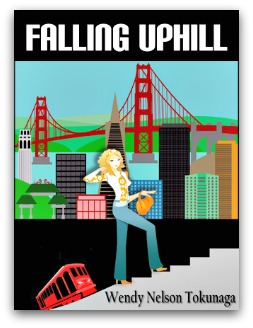
I self-published my first novel, No Kidding, in 2000 with iUniverse. Then I wrote two books for elementary-school students with Kid Haven Press: Famous People: Christine Aguilera (2003) and Wonders of the World: Niagra Falls (2004). Next came two novels that featured Japan, both of which were published by St. Martin’s Griffin: Midori by Moonlight and Love in Translation. And then I self-published three Kindle e-books within the past 12 months: Marriage in Translation: Foreign Wife, Japanese Husband, in 2011; Falling Uphill and His Wife and Daughters, both in 2012.

I suppose you’re working on another book right now?
Yes, a mystery/thriller.

Crossing publishing platforms…

Turning to your three recent books: what made you decide to join the Kindle e-book world?
Falling Uphill was a “trunk novel” I wrote in 2004 that never got published. With the popularity of e-books I decided to revise it a bit and put it out instead of having it gather dust on my hard drive. My agent at the time came close to selling His Wife and Daughters to a major publisher in 2011, but in the end things didn’t work out. I still wanted to bring the book out, so making it available as an e-book seemed like a great idea. I’d gotten a few bites from publishers regarding Marriage in Translation, which was based on a series of blog interviews I’d done of Western women married to Japanese men. But dealing with a publisher would mean the book would take at least a year to come out and would probably need to be longer. I just wanted to get it out as soon as I could to take advantage of the momentum of the blog. Coincidentally, when I was in the finishing stages, the disastrous earthquake and tsunami occurred in Japan. I brought out the book shortly after and for a time gave 50 percent of the proceeds to Japan relief.

Do you think you can reach a different audience through self-publishing?
What’s exciting about e-books is that I can reach an audience! For various reasons, these books wouldn’t have seen the light of day, so I’m happy to continually find readers for them. And, yes, I think I’m reaching a wider geographical audience. And another bonus is that in the e-book world, unlike in the traditional publishing world, the pub date is irrelevant — people can continue to discover my books and I can promote them as summer reads, fall reads or whatever. And e-books don’t ever go “out of print.” I couldn’t be happier with this platform, but it doesn’t mean that I don’t still appreciate traditional publishing and don’t rule out traditional publishing in the future.

Crossing genres…

You got your MFA in creative writing. You also teach and consult on creative writing. What was it like trying your hand at a nonfiction book Marriage in Translation?
These days, non-fiction written in the manner of creative non-fiction and/or narrative non-fiction has lots in common with novels. I think it can be easier for fiction writers to tackle non-fiction, but there might be more challenges for the strictly non-fiction writer to undertake writing fiction.

Why is it so challenging for nonfiction writers to switch over to fiction?
Some — not all — non-fiction writers find it difficult to “make things up” and use their imagination after being so ingrained at using “just the facts.” And, for journalists, I think it can be a challenge to structure a novel that doesn’t reveal everything at once and fight the tendency to go about verifying each point.

Crossing cultures…

Turning to Japan and its influence on your writing. For a while there, Japan was your lodestar. Both Midori by Moonlight and Love in Translation had strong Japanese themes, as does Marriage in Translation. But in your two latest novels your protagonists are all Americans. I’ve read His Wife and Daughters — and enjoyed it very much. There was a scene set in Japan — involving one of the daughters, Phoebe — but otherwise it’s about an American politician who has an affair that causes him to lose his job. I haven’t read Falling Uphill — does it have any Japanese references?
Falling Uphill doesn’t have any Japanese references, at least that I can recall! And in His Wife and Daughters, I thought that for the particular purpose of depicting a certain time in Phoebe’s life that setting it in Tokyo made sense because of the bar hostess culture there. Otherwise, Japan really wouldn’t have played any part in that novel.

Are you moving away from Japan, or will it always be something you write about?
There have been times when I’ve felt that I’ve said all I can say about Japan and need to move on, though it will always be a part of me. I’ve enjoyed writing about Japan and Japanese culture and I even had a Japan-themed short story published in the recent Tomo anthology published by Stone Bridge Press, but I do enjoy writing about topics other than Japan. Yet I am careful to “never say never” about most things.

That said, I think Japanese might enjoy His Wife and Daughters. They have plenty of sex scandals, the most recent one involving the political kingpin Ichiro Ozawa. But in that case, the wife has spoken out — and is trying to poison his career. What was the inspiration behind the book —  do you like politics?
I don’t see His Wife and Daughters as a particularly political book. I was more attracted to the theme of exploring why some women stand by their men in these situations and withstand the humiliation, as well as the fascinating dynamics of a dysfunctional family affected by serial adultery and public scandal.

Crossing art forms…

And now I’ve just got to ask you about your musical career. Are you still pursuing music alongside all this writing?
I’ve been singing and playing music for longer than I’ve been writing. And music is what originally got me to Japan so it’s very important to me. But I don’t have as much time to devote to music right now. My husband and I occasionally play together at home for fun (he plays keyboards), but we haven’t done any gigs for several years. And I wish I had time to keep up with J-pop and enka and go to karaoke! I do manage to catch some music shows via the TV-Japan satellite service, but that’s about it.

Didn’t you and your husband collaborate on a theme song for your book Love in Translation?
Yes we did. That was our last major musical project.

Do you listen to music when you’re writing?
Not usually, but I often have Pandora playing quietly downstairs from my office (the cat likes it!) on a variety of eclectic stations: piano jazz, trip hop, ambient, etc.

Last but not least, I’d like to quiz you about your reading and writing habits:
Last truly great book you read: Gone Girl, by Gillian Flynn
Favorite literary genre: Books that are well written, fast paced and full of surprises.
Reading habits on a plane: I read on my iPad.
The one book you’d require the president to read: He’s so well read that I think he’s way ahead of me.
Favorite books as a child: I especially liked the Edward Eager Magic Series (Half Magic, Magic by the Lake, Seven Day Magic, etc.) as well as The Borrowers series by Mary Norton and The Summer Birds by Penelope Farmer.
Favorite heroine: I always liked books about girls who had special magical powers or mysterious backgrounds.
The writer, dead or alive, you’d most like to meet: I’m constantly networking with fellow writers and have gotten the opportunity to meet with many that I admire, but I suppose it would be quite fascinating to talk with Joan Didion, a writer who definitely excels at both fiction and non-fiction.
Your reading habits: I’m a pretty fast reader. I sometimes take notes and I am mainly reading electronically now. I do find myself constantly analyzing the books I read for craft and structure so it’s sometimes hard to get lost in a good book like I used to be able to back in those Edward Eager days.
Your favorite of your own books: Always the latest one: His Wife and Daughters.
The book of yours you’d most like to see as a film: Any of them!!!
The book you plan to read next: The Expats, by Chris Pavone.

Say, would you do a review for The Displaced Nation on what you think of Chris Pavone’s book?
I’m happy to do a review, but I can’t promise any time soon. I’m in the midst of some very big projects right now. So if there’s not a firm deadline, then I can say yes. 🙂

(See what I mean about how you just can’t keep up with her?) Okay, one final question before I let you go. Since you’ve been so prolific of late, I wonder if you have any advice to impart to other writers who struggle to wrap up their books?
I wish I knew the secret! I’m struggling with my current book and don’t know when the heck I’ll finish it. Writing takes discipline and there’s no magic formula, I’m afraid. And some books come quicker than others.

* * *

Readers, any more questions for Wendy? Please put them in the comments. To reiterate, we are doing a giveaway of one of Wendy’s Kindle e-books to Displaced Dispatch subscribers and to ANYONE WHO COMMENTS! As I can assure you from my own experience, you WANT TO WIN one of these books — they are THE PERFECT SUMMER READS!!!

STAY TUNED for some more fiction tomorrow, with another episode in the life of our fictional expat heroine, Libby. (What, not keeping up with Libby? Read the first three episodes of her expat adventures.)

If you enjoyed this post, we invite you to register for The Displaced Dispatch, a round up of weekly posts from The Displaced Nation, with seasonal recipes, book giveaways and other extras. Register for The Displaced Dispatch by clicking here!

Related posts:

img: Wendy Nelson Tokunaga throwing her considerable energy into yet another round of karaoke…

LIBBY’S LIFE: Oliver’s side of the story

A note from Kate: After the last episode, I thought Oliver should be given a chance to explain things, so this episode is told by the man himself. 

In the last episode, Libby waited up for Oliver, wanting to confront him about her recent discovery. Before she could make her presence known in the darkened house, she heard him on the phone making murmured plans with someone she could only assume was another woman. 

Here he is, at the other woman’s house.

*  *  *

I ring the doorbell, and after a couple of seconds the door opens.

“You took your time,” she says. “It doesn’t take fifteen minutes to get here.”

“Diversion to the liquor store.” I hold out a bottle of Pinot Grigio. “For you.”

I know how to get round women. A good bottle of white never fails.

She takes it from me. “We’ll open that later.”

I follow her along the hall and into the kitchen.

“And Libby doesn’t know you’re here?” she asks. She opens the fridge and puts the wine inside.

“She was asleep. The house was dark. She doesn’t even know I came home.”

“That makes things easier.”

She reaches into a cabinet and gets out two wine glasses, ready for later in the evening.

“Have you eaten tonight?” she asks.

I try to think. To be honest, I’m not sure when I last ate. I tell her this.

She shoots me a disapproving look. “You need to look after yourself, a young strapping man like you. I was about to have a tuna sandwich. Care to join me?”

I hate fish.

“Perfect,” I say.

She starts rattling baking trays and tin openers around, and I lean against the doorjamb, watching her.

“How long have you lived here?” I ask.

She stops banging stuff around long enough to think about the question. “In this house? A couple of years. In Woodhaven? Pretty much since 1976, give or take.”

She opens a tin of tuna and mashes it with mayonnaise. When she finishes with it, it looks like cat food.

“I’m going to make tea,” she says. “Could you get me one of those teapots from that shelf?”

I cross the kitchen and reach up to the high shelf above the window over the sink. “Any particular one?”

“The ginger tabby.”

The shelf is crammed with teapots shaped like cats. I’ve never seen anything so hideous.

“What’s the story with the cats?” I ask. “That’s quite an impressive collection you’ve got there. You must have an eye for antiques.”

Wrong thing to say. She’s not fooled for a minute.

“You’re so full of it,” she says. “They’re awful and you know it.”

She gives me a stern look that makes me feel as if I’m back in my junior school headmistress’s office, hauled onto the carpet for dipping Cheryl Atwood’s ponytail in red paint during art class.

“You’re not going to charm your way into my good books that easily,” Maggie says.

* * *

Oh, come on. Give me some credit. You didn’t think I was going out to meet some fancy woman tonight, did you? I saw Maggie this morning while I was out early walking the dog, and she asked me to come here tonight. Said she had something to tell me, but not to say anything to Libby.

If it was any other old biddy, I’d have told her to keep her nose out, but this is Maggie, and she’s not someone you can just say No to like that. Besides, she’s been good to Libs, so I supposed I owed her this much. And I thought I might get some decent food. Wrong again.

Now I wish I’d gone with my first instincts and told her to mind her own business. I’ve got a feeling that all she wants to do is give me a bollocking.

Can’t blame her, either, to be quite honest. If I’d been a fly on the wall of this house these last couple of months, I’d be thinking, “Oliver, you bastard” too. Any reasonable bloke would just sit down with the wife and try to sort things out, right?

But it’s not as simple as that.

Things never are.

* * *

“About this morning, when I saw you walking Fergus,” Maggie says, when we sit down in her living room, a plate of tuna sandwiches between us on the coffee table.

“What about it?” I ask. The smell of the fish makes me want to throw up.

“I asked you to come round here tonight because Libby told me something that I think you should know.”

I wonder what it could be. Perhaps Libby’s arranged an entire family reunion party at the Holiday Inn.

“And the thing is,” Maggie says, “it’s difficult for me to tell you because I promised her mother I wouldn’t interfere.”

I can’t help it. I snort, although I manage to turn it into a kind of sneeze. Again, Maggie isn’t fooled, and she fixes me with another of her headmistressy stares.

I straighten my face.

“As I was saying,” she continues after a pause, “I did promise her mother I wouldn’t interfere. But it seems that her mother, by not interfering herself, is just as much to blame for the circumstances you and Libby are currently in.”

She puts down her old-lady china plate decorated with gaudy red and orange roses, and starts to pour two cups of tea.

My headmistress never gave me tea after I’d dyed Cheryl’s ponytail.

Maggie passes a cup to me. “More sugar?” she asks.

I sip, then shake my head. This situation is bizarre. I wonder when she’s going to get the cane out. If Maggie ever needs a bit of extra income, she could always go in for private S&M sessions. She’s one scary lady.

She smiles at me. “Good.”

Sips her tea.

“She knows all about it, Oliver.”

The room, still warm from the heat of the day, suddenly feels icy cold.

“Knows what?” I ask, although it’s a rhetorical question. I’m only playing for time, putting off the moment.

“You know what,” Maggie says.

* * *

“I wanted to tell her,” I say after a few minutes have passed. Maggie’s a master in the art of silence, and eventually I had to break it. “But you see…that would have meant breaking a promise to my mother.”

“Tell me.”

“She made me promise I would never tell anyone about what really happened to my father. As far as anyone else was concerned, he ran off with a librarian when I was five.”

“Is your wife ‘anyone else’?”

I open my mouth to answer, “Of course she isn’t” and then stop.

Because if I haven’t told her what really happened to her father-in-law, then that’s what she is, right?

* * *

Most married men have two women in their lives. A wife and a mother. Some manage the two together without any problem.

The others have to make a choice. I thought I’d made my choice the first time I met Libs. She literally took my breath away. Every time I saw her, I had difficulty breathing. She’s the one, I thought.

Now, as Maggie tells me every last thing that Libby has found out from our hitherto unplayed wedding video, I realise I’ve been fooling myself for the last ten years.

More to the point, I’ve been fooling Libby.

.

This was originally published on July 8 at the Woodhaven Happenings site, a blog where you can find extra posts by other Libby’s Life characters. Need reminding of the characters? Check out the Who’s Who.

.

Next post: LIBBY’S LIFE #56 – Falling up

Previous post: LIBBY’S LIFE #55 – Dark Secrets

.

Stay tuned Monday’s guest post by Matt Krause, author of “A Tight Wide-open Space”!

If you enjoyed this post, we invite you to subscribe for email delivery of The Displaced Dispatch, a round up of the week’s posts from The Displaced Nation. Sign up for The Displaced Dispatch by clicking here!

Img: Map of the World – Salvatore Vuono

LIBBY’S LIFE #55 – Dark secrets

A note before Libby begins her journal entry: If you’re a Libby addict, check out Woodhaven Happenings, where from time to time you will find more posts from other characters. The latest is a post from Maggie, describing her side of the story of last week’s meeting with Libby. Want to remind yourself of Who’s Who in Woodhaven? Click here for the cast list!

*  *  *

The babies are in bed. They have been bathed, fed, patted, soothed, and tucked up for the night. After protesting at similar treatment at a too-early hour, Jack is also away for the night.

I sit in the gradually darkening den, watching the sun set behind the trees in the back yard, and wait for Oliver. This is the room he usually heads for when he comes through the door. The temptation to turn on the TV is great, but I resist, knowing I need to channel my thoughts and energy into the inevitable scene that lies ahead tonight, not into another episode of How I Met Your Mother. Also, if I am quiet, I will be able to hear him arrive home.

Oliver’s evening arrivals have been getting later and later. When I comment, mildly, upon this — I never question — he replies in a tone that indicates it’s hardly worth him opening his mouth. “Work,” he says. “Overtime.” “Customer with a problem.”

“What about a wife with a problem?” I want to scream. “Don’t I deserve some of your overtime too?”

But I never do. I’m my mother’s daughter, after all. After the brief interlude here when she abandoned her role as Dutiful Wife To Keith in favour of Fun-Loving Single Woman For Now, she’s back to tiptoeing around the house and fetching Dad his warmed slippers. She gave me the hint about Oliver’s parentage, but I can’t work out what I was supposed to do with the information. Silently store it and sympathise with Oliver, I think she meant.

Thankfully, I have another mother who is not afraid of sticking an oar in when necessary, even if it means breaking a promise to not interfere.

“I used to interfere,” Maggie said, after she had hauled me, the children, and Fergus back to her house earlier today. “All the time. Making that promise to your mother not to get involved nearly killed me.”

“But you decided to go ahead and get involved anyway.”

“You’re like a daughter,” Maggie said, “the daughter I haven’t had for twenty-five years. I could no more stand by and watch you fall to pieces than I was able to watch Sara.”

Maggie sat in her wooden rocking chair, gazing out of the window at the maple tree in the yard. Her eyes were open very wide, as people’s are when they are trying to make tears disobey gravity. Half of me wanted to ask more about the mysterious daughter, but the other half didn’t want to rake over old memories for Maggie.

Also — I have to be honest — I was more intent on getting my own life straightened out. Whatever happened to Maggie and her daughter twenty-five years ago has little to do with what is going on now between me and Oliver.

“What shall I do?” I asked her instead. “How do I talk to a man who won’t talk back?”

Maggie turned slightly, blinking.

“I can’t tell you that,” she said. “You know your own husband. At least, you thought you did. But however you do it, you have to keep telling yourself that you deserve better than this.”

I didn’t dare ask her what she meant by that.

* * *

The sun has been below the horizon for fifteen minutes now, and an occasional firefly flickers among the rhododendrons. The den is completely dark. Oliver is still not home. I curl up on the sofa without bothering to turn on the lamp beside me, and rehearse tonight’s conversation in my head. It’s difficult, of course, because in this imaginary exchange Oliver answers the way I would like him to. We have a reasoned, adult conversation, resulting in a reasoned, adult compromise. He does not mutter monosyllables, or stomp upstairs to the guest bedroom where he has taken to sleeping under the pretext of not getting enough sleep in the same room as the twins, who supposedly wake him up every time they murmur in the night.

I hear the rattle of the garage door and the hum of the car engine as it pulls into the parking bay. The back door opens, then closes again. Oliver’s uncertain footsteps into the unlit kitchen, heading into the hall, then back into the kitchen. Apart from a nightlight glowing on the landing upstairs, the house is in darkness.

Oliver’s footsteps stop. I hear the fridge door open, and the faint light from the fridge interior illuminates the hallway outside the den. Funny how a small light can make such a difference in a dark house. I am reminded of my grandfather’s stories of German air raids and belligerent blackout wardens.

The fridge door closes, the light goes off.

The pop and hiss of a Coke can top, some glugs. A stifled belch.

Another noise. Beeps — ten of them.

I stiffen, listening hard.

Then a quiet voice from the kitchen, speaking into a cellphone.

“Hey. It’s Oliver.” Silence, broken by the tossing of an empty Coke can into the recycling bin. “Change of plan. I can see you now…Yeah, no problem. She’s in bed. I’ll be there in fifteen minutes.”

The back door opens and closes, the garage door rattles open, and the car engine hums again as Oliver reverses onto the driveway.

I stay where I am, motionless, and watch the fireflies for a long time.

.

Next post: LIBBY’S LIFE: Oliver’s side of the story

Previous post: LIBBY’S LIFE #54 – Opening the cocoon 

Need the 411 on characters in Libby’s Life? Click here for  Kate’s page  of Who’s Who in Woodhaven.

Click here to read Libby’s Life from the first episode.


STAY TUNED for Monday’s post.

If you enjoyed this post, we invite you to subscribe for email delivery of The Displaced Dispatch, a round up of the week’s posts from The Displaced Nation. Sign up for The Displaced Dispatch by clicking here!

Image: Travel – Map of the World by Salvatore Vuono / FreeDigit

LIBBY’S LIFE #54 – Opening the cocoon

There’s probably a word for it in the Complete Oxford English Dictionary. An obscure word that only makes an appearance on Radio 4 intellectual game shows. Something like:

Tri-gami-matri-taci-filial (noun, Old English) — the silence of a son regarding his mother’s marriage to a serial bigamist after the father’s third marriage.

Then people like Stephen Fry and Paul Merton would make clever, rude jokes about this word, and you’d wonder why the English language possessed such an item, because such a situation was unlikely to exist.

Except the situation does exist, and consequently I’d like to know the word that has this definition:

“The pissed-off feeling after realising that your husband of nearly seven years has accidentally-on-purpose forgotten to tell you that his estranged father was a serial bigamist and didn’t run off with a local librarian like he and your mother-in-law had always led you to believe.”

I mean, it’s not as if it would have mattered, is it? If Oliver had told me on our second date, “Oh, by the way, Libs, I didn’t grow up with a father because my mum found out that he was married to a couple of other women at the same time” — I would hardly have stomped out of the restaurant before he could ask me out on a third date.

Did he really think I would have said, “God, Oliver, I’m glad you came clean with me now because obviously, there is no way I could marry the spawn of such pond slime”?

I know what you’re thinking. If it wouldn’t have been such a big deal on our second date, why am I making a fuss now?

Because it’s gone past the point of being an unfortunate fact about Oliver’s ancestry. Ten years ago, before our engagement, I could have processed the knowledge and said, “Poor Oliver. Your poor mum. What a terrible thing to happen.”

Now, although I still think that way, pity has been overtaken by hurt that Oliver couldn’t see fit to tell me.

I am being treated like the criminal, but why? The real criminal is Oliver. He has known about this all along, and in the ten years we have known each other, has never told me this story, although it’s obvious that he knew. Why did he not feel he could tell me, his girlfriend, his fiancé, his wife, his soulmate? Has he so little faith in me? I feel bereft, my faith in Oliver plundered.

But self-pity inevitably mutates into anger.

Today, I am angry, and everyone knows it.

Well, nearly everyone. Jack knows it, George knows it, and Beth knows it. The only person who is oblivious is Oliver himself, the object of my anger, and as usual he’s out, avoiding the issue. Avoiding me.

Meanwhile, rage swirls around my head and seeps out through my ears, filling the house with noxious atmosphere.

I’ve been passive too long.

I gather up the twins and strap them into the double stroller. Jack peeps cautiously at me from behind the sofa where he is quietly playing with Lego bricks.

“Put your sneakers on,” I say. “We’re going out.”

*  *  *

It’s a long time since we’ve been out.  Nursery school has finished for the summer. After the first couple of weeks when the Coffee Morning Posse delivered freezer casserole after freezer casserole, no one has been to visit — not even Maggie. I suppose they think I’ve got enough to do without catering to visitors. Even my mother has been quiet, phoning only once since she got back home. For the last few weeks, I’ve holed myself up in the house, seeing no one, ordering groceries online, too depressed and timid to put a foot outside.

But today is a beautiful, sunny day, my anger is invigorating, and I’m tired of being a hermit. I make Jack hold the handle of the stroller, loop Fergus’s leash round my wrist, and off we set, along Juniper Close.  We are walking to Main Street, to a place of busy-ness, to be with other people who will only coo at my babies and won’t see the rage and hurt in the back story.

Fergus, however, has other ideas. He crosses the street docilely enough, but as we turn right towards the road that leads to Main Street, however, he lags behind and his leash pulls on my wrist. He wants to go the other way.

I tug on the leash. He sits. I tug again. He lies down.

It’s an impasse. Fergus and I stare at each other. He usually wins these stare-down contests, but I’m in no mood for defeat. Today, I’m determined to win, so I don’t break my gaze, not even when I hear footsteps on the sidewalk behind me. Whoever it is can step onto the road and walk around us.

The footsteps slow, then stop.

“We first met,” I hear Maggie say, “when there was another drama going on between you and this dog. I haven’t seen you out with these children for weeks. Were you coming to see me?”

I continue to stare at Fergus so I don’t have to meet Maggie’s eyes. She’s right. I haven’t seen her since the twins were a couple of weeks old. How time flies when you’re having fun.

“If I hadn’t seen you today,” she goes on, “I’d have come to visit. I don’t like to intrude, but…”

“It’s been difficult,” I mutter. “The twins — they’re a lot of work.”

“I’m sure they are,” she says. “And from what I hear, so is your husband.”

She has my attention now.

“How do you know?” I demand. “What do you know?”

Maggie places a hand on my forearm and takes Fergus’s leash from my wrist. She gives the leash a gentle shake, and he gets up to stand by her, as docile as you please.

“Your mother and I became pretty good friends while she was here, you know. We made an agreement. I would be there for her daughter in America, and if the need ever arises, she will be there for mine in England.”

Mums’ Army. The Maternal Foreign Legion.

“Come on, Jack,” Maggie says, taking his hand. “Back to Granny Maggie’s house.”

With difficulty, I turn the wide stroller around to face the other direction.

“‘Granny Maggie’?” I ask. “Does that make you my mother, then?”

Maggie smiles, just a little.

“The next best thing on this side of the ocean,” she says.

.

Next post: LIBBY’S LIFE # 55 – Dark secrets

Previous post: LIBBY’S LIFE #53 – Preserved on tape 

Need the 411 on characters in Libby’s Life? Click here for  Kate’s page  of Who’s Who in Woodhaven.

Click here to read Libby’s Life from the first episode.


STAY TUNED for Monday’s post — a Dolce Vita Slideshow!

If you enjoyed this post, we invite you to subscribe for email delivery of The Displaced Dispatch, a round up of the week’s posts from The Displaced Nation. Sign up for The Displaced Dispatch by clicking here!

Image: Travel – Map of the World by Salvatore Vuono / FreeDigit

LIBBY’S LIFE #53 – Preserved on tape

I stare at the dark computer screen, wondering if my overactive imagination is misleading me.

Only one way to find out. An imagination doesn’t mislead twice. Not in the face of hard facts from a digital camera.

I hit “Play” on the screen again, and scroll through our unedited wedding footage until the time elapsed says 1 hour, 25 minutes.

Act 1:

The evening party at our wedding. To the left of the stage where the band is playing a particularly sickly version of  Stevie Wonder’s “I just called to say I love you” (look, my dad booked the band, OK?) a large clock on the wall shows the time to be 9:40.

At 9:40pm on our wedding day, Oliver and I were on the other side of London, in the bar at the Heathrow Hilton, ready for our flight to Ibiza the next morning.

This is all the stuff that happened after we left our party. It’s fascinating and morbid at the same time. Like watching your own funeral.

No one appreciates the band’s rendition of Stevie Wonder, and the only person on the dance floor is a little girl in a pink frothy frock — the daughter of Mum’s cousin. Yasmin, her name is. She  twirls around in circles, round and round and round again, until she is dizzy and falls down, laughing up at the camera. The camera zooms out, and to the right of the dance floor reveals a cluster of small, circular tables, covered with empty glasses and plates of half-eaten vol-au-vents. We were supposed to have had wait staff all night at the reception, but apparently they disappeared as soon as the Adorable Couple had left the bash.

At one of the small tables, on her own and nursing a glass of what looks like water but is most likely vodka, sits Sandra. She hunches to one side, leaning against the wall, a morose expression on her face as she swigs from the glass. She’s not happy that her little boy has another woman in his life.

The camera swings down in a jerky movement and drops its gaze to the floor. A man’s foot in a  scuffed black shoe — the videographer’s. (I’m guessing he’s had quite a bit of party bubbly and is merely filming for his own amusement, since the day’s main attractions are now propping up a different bar in a Hilton forty miles away.) Then up again, focusing on the little girl in the pink dress, who is dancing a ballet routine to the band playing a different song — a slow one by Journey, I think. A few feet behind the little girl, my mother comes into view. The mother of the bride is resplendent in a fuchsia pink wedding suit that would have been more at home at a wedding in 1987. She’s heading towards Sandra.

At the little table, Mum sits down and pushes some vol-au-vents aside. She smiles brightly at Sandra; they are related now, bonded by marriage and the mutual loss of their only offspring. Mum, though, is not as heartbroken as her counterpart, because she has not really lost a daughter. Daughters are never lost; they are merely loaned to their husbands.

Sandra, however is inconsolable. Her loss is total, and she is utterly bereft. Emotion runs deep in her veins. So does the vodka.

She says something to Mum which is inaudible above the strains of the Steve Perry wannabe. She waves her glass around, and speaks some more. I know that if I could hear her, the words would be slurred.

A look of concern crosses my mother’s face.

I recognise this look. It’s the look I used to see when I came home from school, slamming my book bag on the kitchen table and muttering dire, cryptic threats against whoever had happened to piss me off that day. A quick, sideways glance, sizing up the gravity of the situation: “Is Libby really going to slash that teacher’s tyres? Do I intervene or keep saying ‘Yes, dear’?”

Mum starts to speak, and Sandra’s face crumples. Mum takes her hand and squeezes it.

I want to know more about this little scene, but the videographer is intent upon capturing Second Cousin Yasmin  and her ballet routine whose tempo is too fast for this last-smooch-at-the-disco song.

The camera zooms in on the little dancing feet in their pink sparkly Mary Jane shoes, and the unfolding drama between my mother and Sandra is lost.

Act 2

I nearly missed this part, so intent was I upon the visual aspect of the film. My mother and Sandra do not appear on the whole of the DVD again, even though there is still another forty minutes of footage to go. My goodness, but we got our money’s worth from that videographer.

A tantrum on the dance floor.

Second Cousin Yasmin has exhausted her repertoire of dance routines but, undeterred, has dragged a chair to the middle of the floor so she can show off her barre exercises.

Battements tendus — un, deux, trois. To the side — un, deux, trois.

Pleasing, perhaps, to the eyes of fond mothers at ballet school, when set to the strains of Saint-Saens and Faure, but not so pleasing to the occupants of the dance floor who are trying to boogie to the band’s version of “Love Shack.” They keep tripping over the chair and Yasmin’s outstretched limbs.

Yasmin’s father, my mother’s cousin Ted, strides onto the wooden floor. He picks up the chair in one hand, and grabs onto TwinkleToes herself with his other.

“Bang bang, on the door baby,” sings the female vocalist in little more than a whisper.

The lull in the song is Yasmin’s cue to yell, very loudly. She calls her father a name that six-year-olds are not supposed to know, let alone use in the formal setting of a wedding reception. Uncle Ted is not impressed, and tries to haul her away. It’s well past her bedtime, anyway.

Yasmin, though, doesn’t agree with this sentiment, and sits down on the floor very suddenly, knocking her father off balance. He drops the chair, trips over his daughter’s leg, and sprawls in a most ungainly manner on the floor.

The videographer, who has been professionally quiet behind the camera until this point, lets out a huge snort of amusement and backs away, towards the cluster of tables, get a better view. The band has stopped playing; I can see them conferring on stage, wondering whether to ignore the little scene, or to play a noisy song to drown it out.

In the hush, close behind the camera, a voice.

Sandra’s voice, perfectly recorded for posterity.

“I was his third. If it hadn’t been for that car accident, when Oliver and I met his other wives in the hospital, we might still all be one big happy family.”

.

Next post: LIBBY’S LIFE #54 – Opening the cocoon

Previous post: LIBBY’S LIFE #52 – Life: A series of hellos and goodbyes

Click here to read Libby’s Life from the first episode

STAY TUNED for Friday’s post — another Displaced Q from Tony James Slater.

If you enjoyed this post, we invite you to subscribe for email delivery of The Displaced Dispatch, a round up of the week’s posts from The Displaced Nation. Sign up for The Displaced Dispatch by clicking here!

Image: Travel – Map of the World by Salvatore Vuono / FreeDigit

For expat novelist Laura Graham, even a dark Tuscan alley has La Dolce Vita to spare

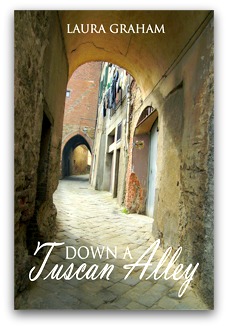
“Down a Tuscan Alley” — when I first heard the title of Laura Graham’s debut novel about an Englishwoman in Tuscany, I assumed it would be a thriller or mystery. Something nefarious would happen down a Tuscan alley, and the protagonist, whose name is Lorri, would find herself enmeshed in events beyond her comprehension, fearful of getting caught in the crossfire between rival Mafia gangs…

The book is no such thing, I’m happy to report (I’m not a fan of Mafia thrillers). Strange things do happen in the dark alley outside of the tiny flat where Lorri lives in the Centro Storico (village on a hill) of the Tuscan town of Sinalunga — but nothing worse than a peeping Tom. And at one point there’s a shady-looking man following Lorri — but he turns out to be (relatively speaking) harmless.

No, the book’s real mystery has to do with why Lorri is living in a tiny Tuscan village on her own. Well, she’s not on her own but has two cats. The last time she was in Sinalunga, it was with her husband, Richard. They had bought the flat together and Richard fixed it up. But now their marriage is over because of Richard’s infidelity. Or Lorri thinks it is over — Richard is having second thoughts.

Lorri, however, is determined. She has come to Italy to get lost in the culture and start her life again. But is she doing the right thing? Her Italian neighbors treat her with some suspicion: what’s a woman doing living on her own, with no visible means of support? (She has decided to do B&B in her little flat, but since it has only one bedroom, when the guests come, she has to sleep on the sitting room floor.)

And she also has to persuade herself to trust her gut instincts. As she says toward the start of the novel:

Am I crazy to come here? Hardly any grasp of the language, forty-seven, alone and with virtually no money? Many would think so…

Lest you think we’re venturing into Under the Tuscan Sun territory, rest assured, we’re not. Lorri does not take life, let alone her midlife predicament, too seriously. This is a flat overlooking an alley we’re talking about, not a 250-year-old villa. And so what if she ends up seizing an opportunity to get involved with the handsome young builder Ronaldo? Isn’t La Dolce Amore the quickest way to obtain La Dolce Vita?

But before I get too carried away with the story, let me turn the conversation over to Laura Graham, who has graciously agreed to answer a few questions about both her book and her life story — which, as she freely admits, the novel is based on.

The decision to write an autobiographical novel

Thank you so much, Laura, for agreeing to this chat. Your story — both in the book and in real life — neatly combines the two themes we’ve been talking about on The Displaced Nation this month: the quest for La Dolce Vita and the need for taking a “midlife gap year,” which sometimes heralds an even bigger life change. But let’s start by having you talk a little about your background — where you were born, what you studied and why you went to live in Italy.
I was born and brought up on the Isle of Tiree on the West Coast of Scotland for the first six years of my life. I then came to London and entered a convent school.

Later, as an adult, I won a scholarship to study drama at the London Academy of Music and Dramatic Art for two years. I received the prize for being the most promising student and immediately got a job understudying Helen Mirren in The Balcony at the Aldwych Theatre in London. I had a long and successful acting career at the Royal Shakespeare Company and the Young Vic, also on television.

When my long relationship ended with my former partner, I felt the need to turn my life around and decided to begin again in Italy. About ten years before, I’d invested £6,000 in a tiny hilltop village apartment in Tuscany, never thinking that one day it would become my permanent home. I still live in the village, but in a house, with my partner Rosalbo, a property restorer and an artist (he paints cats!). Besides writing, I run my own holiday agency, called “Laura’s Houses.”

Down the Tuscan Alley is your first novel. Have you written anything else?
I have also written a book for children called A Tale of Two Tuscan Cats, which was published last October. It has recently come out in Italian. Rosalbo did the illustrations.

What made you decide to write a novel about a middle-aged woman who is determined to change her life by moving abroad?
Because I’ve experienced it and thought it would make a good story — and might help others so inclined.

Why a novel and not a memoir?
I wrote my story in a novel form to protect the people I wrote about — I’ve changed their names, although some of them are now dead.

What audience did you have in mind when writing the book?
Women like myself, who want more from life than just settling into middle age with nothing but memories. Life is to be lived!

One of your Amazon reviewers wrote: “Brava! Brava! Brava! I loved reading Down a Tuscan Alley. The comic cast of characters brought me to the heart of bellisima Italia.” Other readers, however, said they were grateful that the book isn’t just about how beautiful Italy is. To which parts of the story have most readers responded?
The parts that are thought-provoking — about losing oneself in another culture in order to find oneself — and the humor are what people seem to enjoy.

Getting to the heart of La Dolce Vita…

From the time she arrives Italy, Lorri seems to be in touch with the little things that make her Tuscan alley so different from the Devonshire alley where she was living with friends, just before she left: the old stone steps, the steeple of the magnificent ochre-colored church she can see from her window, the birdsong… Is there something special about Italy that awakens the five senses?
In my opinion it is the light that awakens the senses. The light in Tuscany touches something in you, brings you to life — it’s like a medicine, a tonic.

Since you’re a former actress, would you say that daily life in Italy is more theatrical?
Living in Italy is certainly more theatrical than living in the UK. The people here are open and spontaneous.

And Lorri immediately becomes part of that drama. As her elderly English-speaking neighbor in Sinalunga, Lionello Torossi, says: “The people are delighted to see you…You are their portable theater.” But doesn’t some of the charm of a place have to do with its novelty value? Wouldn’t an Italian feel charmed by a Devonshire alley?
I think the Italians would be fascinated by a Devonshire back alley, if only to think — how is it possible to live there?

…and La Dolce Amore

At one point, Lorri is contemplating her affair with Ronaldo and says to herself: “How can you speak with your heart when you don’t know the words?” Call me a skeptic, but couldn’t their relationship change for the worse once their verbal communications improve?
No, I think Lorri would still find Ronaldo enchanting once she’s able to understand more of the language. But perhaps also more infuriating at times!

Lorri also says, with reference to Ronaldo: “These torrid passions are what happens to English women in hot countries.” Is romance so very different in Italy as compared to the UK?
Torrid passions indeed! The Italian art of seduction is very different from the UK. An Italian makes a woman feel every inch a woman and delights in her beauty and femininity no matter what her age.

Many of The Displaced Nation’s readers are in cross-cultural relationships. What do you find to be the biggest challenge about getting together with someone of another culture?
I cannot pretend it’s easy getting together for a long time with someone of a different culture — although it’s not the culture so much as the mentality. There are many things to learn, mainly about one’s self — and that’s always a challenge. Here in Italy, it’s the language I find most difficult and the humor, which is somewhat different from ours. Of the two, language is the bigger difficulty. Communicating is the key to success when living in another country. Otherwise, you can’t offer as much as yourself as you would like to.

The challenge of exporting La Dolce Vita

After living in a small Italian community for so long, do you think you could ever fit back into living in Britain?
No, I can’t imagine myself living again in the UK even though I go back twice a year and enjoy it. But if I had to I would adjust simply because I’m English. But the biggest culture shock — apart from the food — would be the people. I’ve grown so used to the warmth of the Italians.

Could you bottle the formula you’ve developed for La Dolce Vita in Tuscany and bring it back with you?
The only way to bottle the formula of the Tuscan Dolce Vita is to carry it inside my heart — and take it with me wherever I go.

Coming soon!

Please tell me that you’re working on another book. By the time I finished Down a Tuscan Alley, I’d grown fond of Lorri, Ronaldo and the various neighbors — and felt bereft!
I am on the last chapter of my next book: The Story of Kelly McCloud. This is also set in Italy and is about a young woman who takes a job as a housesitter in an Italian villa. Amongst an eccentric English family, a fallen angel and a dragon, she discovers how to use the whole of her brain and realizes the potentiality of the human race.

Assolutamente favoloso! Thanks so much, Laura!

Readers, you can purchase Down a Tuscan Alley on Amazon. You can also read more about Laura Graham at her author site. And, should you now feel tempted into trying out La Dolce Vita for yourself, then consider renting one of her two houses in the Centro Storico of Sinalunga. What are you waiting for?!

STAY TUNED for tomorrow’s episode in the life of our fictional expat heroine, Libby, who has traded her Boston Red Sox cap for a Sherlock Holmes deerstalker in her quest to uncover her husband’s roots. (What, not keeping up with Libby? Read the first three episodes of her expat adventures.)

If you enjoyed this post, we invite you to register for The Displaced Dispatch, a round up of weekly posts from The Displaced Nation, with seasonal recipes, book giveaways and other extras. Register for The Displaced Dispatch by clicking here!

Related posts:

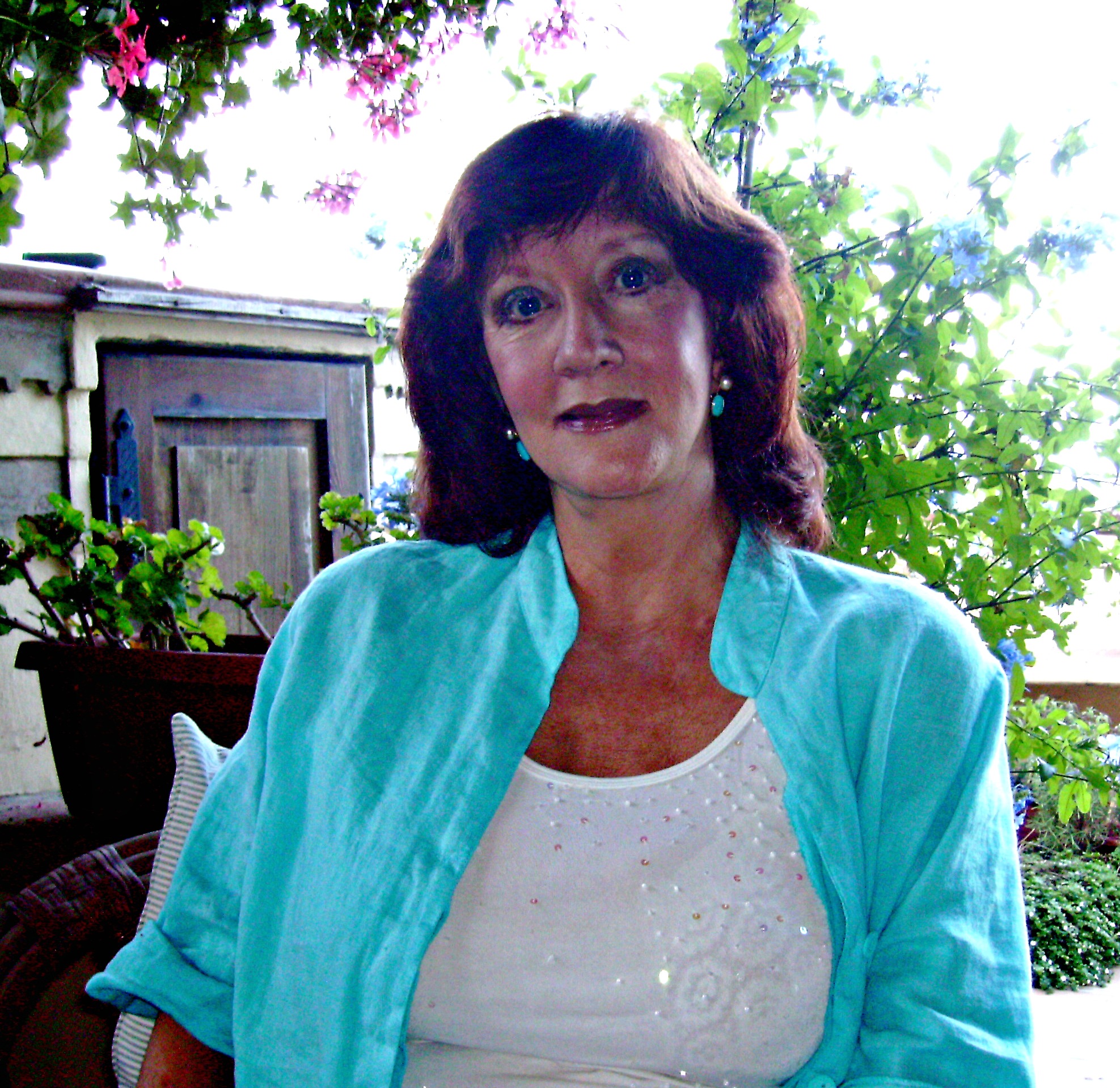
img: Laura Graham, on the terrace outside her house in Tuscany.

LIBBY’S LIFE #52 – Life: A series of hellos and goodbyes

Mum kisses me. “I love you,” she says.

She’s done that quite a few times in the last couple of weeks, which is funny because she’s not really a kissy or “I love you” kind of person. When I was growing up, she displayed her affection via a surprise addition of homemade cake in my school lunch box, a Ladybird book from a trip to WH Smith, or a poster of Take That sneaked into the weekly shopping trolley.

But kisses and “I love you”s?

Never. “Show, don’t tell” was Mum’s philosophy. Walk the walk, don’t talk the talk.

So either her six weeks in America has rubbed off more vigorously than anyone could have anticipated — they’re very big on saying “I love you” at every opportunity here — or she’s unbearably worried.

When I was fourteen, I fell off my bike and hit my head on the tarmac. I was out cold, in hospital — for twenty-four hours, I’m told, although from my point of view it could have been anywhere between five seconds and an eternity. In the moments or hours before my eyelids fluttered open and Mum’s voice proclaimed “She’s awake!” I heard her saying the same thing, over and again. “Don’t go, Libby. Please don’t go. I love you. Please stay here, Libs. I love you.”

It had puzzled me at the time. I was in bed; of that much I was aware in my semi-conscious fog, so where could I go? Later, of course, I realised that Mum was speaking of a more permanent one-way trip, so I didn’t mention I’d overheard her bedside soliloquy. Saying “I love you” out loud like that was slightly embarrassing; like not being able to reach the bathroom on time, or having other bodily emissions erupt against our will.

It must be a British thing. We acquired our reputation of stiff upper lip and British reserve for a reason, I guess. The preschoolers’ moms here drop their children off at nursery with a chorus of “Mommy loves you, honey!”, while the kids run into school without a backward glance. I wonder how many of them grow up thinking that “Mommy loves you” is just another form of “Goodbye”, rendered less valuable by its daily usage.

You see, when my mum says it, I know it’s from the heart and not merely a salutation.

“I love you too,” I say, and kiss her cheek.

She could be saying it because she’s about to get in the Lincoln Town Car that takes her to Logan Airport for her flight back to Heathrow, but even lovey-dovey goodbyes aren’t Mum’s scene. A laconic “Well, I suppose I won’t be seeing you for a long time” would have been more her style.

No. She’s worried. I’m sure of it.

She’s worried that I’m descending into a pit of depression, which because of its timing could conveniently be classified as “post-natal” but in reality has been brought on by my husband’s ever-increasing distance from me, and his preoccupation with…what? I don’t know what. He’s got something on his mind, something to do with his father, but apparently his own wife is not allowed to be privy to those inner thoughts.

She never has been, I know now.

“All set?” the driver asks her.

Mum nods. She gets into the back seat of the long, black car, shuts the door, and winds down the window.

“Sandra,” she mouths. “Don’t forget.”

The car backs down our driveway, reverses onto Juniper Drive.

Mum waves. I wave back. So does Jack.

Oliver, naturally, is absent from the family scene.

I go inside, and for once, Oliver’s absence is a blessing. What I’m about to do wouldn’t be a good idea while he’s around.

This week I have learned from Mum that, at our wedding, after Oliver and I had left for our first night in a hotel as a married couple, my mother-in-law got falling-down drunk but unfortunately not speechlessly so, and started telling my own mother a few family secrets. Mum tried to shut her up but not before Sandra had released a collection of dead ancestors’ remains from a large cupboard — information which, I inferred, was relevant to the present situation. My mother had kept this information to herself for six years, but even now, she delicately skirted round the details of what Sandra had told her.

“It’s not my information to give,” she insisted. “You’ll have to get it from the horse’s mouth.”

Tantalising and unhelpful, albeit highly satisfying to hear my mother-in-law referred to as a horse.

And then, just this morning while I was helping Mum finish her packing, I remembered. Tucked away in a box in the basement is a box of our English DVDs. We don’t get them out because they’re in the wrong format for the DVD player here, but they will play on my laptop. The particular one I want, though, I’ve never actually played before.

With a flashlight in my hand, I descend the wooden stairs into the basement. It’s dark down here, and with the humidity rising as summer approaches, there’s a smell of musty damp in the air. A rustling noise, a scurry of rodent feet makes me jump — I’ve disturbed something the pest control people missed on their last visit — but even the threat of mouse attack doesn’t deter me.

I find the box of DVDs and, shining the flashlight on them, flick through until I see the one I’m looking for.

I double-check the label.

Yes. This is it.

“Libby and Oliver. Wedding footage (not in official video).”

.

Next post: LIBBY’S LIFE #53 – Preserved on tape

Previous post: LIBBY’S LIFE #51-On a cliff edge

Click here to read Libby’s Life from the first episode

STAY TUNED for Friday’s post — another Displaced Q from Tony James Slater.

If you enjoyed this post, we invite you to subscribe for email delivery of The Displaced Dispatch, a round up of the week’s posts from The Displaced Nation. Sign up for The Displaced Dispatch by clicking here!

Image: Travel – Map of the World by Salvatore Vuono / FreeDigit

LIBBY’S LIFE #51 – On a cliff edge

A fly-on-the-wall observer of our household would see nothing wrong.

They’d see a family who has time-travelled from the 1950s. A young wife at home with a preschooler and two babies; a granny who hovers solicitously around her daughter and oldest grandchild; a husband who is polite and calm and doesn’t shout. A large dog that slobbers, and spends all his time between back yard and mud room.

The perfect family, even with slobbery dog, the observer would conclude.

But here’s the catch. My husband is not polite and calm by nature. He kicks electrical appliances when they fail, and shouts when he treads on Lego bricks in his bare feet. A month ago, he was experimenting nightly in the kitchen after becoming addicted to the Food Network Channel, and the air turned indigo as he tried to out-curse Gordon Ramsay.

He does none of this now. He is silent, detached, an observer himself.

I don’t like the new version of Oliver one bit.

Although you’d think this Oliver would be an improvement on the old model, he isn’t. He’s an automaton, with his studied manners. He pauses before he replies to anything I say, as if I’ve said something so stupid that he had to stop and count to ten.

His forays into the kitchen take place in silence, as if he is not creating with culinary pleasure but conducting a serious lab experiment; my efforts to compliment his cooking are met with shrugs, grunts, or monosyllables. After a pause, of course.

I want the old Oliver back so much.

Why did I send that bloody email to his sister? I can only think that I’ve watched too many episodes of Oprah or Ricki Lake in my past. Families, it seems, do not always need reuniting thirty years down the line.

“Can’t we talk about what’s happened?” I asked him one night.

That slight pause before he spoke.

“No point.”

“But we need to talk!”

Another pause.

“Everything’s fine, Libby.”

They’re not fine, at least not from where I am. They’re very far from fine. But how can you make something right between two people when the other person won’t admit there is something wrong?

Meanwhile, to Jack, I have to pretend there is nothing wrong. It’s very difficult, when your four-year-old repeatedly asks you why you have red eyes, not to answer “Because your father is a cold bastard” but so far I have managed to refrain.

Now that Kate’s gone home, I have no one to talk to. Maggie is on vacation, and as for talking to my mother, forget it. I know what she would say, and it would be along the lines of It Being My Own Fault and I Shouldn’t Do Things That Upset My Better Half. She’s spent her entire married life appeasing my father, so I wouldn’t expect anything more.

She made a Lightning McQueen cake for Jack’s fourth birthday on Sunday, and we all pretended to be a happy family around the dining room table. I hadn’t arranged a party, but promised Jack we would have one in the garden when the weather is better and Mummy isn’t as tired.

When we’d had some cake and Jack had opened his presents — thank goodness for internet shopping and express delivery — Oliver excused himself.

“Going to the office,” he said.

“But it’s Sunday,” I said. “It’s Jack’s birthday.”

He looked at me for a few seconds. I shrivelled inside. Then he left the house.

“Where’s Daddy gone?” Jack demanded.

“To work, sweetheart,” I said, bending over one of the twins so that Jack couldn’t see my face as I blinked back tears.

Tears, I’ve found, are never far away.

“It’s my birthday! Daddies shouldn’t go to work on birthdays!”

Jack was right, of course. Daddies shouldn’t do that.

Outrage surged inside me, which had the welcome effect of banishing the ever-ready tears. It was one thing to punish me, but another thing entirely to punish Jack by abandoning his birthday tea before we’d had second helpings of cake.

George started to howl for his dinner, and Beth joined in. I carried them into the living room, plonked them in their bouncy chairs, and sat on the floor between the two of them with my back against the sofa, stuffing a bottle in each mouth.

In the slurping, hiccuping peace that followed, I could hear Mum tidying up in the kitchen and talking to Jack, who was still luxuriating in his whinge-fest.

“I didn’t want Daddy to go to work today.”

“I’m sure you didn’t. But sometimes grown-ups don’t want things either.”

“You mean Daddy didn’t want to go to work?”

Clattering as a cupboard opened and dishes were put away.

“Hmm. Now that’s a tricky one. No, I think if Daddy didn’t want to go to work, he wouldn’t. What do you think?”

Goodness. Now there was a turn up for the books: my mother, badmouthing Oliver, and in her grandson’s presence?

No doubt some earnest couples-counselling guru would frown upon this, and tell me I should not encourage such blatant side-taking, but sod it. I need all the moral support I can get.

It occurred to me that I might not be giving Mum a fair chance by not confiding in her. She’s different from the demanding woman who arrived a month ago, but she’s not how she is with Dad either. She’s…well, I guess this is who my mother really is.

I heard her telling Jack to go and draw a nice picture for Mummy with his new crayons, and a second later, she came into the living room and sat down on the sofa behind me.

I leaned further back against the sofa.

“Are you comfy down there on the floor?” she asked.

“Mmm-hmm.”

I felt her stroking my hair, and imagined that I was six years old again. I remembered stroking my hair like that one day in 1986 after I came home from school, crying, and telling her that Cheryl Stokes had said I smelled bad, and it wasn’t true, was it?

How could it be? Mum said. I make you have a bath every night. “Which is more than can be said for Cheryl Stokes’s slovenly mother,” she added under her breath.

Not being familiar with the word “slovenly”, I thought she’d said “heavenly”, and for a long time after that thought that Cheryl Stokes’s mother was married to God, which made complete sense to my six-year-old logic, because Cheryl Stokes didn’t seem to have a father.

“Mum?” I asked now. “What happened to Cheryl, from the big Stokes family that used to live up the road from us?”

“Married twice, divorced twice. I see her every now and then in Sainsbury’s. She’s got three children. Maybe more.”

I sighed. “Like her heavenly mother.”

“Sorry?”

“Never mind. The apple didn’t fall far from the tree, did it? Her mother was just the same.”

I thought some more, my eyes closed. About my battle with Patsy Traynor, my fierce protection of Jack against Caroline’s devil-child. It’s what Mum would have done. This apple hadn’t fallen far from the tree either.

“Do we all turn into our mothers?” I asked. “Are you like Grandma? Oliver’s not a bit like his mother. He must be like his…” I trailed off and sobbed.

The hand on my head faltered a little before it carried on stroking.

“I know you meant well,” Mum said. “Sometimes it’s hard for other people to forgive good intentions, though.”

“He’d kept a birthday card from his dad since he was six!” I burst out. “And a stuffed tiger! You don’t do that if you want to forget about someone! Why would you keep that stuff otherwise?”

George finished his bottle. I lifted him out of the chair and passed him across to Mum to be winded. She put him over one shoulder and patted his back.

“You might keep it,” she said, not looking at me, “if it represents something good. Like the only good thing you can remember about that person.”

George burped. Beth started to fuss, and I realised that I’d let the bottle slide from her mouth.

“What are you getting at?” I said at last. “Do you know something about Oliver that I don’t?”

Mum shook her head. “I’ve probably said too much already.”

She put George back in his chair and bounced it gently with her foot.

“Speak to Sandra,” she said.

.

Next post: LIBBY’S LIFE #52 – Life: A series of hellos and goodbyes

Previous post: Me and my shadow: LIBBY’S LIFE #50 – Home Again

Click here to read Libby’s Life from the first episode

STAY TUNED for Friday’s post — another Displaced Q from Tony James Slater.

If you enjoyed this post, we invite you to subscribe for email delivery of The Displaced Dispatch, a round up of the week’s posts from The Displaced Nation. Sign up for The Displaced Dispatch by clicking here!

Image: Travel – Map of the World by Salvatore Vuono / FreeDigit

Me and my shadow: LIBBY’S LIFE #50 – Home again

Oh, thank the lord and all his angels. I am on my way back to England, after an extended stay with the Patricks.

How extended, exactly? Two weeks, two months, two years? Who knows?

Time expands to encompass the drama available.

~

Never have I wanted to be somewhere else so badly as on the evening that Tania Patrick appeared on Libby’s doorstep and refused to leave. She wanted to meet her big brother, come what may — and never mind the collateral damage to his family.

The awkwardness, the embarrassment, the toe-curling please-God-get-me-out-of-here-ness of that meeting. The sister seemed oblivious to our shuffling feet, the nervous coughs, and our collective intake of breath as we heard Oliver’s car pull onto the driveway.

“Oliver!” Tania Patrick cooed, as she elbowed Libby out of the way, opened the front door, and and leaned in to kiss him on the cheek.

While she’s not unattractive, she’s never going to feature in a Pirelli calendar either, and Oliver’s not the touchy-feely type without a good reason for being so.

“Do I know you?” he asked, leaning back to avoid her embrace.

Libby, meanwhile, watching the scene as intently as her husband would watch a penalty shootout between Arsenal and Spurs, couldn’t bear the suspense. It occurred to me afterwards that she could have exonerated herself by blaming the sister for tracking Oliver down, but, guileless as she is, she blurted out her version of the truth.

“Oliver, this is Tania. She’s your sister. We met online after I emailed her.”

I couldn’t help but cover my face with my hands, shaking my head. Libby would not only have shaken hands with her executioner but apologised for treading on his foot on the way across the scaffold.

Oliver sidled through the front door into the house, pressing himself against the walls so he didn’t have to touch the visitor.

“And you didn’t think to tell me at the time?” he asked Libby.

“Well…” She floundered. “I mean, I didn’t tell her where we lived or anything, so I didn’t think she’d come here.”

“Took a bit of detective work to find you!” Tania’s voice was raspy. A recently ex-smoker’s cough. “Dad never talks about you, but my grandma told me once I had a brother somewhere.”

“Did she.” Oliver’s question dropped at the end to become a statement. “I bet he doesn’t know you’re here now.”

For the first time, Tania seemed unsure of herself.

“He doesn’t, no.”

Oliver nodded.

“Keep it that way,” he said, opening the front door wide, and indicating to his newly-discovered and quickly-abandoned sister that this particular game of Happy Families was over.

~

I wasn’t sure what happened between Libby and Oliver after that. They disappeared into their room with the twins, and every now and then I heard the sound of raised voices, followed by one of the twins’ wailing.

Jane and I put Jack to bed, and had a whispered conversation while his bath was running.

“It will blow over,” Jane said, sounding more certain than she looked. “It has to. She meant no harm.”

“Things will look better in the morning,” I said.

~

They didn’t, of course.

They looked worse.

And the morning after that, too. Every day was worse than the last.

Libby put on a brave face and bright smiles during the day — while Oliver was out — and for minutes at a time we would forget anything was wrong. The babies always knew something was wrong, though, and cried alternately with hunger and colic. On Day Three, Libby abandoned her principles and gave them formula milk.

When Oliver came home in the evenings, the atmosphere changed in the house. Jane and I would scurry for cover in the basement, pretending that we were keeping Jack entertained and out of the way.

Bad enough to bear were the frozen silences whenever Libby and Oliver were in the same room together. When Jane and I prepared dinner in the kitchen, we whispered, as if by whispering we could dissipate the cloud of anger and resentment that billowed forth from Oliver.

Worst of all, though were the nights. When everyone was in bed, we could hear — although we pretended not to — the increasing volume of Oliver’s voice, as the same argument was rehashed again and again.

“You had no right! None of your business!”

An inaudible murmur from Libby. More raging from Oliver.

“How would you like it if I invited a whole bunch of your long lost, naff relatives to barge into our life and turn it upside down? You wouldn’t, would you?”

Another murmur from Libby, this time louder so the quaver in her voice is detectable.

“I don’t care how good your intentions were. I’ve spent my entire life trying to forget that bastard ever existed, and now I have to deal with him and a TOWIE half-sister, thanks to your good intentions. If those are your good intentions, God help us all when you have bad ones.”

And so on. Every night. Libby looked shattered — a normal look for a mother with new twins, but this was exhaustion on a different plane.

~

Sunday arrived, and I had to leave. I wished I could take Libby as well.

She had refused to talk about what had happened. Perhaps she felt that ignoring the problem would make it go away.

“I’ll be all right,” she said, as she said goodbye to me. “Mum’s still here, at least.”

Jane had stepped up her game in the last few days. If she previously thought Libby was confident, and felt inadequate around her, this was no longer the case. A mother is always a mother, no matter how old her children are.

“You’ve got to talk to someone, Libs,” I said. “You can’t bottle it up like this.”

She shook her head. “Can’t,” she said, pressing her lips together in a thin line. “You have no idea what a Pandora’s Box I’ve opened.”

I had an idea. “Then write. Get it out of your system that way.”

She nodded slightly. “I’ll think about it.”

“I can’t do your blog next week,” I said. Actually, I could, but this would be good therapy for Libs.

“I’ll think about it,” she repeated. She sniffed, straightened up, and put her shoulders back. “You’d better go. The traffic will be awful if you leave it any later. The Red Sox are playing at home today.”

I sat in the car, put it in reverse, and backed out of the driveway. As I stopped at the end of Juniper Drive, I looked in the rearview mirror. Libby was standing by her mailbox, still waving.

Even from this distance, I could see she was crying.

.

Next: LIBBY’S LIFE #51 – On a cliff edge

Previous: LIBBY’S LIFE #49- An unwelcome blast from the past

Stay tuned for Friday’s Displaced Q testing your ability in another aspect of La Dolce Vita!

If you enjoyed this post, we invite you to subscribe for email delivery of The Displaced Dispatch, a round up of the week’s posts from The Displaced Nation. Sign up for The Displaced Dispatch by clicking here!

Img: Map of the World – Salvatore Vuono
Me and my shadow: LIBBY’S LIFE #49 – An unwelcome blast from the past

Well, here I am again. Kate, that is, not Libby.

Not sure when Libby will have enough free time to write her journal herself, so you’ll have to put up with me this week, and possibly next week as well. After that, who knows? Maybe Libs can persuade Maggie to fire off a bulletin for you. Or perhaps her mother could do it…now that would be interesting.

~ ~ ~

Having changed my flight,  I’m going home rather later than I intended, so am now snugly ensconced Chez Patrick where I have agreed to stay for the next two weeks.

A somewhat rash decision, in retrospect. Might have been wiser to stay in the local Motel 6 and commute to my temporary job as Mother’s Help.

It’s not that Libby’s accommodation isn’t wonderful. I’m sleeping on a big sofa-bed in Oliver’s home office. It’s warm, cosy, and has free wifi with a strong signal. Being here means that Oliver can’t use his office much, because the contents of my suitcase are draped all over his swivel chair, but that doesn’t matter. He spends most of his time ten miles away at his workplace.

Yes, Oliver is back at work already. No paid paternity leave for him, but I suspect that is merely an excuse for his absence.

The real problem, for both Oliver and me, is his mother-in-law.

Oliver and Jane aren’t a good mix. We’re not talking chalk and cheese or even oil and water here. Think chemistry class, think sodium and water, think fiery explosions on calm water, and you’re on the right track.

“I thought you said they used to get on well together?” I said to Libby on Oliver’s first day back at work, when the twins were barely a week old. He had stomped out of the house before seven a.m. while Jane tagged after him, swiping ineffectually at his back with a clothes brush. This morning, just before he slammed the door on his way out to the garage, Jane asked him if he’d got a clean hankie in his pocket.

“They did,” she replied, wriggling around on the couch, a baby in each arm. “When I first started going out with Oliver, she pandered to him the way she panders to my father, and he lapped it up. Every argument we ever had, his trump card was ‘Your mother would never say that to your dad.'”

“So what’s his problem now?”

“Ah, well, everything’s got a flip side, hasn’t it? The reason she panders is because she thinks men are useless in the home. According to her, Oliver’s totally incompetent and shouldn’t be allowed near one newborn, let alone two.”

“Ah.”

“I don’t blame her in the case of my Dad. I mean — he is useless, although I sometimes wonder if she makes him that way. Self-fulfilling prophecy and all that. But Oliver’s quite capable of rustling up some bottles of formula and cooking dinner.”

“Not that you need to do any cooking for weeks.” The freezer was chock full of homemade, ready-to-reheat meals, courtesy of the Coffee Morning Posse. Every day, Charlie, Anita or Julia would turn up with more Tupperware boxes, labelled “Chicken a la King” or “Chilli Con Carne” or “Swedish Meatballs”. I’d got to the point where I was considering another pregnancy myself, just for the Meals-On-Wheels benefits.

“Just as well, isn’t it, if I had to rely on my Mum to feed me? She claims Oliver’s incompetent, but then she can’t get past the American-English differences. The other week she decided to make some scones, but couldn’t find the plain flour. It’s called all-purpose flour over here, right, but the leap of imagination to translate was beyond her. All I heard was, Ooh, it’s not the same as what I get in Sainsbury’s.”

“Did you get your scones?”

“Are you kidding? She walked to the gas station up the road and bought some Twinkies. Jack ate four, and he was awake until midnight. I used to take the mick out of Sandra because she once gave Jack some Red Bull, but this was actually worse.”

One of the twins started to cry, so I took the non-crying one from Libby. I think it was Beth. Or maybe it was George. Both twins wore green footie pyjamas, so I couldn’t tell which was which from the outside.

I rested Tweedledum over my left shoulder, absent-mindedly patting its back. Libby handed me an old towel, and I tucked it underneath the baby’s chin.

“I didn’t bring any babyproof clothes with me,” I said. “Mostly business work clothes, and I’m running out of things to wear.”

I’d forgotten the trick of keeping an old cloth on your shoulder when burping babies, and all day yesterday I had the sensation that a piece of ripe Camembert was following me everywhere, until Jane pointed out the trail of curdled milk on the back of my favourite white shirt. The local dry cleaners’ profits would skyrocket when I got home.

“Raid my closet,” Libby suggested. “Take some home with you. I’ll never fit into half of my clothes ever again.”

She’s sweet, but — no. Even at ten days postpartum, she’s thinner than I am now.

If I didn’t like her so much, I’d hate her.

“Or you could go to the mall for some more things,” Libby went on. “Take Jack and Mum with you, and I’ll have some quiet time with the twins.”

That didn’t seem like a bad idea. I’d take Jane, tire Jack out on the little indoor playground there, and when they got home they’d both be ready for bed.

“It’s got possibilities,” I said, and went in search of Libby’s mother and first-born.

*  *  *

Once you get Jane out of the house, she’s different. She even opened up a little to me.

“It’s not that I don’t want to help,” she confessed. “It’s just that I feel very inadequate around Libby, as if I’m going to get everything wrong no matter how hard I try. She’s not the same person who went away a year ago. She’s so much more…confident.”

“She’s not expecting you to be Superwoman,” I said. “Just her mum. And by that I don’t mean Oliver’s mum as well. He can work out himself if he needs a clean hankie or not.”

She had the grace to look a bit ashamed.

As well as going clothes shopping for me, I dragged her and Jack into a supermarket and a craft store. It’s Jack’s fourth birthday in just over a week, and I’m pretty sure Libby won’t have got her act together enough to do anything really special. Between the three of us, we picked out birthday napkins, party favours, and all the stuff Jane needed to make a 3D Lightning McQueen cake.

“I do hope Libby won’t mind me doing this,” she kept saying. “I don’t want to end up being more of a hindrance than a help.”

I told her that she had a long way to go before she attained Oliver’s mum’s standards  of “helping” and that her birthday cake was unlikely to put Libby and Jack into hospital.

She seemed mull this over, and by the time we got in the car to drive home, was the perkiest I’d seen her all week.

When we arrived at the house, a strange car was parked in the driveway.

“Another food delivery from Libby’s friends, I expect,” I said to Jane as we hauled the shopping bags into the hallway.

“Libs?” I called. “We’re home. We’ve got everything sorted out for Jack’s bir–Libs? Are you OK?”

Libby walked unsteadily towards us from the living room. Her face was pale. Following behind her was a woman: tall, fair-skinned, with sparse, sandy-coloured hair. Another of the Coffee Morning Posse, I presumed.

“I’m fine,” Libby said, giving me a too-bright smile that pronounced her a fibber. “Did you get what you need?”

“Yes,” I said, holding up a Macy’s bag in one hand and a Stop and Shop carrier in the other. “Your mum’s going to make Jack’s birthday cake.”

The woman behind Libby spoke to Jack who, at the sight of the stranger, had hidden himself behind his Granny Jane.

“It’s your birthday soon? When’s your birthday, darlin’?”

An English accent. Definitely one of the Coffee Morning Posse.

“Thirteenth of May.”  Libby replied for him after a pause.

“Aww. He’s shy.” The woman put her head on one side. “Just like our Damian.”

Silence from Libby as she looked down at her bare feet. The silence grew until it filled the two-storey room.

“Is Damian a friend of Jack’s?” I asked.

The woman laughed.

“I hope he will be,” she said.

In the living room, one of the twins began to whimper. Normally this would have Libby running to see what the fuss was about, but she didn’t look up from studying her toes.

“This is my mother Jane and my friend Kate,” she said sideways, in the general direction of the stranger. “They’re both staying here, so you can see that it’s not really feasible for you to stay as well.”

“No problem at all. You’ve got your hands full, I can see that. But I’d love to stay and see Oliver.”

“Well, as I explained, Oliver’s on a business trip for three weeks, and that’s why these two wonderful ladies are helping me out–”

Oliver? Business trip? First I’d heard of it, but Libby must have a good reason for telling such a whopper, so I went along with it.

“That’s right.” I nodded, and looked across at Jane to make sure she was going along with whatever plan Libby was hatching.

She wasn’t.

“But –” she said, in a tone of bewilderment. “But Oliver left this morning and said nothing about being away for three weeks. In fact, I heard him say he’d be home in time to cook dinner.”

The woman called Tania folded her arms. “You know, I thought something didn’t sound right. What kind of man leaves his wife on her own with newborn twins, for heavens’ sake?”

She shot a look of triumph at Libby.

“Not my brother, that’s for sure.” She held her hand out to me.

“Tania Patrick,” she said. “Oliver’s long-lost sister. Pleased to meet you.”

Next: LIBBY’S LIFE #50 – Home again

Previous: Me and my shadow: LIBBY’S LIFE #48 – Hospital visiting hours 

Stay tuned for Friday’s Displaced Q!

If you enjoyed this post, we invite you to subscribe for email delivery of The Displaced Dispatch, a round up of the week’s posts from The Displaced Nation. Sign up for The Displaced Dispatch by clicking here!

Img: Map of the World – Salvatore Vuono