 So with my last entry, on James Joyce’s Paris, I was left bemoaning the term Expat Writer. Partly, I’m annoyed with myself for choosing such a term as “Classic Expat Writing” for this series of blog posts. Ultimately, who wants to read a series of posts called “Classic Expat Writing”? It assumes too much and adopts a slightly superior attitude. And, most importantly, it’s dry and not all catchy. Instead, think of this as writing by the displaced.
The reason that I opted to do this series of posts was so I could share some writing that has moved me, and present it to an audience that is likely to in some way be attuned and empathetic to its contents, either through their own personal experience or particular interests. If people then go off and look at the authors in more detail, so much the better. It’s for these reasons why I am particularly excited with this week’s example.
I have to confess that I was not familiar with the name Sōseki until I visited Japan. My knowledge of Japanese literature is embarrassingly slight and doesn’t really extend beyond Mishima and Murakami. But a few years back, when visiting Tokyo, I sought out the Kinokuniya bookstore near Shinjuku because it had a large selection of English-language books. Having a few days before visiting the Temple of the Golden Pavilion in Kyoto, I was keen to buy Mishima’s novel The Temple of the Golden Pavilion. But when left in a bookstore I can’t help but browse and one book, in particular, caught my eye: The Tower of London: Tales of Victorian London by Sōseki. At this point, I had never before heard about Sōseki Natsume (1867 – 1916), and had no idea about his place in the canon of Japanese literature. If I had been in Japan a few years earlier, it may have passed me unnoticed that the two 1,000 yen notes I would use to buy this book, in fact, featured Sōseki’s portrait.
Instead from a position of ignorance I picked up the book and was intrigued by it. It’s a collection of essays and writings that Sōseki wrote about his time in London.* In the summer of 1900, as a young, unknown professor, he traveled to London on a somewhat meagre scholarship that was provided to him by the Japanese government. Sōseki was to spend the next two years in the city, unhappy and isolated.
Now being a miserable monoglot, I am entirely dependent upon skilled translators when it comes to foreign (well “foreign” from my perspective) literature. Obviously, I’m not in a position to comment on how accurately Damian Flanagan’s translation conveys the flavor of Sōseki’s prose, but I did find it to be an incredible read with crisp and clean prose.
The title essay is a phenomenal piece of literature, but it is Sōseki’s Letter from London that I’m highlighting today. Sōseki conveys in a way that I’ve not seen from others that awkward, slippery sense of dislocation of being in an alien country. Even politeness takes on a faintly threatening edge.
One of the things I’ve noticed in the Expat blogging community, we seem to like it when we find writing that we can relate to, that reiterates thoughts and fears that we have had. Of course, there is a place for that. With Expat blogging it can help develop relationships, it helps builds an audience, and there is very much a place for it. But it can also act like comfort food.
Sōseki, by contrast, has observations and thoughts about the city that I don’t think anybody other than himself could have had. And, for me, that’s what is so interesting and so worthwhile about this book.
This collection, which is published by Tuttle publishing, really should be read by more people. Go buy it and then read it, pronto.
Once outside, everyone I meet is depressingly tall. Worse, they all have unfriendly faces. If they imposed a tax on height in this country they might come up with a more economically small animal. But these are the words of one who cannot accept defeat gracefully, and, looked at impartially, one would have to say that it was they, not I, who look splendid. In any case, I feel small. An unusually small person approaches. Eureka! I think. But when we brush past one another I see he is about two inches taller than me. A strangely complexioned Tom Thumb approaches, but now I realize this is my own image reflected in a mirror. There is nothing for it but to laugh bitterly, and, naturally, when I do so, the image laughs, bitterly, too …
… Generally, people are of a pleasant disposition. Nobody would ever grab me and start insulting and abusing me. They do not take any notice of me. Being magnanimous and composed in all things is in these parts one qualification of being a gentleman. Overtly fussing over trifles like some pickpocket or staring at a person’s face with curiosity is considered vulgar … Pointing at people is the height of rudeness. Such are the customs, but of course London is also the workshop of the world, so they do not laughingly regard foreigners as curiosities. Most people are extremely busy. The ir heads seem to be so teeming with thoughts of money that they have no time to jeer at us Japanese as yellow people. (‘Yellow people’ is well chosen. We are indeed yellow. When I was in Japan I knew I was not particularly white but I regarded myself as being close to a regular human colour, but in this country I have finally realized that I am three leagues away from a human colour – a yellow person who saunters amongst the crowds going to watch plays and shows).
But sometimes there are people who surreptitiously comment on my country of origin. The other day I was standing in looking around a shop somewhere when two women approached me from behind, remarking, “least-poor Chinese”. “Least-poor” is an extraordinary adjective. In one park I heard a couple arguing whether I was a Chinaman or a Japanese. Two or three days ago I was invited out somewhere and set off in my silk hat and frock-coat only for two men who seemed like workmen to pass by saying, “A handsome Jap.” I do not know whether I should be flattered or offended.
*I’m not entirely sure what it says about me that in browsing a large selection of Japanese literature in an effort to get a better understanding of Japan, I picked up a book that is centered around impressions of London and the English.
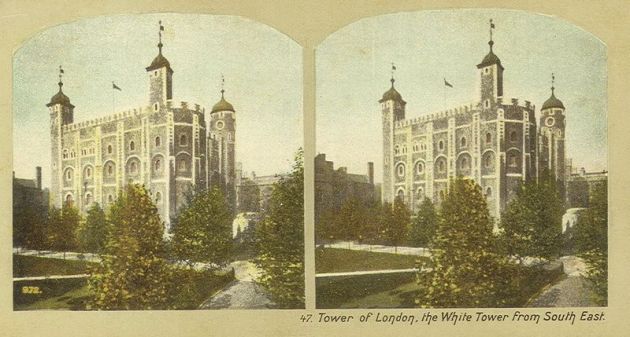
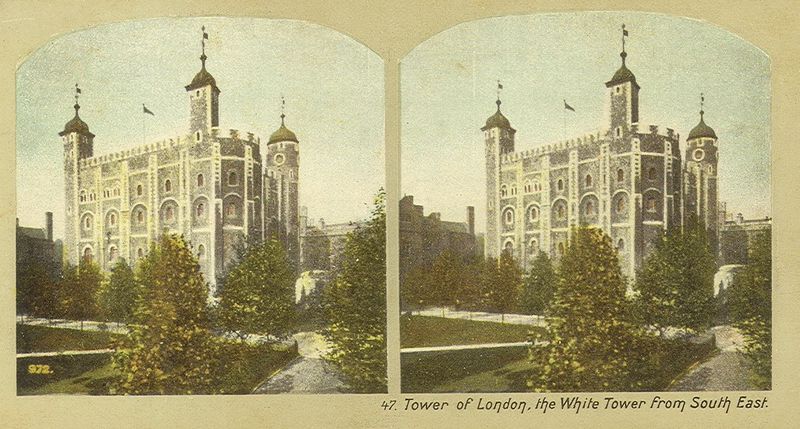
Img: White Tower, Tower of London, from the South East, c. 1890-1910, courtesy Wikimedia Commons
If you enjoyed this post, we invite you to subscribe for email delivery of The Displaced Nation. That way, you won’t miss a single issue.
Related posts:








 The Displaced Nation
