The Displaced Nation

A home for international creatives

Tag Archives: Random Nomads

RANDOM NOMAD: Piglet in Portugal, Award-Winning Expat Blogger

Born in: Harrow, England
Passport(s): British
Country lived in: Portugal Has had a house there from 2006-present
Cyberspace coordinates: Piglet in Portugal (blog)

What made you leave your homeland in the first place?
Although we left the UK primarily due to health reasons, we were also in search of a better quality of life. The jobsworth* culture and the “health and safety” people, plus the PC Brigade**, were slowly driving us mad; we no longer had the right to exercise common sense any more than we were capable of making our own decisions. Yes, Mr Jobsworth, we know if we stand by the edge of a cliff we could fall off it. Or if we go out in the rain, we are likely to get wet. There appeared to be a whole army of people telling us what to do and what to think! England is not nicknamed the Nanny State*** for nothing!
* Jobsworth: A person in a position of minor authority who invokes the letter of the law in order to avoid any action requiring initiative, cooperation, etc.
** PC Brigade: Politically correct brigade.
*** Nanny State: A government that makes decisions for people that they might otherwise make for themselves, especially those relating to private and personal behavior.

Is anyone else in your immediate family displaced?
Our daughter moved to Lyon in France with her ice dance partner when she was just 15 years old to rain with a world-famous ice dance coach. When she gave up skating ten years ago, she met her French husband-to-be and remained in France. They have just had their first child — our first grandchild.

Describe the moment when you felt most displaced over the course of your many displacements.
I am unable to pinpoint the exact moment I felt “displaced” — it was more, shall we say, “moments” which gradually crept up on me over time. Language is a huge problem, and despite my valiant efforts to learn Portuguese, I have failed miserably. I’ve spent thousands of euros on private lessons, studied hard, but am still unable to converse properly in Portuguese. I’ve had to accept I am not a natural linguist and have resigned myself to doing the best I can. (No, I do not need any more lectures as to “you have to learn the language to integrate.” I have really tried.) Because of this failure, I now know what it feels like to be in a room full of people and feel totally alone — almost as if the room were empty or you were invisible. You are there in body but not in mind; simply a spectator. This is really difficult for me as I am gregarious by nature and a natural “chatterbox.” I am sure there are many expats out there who can relate… I am also a real foodie and, apart from desserts and cakes, am not that keen on Portuguese food…

Actually, you have made me stop and think again about this question.

Perhaps the moment I actually felt “displaced” was when our first grandchild was born recently in France. We also have another grandchild due in September, but in the UK. My first thoughts were: do we relocate to France or the UK? We have no family in Portugal so why stay here? I have begun to feel restless.

Describe the moment when you felt least displaced.
I have always felt at home in Portugal, despite language difficulties and a cuisine that is rather “basic” for my tastes. I have never tried to change anything: e.g., protest against bullfighting or insist our local snack bar serves fish and chips or curry. I accept life as it is.

You may bring one curiosity you’ve collected from the country where you’ve lived into the Displaced Nation. What’s in your suitcase?
My curiosity item would have to be bacalhau. It is dried salted cod fish and a long-time favorite with the Portuguese. I wrote a blog post about it.

You’re invited to prepare one meal based on your travels for other Displaced Nation members. What’s on the menu?
It’s a struggle for me to find Portuguese recipes I like. Most of the restaurants here in the Algarve serve up very much the same dishes: chicken piri-piri, sardines or grilled fish and meats served with salad and chips, etc. “Dish of the Day” offers other variations, but as I do not like snails, the “unmentionable” parts of animals or beans, this means the choice of food is often limited. But here goes:
Piglet’s Menu for The Displaced Nation

  • Calde de Verde (Portuguese Cabbage Soup)
  • Carne de Porco a Alentejana (Pork with Clams) [See recipe.]
  • A selection of Portuguese cheeses and crusty bread
  • Molotof — a light dessert made with egg whites. [Watch video.]

You may add one word or expression from the country you’ve lived in to The Displaced Nation argot. What word do you loan us?
My first instinct is to loan you leitão, which means “piglet” in Portuguese. My husband and I went out to lunch soon after we arrived in Portugal, and I thought I’d ordered roast pork. It turned out to be suckling pig! Hmmmm it made my trotters twitch! Mental note — I need to be more careful in translating the menu in future. Porco is pork. But perhaps it would be more in keeping for me to loan you the first Portuguese word I learned: bonita. It means beautiful.

Alice meets many curious animals when she ventures into Wonderland, including a piglet at one point. We’re curious (and curiouser!): why have you chosen the piglet moniker, avatar, and doppelgänger
Because I adore pigs. I would love to keep Vietnamese pot-bellied pigs if we had a large garden. I was nearly tempted to buy a little pig a few months ago at the local market until my head ruled my heart and common sense kicked in. Awww, but it was so cute! Some people love dogs. With me it is pigs.

QUESTION: Readers — yay or nay for letting Piglet in Portugal into The Displaced Nation? Tell us your reasons. (Note: It’s fine to vote “nay” as long as you couch your reasoning in terms we all — including Piglet — find amusing.)

STAY TUNED for tomorrow’s installment from our displaced fictional heroine, Libby. Kate Allison has assured us it will contain some more Alice in Wonderland references — but will there be any piglets? Curiouser and curiouser, I think you’ll agree…

If you enjoyed this post, we invite you to subscribe for email delivery of The Displaced Nation. That way, you won’t miss a single issue. SPECIAL OFFER: New subscribers receive a FREE copy of “A Royally Displaced Tea.”

Related posts:

RANDOM NOMAD: Balaka Basu, Ph.D. Student in English Literature

Born in: New York City, USA
Passport(s): USA
Countries lived in: India (New Delhi): 1981, 1987-89, 1991, 2003-04; Italy (Rome): 2002
Cyberspace coordinates: The Society of Friends of the Text (collaborative blog)

What made you leave your homeland in the first place?
I’ve inherited displacement from my parents, who moved (individually) to the United States from India for graduate studies and sort of never left. They made periodic attempts to pick up stakes and move back, taking me with them, but these never lasted for more than a year at a time. My childhood left me feeling like a person without a homeland, always living between worlds, never quite belonging anywhere.

Describe the moment when you felt most displaced over the course of your many displacements.
As a child, it used to be while saying — or rather, in my case, not saying — the Pledge of Allegiance at morning assemblies. Now, every so often, out of nowhere, I’ll have this weird sense of wanting to go “home” and smell the jasmine and the honeysuckle, and the smoky, pungent mustard oil, and have someone bring me a glass of freshly pressed pomegranate juice.

Describe the moment when you felt least displaced.
This is a difficult question because the land of my birth is sort of my adopted homeland. I was born in the United States — but was taken back to India when I was 28 days old. My first language is not English, but I can neither read nor write in Bengali. I’m pretty much always feeling displaced. However, I’ve got the subway map of New York tattooed on my heart, and it’s always been the place I’ve come back to. I love coming into the city early in the morning from points east and watching the rose-gold light of the sunrise reflecting back from the million glass windows. And one of the things I loved about Rome is that it felt a bit like Calcutta — a city also caught between two worlds, displaced all on its own.

You may bring one curiosity you’ve collected from the country where you’ve lived into the Displaced Nation. What’s in your suitcase?
From India: A beaten copper sculpture of a woman bathing, a gift from my father.
From New York: A poster of the New Yorker cover “View of the World from Ninth Avenue,” by the Romanian-born American cartoonist Saul Steinberg. It depicts the supposedly limited mental geography of Manhattanites.
From Rome: A copy of Bernini’s marble baby elephant.

You’re invited to prepare one meal based on your travels for other Displaced Nation members. What’s on the menu?
Llish (a fish only available in India/Bengal) in mustard and chili paste, which has been smoked in banana leaves; rice; green mangoes in oil; and for dessert, by way of Rome, blackberry gelato and an espresso.

You may add one word or expression from each of the countries you’ve lived in to the Displaced Nation argot. What words do you loan us?
From India: Arbit, short for arbitrary, used as slang in India. Whenever I hear Indian people say “arbit,” it reminds me that English is one of their national languages, too, and has evolved in a distinct and separate way.
From Italy: Prego: the indispensable word! How can you not like a word that means “if you please,” “you’re welcome,” “excuse me,” “would you mind if I walked in front of you,” and so on. You can say it any time, and it will almost never be wrong. How economical!
From New York (which I think is fair to include even though it’s my birthplace): I’ve got to go with the unprintable expletive here. When I go other places, it’s terribly difficult to remember that curse words aren’t universally accepted as terms of endearment.

This month The Displaced Nation is celebrating Alice in Wonderland as a literary analogue for disorientation and displacement. Upon entering Wonderland, Alice commits many social blunders, as when telling Mouse all about her cat, Dinah. Can you describe an instance where you inadvertently offended someone in one of your adopted lands?
Well, there was this one time when I met an astrologer in New Delhi, who apparently used to read the stars for a previous prime minister. I asked how anyone in the civilized world could take these things seriously. But I’m not sure that was exactly … inadvertent.

QUESTION: Readers — yay or nay for letting Balaka Basu into The Displaced Nation? Tell us your reasons. (Note: It’s fine to vote “nay” as long as you couch your reasoning in terms we all — including Balaka — find amusing.)

img: Balaka Basu by Edie Nugent, taken in Edie’s Manhattan apartment.

STAY TUNED for tomorrow’s installment from our displaced fictional heroine Libby — and see if you can spot the Alice references!

If you enjoyed this post, we invite you to subscribe for email delivery of The Displaced Nation. That way, you won’t miss a single issue. SPECIAL OFFER: New subscribers receive a FREE copy of “A Royally Displaced Tea.”

Related posts:
RANDOM NOMAD: Jack Scott, Former Bureaucrat & Soon to Be Published Author

Born in: Canterbury, England
Passport(s): British with official Turkish Residency
Countries lived in: Malaysia (Malacca): 1967-1969; Turkey (Bodrum): 2010-present
Cyberspace coordinates: Perking the Pansies | A comical narrative of expat life (blog)

What made you leave your homeland in the first place?
I moved to Bodrum in Turkey with my civil partner, Liam. I was a petty bureaucrat for 30 years gently ascending a career ladder to middle management, middle income and a middling London suburban terrace; comfortable, secure and passionately dissatisfying. We thought it high time to take a break from our labors, put our feet up and watch the pansies grow while we were young enough to enjoy it.

Is anyone else in your immediate family a “displaced” person?
My father more or less ran away from home when he was 16 to join the army. If he hadn’t, he probably would have ended up down a mine or in a factory (the days when Britain had such things). He (and then we) traveled widely — to Northern Ireland, where he met and married my mother and where my eldest brother was born; then on to Germany, where my second brother was born and contracted polio; then on to Malaya (before independence), where my elder sister was born; then back to England (Canterbury), where I was born. Our family then moved to Pimlico, in Central London, living in a barracks that is now the Chelsea School of Art(!). Finally, we went to Malaysia, where my younger sister was born. In Malaysia, we lived in a large, self-contained complex on the coast near Malacca called Terendak Camp. The camp had been built along miles of golden sands overlooking the Malacca Straights for army personnel and their families from Britain and across the Commonwealth — we shared it with Aussies, Kiwis and a few people from Malta. It was all very colonial, unimaginable today. I also seem to remember Dad traveling on his own to Cyprus, Aden (in Yemen), and Egypt. He died some years ago. Maybe I’ll write something about him one day…

Describe the moment when you felt most displaced over the course of your many displacements.
It was right here in Bodrum. We were spited by a storm of Biblical proportions that was punctured by a spectacular light-and-sound show that lit up the sopping sky and cut the power. Prodigious pulses of horizontal rain assailed every crack and cranny of our house, through every easterly window frame and beneath every threshold. It was freezing, so Liam and I hid under the duvet and fought over the hot water bottle. All Turkish houses leak, have no insulation and precious little heating. Of course, it rains in England, too — but not like that. Now, that’s not in the guidebooks and travelogues.

Describe the moment when you felt least displaced.
Liam and I were chuffed when our Turkish neighbors invited us over for dinner. Our grasp of Turkish remains lamentably poor and their English is virtually non-existent — but they made us feel very welcome and the food was delicious. There was much waving of hands and furious gesticulation. We used a Turkish-English dictionary to chuck random words into the conversation just for the hell of it. Turks are blessed with an honorable tradition of hospitality long abandoned in the West. In London I hardly knew my neighbors.

You may bring one curiosity you’ve collected from the country where you’ve lived into the Displaced Nation. What’s in your suitcase?
I was very young when I lived in Malaysia. I haven’t been back since though would love to. Sadly, I’ve kept nothing from those distant days. As for Turkey, our prized possession is the fragment of an ancient Ionian capital in our garden. It’s a bit heavy to put in a suitcase, and I’d be arrested if tried. Turkey is an incredible land where history lies casually underfoot.

You’re invited to prepare one meal based on your travels for other Displaced Nation members. What’s on the menu?
Turkish cuisine is up there with the best in the world. I would offer a meze plate of tasty Turkish fare using the best produce from the local market seasoned with exotic herbs and spices you just can’t get at Sainsburys. My guests would be offered:

  • roasted aubergine blended with garlic puree; artichoke hearts with herb dressing, peas and lemons
  • seaweed with a tangy vinaigrette
  • vine leaves stuffed with spiced rice
  • sauteed beans with olive oil and tomatoes
  • white cheese with olives drizzled in olive oil and garnished with oregano
  • finally, the ubiquitous but delicious sigara borek – shallow, fried, cigar-shaped mixed-cheese pastries.

It makes my mouth water just thinking about it. Yours?

You may add one word or expression from each of the countries you’ve lived in to the Displaced Nation argot. What words do you loan us?
Avustralyalılaştıramadıklarımızdanmışsınızcasına. This is a Turkish term pronounced as a single word and an extreme example of agglutination, the process of adding affixes to the base of a word. This word translated into English means “as if you were one of those whom we could not make resemble the Australian people.” Though rhythmic and poetic on the ear, Turkish is not an easy language for Europeans to assimilate as it is thought to belong to the Altaic language family and is distantly related to Mongolian, Korean and other inscrutable Asiatic tongues. Despite Atatürk’s valiant 1928 adoption of the Latin alphabet and the fact that the language is phonetic and mostly regular, the word order, agglutinations and the absence of familiar sounds all conspire to make learning Turkish a very daunting prospect. I’ve chosen it specially for The Displaced Nation to torture, to amuse and to remind everyone how completely hopeless many of us — particularly native English speakers — are with foreign tongues.

Question: Readers — yay or nay for letting Jack Scott into The Displaced Nation? Tell us your reasons. (Note: It’s fine to vote “nay” as long as you couch your reasoning in terms we all — including Jack — find amusing.)

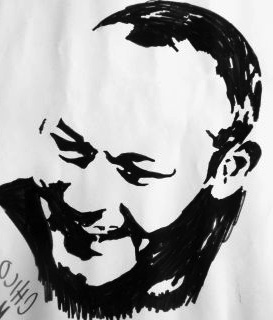
img: Pencil sketch of Jack Scott by a local Turkish artist

If you enjoyed this post, we invite you to subscribe for email delivery of The Displaced Nation. That way, you won’t miss a single issue. SPECIAL OFFER: New subscribers receive a FREE copy of “A Royally Displaced Tea.”

Related posts:
RANDOM NOMAD: Emily Cannell, Housewife & Mother

Born in: Houston, Texas
Passport(s): USA
States/countries lived in: Pennsylvania (Philadelphia): 1989-1990, 1993-1997, 1999-2004, 2006-2010; Louisiana (New Orleans): 1990-1993; Washington (Seattle): 1997-1999; Arizona (Scottsdale): 2004-2006; Japan (Tokyo): 2010-present
Cyber coordinates: Hey from Japan — Notes on Moving (blog)

What made you leave your homeland in the first place?
My husband’s company offered him a job in Japan. We were living near Philadelphia at the time, our fourth “tour of duty” in that city. We jumped at the chance to go somewhere new — location wasn’t that important. Unlike most citizens of the Displaced Nation, I’d never lived overseas. I should point out, though, that in the American vernacular “expat” is often used to describe a person who moves beyond a 50-mile radius from where they were born. By that standard, I’ve long been considered an expat, with Louisiana, Texas, Alabama, Florida, Pennsylvania, Arizona, and Washington state on my resume. At one point, back in the days when I was working as a jack-of-all-trades in the pharmaceuticals industry, I commuted to New Jersey — which in dog years counts as exile in Siberia.

Is anyone else in your immediate family a “displaced” person?
My father is a displaced Canadian living in the US. Does that count? Seriously, he was born in Edmonton, Alberta. After attending medical school, he left to do his residency, internship, and fellowships in the US, which had more cutting-edge techniques and offered more advanced studies than the Canadian system. Eventually, he became too involved in academia to return to Canada, although he still goes back and forth.

Describe the moment when you felt most displaced over the course of your many displacements.
It probably won’t surprise you when I say that the earthquake on March 11th produced one of the worst feelings of displacement — literal as well as psychological — I’ve ever experienced. I was in a small grocery store in Tokyo at the time, trying to read the back of a ready-mix pancake box. The rest of the boxes on the shelves started falling on me, and I could hear glass breaking as wine bottles fell to the floor. The other shoppers, who were mostly Japanese housewives, and I made a beeline for the door. As we reached the street, I saw a man holding on to a street lamp that was swaying back and forth, the top almost touching the ground at my feet. I remember thinking: “These 40-year-old buildings are going to fall on top of me. Where do I go to stay alive?” I headed toward the intersection, stumbling as I went — it was like running on a trampoline with someone else jumping on it. Once I reached the middle of the intersection, I stood there watching and saying nothing while vending machines crashed down, plants fell off balconies, and bikes toppled over. In that moment, I wondered how my biggest worry went from driving car pool on time, to staying alive so I could find my family — alive or dead. (Fortunately, they were all safe.)

Describe the moment when you felt least displaced.
One activity that remains consistent no matter where we live is the kids’ participation in track. Since track meets are an all-day event, my husband and I pitch tent and settle in as though we were on a campsite. This year, just like every other, we hammered in the stakes, opened the cooler, and fed or watered every kid on the track team. And our kids referred to us as “Mr. and Mrs. Noddin’” — not our real names.

You may bring one curiosity you’ve collected from the country where you’ve lived into the Displaced Nation. What’s in your suitcase?
I’ve been toying with the idea of bringing a ninja for their home security value, but once gunpowder was introduced to Japan, the profession went into decline. Besides, the poor man might suffocate if he had to be packed in my suitcase. So instead I’ll carry in these wonderful carved wooden fish I discovered in a Tokyo antique shop. Two fish are looped together with ropes to which big hooks are attached — ideal for hanging pots in the kitchen.

Speaking of the kitchen: you’re invited to prepare one meal based on your travels for other Displaced Nation members. What’s on the menu?
I can make a mean plate of fried green tomatoes, fried okra, collards, corn bread, fried chicken, and black eyed peas. To that I’ll add two dishes that are popular in the Western U.S.: 1) grilled salmon on a plank and 2) fajitas with homemade guacamole. For starters, there will be a choice of Louisiana gumbo (for which I’m famous) and tuna sashimi with ponzu sauce — yes, I’m learning how to “cook” Japanese! Please note that I haven’t chosen to include any of the traditional Amish-country foods despite my many years as a Pennsylvania resident. I can’t make any of the good stuff, and the bad stuff — especially scrapple (pon haus) — is really bad. Residents of The Displaced Nation should not be eating pork scraps if they can avoid it — though I understand your numbers include a dog named Fergus? But dogs are rather spoiled nowadays, and I suspect Fergus may turn his nose up, too.

You may add one word or expression from each of the countries you’ve lived in to the Displaced Nation argot. What words do you loan us?
From the South: Hey. It’s the most common greeting. By adopting this term, you’ll have an easy way of knowing if someone is an outsider. Do they say “hello” or “hi”? Then they’re not from these parts.
From Pennsylvania: Goomba, meaning a male friend. Use it often, and it will detract the kinds of visitors you don’t want.
From the Southwest: Ride ’em hard and put ’em away wet — referring, of course, to how one rides a horse. My husband and I approach parenting in a similar manner.
From Louisiana: Le bon ton roule! Cajun for “Let the good times roll!”
From Washington state: Chinook — a type of salmon. You gotta know your salmon (also true in Japan, of course).
From Japan: So desu ne — meaning “Oh, is that so?” It’s a way of showing that you’re listening when the other person is talking — and I suspect that some Displaced Nation citizens could use some help in that department. I mean, all of us expats want to tell our stories, but how much do we want to listen?

Question: Readers, tell us what you think: should we welcome Emily Cannell to The Displaced Nation and if so, why? (Note: It’s fine to vote “no” as long as you couch your reasoning in terms we all — Emily included — find amusing.)

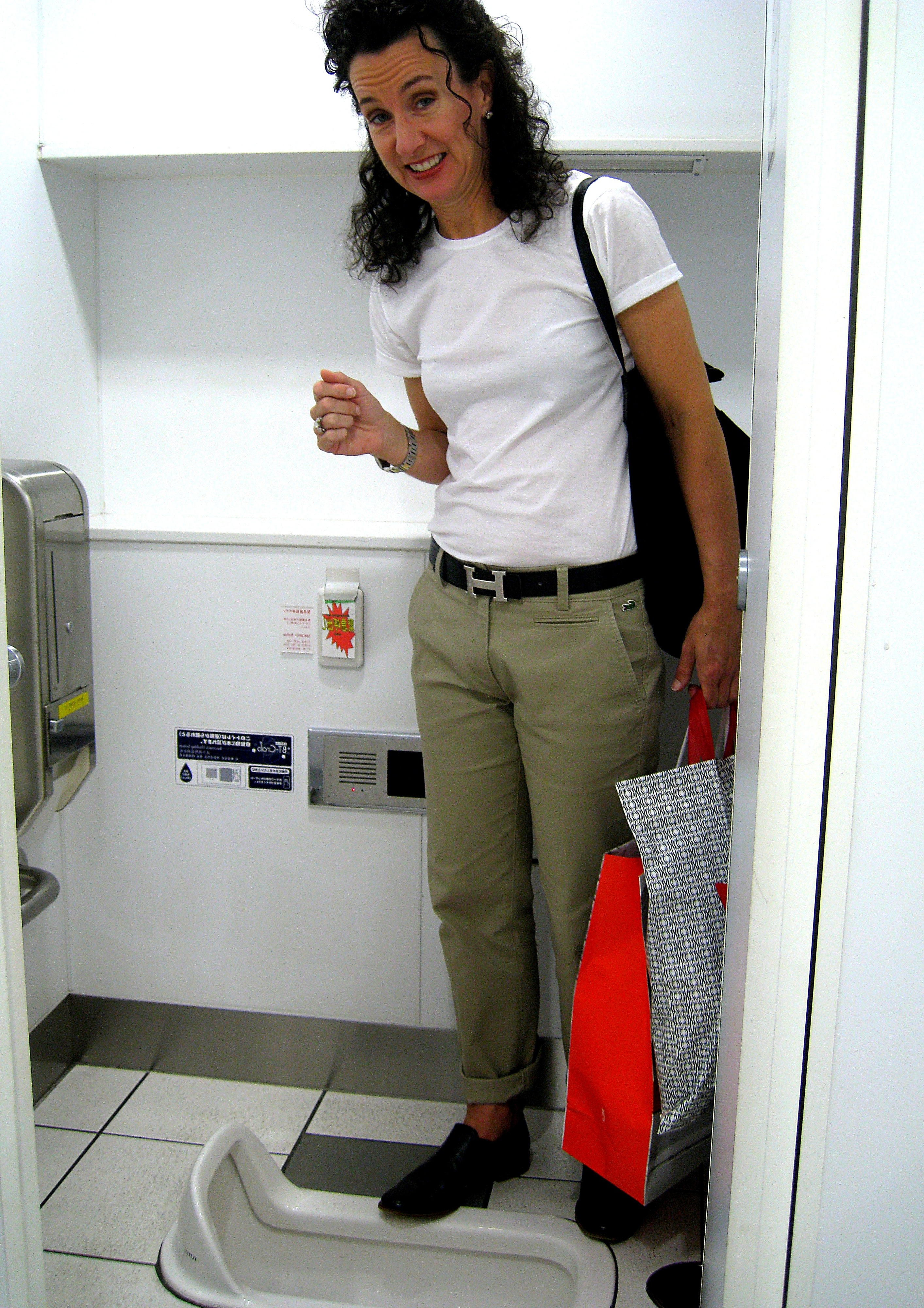
img: Emily Cannell deciding whether to put her carrier bags down and use the facilities in Tokyo’s Harajuku station.

If you enjoyed this post, we invite you to subscribe for email delivery of The Displaced Nation. That way, you won’t miss a single issue. SPECIAL OFFER: New subscribers receive a FREE copy of “A Royally Displaced Tea.”

Related posts:
RANDOM NOMAD: Charlotte Day, High School Student (Sixth Former)

Born in: Sydney, Australia
Passports: Australia, UK and US Green Card
Countries lived in: Australia (Sydney): 1994-2001; United States (New York, New York): 2001-2010; England (Sevenoaks, Kent): 2010-present

What made you leave your homeland in the first place?
My father is Australian and my mother English. They split up when I was two. When I was six, my mother met and married an Australian who had been living in New York for thirty years. I was rather disgruntled about moving to the United States and for two or three years, remained determined never to accept it as “home.” At that time, I was deeply patriotic to my native country — though this sentiment has dissipated since.

Is anyone else in your immediate family a “displaced” person?
My mother’s family, originally from England, has long been displaced. My mother herself was born in Kenya, in 1961. Following the Mau Mau Uprising, her parents were forced to relocate, and my grandfather, presented with a choice between Australia and Canada, chose the warmer of the two countries. My mother spent her childhood bouncing between schools in England and Australia. She eventually grew so fed up with packing and unpacking, she decided to leave school at the age of 16. Her father agreed to the plan provided she spend a final year at the school in Switzerland his own mother had attended as a girl. My mother moved on from Swiss finishing school to work in London, Paris and Sydney. But she appears to have made New York her last port of call. Indeed, we had a fairly solid life in the city until I decided to take myself off to boarding school in England.

Describe the moment when you felt most displaced over the course of your many displacements.
It must have been when I first arrived in New York as a six-year-old. I stepped out of the JFK arrivals terminal into a snowy March night. My stepfather was wearing a leather coat, the interior of his car smelled of leather — and the world outside the car window seemed an undulating stream of black and silver. Though it was the end of 2001’s warm winter, my Australian blood froze beneath my first-ever coat. And their apartment — that was all leather as well. It smelled of musk and cologne. Since that time, I have felt similar pangs of displacement, some of which lasted for considerable periods. But those first few moments in New York stand out as the most acute concentration of “displacedness” I have ever known.

Describe the moment when you felt least displaced.
For the last five or so years in New York, I have felt more at home than I ever did in Sydney. I ascribe this to growing up: at a certain age, one can take possession of a city, know its streets, bridges, tunnels and transportation system. I was too young when I lived in Sydney to reach that kind of comfort level. But when have I felt the most like a New Yorker? Perhaps it was the last time I came home for the holidays, and took the 4 train uptown for the first time in months. At that moment I realized how much this train had been a part of my life — conveying me home from school every day for two years. My old life would always be waiting for me on the subway, ready for me to pick it up again. That’s something only a New Yorker could say!

You may bring one curiosity you’ve collected from each of the countries where you’ve lived into the Displaced Nation. What’s in your suitcase?
From Australia: A miniature wooden wombat figurine — a gift from my grandfather. It conjures memories of a childhood spent beating about the bush (literally) and fishing for yabbies at the dam in the company of audacious dogs who stuck their heads down wombat holes, to no good end.
From New York: A pair of fake Harry Potter glasses. These defined my first six months in New York — I even wore them to my first day of school. I think it is telling that even at the age of six, I was unwilling to give all of my real self to this new home.
From England: My school tie — representative of the alternative universe I seem to have entered. At boarding school, the sense of removal from reality can be disconcerting — especially after having spent a decade in the city I regard as the world’s capital.

You’re invited to prepare one meal based on your travels for other Displaced Nation members. What’s on your menu?
I’d like to make you a Sydney breakfast: scrambled eggs, made with cream, salt and pepper and served on a bed of Turkish toast, with avocado and stewed tomato on the side (is this being greedy?). Our meal will be accompanied by a large “flat white”: what we call perfectly strong, milky coffee without excessive froth. I suggest we consume it overlooking a beach on a Sunday morning. At least, I assume The Displaced Nation has beaches?

You may add one word or expression from each of the countries you’ve lived in to The Displaced Nation argot. What words do you loan us?
From Australia: Daggy. I use this word all the time — and did not realize it was exclusively Australian until I was informed of the etymology. Apparently, it comes from trimming the soiled wool around a sheep’s bottom. Which part of this repugnant whole is actually the “dag,” I do not remember. (No, I’m not a proper Australian!) But as I understand it, “daggy” means sloppy in appearance or badly put together.
From New York: There are so many words, and most are second nature by now. However, I will choose grande-soy-chai-tea-latte because I still shudder to think of myself as the kind of person who can utter such a phrase, at great speed, with great insistence. In fact, I’m still in denial about my love for Starbucks: having known Sydney coffee, my standards should be higher.
From England: Banter. I still do not know the precise meaning of this word, but it seems to encapsulate everything that makes someone my age feel socially acceptable — and, of course, I have no banter whatsoever. I think it means the capacity for combining wit with meaningless conversation. But there are other components, too, which seem to me unfathomable.

Question: Readers, tell us what you think: should we welcome Charlotte Day to The Displaced Nation and if so, why? (Note: It’s fine to vote “no” as long as you couch your reasoning in terms you think we all — Charlotte included — will find amusing.)

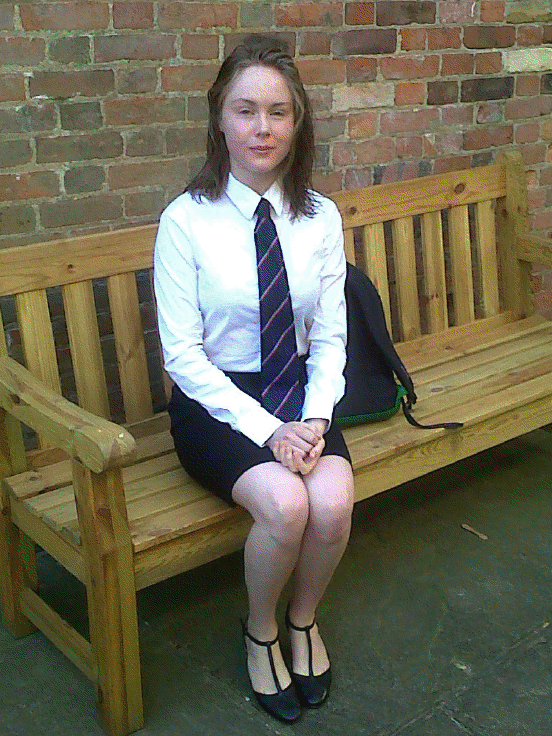
img: Charlotte Day at her boarding school in southeast England

If you enjoyed this post, we invite you to subscribe for email delivery of The Displaced Nation. That way, you won’t miss a single issue. SPECIAL OFFER: New subscribers receive a FREE copy of “A Royally Displaced Tea.”

Related posts:
RANDOM NOMAD: Nerissa Muijs, Business Development Specialist

Born in: Kingston S.E., a wee town in South Australia
Passport: Australian, but will be eligible to become a dual Australian-Dutch citizen this year
Countries lived in: Malaysia (Shah Alam): 1997; New Zealand (Christchurch): 2003; England (Plymouth): 2006-2007; Scotland (Edinburgh): 2007-2008; Netherlands (Almere): 2008-present
Cyberspace coordinates: Adventures in Integration (blog)

What made you leave your homeland in the first place?
I grew up in a small town in South Australia called Lucindale (just 300 people). I don’t feel like I was ever a good fit. I have always had a feeling of wanderlust and being able to go on an AFS exchange to Malaysia when I was 17 added more fuel to the fire, rather than sating my taste for experiencing new places. Once I returned home, I never really settled down again. I was constantly planning my next adventure.

Is anyone else in your immediate family a “displaced” person?
One of my Fabulous Aunts is also perfectly displaced. She lives on a yacht with her partner and two cats. They are currently floating around the Colombian coast, preparing for hurricane season before braving the Panama Canal to head back into the Pacific and beyond.

Describe the moment when you felt most displaced over the course of your many displacements.
Perhaps it was sitting in a restaurant in Malaysia with my wonderful Chinese host family. They had taken me out especially to eat shark’s fin soup. Or it could be the time I was the only Australian sitting in a bar in Christchurch watching the Wallabies beat the All Blacks in the semi finals of the 2003 Rugby World Cup. But seriously, it was probably when I found myself in the immigration offices in Amsterdam realizing I was making a potentially permanent commitment by moving to my husband’s homeland — it was time to grow up!

Describe the moment when you felt least displaced.
On my birthday in 2007. I was living in Edinburgh at the time. My Dutch boyfriend, who is now my husband — we met in Australia when he joined one of my tours to Uluru — was visiting from the Netherlands. A group of my friends took us out to celebrate. In that moment I was happy, I was at home. I find I don’t have the sense of “home” when I return to my hometown in Australia any more. I feel at home with people, not places. Having a cup of tea with my best friend, for example. We’ve done that in at least four countries together and it’s always the same.

You may bring one curiosity you’ve collected from each of the countries where you’ve lived into the Displaced Nation. What’s in your suitcase?
From Malaysia: A batik sarong. I’ve been wearing the same one weekly since 1997, and I love it just as much as the day I paid 5RM for it.
From NZ: The jade pendant I got from Hokitika. It feels cool or warm on my skin and is smooth and comforting.
From England: A cream tea with scones and Cornish clotted cream. A cream tea will always make me think of my elderly great aunts at home and of England.
From Scotland: A “hairy coo” fluffy toy. (Actually, I’d prefer to bring a real-life hairy coo, but I imagine you have strict quarantine rules…)
From Netherlands: Rookworst (a type of smoked sausage, similar to bratwurst).

You’re invited to prepare one meal based on your travels for other Displaced Nation members. What’s on your menu?
Being Australian, I will have to say a barbie. We’ll eat steak, snags [sausages], lamb chops and onions. We’ll tip our hats to Malaysia with some satay sticks. We’ll have bread and my grandma’s hot potato salad. There will be noodle salad that my mum made and sliced beetroot on the side, which I’ll drop on my shirt. Of course, because I live in the Netherlands, we’ll have garlic sauce along with our tomato sauce. And because of the UK influence it will probably be raining, but there will be beer. Lots of beer. And it won’t end for two days. I’ll be up early to cook bacon and eggs again the next morning for the people who just won’t leave. (Dad, I’m talking to you!) It will be fun — care to join me?

You may add one word or expression from each of the countries you’ve lived in to The Displaced Nation argot. What words do you loan us?
From Malaysia: Adding a “la” onto words and sentences: “Okay-la.”
From New Zealand: “Chur bro.” Depending on the context, it can mean “thanks,” “nice,” or “cheers, mate.”
From England: “I’m not trying to be funny, but [insert random passive aggressive insult here].”
From Scotland: Any swear word you can imagine.
From Netherlands: Gezellig, the most important word in the Dutch language. There is no real English translation, though “cosy” is sometimes used. It’s a word people use to describe a pleasant situation. Going out with friends is gezellig. Sitting around having a nice dinner with family is gezellig. Anything that gives you a nice warm fuzzy happy feeling inside can be described as gezellig. Wonderful word.

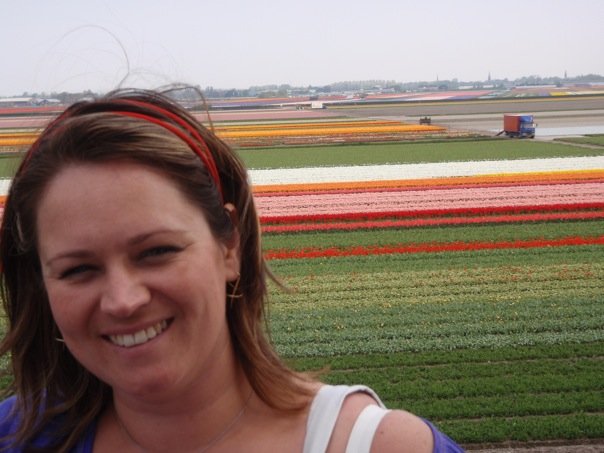
img: Nerissa Muijs at tulip fields outside Lisse, Netherlands.

If you enjoyed this post, we invite you to subscribe for email delivery of The Displaced Nation. That way, you won’t miss a single issue. SPECIAL OFFER: New subscribers receive a FREE copy of “A Royally Displaced Tea.”

Related posts:

RANDOM NOMAD: Kim Andreasson, Management Consultant

Kim AndreassonBorn in: Sweden
Passport: Swedish
Countries lived in: Australia(Sydney): 1988-89; USA (New York and LA): 1996-2010; Vietnam (Saigon): 2010-present
Cyberspace coordinates: DAKA Advisory (business)

What made you leave your homeland in the first place?
My parents decided to travel around the world in 1988-89 and took me along for the ride. We left a snowy Sweden in December and arrived at our first destination, Los Angeles, in 72 degrees and sunshine, staying in the Hyatt on Sunset (now the Andaz West Hollywood). We explored the city’s many attractions including Disneyland and Universal Studios. I was sold and ever since, have considered LA to be the greatest city in the world. At the same time, my curiosity was piqued and I was sold on the idea of leaving something you know well for something different. I have never looked back.

Is anyone else in your immediate family a “displaced” person?
My California-born wife is now displaced as we are living in Saigon. By the way, we first met at a Swedish restaurant in Chinatown in New York City — call it displacement in microcosm.

Describe the moment when you felt the most displaced over the course of your various travels.
I’ve been fortunate to live in the kinds of cities where it’s relatively easy to blend in. But I’ve certainly experienced some memorable cultural contrasts. Soccer (what we Europeans call “football”) is a good example. During the World Cup in 2002 I was in an Irish pub on New York City’s Upper East Side at 4 a.m. watching the match between Sweden and Argentina. I believe I was the only one there watching the game. That was a really strange feeling. By contrast, during the 2009 qualifying match, the time difference was better and there were thousands of of us Swedes watching the games at a bar near Times Square in the middle of the day. This time, I thought I was in Sweden, which was also strange, in its way.

Describe the moment when you felt least displaced.
It’s a curious thing, but it’s when I leave my adopted homeland(s) that I feel especially at home in them. If you ask me my nationality in Vietnam, I’ll always say I’m Swedish. But if you ask me when I’ve just left Vietnam, I’ll say I’m Saigonese (a resident of Saigon). I was in Bangkok recently and couldn’t stop talking about how much I preferred life in Saigon. Likewise, when I lived in the U.S. and went home to Europe, I would feel more American than European during my visit.

You may bring one curiosity you’ve collected from your travels into the Displaced Nation. What’s in your suitcase?
From Australia, a boomerang, for the symbolism of always coming back. From America, a basketball because I enjoy the game and would like to continue playing it. And from Vietnam, a business suit — you can get world-class tailoring here at a very good price.

You’re invited to prepare one meal based on your travels for other Displaced Nation members. What’s on your menu?
Without a doubt, as a Swede, I am known for my guacamole. No, really. I guess because I lived in LA for so long, I came to love Mexican food. I would prepare it for you according to a classic recipe, something like:
1 tablespoon red onion
1 tablespoon cilantro
1 tablespoon jalapeno
1 avocado
2 tablespoons diced tomato
1 pinch of salt

You may add one word or expression from each of the countries you’ve lived in to The Displaced Nation argot. What words do you loan us?
From Australia: “G’day mate” — for its friendliness.
From the USA: “Awesome” — it reminds me of how globalized LA jargon has become, courtesy of Hollywood.
From Vietnam: “Ba” — and if you repeat it three times, you get a beer (333)!

img: Kim Andreasson on his way to Bến Thành Market, in Saigon (Ho Chi Minh City) — that’s if he can navigate the intersection of Le Loi, Ham Nghi, Tran Hung Dao Avenues and Le Lai Street.

If you enjoyed this post, we invite you to subscribe for email delivery of The Displaced Nation. That way, you won’t miss a single issue.

RANDOM NOMAD: Anita McKay, Property Manager

Born in: Indonesia
Passport(s): Indonesian and British Permanent Resident
Countries lived in: Australia (Sydney): 1999-2001; Scotland (Aberdeen): 2007-2009; Western Australia (Perth): 2009-2013
Cyberspace coordinates: Finally Woken (blog)

What made you leave your homeland in the first place?
I left in 2000 to study for a master’s degree in Sydney. I left again in 2007 because my then fiance (now husband) got a job in the UK. Philosophically, I have never really felt at “home” in my own home country of Indonesia. Lots of its values don’t match with mine. From the time I was a child, I felt like an alien and longed to go away.

Is anyone else in your immediate family a “displaced” person?
No. My brother doesn’t like to travel and still lives at home with my parents. But three of my father’s sisters are married to Germans: two still in Germany and one in Indonesia. And I have four cousins living in the Netherlands and Germany.

Describe the moment when you felt the most displaced over the course of your various travels.
It was in Sydney. I was working as a casual staff at an ice cream shop while doing my postgraduate study. It was winter, around 10:00 or 11:00 p.m. I had just closed the shop and was waiting for the bus. It was rainy and cold, and then all of a sudden, there was a hailstorm. I almost cried, I felt so sorry for myself. I was thinking about how if I’d stayed put in Indonesia, I could have been working for a big company and earning a nice salary by then, living with maids and a chauffeur. I wouldn’t have to mop floors or clean windows to pay the rent. In the Indonesian island where I come from, everyone knows me and my family, but here in Sydney, no one cares who I am or whose daughter I am…

Describe the moment when you felt least displaced.
Weirdly, I almost always feel more at home in anywhere but my own country.

You may bring one curiosity you’ve collected from your travels into the Displaced Nation. What’s in your suitcase?
A flash disk containing thousands of photos.

You’re invited to prepare one meal based on your travels for other Displaced Nation members. What’s on your menu?
Chicken tikka masala — it’s originally from Glasgow, most people don’t know that — and cranachan for dessert.

You may add one word or expression you’ve picked up from the countries you’ve lived in to The Displaced Nation argot. What word(s) do you loan us?
“Bollocks.” My hubby, who is Scottish, says it sounds cute when I say it. I try to use a Scottish intonation. He would let me say it whenever I wanted — until I said it in front of his 95-year-old grandmother, and then he explained it was actually a very very rude word.

img: Anita McKay (left) with a good Indonesian friend who was visiting her in Scotland, in front of Balmoral Castle, the only royal residence outside England.

If you enjoyed this post, we invite you to subscribe for email delivery of The Displaced Nation. That way, you won’t miss a single issue.

