The Displaced Nation

A home for international creatives

Tag Archives: Crosscultural marriage

RANDOM NOMAD: Jo Gan, Director of Foreign Teachers, Author & Blogger

Born in: Columbia, Missouri USA
Passport: USA
Country lived in: China (Yuyao City, Zhejiang Province): 2009-11
Cyberspace coordinates: Life Behind the Wall | Thoughts and Experiences of a Black American Woman in China (blog)

What made you leave your homeland in the first place?
I left America due to the economy. I worked in the mortgage field and when the housing market crashed, I needed to find something else to do…or be on unemployment. So I chose to take a job teaching English in China. Two years ago, I got married to a Chinese man whom I met in Yuyao. No, he wasn’t one of my students, as most people assume. I met him in a bar. He came over and asked if he could buy me a beer. We exchanged telephone numbers, and he started calling me every day, three times a day… Six months later, we were married. Yes, it was fast by most people’s standards but I’m not one to waste time — nor is he. It’s been an interesting couple of years.

Is anyone else in your immediate family displaced?
No one else in my family — except a great uncle who lived in Germany most of his life — has ever lived abroad for a long period. Some have been in the military and traveled around, but they always lived on base.

Describe the moment when you felt most displaced.
When I arrived at the airport in Shanghai — it was my very first time coming to China. My luggage had been lost, and I couldn’t communicate with anyone to tell them or report it. I felt frustrated and angry. Then once I got all the paperwork finished, I needed to take a bus to the next city. I couldn’t find the bus station, and no one could understand what I was saying. At that point, I wanted to just get back on the plane and go home.

Describe the moment when you felt least displaced.
When I went home to visit for the first time. Everything looked familiar but felt unfamiliar. I had spent a lot of time missing home, but when I finally got there, it didn’t feel right. In Yuyao, as I walk through the streets or sit in a restaurant and people recognize me, it makes me feel part of the community.

You may bring one curiosity you’ve collected from your adopted country into the Displaced Nation. What’s in your suitcase?
Wow! I guess I’d like to take a Chinese person — if you’d let me in with a companion rather than a suitcase. Yeah…the way they think and perceive things is so different from us Americans. Their ideas of “face,” status, and beauty are so alien to me that I am sometimes at a loss for words to explain it. I can’t get used to the fact that face — losing face, giving face and having face — is of the utmost importance to them. Also, their standard of beauty is so different: very white and very thin. The only way for you to get an accurate view of Chinese culture would be for me to bring a Chinese person along to explain it all to you.

You’re invited to prepare one meal based on your travels for other Displaced Nation members. What’s on the menu?
Since I live in Southeast China, the menu would have to consist of:

  • Steamed seafood. (I apologize in advance for its high salt content.)
  • Chicken feet that have been boiled and then fried.
  • Four kinds of eggs: tea eggs, thousand-year-old eggs, fried eggs with tomato, and boiled salted eggs that have been fertilized (there’s a chicken embryo inside).
  • And of course green vegetables… (By the way, the Chinese call all green leafy veggies “green vegetables.”)

For dessert we would have yangmei  (yumberry fruit), the local favorite.

And for drinks, a choice of:

You may add one word or expression from the country you’re living in to The Displaced Nation argot. What will you loan us?
I will choose Ni chifan le ma? (Have you eaten yet?). Everywhere you go in China, people greet you with Ni chifan le ma? Food is just so important to this culture. Weddings, birthdays, funerals — all of these events involve banquets lasting several hours. Everything tends to be associated with food, and there are many food idioms.

It’s Pocahontas month at The Displaced Nation, and we’re focusing on cross-cultural communications (or the lack). What would you say is the top challenge of an interracial, intercultural marriage — and can you recommend any coping techniques?
First I will say that the most challenging part of being in an intercultural marriage is the people around you. Usually, other people are more concerned about your marriage situation than you are, especially if you live in China. They tend to spend a lot of time telling you what is wrong, or can go wrong, with your marriage. They question the reasons you got married. For example, Chinese people will ask my husband if he married me to get a green card. He tells them: “We live in China, not America. How would a green card help me here?”

As for our personal relationship, we have learned to accept each other’s differences. If something one of us does bothers the other person, we compromise. For example, Chinese men have the tendency to put pork bones, chicken bones, sunflower seed shells, and fish bones directly on the dinner table when they are eating; I find this disgusting. So now we put a bowl beside my husband’s plate for him to discard these things. If you really want to make a relationship to work, any relationship, it takes respect, consideration, and a willingness to compromise.

QUESTION: Readers — yay or nay for letting Jo Gan into The Displaced Nation? Tell us your reasons. (Note: It’s fine to vote “nay” as long as you couch your reasoning in terms we all — including Jo — find amusing.)

img: Jo Gan hamming it up in the classroom by trying on her student’s sunglasses, taken by the student on her iPhone.

STAY TUNED for tomorrow’s installment from our displaced fictional heroine, Libby, when the Patrick family is held to ransom by an army of packing crates from their new home.

If you enjoyed this post, we invite you to subscribe for email delivery of The Displaced Nation. That way, you won’t miss a single issue. SPECIAL OFFER: New subscribers receive a FREE copy of “A Royally Displaced Tea.”

Related posts:

Cross-cultural marriage? 4 good reasons not to rush into it…

painting of Pocahontas and John Rolfe, by J.W. GlassAs announced last week, The Displaced Nation is honoring Pocahontas this month for the role she played in advancing communications between two very different cultures.

This week, we take a closer look at Pocahontas’s decision to marry the Jamestown settler John Rolfe.

Did the Rolfes have an easy time of it in their married life? History doesn’t tell us, but as the veteran of two cross-cultural marriages myself (first to a Brit, now to a Japanese), I tend to think not.

Sure, the union had its advantages for both parties. We know for a fact that two years after marrying Rolfe, Pocahontas was invited to voyage to England with her husband, where she met many prominent people, including King James I.

We know also that Pocahontas’s father, King Powhatan, gave the newlyweds property just across the James River from Jamestown, spanning thousands of acres.

But being in the mood to play devil’s advocate, today I will make the case for why Pocahontas and Rolfe should have hesitated before tying the knot.

Here are my top four reasons for cautioning against cross-cultural marriages like theirs:

1. Marriage across cultures is rarely seen as one of equals.

Rolfe felt he had to defend his decision to marry Pocahontas to his fellow colonists. Here’s what he wrote in a letter addressed to Sir Thomas Dale:

Nor was I ignorant of the heavie displeasure which almightie God conceived against the sonnes of Levie and Israel for marrying strange wives, nor of the inconveniences which may thereby arise,…which made me looke about warily and with good circumspection, into the grounds…which thus should provoke me to be in love with one whose education hath bin rude, her manners barbarous, her generation accursed, and so discrepant in all nurtriture frome my self.

After much soul searching, Rolfe decided he could marry Pocahontas despite her crude education, barbarous manners and different colored skin — as long as she converted to Christianity.

In the above portrait of the couple, by J.W. Glass, Rolfe is instructing Pocahontas in Christian doctrines.

And now let’s turn to Pocahontas. Did she see Rolfe as her equal, given that he was a mere tobacco farmer, and a foreign invader, and she was the daughter of the most powerful chief in the region?

According to historical records, the news of the liaison was well received by the Powhatan tribes, helping to create a climate of peace toward the Jamestown colonists for several years.

I find it instructive to compare Pocahontas with Cleopatra on this point.  Faced with the rising tide of Roman expansionism, Cleopatra seduced Julius Caesar and Marc Anthony to protect her country from being swallowed up. Likewise, Pocahontas may have seen it as her duty to marry John Rolfe, as it meant she could continue working on behalf of her people. (In that sense, Disney may have been right about Pocahontas’s preference for Captain John Smith — but only because he had more power than Rolfe.)

2. The fantasy quotient in such marriages can lead to huge disappointments.

In Glass’s portrait of the couple, John Rolfe gazes down lovingly into the eyes of a young woman with long, straight, dark hair. He seems to be thinking of Pocahontas as his trophy Indian princess — how exotic she is compared to his English wife (who died on the boat coming over).

But what if, at that very moment, Pocahontas is calculating the advantages that could accrue to her and her tribe from their liaison — including representing her father’s tribes to the powers-that-be in London and arguing against their displacement.

Would it crush Rolfe to learn the practical agenda she had in mind for their marriage?

At the same time, though, the painting shows Pocahontas gazing upwards at her husband-to-be. A young girl, she must have harbored a few fantasies as well. Maybe she found Rolfe much more refined than the Indian men she had known — she’d already had an Algonquian husband by then.

In that case, how disappointed she must have felt when, after the wedding, she discovered his habit of chewing and spitting tobacco, overheard him swearing like the sailor he once was, and noticed his tendency to stomp around the place. Why can’t he be more like an Algonquian man and walk as quietly as a leopard?

3. Sons tend to turn into their fathers, and daughters into their mothers — but how can you possibly anticipate this if you can’t read the culture?

Having been married to a Brit myself, I find it amusing to pretend that Pocahontas met Rolfe’s parents before deciding whether to marry him. In my imagination, she, like me, fails to pick up on all the important cues — things like the necessity of being able to produce a Sunday dinner of roasted meat, potatoes, and two veggies, while her husband rests up from his weekly labors. (Rolfe, by the way, is credited with the first successful cultivation of tobacco from the colony of Virginia.)

Likewise, had Rolfe been able to meet Pocahontas’s mother, I imagine he would have thought of her as a kindly Indian squaw — having no idea of her ability to control, coerce and manipulate others to her will.

4. In times of strife, the last thing you want is a cross-cultural misunderstanding.

We marry for better or for worse, but during the worst of times, most of us could do without a partner who is culturally clueless.

For example, if Pocahontas received word that one of her close relations had died — how would she feel if Rolfe resorted to trying to cheer her up with sarcastic British humor: “Well, at least that’s one less Injun for us to worry about!”

By the same token, if Rolfe’s tobacco crop failed due to drought, he may not have felt like dancing with Pocahontas, despite her insistence it would bring on the rains.

* * *

Most of the above, of course, is pure conjecture, but it is also based very closely on my own observations. I’ve witnessed quite a few romances in the Rolfe-Pocahontas mould — particularly while living in Japan. And I’ve seen quite a few of them turn sour.

I’ve also experienced firsthand how devastating it can be if one’s spouse can’t communicate properly when the going gets rough and you don’t have the energy to make allowances for the fact that they come from a different culture.

In my experience, the most important quality one needs to have for a successful cross-cultural marriage is that of being a glutton for punishment — a quality I just so happen to have in spades.

Not wanting an easy life — that’s what it all boils down to. And, unless you have a calling for handling complication piled on complication, then I would suggest choosing a mate who lived in the same neighborhood as you growing up — preferably next door.

Question: Do you agree that cross-cultural marriages are unusually challenging?

img: Detail of “John Rolfe and Pocahontas,” by James William Glass (early 1850s), courtesy Wikipedia (public domain)

STAY TUNED for tomorrow’s RANDOM NOMAD interview, in which our special guest will answer a Pocahontas-related question.

If you enjoyed this post, we invite you to subscribe for email delivery of The Displaced Nation. That way, you won’t miss a single issue. SPECIAL OFFER: New subscribers receive a FREE copy of “A Royally Displaced Tea.”
Related posts:

RANDOM NOMAD: Simon Wheeler, Steel Automotives Project Leader & Former Cricketer

Born in: Aylesbury, Bucks, England
Passport: English (never ever say British!)
Countries lived in: Australia (Adelaide): 1996-98; California (Newport Beach): 2006-09; Slovakia (Plavé Vozokany): 2006-present
Cyberspace coordinates: Rambling Thoughts of Moon | Englishman’s travelling thoughts from England, California and now Slovakia, Plavé Vozokany… Ahoj !! (blog)

What made you leave your homeland in the first place?
My initial travels to Australia came through boredom of work. Having worked in a large pharmaceutical company from 17, at 24 I realized that I needed to have some new adventures. I am a firm believer that if you don’t like your current situation, change it. When I was asked to go play cricket at Grade A level for the Fulham Cricket Club in Adelaide, I packed my bags and left. Actually, I got cold feet about two weeks before I was due to leave. But then a close friend was suddenly struck ill on a Friday, and sadly died two days later. That was the kick I needed.

Is anyone else in your immediate family displaced?
My sister is now a Canadian citizen living in Vancouver. She has been away from England for over 15 years.

Describe the moment when you felt most displaced over the course of your many displacements.
Can I have two? The first occurred just after I’d gotten married to my gorgeous wife on top of Grouse Mountain in Vancouver. After the wedding, she had to go back to her job in California, while I continued waiting in Vancouver for my visa to be approved. In those three months of waiting, the uncertainty of not knowing if I would be allowed to join her made for very stressful times. We could simply have flown back to England, where a job was being held for me in the City. That would have been so easy, but that said, we have never chosen the easy option.

The other time occurred much earlier: May 24th, 1997. A very precise date, but I remember it so well. I was on the road from Melbourne to Sydney, all on my own, on my birthday, and not one person said “Happy Birthday” or even knew it was my special day.

Describe the moment when you felt least displaced.
I’d have to say right now. We moved to my wife’s homeland two years ago. The culture shock, combined my lack of language skills, was daunting at first. The people, especially her family, have been incredible, but finding a life was very tough. Since we moved here, we have both found jobs in the same company; had our first child, the adorable Matej; and are about two months away from moving into the cottage we are renovating in the village next door to Plavé Vozokany (we’ve been living here with my wife’s parents since our arrival). So, right now, I am on the verge of having all I have ever wanted. To settle into a new country takes time, a lot of time, especially one that is so different to your homeland. I still have some time to go, but with the growing family, a supportive wife, a good job, and soon my dream house, I am ticking all the right boxes.

You may bring one curiosity you’ve collected from each of the countries where you’ve lived into the Displaced Nation. What’s in your suitcase?
From England: My St George’s flag — not because I wish to be associated with rowdy football supporters but because it’s a symbol of my country that I’m very proud of.
From Australia: My Ugg boots from the open-air market in Port Adelaide. I have them on right now!
From California: My photographs from the incredible national and state parks in the Western United States: Grand Canyon, Death Valley, Zion, Bryce, Joshua Tree, Big Sur… I could go on…
From Slovakia: A bottle of homemade Slivovica, a plum brandy strong enough to blow your socks off!

You’re invited to prepare one meal based on your travels for other Displaced Nation members. What’s on the menu?
Whoa, that’s tough… But let me try. To start, we’d have fresh prawns and seafood from Australia. As my main, I’d offer my Mum’s Christmas dinner: turkey, sausages and bacon, Brussels sprouts, veggies galore, roast potatoes, cranberries, stuffing… And if there’s still room, I’d throw in some sushi from Masa Sushi, a tiny, simple, dirty-looking place off 19th Street and Habour in Costa Mesa, California — the host/chef really knows what he’s doing. For dessert, we’d have fresh, homemade cream cakes from my mother-in-law here in Slovakia. It would all be washed down with an Australian white, a pint of Coopers (Southern Australian beer), and a couple of shots of Slivovica.

You may add one word or expression from each of the countries you’ve lived in to The Displaced Nation argot. What words do you loan us?
From Australia: Beauty (said in a heavy Aussie accent). It’s used all the time — but most especially on the cricket fields, after a player hits a good shot or the bowler gets a wicket.
From England“In England’s green and pleasant land…” We sang “Jerusulem” at my wedding and on many drunken occasions. It always takes me home…
From California: Awesome — but I’d advise that you restrict the usage to things that are truly awesome; otherwise, it loses its meaning. That pair of shoes is AWESOME; that TV show is AWESOME; You are AWESOME — no! The Grand Canyon is awesome — yes!

It’s Pocahontas month at The Displaced Nation, and we’re focusing on cross-cultural communications (or the lack). By living in your wife’s country, do you find that you’re relying on her to serve as your “interpreter” for Slovakian language and culture? Does this place a special stress on the marriage, and if so, how do the two of you cope with it?
Yes, it definitely does. When you go away on holiday and do, say, exploratory grocery shopping, it’s all a bit of fun trying to cope, but when you actually move to the country it’s totally different. So many things to sort out: banks, mortgages, identity cards, driving license — the list is endless. And she has to do all of this. Even if I have to make a trip to the doctor’s, she has to come. When you are sitting there having two people discuss your health, and you cannot understand what they’re saying, it’s very stressful. As I mentioned earlier, we are renovating an old Slovak cottage. But to communicate with all the different workers and tradesmen, again, she has to do it all… You can imagine what a workload she carries for this project, and the uselessness I feel in not being able to help her.

Our relationship, like so many others, works because one of us takes the lead, and in our case, that happens to be her. Imagine Monica Geller from Friends — well, that is my wife. She likes to be in control. Even when we were living in America, she was in charge. So for us, with some blips, it does work. But whenever I want to do things — relieve her of some of her workload and stress — it’s a struggle. My Slovak is improving, but it is not good enough to cope with these kinds of demands. It’s a very tough language, and at 40, I am a poor student.

QUESTION: Readers — yay or nay for letting Simon Wheeler into The Displaced Nation? Tell us your reasons. (Note: It’s fine to vote “nay” as long as you couch your reasoning in terms we all — including Simon — find amusing.)

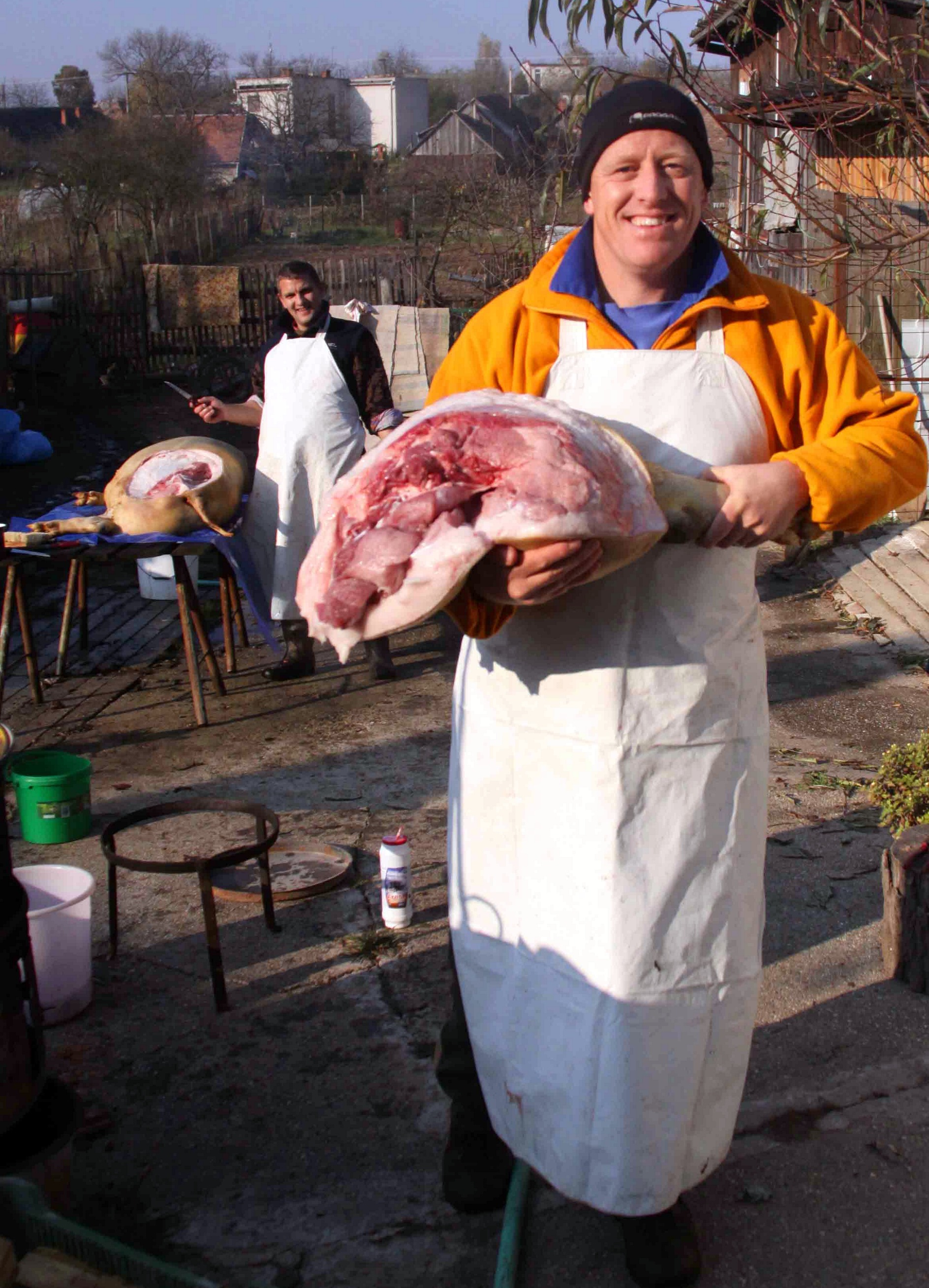
img: Simon participating in the traditional slaughter of pigs that occurs in his Slovakian village every year. His comment: “Most village families rear a couple of pigs every year for this purpose. The custom was new to me, and I didn’t like the idea — never ever thought I’d be doing this kind of thing! But it does mean you can fill your freezer with good quality, home-bred meat and sausages, and I’ve gotten used to it.”

STAY TUNED for tomorrow’s installment from our displaced fictional heroine, Libby, who encounters her very first 4th of July celebrations.

If you enjoyed this post, we invite you to subscribe for email delivery of The Displaced Nation. That way, you won’t miss a single issue. SPECIAL OFFER: New subscribers receive a FREE copy of “A Royally Displaced Tea.”

Related posts:

5 proverbs on cross-cultural relations, by Pocahontas

June was Alice-in-Wonderland month at The Displaced Nation, when we discovered that Alice’s “curiouser and curiouser” adventures have something akin to the situations expats and travelers often find themselves in.

But how do local people feel when global nomads land — kerplunk! — on their soil? During July, we’ll be looking at cross-cultural communications (or the lack) with the help of the legendary Pocahontas, one of the world’s foremost experts on fostering intercultural understanding.

As everyone knows — even kids, thanks to Disney — Pocahontas was the human bridge between foreign and local cultures. She helped to connect two groups that were about as different, and as opposed in their aims, as could be imagined: the Algonquin Indians of the Tidewater region of what is now Virginia, led by her father, Chief Powhatan; and the English settlers who’d been sent by the Virginia Company of London to found Jamestown, led by John Smith.

Earlier today, The Displaced Nation performed a special ceremony to invoke the spirit of Pocahontas. She has paid us a short visit, during which she had the following to say:

Chama Wingapo. That’s “Welcome, friends” in the language of my tribe, the Powhatan. “Powhatan” by the way means waterfall.

As you may know from your studies of history, ours was an Algonquian Indian tribe that lived in the Tidewater region of what I understand is now known as Virginia. My father was their king.

Chama Wingapo. I must say, it’s a little strange to speak these words of welcome aloud. Did you know that no one has spoken our language for more than two centuries? It became extinct as we Indians declined in number, dispersed and lost our cultural identity.

Still, I know you’re not interested in the topic of our displacement. It’s just that it was on my mind when I saw you’d just been discussing what some of our descendants irreverently call White Independence Day.

But to return to my mission for The Displaced Nation: I’ve come back to give you some ideas on what building bridges between so-called “local” people and their foreign visitors entails.

Allow me to offer these five proverbs, which represent the distillation of my own experiences:

1. Not everyone you meet in a foreign land will be over the umpsquoth (moon) about your presence in their territory.

I understand you’ve all chosen to travel overseas for your own self-edification, not on behalf of your government’s colonization campaign. And I applaud you for that.

But some of the people you’ll encounter on your travels don’t give two feathers what brought you there. They will always see you as an outsider — not so much displaced but out of place. Nothing would make them happier than if you returned to your own tribe and ceased taking up space in theirs.

Still others will tolerate your presence — but only as long as they can profit from you in some way.

My people, for instance, offered John Smith land for his colonists to live on, in addition to providing the settlers with food — bread, corn and fish — all for an opportunity to trade with them.

Ideally, you will also at some point find someone like me who is interested in forging a genuine friendship across cultures and (where applicable) races. Someone willing to take the time to serve as the intermediary, go-between, guide, translator — I’ve been told that our brethren on the Japan Islands have their own unique term, iki jibiki (walking dictionary) — between you and local residents, with enough skill to ward off the impact of any poison arrows sent your way.

(While on this topic, I have a slight confession to make. I didn’t really save Captain John Smith’s life. Goodness, I was only ten years old at the time we met. What’s more, we were welcoming him into our tribe during the ceremony when I allegedly performed this feat. Talk about cross-cultural communications gone badly wrong! His life was never endangered…)

2. In adapting to another tribe’s ways, you will constantly struggle between respect and disrespect.

Our esteemed descendant Chief Roy Crazy Horse of the Powhatan Renape Nation said the Disney movie of my early life “distorts history beyond recognition.”

While I largely agree with him, there’s one thing that this film got exactly right. I can’t tell you how many times I had the following exchange, not just with Captain Smith but with many of the other palefaces:

JOHN SMITH: We’ve improved the lives of savages all over the world.
POCAHONTAS: Savages?
JOHN SMITH: Uh, not that you’re a savage.
POCAHONTAS: Just my people!

Of course he (and the others) saw me as a savage, too — I was a heathen, after all!

But just like the wind that can blow hot or cold, this strong aversion to our people would sometimes change into something approaching deep love. In particular, the English respected us for respecting nature.

On this point, the Disney movie went a little too far, portraying me as the original — Aboriginal — tree hugger:

JOHN: Pocahontas, that tree is talking to me!
POCAHONTAS: Then you should talk back!
JOHN: What do you say to a tree?
POCAHONTAS: Anything you want!

Still, there is a grain of truth in that exchange. Our animism was something our foreign friends envied, and hoped they could pick up by association.

3. Romantic love for a person of another culture often has tangled roots.

I should know as I was married twice — once to a fellow Algonquian, and the second time to an English settler by the name of John Rolfe. (No, I was not in love with John Smith — another Disney distortion. I loved him as a father, though.)

Did you know that John Rolfe fretted for several weeks over whether to marry me because I wasn’t a Christian? In the end, I converted and gave myself a Christian name, Rebecca.

At the same time, though, John worshiped the ground I walked on. I was his exotic Indian princess. But sometimes I thought he was more in love with the idea of me as a Noble Savage (rather literally!) than with who I was as a person.

4. When a man or woman moves away from his tribe, opportunities await.

I offer up this proverb for any locals who are considering marriages to foreign visitors.

Thanks to my marriage to John Rolfe, I was able to expand my world far beyond its original boundaries. In the spring of 1616, I, Rebecca Rolfe, took a sea voyage to London as a guest of the Virginia Company. They presented me in all my finery to King James I and the best of London society.

But what is life? The flash of a firefly in the night. I fell ill and died just as we set out on the voyage home. In my memory, the English erected a life-size bronze statue of me at St George’s Church — which you can visit to this day.

Not bad for someone who trod upon this earth a mere 22 years… As I understand it, most people must wait many many umpsquoth before being appointed as the ambassador for their nation.

5. Be ever-watchful of the child whom others may judge harshly because of a mixed heritage.

I had just one child, Thomas Rolfe, who was born to me and John just before we left for England. It’s to my regret that I didn’t live long enough to shield him from the inevitable prejudices shown against Indian-white “mixed-bloods.”

That said, he appears to have thrived, even without my help. Among those who claim descent from Thomas today are several of Virginia’s First Families and the wife of one of your presidents, Nancy Reagan — a strong woman if there ever was one.

The limb doesn’t fall far from the tree!

+ + +

Cheskchamay (all friends), I wish you well on your travels, and I bid you, go in e-wee-ne-tu (peace).

There is one Native American precept that lies beneath all five of these proverbs:

“Do not judge your neighbor until you walk two moons in his moccasins.”

If you remember only this from our encounter, your journey will be a fruitful one.

* * *

Thank you, Pocahontas!

Question: Readers, do you have any responses to Pocahontas’s proverbs — anything to add from your own experiences?

STAY TUNED for tomorrow’s RANDOM NOMAD interview, in which our special guest will answer a Pocahontas-related question.

If you enjoyed this post, we invite you to subscribe for email delivery of The Displaced Nation. That way, you won’t miss a single issue. SPECIAL OFFER: New subscribers receive a FREE copy of “A Royally Displaced Tea.”

